

IEC 62435-3:2020
(Main)Electronic components - Long-term storage of electronic semiconductor devices - Part 3: Data
General Information
- Abstract
IEC 62435-3:2020 describes the aspects of data storage that are necessary for successful use of electronic components being stored after long periods while maintaining traceability or chain of custody. It defines what sort of data needs to be stored alongside the components or dies and the best way to do so in order to avoid losing data during the storage period. As defined in this document, long-term storage refers to a duration that can be more than twelve months for products scheduled for long duration storage. Philosophy, good working practice, and general means to facilitate the successful long-term-storage of electronic components are also addressed.
NOTE: In IEC 62435 (all parts), the term "components" is used interchangeably with dice, wafers, passives and packaged devices.
- Status
- Published
- Publication Date
- 17-Feb-2020
- Technical Committee
- TC 47 - Semiconductor devices
- Drafting Committee
- WG 3 - TC 47/WG 3
- Current Stage
- PPUB - Publication issued
- Start Date
- 18-Feb-2020
- Completion Date
- 28-Feb-2020
Overview
IEC 62435-3:2020 is an international standard published by the International Electrotechnical Commission (IEC) focusing on the long-term storage of electronic semiconductor devices. Specifically, Part 3 of this series addresses the crucial aspect of data storage related to stored electronic components, including dice, wafers, passives, and packaged devices. Long-term storage (LTS) in this context refers to any storage duration exceeding 12 months, commonly applied to components intended for extended service life in industries such as aerospace, railway, and energy sectors.
The standard aims to maintain traceability and chain of custody through proper management of data associated with electronic components during prolonged storage periods. Ensuring that essential information is preserved and accessible is vital to avoiding component degradation risks and supporting effective obsolescence management.
Key Topics
Data Storage Requirements
IEC 62435-3 defines the types of data that must accompany semiconductor devices in storage and the optimal methods to safeguard this information over the long term. Data integrity is critical for maintaining reliable traceability.Traceability and Chain of Custody
The standard emphasizes maintaining detailed records that track component origin, storage conditions, and handling history to support quality assurance and regulatory compliance.Data Storage Media & Failures
It outlines concerns related to both paper and electronic data storage, addressing potential risks such as media degradation, reader incompatibility, or format obsolescence during extended storage periods.Best Practices for Data Management
The document recommends sound working practices, including data verification through periodic checks, suitable software and data formats, as well as strategies to prevent data loss.Component Description Data Packages
Providing comprehensive and structured data packages along with the stored devices ensures that all necessary technical, environmental, and identification details are maintained.
Applications
IEC 62435-3:2020 is essential for organizations engaged in:
Long-Term Component Preservation
Companies that store electronic components for future production runs, warranty replacements, or repair spare parts benefit from this standard’s guidance to avoid degradation of both physical components and their associated data.Obsolescence Management
The standard supports proactive strategies for managing component obsolescence by facilitating preventive storage with traceable data records, especially important for systems expected to operate for decades.Quality and Compliance Assurance
Maintaining documented traceability and chain of custody supports regulatory compliance and risk management in critical sectors such as aerospace, railways, defense, and energy.Data Integrity in Supply Chains
Ensuring reliable data storage and accessibility across complex supply chains helps prevent loss of components’ identity and history during extended storage intervals.
Related Standards
IEC 62435-3:2020 is part of the broader IEC 62435 series that addresses long-term storage of electronic semiconductor devices:
IEC 62435-1: General Requirements
Foundational principles for long-term electronic components storage.IEC 62435-2: Deterioration Mechanisms
Examines factors affecting component integrity over time.IEC 62435-4: Storage Conditions
Guidelines for environmental conditions suitable for long-term storage.IEC 62435-5 to 9: Specific Device Types
Covers storage requirements tailored to different component types like die and wafers, packaged devices, MEMS, passive devices, and special cases.
Additionally, moisture-sensitive device handling covered under IEC TR 62258-3 complements this part by addressing storage concerns for shorter durations.
Keywords: IEC 62435-3, long-term storage, electronic components, semiconductor devices, data storage, traceability, chain of custody, obsolescence management, electronic component storage standards, data integrity, storage media failure, electronic device preservation, quality assurance, aerospace electronics, railway electronics, energy sector electronics.
Frequently Asked Questions
IEC 62435-3:2020 is a standard published by the International Electrotechnical Commission (IEC). Its full title is "Electronic components - Long-term storage of electronic semiconductor devices - Part 3: Data". This standard covers: IEC 62435-3:2020 describes the aspects of data storage that are necessary for successful use of electronic components being stored after long periods while maintaining traceability or chain of custody. It defines what sort of data needs to be stored alongside the components or dies and the best way to do so in order to avoid losing data during the storage period. As defined in this document, long-term storage refers to a duration that can be more than twelve months for products scheduled for long duration storage. Philosophy, good working practice, and general means to facilitate the successful long-term-storage of electronic components are also addressed. NOTE: In IEC 62435 (all parts), the term "components" is used interchangeably with dice, wafers, passives and packaged devices.
IEC 62435-3:2020 describes the aspects of data storage that are necessary for successful use of electronic components being stored after long periods while maintaining traceability or chain of custody. It defines what sort of data needs to be stored alongside the components or dies and the best way to do so in order to avoid losing data during the storage period. As defined in this document, long-term storage refers to a duration that can be more than twelve months for products scheduled for long duration storage. Philosophy, good working practice, and general means to facilitate the successful long-term-storage of electronic components are also addressed. NOTE: In IEC 62435 (all parts), the term "components" is used interchangeably with dice, wafers, passives and packaged devices.
IEC 62435-3:2020 is classified under the following ICS (International Classification for Standards) categories: 31.020 - Electronic components in general. The ICS classification helps identify the subject area and facilitates finding related standards.
IEC 62435-3:2020 is available in PDF format for immediate download after purchase. The document can be added to your cart and obtained through the secure checkout process. Digital delivery ensures instant access to the complete standard document.
Standards Content (Sample)
IEC 62435-3 ®
Edition 1.0 2020-02
INTERNATIONAL
STANDARD
NORME
INTERNATIONALE
Electronic components – Long-term storage of electronic semiconductor
devices –
Part 3: Data
Composants électroniques – Stockage de longue durée des dispositifs
électroniques à semiconducteurs –
Partie 3: Données
All rights reserved. Unless otherwise specified, no part of this publication may be reproduced or utilized in any form
or by any means, electronic or mechanical, including photocopying and microfilm, without permission in writing from
either IEC or IEC's member National Committee in the country of the requester. If you have any questions about IEC
copyright or have an enquiry about obtaining additional rights to this publication, please contact the address below or
your local IEC member National Committee for further information.
Droits de reproduction réservés. Sauf indication contraire, aucune partie de cette publication ne peut être reproduite
ni utilisée sous quelque forme que ce soit et par aucun procédé, électronique ou mécanique, y compris la photocopie
et les microfilms, sans l'accord écrit de l'IEC ou du Comité national de l'IEC du pays du demandeur. Si vous avez des
questions sur le copyright de l'IEC ou si vous désirez obtenir des droits supplémentaires sur cette publication, utilisez
les coordonnées ci-après ou contactez le Comité national de l'IEC de votre pays de résidence.
IEC Central Office Tel.: +41 22 919 02 11
3, rue de Varembé info@iec.ch
CH-1211 Geneva 20 www.iec.ch
Switzerland
About the IEC
The International Electrotechnical Commission (IEC) is the leading global organization that prepares and publishes
International Standards for all electrical, electronic and related technologies.
About IEC publications
The technical content of IEC publications is kept under constant review by the IEC. Please make sure that you have the
latest edition, a corrigendum or an amendment might have been published.
IEC publications search - webstore.iec.ch/advsearchform Electropedia - www.electropedia.org
The advanced search enables to find IEC publications by a The world's leading online dictionary on electrotechnology,
variety of criteria (reference number, text, technical containing more than 22 000 terminological entries in English
committee,…). It also gives information on projects, replaced and French, with equivalent terms in 16 additional languages.
and withdrawn publications. Also known as the International Electrotechnical Vocabulary
(IEV) online.
IEC Just Published - webstore.iec.ch/justpublished
Stay up to date on all new IEC publications. Just Published IEC Glossary - std.iec.ch/glossary
details all new publications released. Available online and 67 000 electrotechnical terminology entries in English and
once a month by email. French extracted from the Terms and Definitions clause of
IEC publications issued since 2002. Some entries have been
IEC Customer Service Centre - webstore.iec.ch/csc collected from earlier publications of IEC TC 37, 77, 86 and
If you wish to give us your feedback on this publication or CISPR.
need further assistance, please contact the Customer Service
Centre: sales@iec.ch.
A propos de l'IEC
La Commission Electrotechnique Internationale (IEC) est la première organisation mondiale qui élabore et publie des
Normes internationales pour tout ce qui a trait à l'électricité, à l'électronique et aux technologies apparentées.
A propos des publications IEC
Le contenu technique des publications IEC est constamment revu. Veuillez vous assurer que vous possédez l’édition la
plus récente, un corrigendum ou amendement peut avoir été publié.
Recherche de publications IEC - Electropedia - www.electropedia.org
webstore.iec.ch/advsearchform Le premier dictionnaire d'électrotechnologie en ligne au
La recherche avancée permet de trouver des publications IEC monde, avec plus de 22 000 articles terminologiques en
en utilisant différents critères (numéro de référence, texte, anglais et en français, ainsi que les termes équivalents dans
comité d’études,…). Elle donne aussi des informations sur les 16 langues additionnelles. Egalement appelé Vocabulaire
projets et les publications remplacées ou retirées. Electrotechnique International (IEV) en ligne.
IEC Just Published - webstore.iec.ch/justpublished Glossaire IEC - std.iec.ch/glossary
Restez informé sur les nouvelles publications IEC. Just 67 000 entrées terminologiques électrotechniques, en anglais
Published détaille les nouvelles publications parues. et en français, extraites des articles Termes et Définitions des
Disponible en ligne et une fois par mois par email. publications IEC parues depuis 2002. Plus certaines entrées
antérieures extraites des publications des CE 37, 77, 86 et
Service Clients - webstore.iec.ch/csc CISPR de l'IEC.
Si vous désirez nous donner des commentaires sur cette
publication ou si vous avez des questions contactez-nous:
sales@iec.ch.
IEC 62435-3 ®
Edition 1.0 2020-02
INTERNATIONAL
STANDARD
NORME
INTERNATIONALE
Electronic components – Long-term storage of electronic semiconductor
devices –
Part 3: Data
Composants électroniques – Stockage de longue durée des dispositifs
électroniques à semiconducteurs –
Partie 3: Données
INTERNATIONAL
ELECTROTECHNICAL
COMMISSION
COMMISSION
ELECTROTECHNIQUE
INTERNATIONALE
ICS 31.020 ISBN 978-2-8322-7889-5
– 2 – IEC 62435-3:2020 © IEC 2020
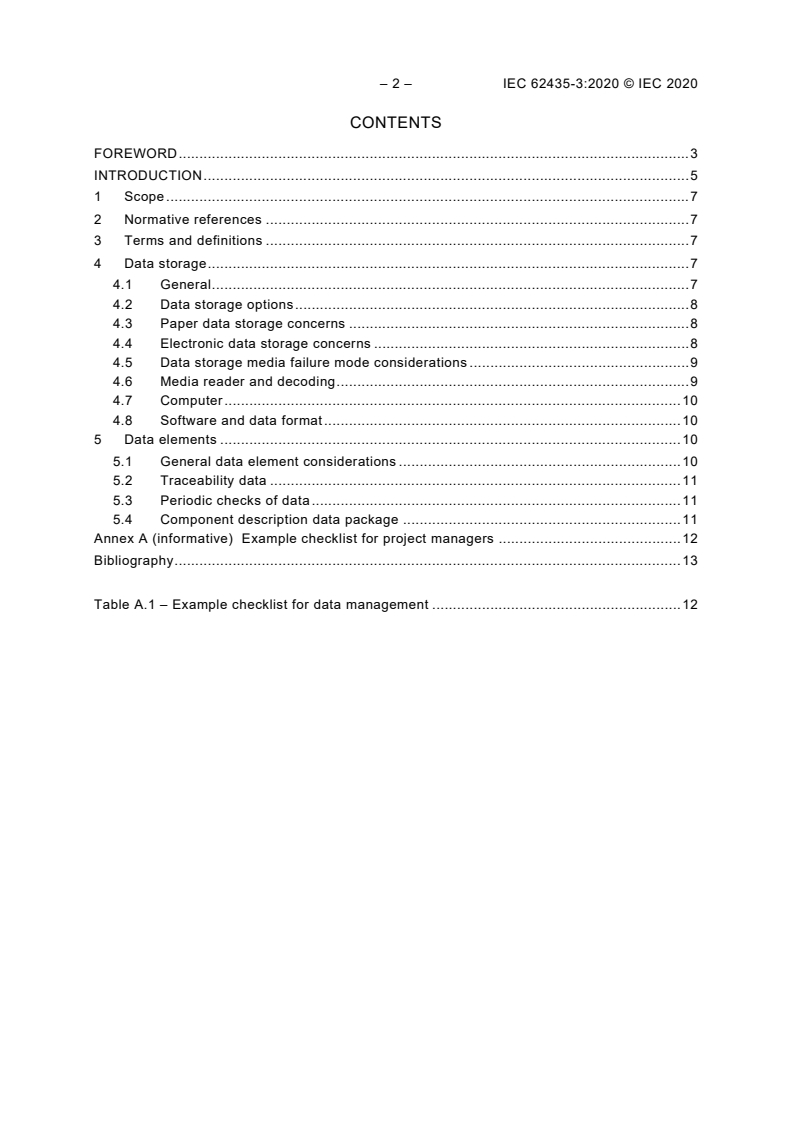
CONTENTS
FOREWORD . 3
INTRODUCTION . 5
1 Scope . 7
2 Normative references . 7
3 Terms and definitions . 7
4 Data storage . 7
4.1 General . 7
4.2 Data storage options . 8
4.3 Paper data storage concerns . 8
4.4 Electronic data storage concerns . 8
4.5 Data storage media failure mode considerations . 9
4.6 Media reader and decoding . 9
4.7 Computer . 10
4.8 Software and data format . 10
5 Data elements . 10
5.1 General data element considerations . 10
5.2 Traceability data . 11
5.3 Periodic checks of data . 11
5.4 Component description data package . 11
Annex A (informative) Example checklist for project managers . 12
Bibliography . 13
Table A.1 – Example checklist for data management . 12
INTERNATIONAL ELECTROTECHNICAL COMMISSION
____________
ELECTRONIC COMPONENTS – LONG-TERM STORAGE
OF ELECTRONIC SEMICONDUCTOR DEVICES –
Part 3: Data
FOREWORD
1) The International Electrotechnical Commission (IEC) is a worldwide organization for standardization comprising
all national electrotechnical committees (IEC National Committees). The object of IEC is to promote
international co-operation on all questions concerning standardization in the electrical and electronic fields. To
this end and in addition to other activities, IEC publishes International Standards, Technical Specifications,
Technical Reports, Publicly Available Specifications (PAS) and Guides (hereafter referred to as "IEC
Publication(s)"). Their preparation is entrusted to technical committees; any IEC National Committee interested
in the subject dealt with may participate in this preparatory work. International, governmental and non-
governmental organizations liaising with the IEC also participate in this preparation. IEC collaborates closely
with the International Organization for Standardization (ISO) in accordance with conditions determined by
agreement between the two organizations.
2) The formal decisions or agreements of IEC on technical matters express, as nearly as possible, an international
consensus of opinion on the relevant subjects since each technical committee has representation from all
interested IEC National Committees.
3) IEC Publications have the form of recommendations for international use and are accepted by IEC National
Committees in that sense. While all reasonable efforts are made to ensure that the technical content of IEC
Publications is accurate, IEC cannot be held responsible for the way in which they are used or for any
misinterpretation by any end user.
4) In order to promote international uniformity, IEC National Committees undertake to apply IEC Publications
transparently to the maximum extent possible in their national and regional publications. Any divergence
between any IEC Publication and the corresponding national or regional publication shall be clearly indicated in
the latter.
5) IEC itself does not provide any attestation of conformity. Independent certification bodies provide conformity
assessment services and, in some areas, access to IEC marks of conformity. IEC is not responsible for any
services carried out by independent certification bodies.
6) All users should ensure that they have the latest edition of this publication.
7) No liability shall attach to IEC or its directors, employees, servants or agents including individual experts and
members of its technical committees and IEC National Committees for any personal injury, property damage or
other damage of any nature whatsoever, whether direct or indirect, or for costs (including legal fees) and
expenses arising out of the publication, use of, or reliance upon, this IEC Publication or any other IEC
Publications.
8) Attention is drawn to the Normative references cited in this publication. Use of the referenced publications is
indispensable for the correct application of this publication.
9) Attention is drawn to the possibility that some of the elements of this IEC Publication may be the subject of
patent rights. IEC shall not be held responsible for identifying any or all such patent rights.
International Standard IEC 62435-3 has been prepared by IEC technical committee 47:
Semiconductor devices.
The text of this International Standard is based on the following documents:
FDIS Report on voting
47/2608/FDIS 47/2615/RVD
Full information on the voting for the approval of this International Standard can be found in
the report on voting indicated in the above table.
This document has been drafted in accordance with the ISO/IEC Directives, Part 2.
– 4 – IEC 62435-3:2020 © IEC 2020
A list of all parts in the IEC 62435 series, published under the general title Electronic
components – Long-term storage of electronic semiconductor devices, can be found on the
IEC website.
The committee has decided that the contents of this document will remain unchanged until the
stability date indicated on the IEC website under "http://webstore.iec.ch" in the data related to
the specific document. At this date, the document will be
• reconfirmed,
• withdrawn,
• replaced by a revised edition, or
• amended.
INTRODUCTION
This document applies to the long-term storage of electronic components.
This document deals with the long-term storage (LTS) of electronic devices drawing on the
best long-term storage practices currently known. For the purposes of this document, LTS is
defined as any device storage whose duration can be more than 12 months for product
scheduled for long duration storage. While intended to address the storage of unpackaged
semiconductors and packaged electronic devices, nothing in this document precludes the
storage of other items under the storage levels defined herein.
Although it has always existed to some extent, obsolescence of electronic components and
particularly of integrated circuits, has become increasingly intense over the last few years.
Indeed, with the existing technological boom, the commercial life of a component has become
very short compared with the life of industrial equipment such as that encountered in the
aeronautical field, the railway industry or the energy sector.
The many solutions enabling obsolescence to be resolved are now identified. However,
selecting one of these solutions should be preceded by a case-by-case technical and
economic feasibility study, depending on whether storage is envisaged for field service or
production, for example:
• remedial storage as soon as components are no longer marketed;
• preventive storage anticipating declaration of obsolescence.
Taking into account the expected life of some installations, sometimes covering several
decades, the qualification times, and the unavailability costs, which can also be very high, the
solution to be adopted to resolve obsolescence should often be rapidly implemented. This is
why the solution retained in most cases consists in systematically storing components which
are in the process of becoming obsolescent.
The technical risks of this solution are, a priori, fairly low. However, it requires perfect mastery
of the implemented process and especially of the storage environment, although this mastery
becomes critical when it comes to long-term storage.
All handling, protection, storage and test operations are recommended to be performed
according to the state of the art.
The application of the approach proposed in this document in no way guarantees that the
stored components are in perfect operating condition at the end of this storage. It only
comprises a means of minimizing potential and probable degradation factors.
Some electronic device users have the need to store electronic devices for long periods of
time. Lifetime buys are commonly made to support production runs of assemblies that well
exceed the production timeframe of its individual parts. This puts the user in a situation
requiring careful and adequate storage of such parts to maintain the as-received solderability
and minimize any degradation effects to the part over time. Major degradation concerns are
moisture, electrostatic fields, ultra-violet light, large variations in temperature, air-borne
contaminants, and outgassing.
Warranties and sparing also present a challenge for the user or repair agency as some
systems have been designated to be used for long periods of time, in some cases for up to
40 years or more. Some of the devices needed for repair of these systems will not be
available from the original supplier for the lifetime of the system or the spare assembly may
be built with the original production run but then require long-term storage. This document
was developed to provide a standard for storing electronic devices for long periods of time.
– 6 – IEC 62435-3:2020 © IEC 2020
The storage of devices that are moisture sensitive but that do not need to be stored for long
periods of time is dealt with in IEC TR 62258-3.
Long-term storage assumes that the device is going to be placed in uninterrupted storage for
a number of years. It is essential that it be useable after storage. It is important that storage
media, the local environment and the associated part data be considered together.
These guidelines do not imply any warranty of product or guarantee of operation beyond the
storage time given by the manufacturer.
The IEC 62435 series is intended to ensure that adequate reliability is achieved for devices in
user applications after long-term storage. Users are encouraged to request data from
suppliers to applicable specifications to demonstrate a successful storage life as requested by
the user. These standards are not intended to address built-in failure mechanisms that would
take place regardless of storage conditions.
These standards are intended to give practical guide to methods of long-duration storage of
electronic components where this is intentional or planned storage of product for a number of
years. Storage regimes for work-in-progress production are managed according to company
internal process requirements and are not detailed in IEC 62435 (all parts).
The overall standard is split into a number of parts. Parts 1 to 4 apply to any long-term
storage and contain general requirements and guidance, whereas Parts 5 to 9 are specific to
the type of product being stored.
Electronic components requiring different storage conditions are covered separately starting
with Part 5.
The structure of the IEC 62435 series as currently planned consists of the following:
– Part 1: General
– Part 2: Deterioration mechanisms
– Part 3: Data
– Part 4: Storage
– Part 5: Die and wafer devices
– Part 6: Packaged or finished devices
– Part 7: MEMS
– Part 8: Passive electronic devices
– Part 9: Special cases
ELECTRONIC COMPONENTS – LONG-TERM STORAGE
OF ELECTRONIC SEMICONDUCTOR DEVICES –
Part 3: Data
1 Scope
This part of IEC 62435 describes the aspects of data storage that are necessary for
successful use of electronic components being stored after long periods while maintaining
traceability or chain of custody. It defines what sort of data needs to be stored alongside the
components or dies and the best way to do so in order to avoid losing data during the storage
period. As defined in this document, long-term storage refers to a duration that can be more
than twelve months for products scheduled for long duration storage. Philosophy, good
working practice, and general means to facilitate the successful long-term-storage of
electronic components are also addressed.
NOTE In IEC 62435 (all parts), the term "components" is used interchangeably with dice, wafers, passives and
packaged devices.
2 Normative references
There are no normative references in this document.
3 Terms and definitions
For the purposes of this document, the following terms and definitions apply.
ISO and IEC maintain terminological databases for use in standardization at the following
addresses:
• IEC Electropedia: available at http://www.electropedia.org/
• ISO Online browsing platform: available at http://www.iso.org/obp
3.1
long-term storage
LTS
planned storage of components to extend the lifecycle for a duration with the intention of
supporting future use
Note 1 to entry: Allowable storage durations will vary by form factor (e.g. packing materials, shape) and storage
conditions. In general, long-term storage is longer than 12 months.
Note 2 to entry: This note applies to the French language only.
[SOURCE: IEC 62435-1:2017, 3.1.2]
4 Data storage
4.1 General
Data associated with the electronic components that are stored shall itself be stored securely
without degradation in order to be available when required during the entire storage period or
longer, if specified. Data not currently required may be archived for future use and
reassessment.
– 8 – IEC 62435-3:2020 © IEC 2020
The data archive is generally stored on any medium, which may include non-volatile memory,
optical disk or storage in redundant array disk servers. It is important to ensure the
environment for media storage is low risk for degradation, and accidental or random events
that could destroy or corrupt the data. The value of the parts is highly dependent upon the
data without which the company might cease to function. See Table A.1 for critical data
storage considerations. The physical and cyber security of the archive store are not
mentioned further here, but should be a main consideration when planning its location and
access.
4.2 Data storage options
From the early 1960s onwards, media for storing data other than paper, have historically
evolved towards magnetic, optical and other forms of solid-state media. It is common practice
to ensure redundancy of storage within storage servers, across physical sites and
geographies. Redundant array storage enables periodic back-up copies and checks to ensure
longevity. Some printed data is effectively undecipherable without computer assistance (such
as bar codes or matrix marks). It is conceivable to store enough information in the optical
markings to satisfy business requirements for traceability. Similarly, printed data may be
recovered from paper or from the part using optical character recognition and associated
software. Other legacy storage media, such as microfiche, can also be in use.
4.3 Paper data storage concerns
Paper storage with the components being stored is subject to many hazards that can be
mitigated with regular intervention. Data and information stored on paper can be corrupted by
aging of ink, moisture or water exposure or simple loss of the physical paper record and/or it's
facsimile. It is recommended that the stored paper be acid free to minimize the risk of brittle
degradation. The permanence of the printed mark on the archival paper should also be
considered for long-term storage of paper with components.
4.4 Electronic data storage concerns
Careful selection of the electronic medium is required, as there are many hazards in relying
on this media that are not instantly apparent. It shall be remembered that data to be archived
shall be retrievable, otherwise the purpose of archiving is negated. Data redundancy can be
achieved by redundant array of independent disks (RAID) at a local or remote network host.
Similarly redundant optical storage may also be used for network storage. Third party "data
storage"/"data warehouse" companies exist, and these are often used as a suitable secondary
location backup and repository for critical or sensitive data.
Data security should be considered in any storage scheme to avoid loss of data upon
retrieval, storage itself or during decoding. Data security measures should be in place upon
data recording on the systems used to generate and store the data. Data to be stored should
be checked prior to storage. Finally, upon retrieval, data extraction equipment should employ
data security measures in additional to ensuring that older data formats are not
miscategorised as unsafe for security.
All electronic data requires the use of a computer of some sort or another device to retrieve
the data and possibly convert it into a human-readable or machine-useable format. Storage
relies on four main precepts to recover this data:
• the useable lifetime of the media itself;
• the presence of the specific media-reading hardware;
• the associated computer;
• the interpreting and display/application software.
4.5 Data storage media failure mode considerations
Storage media preservation or maintenance is as important as physical part storage to
maintain the ability to re-establish provenance, design or test parameters or performance
when the components are to be used. When considering magnetic media, such as tapes and
disks, it is well known that the long-term storage of magnetic media has its own attendant
issues, such as oxide-shedding and magnetic "punch-through" in as little as 5 years. Platter
disks are generally less susceptible, but "punch-through" can still occur, and head-dust,
caused by deterioration of the ferric-oxide bonding agent, can lead to irreparable damage to
both the platter and read heads as soon as the platter is mounted. Network-attached storage
and RAID schemes are used to mitigate the risks for the storage of drives.
Floppy disks are susceptible to mechanical and magnetic damage. Optical media, such as the
compact disk (CD) and the digital versatile disk (DVD), can also present problems. CD-Rs that
are written by the average computer have a distinct shelf life, and, dependent upon the
storage ambience can lose data in 18 months or less; the quality of the initial CD-R or CD-RW
media is paramount.
Shedding of the reflective aluminised coating and delamination can also occur, and the
sensitivity to UV light and certain cleaning chemicals is well documented. There are other
electronic storage mechanisms, such as holographic storage, ferro-optical disks.
Paper storage has concerns of bulk, weight and flammability, coupled with the vulnerability to
damage from water, chemical degradation and fire. Paper de-acidification technology is in
regular use in relation to the preservation of many of our important historical documents.
Despite known issues, some forms of paper will continue to have a valuable place and be
used for a long time.
Non-volatile flash memory solutions with redundancy are another medium for data storage
that can have its own issues. Primarily, the program-erase cycles shall be controlled while
ensuring re-use of media is not near the end of its endurance lifetime. Network attached
storage and control software shall maintain data integrity. Local environmental temperature,
field and radiation exposure can also result in error or data loss.
Online or data warehouses that use redundant array disks pose their own challenges. Care
should be taken to mitigate random error while ensuring redundancy protocols are
maintained.
4.6 Media reader and decoding
This is often the most critical item, as even if the data remains intact upon the storage media,
the function of the media reader and the conversion to useable information cannot be
ensured. Data formats change, sometimes rapidly, due in part to the need for increased
storage density and retrieval speed. Data media readers and decoders should be selected
with storage, back-up and the extended duration and storage duration in mind. Standalone
media recording devices and media readers/decoders should be afforded the same storage
consideration as components and they should be tested periodically to ensure they are in
working order.
Integral with the reader is the native format of the data and operational commands, such that
many drives will not function without the appropriate software functions. Specialised driver
software is, therefore, required to operate the reader. Data media and reader/decoder should
be selected for the expected long-term storage duration.
– 10 – IEC 62435-3:2020 © IEC 2020
4.7 Computer
The computer or data storage systems should be compatible with the media reader hardware
to perform the decoding and possible data conversion. Compatibility with decoding hardware
should be considered when periodic software patches, driver updates, operating system
updates or firmware updates are applied. The complete system and the associated data
operations should be tested periodically to ensure they are in working order.
4.8 Software and data format
Software and data formats are often a hidden pitfall, as even if a new computer and hardware
can be retrofitted to extract the data from the archive media, it cannot be ensured that the
data will be understandable without some additional conversion software. Data character
formats, such as EBDIC, TRASCII, CSV (comma-separated variable) or XML (extensible
mark-up language) formats, require significant re-translation before becoming human-
readable or machine-readable again. Another issue arises because of the different versions of
reader software in addition to the normal readability of the data format.
The advantage of data formats like plain ASCII or direct binary is that the conversion is
straightforward, albeit tedious. Not all plain ASCII data need be carriage-return / linefeed
() bound; as it was employed when computer memory was expensive, link-list or
tokenised ASCII data were also common data formats.
When performing data conversion, it is often easy to pick out conversion errors if the data was
originally human-sensible. But if the data was originally in pure binary, intended as ‘computer
only', then conversion errors are often difficult to detect and identify.
Other data formats can be proprietary and associated with commercially available software.
Whilst these formats may be well used and documented, they are nonetheless subject to
"upgrades", "revisions" or security patches beyond the immediate control of the users.
Many companies have attempted to standardise their documents and formats. For example,
DXF format has been used for all mechanical drawings. As such, the user is reliant upon
backwards compatibility from the software supplier, or legacy equipment and software is
required for the eventuality of data retrieval. Standardized formats that account for some
forward and backward compatibility such as the STEP formats (see ISO 10303 (all parts)) are
widely integrated into electronic design and analysis tools at the time of the publication of this
document.
Periodic "upgrading" and transfer to modern media and software of the archived data can be
routinely required. Standardisation on document formats, such as Word from Microsoft® , can
also lead to periodic revisiting, as upwards compatibility is often problematic.
5 Data elements
5.1 General data element considerations
The data element clauses provide suggested data to be stored for later uses. Measures
should be taken to ensure that unit, bag and box identifiers are also stored and in good
condition to re-establish the data record to the physical unit. Table A.1 can be used to identify
and record the data necessary and agreed between a supplier and a user. It is required that a
risk assessment and a business assessment be done to determine the critical data that shall
be stored for traceability and component description for future use.
_____________
Microsoft® Word is an example of a suitable product available commercially. This information is given for the
convenience of users of this document and does not constitute an endorsement by IEC of this product.
5.2 Traceability data
Various data is recorded during, manufacturing, conditioning and de-conditioning, where
applicable, for example:
– the component manufacturer's name and part number;
– the procurement source;
– the date-code;
– the conditioning/de-conditioning history;
– the validation tests performed;
– the origin of the request for part number storage;
– the equipment on which the component can be used.
The purpose of this data is to perfectly identify the components stored, to ensure the
traceability of maintenance operations and to organize feedback.
5.3 Periodic checks of data
When there are periodic checks, the relative data are recorded (date, nature of the checks,
components tested, results, etc.).
5.4 Component description data package
a) Manufacturer's code
The manufacture's code represents the item code, or store code that enables the link
between the list of circuit boards and the parts list.
b) Component description
1) type;
2) function;
3) model (standardized each time it exists, or generic name);
4) electrical characteristics (for example: voltage and/or power or other parametric
values, and tolerances);
5) temperature range;
6) package type.
c) Manufacturers
Name of the approved original manufacturers or producers
d) Manufacturers' part numbers
Specific commercial part numbers corresponding to each original manufacturer or
producer.
e) Definition and test specification
Accurate specification number
f) Qualification level, quality assurance, etc.
Information related to the component qualification.
g) Component position in the life cycle
Corresponding category in the component life cycle, such as the following: "introduction",
"growth", "maturity", "decline", "phase-out", "discontinuance", etc.
h) Supply
1) Name of the organization (original manufacturer, producer or distributor) that supplied
the electronic components for storage.
2) Certificate of conformity.
– 12 – IEC 62435-3:2020 © IEC 2020
Annex A
(informative)
Example checklist for project managers
Table A.1 – Example checklist for data management
Item Mandatory or Question Reference Answer
good practice
Data What data is required for successful use of 5
the product, refer to data requirements?
What are the business, security and/or
regulatory requirements for the data being
stored?
What are the data file formats used to record
the data to be stored?
Are the file formats defined for future use by
humans and machines?
Media What form of media will be used to store
data?
Will the data be stored internally and/or at a
data warehouse – online?
Has a fault tree analysis and/or risk
assessment been performed on the media
storage method and system?
Is mitigation in place to meet storage
requirements?
Is the storage media encoding designed to
for long-term storage retrieval?
If media is stored, are physical protections
and software in place to facilitate de-
archival?
Is there a business continuity plan in place to
ensure the data can be retrieved from a
duplicate copy, network or remote access
site?
Are validated measures in place to physically
store and maintain the data storage medium?
If the storage is a mark, has the permanency
for the mark been validated for storage and
end of storage readability?
Data Is the data format in a long-lived and
standardised format or file type?
Do data format comply to the business,
security or regulatory requirement
Has a fault tree analysis/ risk assessment
and associated mitigated plan been
performed for the data and are mitigations in
place?
Storage Where is media stored and can it be easily 4.1
mapped to the physical storage?
Bibliography
IEC 60068-2-17:1994, Basic environmental testing procedures – Part 2-17: Tests – Test Q:
Sealing
IEC 60068-2-20:2008, Environmental testing – Part 2-20: Tests – Test T: Test methods for
solderability and resistance to soldering heat of devices with leads
IEC 60749-20-1, Semiconductor devices – Mechanical and climatic test methods – Part 20-
1: Handling, packing, labelling and shipping of surface-mount devices sensitive to the
combined effect of moisture and soldering heat
IEC 60749-21, Semiconductor devices – Mechanical and climatic test methods –Part 21:
Solderability
IEC 61340-5-1, Electrostatics – Part 5-1: Protection of electronic devices from electrostatic
phenomena – General requirements
IEC TR 61340-5-2, Electrostatics – Part 5-2: Protection of electronic devices from
electrostatic phenomena – User guide
IEC TS 61945, Integrated circuits – Manufacturing line approval – Methodology for
technology and failure analysis
IEC 62258 (all parts), Semiconductor die products
IEC TR 62258-3, Semiconductor die products – Part 3: Recommendations for good practice
in handling, packing and storage
IEC 62402, Obsolescence management – Application guide
IEC 62435-2, Electronic components – Long-term storage of electronic semiconductor
devices – Part 2: Deterioration mechanisms
IEC TS 62668-1, Process management for avionics – Counterfeit prevention – Part 1:
Avoiding the use of counterfeit, fraudulent and recycled electronic components
IEC TS 62668-2, Process management for avionics – Counterfeit prevention – Part 2:
Managing electronic components from non-franchised sources
ISO 10303 (all parts), Industrial automation systems and integration – Product data
representation and exchange
ISO 14644 (all parts), Cleanrooms and associated controlled environments
EN 190 000:1995, Generic specification – Integrated monolithic circuits
JEDEC J-STD-033, Standard for handling, packing, shipping, and use of moisture/reflow
sensitive surface mount devices
JEDEC JEP160, Long-term storage guidelines for electronic solid-state wafer, dice and
devices.
GEIA/SAE STD-0016 Standard for preparing a DMSMS management plan
IPC-1601, Printed Board Handling and Storage Guidelines
___________
– 14 – IEC 62435-3:2020 © IEC 2020
SOMMAIRE
AVANT-PROPOS . 15
INTRODUCTION . 17
1 Domaine d'application . 19
2 Références normatives . 19
3 Termes et définitions . 19
4 Stockage de données . 20
4.1 Généralités . 20
4.2 Options de stockage de données . 20
4.3 Préoccupations relatives au stockage de données sur papier . 20
4.4 Préoccupations relatives au stockage électronique de données . 20
4.5 Préoccupations relatives au mode de défaillance des supports de stockage . 21
4.6 Lecteur de support et décodage . 22
4.7 Ordinateur . 22
4.8 Logiciel et format des données . 22
5 Éléments de données . 23
5.1 Préoccupations générales relatives aux éléments de données . 23
5.2 Données de traçabilité . 23
5.3 Vérifications périodiques des données . 23
5.4 Présentation des données pour la description du composant . 24
Annexe A (informative) Exemple de liste de contrôle pour les responsables de projets . 25
Bibliographie . 26
Tableau A.1 – Exemple de liste de contrôle pour la gestion des données . 25
COMMISSION ÉLECTROTECHNIQUE INTERNATIONALE
____________
COMPOSANTS ÉLECTRONIQUES – STOCKAGE DE LONGUE DURÉE
DES DISPOSITIFS ÉLECTRONIQUES À SEMICONDUCTEURS –
Partie 3: Données
AVANT-PROPOS
1) La Commission Electrotechnique Internationale (IEC) est une organisation mondiale de normalisation
composée de l'ensemble des comités électrotechniques nationaux (Comités nationaux de l'IEC). L'IEC a pour
objet de favoriser la coopération internationale pour toutes les questions de normalisation dans les domaines
de l'électricité et de l'électronique. A cet effet, l'IEC – entre autres activités – publie des Normes
internationales, des Spécifications techniques, des Rapports techniques, des Spécifications accessibles au
public (PAS) et des Guides (ci-après dénommés "Publication(s) de l'IEC"). Leur élaboration est confiée à des
comités d'études, aux travaux desquels tout Comité national intéressé par le sujet traité peut participer. Les
organisations internationales, gouvernementales et non gouvernementales, en liaison avec l'IEC, participent
également aux travaux. L'IEC collabore étroitement avec l'Organisation Internationale de Normalisation (ISO),
selon des conditions fixées par accord entre les deux organisations.
2) Les décisions ou accords officiels de l'IEC concernant les questions techniques représentent, dans la mesure
du possible, un accord international sur les sujets étudiés, étant donné que les Comités nationaux de l'IEC
intéressés sont représentés dans chaque comité d'études.
3) Les Publications de l'IEC se présentent sous la forme de recommandations internationales et sont agréées
comme telles par les Comités nationaux de l'IEC. Tous les efforts raisonnables sont entrepris afin que l'IEC
s'assure de l'exactitude du contenu technique de ses publications; l'IEC ne peut pas être tenue responsable de
l'éventuelle mauvaise utilisation ou interprétation qui en est faite par un quelconque utilisateur final.
4) Dans le but d'encourager l'uniformité internationale, les Comités nationaux de l'IEC s'engagent, dans toute la
mesure possible, à appliquer de façon transparente les Publications de l'IEC dans leurs publications nationales
et régionales. Toutes divergences entre toutes Publications de l'IEC et toutes publications nationales ou
régionales correspondantes doivent être indiquées en termes clairs dans ces dernières.
5) L'IEC elle-même ne fournit aucune attestation de conformité. Des organismes de certification indépendants
fournissent des services d'évaluation de conformité et, dans certains secteurs, accèdent aux marques de
conformité de l'IEC. L'IEC n'est responsable d'aucun des services effectués par les organismes de certification
indépendants.
6) Tous les utilisateurs doivent s'assurer qu'ils sont en possession de la dernière édition de cette publication.
7) Aucune responsabilité ne doit être imputée à l'IEC, à ses administrateurs, employés, auxiliaires ou
mandataires, y compris ses experts particuliers et les membres de ses comités d'études et des Comités
nationaux de l'IEC, pour tout préjudice causé en cas de dommages corporels et matériels, ou de tout autre
dommage de quelque nature que ce soit, directe ou indirecte, ou pour supporter les coûts (y compris les frais
de justice) et les dépenses découlant de la publication ou de l'utilisation de cette Publication de l'IEC ou de
toute autre Publi
...