

IEC 62435-1:2017
(Main)Electronic components - Long-term storage of electronic semiconductor devices - Part 1: General
General Information
- Abstract
IEC 62435-1:2017 on long-term-storage covers the terms, definitions and principles of long-term-storage that can be used in as an obsolescence mitigation strategy. Long-term storage refers to a duration that can be more than 12 months for products scheduled for long duration storage. Philosophy, good working practice, and general means to facilitate the successful long-term-storage of electronic components are also addressed.
This standard cancels and replaces IEC/PAS 62435 published in 2005. This first edition constitutes a technical revision.
- Status
- Published
- Publication Date
- 19-Jan-2017
- Technical Committee
- TC 47 - Semiconductor devices
- Drafting Committee
- WG 3 - TC 47/WG 3
- Current Stage
- PPUB - Publication issued
- Start Date
- 20-Jan-2017
- Completion Date
- 04-Feb-2017
Overview
IEC 62435-1:2017, titled Electronic components - Long-term storage of electronic semiconductor devices - Part 1: General, is an international standard published by the International Electrotechnical Commission (IEC). This standard provides comprehensive guidance on the principles, terms, definitions, and practical approaches for long-term storage of semiconductor electronic components. Specifically designed for storage periods exceeding 12 months, IEC 62435-1 serves as a critical reference for organizations looking to mitigate obsolescence risks in their electronic component supply chains. It replaces the earlier IEC/PAS 62435 published in 2005, representing a significant technical revision.
The core philosophy of IEC 62435-1 focuses on ensuring the quality, reliability, and availability of semiconductor devices during extended storage periods, thus enabling efficient lifecycle and inventory management for manufacturers, suppliers, and project managers.
Key Topics
- Terms and Definitions: Establishes clear terminology related to long-term storage for uniform understanding across industries.
- Purpose and Benefits: Details reasons for long-term storage such as obsolescence mitigation, risk reduction, and maintaining secure component availability.
- Decision Criteria: Explains factors influencing decisions to store components long-term, including cost considerations, hazards, and market forces.
- Logistics and Procurement: Provides guidelines on procurement quantities, storage conditions, unit management, and stock rotation to maintain component integrity.
- Storage Conditions: Discusses optimal storage environments, handling practices, inspection protocols, and transportation to minimize degradation.
- Periodic Checks: Emphasizes scheduled testing and validation to ensure components remain functional and meet required performance standards.
- Facility Requirements: Covers aspects like physical security, safety, and environmental controls necessary for effective storage facilities.
- Obsolescence Management: Highlights long-term storage as a strategic approach to manage component lifecycles and reduce supply chain disruptions.
- Policy and Compliance: Addresses relevant legislation, environmental considerations, and the importance of documented policies to support storage management.
Applications
IEC 62435-1:2017 is essential for a variety of stakeholders engaged with electronic semiconductor devices, including:
- Electronics Manufacturers: To maintain component quality during extended production pauses or inventory holding periods.
- Supply Chain Managers: For planning procurement, inventory control, and mitigating risks related to component obsolescence.
- Project Managers: To develop storage strategies ensuring availability of critical components for long-term programs or maintenance.
- Quality Assurance Teams: For implementing regular inspections, validation tests, and ensuring compliance with handling and storage standards.
- Storage Facility Operators: To design and maintain conditions that preserve semiconductor device integrity over time.
- Obsolescence Specialists: Utilizing the standard to create robust mitigation strategies reducing the impact of discontinued or scarce components.
By adhering to IEC 62435-1, organizations can safeguard their electronic components, reduce costs associated with premature failure or unexpected shortages, and streamline their inventory management across long project lifecycles.
Related Standards
- IEC 60721: Classification of environmental conditions relevant to storage and transportation of electronic components.
- IEC 61340: Protection of electronic devices from electrostatic phenomena during handling and storage.
- IEC 60068: Environmental testing standards covering climatic, mechanical, and electrical stress conditions.
- ISO 9001: Quality management systems that complement component storage standards by ensuring consistent process control.
- JEDEC Standards: Industry standards related to semiconductor device packaging and moisture sensitivity classification.
Implementing IEC 62435-1 alongside these related standards helps create a comprehensive framework for managing electronic component life cycles, ensuring reliability, and minimizing supply chain risks related to long-term storage.
Keywords: IEC 62435-1, long-term storage, electronic components, semiconductor devices, obsolescence mitigation, storage guidelines, inventory management, electronic component handling, storage facility requirements, semiconductor storage standards.
Relations
- Effective Date
- 05-Sep-2023
Frequently Asked Questions
IEC 62435-1:2017 is a standard published by the International Electrotechnical Commission (IEC). Its full title is "Electronic components - Long-term storage of electronic semiconductor devices - Part 1: General". This standard covers: IEC 62435-1:2017 on long-term-storage covers the terms, definitions and principles of long-term-storage that can be used in as an obsolescence mitigation strategy. Long-term storage refers to a duration that can be more than 12 months for products scheduled for long duration storage. Philosophy, good working practice, and general means to facilitate the successful long-term-storage of electronic components are also addressed. This standard cancels and replaces IEC/PAS 62435 published in 2005. This first edition constitutes a technical revision.
IEC 62435-1:2017 on long-term-storage covers the terms, definitions and principles of long-term-storage that can be used in as an obsolescence mitigation strategy. Long-term storage refers to a duration that can be more than 12 months for products scheduled for long duration storage. Philosophy, good working practice, and general means to facilitate the successful long-term-storage of electronic components are also addressed. This standard cancels and replaces IEC/PAS 62435 published in 2005. This first edition constitutes a technical revision.
IEC 62435-1:2017 is classified under the following ICS (International Classification for Standards) categories: 31.020 - Electronic components in general. The ICS classification helps identify the subject area and facilitates finding related standards.
IEC 62435-1:2017 has the following relationships with other standards: It is inter standard links to IEC PAS 62435:2005. Understanding these relationships helps ensure you are using the most current and applicable version of the standard.
IEC 62435-1:2017 is available in PDF format for immediate download after purchase. The document can be added to your cart and obtained through the secure checkout process. Digital delivery ensures instant access to the complete standard document.
Standards Content (Sample)
IEC 62435-1 ®
Edition 1.0 2017-01
INTERNATIONAL
STANDARD
NORME
INTERNATIONALE
Electronic components – Long-term storage of electronic semiconductor
devices –
Part 1: General
Composants électroniques – Stockage de longue durée des dispositifs
électroniques à semiconducteurs –
Partie 1: Généralités
All rights reserved. Unless otherwise specified, no part of this publication may be reproduced or utilized in any form
or by any means, electronic or mechanical, including photocopying and microfilm, without permission in writing from
either IEC or IEC's member National Committee in the country of the requester. If you have any questions about IEC
copyright or have an enquiry about obtaining additional rights to this publication, please contact the address below or
your local IEC member National Committee for further information.
Droits de reproduction réservés. Sauf indication contraire, aucune partie de cette publication ne peut être reproduite
ni utilisée sous quelque forme que ce soit et par aucun procédé, électronique ou mécanique, y compris la photocopie
et les microfilms, sans l'accord écrit de l'IEC ou du Comité national de l'IEC du pays du demandeur. Si vous avez des
questions sur le copyright de l'IEC ou si vous désirez obtenir des droits supplémentaires sur cette publication, utilisez
les coordonnées ci-après ou contactez le Comité national de l'IEC de votre pays de résidence.
IEC Central Office Tel.: +41 22 919 02 11
3, rue de Varembé Fax: +41 22 919 03 00
CH-1211 Geneva 20 info@iec.ch
Switzerland www.iec.ch
About the IEC
The International Electrotechnical Commission (IEC) is the leading global organization that prepares and publishes
International Standards for all electrical, electronic and related technologies.
About IEC publications
The technical content of IEC publications is kept under constant review by the IEC. Please make sure that you have the
latest edition, a corrigenda or an amendment might have been published.
IEC Catalogue - webstore.iec.ch/catalogue Electropedia - www.electropedia.org
The stand-alone application for consulting the entire The world's leading online dictionary of electronic and
bibliographical information on IEC International Standards, electrical terms containing 20 000 terms and definitions in
Technical Specifications, Technical Reports and other English and French, with equivalent terms in 16 additional
documents. Available for PC, Mac OS, Android Tablets and languages. Also known as the International Electrotechnical
iPad. Vocabulary (IEV) online.
IEC publications search - www.iec.ch/searchpub IEC Glossary - std.iec.ch/glossary
The advanced search enables to find IEC publications by a 65 000 electrotechnical terminology entries in English and
variety of criteria (reference number, text, technical French extracted from the Terms and Definitions clause of
committee,…). It also gives information on projects, replaced IEC publications issued since 2002. Some entries have been
and withdrawn publications. collected from earlier publications of IEC TC 37, 77, 86 and
CISPR.
IEC Just Published - webstore.iec.ch/justpublished
Stay up to date on all new IEC publications. Just Published IEC Customer Service Centre - webstore.iec.ch/csc
details all new publications released. Available online and If you wish to give us your feedback on this publication or
also once a month by email. need further assistance, please contact the Customer Service
Centre: csc@iec.ch.
A propos de l'IEC
La Commission Electrotechnique Internationale (IEC) est la première organisation mondiale qui élabore et publie des
Normes internationales pour tout ce qui a trait à l'électricité, à l'électronique et aux technologies apparentées.
A propos des publications IEC
Le contenu technique des publications IEC est constamment revu. Veuillez vous assurer que vous possédez l’édition la
plus récente, un corrigendum ou amendement peut avoir été publié.
Catalogue IEC - webstore.iec.ch/catalogue Electropedia - www.electropedia.org
Application autonome pour consulter tous les renseignements
Le premier dictionnaire en ligne de termes électroniques et
bibliographiques sur les Normes internationales,
électriques. Il contient 20 000 termes et définitions en anglais
Spécifications techniques, Rapports techniques et autres
et en français, ainsi que les termes équivalents dans 16
documents de l'IEC. Disponible pour PC, Mac OS, tablettes
langues additionnelles. Egalement appelé Vocabulaire
Android et iPad.
Electrotechnique International (IEV) en ligne.
Recherche de publications IEC - www.iec.ch/searchpub
Glossaire IEC - std.iec.ch/glossary
65 000 entrées terminologiques électrotechniques, en anglais
La recherche avancée permet de trouver des publications IEC
en utilisant différents critères (numéro de référence, texte, et en français, extraites des articles Termes et Définitions des
comité d’études,…). Elle donne aussi des informations sur les publications IEC parues depuis 2002. Plus certaines entrées
projets et les publications remplacées ou retirées. antérieures extraites des publications des CE 37, 77, 86 et
CISPR de l'IEC.
IEC Just Published - webstore.iec.ch/justpublished
Service Clients - webstore.iec.ch/csc
Restez informé sur les nouvelles publications IEC. Just
Published détaille les nouvelles publications parues. Si vous désirez nous donner des commentaires sur cette
Disponible en ligne et aussi une fois par mois par email. publication ou si vous avez des questions contactez-nous:
csc@iec.ch.
IEC 62435-1 ®
Edition 1.0 2017-01
INTERNATIONAL
STANDARD
NORME
INTERNATIONALE
Electronic components – Long-term storage of electronic semiconductor
devices –
Part 1: General
Composants électroniques – Stockage de longue durée des dispositifs
électroniques à semiconducteurs –
Partie 1: Généralités
INTERNATIONAL
ELECTROTECHNICAL
COMMISSION
COMMISSION
ELECTROTECHNIQUE
INTERNATIONALE
ICS 31.020 ISBN 978-2-8322-3835-6
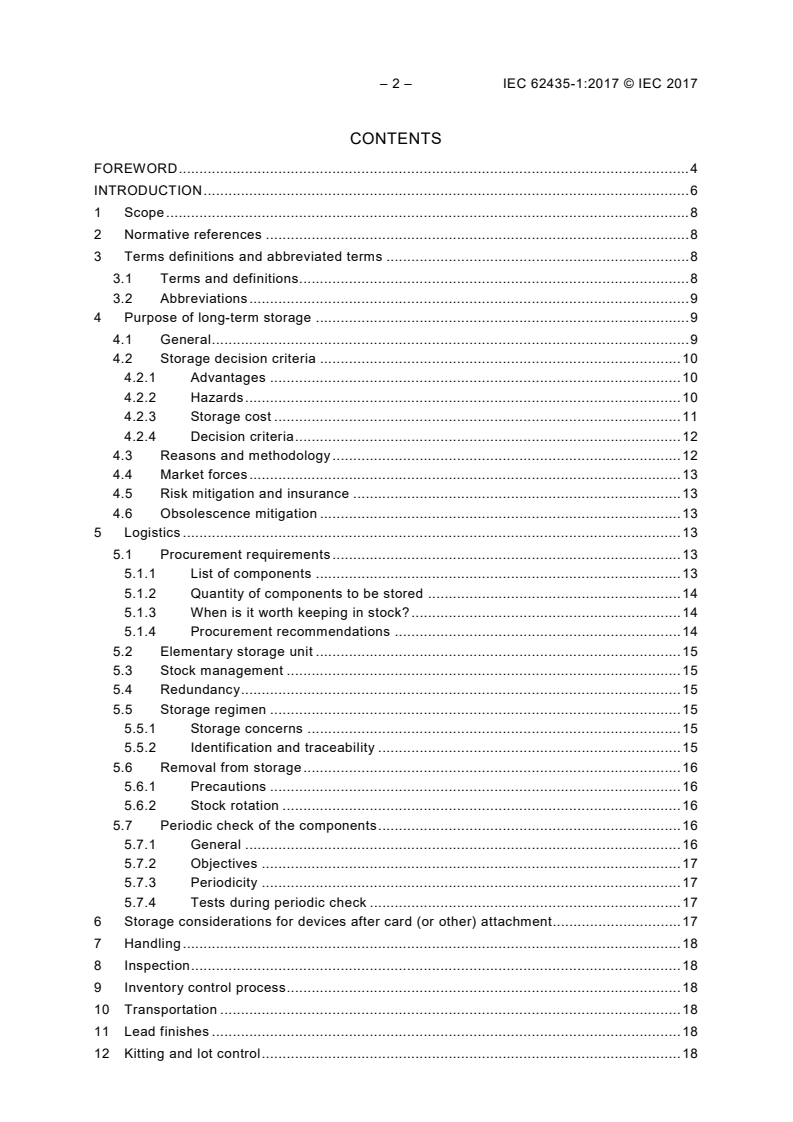
– 2 – IEC 62435-1:2017 © IEC 2017
CONTENTS
FOREWORD . 4
INTRODUCTION . 6
1 Scope . 8
2 Normative references . 8
3 Terms definitions and abbreviated terms . 8
3.1 Terms and definitions . 8
3.2 Abbreviations . 9
4 Purpose of long-term storage . 9
4.1 General . 9
4.2 Storage decision criteria . 10
4.2.1 Advantages . 10
4.2.2 Hazards . 10
4.2.3 Storage cost . 11
4.2.4 Decision criteria . 12
4.3 Reasons and methodology . 12
4.4 Market forces . 13
4.5 Risk mitigation and insurance . 13
4.6 Obsolescence mitigation . 13
5 Logistics . 13
5.1 Procurement requirements . 13
5.1.1 List of components . 13
5.1.2 Quantity of components to be stored . 14
5.1.3 When is it worth keeping in stock? . 14
5.1.4 Procurement recommendations . 14
5.2 Elementary storage unit . 15
5.3 Stock management . 15
5.4 Redundancy . 15
5.5 Storage regimen . 15
5.5.1 Storage concerns . 15
5.5.2 Identification and traceability . 15
5.6 Removal from storage . 16
5.6.1 Precautions . 16
5.6.2 Stock rotation . 16
5.7 Periodic check of the components . 16
5.7.1 General . 16
5.7.2 Objectives . 17
5.7.3 Periodicity . 17
5.7.4 Tests during periodic check . 17
6 Storage considerations for devices after card (or other) attachment. 17
7 Handling . 18
8 Inspection . 18
9 Inventory control process . 18
10 Transportation . 18
11 Lead finishes . 18
12 Kitting and lot control . 18
13 Validation . 19
14 Unplanned storage and types of storage . 19
14.1 Types of storage . 19
14.2 Unplanned storage . 19
15 Other things to store in addition to the components . 20
15.1 Relevant data . 20
15.2 Equipment . 20
16 Storage facility . 20
16.1 Cost of ownership . 20
16.2 Physical security and safety . 20
16.3 Location and ambient environment . 20
17 Policies . 21
17.1 General . 21
17.2 Supply chain . 21
17.3 Re-starting the manufacturing chain . 21
18 Legislation and environmental issues . 21
Annex A (informative) Example checklist for project managers . 22
Annex B (normative) Example checklist for long-term storage facilities . 24
Annex C (informative) Example of a component list . 26
C.1 Component list . 26
C.2 Data description . 27
Annex D (informative) Examples of periodic and/or de-stocking tests . 28
Annex E (informative) Parameters influencing the quantity of components to be stored . 30
Bibliography . 31
Table 1 – Storage hazards . 11
Table A.1 – Example checklist for project managers . 22
Table B.1 – Example checklist for storage facilities . 24
Table C.1 – Component list . 26
Table D.1 – Periodic and/or de-stocking tests . 28
– 4 – IEC 62435-1:2017 © IEC 2017
INTERNATIONAL ELECTROTECHNICAL COMMISSION
____________
ELECTRONIC COMPONENTS –
LONG-TERM STORAGE OF ELECTRONIC
SEMICONDUCTOR DEVICES –
Part 1: General
FOREWORD
1) The International Electrotechnical Commission (IEC) is a worldwide organization for standardization comprising
all national electrotechnical committees (IEC National Committees). The object of IEC is to promote
international co-operation on all questions concerning standardization in the electrical and electronic fields. To
this end and in addition to other activities, IEC publishes International Standards, Technical Specifications,
Technical Reports, Publicly Available Specifications (PAS) and Guides (hereafter referred to as “IEC
Publication(s)”). Their preparation is entrusted to technical committees; any IEC National Committee interested
in the subject dealt with may participate in this preparatory work. International, governmental and non-
governmental organizations liaising with the IEC also participate in this preparation. IEC collaborates closely
with the International Organization for Standardization (ISO) in accordance with conditions determined by
agreement between the two organizations.
2) The formal decisions or agreements of IEC on technical matters express, as nearly as possible, an international
consensus of opinion on the relevant subjects since each technical committee has representation from all
interested IEC National Committees.
3) IEC Publications have the form of recommendations for international use and are accepted by IEC National
Committees in that sense. While all reasonable efforts are made to ensure that the technical content of IEC
Publications is accurate, IEC cannot be held responsible for the way in which they are used or for any
misinterpretation by any end user.
4) In order to promote international uniformity, IEC National Committees undertake to apply IEC Publications
transparently to the maximum extent possible in their national and regional publications. Any divergence
between any IEC Publication and the corresponding national or regional publication shall be clearly indicated in
the latter.
5) IEC itself does not provide any attestation of conformity. Independent certification bodies provide conformity
assessment services and, in some areas, access to IEC marks of conformity. IEC is not responsible for any
services carried out by independent certification bodies.
6) All users should ensure that they have the latest edition of this publication.
7) No liability shall attach to IEC or its directors, employees, servants or agents including individual experts and
members of its technical committees and IEC National Committees for any personal injury, property damage or
other damage of any nature whatsoever, whether direct or indirect, or for costs (including legal fees) and
expenses arising out of the publication, use of, or reliance upon, this IEC Publication or any other IEC
Publications.
8) Attention is drawn to the Normative references cited in this publication. Use of the referenced publications is
indispensable for the correct application of this publication.
9) Attention is drawn to the possibility that some of the elements of this IEC Publication may be the subject of
patent rights. IEC shall not be held responsible for identifying any or all such patent rights.
International Standard IEC 62435-1 has been prepared by IEC technical committee 47:
Semiconductor devices.
This standard cancels and replaces IEC/PAS 62435 published in 2005. This first edition
constitutes a technical revision.
The text of this standard is based on the following documents:
FDIS Report on voting
47/2326/FDIS 47/2349/RVD
Full information on the voting for the approval of this standard can be found in the report on
voting indicated in the above table.
This publication has been drafted in accordance with the ISO/IEC Directives, Part 2.
A list of all parts in the IEC 62435 series, published under the general title Electronic
components – Long-term storage of electronic semiconductor devices, can be found on the
IEC website.
The committee has decided that the contents of this publication will remain unchanged until
the stability date indicated on the IEC website under "http://webstore.iec.ch" in the data
related to the specific publication. At this date, the publication will be
• reconfirmed,
• withdrawn,
• replaced by a revised edition, or
• amended.
– 6 – IEC 62435-1:2017 © IEC 2017
INTRODUCTION
This document applies to the long-term storage of electronic components.
This is a document for long-term storage (LTS) of electronic devices drawing on the best long-
term storage practices currently known. For the purposes of this document, LTS is defined as
any device storage whose duration can be more than 12 months for product scheduled for
long duration storage. While intended to address the storage of unpackaged semiconductors
and packaged electronic devices, nothing in this standard precludes the storage of other
items under the storage levels defined herein.
Although it has always existed to some extent, obsolescence of electronic components and
particularly of integrated circuits, has become increasingly intense over the last few years.
Indeed, with the existing technological boom, the commercial life of a component has become
very short compared with the life of industrial equipment such as that encountered in the
aeronautical field, the railway industry or the energy sector.
The many solutions enabling obsolescence to be resolved are now identified. However,
selecting one of these solutions should be preceded by a case-by-case technical and
economic feasibility study, depending on whether storage is envisaged for field service or
production, for example:
• remedial storage as soon as components are no longer marketed;
• preventive storage anticipating declaration of obsolescence.
Taking into account the expected life of some installations, sometimes covering several
decades, the qualification times, and the unavailability costs, which can also be very high, the
solution to be adopted to resolve obsolescence should often be rapidly implemented. This is
why the solution retained in most cases consists in systematically storing components which
are in the process of becoming obsolescent.
The technical risks of this solution are, a priori, fairly low. However, it requires perfect mastery
of the implemented process and especially of the storage environment, although this mastery
becomes critical when it comes to long-term storage.
All handling, protection, storage and test operations are recommended to be performed
according to the state of the art.
The application of the approach proposed in this standard in no way guarantees that the
stored components are in perfect operating condition at the end of this storage. It only
comprises a means of minimizing potential and probable degradation factors.
Some electronic device users have the need to store electronic devices for long periods of
time. Lifetime buys are commonly made to support production runs of assemblies that well
exceed the production timeframe of its individual parts. This puts the user in a situation
requiring careful and adequate storage of such parts to maintain the as-received solderability
and minimize any degradation effects to the part over time. Major degradation concerns are
moisture, electrostatic fields, ultra-violet light, large variations in temperature, air-borne
contaminants, and outgassing.
Warranties and sparing also present a challenge for the user or repair agency as some
systems have been designated to be used for long periods of time, in some cases for up to
40 years or more. Some of the devices needed for repair of these systems will not be
available from the original supplier for the lifetime of the system or the spare assembly may
be built with the original production run but then require long-term storage. This document
was developed to provide a standard for storing electronic devices for long periods of time.
For storage of devices that are moisture sensitive but that do not need to be stored for long
periods of time, refer to IEC TR 62258-3.
Long-term storage assumes that the device is going to be placed in uninterrupted storage for
a number of years. It is essential that it is useable after storage. Particular attention should be
paid to storage media surrounding the devices together with the local environment.
These guidelines do not imply any warranty of product or guarantee of operation beyond the
storage time given by the manufacturer.
The IEC 62435 series is intended to ensure that adequate reliability is achieved for devices in
user applications after long-term storage. Users are encouraged to request data from
suppliers to applicable specifications to demonstrate a successful storage life as requested by
the user. These standards are not intended to address built-in failure mechanisms that would
take place regardless of storage conditions.
These standards are intended to give practical guide to methods of long-duration storage of
electronic components where this is intentional or planned storage of product for a number of
years. Storage regimes for work-in-progress production are managed according to company
internal process requirements and are not detailed in this series of standards.
The overall standard is split into a number of parts. Parts 1 to 4 apply to any long-term
storage and contain general requirements and guidance, whereas Parts 5 to 9 are specific to
the type of product being stored. It is intended that the product specific part should be read
alongside the general requirements of Parts 1 to 4.
Electronic components requiring different storage conditions are covered separately starting
with Part 5.
The structure of the IEC 62435 series as currently conceived is as follows:
Part 1 – General
Part 2 – Deterioration mechanisms
Part 3 – Data
Part 4 – Storage
Part 5 – Die and wafer devices
Part 6 – Packaged or finished devices
Part 7 – MEMS
Part 8 – Passive electronic devices
Part 9 – Special cases
_____________
Under preparation.
– 8 – IEC 62435-1:2017 © IEC 2017
ELECTRONIC COMPONENTS –
LONG-TERM STORAGE OF ELECTRONIC
SEMICONDUCTOR DEVICES –
Part 1: General
1 Scope
This part of IEC 62435 on long-term-storage covers the terms, definitions and principles of
long-term-storage that can be used in as an obsolescence mitigation strategy. Long-term
storage refers to a duration that can be more than 12 months for products scheduled for long
duration storage. Philosophy, good working practice, and general means to facilitate the
successful long-term-storage of electronic components are also addressed.
2 Normative references
The following documents are referred to in the text in such a way that some or all of their
content constitutes requirements of this document. For dated references, only the edition
cited applies. For undated references, the latest edition of the referenced document (including
any amendments) applies.
IEC 60749-20-1, Semiconductor devices – Mechanical and climatic test methods – Part 20-1:
Handling, packing, labelling and shipping of surface-mount devices sensitive to the combined
effect of moisture and soldering heat
3 Terms definitions and abbreviated terms
For the purposes of this document, the following terms, definitions and abbreviated terms
apply.
ISO and IEC maintain terminological databases for use in standardization at the following
addresses:
• IEC Electropedia: available at http://www.electropedia.org/
• ISO Online browsing platform: available at http://www.iso.org/obp
3.1 Terms and definitions
3.1.1
storage environment
specially controlled storage area, with particular control of temperature, humidity, atmosphere
and any other conditions depending on the product requirements
3.1.2
long-term storage
LTS
planned storage of components to extend the life-cycle for a duration with the intention of
supporting future use
Note 1 to entry: Allowable storage durations will vary by form factor (e.g., packing materials, shape) and storage
conditions. In general, long-term storage is longer than 12 months.
3.1.3
electronic device
packaged electrical, electronic, electro-mechanical (EEE) item, or assemblies using such
items
3.1.4
moisture barrier bag
MBB
storage bag manufactured with a flexible laminated vapour barrier film that restricts the
transmission of water vapour
Note 1 to entry: Refer to IEC60749-20-1 for packaging of moisture sensitive products.
3.1.5
humidity indicator card
HIC
card printed with a moisture sensitive chemical (cobalt bromide) that changes from blue to
pink in the presence of water vapour
3.2 Abbreviations
ESD electro-static discharge
4 Purpose of long-term storage
4.1 General
LTS is intended as any device storage for more than 12 months but typically much longer.
Annexes A to E provide useful lists and tools for documentation and later use during and after
long-duration storage. While most stock is purchased for immediate production requirements,
some product is stored for the following reasons:
• bulk purchase for incremental production;
• cost reasons, justified by price breaks or minimum purchase quantities;
• last-time buy, required for future production;
• special, bespoke components;
• product stored for a customer for their future production;
• product stored for anticipated future orders;
• spares for in-service repair.
LTS stock shall not be stored alongside products for immediate planned production. It is
recommended that products destined for future production be segregated and stored in a
long-term storage facility in order to guard against:
• unintended mixing of stored components and use of components in immediate production
that were intended for future production use;
• selling or disposal of stock which has been stored longer than expected in production
stores and is erroneously assumed to be no longer required;
• inventory review and reduction with unintended disposal of components;
• unintended and repeated opening of cabinets containing LTS products.
– 10 – IEC 62435-1:2017 © IEC 2017
4.2 Storage decision criteria
4.2.1 Advantages
4.2.1.1 Technical simplicity – Rapidity
When the various steps of the storage process are finalized and validated, the creation of a
stock is a simpler, faster and technically less hazardous solution than developing or modifying
electronic boards.
Storage can also be a temporary solution enabling equipment maintenance during
modification or development of electronic boards.
4.2.1.2 Solution durability
Any equipment changes based on the use of new electronic components will be faced,
eventually, with the obsolescence of these new components. Storage can resolve obsoles-
cence problems until the end of the operating life of the equipment.
4.2.1.3 Preventive storage
Preventive storage (i.e., before the component becomes obsolete) presents several additional
advantages compared with remedial storage (i.e., when the component has already become
obsolete). This can be advantageous for a number of different reasons including the following:
• the component price has not become prohibitive as in the case of specific obsolete
components that have become very rare;
• the quality level is ensured if the component can be purchased directly from the
manufacturer or franchised distributor;
• the likelihood of being supplied counterfeit, fraudulent or recycled components is very
unlikely when purchasing directly from the manufacturer or franchised distributor. However,
when a component has been obsolete for a long time, it is possible that it could only be
found at suppliers who specialise in purchasing, storage and resale of obsolete
components, where the chance of receiving counterfeit components is increased. For
more information, refer to IEC TS 62668-1 and IEC TS 62668-2. In this case, no
component reliability guarantee is likely to apply.
For more information, refer to IEC 62402.
4.2.2 Hazards
4.2.2.1 General
There are a number of hazards related to the storage of components that should be taken into
account in long-term storage. These are listed in the following Table 1 and referenced
paragraphs, as well as in IEC 62435-2.
Table 1 – Storage hazards
Hazard Reference Description Mitigation
General aging 4.2.2.2 Components, when stored, have Ensure that component deterioration
natural aging mechanisms which can mechanisms have been assessed
cause the component to deteriorate. and storage conditions minimise
these effects.
Poor stock 4.2.2.3 Underestimation of the number of Ensure that correct methods are
dimensioning components required for storage. used to calculate the number of
Can lead to future shortages. components required for storage.
Control during 4.2.2.4 Variable or uncontrolled storage Storage conditions should be
storage conditions may cause components to controlled to pre-determined limits
deteriorate rapidly. and monitored for out of control
events.
Freezing of 4.2.2.5 The design and function of Components stored for future use
equipment design equipment may be required to be imply that the design should be
and functionality upgraded during the life of the frozen.
equipment.
4.2.2.2 Generic aging hazard
Components when stored do not remain in a pristine condition and will have a natural aging
characteristic(s). This effect can be mitigated by investigating the deterioration mechanisms
for any component type that is being stored and to design the storage conditions to minimise
any likely deterioration. See IEC 62435-2 for more information.
4.2.2.3 Poor stock dimensioning
The calculation of the volume of components to be stored may be based on feedback (opera-
tional failure rate) and/or on theoretical models (predictive failure rate). Calculation using
feedback is only valid if the sample is big enough (significant population of components ins-
talled, operation for several years, high number of failures evidenced). Predictive calculations
do not generally take into account the extrinsic parameters of the components (defects
caused by printed-board handling and repair, systematic replacement of the components
(including functional components) during repairs, improper use of the components, etc.).
Therefore, the stock volume can be improperly assessed.
Underestimating the stock can lead to a lack of components to repair printed boards, which
will ruin the stock strategy. Overestimating it will lead to the purchasing and conditioning of
components which will not be used, adding significant costs.
4.2.2.4 Control during storage
Storage conditions shall be precisely defined, controlled and auditable. In addition, it is
important to check the quality of the components to be stored.
4.2.2.5 Freezing of equipment design and functionality
Storing components to ensure equipment maintenance over a long time implies that
equipment design be frozen. A long-duration storage solution is therefore not compatible with
the desire to upgrade equipment and functionalities.
4.2.3 Storage cost
In order to assess the cost of a storage solution, various items should be taken into account,
such as:
• component purchasing;
• validation/test of purchased component batches;
– 12 – IEC 62435-1:2017 © IEC 2017
• conditioning and de-conditioning;
• stock management;
• maintenance of installations dedicated to storage by means of manufacturing tests and/or
repair;
• staff ensuring storage, maintenance operations, etc.;
• financial cost of tied-up stocks.
4.2.4 Decision criteria
The following criteria should be taken into account:
• planned storage time;
• stock dimensioning;
• dimensioning reliability index;
• life of test means;
• life of manufacturing means and/or printed boards;
• competence traceability and related documentation;
• industrial consequences of under-dimensioning or a component failure at the end of
storage;
• confidence level in the knowledge of potential component failure mechanisms;
• cost compared with other solutions;
• impact of accepting new product orders using the LTS components;
• audit/inspection schedule and standards used.
4.3 Reasons and methodology
Many electronic components have a shorter life-cycle than the design and manufacturing
cycle time of the equipment in which they are used. This is especially true for equipment that
is designed for military, space, automotive, medical or other high-reliability products, which
have an extended design cycle or planned period of manufacturing. Some components,
therefore, become obsolete before the manufacturing cycle is complete. Cost for long-term
storage is ultimately taken into account by suppliers and customers as part of the business
contract terms and conditions.
When a component becomes obsolete, the users have the choice of either
upgrading/redesigning the product during their manufacturing cycle, for which there is a cost
penalty, or they may choose to make a life-time buy for all the production and maintenance
requirements.
Additional costs related to testing and type approval for the redesign shall be factored in when
making this choice. This cost for long-term storage shall take account not only the upfront
cost of purchasing the components and the costs for storage, but also costs associated with
periodic checking or qualification of the stored components. There is also risk associated with
either strategy and this needs to be taken into account.
Assuming that components have been purchased ahead of planned production, then these
components need to be stored in a carefully predetermined manner. Assuming that the
components will be beyond the manufacturer’s stated shelf-life at the time of production, then
consideration shall be given as to how they are packed or re-packed prior to storage including
testing and qualification to ensure that only good components are stored. Refer to 5.5 for
more information.
4.4 Market forces
Market forces determine when it is uneconomical to continue to manufacture a component
and it is declared end-of-life or obsolete. Occasionally, a manufacturer can be persuaded to
restart the manufacturing of an obsolete component, but normally this will require a significant
investment.
It is not always possible to predict when the end-of-life will occur for a particular component,
and the manufacturer itself may not be able to give advanced warning or last-time-buy. It is
therefore not recommended to assume that there will always be an opportunity to make a last
purchase towards the end of the production cycle of a particular component.
4.5 Risk mitigation and insurance
Whether long-term storage is used or not, there is risk involved in the future availability of
components for a particular design. Analysing and calculating the risk involved, including the
financial costs involved, is beyond the scope of this document. However, there are many
specialist consultancies who specialize in risk analysis and management.
One factor to consider in storing components is the insurance cost should the worst happen
and the components cannot be used after storage. Generally, the insurance value is likely to
increase during the life of storage. At the start of storage, while replacement components
could be obtained from the manufacturer, the insurance value may represent just the cost of
these replacements. As the storage time continues, the cost of replacing the components will
increase up to the maximum costs for redesign and qualification should the components be
unusable.
However, there are various risk mitigation methods such as using multiple storage locations,
which helps to reduce the storage risk and associated insurance costs. The effective use of
monitoring, checking and qualification during storage should help to reduce the risk of
damage occurring during storage.
4.6 Obsolescence mitigation
The risks associated with obsolescence should be considered as early in the design cycle as
possible in order to guard against using components that are more likely to become obsolete
sooner with no viable alternative available. Care should be taken when designing advanced
electronics using components originally designed for a mass-market product such as a mobile
phone, since these components tend to have an extremely short life cycle. Likewise, memory
products tend to have short manufacturing cycles where frequent die shrinks and rapid
increases in memory density lead to early obsolescence. It should not be assumed that a
larger capacity memory can always replace an obsolete memory component. Refer to
IEC 62402 and GEIA/SAE STD-0016. Consideration should also be given to the obsolescence
of test equipment and programmes.
5 Logistics
5.1 Procurement requirements
5.1.1 List of components
A appropriate list of the components used shall be established for units under long-term
storage. It should include the part number, specifications, manufacturers and the
corresponding trade references.
The list shall be cross-referenced to the next higher level assembly.
The purpose of this list is to
– 14 – IEC 62435-1:2017 © IEC 2017
• define all components required for future series production;
• manage the long-term storage;
• manage spares and repairs.
An example of this list is given in Annex C.
5.1.2 Quantity of components to be stored
5.1.2.1 General
Two types of stocks should be taken into account:
• production stock;
• field service stock.
Special attention should be paid to:
• specific components;
• single-source components;
• components becoming obsolete before the end of production.
Care should be taken to ensure that the stored quantities take into account parts used for
tests considered as destructive.
5.1.2.2 Production stock
Stock should take account of planned production and where possible future productions (to
re-launch to the market).
5.1.2.3 Calculating field service stock quantities
This stock should enable components to be kept operational during the whole life of the
equipment and systems (for example, 25, 30, even 40 years for defence, railroad, medical or
nuclear power plant equipment).
A method should be established to determine the quantity of components required for field
service stock.
5.1.3 When is it worth keeping in stock?
Depending on the component type
• the procurement of specific components should be launched at the latest at the same time
as the last component production batch is manufactured.
• if it is a single-source component, the order should be launched in the time prescribed by
the manufacturer.
5.1.4 Procurement recommendations
Every component batch should be clearly identified.
It is recommended that no batch should have manufacturing date-codes older than two years
at the time of delivery.
Batches (compliance certificate, electrical test results, etc.) shall be accompanied by all the
documents enabling the traceability of the components to be ensured.
Batches should be of known provenance.
Components shall be delivered, if required, in packages guaranteeing ESD protection and
protection against humidity, complete with any hazard labels.
Packages will be correctly identified (date-code, manufacturer, component reference).
5.2 Elementary storage unit
The elementary storage unit is defined as the smallest entity related to the reference of a
stored component.
The elementary storage unit shall be adapted to the expected consumption, in order to reduce
the number of conditioning and de-conditioning operations, to which the components are
subjected.
For example, let us assume that
• the expected consumption of a specific product is
...