

IEC 61499-4:2013
(Main)Function blocks - Part 4: Rules for compliance profiles
General Information
- Abstract
IEC 61499-4:2013 defines rules for the development of compliance profiles, which specify the features of IEC 61499-1 and 61499-2 to be implemented in order to promote the following attributes of IEC 61499-based systems, devices and software tools:
- interoperability of devices from multiple suppliers;
- portability of software between software tools of multiple suppliers;
- and configurability of devices from multiple vendors by software tools of multiple suppliers. This second edition cancels and replaces the first edition published in 2005. It constitutes a technical revision and includes the following significant technical changes: Table B.1 has been updated for consistency with Table 8 of IEC 61499-1:2013.
- Status
- Published
- Publication Date
- 29-Jan-2013
- Technical Committee
- SC 65B - Measurement and control devices
- Drafting Committee
- WG 15 - TC 65/SC 65B/WG 15
- Current Stage
- PPUB - Publication issued
- Start Date
- 30-Jan-2013
- Completion Date
- 15-Feb-2013
Overview
IEC 61499-4:2013, titled Function blocks - Part 4: Rules for compliance profiles, is an international standard published by the International Electrotechnical Commission (IEC). It defines the rules for developing compliance profiles that specify required features of IEC 61499-1 and IEC 61499-2 for implementation. The goal is to enhance key attributes of systems, devices, and software tools based on the IEC 61499 standard, including:
- Interoperability between devices from multiple suppliers
- Portability of software across different software tools from various vendors
- Configurability of devices sourced from diverse vendors by different software tools
This second edition (2013) replaces the original 2005 edition, incorporating technical revisions and aligning certain device configurability classes for greater consistency.
Key Topics
The standard covers essential aspects for structuring compliance profiles, including:
- Structure of Compliance Profiles: Defined outline to ensure profiles consistently address critical elements such as portability, interoperability, configurability, and test requirements.
- Scope and Functional Coverage: Guidance on articulating the intended usage and functional scope of compliance profiles, including any additional or excluded requirements beyond the base IEC 61499-1 and -2 documents.
- Portability Provisions: Requirements to ensure software elements can be accepted and correctly interpreted by multiple software tools.
- Interoperability Provisions: Rules to enable devices and systems from different suppliers to effectively communicate and operate together.
- Configurability Provisions: Specifications to allow diverse devices to be configured by software tools from various vendors.
- Test Requirements: Defining tests necessary to validate compliance with profiles and ensure reliable implementation.
- Extensions and Mapping: Compliance profiles may define extensions beyond IEC 61499-1 and 61499-2, with clear mapping to existing standard elements.
The standard also clarifies terminology, defining critical terms such as comply, conform, interoperable, portable, configurable, and interchangeable for uniform understanding.
Applications
IEC 61499-4:2013 plays a vital role in the automation and industrial process control industry by promoting:
- Multi-vendor system integration: Facilitates seamless operation of devices and software tools produced by different manufacturers, reducing vendor lock-in.
- Software portability across tools: Ensures software components can migrate and be reused across multiple development environments, accelerating engineering workflows.
- Device configurability: Supports flexible configuration of complex industrial devices, enhancing system adaptability and maintainability.
- Standardized compliance profiles: Aids manufacturers and tool developers in establishing consistent profiles that improve product compatibility and customer confidence.
- Testing and verification: Provides a framework for rigorous testing, ensuring compliance and reducing implementation errors.
This standard is essential for engineers, system integrators, software developers, and vendors involved in developing and deploying IEC 61499-based distributed automation systems, enabling improved interoperability and lifecycle management.
Related Standards
IEC 61499-4:2013 is part of the IEC 61499 series, which addresses function blocks for distributed industrial automation:
- IEC 61499-1: Function blocks - Part 1: Architecture - Defines the overall architecture and basic concepts of function blocks in distributed control systems.
- IEC 61499-2: Function blocks - Part 2: Software tool requirements - Specifies requirements for software tools that support the development, configuration, and maintenance of systems based on IEC 61499.
- ISO/IEC Directives, Part 2: Outlines rules for the structure and drafting of International Standards, relevant for developing compliance profiles.
These complementary standards support the robust implementation and certification of IEC 61499 technology, ensuring consistent adherence to architectural and development processes.
Keywords: IEC 61499-4, function blocks, compliance profiles, interoperability, portability, configurability, distributed automation systems, software tools, IEC standards, industrial control, device configurability, software portability, interoperability standards, automation compliance, industrial automation standards.
Relations
- Effective Date
- 05-Sep-2023
Get Certified
Connect with accredited certification bodies for this standard

DVS-ZERT GmbH
German welding certification society.
CARES (UK Certification Authority for Reinforcing Steels)
UK certification for reinforcing steels and construction.
EWF/IIW (European/International Welding Federation)
International welding personnel certification.
Sponsored listings
Frequently Asked Questions
IEC 61499-4:2013 is a standard published by the International Electrotechnical Commission (IEC). Its full title is "Function blocks - Part 4: Rules for compliance profiles". This standard covers: IEC 61499-4:2013 defines rules for the development of compliance profiles, which specify the features of IEC 61499-1 and 61499-2 to be implemented in order to promote the following attributes of IEC 61499-based systems, devices and software tools: - interoperability of devices from multiple suppliers; - portability of software between software tools of multiple suppliers; - and configurability of devices from multiple vendors by software tools of multiple suppliers. This second edition cancels and replaces the first edition published in 2005. It constitutes a technical revision and includes the following significant technical changes: Table B.1 has been updated for consistency with Table 8 of IEC 61499-1:2013.
IEC 61499-4:2013 defines rules for the development of compliance profiles, which specify the features of IEC 61499-1 and 61499-2 to be implemented in order to promote the following attributes of IEC 61499-based systems, devices and software tools: - interoperability of devices from multiple suppliers; - portability of software between software tools of multiple suppliers; - and configurability of devices from multiple vendors by software tools of multiple suppliers. This second edition cancels and replaces the first edition published in 2005. It constitutes a technical revision and includes the following significant technical changes: Table B.1 has been updated for consistency with Table 8 of IEC 61499-1:2013.
IEC 61499-4:2013 is classified under the following ICS (International Classification for Standards) categories: 25.040.40 - Industrial process measurement and control. The ICS classification helps identify the subject area and facilitates finding related standards.
IEC 61499-4:2013 has the following relationships with other standards: It is inter standard links to IEC 61499-4:2005. Understanding these relationships helps ensure you are using the most current and applicable version of the standard.
IEC 61499-4:2013 is available in PDF format for immediate download after purchase. The document can be added to your cart and obtained through the secure checkout process. Digital delivery ensures instant access to the complete standard document.
Standards Content (Sample)
IEC 61499-4 ®
Edition 2.0 2013-01
INTERNATIONAL
STANDARD
NORME
INTERNATIONALE
Function blocks –
Part 4: Rules for compliance profiles
Blocs fonctionnels –
Partie 4: Règles pour les profils de conformité
All rights reserved. Unless otherwise specified, no part of this publication may be reproduced or utilized in any form
or by any means, electronic or mechanical, including photocopying and microfilm, without permission in writing from
either IEC or IEC's member National Committee in the country of the requester.
If you have any questions about IEC copyright or have an enquiry about obtaining additional rights to this publication,
please contact the address below or your local IEC member National Committee for further information.
Droits de reproduction réservés. Sauf indication contraire, aucune partie de cette publication ne peut être reproduite ni
utilisée sous quelque forme que ce soit et par aucun procédé, électronique ou mécanique, y compris la photocopie et les
microfilms, sans l'accord écrit de la CEI ou du Comité national de la CEI du pays du demandeur.
Si vous avez des questions sur le copyright de la CEI ou si vous désirez obtenir des droits supplémentaires sur cette
publication, utilisez les coordonnées ci-après ou contactez le Comité national de la CEI de votre pays de résidence.
IEC Central Office Tel.: +41 22 919 02 11
3, rue de Varembé Fax: +41 22 919 03 00
CH-1211 Geneva 20 info@iec.ch
Switzerland www.iec.ch
About the IEC
The International Electrotechnical Commission (IEC) is the leading global organization that prepares and publishes
International Standards for all electrical, electronic and related technologies.
About IEC publications
The technical content of IEC publications is kept under constant review by the IEC. Please make sure that you have the
latest edition, a corrigenda or an amendment might have been published.
Useful links:
IEC publications search - www.iec.ch/searchpub Electropedia - www.electropedia.org
The advanced search enables you to find IEC publications The world's leading online dictionary of electronic and
by a variety of criteria (reference number, text, technical electrical terms containing more than 30 000 terms and
committee,…). definitions in English and French, with equivalent terms in
It also gives information on projects, replaced and additional languages. Also known as the International
withdrawn publications. Electrotechnical Vocabulary (IEV) on-line.
IEC Just Published - webstore.iec.ch/justpublished Customer Service Centre - webstore.iec.ch/csc
Stay up to date on all new IEC publications. Just Published If you wish to give us your feedback on this publication
details all new publications released. Available on-line and or need further assistance, please contact the
also once a month by email. Customer Service Centre: csc@iec.ch.
A propos de la CEI
La Commission Electrotechnique Internationale (CEI) est la première organisation mondiale qui élabore et publie des
Normes internationales pour tout ce qui a trait à l'électricité, à l'électronique et aux technologies apparentées.
A propos des publications CEI
Le contenu technique des publications de la CEI est constamment revu. Veuillez vous assurer que vous possédez
l’édition la plus récente, un corrigendum ou amendement peut avoir été publié.
Liens utiles:
Recherche de publications CEI - www.iec.ch/searchpub Electropedia - www.electropedia.org
La recherche avancée vous permet de trouver des Le premier dictionnaire en ligne au monde de termes
publications CEI en utilisant différents critères (numéro de électroniques et électriques. Il contient plus de 30 000
référence, texte, comité d’études,…). termes et définitions en anglais et en français, ainsi que
Elle donne aussi des informations sur les projets et les les termes équivalents dans les langues additionnelles.
publications remplacées ou retirées. Egalement appelé Vocabulaire Electrotechnique
International (VEI) en ligne.
Just Published CEI - webstore.iec.ch/justpublished
Service Clients - webstore.iec.ch/csc
Restez informé sur les nouvelles publications de la CEI.
Just Published détaille les nouvelles publications parues. Si vous désirez nous donner des commentaires sur
Disponible en ligne et aussi une fois par mois par email. cette publication ou si vous avez des questions
contactez-nous: csc@iec.ch.
IEC 61499-4 ®
Edition 2.0 2013-01
INTERNATIONAL
STANDARD
NORME
INTERNATIONALE
Function blocks –
Part 4: Rules for compliance profiles
Blocs fonctionnels –
Partie 4: Règles pour les profils de conformité
INTERNATIONAL
ELECTROTECHNICAL
COMMISSION
COMMISSION
ELECTROTECHNIQUE
PRICE CODE
INTERNATIONALE
CODE PRIX L
ICS 25.040.40 ISBN 978-2-83220-625-6
– 2 – 61499-4 © IEC:2013
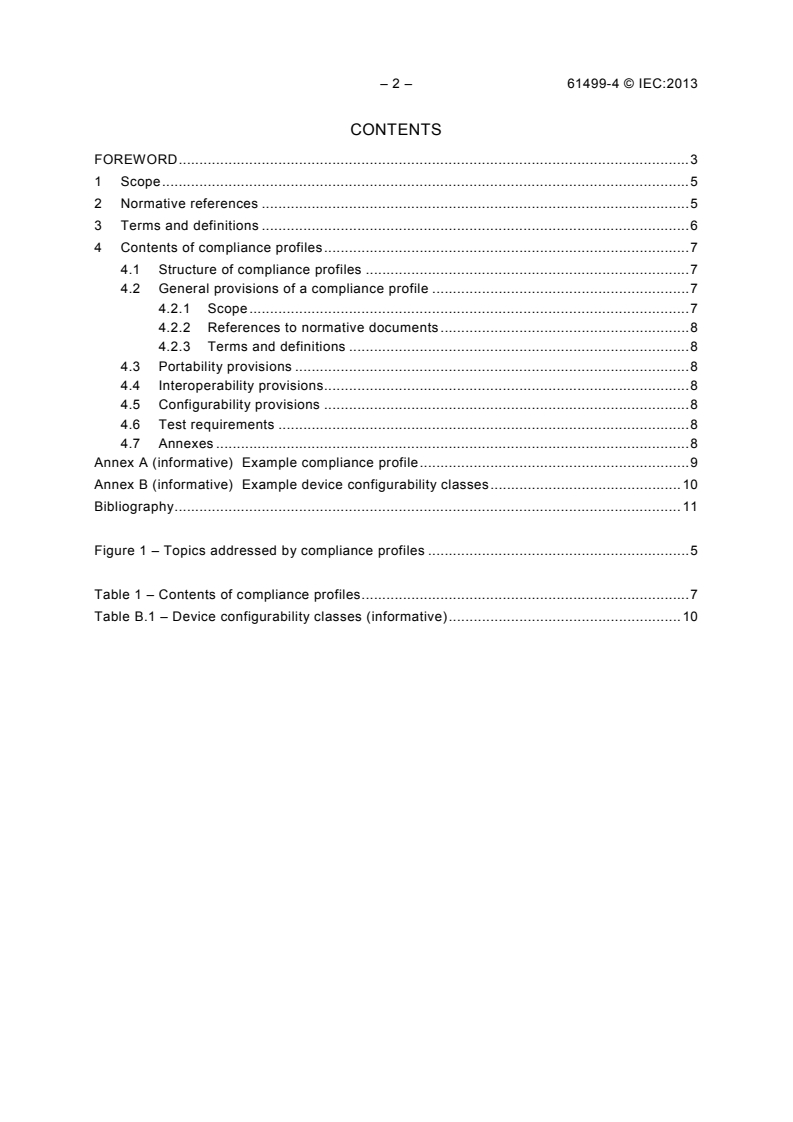
CONTENTS
FOREWORD . 3
1 Scope . 5
2 Normative references . 5
3 Terms and definitions . 6
4 Contents of compliance profiles . 7
4.1 Structure of compliance profiles . 7
4.2 General provisions of a compliance profile . 7
4.2.1 Scope . 7
4.2.2 References to normative documents . 8
4.2.3 Terms and definitions . 8
4.3 Portability provisions . 8
4.4 Interoperability provisions. 8
4.5 Configurability provisions . 8
4.6 Test requirements . 8
4.7 Annexes . 8
Annex A (informative) Example compliance profile . 9
Annex B (informative) Example device configurability classes . 10
Bibliography . 11
Figure 1 – Topics addressed by compliance profiles . 5
Table 1 – Contents of compliance profiles . 7
Table B.1 – Device configurability classes (informative) . 10
61499-4 © IEC:2013 – 3 –
INTERNATIONAL ELECTROTECHNICAL COMMISSION
____________
FUNCTION BLOCKS –
Part 4: Rules for compliance profiles
FOREWORD
1) The International Electrotechnical Commission (IEC) is a worldwide organization for standardization comprising
all national electrotechnical committees (IEC National Committees). The object of IEC is to promote
international co-operation on all questions concerning standardization in the electrical and electronic fields. To
this end and in addition to other activities, IEC publishes International Standards, Technical Specifications,
Technical Reports, Publicly Available Specifications (PAS) and Guides (hereafter referred to as “IEC
Publication(s)”). Their preparation is entrusted to technical committees; any IEC National Committee interested
in the subject dealt with may participate in this preparatory work. International, governmental and non-
governmental organizations liaising with the IEC also participate in this preparation. IEC collaborates closely
with the International Organization for Standardization (ISO) in accordance with conditions determined by
agreement between the two organizations.
2) The formal decisions or agreements of IEC on technical matters express, as nearly as possible, an international
consensus of opinion on the relevant subjects since each technical committee has representation from all
interested IEC National Committees.
3) IEC Publications have the form of recommendations for international use and are accepted by IEC National
Committees in that sense. While all reasonable efforts are made to ensure that the technical content of IEC
Publications is accurate, IEC cannot be held responsible for the way in which they are used or for any
misinterpretation by any end user.
4) In order to promote international uniformity, IEC National Committees undertake to apply IEC Publications
transparently to the maximum extent possible in their national and regional publications. Any divergence
between any IEC Publication and the corresponding national or regional publication shall be clearly indicated in
the latter.
5) IEC itself does not provide any attestation of conformity. Independent certification bodies provide conformity
assessment services and, in some areas, access to IEC marks of conformity. IEC is not responsible for any
services carried out by independent certification bodies.
6) All users should ensure that they have the latest edition of this publication.
7) No liability shall attach to IEC or its directors, employees, servants or agents including individual experts and
members of its technical committees and IEC National Committees for any personal injury, property damage or
other damage of any nature whatsoever, whether direct or indirect, or for costs (including legal fees) and
expenses arising out of the publication, use of, or reliance upon, this IEC Publication or any other IEC
Publications.
8) Attention is drawn to the Normative references cited in this publication. Use of the referenced publications is
indispensable for the correct application of this publication.
9) Attention is drawn to the possibility that some of the elements of this IEC Publication may be the subject of
patent rights. IEC shall not be held responsible for identifying any or all such patent rights.
International Standard IEC 61499-4 has been prepared by subcommittee 65B: Measurement
and control devices, of IEC technical committee 65: Industrial-process measurement, control
and automation.
This second edition cancels and replaces the first edition published in 2005. This edition
constitutes a technical revision.
This edition includes the following significant technical changes with respect to the previous
edition:
Table B.1 has been updated for consistency with Table 8 of IEC 61499-1:2013.
– 4 – 61499-4 © IEC:2013
The text of this standard is based on the following documents:
FDIS Report on voting
65B/854/FDIS 65B/862/RVD
Full information on the voting for the approval of this standard can be found in the report on
voting indicated in the above table.
This publication has been drafted in accordance with the ISO/IEC Directives, Part 2.
A list of all parts of the IEC 61499 series, published under the general title Function blocks,
can be found on the IEC website.
Terms defined in IEC 61499-1, IEC 61499-2 and this standard are italicized.
The committee has decided that the contents of this publication will remain unchanged until
the stability date indicated on the IEC web site under "http://webstore.iec.ch" in the data
related to the specific publication. At this date, the publication will be
• reconfirmed,
• withdrawn,
• replaced by a revised edition, or
• amended.
61499-4 © IEC:2013 – 5 –
FUNCTION BLOCKS –
Part 4: Rules for compliance profiles
1 Scope
This part of IEC 61499 defines rules for the development of compliance profiles, which specify
the features of IEC 61499-1 and 61499-2 to be implemented in order to promote the following
attributes of IEC 61499-based systems, devices and software tools:
• interoperability of devices from multiple suppliers;
• portability of software between software tools of multiple suppliers; and
• configurability of devices from multiple vendors by software tools of multiple suppliers.
These attributes are illustrated in Figure 1.
portability
Software tool 1 Software tool 2
…other tools and devices.
configurability
interoperability
Device 1 Device 2
Sensor/ Sensor/
Actuator Actuator
Link #1 Link #2
IEC 274/13
NOTE 1 The sensor/actuator links designated #1 and #2 in Figure 1 may be non-interoperable. However, it is
intended that systems complying with a particular profile may show the transfer of events and data from sensors on
one link to actuators on another link using appropriately configured and interconnected service interface function
blocks.
NOTE 2 Compliance profiles may extend their scope beyond that shown in Figure 1 to include interoperability of
sensors and actuators.
NOTE 3 Suppliers of software tools ensure that their products conform to the requirements of IEC 61499-2 as well
as any specific requirements defined in compliance profiles applicable to their particular software tools.
Figure 1 – Topics addressed by compliance profiles
The specification of provisions for the facilitation of device interchangeability is beyond the
scope of this part of IEC 61499.
2 Normative references
The following documents, in whole or in part, are normatively referenced in this document and
are indispensable for its application. For dated references, only the edition cited applies. For
undated references, the latest edition of the referenced document (including any
amendments) applies.
– 6 – 61499-4 © IEC:2013
IEC 61499-1,— Function blocks – Part 1: Architecture
IEC 61499-2,— Function blocks – Part 2: Software tool requirements
ISO/IEC Directives, Part 2:2011, Rules for the structure and drafting of International
Standards
3 Terms and definitions
For the purposes of this document, the terms and definitions given in IEC 61499-1 and
IEC 61499-2, as well as the following, apply.
NOTE 1 Terms defined in this clause are italicized where they appear.
NOTE 2 See also the ISO/AFNOR Dictionary of computer science and the International Electrotechnical
Vocabulary for terms not defined or referenced in this part of IEC 61499.
3.1
comply
comply with a specification
meet all the requirements (of the specification)
3.2
compliance profile
specification complying with the rules given in this part of IEC 61499
3.3
configurability
ability (of a functional unit) to be configured
EXAMPLE The configurability of a device can be expressed by the extent to which it conforms to the
configurability requirements of a compliance profile.
3.4
conform
conform to a specification
satisfy some, but not necessarily all, of the requirements (of the specification)
EXAMPLE A software tool or a device developed to meet some but not necessarily all of the requirements of a
compliance profile is said to "conform to" or to be "conformant with" that compliance profile.
3.5
interoperable
able to operate together to perform a specified set of functions
EXAMPLE Two devices may be considered interoperable if they are able to operate together to perform the
functions specified in a system configuration.
3.6
interchangeable
interchangeable with a functional unit
able to be substituted (for the functional unit)
—————————
To be published. Expected publication date: 2013.
See Bibliography.
See Bibliography.
61499-4 © IEC:2013 – 7 –
EXAMPLE A device may be considered interchangeable with another device if it can be substituted for the device
in such a way that any distributed applications will continue to operate as before the substitution, including
identical dynamic responses of any distributed applications involving the device.
3.7
portable
able to be accepted and correctly interpreted by multiple software tools
EXAMPLE A software library element is portable between two software tools if it can be accepted and correctly
interpreted by both software tools.
4 Contents of compliance profiles
4.1 Structure of compliance profiles
The contents of compliance profiles shall follow the general outline given in Table 1. Rules for
the writing of specific clauses and subclauses of such profiles are given in the remainder of
this clause.
The title of a compliance profile shall have the form "IEC 61499 Compliance Profile for ",
where is free text denoting the scope of intended usage of the profile, for example
"Feasibility demonstrations". The title page or a Foreword shall also denote the
organization(s) or individual(s) responsible for the development and maintenance of the
compliance profile.
Compliance profiles may define features not specified in IEC 61499-1 and 61499-2. Such
features shall be described as "extensions to IEC 61499-1" or "extensions to IEC 61499-2"
and the compliance profile shall specify their mapping to the elements described in
IEC 61499-1 or 61499-2, respectively.
Table 1 – Contents of compliance profiles
0. TITLE
0.1 Foreword
1 Scope
2 Normative documents
3 Terms and definitions
4 Portability provisions
5 Interoperability provisions
6 Configurability provisions
7 Test requirements
8 Annexes
4.2 General provisions of a compliance profile
4.2.1 Scope
Clause 1 of a compliance profile shall address the following subjects:
a) the intended usage of the compliance profile;
b) the functional scope addressed by the compliance profile. This may be addressed by a
suitably edited version of Figure 1 accompanied by appropriate text;
c) any additional requirements or restrictions beyond those of IEC 61499-1 and IEC 61499-2
which shall be met within the scope of the compliance profile;
– 8 – 61499-4 © IEC:2013
d) any requirements of IEC 61499-1 and IEC 61499-2 that need not be met within the scope
of the compliance profile;
e) provisions of the compliance profile that contradict the normative requirements of
IEC 61499-1 and IEC 61499-2, and the technical reasons for such contradictions.
4.2.2 References to normative documents
Clause 2 of a compliance profile shall follow the rules for normative references given in Part 2
of the ISO/IEC Directives.
4.2.3 Terms and definitions
Clause 3 of a compliance profile shall follow the rules for terms and definitions given in 6.3.1
and Annex D of Part 2 of the ISO/IEC Directives.
4.3 Portability provisions
Clause 4 of a compliance profile shall contain the following information:
• The extent to which conforming software tools shall be capable of producing library
elements in the syntax and with the semantics defined in Annexes A and B of
IEC 61499-2:2013.
• The extent to which conforming software tools shall be capable of correctly parsing and
interpreting library elements in the syntax and with the semantics defined in Annexes A
and B of IEC 61499-2:2013.
• The format of filenames (if any) to be used for the exchange of library elements, for
instance .xml.
4.4 Interoperability provisions
Clause 5 of a compliance profile shall specify the means to be used to meet the requirements
for communication among entities within the functional scope of the compliance profile, for
instance in terms of the semantics of the event and data inputs and outputs of
communication function blocks defined in IEC 61499-1.
The syntax of the event and data inputs and outputs of communication function blocks may,
but are not required to, be used to meet the requirements of this subclause.
4.5 Configurability provisions
Clause 6 of a compliance profile shall specify the means to be implemented by devices and
software tools to achieve configurability of the former by the latter. This may include the
definition of one or more configurability classes for devices.
NOTE An example of the definition of configurability classes is shown in Annex B.
4.6 Test requirements
Clause 7 of a compliance profile shall specify the tests (if any) to be performed to ensure
compliance with the requirements of the profile.
4.7 Annexes
A compliance profile may contain normative or informative annexes. A normative annex
contains provisions which shall be satisfied by compliant implementations, while an
informative annex shall not contain such provisions. The normative or informative nature of
each Annex shall be made clear by the way in which it is referred to in the text and by an
indication in the profile's table of contents and under the heading of the annex.
61499-4 © IEC:2013 – 9 –
Annex A
(informative)
Example compliance profile
An example document used to guide and record the results of an IEC 61499 feasibility
demonstration project undertaken by the Holonic Manufacturing Systems (HMS) Consortium
is available online at http://www.holobloc.com/doc/ita/index.htm. To save space, this
document is not included here. Notices of updates to the referenced document will be posted
at http://www.holobloc.com/.
– 10 – 61499-4 © IEC:2013
Annex B
(informative)
Example device configurability classes
NOTE The following is an example of suggested wording that could be used in a compliance profile and does not
form a normative provision of this standard.
Types and instances of devices conforming with this compliance profile are specified
according to the rules given in IEC 61499-1.
Devices conforming to this compliance profile are characterized as belonging to one of three
configurability classes, namely:
• Class 0: Simple devices;
• Class 1: Simple programmable devices;
• Class 2: User-reprogrammable devices.
Configurability is specified in terms of the management commands (defined in IEC 61499-1)
to which each type of device can respond, as given in Table B.1.
Table B.1 – Device configurability classes (informativ
...