


IEC 61008-1:2010
(Main)Residual current operated circuit-breakers without integral overcurrent protection for household and similar uses (RCCBs) - Part 1: General rules
General Information
- Abstract
IEC 61008-1:2010 applies to residual current operated circuit-breakers functionally independent of, or functionally dependent on, line voltage, for household and similar uses, not incorporating overcurrent protection (hereafter referred to as RCCBs), for rated voltages not exceeding 440 V a.c. with rated frequencies of 50 Hz, 60 Hz or 50/60 Hz and rated currents not exceeding 125 A, intended principally for protection against shock hazard. This third edition cancels and replaces the second edition published in 1996, amendment 1 (2002) and amendment 2 (2006). This edition constitutes a technical revision. This edition includes the following significant technical changes with respect to the previous edition:
- complete revision of EMC sequences, including the new test T.2.6 already approved in IEC 61543;
- clarification of RCDs current/time characteristics reported in Tables 1 and 2;
- revision of test procedure for IΔn between 5 A and 200 A;
- testing procedure regarding the 6mA d.c. current superimposed to the fault current;
- improvement highlighting RCDs with multiple sensitivity;
- tests for the use of RCCBs in IT systems.
- Status
- Published
- Publication Date
- 11-Sep-2013
- Technical Committee
- SC 23E - Circuit-breakers and similar equipment for household use
- Drafting Committee
- WG 2 - TC 23/SC 23E/WG 2
- Current Stage
- DELPUB - Deleted Publication
- Start Date
- 21-Nov-2024
- Completion Date
- 04-Dec-2020
Buy Documents
IEC 61008-1:2010 - Residual current operated circuit-breakers without integral overcurrent protection for household and similar uses (RCCBs) - Part 1: General rules Released:2/11/2010

IEC 61008-1:2010+AMD1:2012+AMD2:2013 CSV - Residual current operated circuit-breakers without integral overcurrent protection for household and similar uses (RCCBs) - Part1: General rules Released:9/12/2013
IEC 61008-1:2010+AMD1:2012 CSV - Residual current operated circuit-breakers without integral overcurrent protection for household and similar uses (RCCBs) - Part 1: General rules Released:4/30/2012
IEC 61008-1:2010 Overview
IEC 61008-1:2010 is an international standard issued by the International Electrotechnical Commission (IEC) that covers Residual Current Operated Circuit-Breakers (RCCBs) without integral overcurrent protection. Specifically designed for household and similar uses, this standard outlines the general rules applicable to RCCBs with rated voltages up to 440 V a.c., rated currents up to 125 A, and operating frequencies of 50 Hz, 60 Hz, or 50/60 Hz.
RCCBs under this standard are primarily intended to protect users against electric shock hazards by promptly disconnecting electricity when residual current faults occur. This edition of the standard represents a technical revision with significant improvements from previous editions, including enhanced electromagnetic compatibility (EMC) testing and refined operational characteristics.
Key Topics Covered
Classification and Characteristics
IEC 61008-1 defines RCCBs based on several criteria, such as:
- Functional independence or dependence on line voltage
- Number of poles and current paths
- Adjustability of residual operating current
- Behavior under voltage surges and presence of DC components
- Time-delay characteristics and external influences
- Installation and mounting methods
Rated Quantities
The standard specifies the following rated quantities essential to RCCB performance:
- Rated voltage (up to 440 V a.c.)
- Rated current (up to 125 A)
- Rated residual operating current (IΔn)
- Rated residual non-operating current (IΔno)
- Operating frequency (50/60 Hz)
- Rated making and breaking capacities
- Residual making and breaking capacities
Construction and Operation Requirements
IEC 61008-1 outlines critical mechanical and electrical requirements, including:
- Mechanical design and endurance
- Electrical endurance and temperature-rise limits
- Protection against electric shock
- Resistance to mechanical shock, heat, and fire
- Electromagnetic compatibility (EMC) performance
- Behavior under earth fault currents with DC components
Testing Procedures
The standard describes rigorous testing protocols to ensure RCCB reliability and safety:
- Verification of marking durability and screw terminal reliability
- Dielectric property tests, including insulation resistance and dielectric strength
- Temperature-rise measurements under standard conditions
- Electromagnetic compatibility and immunity tests
- Tests simulating use in IT systems and presence of DC components superimposed on fault currents
Practical Applications
IEC 61008-1:2010 RCCBs are widely utilized in residential homes, commercial buildings, and other similar environments to enhance electrical safety by preventing dangerous earth leakage currents. Key practical uses include:
- Shock hazard protection: Quickly disconnecting circuits when leakage current exceeds safe thresholds to protect persons from electric shocks.
- Installation in household electrical panels: Serving as essential protective devices in distribution boards without combined overcurrent protection.
- Use in systems with DC components: Ensuring reliable operation even where DC residual currents are present, such as in solar power systems or electric vehicle charging stations.
- Compatibility with regional electrical installations: Supporting rated voltages and frequencies common globally, offering standardized safety solutions.
RCCBs designed according to IEC 61008-1 meet stringent international safety standards, facilitating their integration into global electrical infrastructures and compliance with local building codes.
Related Standards and References
IEC 61008-1 complements and interacts with several key IEC standards, including:
- IEC 61543: Electromagnetic compatibility (EMC) testing procedures for low-voltage RCDs, referenced for the new EMC test sequences adopted.
- IEC 61009-1: Residual current operated circuit-breakers with integral overcurrent protection (RCBOs) for household uses.
- International Electrotechnical Vocabulary (IEV): Provides standardized terminology related to RCCBs.
- National and regional electrical safety codes: Incorporate IEC standards to enhance uniformity in residual current device requirements.
By adhering to IEC 61008-1:2010, manufacturers, electrical engineers, and safety inspectors ensure that RCCBs provide reliable, standardized protection against shock hazards in household electrical installations worldwide.
Keywords: IEC 61008-1, RCCB, residual current operated circuit-breaker, electrical safety, shock hazard protection, household electrical devices, electromagnetic compatibility, rated voltage, rated current, earth fault current, IEC standard for RCCB, electrical installation safety.
Relations
- Effective Date
- 05-Sep-2023
- Effective Date
- 05-Sep-2023
- Effective Date
- 05-Sep-2023
- Effective Date
- 05-Sep-2023
- Effective Date
- 05-Sep-2023
- Effective Date
- 05-Sep-2023
Buy Documents
IEC 61008-1:2010 - Residual current operated circuit-breakers without integral overcurrent protection for household and similar uses (RCCBs) - Part 1: General rules Released:2/11/2010
IEC 61008-1:2010+AMD1:2012+AMD2:2013 CSV - Residual current operated circuit-breakers without integral overcurrent protection for household and similar uses (RCCBs) - Part1: General rules Released:9/12/2013
IEC 61008-1:2010+AMD1:2012 CSV - Residual current operated circuit-breakers without integral overcurrent protection for household and similar uses (RCCBs) - Part 1: General rules Released:4/30/2012
Get Certified
Connect with accredited certification bodies for this standard

IMQ S.p.A. (Certification)
Italian electrical product certification.

SLG Prüf- und Zertifizierungs GmbH
German testing and certification body.

UL Solutions
Global safety science company with testing, inspection and certification.
Sponsored listings
Frequently Asked Questions
IEC 61008-1:2010 is a standard published by the International Electrotechnical Commission (IEC). Its full title is "Residual current operated circuit-breakers without integral overcurrent protection for household and similar uses (RCCBs) - Part 1: General rules". This standard covers: IEC 61008-1:2010 applies to residual current operated circuit-breakers functionally independent of, or functionally dependent on, line voltage, for household and similar uses, not incorporating overcurrent protection (hereafter referred to as RCCBs), for rated voltages not exceeding 440 V a.c. with rated frequencies of 50 Hz, 60 Hz or 50/60 Hz and rated currents not exceeding 125 A, intended principally for protection against shock hazard. This third edition cancels and replaces the second edition published in 1996, amendment 1 (2002) and amendment 2 (2006). This edition constitutes a technical revision. This edition includes the following significant technical changes with respect to the previous edition: - complete revision of EMC sequences, including the new test T.2.6 already approved in IEC 61543; - clarification of RCDs current/time characteristics reported in Tables 1 and 2; - revision of test procedure for IΔn between 5 A and 200 A; - testing procedure regarding the 6mA d.c. current superimposed to the fault current; - improvement highlighting RCDs with multiple sensitivity; - tests for the use of RCCBs in IT systems.
IEC 61008-1:2010 applies to residual current operated circuit-breakers functionally independent of, or functionally dependent on, line voltage, for household and similar uses, not incorporating overcurrent protection (hereafter referred to as RCCBs), for rated voltages not exceeding 440 V a.c. with rated frequencies of 50 Hz, 60 Hz or 50/60 Hz and rated currents not exceeding 125 A, intended principally for protection against shock hazard. This third edition cancels and replaces the second edition published in 1996, amendment 1 (2002) and amendment 2 (2006). This edition constitutes a technical revision. This edition includes the following significant technical changes with respect to the previous edition: - complete revision of EMC sequences, including the new test T.2.6 already approved in IEC 61543; - clarification of RCDs current/time characteristics reported in Tables 1 and 2; - revision of test procedure for IΔn between 5 A and 200 A; - testing procedure regarding the 6mA d.c. current superimposed to the fault current; - improvement highlighting RCDs with multiple sensitivity; - tests for the use of RCCBs in IT systems.
IEC 61008-1:2010 is classified under the following ICS (International Classification for Standards) categories: 29.120.50 - Fuses and other overcurrent protection devices. The ICS classification helps identify the subject area and facilitates finding related standards.
IEC 61008-1:2010 has the following relationships with other standards: It is inter standard links to IEC 61008-1:2010/AMD2:2013, IEC 61008-1:2010/AMD1:2012, IEC 61008-1:1996/AMD1:2002, IEC 61008-1:1996, IEC 61008-1:2024, IEC 61008-1:1996/AMD2:2006. Understanding these relationships helps ensure you are using the most current and applicable version of the standard.
IEC 61008-1:2010 is available in PDF format for immediate download after purchase. The document can be added to your cart and obtained through the secure checkout process. Digital delivery ensures instant access to the complete standard document.
Standards Content (Sample)
IEC 61008-1 ®
Edition 3.0 2010-02
INTERNATIONAL
STANDARD
NORME
INTERNATIONALE
Residual current operated circuit-breakers without integral overcurrent
protection for household and similar uses (RCCBs) –
Part 1: General rules
Interrupteurs automatiques à courant différentiel résiduel sans dispositif de
protection contre les surintensités incorporé pour usages domestiques et
analogues (ID) –
Partie 1: Règles générales
All rights reserved. Unless otherwise specified, no part of this publication may be reproduced or utilized in any form or by
any means, electronic or mechanical, including photocopying and microfilm, without permission in writing from either IEC or
IEC's member National Committee in the country of the requester.
If you have any questions about IEC copyright or have an enquiry about obtaining additional rights to this publication,
please contact the address below or your local IEC member National Committee for further information.
Droits de reproduction réservés. Sauf indication contraire, aucune partie de cette publication ne peut être reproduite
ni utilisée sous quelque forme que ce soit et par aucun procédé, électronique ou mécanique, y compris la photocopie
et les microfilms, sans l'accord écrit de la CEI ou du Comité national de la CEI du pays du demandeur.
Si vous avez des questions sur le copyright de la CEI ou si vous désirez obtenir des droits supplémentaires sur cette
publication, utilisez les coordonnées ci-après ou contactez le Comité national de la CEI de votre pays de résidence.
IEC Central Office
3, rue de Varembé
CH-1211 Geneva 20
Switzerland
Email: inmail@iec.ch
Web: www.iec.ch
About the IEC
The International Electrotechnical Commission (IEC) is the leading global organization that prepares and publishes
International Standards for all electrical, electronic and related technologies.
About IEC publications
The technical content of IEC publications is kept under constant review by the IEC. Please make sure that you have the
latest edition, a corrigenda or an amendment might have been published.
ƒ Catalogue of IEC publications: www.iec.ch/searchpub
The IEC on-line Catalogue enables you to search by a variety of criteria (reference number, text, technical committee,…).
It also gives information on projects, withdrawn and replaced publications.
ƒ IEC Just Published: www.iec.ch/online_news/justpub
Stay up to date on all new IEC publications. Just Published details twice a month all new publications released. Available
on-line and also by email.
ƒ Electropedia: www.electropedia.org
The world's leading online dictionary of electronic and electrical terms containing more than 20 000 terms and definitions
in English and French, with equivalent terms in additional languages. Also known as the International Electrotechnical
Vocabulary online.
ƒ Customer Service Centre: www.iec.ch/webstore/custserv
If you wish to give us your feedback on this publication or need further assistance, please visit the Customer Service
Centre FAQ or contact us:
Email: csc@iec.ch
Tel.: +41 22 919 02 11
Fax: +41 22 919 03 00
A propos de la CEI
La Commission Electrotechnique Internationale (CEI) est la première organisation mondiale qui élabore et publie des
normes internationales pour tout ce qui a trait à l'électricité, à l'électronique et aux technologies apparentées.
A propos des publications CEI
Le contenu technique des publications de la CEI est constamment revu. Veuillez vous assurer que vous possédez
l’édition la plus récente, un corrigendum ou amendement peut avoir été publié.
ƒ Catalogue des publications de la CEI: www.iec.ch/searchpub/cur_fut-f.htm
Le Catalogue en-ligne de la CEI vous permet d’effectuer des recherches en utilisant différents critères (numéro de référence,
texte, comité d’études,…). Il donne aussi des informations sur les projets et les publications retirées ou remplacées.
ƒ Just Published CEI: www.iec.ch/online_news/justpub
Restez informé sur les nouvelles publications de la CEI. Just Published détaille deux fois par mois les nouvelles
publications parues. Disponible en-ligne et aussi par email.
ƒ Electropedia: www.electropedia.org
Le premier dictionnaire en ligne au monde de termes électroniques et électriques. Il contient plus de 20 000 termes et
définitions en anglais et en français, ainsi que les termes équivalents dans les langues additionnelles. Egalement appelé
Vocabulaire Electrotechnique International en ligne.
ƒ Service Clients: www.iec.ch/webstore/custserv/custserv_entry-f.htm
Si vous désirez nous donner des commentaires sur cette publication ou si vous avez des questions, visitez le FAQ du
Service clients ou contactez-nous:
Email: csc@iec.ch
Tél.: +41 22 919 02 11
Fax: +41 22 919 03 00
IEC 61008-1 ®
Edition 3.0 2010-02
INTERNATIONAL
STANDARD
NORME
INTERNATIONALE
Residual current operated circuit-breakers without integral overcurrent
protection for household and similar uses (RCCBs) –
Part 1: General rules
Interrupteurs automatiques à courant différentiel résiduel sans dispositif de
protection contre les surintensités incorporé pour usages domestiques et
analogues (ID) –
Partie 1: Règles générales
INTERNATIONAL
ELECTROTECHNICAL
COMMISSION
COMMISSION
ELECTROTECHNIQUE
PRICE CODE
INTERNATIONALE
XF
CODE PRIX
ICS 29.120.50 ISBN 978-2-88910-398-0
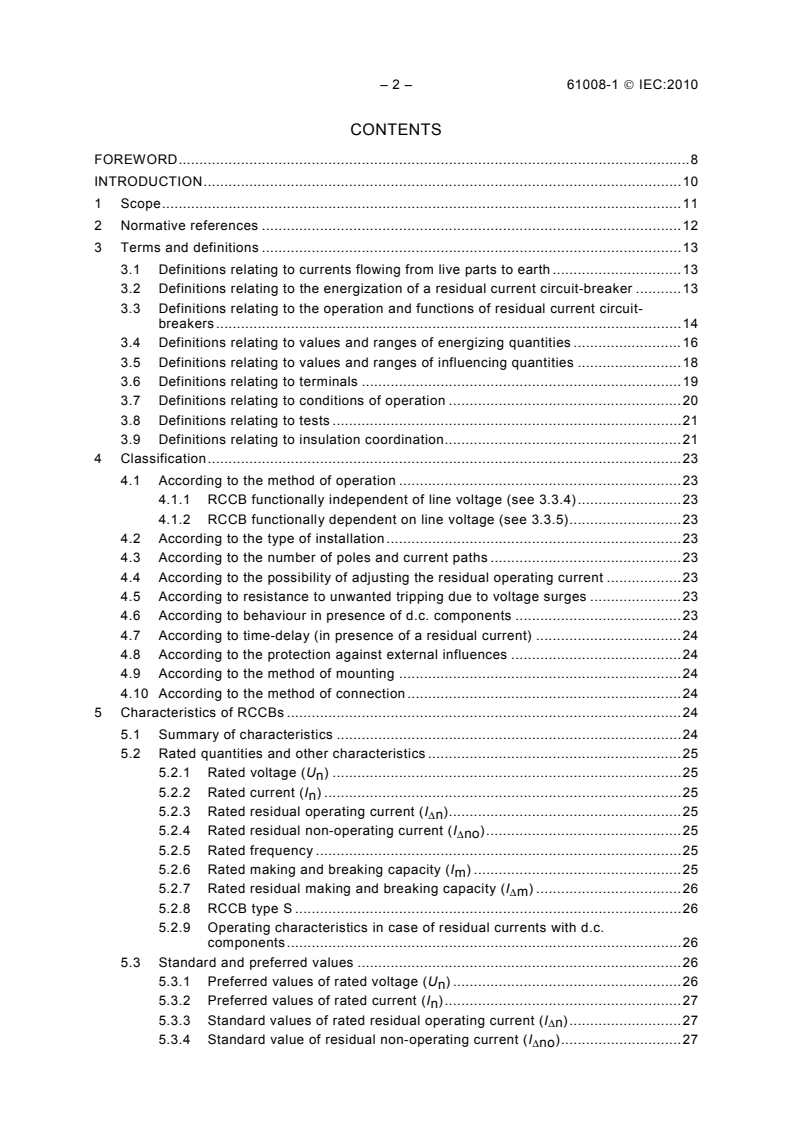
– 2 – 61008-1 © IEC:2010
CONTENTS
FOREWORD.8
INTRODUCTION.10
1 Scope.11
2 Normative references .12
3 Terms and definitions .13
3.1 Definitions relating to currents flowing from live parts to earth .13
3.2 Definitions relating to the energization of a residual current circuit-breaker .13
3.3 Definitions relating to the operation and functions of residual current circuit-
breakers.14
3.4 Definitions relating to values and ranges of energizing quantities .16
3.5 Definitions relating to values and ranges of influencing quantities .18
3.6 Definitions relating to terminals .19
3.7 Definitions relating to conditions of operation .20
3.8 Definitions relating to tests .21
3.9 Definitions relating to insulation coordination.21
4 Classification.23
4.1 According to the method of operation .23
4.1.1 RCCB functionally independent of line voltage (see 3.3.4).23
4.1.2 RCCB functionally dependent on line voltage (see 3.3.5).23
4.2 According to the type of installation.23
4.3 According to the number of poles and current paths .23
4.4 According to the possibility of adjusting the residual operating current .23
4.5 According to resistance to unwanted tripping due to voltage surges .23
4.6 According to behaviour in presence of d.c. components .23
4.7 According to time-delay (in presence of a residual current) .24
4.8 According to the protection against external influences .24
4.9 According to the method of mounting .24
4.10 According to the method of connection.24
5 Characteristics of RCCBs .24
5.1 Summary of characteristics .24
5.2 Rated quantities and other characteristics .25
5.2.1 Rated voltage (U ) .25
n
5.2.2 Rated current (I ) .25
n
5.2.3 Rated residual operating current (I ).25
Δn
5.2.4 Rated residual non-operating current (I ).25
Δno
5.2.5 Rated frequency .25
5.2.6 Rated making and breaking capacity (I ) .25
m
5.2.7 Rated residual making and breaking capacity (I ) .26
Δm
5.2.8 RCCB type S .26
5.2.9 Operating characteristics in case of residual currents with d.c.
components.
5.3 Standard and preferred values .26
5.3.1 Preferred values of rated voltage (U ) .26
n
5.3.2 Preferred values of rated current (I ).27
n
5.3.3 Standard values of rated residual operating current (I ).27
Δn
5.3.4 Standard value of residual non-operating current (I ).27
Δno
61008-1 © IEC:2010 – 3 –
5.3.5 Standard minimum value of non-operating overcurrent in case of a
multiphase balanced load through a multipole RCCB (see 3.4.2.1) .27
5.3.6 Standard minimum value of the non-operating overcurrent in case of
a single-phase load through a three-pole or four-pole RCCB (see
3.4.2.2).27
5.3.7 Preferred values of rated frequency.27
5.3.8 Minimum value of the rated making and breaking capacity (I ) .27
m
5.3.9 Minimum value of the rated residual making and breaking capacity
(I ).28
Δm
5.3.10 Standard and preferred values of the rated conditional short-circuit
current (I ).28
nc
5.3.11 Standard values of the rated conditional residual short-circuit current
(I ).28
Δc
5.3.12 Limit values of break time and non-actuating time for RCCB of type
AC and A.28
5.3.13 Standard value of rated impulse withstand voltage (U ).29
imp
5.4 Coordination with short-circuit protective devices (SCPDs).30
5.4.1 General .30
5.4.2 Rated conditional short-circuit current (I ) .30
nc
5.4.3 Rated conditional residual short-circuit current (I ) .30
Δc
6 Marking and other product information.30
7 Standard conditions for operation in service and for installation.32
7.1 Standard conditions.32
7.2 Conditions of installation .33
7.3 Pollution degree .33
8 Requirements for construction and operation.33
8.1 Mechanical design.33
8.1.1 General .33
8.1.2 Mechanism .33
8.1.3 Clearances and creepage distances (see Annex B) .35
8.1.4 Screws, current-carrying parts and connections.37
8.1.5 Terminals for external conductors.38
8.2 Protection against electric shock .40
8.3 Dielectric properties and isolating capability .40
8.4 Temperature-rise.41
8.4.1 Temperature-rise limits.41
8.4.2 Ambient air temperature .41
8.5 Operating characteristic .41
8.6 Mechanical and electrical endurance.41
8.7 Performance at short-circuit currents.41
8.8 Resistance to mechanical shock and impact.42
8.9 Resistance to heat .42
8.10 Resistance to abnormal heat and to fire .42
8.11 Test device.42
8.12 Requirements for RCCBs functionally dependent on line voltage.42
8.13 Behaviour of RCCBs in case of overcurrents in the main circuit.43
8.14 Behaviour of RCCBs in the case of current surges caused by impulse
voltages .43
8.15 Behaviour of RCCBs in case of earth fault currents comprising a d.c.
component .43
– 4 – 61008-1 © IEC:2010
8.16 Reliability .43
8.17 Electromagnetic compatibility (EMC) .43
9 Tests .43
9.1 General .43
9.2 Test conditions.44
9.3 Test of indelibility of marking .45
9.4 Test of reliability of screws, current-carrying parts and connections .46
9.5 Test of reliability of terminals for external conductors .47
9.6 Verification of protection against electric shock .48
9.7 Test of dielectric properties .49
9.7.1 Resistance to humidity .49
9.7.2 Insulation resistance of the main circuit .49
9.7.3 Dielectric strength of the main circuit.50
9.7.4 Insulation resistance and dielectric strength of auxiliary circuits .51
9.7.5 Secondary circuit of detection transformers .51
9.7.6 Capability of control circuits connected to the main circuit
withstanding high d.c. voltages due to insulation measurements.51
9.7.7 Verification of impulse withstand voltages (across clearances and
across solid insulation) and of leakage current across open contacts .52
9.8 Test of temperature-rise .54
9.8.1 Ambient air temperature .54
9.8.2 Test procedure .54
9.8.3 Measurement of the temperature of parts .54
9.8.4 Temperature rise of a part .55
9.9 Verification of the operating characteristic .55
9.9.1 Test circuit .55
9.9.2 Off-load tests with residual sinusoidal alternating currents at the
reference temperature of 20 °C ± 5 °C.55
9.9.3 Verification of the correct operation with load at the reference
temperature.56
9.9.4 Tests at the temperature limits .56
9.9.5 Particular test conditions for RCCBs functionally dependent on line
voltage .
9.10 Verification of mechanical and electrical endurance .57
9.10.1 General test conditions.57
9.10.2 Test procedure .57
9.10.3 Condition of the RCCB after test.58
9.11 Verification of the behaviour of the RCCB under short-circuit conditions.58
9.11.1 List of the short-circuit tests.58
9.11.2 Short-circuit tests .58
9.12 Verification of resistance to mechanical shock and impact.67
9.12.1 Mechanical shock .67
9.12.2 Mechanical impact.67
9.13 Test of resistance to heat .70
9.14 Test of resistance to abnormal heat and to fire .71
9.15 Verification of the trip-free mechanism .71
9.15.1 General test conditions.71
9.15.2 Test procedure .71
9.16 Verification of the operation of the test device at the limits of rated voltage .72
61008-1 © IEC:2010 – 5 –
9.17 Verification of the behaviour of RCCBs functionally dependent on line
voltage, classified under 4.1.2.1, in case of failure of the line voltage.72
9.17.1 Determination of the limiting value of the line voltage (U ).72
x
9.17.2 Verification of the automatic opening in case of failure of the line
voltage .73
9.17.3 Verification of the correct operation, in presence of a residual
current, for RCCBs opening with delay in case of failure of the line
voltage .73
9.17.4 Verification of the correct operation of RCCBs with three or four
current paths, with a residual current, one line terminal only being
energized .73
9.17.5 Verification of the reclosing function of automatically reclosing
RCCBs .73
9.18 Verification of limiting values of the non-operating current under overcurrent
conditions.73
9.18.1 Verification of the limiting value of overcurrent in case of a load
through an RCCB with two current paths .73
9.18.2 Verification of the limiting value of overcurrent in case of a single
phase load through a three-pole or four-pole RCCB.74
9.19 Verification of behaviour of RCCBs in case of current surges caused by
impulse voltages .74
9.19.1 Current surge test for all RCCBs (0,5 μs/100 kHz ring wave test) .74
9.19.2 Verification of behaviour at surge currents up to 3 000 A (8/20 μs
surge current test) .75
9.20 Verification of resistance of the insulation against an impulse voltage .75
9.21 Verification of correct operation of residual currents with d.c. components .76
9.21.1 Type A residual current devices.76
9.22 Verification of reliability .77
9.22.1 Climatic test .77
9.22.2 Test with temperature of 40 °C .79
9.23 Verification of ageing of electronic components.80
9.24 Electromagnetic compatibility (EMC) .80
Annex A (normative) Test sequence and number of samples to be submitted for
certification purposes.107
Annex B (normative) Determination of clearances and creepage distances . 113
Annex C (normative) Arrangement for the detection of the emission of ionized gases
during short-circuit tests .115
Annex D (normative) Routine tests.118
Annex E (informative) Void .119
Annex IA (informative) Methods for determination of short-circuit power-factor .120
Annex IB (informative) Glossary of symbols .121
Annex IC (informative) Examples of terminal designs. 122
Annex ID (informative) Correspondence between ISO and AWG copper conductors . 125
Annex IE (informative) Follow-up testing program for RCCBs . 126
Annex IF (informative) SCPDs for short-circuit tests .130
Bibliography.132
Figure 1 – Thread forming tapping screw (3.6.10) .80
Figure 2 – Thread cutting tapping screw (3.6.11) .81
Figure 3 – Standard test finger (9.6) .82
– 6 – 61008-1 © IEC:2010
Figure 4 – Test circuit for the verification of
– operating characteristics (9.9)
– trip-free mechanism (9.15)
– behaviour in case of failure of line voltage (9.17.3 and 9.17.4) for RCCBs
functionally dependent on line voltage .83
Figure 5 – Test circuit for the verification of the correct operation of RCCBs in the case
of residual pulsating direct currents .84
Figure 6 – Test circuit for the verification of the correct operation in case of residual
pulsating direct currents in presence of a standing smooth direct current of 0,006 A.85
Figure 7 – Test circuit for the verification of the suitability of an RCCB for use in IT
systems .87
Figure 8 – Test circuit for the verification of the rated making and breaking capacity
and of the coordination with a SCPD of a single-pole RCCB with two current paths
(9.11).88
Figure 9 – Test circuit for the verification of the rated making and breaking capacity
and of the coordination with a SCPD of a two-pole RCCB, in case of a single-phase
circuit (9.11) .89
Figure 10 – Test circuit for the verification of the rated making and breaking capacity
and of the coordination with a SCPD of a three-pole RCCB on three-phase circuit
(9.11).90
Figure 11 – Test circuit for the verification of the rated making and braking capacity
and of the coordination with a SCPD of a three-pole RCCB with four current paths on a
three-phase circuit with neutral (9.11).91
Figure 12 – Test circuit for the verification of the rated making and breaking capacity
and of the coordination with a SCPD of a four-pole RCCB on a three-phase circuit with
neutral (9.11) .92
Figure 13 – Test apparatus for the verification of the minimum I t and I values to be
p
withstood by the RCCB (9.11.2.1 a)).93
Figure 14 – Mechanical shock test apparatus (9.12.1) .94
Figure 15 – Mechanical impact test apparatus (9.12.2.1) .95
Figure 16 – Striking element for pendulum impact test apparatus (9.12.2.1) .96
Figure 17 – Mounting support for sample for mechanical impact test (9.12.2.1) .97
Figure 18 – Example of mounting and unenclosed RCCB for mechanical impact test
(9.12.2.1).98
Figure 19 – Example of mounting of panel mounting type RCCB for the mechanical
impact test (9.21.2.1) .99
Figure 20 – Application of force for mechanical test of rail mounted RCCB (9.12.2.2) . 100
Figure 21 – Ball-pressure test apparatus (9.13.2) .100
Figure 22 – Test circuit for the verification of the limiting value of overcurrent in case of
single-phase load through a three-pole RCCB (9.18.2) .101
Figure 23 – Current ring wave 0,5 μs/100 kHz .102
Figure 24 – Test circuit for the ring wave test at RCCBs .102
Figure 25 – Stabilizing period for reliability test (9.22.1.3).103
Figure 26 – Reliability test cycle (9.22.1.3) .104
Figure 27 – Example for test circuit for verification of ageing of electronic components
(9.23).105
Figure 28 – Surge current impulse 8/20 μs.105
Figure 29 – Test circuit for the surge current test at RCCBs.106
Figure 30 – Example of calibration record for short-circuit test (9.11.2.1 j) ii)) . 106
Figures B.1 to B.10 – Illustrations of the application of creepage distances .114
61008-1 © IEC:2010 – 7 –
Figure C.1 – Test arrangement .116
Figure C.2 – Grid .117
Figure C.3 – Grid circuit.117
Figure IC.1 – Examples of pillar terminals.122
Figure IC.2 – Examples of screw terminals and stud terminals.123
Figure IC.3 – Examples of saddle terminals .124
Figure IC.4 – Examples of lug terminals.124
Table 1 – Limit values of break time and non-actuating time for alternating residual
currents (r.m.s. values) for type AC and A RCCB.29
Table 2 – Maximum values of break time for half-wave pulsating residual currents
(r.m.s. values) for type A RCCB .29
Table 3 – Rated impulse withstand voltage as a function of the nominal voltage of the
installation .30
Table 4 – Standard conditions for operation in service .32
Table 5 – Minimum clearances and creepage distances.36
Table 6 – Connectable cross-sections of copper conductors for screw-type terminals .38
Table 7 – Temperature-rise values.41
Table 8 – Requirements for RCCBs functionally dependent on line voltage.43
Table 9 – List of type tests.44
Table 10 – Test copper conductors corresponding to the rated currents.45
Table 11 – Screw thread diameters and applied torques .46
Table 12 – Pulling forces .47
Table 13 – Conductor dimensions .48
Table 14 – Test voltage of auxiliary circuits .51
Table 15 – Test voltage across the open contacts for verifying the suitability for
isolation, referred to the rated impulse withstand voltage of the RCCB and the altitude
where the test is carried out.53
Table 16 − Test voltage for verification of impulse withstand voltage for the parts not
tested in 9.7.7.1.54
Table 17 – Tests to be made to verify the behaviour of RCCBs under short-circuit
conditions .58
²
Table 18 – Minimum values of l t and l .60
p
Table 19 – Power factors for short-circuit tests .61
Table 20 – Tripping current ranges for type A RCCBs .77
Table 21 – Tests to be applied for EMC .80
Table A.1 – Test sequences.108
Table A.2 – Number of samples for full test procedure .109
Table A.3 – Number of samples for simplified test procedure. 111
Table A.4 – Test sequences for RCCBs of different classification according to 4.6 .112
Table IE.1 – Test sequences during follow-up inspections .126
Table IE.2 – Number of samples to be tested.128
Table IF.1 – Indication of silver wire diameters as a function of rated currents and
short-circuit currents .130
– 8 – 61008-1 © IEC:2010
INTERNATIONAL ELECTROTECHNICAL COMMISSION
____________
RESIDUAL CURRENT OPERATED CIRCUIT-BREAKERS
WITHOUT INTEGRAL OVERCURRENT PROTECTION
FOR HOUSEHOLD AND SIMILAR USES (RCCBs) –
Part 1: General rules
FOREWORD
1) The International Electrotechnical Commission (IEC) is a worldwide organization for standardization comprising
all national electrotechnical committees (IEC National Committees). The object of IEC is to promote
international co-operation on all questions concerning standardization in the electrical and electronic fields. To
this end and in addition to other activities, IEC publishes International Standards, Technical Specifications,
Technical Reports, Publicly Available Specifications (PAS) and Guides (hereafter referred to as “IEC
Publication(s)”). Their preparation is entrusted to technical committees; any IEC National Committee interested
in the subject dealt with may participate in this preparatory work. International, governmental and non-
governmental organizations liaising with the IEC also participate in this preparation. IEC collaborates closely
with the International Organization for Standardization (ISO) in accordance with conditions determined by
agreement between the two organizations.
2) The formal decisions or agreements of IEC on technical matters express, as nearly as possible, an international
consensus of opinion on the relevant subjects since each technical committee has representation from all
interested IEC National Committees.
3) IEC Publications have the form of recommendations for international use and are accepted by IEC National
Committees in that sense. While all reasonable efforts are made to ensure that the technical content of IEC
Publications is accurate, IEC cannot be held responsible for the way in which they are used or for any
misinterpretation by any end user.
4) In order to promote international uniformity, IEC National Committees undertake to apply IEC Publications
transparently to the maximum extent possible in their national and regional publications. Any divergence
between any IEC Publication and the corresponding national or regional publication shall be clearly indicated in
the latter.
5) IEC itself does not provide any attestation of conformity. Independent certification bodies provide conformity
assessment services and, in some areas, access to IEC marks of conformity. IEC is not responsible for any
services carried out by independent certification bodies.
6) All users should ensure that they have the latest edition of this publication.
7) No liability shall attach to IEC or its directors, employees, servants or agents including individual experts and
members of its technical committees and IEC National Committees for any personal injury, property damage or
other damage of any nature whatsoever, whether direct or indirect, or for costs (including legal fees) and
expenses arising out of the publication, use of, or reliance upon, this IEC Publication or any other IEC
Publications.
8) Attention is drawn to the Normative references cited in this publication. Use of the referenced publications is
indispensable for the correct application of this publication.
9) Attention is drawn to the possibility that some of the elements of this IEC Publication may be the subject of
patent rights. IEC shall not be held responsible for identifying any or all such patent rights.
International Standard IEC 61008-1 has been prepared by subcommittee 23E: Circuit-
breakers and similar equipment for household use, of IEC technical committee 23: Electrical
accessories.
This third editions cancels and replaces the second edition published in 1996, amendment 1
(2002) and amendment 2 (2006). This edition constitutes a technical revision.
This edition includes the following significant technical changes with respect to the previous
edition:
– complete revision of EMC sequences, including the new test T.2.6 already approved in
IEC 61543;
– clarification of RCDs current/time characteristics reported in Tables 1 and 2;
– revision of test procedure for I between 5 A and 200 A;
Δn
61008-1 © IEC:2010 – 9 –
– testing procedure regarding the 6mA d.c. current superimposed to the fault current;
– improvement highlighting RCDs with multiple sensitivity;
– tests for the use of RCCBs in IT systems.
The text of this standard is based on the following documents:
FDIS Report on voting
23E/681/FDIS 23E/685/RVD
Full information on the voting for the approval of this standard can be found in the report on
voting indicated in the above table.
This publication has been drafted in accordance with the ISO/IEC Directives, Part 2.
A list of all parts of the IEC 61008 series, published under the general title, Residual current
operated circuit-breakers without integral overcurrent protection for household and similar
uses (RCCBs), can be found on the IEC website.
The committee has decided that the contents of this publication will remain unchanged until
the stability date indicated on the IEC web site under "http://webstore.iec.ch" in the data
related to the specific publication. At this date, the publication will be
• reconfirmed,
• withdrawn,
• replaced by a revised edition, or
• amended.
– 10 – 61008-1 © IEC:2010
INTRODUCTION
This part includes definitions, requirements and tests, covering all types of RCCBs. For the
applicability to a specific type this part applies in conjunction with the relevant part, as
follows:
Part 2-1: Applicability of the general rules to RCCBs functionally independent of line voltage.
Part 2-2: Applicability of the general rules to RCCBs functionally dependent on line voltage.
61008-1 © IEC:2010 – 11 –
RESIDUAL CURRENT OPERATED CIRCUIT-BREAKERS
WITHOUT INTEGRAL OVERCURRENT PROTECTION
FOR HOUSEHOLD AND SIMILAR USES (RCCBs) –
Part 1: General rules
1 Scope
This International Standard applies to residual current operated circuit-breakers functionally
independent of, or functionally dependent on, line voltage, for household and similar uses, not
incorporating overcurrent protection (hereafter referred to as RCCBs), for rated voltages not
exceeding 440 V a.c. with rated frequencies of 50 Hz, 60 Hz or 50/60 Hz and rated currents
not exceeding 125 A, intended principally for protection against shock hazard.
These devices are intended to protect persons against indirect contact, the exposed
conductive parts of the installation being connected to an appropriate earth electrode. They
may be used to provide protection against fire hazards due to a persistent earth fault current,
without the operation of the overcurrent protective device.
RCCBs having a rated residual operating current not exceeding 30 mA are also used as a
means for additional protection in case of failure of the protective means against electric
shock.
This standard applies to devices performing simultaneously the functions of detection of the
residual current, of comparison of the value of this current with the residual operating value
and of opening of the protected circuit when the residual current exceeds this value.
NOTE 1 The requirements for RCCBs are in line with the general requirements of IEC 60755. RCCBs are
essentially intended to be operated by uninstructed persons and designed not to require maintenance. They may
be submitted for certification purposes.
NOTE 2 Installation and application rules of RCCBs are given in the IEC 60364 series.
They are intended for use in an environment with pollution degree 2.
They are suitable for isolation.
RCCBs complying with this standard, with the exception of those with an uninterrupted
neutral, are suitable for use in IT systems.
Special precautions (e.g. lightning arresters) may be necessary when excessive overvo
...
IEC 61008-1 ®
Edition 3.2 2013-09
CONSOLIDATED VERSION
INTERNATIONAL
STANDARD
NORME
INTERNATIONALE
colour
inside
Residual current operated circuit-breakers without integral overcurrent
protection for household and similar uses (RCCBs) –
Part 1: General rules
Interrupteurs automatiques à courant différentiel résiduel sans dispositif de
protection contre les surintensités incorporé pour usages domestiques et
analogues (ID) –
Partie 1: Règles générales
All rights reserved. Unless otherwise specified, no part of this publication may be reproduced or utilized in any form
or by any means, electronic or mechanical, including photocopying and microfilm, without permission in writing from
either IEC or IEC's member National Committee in the country of the requester. If you have any questions about IEC
copyright or have an enquiry about obtaining additional rights to this publication, please contact the address below or
your local IEC member National Committee for further information.
Droits de reproduction réservés. Sauf indication contraire, aucune partie de cette publication ne peut être reproduite
ni utilisée sous quelque forme que ce soit et par aucun procédé, électronique ou mécanique, y compris la photocopie
et les microfilms, sans l'accord écrit de l'IEC ou du Comité national de l'IEC du pays du demandeur. Si vous avez des
questions sur le copyright de l'IEC ou si vous désirez obtenir des droits supplémentaires sur cette publication, utilisez
les coordonnées ci-après ou contactez le Comité national de l'IEC de votre pays de résidence.
IEC Central Office Tel.: +41 22 919 02 11
3, rue de Varembé info@iec.ch
CH-1211 Geneva 20 www.iec.ch
Switzerland
About the IEC
The International Electrotechnical Commission (IEC) is the leading global organization that prepares and publishes
International Standards for all electrical, electronic and related technologies.
About IEC publications
The technical content of IEC publications is kept under constant review by the IEC. Please make sure that you have the
latest edition, a corrigendum or an amendment might have been published.
IEC publications search - webstore.iec.ch/advsearchform IEC online collection - oc.iec.ch
The advanced search enables to find IEC publications by a Discover our powerful search engine and read freely all the
variety of criteria (reference number, text, technical publications previews. With a subscription you will always
committee, …). It also gives information on projects, replaced have access to up to date content tailored to your needs.
and withdrawn publications.
Electropedia - www.electropedia.org
IEC Just Published - webstore.iec.ch/justpublished
The world's leading online dictionary on electrotechnology,
Stay up to date on all new IEC publications. Just Published
containing more than 22 000 terminological entries in English
details all new publications released. Available online and
and French, with equivalent terms in 18 additional languages.
once a month by email.
Also known as the International Electrotechnical Vocabulary
(IEV) online.
IEC Customer Service Centre - webstore.iec.ch/csc
If you wish to give us your feedback on this publication or
need further assistance, please contact the Customer Service
Centre: sales@iec.ch.
A propos de l'IEC
La Commission Electrotechnique Internationale (IEC) est la première organisation mondiale qui élabore et publie des
Normes internationales pour tout ce qui a trait à l'électricité, à l'électronique et aux technologies apparentées.
A propos des publications IEC
Le contenu technique des publications IEC est constamment revu. Veuillez vous assurer que vous possédez l’édition la
plus récente, un corrigendum ou amendement peut avoir été publié.
Recherche de publications IEC - IEC online collection - oc.iec.ch
webstore.iec.ch/advsearchform Découvrez notre puissant moteur de recherche et consultez
La recherche avancée permet de trouver des publications IEC gratuitement tous les aperçus des publications. Avec un
en utilisant différents critères (numéro de référence, texte, abonnement, vous aurez toujours accès à un contenu à jour
comité d’études, …). Elle donne aussi des informations sur adapté à vos besoins.
les projets et les publications remplacées ou retirées.
Electropedia - www.electropedia.org
IEC Just Published - webstore.iec.ch/justpublished
Le premier dictionnaire d'électrotechnologie en ligne au
Restez informé sur les nouvelles publications IEC. Just
monde, avec plus de 22 000 articles terminologiques en
Published détaille les nouvelles publications parues.
anglais et en français, ainsi que les termes équivalents dans
Disponible en ligne et une fois par mois par email.
16 langues additionnelles. Egalement appelé Vocabulaire
Electrotechnique International (IEV) en ligne.
Service Clients - webstore.iec.ch/csc
Si vous désirez nous donner des commentaires sur cette
publication ou si vous avez des questions contactez-nous:
sales@iec.ch.
IEC 61008-1 ®
Edition 3.2 2013-09
CONSOLIDATED VERSION
INTERNATIONAL
STANDARD
NORME
INTERNATIONALE
colour
inside
Residual current operated circuit-breakers without integral overcurrent
protection for household and similar uses (RCCBs) –
Part 1: General rules
Interrupteurs automatiques à courant différentiel résiduel sans dispositif de
protection contre les surintensités incorporé pour usages domestiques et
analogues (ID) –
Partie 1: Règles générales
INTERNATIONAL
ELECTROTECHNICAL
COMMISSION
COMMISSION
ELECTROTECHNIQUE
INTERNATIONALE
ICS 29.120.50 ISBN 978-2-8322-1093-2
IEC 61008-1 ®
Edition 3.2 2013-09
CONSOLIDATED VERSION
REDLINE VERSION
VERSION REDLINE
colour
inside
Residual current operated circuit-breakers without integral overcurrent
protection for household and similar uses (RCCBs) –
Part 1: General rules
Interrupteurs automatiques à courant différentiel résiduel sans dispositif de
protection contre les surintensités incorporé pour usages domestiques et
analogues (ID) –
Partie 1: Règles générales
– 2 – 61008-1 IEC:2010+A1:2012
+A2:2013
CONTENTS
FOREWORD. 10
INTRODUCTION . 12
1 Scope . 13
2 Normative references . 14
3 Terms and definitions . 15
3.1 Definitions relating to currents flowing from live parts to earth . 15
3.2 Definitions relating to the energization of a residual current circuit-breaker . 16
3.3 Definitions relating to the operation and functions of residual current circuit-
breakers . 16
3.4 Definitions relating to values and ranges of energizing quantities . 18
3.5 Definitions relating to values and ranges of influencing quantities . 20
3.6 Definitions relating to terminals . 21
3.7 Definitions relating to conditions of operation . 22
3.8 Definitions relating to tests . 23
3.9 Definitions relating to insulation coordination . 23
4 Class i f i c a t i on . 25
4.1 According to the method of operation . 25
4.1.1 RCCB functionally independent of line voltage (see 3.3.4) . 25
4.1.2 RCCB functionally dependent on line voltage (see 3.3.5) . 25
4.2 According to the type of installation . 25
4.3 According to the number of poles and current paths . 25
4.4 According to the possibility of adjusting the residual operating current . 25
4.5 According to resistance to unwanted tripping due to voltage surges . 25
4.6 According to behaviour in presence of d.c. components . 26
4.7 According to time-delay (in presence of a residual current) . 26
4.8 According to the protection against external influences . 26
4.9 According to the method of mounting . 26
4.10 According to the method of connection . 26
4.11 According to the type of terminals . 26
5 Characteristics of RCCBs . 27
5.1 Summary of characteristics . 27
5.2 Rated quantities and other characteristics . 27
5.2.1 Rated voltage (U ) . 27
n
5.2.2 Rated current (I ) . 28
n
5.2.3 Rated residual operating current (I ) . 28
n
5.2.4 Rated residual non-operating current (I ) . 28
no
5.2.5 Rated frequency . 28
5.2.6 Rated making and breaking capacity (I ) . 28
m
5.2.7 Rated residual making and breaking capacity (I ) . 28
m
5.2.8 RCCB type S . 28
5.2.9 Operating characteristics in case of residual currents with d.c.
components . 28
5.3 Standard and preferred values . 29
5.3.1 Preferred values of rated voltage (U ) . 29
n
5.3.2 Preferred values of rated current (I ) . 29
n
5.3.3 Standard values of rated residual operating current (I ) . 29
n
61008-1 IEC:2010+A1:2012 – 3 –
+A2:2013
5.3.4 Standard value of residual non-operating current (I ) . 29
no
5.3.5 Standard minimum value of non-operating overcurrent in case of a
multiphase balanced load through a multipole RCCB (see 3.4.2.1) . 30
5.3.6 Standard minimum value of the non-operating overcurrent in case of
a single-phase load through a three-pole or four-pole RCCB (see
3.4.2.2) . 30
5.3.7 Preferred values of rated frequency . 30
5.3.8 Minimum value of the rated making and breaking capacity (I ) . 30
m
5.3.9 Minimum value of the rated residual making and breaking capacity
(I ) . 30
m
5.3.10 Standard and preferred values of the rated conditional short-circuit
current (I ) . 30
nc
5.3.11 Standard values of the rated conditional residual short-circuit current
(I ) . 30
c
5.3.12 Limit values of break time and non-actuating time for RCCB of type
AC and A . 31
5.3.13 Standard value of rated impulse withstand voltage (U ) . 32
imp
5.4 Coordination with short-circuit protective devices (SCPDs) . 32
5.4.1 General . 32
5.4.2 Rated conditional short-circuit current (I ) . 33
nc
5.4.3 Rated conditional residual short-circuit current (I ) . 33
c
6 Marking and other product information . 33
7 Standard conditions for operation in service and for installation . 35
7.1 Standard conditions . 35
7.2 Conditions of installation . 35
7.3 Pollution degree . 36
8 Requirements for construction and operation . 36
8.1 Mechanical design . 36
8.1.1 General . 36
8.1.2 Mechanism . 36
8.1.3 Clearances and creepage distances (see Annex B) . 38
8.1.4 Screws, current-carrying parts and connections . 40
8.1.5 Terminals for external conductors . 41
8.2 Protection against electric shock . 44
8.3 Dielectric properties and isolating capability . 44
8.4 Temperature-rise . 45
8.4.1 Temperature-rise limits . 45
8.4.2 Ambient air temperature . 45
8.5 Operating characteristic . 45
8.6 Mechanical and electrical endurance . 45
8.7 Performance at short-circuit currents . 45
8.8 Resistance to mechanical shock and impact . 46
8.9 Resistance to heat . 46
8.10 Resistance to abnormal heat and to fire . 46
8.11 Test device . 46
8.12 Requirements for RCCBs functionally dependent on line voltage . 46
8.13 Behaviour of RCCBs in case of overcurrents in the main circuit . 47
8.14 Behaviour of RCCBs in the case of current surges caused by impulse
voltages . 47
– 4 – 61008-1 IEC:2010+A1:2012
+A2:2013
8.15 Behaviour of RCCBs in case of earth fault currents comprising a d.c.
component . 47
8.16 Reliability . 47
8.17 Electromagnetic compatibility (EMC) . 47
9 Tes t s . 47
9.1 General . 47
9.2 Test conditions . 48
9.3 Test of indelibility of marking. 49
9.4 Test of reliability of screws, current-carrying parts and connections . 50
9.5 Tests of reliability of screw-type terminals for external copper conductors . 51
9.6 Verification of protection against electric shock . 53
9.7 Test of dielectric properties . 53
9.7.1 Resistance to humidity . 53
9.7.2 Insulation resistance of the main circuit . 54
9.7.3 Dielectric strength of the main circuit . 55
9.7.4 Insulation resistance and dielectric strength of auxiliary circuits . 55
9.7.5 Secondary circuit of detection transformers . 56
9.7.6 Capability of control circuits connected to the main circuit
withstanding high d.c. voltages due to insulation measurements . 56
9.7.7 Verification of impulse withstand voltages (across clearances and
across solid insulation) and of leakage current across open contacts . 57
9.8 Test of temperature-rise . 62
9.8.1 Ambient air temperature . 62
9.8.2 Test procedure . 62
9.8.3 Measurement of the temperature of parts . 62
9.8.4 Temperature rise of a part . 62
9.9 Verification of the operating characteristics . 63
9.9.1 Test circuit and test procedure . 63
9.9.2 Off-load tests with residual sinusoidal alternating currents at the
reference temperature of 20 °C 5 °CTests for all RCCBs . 63
9.9.3 Additional verification of the correct operation with load at the
reference temperature at residual currents with d.c. components for
type A RCCBs . 65
9.9.4 Tests at the temperature limits . 66
9.9.54 Particular test conditions for RCCBs functionally dependent on line
voltage . 66
9.10 Verification of mechanical and electrical endurance . 66
9.10.1 General test conditions . 66
9.10.2 Test procedure . 67
9.10.3 Condition of the RCCB after test. 67
9.11 Verification of the behaviour of the RCCB under short-circuit conditions . 68
9.11.1 List of the short-circuit tests . 68
9.11.2 Short-circuit tests . 68
9.12 Verification of resistance to mechanical shock and impact . 77
9.12.1 Mechanical shock . 77
9.12.2 Mechanical impact . 77
9.13 Test of resistance to heat . 80
9.14 Test of resistance to abnormal heat and to fire . 81
9.15 Verification of the trip-free mechanism . 82
9.15.1 General test conditions . 82
61008-1 IEC:2010+A1:2012 – 5 –
+A2:2013
9.15.2 Test procedure . 82
9.16 Verification of the operation of the test device at the limits of rated voltage . 82
9.17 Verification of the behaviour of RCCBs functionally dependent on line
voltage, classified under 4.1.2.1, in case of failure of the line voltage . 83
9.17.1 Determination of the limiting value of the line voltage (U ) . 83
x
9.17.2 Verification of the automatic opening in case of failure of the line
voltage . 83
9.17.3 Verification of the correct operation, in presence of a residual
current, for RCCBs opening with delay in case of failure of the line
voltage . 83
9.17.4 Verification of the correct operation of RCCBs with three or four
current paths, with a residual current, one line terminal only being
energiz ed. 84
9.17.5 Verification of the reclosing function of automatically reclosing
RCCBs . 84
9.18 Verification of limiting values of the non-operating current under overcurrent
condit ions . 84
9.18.1 Verification of the limiting value of overcurrent in case of a load
through an RCCB with two current paths . 84
9.18.2 Verification of the limiting value of overcurrent in case of a single
phase load through a three-pole or four-pole RCCB . 84
9.19 Verification of behaviour of RCCBs in case of current surges caused by
impulse voltages . 85
9.19.1 Current surge test for all RCCBs (0,5 s/100 kHz ring wave test) . 85
9.19.2 Verification of behaviour at surge currents up to 3 000 A (8/20 s
surge current test) . 85
9.20 Verification of resistance of the insulation against an impulse voltage Void . 86
9.21 Verification of correct operation of residual currents with d.c.
componentsVoid . 87
9.21.1 Type A residual current devices . 87
9.22 Verification of reliability. 88
9.22.1 Climatic test . 88
9.22.2 Test with temperature of 40 °C . 90
9.23 Verification of ageing of electronic components . 90
9.24 Electromagnetic compatibility (EMC) . 91
9.24.1 Tests covered by the present standard . 91
9.24.2 Additional tests . 91
9.25 Test of resistance to rusting . 91
Annex A (normative) Test sequence and number of samples to be submitted for
certification purposes . 120
Annex B (normative) Determination of clearances and creepage distances . 127
Annex C (normative) Arrangement for the detection of the emission of ionized gases
during short-circuit tests . 134
Annex D (normative) Routine tests . 137
Annex E (informative) Void . 138
Annex IA (informative) Methods for determination of short-circuit power-factor . 139
Annex IB (informative) Glossary of symbols . 140
Annex IC (informative) Examples of terminal designs . 141
Annex ID (informative) Correspondence between ISO and AWG copper conductors . 144
Annex IE (informative) Follow-up testing program for RCCBs . 145
– 6 – 61008-1 IEC:2010+A1:2012
+A2:2013
Annex IF (informative) SCPDs for short-circuit tests . 149
Annex J (normative) Particular requirements for RCCBs with screwless type terminals
for external copper conductors . 150
Annex K (normative) Particular requirements for RCCBs with flat quick-connect
terminations . 158
Annex L (normative) Specific requirements for RCCBs with screw-type terminals for
external untreated aluminium conductors and with aluminium screw-type terminals for
use with copper or with aluminium conductors . 165
Bibliography . 175
Figure 1 – Thread forming tapping screw (3.6.10) . 92
Figure 2 – Thread cutting tapping screw (3.6.11) . 92
Figure 3 – Standard test finger (9.6) . 93
Figure 4 – Test circuit for the verification of
– operating characteristics (9.9)
– trip-free mechanism (9.15)
– behaviour in case of failure of line voltage (9.17.3 and 9.17.4) for RCCBs
functionally dependent on line voltage . 94
Figure 5 – Test circuit for the verification of the correct operation of RCCBs in the case
of residual pulsating direct currents . 95
Figure 6 – Test circuit for the verification of the correct operation in case of residual
pulsating direct currents in presence of a standing smooth direct current of 0,006 A . 96
Figure 7 – Test circuit for the verification of the suitability of an RCCB
for use in IT systems . 98
Figure 7 – Typical diagram for all short circuit tests except for 9.11.2.3 c) . 99
Figure 8 – Test circuit for the verification of the rated making and breaking capacity
and of the coordination with a SCPD of a single-pole RCCB with two current paths
(9.11) . 100
Figure 8 – Typical diagram for short circuit tests according to 9.11.2.3 c) . 101
Figure 9 – Test circuit for the verification of the rated making
and breaking capacity and of the coordination with a SCPD of a two-pole RCCB,
in case of a single-phase circuit (9.11) . 102
Figure 9 – Detail of impedances Z, Z and Z . 102
1 2
Figure 10 – Test circuit for the verification of the rated making and breaking capacity
and of the coordination with a SCPD of a three-pole RCCB on three-phase circuit
(9.11)Void . 103
Figure 11 – Test circuit for the verification of the rated making and braking capacity
and of the coordination with a SCPD of a three-pole RCCB with four current paths
on a three-phase circuit with neutral (9.11)Void . 104
Figure 12 – Test circuit for the verification of the rated making
and breaking capacity and of the coordination with a SCPD of a four-pole RCCB
on a three-phase circuit with neutral (9.11)Void . 105
Figure 13 – Test apparatus for the verification of the minimum I t and I values to be
p
withstood by the RCCB (9.11.2.1 a)) . 106
Figure 14 – Mechanical shock test apparatus (9.12.1) . 107
Figure 15 – Mechanical impact test apparatus (9.12.2.1) . 108
Figure 16 – Striking element for pendulum impact test apparatus (9.12.2.1) . 109
Figure 17 – Mounting support for sample for mechanical impact test (9.12.2.1) . 110
Figure 18 – Example of mounting and unenclosed RCCB for mechanical impact test
(9.12.2.1) . 111
61008-1 IEC:2010+A1:2012 – 7 –
+A2:2013
Figure 19 – Example of mounting of panel mounting type RCCB for the mechanical
impact test (9.212.2.1) . 112
Figure 20 – Application of force for mechanical test of rail mounted RCCB (9.12.2.2) . 113
Figure 21 – Ball-pressure test apparatus (9.13.2) . 113
Figure 22 – Test circuit for the verification of the limiting value of overcurrent in case of
single-phase load through a three-pole RCCB (9.18.2) . 114
Figure 23 – Current ring wave 0,5 s/100 kHz . 115
Figure 24 – Test circuit for the ring wave test at RCCBs . 115
Figure 25 – Stabilizing period for reliability test (9.22.1.3) . 116
Figure 26 – Reliability test cycle (9.22.1.3) . 117
Figure 27 – Example for test circuit for verification of ageing of electronic components
(9.23) . 118
Figure 28 – Surge current impulse 8/20 s . 118
Figure 29 – Test circuit for the surge current test at RCCBs . 119
Figure 30 – Example of calibration record for short-circuit test (9.11.2.1 j) ii)) . 119
Figure B.1 to B.10 – Illustrations of the application of creepage distances . 131
Figure B.1 – Examples of methods of measuring creepage distances and clearances . 133
Figure C.1 – Test arrangement . 135
Figure C.2 – Grid . 136
Figure C.3 – Grid circuit . 136
Figure IC.1 – Examples of pillar terminals . 141
Figure IC.2 – Examples of screw terminals and stud terminals . 142
Figure IC.3 – Examples of saddle terminals . 143
Figure IC.4 – Examples of lug terminals . 143
Figure J.1 – Connecting samples . 155
Figure J.2 – Examples of screwless-type terminals . 156
Figure K.1 – Example of position of the thermocouple for measurement of the
temperature-rise . 161
Figure K.2 – Dimensions of male tabs . 162
Figure K.3 – Dimensions of round dimple detents (see Figure K.2) . 163
Figure K.4 – Dimensions of rectangular dimple detents (see Figure K.2) . 163
Figure K.5 – Dimensions of hole detents . 163
Figure K.6 – Dimensions of female connectors . 164
Figure L.1 – General arrangement for the test . 173
Figure L.2 . 173
Figure L.3 . 174
Figure L.4 . 174
Figure L.5 . 174
Figure L.6 . 174
Table 1 – Limit values of break time and non-actuating time for alternating residual
currents (r.m.s. values) for type AC and A RCCB . 31
Table 2 – Maximum values of break time for half-wave pulsating residual currents
(r.m.s. values) for type A RCCB . 32
– 8 – 61008-1 IEC:2010+A1:2012
+A2:2013
Table 3 – Rated impulse withstand voltage as a function of the nominal voltage of the
installation . . 32
Table 4 – Standard conditions for operation in service . 35
Table 5 – Minimum clearances and creepage distances . 39
Table 6 – Connectable cross-sections of copper conductors for screw-type terminals . 42
Table 7 – Temperature-rise values . 45
Table 8 – Requirements for RCCBs functionally dependent on line voltage . 47
Table 9 – List of type tests . 48
Table 10 – Test copper conductors corresponding to the rated currents . 49
Table 11 – Screw thread diameters and applied torques . 50
Table 12 – Pulling forces . 52
Table 13 – Conductor dimensions . 56
Table 14 – Test voltage of auxiliary circuits . 56
Table 15 – Test voltage across the open contacts for verifying the suitability for
isolation, referred to the rated impulse withstand voltage of the RCCB and the altitude
where the test is carried out . 58
Table 16 Test voltage for verification of impulse withstand voltage for the parts not
tested in 9.7.7.1 . 60
Table 17 – Tests to be made to verify the behaviour of RCCBs under short-circuit
conditions . . 68
²
Table 18 – Minimum values of l t and l . 70
p
Table 19 – Power factors for short-circuit tests . 71
Table 20 – Tripping current ranges for type A RCCBs . 65
Table 21 – Tests to be applied for EMC covered by this standard . 91
Table 22 – Test voltage for verifying the suitability for isolation, referred to the rated
impulse withstand voltage of the RCCB and the altitude where the test is carried out . 60
Table 23 – Tests to be carried out according to IEC 61543 . 91
Table A.1 – Test sequences . 121
Table A.2 – Number of samples for full test procedure . 123
Table A.3 – Number of samples for simplified test procedure . 125
Table A.4 – Test sequences for RCCBs of different classification according to 4.6 . 126
Table IE.1 – Test sequences during follow-up inspections . 145
Table IE.2 – Number of samples to be tested . 148
Table IF.1 – Indication of silver wire diameters as a function of rated currents and
short-circuit currents . 149
Table J.1 – Connectable conductors . 152
Table J.2 – Cross-sections of copper conductors connectable to screwless-type
terminals . 153
Table J.3 – Pull forces . 154
Table K.1 – Informative table on colour code of female connectors in relationship with
the cross section of the conductor . 159
Table K. 2 – Overload test forces . 160
Table K.3 – Dimensions of tabs . 161
Table K.4 – Dimensions of female connectors . 164
Table L.1 – Marking for terminals . 166
61008-1 IEC:2010+A1:2012 – 9 –
+A2:2013
Table L.2 – Connectable cross-sections of aluminium conductors for screw-type
terminals . 167
Table L.3 – List of tests according to the material of conductors and terminals . 168
Table L.4 – Connectable conductors and their theoretical diameters . 168
Table L.5 – Cross sections (S) of aluminium test conductors corresponding to the
rated currents . 169
Table L.6 – Test conductor length . 170
Table L.7 – Equalizer and busbar dimensions . 170
Table L.8 – Test current as a function of rated current . 172
Table L.9 – Example of calculation for determining the average temperature deviation D . 172
– 10 – 61008-1 © IEC:2010+A1:2012
+A2:2013
INTERNATIONAL ELECTROTECHNICAL COMMISSION
____________
RESIDUAL CURRENT OPERATED CIRCUIT-BREAKERS
WITHOUT INTEGRAL OVERCURRENT PROTECTION
FOR HOUSEHOLD AND SIMILAR USES (RCCBs) –
Part 1: General rules
FOREWORD
1) The International Electrotechnical Commission (IEC) is a worl
...
IEC 61008-1 ®
Edition 3.1 2012-04
INTERNATIONAL
STANDARD
NORME
INTERNATIONALE
colour
inside
Residual current operated circuit-breakers without integral overcurrent
protection for household and similar uses (RCCBs) –
Part 1: General rules
Interrupteurs automatiques à courant différentiel résiduel sans dispositif de
protection contre les surintensités incorporé pour usages domestiques et
analogues (ID) –
Partie 1: Règles générales
All rights reserved. Unless otherwise specified, no part of this publication may be reproduced or utilized in any form
or by any means, electronic or mechanical, including photocopying and microfilm, without permission in writing from
either IEC or IEC's member National Committee in the country of the requester.
If you have any questions about IEC copyright or have an enquiry about obtaining additional rights to this publication,
please contact the address below or your local IEC member National Committee for further information.
Droits de reproduction réservés. Sauf indication contraire, aucune partie de cette publication ne peut être reproduite ni
utilisée sous quelque forme que ce soit et par aucun procédé, électronique ou mécanique, y compris la photocopie et les
microfilms, sans l'accord écrit de la CEI ou du Comité national de la CEI du pays du demandeur.
Si vous avez des questions sur le copyright de la CEI ou si vous désirez obtenir des droits supplémentaires sur cette
publication, utilisez les coordonnées ci-après ou contactez le Comité national de la CEI de votre pays de résidence.
IEC Central Office Tel.: +41 22 919 02 11
3, rue de Varembé Fax: +41 22 919 03 00
CH-1211 Geneva 20 info@iec.ch
Switzerland www.iec.ch
About the IEC
The International Electrotechnical Commission (IEC) is the leading global organization that prepares and publishes
International Standards for all electrical, electronic and related technologies.
About IEC publications
The technical content of IEC publications is kept under constant review by the IEC. Please make sure that you have the
latest edition, a corrigenda or an amendment might have been published.
Useful links:
IEC publications search - www.iec.ch/searchpub Electropedia - www.electropedia.org
The advanced search enables you to find IEC publications The world's leading online dictionary of electronic and
by a variety of criteria (reference number, text, technical electrical terms containing more than 30 000 terms and
committee,…). definitions in English and French, with equivalent terms in
It also gives information on projects, replaced and additional languages. Also known as the International
withdrawn publications. Electrotechnical Vocabulary (IEV) on-line.
IEC Just Published - webstore.iec.ch/justpublished Customer Service Centre - webstore.iec.ch/csc
Stay up to date on all new IEC publications. Just Published If you wish to give us your feedback on this publication
details all new publications released. Available on-line and or need further assistance, please contact the
also once a month by email. Customer Service Centre: csc@iec.ch.
A propos de la CEI
La Commission Electrotechnique Internationale (CEI) est la première organisation mondiale qui élabore et publie des
Normes internationales pour tout ce qui a trait à l'électricité, à l'électronique et aux technologies apparentées.
A propos des publications CEI
Le contenu technique des publications de la CEI est constamment revu. Veuillez vous assurer que vous possédez
l’édition la plus récente, un corrigendum ou amendement peut avoir été publié.
Liens utiles:
Recherche de publications CEI - www.iec.ch/searchpub Electropedia - www.electropedia.org
La recherche avancée vous permet de trouver des Le premier dictionnaire en ligne au monde de termes
publications CEI en utilisant différents critères (numéro de électroniques et électriques. Il contient plus de 30 000
référence, texte, comité d’études,…). termes et définitions en anglais et en français, ainsi que
Elle donne aussi des informations sur les projets et les les termes équivalents dans les langues additionnelles.
publications remplacées ou retirées. Egalement appelé Vocabulaire Electrotechnique
International (VEI) en ligne.
Just Published CEI - webstore.iec.ch/justpublished
Service Clients - webstore.iec.ch/csc
Restez informé sur les nouvelles publications de la CEI.
Just Published détaille les nouvelles publications parues. Si vous désirez nous donner des commentaires sur
Disponible en ligne et aussi une fois par mois par email. cette publication ou si vous avez des questions
contactez-nous: csc@iec.ch.
IEC 61008-1 ®
Edition 3.1 2012-04
INTERNATIONAL
STANDARD
NORME
INTERNATIONALE
colour
inside
Residual current operated circuit-breakers without integral overcurrent
protection for household and similar uses (RCCBs) –
Part 1: General rules
Interrupteurs automatiques à courant différentiel résiduel sans dispositif de
protection contre les surintensités incorporé pour usages domestiques et
analogues (ID) –
Partie 1: Règles générales
INTERNATIONAL
ELECTROTECHNICAL
COMMISSION
COMMISSION
ELECTROTECHNIQUE
PRICE CODE
INTERNATIONALE
CODE PRIX CV
ICS 29.120.50 ISBN 978-2-8322-0082-7
– 2 – 61008-1 IEC:2010+A1:2012
CONTENTS
FOREWORD . 10
INTRODUCTION . 12
1 Scope . 13
2 Normative references . 14
3 Terms and definitions . 15
3.1 Definitions relating to currents flowing from live parts to earth . 15
3.2 Definitions relating to the energization of a residual current circuit-breaker . 16
3.3 Definitions relating to the operation and functions of residual current circuit-
breakers . 16
3.4 Definitions relating to values and ranges of energizing quantities . 18
3.5 Definitions relating to values and ranges of influencing quantities . 20
3.6 Definitions relating to terminals . 21
3.7 Definitions relating to conditions of operation . 22
3.8 Definitions relating to tests . 23
3.9 Definitions relating to insulation coordination . 23
4 Classification . 25
4.1 According to the method of operation . 25
4.1.1 RCCB functionally independent of line voltage (see 3.3.4) . 25
4.1.2 RCCB functionally dependent on line voltage (see 3.3.5) . 25
4.2 According to the type of installation . 25
4.3 According to the number of poles and current paths . 25
4.4 According to the possibility of adjusting the residual operating current . 25
4.5 According to resistance to unwanted tripping due to voltage surges . 25
4.6 According to behaviour in presence of d.c. components . 26
4.7 According to time-delay (in presence of a residual current) . 26
4.8 According to the protection against external influences . 26
4.9 According to the method of mounting . 26
4.10 According to the method of connection . 26
4.11 According to the type of terminals . 26
5 Characteristics of RCCBs . 27
5.1 Summary of characteristics . 27
5.2 Rated quantities and other characteristics . 27
5.2.1 Rated voltage (U ) . 27
n
5.2.2 Rated current (I ) . 28
n
5.2.3 Rated residual operating current (I ) . 28
∆n
5.2.4 Rated residual non-operating current (I ) . 28
∆no
5.2.5 Rated frequency . 28
5.2.6 Rated making and breaking capacity (I ) . 28
m
5.2.7 Rated residual making and breaking capacity (I ) . 28
∆m
5.2.8 RCCB type S . 28
5.2.9 Operating characteristics in case of residual currents with d.c.
components . 28
5.3 Standard and preferred values . 29
5.3.1 Preferred values of rated voltage (U ) . 29
n
5.3.2 Preferred values of rated current (I ) . 29
n
61008-1 IEC:2010+A1:2012 – 3 –
5.3.3 Standard values of rated residual operating current (I ) . 29
∆n
5.3.4 Standard value of residual non-operating current (I ) . 29
∆no
5.3.5 Standard minimum value of non-operating overcurrent in case of a
multiphase balanced load through a multipole RCCB (see 3.4.2.1) . 30
5.3.6 Standard minimum value of the non-operating overcurrent in case of
a single-phase load through a three-pole or four-pole RCCB (see
3.4.2.2) . 30
5.3.7 Preferred values of rated frequency . 30
5.3.8 Minimum value of the rated making and breaking capacity (I ) . 30
m
5.3.9 Minimum value of the rated residual making and breaking capacity
(I ) . 30
∆m
5.3.10 Standard and preferred values of the rated conditional short-circuit
current (I ) . 30
nc
5.3.11 Standard values of the rated conditional residual short-circuit current
(I ) . 30
∆c
5.3.12 Limit values of break time and non-actuating time for RCCB of type
AC and A . 31
5.3.13 Standard value of rated impulse withstand voltage (U ) . 32
imp
5.4 Coordination with short-circuit protective devices (SCPDs) . 32
5.4.1 General . 32
5.4.2 Rated conditional short-circuit current (I ) . 33
nc
5.4.3 Rated conditional residual short-circuit current (I ) . 33
∆c
6 Marking and other product information. 33
7 Standard conditions for operation in service and for installation . 35
7.1 Standard conditions . 35
7.2 Conditions of installation . 35
7.3 Pollution degree . 36
8 Requirements for construction and operation . 36
8.1 Mechanical design . 36
8.1.1 General . 36
8.1.2 Mechanism . 36
8.1.3 Clearances and creepage distances (see Annex B) . 38
8.1.4 Screws, current-carrying parts and connections . 40
8.1.5 Terminals for external conductors . 41
8.2 Protection against electric shock . 44
8.3 Dielectric properties and isolating capability . 44
8.4 Temperature-rise . 45
8.4.1 Temperature-rise limits . 45
8.4.2 Ambient air temperature . 45
8.5 Operating characteristic . 45
8.6 Mechanical and electrical endurance . 45
8.7 Performance at short-circuit currents . 45
8.8 Resistance to mechanical shock and impact . 46
8.9 Resistance to heat . 46
8.10 Resistance to abnormal heat and to fire . 46
8.11 Test device. 46
8.12 Requirements for RCCBs functionally dependent on line voltage . 46
8.13 Behaviour of RCCBs in case of overcurrents in the main circuit . 47
8.14 Behaviour of RCCBs in the case of current surges caused by impulse
voltages . 47
– 4 – 61008-1 IEC:2010+A1:2012
8.15 Behaviour of RCCBs in case of earth fault currents comprising a d.c.
component . 47
8.16 Reliability . 47
8.17 Electromagnetic compatibility (EMC) . 47
9 Tests . 47
9.1 General . 47
9.2 Test conditions . 48
9.3 Test of indelibility of marking . 49
9.4 Test of reliability of screws, current-carrying parts and connections . 50
9.5 Tests of reliability of screw-type terminals for external copper conductors . 51
9.6 Verification of protection against electric shock . 53
9.7 Test of dielectric properties . 53
9.7.1 Resistance to humidity . 53
9.7.2 Insulation resistance of the main circuit . 54
9.7.3 Dielectric strength of the main circuit . 55
9.7.4 Insulation resistance and dielectric strength of auxiliary circuits . 55
9.7.5 Secondary circuit of detection transformers . 56
9.7.6 Capability of control circuits connected to the main circuit
withstanding high d.c. voltages due to insulation measurements . 56
9.7.7 Verification of impulse withstand voltages (across clearances and
across solid insulation) and of leakage current across open contacts . 57
9.8 Test of temperature-rise . 62
9.8.1 Ambient air temperature . 62
9.8.2 Test procedure . 62
9.8.3 Measurement of the temperature of parts . 62
9.8.4 Temperature rise of a part . 62
9.9 Verification of the operating characteristic . 63
9.9.1 Test circuit . 63
9.9.2 Off-load tests with residual sinusoidal alternating currents at the
reference temperature of 20 °C ± 5 °C . 63
9.9.3 Verification of the correct operation with load at the reference
temperature . 64
9.9.4 Tests at the temperature limits . 64
9.9.5 Particular test conditions for RCCBs functionally dependent on line
voltage . 65
9.10 Verification of mechanical and electrical endurance . 65
9.10.1 General test conditions . 65
9.10.2 Test procedure . 65
9.10.3 Condition of the RCCB after test . 66
9.11 Verification of the behaviour of the RCCB under short-circuit conditions . 66
9.11.1 List of the short-circuit tests . 66
9.11.2 Short-circuit tests . 66
9.12 Verification of resistance to mechanical shock and impact . 75
9.12.1 Mechanical shock . 75
9.12.2 Mechanical impact . 76
9.13 Test of resistance to heat . 78
9.14 Test of resistance to abnormal heat and to fire . 79
9.15 Verification of the trip-free mechanism . 80
9.15.1 General test conditions . 80
9.15.2 Test procedure . 80
61008-1 IEC:2010+A1:2012 – 5 –
9.16 Verification of the operation of the test device at the limits of rated voltage . 80
9.17 Verification of the behaviour of RCCBs functionally dependent on line
voltage, classified under 4.1.2.1, in case of failure of the line voltage . 81
9.17.1 Determination of the limiting value of the line voltage (U ) . 81
x
9.17.2 Verification of the automatic opening in case of failure of the line
voltage . 81
9.17.3 Verification of the correct operation, in presence of a residual
current, for RCCBs opening with delay in case of failure of the line
voltage . 82
9.17.4 Verification of the correct operation of RCCBs with three or four
current paths, with a residual current, one line terminal only being
energized . 82
9.17.5 Verification of the reclosing function of automatically reclosing
RCCBs . 82
9.18 Verification of limiting values of the non-operating current under overcurrent
conditions . 82
9.18.1 Verification of the limiting value of overcurrent in case of a load
through an RCCB with two current paths . 82
9.18.2 Verification of the limiting value of overcurrent in case of a single
phase load through a three-pole or four-pole RCCB . 82
9.19 Verification of behaviour of RCCBs in case of current surges caused by
impulse voltages . 83
9.19.1 Current surge test for all RCCBs (0,5 µs/100 kHz ring wave test) . 83
9.19.2 Verification of behaviour at surge currents up to 3 000 A (8/20 µs
surge current test) . 83
9.20 Verification of resistance of the insulation against an impulse voltage Void . 84
9.21 Verification of correct operation of residual currents with d.c. components . 85
9.21.1 Type A residual current devices . 85
9.22 Verification of reliability . 86
9.22.1 Climatic test . 86
9.22.2 Test with temperature of 40 °C . 88
9.23 Verification of ageing of electronic components . 89
9.24 Electromagnetic compatibility (EMC) . 89
9.25 Test of resistance to rusting . 89
Annex A (normative) Test sequence and number of samples to be submitted for
certification purposes . 118
Annex B (normative) Determination of clearances and creepage distances . 125
Annex C (normative) Arrangement for the detection of the emission of ionized gases
during short-circuit tests . 132
Annex D (normative) Routine tests. 135
Annex E (informative) Void . 136
Annex IA (informative) Methods for determination of short-circuit power-factor . 137
Annex IB (informative) Glossary of symbols . 138
Annex IC (informative) Examples of terminal designs . 139
Annex ID (informative) Correspondence between ISO and AWG copper conductors . 142
Annex IE (informative) Follow-up testing program for RCCBs . 143
Annex IF (informative) SCPDs for short-circuit tests . 147
Annex J (normative) Particular requirements for RCCBs with screwless type terminals
for external copper conductors . 148
– 6 – 61008-1 IEC:2010+A1:2012
Annex K (normative) Particular requirements for RCCBs with flat quick-connect
terminations . 156
Annex L (normative) Specific requirements for RCCBs with screw-type terminals for
external untreated aluminium conductors and with aluminium screw-type terminals for
use with copper or with aluminium conductors . 163
Bibliography . 173
Figure 1 – Thread forming tapping screw (3.6.10) . 90
Figure 2 – Thread cutting tapping screw (3.6.11) . 90
Figure 3 – Standard test finger (9.6) . 91
Figure 4 – Test circuit for the verification of
– operating characteristics (9.9)
– trip-free mechanism (9.15)
– behaviour in case of failure of line voltage (9.17.3 and 9.17.4) for RCCBs
functionally dependent on line voltage . 92
Figure 5 – Test circuit for the verification of the correct operation of RCCBs in the case
of residual pulsating direct currents . 93
Figure 6 – Test circuit for the verification of the correct operation in case of residual
pulsating direct currents in presence of a standing smooth direct current of 0,006 A . 94
Figure 7 – Test circuit for the verification of the suitability of an RCCB
for use in IT systems.
Figure 7 – Typical diagram for all short circuit tests except for 9.11.2.3 c) . 97
Figure 8 – Test circuit for the verification of the rated making and breaking capacity
and of the coordination with a SCPD of a single-pole RCCB with two current paths
(9.11) .
Figure 8 – Typical diagram for short circuit tests according to 9.11.2.3 c) . 99
Figure 9 – Test circuit for the verification of the rated making
and breaking capacity and of the coordination with a SCPD of a two-pole RCCB,
in case of a single-phase circuit (9.11) .
Figure 9 – Detail of impedances Z, Z and Z . 100
1 2
Figure 10 – Test circuit for the verification of the rated making and breaking capacity
and of the coordination with a SCPD of a three-pole RCCB on three-phase circuit
(9.11) Void . 101
Figure 11 – Test circuit for the verification of the rated making and braking capacity
and of the coordination with a SCPD of a three-pole RCCB with four current paths
on a three-phase circuit with neutral (9.11) Void . 102
Figure 12 – Test circuit for the verification of the rated making
and breaking capacity and of the coordination with a SCPD of a four-pole RCCB
on a three-phase circuit with neutral (9.11) Void . 103
Figure 13 – Test apparatus for the verification of the minimum I t and I values to be
p
withstood by the RCCB (9.11.2.1 a)) . 104
Figure 14 – Mechanical shock test apparatus (9.12.1) . 105
Figure 15 – Mechanical impact test apparatus (9.12.2.1) . 106
Figure 16 – Striking element for pendulum impact test apparatus (9.12.2.1) . 107
Figure 17 – Mounting support for sample for mechanical impact test (9.12.2.1) . 108
Figure 18 – Example of mounting and unenclosed RCCB for mechanical impact test
(9.12.2.1) . 109
Figure 19 – Example of mounting of panel mounting type RCCB for the mechanical
impact test (9.21.2.1) . 110
Figure 20 – Application of force for mechanical test of rail mounted RCCB (9.12.2.2) . 111
61008-1 IEC:2010+A1:2012 – 7 –
Figure 21 – Ball-pressure test apparatus (9.13.2) . 111
Figure 22 – Test circuit for the verification of the limiting value of overcurrent in case of
single-phase load through a three-pole RCCB (9.18.2) . 112
Figure 23 – Current ring wave 0,5 µs/100 kHz . 113
Figure 24 – Test circuit for the ring wave test at RCCBs . 113
Figure 25 – Stabilizing period for reliability test (9.22.1.3) . 114
Figure 26 – Reliability test cycle (9.22.1.3) . 115
Figure 27 – Example for test circuit for verification of ageing of electronic components
(9.23) . 116
Figure 28 – Surge current impulse 8/20 µs . 116
Figure 29 – Test circuit for the surge current test at RCCBs. 117
Figure 30 – Example of calibration record for short-circuit test (9.11.2.1 j) ii)) . 117
Figure B.1 to B.10 – Illustrations of the application of creepage distances .
Figure B.1 – Examples of methods of measuring creepage distances and clearances . 131
Figure C.1 – Test arrangement . 133
Figure C.2 – Grid . 134
Figure C.3 – Grid circuit . 134
Figure IC.1 – Examples of pillar terminals . 139
Figure IC.2 – Examples of screw terminals and stud terminals . 140
Figure IC.3 – Examples of saddle terminals . 141
Figure IC.4 – Examples of lug terminals . 141
Figure J.1 – Connecting samples . 153
Figure J.2 – Examples of screwless-type terminals . 154
Figure K.1 – Example of position of the thermocouple for measurement of the
temperature-rise . 159
Figure K.2 – Dimensions of male tabs . 160
Figure K.3 – Dimensions of round dimple detents (see Figure K.2) . 161
Figure K.4 – Dimensions of rectangular dimple detents (see Figure K.2) . 161
Figure K.5 – Dimensions of hole detents . 161
Figure K.6 – Dimensions of female connectors . 162
Figure L.1 – General arrangement for the test. 171
Figure L.2 . 171
Figure L.3 . 172
Figure L.4 . 172
Figure L.5 . 172
Figure L.6 . 172
Table 1 – Limit values of break time and non-actuating time for alternating residual
currents (r.m.s. values) for type AC and A RCCB . 31
Table 2 – Maximum values of break time for half-wave pulsating residual currents
(r.m.s. values) for type A RCCB . 32
Table 3 – Rated impulse withstand voltage as a function of the nominal voltage of the
installation . 32
Table 4 – Standard conditions for operation in service . 35
Table 5 – Minimum clearances and creepage distances . 39
– 8 – 61008-1 IEC:2010+A1:2012
Table 6 – Connectable cross-sections of copper conductors for screw-type terminals . 42
Table 7 – Temperature-rise values . 45
Table 8 – Requirements for RCCBs functionally dependent on line voltage . 47
Table 9 – List of type tests . 48
Table 10 – Test copper conductors corresponding to the rated currents . 49
Table 11 – Screw thread diameters and applied torques . 50
Table 12 – Pulling forces . 52
Table 13 – Conductor dimensions .
Table 14 – Test voltage of auxiliary circuits . 56
Table 15 – Test voltage across the open contacts for verifying the suitability for
isolation, referred to the rated impulse withstand voltage of the RCCB and the altitude
where the test is carried out .
Table 16 − Test voltage for verification of impulse withstand voltage for the parts not
tested in 9.7.7.1 . 60
Table 22 – Test voltage for verifying the suitability for isolation, referred to the rated
impulse withstand voltage of the RCCB and the altitude where the test is carried out . 60
Table 17 – Tests to be made to verify the behaviour of RCCBs under short-circuit
conditions . 66
²
Table 18 – Minimum values of l t and l . 68
p
Table 19 – Power factors for short-circuit tests . 69
Table 20 – Tripping current ranges for type A RCCBs . 85
Table 21 – Tests to be applied for EMC . 89
Table 22 – Test voltage for verifying the suitability for isolation, referred to the rated
impulse withstand voltage of the RCCB and the altitude where the test is carried out . 60
Table A.1 – Test sequences. 119
Table A.2 – Number of samples for full test procedure . 121
Table A.3 – Number of samples for simplified test procedure . 123
Table A.4 – Test sequences for RCCBs of different classification according to 4.6 . 124
Table IE.1 – Test sequences during follow-up inspections . 143
Table IE.2 – Number of samples to be tested . 145
Table IF.1 – Indication of silver wire diameters as a function of rated currents and
short-circuit currents . 147
Table J.1 – Connectable conductors . 150
Table J.2 – Cross-sections of copper conductors connectable to screwless-type
terminals . 151
Table J.3 – Pull forces . 152
Table K.1 – Informative table on colour code of female connectors in relationship with
the cross section of the conductor. 157
Table K. 2 – Overload test forces . 158
Table K.3 – Dimensions of tabs . 159
Table K.4 – Dimensions of female connectors . 162
Table L.1 – Marking for terminals . 164
Table L.2 – Connectable cross-sections of aluminium conductors for screw-type
terminals . 165
Table L.3 – List of tests according to the material of conductors and terminals . 166
Table L.4 – Connectable conductors and their theoretical diameters . 166
61008-1 IEC:2010+A1:2012 – 9 –
Table L.5 – Cross sections (S) of aluminium test conductors corresponding to the
rated currents . 167
Table L.6 – Test conductor length . 168
Table L.7 – Equalizer and busbar dimensions . 168
Table L.8 – Test current as a function of rated current . 170
Table L.9 – Example of calculation for determining the average temperature deviation D . 170
– 10 – 61008-1 © IEC:2010+A1:2012
INTERNATIONAL ELECTROTECHNICAL COMMISSION
____________
RESIDUAL CURRENT OPERATED CIRCUIT-BREAKERS
WITHOUT INTEGRAL OVERCURRENT PROTECTION
FOR HOUSEHOLD AND SIMILAR USES (RCCBs) –
Part 1: General rules
FOREWORD
1) The International Electrotechnical Commission (IEC) is a worldwide organization for standardization comprising
all national electrotechnical committees (IEC National Committees). The object of IEC is to promote
international co-operation on all questions concerning standardization in the electrical and electronic fields. To
this end and in addition to other activities, IEC publishes International Standards, Technical Specifications,
Technical Reports, Publicly Available Specifications (PAS) and Guides (hereafter referred to as “IEC
Publication(s)”). Their preparation is entrusted to technical committees; any IEC National Committee interested
in the subject dealt with may participate in this preparatory work. International, governmental and non-
governmental organizations liaising with the IEC also participate in this preparation. IEC collaborates closely
with the International Organization for Standardization (ISO) in accordance with conditions determined by
agreement between the two organizations.
2) The formal decisions or agreements of IEC on technical matters express, as nearly as possible, an international
consensus of opinion on the relevant subjects since each technical comm
...