

IEC 60811-410:2012
(Main)Electric and optical fibre cables - Test methods for non-metallic materials - Part 410: Miscellaneous tests - Test method for copper-catalyzed oxidative degradation of polyolefin insulated conductors
General Information
- Abstract
IEC 60811-410:2012 gives the procedure for copper-catalyzed oxidative degradation of a polyolefin, which is typically used for insulation in communication cables. IEC 60811-410:2012 cancels and replaces Annex B of IEC 60811-4-2:2004, which is withdrawn. Full details of the replacements are shown in Annex A of IEC 60811-100:2012. There are no specific technical changes with respect to the previous edition, but see the Foreword to IEC 60811-100:2012.
This publication is to be read in conjunction with IEC 60811-100:2012.
- Status
- Published
- Publication Date
- 20-Jul-2017
- Technical Committee
- TC 20 - Electric cables
- Drafting Committee
- WG 17 - TC 20/WG 17
- Current Stage
- PPUB - Publication issued
- Start Date
- 12-Mar-2012
- Completion Date
- 31-Mar-2012
Buy Documents

IEC 60811-410:2012 - Electric and optical fibre cables - Test methods for non-metallic materials - Part 410: Miscellaneous tests - Test method for copper-catalyzed oxidative degradation of polyolefin insulated conductors Released:3/12/2012

IEC 60811-410:2012+AMD1:2017 CSV - Electric and optical fibre cables - Test methods for non-metallic materials - Part 410: Miscellaneous tests - Test method for copper-catalyzed oxidative degradation of polyolefin insulated conductors Released:7/21/2017
Overview
IEC 60811-410:2012 - Electric and optical fibre cables: Test methods for non-metallic materials - Part 410 - specifies a laboratory test method for copper‑catalyzed oxidative degradation of polyolefin insulated conductors. The procedure targets polyolefin insulation commonly used in communication cables and defines how to reproduce and assess copper‑accelerated oxidative aging in a controlled way. This publication cancels and replaces Annex B of IEC 60811‑4‑2:2004 (withdrawn) and is intended to be read in conjunction with IEC 60811‑100:2012.
Key topics and requirements
- Scope and purpose: Defines the objective and applicability of the copper‑catalyzed oxidative degradation test for polyolefin insulated conductors.
- Test procedure: Provides a standardized method to expose polyolefin insulation to conditions that reveal copper‑catalyzed oxidative effects (sample handling and controlled exposure procedures are included).
- Sample preparation and conditioning: Specifies how specimens should be prepared and conditioned prior to testing to ensure reproducibility (see IEC 60811‑100:2012 for general test principles).
- Observation and evaluation: Covers how to assess degradation outcomes and document results for comparison and quality decisions.
- Traceability and reporting: Requires clear reporting of test conditions, specimen details, and results so data can be used for material qualification or failure analysis.
(Note: IEC 60811‑410:2012 should be used with IEC 60811‑100:2012 for full procedural detail and normative references.)
Applications and who uses it
IEC 60811‑410:2012 is most relevant to:
- Cable manufacturers performing material qualification and production quality control.
- Independent test laboratories and certification bodies conducting standardized aging tests.
- R&D teams evaluating new polyolefin formulations or additives for resistance to copper‑catalyzed oxidation.
- Procurement, engineering and reliability departments needing objective data for supplier acceptance criteria.
- Failure analysis experts assessing insulation degradation in field returns or warranty investigations.
Practical uses include assessing long‑term stability, comparing formulations, setting acceptance limits, and supporting design choices for communication and signal cables where copper conductors and polyolefin insulation are in contact.
Related standards
- IEC 60811 series - Test methods for non‑metallic materials of electric and optical fibre cables
- IEC 60811‑100:2012 - General information on test procedures (to be read with Part 410)
- IEC 60811‑4‑2:2004 - (Annex B withdrawn; replaced by IEC 60811‑410:2012)
Keywords: IEC 60811‑410:2012, copper‑catalyzed oxidative degradation, polyolefin insulated conductors, cable insulation test, communication cables, IEC 60811 test methods.
Relations
- Effective Date
- 05-Sep-2023
- Effective Date
- 05-Sep-2023
Buy Documents
IEC 60811-410:2012 - Electric and optical fibre cables - Test methods for non-metallic materials - Part 410: Miscellaneous tests - Test method for copper-catalyzed oxidative degradation of polyolefin insulated conductors Released:3/12/2012
IEC 60811-410:2012+AMD1:2017 CSV - Electric and optical fibre cables - Test methods for non-metallic materials - Part 410: Miscellaneous tests - Test method for copper-catalyzed oxidative degradation of polyolefin insulated conductors Released:7/21/2017
Get Certified
Connect with accredited certification bodies for this standard

IMQ S.p.A. (Certification)
Italian electrical product certification.

SLG Prüf- und Zertifizierungs GmbH
German testing and certification body.

UL Solutions
Global safety science company with testing, inspection and certification.
Sponsored listings
Frequently Asked Questions
IEC 60811-410:2012 is a standard published by the International Electrotechnical Commission (IEC). Its full title is "Electric and optical fibre cables - Test methods for non-metallic materials - Part 410: Miscellaneous tests - Test method for copper-catalyzed oxidative degradation of polyolefin insulated conductors". This standard covers: IEC 60811-410:2012 gives the procedure for copper-catalyzed oxidative degradation of a polyolefin, which is typically used for insulation in communication cables. IEC 60811-410:2012 cancels and replaces Annex B of IEC 60811-4-2:2004, which is withdrawn. Full details of the replacements are shown in Annex A of IEC 60811-100:2012. There are no specific technical changes with respect to the previous edition, but see the Foreword to IEC 60811-100:2012. This publication is to be read in conjunction with IEC 60811-100:2012.
IEC 60811-410:2012 gives the procedure for copper-catalyzed oxidative degradation of a polyolefin, which is typically used for insulation in communication cables. IEC 60811-410:2012 cancels and replaces Annex B of IEC 60811-4-2:2004, which is withdrawn. Full details of the replacements are shown in Annex A of IEC 60811-100:2012. There are no specific technical changes with respect to the previous edition, but see the Foreword to IEC 60811-100:2012. This publication is to be read in conjunction with IEC 60811-100:2012.
IEC 60811-410:2012 is classified under the following ICS (International Classification for Standards) categories: 13.320 - Alarm and warning systems; 29.035.01 - Insulating materials in general; 29.060.20 - Cables. The ICS classification helps identify the subject area and facilitates finding related standards.
IEC 60811-410:2012 has the following relationships with other standards: It is inter standard links to IEC 60811-4-2:2004, IEC 60811-410:2012/AMD1:2017. Understanding these relationships helps ensure you are using the most current and applicable version of the standard.
IEC 60811-410:2012 is available in PDF format for immediate download after purchase. The document can be added to your cart and obtained through the secure checkout process. Digital delivery ensures instant access to the complete standard document.
Standards Content (Sample)
SLOVENSKI STANDARD
01-september-1995
Alarm systems - Part 1: General requirements - Section Three: Environmental
testing
Alarm systems. Part 1: General requirements. Section Three: Environmental testing
Systèmes d'alarme. Première partie: Prescriptions générales. Section trois: Essais
climatiques et mécaniques
Ta slovenski standard je istoveten z: IEC 60839-1-3
ICS:
13.320 Alarmni in opozorilni sistemi Alarm and warning systems
19.040 Preskušanje v zvezi z Environmental testing
okoljem
2003-01.Slovenski inštitut za standardizacijo. Razmnoževanje celote ali delov tega standarda ni dovoljeno.
NORME CEI
INTERNATIONALE IEC
839-1-3
INTERNATIONAL
Première édition
STAN DARD
First edition
Systèmes d'alarme
Première partie:
Prescriptions générales
Section trois — Essais climatiques et mécaniques
Alarm systems
Part 1:
General requirements
Section three — Environmental testing
© CEI 1988 Droits de reproduction réservés — Copyright - all rights reserved
Aucune partie de cette publication ne peut âtre reproduite ni No part of this publication may be reproduced or utilized
utilisée sous quelque forme que ce soit et par aucun procédé, in any form or by any means, electronic or mechanical,
électronique ou mécanique, y compris la photocopie et les including photocopying and microfilm, without permission
microfilms, sans l'accord écrit de l'éditeur. in writing from the publisher
Bureau central de la Commission Electrotechnique Internationale 3, rue de Varembé Genève Suisse
CODE PRIX
Commission Electrotechnique Internationale
X
PRICE CODE
International Electrotechnical Commission
IEC
McHf,gyHapoaHae 3rleKTpoTeXH114ecKaR HOMHCCHfi
Pour prix, voir catalogue en vigueur
•
For price, see current catalogue
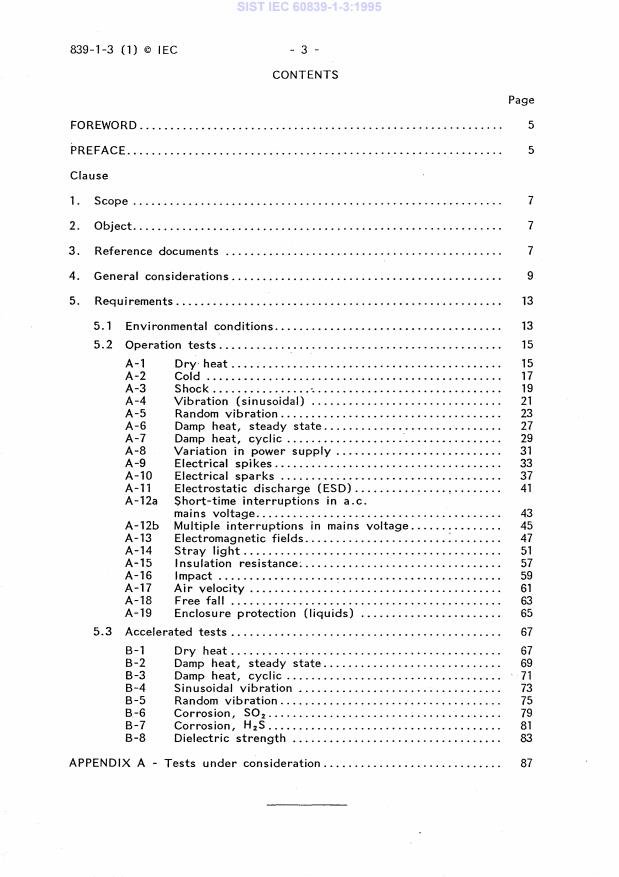
839-1-3(1)©IEC - 3 -
CONTENTS
Page
FOREWORD 5
PREFACE
Clause
1. Scope 7
2. Object 7
3. Reference documents 7
4. General considerations 9.
5. Requirements 13
5.1 Environmental conditions 13
5.2 Operation tests 15
A-1 Dry heat 15
A-2 Cold 17
A-3 Shock 19
A-4 Vibration (sinusoidal) 21
A-5 Random vibration 23
A-6 Damp heat, steady state 27
A-7 Damp heat, cyclic 29
A-8 Variation in power supply 31
A-9 Electrical spikes 33
A-10 Electrical sparks 37
A-11 Electrostatic discharge (ESD) 41
A-12a Short-time interruptions in a.c.
mains voltage 43
A-12b Multiple interruptions in mains voltage 45
A-13 Electromagnetic fields 47
A-14 Stray light 51
A-15 Insulation resistance 57
A-16 Impact 59
A-17 Air velocity 61
A-18 Free fall 63
A-19 Enclosure protection (liquids) 65
5.3 Accelerated tests 67
B-1 Dry heat 67
B-2 Damp heat, steady state 69
B-3 Damp heat, cyclic 71
B-4 Sinusoidal vibration 73
B-5 Random vibration 75
2 B-6 Corrosion, SO 79
2 S B-7 Corrosion, H 81
B-8 Dielectric strength 83
APPENDIX A - Tests under consideration 87
839-1-3 (1) ©
IEC
INTERNATIONAL ELECTROTECHNICAL COMMISSION
ALARM SYSTEMS
Part 1: General requirements
Section Three - Environmental testing
FOREWORD
The formal decisions or agreements of the IEC on technical matters, prepared by Technical
1)
Committees on which all the National Committees having a special interest therein are
represented, express, as nearly as possible, an international consensus of opinion on the
subjects dealt with.
They have the form of recommendations for international use and they are accepted by the
2)
National Committees in that sense.
In order to promote international unification, the IEC expresses the wish that all
3)
National Committees should adopt the text of the IEC recommendation for their national
rules in so far as national conditions will permit. Any divergence between the IEC recom-
mendation and the corresponding national rules should, as far as possible, be clearly
indicated in the latter.
PREFACE
This standard has been prepared by IEC Technical Committee No. 79:
Alarm systems.
The text of this standard is based on the following documents:
Report on Voting
Six Months' Rule
79(C0)9 79(CO)11
Full information on the voting for the approval of this standard can be
found in the Voting Report indicated in the above table.
839-1-3 (1) © IEC -7-
ALARM SYSTEMS
Part One: General Requirements
Section Three - Environmental testing
1. Scope
This standard specifies environmental test methods to be used for
testing system components of an alarm system.
This standard does not preclude the use of other environmental
exposures having special characteristics suitable for the evaluation of
special environmental conditions.
Requirements, performance criteria, test schedules, etc., are not
covered by this standard, but are to be given in the specific
standards for the particular alarm systems and/or components.
This standard shall be used in conjunction with the following IEC
publications.
Publications:
839-1-1: Alarm systems, Part 1: General requirements. Sec-
tion One - General. (Under consideration.)
801-1 (1984): Electromagnetic compatibility for industrial-process
measurement and control equipment, Part 1: General
introduction.
2. Object
The object of this standard is to provide a standard range of tests
to determine the suitability of components and equipment for use,
storage and transportation under various environmental conditions.
3.
Reference documents
Publications:
68: Basic environmental testing procedures.
68-1 (1982) : Part 1: General and guidance.
529 (1976) : Classification of degrees of protection provided by
enclosures.
654: Operating conditions for industrial-process measurement
and control equipment.
839-1-3 (1) © IEC - 9 -
721: Classification of environmental conditions.
801-2 (1984): Electromagnetic compatibility for industrial-process
measurement and control equipment, Part 2: Electrostatic
discharge requirements.
801-3 (1984): Part 3: Radiated electromagnetic field requirements.
4. General considerations
4.1 This standard contains a selection of environmental test methods
taken from other standards including IEC Publication 68.
4.2 The selected test methods have been found suitable for testing
components of an alarm system and have the necessary reproducibility
and severities suitable for this field of application.
For general guidance on environmental testing, reference should be
made to IEC Publication 68-1.
For specific guidance on the various environmental test methods used
in this standard, reference should be made to the description of the
relevant test.
4.3 Classification of tests
This standard specifies a range of test methods with a number of
test severities in order to cover the need for relevant tests for each
system component.
The aim of each test is characterized by allocation of the test to one
of the following two test classes:
a)
Class A - Operation tests
The object of a test in Class A is:
i)
to demonstrate the ability of the specimen to operate correctly
under the influence of the normal service environment and/or
ii)
to demonstrate the immunity of the specimen to false alarm
under the influence of a particular service environment.
The test specimen is exposed to an environment corresponding in
its effects to the normal service environment.
b) Class B - Accelerated tests
The object of a test in Class B is to demonstrate the ability of the
specimen to survive under the influence of an artificial environ-
ment more severe than the normal service environment.
The test specimen is subjected to exposures, which are intention-
ally more severe that the service environment, in order to give
information about the long-term stability.
839-1-3 (1) © IEC - 11 -
The specimen shall be switched off during all Test B exposures.
See Appendix B of IEC Publication 68-1.
4.4 Identification of tests
References in other parts of the standard to a specific environmental
test in this part of the standard shall be identified as follows:
Example: lEC 839-1-3/ A - 1/1
This part
Test class, for example A: Operation tests
Test serial number
Test severity, for example 1: 40 °C/2 h
Reference "A-1/1" in this example identifies the relevant test
method and severity in Test A-1 (see Sub-clause 5.2) .
A higher severity number does not necessarily mean a more severe
test.
4.5 Recommendations for basic requirements
(to be incorporated in the specific standards)
Severity
Test Method
Indoor Outdoor
a) Operation tests
A- 1 3 5
Dry heat
6 7
A- 2 Cold
1 1
A- 3 Shock
2 2
A- 4 Vibration (sinusoidal)
A- 5 Random vibration - -
2 2
A- 6 Damp heat, steady state
1 2
A- 7 Damp heat, cyclic
A- 8 Variation in power supply See Test A-8
A- 9 Electrical spikes 6
A-10 Electrical sparks 1 1
A-11 Electrostatic discharge (ESD) 4 4
A-12a Short-time interruptions in a.c.
mains voltage 4 4
A-13 Electromagnetic fields 4 4
A-14
Stray light - -
A-15 1 1
Insulation resistance
1 1
A-16 Impact
A-17 Air velocity - -
A-18 Free fall 3 3
A-19 Enclosure protection (liquids) - -
b) Accelerated tests
B-1 Dry heat - 5
1 1
B-2 Damp heat, steady state
1 2
B-3 Damp heat, cyclic
2 2
B-4 Sinusoidal vibration
2 2
B-5 Random vibration
B-6 Corrosion, SO2 6
-
.B-7 Corrosion, H2S -
1 1
B-8 Dielectric strength
839-1-3 (1) © IEC - 13 -
5. Requirements
5.1 Environmental' conditions
Equipment for use in hostile environments such as cold stores,
plating shops or corrosive atmospheres shall be to an appropriate
specification or be provided with special protection to take account of
the particular hazards.
Where high levels of interference from other equipment or external
sources such as lightning or power supply transients are likely,
special care shall be taken in the design and installation of the alarm
equipment to reduce the possibility of interference signals affecting the
normal operation of the system.
For other details refer to the specific rules for the devices and to
the test mentioned in this,standard.
839-1-3 (1) © IEC - 15 -
5.2 Operation tests
Test:
A-1
Test method:
Dry heat.
Reference to standard: IEC Publication 68-2 -2, fourth edition (1974),
Part 2: Tests - Test Bd: Dry heat, for heat-
dissipating specimen with gradual change of
temperature.
Object of the test: To determine the suitability of components,
equipment and other articles for operation
under conditions of high temperature.
Background information concerning the dry
heat test is given in IEC Publication 68-3-1,
first edition (1974), Part 3: Background
information. Section One - Cold and dry heat
tests.
Test procedure in brief: The test consists of exposure to the specified
high temperature under "free air" conditions
for the time specified. The time shall be
long enough for the specimen to achieve tempe-
rature stability.
Special preconditioning may be specified. The
rate of change of temperature shall not exceed
1 °C/min.
The humidity content of the test atmosphere
shall not exceed 20 g/m3.
Detail specification:
For full test details, reference should be made
to the IEC publication stated above and the
detail specification of this test in the relevant
part of the standard.
Test severities: The following severities can be specified:
Severity 1 2 3 4 5 6 7 8 9
Temperature (°C) 40 55 40 55 70
Duration (h) ** 2 2 16 16 2 2
* To be given in the specific standards for the particular alarm systems
and/or components.
** After temperature stability is reached.
839-1-3 (1) © IEC - 17 -
Test: A-2
Test method: Cold.
Reference to standard: IEC Publication 68-2-1, fourth edition (1974),
Part 2: Tests - Test Ad: Cold for heat-
dissipating specimen with gradual change of
temperature.
Object of the test: To determine the suitability of components,
equipment and other articles for operation
under conditions of low temperature.
Background information concerning the cold
test is given in IEC Publication 68-3-1, first
edition (1974), Part 3: Background inform-
ation. Section One - Cold and dry heat tests.
Test procedure in brief: The test consists of exposure to the specified
low temperature under "free air" conditions for
the time specified. The time shall be long
enough for the specimen to achieve tempera-
ture stability.
Special preconditioning may be specified. The
rate of change of temperature shall not exceed
1 °C/min to avoid temperature shock.
Detail specification: For full test details, reference should be made
to the IEC publication stated above and the
detail specification of this test in the relevant
part of the standard.
Test severities: The following severities can be specified:
Severity
1 2 3 4 5 6 7 8 9 10
Temperature (°C) +5 +5 0 -10 -25
0 -10 -25 -40 -40
Duration (h) * 2 16 2 16 2 16 2 16 16
* After temperature stability is reached.
839-1-3(1)©IEC -19-
Test: A-3
Test method: Shock.
IEC Publication 68-2-27, second edition (1972),
Reference to standard:
Part 2: Tests - Test Ea: Shock.
Object of the test: To determine the suitability of components,
equipment and other articles for operation
under conditions of mechanical shock.
Test procedure in brief: The test consists of exposure to a number of
shocks with a fixed peak acceleration and time
duration.
The shock pulse has a half-sine time response.
The specimen shall, in turn, be subjected to
shocks in both directions of each of three
mutually perpendicular axes. The specimen
shall be mounted on a stiff fixture by its
normal mounting means. The specimen shall be
switched on during the test.
Detail specification: For full test details, reference should be made
to the IEC publication stated above, and the
detail specification of this test in the relevant
part of the standard.
Test severities: The following severities can be specified:
Severity 1 2
Shock impulse Half sine Half sine
Level (m.s- Z ) 500 1 000
(g) (50) (100)
Duration (ms)
11 6
Number of shocks 3 3
per direction
Number of directions 6 6
839-1-3 (1) © IEC - 21 -
Test: A-4
Test method: Vibration (sinusoidal).
Reference to standard:
IEC Publication 68-2-6, fifth edition (1982),
Part 2: Tests - Test Fc and guidance: Vibra-
tion (sinusoidal) .
Object of the test: To determine the suitability of components,
equipment and other articles for use and
operation under conditions of vibration.
Test procedure in brief: The test consists of exposure to the vibration
level for a time long enough for testing the
various functions of the specimen during the
exposure. The specimen shall, in turn, be
tested in three mutually perpendicular axes
mounted on a rigid fixture by its normal
mounting means. The specimen shall be
switched on during the test.
The equipment shall normally be mounted so
that the gravitational force acts in the same
direction as it would in normal use. Where the
effect of gravitational force is not important,
the equipment may be mounted in any attitude.
Detail specification:
For full test details, reference should be made
to the IEC . publication stated above, and the
detail specification of this test in the relevant
part of the standard.
Test severities: The following severities can be specified:
Severity 1 2 3 4
Frequency (Hz) 10 to 55 10 to 55 10 to 150 10 to 150
Level (m.s-2) 0.981 9.81 0.981 9.81
(g) (0.1) (1) (0.1) (1)
Number of axes
3 3 3 3
Number of sweep cycles One sweep cycle in each functional mode
per axis
as defined in the specific standards for
alarm systems and/or components
839-1-3(1)©IEC -23-
Test: A-5
Test method: Random vibration.
Reference to standard: IEC Publication 68-2-34, first edition (1973),
Part 2: Tests - Test Fd: Random vibration
wide band. General requirements, and IEC
Publication 68-2-35, first edition (1973),
Part 2: Tests - Test Fda: Random vibration
wide band - Reproducibility high.
Object of the test:.
To determine the suitability of components,
equipment and other articles for use and
operation under conditions of vibration.
Test procedure in brief:
The test consists of exposure to the vibration
level for a time long enough for testing the
various functions of the specimen during the
exposure. The specimen shall, in turn, be
tested in three mutually perpendicular axes
mounted on a rigid fixture by its normal
mounting means. The specimen shall be
switched on during the test.
The equipment shall normally be mounted so
that the gravitational force acts in the same
direction as it would in normal use. Where the
effect of gravitational force is not important,
the equipment may be mounted in any attitude.
Detail specification: For full test details, reference should be made
to the IEC publication stated above and the
detail specification of this test in the relevant
part of the standard.
839-1-3 (1) ©
IEC - 25 -
Test severities: The following severities can be specified:
Severity
1 2
Total frequency range (Hz)
10 to 150 10 to 150
Total rms level
(m. s- 2 ) 1.6 16
(g) (0.16) (1.6)
ASD level, 10 Hz to 20 Hz (mes -3) 0.048 4.8
(g 2/Hz) (0.0005) (0.05)
ASD level, 20 Hz to 150 Hz (dB/octave) -3 -3
Number of axes
3 3
Duration per axis
Minimum 2 min in each
functional mode as
defined in the specific
standards for alarm
systems and/or
components
839-1-3 (1) © IEC
- 27 -
Test:
A-6
Test method:
Damp heat, steady state.
Reference to standard:
IEC Publication 68-2-3, third edition (1969),
Part 2: Tests - Test Ca: Damp heat, steady
state (modified procedure).
Object of the test:
To determine the suitability of components,
equipment and other articles for use and
storage under conditions of high relative
humidity, where the absorption of humidity
mainly takes place by diffusion.
Further background information concerning
damp heat tests is given in
IEC Publica-
tion 68-2-28, second edition (1980) :
Guidance
for damp heat test.
Test procedure in brief: The test consists of exposure to a constant
temperature of 30 °C and a constant relative
humidity of 93% for a certain fixed time defined
by the severity class in question. The hand-
ling of the specimen shall be such that no
condensation of water occurs on the specimen.
Special recovery conditions before final mea-
surements can be specified.
Detail specification:
For full test details, reference should be made
to the IEC publication stated above and the
detail specification of this test in the relevant
part of the standard.
Test severities:
The following severities can be specified:
Severity
1 2 3 4 5 6 7 8 9
Duration (days) 16 21
839-1-3 (1) © IEC - 29 -
Test:
A-7
Test method:
Damp heat, cyclic.
Reference to standard: IEC Publication 68-2-30, second edition (1980),
Part 2: Tests - Test Db and guidance: Damp
heat, cyclic (12 h + 12-hour cycle).
Object of the test: To determine the suitability of components,
equipment and other articles for operation
under conditions of high relative humidity
when combined with cyclic temperature
changes.
Further background information concerning
damp heat tests is given in IEC Publica-
tion 68-2-28, second edition (1980): Guidance
for damp heat tests.
Test procedure in brief: The test consists of exposure to cyclic
temperature variations between 25 °C and the
appropriate upper temperature, maintaining the
relative humidity above 95% during the tempe-
rature change and low temperature phases,
and at (93 ± 3)% during the upper temperature
phases.
Condensation shall occur on the specimen
during the temperature rise.
Standard stabilizing period before and re-
covery conditions after the cyclic exposure are
specified. Special electrical conditions and
recovery conditions may be specified.
Detail specification: For full test details, reference should be made
to the IEC publication stated above and the
detail specification of this test in the relevant
part of the standard.
Test severities:
The following severities can be specified:
Severity
1 2 3 4 5 6 7 8 9
Upper temperature (°C)
40 40 55 55
Duration (cycles)
2 6 2 6
839-1-3 (1) © IEC - 31 -
Test: A-8
Test method: Variation in power supply.
Reference to standard: No reference to international standards can be
given at the moment.
Object of the test: To determine the suitability of alarm system
components for operation under conditions of
varying mains supply.
Test procedure in brief: The test consists of exposure at standard
atmospheric conditions for testing to the
specified power supply condition for a period
long enough to obtain temperature stability and
to perform the required measurements.
Detail specification: For full test details, reference should be made
to the detail specification of this test in the
relevant part of the standard.
Test severities:
The following severities can be specified:
Severity
1 2
Supply voltage (Vnom) +1O% To manufacturer's
-15% specification
Duration Until temperature stability is reached
and measurements are performed
839-1-3 (1) o IEC - 33 -
Test: A-9
Test method: Electrical spikes.
Reference to standard: IEC Publication 801-4: Electromagnetic
compatibility for industrial-process measu re-
ment and control equipment, Part 4: Electrical
fast transient requirements (in preparation)
and Part 5: Surge voltage immunity require-
ments (under consideration) .
Object of the test: To determine the suitability of equipment and
sub-units to function under conditions where
electrical spikes are superimposed on the mains
voltage or induced on signal lines.
Test procedure in brief: The test consists of exposure to double
exponential waveform transient voltages. Below
500 V the transients shall have rise times of
10 ns and decay times in the interval 0.1 ps to
1 ps. Above 500 V the transients shall have
rise times of 35 ns and decay times in the
interval 1 ps to 3 ps. The decay time is the
interval between the half amplitude points of
the transient.
Note.- The decay time intervals are given for
the possibility of using available
generators, but the decay time used
should be specified in the test report.
The transient generator shall have an output
impedance of 50 Q. Transients shall be coupled
to the test object using both common mode and
differential mode interference. At least 10
positive and 10 negative transients shall be
applied in each mode.
Insertion of blocking filters in the cables to
the specimen may be necessary to prevent the
transient energy being dissipated in the mains
or other interconnected units.
Detail specification: For full test details, reference is made to the
lEC publication stated above and the detailed
specification of this test in the relevant part
of the standard.
839-1-3 (1) © IEC 35 - -
Test severities: The following severities can be specified:
(all figures are open-circuit values)
Severity
1 2 3 4 5 6 7 8
Amplitude (V) 50 100 200 500 1 000 1 500 2 000 3 750
(peak value)
Decay time (Ns) 0.1 0.1 1 1 1 1
0.1 0.1
to 1 to 1 to 3 to 3 to 3 to 3
to 1 to 1
839-1-3 (1) co -37-
Test: A-10
Test method: Electrical sparks.
Reference to standard: No reference to international standards can be
given at the moment.
Object of the test: To determine the suitability of equipment and
sub-units to function under conditions where
electrical transients in the form of a pulse
train (repetitive spikes) are superimposed on
the mains voltage.
Test procedure in brief: The test consists of exposure to a pulse train
of repetitive transient voltages (see
Figure A-10). The test pulse is generated by
switching off a 300 H coil supplied with a d.c.
voltage between 110 V and 220 V. The test
pulse has a frequency spectrum up to
100 MHz. The test pulse shall be coupled to
the test object through a 0.1 nF capacitor.
The test signal shall be superimposed on the
mains both as common mode and differential
mode interference. At least 60 pulse trains
shall be applied in each mode.
A low-pass filter is inserted to prevent the
transient energy being dissipated in the mains
impedance.
Amplitude
Duration
ow-
916/87
Fig. A-10. - Waveform of test signal.
Detail specification: For full test details, reference should be made
to the detail specification of this test in the
relevant part of the standard.
839-1-3 (1) © IEC - 39 -
Test severities: The following severities can be specified:
(all figures are open-circuit values)
Severity 1 2 3
Amplitude (kV) approx.
(peak value) 4
Duration (ms) approx. 1
839-1-3 (1) © IEC
- 41 -
Test: A-11
Test method: Electrostatic discharge (ESD) .
Reference to standard: IEC Publication 801-2, first edition (1984):
Electromagnetic compatibility for industrial-
process measurement and control equipment,
Part 2: Electrostatic discharge requirements.
Object of the test: To evaluate the performance of equipment and
sub-units when subjected to electrostatic
discharges.
Test procedure in brief: A capacitor of 150 pF shall be charged by a
suitable d.c. voltage source. The capacitor is
then discharged through the specimen by
connecting one terminal to earth (chassis) and
the other via 150 St to surfaces which are
normally accessible to the operator. At least
10 discharges shall be applied.
The time interval between successive dis-
charges shall be greater than 1 s.
Test specimens without an earth terminal shall
be placed on a ground plane which projects
beyond the specimen by at least 0.1 m on all
sides. The earth connection to the capacitor
shall be as short as possible.
The discharge electrode shall approach the
specimen until discharge occurs and shall then
be removed before the next disc
...
IEC 60811-410 ®
Edition 1.0 2012-03
INTERNATIONAL
STANDARD
NORME
INTERNATIONALE
Electric and optical fibre cables – Test methods for non-metallic materials –
Part 410: Miscellaneous tests – Test method for copper-catalyzed oxidative
degradation of polyolefin insulated conductors
Câbles électriques et à fibres optiques – Méthodes d’essai pour les matériaux
non-métalliques –
Partie 410: Essais divers – Méthode d’essai pour la mesure de la dégradation
par oxydation catalytique par le cuivre des conducteurs isolés aux polyoléfines
All rights reserved. Unless otherwise specified, no part of this publication may be reproduced or utilized in any form
or by any means, electronic or mechanical, including photocopying and microfilm, without permission in writing from
either IEC or IEC's member National Committee in the country of the requester.
If you have any questions about IEC copyright or have an enquiry about obtaining additional rights to this publication,
please contact the address below or your local IEC member National Committee for further information.
Droits de reproduction réservés. Sauf indication contraire, aucune partie de cette publication ne peut être reproduite ni
utilisée sous quelque forme que ce soit et par aucun procédé, électronique ou mécanique, y compris la photocopie et les
microfilms, sans l'accord écrit de la CEI ou du Comité national de la CEI du pays du demandeur.
Si vous avez des questions sur le copyright de la CEI ou si vous désirez obtenir des droits supplémentaires sur cette
publication, utilisez les coordonnées ci-après ou contactez le Comité national de la CEI de votre pays de résidence.
IEC Central Office Tel.: +41 22 919 02 11
3, rue de Varembé Fax: +41 22 919 03 00
CH-1211 Geneva 20 info@iec.ch
Switzerland www.iec.ch
About the IEC
The International Electrotechnical Commission (IEC) is the leading global organization that prepares and publishes
International Standards for all electrical, electronic and related technologies.
About IEC publications
The technical content of IEC publications is kept under constant review by the IEC. Please make sure that you have the
latest edition, a corrigenda or an amendment might have been published.
Useful links:
IEC publications search - www.iec.ch/searchpub Electropedia - www.electropedia.org
The advanced search enables you to find IEC publications The world's leading online dictionary of electronic and
by a variety of criteria (reference number, text, technical electrical terms containing more than 30 000 terms and
committee,…). definitions in English and French, with equivalent terms in
It also gives information on projects, replaced and additional languages. Also known as the International
withdrawn publications. Electrotechnical Vocabulary (IEV) on-line.
IEC Just Published - webstore.iec.ch/justpublished Customer Service Centre - webstore.iec.ch/csc
Stay up to date on all new IEC publications. Just Published If you wish to give us your feedback on this publication
details all new publications released. Available on-line and or need further assistance, please contact the
also once a month by email. Customer Service Centre: csc@iec.ch.
A propos de la CEI
La Commission Electrotechnique Internationale (CEI) est la première organisation mondiale qui élabore et publie des
Normes internationales pour tout ce qui a trait à l'électricité, à l'électronique et aux technologies apparentées.
A propos des publications CEI
Le contenu technique des publications de la CEI est constamment revu. Veuillez vous assurer que vous possédez
l’édition la plus récente, un corrigendum ou amendement peut avoir été publié.
Liens utiles:
Recherche de publications CEI - www.iec.ch/searchpub Electropedia - www.electropedia.org
La recherche avancée vous permet de trouver des Le premier dictionnaire en ligne au monde de termes
publications CEI en utilisant différents critères (numéro de électroniques et électriques. Il contient plus de 30 000
référence, texte, comité d’études,…). termes et définitions en anglais et en français, ainsi que
Elle donne aussi des informations sur les projets et les les termes équivalents dans les langues additionnelles.
publications remplacées ou retirées. Egalement appelé Vocabulaire Electrotechnique
International (VEI) en ligne.
Just Published CEI - webstore.iec.ch/justpublished
Service Clients - webstore.iec.ch/csc
Restez informé sur les nouvelles publications de la CEI.
Just Published détaille les nouvelles publications parues. Si vous désirez nous donner des commentaires sur
Disponible en ligne et aussi une fois par mois par email. cette publication ou si vous avez des questions
contactez-nous: csc@iec.ch.
IEC 60811-410 ®
Edition 1.0 2012-03
INTERNATIONAL
STANDARD
NORME
INTERNATIONALE
Electric and optical fibre cables – Test methods for non-metallic materials –
Part 410: Miscellaneous tests – Test method for copper-catalyzed oxidative
degradation of polyolefin insulated conductors
Câbles électriques et à fibres optiques – Méthodes d’essai pour les matériaux
non-métalliques –
Partie 410: Essais divers – Méthode d’essai pour la mesure de la dégradation
par oxydation catalytique par le cuivre des conducteurs isolés aux polyoléfines
INTERNATIONAL
ELECTROTECHNICAL
COMMISSION
COMMISSION
ELECTROTECHNIQUE
PRICE CODE
INTERNATIONALE
CODE PRIX L
ICS 29.035.01; 29.060.20 ISBN 978-2-88912-972-0
– 2 – 60811-410 IEC:2012
CONTENTS
FOREWORD . 3
INTRODUCTION . 5
1 Scope . 6
2 Normative references . 6
3 Terms and definitions . 6
4 Test method . 6
4.1 General . 6
4.2 Apparatus . 6
4.3 Sample and test pieces preparation. 7
4.4 Test procedure . 7
4.5 Measurements . 8
5 Test report. 8
Annex A (normative) Instrument calibration . 10
Bibliography . 11
Figure 1 – Evaluation of OIT from recorded-time-based thermogram . 9
Figure A.1 – Representative melting endothermic for indium . 10
60811-410 IEC:2012 – 3 –
INTERNATIONAL ELECTROTECHNICAL COMMISSION
____________
ELECTRIC AND OPTICAL FIBRE CABLES –
TEST METHODS FOR NON-METALLIC MATERIALS –
Part 410: Miscellaneous tests –
Test method for copper-catalyzed oxidative degradation
of polyolefin insulated conductors
FOREWORD
1) The International Electrotechnical Commission (IEC) is a worldwide organization for standardization comprising
all national electrotechnical committees (IEC National Committees). The object of IEC is to promote
international co-operation on all questions concerning standardization in the electrical and electronic fields. To
this end and in addition to other activities, IEC publishes International Standards, Technical Specifications,
Technical Reports, Publicly Available Specifications (PAS) and Guides (hereafter referred to as “IEC
Publication(s)”). Their preparation is entrusted to technical committees; any IEC National Committee interested
in the subject dealt with may participate in this preparatory work. International, governmental and non-
governmental organizations liaising with the IEC also participate in this preparation. IEC collaborates closely
with the International Organization for Standardization (ISO) in accordance with conditions determined by
agreement between the two organizations.
2) The formal decisions or agreements of IEC on technical matters express, as nearly as possible, an international
consensus of opinion on the relevant subjects since each technical committee has representation from all
interested IEC National Committees.
3) IEC Publications have the form of recommendations for international use and are accepted by IEC National
Committees in that sense. While all reasonable efforts are made to ensure that the technical content of IEC
Publications is accurate, IEC cannot be held responsible for the way in which they are used or for any
misinterpretation by any end user.
4) In order to promote international uniformity, IEC National Committees undertake to apply IEC Publications
transparently to the maximum extent possible in their national and regional publications. Any divergence
between any IEC Publication and the corresponding national or regional publication shall be clearly indicated in
the latter.
5) IEC itself does not provide any attestation of conformity. Independent certification bodies provide conformity
assessment services and, in some areas, access to IEC marks of conformity. IEC is not responsible for any
services carried out by independent certification bodies.
6) All users should ensure that they have the latest edition of this publication.
7) No liability shall attach to IEC or its directors, employees, servants or agents including individual experts and
members of its technical committees and IEC National Committees for any personal injury, property damage or
other damage of any nature whatsoever, whether direct or indirect, or for costs (including legal fees) and
expenses arising out of the publication, use of, or reliance upon, this IEC Publication or any other IEC
Publications.
8) Attention is drawn to the Normative references cited in this publication. Use of the referenced publications is
indispensable for the correct application of this publication.
9) Attention is drawn to the possibility that some of the elements of this IEC Publication may be the subject of
patent rights. IEC shall not be held responsible for identifying any or all such patent rights.
International Standard IEC 60811-410 has been prepared by IEC technical committee 20:
Electric cables.
This Part 410 of IEC 60811 cancels and replaces Annex B of IEC 60811-4-2:2004, which is
withdrawn. Full details of the replacements are shown in Annex A of IEC 60811-100:2012.
There are no specific technical changes with respect to the previous edition, but see the
Foreword to IEC 60811-100:2012.
– 4 – 60811-410 IEC:2012
The text of this standard is based on the following documents:
FDIS Report on voting
20/1294/FDIS 20/1343/RVD
Full information on the voting for the approval of this standard can be found in the report on
voting indicated in the above table.
This publication has been drafted in accordance with the ISO/IEC Directives, Part 2.
This part of IEC 60811 shall be used in conjunction with IEC 60811-100.
A list of all the parts in the IEC 60811 series, published under the general title Electric and
optical fibre cables – Test methods for non-metallic materials, can be found on the IEC
website.
The committee has decided that the contents of this publication will remain unchanged until
the stability date indicated on the IEC web site under "http://webstore.iec.ch" in the data
related to the specific publication. At this date, the publication will be
• reconfirmed,
• withdrawn,
• replaced by a revised edition, or
• amended.
60811-410 IEC:2012 – 5 –
INTRODUCTION
The IEC 60811 series specifies the test methods to be used for testing non-metallic materials
of all types of cables. These test methods are intended to be referenced in standards for
cable construction and for cable materials.
NOTE 1 Non-metallic materials are typically used for insulating, sheathing, bedding, filling or taping within cables.
NOTE 2 These test methods are accepted as basic and fundamental and have been developed and used over
many years principally for the materials in all energy cables. They have also been widely accepted and used for
other cables, in particular optical fibre cables, communication and control cables and cables for ships and offshore
applications.
– 6 – 60811-410 IEC:2012
ELECTRIC AND OPTICAL FIBRE CABLES –
TEST METHODS FOR NON-METALLIC MATERIALS –
Part 410: Miscellaneous tests –
Test method for copper-catalyzed oxidative degradation
of polyolefin insulated conductors
1 Scope
This Part 410 of IEC 60811 gives the procedure for copper-catalyzed oxidative degradation of
a polyolefin, which is typically used for insulation in communication cables.
Full test conditions, such as temperature, duration, etc. and full test requirements are not
specified in this standard; it is intended that they should be specified by the standard dealing
with the relevant type of cable.
2 Normative references
The following documents, in whole or in part, are normatively referenced in this document and
are indispensable for its application. For dated references, only the edition cited applies. For
undated references, the latest edition of the referenced document (including any
amendments) applies.
IEC 60811-100:2012, Electric and optical fibre cables – Test methods for non-metallic
materials – Part 100: General
3 Terms and definitions
For the purposes of this document, the terms and definitions given in IEC 60811-100 apply.
4 Test method
4.1 General
The need for a manufacturer to monitor his cable production to ensure that it has adequate
resistance to oxidation is well established. The Oxidation Induction Time (OIT) test has been
found suitable for monitoring both raw materials and cables for compliance with this
requirement, once suitable materials have been selected. The OIT test is not suitable for the
selection of materials. For this purpose, long-term thermal ageing tests are preferred.
4.2 Apparatus
For the purposes of this test, the different equipment used is as follows:
a) A differential thermal analyser or differential scanning calorimeter, capable of heating at
rates of up to at least (20 ± 1) K/min and maintaining the test temperature isothermally
within 0,2 K and of automatic recording of differences in temperature (or differences in
heat transfer) between the sample and a reference material to the required sensitivity and
precision.
b) A recorder capable of displaying heat flow or temperature difference on the Y-axis, and
time on the X-axis. The time base shall be accurate to ± 1 % and be readable to 0,1 min.
c) A gas-selector switch and regulators for high-purity nitrogen and oxygen.
60811-410 IEC:2012 – 7 –
d) An analytical balance capable of weighing 30 g, and readable and repeatable to ±0,1 mg.
e) Test pieces holders: aluminium holders, each of approximately 6 mm to 7 mm in diameter,
or of similar dimensions as supplied by the manufacturer of the instrument.
4.3 Sample and test pieces preparation
From a sample of the cable, prepare an appropriate number, e.g. four test pieces of different
colours, of approximately 4 mm length containing the core. The test pieces shall be cut from
an insulated core to yield 3 mg to 5 mg of insulating material.
Insert one test piece in an aluminium holder.
4.4 Test procedure
Before carrying out a test series, the instrument shall be calibrated and prepared as described
in Annex A.
Open valves on both the nitrogen and oxygen gas cylinders. Place the gas selector switch to
the nitrogen (N ) position and adjust the flow rate to (50 ± 5) ml/min using a flowmeter.
Place the prepared test piece holder (see 4.3) in the differential thermal analyser and an
empty aluminium holder in the reference position.
NOTE Crimping the test piece with a suitable aluminium or stainless steel screen is optional. It may provide a
better contact with the test piece holder.
Purge with nitrogen for 5 min. Check the flow rate and readjust to (50 ± 5) ml/min if required.
Set signal amplification and recorder sensitivity to the full scale pen deflection associated with
the exothermic reaction and set the temperature base at zero.
Set the heating rate to 20 K/min and start the programmed heating.
Continue heating until the specified test temperature, controlled to ± 1 °C, is reached.
Discontinue programmed heating and equilibrate the test piece to a constant temperature.
Start to record the thermogram. A test temperature of 200 °C has been found appropriate for
polyethylene. To simplify the procedure, it is allowed to omit the programmed pre-heating and
start directly at the test temperature.
Once temperature equilibrium has been established (steady recorder signal), change purge
gas to oxygen, and adjust the flow rate to (50 ±5) ml/min. Mark this point on the recorder. This
change-over point to oxygen purge is considered the zero time of the experiment (T ).
o
Continue the isothermal operation until maximum pen deflection is attained after
commencement of the oxidative exotherm as shown on the recorder (see Figure 1).
In the case of a multi-step exotherm, continue the isothermal operation until maximum pen
deflection occurs.
When the test is completed, turn off the recorder and switch the gas selector back to nitrogen.
Allow the differential thermal analyser to cool to the ambient temperature.
Repeat the entire test on a new test piece, three more times, thus generating a total of four
thermograms. The use of a fresh aluminium reference holder for each test piece is optional.
– 8 – 60811-410 IEC:2012
4.5 Measurements
Extend the recorded base line from time zero to beyond the oxidative exotherm. Extrapolate
the steepest part of the exotherm to intercept the extended baseline (see Figure 1).
The OIT shall be measured from zero to the smallest time interval practical, not exceeding
1 min.
5 Test report
The test report shall be in accordance with that given in IEC 60811-100.
60811-410 IEC:2012 – 9 –
Key
1 5 switch to isothermal operation
∆ power or ∆T
2 time 6 switch to oxygen
...
IEC 60811-410 ®
Edition 1.1 2017-07
CONSOLIDATED VERSION
INTERNATIONAL
STANDARD
NORME
INTERNATIONALE
colour
inside
Electric and optical fibre cables – Test methods for non-metallic materials –
Part 410: Miscellaneous tests – Test method for copper-catalyzed oxidative
degradation of polyolefin insulated conductors
Câbles électriques et à fibres optiques – Méthodes d’essai pour les matériaux
non-métalliques –
Partie 410: Essais divers – Méthode d’essai pour la mesure de la dégradation
par oxydation catalytique par le cuivre des conducteurs isolés aux polyoléfines
All rights reserved. Unless otherwise specified, no part of this publication may be reproduced or utilized in any form
or by any means, electronic or mechanical, including photocopying and microfilm, without permission in writing from
either IEC or IEC's member National Committee in the country of the requester. If you have any questions about IEC
copyright or have an enquiry about obtaining additional rights to this publication, please contact the address below or
your local IEC member National Committee for further information.
Droits de reproduction réservés. Sauf indication contraire, aucune partie de cette publication ne peut être reproduite
ni utilisée sous quelque forme que ce soit et par aucun procédé, électronique ou mécanique, y compris la photocopie
et les microfilms, sans l'accord écrit de l'IEC ou du Comité national de l'IEC du pays du demandeur. Si vous avez des
questions sur le copyright de l'IEC ou si vous désirez obtenir des droits supplémentaires sur cette publication, utilisez
les coordonnées ci-après ou contactez le Comité national de l'IEC de votre pays de résidence.
IEC Central Office Tel.: +41 22 919 02 11
3, rue de Varembé Fax: +41 22 919 03 00
CH-1211 Geneva 20 info@iec.ch
Switzerland www.iec.ch
About the IEC
The International Electrotechnical Commission (IEC) is the leading global organization that prepares and publishes
International Standards for all electrical, electronic and related technologies.
About IEC publications
The technical content of IEC publications is kept under constant review by the IEC. Please make sure that you have the
latest edition, a corrigenda or an amendment might have been published.
IEC Catalogue - webstore.iec.ch/catalogue Electropedia - www.electropedia.org
The stand-alone application for consulting the entire The world's leading online dictionary of electronic and
bibliographical information on IEC International Standards, electrical terms containing 20 000 terms and definitions in
Technical Specifications, Technical Reports and other English and French, with equivalent terms in 16 additional
documents. Available for PC, Mac OS, Android Tablets and languages. Also known as the International Electrotechnical
iPad. Vocabulary (IEV) online.
IEC publications search - www.iec.ch/searchpub IEC Glossary - std.iec.ch/glossary
The advanced search enables to find IEC publications by a 65 000 electrotechnical terminology entries in English and
variety of criteria (reference number, text, technical French extracted from the Terms and Definitions clause of
committee,…). It also gives information on projects, replaced IEC publications issued since 2002. Some entries have been
and withdrawn publications. collected from earlier publications of IEC TC 37, 77, 86 and
CISPR.
IEC Just Published - webstore.iec.ch/justpublished
Stay up to date on all new IEC publications. Just Published IEC Customer Service Centre - webstore.iec.ch/csc
details all new publications released. Available online and If you wish to give us your feedback on this publication or
also once a month by email. need further assistance, please contact the Customer Service
Centre: csc@iec.ch.
A propos de l'IEC
La Commission Electrotechnique Internationale (IEC) est la première organisation mondiale qui élabore et publie des
Normes internationales pour tout ce qui a trait à l'électricité, à l'électronique et aux technologies apparentées.
A propos des publications IEC
Le contenu technique des publications IEC est constamment revu. Veuillez vous assurer que vous possédez l’édition la
plus récente, un corrigendum ou amendement peut avoir été publié.
Catalogue IEC - webstore.iec.ch/catalogue Electropedia - www.electropedia.org
Application autonome pour consulter tous les renseignements
Le premier dictionnaire en ligne de termes électroniques et
bibliographiques sur les Normes internationales,
électriques. Il contient 20 000 termes et définitions en anglais
Spécifications techniques, Rapports techniques et autres
et en français, ainsi que les termes équivalents dans 16
documents de l'IEC. Disponible pour PC, Mac OS, tablettes
langues additionnelles. Egalement appelé Vocabulaire
Android et iPad.
Electrotechnique International (IEV) en ligne.
Recherche de publications IEC - www.iec.ch/searchpub
Glossaire IEC - std.iec.ch/glossary
La recherche avancée permet de trouver des publications IEC
65 000 entrées terminologiques électrotechniques, en anglais
en utilisant différents critères (numéro de référence, texte,
et en français, extraites des articles Termes et Définitions des
comité d’études,…). Elle donne aussi des informations sur les
publications IEC parues depuis 2002. Plus certaines entrées
projets et les publications remplacées ou retirées.
antérieures extraites des publications des CE 37, 77, 86 et
CISPR de l'IEC.
IEC Just Published - webstore.iec.ch/justpublished
Restez informé sur les nouvelles publications IEC. Just Service Clients - webstore.iec.ch/csc
Published détaille les nouvelles publications parues. Si vous désirez nous donner des commentaires sur cette
Disponible en ligne et aussi une fois par mois par email. publication ou si vous avez des questions contactez-nous:
csc@iec.ch.
IEC 60811-410 ®
Edition 1.1 2017-07
CONSOLIDATED VERSION
INTERNATIONAL
STANDARD
NORME
INTERNATIONALE
colour
inside
Electric and optical fibre cables – Test methods for non-metallic materials –
Part 410: Miscellaneous tests – Test method for copper-catalyzed oxidative
degradation of polyolefin insulated conductors
Câbles électriques et à fibres optiques – Méthodes d’essai pour les matériaux
non-métalliques –
Partie 410: Essais divers – Méthode d’essai pour la mesure de la dégradation
par oxydation catalytique par le cuivre des conducteurs isolés aux polyoléfines
INTERNATIONAL
ELECTROTECHNICAL
COMMISSION
COMMISSION
ELECTROTECHNIQUE
INTERNATIONALE
ICS 29.035.01; 29.060.20 ISBN 978-2-8322-4653-5
IEC 60811-410 ®
Edition 1.1 2017-07
CONSOLIDATED VERSION
REDLINE VERSION
VERSION REDLINE
colour
inside
Electric and optical fibre cables – Test methods for non-metallic materials –
Part 410: Miscellaneous tests – Test method for copper-catalyzed oxidative
degradation of polyolefin insulated conductors
Câbles électriques et à fibres optiques – Méthodes d’essai pour les matériaux
non-métalliques –
Partie 410: Essais divers – Méthode d’essai pour la mesure de la dégradation
par oxydation catalytique par le cuivre des conducteurs isolés aux polyoléfines
– 2 – IEC 60811-410:2012+AMD1:2017 CSV
IEC 2017
CONTENTS
FOREWORD . 3
INTRODUCTION . 5
1 Scope . 6
2 Normative references . 6
3 Terms and definitions . 6
4 Test method . 6
4.1 General . 6
4.2 Apparatus . 6
4.3 Sample and test pieces preparation. 7
4.4 Test procedure . 7
4.5 Measurements . 8
5 Test report. 8
Annex A (normative) Instrument calibration . 10
Bibliography . 11
Figure 1 – Evaluation of OIT from recorded-time-based thermogram . 9
Figure A.1 – Representative melting endothermic for indium . 10
IEC 2017
INTERNATIONAL ELECTROTECHNICAL COMMISSION
____________
ELECTRIC AND OPTICAL FIBRE CABLES –
TEST METHODS FOR NON-METALLIC MATERIALS –
Part 410: Miscellaneous tests –
Test method for copper-catalyzed oxidative degradation
of polyolefin insulated conductors
FOREWORD
1) The International Electrotechnical Commission (IEC) is a worldwide organization for standardization comprising
all national electrotechnical committees (IEC National Committees). The object of IEC is to promote
international co-operation on all questions concerning standardization in the electrical and electronic fields. To
this end and in addition to other activities, IEC publishes International Standards, Technical Specifications,
Technical Reports, Publicly Available Specifications (PAS) and Guides (hereafter referred to as “IEC
Publication(s)”). Their preparation is entrusted to technical committees; any IEC National Committee interested
in the subject dealt with may participate in this preparatory work. International, governmental and non-
governmental organizations liaising with the IEC also participate in this preparation. IEC collaborates closely
with the International Organization for Standardization (ISO) in accordance with conditions determined by
agreement between the two organizations.
2) The formal decisions or agreements of IEC on technical matters express, as nearly as possible, an international
consensus of opinion on the relevant subjects since each technical committee has representation from all
interested IEC National Committees.
3) IEC Publications have the form of recommendations for international use and are accepted by IEC National
Committees in that sense. While all reasonable efforts are made to ensure that the technical content of IEC
Publications is accurate, IEC cannot be held responsible for the way in which they are used or for any
misinterpretation by any end user.
4) In order to promote international uniformity, IEC National Committees undertake to apply IEC Publications
transparently to the maximum extent possible in their national and regional publications. Any divergence
between any IEC Publication and the corresponding national or regional publication shall be clearly indicated in
the latter.
5) IEC itself does not provide any attestation of conformity. Independent certification bodies provide conformity
assessment services and, in some areas, access to IEC marks of conformity. IEC is not responsible for any
services carried out by independent certification bodies.
6) All users should ensure that they have the latest edition of this publication.
7) No liability shall attach to IEC or its directors, employees, servants or agents including individual experts and
members of its technical committees and IEC National Committees for any personal injury, property damage or
other damage of any nature whatsoever, whether direct or indirect, or for costs (including legal fees) and
expenses arising out of the publication, use of, or reliance upon, this IEC Publication or any other IEC
Publications.
8) Attention is drawn to the Normative references cited in this publication. Use of the referenced publications is
indispensable for the correct application of this publication.
9) Attention is drawn to the possibility that some of the elements of this IEC Publication may be the subject of
patent rights. IEC shall not be held responsible for identifying any or all such patent rights.
This consolidated version of the official IEC Standard and its amendment has been prepared
for user convenience.
IEC 60811-410 edition 1.1 contains the first edition (2012-03) [documents 20/1294/FDIS and
20/1343/RVD] and its amendment 1 (2017-07) [documents 20/1734/FDIS and 20/1739/RVD].
In this Redline version, a vertical line in the margin shows where the technical content is
modified by amendment 1. Additions are in green text, deletions are in strikethrough red text. A
separate Final version with all changes accepted is available in this publication.
– 4 – IEC 60811-410:2012+AMD1:2017 CSV
IEC 2017
International Standard IEC 60811-410 has been prepared by IEC technical committee 20:
Electric cables.
There are no specific technical changes with respect to the previous edition, but see
the Foreword to IEC 60811-100:2012.
This publication has been drafted in accordance with the ISO/IEC Directives, Part 2.
This part of IEC 60811 shall be used in conjunction with IEC 60811-100.
A list of all the parts in the IEC 60811 series, published under the general title Electric and
optical fibre cables – Test methods for non-metallic materials, can be found on the IEC
website.
The committee has decided that the contents of the base publication and its amendment will
remain unchanged until the stability date indicated on the IEC web site under
"http://webstore.iec.ch" in the data related to the specific publication. At this date,
the publication will be
• reconfirmed,
• withdrawn,
• replaced by a revised edition, or
• amended.
IMPORTANT – The 'colour inside' logo on the cover page of this publication indicates
that it contains colours which are considered to be useful for the correct
understanding of its contents. Users should therefore print this document using a
colour printer.
IEC 2017
INTRODUCTION
The IEC 60811 series specifies the test methods to be used for testing non-metallic materials
of all types of cables. These test methods are intended to be referenced in standards for
cable construction and for cable materials.
NOTE 1 Non-metallic materials are typically used for insulating, sheathing, bedding, filling or taping within cables.
NOTE 2 These test methods are accepted as basic and fundamental and have been developed and used over
many years principally for the materials in all energy cables. They have also been widely accepted and used for
other cables, in particular optical fibre cables, communication and control cables and cables for ships and offshore
applications.
– 6 – IEC 60811-410:2012+AMD1:2017 CSV
IEC 2017
ELECTRIC AND OPTICAL FIBRE CABLES –
TEST METHODS FOR NON-METALLIC MATERIALS –
Part 410: Miscellaneous tests –
Test method for copper-catalyzed oxidative degradation
of polyolefin insulated conductors
1 Scope
This Part 410 of IEC 60811 gives the procedure for copper-catalyzed oxidative degradation of
a polyolefin, which is typically used for insulation in communication cables.
Full test conditions, such as temperature, duration, etc. and full test requirements are not
specified in this standard; it is intended that they should be specified by the standard dealing
with the relevant type of cable.
2 Normative references
The following documents, in whole or in part, are normatively referenced in this document and
are indispensable for its application. For dated references, only the edition cited applies. For
undated references, the latest edition of the referenced document (including any
amendments) applies.
IEC 60811-100:2012, Electric and optical fibre cables – Test methods for non-metallic
materials – Part 100: General
3 Terms and definitions
For the purposes of this document, the terms and definitions given in IEC 60811-100 apply.
4 Test method
4.1 General
The need for a manufacturer to monitor his cable production to ensure that it has adequate
resistance to oxidation is well established. Once suitable materials have been selected, the
oxidation induction time (OIT) test has been found suitable for monitoring both raw materials
and cables for compliance with this the oxidative degradation requirement, once suitable
materials have been selected. The OIT test is not suitable for the selection determination of
materials ageing properties. For this purpose, long-term thermal ageing tests are preferred.
4.2 Apparatus
For the purposes of this test, the different equipment used is as follows:
a) A differential thermal analyser or differential scanning calorimeter, capable of heating at
rates of up to at least (20 ± 1) K/min and maintaining the test temperature isothermally
within 0,2 K and of automatic recording of differences in temperature (or differences in
heat transfer) between the sample and a reference material to the required sensitivity and
precision.
b) A recorder capable of displaying heat flow or temperature difference on the Y-axis, and
time on the X-axis. The time base shall be accurate to ± 1 % and be readable to 0,1 min.
© IEC 2017
c) A gas-selector switch and regulators for high-purity nitrogen and oxygen; N , O with
2 2
purity:
• N 5.0 = 99,999 % purity;
• O 4.5 = 99,995 % purity.
d) An analytical balance capable of weighing 30 g 3 mg to 5 mg, and readable and
repeatable to ±0,1 mg ± 1 μg. The mass rounding is in 10 μg.
e) Test pieces holders: aluminium holders, each of approximately 6 mm to 7 mm in diameter,
or of similar dimensions as supplied by the manufacturer of the instrument.
4.3 Sample and test pieces preparation
From a sample of the cable, prepare an appropriate number, e.g. four test pieces of different
colours, of approximately 4 mm length containing the core. The test pieces shall be cut from
an insulated core to yield 3 mg to 5 mg of insulating material.
Insert one test piece in an aluminium holder.
4.4 Test procedure
Before carrying out a test series, the instrument shall be calibrated and prepared as described
in Annex A.
Open valves on both the nitrogen and oxygen gas cylinders. Place the gas selector switch to
the nitrogen (N ) position and adjust the flow rate to (50 ± 5) ml/min using a flowmeter.
Place the prepared test piece holder (see 4.3) in the differential thermal analyser and an
empty aluminium holder in the reference position.
NOTE Crimping the test piece with a suitable aluminium or stainless steel screen is optional. It may provide a
better contact with the test piece holder. If the piece holder is closed, the oxidation cannot be made.
Purge with nitrogen for 5 min. Check the flow rate and readjust to (50 ± 5) ml/min if required.
Set signal amplification and recorder sensitivity to the full scale pen deflection associated with
the exothermic reaction and set the temperature base at zero.
Set the heating rate to 20 K/min and start the programmed heating.
Continue heating until the specified test temperature, controlled to ± 1 °C, is reached.
Discontinue programmed heating and equilibrate the test piece to a constant temperature.
Start to record the thermogram. A test temperature of 200 °C has been found appropriate for
polyethylene. To simplify the procedure, it is allowed to omit the programmed pre-heating and
start directly at the test temperature.
Once temperature equilibrium has been established (steady recorder signal), change purge
gas to oxygen, and adjust the flow rate to (50 ±5) ml/min. Mark this point on the recorder. This
change-over point to oxygen purge is considered the zero time of the experiment (T ).
o
Continue the isothermal operation until maximum pen deflection is attained after
commencement of the oxidative exotherm as shown on the recorder (see Figure 1).
In the case of a multi-step exotherm, continue the isothermal operation until maximum pen
deflection occurs.
When the test is completed, turn off the recorder and switch the gas selector back to nitrogen.
– 8 – IEC 60811-410:2012+AMD1:2017 CSV
IEC 2017
Allow the differential thermal analyser to cool to the ambient temperature.
Repeat the entire test on a new test piece, three more times, thus generating a total of four
thermograms. The use of a fresh aluminium reference holder for each test piece is optional.
4.5 Measurements
Extend the recorded base line from time zero to beyond the oxidative exotherm. Extrapolate
the steepest part of the exotherm to intercept the extended baseline (see Figure 1).
The OIT shall be measured from zero to the smallest time interval practical, not exceeding
1 min.
5 Test report
The test report shall be in accordance with that given in IEC 60811-100.
IEC 2017
Key
1 5 switch to isothermal operation
∆ power or ∆T or ∆enthalpy
2 time 6 switch to oxygen
3 programmed heat (nitrogen) 7 OIT
4 isothermal mode (oxygen)
Figure 1 – Evaluation of OIT from recorded-time-based thermogram
– 10 – IEC 60811-410:2012+AMD1:2017 CSV
IEC 2017
Annex A
(normative)
Instrument calibration
The instruments shall be calibrated as follows:
a) Calibrate the instrument according to the manufacturer's instructions before starting. Use
analytical-grade indium as a temperature reference material.
b) Place analytical-grade indium into an aluminium holder with an aluminium cover. Place
the sample, typically 6 mg, thus prepared, and a reference aluminium holder with cover
into the instrument.
Should it be necessary to clean the sample and the aluminium reference holder and
cover, use petroleum ether or other suitable solvent to remove contaminants.
c) Programme the temperature of the scanner from 145 °C to 165 °C at a rate of 1 K/min,
while recording the thermogram.
d) Calibrate the instrument according to the manufacturer's instructions in order to obtain an
indium first order transition temperature of 156,6 °C. For calibration purposes, the melting
point 156,6 °C is defined as the intersection of the extrapolated peak onset and the
extrapolated baseline (see Figure A.1).
Figure A.1 – Representative melting endothermic for indium
IEC 2017
Bibliography
IEC 60811-4-2:2004, Insulating and sheathing materials of electric and optical cables –
Common test methods – Part 4-2: Methods specific to polyethylene and polypropylene
compounds – Tensile strength and elongation at break after conditioning at elevated
temperature – Wrapping test after conditioning at elevated temperature – Wrapping test after
thermal ageing in air – Measurement of mass increase – Long-term stability test – Test
method for copper-catalyzed oxidative degradation
(withdrawn)
____________
– 12 – IEC 60811-410:2012+AMD1:2017 CSV
IEC 2017
SOMMAIRE
AVANT-PROPOS . 13
INTRODUCTION . 15
1 Domaine d’application . 16
2 Références normatives . 16
3 Termes et définitions . 16
4 Méthode d’essai . 16
4.1 Généralités. 16
4.2 Appareillage . 16
4.3 Echantillon et préparation des éprouvettes . 17
4.4 Mode opératoire . 17
4.5 Mesures . 18
5 Rapport d’essai . 18
Annexe A (normative) Etalonnage de l’appareil . 20
Bibliographie . 21
Figure 1 – Evaluation du TIT à partir du thermogramme de base enregistré . 19
Figure A.1 – Représentation de l'endotherme de fusion pour l'indium . 20
IEC 2017
COMMISSION ÉLECTROTECHNIQUE INTERNATIONALE
____________
CÂBLES ÉLECTRIQUES ET À FIBRES OPTIQUES –
MÉTHODES D’ESSAI POUR LES MATÉRIAUX NON-MÉTALLIQUES –
Partie 410: Essais divers –
Méthode d’essai pour la mesure de la dégradation par oxydation
catalytique par le cuivre des conducteurs isolés aux polyoléfines
AVANT-PROPOS
1) La Commission Electrotechnique Internationale (IEC) est une organisation mondiale de normalisation
composée de l'ensemble des comités électrotechniques nationaux (Comités nationaux de l’IEC). L’IEC a pour
objet de favoriser la coopération internationale pour toutes les questions de normalisation dans les domaines
de l'électricité et de l'électronique. A cet effet, l’IEC – entre autres activités – publie des Normes
internationales, des Spécifications techniques, des Rapports techniques, des Spécifications accessibles au
public (PAS) et des Guides (ci-après dénommés "Publication(s) de l’IEC"). Leur élaboration est confiée à des
comités d'études, aux travaux desquels tout Comité national intéressé par le sujet traité peut participer. Les
organisations internationales, gouvernementales et non gouvernementales, en liaison avec l’IEC, participent
également aux travaux. L’IEC collabore étroitement avec l'Organisation Internationale de Normalisation (ISO),
selon des conditions fixées par accord entre les deux organisations.
2) Les décisions ou accords officiels de l’IEC concernant les questions techniques représentent, dans la mesure
du possible, un accord international sur les sujets étudiés, étant donné que les Comités nationaux de l’IEC
intéressés sont représentés dans chaque comité d’études.
3) Les Publications de l’IEC se présentent sous la forme de recommandations internationales et sont agréées
comme telles par les Comités nationaux de l’IEC. Tous les efforts raisonnables sont entrepris afin que l’IEC
s'assure de l'exactitude du contenu technique de ses publications; l’IEC ne peut pas être tenue responsable de
l'éventuelle mauvaise utilisation ou interprétation qui en est faite par un quelconque utilisateur final.
4) Dans le but d'encourager l'uniformité internationale, les Comités nationaux de l’IEC s'engagent, dans toute la
mesure possible, à appliquer de façon transparente les Publications de l’IEC dans leurs publications nationales
et régionales. Toutes divergences entre toutes Publications de l’IEC et toutes publications nationales ou
régionales correspondantes doivent être indiquées en termes clairs dans ces dernières.
5) L’IEC elle-même ne fournit aucune attestation de conformité. Des organismes de certification indépendants
fournissent des services d'évaluation de conformité et, dans certains secteurs, accèdent aux marques de
conformité de l’IEC. L’IEC n'est responsable d'aucun des services effectués par les organismes de certification
indépendants.
6) Tous les utilisateurs doivent s'assurer qu'ils sont en possession de la dernière édition de cette publication.
7) Aucune responsabilité ne doit être imputée à l’IEC, à ses administrateurs, employés, auxiliaires ou
mandataires, y compris ses experts particuliers et les membres de ses comités d'études et des Comités
nationaux de l’IEC, pour tout préjudice causé en cas de dommages corporels et matériels, ou de tout autre
dommage de quelque nature que ce soit, directe ou indirecte, ou pour supporter les coûts (y compris les frais
de justice) et les dépenses découlant de la publication ou de l'utilisation de cette Publication de l’IEC ou de
toute autre Publication de l’IEC, ou au crédit qui lui est accordé.
8) L'attention est attirée sur les références normatives citées dans cette publication. L'utilisation de publications
référencées est obligatoire pour une application correcte de la présente publication.
9) L’attention est attirée sur le fait que certains des éléments de la présente Publication de l’IEC peuvent faire
l’objet de droits de brevet. L’IEC ne saurait être tenue pour responsable de ne pas avoir identifié de tels droits
de brevets et de ne pas avoir signalé leur existence.
Cette version consolidée de la Norme IEC officielle et de son amendement a été préparée pour
la commodité de l'utilisateur.
L'IEC 60811-410 édition 1.1 contient la première édition (2012-03) [documents 20/1294/FDIS et
20/1343/RVD] et son amendement 1 (2017-07) [documents 20/1734/FDIS et 20/1739/RVD].
Dans cette version Redline, une ligne verticale dans la marge indique où le contenu technique
est modifié par l’amendement 1. Les ajouts sont en vert, les suppressions sont en rouge,
barrées. Une version Finale avec toutes les modifications acceptées est disponible dans cette
publication.
– 14 – IEC 60811-410:2012+AMD1:2017 CSV
IEC 2017
La Norme internationale IEC 60811-410 a été établie par le comité d’études 20 de l’IEC:
Câbles électriques.
Aucune modification technique n’a été effectuée par rapport à l’édition précédente;
voir cependant l’avant-propos de l’IEC 60811-100:2012.
Cette publication a été rédigée selon les Directives ISO/IEC, Partie 2.
La présente partie de l’IEC 60811 doit être utilisée conjointement avec l’IEC 60811-100.
Une liste de toutes les parties de la série IEC 60811, publiées sous le titre général Câbles
électriques et à fibres optiques – Méthodes d’essai pour les matériaux non-métalliques, peut
être consultée sur le site web de l’IEC.
Le comité a décidé que le contenu de la publication de base et de son amendement ne sera
pas modifié avant la date de stabilité indiquée sur le site web de l’IEC sous
"http://webstore.iec.ch" dans les données relatives à la publication recherchée. A cette
date, la publication sera
• reconduite,
• supprimée,
• remplacée par une édition révisée, ou
• amendée.
IMPORTANT – Le logo "colour inside" qui se trouve sur la page de couverture de cette
publication indique qu'elle contient des couleurs qui sont considérées comme utiles à
une bonne compréhension de son contenu. Les utilisateurs devraient, par conséquent,
imprimer cette publication en utilisant une imprimante couleur.
IEC 2017
INTRODUCTION
La série IEC 60811 précise les méthodes à employer pour les essais des matériaux non-
métalliques sur tous les types de câbles. Ces méthodes d’essai seront citées en référence
dans les normes relatives à la construction des câbles et aux matériaux des câbles.
NOTE 1 Les matériaux non-métalliques sont généralement utilisés pour l’isolation, le gainage, le matelassage, le
remplissage ou le rubanage des câbles.
NOTE 2 Ces méthodes d’essai sont reconnues comme fondamentales; elles ont été développées et utilisées
durant de nombreuses années, principalement pour les matériaux dans tous les câbles de distribution d’énergie.
Elles ont aussi été largement reconnues et utilisées pour d’autres types de câbles, en particulier les câbles à fibres
optiques, les câbles de communication et de commande, ainsi que les câbles utilisés à bord des navires et dans
les applications offshore.
– 16 – IEC 60811-410:2012+AMD1:2017 CSV
IEC 2017
CÂBLES ÉLECTRIQUES ET À FIBRES OPTIQUES –
MÉTHODES D’ESSAI POUR LES MATÉRIAUX NON-MÉTALLIQUES –
Partie 410: Essais divers –
Méthode d’essai pour la mesure de la dégradation par oxydation
catalytique par le cuivre des conducteurs isolés aux polyoléfines
1 Domaine d’application
La présente Partie 410 de l’IEC 60811 décrit la procédure de mesure de la dégradation par
oxydation catalytique, par le cuivre, d’une polyoléfine, généralement utilisée pour l’isolation
des câbles de communication.
Les conditions complètes des essais, telles que la température, la durée, etc. et l’ensemble
des exigences d’essai ne sont pas spécifiées dans cette norme; elles figurent, en principe,
dans les normes applicables à chaque type de câble.
2 Références normatives
Les documents suivants sont cités en référence de manière normative, en intégralité ou en
partie, dans le présent document et sont indispensables pour son application. Pour les
références datées, seule l’édition citée s’applique. Pour les références non datées, la
dernière édition du document de référence s’applique (y compris les éventuels
amendements).
IEC 60811-100:2012, Câbles électriques et à fibres optiques – Méthodes d’essai pour les
matériaux non-métalliques – Partie 100: Généralités
3 Termes et définitions
Pour les besoins du présent document, les termes et définitions donnés dans la
IEC 60811-100 s’appliquent.
4 Méthode d’essai
4.1 Généralités
Le besoin pour un fabricant de contrôler sa la production de câbles afin de s'assurer de leur
bonne résistance à l'oxydation est bien établi. Les matériaux appropriés ayant été choisis,
l'essai du temps d'induction thermique (TIT) a été jugé satisfaisant pour contrôler les
matières premières et les câbles, afin de vérifier leur conformité à cette l’exigence relative à
la dégradation par oxydation. L'essai du TIT n'est pas approprié à la sélection pour
déterminer les propriétés de vieillissement des matériaux. Pour cette sélection A cet effet, les
essais de vieillissement thermique à long terme sont préférables privilégiés.
4.2 Appareillage
Pour les besoins de cet essai, l’appareillage utilisé est le suivant:
___________
En anglais: OIT: Oxidation Induction Time.
© IEC 2017
a) Un analyseur thermique différentiel ou un calorimètre enthalpique différentiel, capable de
chauffer au moins à une vitesse de (20 ± 1) K/min, de maintenir la température d'essai de
façon isotherme à ± 0,2 K et d'enregistrer automatiquement des différences de
température (ou des différences en transfert de chaleur) entre l'échantillon et le matériau
de référence aux sensibilités et précisions exigées.
b) Un enregistreur capable de présenter la différence d'enthalpie ou de température en
ordonnées et le temps en abscisse. La précision de la base de temps doit être de ± 1 %
avec une lisibilité de 0,1 min.
c) Un sélecteur de gaz et des régulateurs pour azote et oxygène ultra-purs; N , O dont la
2 2
valeur de pureté est de:
• N 5.0 = 99,999 % (de pureté);
• O 4.5 = 99,995 % (de pureté);
d) Une balance d'analyse permettant de peser 30 g 3 mg à 5 mg, lisible et fidèle à ± 0,1 mg
± 1 μg. L'arrondi de la masse est donné en 10 μg.
e) Des capsules à échantillons: capsules en aluminium d'environ 6 mm à 7 mm de diamètre
chacune, ou de dimensions voisines, fournies par le constructeur de l'appareillage.
4.3 Echantillon et préparation des éprouvettes
A partir d’un échantillon du câble, préparer un nombre approprié (par exemple quatre
échantillons de couleurs différentes) d’éprouvettes d'une longueur de 4 mm et contenant
l’âme. Les éprouvettes doivent être coupées sur un conducteur isolé afin que le poids
d’isolant soit de 3 mg à 5 mg.
Introduire une éprouvette dans une capsule en aluminium.
4.4 Mode opératoire
Avant de commencer une série d’essais, l’instrument doit être étalonné et préparé suivant les
indications de l’Annexe A.
Ouvrir les deux vannes d'azote et d'oxygène. Placer le sélecteur de gaz en position azote
(N ) et ajuster le débit à (50 ± 5) ml/min à l'aide du débitmètre.
Placer le porte-éprouvette ainsi préparé (voir 4.3) dans l’analyseur thermique et une capsule
en aluminium vide comme référence.
NOTE Si on le désire, on peut sertir l’éprouvette à l’aide d’un tamis en aluminium ou en acier inoxydable. Cela
peut favoriser le contact avec le porte-éprouvette. Si le porte-éprouvette est fermé, l'oxydation ne peut être
obtenue.
Purger avec l'azote pendant 5 min. Vérifier le débit, et si nécessaire le régler à
(50 ± 5) ml/min.
Choisir un niveau d'amplification du signal et une sensibilité de l'enregistreur tels que la
réaction exothermique provoque un enregistrement sur toute l'échelle et régler la température
de base sur zéro.
Régler la vitesse de chauffe à 20 K/min et mettre en route le chauffage programmé.
Continuer à chauffer jusqu'à ce que la température d'essai spécifiée, contrôlée à ± 1 °C, soit
atteinte. Interrompre le programme de chauffe et maintenir la température de l'éprouvette.
Commencer l'enregistrement du thermogramme. Il a été démontré qu'une température d'essai
de 200 °C était appropriée pour le polyéthylène. Pour simplifier la procédure, il est permis de
supprimer le préchauffage programmé et de démarrer directement à la température d'essai.
– 18 – IEC 60811-410:2012+AMD1:2017 CSV
IEC 2017
Une fois l'équilibre de température atteint (stabilité du signal de l'enregistreur), passer sous
oxygène et ajuster le débit à (50 ± 5) ml/min. Faire un repère sur l'enregistrement. Le
passage sous oxygène est considéré comme étant le temps zéro de l'essai (T ).
o
L'opération isothermique est poursuivie jusqu'au maximum de déviation de l’aiguille après le
début de l'oxydation exothermique comme l'indique l'enregistrement (voir Figure 1).
Dans le cas où il y a plusieurs paliers dans la réaction exothermique, continuer l'opération
isothermique jusqu'à ce que la déviation maximale de l’aiguille soit atteinte.
A la fin de l'essai, arrêter l'enregistreur et remettre le sélecteur de gaz sur la position azote.
Laisser l’analyseur thermique différentiel refroidir à la température ambiante.
Refaire trois autres essais complets sur une nouvelle éprouvette de façon à obtenir un total
de quatre thermogrammes. L'utilisation d'une nouvelle capsule d'aluminium de référence pour
chaque éprouvette n'est pas indispensable.
4.5 Mesures
Prolonger la ligne de base depuis le temps zéro pour qu’il dépasse la courbe d'oxydation
exothermique. Extrapoler la partie de plus forte pente de la courbe exothermique jusqu'à
rejoindre le prolongement de la ligne de base (voir Figure 1).
Le temps d'induction thermique (TIT) doit être mesuré depuis le temps zéro jusqu'au plus petit
intervalle pratique inférieur ou égal à 1 min.
5 Rapport d’essai
Le rapport d’essai doit être conforme aux spécifications de l’IEC 60811-100.
IEC 2017
Légende
1 5 passage à l’opération isothermique
∆ puissance ou ∆T ou ∆enthalpie
2 temps 6 passage sous oxygène
3 chauffage programmé (azote) 7 TIT
4 mode isothermique (oxygène)
Figure 1 – Evaluation du TIT à partir du thermogramme de base enregistré
– 20 – IEC 60811-410:2012+AMD1:2017 CSV
IEC 2017
Annexe A
(normative)
Etalonnage de l’appareil
L’appareil doit être étalonné comme suit:
a) Etalonner l'appareil selon les instructions du fabricant avant de commencer la
manipulation. Utiliser l'indium de pureté analytique comme référence de température.
b) Placer l'indium de pureté analytique dans une capsule d'aluminium munie d'un couvercle
d'aluminium. Placer l'échantillon, typiquement 6 mg, ainsi préparé et une capsule
d'aluminium de référence avec couvercle dans l’appareil.
S'il est nécessaire de nettoyer l'échantillon et la capsule et le couvercle d'aluminium de
référence, utiliser de l'éther de pétrole ou un autre solvant convenable pour éliminer les
souillures.
c) Programmer la température du scanner de 145 °C à 165 °C à la vitesse de 1 K/min en
enregistrant le thermogramme.
d) Etalonner l'appareil suivant les instructions du constructeur afin d'obtenir une
température de transition du premier ordre de l'indium 156,6 °C. Pour cet étalonnage, le
point de fusion 156,6 °C est défini comme l'intersection de la tangente prolongée de la
première pente du pic endothermique et de la ligne de base extrapolée (voir Figure A.1).
Figure A.1 – Représentation de l'endotherme de fusion pour l'indium
IEC 2017
Bibliographie
IEC 60811-4-2:2004, Matériaux d'isolation et de gainage des câbles électriques et optiques –
Méthodes d'essais communes – Partie 4-2: Méthodes spécifiques pour les mélanges
polyéthylène et polypropylène – Résistance à la traction et allongement à la rupture après
conditionnement à température élevée – Essai d'enroulement après conditionnement à
température élevée – Essai d'enroulement après vieillissement thermique dans l'air – Mesure
de l'augmentation de masse – Essai de stabilité à long terme – Méthode d'essai pour
l'oxydation catalytique par le cuivre
(retirée)
____________
IEC 60811-410 ®
Edition 1.1 2017-07
CONSOLIDATED VERSION
FINAL VERSION
VERSION FINALE
Electric and optical fibre cables – Test methods for non-metallic materials –
Part 410: Miscellaneous tests – Test method for copper-catalyzed oxidative
degradation of polyolefin insulated conductors
Câbles électriques et à fibres optiques – Méthodes d’essai pour les matériaux
non-métalliques –
Partie 410: Essais divers – Méthode d’essai pour la mesure de la dégradation
par oxydation catalytique par le cuivre des conducteurs isolés aux polyoléfines
– 2 – IEC 60811-410:2012+AMD1:2017 CSV
IEC 2017
CONTENTS
FOREWORD . 3
INTRODUCTION . 5
1 Sc
...