

IEC 60445:2010
(Main)Basic and safety principles for man-machine interface, marking and identification - Identification of equipment terminals, conductor terminations and conductors
General Information
- Abstract
IEC 60445:2010 applies to the identification and marking of terminals of electrical equipment such as resistors, fuses, relays, contactors, transformers, rotating machines and, wherever applicable, to combinations of such equipment (e.g. assemblies), and also applies to the identification of terminations of certain designated conductors. It also provides general rules for the use of certain colours or alphanumeric notations to identify conductors with the aim of avoiding ambiguity and ensuring safe operation. These conductor colours or alphanumeric notations are intended to be applied in cables or cores, busbars, electrical equipment and installations. This fifth edition is a merged version of IEC 60445 and IEC 60446, and cancels and replaces the fourth edition of IEC 60445, published in 2006, and the fourth edition of IEC 60446, published in 2007. This edition includes the following significant technical changes with respect to the previous edition:
- addition of new definitions in Clause 3;
- revision of some clauses to use words from reference IEC standards. These revisions did not change any technical requirements but to clarify the wording;
- addition of Annex B (informative) "List of notes concerning certain countries". It has the status of a horizontal standard in accordance with IEC Guide 104.
- Status
- Published
- Publication Date
- 26-Aug-2010
- Technical Committee
- TC 3 - Documentation, graphical symbols and representations of technical information
- Drafting Committee
- MT 11 - TC 2/MT 11
- Current Stage
- DELPUB - Deleted Publication
- Start Date
- 04-Aug-2017
- Completion Date
- 28-Aug-2026
Buy Documents
IEC 60445:2010 - Basic and safety principles for man-machine interface, marking and identification - Identification of equipment terminals, conductor terminations and conductors Released:8/27/2010
Overview
IEC 60445:2010 is an International Electrotechnical Commission (IEC) standard that establishes the basic and safety principles for man-machine interface, marking, and identification of electrical equipment terminals, conductor terminations, and conductors. This fifth edition merges and replaces IEC 60445 and IEC 60446, providing a harmonized approach to the identification and marking requirements of electrical components such as resistors, fuses, relays, contactors, transformers, and rotating machines.
The standard aims to promote safety and clarity in electrical installations by defining requirements for consistent use of colours and alphanumeric notations. These help avoid ambiguity and ensure clear identification of conductors in cables, busbars, terminals, and assemblies, supporting safe operation and maintenance of electrical systems.
Key Topics
Scope and Application
IEC 60445 applies to the identification and marking of terminals within individual electrical equipment and combinations (assemblies). It also covers terminations of designated conductors for a wide range of applications in electrical engineering and installation.Identification Methods
The standard delineates methods for identifying terminals and conductors using:- Colours: Specific colours are prescribed to indicate different conductor functions such as neutral, protective, or line conductors.
- Bi-colour combinations: Used primarily for protective and combined protective and line conductors.
- Alphanumeric Notations: Clear marking systems to label terminals and conductors when colours alone are insufficient.
Colour Identification Guidelines
- Neutral or mid-point conductors have designated colours.
- Line conductors for alternating current (AC) systems are distinctly marked.
- Protective conductors and combined protective earth neutral (PEN) conductors have specific colour codes.
- Use of bi-colour stripes to represent multifunctional conductors, enhancing clarity.
Marking Principles for Equipment Terminals
IEC 60445 outlines principles for marking terminals on equipment, including the use of alphanumeric symbols and graphical symbols for clarity and to minimize errors during installation and servicing.Country-specific Notes
Annex B contains informative notes for identification practices that vary depending on the country, supporting international harmonization while respecting local conventions.
Applications
IEC 60445:2010 is essential for ensuring safe and consistent man-machine interfaces in electrical engineering by standardizing conductor and terminal markings. It finds practical application in:
- Equipment manufacturers designing and labeling terminals of electrical devices (e.g., transformers, contactors, and relays).
- Electrical installation engineers responsible for wiring and identifying conductor functions in cables, busbars, and assemblies.
- Maintenance specialists and safety inspectors who rely on consistent identification to ensure safe operation and troubleshoot systems.
- Standards development committees harmonizing electrical safety and identification worldwide through consistent criteria.
By adhering to IEC 60445, organizations can reduce wiring errors, enhance safety, simplify maintenance, and facilitate global interoperability of electrical components and systems.
Related Standards
IEC 60445 references and aligns with several key complementary standards relevant to identification in electrical systems, including:
- IEC 60417 – Graphical symbols for use on equipment, providing standardized symbols for terminals and components.
- IEC 60617 – Graphical symbols for diagrams used in electrical and electronic engineering documentation.
- IEC Guide 104 – Principles for preparing safety publications, emphasizing the safety aspects in marking and interface design.
- ISO/IEC Guide 51 – Guidelines on safety aspects and how to include them in international standards for risk minimization.
Additionally, IEC 60445 builds upon terminology aligned with IEC 60050-195, the international electrotechnical vocabulary, ensuring consistency across IEC publications.
Keywords: IEC 60445:2010, electrical equipment marking, conductor identification, terminal marking, safety standards, man-machine interface, electrical wiring colours, alphanumeric conductor codes, IEC standards, electrical safety compliance.
Relations
- Effective Date
- 05-Sep-2023
- Effective Date
- 05-Sep-2023
- Effective Date
- 05-Sep-2023
Buy Documents
IEC 60445:2010 - Basic and safety principles for man-machine interface, marking and identification - Identification of equipment terminals, conductor terminations and conductors Released:8/27/2010
Get Certified
Connect with accredited certification bodies for this standard

IMQ S.p.A. (Certification)
Italian electrical product certification.

SLG Prüf- und Zertifizierungs GmbH
German testing and certification body.

UL Solutions
Global safety science company with testing, inspection and certification.
Sponsored listings
Frequently Asked Questions
IEC 60445:2010 is a standard published by the International Electrotechnical Commission (IEC). Its full title is "Basic and safety principles for man-machine interface, marking and identification - Identification of equipment terminals, conductor terminations and conductors". This standard covers: IEC 60445:2010 applies to the identification and marking of terminals of electrical equipment such as resistors, fuses, relays, contactors, transformers, rotating machines and, wherever applicable, to combinations of such equipment (e.g. assemblies), and also applies to the identification of terminations of certain designated conductors. It also provides general rules for the use of certain colours or alphanumeric notations to identify conductors with the aim of avoiding ambiguity and ensuring safe operation. These conductor colours or alphanumeric notations are intended to be applied in cables or cores, busbars, electrical equipment and installations. This fifth edition is a merged version of IEC 60445 and IEC 60446, and cancels and replaces the fourth edition of IEC 60445, published in 2006, and the fourth edition of IEC 60446, published in 2007. This edition includes the following significant technical changes with respect to the previous edition: - addition of new definitions in Clause 3; - revision of some clauses to use words from reference IEC standards. These revisions did not change any technical requirements but to clarify the wording; - addition of Annex B (informative) "List of notes concerning certain countries". It has the status of a horizontal standard in accordance with IEC Guide 104.
IEC 60445:2010 applies to the identification and marking of terminals of electrical equipment such as resistors, fuses, relays, contactors, transformers, rotating machines and, wherever applicable, to combinations of such equipment (e.g. assemblies), and also applies to the identification of terminations of certain designated conductors. It also provides general rules for the use of certain colours or alphanumeric notations to identify conductors with the aim of avoiding ambiguity and ensuring safe operation. These conductor colours or alphanumeric notations are intended to be applied in cables or cores, busbars, electrical equipment and installations. This fifth edition is a merged version of IEC 60445 and IEC 60446, and cancels and replaces the fourth edition of IEC 60445, published in 2006, and the fourth edition of IEC 60446, published in 2007. This edition includes the following significant technical changes with respect to the previous edition: - addition of new definitions in Clause 3; - revision of some clauses to use words from reference IEC standards. These revisions did not change any technical requirements but to clarify the wording; - addition of Annex B (informative) "List of notes concerning certain countries". It has the status of a horizontal standard in accordance with IEC Guide 104.
IEC 60445:2010 is classified under the following ICS (International Classification for Standards) categories: 29.020 - Electrical engineering in general. The ICS classification helps identify the subject area and facilitates finding related standards.
IEC 60445:2010 has the following relationships with other standards: It is inter standard links to IEC 60446:2007, IEC 60445:2017, IEC 60445:2006. Understanding these relationships helps ensure you are using the most current and applicable version of the standard.
IEC 60445:2010 is available in PDF format for immediate download after purchase. The document can be added to your cart and obtained through the secure checkout process. Digital delivery ensures instant access to the complete standard document.
Standards Content (Sample)
IEC 60445 ®
Edition 5.0 2010-08
INTERNATIONAL
STANDARD
NORME
INTERNATIONALE
colour
inside
BASIC SAFETY PUBLICATION
PUBLICATION FONDAMENTALE DE SÉCURITÉ
Basic and safety principles for man-machine interface, marking and
identification –
Identification of equipment terminals, conductor terminations and conductors
Principes fondamentaux et de sécurité pour les interfaces homme-machines, le
marquage et l’identification –
Identification des bornes de matériels, des extrémités de conducteurs et des
conducteurs
All rights reserved. Unless otherwise specified, no part of this publication may be reproduced or utilized in any form or by
any means, electronic or mechanical, including photocopying and microfilm, without permission in writing from either IEC or
IEC's member National Committee in the country of the requester.
If you have any questions about IEC copyright or have an enquiry about obtaining additional rights to this publication,
please contact the address below or your local IEC member National Committee for further information.
Droits de reproduction réservés. Sauf indication contraire, aucune partie de cette publication ne peut être reproduite
ni utilisée sous quelque forme que ce soit et par aucun procédé, électronique ou mécanique, y compris la photocopie
et les microfilms, sans l'accord écrit de la CEI ou du Comité national de la CEI du pays du demandeur.
Si vous avez des questions sur le copyright de la CEI ou si vous désirez obtenir des droits supplémentaires sur cette
publication, utilisez les coordonnées ci-après ou contactez le Comité national de la CEI de votre pays de résidence.
IEC Central Office
3, rue de Varembé
CH-1211 Geneva 20
Switzerland
Email: inmail@iec.ch
Web: www.iec.ch
About the IEC
The International Electrotechnical Commission (IEC) is the leading global organization that prepares and publishes
International Standards for all electrical, electronic and related technologies.
About IEC publications
The technical content of IEC publications is kept under constant review by the IEC. Please make sure that you have the
latest edition, a corrigenda or an amendment might have been published.
ƒ Catalogue of IEC publications: www.iec.ch/searchpub
The IEC on-line Catalogue enables you to search by a variety of criteria (reference number, text, technical committee,…).
It also gives information on projects, withdrawn and replaced publications.
ƒ IEC Just Published: www.iec.ch/online_news/justpub
Stay up to date on all new IEC publications. Just Published details twice a month all new publications released. Available
on-line and also by email.
ƒ Electropedia: www.electropedia.org
The world's leading online dictionary of electronic and electrical terms containing more than 20 000 terms and definitions
in English and French, with equivalent terms in additional languages. Also known as the International Electrotechnical
Vocabulary online.
ƒ Customer Service Centre: www.iec.ch/webstore/custserv
If you wish to give us your feedback on this publication or need further assistance, please visit the Customer Service
Centre FAQ or contact us:
Email: csc@iec.ch
Tel.: +41 22 919 02 11
Fax: +41 22 919 03 00
A propos de la CEI
La Commission Electrotechnique Internationale (CEI) est la première organisation mondiale qui élabore et publie des
normes internationales pour tout ce qui a trait à l'électricité, à l'électronique et aux technologies apparentées.
A propos des publications CEI
Le contenu technique des publications de la CEI est constamment revu. Veuillez vous assurer que vous possédez
l’édition la plus récente, un corrigendum ou amendement peut avoir été publié.
ƒ Catalogue des publications de la CEI: www.iec.ch/searchpub/cur_fut-f.htm
Le Catalogue en-ligne de la CEI vous permet d’effectuer des recherches en utilisant différents critères (numéro de référence,
texte, comité d’études,…). Il donne aussi des informations sur les projets et les publications retirées ou remplacées.
ƒ Just Published CEI: www.iec.ch/online_news/justpub
Restez informé sur les nouvelles publications de la CEI. Just Published détaille deux fois par mois les nouvelles
publications parues. Disponible en-ligne et aussi par email.
ƒ Electropedia: www.electropedia.org
Le premier dictionnaire en ligne au monde de termes électroniques et électriques. Il contient plus de 20 000 termes et
définitions en anglais et en français, ainsi que les termes équivalents dans les langues additionnelles. Egalement appelé
Vocabulaire Electrotechnique International en ligne.
ƒ Service Clients: www.iec.ch/webstore/custserv/custserv_entry-f.htm
Si vous désirez nous donner des commentaires sur cette publication ou si vous avez des questions, visitez le FAQ du
Service clients ou contactez-nous:
Email: csc@iec.ch
Tél.: +41 22 919 02 11
Fax: +41 22 919 03 00
IEC 60445 ®
Edition 5.0 2010-08
INTERNATIONAL
STANDARD
NORME
INTERNATIONALE
colour
inside
BASIC SAFETY PUBLICATION
PUBLICATION FONDAMENTALE DE SÉCURITÉ
Basic and safety principles for man-machine interface, marking and
identification –
Identification of equipment terminals, conductor terminations and conductors
Principes fondamentaux et de sécurité pour les interfaces homme-machines, le
marquage et l’identification –
Identification des bornes de matériels, des extrémités de conducteurs et des
conducteurs
INTERNATIONAL
ELECTROTECHNICAL
COMMISSION
COMMISSION
ELECTROTECHNIQUE
PRICE CODE
INTERNATIONALE
T
CODE PRIX
ICS 29.020 ISBN 978-2-88912-166-3
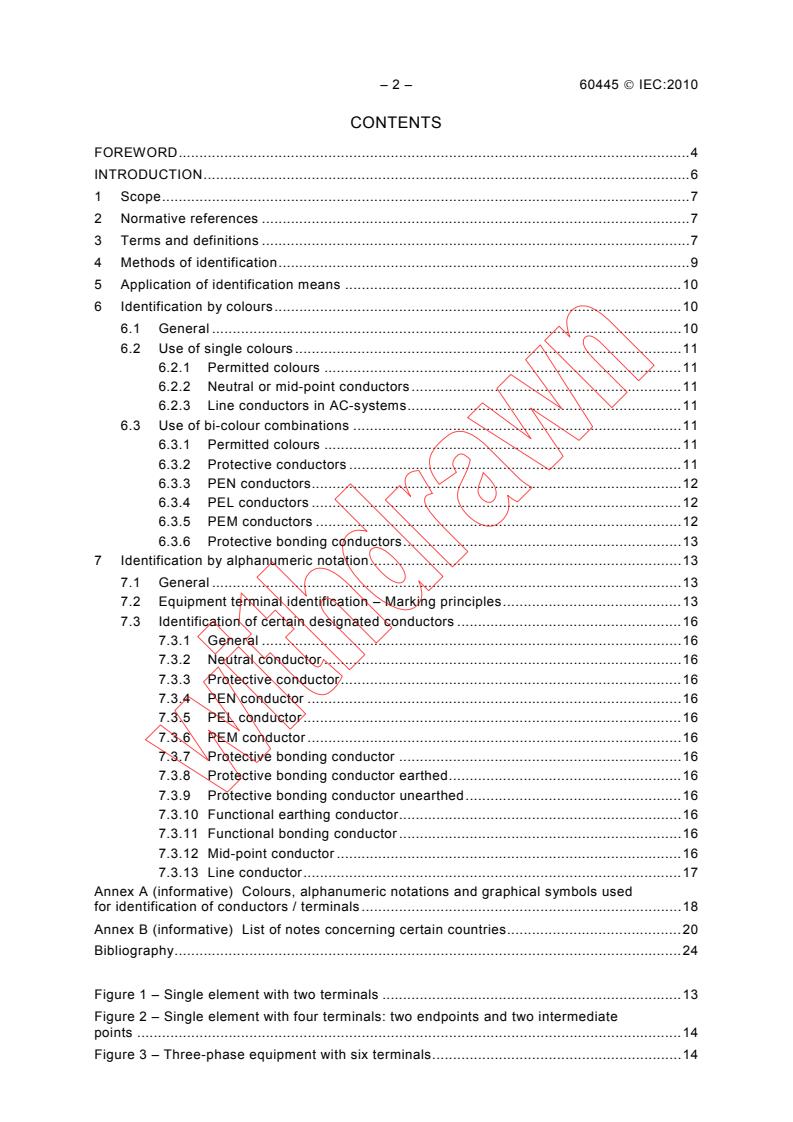
– 2 – 60445 © IEC:2010
CONTENTS
FOREWORD.4
INTRODUCTION.6
1 Scope.7
2 Normative references .7
3 Terms and definitions .7
4 Methods of identification.9
5 Application of identification means .10
6 Identification by colours.10
6.1 General .10
6.2 Use of single colours .11
6.2.1 Permitted colours .11
6.2.2 Neutral or mid-point conductors.11
6.2.3 Line conductors in AC-systems.11
6.3 Use of bi-colour combinations .11
6.3.1 Permitted colours .11
6.3.2 Protective conductors .11
6.3.3 PEN conductors.12
6.3.4 PEL conductors .12
6.3.5 PEM conductors .12
6.3.6 Protective bonding conductors.13
7 Identification by alphanumeric notation.13
7.1 General .13
7.2 Equipment terminal identification – Marking principles.13
7.3 Identification of certain designated conductors .16
7.3.1 General .16
7.3.2 Neutral conductor .16
7.3.3 Protective conductor.16
7.3.4 PEN conductor .16
7.3.5 PEL conductor.16
7.3.6 PEM conductor .16
7.3.7 Protective bonding conductor .16
7.3.8 Protective bonding conductor earthed.16
7.3.9 Protective bonding conductor unearthed.16
7.3.10 Functional earthing conductor.16
7.3.11 Functional bonding conductor .16
7.3.12 Mid-point conductor .16
7.3.13 Line conductor.17
Annex A (informative) Colours, alphanumeric notations and graphical symbols used
for identification of conductors / terminals.18
Annex B (informative) List of notes concerning certain countries.20
Bibliography.24
Figure 1 – Single element with two terminals .13
Figure 2 – Single element with four terminals: two endpoints and two intermediate
points .14
Figure 3 – Three-phase equipment with six terminals.14
60445 © IEC:2010 – 3 –
Figure 4 – Three-element equipment with twelve terminals: six endpoints and six
intermediate points .14
Figure 5 – Equipment with groups of elements.15
Figure 6 – Interconnection of equipment terminals and certain designated conductors.15
Table A.1 – Colours, alphanumeric notations and graphical symbols used for
identification of conductors / terminals .18
– 4 – 60445 © IEC:2010
INTERNATIONAL ELECTROTECHNICAL COMMISSION
____________
BASIC AND SAFETY PRINCIPLES FOR MAN-MACHINE
INTERFACE, MARKING AND IDENTIFICATION –
IDENTIFICATION OF EQUIPMENT TERMINALS, CONDUCTOR
TERMINATIONS AND CONDUCTORS
FOREWORD
1) The International Electrotechnical Commission (IEC) is a worldwide organization for standardization comprising
all national electrotechnical committees (IEC National Committees). The object of IEC is to promote
international co-operation on all questions concerning standardization in the electrical and electronic fields. To
this end and in addition to other activities, IEC publishes International Standards, Technical Specifications,
Technical Reports, Publicly Available Specifications (PAS) and Guides (hereafter referred to as “IEC
Publication(s)”). Their preparation is entrusted to technical committees; any IEC National Committee interested
in the subject dealt with may participate in this preparatory work. International, governmental and non-
governmental organizations liaising with the IEC also participate in this preparation. IEC collaborates closely
with the International Organization for Standardization (ISO) in accordance with conditions determined by
agreement between the two organizations.
2) The formal decisions or agreements of IEC on technical matters express, as nearly as possible, an international
consensus of opinion on the relevant subjects since each technical committee has representation from all
interested IEC National Committees.
3) IEC Publications have the form of recommendations for international use and are accepted by IEC National
Committees in that sense. While all reasonable efforts are made to ensure that the technical content of IEC
Publications is accurate, IEC cannot be held responsible for the way in which they are used or for any
misinterpretation by any end user.
4) In order to promote international uniformity, IEC National Committees undertake to apply IEC Publications
transparently to the maximum extent possible in their national and regional publications. Any divergence
between any IEC Publication and the corresponding national or regional publication shall be clearly indicated in
the latter.
5) IEC itself does not provide any attestation of conformity. Independent certification bodies provide conformity
assessment services and, in some areas, access to IEC marks of conformity. IEC is not responsible for any
services carried out by independent certification bodies.
6) All users should ensure that they have the latest edition of this publication.
7) No liability shall attach to IEC or its directors, employees, servants or agents including individual experts and
members of its technical committees and IEC National Committees for any personal injury, property damage or
other damage of any nature whatsoever, whether direct or indirect, or for costs (including legal fees) and
expenses arising out of the publication, use of, or reliance upon, this IEC Publication or any other IEC
Publications.
8) Attention is drawn to the Normative references cited in this publication. Use of the referenced publications is
indispensable for the correct application of this publication.
9) Attention is drawn to the possibility that some of the elements of this IEC Publication may be the subject of
patent rights. IEC shall not be held responsible for identifying any or all such patent rights.
International Standard IEC 60445 has been prepared by IEC technical committee 16: Basic
and safety principles for man-machine interface, marking and identification.
This fifth edition is a merged version of IEC 60445 and IEC 60446, and cancels and replaces
the fourth edition of IEC 60445, published in 2006, and the fourth edition of IEC 60446,
published in 2007.
It has the status of a basic safety publication in accordance with IEC Guide 104.
This edition includes the following significant technical changes with respect to the previous edition:
a) addition of new definitions in Clause 3;
b) revision of some clauses to use words from reference IEC standards. These revisions did
not change any technical requirements but to clarify the wording;
60445 © IEC:2010 – 5 –
c) addition of Annex B (informative) “List of notes concerning certain countries”.
The text of this standard is based on the following documents:
FDIS Report on voting
16/479/FDIS 16/480/RVD
Full information on the voting for the approval of this standard can be found in the report on
voting indicated in the above table.
This publication has been drafted in accordance with the ISO/IEC Directives, Part 2.
The reader’s attention is drawn to the fact that Annex B lists all of the “in-some-country”
clauses on differing practices of a less permanent nature relating to the subject of this
standard.
The committee has decided that the contents of this publication will remain unchanged until
the stability date indicated on the IEC web site under "http://webstore.iec.ch" in the data
related to the specific publication. At this date, the publication will be
• reconfirmed,
• withdrawn,
• replaced by a revised edition, or
• amended.
IMPORTANT – The 'colour inside' logo on the cover page of this publication indicates
that it contains colours which are considered to be useful for the correct understanding
of its contents. Users should therefore print this document using a colour printer.
– 6 – 60445 © IEC:2010
INTRODUCTION
This basic safety publication is primarily intended for use by technical committees in the
preparation of standards in accordance with the principles laid down in IEC Guide 104 and
ISO/IEC Guide 51.
It is not intended for use by manufacturers or certification bodies. One of the responsibilities
of a technical committee is, wherever applicable, to make use of basic safety publications in
the preparation of its publications. The requirements of this basic safety publication will not
apply unless specifically referred to or included in the relevant publications.
In this fifth edition of IEC 60445, the terminology has been aligned with IEC 60050-195.
60445 © IEC:2010 – 7 –
BASIC AND SAFETY PRINCIPLES FOR MAN-MACHINE
INTERFACE, MARKING AND IDENTIFICATION –
IDENTIFICATION OF EQUIPMENT TERMINALS, CONDUCTOR
TERMINATIONS AND CONDUCTORS
1 Scope
This International Standard applies to the identification and marking of terminals of electrical
equipment such as resistors, fuses, relays, contactors, transformers, rotating machines and,
wherever applicable, to combinations of such equipment (e.g. assemblies), and also applies
to the identification of terminations of certain designated conductors. It also provides general
rules for the use of certain colours or alphanumeric notations to identify conductors with the
aim of avoiding ambiguity and ensuring safe operation. These conductor colours or
alphanumeric notations are intended to be applied in cables or cores, busbars, electrical
equipment and installations.
2 Normative references
The following referenced documents are indispensable for the application of this document.
For dated references, only the edition cited applies. For undated references, the latest edition
of the referenced document (including any amendments) applies.
IEC 60417, Graphical symbols for use on equipment
IEC 60617, Graphical symbols for diagrams
IEC Guide 104, The preparation of safety publications and the use of basic safety publications
and group safety publications
ISO/IEC Guide 51, Safety aspects – Guidelines for their inclusion in standards
3 Terms and definitions
For the purposes of this document, the following terms and definitions apply.
NOTE The terms are sorted in alphabetical order in the English language.
3.1
electrical equipment
item used for purposes like generation, conversion, distribution or utilization of electric energy
(e.g. electrical machines, transformers, switchgear and controlgear, measuring instruments,
wiring systems, current-using equipment, etc.)
[IEC 60050-826:2004, 826-16-01, modified]
3.2
functional bonding conductor
conductor provided for functional- equipotential bonding
[IEC 60050-195:1998, 195-02-16]
– 8 – 60445 © IEC:2010
3.3
functional earthing
functional grounding (in US)
earthing a point or points in a system or in an installation or in equipment, for purposes other
than electrical safety
[IEC 60050-195, Amendment 1:2001, 195-01-13]
3.4
functional earthing conductor
functional grounding conductor (in US)
earthing conductor provided for functional earthing
[IEC 60050-195, 195-02-15]
3.5
functional-equipotential-bonding
equipotential bonding for operational reasons other than safety
[IEC 60050-195, 195-01-16]
3.6
line conductor
phase conductor (in AC systems) (deprecated)
pole conductor (in DC systems) (deprecated)
conductor which is energized in normal operation and capable of contributing to the
transmission or distribution of electric energy but which is not a neutral or mid-point conductor
[IEC 60050-195, 195-02-08]
3.7
mid-point conductor
conductor electrically connected to the mid-point and capable of contributing to the
distribution of electric energy
[IEC 60050-195, 195-02-07]
3.8
neutral conductor
conductor electrically connected to the neutral point and capable of contributing to the
distribution of electric energy
[IEC 60050-195, 195-02-06]
3.9
PEL conductor
conductor combining the functions of both a protective earthing conductor and a line
conductor
[IEC 60050-195, 195-02-14]
3.10
PEM conductor
conductor combining the functions of both a protective earthing conductor and a mid-point
conductor
[IEC 60050-195, 195-02-13]
60445 © IEC:2010 – 9 –
3.11
PEN conductor
conductor combining the functions of both a protective earthing conductor and a neutral
conductor
[IEC 60050-195, 195-02-12]
3.12
protective bonding conductor
equipotential bonding conductor (deprecated)
protective conductor provided for protective-equipotential-bonding
[IEC 60050-195, 195-02-10]
3.13
protective bonding conductor, earthed
protective bonding conductor with a conductive path to earth
3.14
protective bonding conductor, unearthed
protective bonding conductor without a conductive path to earth
3.15
protective conductor
(identification: PE)
conductor provided for purposes of safety, for example protection against electric shock
[IEC 60050-195, 195-02-09]
3.16
protective earthing
protective grounding (in US)
earthing a point or points in a system or in an installation or in equipment, for purposes of
electrical safety
[IEC 60050-195, Amendment 1:2001, 195-01-11]
3.17
protective earthing conductor
protective grounding conductor (in US)
protective conductor provided for protective earthing
[IEC 60050-195:1998, 195-02-11]
3.18
protective-equipotential-bonding
equipotential bonding for the purposes of safety
[IEC 60050-195:1998, 195-01-15]
4 Methods of identification
Where the identification of equipment terminals and of terminations of certain designated
conductors is considered necessary, it shall be effected by the use of one or more of the
following methods:
– the physical or relative location of the equipment terminals or of terminations of certain
designated conductors;
– 10 – 60445 © IEC:2010
– a colour code for equipment terminals and terminations of certain designated conductors
in accordance with Clause 6;
– graphical symbols in accordance with IEC 60417. If additional symbols are required, these
shall be consistent with IEC 60617;
– an alphanumeric notation in accordance with the system laid down in Clause 7.
To keep consistency with the documentation, conductor and equipment terminal designation,
the alphanumeric notation is recommended.
Identification of conductors by colours shall be in accordance with the requirements provided
in Clause 6. Identification of conductors by alphanumeric notation shall be in accordance with
the requirements provided in Clause 7.
NOTE It is recognised that for complex systems and installations additional marking and labelling may be needed
for reasons other than safety, see for example IEC 62491.
5 Application of identification means
The identifying colour, graphical symbol or alphanumeric notation shall be located on, or
adjacent to, the corresponding terminal.
When more than one identification method is used and confusion is possible, the correlation
between the methods shall be clarified in the associated documentation.
When no confusion is possible, the juxtaposition of numerical and alphanumeric notation may
be applied.
Terminals/conductors used for earthing are divided concerning their purpose of earthing into
the two basic concept of protective earthing and functional earthing.
– If a terminal or conductor fulfils the requirements for both protective earthing and
functional earthing, it shall be designated as a protective earthing terminal/conductor.
– If the requirements for protective earthing are not met by a functional earthing
terminal/conductor, it shall not be marked with an identification of a protective earthing
terminal/conductor.
– The requirements for functional earthing are to be defined by the manufacturer or the
relevant product committee and should be specified within the documentation of the
equipment.
NOTE For example requirements for handling EMC issues.
6 Identification by colours
6.1 General
For identification of conductors, the following colours are permitted:
– black, brown, red, orange, yellow, green, blue, violet, grey, white, pink, turquoise.
NOTE This list of colours is derived from IEC 60757.
The identification by colour shall be used at terminations and preferably throughout the length
of the conductor either by the colour of the insulation or by colour markers, except for bare
conductors where the colour identification shall be at termination and connection points.
Identification by colour or marking is not required for
– concentric conductors of cables,
60445 © IEC:2010 – 11 –
– metal sheath or armour of cables when used as a protective conductor,
– bare conductors where permanent identification is not practicable,
– extraneous-conductive-parts used as a protective conductor,
– exposed-conductive-parts used as a protective conductor.
Additional markings, for example alphanumerical, are allowed, provided that the colour
identification remains unambiguous.
6.2 Use of single colours
6.2.1 Permitted colours
The single colours green and yellow are only permitted where confusion with the colouring of
the conductors in accordance with 6.3.2 to 6.3.6 is not likely to occur.
6.2.2 Neutral or mid-point conductors
Where a circuit includes a neutral or mid-point conductor identified by colour, the colour used
for this purpose shall be blue. In order to avoid confusion with other colours it is
recommended to use an unsaturated colour blue, often called "light blue". Blue shall not be
used for identifying any other conductor where confusion is possible.
In the absence of a neutral or mid-point conductor within the whole wiring system, a conductor
identified by blue may be used for any other purposes, except as a protective conductor.
If identification by colour is used, bare conductors used as neutral or mid-point conductors
shall be either coloured by a blue stripe, 15 mm to 100 mm wide in each unit or enclosure and
each accessible position, or coloured blue throughout their length.
NOTE IEC 60079-11 prescribes blue when a colour is used for the marking of terminal, terminal boxes, plugs and
sockets of intrinsically-safe circuits.
6.2.3 Line conductors in AC-systems
For line conductors in AC-systems the preferred colours are BLACK, BROWN and GREY.
NOTE Sequence of colour codes in this clause is alphabetical. It does not recommend phasing or direction of
rotation.
6.3 Use of bi-colour combinations
6.3.1 Permitted colours
Combinations of any two of the colours listed in 6.1 are permitted provided there is no risk of
confusion.
To avoid such confusion the colour green and the colour yellow shall not be used in colour
combinations other than the combination green-and-yellow. The use of the combination of the
colours green-and-yellow is restricted to the purposes of 6.3.2 to 6.3.6.
6.3.2 Protective conductors
Protective conductors shall be identified by the bi-colour combination green-and-yellow.
NOTE 1 It may be necessary to provide additional marking to unambiguously identify a certain designated
conductor.
NOTE 2 An additional colour marking is required for PEN, PEL and PEM conductors.
– 12 – 60445 © IEC:2010
Green-and-yellow is the only colour combination recognized for identifying the protective
conductor.
The colour combination green-and-yellow shall be such that, on any 15 mm length of the
conductor where colour coding is applied, one of these colours covers at least 30 % and not
more than 70 % of the surface of the conductor, the other colour covering the remainder of
that surface.
If bare conductors, used as protective conductors, are provided with colouring they shall be
coloured green-and-yellow, either throughout the whole length of each conductor or in each
compartment or unit or at each accessible position. If adhesive tape is used, only bi-coloured
tape shall be applied.
NOTE 3 Where the protective conductor can be easily identified by its shape, construction or position, for
example a concentric conductor, colour coding throughout its length is not necessary but the ends or accessible
positions should be clearly identified by the graphical symbol or the bi-colour combination green-and-yellow
or the alphanumeric notation PE.
NOTE 4 If extraneous conductive parts are used as a PE conductor identification by colours is not necessary.
6.3.3 PEN conductors
PEN conductors, when insulated, shall be marked by one of the following methods:
– green-and-yellow throughout their length with, in addition, blue markings at the
terminations; or
– blue throughout their length with, in addition, green-and-yellow markings at the
terminations.
NOTE 1 The choice of method or methods to be applied within a country should be made by the relevant
committees and not on individual basis.
NOTE 2 The additional blue markings at the termination may be omitted once either of the following two indents is
met:
– in electrical equipment, if relevant requirements are included in specific product standards or within a country;
– in case of wiring systems, for example those used in industry, if decided by the relevant committee.
6.3.4 PEL conductors
PEL conductors, when insulated, shall be marked green-and-yellow throughout their length
with, in addition, blue markings at their terminations.
NOTE The additional blue markings at the termination may be omitted once either of the following two indents is
met:
– in electrical equipment, if relevant requirements are included in specific product standards or within a country;
– in case of wiring systems, for example those used in industry, if decided by the relevant committee.
If confusion with a PEN or PEM conductor is likely, the alphanumeric designation as given in
7.3.5 shall be indicated at their terminations.
6.3.5 PEM conductors
PEM conductors, when insulated, shall be marked green-and-yellow throughout their length
with, in addition, blue markings at their terminations.
NOTE The additional blue markings at the termination may be omitted once either of the following two indents is
met:
60445 © IEC:2010 – 13 –
– in electrical equipment, if relevant requirements are included in specific product standards or within a country;
– in case of wiring systems, for example those used in industry, if decided by the relevant committee.
If confusion with a PEN or PEL conductor is likely, the alphanumeric designation as given in
7.3.6 shall be indicated at their terminations.
6.3.6 Protective bonding conductors
Protective bonding conductors shall be identified by the bi-colour combination green-and-
yellow as specified in 6.3.1.
7 Identification by alphanumeric notation
7.1 General
If letters and/or numerals are used for identification, letters shall be upper case Latin
characters only and numerals shall be Arabic numerals.
NOTE It is recommended that the reference letters for DC elements be chosen from the first part and reference
letters for AC elements from the second part of the alphabet.
Letters “I” and “O” shall not be used to prevent confusion with the numerals “1” and “0”; the
signs “+” and “–“ may be used.
In order to avoid confusion, unattached numerals 6 and 9 shall be underlined.
All alphanumeric notations shall be in strong contrast to the colour of the insulation.
The identification shall be clearly legible and durable.
NOTE For evaluation of the durability see IEC 60227-2.
The alphanumeric system applies to identification of conductors and of conductors in a group
of conductors. Conductors with green-and-yellow coloured insulation shall only be identified
as a certain designated conductor in accordance with 7.3.3 to 7.3.9.
The alphanumeric identifications specified in 7.3 shall not be used for any other purpose than
that specified.
Where no confusion is possible, parts of the complete alphanumeric notation laid down in the
following marking principles may be omitted.
7.2 Equipment terminal identification – Marking principles
Terminal marking is based on the following principles:
7.2.1 The two end points of an element are distinguished by consecutive reference numbers,
the odd number being lower than the even number, for example 1 and 2 (see Figure 1).
IEC 1448/99
Figure 1 – Single element with two terminals
– 14 – 60445 © IEC:2010
7.2.2 The intermediate points of a single element are distinguished by reference numbers,
preferably in a numerical order, for example 3, 4, 5, etc. The reference numbers chosen for
intermediate points shall be higher than those chosen for the end points; their numbering
commences at the point which lies closest to the end point with the lower reference number.
Thus, for example, the intermediate points, of an element with the end points 1 and 2 will be
denoted by the reference numbers 3 and 4 (see Figure 2).
IEC 1449/99
Figure 2 – Single element with four terminals: two endpoints
and two intermediate points
7.2.3 If several similar elements are combined in a group of elements, then one of the
following methods for marking the elements shall be used:
– the two end points and intermediate points, if any, are distinguished by letters preceding
the reference numbers referred to in 7.2.1 and 7.2.2 ; for example U, V, W corresponding
to the phases of a three-phase AC system (see Figure 3);
IEC 1450/99
Figure 3 – Three-phase equipment with six terminals
– the two end points and intermediate points, if any, are distinguished by numbers preceding
the reference numbers referred to in 7.2.1 and 7.2.2 where a phase identification is not
necessary or possible. To avoid confusion these numbers shall be separated by a full
stop. For example the end points of one element may be marked 1.1 and 1.2, those of
another element 2.1 and 2.2 (see Figure 4);
NOTE For examples of an unambiguous terminal designation with respect to the object to which the terminal
belongs, see Annex B of IEC 61666.
IEC 1451/99
Figure 4 – Three-element equipment with twelve terminals:
six endpoints and six intermediate points
– in case of terminal blocks, numerical identification in numerical order.
60445 © IEC:2010 – 15 –
Further detailed requirements on terminal markings and identification may be given by
relevant product committees.
7.2.4 Similar groups of elements having the same reference letters are distinguished by a
numerical prefix to the reference letters (see Figures 5a and 5b).
+
IEC 1453/99
IEC 1452/99
Figure 5a – Three-phase equipment with two groups Figure 5b – Two-phase equipment with two groups of
of elements elements with four terminals each not intended to be
connected to certain designated conductors
Figure 5 – Equipment with groups of elements
Figure 6 illustrates the interconnection of equipment terminals and certain designated
conductors, marked in accordance with the alphanumeric notation.
IEC 1454/99
Figure 6 – Interconnection of equipment terminals and certain designated conductors
– 16 – 60445 © IEC:2010
7.3 Identification of certain designated conductors
7.3.1 General
Equipment terminals which are intended to be connected directly or indirectly to certain
designated conductors, and terminations of certain designated conductors shall be marked
with reference letters or graphical symbols or both reference letters and graphical symbols
according to Table A.1.
7.3.2 Neutral conductor
The alphanumeric identification of a neutral conductor shall be ‘N’.
7.3.3 Protective conductor
The alphanumeric identification of a protective conductor shall be ‘PE’. This identification also
applies for a protective earthing conductor.
7.3.4 PEN conductor
The alphanumeric identification of a PEN conductor shall be ‘PEN’.
7.3.5 PEL conductor
The alphanumeric identification of a PEL conductor shall be ‘PEL’.
7.3.6 PEM conductor
The alphanumeric identification of a PEM conductor shall be ‘PEM’.
7.3.7 Protective bonding conductor
The alphanumeric identification of a protective bonding conductor shall be ‘PB’.
7.3.8 Protective bonding conductor earthed
If it is necessary to distinguish between a protective bonding conductor earthed and a
protective bonding conductor unearthed, the alphanumeric identification of a protective
bonding conductor earthed shall be ‘PBE’.
7.3.9 Protective bonding conductor unearthed
If it is necessary to distinguish between a protective bonding conductor earthed and a
protective bonding conductor unearthed, the alphanumeric identification of a protective
bonding conductor unearthed shall be ‘PBU’.
7.3.10 Functional earthing conductor
The alphanumeric identification of a functional earthing conductor shall be ‘FE’.
7.3.11 Functional bonding conductor
The alphanumeric identification of a functional bonding conductor shall be ‘FB’.
7.3.12 Mid-point conductor
The alphanumeric identification of a mid-point conductor shall be ‘M’.
60445 © IEC:2010 – 17 –
7.3.13 Line conductor
The alphanumeric identification of a line conductor shall start with the letter “L” suffixed by:
– for a.c. circuit, a sequential number of line conductors, starting with the digit one “1”;
– for d.c. circuit with the sign “+” for the positive line conductor and with the sign “-“ for the
negative line conductor.
If no more than one line conductor is used, the suffix may be omitted.
– 18 – 60445 © IEC:2010
Annex A
(informative)
Colours, alphanumeric notations and graphical symbols
used for identification of conductors / terminals
Table A.1 – Colours, alphanumeric notations and graphical symbols used for
identification of conductors / terminals
Designated conductors/terminals Identification of conductors / terminals by
a
Alphanumeric notations Colours Graphical
b
symbols
Conductors Terminals
AC conductors AC AC -
Line 1 L1 U d
BK or
c
Line 2 L2 V d
BR or
c
Line 3 L3 W d
GR
Mid-point conductors M M
No
e
BU
recommendation
Neutral conductors N N
DC conductors DC DC -
Positive
L+ +
No
recommendation
Negative L- -
Protective conductors PE PE
GNYE
f
PEN conductors PEN PEN
GNYE
No
PEL conductors PEL PEL
recommendation
f
PEM conductors PEM PEM BU
g
Protective bonding conductors PB PB
GNYE
- earthed PBE PBE
No
- unearthed PBU PBU recommendation
h
Functional earthing conductors FE FE
No
recommendation
Functional bonding conductors FB FB
a See Clause 7.
b The graphics shown correspond to the following symbol No in IEC 60417.
IEC 60417-5032 (2002-10) IEC 60417-5019 (2006-08)
IEC 60417-5031 (2002-10) IEC 60417-5018 (2006-10)
IEC 60417-5005 (2002-10) IEC 60417-5020 (2002-10)
IEC 60417-5006 (2002-10) IEC 60417-5021 (2002-10)
c Only necessary in systems with more than one phase.
d This sequence of colour codes is alphabetical. It does not present recommended phasing or a direction of
rotation.
e See 6.2.2.
f See 6.3.3 to 6.3.5.
g A protective bonding conductor will in most cases be a protective bonding conductor earthed. It is not
necessary to designate these with PBE. In those cases where both a distinction between a protective
bonding conductor earthed and a protective bonding conductor unearthed are used, a clear distinction
between them shall be made (for example, within electro medical installations) and the designations PBE
and PBU should be applied.
60445 © IEC:2010 – 19 –
h Neither the designation FE nor the graphical symbol 5018 of IEC 60417 shall be applied for conductors or
terminals having a protective function. Bi-colour insulation green-and-yellow cannot be used for conductors
without having protective function (i.e. for conductors others than PE, PEN, PEL, PEM, PB, PBE, PBU).
See Clause 5.
– 20 – 60445 © IEC:2010
Annex B
(informative)
List of notes concerning certain countries
Country Clause Nature (permanent or less permanent Rationale (detailed justification for the Wording
No. according to IEC Directives) requested country note)
RU 3 The earthed line conductor is used in In the Russian Federation, the following definitions apply:
single-phase a.c. electrical systems, in
line conductor, earthed
three-phase a.c. electrical systems
a line conductor which has an electrical connection with the earth
without the neutral point and in two-wire
electrode
d.c. electrical systems.
In the Russian Federation use of term phase conductor
"phase conductor" and “pole conductor” a line conductor which is used in an a.c. electrical circuit
has been renewed tom indicate line
conductors in a.c. system and d.c. pole conductor
systems respectively. a line conductor which is used in an d.c. electrical circuit
RU 3.5 Definition of term "mid-point conductor" in In the Russian Federation, the mid-point conductor is defined as:
the IEC 60050-195 is given so that the
a conductor electrically connected to the mid-point of the d.c.
area of use of this conductor is uncertain.
electrical system and used for the transmission and distribution of
In the Russian Federation the definition
electric energy
of mid-point conductor taken from the
IEC 60050-195 have been executed more
precisely to state unambiguously its
application in the d.c. electrical circuits.
RU 3.6 Definition of term "neutral conductor" in In the Russian Federation, the neutral conductor is defined as:
the IEC 60050-195 is given so that the
a conductor electrically connected to the neutral point or the mid-point
area of use of this conductor is uncertain.
of the a.c. electrical system and used for the transmission and
In the Russian Federation the definition
distribution of electric energy
of neutral conductor taken from the
IEC 60050-195 have been executed more
precisely to state unambiguously its
application in the a.c. electrical circuits.
60445 © IEC:2010 – 21 –
Country Clause Nature (permanent or less permanent Rationale (detailed justification for the Wording
No. according to IEC Directives) requested country note)
RU 6.2 In the Russian Federation, the preferred colour of the phase conductor
of a single-phase electrical circuit is BROWN. When the single-phase
electrical circuit is branched from a three-phase electrical circuit, the
colour identification of the phase conductor of the single-phase
electrical circuit should coincide with the colour identification of that
phase conductor of the three-phase electric
...