

IEC 61217:1996
(Main)Radiotherapy equipment - Coordinates, movements and scales
General Information
- Abstract
Applies to equipment and data related to the process of teleradiotherapy, including patient image data used in relation with radiotherapy treatment planning systems, radiotherapy simulators, isocentric gamma beam therapy equipment, isocentric medical electron accelerators, and non-isocentric equipment when relevant. The object of this standard is to define a consistent set of coordinate systems for use throughout the process of teleradiotherapy, to define the marking of scales (where provided), to define the movements of equipment used in this process, and to facilitate computer control when used.
- Status
- Published
- Publication Date
- 13-Apr-2008
- Drafting Committee
- WG 1 - TC 62/SC 62C/WG 1
- Current Stage
- DELPUB - Deleted Publication
- Start Date
- 07-Dec-2011
- Completion Date
- 28-Aug-2026
Buy Documents
IEC 61217:1996+AMD1:2000 CSV - Radiotherapy equipment - Coordinates, movements and scales Released:3/8/2002


IEC 61217:1996+AMD1:2000+AMD2:2007 CSV - Radiotherapy equipment - Coordinates, movements and scales Released:4/14/2008
Overview
IEC 61217:1996, "Radiotherapy equipment – Coordinates, movements and scales," is an international standard developed by the International Electrotechnical Commission (IEC). This standard is essential for ensuring consistency and interoperability across a wide range of radiotherapy equipment used in medical treatments, including teleradiotherapy systems, radiotherapy simulators, isocentric gamma beam equipment, isocentric electron accelerators, and other relevant devices. Its primary goal is to define a consistent set of coordinate systems, equipment movements, and markings of scales for both manual and computer-controlled radiotherapy operations. Standardization in this area is crucial for accurate patient positioning, treatment delivery, and integration with radiotherapy treatment planning systems.
Key Topics
- Coordinate Systems: The standard details the definition and application of various coordinate systems used throughout radiotherapy processes, including those for the fixed reference frame, gantry, patient support, beam limiting devices, and the patient. This uniform approach ensures clarity and precise communication in treatment planning and device operation.
- Equipment Movements: IEC 61217 specifies conventions for describing and identifying the angular and linear motions of radiotherapy equipment, such as rotations of gantries, tables, and beam-limiting devices, as well as translations related to patient support systems.
- Marking of Scales: Guidance is provided for the consistent marking, reading, and display of mechanical and digital scales on radiotherapy devices, aiding both manual and computer-assisted operations.
- Interoperability: The standard supports reliable exchange and comparison of radiotherapy data within and between facilities, equipment manufacturers, and software systems (including those using DICOM for image data).
- Annexes for Reference: Informative annexes supply examples of coordinate transformations, terminology, bibliographic references, and the relationship between IEC and DICOM coordinate systems.
Applications
IEC 61217:1996 is widely used in the design, manufacturing, and clinical operation of radiotherapy equipment. Some typical applications include:
- Radiotherapy Treatment Planning: Ensuring treatment plans generated by planning systems correspond precisely to equipment positioning during patient treatment, thus reducing the risk of geometric errors.
- Patient Setup and Positioning: Defining clear reference frames and zero positions allows clinicians to consistently position patients, enhancing treatment reproducibility and safety.
- Equipment Interoperability: Facilitating integration between diverse equipment (such as simulators, accelerators, and imaging devices) from multiple manufacturers by providing a common language for movement and alignment.
- Quality Assurance and Maintenance: Providing reference standards for equipment calibration, validation, and routine checks, contributing to reliable dose delivery and patient safety.
- Research and Development: Supporting innovation in radiotherapy technologies by standardizing key parameters, movements, and measurement references for new device development.
Related Standards
For a comprehensive approach to radiotherapy equipment safety and interoperability, the following related standards should also be considered:
- IEC 60601-2-1: Medical electrical equipment - Particular requirements for the safety of electron accelerators in the range 1 MeV to 50 MeV.
- IEC 60601-2-11: Medical electrical equipment - Particular requirements for the safety of gamma beam therapy equipment.
- IEC 60976: Medical electrical equipment - Medical electron accelerators - Functional performance characteristics.
- IEC 60977: Medical electrical equipment - Dosimeters with ionization chambers and/or semi-conductor detectors as used in radiotherapy.
Adhering to IEC 61217:1996 in conjunction with these related standards enables manufacturers, clinical users, and service providers to ensure consistency, patient safety, and compatibility in the field of radiotherapy equipment.
Keywords: IEC 61217, radiotherapy equipment, coordinate systems, equipment movements, scale markings, radiotherapy standards, medical device interoperability, treatment planning, patient positioning, teleradiotherapy.
Relations
- Amended By
IEC 61217:1996/AMD2:2007 - Amendment 2 - Radiotherapy equipment - Coordinates, movements and scales - Effective Date
- 05-Sep-2023
- Amended By
IEC 61217:1996/AMD1:2000 - Amendment 1 - Radiotherapy equipment - Coordinates, movements and scales - Effective Date
- 05-Sep-2023
- Effective Date
- 05-Sep-2023
Buy Documents
IEC 61217:1996+AMD1:2000 CSV - Radiotherapy equipment - Coordinates, movements and scales Released:3/8/2002
IEC 61217:1996+AMD1:2000+AMD2:2007 CSV - Radiotherapy equipment - Coordinates, movements and scales Released:4/14/2008
Get Certified
Connect with accredited certification bodies for this standard

BSI Group
BSI (British Standards Institution) is the business standards company that helps organizations make excellence a habit.

TÜV Rheinland
TÜV Rheinland is a leading international provider of technical services.

TÜV SÜD
TÜV SÜD is a trusted partner of choice for safety, security and sustainability solutions.
Sponsored listings
Frequently Asked Questions
IEC 61217:1996 is a standard published by the International Electrotechnical Commission (IEC). Its full title is "Radiotherapy equipment - Coordinates, movements and scales". This standard covers: Applies to equipment and data related to the process of teleradiotherapy, including patient image data used in relation with radiotherapy treatment planning systems, radiotherapy simulators, isocentric gamma beam therapy equipment, isocentric medical electron accelerators, and non-isocentric equipment when relevant. The object of this standard is to define a consistent set of coordinate systems for use throughout the process of teleradiotherapy, to define the marking of scales (where provided), to define the movements of equipment used in this process, and to facilitate computer control when used.
Applies to equipment and data related to the process of teleradiotherapy, including patient image data used in relation with radiotherapy treatment planning systems, radiotherapy simulators, isocentric gamma beam therapy equipment, isocentric medical electron accelerators, and non-isocentric equipment when relevant. The object of this standard is to define a consistent set of coordinate systems for use throughout the process of teleradiotherapy, to define the marking of scales (where provided), to define the movements of equipment used in this process, and to facilitate computer control when used.
IEC 61217:1996 is classified under the following ICS (International Classification for Standards) categories: 11.040.50 - Radiographic equipment; 13.280 - Radiation protection. The ICS classification helps identify the subject area and facilitates finding related standards.
IEC 61217:1996 has the following relationships with other standards: It is inter standard links to IEC 61217:1996/AMD2:2007, IEC 61217:1996/AMD1:2000, IEC 61217:2011. Understanding these relationships helps ensure you are using the most current and applicable version of the standard.
IEC 61217:1996 is available in PDF format for immediate download after purchase. The document can be added to your cart and obtained through the secure checkout process. Digital delivery ensures instant access to the complete standard document.
Standards Content (Sample)
NORME CEI
INTERNATIONALE IEC
INTERNATIONAL
Edition 1.1
STANDARD
2002-03
Edition 1:1996 consolidée par l'amendement 1:2000
Edition 1:1996 consolidated with amendment 1:2000
Appareils utilisés en radiothérapie –
Coordonnées, mouvements et échelles
Radiotherapy equipment –
Coordinates, movements and scales
Numéro de référence
Reference number
CEI/IEC 61217:1996+A1:2000
Numérotation des publications Publication numbering
Depuis le 1er janvier 1997, les publications de la CEI As from 1 January 1997 all IEC publications are
sont numérotées à partir de 60000. Ainsi, la CEI 34-1 issued with a designation in the 60000 series. For
devient la CEI 60034-1. example, IEC 34-1 is now referred to as IEC 60034-1.
Editions consolidées Consolidated editions
Les versions consolidées de certaines publications de la The IEC is now publishing consolidated versions of its
CEI incorporant les amendements sont disponibles. Par publications. For example, edition numbers 1.0, 1.1
exemple, les numéros d’édition 1.0, 1.1 et 1.2 indiquent and 1.2 refer, respectively, to the base publication,
respectivement la publication de base, la publication de the base publication incorporating amendment 1 and
base incorporant l’amendement 1, et la publication de the base publication incorporating amendments 1
base incorporant les amendements 1 et 2. and 2.
Informations supplémentaires Further information on IEC publications
sur les publications de la CEI
Le contenu technique des publications de la CEI est The technical content of IEC publications is kept
constamment revu par la CEI afin qu'il reflète l'état under constant review by the IEC, thus ensuring that
actuel de la technique. Des renseignements relatifs à the content reflects current technology. Information
cette publication, y compris sa validité, sont dispo- relating to this publication, including its validity, is
nibles dans le Catalogue des publications de la CEI available in the IEC Catalogue of publications
(voir ci-dessous) en plus des nouvelles éditions, (see below) in addition to new editions, amendments
amendements et corrigenda. Des informations sur les and corrigenda. Information on the subjects under
sujets à l’étude et l’avancement des travaux entrepris consideration and work in progress undertaken by the
par le comité d’études qui a élaboré cette publication, technical committee which has prepared this
ainsi que la liste des publications parues, sont publication, as well as the list of publications issued,
également disponibles par l’intermédiaire de: is also available from the following:
• Site web de la CEI (www.iec.ch) • IEC Web Site (www.iec.ch)
• Catalogue des publications de la CEI • Catalogue of IEC publications
Le catalogue en ligne sur le site web de la CEI The on-line catalogue on the IEC web site
(www.iec.ch/catlg-f.htm) vous permet de faire des (www.iec.ch/catlg-e.htm) enables you to search
recherches en utilisant de nombreux critères, by a variety of criteria including text searches,
comprenant des recherches textuelles, par comité technical committees and date of publication. On-
d’études ou date de publication. Des informations line information is also available on recently
en ligne sont également disponibles sur les issued publications, withdrawn and replaced
nouvelles publications, les publications rempla- publications, as well as corrigenda.
cées ou retirées, ainsi que sur les corrigenda.
• IEC Just Published
• IEC Just Published
Ce résumé des dernières publications parues
This summary of recently issued publications
(www.iec.ch/JP.htm) est aussi disponible par
(www.iec.ch/JP.htm) is also available by email.
courrier électronique. Veuillez prendre contact
Please contact the Customer Service Centre (see
avec le Service client (voir ci-dessous) pour plus
below) for further information.
d’informations.
• Service clients
• Customer Service Centre
Si vous avez des questions au sujet de cette
If you have any questions regarding this
publication ou avez besoin de renseignements
publication or need further assistance, please
supplémentaires, prenez contact avec le Service
contact the Customer Service Centre:
clients:
Email: custserv@iec.ch
Email: custserv@iec.ch
Tél: +41 22 919 02 11
Tel: +41 22 919 02 11
Fax: +41 22 919 03 00
Fax: +41 22 919 03 00
.
NORME CEI
INTERNATIONALE IEC
INTERNATIONAL
Edition 1.1
STANDARD
2002-03
Edition 1:1996 consolidée par l'amendement 1:2000
Edition 1:1996 consolidated with amendment 1:2000
Appareils utilisés en radiothérapie –
Coordonnées, mouvements et échelles
Radiotherapy equipment –
Coordinates, movements and scales
IEC 2002 Droits de reproduction réservés Copyright - all rights reserved
Aucune partie de cette publication ne peut être reproduite ni No part of this publication may be reproduced or utilized in
utilisée sous quelque forme que ce soit et par aucun procédé, any form or by any means, electronic or mechanical,
électronique ou mécanique, y compris la photocopie et les including photocopying and microfilm, without permission in
microfilms, sans l'accord écrit de l'éditeur. writing from the publisher.
International Electrotechnical Commission 3, rue de Varembé Geneva, Switzerland
Telefax: +41 22 919 0300 e-mail: inmail@iec.ch IEC web site http://www.iec.ch
CODE PRIX
Commission Electrotechnique Internationale
CR
PRICE CODE
International Electrotechnical Commission
Pour prix, voir catalogue en vigueur
For price, see current catalogue
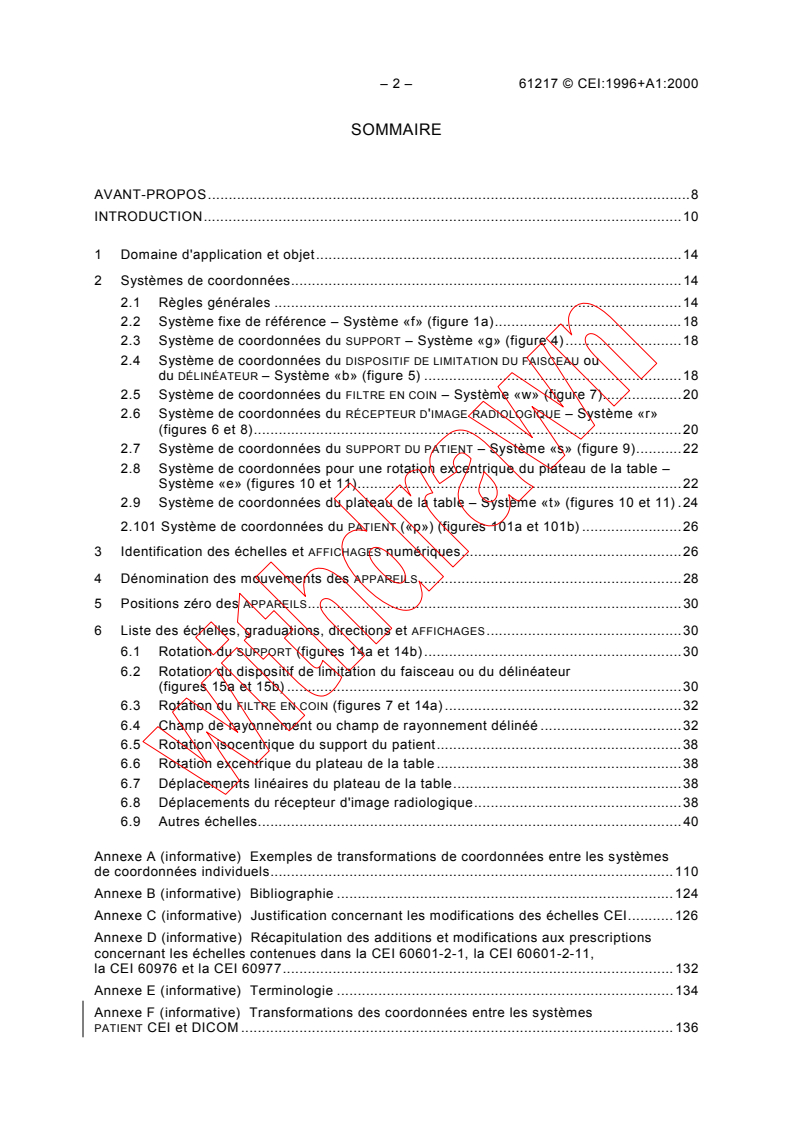
– 2 – 61217 © CEI:1996+A1:2000
SOMMAIRE
AVANT-PROPOS.8
INTRODUCTION.10
1 Domaine d'application et objet.14
2 Systèmes de coordonnées.14
2.1 Règles générales .14
2.2 Système fixe de référence – Système «f» (figure 1a).18
2.3 Système de coordonnées du SUPPORT – Système «g» (figure 4).18
2.4 Système de coordonnées du DISPOSITIF DE LIMITATION DU FAISCEAU ou
du DÉLINÉATEUR – Système «b» (figure 5) .18
2.5 Système de coordonnées du FILTRE EN COIN – Système «w» (figure 7).20
2.6 Système de coordonnées du RÉCEPTEUR D'IMAGE RADIOLOGIQUE – Système «r»
(figures 6 et 8).20
2.7 Système de coordonnées du SUPPORT DU PATIENT – Système «s» (figure 9).22
2.8 Système de coordonnées pour une rotation excentrique du plateau de la table –
Système «e» (figures 10 et 11).22
2.9 Système de coordonnées du plateau de la table – Système «t» (figures 10 et 11) .24
2.101 Système de coordonnées du PATIENT («p») (figures 101a et 101b) .26
3 Identification des échelles et AFFICHAGES numériques.26
4 Dénomination des mouvements des APPAREILS .28
5 Positions zéro des APPAREILS.30
6 Liste des échelles, graduations, directions et AFFICHAGES.30
6.1 Rotation du SUPPORT (figures 14a et 14b).30
6.2 Rotation du dispositif de limitation du faisceau ou du délinéateur
(figures 15a et 15b) .30
6.3 Rotation du FILTRE EN COIN (figures 7 et 14a) .32
6.4 Champ de rayonnement ou champ de rayonnement délinéé .32
6.5 Rotation isocentrique du support du patient.38
6.6 Rotation excentrique du plateau de la table.38
6.7 Déplacements linéaires du plateau de la table.38
6.8 Déplacements du récepteur d'image radiologique.38
6.9 Autres échelles.40
Annexe A (informative) Exemples de transformations de coordonnées entre les systèmes
de coordonnées individuels.110
Annexe B (informative) Bibliographie .124
Annexe C (informative) Justification concernant les modifications des échelles CEI.126
Annexe D (informative) Récapitulation des additions et modifications aux prescriptions
concernant les échelles contenues dans la CEI 60601-2-1, la CEI 60601-2-11,
la CEI 60976 et la CEI 60977.132
Annexe E (informative) Terminologie .134
Annexe F (informative) Transformations des coordonnées entre les systèmes
PATIENT CEI et DICOM .136
61217 © IEC:1996+A1:2000 − 3 −
CONTENTS
FOREWORD.9
INTRODUCTION.11
1 Scope and object.15
2 Coordinate systems.15
2.1 General rules .15
2.2 Fixed reference system ("f") (figure 1a) .19
2.3 GANTRY coordinate system ("g") (figure 4) .19
2.4 BEAM LIMITING DEVICE or DELINEATOR coordinate system ("b") (figure 5) .19
2.5 WEDGE FILTER coordinate system ("w") (figure 7) .21
2.6 X-RAY IMAGE RECEPTOR coordinate system ("r") (figures 6 and 8).21
2.7 PATIENT SUPPORT coordinate system ("s") (figure 9) .23
2.8 Table top eccentric rotation coordinate system ("e") (figures 10 and 11).23
2.9 Table top coordinate system ("t") (figures 10 and 11) .25
2.101 PATIENT coordinate system ("p") (see figures 101a and 101b) .27
3 Identification of scales and digital DISPLAYS .27
4 Designation of EQUIPMENT movements .29
5EQUIPMENT zero positions .31
6 List of scales, graduations, directions and DISPLAYS.31
6.1 Rotation of the GANTRY (figures 14a and 14b).31
6.2 Rotation of the BEAM LIMITING DEVICE or DELINEATOR (figures 15a and 15b).31
6.3 Rotation of the WEDGE FILTER (figures 7 and 14a) .33
6.4 Radiation field or delineated radiation field.33
6.5 Patient support isocentric rotation .39
6.6 Table top eccentric rotation .39
6.7 Table top linear movements .39
6.8 X-ray image receptor movements .39
6.9 Other scales.41
Annex A (informative) Examples of coordinate transformations between individual
coordinate systems.111
Annex B (informative) Bibliography .125
Annex C (informative) Rationale for changes in IEC scales.127
Annex D (informative) Summary of additions and changes to scale statements
in IEC 60601-2-1, IEC 60601-2-11, IEC 60976 and IEC 60977.133
Annex E (informative) Terminology .135
Annex F (informative) Coordinate transformations between IEC and DICOM
PATIENT coordinates .137
– 4 – 61217 © CEI:1996+A1:2000
Figure 1a – Systèmes de coordonnées (voir 2.1.2) avec toutes les positions angulaires
à zéro .44
Figure 1b − Translation de l'origine Id le long de Xm, Ym, Zm et rotation autour de l'axe Zd,
qui est parallèle à Zm (voir 2.1.4) .46
Figure 1c − Translation de l'origine Id le long de Xm, Ym, Zm et rotation autour de l'axe Yd,
qui est parallèle à Ym (voir 2.1.4) .46
Figure 2 – Système de coordonnées direct XYZ ascendant (représentation en perspective)
montrant les directions de rotation positives ψ, ϕ, θ, des systèmes descendants (voir 2.2) .48
Figure 3 – Structure hiérarchique des systèmes de coordonnées (voir 2.1.3 et 2.1.5) .50
Figure 4 – Rotation (ϕg= 15°) du système de coordonnées du SUPPORT Xg, Yg, Zg dans
le système fixe de référence Xf, Yf, Zf (voir 2.3) .52
Figure 5 – Rotation (θb = 15°) du système de coordonnées du DISPOSITIF DE LIMITATION DU
FAISCEAU ou du DÉLINÉATEUR Xb, Yb, Zb dans le système de coordonnées du SUPPORT Xg,
Yg, Zg, et rotation résultante du CHAMP DE RAYONNEMENT ou du CHAMP DE RAYONNEMENT
DÉLINÉÉ de dimensions FX et FY (voir 2.4) .54
Figure 6 – Déplacement de l'origine Ir du système de coordonnées du RÉCEPTEUR D'IMAGE
RADIOLOGIQUE (type amplificateur de brillance) dans le système de coordonnées du
SUPPORT, de Rx = –8, Ry = +10, Rz = –40 (voir 2.6).56
Figure 7 – Rotation (θw = 270°) et translation du système de coordonnées du FILTRE EN
COIN Xw, Yw, Zw dans le système de coordonnées du DISPOSITIF DE LIMITATION DU FAISCEAU
Xb, Yb, Zb, le système de coordonnées du DISPOSITIF DE LIMITATION DU FAISCEAU ayant
tourné d'un angle θb = 345° (voir 2.5) .58
Figure 8 – Rotation (θr = 90°) et déplacement du système de coordonnées Xr, Yr, Zr du
système du RÉCEPTEUR D'IMAGE RADIOLOGIQUE de type CASSETTE RADIOGRAPHIQUE dans
le système de coordonnées du SUPPORT Xg, Yg, Zg (voir 2.6).60
Figure 9 – Rotation (θs = 345°) du système de coordonnées Xs, Ys, Zs du SUPPORT DU
PATIENT dans le système de coordonnées fixe Xf, Yf, Zf (voir 2.7) .62
Figure 10 – Rotation de θe du système de coordonnées excentrique du plateau de la table
dans le système de coordonnées du SUPPORT DU PATIENT qui est lui-même tourné d'un angle
de θs dans le système fixe de référence, avec θe = 360° – θs (voir 2.8 et 2.9).64
Figure 11a –Plateau de la table abaissé sous l'ISOCENTRE de Tz = –20 cm (voir 2.8 et 2.9).66
Figure 11b − Déplacement du système de coordonnées du plateau de la table de Tx = + 5,
Ty = Le + 10 dans le système de coordonnées du SUPPORT DU PATIENT Xs, Ys, Zs qui est
tourné de θs = 330° dans le système de coordonnées fixe Xf, Yf, Zf (voir 2.8 et 2.9). .66
Figure 11c − Rotation du système de coordonnées du plateau de la table de θe = 30° dans
le système de coordonnées excentrique. Le SUPPORT DU PATIENT est tourné de θs = 330°
dans le système de coordonnées fixe, Tx = 0, Ty = Le (voir 2.8 et 2.9) .66
Figure 12a – Exemple d'échelle pour le DISPOSITIF DE LIMITATION DU FAISCEAU, index fixé
au système ascendant (SUPPORT) et échelle fixée au système descendant (DISPOSITIF DE
LIMITATION DU FAISCEAU), représenté vu de l'ISOCENTRE (voir 2.1.6.2 et article 3) .68
Figure 12b – Exemple d'échelle pour le DISPOSITIF DE LIMITATION DU FAISCEAU, index fixé
au système descendant (DISPOSITIF DE LIMITATION DU FAISCEAU) et échelle fixée au système
ascendant (SUPPORT), représenté vu de l'ISOCENTRE (voir 2.1.6.2 et article 3) .70
Figure 12c – Exemples d'échelles (voir article 3) .72
Figure 13a – SUPPORT tournant (adapté de la CEI 60601-2-1) avec identification des
axes 1 à 8, des directions 9 à 13, et des dimensions 14 et 15 (voir article 4) .74
Figure 13b – SIMULATEUR DE RADIOTHÉRAPIE ISOCENTRIQUE ou APPAREIL de TÉLÉRADIO-
THÉRAPIE, avec identification des axes 1; 4 à 6; 19, des directions 9 à 12; 16 à 18 et
des dimensions 14; 15 (voir article 4).76
61217 © IEC:1996+A1:2000 − 5 −
Figure 1a – Coordinate systems (see 2.1.2) with all angular positions set to zero .45
Figure 1b − Translation of origin Id along Xm, Ym, Zm and rotation around axis Zd
parallel to Z (see 2.1.4).47
Figure 1c − Translation of origin Id along Xm, Ym, Zm and rotation around axis Yd
parallel to Ym (see 2.1.4).47
Figure 2 – X Y Z right-hand coordinate mother system (isometric drawing) showing ψ,
ϕ, θ directions of positive rotation for daughter system (see 2.2).49
Figure 3 – Hierarchical structure among coordinate systems (see 2.1.3 and 2.1.5) .51
Figure 4 – Rotation (ϕg = 15°) of GANTRY coordinate system Xg, Yg, Zg in fixed
coordinate system Xf, Yf, Zf (see 2.3) .53
Figure 5 – Rotation (θb = 15°) of BEAM LIMITING DEVICE or DELINEATOR coordinate
system Xb, Yb, Zb in GANTRY coordinate system Xg, Yg, Zg, and resultant rotation of
RADIATION FIELD or DELINEATED RADIATION FIELD of dimensions FX and FY (see 2.4) .55
Figure 6 – Displacement of image intensifier type X-RAY IMAGE RECEPTOR coordinate
system origin, Ir, in GANTRY coordinate system, by Rx = –8, Ry = +10, Rz = –40
(see 2.6) .57
Figure 7 – Rotation (θw = 270°) and translation of WEDGE FILTER coordinate system Xw,
Yw, Zw in BEAM LIMITING DEVICE coordinate system Xb, Yb, Zb, the BEAM LIMITING DEVICE
coordinate system having a rotation θb = 345° (see 2.5) .59
Figure 8 – Rotation (θr = 90°) and displacement of RADIOGRAPHIC CASSETTE type X-RAY
IMAGE RECEPTOR coordinate system Xr, Yr, Zr in GANTRY coordinate system Xg, Yg, Zg
(see 2.6) .61
Figure 9 – Rotation (θs = 345°) of PATIENT SUPPORT coordinate system Xs, Ys, Zs in
fixed coordinate system Xf, Yf, Zf (see 2.7).63
Figure 10 – Table top eccentric coordinate system rotation θe in PATIENT SUPPORT
coordinate system which has been rotated by θs in the fixed coordinate system with
θe = 360° – θs (see 2.8 and 2.9) .65
Figure 11a – Table top displaced below ISOCENTRE by Tz = –20 cm (see 2.8 and 2.9).67
Figure 11b − Table top coordinate system displacement Tx = + 5, Ty = Le + 10 in
PATIENT SUPPORT coordinate system Xs, Ys, Zs rotation (θs = 330°) in fixed coordinate
system Xf, Yf, Zf (see 2.8 and 2.9).67
Figure 11c − Table top coordinate system rotation (θe = 30°) about table top eccentric
system. PATIENT SUPPORT rotation (θs = 330°) in fixed coordinate system Tx = 0, Ty =
Le (see 2.8 and 2.9).67
Figure 12a – Example of BEAM LIMITING DEVICE scale, pointer on mother system
(GANTRY), scale on daughter system (BEAM LIMITING DEVICE), viewed from ISOCENTRE
(see 2.1.6.2 and clause 3) .69
Figure 12b – Example of BEAM LIMITING DEVICE scale, pointer on daughter system
(BEAM LIMITING DEVICE), scale on mother system (GANTRY), viewed from ISOCENTRE
(see 2.1.6.2 and clause 3) .71
Figure 12c – Examples of scales (see clause 3).73
Figure 13a − Rotary GANTRY (adapted from IEC 60601-2-1) with identification of axes 1
to 8, directions 9 to 13, and dimensions 14 and 15 (see clause 4).75
Figure 13b − ISOCENTRIC RADIOTHERAPY SIMULATOR or TELERADIOTHERAPY EQUIPMENT, with
identification of axes 1; 4 to 6; 19, of directions 9 to 12; 16 to 18 and of dimensions 14;
15 (see clause 4) .77
– 6 – 61217 © CEI:1996+A1:2000
Figure 13c – Vue depuis la source de rayonnement d'un champ de rayonnement de
téléradiothérapie ou d'un champ de rayonnement délinéé d'un simulateur de radiothérapie
(voir article 4) .78
Figure 14a – Exemple d'un APPAREIL de TÉLÉRADIOTHÉRAPIE ISOCENTRIQUE (voir 6.1 et 6.3).80
Figure 14b – Exemple de simulateur de radiothérapie isocentrique (voir 6.1) .82
Figure 15a – CHAMP DE RAYONNEMENT (FX × FY) à la DISTANCE NORMALE DE TRAITEMENT,
rectangulaire et symétrique, tourné de θb = 30°, vu d'un point situé en dessous de
l'ISOCENTRE en regardant vers la SOURCE DE RAYONNEMENT (voir 6.2) .84
Figure 15b – Même CHAMP DE RAYONNEMENT (FX × FY) à la DISTANCE NORMALE DE
TRAITEMENT, rectangulaire et symétrique, tourné de θb = 30°, vu depuis la SOURCE DE
RAYONNEMENT (voir 6.2).84
Figure 16a – CHAMP DE RAYONNEMENT ou CHAMP DE RAYONNEMENT DÉLINÉÉ rectangulaire et
symétrique, vu depuis la SOURCE DE RAYONNEMENT (voir 6.4).86
Figure 16b – CHAMP DE RAYONNEMENT ou CHAMP DE RAYONNEMENT DÉLINÉÉ rectangulaire et
asymétrique selon Yb, vu depuis la SOURCE DE RAYONNEMENT (voir 6.4) .88
Figure 16c – CHAMP DE RAYONNEMENT ou CHAMP DE RAYONNEMENT DÉLINÉÉ rectangulaire et
asymétrique selon Xb, vu depuis la SOURCE DE RAYONNEMENT (voir 6.4) .90
Figure 16d – CHAMP DE RAYONNEMENT ou CHAMP DE RAYONNEMENT DÉLINÉÉ rectangulaire et
asymétrique en Xb et Yb, vu depuis la SOURCE DE RAYONNEMENT (voir 6.4).92
Figure 16e – CHAMP DE RAYONNEMENT rectangulaire et symétrique, tourné d'un
angle θb = 30°, vu depuis la SOURCE DE RAYONNEMENT (voir 6.4) .94
Figure 16f – CHAMP DE RAYONNEMENT rectangulaire et asymétrique selon Yb, tourné
d'un angle θb = 30°, vu depuis la SOURCE DE RAYONNEMENT (voir 6.4).96
Figure 16g – CHAMP DE RAYONNEMENT rectangulaire et asymétrique selon Xb, tourné
d'un angle θb = 30°, vu depuis la SOURCE DE RAYONNEMENT (voir 6.4).98
Figure 16h – CHAMP DE RAYONNEMENT rectangulaire et asymétrique selon Xb et Yb,
et tourné d'un angle θb = 30°, vu depuis la SOURCE DE RAYONNEMENT (voir 6.4).100
Figure 16i – CHAMP DE RAYONNEMENT irrégulier multi-éléments (multilames) d'un seul
tenant, vu depuis la SOURCE DE RAYONNEMENT, avec déplacement des éléments selon
la direction Xb (voir 6.4).102
Figure 16j – CHAMP DE RAYONNEMENT irrégulier multi-éléments (multilames) en deux
parties, vu depuis la SOURCE DE RAYONNEMENT avec déplacement des éléments selon la
direction Xb (voir 6.4) .104
Figure 16k – CHAMP DE RAYONNEMENT irrégulier multi-éléments (multilames) d'un seul
tenant, vu depuis la SOURCE DE RAYONNEMENT, avec déplacement des éléments selon
la direction Yb (voir 6.4).106
Figure 101a – Système de coordonnées du PATIENT (le PATIENT est sur le dos).108
Figure 101b – Rotation du système de coordonnées du PATIENT .108
Figure F.1 – Transformations des coordonnées entre les systèmes PATIENT CEI et DICOM . 138
Tableau 1 – Dénomination des mouvements des APPAREILS .28
Tableau 2 – Systèmes de coordonnées individuels .42
Tableau A.1 – Matrices de rotation .110
61217 © IEC:1996+A1:2000 − 7 −
Figure 13c – View from radiation source of teleradiotherapy radiation field or radio-
therapy simulator delineated radiation field (see clause 4) .79
Figure 14a – Example of ISOCENTRIC TELERADIOTHERAPY EQUIPMENT (see 6.1 and 6.3).81
Figure 14b – Example of ISOCENTRIC RADIOTHERAPY SIMULATOR equipment (see 6.1) .83
Figure 15a – Rotated (θb = 30°) symmetrical rectangular RADIATION FIELD (FX × FY) at
NORMAL TREATMENT DISTANCE, viewed from ISOCENTRE looking toward RADIATION SOURCE
(see 6.2) .85
Figure 15b – Same rotated (θb = 30°) symmetrical rectangular RADIATION FIELD
(FX × FY) at NORMAL TREATMENT DISTANCE, viewed from RADIATION SOURCE (see 6.2) .85
Figure 16a – Rectangular and symmetrical RADIATION FIELD or DELINEATED RADIATION
FIELD, viewed from RADIATION SOURCE (see 6.4).87
Figure 16b – Rectangular and asymmetrical in Yb RADIATION FIELD or DELINEATED
RADIATION FIELD, viewed from RADIATION SOURCE (see 6.4).89
Figure 16c – Rectangular and asymmetrical in Xb RADIATION FIELD or DELINEATED
RADIATION FIELD, viewed from RADIATION SOURCE (see 6.4).91
Figure 16d – Rectangular and asymmetrical in Xb and Yb RADIATION FIELD or
DELINEATED RADIATION FIELD, viewed from RADIATION SOURCE (see 6.4).93
Figure 16e – Rectangular and symmetrical RADIATION FIELD, rotated by θb = 30°,
viewed from RADIATION SOURCE (see 6.4).95
Figure 16f – Rectangular and asymmetrical in Yb RADIATION FIELD, rotated by θb = 30°,
viewed from RADIATION SOURCE (see 6.4).97
Figure 16g – Rectangular and asymmetrical in Xb RADIATION FIELD, rotated by θb = 30°,
viewed from RADIATION SOURCE (see 6.4).99
Figure 16h – Rectangular and asymmetrical in Xb and Yb RADIATION FIELD, rotated by
θb = 30°, viewed from RADIATION SOURCE (see 6.4).101
Figure 16i – Irregular multi-element (multileaf) contiguous RADIATION FIELD, viewed from
RADIATION SOURCE, with element motion in Xb direction (see 6.4) .103
Figure 16j – Irregular multi-element (multileaf) two-part RADIATION FIELD, viewed from
RADIATION SOURCE, with element motion in Xb direction (see 6.4) .105
Figure 16k – Irregular multi-element (multileaf) contiguous RADIATION FIELD, viewed
from RADIATION SOURCE, with element motion in Yb direction (see 6.4) .107
Figure 101a – PATIENT coordinate system (PATIENT is supine) .109
Figure 101b – Rotation of PATIENT coordinate system .109
Figure F.1 – Coordinate transformations between IEC and DICOM PATIENT coordinates .139
Table 1 – EQUIPMENT movements and designations .29
Table 2 – Individual coordinate systems .43
Table A.1 − Rotation matrices .111
– 8 – 61217 © CEI:1996+A1:2000
COMMISSION ÉLECTROTECHNIQUE INTERNATIONALE
____________
APPAREILS UTILISÉS EN RADIOTHÉRAPIE –
COORDONNÉES, MOUVEMENTS ET ÉCHELLES
AVANT-PROPOS
1) La CEI (Commission Electrotechnique Internationale) est une organisation mondiale de normalisation
composée de l'ensemble des comités électrotechniques nationaux (Comités nationaux de la CEI). La CEI a
pour objet de favoriser la coopération internationale pour toutes les questions de normalisation dans les
domaines de l'électricité et de l'électronique. A cet effet, la CEI, entre autres activités, publie des Normes
internationales. Leur élaboration est confiée à des comités d'études, aux travaux desquels tout Comité national
intéressé par le sujet traité peut participer. Les organisations internationales, gouvernementales et non
gouvernementales, en liaison avec la CEI, participent également aux travaux. La CEI collabore étroitement
avec l'Organisation Internationale de Normalisation (ISO), selon des conditions fixées par accord entre les
deux organisations.
2) Les décisions ou accords officiels de la CEI concernant les questions techniques représentent, dans la mesure
du possible, un accord international sur les sujets étudiés, étant donné que les Comités nationaux intéressés
sont représentés dans chaque comité d’études.
3) Les documents produits se présentent sous la forme de recommandations internationales. Ils sont publiés
comme normes, spécifications techniques, rapports techniques ou guides et agréés comme tels par les
Comités nationaux.
4) Dans le but d'encourager l'unification internationale, les Comités nationaux de la CEI s'engagent à appliquer de
façon transparente, dans toute la mesure possible, les Normes internationales de la CEI dans leurs normes
nationales et régionales. Toute divergence entre la norme de la CEI et la norme nationale ou régionale
correspondante doit être indiquée en termes clairs dans cette dernière.
5) La CEI n’a fixé aucune procédure concernant le marquage comme indication d’approbation et sa responsabilité
n’est pas engagée quand un matériel est déclaré conforme à l’une de ses normes.
6) L’attention est attirée sur le fait que certains des éléments de la présente Norme internationale peuvent faire
l’objet de droits de propriété intellectuelle ou de droits analogues. La CEI ne saurait être tenue pour
responsable de ne pas avoir identifié de tels droits de propriété et de ne pas avoir signalé leur existence.
La Norme internationale CEI 61217 a été établie par le sous-comité 62C: Appareils de radio-
thérapie, de médecine nucléaire et de dosimétrie du rayonnement, du comité d'études 62 de
la CEI: Equipements électriques dans la pratique médicale.
La présente version consolidée de la CEI 61217 comprend la première édition (1996)
[documents 62C/143/FDIS et 62C/165/RVD] et son amendement 1 (2000) [documents
62C/279/FDIS et 62C/287/RVD].
Le contenu technique de cette version consolidée est donc identique à celui de l'édition de
base et à son amendement; cette version a été préparée par commodité pour l'utilisateur.
Elle porte le numéro d'édition 1.1.
Une ligne verticale dans la marge indique où la publication de base a été modifiée par
l'amendement 1.
Les annexes A, B, C, D, E et F sont données uniquement à titre d’information.
Le comité a décidé que le contenu de cette publication de base et de son amendement ne
sera pas modifié avant 2005. A cette date, la publication sera
• reconduite;
• supprimée;
• remplacée par une édition révisée, ou
• amendée.
61217 © IEC:1996+A1:2000 − 9 −
INTERNATIONAL ELECTROTECHNICAL COMMISSION
____________
RADIOTHERAPY EQUIPMENT –
COORDINATES, MOVEMENTS AND SCALES
FOREWORD
1) The IEC (International Electrotechnical Commission) is a worldwide organization for standardization comprising
all national electrotechnical committees (IEC National Committees). The object of the IEC is to promote
international co-operation on all questions concerning standardization in the electrical and electronic fields. To
this end and in addition to other activities, the IEC publishes International Standards. Their preparation is
entrusted to technical committees; any IEC National Committee interested in the subject dealt with may
participate in this preparatory work. International, governmental and non-governmental organizations liaising
with the IEC also participate in this preparation. The IEC collaborates closely with the International
Organization for Standardization (ISO) in accordance with conditions determined by agreement between the
two organizations.
2) The formal decisions or agreements of the IEC on technical matters express, as nearly as possible, an
international consensus of opinion on the relevant subjects since each technical committee has representation
from all interested National Committees.
3) The documents produced have the form of recommendations for international use and are published in the form
of standards, technical specifications, technical reports or guides and they are accepted by the National
Committees in that sense.
4) In order to promote international unification, IEC National Committees undertake to apply IEC International
Standards transparently to the maximum extent possible in their national and regional standards. Any
divergence between the IEC Standard and the corresponding national or regional standard shall be clearly
indicated in the latter.
5) The IEC provides no marking procedure to indicate its approval and cannot be rendered responsible for any
equipment declared to be in conformity with one of its standards.
6) Attention is drawn to the possibility that some of the elements of this International Standard may be the subject
of patent rights. The IEC shall not be held responsible for identifying any or all such patent rights.
International Standard IEC 61217 has been prepared by sub-committee 62C: Equipment for
radiotherapy, nuclear medicine and radiation dosimetry, of IEC technical committee 62:
Electrical equipment in medical practice.
This consolidated version of IEC 61217 consists of the first edition (1996) [documents
62C/143/FDIS and 62C/165/RVD] and its amendment 1 (2000) [documents 62C/279/FDIS and
62C/287/RVD].
The technical content is therefore identical to the base edition and its amendment and has
been prepared for user convenience.
It bears the edition number 1.1.
A vertical line in the margin shows where the base publication has been modified by
amendment 1.
Annexes A, B, C, D, E and F are for information only.
The committee has decided that the contents of the base publication and its amendment will
remain unchanged until 2005. At this date, the publication will be
• reconfirmed;
• withdrawn;
• replaced by a revised edition, or
• amended.
– 10 – 61217 © CEI:1996+A1:2000
INTRODUCTION
La RADIOTHÉRAPIE est pratiquée dans des centres médicaux disposant de divers APPAREILS
fournis par différents CONSTRUCTEURS et habituellement réunis dans un même service de
RADIOTHÉRAPIE. Pour établir un plan de traitement, simuler le traitement, positionner le
PATIENT et orienter le FAISCEAU DE RAYONNEMENT, ces APPAREILS peuvent être réglés à
diverses positions angulaires et linéaires et, dans le cas de la RADIOTHÉRAPIE CINÉTIQUE, ils
peuvent être mis en rotation ou translation pendant l'IRRADIATION du PATIENT. Il est essentiel
que les prescriptions concernant la position du PATIENT, les dimensions, directions et qualités
du FAISCEAU DE RAYONNEMENT définies par le plan de traitement puissent être réalisées ou
modifiées sur les APPAREILS de RADIOTHÉRAPIE suivant des programmes déterminés, avec
précision et sans erreur d'interprétation. Une identification standardisée des coordonnées et
des échelles des APPAREILS utilisés en RADIOTHÉRAPIE, y compris les SIMULATEURS DE RADIO-
THÉRAPIE, est absolument nécessaire, puisque des différences de marquages et d’échelles
pour des mouvements similaires sur les différents types d'APPAREILS utilisés dans un même
service peuvent multiplier les risques d'erreur. De plus, il convient que les données obtenues
par les APPAREILS utilisés pour définir la position du volume tumoral, tels que ceux utilisant les
ultrasons, le RAYONNEMENT X, la résonance magnétique ou les scanographes, soient trans-
mises au système de planification du traitement sous une forme compatible avec le système
de coordonnées utilisé en RADIOTHÉRAPIE. Des systèmes de coordonnées pour les paramètres
géométriques individuels sont nécessaires pour faciliter la transformation mathématique des
points et vecteurs d'un système de coordonnées à un autre.
Un objectif de la présente norme est d'éviter toute ambiguïté, confusion ou erreur qui pourrait
se produire en utilisant divers types d'APPAREILS. De ce fait, elle s'applique à tout type
d'APPAREILS de TÉLÉRADIOTHÉRAPIE, aux SIMULATEURS DE RADIOTHÉRAPIE, aux informations
provenant d’APPAREILS de diagnostic et utilisées en RADIOTHÉRAPIE, aux APPAREILS de
vérification et d'enregistrement, ainsi qu’aux données utilisées pour l'établissement des plans
de traitement.
La dénomination des mouvements utilise les termes définis répertoriés dans la CEI 60788 et
dans les annexes AA de la CEI 60601-2-1 et de la CEI 60601-2-29 (voir annexe E).
La présente norme ne fait pas partie de la série 601 des normes de sécurité. Elle ne constitue
pas un code de sécurité et elle ne contient pas de prescriptions concernant les performances.
Les présentes prescriptions n'apparaîtront donc pas dans les éditions futures de la série des
CEI 60601-2 qui traite exclusivement des prescriptions de sécurité.
La CEI 60601-2-1, la CEI 60601-2-11, la CEI 60601-2-29, la CEI 60976, la CEI 60977, la
CEI 61168 et la CEI 61170 contiennent des conventions concernant les mouvements et les
échelles des APPAREILS. Quelques modifications et additions ont été introduites dans la
présente norme. Elles sont répertoriées à l'annexe D.
L'un des intérêts essentiels d'un système de coordonnées standardisé est de contribuer à la
sécurité dans l'établissement des plans de traitement en RADIOTHÉRAPIE. Les exemples d'échelles
qui sont donnés dans cette norme sont cohérents avec les systèmes de coordonnées qui y
sont décrits. Les UTILISATEURS peuvent utiliser d'autres conventions pour les échelles. Il est
escompté que les CONSTRUCTEURS utiliseront normalement pour les nouveaux APPAREILS la
convention d'échelles de cette norme.
Lorsque, à la demande d'UTILISATEURS, les CONSTRUCTEURS fournissent des APPAREILS ayant
d'autres conventions d'échelles, pour qu'elles soient cohérentes avec celles des APPAREILS
déjà installés dans les locaux d'un UTILISATEUR, ou qu'elles soient conformes à des conven-
tions ou réglementations locales, ces APPAREILS ne peuvent pas être déclarés comme étant
conformes à cette norme.
61217 © IEC:1996+A1:2000 − 11 −
INTRODUCTION
RADIOTHERAPY is performed in medical centres where a variety of EQUIPMENT from different
MANUFACTURERS is usually concentrated in the RADIOTHERAPY department. In order to plan and
simulate the treatment, set up the PATIENT and direct the RADIATION BEAM, such EQUIPMENT can
be put in different angular and linear positions and, in the case of MOVING BEAM RADIOTHERAPY,
can be rotated and translated during the IRRADIATION of the PATIENT. It is essential that the
position of the PATIENT, and the dimensions, directions, and qualities of the RADIATION BEAM
prescribed in the treatment plan, be set up or varied by programmes on the RADIOTHERAPY
EQUIPMENT with accuracy and without misunderstanding. Standard identification and scaling of
coordinates is required for EQUIPMENT used in RADIOTHERAPY, including RADIOTHERAPY
SIMULATORS, because differences in the marking and scaling of similar movements on the
various types of EQUIPMENT used in the same department may increase the probability of error.
In addition, data from EQUIPMENT used to evaluate the tumour region, such as ultrasound, X-
ray, CT and MRI should be presented to the treatment planning system in a form which is
consistent with the RADIOTHERAPY coordinate system. Coordinate systems for individual
geometrical parameters are required in order to facilitate the mathematical transformation of
points and vectors from one coordinate system to another.
A goal of this standard is to avoid ambiguity, confusion, and errors which could be caused
when using different types of EQUIPMENT. Hence, its scope applies to all types of TELERADIO-
THERAPY EQUIPMENT, RADIOTHERAPY SIMULATORS, information from diagnostic EQUIPMENT when
used for RADIOTHERAPY, recording and verification EQUIPMENT, and to data input for the
treatment planning process.
Movement nomenclature is to be classified as defined terms according to IEC 60788 and
appendix AA of IEC 60601-2-1 and IEC 60601-2-29 (see annex E).
This standard is issued as a publication separate from the 601 series of s
...
IEC 61217
Edition 1.2 2008-04
INTERNATIONAL
STANDARD
NORME
INTERNATIONALE
Radiotherapy equipment – Coordinates, movements and scales
Appareils utilisés en radiothérapie – Coordonnées, mouvements et échelles
All rights reserved. Unless otherwise specified, no part of this publication may be reproduced or utilized in any form or by
any means, electronic or mechanical, including photocopying and microfilm, without permission in writing from either IEC or
IEC's member National Committee in the country of the requester.
If you have any questions about IEC copyright or have an enquiry about obtaining additional rights to this publication,
please contact the address below or your local IEC member National Committee for further information.
Droits de reproduction réservés. Sauf indication contraire, aucune partie de cette publication ne peut être reproduite
ni utilisée sous quelque forme que ce soit et par aucun procédé, électronique ou mécanique, y compris la photocopie
et les microfilms, sans l'accord écrit de la CEI ou du Comité national de la CEI du pays du demandeur.
Si vous avez des questions sur le copyright de la CEI ou si vous désirez obtenir des droits supplémentaires sur cette
publication, utilisez les coordonnées ci-après ou contactez le Comité national de la CEI de votre pays de résidence.
IEC Central Office
3, rue de Varembé
CH-1211 Geneva 20
Switzerland
Email: inmail@iec.ch
Web: www.iec.ch
About the IEC
The International Electrotechnical Commission (IEC) is the leading global organization that prepares and publishes
International Standards for all electrical, electronic and related technologies.
About IEC publications
The technical content of IEC publications is kept under constant review by the IEC. Please make sure that you have the
latest edition, a corrigenda or an amendment might have been published.
ƒ Catalogue of IEC publications: www.iec.ch/searchpub
The IEC on-line Catalogue enables you to search by a variety of criteria (reference number, text, technical committee,…).
It also gives information on projects, withdrawn and replaced publications.
ƒ IEC Just Published: www.iec.ch/online_news/justpub
Stay up to date on all new IEC publications. Just Published details twice a month all new publications released. Available
on-line and also by email.
ƒ Electropedia: www.electropedia.org
The world's leading online dictionary of electronic and electrical terms containing more than 20 000 terms and definitions
in English and French, with equivalent terms in additional languages. Also known as the International Electrotechnical
Vocabulary online.
ƒ Customer Service Centre: www.iec.ch/webstore/custserv
If you wish to give us your feedback on this publication or need further assistance, please visit the Customer Service
Centre FAQ or contact us:
Email: csc@iec.ch
Tel.: +41 22 919 02 11
Fax: +41 22 919 03 00
A propos de la CEI
La Commission Electrotechnique Internationale (CEI) est la première organisation mondiale qui élabore et publie des
normes internationales pour tout ce qui a trait à l'électricité, à l'électronique et aux technologies apparentées.
A propos des publications CEI
Le contenu technique des publications de la CEI est constamment revu. Veuillez vous assurer que vous possédez
l’édition la plus récente, un corrigendum ou amendement peut avoir été publié.
ƒ Catalogue des publications de la CEI: www.iec.ch/searchpub/cur_fut-f.htm
Le Catalogue en-ligne de la CEI vous permet d’effectuer des recherches en utilisant différents critères (numéro de référence,
texte, comité d’études,…). Il donne aussi des informations sur les projets et les publications retirées ou remplacées.
ƒ Just Published CEI: www.iec.ch/online_news/justpub
Restez informé sur les nouvelles publications de la CEI. Just Published détaille deux fois par mois les nouvelles
publications parues. Disponible en-ligne et aussi par email.
ƒ Electropedia: www.electropedia.org
Le premier dictionnaire en ligne au monde de termes électroniques et électriques. Il contient plus de 20 000 termes et
définitions en anglais et en français, ainsi que les termes équivalents dans les langues additionnelles. Egalement appelé
Vocabulaire Electrotechnique International en ligne.
ƒ Service Clients: www.iec.ch/webstore/custserv/custserv_entry-f.htm
Si vous désirez nous donner des commentaires sur cette publication ou si vous avez des questions, visitez le FAQ du
Service clients ou contactez-nous:
Email: csc@iec.ch
Tél.: +41 22 919 02 11
Fax: +41 22 919 03 00
IEC 61217
Edition 1.2 2008-04
INTERNATIONAL
STANDARD
NORME
INTERNATIONALE
Radiotherapy equipment – Coordinates, movements and scales
Appareils utilisés en radiothérapie – Coordonnées, mouvements et échelles
INTERNATIONAL
ELECTROTECHNICAL
COMMISSION
COMMISSION
ELECTROTECHNIQUE
PRICE CODE
INTERNATIONALE
CR
CODE PRIX
ICS 11.040.50; 13.280 ISBN 2-8318-0000-0
− 2 − 61217 © IEC:1996+A1:2000+A2:2007
CONTENTS
FOREWORD.5
INTRODUCTION.7
INTRODUCTION (to amendment 2) .9
1 Scope and object.10
2 Coordinate systems.10
2.1 General rules .10
2.2 Fixed reference system ("f") (figure 1a) .12
2.3 GANTRY coordinate system ("g") (figure 4) .12
2.4 BEAM LIMITING DEVICE or DELINEATOR coordinate system ("b") (figure 5) .12
2.5 WEDGE FILTER coordinate system ("w") (figure 7) .13
2.6 X-RAY IMAGE RECEPTOR coordinate system ("r") (figures 6 and 8) .13
2.7 PATIENT SUPPORT coordinate system ("s") (figure 9) .14
2.8 Table top eccentric rotation coordinate system ("e") (figures 10 and 11).14
2.9 Table top coordinate system ("t") (Figures 10, 11, 18 and 19).15
2.10 PATIENT coordinate system ("p") (Figures 17a and 17b) .16
3 Identification of scales and digital DISPLAYS .16
4 Designation of EQUIPMENT movements .17
5 EQUIPMENT zero positions .18
6 List of scales, graduations, directions and DISPLAYS.18
6.1 Rotation of the GANTRY (figures 14a and 14b).18
6.2 Rotation of the BEAM LIMITING DEVICE or DELINEATOR (figures 15a and 15b) .18
6.3 Rotation of the WEDGE FILTER (figures 7 and 14a) .19
6.4 Radiation field or delineated radiation field.19
6.5 Patient support isocentric rotation .21
6.6 Table top eccentric rotation .21
6.7 Table top linear and angular movements .22
6.8 X-ray image receptor movements .22
6.9 Other scales.23
Annex A (informative) Examples of coordinate transformations between individual
coordinate systems.59
Annex B (informative) Bibliography .66
Annex C (informative) Rationale for changes in IEC scales.67
Annex D (informative) Summary of additions and changes to scale statements in
IEC 60601-2-1, IEC 60601-2-11, IEC 60976 and IEC 60977 .70
Annex E (informative) Terminology .71
Annex F (informative) Coordinate transformations between IEC and DICOM PATIENT
coordinates.72
61217 © IEC:1996+A1:2000+A2:2007 − 3 −
Figure 1a – Coordinate systems (see 2.1.2) with all angular positions set to zero .25
Figure 1b − Translation of origin Id along Xm, Ym, Zm and rotation around axis Zd
parallel to Z (see 2.1.4).26
Figure 1c − Translation of origin Id along Xm, Ym, Zm and rotation around axis Yd
parallel to Ym (see 2.1.4).26
Figure 2 – X Y Z right-hand coordinate mother system (isometric drawing) showing ψ,
ϕ, θ directions of positive rotation for daughter system (see 2.2).27
Figure 3 – Hierarchical structure among coordinate systems (see 2.1.3 and 2.1.5) .28
Figure 4 – Rotation (ϕg = 15°) of GANTRY coordinate system Xg, Yg, Zg in fixed
coordinate system Xf, Yf, Zf (see 2.3) .29
Figure 5 – Rotation (θb = 15°) of BEAM LIMITING DEVICE or DELINEATOR coordinate
system Xb, Yb, Zb in GANTRY coordinate system Xg, Yg, Zg, and resultant rotation of
RADIATION FIELD or DELINEATED RADIATION FIELD of dimensions FX and FY (see 2.4) .30
Figure 6 – Displacement of image intensifier type X-RAY IMAGE RECEPTOR coordinate
system origin, Ir, in GANTRY coordinate system, by Rx = –8, Ry = +10, Rz = –40
(see 2.6) .31
Figure 7 – Rotation (θw = 270°) and translation of WEDGE FILTER coordinate system Xw,
Yw, Zw in BEAM LIMITING DEVICE coordinate system Xb, Yb, Zb, the BEAM LIMITING DEVICE
coordinate system having a rotation θb = 345° (see 2.5) .32
Figure 8 – Rotation (θr = 90°) and displacement of RADIOGRAPHIC CASSETTE type X-RAY
IMAGE RECEPTOR coordinate system Xr, Yr, Zr in GANTRY coordinate system Xg, Yg, Zg
(see 2.6) .33
Figure 9 – Rotation (θs = 345°) of PATIENT SUPPORT coordinate system Xs, Ys, Zs in
fixed coordinate system Xf, Yf, Zf (see 2.7).34
Figure 10 – Table top eccentric coordinate system rotation θe in PATIENT SUPPORT
coordinate system which has been rotated by θs in the fixed coordinate system with
θe = 360° – θs (see 2.8 and 2.9) .35
Figure 11a – Table top displaced below ISOCENTRE by Tz = –20 cm (see 2.8 and 2.9).36
Figure 11b − Table top coordinate system displacement Tx = + 5, Ty = Le + 10 in
PATIENT SUPPORT coordinate system Xs, Ys, Zs rotation (θs = 330°) in fixed coordinate
system Xf, Yf, Zf (see 2.8 and 2.9).36
Figure 11c − Table top coordinate system rotation (θe = 30°) about table top eccentric
system. PATIENT SUPPORT rotation (θs = 330°) in fixed coordinate system Tx = 0, Ty =
Le (see 2.8 and 2.9).36
Figure 12a – Example of BEAM LIMITING DEVICE scale, pointer on mother system
(GANTRY), scale on daughter system (BEAM LIMITING DEVICE), viewed from ISOCENTRE
(see 2.1.6.2 and clause 3) .37
Figure 12b – Example of BEAM LIMITING DEVICE scale, pointer on daughter system
(BEAM LIMITING DEVICE), scale on mother system (GANTRY), viewed from ISOCENTRE
(see 2.1.6.2 and clause 3) .38
Figure 12c – Examples of scales (see clause 3).39
Figure 13a − Rotary GANTRY (adapted from IEC 60601-2-1) with identification of axes 1
to 8, directions 9 to 13, and dimensions 14 and 15 (see clause 4) .40
Figure 13b − ISOCENTRIC RADIOTHERAPY SIMULATOR or TELERADIOTHERAPY EQUIPMENT, with
identification of axes 1; 4 to 6; 19, of directions 9 to 12; 16 to 18 and of dimensions 14;
15 (see clause 4) .41
Figure 13c – View from radiation source of teleradiotherapy radiation field or radio-
therapy simulator delineated radiation field (see clause 4) .42
Figure 14a – Example of ISOCENTRIC TELERADIOTHERAPY EQUIPMENT (see 6.1 and 6.3).43
Figure 14b – Example of ISOCENTRIC RADIOTHERAPY SIMULATOR equipment (see 6.1) .44
− 4 − 61217 © IEC:1996+A1:2000+A2:2007
Figure 15a – Rotated (θb = 30°) symmetrical rectangular RADIATION FIELD (FX × FY) at
NORMAL TREATMENT DISTANCE, viewed from ISOCENTRE looking toward RADIATION SOURCE
(see 6.2) .45
Figure 15b – Same rotated (θb = 30°) symmetrical rectangular RADIATION FIELD
(FX × FY) at NORMAL TREATMENT DISTANCE, viewed from RADIATION SOURCE (see 6.2) .45
Figure 16a – Rectangular and symmetrical RADIATION FIELD or DELINEATED RADIATION
FIELD, viewed from RADIATION SOURCE (see 6.4).46
Figure 16b – Rectangular and asymmetrical in Yb RADIATION FIELD or DELINEATED
RADIATION FIELD, viewed from RADIATION SOURCE (see 6.4).47
Figure 16c – Rectangular and asymmetrical in Xb RADIATION FIELD or DELINEATED
RADIATION FIELD, viewed from RADIATION SOURCE (see 6.4).48
Figure 16d – Rectangular and asymmetrical in Xb and Yb RADIATION FIELD or
DELINEATED RADIATION FIELD, viewed from RADIATION SOURCE (see 6.4).49
Figure 16e – Rectangular and symmetrical RADIATION FIELD, rotated by θb = 30°,
viewed from RADIATION SOURCE (see 6.4).50
Figure 16f – Rectangular and asymmetrical in Yb RADIATION FIELD, rotated by θb = 30°,
viewed from RADIATION SOURCE (see 6.4).51
Figure 16g – Rectangular and asymmetrical in Xb RADIATION FIELD, rotated by θb = 30°,
viewed from RADIATION SOURCE (see 6.4).52
Figure 16h – Rectangular and asymmetrical in Xb and Yb RADIATION FIELD, rotated by
θb = 30°, viewed from RADIATION SOURCE (see 6.4).53
Figure 16i – Irregular multi-element (multileaf) contiguous RADIATION FIELD, viewed from
RADIATION SOURCE, with element motion in Xb direction (see 6.4) .54
Figure 16j – Irregular multi-element (multileaf) two-part RADIATION FIELD, viewed from
RADIATION SOURCE, with element motion in Xb direction (see 6.4) .55
Figure 16k – Irregular multi-element (multileaf) contiguous RADIATION FIELD, viewed
from RADIATION SOURCE, with element motion in Yb direction (see 6.4) .56
Figure 17a – PATIENT coordinate system (PATIENT is supine) .57
Figure 17b – Rotation of PATIENT coordinate system .57
Figure 18 – Table top pitch rotation of table top coordinate system Xt, Yt, Zt
(see 6.7.4) .58
Figure 19 – Table top roll rotation of table top coordinate system Xt, Yt, Zt (see 6.7.5) .58
Figure F.1 – Coordinate transformations between IEC and DICOM PATIENT coordinates .73
Table 1 – EQUIPMENT movements and designations .17
Table 2 – Individual coordinate systems.24
Table A.1 − Rotation matrices .59
61217 © IEC:1996+A1:2000+A2:2007 − 5 −
INTERNATIONAL ELECTROTECHNICAL COMMISSION
____________
RADIOTHERAPY EQUIPMENT –
COORDINATES, MOVEMENTS AND SCALES
FOREWORD
1) The International Electrotechnical Commission (IEC) is a worldwide organization for standardization comprising
all national electrotechnical committees (IEC National Committees). The object of IEC is to promote
international co-operation on all questions concerning standardization in the electrical and electronic fields. To
this end and in addition to other activities, IEC publishes International Standards, Technical Specifications,
Technical Reports, Publicly Available Specifications (PAS) and Guides (hereafter referred to as “IEC
Publication(s)”). Their preparation is entrusted to technical committees; any IEC National Committee interested
in the subject dealt with may participate in this preparatory work. International, governmental and non-
governmental organizations liaising with the IEC also participate in this preparation. IEC collaborates closely
with the International Organization for Standardization (ISO) in accordance with conditions determined by
agreement between the two organizations.
2) The formal decisions or agreements of IEC on technical matters express, as nearly as possible, an international
consensus of opinion on the relevant subjects since each technical committee has representation from all
interested IEC National Committees.
3) IEC Publications have the form of recommendations for international use and are accepted by IEC National
Committees in that sense. While all reasonable efforts are made to ensure that the technical content of IEC
Publications is accurate, IEC cannot be held responsible for the way in which they are used or for any
misinterpretation by any end user.
4) In order to promote international uniformity, IEC National Committees undertake to apply IEC Publications
transparently to the maximum extent possible in their national and regional publications. Any divergence
between any IEC Publication and the corresponding national or regional publication shall be clearly indicated in
the latter.
5) IEC provides no marking procedure to indicate its approval and cannot be rendered responsible for any
equipment declared to be in conformity with an IEC Publication.
6) All users should ensure that they have the latest edition of this publication.
7) No liability shall attach to IEC or its directors, employees, servants or agents including individual experts and
members of its technical committees and IEC National Committees for any personal injury, property damage or
other damage of any nature whatsoever, whether direct or indirect, or for costs (including legal fees) and
expenses arising out of the publication, use of, or reliance upon, this IEC Publication or any other IEC
Publications.
8) Attention is drawn to the Normative references cited in this publication. Use of the referenced publications is
indispensable for the correct application of this publication.
9) Attention is drawn to the possibility that some of the elements of this IEC Publication may be the subject of
patent rights. IEC shall not be held responsible for identifying any or all such patent rights.
International Standard IEC 61217 has been prepared by sub-committee 62C: Equipment for
radiotherapy, nuclear medicine and radiation dosimetry, of IEC technical committee 62:
Electrical equipment in medical practice.
This consolidated version of IEC 61217 consists of the first edition (1996) [documents
62C/143/FDIS and 62C/165/RVD], its amendment 1 (2000) [documents 62C/279/FDIS and
62C/287/RVD] and its amendment 2 (2007) [documents 62C/418/CDV and 62C/428/RVC].
The technical content is therefore identical to the base edition and its amendments and has
been prepared for user convenience.
It bears the edition number 1.2.
A vertical line in the margin shows where the base publication has been modified by
amendments 1 and 2.
Annexes A, B, C, D, E and F are for information only.
− 6 − 61217 © IEC:1996+A1:2000+A2:2007
The committee has decided that the contents of the base publication and its amendments will
remain unchanged until the maintenance result date indicated on the IEC web site under
"http://webstore.iec.ch" in the data related to the specific publication. At this date,
the publication will be
• reconfirmed,
• withdrawn,
• replaced by a revised edition, or
• amended.
61217 © IEC:1996+A1:2000+A2:2007 − 7 −
INTRODUCTION
RADIOTHERAPY is performed in medical centres where a variety of EQUIPMENT from different
MANUFACTURERS is usually concentrated in the RADIOTHERAPY department. In order to plan and
simulate the treatment, set up the PATIENT and direct the RADIATION BEAM, such EQUIPMENT can
be put in different angular and linear positions and, in the case of MOVING BEAM RADIOTHERAPY,
can be rotated and translated during the IRRADIATION of the PATIENT. It is essential that the
position of the PATIENT, and the dimensions, directions, and qualities of the RADIATION BEAM
prescribed in the treatment plan, be set up or varied by programmes on the RADIOTHERAPY
EQUIPMENT with accuracy and without misunderstanding. Standard identification and scaling of
coordinates is required for EQUIPMENT used in RADIOTHERAPY, including RADIOTHERAPY
SIMULATORS, because differences in the marking and scaling of similar movements on the
various types of EQUIPMENT used in the same department may increase the probability of error.
In addition, data from EQUIPMENT used to evaluate the tumour region, such as ultrasound, X-
ray, CT and MRI should be presented to the treatment planning system in a form which is
consistent with the RADIOTHERAPY coordinate system. Coordinate systems for individual
geometrical parameters are required in order to facilitate the mathematical transformation of
points and vectors from one coordinate system to another.
A goal of this standard is to avoid ambiguity, confusion, and errors which could be caused
when using different types of EQUIPMENT. Hence, its scope applies to all types of TELERADIO-
THERAPY EQUIPMENT, RADIOTHERAPY SIMULATORS, information from diagnostic EQUIPMENT when
used for RADIOTHERAPY, recording and verification EQUIPMENT, and to data input for the
treatment planning process.
Movement nomenclature is to be classified as defined terms according to IEC 60788 and
appendix AA of IEC 60601-2-1 and IEC 60601-2-29 (see annex E).
This standard is issued as a publication separate from the 601 series of safety standards. It is
not a safety code and does not contain performance requirements. Thus, the present
requirements will not appear in future editions of the IEC 60601-2 series, which deals
exclusively with safety requirements.
IEC 60601-2-1, IEC 60601-2-11, IEC 60601-2-29, IEC 60976, IEC 60977, IEC 61168 and
IEC 61170 include EQUIPMENT movements and scale conventions. A number of changes and
additions have been made in this standard. These are summarized in annex D.
A major value of a standard coordinate system is its contribution to safety in RADIOTHERAPY
treatment planning. The scales that are demonstrated in this standard are consistent with the
coordinate systems described herein. USERS may use other scale conventions. It is anticipated
that MANUFACTURERS will normally employ the scale conventions of this standard for new
EQUIPMENT.
If MANUFACTURERS provide other optional scale conventions when requested by USERS, such as to
match existing EQUIPMENT in a USER'S facility or to comply with local convention or regulations,
such EQUIPMENT cannot be said to comply with this standard.
− 8 − 61217 © IEC:1996+A1:2000+A2:2007
It is also anticipated that MANUFACTURERS may provide, as options, scales to convert a USER'S
existing EQUIPMENT to the scale conventions of this standard.
This standard does not address non-ISOCENTRIC EQUIPMENT and pitch or roll movements of the
RADIATION HEAD, due to limited clinical use.
It is anticipated that future amendments may address the following:
– PATIENT coordinate system;
– Three-dimensional RADIOTHERAPY SIMULATORS;
– CT type RADIOTHERAPY SIMULATORS;
– non-ISOCENTRIC EQUIPMENT.
61217 © IEC:1996+A1:2000+A2:2007 − 9 −
INTRODUCTION
(to amendment 2)
This Amendment 2 extends the rotation of the patient support devices around the Z-axis in the
IEC fixed coordinate system to two additional rotations – rolling around the patient’s
longitudinal axis and pitching around the patient’s transversal axis.
The use of the two new additional degrees of freedom (pitch and roll) generalizes the
coordinate systems to include systematically 3 rotations and 3 translations, therefore
supporting 6 degrees of freedom in a systematic way. Modern patient support devices with 6
degrees of freedom can use a combined translation and rotation to get the same result as the
eccentric table top rotation. When changing table position data using the new IEC systems,
the definition of isocentric rotations is sufficient to transfer all treatment-related information.
The eccentric table top coordinate system is however maintained for backward compatibility.
NOTE It is quite common in proton therapy to use a treatment chair, where the patient can be rotated and tilted,
while the beam line has a fixed direction.
− 10 − 61217 © IEC:1996+A1:2000+A2:2007
RADIOTHERAPY EQUIPMENT –
COORDINATES, MOVEMENTS AND SCALES
1 Scope and object
This International Standard applies to equipment and data related to the process of tele-
radiotherapy, including patient image data used in relation with radiotherapy treatment
planning systems, radiotherapy simulators, isocentric gamma beam therapy equipment,
isocentric medical electron accelerators, and non-isocentric equipment when relevant.
The object of this standard is to define a consistent set of coordinate systems for use
throughout the process of teleradiotherapy, to define the marking of scales (where provided),
to define the movements of equipment used in this process, and to facilitate computer control
when used.
2 Coordinate systems
An individual coordinate system is assigned to each major part of the EQUIPMENT which can
potentially be moved in relation to another part, as illustrated in figure 1a and summarized in
table 1. Furthermore a fixed reference system is defined. Each major part (e.g. GANTRY,
RADIATION HEAD) is always stationary with respect to its own coordinate system.
Perspective views of an ISOCENTRIC MEDICAL ELECTRON ACCELERATOR and a RADIOTHERAPY
SIMULATOR are shown in figures 1a, 14a and 14b. Isometric projection drawings of coordinate
systems are shown in several figures. In the figures, an elliptic (isometric projection) arrow
around an axis of a coordinate system always shows clockwise rotation of that coordinate
system about that axis when viewed from its origin and in the positive direction.
NOTE In the following description of individual coordinate systems, counter-clockwise (ccw) rotations are
sometimes described in which the axis of rotation is not viewed from the origin of the individual coordinate system.
The definitions of coordinate systems, as stated in the following subclauses, allow mathe-
matical transformations (rotation and/or translation) for the transfer of a point or vector
coordinates in one system to any other coordinate system. See annex A for examples of
coordinate transformations.
2.1 General rules
2.1.1 All coordinate systems are Cartesian right-handed. The positive parameter directions
of linear and angular movements between systems are identified in figure 2. With all
coordinate system angles set to zero, all coordinate system Z axes are vertically upward.
2.1.2 Coordinate axes are identified by a capital letter followed by a lower-case letter,
representing coordinate system identification.
2.1.3 Coordinate systems have a hierarchical structure (mother-daughter relation) in the
sense that each system is derived from another system. The common mother system is the
fixed reference system. Figure 3 and table 2 show the hierarchical structure which is divided
GANTRY, the second in relation to the
into two sub-hierarchical structures, one in relation to the
PATIENT SUPPORT.
61217 © IEC:1996+A1:2000+A2:2007 − 11 −
2.1.4 The position and orientation of each daughter coordinate system (d) is derived from its
mother coordinate system (m) by translation of its origin Id along one, two or three axes of its
mother system and then by rotation of the daughter system about one of the daughter
translated system axes.
NOTE The mechanical motions of parts of the EQUIPMENT may follow a different sequence, as long as the
EQUIPMENT ends up in the same position and orientation as it would have done if the indicated sequence had been
followed.
Figures 1b and 1c show examples of translation of the daughter system origin Id along the
mother system coordinate axes Xm, Ym, Zm.
Figure 1b shows translation of origin Id along Xm, Ym, Zm and rotation about axis Zd which is
parallel to Zm.
Figure 1c shows translation of origin Id along Xm, Ym, Zm and rotation about axis Yd which is
parallel to Ym.
Example: The BEAM LIMITING DEVICE coordinate system is derived from the GANTRY system and
the latter from the fixed system. Thus, a rotation of the GANTRY system causes an analogous
rotation of the coordinate axes of the BEAM LIMITING DEVICE coordinate system in the fixed
system and the origin of the BEAM LIMITING DEVICE system (position of the RADIATION SOURCE) is
displaced in the fixed system (in space).
2.1.5 A point defined in one system can be defined in the coordinates of the next higher
system (its mother) or the next lower system (its daughter) by applying a coordinate
transformation, see figure 3 and annex A. Thus, it is possible to calculate, for a point defined
in the BEAM LIMITING DEVICE system, its coordinates in the table top system by application of
successive coordinate transformations (rotations and translations of the origin, as defined
in 2.1.4), going first from the BEAM LIMITING DEVICE system upwards to the fixed system (i.e.
BEAM LIMITING DEVICE system to GANTRY system to fixed system) and from this downwards to the
table top system (i.e. fixed system to PATIENT SUPPORT system to table top eccentric rotation
system, if available, to table top system). Such a coordinate transformation may considerably
facilitate the solution of complex geometrical problems encountered in treatment planning, as
well as minimize errors in the positioning of EQUIPMENT.
2.1.6 Notations
2.1.6.1 Capital letters are used for coordinate axis identification and lower-case letters are
used for coordinate system identification.
Example: Yg means y axis of the GANTRY system.
2.1.6.2 The rotation of one coordinate system with respect to its mother system about one
particular axis of its own system is designated by the rotation angle which identifies the axis
about which it rotates (ψ about X, ϕ about Y, and θ about Z), and by a lower-case letter
identifying the system involved.
Example: θb = 30° means rotation of the "b" system with respect to the “g” system by an angle
of 30° (clockwise as viewed from ISOCENTRE) around axis Zb of the "b" system (see figures
12a, 12b and also figure 5, where θb= 15°).
2.1.6.3 The linear position of the origin of a coordinate system within its mother system is
designated by capital letters identifying the daughter coordinate system and by the
designation of the coordinate axis of the mother system along which it is translated.
Example: Ry = (numerical value) means position of the origin of the X-RAY IMAGE RECEPTOR
coordinate system along coordinate axis Yg (of its mother system).
− 12 − 61217 © IEC:1996+A1:2000+A2:2007
2.1.6.4 For a movable component part which does not have its own coordinate system, its
position within the system in which it moves is designated by a capital letter identifying the
device in movement and a lower-case letter identifying the coordinate axis of the coordinate
system along which it moves.
Example: X1 [Xb] = (numerical value) means position of RADIATION FIELD or DELINEATED RADIATION
FIELD edge X1 along axis Xb of the BEAM LIMITING DEVICE system.
NOTE When a component part position can be displaced along only one coordinate axis, then the designation of
this coordinate axis can be omitted. Thus, for the above example, X1 = (numerical value) is sufficient.
2.1.6.5 The position of a point within a coordinate system is given by the numerical values of
its coordinates in that system.
Example: Coordinate values of a point in the X-RAY IMAGE RECEPTOR system
xr = +20 cm
yr = −10 cm
zr = 0 cm
2.1.7 For rotational transformations involving more than one rotation the sequence of the
rotations must be kept consistent. If the rotational sequence varies, the resulting
transformation matrix and the orientation of the axis will be different.
The sequence in which the rotations shall be applied is the sequence in which these rotations
are described in Clause 2 of this standard.
–
NOTE M = M (see Clause A.1).
ab ba
2.2 Fixed reference system ("f") (figure 1a)
The fixed coordinate system "f" is stationary in space. It is defined by a horizontal coordinate
axis Yf directed from the ISOCENTRE toward the GANTRY, by a coordinate axis Zf directed
vertically upward and by a coordinate axis Xf, normal to Yf and Zf and directed to the viewer's
right when facing the GANTRY. For ISOCENTRIC EQUIPMENT the origin If is the ISOCENTRE Io and,
therefore, Yf is the rotation axis of the GANTRY.
2.3 GANTRY coordinate system ("g") (figure 4)
The "g" coordinate system is stationary with respect to the GANTRY and its mother system is
the "f" system. Its origin Ig is the ISOCENTRE. Its coordinate axis Zg passes through and is
directed towards the RADIATION SOURCE. Coordinate axes Yg and Yf coincide.
The "g" system is in the zero angular position when it coincides with the "f" system.
The rotation of the "g" system is defined by the rotation of coordinate axes Xg, Zg by an angle
ϕg about axis Yg (therefore about Yf of the "f" system).
An increase in the value of ϕg corresponds to a clockwise rotation of the GANTRY as viewed
along the horizontal axis Yf from the ISOCENTRE towards the GANTRY.
2.4 BEAM LIMITING DEVICE or DELINEATOR coordinate system ("b") (figure 5)
The "b" coordinate system is stationary with respect to the BEAM LIMITING DEVICE or DELINEATOR
system and its mother system is the "g" system. Its origin Ib is the RADIATION SOURCE. Its
coordinate axis Zb coincides with and points in the same direction as axis Zg. The coordinate
axes Xb and Yb are perpendicular to the corresponding edges X1, X2, Y1 and Y2 of the
RADIATION FIELD or DELINEATED RADIATION FIELD (see 6.4).
61217 © IEC:1996+A1:2000+A2:2007 − 13 −
NOTE The positions of the RADIATION FIELD edges are defined by the coordinate system. The coordinate system is
not defined by the RADIATION FIELD edges.
For EQUIPMENT capable of variation of the distance from the ISOCENTRE to the RADIATION SOURCE
(e.g. some RADIOTHERAPY SIMULATORS), this SAD-movement corresponds to a linear displace-
ment of the "b" coordinate system along the Zg axis of its mother system (“g” system).
The "b" system is in the zero angular position when the coordinate axes Xb, Yb are parallel to
and in the same directions as the corresponding axes Xg, Yg.
The rotation of the "b" system is defined by the rotation of the coordinate axes Xb, Yb about
axis Zb (therefore about axis Zg of the "g" system) by an angle θb.
An increase in the value of angle θb corresponds to the clockwise rotation of the RADIATION
FIELD or DELINEATED RADIATION FIELD as viewed from the ISOCENTRE towards the RADIATION
SOURCE (see figures 15a, 15b).
2.5 WEDGE FILTER coordinate system ("w") (figure 7)
The "w" coordinate system is stationary with respect to the WEDGE FILTER and its mother
system is the "b" system. Its origin, Iw, is a defined point such that the coordinate axis Yw is
directed towards the thin edge of the WEDGE FILTER and in its zero position axis Zw passes
through the RADIATION SOURCE, coincides with axis Zb and points in the same direction as Zb.
NOTE 1 The MANUFACTURER or USER may choose the location of Iw to suit the design of the WEDGE FILTER DEVICE.
For example it is possible to define Iw as the point of intersection of axis Zw with a particular surface of the WEDGE
FILTER.
In the zero angular position of the "w" system (θw = 0) and of the "b" system (θb = 0) the thin
edge of the WEDGE FILTER (end, along Yw, with highest transmission) is toward the GANTRY
and the coordinate axes Xw, Yw are parallel to the corresponding axes Xb, Yb.
The rotation of the "w" system is defined by the rotation of coordinate axes Xw, Yw about axis
Zw (parallel to axis Zb of the "b" system) by an angle θw.
An increase in the value of angle θw corresponds to the counter-clockwise rotation of the
WEDGE FILTER about Zw (parallel to axis Zb) as viewed from the RADIATION SOURCE.
At the zero angular position of the "w", "b" and "g" coordinate systems, a positive longitudinal
displacement of the origin Iw corresponds to the movement of the WEDGE FILTER thin edge
toward the GANTRY, along Yb and a positive lateral displacement corresponds to the
movement along Xb to the viewer's right when facing the GANTRY.
NOTE 2 For convenience of access, mechanical WEDGE FILTERS may be inserted transversely. In such cases,
WEDGE FILTER orientation angles also apply. If, for example, with the "b" and "g" systems in zero angular positions
(θb = 0 and ϕg = 0), the WEDGE FILTER is inserted with the thin edge directed to the viewer's left when facing the
GANTRY, the angle 0w corresponds to 90°. In the same conditions, when the WEDGE FILTER is inserted with the thin
edge directed to the viewer’s right when facing the GANTRY, the angle θw corresponds to 270°.
2.6 X-RAY IMAGE RECEPTOR coordinate system ("r") (figures 6 and 8)
The "r" coordinate system is stationary with respect to the X-RAY IMAGE RECEPTOR (e.g. image
intensifier, RADIOGRAPHIC FILM in RADIOGRAPHIC CASSETTE HOLDER, RADIATION sensitive
foil/plate) and its mother system is the "g" system. Its origin Ir is at the centre of the IMAGE
RECEPTION AREA.
In the zero angular position of the "r" system, the coordinate axes Xr, Yr, Zr are parallel to the
corresponding axes Xg, Yg, Zg of the "g" system.
The rotation of the "r" system is defined by the rotation of the coordinate axes Xr, Yr about Zr
(parallel to axis Zg) by an angle θr.
− 14 − 61217 © IEC:1996+A1:2000+A2:2007
An increase in the value of angle θr corresponds to a counter-clockwise rotation of the X-RAY
IMAGE RECEPTOR as viewed from the RADIATION SOURCE.
In the zero position of the "r" system, its origin Ir is at the ISOCENTRE. This may not be mecha-
nically achievable, but it defines the origin of the displacement of the "r" system along Zg.
NOTE 1 The distance (SID) from the RADIATION SOURCE to the X-RAY IMAGE RECEPTOR PLANE may also be DISPLAYED for
use in determining the geometric magnification of the image.
The values of Rx, Ry and Rz are the lateral, longitudinal and vertical displacements of the
origin Ir of the IMAGE RECEPTION AREA along Xg, Yg and Zg respectively.
NOTE 2 When there are several different devices (such as RADIOGRAPHIC FILM or IMAGE INTENSIFIER), used as X-RAY
IMAGE RECEPTORS on a given EQUIPMENT, each device may have its own origin, Ir.
2.7 PATIENT SUPPORT coordinate system ("s") (figure 9)
The "s" coordinate system is stationary with respect to that part of the PATIENT SUPPORT which
rotates about the vertical axis Zs. This rotation is achieved by the part commonly designated
as the turntable. The mother system of the “s” system is the "f" system. Its daughter system is
the eccentric rotation coordinate system “e” .
NOTE 1 The "s" system applies to both ISOCENTRIC PATIENT SUPPORTS and non-ISOCENTRIC PATIENT SUPPORTS. The
former are characterized by a vertical rotation axis stationary in space, whereas, in the latter, this axis is movable
linearly along directions parallel to the coordinate axes Xf and Yf.
The origin Is of the "s" system is on the vertical axis of rotation, Zs, at a distance from the
floor equal to the ISOCENTRE to floor distance.
PATIENT SUPPORT, Is is at the ISOCENTRE and the coordinate axes Xs,
In the zero position of the
Ys, Zs of the "s" system coincide with the corresponding axes Xf, Yf, Zf of the "f" system.
The rotation of the "s" system is defined by the rotation of the coordinate axes Xs, Ys about
axis Zs (parallel to Zf) by an angle θs.
An increase in the value of angle θs corresponds to the counter-clockwise rotation of the
PATIENT SUPPORT as viewed from above.
NOTE 2 For non-ISOCENTRIC PATIENT SUPPORTS the values of lateral and longitudinal displacements of the origin Is
along the coordinate axes Xf and Yf are designated Sx and Sy.
NOTE 3 As the height of Is is fixed, Sz = 0. The vertical displacement of the table top with reference to the
ISOCENTRE is treated in 2.9; it is designated Tz.
2.8 Table top eccentric rotation coordinate system ("e") (figures 10 and 11)
An ISOCENTRIC PATIENT SUPPORT can have provision for table top rotation about a vertical axis,
Ze, displaced by a distance −Le from the coordinate axis Zs of the “s” system, along the
coordinate axis Ys of the "s" system.
The "e" coordinate system is stationary with respect to the eccentric rotation device. Its
mother system is the PATIENT SUPPORT "s" system. Its daughter system is the table top “t”
system. The origin Ie of the eccentric system is on the vertical axis of eccentric rotation at a
distance from the floor equal to the ISOCENTRE to floor distance.
NOTE 1 For ISOCENTRIC PATIENT SUPPORTS without the provision of eccentric rotation and for non-ISOCENT
...