

IEC 60976:2007
(Main)Medical electrical equipment - Medical electron accelerators - Functional performance characteristics
General Information
- Abstract
Applies to medical electron accelerators when used, for therapy purposes, in human medical practice. This standard applies to medical electron accelerators which deliver a radiation beam of either X-radiation or electron radiation with nominal energies in the range 1 MeV to 50 MeV at maximum absorbed dose rates between 0,001 Gy s-1 and 1 Gy s-1 at 1 m from the radiation source and at normal treatment distances between 50 cm and 200 cm from the radiation source. The present standard describes measurements and test procedures to be performed by the manufacturer at the design and construction stage of a medical electron accelerator but does not specify acceptance tests to be performed after installation at the purchaser's site. The accompanying report, IEC 60977, however, does suggest that many of the test procedures are appropriate for acceptance tests. The measurement conditions described in the present standard differ from those previously in use. This applies particularly to the phantom position for measurements and the measurement of distances from the isocentre. These new conditions should be substituted for and not be added to previous methods. This standard specifies test procedures for the determination and disclosure of functional performance characteristics, knowledge of which is deemed necessary for proper application and use of a medical electron accelerator and which are to be declared in the accompanying documents together with the greatest deviation or variation to be expected under specific conditions in normal use. A format for presentation of functional performance values is given in Annex A. It is recognized that inaccuracies in the test methods must be allowed for when assessing performance. However, it was not felt to be advisable to combine the errors into an overall performance tolerance but to keep them separate in the expectation that more accurate test methods will be evolved. It is not intended that this standard should in any way inhibit the future development of new designs of equipment which may have operating modes and parameters different from those described herein, provided that such equipment achieves equivalent levels of performance for the treatment of patients. Except where otherwise stated this standard assumes that the medical electron accelerators have an isocentric gantry. Where the equipment is non-isocentric, the description of performance and test methods may need to be suitably adapted. This second edition cancels and replaces the first edition published in 1989. It constitutes a technical revision. This second edition includes the addition of performance standards and test methods relating to the following new technologies: - dynamic beam delivery techniques, such as moving beam radiotherapy, intensity-modulated radiation therapy (IMRT), image-guided radiotherapy (IGRT) and programmable wedge fields; - stereotactic radiotherapy (SRT) / stereotactic radiosurgery (SRS); - use of electronic imaging devices. This standard, together with IEC TR 60977, should be read in conjunction with IEC 60601-2-1.
- Status
- Published
- Publication Date
- 15-Oct-2007
- Drafting Committee
- WG 1 - TC 62/SC 62C/WG 1
- Current Stage
- PPUB - Publication issued
- Start Date
- 16-Oct-2007
- Completion Date
- 31-Oct-2007

Overview
IEC 60976:2007 is an international standard developed by the International Electrotechnical Commission (IEC) that specifies the functional performance characteristics of medical electron accelerators used in human medical practice for therapy. This standard focuses on the measurement, evaluation, and presentation of functional performance data for medical linear accelerators delivering either X-radiation or electron radiation in the energy range of 1 MeV to 50 MeV, and at maximum absorbed dose rates between 0.001 Gy/s and 1 Gy/s at 1 meter from the radiation source. IEC 60976:2007 is intended for use by manufacturers during the design and construction stages and is essential for ensuring high standards of reliability and comparability in radiotherapy equipment.
Key Topics
IEC 60976:2007 addresses several critical areas related to medical electron accelerators:
- Scope of Performance Assessment: Focuses on the functional, rather than safety, aspects of electron accelerators, with particular attention to parameters affecting the quality and precision of radiotherapy treatments.
- Measurement and Test Procedures: Provides detailed test methods for evaluating performance characteristics, including those relating to new technologies like IMRT (intensity-modulated radiation therapy), IGRT (image-guided radiotherapy), dynamic beam delivery techniques, stereotactic radiotherapy (SRT), stereotactic radiosurgery (SRS), and the use of electronic imaging devices.
- Standardized Conditions: Specifies how measurements regarding doses, field sizes, uniformity, and beam geometry should be performed for consistency and comparability.
- Performance Declarations: Requires manufacturers to present performance parameters, together with expected deviations under normal use, in the accompanying documentation to ensure users have transparent data for comparison.
- Adaptability: Recognizes new developments and varying equipment designs, allowing for adaptation of test methods while maintaining equivalent performance standards.
Applications
The practical value of IEC 60976:2007 centers on improving the reliability and effectiveness of radiotherapy:
- Design and Development: Guides manufacturers in developing high-quality electron accelerators by standardizing performance evaluation.
- Type Testing: Outlines procedures ideal for type testing at the manufacturing stage, ensuring new equipment meets internationally recognized benchmarks before reaching healthcare facilities.
- Clinical Comparison: Enables healthcare providers and physicists to compare different brands and models of electron accelerators, supported by clearly documented performance metrics.
- New Radiotherapy Techniques: Accommodates cutting-edge modalities like moving beam radiotherapy, IMRT, IGRT, SRT, and SRS, ensuring the latest clinical practices are factored into performance evaluation.
- Documentation and Transparency: Supports better documentation practices, providing clinical users with clear, comparable performance data, essential for treatment planning and equipment selection.
- Quality Assurance: While not specifying acceptance testing at the installation site, many IEC 60976 test procedures are referenced in IEC TR 60977 for acceptance and periodic testing, supporting ongoing quality assurance programs.
Related Standards
Using IEC 60976:2007 effectively often involves reference to other key international standards, including:
- IEC 60601-2-1: Medical electrical equipment - Part 2-1: Particular requirements for the safety of electron accelerators in the range 1 MeV to 50 MeV.
- IEC TR 60977: Guidelines detailing acceptance and constancy tests for medical electron accelerators.
- IEC 61217: Radiotherapy equipment - Coordinates, movements, and scales.
- IEC 60580: Medical electrical equipment - Dose area product meters.
- IEC 60788: Medical electrical equipment - Glossary of defined terms.
- IEC 60601-1: General requirements for basic safety and essential performance.
Conclusion
IEC 60976:2007 is a foundational standard for the assessment of medical electron accelerator performance, contributing to the safety, precision, and reproducibility of modern radiotherapy techniques. Its comprehensive framework assists manufacturers, clinical users, and quality assurance professionals in achieving and maintaining high operational standards in cancer treatment technology. For healthcare organizations and manufacturers aiming for excellence in radiation therapy devices, alignment with IEC 60976 is a critical step.
Relations
- Effective Date
- 25-Aug-2026
- Effective Date
- 05-Sep-2023
Get Certified
Connect with accredited certification bodies for this standard

BSI Group
BSI (British Standards Institution) is the business standards company that helps organizations make excellence a habit.

TÜV Rheinland
TÜV Rheinland is a leading international provider of technical services.

TÜV SÜD
TÜV SÜD is a trusted partner of choice for safety, security and sustainability solutions.
Sponsored listings
Frequently Asked Questions
IEC 60976:2007 is a standard published by the International Electrotechnical Commission (IEC). Its full title is "Medical electrical equipment - Medical electron accelerators - Functional performance characteristics". This standard covers: Applies to medical electron accelerators when used, for therapy purposes, in human medical practice. This standard applies to medical electron accelerators which deliver a radiation beam of either X-radiation or electron radiation with nominal energies in the range 1 MeV to 50 MeV at maximum absorbed dose rates between 0,001 Gy s-1 and 1 Gy s-1 at 1 m from the radiation source and at normal treatment distances between 50 cm and 200 cm from the radiation source. The present standard describes measurements and test procedures to be performed by the manufacturer at the design and construction stage of a medical electron accelerator but does not specify acceptance tests to be performed after installation at the purchaser's site. The accompanying report, IEC 60977, however, does suggest that many of the test procedures are appropriate for acceptance tests. The measurement conditions described in the present standard differ from those previously in use. This applies particularly to the phantom position for measurements and the measurement of distances from the isocentre. These new conditions should be substituted for and not be added to previous methods. This standard specifies test procedures for the determination and disclosure of functional performance characteristics, knowledge of which is deemed necessary for proper application and use of a medical electron accelerator and which are to be declared in the accompanying documents together with the greatest deviation or variation to be expected under specific conditions in normal use. A format for presentation of functional performance values is given in Annex A. It is recognized that inaccuracies in the test methods must be allowed for when assessing performance. However, it was not felt to be advisable to combine the errors into an overall performance tolerance but to keep them separate in the expectation that more accurate test methods will be evolved. It is not intended that this standard should in any way inhibit the future development of new designs of equipment which may have operating modes and parameters different from those described herein, provided that such equipment achieves equivalent levels of performance for the treatment of patients. Except where otherwise stated this standard assumes that the medical electron accelerators have an isocentric gantry. Where the equipment is non-isocentric, the description of performance and test methods may need to be suitably adapted. This second edition cancels and replaces the first edition published in 1989. It constitutes a technical revision. This second edition includes the addition of performance standards and test methods relating to the following new technologies: - dynamic beam delivery techniques, such as moving beam radiotherapy, intensity-modulated radiation therapy (IMRT), image-guided radiotherapy (IGRT) and programmable wedge fields; - stereotactic radiotherapy (SRT) / stereotactic radiosurgery (SRS); - use of electronic imaging devices. This standard, together with IEC TR 60977, should be read in conjunction with IEC 60601-2-1.
Applies to medical electron accelerators when used, for therapy purposes, in human medical practice. This standard applies to medical electron accelerators which deliver a radiation beam of either X-radiation or electron radiation with nominal energies in the range 1 MeV to 50 MeV at maximum absorbed dose rates between 0,001 Gy s-1 and 1 Gy s-1 at 1 m from the radiation source and at normal treatment distances between 50 cm and 200 cm from the radiation source. The present standard describes measurements and test procedures to be performed by the manufacturer at the design and construction stage of a medical electron accelerator but does not specify acceptance tests to be performed after installation at the purchaser's site. The accompanying report, IEC 60977, however, does suggest that many of the test procedures are appropriate for acceptance tests. The measurement conditions described in the present standard differ from those previously in use. This applies particularly to the phantom position for measurements and the measurement of distances from the isocentre. These new conditions should be substituted for and not be added to previous methods. This standard specifies test procedures for the determination and disclosure of functional performance characteristics, knowledge of which is deemed necessary for proper application and use of a medical electron accelerator and which are to be declared in the accompanying documents together with the greatest deviation or variation to be expected under specific conditions in normal use. A format for presentation of functional performance values is given in Annex A. It is recognized that inaccuracies in the test methods must be allowed for when assessing performance. However, it was not felt to be advisable to combine the errors into an overall performance tolerance but to keep them separate in the expectation that more accurate test methods will be evolved. It is not intended that this standard should in any way inhibit the future development of new designs of equipment which may have operating modes and parameters different from those described herein, provided that such equipment achieves equivalent levels of performance for the treatment of patients. Except where otherwise stated this standard assumes that the medical electron accelerators have an isocentric gantry. Where the equipment is non-isocentric, the description of performance and test methods may need to be suitably adapted. This second edition cancels and replaces the first edition published in 1989. It constitutes a technical revision. This second edition includes the addition of performance standards and test methods relating to the following new technologies: - dynamic beam delivery techniques, such as moving beam radiotherapy, intensity-modulated radiation therapy (IMRT), image-guided radiotherapy (IGRT) and programmable wedge fields; - stereotactic radiotherapy (SRT) / stereotactic radiosurgery (SRS); - use of electronic imaging devices. This standard, together with IEC TR 60977, should be read in conjunction with IEC 60601-2-1.
IEC 60976:2007 is classified under the following ICS (International Classification for Standards) categories: 11.040.50 - Radiographic equipment; 13.280 - Radiation protection. The ICS classification helps identify the subject area and facilitates finding related standards.
IEC 60976:2007 has the following relationships with other standards: It is inter standard links to EN ISO 16645:2019, IEC 60976:1989/AMD1:2000. Understanding these relationships helps ensure you are using the most current and applicable version of the standard.
IEC 60976:2007 is available in PDF format for immediate download after purchase. The document can be added to your cart and obtained through the secure checkout process. Digital delivery ensures instant access to the complete standard document.
Standards Content (Sample)
IEC 60976
Edition 2.0 2007-10
INTERNATIONAL
STANDARD
NORME
INTERNATIONALE
Medical electrical equipment – Medical electron accelerators – Functional
performance characteristics
Appareils électromédicaux – Accélérateurs médicaux d’électrons –
Caractéristiques fonctionnelles de performance
All rights reserved. Unless otherwise specified, no part of this publication may be reproduced or utilized in any form or by
any means, electronic or mechanical, including photocopying and microfilm, without permission in writing from either IEC or
IEC's member National Committee in the country of the requester.
If you have any questions about IEC copyright or have an enquiry about obtaining additional rights to this publication,
please contact the address below or your local IEC member National Committee for further information.
Droits de reproduction réservés. Sauf indication contraire, aucune partie de cette publication ne peut être reproduite
ni utilisée sous quelque forme que ce soit et par aucun procédé, électronique ou mécanique, y compris la photocopie
et les microfilms, sans l'accord écrit de la CEI ou du Comité national de la CEI du pays du demandeur.
Si vous avez des questions sur le copyright de la CEI ou si vous désirez obtenir des droits supplémentaires sur cette
publication, utilisez les coordonnées ci-après ou contactez le Comité national de la CEI de votre pays de résidence.
IEC Central Office
3, rue de Varembé
CH-1211 Geneva 20
Switzerland
Email: inmail@iec.ch
Web: www.iec.ch
About the IEC
The International Electrotechnical Commission (IEC) is the leading global organization that prepares and publishes
International Standards for all electrical, electronic and related technologies.
About IEC publications
The technical content of IEC publications is kept under constant review by the IEC. Please make sure that you have the
latest edition, a corrigenda or an amendment might have been published.
ƒ Catalogue of IEC publications: www.iec.ch/searchpub
The IEC on-line Catalogue enables you to search by a variety of criteria (reference number, text, technical committee,…).
It also gives information on projects, withdrawn and replaced publications.
ƒ IEC Just Published: www.iec.ch/online_news/justpub
Stay up to date on all new IEC publications. Just Published details twice a month all new publications released. Available
on-line and also by email.
ƒ Electropedia: www.electropedia.org
The world's leading online dictionary of electronic and electrical terms containing more than 20 000 terms and definitions
in English and French, with equivalent terms in additional languages. Also known as the International Electrotechnical
Vocabulary online.
ƒ Customer Service Centre: www.iec.ch/webstore/custserv
If you wish to give us your feedback on this publication or need further assistance, please visit the Customer Service
Centre FAQ or contact us:
Email: csc@iec.ch
Tel.: +41 22 919 02 11
Fax: +41 22 919 03 00
A propos de la CEI
La Commission Electrotechnique Internationale (CEI) est la première organisation mondiale qui élabore et publie des
normes internationales pour tout ce qui a trait à l'électricité, à l'électronique et aux technologies apparentées.
A propos des publications CEI
Le contenu technique des publications de la CEI est constamment revu. Veuillez vous assurer que vous possédez
l’édition la plus récente, un corrigendum ou amendement peut avoir été publié.
ƒ Catalogue des publications de la CEI: www.iec.ch/searchpub/cur_fut-f.htm
Le Catalogue en-ligne de la CEI vous permet d’effectuer des recherches en utilisant différents critères (numéro de référence,
texte, comité d’études,…). Il donne aussi des informations sur les projets et les publications retirées ou remplacées.
ƒ Just Published CEI: www.iec.ch/online_news/justpub
Restez informé sur les nouvelles publications de la CEI. Just Published détaille deux fois par mois les nouvelles
publications parues. Disponible en-ligne et aussi par email.
ƒ Electropedia: www.electropedia.org
Le premier dictionnaire en ligne au monde de termes électroniques et électriques. Il contient plus de 20 000 termes et
définitions en anglais et en français, ainsi que les termes équivalents dans les langues additionnelles. Egalement appelé
Vocabulaire Electrotechnique International en ligne.
ƒ Service Clients: www.iec.ch/webstore/custserv/custserv_entry-f.htm
Si vous désirez nous donner des commentaires sur cette publication ou si vous avez des questions, visitez le FAQ du
Service clients ou contactez-nous:
Email: csc@iec.ch
Tél.: +41 22 919 02 11
Fax: +41 22 919 03 00
IEC 60976
Edition 2.0 2007-10
INTERNATIONAL
STANDARD
NORME
INTERNATIONALE
Medical electrical equipment – Medical electron accelerators – Functional
performance characteristics
Appareils électromédicaux – Accélérateurs médicaux d’électrons –
Caractéristiques fonctionnelles de performance
INTERNATIONAL
ELECTROTECHNICAL
COMMISSION
COMMISSION
ELECTROTECHNIQUE
PRICE CODE
INTERNATIONALE
XD
CODE PRIX
ICS 11.040.50; 13.280 ISBN 2-8318-9314-3
– 2 – 60976 © IEC:2007
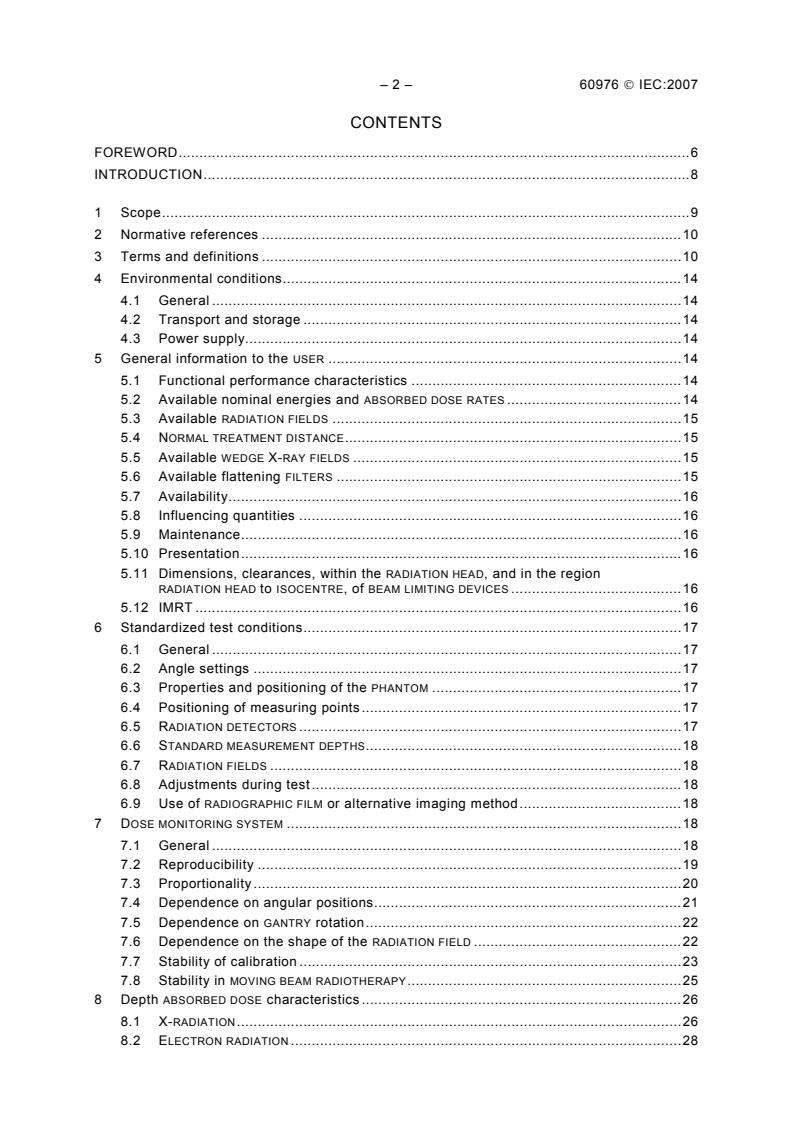
CONTENTS
FOREWORD.6
INTRODUCTION.8
1 Scope.9
2 Normative references .10
3 Terms and definitions .10
4 Environmental conditions.14
4.1 General .14
4.2 Transport and storage .14
4.3 Power supply.14
5 General information to the USER .14
5.1 Functional performance characteristics .14
5.2 Available nominal energies and ABSORBED DOSE RATES .14
5.3 Available RADIATION FIELDS .15
5.4 NORMAL TREATMENT DISTANCE.15
5.5 Available WEDGE X-RAY FIELDS .15
5.6 Available flattening FILTERS .15
5.7 Availability.16
5.8 Influencing quantities .16
5.9 Maintenance.16
5.10 Presentation.16
5.11 Dimensions, clearances, within the RADIATION HEAD, and in the region
RADIATION HEAD to ISOCENTRE, of BEAM LIMITING DEVICES .16
5.12 IMRT .16
6 Standardized test conditions.17
6.1 General .17
6.2 Angle settings .17
6.3 Properties and positioning of the PHANTOM .17
6.4 Positioning of measuring points.17
6.5 RADIATION DETECTORS .17
6.6 STANDARD MEASUREMENT DEPTHS.18
6.7 RADIATION FIELDS .18
6.8 Adjustments during test.18
6.9 Use of RADIOGRAPHIC FILM or alternative imaging method.18
7 DOSE MONITORING SYSTEM .18
7.1 General .18
7.2 Reproducibility .19
7.3 Proportionality.20
7.4 Dependence on angular positions.21
7.5 Dependence on GANTRY rotation.22
7.6 Dependence on the shape of the RADIATION FIELD .22
7.7 Stability of calibration .23
7.8 Stability in MOVING BEAM RADIOTHERAPY.25
8 Depth ABSORBED DOSE characteristics .26
8.1 X-RADIATION.26
8.2 ELECTRON RADIATION .28
60976 © IEC:2007 – 3 –
9 Uniformity of RADIATION FIELDS .31
9.1 X-RADIATION.31
9.2 ELECTRON RADIATION .36
9.3 PENUMBRA of RADIATION FIELDS.38
10 Indication of RADIATION FIELDS.39
10.1 X-RADIATION.39
10.2 ELECTRON RADIATION .45
10.3 Geometry and motion speeds of adjustable BLDs for X-RADIATION and
ELECTRON RADIATION .46
10.4 Illuminance and PENUMBRA of the LIGHT FIELD.47
11 Indication of the RADIATION BEAM AXIS.48
11.1 General .48
11.2 Indication on entry to the PATIENT .49
11.3 Indication on exit from the PATIENT .51
12 ISOCENTRE .52
12.1 Displacement of the RADIATION BEAM AXIS from the ISOCENTRE .52
12.2 Indication of the ISOCENTRE .53
13 Indication of distance along the RADIATION BEAM AXIS .53
13.1 Indicating device .53
13.2 Additional indicating device for equipment with variable distance between
RADIATION SOURCE and ISOCENTRE and for non-isocentric equipment .54
14 Zero position of rotational scales .55
14.1 General .55
14.2 Information to the USER .55
14.3 Tests.55
15 Congruence of opposed RADIATION FIELDS.56
15.1 Information to the USER .56
15.2 Test.56
16 Movements of the PATIENT table.57
16.1 General .57
16.2 Vertical movement of the table .57
16.3 ISOCENTRIC rotation of the table.58
16.4 Parallelism of table rotational axes .58
16.5 Rigidity of the table .59
17 ELECTRONIC IMAGING DEVICE (e.g. EPID) .60
17.1 Information to the USER .60
17.2 Tests.62
Annex A (informative) Format for presentation of functional performances values.75
Index of defined terms .96
Figure 1 – Explanatory diagram for the definition of wedge .64
Figure 2 – The rotary GANTRY.65
Figure 3 – The wall- or floor-mounted GANTRY.66
Figure 4 – The ceiling-mounted GANTRY .67
Figure 5 – Flattened area (shown hatched) within the RADIATION FIELD .68
– 4 – 60976 © IEC:2007
Figure 6 – Examples of profiles of ABSORBED DOSE along the major axes or the
diagonal axes .69
Figure 7 – Explanatory diagram for flatness of the ELECTRON FIELD .70
Figure 8 – A possible arrangement of equipment for the measurement of the ISOCENTRE
described in Clause 12 .71
Figure 9 – Test 10.1.1.3.72
Figure 10 – RADIATION HEAD showing X-RADIATION BLDs and ACCESSORIES (see 4.11) .73
Figure 11 – Multi-element BLD RADIATION FIELDS used for measurement of X-RADIATION
PENUMBRA (see 8.3.2).74
Table 1 – Conditions for testing reproducibility.19
Table 2 – Conditions for testing proportionality of the DOSE MONITORING SYSTEM.20
Table 3 – Conditions for testing dependence of the DOSE MONITORING SYSTEM on
equipment position.21
Table 4 – Conditions for testing dependence of the DOSE MONITORING SYSTEM on
GANTRY rotation.22
Table 5 – Conditions for testing dependence on the shape of the RADIATION FIELD.23
Table 6 – Conditions for testing stability of calibration of the DOSE MONITORING SYSTEM .24
Table 7 – Conditions for testing stability of the DOSE MONITORING SYSTEM in MOVING
BEAM RADIOTHERAPY .26
Table 8 – Conditions for testing depth dose characteristics.27
Table 9 – Conditions for testing depth dose characteristics.29
Table 10 – Conditions for testing stability of PENETRATIVE QUALITY of ELECTRON
RADIATION.29
Table 11 – Flattened area according to Figure 5 .31
Table 12 – Conditions for testing flatness and symmetry of X-RAY FIELDS .32
Table 13 – Conditions for testing deviation of dose distribution of X-RAY FIELDS with
angular position .33
Table 14 – Conditions for testing maximum ABSORBED DOSE ratio in the RADIATION FIELD .34
Table 15 – Conditions for testing WEDGE FACTORS .35
Table 16 – Conditions for testing WEDGE ANGLES .35
Table 17 – Conditions for testing flatness, symmetry, deviation of dose distribution with
angular position, and maximum ABSORBED DOSE ratio of ELECTRON FIELDS .37
Table 18 – Conditions for film calibration .41
Table 19 – Conditions for testing the numerical and the LIGHT FIELD-INDICATION.42
Table 20 – Conditions for testing reproducibility of X-RAY FIELDS .44
Table 21 – Conditions for testing the LIGHT FIELD-INDICATOR for ELECTRON RADIATION .46
Table 22 – Conditions for testing geometry of the BEAM LIMITING SYSTEM .48
Table 23 – Conditions for testing the indication of the RADIATION BEAM AXIS on entry to
the PATIENT .50
Table 24 – Conditions for testing the indication of the RADIATION BEAM AXIS on exit from
the PATIENT .51
60976 © IEC:2007 – 5 –
Table 25 – Conditions for testing indication of the ISOCENTRE.53
Table 26 – Conditions for testing vertical movement of the table.58
Table 27 – Conditions for testing ISOCENTRIC rotation of the table .58
Table 28 – Conditions for testing the angulation of rotational axes of the table .59
Table 29 – Conditions for testing lateral rigidity of the table .60
– 6 – 60976 © IEC:2007
INTERNATIONAL ELECTROTECHNICAL COMMISSION
______________
MEDICAL ELECTRICAL EQUIPMENT –
MEDICAL ELECTRON ACCELERATORS –
FUNCTIONAL PERFORMANCE CHARACTERISTICS
FOREWORD
1) The International Electrotechnical Commission (IEC) is a worldwide organization for standardization comprising
all national electrotechnical committees (IEC National Committees). The object of IEC is to promote
international co-operation on all questions concerning standardization in the electrical and electronic fields. To
this end and in addition to other activities, IEC publishes International Standards, Technical Specifications,
Technical Reports, Publicly Available Specifications (PAS) and Guides (hereafter referred to as “IEC
Publication(s)”). Their preparation is entrusted to technical committees; any IEC National Committee interested
in the subject dealt with may participate in this preparatory work. International, governmental and non-
governmental organizations liaising with the IEC also participate in this preparation. IEC collaborates closely
with the International Organization for Standardization (ISO) in accordance with conditions determined by
agreement between the two organizations.
2) The formal decisions or agreements of IEC on technical matters express, as nearly as possible, an international
consensus of opinion on the relevant subjects since each technical committee has representation from all
interested IEC National Committees.
3) IEC Publications have the form of recommendations for international use and are accepted by IEC National
Committees in that sense. While all reasonable efforts are made to ensure that the technical content of IEC
Publications is accurate, IEC cannot be held responsible for the way in which they are used or for any
misinterpretation by any end user.
4) In order to promote international uniformity, IEC National Committees undertake to apply IEC Publications
transparently to the maximum extent possible in their national and regional publications. Any divergence
between any IEC Publication and the corresponding national or regional publication shall be clearly indicated in
the latter.
5) IEC provides no marking procedure to indicate its approval and cannot be rendered responsible for any
equipment declared to be in conformity with an IEC Publication.
6) All users should ensure that they have the latest edition of this publication.
7) No liability shall attach to IEC or its directors, employees, servants or agents including individual experts and
members of its technical committees and IEC National Committees for any personal injury, property damage or
other damage of any nature whatsoever, whether direct or indirect, or for costs (including legal fees) and
expenses arising out of the publication, use of, or reliance upon, this IEC Publication or any other IEC
Publications.
8) Attention is drawn to the Normative references cited in this publication. Use of the referenced publications is
indispensable for the correct application of this publication.
9) Attention is drawn to the possibility that some of the elements of this IEC Publication may be the subject of
patent rights. IEC shall not be held responsible for identifying any or all such patent rights.
International standard IEC 60976 has been prepared by subcommittee 62C: Equipment for
radiotherapy, nuclear medicine and radiation dosimetry, of IEC technical committee 62:
Electrical equipment in medical practice.
This second edition cancels and replaces the first edition published in 1989. It constitutes a
technical revision.
This second edition includes the addition of performance standards and test methods relating
to the following new technologies:
− dynamic beam delivery techniques, such as
• MOVING BEAM RADIOTHERAPY,
• INTENSITY-MODULATED RADIATION THERAPY (IMRT),
• IMAGE-GUIDED RADIOTHERAPY (IGRT) and
• PROGRAMMABLE WEDGE FIELDS;
− STEREOTACTIC RADIOTHERAPY (SRT) / STEREOTACTIC RADIOSURGERY (SRS);
60976 © IEC:2007 – 7 –
− use of ELECTRONIC IMAGING DEVICES.
This standard, together with IEC TR 60977, should be read in conjunction with IEC 60601-2-1.
The text of this standard is based on the following documents:
FDIS Report on voting
62C/429/FDIS 62C/433/RVD
Full information on the voting for the approval of this standard can be found in the report on
voting indicated in the above table.
This publication has been drafted in accordance with the ISO/IEC Directives, Part 2.
In this standard, the following print types are used:
– requirements, compliance with which can be tested, and definitions: in roman type;
– explanations, advice, general statements, exceptions and notes: in small roman type;
– test specifications and headings of sub-clauses: in italic type;
– TERMS USED THROUGHOUT THIS PARTICULAR STANDARD THAT HAVE BEEN LISTED IN THE INDEX OF
DEFINED TERMS AND DEFINED IN CLAUSE 3, OR IN OTHER STANDARDS: SMALL CAPITALS.
The committee has decided that the contents of this publication will remain unchanged until
the maintenance result date indicated on the IEC web site under "http://webstore.iec.ch" in
the data related to the specific publication. At this date, the publication will be
• reconfirmed;
• withdrawn;
• replaced by a revised edition, or
• amended.
– 8 – 60976 © IEC:2007
INTRODUCTION
Standards containing safety requirements for medical ELECTRON ACCELERATORS have been
published by the IEC, details of which will be found in Clause 2.
The present standard specifies methods of testing and methods of disclosure of functional
performance of medical ELECTRON ACCELERATORS intended for RADIOTHERAPY. It permits a
direct comparison between the performance data of equipment of different MANUFACTURERS.
Since this standard does not contain safety requirements, it has not been numbered in the
IEC 60601 publication series. It describes aspects of functional performance of medical
ELECTRON ACCELERATORS and the way in which they should be presented. It also includes test
methods and conditions suitable for TYPE TESTS. These test methods are suggested test
methods and alternative methods may be equally appropriate, but the specified functional
performance characteristics of medical ELECTRON ACCELERATORS shall be related to these test
methods and conditions. Tests specified in this standard are not necessarily appropriate for
ensuring that any individual medical ELECTRON ACCELERATOR conforms to the declared
functional performance during the course of its working lifetime. Guidance on the values
which may be expected is given in the technical report, IEC 60977.
This International Standard was first published in 1989. With the rapidly increasing use of
medical ELECTRON ACCELERATORS equipped with multi-element BEAM LIMITING DEVICES (BLDs),
amendments to both this standard and the associated report, IEC 60977, were published in
2000. Amendment 1 was intended mainly to address the basic performance issues associated
with the applications of multi-element BLDs to static RADIATION FIELDS. This second edition
includes the addition of performance standards and test methods relating to several relatively
new technologies introduced within the last few years, including dynamic beam delivery
techniques, such as MOVING BEAM RADIOTHERAPY, INTENSITY-MODULATED RADIATION THERAPY
(IMRT), IMAGE-GUIDED RADIOTHERAPY (IGRT), and PROGRAMMABLE WEDGE FIELDS (PWF). Also
included are STEREOTACTIC RADIOTHERAPY (SRT)/STEREOTACTIC RADIOSURGERY (SRS) and the
use of certain ELECTRONIC IMAGING DEVICES.
In recognition of the diversity of equipment produced by MANUFACTURERS in each of these
technologies, this second edition has specified performance standards, methods of test, and
methods of disclosure of functional performance, that are as basic and generic as possible.
MANUFACTURERS may add more detailed information and special tests of performance
characteristics to each performance category, in their ACCOMPANYING DOCUMENTS.
60976 © IEC:2007 – 9 –
MEDICAL ELECTRICAL EQUIPMENT –
MEDICAL ELECTRON ACCELERATORS –
FUNCTIONAL PERFORMANCE CHARACTERISTICS
1 Scope
This International Standard applies to medical ELECTRON ACCELERATORS when used, for
therapy purposes, in human medical practice.
This standard applies to medical ELECTRON ACCELERATORS which deliver a RADIATION BEAM of
either X-RADIATION or ELECTRON RADIATION with NOMINAL ENERGIES in the range 1 MeV to 50 MeV
–1 –1
at maximum ABSORBED DOSE RATES between 0,001 Gy s and 1 Gy s at 1 m from the
RADIATION SOURCE and at NORMAL TREATMENT DISTANCES between 50 cm and 200 cm from the
RADIATION SOURCE.
The present standard describes measurements and test procedures to be performed by the
MANUFACTURER at the design and construction stage of a medical ELECTRON ACCELERATOR but
does not specify ACCEPTANCE TESTS to be performed after installation at the purchaser's site.
The accompanying report, IEC 60977, however, does suggest that many of the test
procedures are appropriate for ACCEPTANCE TESTS.
The measurement conditions described in the present standard differ from those previously in
use. This applies particularly to the PHANTOM position for measurements and the
measurement of distances from the ISOCENTRE. These new conditions should be substituted
for and not be added to previous methods.
This standard specifies test procedures for the determination and disclosure of functional
performance characteristics, knowledge of which is deemed necessary for proper application
and use of a medical ELECTRON ACCELERATOR and which are to be declared in the
ACCOMPANYING DOCUMENTS together with the greatest deviation or variation to be expected
under specific conditions in NORMAL USE. A format for presentation of functional performance
values is given in Annex A.
It is recognized that inaccuracies in the test methods must be allowed for when assessing
performance. However, it was not felt to be advisable to combine the errors into an overall
performance tolerance but to keep them separate in the expectation that more accurate test
methods will be evolved.
It is not intended that this standard should in any way inhibit the future development of new
designs of equipment which may have operating modes and parameters different from those
described herein, provided that such equipment achieves equivalent levels of performance for
the TREATMENT of PATIENTS.
Except where otherwise stated this standard assumes that the medical ELECTRON
ACCELERATORS have an ISOCENTRIC GANTRY. Where the equipment is non-isocentric, the
description of performance and test methods may need to be suitably adapted.
NOTE A statement of compliance with this standard does not necessarily imply that these tests will be or have
been applied as TYPE TESTS or as individual tests.
– 10 – 60976 © IEC:2007
2 Normative references
The following referenced documents are indispensable for the application of this document.
For dated references, only the edition cited applies. For undated references, the latest edition
of the referenced document (including any amendments) applies.
IEC 60580:2000, Medical electrical equipment – Dose area product meters
IEC 60601-1:2005, Medical electrical equipment – Part 1: General requirements for basic
safety and essential performance
IEC 60601-2-1:1998, Medical electrical equipment – Part 2-1: Particular requirements for the
safety of electron accelerators in the range 1 MeV to 50 MeV
Amendment 1 (2002)
IEC 60788:2004, Medical electrical equipment – Glossary of defined terms
IEC 60977, Medical electrical equipment – Medical electron accelerators in the range 1 MeV
to 50 MeV – Guidelines for functional performance characteristics
IEC 61217, Radiotherapy equipment – Coordinates, movements and scales
IEC 61223-1:1993, Evaluation and routine testing in medical imaging departments – Part 1:
General aspects
3 Terms and definitions
For the purposes of this document, the terms and definitions given in IEC 60580:2000,
IEC 60601-1:2005, IEC 60601-2-1:1998, IEC 60788:2004, IEC 61223-1:1993 and the
following apply.
3.1
BASE DEPTH
depth in a PHANTOM of the plane containing the distal point of 90 % of the maximum ABSORBED
DOSE on the RADIATION BEAM AXIS
3.2
BEAM LIMITING DEVICE
BLD
structure, fixed or movable, intended to block or collimate IONIZING
RADIATION, resulting in shielding the TREATMENT region from unintended X-RADIATION or
ELECTRON RADIATION
3.3
DEPTH OF DOSE MAXIMUM
depth in a PHANTOM of the maximum ABSORBED DOSE on the RADIATION BEAM AXIS
3.4
DYNAMIC RANGE
RADIOTHERAPY> maximum usable signal divided by the minimum usable signal (the root
<
mean square noise)
NOTE The DYNAMIC RANGE is expressed in decibels.
60976 © IEC:2007 – 11 –
3.5
ELECTRONIC IMAGING DEVICE
EID
device consisting of one or more RADIATION DETECTORS and associated electronics, which
enables anatomical structures of a PATIENT to be viewed as a digital radiograph at a viewing
screen
NOTE See also 3.6.
3.6
ELECTRONIC PORTAL IMAGING DEVICE
EPID
device consisting of a two-dimensional RADIATION DETECTOR and associated electronics,
placed normal to the RADIATION BEAM AXIS, which enables anatomical structures of a PATIENT to
ELECTRON
be viewed as a digital radiograph at a viewing screen, using the medical
ACCELERATOR'S RADIATION BEAM as the RADIATION SOURCE
NOTE The primary function of an EPID is in verification of PATIENT set-up, and so replaces the need for port-films
for this same purpose.
3.7
GEOMETRICAL FIELD SIZE
geometrical projection as seen from the centre of the front surface of the RADIATION SOURCE
on a plane perpendicular to the axis of the beam of the distal end of the BEAM LIMITING DEVICE
NOTE The field is thus of the same shape as the aperture of the BEAM LIMITING DEVICE. The GEOMETRICAL FIELD
SIZE may be defined at any distance from the VIRTUAL SOURCE.
3.8
IMAGE-GUIDED RADIOTHERAPY
IGRT
RADIOTHERAPY process by which the location of a RADIOTHERAPY BEAM relative to the intended
TARGET VOLUME within a PATIENT’S anatomy is determined by imaging of the TARGET VOLUME
and surrounding anatomical structures at the time of TREATMENT, so as to enable any
necessary positional corrections to the intended relative location of beam to TARGET VOLUME
3.9
INTENSITY-MODULATED RADIATION THERAPY
IMRT
TREATMENT procedure requiring, in general, the coordinated control of photon or electron
fluence, beam orientation relative to the PATIENT, and beam size; either in a continuous or a
discrete manner, and as pre-determined by a TREATMENT plan
NOTE The primary purpose of IMRT is to improve the conformity of the dose distribution to the planned TARGET
VOLUME, while minimizing dose to surrounding healthy tissue.
3.10
ISOCENTRIC
used in presence of an ISOCENTRE
3.11
ISOCENTRIC EQUIPMENT
equipment for RADIOTHERAPY designed and constructed in such a manner that it has an
ISOCENTRE
3.12
ISOCENTRIC TREATMENT
TREATMENT of a PATIENT in which the position of the TARGET VOLUME is
referred to the ISOCENTRE
– 12 – 60976 © IEC:2007
3.13
NOMINAL ENERGY
ENERGY
ENERGY stated by the MANUFACTURER to characterize the RADIATION BEAM
3.14
NORMAL TREATMENT DISTANCE
NTD
SPECIFIED distance measured along the REFERENCE AXIS from the
ELECTRON RADIATION window to the distal end of the ELECTRON BEAM APPLICATOR or to a
SPECIFIED plane
SPECIFIED distance measured along the REFERENCE AXIS from the front surface
of the TARGET to the ISOCENTRE or, for EQUIPMENT without an ISOCENTRE, to a SPECIFIED plane
3.15
PENETRATIVE QUALITY
depth in a PHANTOM most distant from its surface at which the ABSORBED DOSE is 80 % of the
dose at the DEPTH OF DOSE MAXIMUM, measured on the RADIATION BEAM AXIS in a SPECIFIED
RADIATION FIELD and with the surface of the PHANTOM at a SPECIFIED distance
3.16
PRACTICAL RANGE
depth in a PHANTOM with its surface at the NORMAL TREATMENT
DISTANCE, for which on the depth dose chart the extrapolation of the steepest fall-off section of
the ABSORBED DOSE distribution along the RADIATION BEAM AXIS intercepts the extrapolated tail
of the ABSORBED DOSE distribution
3.17
PRIMARY-SECONDARY DOSE MONITORING SYSTEM
combination of two DOSE MONITORING SYSTEMS in which one is arranged to be the PRIMARY
DOSE MONITORING SYSTEM and the other is to be the SECONDARY DOSE MONITORING SYSTEM
3.18
PROGRAMMABLE WEDGE FIELD
PWF
generation of a wedge-shaped dose profile, with or without the use of a fixed metal WEDGE
FILTER placed in the X-RAY BEAM, where the programmed wedge DOSE profile may be
generated by controlling the relationship between the beam intensity and a moveable BEAM
LIMITING DEVICE
3.19
QUALITY INDEX
ratio of the ABSORBED DOSE measured at a depth of 20 cm to that measured at
a depth of 10 cm
NOTE The detector is at the NORMAL TREATMENT DISTANCE. The measurement is made in a PHANTOM on the
RADIATION BEAM AXIS for a RADIATION FIELD of 10 cm × 10 cm.
3.20
RADIATION TYPE
nature of the waves or corpuscles comprising the RADIATION, for example whether the
RADIATION is X-RADIATION or ELECTRON RADIATION
3.21
REDUNDANT DOSE MONITORING SYSTEM
combination of two DOSE MONITORING SYSTEMS in which both systems are arranged to be the
PRIMARY DOSE MONITORING SYSTEM
60976 © IEC:2007 – 13 –
3.22
RELATIVE SURFACE DOSE
ratio of the ABSORBED DOSE on the RADIATION BEAM AXIS at the depth of 0,5 mm to the
maximum ABSORBED DOSE on the RADIATION BEAM AXIS both measured in a PHANTOM with its
surface at a specified distance
[IEC 60601-2-1:1998, definition 2.1.116, modified]
3.23
SIGNAL-TO-NOISE RATIO
mean value of the signal divided by the standard deviation, of the signal
from the image pixels, for a uniform input fluence
NOTE The SIGNAL-TO-NOISE RATIO is expressed as % or decibels.
3.24
STANDARD MEASUREMENT DEPTH
specified depth in a PHANTOM
3.25
STEREOTACTIC FRAME OF REFERENCE
three-dimensional coordinate system for numerical specification of the position of those parts
of a PATIENT’S anatomy intended for SRS/SRT TREATMENT
3.26
STEREOTACTIC RADIOSURGERY
SRS
specific version of STEREOTACTIC RADIOTHERAPY, in which a single high dose of RADIATION is
delivered to the TARGET VOLUME, using a STEREOTACTIC FRAME OF REFERENCE in conjunction
with anatomical registration points
3.27
STEREOTACTIC RADIOTHERAPY
SRT
TREATMENT procedure in which RADIATION BEAMS of generally small size are oriented from
various angles, and precisely positioned relative to a TARGET VOLUME within the PATIENT
NOTE Precise location of the TARGET VOLUME is enabled by use of a three-dimensional frame of reference, which
may include anatomical registration points or markers, and immobilisation methods, or imaging techniques.
3.28
STEREOTACTIC REGISTRATION POINT
reference point on the PATIENT’S anatomy, used to establish the STEREOTACTIC FRAME OF
REFERENCE for an SRS/SRT TREATMENT
3.29
TERMINATE RADIATION
to stop IRRADIATION without the possibility of restarting without reselection of operating
conditions
NOTE That means returning to the PREPARATORY STATE
− when the pre-selected value of DOSE MONITOR UNITS is reached, or
− when the pre-selected value of elapsed time is reached, or
− by deliberate manual act, or
− by the operation of an INTERLOCK, or
− by pre-selected value of GANTRY angular position in MOVING BEAM RADIOTHERAPY.
– 14 – 60976 © IEC:2007
3.30
WEDGE ANGLE
angle defined by the slope of the line joining two points equidistant from the
RADIATION BEAM AXIS and half the width of the geometrical field apart on an isodose curve
passing through the RADIATION BEAM AXIS at STANDARD MEASUREMENT DEPTH
NOTE See 9.1.5.1.
3.31
WEDGE FACTOR
ratio of the ABSORBED DOSE on the RADIATION BEAM AXIS at the STANDARD MEASUREMENT DEPTH
between a WEDGE X-RAY FIELD and a non-wedge X-ray field of the same ENERGY and field size
NOTE For WEDGE X-RAY FIELDS produced by a fixed metal WEDGE FILTER, the WEDGE FACTOR would be the ratio
with and without the WEDGE FILTER present in the RADIATION BEAM.
3.32
WEDGE X-RAY FIELD
X-RADIATION field with a dose distribution that changes approximately linearly with distance
from the beam edge along a line perpendicular to and passing through the RADIATION BEAM
AXIS
4 Environmental conditions
4.1 General
Except where other allowable environmental conditions are stated in the ACCOMPANYING
DOCUMENTS this particular standard applies to equipment installed, used or kept in locations
where the following environmental conditions prevail:
a) the ambient temperature falls within the range 15 °C to 35 °C;
b) the relative humidity falls within the range 30 % to 75 %;
4 4
c) the atmospheric pressure falls within the range 7 × 10 Pa to 11 × 10 Pa (700 mbar to
1 100 mbar).
4.2 Transport and storage
The allowable environmental conditions for transport and storage shall be stated in the
ACCOMPANYING DOCUMENTS.
4.3 Power supply
For power supply modalities, see 4.10.2 of IEC 60601-1:2005.
Sufficiently low internal impedance is needed to prevent voltage fluctuations between on-load
and off-load steady states exceeding ±5 %.
5 General information to the USER
5.1 Functional performance characteristics
The ACCOMPANYING DOCUMENTS shall state all functional performance characteristics
contained in Clauses 6 to 16 and the information required in 5.2 to 5.9, 4.1 and 4.2.
ABSORBED DOSE RATES
5.2 Available nominal energies and
The ACCOMPANYING DOCUMENTS shall state the available NOMINAL ENERGIES and the available
associated ABSORBED DOSE RATES at NORMAL TREATMENT DISTANCE under conditions of
60976 © IEC:2007 – 15 –
maximum BUILD UP in a PHANTOM for the maximum and 10 cm × 10 cm RADIATION FIELDS (or if
not available, the MANUFACTURER’S specified reference field size) for both X-RADIATION and
ELECTRON RADIATION.
Where an SRT/SRS mode is available, the above information shall be provided for the
applicable NOMINAL ENERGIES and X-RADIATION fields.
5.3 Available RADIATION FIELDS
The ACCOMPANYING DOCUMENTS shall list the available RADIATION FIELDS in dimensions given in
centimetres at NORMAL TREATMENT DISTANCE for both X-RADIATION and ELECTRON RADIATION.
For a multi-element BLD, the ACCOMPANYING DOCUMENTS shall provide the information specified
in 10.3.
5.4 NORMAL TREATMENT DISTANCE
The ACCOMPANYING DOCUMENTS shall state the NORMAL TREATMENT DISTANCE in centimetres.
5.5 Available WEDGE X-RAY FIELDS
Where WEDGE X-RAY FIELD capability is provided, the ACCOMPANYING DOCUMENTS shall provide
the following information:
a) designation;
NOMINAL ENERGIES;
b)
c) WEDGE ANGLES available;
WEDGE X-RAY FIELD angles for the specified X-
d) isodose value used for the determination of
RAY FIELD;
e) WEDGE X-RAY FIELD orientations available;
f) minimum and maximum RADIATION F
...