

IEC TR 62263:2024
(Main)Live working - Guidelines for the installation and maintenance of optical fibre cables on overhead power lines
General Information
- Abstract
IEC TR 62263:2024 covers procedures for the installation and maintenance of optical fibre cables on single and multi-circuit overhead power lines, including:
– optical ground wire (OPGW) fibre cable;
– optical phase conductor fibre cable (OPPC);
– optical attached fibre cable (OPAC);
– all dielectric self supporting (ADSS) optical fibre cable.
Relevant electrical hazards are also discussed.
- Status
- Published
- Publication Date
- 09-Dec-2024
- Technical Committee
- TC 78 - Live working
- Current Stage
- PPUB - Publication issued
- Start Date
- 10-Dec-2024
- Completion Date
- 22-Nov-2024
Overview
IEC TR 62263:2024, published by the International Electrotechnical Commission (IEC), provides comprehensive guidelines for the installation and maintenance of optical fibre cables on overhead power lines. This technical report covers procedures relevant to both single and multi-circuit lines, detailing best practices for working with various types of optical fibre cables, including optical ground wire (OPGW), optical phase conductor fibre cable (OPPC), optical attached fibre cable (OPAC), and all dielectric self-supporting (ADSS) optical fibre cable. Additionally, the standard addresses electrical hazards associated with live working environments to enhance safety and operational efficiency.
Key Topics
Types of Optical Fibre Cables
The report describes installation and maintenance procedures for:- OPGW (Optical Ground Wire)
- OPPC (Optical Phase Conductor Cable)
- OPAC (Optical Attached Cable)
- ADSS (All Dielectric Self-Supporting Cable)
Installation Methods & Equipment
- Conventional tension stringing method
- Cradle block stringing method
- Use of anti-twist running boards, pullers, tensioners, and stringing blocks
- Manufacturer guidelines on cable bending radius, stringing tension, and maximum stringing speed
- Earthing practices and equipment for safety
Electrical and Mechanical Hazards
- Risks arising from electric and magnetic field induction, especially from energized adjacent lines
- Procedures for minimizing exposure to induced voltage and current
- Protective earthing systems and worker safety
- Consideration of hazards from lightning, accidental contact, and switching errors
Cable Maintenance & Testing
- Procedures for checking cable continuity and attenuation losses
- Guidelines for the protection and placement of splice closures
- Recommendations for cable installation under various environmental conditions
Applications
IEC TR 62263:2024 is essential for utility companies, electrical contractors, transmission line engineers, and maintenance teams engaged in the installation or upkeep of optical fibre communication infrastructure on overhead power lines. Typical applications include:
- Upgrading or replacing earth wires with OPGW to integrate telecommunications capabilities into electrical grid infrastructure
- Installing new ADSS or OPPC cables for data transmission without metallic supporting elements or with dual conductor/communication roles
- Performing live working tasks near energized lines while adhering to best safety practices to prevent electrical accidents
- Conducting maintenance activities to ensure continued performance and safety of installed optical fibre cables
By following these guidelines, professionals can ensure the integrity, reliability, and safety of fibre optic infrastructure in high-voltage environments.
Related Standards
To fully implement the practices outlined in IEC TR 62263:2024, reference to the following international standards and resources is recommended:
- IEC 60050-466: International Electrotechnical Vocabulary – Overhead Lines
- IEC 60050-651: International Electrotechnical Vocabulary – Live Working
- IEC 60743: Live Working – Terminology for tools, devices, and equipment
- IEC TR 61328: Live Working – Guidelines for work on overhead lines
- ISO/IEC Directives: General rules for the preparation of international standards
- Electropedia (www.electropedia.org): Reference for electrotechnical terminology
Adherence to IEC TR 62263:2024 and these related standards promotes safer, more consistent, and efficient installation and maintenance of optical fibre cables on overhead power lines worldwide, supporting the reliable expansion of smart grid and communication networks.
Relations
- Effective Date
- 27-Oct-2023
Get Certified
Connect with accredited certification bodies for this standard

IMQ S.p.A. (Certification)
Italian electrical product certification.

SLG Prüf- und Zertifizierungs GmbH
German testing and certification body.

UL Solutions
Global safety science company with testing, inspection and certification.
Sponsored listings
Frequently Asked Questions
IEC TR 62263:2024 is a technical report published by the International Electrotechnical Commission (IEC). Its full title is "Live working - Guidelines for the installation and maintenance of optical fibre cables on overhead power lines". This standard covers: IEC TR 62263:2024 covers procedures for the installation and maintenance of optical fibre cables on single and multi-circuit overhead power lines, including: – optical ground wire (OPGW) fibre cable; – optical phase conductor fibre cable (OPPC); – optical attached fibre cable (OPAC); – all dielectric self supporting (ADSS) optical fibre cable. Relevant electrical hazards are also discussed.
IEC TR 62263:2024 covers procedures for the installation and maintenance of optical fibre cables on single and multi-circuit overhead power lines, including: – optical ground wire (OPGW) fibre cable; – optical phase conductor fibre cable (OPPC); – optical attached fibre cable (OPAC); – all dielectric self supporting (ADSS) optical fibre cable. Relevant electrical hazards are also discussed.
IEC TR 62263:2024 is classified under the following ICS (International Classification for Standards) categories: 13.260 - Protection against electric shock. Live working; 29.240.99 - Other equipment related to power transmission and distribution networks; 29.260.99 - Other electrical equipment for working in special conditions. The ICS classification helps identify the subject area and facilitates finding related standards.
IEC TR 62263:2024 has the following relationships with other standards: It is inter standard links to IEC TR 62263:2005. Understanding these relationships helps ensure you are using the most current and applicable version of the standard.
IEC TR 62263:2024 is available in PDF format for immediate download after purchase. The document can be added to your cart and obtained through the secure checkout process. Digital delivery ensures instant access to the complete standard document.
Standards Content (Sample)
IEC TR 62263 ®
Edition 2.0 2024-12
TECHNICAL
REPORT
colour
inside
Live working – Guidelines for the installation and maintenance of optical fibre
cables on overhead power lines
All rights reserved. Unless otherwise specified, no part of this publication may be reproduced or utilized in any form
or by any means, electronic or mechanical, including photocopying and microfilm, without permission in writing from
either IEC or IEC's member National Committee in the country of the requester. If you have any questions about IEC
copyright or have an enquiry about obtaining additional rights to this publication, please contact the address below or
your local IEC member National Committee for further information.
IEC Secretariat Tel.: +41 22 919 02 11
3, rue de Varembé info@iec.ch
CH-1211 Geneva 20 www.iec.ch
Switzerland
About the IEC
The International Electrotechnical Commission (IEC) is the leading global organization that prepares and publishes
International Standards for all electrical, electronic and related technologies.
About IEC publications
The technical content of IEC publications is kept under constant review by the IEC. Please make sure that you have the
latest edition, a corrigendum or an amendment might have been published.
IEC publications search - webstore.iec.ch/advsearchform IEC Products & Services Portal - products.iec.ch
The advanced search enables to find IEC publications by a Discover our powerful search engine and read freely all the
variety of criteria (reference number, text, technical publications previews, graphical symbols and the glossary.
committee, …). It also gives information on projects, replaced With a subscription you will always have access to up to date
and withdrawn publications. content tailored to your needs.
IEC Just Published - webstore.iec.ch/justpublished
Electropedia - www.electropedia.org
Stay up to date on all new IEC publications. Just Published
The world's leading online dictionary on electrotechnology,
details all new publications released. Available online and once
containing more than 22 500 terminological entries in English
a month by email.
and French, with equivalent terms in 25 additional languages.
Also known as the International Electrotechnical Vocabulary
IEC Customer Service Centre - webstore.iec.ch/csc
(IEV) online.
If you wish to give us your feedback on this publication or need
further assistance, please contact the Customer Service
Centre: sales@iec.ch.
IEC TR 62263 ®
Edition 2.0 2024-12
TECHNICAL
REPORT
colour
inside
Live working – Guidelines for the installation and maintenance of optical fibre
cables on overhead power lines
INTERNATIONAL
ELECTROTECHNICAL
COMMISSION
ICS 13.260; 29.240.99; 29.260.99 ISBN 978-2-8322-7062-2
– 2 – IEC TR 62263:2024 © IEC 2024
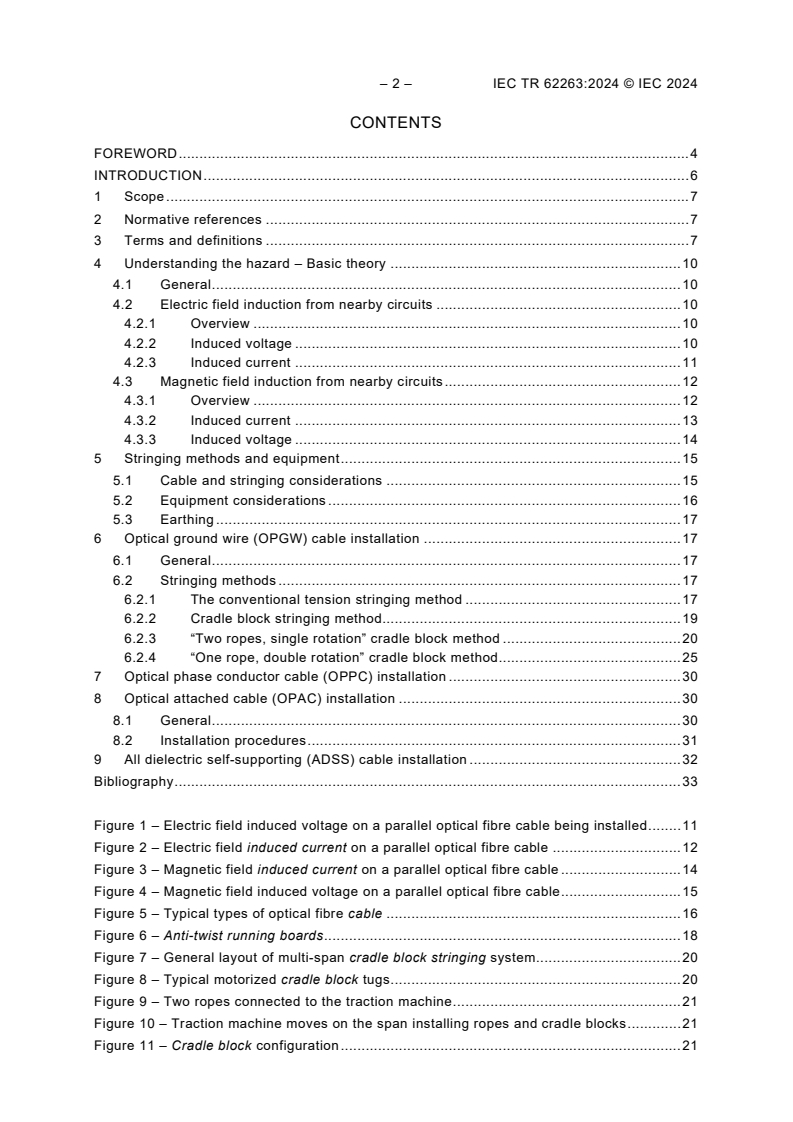
CONTENTS
FOREWORD . 4
INTRODUCTION . 6
1 Scope . 7
2 Normative references . 7
3 Terms and definitions . 7
4 Understanding the hazard – Basic theory . 10
4.1 General . 10
4.2 Electric field induction from nearby circuits . 10
4.2.1 Overview . 10
4.2.2 Induced voltage . 10
4.2.3 Induced current . 11
4.3 Magnetic field induction from nearby circuits . 12
4.3.1 Overview . 12
4.3.2 Induced current . 13
4.3.3 Induced voltage . 14
5 Stringing methods and equipment . 15
5.1 Cable and stringing considerations . 15
5.2 Equipment considerations . 16
5.3 Earthing . 17
6 Optical ground wire (OPGW) cable installation . 17
6.1 General . 17
6.2 Stringing methods . 17
6.2.1 The conventional tension stringing method . 17
6.2.2 Cradle block stringing method. 19
6.2.3 “Two ropes, single rotation” cradle block method . 20
6.2.4 “One rope, double rotation” cradle block method . 25
7 Optical phase conductor cable (OPPC) installation . 30
8 Optical attached cable (OPAC) installation . 30
8.1 General . 30
8.2 Installation procedures . 31
9 All dielectric self-supporting (ADSS) cable installation . 32
Bibliography . 33
Figure 1 – Electric field induced voltage on a parallel optical fibre cable being installed . 11
Figure 2 – Electric field induced current on a parallel optical fibre cable . 12
Figure 3 – Magnetic field induced current on a parallel optical fibre cable . 14
Figure 4 – Magnetic field induced voltage on a parallel optical fibre cable . 15
Figure 5 – Typical types of optical fibre cable . 16
Figure 6 – Anti-twist running boards . 18
Figure 7 – General layout of multi-span cradle block stringing system. 20
Figure 8 – Typical motorized cradle block tugs . 20
Figure 9 – Two ropes connected to the traction machine . 21
Figure 10 – Traction machine moves on the span installing ropes and cradle blocks . 21
Figure 11 – Cradle block configuration . 21
Figure 12 – Supporting rope connection to the towers . 22
Figure 13 – OPGW cable installation. 22
Figure 14 – OPGW cable connection to towers . 22
Figure 15 – Bundle rotation . 23
Figure 16 – Existing earth wire recovery . 23
Figure 17 – Supporting rope disconnected from towers . 23
Figure 18 – Ropes connected to the brake unit . 24
Figure 19 – Recovery of ropes and cradle blocks . 24
Figure 20 – Typical “two ropes” cradle blocks . 24
Figure 21 – Typical brake units . 25
Figure 22 – Supporting rope connected to the traction machine . 25
Figure 23 – Traction machine moves on the span installing rope and cradle blocks . 26
Figure 24 – Cradle block configuration . 26
Figure 25 – Supporting rope connection to the towers . 26
Figure 26 – First bundle rotation . 27
Figure 27 – OPGW cable installation. 27
Figure 28 – OPGW cable connection to towers . 28
Figure 29 – Second bundle rotation . 28
Figure 30 – OPGW cable clipping and supporting rope disconnection from towers . 29
Figure 31 – Supporting rope connected to the brake unit . 29
Figure 32 – Recovery of rope and cradle blocks . 29
Figure 33 – Typical “1 rope” cradle blocks . 30
Figure 34 – Typical optical fibre cable motorized tug and wrapping machine . 31
– 4 – IEC TR 62263:2024 © IEC 2024
INTERNATIONAL ELECTROTECHNICAL COMMISSION
____________
LIVE WORKING – GUIDELINES FOR THE INSTALLATION
AND MAINTENANCE OF OPTICAL FIBRE CABLES
ON OVERHEAD POWER LINES
FOREWORD
1) The International Electrotechnical Commission (IEC) is a worldwide organization for standardization comprising
all national electrotechnical committees (IEC National Committees). The object of IEC is to promote international
co-operation on all questions concerning standardization in the electrical and electronic fields. To this end and
in addition to other activities, IEC publishes International Standards, Technical Specifications, Technical Reports,
Publicly Available Specifications (PAS) and Guides (hereafter referred to as “IEC Publication(s)”). Their
preparation is entrusted to technical committees; any IEC National Committee interested in the subject dealt with
may participate in this preparatory work. International, governmental and non-governmental organizations liaising
with the IEC also participate in this preparation. IEC collaborates closely with the International Organization for
Standardization (ISO) in accordance with conditions determined by agreement between the two organizations.
2) The formal decisions or agreements of IEC on technical matters express, as nearly as possible, an international
consensus of opinion on the relevant subjects since each technical committee has representation from all
interested IEC National Committees.
3) IEC Publications have the form of recommendations for international use and are accepted by IEC National
Committees in that sense. While all reasonable efforts are made to ensure that the technical content of IEC
Publications is accurate, IEC cannot be held responsible for the way in which they are used or for any
misinterpretation by any end user.
4) In order to promote international uniformity, IEC National Committees undertake to apply IEC Publications
transparently to the maximum extent possible in their national and regional publications. Any divergence between
any IEC Publication and the corresponding national or regional publication shall be clearly indicated in the latter.
5) IEC itself does not provide any attestation of conformity. Independent certification bodies provide conformity
assessment services and, in some areas, access to IEC marks of conformity. IEC is not responsible for any
services carried out by independent certification bodies.
6) All users should ensure that they have the latest edition of this publication.
7) No liability shall attach to IEC or its directors, employees, servants or agents including individual experts and
members of its technical committees and IEC National Committees for any personal injury, property damage or
other damage of any nature whatsoever, whether direct or indirect, or for costs (including legal fees) and
expenses arising out of the publication, use of, or reliance upon, this IEC Publication or any other IEC
Publications.
8) Attention is drawn to the Normative references cited in this publication. Use of the referenced publications is
indispensable for the correct application of this publication.
9) IEC draws attention to the possibility that the implementation of this document may involve the use of (a)
patent(s). IEC takes no position concerning the evidence, validity or applicability of any claimed patent rights in
respect thereof. As of the date of publication of this document, IEC had not received notice of (a) patent(s), which
may be required to implement this document. However, implementers are cautioned that this may not represent
the latest information, which may be obtained from the patent database available at https://patents.iec.ch. IEC
shall not be held responsible for identifying any or all such patent rights.
IEC TR 62263 has been prepared by IEC technical committee 78: Live working. It is a Technical
Report.
This second edition cancels and replaces the first edition published in 2005. This edition
constitutes a technical revision.
This edition includes the following significant technical changes with respect to the previous
edition:
a) it incorporates some technical changes to update equipment work methods and procedures,
bringing them in line with the state of the art;
b) the content of the previous edition is kept but without mandatory terms as required by IEC
ISO Directives 2 for a Technical Report.
The text of this Technical Report is based on the following documents:
Draft Report on voting
78/1468/DTR 78/1481/RVDTR
Full information on the voting for its approval can be found in the report on voting indicated in
the above table.
The language used for the development of this Technical Report is English.
This document was drafted in accordance with ISO/IEC Directives, Part 2, and developed in
accordance with ISO/IEC Directives, Part 1 and ISO/IEC Directives, IEC Supplement, available
at www.iec.ch/members_experts/refdocs. The main document types developed by IEC are
described in greater detail at www.iec.ch/publications.
Words in italics in the text are defined in Clause 3.
The committee has decided that the contents of this document will remain unchanged until the
stability date indicated on the IEC website under webstore.iec.ch in the data related to the
specific document. At this date, the document will be
• reconfirmed,
• withdrawn, or
• revised.
IMPORTANT – The "colour inside" logo on the cover page of this document indicates
that it contains colours which are considered to be useful for the correct understanding
of its contents. Users should therefore print this document using a colour printer.
– 6 – IEC TR 62263:2024 © IEC 2024
INTRODUCTION
This document discusses general procedures for the installation and maintenance of optical
fibre cables on single and multi-circuit overhead power lines. Due to the hazards involved in
stringing near energized lines, the general concepts of electric and magnetic induction are
presented.
The overall intent of this document is to provide state of the art methods in an informative
manner recognizing that there are several procedural variations within the industry. There are
also multiple standards and regulatory jurisdictions which specify methods and requirements
beyond the scope of this document.
LIVE WORKING – GUIDELINES FOR THE INSTALLATION
AND MAINTENANCE OF OPTICAL FIBRE CABLES
ON OVERHEAD POWER LINES
1 Scope
This document covers procedures for the installation and maintenance of optical fibre cables
on single and multi-circuit overhead power lines, including:
– optical ground wire (OPGW) fibre cable;
– optical phase conductor fibre cable (OPPC);
– optical attached fibre cable (OPAC);
– all dielectric self supporting (ADSS) optical fibre cable.
Relevant electrical hazards are also discussed.
2 Normative references
The following documents are referred to in the text in such a way that some or all of their content
constitutes requirements of this document. For dated references, only the edition cited applies.
For undated references, the latest edition of the referenced document (including any
amendments) applies.
IEC 60050–466:1990, International Electrotechnical Vocabulary (IEV) – Part 466: Overhead
lines (available at www.electropedia.org)
IEC 60050-–651:1999, International Electrotechnical Vocabulary (IEV) – Part 651: Live working
(available at www.electropedia.org)
IEC 60743, Live working – Terminology for tools, devices and equipment
3 Terms and definitions
For the purposes of this document, the terms and definitions given in IEC 60050-466,
IEC 60050-651, IEC 60743 and the following apply.
ISO and IEC maintain terminological databases for use in standardization at the following
addresses:
• IEC Electropedia: available at http://www.electropedia.org/
• ISO Online browsing platform: available at http://www.iso.org/obp
NOTE Terminology for equipment and procedures associated with the installation of overhead conductors and earth
wires varies widely throughout the utility industry.
3.1
all dielectric self-supporting cable
ADSS cable
optical fibre cable which has no metallic supporting or messenger cable
– 8 – IEC TR 62263:2024 © IEC 2024
3.2
anti-twist running board
pulling device designed to resist the torque generated by a change in tension of the OPGW
cable, thus preventing rotation in order to maintain optical fibre strain margin
3.3
bullwheel
wheel or wheels incorporated as an integral part of a puller or tensioner with multiple offset
grooves allowing the continuous winding of a conductor or a rope to generate pulling or braking
tension through friction
3.4
conductor
cable
wire
bare or insulated wire or combination of wires, suitable for carrying an electric current
3.5
cradle block stringing
system of cradle stringing blocks, spacer rope, pulling rope, a brake unit, and a remotely
controlled motorized tug, which use the existing earth wire as support when installing the new
optical fibre cable
3.6
de-energized, adj.
at an electric potential equal to or not significantly different from that of the earth
[SOURCE: IEC 60050-651:2014, 651-21-09, modified – the term “dead” has been removed, in
the definition “at the worksite” has been removed and the note has been removed.]
3.7
earth wire
ground wire
conductor connected to earth at some or all supports, which is suspended usually but not
necessarily above the line conductors to provide a degree of protection against lightning strikes
[SOURCE: IEC 60050-466:1990, 466-10-25]
3.8
energized, adj.
current-carrying, adj.
live, adj.
at a potential significantly different from that of the earth at the work site and which presents
an electrical hazard
[SOURCE: IEC 60050-651:2014, 651-21-08, modified – “current-carrying” has been added as
a term, in the definition “electric” has been removed, “significanty” has been added, and the
notes have been removed.]
3.9
fault current
current flowing at a given point of a network resulting from a fault at another point of this network
3.10
induced current
current flowing as a result of induced voltage
3.11
optical attached cable
OPAC
non-metallic optical fibre cable designed to be wrapped or lashed onto the existing earth wire
or phase conductor
3.12
optical phase conductor cable
OPPC
stranded metallic cable incorporating optical fibres which has the dual function of a normal
conductor with built-in telecommunication capabilities
3.13
optical ground wire cable
OPGW cable
stranded metallic cable incorporating optical fibres which has the dual function of a normal earth
wire with built-in telecommunication capabilities
3.14
pull section
section of line where the conductor is being pulled into place by the puller and tensioner
3.15
sagging
process of pulling the optical fibre cable up to sag
3.16
sealing end
assembly through which optical fibres pass providing sufficient insulation and voltage withstand
capacity to maintain system integrity
3.17
stringing
process of pulling pilot ropes, pulling ropes, optical fibre cables, earth wire and conductors over
stringing blocks supported on structures of overhead lines
3.18
stringing block
block
sheave or pulley, complete with a frame used separately or in groups and suspended from
structures to permit the stringing of conductors
3.19
vibration damper
device attached to a conductor or an earth wire in order to suppress or minimize vibrations due
to wind
[SOURCE: IEC 60050-466:1990, 466-11-16]
– 10 – IEC TR 62263:2024 © IEC 2024
4 Understanding the hazard – Basic theory
4.1 General
The process of installing conductors on transmission and distribution lines exposes personnel
to both electrical and mechanical risk.
Electrical worksite hazards include induced voltages and currents from energized adjacent lines
as well as accidental energization of the conductors being installed. Personnel protection can
be achieved through correct work methods, specialized training and properly applying adequate
protective earthing systems.
Electrical charges or voltage can appear on a conductor being installed, or on other equipment
and components such as conducting (metallic) pulling rope, pilot rope or earth wires due to one
or more of the following factors:
a) electromagnetic induction from adjacent energized lines/circuits, or when crossing over
energized lines;
b) accidental contact of the conductor or ropes being installed, with an existing adjacent
energized line; this is the most likely cause of electrical hazard when working on distribution
lines in crowded urban areas where existing circuits cannot be shut down;
c) electrostatic charging (i.e., conductive coupling) of the conductors or ropes by atmospheric
conditions or by an adjacent high voltage direct current (HVDC) transmission line;
d) switching error in which the conductor being installed is accidentally energized;
e) lightning strikes in the vicinity, or a lightning strike to the conductor being installed or other
equipment and components such as the ropes involved in the stringing process.
The hazards caused by lightning strikes, accidental contact with a live line and switching errors
are generally understood. However, the hazards caused by induced voltages and currents are
probably less understood and are therefore explained in some detail here. It is important to note
that the basic difference between the hazard caused by induction, and the other sources given
above is that the induction is continuous as long as the source line is energized, rather than
instantaneous or transient in the case of lightning or a fault current.
Mechanical worksite hazards include unexpected breaking of the pulling line elements,
movement of the equipment under load, handling of material, lifting of material and tools on the
tower and working activity at height.
There are two common types of induction problems caused by nearby energized AC lines:
electric field and magnetic field. Each has both voltage and current implications.
4.2 Electric field induction from nearby circuits
4.2.1 Overview
If the nearby line is an energized DC transmission line, the induced voltage is the result of
switching transients or ion drift, and can result in even higher voltages than if the nearby line
were an AC line.
4.2.2 Induced voltage
The electric field around an energized conductor produces a voltage on an isolated and
unearthed conducting object nearby (see Figure 1).
The voltage produced depends on the source voltage magnitude and the geometry of the
systems but not on the length of the parallel between the energized line and the new conductor
being installed.
If the circuit is unearthed, the induced voltage can be as much as 30 % of the energized line
voltage. This induced voltage can be calculated, but it is generally not necessary to do so. If
the new conductor being installed is earthed at any point, the charge is reduced to a much lower
steady state value, depending on the resistance to earth of the earth path.
a) Pictorial view
b) Diagrammatic view
NOTE This figure is simplified. The three phases of the existing energized line are involved in the induction.
Figure 1 – Electric field induced voltage on a parallel
optical fibre cable being installed
4.2.3 Induced current
With an AC system, the energized lines and the earthed conductor being installe
...