

IEC 62313:2009
(Main)Railway applications - Power supply and rolling stock - Technical criteria for the coordination between power supply (substation) and rolling stock
General Information
- Abstract
IEC 62313:2009 is intended to be used to set up the requirements for the acceptance of rolling stock on infrastructure in the field of:
- co-ordination of protection principles between power supply and traction units, especially fault discrimination for short-circuits;
- co-ordination of installed power on the line and power demand of the trains;
- co-ordination of traction unit regenerative braking and power supply receptivity;
- co-ordination of harmonic behaviour.
- Status
- Published
- Publication Date
- 06-Apr-2009
- Technical Committee
- TC 9 - Electrical equipment and systems for railways
- Current Stage
- PPUB - Publication issued
- Start Date
- 07-Apr-2009
- Completion Date
- 30-Apr-2009
Buy Documents
IEC 62313:2009 - Railway applications - Power supply and rolling stock - Technical criteria for the coordination between power supply (substation) and rolling stock Released:4/7/2009
Overview
IEC 62313:2009 is an international standard developed by the International Electrotechnical Commission (IEC) that defines technical criteria for coordinating the power supply substations with railway rolling stock. This standard focuses on optimizing the interaction between electrical infrastructure and traction units in rail transport systems, ensuring safe, efficient, and reliable power management across the network.
The core objective of IEC 62313:2009 is to establish a harmonized framework of requirements for the acceptance of rolling stock on railway infrastructure. It addresses essential aspects of power supply coordination including protection principles, power demand management, regenerative braking integration, and harmonic compatibility. By defining these technical criteria, the standard supports interoperability and operational safety in railway electrification systems.
Key Topics
Protection Coordination Between Power Supply and Traction Units
IEC 62313 outlines protection principles with a focus on fault discrimination, particularly for short-circuit conditions. It specifies coordination methods between substation-based protections and those installed on rolling stock to limit electrical faults and prevent system disturbances.Power Demand and Installed Power Coordination
The standard provides guidelines for balancing the installed power capacity of the railway power supply with the dynamic power requirements of trains. Proper coordination ensures optimal energy delivery without overloading infrastructure components.Regenerative Braking and Power Supply Receptivity
Techniques for coordinating the regenerative braking systems of traction units with the power supply infrastructure are detailed. This helps to utilize energy fed back into the supply system efficiently, reducing energy consumption and improving overall system sustainability.Harmonic Behavior and Compatibility
IEC 62313 addresses harmonic generation by rolling stock and its impact on power quality. It includes methodologies to study, assess, and control harmonic disturbances, ensuring electromagnetic compatibility and maintaining system stability.Train Current Limitation and Power Factor Management
The standard prescribes limits on train current to safeguard the infrastructure and enhance energy efficiency. It also covers the acceptable ranges of inductive and capacitive power factors to maintain power supply quality.
Applications
IEC 62313:2009 applies to the coordination of AC and DC electrified railway systems where electric traction units interface with substations. Practical applications include:
Infrastructure Design and Verification
Railway infrastructure planners and engineers use the standard to verify that power supply installations meet necessary operational and safety criteria before commissioning.Rolling Stock Acceptance Testing
Manufacturers and operators ensure that new locomotives and trains comply with IEC 62313 requirements for power interface compatibility before approval for service.Power System Optimization
Utilities and network operators apply the guidelines to optimize power factor correction, regenerative braking utilization, and harmonic mitigation strategies.Protection System Coordination
Maintenance and protection engineers coordinate substation and rolling stock protection devices in line with IEC 62313 to enhance fault detection and interruption effectiveness.
Related Standards
To complement IEC 62313, users should consider these related standards governing railway electrification and power systems:
- IEC 60571 – Electronic equipment used on rolling stock
- IEC 60850 – Power supply specifications for railway traction systems
- IEC 61000 series – Electromagnetic compatibility standards applicable to railways
- EN 50388 – Railway applications: Power supply and rolling stock - Technical criteria for coordination between power supply and rolling stock (European adoption and complement)
Summary
IEC 62313:2009 plays a critical role in ensuring the harmonized and safe operation of railway power supply and rolling stock interfaces. By addressing protection coordination, power demand management, regenerative braking integration, and harmonic control, this standard offers practical value for infrastructure developers, manufacturers, operators, and maintenance personnel working in electrified railway systems worldwide. Adopting IEC 62313 facilitates interoperability, enhances power quality, and supports sustainable railway transport development.
Relations
- Referred By
EN 61377:2016 - Railway applications - Rolling stock - Combined test method for traction Systems - Effective Date
- 10-Feb-2026
- Effective Date
- 10-Feb-2026
- Effective Date
- 10-Feb-2026
- Effective Date
- 10-Feb-2026
Buy Documents
IEC 62313:2009 - Railway applications - Power supply and rolling stock - Technical criteria for the coordination between power supply (substation) and rolling stock Released:4/7/2009
Get Certified
Connect with accredited certification bodies for this standard

IRIS Certification (UNIFE)
International Railway Industry Standard certification.

TÜV SÜD Rail GmbH
TÜV SÜD railway certification services.

Bureau Veritas Railway Certification
Railway and transportation certification.
Sponsored listings
Frequently Asked Questions
IEC 62313:2009 is a standard published by the International Electrotechnical Commission (IEC). Its full title is "Railway applications - Power supply and rolling stock - Technical criteria for the coordination between power supply (substation) and rolling stock". This standard covers: IEC 62313:2009 is intended to be used to set up the requirements for the acceptance of rolling stock on infrastructure in the field of: - co-ordination of protection principles between power supply and traction units, especially fault discrimination for short-circuits; - co-ordination of installed power on the line and power demand of the trains; - co-ordination of traction unit regenerative braking and power supply receptivity; - co-ordination of harmonic behaviour.
IEC 62313:2009 is intended to be used to set up the requirements for the acceptance of rolling stock on infrastructure in the field of: - co-ordination of protection principles between power supply and traction units, especially fault discrimination for short-circuits; - co-ordination of installed power on the line and power demand of the trains; - co-ordination of traction unit regenerative braking and power supply receptivity; - co-ordination of harmonic behaviour.
IEC 62313:2009 is classified under the following ICS (International Classification for Standards) categories: 45.060.01 - Railway rolling stock in general. The ICS classification helps identify the subject area and facilitates finding related standards.
IEC 62313:2009 has the following relationships with other standards: It is inter standard links to EN 61377:2016, EN IEC 62590-1:2025, EN IEC 61133:2021, prEN IEC 62590-3-1:2024. Understanding these relationships helps ensure you are using the most current and applicable version of the standard.
IEC 62313:2009 is available in PDF format for immediate download after purchase. The document can be added to your cart and obtained through the secure checkout process. Digital delivery ensures instant access to the complete standard document.
Standards Content (Sample)
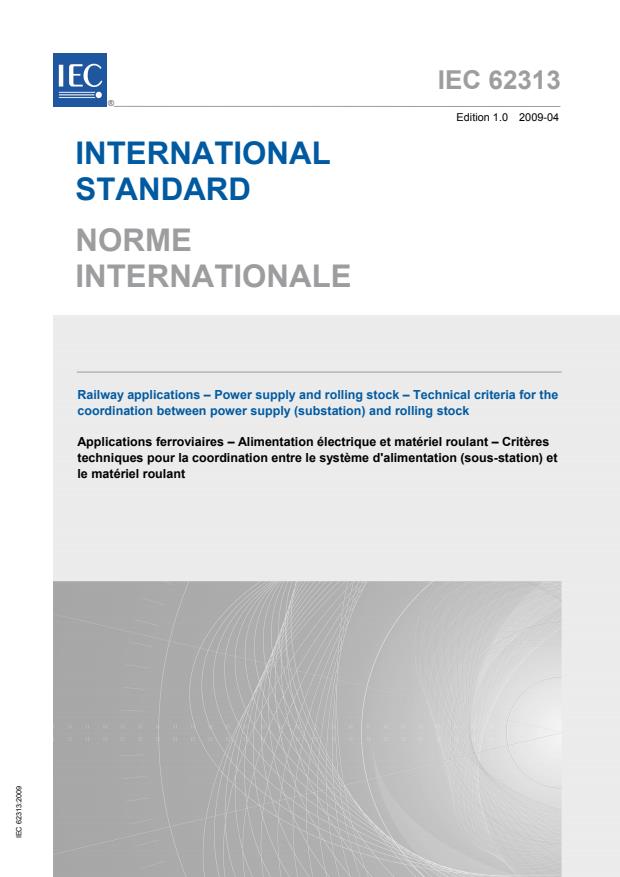
IEC 62313 ®
Edition 1.0 2009-04
INTERNATIONAL
STANDARD
NORME
INTERNATIONALE
Railway applications – Power supply and rolling stock – Technical criteria for the
coordination between power supply (substation) and rolling stock
Applications ferroviaires – Alimentation électrique et matériel roulant – Critères
techniques pour la coordination entre le système d'alimentation (sous-station) et
le matériel roulant
All rights reserved. Unless otherwise specified, no part of this publication may be reproduced or utilized in any form or by
any means, electronic or mechanical, including photocopying and microfilm, without permission in writing from either IEC or
IEC's member National Committee in the country of the requester.
If you have any questions about IEC copyright or have an enquiry about obtaining additional rights to this publication,
please contact the address below or your local IEC member National Committee for further information.
Droits de reproduction réservés. Sauf indication contraire, aucune partie de cette publication ne peut être reproduite
ni utilisée sous quelque forme que ce soit et par aucun procédé, électronique ou mécanique, y compris la photocopie
et les microfilms, sans l'accord écrit de la CEI ou du Comité national de la CEI du pays du demandeur.
Si vous avez des questions sur le copyright de la CEI ou si vous désirez obtenir des droits supplémentaires sur cette
publication, utilisez les coordonnées ci-après ou contactez le Comité national de la CEI de votre pays de résidence.
IEC Central Office
3, rue de Varembé
CH-1211 Geneva 20
Switzerland
Email: inmail@iec.ch
Web: www.iec.ch
About the IEC
The International Electrotechnical Commission (IEC) is the leading global organization that prepares and publishes
International Standards for all electrical, electronic and related technologies.
About IEC publications
The technical content of IEC publications is kept under constant review by the IEC. Please make sure that you have the
latest edition, a corrigenda or an amendment might have been published.
ƒ Catalogue of IEC publications: www.iec.ch/searchpub
The IEC on-line Catalogue enables you to search by a variety of criteria (reference number, text, technical committee,…).
It also gives information on projects, withdrawn and replaced publications.
ƒ IEC Just Published: www.iec.ch/online_news/justpub
Stay up to date on all new IEC publications. Just Published details twice a month all new publications released. Available
on-line and also by email.
ƒ Electropedia: www.electropedia.org
The world's leading online dictionary of electronic and electrical terms containing more than 20 000 terms and definitions
in English and French, with equivalent terms in additional languages. Also known as the International Electrotechnical
Vocabulary online.
ƒ Customer Service Centre: www.iec.ch/webstore/custserv
If you wish to give us your feedback on this publication or need further assistance, please visit the Customer Service
Centre FAQ or contact us:
Email: csc@iec.ch
Tel.: +41 22 919 02 11
Fax: +41 22 919 03 00
A propos de la CEI
La Commission Electrotechnique Internationale (CEI) est la première organisation mondiale qui élabore et publie des
normes internationales pour tout ce qui a trait à l'électricité, à l'électronique et aux technologies apparentées.
A propos des publications CEI
Le contenu technique des publications de la CEI est constamment revu. Veuillez vous assurer que vous possédez
l’édition la plus récente, un corrigendum ou amendement peut avoir été publié.
ƒ Catalogue des publications de la CEI: www.iec.ch/searchpub/cur_fut-f.htm
Le Catalogue en-ligne de la CEI vous permet d’effectuer des recherches en utilisant différents critères (numéro de référence,
texte, comité d’études,…). Il donne aussi des informations sur les projets et les publications retirées ou remplacées.
ƒ Just Published CEI: www.iec.ch/online_news/justpub
Restez informé sur les nouvelles publications de la CEI. Just Published détaille deux fois par mois les nouvelles
publications parues. Disponible en-ligne et aussi par email.
ƒ Electropedia: www.electropedia.org
Le premier dictionnaire en ligne au monde de termes électroniques et électriques. Il contient plus de 20 000 termes et
définitions en anglais et en français, ainsi que les termes équivalents dans les langues additionnelles. Egalement appelé
Vocabulaire Electrotechnique International en ligne.
ƒ Service Clients: www.iec.ch/webstore/custserv/custserv_entry-f.htm
Si vous désirez nous donner des commentaires sur cette publication ou si vous avez des questions, visitez le FAQ du
Service clients ou contactez-nous:
Email: csc@iec.ch
Tél.: +41 22 919 02 11
Fax: +41 22 919 03 00
IEC 62313 ®
Edition 1.0 2009-04
INTERNATIONAL
STANDARD
NORME
INTERNATIONALE
Railway applications – Power supply and rolling stock – Technical criteria for
the coordination between power supply (substation) and rolling stock
Applications ferroviaires – Alimentation électrique et matériel roulant – Critères
techniques pour la coordination entre le système d'alimentation (sous-station)
et le matériel roulant
INTERNATIONAL
ELECTROTECHNICAL
COMMISSION
COMMISSION
ELECTROTECHNIQUE
PRICE CODE
INTERNATIONALE
X
CODE PRIX
ICS 45.060 ISBN 978-2-88910-667-7
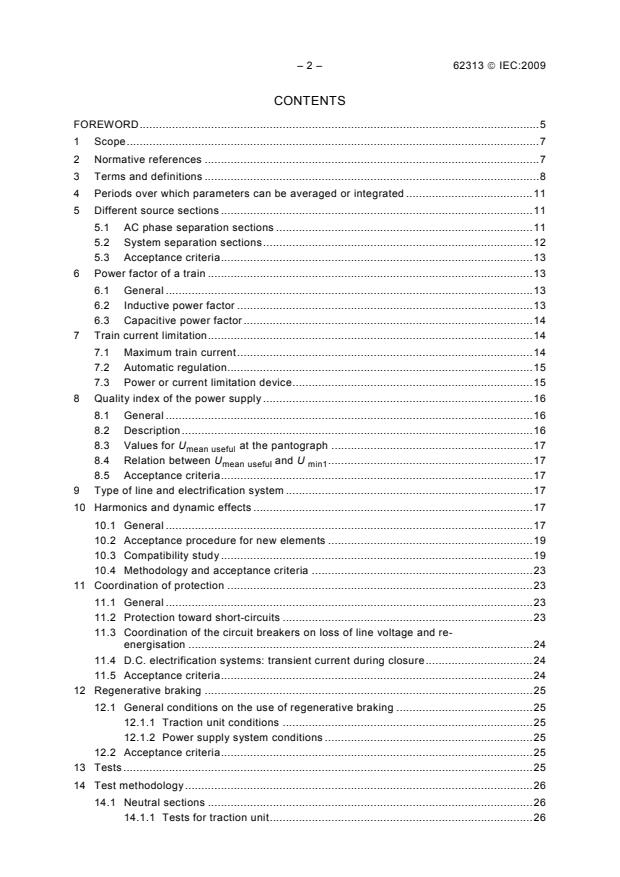
– 2 – 62313 © IEC:2009
CONTENTS
FOREWORD.5
1 Scope.7
2 Normative references .7
3 Terms and definitions .8
4 Periods over which parameters can be averaged or integrated .11
5 Different source sections .11
5.1 AC phase separation sections .11
5.2 System separation sections.12
5.3 Acceptance criteria.13
6 Power factor of a train .13
6.1 General .13
6.2 Inductive power factor .13
6.3 Capacitive power factor .14
7 Train current limitation.14
7.1 Maximum train current.14
7.2 Automatic regulation.15
7.3 Power or current limitation device.15
8 Quality index of the power supply .16
8.1 General .16
8.2 Description.16
8.3 Values for U at the pantograph .17
mean useful
8.4 Relation between U and U .17
mean useful min1
8.5 Acceptance criteria.17
9 Type of line and electrification system .17
10 Harmonics and dynamic effects .17
10.1 General .17
10.2 Acceptance procedure for new elements .19
10.3 Compatibility study .19
10.4 Methodology and acceptance criteria .23
11 Coordination of protection .23
11.1 General .23
11.2 Protection toward short-circuits .23
11.3 Coordination of the circuit breakers on loss of line voltage and re-
energisation .24
11.4 D.C. electrification systems: transient current during closure.24
11.5 Acceptance criteria.24
12 Regenerative braking .25
12.1 General conditions on the use of regenerative braking .25
12.1.1 Traction unit conditions .25
12.1.2 Power supply system conditions .25
12.2 Acceptance criteria.25
13 Tests .25
14 Test methodology.26
14.1 Neutral sections .26
14.1.1 Tests for traction unit.26
62313 © IEC:2009 – 3 –
14.1.2 Tests for infrastructure .26
14.2 Power factor.26
14.3 Train current limitation.27
14.4 Quality index of the power supply.27
14.4.1 U (zone) .27
mean useful
14.4.2 U (train) .27
mean useful
14.4.3 Relation between U and U .28
mean useful min1
14.5 Harmonics and dynamic effects .28
14.6 Coordination of protections.28
14.6.1 Protection toward short-circuits and action on circuit-breakers .28
14.6.2 Coordination of the circuit breakers on loss of line voltage and re-
energisation.28
14.6.3 DC traction units: Transient current during closure .29
14.7 Regenerative braking .29
14.7.1 Traction unit .29
14.7.2 Substation .29
Annex A (informative) Integration periods over which parameters can be averaged .30
Annex B (informative) Selection criteria determining the voltage at the pantograph for
high speed trains .31
Annex C (informative) Investigation of harmonic characteristics and related
overvoltages .34
Annex D (informative) Data related to the compatibility study of harmonics and
dynamic effects.36
Annex E (informative) Types of different source sections .42
Annex F (informative) Maximum allowable train current .44
Annex G (informative) Maximum contact line – rail short-circuit level as European
practise.45
Annex H (informative) di/dt when closure of traction unit circuit breaker.46
Annex I (informative) Special national conditions .47
Bibliography.48
Figure 1 – Maximum train current against voltage .15
Figure 2 – Procedure for compatibility study of harmonics and dynamic effects .20
Figure E.1 – Insulator section .42
Figure E.2 – Neutral section with insulators .42
Figure E.3 – Neutral section with insulated overlaps .42
Figure E.4 – Split neutral section with an insulator and insulated overlaps.42
Figure E.5 – Split neutral section with three insulated overlaps.43
Figure E.6 – Changeover section .43
Figure E.7 – Example of system separation section from AC to DC.43
Figure E.8 – Example of system separation section from DC to AC.43
Table 1 – Total inductive power factor λ of a train.14
Table 2 – Value of factor a (informative) .15
Table 3 – Minimum U at pantograph (V) .17
mean useful
Table 4 – Description of steps.21
– 4 – 62313 © IEC:2009
Table 5 – Action on circuit-breakers at an internal fault within a traction unit.23
Table 6 – Tests.26
Table A.1 – Integration period.30
Table D.1 – Characterization of a.c. electrified lines .36
Table D.2 – Characterisation of d.c. electrified lines .38
Table D.3 – Characterisation of one a.c. train with respect to impedances, harmonics
and stability .39
Table D.4 – Characterisation of one d.c. train with respect to impedances, harmonics
and stability .41
Table F.1 – Maximum allowable train current (A) .44
Table G.1 – Maximum contact line – rail short-circuit level as European practise .45
Table H.1 – di/dt when closure of traction unit circuit breaker .46
62313 © IEC:2009 – 5 –
INTERNATIONAL ELECTROTECHNICAL COMMISSION
____________
RAILWAY APPLICATIONS –
POWER SUPPLY AND ROLLING STOCK –
TECHNICAL CRITERIA FOR THE COORDINATION BETWEEN
POWER SUPPLY (SUBSTATION) AND ROLLING STOCK
FOREWORD
1) The International Electrotechnical Commission (IEC) is a worldwide organization for standardization comprising
all national electrotechnical committees (IEC National Committees). The object of IEC is to promote
international co-operation on all questions concerning standardization in the electrical and electronic fields. To
this end and in addition to other activities, IEC publishes International Standards, Technical Specifications,
Technical Reports, Publicly Available Specifications (PAS) and Guides (hereafter referred to as “IEC
Publication(s)”). Their preparation is entrusted to technical committees; any IEC National Committee interested
in the subject dealt with may participate in this preparatory work. International, governmental and non-
governmental organizations liaising with the IEC also participate in this preparation. IEC collaborates closely
with the International Organization for Standardization (ISO) in accordance with conditions determined by
agreement between the two organizations.
2) The formal decisions or agreements of IEC on technical matters express, as nearly as possible, an international
consensus of opinion on the relevant subjects since each technical committee has representation from all
interested IEC National Committees.
3) IEC Publications have the form of recommendations for international use and are accepted by IEC National
Committees in that sense. While all reasonable efforts are made to ensure that the technical content of IEC
Publications is accurate, IEC cannot be held responsible for the way in which they are used or for any
misinterpretation by any end user.
4) In order to promote international uniformity, IEC National Committees undertake to apply IEC Publications
transparently to the maximum extent possible in their national and regional publications. Any divergence
between any IEC Publication and the corresponding national or regional publication shall be clearly indicated in
the latter.
5) IEC provides no marking procedure to indicate its approval and cannot be rendered responsible for any
equipment declared to be in conformity with an IEC Publication.
6) All users should ensure that they have the latest edition of this publication.
7) No liability shall attach to IEC or its directors, employees, servants or agents including individual experts and
members of its technical committees and IEC National Committees for any personal injury, property damage or
other damage of any nature whatsoever, whether direct or indirect, or for costs (including legal fees) and
expenses arising out of the publication, use of, or reliance upon, this IEC Publication or any other IEC
Publications.
8) Attention is drawn to the Normative references cited in this publication. Use of the referenced publications is
indispensable for the correct application of this publication.
9) Attention is drawn to the possibility that some of the elements of this IEC Publication may be the subject of
patent rights. IEC shall not be held responsible for identifying any or all such patent rights.
International Standard IEC 62313 has been prepared by IEC technical committee 9: Electrical
equipment and systems for railways. This standard is based on EN 50388 (2005).
The text of this standard is based on the following documents:
FDIS Report on voting
9/1225/FDIS 9/1258/RVD
Full information on the voting for the approval of this standard can be found in the report on
voting indicated in the above table.
This publication has been drafted in accordance with the ISO/IEC Directives, Part 2.
– 6 – 62313 © IEC:2009
The committee has decided that the contents of this publication will remain unchanged until
the maintenance result date indicated on the IEC web site under "http://webstore.iec.ch" in
the data related to the specific publication. At this date, the publication will be
• reconfirmed,
• withdrawn,
• replaced by a revised edition, or
• amended.
62313 © IEC:2009 – 7 –
RAILWAY APPLICATIONS –
POWER SUPPLY AND ROLLING STOCK –
TECHNICAL CRITERIA FOR THE COORDINATION BETWEEN
POWER SUPPLY (SUBSTATION) AND ROLLING STOCK
1 Scope
This International Standard is intended to be used to set up the requirements for the
acceptance of rolling stock on infrastructure in the field of:
– co-ordination of protection principles between power supply and traction units, especially
fault discrimination for short-circuits;
– co-ordination of installed power on the line and power demand of the trains;
– co-ordination of traction unit regenerative braking and power supply receptivity;
– co-ordination of harmonic behaviour.
This standard deals with the definition and quality requirements of the power supply at the
interface between traction unit and fixed installations.
The standard specifies the interface between rolling stock and electrical fixed installations for
traction, in the frame ”supply system“. The interaction between pantograph and overhead line
and the interaction with subsystem “control-command” (especially signalling) are not dealt
with in the standard.
Requirements are given for the following categories of line:
– high speed lines,
– conventional lines.
For classical lines, values, if any, are given for the existing European networks. A set of
values is also specified for the future network, which is named ”target“ network.
The following electric traction systems are concerned:
– railways;
– guided mass transport systems that are integrated with the railways;
– material transport systems that are integrated with the railways.
This standard does not apply retrospectively to rolling stock already accepted by
infrastructure managers. However, on new infrastructure, existing rolling stock may be
accepted by the infrastructure manager, provided there is an agreement.
Information is given to the train operating companies on electrification parameters to enable
them to confirm after consultation with the rolling stock manufacturers that there will be no
consequential disturbance on the electrification system.
2 Normative references
The following referenced documents are indispensable for the application of this document.
For dated references, only the edition cited applies. For undated references, the latest edition
of the referenced document (including any amendments) applies.
– 8 – 62313 © IEC:2009
IEC 60050-811, International Electrotechnical vocabulary (IEV) – Chapter 811: Electric
traction
IEC 60850, Railway applications – Supply voltages of traction systems
IEC 61133, Railway applications – Rolling stock – Testing of rolling stock on completion of
construction and before entry into service
IEC 61992-1, Railway applications – Fixed installations – D.C. switchgear – Part 1: General
ISO 3166-1:2006, Codes for the representation of names of countries and their subdivisions –
Part 1: Country codes
3 Terms and definitions
For the purposes of this international Standard, the following terms and definitions apply.
3.1
high speed line
specially built or upgraded line equipped for speeds generally equal to or greater than
200 km/h
3.2
conventional line
line on which conventional freight and passenger trains run. It is not specially built for high
speed as defined in 3.1.
It includes:
• information on European networks named with their national country code
(see ISO 3166-1);
• future target network named ”target“, see 3.25
3.3
type of line
classification of lines as a function of the parameters described in 3.4 to 3.6
3.4
train power at the pantograph
active power of the train taking into account power for traction, regeneration and auxiliary
3.5
minimum possible headway
interval at which trains can run as allowed by the signalling system
3.6
maximum line speed
speed for which the line was approved for operation
3.7
contact line
conductor system for supplying electric energy to vehicles through current-collecting
equipment
[IEV 811-33-01]
62313 © IEC:2009 – 9 –
3.8
overhead contact line
contact line placed above (or beside) the upper limit of the vehicle gauge and supplying
vehicles with electric energy through roof–mounted current collection equipment
[IEV 811-33-02]
3.9
(traction) substation
installation, the main function of which is to supply a contact line system, at which the voltage
of a primary supply system, and in certain cases the frequency, is converted to the voltage
and frequency of the contact line
3.10
total power factor λ
active power
λ =
apparent power
3.11
deformation factor υ
λ
υ =
cos ϕ
3.12
power factor of the fundamental wave
active power of the fundamental wave
cos ϕ =
apparent power of the fundamental wave
NOTE This is also the displacement factor cos ϕ.
3.13
different source section
a section of a contact line to prevent successive electrical sections, differing in voltage, phase
or frequency being connected together by the passage of current collectors
• neutral section
section of a contact line provided with a sectioning point at each end to prevent
successive electrical sections, differing in voltage, phase or frequency being
connected together by the passage of current collectors
• [IEV 811-36-16]
insulator section
section of a contact line to prevent successive electrical sections, differing in voltage,
phase or frequency being connected together by the passage of current collectors,
formed by an insulator inserted in a continuous run of contact line
• changeover section
section of a contact line provided with a section in the middle to enable energization
from either power supply source at each end by switching
3.14
vehicle
general term denoting any single item of rolling stock, e.g. a locomotive, a coach or a wagon
[IEV 811-02-02]
– 10 – 62313 © IEC:2009
3.15
traction unit
general term covering a locomotive, motor coach or train unit
[IEV 811-02-04]
3.16
rolling stock
general term covering all vehicles with or without motors
[IEV 811-02-01]
3.17
train
any combination of rolling stock coupled together. It includes banking locomotives
3.18
normal operating conditions
traffic operating to the design timetable and train formation used for power supply fixed
installation design.
Power supply equipment is operated according to standard design rules.
NOTE Standard rules may vary depending on the infrastructure manager’s policy.
3.19
abnormal operating conditions
either higher traffic loads or outage of power supply equipment outside the design standard
NOTE Under these conditions, traffic may not operate to the design timetable.
3.20
mean useful voltage at the pantograph
U
mean useful
3.20.1
U (zone)
mean useful
voltage giving an indication of the quality of the power supply in a geographic zone during the
peak traffic period in the timetable
3.20.2
(train)
U
mean useful
voltage identifying the dimensioning train and enables the effect on its performance to be
quantified
3.21
dimensioning train
train with the lowest mean useful voltage
3.22
register of infrastructure
a single document which compiles, for each section of line, the characteristics of the lines
concerned for all subsystems that include fixed equipment.
This “register of infrastructure” should be drawn up by the infrastructure manager or its
authorised representative.
62313 © IEC:2009 – 11 –
3.23
infrastructure manager
any body or undertaking that is responsible in particular for establishing and maintaining
railway infrastructure. This may also include the management of infrastructure control and
safety systems. The functions of the infrastructure manager on a network or part of a network
may be allocated to different bodies or undertakings.
3.24
new element
generally, any new, rebuilt or modified (hardware or software) traction-unit or power supply
component having a possible influence on the harmonic behaviour of the power supply
system.
This new element will be integrated in an existing power supply network with traction units, for
example for fixed installation side:
– transformer;
– HV cable;
– filters;
– converter
3.25
target network
network whose design allows the requirements of European interoperability and should avoid
later costly investments
4 Periods over which parameters can be averaged or integrated
This clause is informative and refers to Annex A.
The train operators or infrastructure managers use parameters for:
– their dimensioning computations;
– protection measures;
– planning;
– etc.
These are effective only if they are averaged over precisely defined time spans.
Annex A gives, for information, the periods over which those parameters should be averaged.
5 Different source sections
There are several types of different source sections, such as the insulator section, the neutral
section and the changeover section, as shown in Annex E.
5.1 AC phase separation sections
There are four possibilities for the train to run through phase separation sections:
a) with traction/regenerative current carried;
b) with auxiliary load current carried;
c) with no-load current of the transformer carried;
d) with no power consumption.
The choice between a) to d) shall be made by the infrastructure manager.
– 12 – 62313 © IEC:2009
The requirements for the design of the infrastructure and rolling stock are:
a) Traction/regenerative current carried
If the phase separation sections are to be negotiated with traction/regenerative current
carried, changeover sections shall be installed in the infrastructure. See Clause E.4 for the
information on the changeover section.
Changeover operation of supplied power for the changeover section shall be performed
automatically in the infrastructure.
Trains shall allow short interruptions of supply voltage during changeover operations
without causing any damages or failures.
b) Auxiliary load current carried
If the phase separation sections are to be negotiated with auxiliary load current carried,
sections and pantographs shall be capable of breaking auxiliary load current, and also
making and carrying inrush current of transformers.
Traction/regenerative current shall be brought to zero when entering the phase separation
section. Automatic operation is preferred; however, manual on board operation is also
permitted.
Sections shall have enough length to avoid the two phases bridged by the arc of
traction/regenerative current in case traction/regenerative current fails to become zero.
See Clause E.1 for the information on the insulator section.
c) No-load current of transformer carried
If the phase separation sections are to be negotiated with no-load current of transformer
carried, sections and pantographs shall be capable of making and carrying inrush current
of transformers.
Both traction/regenerative current and auxiliary load current shall be brought to zero when
entering the phase separation section. Automatic operation is preferred; however, manual
on board operation is also permitted.
Sections shall have enough length to avoid the two phases bridged by the arc of
traction/regenerative current in case traction/regenerative current fails to become zero.
See Clause E.1 for the information on the insulator section.
d) No power consumption
If the phase separation sections are to be negotiated with power consumption of the train
brought to zero, power consumption shall be brought to zero when entering the phase
separation section.
For high-speed lines, this shall be done automatically.
For conventional lines, automatic operation is preferred; however, manual on board
operation is also permitted.
Lowering of the pantographs is not necessary.
See Clauses E.2 and E.3 for the information on the suitable sections.
The infrastructure manager shall provide adequate means to allow a train that is gapped
underneath the phase separation to be restarted. Such means, however, are not necessarily
required for the insulator section.
5.2 System separation sections
The trains shall be able to move from one energy supply system to an adjacent one which
uses a different energy supply without bridging the two systems. The necessary actions
(opening of the main circuit-breaker, lowering of the pantographs) depend on the type of both
supply systems as well as on the arrangement of pantographs on trains and the running
speed.
There are two possibilities for the train to run through system separation sections:
62313 © IEC:2009 – 13 –
a) with pantograph raised and touching the contact wire;
b) with pantograph lowered and not touching the contact wire.
The choice between a) and b) shall be made by the infrastructure manager.
The requirements for the design of the infrastructure and rolling stock are:
a) Pantograph raised
If the system separation sections are negotiated with pantographs raised to the contact
wire, provisions shall be taken in the infrastructure to avoid bridging of both adjacent
power supply systems when the opening of the on-board circuit-breaker(s) fails, e.g.
earthing of neutral section.
For High Speed lines, on rolling stock, devices shall open automatically the circuit-breaker
before reaching the separation section and recognise automatically the voltage of the new
power supply system at the pantograph in order to switch the corresponding circuits.
For conventional lines, these requirements for High Speed lines may be applied.
b) Pantograph lowered
If the system separation sections are negotiated with pantographs lowered the following
conditions apply:
The design of separation section between differing energy supply systems shall ensure
that, in case of a pantograph unintentionally applied to the contact line, bridging of two
power supply systems is avoided and switching off both supply sections is triggered
immediately. Triggering of a short-circuit ensures the operation of insulated sections.
– For High Speed lines, at supply system separations which require a lowering of the
pantograph, the pantograph shall be lowered without the driver’s intervention, triggered
by control signals.
– For conventional lines, these requirements for High Speed lines may be applied.
Examples of the section length to avoid bridging by arcs are given in Clause E.4.
5.3 Acceptance criteria
Infrastructure, traction units and control command designers shall comply with the
requirements of 5.1 and 5.2.
6 Power factor of a train
6.1 General
The higher the power factor of a train, the better the power supply performance, therefore the
rules below apply.
Capacitive or inductive power from a train can be utilised to change the overhead contact line
voltage.
6.2 Inductive power factor
This subclause deals only with inductive power factor and power consumption over the range
of voltages from U to U defined in IEC 60850.
min1 max1
Table 1 gives the total inductive power factor λ of a train. For the calculation of λ, only the
fundamental of the voltage at pantograph is taken into account.
– 14 – 62313 © IEC:2009
Table 1 – Total inductive power factor λ of a train
Instantaneous Conventional lines
High speed lines
train power P at the pantograph
c
MW High-speed Upgraded Target
d d a d
P > 6 ≥ 0,95 ≥ 0,95 ≥0,95
d d a d
2 < P ≤ 6 ≥ 0,93 ≥ 0,93 ≥0,93
b b b
0 ≤ P ≤ 2
Where a train or single vehicle is stationary, with the pantograph in contact with the catenary, traction power off and
auxiliaries in service, the total resulting power factor shall not be less than 0,8 if the active power from the overhead
contact line is greater than 200 kW.
The calculation of overall average λ for a train journey, including the stops, is taken from the active energy W
P
(MWh) and reactive energy W (MVArh) given by a computer simulation of a train journey or metered on an actual
Q
train.
λ =
⎛ ⎞
WQ
⎜ ⎟
1+
⎜ ⎟
W
p
⎝ ⎠
a
These values are recommended.
b
In order to control the total power factor of the auxiliary load of a train during the coasting phases, the overall
average λ (traction and auxiliaries) defined by simulation and/or measurement shall be higher than 0,85 over a
complete timetable journey.
c
The infrastructure manager may impose conditions, for example: economic, operating, power limitation for
acceptance of interoperable trains having power factors below the target value.
d
It is expected that these values may be improved, respectively 0,98 and 0,95.
During regeneration, the inductive power factor is allowed to decrease freely in order to keep
voltage within limits.
6.3 Capacitive power factor
During traction mode, capacitive power factor is allowed in order to keep voltage within limits.
– Within the range of voltage from U to U defined in IEC 60850, capacitive power
min1 max1
factors are not limited.
– Within the range of voltage from U to U defined in IEC 60850, a train shall not
max1 max2
behave like a capacitor.
NOTE Capacitive power factors could lead to overvoltages and/or dynamic effects and should be treated
according to Clause 10.
7 Train current limitation
7.1 Maximum train current
The maximum allowable train current including auxiliary shall be set by the infrastructure
manager.
Table F.1 in Annex F indicates, for information the maximum allowable train current including
auxiliary. The levels apply both in tractive and regenerative modes.
NOTE In order to prevent the energy subsystem from over sizing, the values given in Table F.1 are given for
rolling stock and not for the design of the energy sub-system for continuous load.
62313 © IEC:2009 – 15 –
7.2 Automatic regulation
In order to facilitate stable operation on weak power supply networks or in abnormal operating
conditions, if requested by the infrastructure manager, trains shall be equipped with an
automatic device e.g.: part of the propulsion control system software, which adapts the level of
the power consumption depending on overhead line voltage in steady state condition. Figure
1 gives the maximum allowed train current as a function of the overhead contact line voltage.
This figure does not apply in regenerative braking mode.
Current
I
max
B
A
C
I
auxiliary
Current
Overhead line
a × U
(1) U n U
min2 max2
voltage
Current level exceeded Allowable current levels
No traction
A B C
I the maximum current consumed by the train at nominal voltage
max
IEC 438/09
(1) with regard to the setting values of the under-voltage releases, see IEC 60850, NOTE 2 of 4.1.
NOTE The purpose of this diagram is not to design the nominal power of the train.
Figure 1 – Maximum train current against voltage
The value of the knee point factor “a” should be given based on an agreement among related
organizations.
Table 2 is given only for information.
Table 2 – Value of factor a (informative)
AC AC DC DC DC
Power supply
25 000 V 15 000 V 3 000 V 1 500 V 750 V
system
50 Hz 16,7 Hz
Value of a 0,9 0,95 0,9 0,9 0,8
7.3 Power or current limitation device
In order to allow a powerful traction unit to operate everywhere, on weak or electrically well
supplied lines, and if requested by the infrastructure manager, it is necessary to install on board a
current or power selector which will limit the power demand of the train to the electrical
capacity of the line. This can be made through a software function within the control
electronics.
– 16 – 62313 © IEC:2009
The infrastructure manager shall declare the required limitation of each line in a “register of
infrastructure”.
This setting shall be carried out automatically.
However, if the infrastructure has not been equipped for automatic power selection, it can be
done manually by the drivers.
8 Quality index of the power supply
8.1 General
The aim of the dimensioning study, as set out in Annex B, is to define the characteristics of
fixed installations.
These installations should allow the most severe conditions, as specified in the design
timetable, to be satisfied through:
– the densest operating period in the timetable, corresponding to peak traffic;
– the characteristics of the different types of train involved, taking account of the selected
traction units.
The quality index U is calculated by simulation and can be verified by ad hoc
mean useful
measurements on a critical train.
8.2 Description
Mean useful voltage is calculated by computer simulation of a geographic zone (zone under
study) which takes account of all trains scheduled to pass through the zone in an appropriate
period of time corresponding to the peak traffic period in the timetable. This given period of
time shall be sufficient to take account of the highest load on each electrical section in the
geographic zone.
Account shall be taken of the electrical characteristics of the infrastructure and each different
type of train in the simulation.
The fundamental voltage at the pantograph of each train in the geographic zone is analysed
at each simulation time step. For a.c. systems, the r.m.s. values of the fundamental voltage is
used. For d.c. systems, the mean voltage is used. This time step in the simulation shall be
short enough to take into account all events in the timetable.
The voltage values from the simulation are used to study:
a) U (zone)
mean useful
This is the mean value of all voltages analysed in the simulation and gives an indication of
the quality of the power supply for the entire zone.
All trains in the geographic zone, over the peak traffic period considered, are included in
this analysis whether they are in traction mode or not (stationary, traction, regeneration,
coasting) at each simulation time step.
b) U (train)
mean useful
This is the mean value of all voltages in the same simulation as the geographic zone study
but only analysing the voltages for one particular train at each time step where the train is
taking traction load (ignoring steps when the trains is stationary, regenerating or coasting).
The mean value of these voltages gives a check on the performance of each train in the
simulation and as
...