


IEC PAS 61162-101:2003
(Main)Maritime navigation and radiocommunication equipment and systems - Digital interfaces - Part 101: Single talker and multiple listeners - Modified sentences and requirements for IEC 61162-1
General Information
- Abstract
Contains additional requirements for existing sentences and details additions to the existing format which have been found desirable in the light of field experience. Reference is made to IEC/PAS 61162-100 which covers the requirements of the universal shipborne Automatic Identification System (AIS).
- Status
- Replaced
- Publication Date
- 09-Sep-2003
- Technical Committee
- TC 80 - Maritime navigation and radiocommunication equipment and systems
- Drafting Committee
- WG 6 - TC 80/WG 6
- Current Stage
- DELPUB - Deleted Publication
- Start Date
- 08-Jul-2008
- Completion Date
- 28-Aug-2026
Buy Documents

IEC PAS 61162-101:2003 - Maritime navigation and radiocommunication equipment and systems - Digital interfaces - Part 101: Single talker and multiple listeners - Modified sentences and requirements for IEC 61162-1 Released:9/10/2003
Relations
- Effective Date
- 05-Sep-2023
Buy Documents
IEC PAS 61162-101:2003 - Maritime navigation and radiocommunication equipment and systems - Digital interfaces - Part 101: Single talker and multiple listeners - Modified sentences and requirements for IEC 61162-1 Released:9/10/2003
Get Certified
Connect with accredited certification bodies for this standard

DNV
DNV is an independent assurance and risk management provider.

Lloyd's Register
Lloyd's Register is a global professional services organisation specialising in engineering and technology.

FSC International
Forest Stewardship Council certification.
Sponsored listings
Frequently Asked Questions
IEC PAS 61162-101:2003 is a technical specification published by the International Electrotechnical Commission (IEC). Its full title is "Maritime navigation and radiocommunication equipment and systems - Digital interfaces - Part 101: Single talker and multiple listeners - Modified sentences and requirements for IEC 61162-1". This standard covers: Contains additional requirements for existing sentences and details additions to the existing format which have been found desirable in the light of field experience. Reference is made to IEC/PAS 61162-100 which covers the requirements of the universal shipborne Automatic Identification System (AIS).
Contains additional requirements for existing sentences and details additions to the existing format which have been found desirable in the light of field experience. Reference is made to IEC/PAS 61162-100 which covers the requirements of the universal shipborne Automatic Identification System (AIS).
IEC PAS 61162-101:2003 is classified under the following ICS (International Classification for Standards) categories: 47.020.70 - Navigation and control equipment. The ICS classification helps identify the subject area and facilitates finding related standards.
IEC PAS 61162-101:2003 has the following relationships with other standards: It is inter standard links to IEC 61162-1:2007. Understanding these relationships helps ensure you are using the most current and applicable version of the standard.
IEC PAS 61162-101:2003 is available in PDF format for immediate download after purchase. The document can be added to your cart and obtained through the secure checkout process. Digital delivery ensures instant access to the complete standard document.
Standards Content (Sample)
IEC/PAS 61162-101
Edition 1.0
2003-09
Maritime navigation and
radiocommunication equipment
and systems –
Digital interfaces –
Part 101:
Single talker and multiple listeners –
Modified sentences and requirements
for IEC 61162-1
PUBLICLY AVAILABLE SPECIFICATION
IN TE RNA TI ONA L
ELECTROTEC HNICAL
Reference number
COM M IS SION
IEC/PAS 61162-101
IEC/PAS 61162-101
Edition 1.0
2003-09
Maritime navigation and
radiocommunication equipment
and systems –
Digital interfaces –
Part 101:
Single talker and multiple listeners –
Modified sentences and requirements
for IEC 61162-1
PUBLICLY AVAILABLE SPECIFICATION
IN TE RNA TI ONA L
ELECTROTEC HNICAL
Reference number
COM M IS SION
IEC/PAS 61162-101
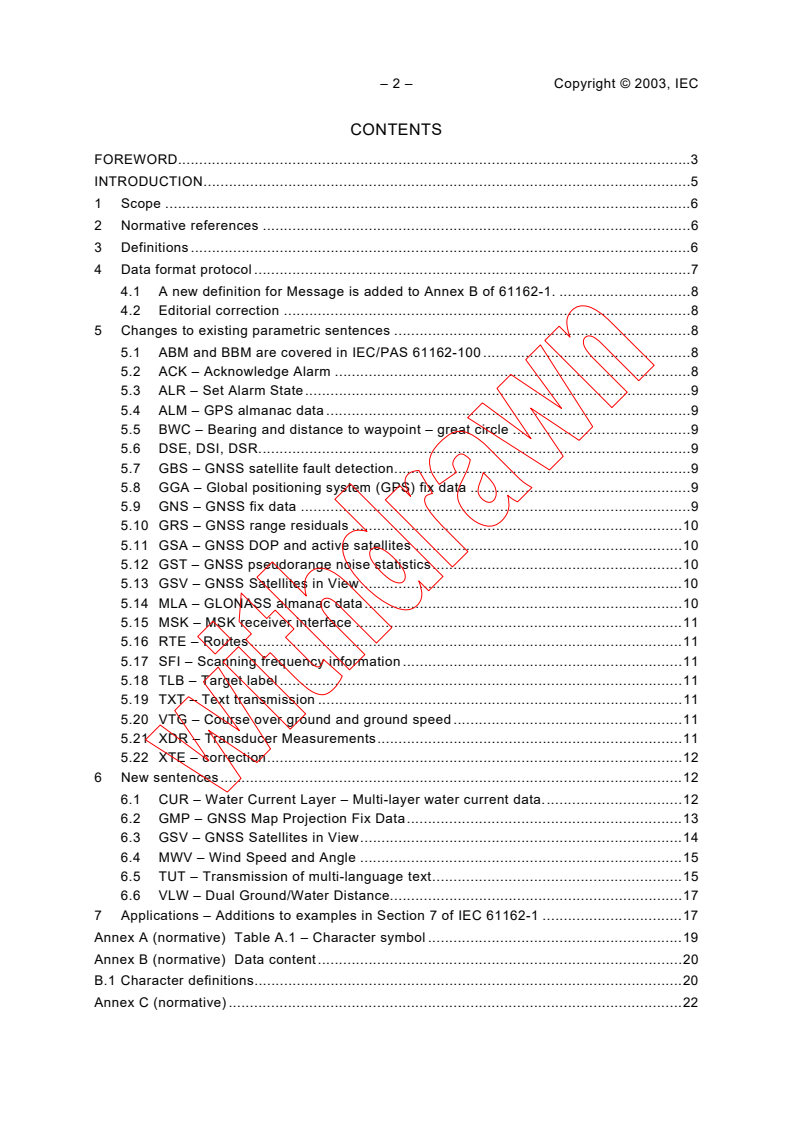
– 2 – Copyright © 2003, IEC
CONTENTS
FOREWORD.3
INTRODUCTION.5
1 Scope.6
2 Normative references.6
3 Definitions.6
4 Data format protocol.7
4.1 A new definition for Message is added to Annex B of 61162-1. .8
4.2 Editorial correction .8
5 Changes to existing parametric sentences .8
5.1 ABM and BBM are covered in IEC/PAS 61162-100 .8
5.2 ACK – Acknowledge Alarm .8
5.3 ALR – Set Alarm State.9
5.4 ALM – GPS almanac data .9
5.5 BWC – Bearing and distance to waypoint – great circle .9
5.6 DSE, DSI, DSR.9
5.7 GBS – GNSS satellite fault detection.9
5.8 GGA – Global positioning system (GPS) fix data .9
5.9 GNS – GNSS fix data .9
5.10 GRS – GNSS range residuals .10
5.11 GSA – GNSS DOP and active satellites .10
5.12 GST – GNSS pseudorange noise statistics.10
5.13 GSV – GNSS Satellites in View.10
5.14 MLA – GLONASS almanac data.10
5.15 MSK – MSK receiver interface .11
5.16 RTE – Routes.11
5.17 SFI – Scanning frequency information .11
5.18 TLB – Target label .11
5.19 TXT – Text transmission .11
5.20 VTG – Course over ground and ground speed .11
5.21 XDR – Transducer Measurements.11
5.22 XTE – correction.12
6 New sentences.12
6.1 CUR – Water Current Layer – Multi-layer water current data.12
6.2 GMP – GNSS Map Projection Fix Data.13
6.3 GSV – GNSS Satellites in View.14
6.4 MWV – Wind Speed and Angle .15
6.5 TUT – Transmission of multi-language text.15
6.6 VLW – Dual Ground/Water Distance.17
7 Applications – Additions to examples in Section 7 of IEC 61162-1 .17
Annex A (normative) Table A.1 – Character symbol .19
Annex B (normative) Data content.20
B.1 Character definitions.20
Annex C (normative) .22
INTERNATIONAL ELECTROTECHNICAL COMMISSION
____________
MARITIME NAVIGATION AND RADIOCOMMUNICATION
EQUIPMENT AND SYSTEMS –
DIGITAL INTERFACES –
Part 101: Single talker and multiple listeners –
Modified sentences and requirements for IEC 61162-1
FOREWORD
1) The International Electrotechnical Commission (IEC) is a worldwide organization for standardization comprising
all national electrotechnical committees (IEC National Committees). The object of IEC is to promote
international co-operation on all questions concerning standardization in the electrical and electronic fields. To
this end and in addition to other activities, IEC publishes International Standards, Technical Specifications,
Technical Reports, Publicly Available Specifications (PAS) and Guides (hereafter referred to as “IEC
Publication(s)”). Their preparation is entrusted to technical committees; any IEC National Committee interested
in the subject dealt with may participate in this preparatory work. International, governmental and non-
governmental organizations liaising with the IEC also participate in this preparation. IEC collaborates closely
with the International Organization for Standardization (ISO) in accordance with conditions determined by
agreement between the two organizations.
2) The formal decisions or agreements of IEC on technical matters express, as nearly as possible, an international
consensus of opinion on the relevant subjects since each technical committee has representation from all
interested IEC National Committees.
3) IEC Publications have the form of recommendations for international use and are accepted by IEC National
Committees in that sense. While all reasonable efforts are made to ensure that the technical content of IEC
Publications is accurate, IEC cannot be held responsible for the way in which they are used or for any
misinterpretation by any end user.
4) In order to promote international uniformity, IEC National Committees undertake to apply IEC Publications
transparently to the maximum extent possible in their national and regional publications. Any divergence
between any IEC Publication and the corresponding national or regional publication shall be clearly indicated in
the latter.
5) IEC provides no marking procedure to indicate its approval and cannot be rendered responsible for any
equipment declared to be in conformity with an IEC Publication.
6) All users should ensure that they have the latest edition of this publication.
7) No liability shall attach to IEC or its directors, employees, servants or agents including individual experts and
members of its technical committees and IEC National Committees for any personal injury, property damage or
other damage of any nature whatsoever, whether direct or indirect, or for costs (including legal fees) and
expenses arising out of the publication, use of, or reliance upon, this IEC Publication or any other IEC
Publications.
8) Attention is drawn to the Normative references cited in this publication. Use of the referenced publications is
indispensable for the correct application of this publication.
9) Attention is drawn to the possibility that some of the elements of this IEC Publication may be the subject of
patent rights. IEC shall not be held responsible for identifying any or all such patent rights.
A PAS is a technical specification not fulfilling the requirements for a standard, but made
available to the public.
IEC-PAS 61162-101 has been processed by IEC technical committee 80: Maritime navigation
and radiocommunication equipment and systems.
The text of this PAS is based on the This PAS was approved for
following document: publication by the P-members of the
committee concerned as indicated in
the following document
Draft PAS Report on voting
80/363/PAS 80/376/RVD
Following publication of this PAS, the technical committee or subcommittee concerned will
investigate the possibility of transforming the PAS into an International Standard.
– 4 – Copyright © 2003, IEC
This PAS document relates to International Standards of the IEC 61162 series. The document
has been co-ordinated with the NMEA Standards Committee.
This PAS shall remain valid for an initial maximum period of 3 years starting from 2003-09.
The validity may be extended for a single 3-year period, following which it shall be revised to
become another type of normative document, or shall be withdrawn.
INTRODUCTION
This document is issued as a IEC Publicly Available Specification according to the IEC/PAS
approval process. This agreed process allows the latest information on modified sentences to
be placed in the public domain in a shorter timescale than revising the appropriate
international standards.
The publication of this PAS is intended to provide information on the interface standards
which have been upgraded, modified or introduced in the light of experience with earlier
editions of the IEC Standard 61162-1.
This publication IEC/PAS 61162-101 will be aligned with similar standards adopted by the
NMEA in the latest version 3.12 of NMEA 0183.
A second IEC/PAS 61162-100 is available which deals solely with the interface standards
required to implement the AIS. A future IEC/PAS 61162-102 will be made available
concerning the additional requirements for the Voyage Data recorder (VDR).
This PAS will be replaced at a future date by, or be included within, a revision of the
international standard IEC 61162-1.
– 6 – Copyright © 2003, IEC
MARITIME NAVIGATION AND RADIOCOMMUNICATION
EQUIPMENT AND SYSTEMS –
DIGITAL INTERFACES –
Part 101: Single talker and multiple listeners –
Modified sentences and requirements for IEC 61162-1
1 Scope
This PAS document for IEC 61162-1 contains additional requirements for existing sentences
and details additions to the existing format which have been found desirable in the light of
field experience.
This is the second PAS document to be developed for the IEC 61162-1, reference should be
made to IEC/PAS 61162-100 which covers the requirements of the universal shipborne
Automatic Identification System (AIS).
2 Normative references
The following referenced documents are indispensable for the application of this document.
For dated references, only the edition cited applies. For undated references, the latest edition
of the referenced document (including any amendments) applies.
Additions to this list are concerned solely with the new AIS and IEC/PAS 61162-100 should be
referred to for details.
3 Definitions
3.1
Parametric sentences
(Reference IEC 61162-1 Section 5 : Data format protocol)
These sentences start with the “$” delimiter, and represent the majority of approved
sentences defined by this standard. This sentence structure, with delimited and defined data
fields, is the preferred method for conveying information.
The basic rules for parametric sentence structures are:
a) The sentence begins with the “$” delimiter.
b) Only approved sentence formatters are allowed. Formatters used by special-purpose
encapsulation sentences cannot be reused. See Annex C, tables C.1 and C.2.
c) Only valid characters are allowed. See Annex B, tables B.1 and B.2.
d) Only approved field types are allowed. See Annex A, table A.1.
e) Data fields (parameters) are individually delimited, and their content is identified and often
described in detail by this standard.
f) Encapsulated non-delimited data fields are NOT ALLOWED.
3.2
Encapsulation sentences
(Reference IEC 61162-1 these are new sentences : see note below)
There follows a brief description of the Encapsulation sentence. Note that a full description is
to be found in the IEC/PAS 61162-100 for the universal shipborne Automatic Identification
System (AIS).
These sentences start with the “!” delimiter. The function of this special-purpose sentence
structure is to provide a means to convey information, when the specific data content is
unknown or greater information bandwidth is needed. This is similar to a modem that
transfers information without knowing how the information is to be decoded or interpreted.
The basic rules for encapsulation sentence structures are:
a) The sentence begins with the “!” delimiter.
b) Only approved sentence formatters are allowed. Formatters used by conventional
parametric sentences can not be reused.
c) Only valid characters are allowed.
d) Only approved field types are allowed)
e) Only Six bit coding may be used to create encapsulated data fields.
f) Encapsulated data fields may consist of any number of parameters, and their content is
not identified or described by this standard.
g) The sentence must be defined with one encapsulated data field and any number of
parametric data fields separated by the “,” data field delimiter. The encapsulated data
field shall always be the second to last data field in the sentence, not counting the
checksum fieldh)
h) The sentence contains a “Total Number Of Sentences” field.
i) The sentence contains a “Sentence Number” field.
j) The sentence contains a “Sequential Message Identifier” field.
k) The sentence contains a “Fill Bits” field immediately following the encapsulated data field.
The Fill Bits field shall always be the last data field in the sentence, not counting the
checksum field.
NOTE This method of conveying information is to be used only when absolutely necessary, and will only be
considered when one or both of two conditions are true, and when there is no alternative.
Condition 1: The data parameters are unknown by devices having to convey the information. For example, the
ABM and BBM sentences meet this condition, because the content is not known to the Universal Automatic
Identification System (AIS) transponder.
Condition 2: When information requires a significantly higher data rate than can be achieved by the IEC 61162-1
(4 800 baud) and IEC 61162-2 (38 400 baud) standards utilising parametric sentences.
By encapsulating a large amount of information, the number of overhead characters, such as “,” field delimiters can
be reduced, resulting in higher data transfer rates. It is very unusual for this second condition to be fulfilled. As an
example, a UAIS transponder has a data rate capability of 4 500 messages per minute, and satisfies this condition,
resulting in the VDM and VDO sentences.
4 Data format protocol
Reference IEC 61162-1 Section 5: New section 5.3.7 multi-sentence messages, see also 4.1
and 4.2 below.
Multi-sentence messages may be transmitted where a data message exceeds the available
character space in a single sentence. The key fields supporting the multi-sentence message
capability shall always be included, without exception. The required fields are: total number
of sentences, sentence number, and sequential message identifier fields. Only sentence
definitions containing these fields may be used to form messages. The TUT sentence is a
good example of how a sentence is defined to provide these capabilities.
The Listener should be aware that a multi-sentence message may be interrupted by a higher
priority message such as an alarm sentence, and thus the original message should be
discarded as incomplete and has to await re-transmission. The Listener has to check that
multi-sentences are contiguous.
– 8 – Copyright © 2003, IEC
Should an error occur in any sentence of a multi-sentence message, the Listener shall discard
the whole message and be prepared to receive the message again upon the next
transmission.
4.1 A new definition for Message is added to Annex B of 61162-1
Message – A message consists of 2 or more sentences with the same sentence formatter.
Messages are used when 2 or more sentences are needed to convey related data that
exceeds the maximum sentence length. This only applies to those sentence formatters that
are defined with the key fields supporting multi-sentence messages.
4.2 Editorial correction
Previously, the words ‘Sentence’ and ‘Message’ had been interchangeable in their use within
the standard. The word ‘Message’ has now been given a specific meaning – see 4.1 above.
The words ‘Sentence’ and ‘Message’ are no longer interchangeable and have two different
meanings. Accordingly, a number of sentence descriptions, field labels, and notes have been
edited to use the words ‘Sentence’ and ‘Message’ in a consistent and proper manner. The
sentences affected are:
ALM GPS Almanac Data
ABM UAIS Addressed binary and safety related message.
BBM UAIS Broadcast Binary Message.
DSE Expanded Digital Selective Calling
DSI DSC Transponder Initialise
DSR DSC Transponder Response
GBS GNSS Satellite Fault Detection
GMP GNSS Map Projection Fix Data
GNS GNSS Fix Data
GRS GNSS Range Residuals
GSA GNSS DOP and Active Satellites
GST GNSS Pseudorange Error Statistics
GSV GNSS Satellites in View
MLA GLONASS Almanac Data
MSK MSK Receiver Interface
RTE Routes RTE - Routes
SFI Scanning Frequency Information
TLB Target Label
5 Changes to existing parametric sentences
Reference IEC 61162-1 Section 6.3:
5.1 ABM and BBM are covered in IEC/PAS 61162-100
5.2 ACK – Acknowledge Alarm
Updated the text label for the data field.
$--ACK,xxx*hh
Unique alarm number (identifier) at alarm source
5.3 ALR – Set Alarm State
Updated the text label of the alarm identification field to be the same as that field in the ACK
sentence.
$--ALR,hhmmss.ss,xxx,A,A,c--c*hh
Alarm’s description text
Alarm’s acknowledge state, A = acknowledged, V = unacknowledged
Alarm condition (A = threshold exceeded, V = not exceeded)
Unique alarm number (identifier) at alarm source
Time of alarm condition change, UTC
5.4 ALM – GPS almanac data
The description should now read:
Contains GPS week number, satellite health and the complete almanac for one satellite.
Multiple sentences may be transmitted, one for each satellite in the GPS constellation, up to a
maximum of 32 sentences.
Note also that the word “message” is replaced by “sentence” in fields 1 and 2.
5.5 BWC – Bearing and distance to waypoint – great circle
BWC data is calculated along the great circle path from present position rather than along the
rhumb line
5.6 DSE, DSI, DSR
The following changes have been made to the relevant notes for sentences: DSE, DSI
and DSR.
In each case Note 5 should now read
NOTE 5 The number of data sets may require the transmission of multiple sentences all containing identical field
formats. The first field specifies the number of sentences, minimum value = 1. The second field identifies the order
of this sentence (sentence number), minimum value = 1. For efficiency, it is permitted that null fields be used in the
additional sentences when the data is unchanged from the first sentence [Note that this practice can lead to the
incorrect assembly of messages if there is a high risk of loss of sentence].”
Note also that the word “message” is replaced by “sentence” in fields 1 and 2.
5.7 GBS – GNSS satellite fault detection
The word “message(s)” in paragraphs 1 and 2 of the description should be amended to
“sentence(s)”.
5.8 GGA – Global positioning system (GPS) fix data
Note 1 has been clarified in terms of valid or invalid data.
NOTE 1 All GPS quality indicators in headings 1 through 8 are considered “valid”. The heading “0” is the only
“invalid” indicator. The GPS Quality indicator field shall not be a null field.
5.9 GNS – GNSS fix data
The word “message” in the second paragraph should be replaced by “sentence”.
Note 1 has been clarified in terms of valid or invalid data.
– 10 – Copyright © 2003, IEC
NOTE 1 All GPS quality indicators in headings 1 through 8 are considered “valid”. The heading “0” is the only
“invalid” indicator. The GPS Quality indicator field shall not be a null field.
5.10 GRS – GNSS range residuals
The word “messages” in the second and third paragraphs should be replaced by “sentences”.
5.11 GSA – GNSS DOP and active satellites
The word “messages” in the opening paragraph should be replaced by “sentences”.
5.12 GST – GNSS pseudorange noise statistics
Amend the word “message” in the opening paragraph to “sentence”.
5.13 GSV – GNSS Satellites in View
Number of satellites (SV) in view, satellite ID numbers, elevation, azimuth, and SNR value.
Four satellites maximum, per transmission. Total number of sentences being transmitted and
the number of the sentence being transmitted are indicated in the first two fields.
If multiple GPS, GLONASS, etc. satellites are in view, use separate GSV sentences with
talker ID GP to show the GPS satellites in view and talker GL to show the GLONASS
satellites in view, etc. The GN identifier shall not be used with this sentence.
$--GSV,x,x,xx,xx,xx,xxx,xx,.…….…….,xx,xx,xxx,xx*hh
th 2
4 SV
nd rd 2
2 – 3 SV
SNR (C/No) 00-99dB-Hz, null when not tracking
Azimuth, degrees true, 000 to 359
Elevation, degrees, 90° maximum
Satellite ID number
Total number of satellites in view
Sentence number , 1 to 9
Total number of sentences , 1 to 9
NOTE 1 Satellite information may require the transmission of multiple sentences all containing identical field
formats when sending a complete message. The first field specifies the total number of sentences, minimum
value=1. The second field identifies the order of this sentence (sentence number), minimum value = 1. For
efficiency it is permitted that null fields be used in the additional sentences when the data is unchanged from the
first sentence.
NOTE 2 A variable number of “Satellite ID-Elevation-Azimuth-SNR” sets are allowed up to a maximum of four
sets per sentence. Null fields are not required for unused sets when less than four sets are transmitted.
NOTE 3 Satellite ID numbers. To avoid possible confusion caused by repetition of satellite ID numbers when
using multiple satellite systems, the following convention has been adopted:
a) GPS satellites are identified by their PRN numbers, which range from 1 to 32.
b) The numbers 33-64 are reserved for WAAS satellites. The WAAS system PRN numbers are 120-138.
The offset from NMEA WAAS SV ID to WAAS PRN number is 87. A WAAS PRN number of 120 minus 87
yields the SV ID of 33. The addition of 87 to the SV ID yields the WAAS PRN number.
c) The numbers 65-96 are reserved for GLONASS satellites. GLONASS satellites are identified by
64+satellite slot number. The slot numbers are 1 through 24 for the full GLONASS constellation of 24
satellites, this gives a range of 65 through 88. The numbers 89 through 96 are available if slot numbers
above 24 are allocated to on-orbit spares.
5.14 MLA – GLONASS almanac data
The word “messages” in the opening paragraph should be replaced by “sentences”.
Note also that the word “message(s)” is replaced by “sentence(s)” in fields 1 and 2.
5.15 MSK – MSK receiver interface
Command sentence to a radiobeacon MSK receiver (beacon receiver) or reply from an MSK
receiver to a query sentence.
5.16 RTE – Routes
Note 2 is replaced by the following
NOTE 2 A single route may require the transmission of multiple sentences, all containing identical field formats
when sending a complex message. The first field specifies the number of sentences, minimum value = 1. The
second field identifies the order of this sentence (sentence number), minimum value = 1. For efficiency it is
permitted that null fields be used in the additional sentences when the data is unchanged from the first sentence.
[Note that this practice can lead to the incorrect assembly of messages if there is a high risk of loss of sentence].
Note also that the word “message” is replaced by “sentence” in fields 1, 2 and [ 3 ].
5.17 SFI – Scanning frequency information
The word “message(s)” is replaced by “sentence(s)” in fields 1 and 2.
5.18 TLB – Target label
The word “message” is replaced by “sentence” in Notes 1 and 2.
5.19 TXT – Text transmission
Note 1 is replaced by the following
NOTE 1 Text messages may require the transmission of multiple sentences, all containing identical field formats
when sending a complex message. The first field specifies the number of sentences, minimum value = 1. The
second field identifies the order of this sentence (sentence number), minimum value = 1. For efficiency it is
permitted that null fields be used in the additional sentences when the data is unchanged from the first sentence.
[Note that this practice can lead to the incorrect assembly of messages if there is a high risk of loss of sentence].”
The word “message” is replaced by “sentence” in fields 1 and 2.
5.20 VTG – Course over ground and ground speed
The change is to the definition in the note
NOTE The mode indicator provides status information about the operation of the source devices (such as
positioning systems, velocity sensors, etc.) generating this sentence, and the validity of the data being provided.
The possible indications are as follows:
5.21 XDR – Transducer Measurements
An additi
...