


IEC 61097-16:2019
(Main)Global maritime distress and safety system (GMDSS) - Part 16: Ship earth stations operating in mobile-satellite systems recognized for use in the GMDSS - Operational and performance requirements, methods of testing and required test results
Global maritime distress and safety system (GMDSS) - Part 16: Ship earth stations operating in mobile-satellite systems recognized for use in the GMDSS - Operational and performance requirements, methods of testing and required test results
IEC 61097-16:2019 specifies the minimum operational and performance requirements, methods of testing and required test results for any ship earth stations intended for operation in mobile-satellite systems and services which are recognized by the International Maritime Organization as meeting the criteria required by the IMO under regulation IV/4-1 of the International Convention for the Safety of Life at Sea, 1974, as amended, for the provision of mobile-satellite systems and services in the GMDSS, regardless of the mobile satellite provider used.
This document incorporates the minimum criteria and performance standards of the IMO, currently prescribed in IMO Resolution A.1001(25) in IMO Resolution MSC.434(98) and is also associated with IMO Resolution A.694(17) and IEC 60945.
Matters relating to the installation of the ship earth station are given in Annex A.
Système mondial de détresse et de sécurité en mer (SMDSM) - Partie 16: Stations terriennes de navire fonctionnant dans les systèmes mobiles par satellite reconnus pour une utilisation dans le SMDSM – Exigences opérationnelles et de fonctionnement, méthodes d'essai et résultats exigibles
L'IEC 61097-16:2019 spécifie les exigences opérationnelles et de fonctionnement, les méthodes d'essai et les résultats exigibles minimaux pour toute station terrienne de navire destinée à fonctionner dans les systèmes et les services mobiles par satellite qui sont reconnus par l'Organisation maritime internationale comme satisfaisant aux critères exigés par l'OMI en vertu du règlement IV/4-1 de la Convention internationale sur la Sauvegarde de la vie humaine en mer (Safety Of Life At Sea), 1974, telle que modifiée, pour la fourniture des systèmes et des services mobiles par satellite dans le SMDSM, indépendamment du fournisseur de satellite mobile utilisé.
Le présent document contient les critères minimaux et les normes de fonctionnement de l'OMI, actuellement prescrits dans la Résolution OM A.1001(25), dans la Résolution OMI MSC.434(98) et il est également associé à la Résolution OMI A.694(17) et l'IEC 60945.
Les sujets en rapport avec l'installation de la station terrienne de navire sont indiqués dans l'Annexe A.
General Information
- Status
- Published
- Publication Date
- 07-Jul-2019
- Technical Committee
- TC 80 - Maritime navigation and radiocommunication equipment and systems
- Drafting Committee
- PT 61097-16 - TC 80/PT 61097-16
- Current Stage
- PPUB - Publication issued
- Start Date
- 08-Jul-2019
- Completion Date
- 02-Aug-2019
Overview
IEC 61097-16:2019 is an international standard published by the International Electrotechnical Commission (IEC) that defines essential operational and performance requirements for ship earth stations (SES) operating in mobile-satellite systems recognized for use within the Global Maritime Distress and Safety System (GMDSS). This standard ensures ship earth stations comply with the minimum criteria established by the International Maritime Organization (IMO) under regulation IV/4-1 of SOLAS 1974, as amended. It covers system functionality, testing methods, required test results, and installation guidelines related to SES intended for maritime distress communications via mobile satellite services.
By incorporating IMO resolutions such as A.1001(25), MSC.434(98), and A.694(17), along with IEC 60945 standards, IEC 61097-16:2019 ensures uniformity and reliability in ship-to-shore and distress communication systems through satellite technology. Annex A provides specific requirements related to the installation of ship earth stations.
Key Topics
Operational and Functional Requirements
Defines the essential capabilities ship earth stations must support, including handling distress alerts, urgency and safety communications, automatic distress alert repetition, priority management, and integrated equipment interfaces such as CAM (Communication Addressing and Management).Methods of Testing and Required Test Results
Specifies standardized procedures to verify SES performance to meet the prescribed operational criteria. Testing covers distress alert transmission, reception capabilities, audible and visual indicators, position updating, and cybersecurity measures to protect system integrity.Transmission and Reception of Distress Alerts
Outlines priority handling, content requirements for alerts and subsequent communications, and mechanisms for false alarm cancellation. The standard mandates automatic repetition and presentation of distress, urgency, and safety messages.Integrated System Interfaces
Details standardized communication protocols and interface management between ship earth stations and other onboard equipment or shore facilities, ensuring interoperability within maritime communication networks.Power Supply and Antenna Requirements
Addresses power supply change-over to maintain continuous operation during failure scenarios and proper antenna siting to ensure optimal signal reception and transmission while safeguarding against RF radiation hazards.Installation Guidelines (Annex A)
Provides normative standards for equipment installation, including power supply considerations, RF radiation protection, and necessary information in equipment manuals to aid compliant maritime communication setups.
Applications
IEC 61097-16:2019 is critical for manufacturers, installers, and operators of maritime communication equipment to ensure compliance with GMDSS requirements for satellite-based ship earth stations. Practical applications include:
- Ship Electronics Manufacturers designing SES that meet IMO and IEC standards for distress and safety communication.
- Maritime Safety Authorities and Regulators enforcing compliance of sea-going vessels with international distress communication standards.
- Ship Operators and Crew relying on certified ship earth stations for effective emergency and routine communications within GMDSS frameworks.
- Installation and Maintenance Technicians following standardized installation and testing procedures to maintain communication integrity and operational readiness.
- Satellite Communication Providers aligning services to meet technical criteria detailed in the standard ensuring interoperability and safety compliance.
Related Standards
- IEC 60945 – Maritime navigation and radio communication equipment and systems – General requirements – Methods of testing and required test results.
- IMO Resolution A.1001(25) – Performance standards for satellite EPIRB COSPAS-SARSAT C/S.
- IMO Resolution MSC.434(98) – Performance standards for GMDSS shipborne equipment using the Inmarsat satellite system.
- IMO Resolution A.694(17) – On carriage requirements for shipborne communications equipment.
- SOLAS 1974 Regulation IV/4-1 – Regulations concerning the provision of communication equipment on ships for GMDSS.
Keywords: IEC 61097-16, GMDSS, ship earth stations, mobile-satellite systems, maritime distress communication, IMO regulations, SOLAS, operational requirements, performance standards, maritime satellite communication, ship safety equipment, maritime radio standards, distress alert system, satellite communication testing, maritime equipment installation.
Buy Documents
IEC 61097-16:2019 - Global maritime distress and safety system (GMDSS) - Part 16: Ship earth stations operating in mobile-satellite systems recognized for use in the GMDSS - Operational and performance requirements, methods of testing and required test results Released:7/8/2019
Get Certified
Connect with accredited certification bodies for this standard

DNV
DNV is an independent assurance and risk management provider.

Lloyd's Register
Lloyd's Register is a global professional services organisation specialising in engineering and technology.

ABS Quality Evaluations Inc.
American Bureau of Shipping quality certification.
Sponsored listings
Frequently Asked Questions
IEC 61097-16:2019 is a standard published by the International Electrotechnical Commission (IEC). Its full title is "Global maritime distress and safety system (GMDSS) - Part 16: Ship earth stations operating in mobile-satellite systems recognized for use in the GMDSS - Operational and performance requirements, methods of testing and required test results". This standard covers: IEC 61097-16:2019 specifies the minimum operational and performance requirements, methods of testing and required test results for any ship earth stations intended for operation in mobile-satellite systems and services which are recognized by the International Maritime Organization as meeting the criteria required by the IMO under regulation IV/4-1 of the International Convention for the Safety of Life at Sea, 1974, as amended, for the provision of mobile-satellite systems and services in the GMDSS, regardless of the mobile satellite provider used. This document incorporates the minimum criteria and performance standards of the IMO, currently prescribed in IMO Resolution A.1001(25) in IMO Resolution MSC.434(98) and is also associated with IMO Resolution A.694(17) and IEC 60945. Matters relating to the installation of the ship earth station are given in Annex A.
IEC 61097-16:2019 specifies the minimum operational and performance requirements, methods of testing and required test results for any ship earth stations intended for operation in mobile-satellite systems and services which are recognized by the International Maritime Organization as meeting the criteria required by the IMO under regulation IV/4-1 of the International Convention for the Safety of Life at Sea, 1974, as amended, for the provision of mobile-satellite systems and services in the GMDSS, regardless of the mobile satellite provider used. This document incorporates the minimum criteria and performance standards of the IMO, currently prescribed in IMO Resolution A.1001(25) in IMO Resolution MSC.434(98) and is also associated with IMO Resolution A.694(17) and IEC 60945. Matters relating to the installation of the ship earth station are given in Annex A.
IEC 61097-16:2019 is classified under the following ICS (International Classification for Standards) categories: 47.020.70 - Navigation and control equipment. The ICS classification helps identify the subject area and facilitates finding related standards.
IEC 61097-16:2019 is available in PDF format for immediate download after purchase. The document can be added to your cart and obtained through the secure checkout process. Digital delivery ensures instant access to the complete standard document.
Standards Content (Sample)
IEC 61097-16 ®
Edition 1.0 2019-07
INTERNATIONAL
STANDARD
NORME
INTERNATIONALE
Global maritime distress and safety system (GMDSS) –
Part 16: Ship earth stations operating in mobile-satellite systems recognized for
use in the GMDSS – Operational and performance requirements, methods of
testing and required test results
Système mondial de détresse et de sécurité en mer (SMDSM) –
Partie 16: Stations terriennes de navire fonctionnant dans les systèmes mobiles
par satellite reconnus pour une utilisation dans le SMDSM – Exigences
opérationnelles et de fonctionnement, méthodes d'essai et résultats exigibles
All rights reserved. Unless otherwise specified, no part of this publication may be reproduced or utilized in any form
or by any means, electronic or mechanical, including photocopying and microfilm, without permission in writing from
either IEC or IEC's member National Committee in the country of the requester. If you have any questions about IEC
copyright or have an enquiry about obtaining additional rights to this publication, please contact the address below or
your local IEC member National Committee for further information.
Droits de reproduction réservés. Sauf indication contraire, aucune partie de cette publication ne peut être reproduite
ni utilisée sous quelque forme que ce soit et par aucun procédé, électronique ou mécanique, y compris la photocopie
et les microfilms, sans l'accord écrit de l'IEC ou du Comité national de l'IEC du pays du demandeur. Si vous avez des
questions sur le copyright de l'IEC ou si vous désirez obtenir des droits supplémentaires sur cette publication, utilisez
les coordonnées ci-après ou contactez le Comité national de l'IEC de votre pays de résidence.
IEC Central Office Tel.: +41 22 919 02 11
3, rue de Varembé info@iec.ch
CH-1211 Geneva 20 www.iec.ch
Switzerland
About the IEC
The International Electrotechnical Commission (IEC) is the leading global organization that prepares and publishes
International Standards for all electrical, electronic and related technologies.
About IEC publications
The technical content of IEC publications is kept under constant review by the IEC. Please make sure that you have the
latest edition, a corrigendum or an amendment might have been published.
IEC publications search - webstore.iec.ch/advsearchform Electropedia - www.electropedia.org
The advanced search enables to find IEC publications by a The world's leading online dictionary on electrotechnology,
variety of criteria (reference number, text, technical containing more than 22 000 terminological entries in English
committee,…). It also gives information on projects, replaced and French, with equivalent terms in 16 additional languages.
and withdrawn publications. Also known as the International Electrotechnical Vocabulary
(IEV) online.
IEC Just Published - webstore.iec.ch/justpublished
Stay up to date on all new IEC publications. Just Published IEC Glossary - std.iec.ch/glossary
details all new publications released. Available online and 67 000 electrotechnical terminology entries in English and
once a month by email. French extracted from the Terms and Definitions clause of
IEC publications issued since 2002. Some entries have been
IEC Customer Service Centre - webstore.iec.ch/csc collected from earlier publications of IEC TC 37, 77, 86 and
If you wish to give us your feedback on this publication or CISPR.
need further assistance, please contact the Customer Service
Centre: sales@iec.ch.
A propos de l'IEC
La Commission Electrotechnique Internationale (IEC) est la première organisation mondiale qui élabore et publie des
Normes internationales pour tout ce qui a trait à l'électricité, à l'électronique et aux technologies apparentées.
A propos des publications IEC
Le contenu technique des publications IEC est constamment revu. Veuillez vous assurer que vous possédez l’édition la
plus récente, un corrigendum ou amendement peut avoir été publié.
Recherche de publications IEC - Electropedia - www.electropedia.org
webstore.iec.ch/advsearchform Le premier dictionnaire d'électrotechnologie en ligne au
La recherche avancée permet de trouver des publications IEC monde, avec plus de 22 000 articles terminologiques en
en utilisant différents critères (numéro de référence, texte, anglais et en français, ainsi que les termes équivalents dans
comité d’études,…). Elle donne aussi des informations sur les 16 langues additionnelles. Egalement appelé Vocabulaire
projets et les publications remplacées ou retirées. Electrotechnique International (IEV) en ligne.
IEC Just Published - webstore.iec.ch/justpublished Glossaire IEC - std.iec.ch/glossary
Restez informé sur les nouvelles publications IEC. Just 67 000 entrées terminologiques électrotechniques, en anglais
Published détaille les nouvelles publications parues. et en français, extraites des articles Termes et Définitions des
Disponible en ligne et une fois par mois par email. publications IEC parues depuis 2002. Plus certaines entrées
antérieures extraites des publications des CE 37, 77, 86 et
Service Clients - webstore.iec.ch/csc CISPR de l'IEC.
Si vous désirez nous donner des commentaires sur cette
publication ou si vous avez des questions contactez-nous:
sales@iec.ch.
IEC 61097-16 ®
Edition 1.0 2019-07
INTERNATIONAL
STANDARD
NORME
INTERNATIONALE
Global maritime distress and safety system (GMDSS) –
Part 16: Ship earth stations operating in mobile-satellite systems recognized for
use in the GMDSS – Operational and performance requirements, methods of
testing and required test results
Système mondial de détresse et de sécurité en mer (SMDSM) –
Partie 16: Stations terriennes de navire fonctionnant dans les systèmes mobiles
par satellite reconnus pour une utilisation dans le SMDSM – Exigences
opérationnelles et de fonctionnement, méthodes d'essai et résultats exigibles
INTERNATIONAL
ELECTROTECHNICAL
COMMISSION
COMMISSION
ELECTROTECHNIQUE
INTERNATIONALE
ICS 47.020.70 ISBN 978-2-8322-7119-3
– 2 – IEC 61097-16:2019 © IEC 2019
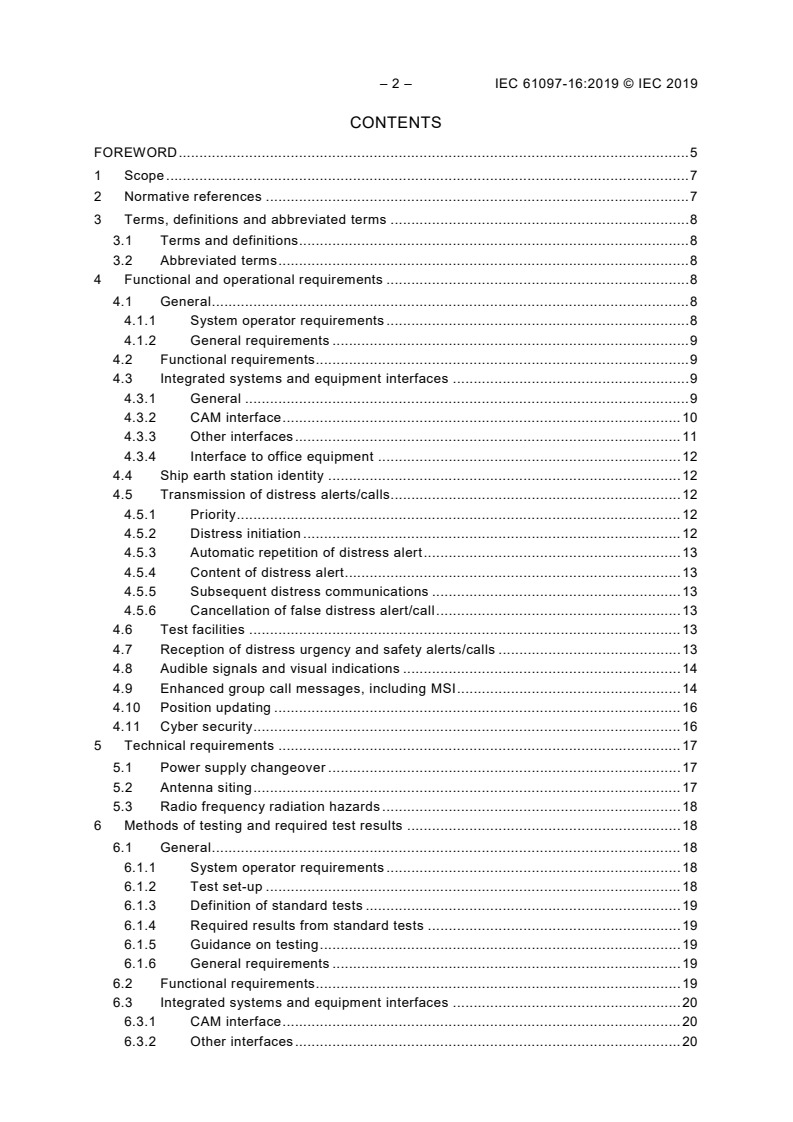
CONTENTS
FOREWORD . 5
1 Scope . 7
2 Normative references . 7
3 Terms, definitions and abbreviated terms . 8
3.1 Terms and definitions . 8
3.2 Abbreviated terms . 8
4 Functional and operational requirements . 8
4.1 General . 8
4.1.1 System operator requirements . 8
4.1.2 General requirements . 9
4.2 Functional requirements . 9
4.3 Integrated systems and equipment interfaces . 9
4.3.1 General . 9
4.3.2 CAM interface . 10
4.3.3 Other interfaces . 11
4.3.4 Interface to office equipment . 12
4.4 Ship earth station identity . 12
4.5 Transmission of distress alerts/calls . 12
4.5.1 Priority . 12
4.5.2 Distress initiation . 12
4.5.3 Automatic repetition of distress alert . 13
4.5.4 Content of distress alert . 13
4.5.5 Subsequent distress communications . 13
4.5.6 Cancellation of false distress alert/call . 13
4.6 Test facilities . 13
4.7 Reception of distress urgency and safety alerts/calls . 13
4.8 Audible signals and visual indications . 14
4.9 Enhanced group call messages, including MSI . 14
4.10 Position updating . 16
4.11 Cyber security . 16
5 Technical requirements . 17
5.1 Power supply changeover . 17
5.2 Antenna siting . 17
5.3 Radio frequency radiation hazards . 18
6 Methods of testing and required test results . 18
6.1 General . 18
6.1.1 System operator requirements . 18
6.1.2 Test set-up . 18
6.1.3 Definition of standard tests . 19
6.1.4 Required results from standard tests . 19
6.1.5 Guidance on testing . 19
6.1.6 General requirements . 19
6.2 Functional requirements . 19
6.3 Integrated systems and equipment interfaces . 20
6.3.1 CAM interface . 20
6.3.2 Other interfaces . 20
6.4 Ship earth station identity . 20
6.5 Transmission of distress alerts/calls . 20
6.5.1 Priority . 20
6.5.2 Distress initiation . 22
6.5.3 Automatic repetition of distress alert . 24
6.5.4 Content of distress alert . 24
6.5.5 Subsequent distress communications . 25
6.5.6 Cancellation of false distress alert/call . 25
6.6 Test facilities . 25
6.6.1 Purpose . 26
6.6.2 Method of test. 26
6.6.3 Required results . 26
6.7 Reception of distress, urgency and safety alerts/calls . 26
6.7.1 Priorities . 26
6.7.2 Presentation . 27
6.8 Audible and visual indications . 28
6.8.1 Purpose . 28
6.8.2 Method of test. 28
6.8.3 Required result . 28
6.9 Enhanced group call messages, including MSI . 28
6.9.1 Reception of EGC messages . 28
6.9.2 Presentation of EGC messages . 29
6.9.3 Printing device . 29
6.10 Position updating . 29
6.10.1 Purpose . 29
6.10.2 Method of test. 29
6.10.3 Required result . 30
6.11 Cyber security . 30
6.12 Power supply changeover . 30
6.12.1 Purpose . 30
6.12.2 Method of test. 30
6.12.3 Required result . 30
6.13 Antenna siting . 31
6.14 Radio frequency hazards . 31
Annex A (normative) Requirements related to installation . 32
A.1 General . 32
A.2 Power supply . 32
A.3 Radio frequency radiation hazards . 32
A.4 Information to be provided in equipment manuals . 32
Annex B (normative) Standard tests A and B . 33
B.1 Test A: duplex call test (ship originated) . 33
B.2 Test B: duplex call test (shore originated) . 33
Annex C (normative) SMV – SafetyNET message, vessel in distress information . 34
Annex D (informative) Ship motion operational limits for SES above-deck unit . 37
D.1 General . 37
D.2 Extreme ship motion values for SES ADU . 37
Bibliography . 38
– 4 – IEC 61097-16:2019 © IEC 2019
Figure 1 – Interfaces of ship earth station . 9
Figure 2 – Reference architecture for ship earth station cyber security . 17
Table 1 – IEC 61162-1 sentences received by the ship earth station equipment. 10
Table 2 – IEC 61162-1 sentences transmitted by the ship earth station equipment . 10
Table 3 – Classification of ship earth station alerts . 10
Table 4 – Alert titles and text . 11
Table 5 – Definition of audible signals . 14
Table 6 – Testing with different priorities . 21
Table 7 – Pre-emption of calls set up from ship. 22
Table 8 – Pre-emption of facsimile audio call set up from ship . 22
Table 9 – Testing with different priorities . 26
Table 10 – Pre-emption of calls set up from shore . 27
Table D.1 – Extreme ship motion values for SES ADU . 37
INTERNATIONAL ELECTROTECHNICAL COMMISSION
____________
GLOBAL MARITIME DISTRESS AND SAFETY SYSTEM (GMDSS) –
Part 16: Ship earth stations operating in mobile-satellite
systems recognized for use in the GMDSS – Operational
and performance requirements, methods of testing
and required test results
FOREWORD
1) The International Electrotechnical Commission (IEC) is a worldwide organization for standardization comprising
all national electrotechnical committees (IEC National Committees). The object of IEC is to promote
international co-operation on all questions concerning standardization in the electrical and electronic fields. To
this end and in addition to other activities, IEC publishes International Standards, Technical Specifications,
Technical Reports, Publicly Available Specifications (PAS) and Guides (hereafter referred to as "IEC
Publication(s)"). Their preparation is entrusted to technical committees; any IEC National Committee interested
in the subject dealt with may participate in this preparatory work. International, governmental and non-
governmental organizations liaising with the IEC also participate in this preparation. IEC collaborates closely
with the International Organization for Standardization (ISO) in accordance with conditions determined by
agreement between the two organizations.
2) The formal decisions or agreements of IEC on technical matters express, as nearly as possible, an international
consensus of opinion on the relevant subjects since each technical committee has representation from all
interested IEC National Committees.
3) IEC Publications have the form of recommendations for international use and are accepted by IEC National
Committees in that sense. While all reasonable efforts are made to ensure that the technical content of IEC
Publications is accurate, IEC cannot be held responsible for the way in which they are used or for any
misinterpretation by any end user.
4) In order to promote international uniformity, IEC National Committees undertake to apply IEC Publications
transparently to the maximum extent possible in their national and regional publications. Any divergence
between any IEC Publication and the corresponding national or regional publication shall be clearly indicated in
the latter.
5) IEC itself does not provide any attestation of conformity. Independent certification bodies provide conformity
assessment services and, in some areas, access to IEC marks of conformity. IEC is not responsible for any
services carried out by independent certification bodies.
6) All users should ensure that they have the latest edition of this publication.
7) No liability shall attach to IEC or its directors, employees, servants or agents including individual experts and
members of its technical committees and IEC National Committees for any personal injury, property damage or
other damage of any nature whatsoever, whether direct or indirect, or for costs (including legal fees) and
expenses arising out of the publication, use of, or reliance upon, this IEC Publication or any other IEC
Publications.
8) Attention is drawn to the Normative references cited in this publication. Use of the referenced publications is
indispensable for the correct application of this publication.
9) Attention is drawn to the possibility that some of the elements of this IEC Publication may be the subject of
patent rights. IEC shall not be held responsible for identifying any or all such patent rights.
International Standard IEC 61097-16 has been prepared by IEC technical committee 80:
Maritime navigation and radiocommunication equipment and systems.
The text of this International Standard is based on the following documents:
FDIS Report on voting
80/928/FDIS 80/932/RVD
Full information on the voting for the approval of this International Standard can be found in
the report on voting indicated in the above table.
This document has been drafted in accordance with the ISO/IEC Directives, Part 2.
– 6 – IEC 61097-16:2019 © IEC 2019
A list of all parts in the IEC 61097 series, published under the general title Global maritime
distress and safety system (GMDSS), can be found on the IEC website.
The committee has decided that the contents of this document will remain unchanged until the
stability date indicated on the IEC website under "http://webstore.iec.ch" in the data related to
the specific document. At this date, the document will be
• reconfirmed,
• withdrawn,
• replaced by a revised edition, or
• amended.
GLOBAL MARITIME DISTRESS AND SAFETY SYSTEM (GMDSS) –
Part 16: Ship earth stations operating in mobile-satellite
systems recognized for use in the GMDSS – Operational
and performance requirements, methods of testing
and required test results
1 Scope
This part of IEC 61097 specifies the minimum operational and performance requirements,
methods of testing and required test results for any ship earth stations intended for operation
in mobile-satellite systems and services which are recognized by the International Maritime
Organization as meeting the criteria required by the IMO under regulation IV/4-1 of the
International Convention for the Safety of Life at Sea, 1974, as amended, for the provision of
mobile-satellite systems and services in the GMDSS, regardless of the mobile satellite
provider used.
This document incorporates the minimum criteria and performance standards of the IMO,
currently prescribed in IMO Resolution A.1001(25) in IMO Resolution MSC.434(98) and is
also associated with IMO Resolution A.694(17) and IEC 60945.
All text of this document whose wording is identical to that of resolution MSC.434(98) is
printed in italics and reference is made to that resolution and the sub-clause number.
Matters relating to the installation of the ship earth station are given in Annex A.
2 Normative references
The following documents are referred to in the text in such a way that some or all of their
content constitutes requirements of this document. For dated references, only the edition
cited applies. For undated references, the latest edition of the referenced document (including
any amendments) applies.
IEC 60945, Maritime navigation and radiocommunication equipment and systems – General
requirements – Methods of testing and required test results
IEC 61162-1, Maritime navigation and radiocommunication equipment and systems – Digital
interfaces – Part 1: Single talker and multiple listeners
IEC 61162-450, Maritime navigation and radiocommunication equipment and systems –
Digital interfaces – Part 450: Multiple talkers and multiple listeners – Ethernet interconnection
IEC 61162-460, Maritime navigation and radiocommunication equipment and systems –
Digital interfaces – Part 460: Multiple talkers and multiple listeners – Ethernet interconnection
– Safety and security
IEC 62288, Maritime navigation and radiocommunication equipment and systems –
Presentation of navigation-related information on shipborne navigational displays – General
requirements, methods of testing and required test results
IEC 62923-1, Maritime navigation and radiocommunication equipment and systems – Bridge
alert management – Part 1: Operational and performance requirements, methods of testing
and required test results
– 8 – IEC 61097-16:2019 © IEC 2019
IMO Resolution MSC.191(79), Performance standards for the presentation of navigation
related information on shipborne navigational displays
IMO Resolution MSC.434(98), Recommendation on performance standards for ship earth
stations for use in the GMDSS
3 Terms, definitions and abbreviated terms
3.1 Terms and definitions
No terms and definitions are listed in this document.
ISO and IEC maintain terminological databases for use in standardization at the following
addresses:
• IEC Electropedia: available at http://www.electropedia.org/
• ISO Online browsing platform: available at http://www.iso.org/obp
3.2 Abbreviated terms
BAM bridge alert management
CAM central alert management
EGC enhanced group call
EUT equipment under test
GMDSS global maritime distress and safety system
HMI human machine interface
IMO International Maritime Organization
ISO International Organization for Standardization
ITU International Telecommunications Union
MSI maritime safety information
REDS removable external data source
RCC rescue coordination centre
SES ship earth station
SET simulated earth termination
4 Functional and operational requirements
4.1 General
(See 6.1)
4.1.1 System operator requirements
(MSC.434(98), Annex, 2.1.1) The ship earth station shall operate using a recognized mobile-
satellite service and meet the functional requirements of resolution A.1001(25). The ship earth
station shall comply with the technical standard provided by the recognized mobile-satellite
system provider and be certified by this provider for operation in the GMDSS, in order to
ensure operational reliability.
(MSC.434(98), Annex, 2.1.2) The ship earth station shall comply with ITU Radio Regulations.
4.1.2 General requirements
(MSC.434(98), Annex, 1) The ship earth station installation capable of two-way
radiocommunications shall comply with the general requirements set out in resolutions
A.694(17), A.813(19), MSC.191(79), MSC.302(87).
Annex D gives, for information purposes, details of ship motion likely to be experienced by
ship earth stations.
4.2 Functional requirements
(See 6.2)
MSC.434(98), Annex, 2.2.1) The ship earth station shall be capable of automatically
recognizing the priority of ship-to-ship, ship-to-shore and shore-to-ship communications and
shall process them in accordance with the message priority defined by the ITU Radio
Regulations. The order of processing these communications shall be:
1) Distress;
2) Urgency;
3) Safety; and
4) other communications.
(MSC.434(98), Annex, 3.1.1) The primary HMI shall provide all functions necessary to carry
out all communication procedures, including those required by the GMDSS.
(MSC.434(98), Annex, 2.2.2) The ship earth station shall provide a specific visual indication
when unable to detect or otherwise make contact with the satellites of the mobile-satellite
system for a period of one minute or more, as referred to in Table 3.
4.3 Integrated systems and equipment interfaces
(See 6.3)
4.3.1 General
The ship earth station equipment shall be capable of at least transmitting and receiving data
using the IEC 61162-1 sentences specified in Table 1 and Table 2. IEC 61162-460 shall be
applied wherever reference to use of IEC 61162-450 interfaces is specified (see also 4.11).
Interfaces are shown in Figure 1, where required interfaces are indicated with solid lines and
optional interfaces are indicated in dashed lines.
For systems that do not have an integral electronic position fixing system, the interface for the
external device is mandatory.
Figure 1 – Interfaces of ship earth station
– 10 – IEC 61097-16:2019 © IEC 2019
Table 1 – IEC 61162-1 sentences received by the ship earth station equipment
Mnemonic Interface Name Comment
ACN CAM Alert command Alert command for instance
acknowledge
HBT CAM Heartbeat Support reliable alert
related communication
GLL, GGA, GNS, RMC External position Position If position not internally
information equipment provided
Table 2 – IEC 61162-1 sentences transmitted by the ship earth station equipment
Mnemonic Interface Name Comment
SM1, SM2, SM3, SM4, Navigation display Maritime Safety For SMV, see Annex C
SMB and SMV systems Information
ARC, ALC, ALF, HBT CAM Alert information
4.3.2 CAM interface
(MSC.434(98), Annex, 2.3.1) The equipment shall meet the requirements for Bridge Alert
Management system (BAM). Equipment interfaces shall comply with recognized international
standards. Where the ship earth station is part of an Integrated Communication System (ICS),
Integrated Navigation System (INS) or Integrated Bridge System (IBS), or connected to a
navigation system, this shall not impair any of the GMDSS functions of these systems or the
ship earth station itself.
In the BAM concept, the SES acts as the alert source and the CAM acts as the target of alert
reporting by alert sources.
For bridge alert management, the classification of alerts shall be as given in Table 3.
Table 3 – Classification of ship earth station alerts
Cause Alarm Warning Caution Cat. A Cat. B Alert ID
No contact with satellites (4.2) X X 3116
Received distress alert relay (4.3.2) X X 3122
Received urgency message (4.8) X X 3122
Received MSI (4.9) X X 3123
Paper low/mass storage full (4.9) X X 3079
Loss of position (4.10) X X 3016
Manual position older than 4 h (4.10) 3013
X X
NOTE A simplified description of the terms in accordance with IMO Resolution MSC.302(87) is:
• Alarm: Audible announcement until acknowledged by the operator
• Warning: Short audible announcement repeated every 5 minutes until acknowledged by the operator
• Caution: Silent
• Category A: Acknowledge possible only at source or when full source information is available. Audible
announcement only at location at which acknowledge is possible.
• Category B: Acknowledge possible both at source and at CAM. Audible announcement in every location at
which acknowledge is possible.
The SES shall be provided with a data interface for communication compliant with the BAM
concept capable of transmitting the sentences ALC, ALF, ARC and HBT and receiving the
sentences ACN and HBT in accordance with IEC 61162-1 or IEC 61162-450 and IEC 62923-1.
The text information used in the ALF sentence shall be as given in Table 4.
Table 4 – Alert titles and text
Alert ID Alert text Additional information
st nd
(1 ALF) (2 ALF)
3116 Lost connection Check GMDSS satellite terminal
3122 Distress Rx Incoming distress. Check GMDSS display
3122 Urgency Rx Incoming urgency warning. Check GMDSS display
3123 MSI Rx Check new received maritime safety information
3079 Paper low Check GMDSS printer paper
3079 Storage low Check GMDSS message storage medium
3016 Lost position Check GMDSS terminal for lost position
3013 Doubtful pos GMDSS update manual position
4.3.3 Other interfaces
(MSC.434(98), Annex, 2.3.2) The ship earth station shall provide an interface from which data
from Enhanced Group Call communications (EGC), including Maritime Safety Information
(MSI), can be provided to navigation display systems, in accordance with the recognized
international standards.
The SES shall be provided with a data interface for communication with navigation display
systems capable of transmitting the sentences SM1, SM2, SM3, SM4 and SMB in accordance
with IEC 61162-1 or IEC 61162-450.
(MSC.434(98), Annex, 2.3.3) The ship earth station shall provide either an integral electronic
position fixing equipment or have an interface for position updating conforming to the
recognized international standard.
The SES shall be provided with a data interface for updating position information capable of
receiving the sentences GLL, GGA, GNS, RMC in accordance with IEC 61162-1 or
IEC 61162-450, unless an integral electronic position fixing equipment is provided.
Formatting and transmission of distress alert position information shall be clearly and
unambiguously labelled as such and presented in the format of degrees, minutes and decimal
fraction of minutes.
NOTE The format is specified in Volume II of the IAMSAR Manual. The position format is degrees-
minutes.decimal minutes hemisphere (N,S,E,W, no preceding space as in dd-mm.mmmH ddd-mm.mmmH), leading
zeros optional (because the "-" and "." remove the ambiguity that would result otherwise), latitude first, longitude
second, space separating latitude and longitude.
(MSC.434(98), Annex, 2.3.4) The ship earth station shall provide an interface in accordance
with the recognized international standards to report a ship's identifier and location data from
a received distress alert relay to navigation display systems in order to enable graphical
display and possible linking to target information.
– 12 – IEC 61097-16:2019 © IEC 2019
The SES shall be provided with a data interface to report a ship's identifier and location data
from a received distress alert relay capable of transmitting the sentence SMV in accordance
with IEC 61162-1 or IEC 61162-450. The SMV sentence shall not be transmitted if the latitude
and longitude information is not present or is invalid.
4.3.4 Interface to office equipment
The SES may optionally have an interface to provide an internet connection for the ship's
office equipment. When this interface is provided, appropriate provisions shall be made to
isolate the interface and functions from the interfaces and functions related to GMDSS. See
4.11.
4.4 Ship earth station identity
(See 6.4)
(MSC.434(98), Annex, 3.2.1) No control external to the equipment shall be available for
alteration of the ship station identity.
Changes may only be carried out by authorised authorities or the manufacturer's
representative.
4.5 Transmission of distress alerts/calls
4.5.1 Priority
(See 6.5.1)
(MSC.434(98), Annex, 3.3.1) It shall be possible to initiate transmission of distress alerts/calls
at any time. It shall be possible to initiate transmission of distress alerts/calls whilst the ship
earth station is transmitting lower priority communications, and whilst it is receiving
communications of any priority, if necessary by pre-emption of those communications.
4.5.2 Distress initiation
(See 6.5.2)
(MSC.434(98), Annex, 3.3.2) It shall be possible to initiate and make distress alerts/calls from
the position at which the ship is normally navigated. The equipment shall include an option
making it possible to initiate transmission of distress alerts/calls at a position remote from the
primary HMI of the equipment.
(MSC.434(98), Annex, 3.3.3) The HMI shall include a dedicated distress button that has no
other function than activating distress transmissions.
(MSC.434(98), Annex, 3.3.4) A distress alert/call shall be activated only by means of a
dedicated distress button (a physical button, not a touchscreen button). The dedicated
distress button shall not be any key of a digital input panel or a keyboard provided on the
equipment. The distress button shall be clearly identified and protected against inadvertent
activation, requiring at least two independent actions. Lifting of the protective lid or cover is
considered as the first action. Pressing the distress button as specified above is considered
as the second independent action.
(MSC.434(98), Annex, 3.3.5) The distress button shall be red in colour and marked
"DISTRESS". Where a non-transparent protective lid or cover is used, it shall be red in colour
and also be marked "DISTRESS".
(MSC.434(98), Annex, 3.3.6) The required protection of the distress button shall consist of a
spring-loaded lid or cover permanently attached to the equipment by e.g. hinges. It shall not
be necessary for the user to remove additional seals or to break the lid or cover in order to
operate the distress button.
(MSC.434(98), Annex, 3.3.7) The equipment shall indicate the status of the distress alert/call.
The operation of the distress button shall generate a visible and audible indication. The
distress button shall be kept pressed for at least 3 seconds. A flashing light and an
intermittent audible signal shall start immediately. After the transmission of the distress
alert/call is initiated, the visual indication shall become steady and the audible signal shall
cease.
4.5.3 Automatic repetition of distress alert
(See 6.5.3)
(MSC.434(98), Annex, 3.3.8) The equipment shall automatically initiate repetitive initial
distress alerts/calls, which are repeated until cancelled on the ship or until appropriately
acknowledged. It shall be possible to interrupt repetitive initial distress alerts/calls. Such
operation shall not interrupt the transmission of a distress alert/call in progress but shall
prevent repetitive transmissions of a distress alert/call.
4.5.4 Content of distress alert
(See 6.5.4)
(MSC.434(98), Annex, 3.3.9) The distress alert shall contain identification of the station in
distress, its position and the time of the position fix.
4.5.5 Subsequent distress communications
(See 6.5.5)
(MSC.434(98), Annex, 3.3.10) The equipment shall be capable of transmitting and receiving
subsequent distress communication.
4.5.6 Cancellation of false distress alert/call
(See 6.5.6)
(MSC.434(98), Annex, 3.3.11) After initiating a false distress alert/call, it shall be possible to
send a cancellation of the alert/call. This cancellation alert/call shall not be initiated by cutting
the power supply to the ship earth station nor by the operator switching the ship earth station
off.
4.6 Test facilities
(See 6.6)
(MSC.434(98), Annex, 3.4.1) It shall be possible to test the distress capability of the ship
earth station without initiating a distress alert/call.
4.7 Reception of distress urgency and safety alerts/calls
(See 6.7)
(MSC.434(98), Annex, 3.5.1) It shall be possible for the ship earth station to receive distress,
urgency and safety priority alerts/calls whilst it is being used for communications of a lower
priority than that being received.
(MSC.434(98), Annex, 3.5.3) For the presentation of received distress and urgency
alerts/calls intended as text to be read, the equipment shall include or interface to either:
1) an integrated printing device; or
2) a dedicated display device, printer output port and a non-volatile message memory; or
3) a connection to a navigation system and a non-volatile message memory.
– 14 – IEC 61097-16:2019 © IEC 2019
4.8 Audible signals and visual indications
(See 6.8)
(MSC.434(98), Annex, 3.5.2) Provision shall be made for an audible signal and visual
indication at the position from which the ship is normally navigated, to indicate receipt of a
distress or urgency enhanced group call message. It shall not be possible to disable this
indication and it shall only be possible to reset it manually and only from the position where
the message is displayed or printed. The audible signals for distress, urgency and their
acknowledgements shall be continuously repeated until manually terminated.
(MSC.434(98), Annex, 3.6.1) The audible signals shall be activated in relation to:
1) distress alert/calls or distress relay alert/calls; and
2) urgency calls and messages.
Definitions of audible signals are given in Table 5.
Table 5 – Definition of audible signals
Fixed alarm Tone 1 Tone 2 Tone 1 Tone 2
sounds Frequency (Hz) Frequency (Hz) Duration (ms) Duration (ms)
Distress Ack 2 200 1 300 500 500
(see Note)
Urgency 2 200 Silence 250 250
(see Note)
Urgency Ack 2 200 Silence 500 500
(see Note)
Count 2 000 Silence 500 500
The Distress Ack, Urgency and Urgency Ack alarms shall not be able to be customized. These alarms shall be
continuously repeated until manually terminated.
(MSC.434(98), Annex, 3.6.2) For visual indication the ship earth station shall conform to MSC
191(79).
NOTE (MSC.434(98), Annex, 3.6.3) BAM classification of priorities and categories are given in Table 3.
4.9 Enhanced group call messages, including MSI
(See 6.9)
(MSC.434(98), Annex, 3.7.1) Facilities shall be provided for the ship earth station to receive
maritime safety information (MSI) for the NAVAREA/METAREA and the coastal warning areas
and different classes of messages:
1) where the ship is sailing and 300 NM beyond the limits of the NAVAREA/METAREA;
2) for the planned voyage; and
3) for a fixed position.
Additional means shall be provided to filter received MSI based on NAVAREA/METAREA and
the coastal warning area codes and different classes of messages.
The acceptance or rejection of service codes shall be under the operator's control except
when the equipment always receives navigational and meteorological warnings and forecasts,
search and rescue information and shore-ship distress alert relays that are directed to a fixed
or absolute geographical area in which the ship i
...
Questions, Comments and Discussion
Ask us and Technical Secretary will try to provide an answer. You can facilitate discussion about the standard in here.
Loading comments...