


IEC PAS 60747-17:2011
(Main)Semiconductor devices - Discrete devices - Part 17: Magnetic and capacitive coupler for basic and reinforced isolation
General Information
- Abstract
IEC/PAS 60747-17:2011(E) gives the terminology, essential ratings, characteristics, safety test and the measuring methods of magnetic and capacitive couplers. It specifies the principles of magnetic and capacitive coupling across an isolation barrier and the related requirements for basic isolation and reinforced insulation.
- Status
- Replaced
- Publication Date
- 16-Nov-2011
- Technical Committee
- SC 47E - Discrete semiconductor devices
- Drafting Committee
- WG 4 - TC 47/SC 47E/WG 4
- Current Stage
- DELPUB - Deleted Publication
- Start Date
- 21-Sep-2020
- Completion Date
- 28-Aug-2026
Relations
- Effective Date
- 05-Sep-2023
- Effective Date
- 05-Sep-2023
Frequently Asked Questions
IEC PAS 60747-17:2011 is a technical specification published by the International Electrotechnical Commission (IEC). Its full title is "Semiconductor devices - Discrete devices - Part 17: Magnetic and capacitive coupler for basic and reinforced isolation". This standard covers: IEC/PAS 60747-17:2011(E) gives the terminology, essential ratings, characteristics, safety test and the measuring methods of magnetic and capacitive couplers. It specifies the principles of magnetic and capacitive coupling across an isolation barrier and the related requirements for basic isolation and reinforced insulation.
IEC/PAS 60747-17:2011(E) gives the terminology, essential ratings, characteristics, safety test and the measuring methods of magnetic and capacitive couplers. It specifies the principles of magnetic and capacitive coupling across an isolation barrier and the related requirements for basic isolation and reinforced insulation.
IEC PAS 60747-17:2011 is classified under the following ICS (International Classification for Standards) categories: 31.080.99 - Other semiconductor devices. The ICS classification helps identify the subject area and facilitates finding related standards.
IEC PAS 60747-17:2011 has the following relationships with other standards: It is inter standard links to IEC 60747-17:2020, IEC 60747-17:2020/COR1:2021. Understanding these relationships helps ensure you are using the most current and applicable version of the standard.
IEC PAS 60747-17:2011 is available in PDF format for immediate download after purchase. The document can be added to your cart and obtained through the secure checkout process. Digital delivery ensures instant access to the complete standard document.
Standards Content (Sample)
IEC/PAS 60747-17 ®
Edition 1.0 2011-11
PUBLICLY AVAILABLE
SPECIFICATION
PRE-STANDARD
Semiconductor devices – Discrete devices –
Part 17: Magnetic and capacitive coupler for basic and reinforced isolation
IEC/PAS 60747-17:2011(E)
All rights reserved. Unless otherwise specified, no part of this publication may be reproduced or utilized in any form
or by any means, electronic or mechanical, including photocopying and microfilm, without permission in writing from
either IEC or IEC's member National Committee in the country of the requester.
If you have any questions about IEC copyright or have an enquiry about obtaining additional rights to this publication,
please contact the address below or your local IEC member National Committee for further information.
IEC Central Office
3, rue de Varembé
CH-1211 Geneva 20
Switzerland
Email: inmail@iec.ch
Web: www.iec.ch
About the IEC
The International Electrotechnical Commission (IEC) is the leading global organization that prepares and publishes
International Standards for all electrical, electronic and related technologies.
About IEC publications
The technical content of IEC publications is kept under constant review by the IEC. Please make sure that you have the
latest edition, a corrigenda or an amendment might have been published.
Catalogue of IEC publications: www.iec.ch/searchpub
The IEC on-line Catalogue enables you to search by a variety of criteria (reference number, text, technical committee,…).
It also gives information on projects, withdrawn and replaced publications.
IEC Just Published: www.iec.ch/online_news/justpub
Stay up to date on all new IEC publications. Just Published details twice a month all new publications released. Available
on-line and also by email.
Electropedia: www.electropedia.org
The world's leading online dictionary of electronic and electrical terms containing more than 20 000 terms and definitions
in English and French, with equivalent terms in additional languages. Also known as the International Electrotechnical
Vocabulary online.
Customer Service Centre: www.iec.ch/webstore/custserv
If you wish to give us your feedback on this publication or need further assistance, please visit the Customer Service
Centre FAQ or contact us:
Email: csc@iec.ch
Tel.: +41 22 919 02 11
Fax: +41 22 919 03 00
IEC/PAS 60747-17 ®
Edition 1.0 2011-11
PUBLICLY AVAILABLE
SPECIFICATION
PRE-STANDARD
Semiconductor devices – Discrete devices –
Part 17: Magnetic and capacitive coupler for basic and reinforced isolation
INTERNATIONAL
ELECTROTECHNICAL
COMMISSION
PRICE CODE
W
ICS 31.080.99 ISBN 978-2-88912-792-4
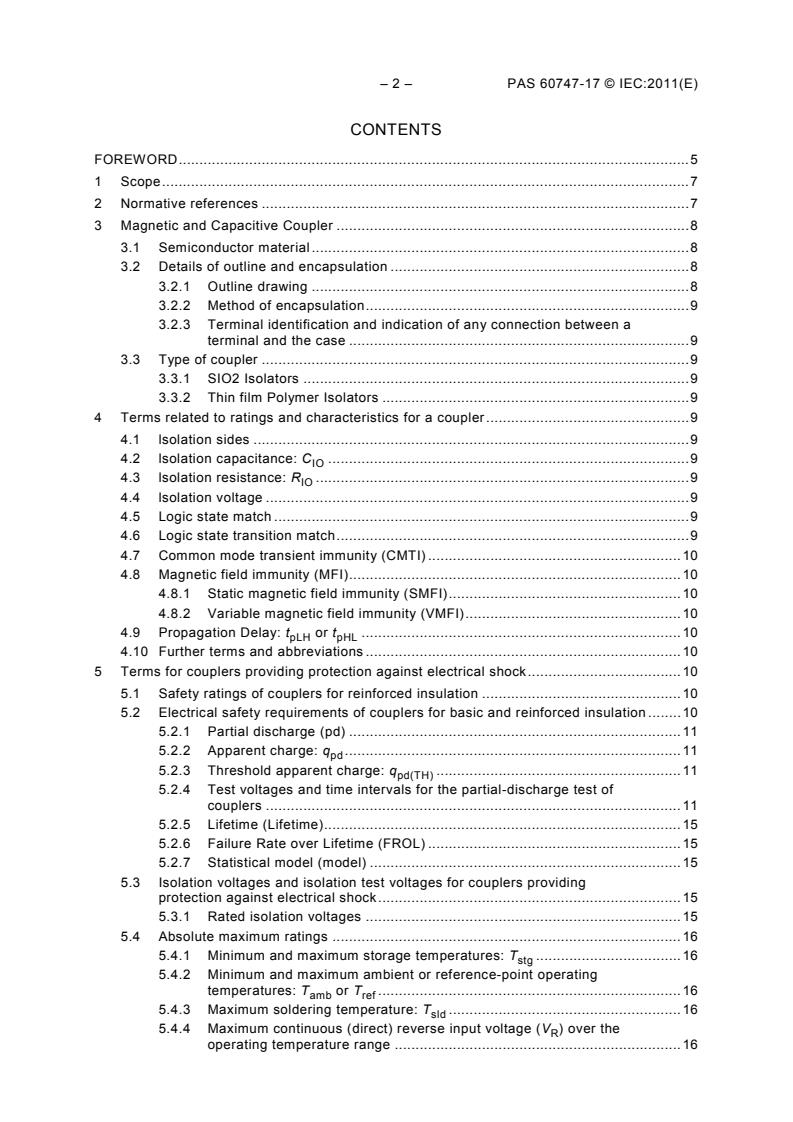
– 2 – PAS 60747-17 © IEC:2011(E)
CONTENTS
FOREWORD . 5
1 Scope . 7
2 Normative references . 7
3 Magnetic and Capacitive Coupler . 8
3.1 Semiconductor material . 8
3.2 Details of outline and encapsulation . 8
3.2.1 Outline drawing . 8
3.2.2 Method of encapsulation . 9
3.2.3 Terminal identification and indication of any connection between a
terminal and the case . 9
3.3 Type of coupler . 9
3.3.1 SIO2 Isolators . 9
3.3.2 Thin film Polymer Isolators . 9
4 Terms related to ratings and characteristics for a coupler . 9
4.1 lsolation sides . 9
4.2 lsolation capacitance: C . 9
IO
4.3 lsolation resistance: R . 9
IO
4.4 lsolation voltage . 9
4.5 Logic state match . 9
4.6 Logic state transition match . 9
4.7 Common mode transient immunity (CMTI) . 10
4.8 Magnetic field immunity (MFI) . 10
4.8.1 Static magnetic field immunity (SMFI) . 10
4.8.2 Variable magnetic field immunity (VMFI) . 10
4.9 Propagation Delay: t or t . 10
pLH pHL
4.10 Further terms and abbreviations . 10
5 Terms for couplers providing protection against electrical shock . 10
5.1 Safety ratings of couplers for reinforced insulation . 10
5.2 Electrical safety requirements of couplers for basic and reinforced insulation . 10
5.2.1 Partial discharge (pd) . 11
5.2.2 Apparent charge: q . 11
pd
5.2.3 Threshold apparent charge: q . 11
pd(TH)
5.2.4 Test voltages and time intervals for the partial-discharge test of
couplers . 11
5.2.5 Lifetime (Lifetime) . 15
5.2.6 Failure Rate over Lifetime (FROL) . 15
5.2.7 Statistical model (model) . 15
5.3 Isolation voltages and isolation test voltages for couplers providing
protection against electrical shock . 15
5.3.1 Rated isolation voltages . 15
5.4 Absolute maximum ratings . 16
5.4.1 Minimum and maximum storage temperatures: T . 16
stg
5.4.2 Minimum and maximum ambient or reference-point operating
temperatures: T or T . 16
amb ref
5.4.3 Maximum soldering temperature: T . 16
sld
5.4.4 Maximum continuous (direct) reverse input voltage (V ) over the
R
operating temperature range . 16
PAS 60747-17 © IEC:2011(E) – 3 –
5.4.5 Maximum continuous (direct) or repetitive peak isolation voltage (V
lO
or V ) over the operating temperature range . 16
IORM
5.4.6 Maximum surge isolation voltage (V ) over the operating
IOSM
temperature range . 16
5.4.7 Maximum continuous input current (I ) at an ambient or reference-
I
point temperature of 25 °C and derating curve or derating factor . 17
5.4.8 Maximum peak input current (I ) at an ambient or reference-point
lM
temperature of 25 °C and under specified pulse conditions . 17
5.4.9 Maximum power dissipation (P ) of the output stage at an ambient
trn
or reference- point temperature of 25 °C and a derating curve or
derating factor . 17
5.4.10 Maximum total power dissipation of the package (P ) at an ambient
tot
or reference- point temperature of 25 °C and derating curve or
derating factor . 17
6 Electrical characteristics . 17
6.1 Coupler logic and timing definitions . 17
7 Coupler protection against electrical shock . 18
7.1 Type . 18
7.2 Ratings (shall be listed in a special section in the manufacturer's datasheet) . 18
7.2.1 Safety Limiting Values . 18
7.2.2 Functional ratings . 18
7.2.3 Rated isolation voltages . 18
7.3 Electrical safety requirements . 19
7.4 Electrical, environmental and/or endurance test information: (supplementary
information if desired by the manufacturer) . 19
7.4.1 Routine test . 19
7.4.2 Sample test . 19
7.4.3 Type Test . 20
8 Measuring methods for couplers . 28
8.1 Input-to-output capacitance (C ) . 28
lO
8.1.1 Purpose . 28
8.1.2 Circuit diagram . 28
8.1.3 Measurement procedure . 28
8.1.4 Precautions to be observed . 29
8.1.5 Special conditions . 29
8.2 Isolation resistance between input and output, R . 29
lO
8.2.1 Purpose . 29
8.2.2 Circuit diagram . 29
8.2.3 Precautions to be observed . 29
8.2.4 Measurement procedure . 29
8.2.5 Special conditions . 29
8.3 Isolation test. 30
8.3.1 Purpose . 30
8.3.2 Circuit diagram . 30
8.3.3 Test procedure . 30
8.3.4 Requirements . 30
8.3.5 Specified conditions . 30
8.4 Partial discharges of magnetic couplers . 31
8.4.1 Purpose . 31
8.4.2 Circuit diagram . 31
– 4 – PAS 60747-17 © IEC:2011(E)
8.4.3 Description of the test circuit and requirements . 31
8.4.4 Test procedure . 32
8.4.5 Specified conditions . 33
8.5 Switching times of couplers . 34
8.5.1 Purpose . 34
8.5.2 Circuit diagram . 34
8.5.3 Circuit description and requirements . 34
8.5.4 Precautions to be observed . 34
8.5.5 Measurement procedure . 34
8.5.6 Specified conditions . 35
8.6 Measuring methods of common-mode transient immunity (CMTI) for
magnetic couplers . 36
8.6.1 Purpose . 36
8.6.2 Circuit diagram . 36
8.6.3 Circuit description and requirements . 36
8.6.4 Precautions to be observed . 36
8.6.5 Measuring procedure . 37
8.6.6 Specified conditions . 38
8.7 Measuring methods of magnetic field immunity for couplers . 38
8.7.1 Purpose . 38
8.7.2 Circuit diagram . 39
8.7.3 Circuit description and requirements . 39
8.7.4 Measuring procedure as specified by IEC-61000-4-8 and IEC-61000-4-9 . 39
8.8 Surge test of the isolation . 39
Figure 1 – Time intervals for method a) of the test voltage . 13
Figure 2 – Time intervals for method b) of the test voltage . 14
Figure 3 – Basic isolation capacitance measurement circuit . 28
Figure 4 – Basic isolation resistance measurement circuit . 29
Figure 5 – Basic isolation voltage measurement circuit . 30
Figure 6 – Partial discharge test circuit . 31
Figure 7 – Connections for the calibration of the complete test arrangement . 32
Figure 8 – Switching time test circuit . 34
Figure 9 – Transition time waveform measurement . 35
Figure 10 – Propagation delay time waveform measurement . 35
Figure 11 – Common-mode transient immunity (CMTI) measurement circuit for
couplers . 36
Figure 12 – Common-mode transient immunity (CMTI) + V or –V waveform . 38
CM CM
Figure 13 – Magnetic field immunity (MFI) test circuit . 39
Table 1 – Overview of characteristics and symbols . 17
Table 2 – Datasheet characteristics . 19
Table 3 – Tests and test sequence for coupler providing basic insulation and
reinforced insulation for protection against electrical shock . 26
Table 4 – Test conditions . 28
Table 5 – Specified conditions . 33
PAS 60747-17 © IEC:2011(E) – 5 –
INTERNATIONAL ELECTROTECHNICAL COMMISSION
____________
SEMICONDUCTOR DEVICES –
DISCRETE DEVICES –
Part 17: Magnetic and capacitive coupler
for basic and reinforced isolation
FOREWORD
1) The International Electrotechnical Commission (IEC) is a worldwide organization for standardization comprising
all national electrotechnical committees (IEC National Committees). The object of IEC is to promote
international co-operation on all questions concerning standardization in the electrical and electronic fields. To
this end and in addition to other activities, IEC publishes International Standards, Technical Specifications,
Technical Reports, Publicly Available Specifications (PAS) and Guides (hereafter referred to as “IEC
Publication(s)”). Their preparation is entrusted to technical committees; any IEC National Committee interested
in the subject dealt with may participate in this preparatory work. International, governmental and non-
governmental organizations liaising with the IEC also participate in this preparation. IEC collaborates closely
with the International Organization for Standardization (ISO) in accordance with conditions determined by
agreement between the two organizations.
2) The formal decisions or agreements of IEC on technical matters express, as nearly as possible, an international
consensus of opinion on the relevant subjects since each technical committee has representation from all
interested IEC National Committees.
3) IEC Publications have the form of recommendations for international use and are accepted by IEC National
Committees in that sense. While all reasonable efforts are made to ensure that the technical content of IEC
Publications is accurate, IEC cannot be held responsible for the way in which they are used or for any
misinterpretation by any end user.
4) In order to promote international uniformity, IEC National Committees undertake to apply IEC Publications
transparently to the maximum extent possible in their national and regional publications. Any divergence
between any IEC Publication and the corresponding national or regional publication shall be clearly indicated in
the latter.
5) IEC itself does not provide any attestation of conformity. Independent certification bodies provide conformity
assessment services and, in some areas, access to IEC marks of conformity. IEC is not responsible for any
services carried out by independent certification bodies.
6) All users should ensure that they have the latest edition of this publication.
7) No liability shall attach to IEC or its directors, employees, servants or agents including individual experts and
members of its technical committees and IEC National Committees for any personal injury, property damage or
other damage of any nature whatsoever, whether direct or indirect, or for costs (including legal fees) and
expenses arising out of the publication, use of, or reliance upon, this IEC Publication or any other IEC
Publications.
8) Attention is drawn to the Normative references cited in this publication. Use of the referenced publications is
indispensable for the correct application of this publication.
9) Attention is drawn to the possibility that some of the elements of this IEC Publication may be the subject of
patent rights. IEC shall not be held responsible for identifying any or all such patent rights.
A PAS is a technical specification not fulfilling the requirements for a standard, but made
available to the public.
– 6 – PAS 60747-17 © IEC:2011(E)
IEC-PAS 60747-17 has been processed by subcommittee 47E: Discrete semiconductor
devices, of IEC technical committee 47: Semiconductor devices.
The text of this PAS is based on the This PAS was approved for
following document: publication by the P-members of the
committee concerned as indicated in
the following document
Draft PAS Report on voting
47E/412/PAS 47E/423/RVD
Following publication of this PAS, which is a pre-standard publication, the technical committee
or subcommittee concerned may transform it into an International Standard.
This PAS shall remain valid for an initial maximum period of 3 years starting from the
publication date. The validity may be extended for a single period up to a maximum of 3 years,
at the end of which it shall be published as another type of normative document, or shall be
withdrawn.
PAS 60747-17 © IEC:2011(E) – 7 –
SEMICONDUCTOR DEVICES –
DISCRETE DEVICES –
Part 17: Magnetic and capacitive coupler
for basic and reinforced isolation
1 Scope
This PAS gives the terminology, essential ratings, characteristics, safety test and the
measuring methods of magnetic and capacitive couplers.
It specifies the principles of magnetic and capacitive coupling across an isolation barrier and
the related requirements for basic isolation and reinforced insulation.
2 Normative references
The following documents, in whole or in part, are normatively referenced in this document and
are indispensable for its application. For dated references, only the edition cited applies. For
undated references, the latest edition of the referenced document (including any
amendments) applies.
IEC 60060-1, High-voltage test techniques – Part 1: General definitions and test requirements
IEC 60068-1:1988, Environmental testing – Part 1: General and guidance
IEC 60068-2-1, Environmental testing – Part 2-1: Tests – Test A: Cold
IEC 60068-2-2, Environmental testing – Part 2-2: Tests – Test B: Dry heat
IEC 60068-2-67, Environmental testing – Part 2-67: Tests – Test Cy: Damp heat, steady state,
accelerated test primarily intended for components
IEC 60068-2-6, Environmental testing – Part 2-6: Tests – Test Fc: Vibration (sinusoidal)
IEC 60068-2-14, Environmental testing – Part 2-14: Tests – Test N: Change of temperature
IEC 60068-2-17:1994, Basic environmental testing procedures – Part 2-17: Tests – Test Q:
Sealing
IEC 60068-2-20, Environmental testing – Part 2-20: Tests – Test T: Test methods for
solderability and resistance to soldering heat of devices with leads
IEC 60068-2-27, Environmental testing – Part 2-27: Tests – Test Ea and guidance: Shock
IEC 60068-2-30, Environmental testing – Part 2-30: Tests – Test Db: Damp heat, cyclic
(12 + 12 h cycle)
IEC 60068-2-58:2004, Environmental testing – Part 2-58: Tests – Test Td: Test methods for
solderability, resistance to dissolution of metallization and to soldering heat of surface
mounting devices (SMD)
– 8 – PAS 60747-17 © IEC:2011(E)
IEC 60112, Method for the determination of the proof and the comparative tracking indices of
solid insulating materials
IEC 60216-1, Electrical insulating materials – Properties of thermal endurance – Part 1:
Ageing procedures and evaluation of test results
IEC 60216-2: Electrical insulating materials – Thermal endurance properties – Part 2:
Determination of thermal endurance properties of electrical insulating materials – Choice of
test criteria
IEC 60270:2000, High-voltage test techniques – Partial discharge measurements
IEC 60664-1:2007, Insulation coordination for equipment within low-voltage systems – Part 1:
Principles, requirements and tests
IEC 60672-2, Ceramic and glass insulating materials – Part 2: Methods of test
IEC 60695-11-5, Fire hazard testing – Part 11-5: Test flames – Needle-flame test method –
Apparatus, confirmatory test arrangement and guidance
IEC 61000-4-5, Electromagnetic compatibility (EMC) – Part 4-5: Testing and measurement
techniques – Surge immunity test
IEC 61000-4-8, Electromagnetic compatibility (EMC) – Part 4-8: Testing and measurement
techniques – Power frequency magnetic field immunity test
IEC 61000-4-9, Electromagnetic compatibility (EMC) – Part 4: Testing and measurement
techniques – Section 9: Pulse magnetic field immunity test
IEC 62539, Guide for the statistical analysis of electrical insulation breakdown data
3 Magnetic and Capacitive Coupler
Magnetic and capacitive couplers consist of a transmitter stage and a receiver stage on either
side of a galvanic insulation barrier. The device transmits a signal across the insulation
boundary where a receiver stage is able to detect the transmitted signal and uses the
information to generate the electrical output signal.
In this PAS, magnetic and capacitive couplers are referred to as “coupler”.
This PAS can only be applied to magnetic and capacitive couplers listed under 3.3 ‘Type of
coupler’.
3.1 Semiconductor material
Input: Silicon, etc.
Output: Silicon, etc.
3.2 Details of outline and encapsulation
3.2.1 Outline drawing
For details, see the relevant IEC standards.
PAS 60747-17 © IEC:2011(E) – 9 –
3.2.2 Method of encapsulation
The materials of encapsulation shall be given e.g. glass/metal/plastic/other
3.2.3 Terminal identification and indication of any connection between a terminal and
the case
3.3 Type of coupler
Ambient-rated or case-rated coupler device for signal-isolation applications with input(s) and
output(s) in one package.
3.3.1 SIO2 Isolators
Isolators with an internal insulation construction utilizing Silicon Dioxide or Silica based
material.
3.3.2 Thin film Polymer Isolators
Isolators with an internal insulation construction, utilising a thin film polymer insulation layer
spin coated onto a base substrate.
NOTE A package also may be a molded module.
4 Terms related to ratings and characteristics for a coupler
4.1 lsolation sides
All Terminals of the first side are isolated from all terminals of the second side by an isolation
barrier forming a two-terminal device.
4.2 lsolation capacitance: C
IO
The total capacitance between the terminals on a first side of the isolation barrier connected
together and the terminals on a second side of the isolation barrier connected together
forming a two-terminal device.
4.3 lsolation resistance: R
IO
The resistance between the terminals on a first side of the isolation barrier connected
together and all the terminals on a second side of the isolation barrier connected together
forming a two-terminal device.
4.4 lsolation voltage
The voltage between any specified terminal on the first side of the isolation barrier and any
terminal on the second side of the isolation barrier.
4.5 Logic state match
The condition in which an output logic state matches the associated input logic state.
4.6 Logic state transition match
The condition in which an output logic state change follows the associated input logic state
change.
– 10 – PAS 60747-17 © IEC:2011(E)
4.7 Common mode transient immunity (CMTI)
Common mode transient immunity (CMTl) is the maximum tolerable rate-of-rise (or fall) of a
common-mode voltage. It is given in volts per second. CMTl should include the amplitude of
the common-mode voltage that can be tolerated.
4.8 Magnetic field immunity (MFI)
4.8.1 Static magnetic field immunity (SMFI)
The maximum tolerable magnetic field density regardless of component orientation under
which the coupler maintains its specified performance.
4.8.2 Variable magnetic field immunity (VMFI)
The maximum tolerable magnetic field density change or the maximum tolerable magnetic
field amplitude at defined frequency regardless of component orientation under which the
coupler maintains its specified performance.
4.9 Propagation Delay: t or t
pLH pHL
The duration from the presence of an input signal to the time at which the output matches the
associated state of the input signal.
4.10 Further terms and abbreviations
– V or V Supply voltage
DD CC
– IC Input or output integrated circuit of a coupler
– I/O Input/Output terminal(s) of an integrated circuit
– GND Ground reference for an integrated circuits
– V Input voltage, either V or V
I IL IH
– V Output voltage, either V or V
O OL OH
5 Terms for couplers providing protection against electrical shock
Terms for a coupler designed to maintain protection against electrical shock after it has been
subjected to operating conditions (safety ratings) that exceed the specified ratings (limiting
values) for normal operation.
5.1 Safety ratings of couplers for reinforced insulation
Electrical, thermal, and mechanical operating conditions that exceed the specified ratings
(limiting values) for normal operation, and to which the specified safety requirements refer.
5.2 Electrical safety requirements of couplers for basic and reinforced insulation
Electrical requirements that have to be met and maintained after the couplers have been
subjected to specified safety ratings, to ensure protection against electrical shock.
NOTE The couplers may become permanently inoperative when safety ratings are applied.
Dielectric Strength
If an enclosure of material is depended upon to serve as electrical insulation, it shall have a
dielectric strength in the use thickness at 16 Hz – 100 Hz:
in case of basic insulation:
of 1,3 × VIOSM, rms, 1 s, Tamb,max
PAS 60747-17 © IEC:2011(E) – 11 –
in case of reinforced insulation
of at least 10 000 V, rms,1 s Tamb,max or 1,6 × VIOSM, rms, 1 s, Tamb,max respectively
– if 1,6 × VIOSM, rms, is higher than 10 000V –
In both cases, after conditioning for 96 h to moist air having a relative humidity of 90 % ± 5 %
at a temperature of 85,0 °C ± 2,0 °C.
Resistivity
The resistivity of the isolator material shall not be less than:
10 Ω at V = 500 V for 1 min after conditioning for 40 h at 23,0 °C ± 2,0 °C and 50 % ± 5 %
IO
percent relative humidity.
5.2.1 Partial discharge (pd)
Localized electrical discharge which occurs in the insulation between all terminals of the first
side and all terminals of the second side of the coupler.
5.2.2 Apparent charge: q
pd
Electrical discharge caused by a partial discharge in the coupler.
5.2.3 Threshold apparent charge: q
pd(TH)
A specified value of apparent charge that is as small as technically feasible and to which
measured values of the partial-discharge inception voltage or extinction voltage, respectively,
refer.
NOTE 1 A threshold apparent charge of 5 pC was found to be a practicable criterion for couplers. Otherwise it
should be defined on each individual device design. Smaller values are desirable but are not viable.
NOTE 2 In actual testing, this criterion applies to the apparent charge pulse with the maximum value.
NOTE 3 The term "specified discharge magnitude" (see 3.18.2 of IEC 60664-1:2007) is synonymous with
"threshold apparent charge".
5.2.4 Test voltages and time intervals for the partial-discharge test of couplers
See Figures 1 and 2.
All applicable test voltages in this PAS are peak voltages, unless otherwise stated.
5.2.4.1 Test voltage: V
pd(t)
The voltage applied during the test period of the partial discharge test between all terminals of
the first side (connected together) and all terminals of the second side (connected together) to
the coupler under test.
5.2.4.2 Initial test voltage: V
pd(ini)
The test voltage applied during the initial test time t .
ini
5.2.4.2.1 Initial test voltage: V
pd(ini),a
(See 4.3.3.3 and Table F.1 of IEC 60664-1:2007 for minimum voltages, interpolation is
possible). The value of the voltage applied at the beginning of the measurement, for a
specified time t , is intended to simulate the occurrence of a transient over-voltage. Refer to
ini
Figure 1.
– 12 – PAS 60747-17 © IEC:2011(E)
5.2.4.2.2 Initial test voltage: V
pd(ini),b
The isolation test voltage applied between all terminals of the first side (connected together)
and all terminals of the second side (connected together) at routine test (method b). A
withstand voltage equal to the manufacturer's rating with a maximum of V . Refer to
IOTM
Figure 2.
NOTE 1 The initial test voltage is higher than or equal to the test voltage in the second part of the test period in
which partial discharge characteristics are measured, see 5.2.4.6.
NOTE 2 For the method according to Figure 1, the specified value for the initial test voltage is equal to the
specified value of the rated transient isolation voltage V .
IOTM
NOTE 3 For methods according to Figure 2, the specified value for the initial test voltage (isolation voltage) is
equal to or lower than the specified value of the rated transient isolation voltage V .
IOTM
NOTE 4 The equivalent r.m.s, value of an a.c. test voltage may also be used.
5.2.4.2.3 Multiplying factor: F for method a) and method b)
For basic insulation:
At routine test stage and initial measurement of the type test: F = 1,5
At sample test stage and after life tests, subgroup 1: F = 1,3
After endurance tests, subgroups 2 and 3: F = 1,2
For reinforced insulation:
At routine test stage and initial measurement of the type test: F = 1,875
At sample test stage and after life tests, subgroup 1: F = 1,6
After endurance tests, subgroups 2 and 3: F = 1,2
5.2.4.3 Apparent charge measuring voltage: V
pd(m)
The test voltage at which apparent charge is measured.
NOTE 1 Specified values of this voltage may be expressed as multiple of the specified value of the rated isolation
voltage or rated repetitive peak isolation voltage: V = F × V or V = F × V , whichever is higher.
pd(m) IOWM pd(m) IORM
Refer to 5.2.4.2.3 multiplying factor.
NOTE 2 Test voltage, where the apparent charge has to be equal or less than the specified value.
5.2.4.4 Partial-discharge inception voltage: V
pd(I)
The lowest peak value of an a.c. test voltage at which the apparent charge is greater than the
specified threshold apparent charge, if the test voltage is increased from a lower value where
no partial discharge occurs.
NOTE The equivalent r.m.s. value of an a.c. test voltage may also be used.
5.2.4.5 Partial-discharge extinction voltage: V
pd(e)
The lowest peak value of an a.c. test voltage at which the apparent charge is smaller than the
specified threshold apparent charge, if the test voltage is reduced from a higher value where
such discharge occurs.
NOTE The equivalent r.m.s. value of an a.c. test voltage may also be used.
5.2.4.6 Time intervals of the test voltage
See the terms and letter symbols indicated in Figures 1 and 2.
PAS 60747-17 © IEC:2011(E) – 13 –
Key
t = initial time (method a) only)
ini
t = (partial-discharge) stress time
st
t = (partial-discharge) measuring time
m
t , t , t , t = settling times
1 2 3 4
Figure 1 – Time intervals for method a) of the test voltage
– 14 – PAS 60747-17 © IEC:2011(E)
Method b1)
Method b2)
Method b3)
Key
t = isolation test time (method b only) t = lsolation test stress time (method b only)
ini,b stl
t = (partial-discharge) stress time t = (partial-discharge) measuring time
st2 m
t , t , t , t = settling times
1 2 3 4
Figure 2 – Time intervals for method b) of the test voltage
PAS 60747-17 © IEC:2011(E) – 15 –
5.2.5 Lifetime (Lifetime)
Minimum years applied at statistical interpolation of lifetime in correlation with failure rate.
5.2.6 Failure Rate over Lifetime (FROL)
Maximum failure rate due to isolation break down using lifetime prediction.
5.2.7 Statistical model (model)
The type of curve fit shall be based on the material type as defined in 3.3.1 and 3.3.2.
In cases where the insulation material type is not defined by either of these definitions, the
statistical modelling method specified in 5.2.7.1 shall be used.
5.2.7.1 Material types as defined in 3.3.1 shall use the exponential modelling method.
−kV
L =ce
where:
L = time-to-failure at test voltage V
V = voltage
c = constant
k = constant
5.2.7.2 Material types as defined in 3.3.2 shall use the following modeling method.
n
−(E −E )
t
e
L =
m
(E −E )
t
where:
L = time-to-failure at test voltage V
E = threshold field where no charge injection will happen
t
E = stress field when test voltage V is applied
m = constant
n = constant
5.3 Isolation voltages and isolation test voltages for couplers providing protection
against electrical shock
All applicable test voltages in this PAS are peak voltages, unless otherwise stated.
5.3.1 Rated isolation voltages
The maximum voltage between all input terminals (connected together) and all output
terminals (connected together) respectively.
5.3.1.1 DC lsolation voltage: V
IO
The value of the constant isolation voltage.
– 16 – PAS 60747-17 © IEC:2011(E)
5.3.1.2 Maximum rated isolation working voltage: V
IOWM
An r.m.s. value or an equivalent d.c. voltage of withstand voltage assigned by the
manufacturer of the couplers, characterizing the specified (long term) withstand capability of
its isolation.
5.3.1.3 Maximum rated repetitive peak isolation voltage: V
IORM
A repetitive peak value of withstand voltage assigned by the manufacturer of the couplers,
characterizing the specified withstand capability of its isolation against repetitive peak
voltages. This peak isolation voltage includes all repetitive transient voltages, but excludes all
non-repetitive transient voltages.
NOTE A repetitive transient voltage is usually a function of the circuit. A non-repetitive transient voltage is usually
due to an external cause and it is assumed that its effect has completely disappeared before the next non-
repetitive voltage transient arrives.
5.3.1.4 Maximum rated transient isolation voltage: V
IOTM
A peak value of impulse withstand voltage assigned by the manufacturer of the couplers,
characterizing the specified withstand capability of its isolation against transient over-voltages.
5.3.1.5 Withstanding isolation voltage: V
ISO
Maximum isolation withstanding a.c. r.m.s. voltage for one minute.
5.3.1.6 Surge isolation voltage: V
IOSM
The highest instantaneous value of an isolation voltage pulse with short time duration and of
specified wave shape (see also: 5.4.6).
5.4 Absolute maximum ratings
Indicate any qualifications such as time, frequency, pulse duration, humidity, etc. Exceeding
the maximum ratings can lead to damage of the isolation barrier.
5.4.1 Minimum and maximum storage temperatures: T
stg
5.4.2 Minimum and maximum ambient or reference-point operating temperatures:
T or T
amb ref
5.4.3 Maximum soldering temperature: T
sld
Maximum soldering time and minimum distance to case should be specified.
5.4.4 Maximum continuous (direct) reverse input voltage (V ) over the operating
R
temperature range
5.4.5 Maximum continuous (direct) or repetitive peak isolation voltage (V or V )
lO IORM
over the operating temperature range
The wave shape and repetition rate should be specified.
5.4.6 Maximum surge isolation voltage (V ) over the operating temperature range
IOSM
In case of basic insulation all DUT shall pass V × 1.3.
IOSM
In the case of reinforced insulation, all DUT shall pass the surge test with rated V × 1,6
IOSM
but with a minimum of 10 kV. V should be specified for pulses of both. Surge test method
IOSM
according to 10.1 of IEC 60065:2001 using test circuit with impedance shown in Figure 5a of
IEC 60065:2001.
PAS 60747-17 © IEC:2011(E) – 17 –
5.4.7 Maximum continuous input current (I ) at an ambient or reference-point
I
temperature of 25 °C and derating curve or derating factor
5.4.8 Maximum peak input current (I ) at an ambient or reference-point temperature
lM
of 25 °C and under specified pulse conditions
5.4.9 Maximum power dissipation (P ) of the output stage at an ambient or
trn
reference- point temperature of 25 °C and a derating curve or derating factor
5.4.10 Maximum total power dissipation of the package (P ) at an ambient or
tot
reference- point temperature of 25 °C and derating curve or derating factor
6 Electrical characteristics
6.1 Coupler logic and timing definitions
Table 1 – Overview of characteristics and symbols
Conditions at
No. Characteristics Notes Symbols Requirements
T or T = 25 °C
amb case
unless otherwise stated
First logic level input voltage
6.1.1 1 V min
IH
(logic high Input voltage)
Second logic level input voltage
6.1.2 1 V max
IL
(logic low input voltage)
First logic level output voltage
6.1.3 1 V min
OH
(logic high output voltage)
Defined load
Second logic level output
6.1.4 voltage 1 V max
OL
(logic low output voltage)
Propagation delay input to
6.1.5 t max
pLH
Load conditions defined
output at change low to high Uin
10 % to 90 % or 50 % to
Propagation delay input to
50 %
6.1.6 t max
pHL
output at change low to high Uin
|t –
pLH
6.1.7 Pulse width distortion As 6.1.5 & 6.1.6 max
t |
pHL
10 % to 90 %, load
6.1.8 Output rise time t max
r
defined
90 % to 10 %, load
6.1.9 Output fall time t max
f
defined
6.1.10 Working frequency f max
Isolation resistance
6.1.11 V specified R Typ
IO IO
between input and output
6.1.12 Barrier capacitance As tested in section 8.1 C Typ
IO
f = 0 Hz ICC1 min max
6.1.13 First-side supply current
f = f ICC1 min max
max
f = 0 Hz ICC2 min max
6.1.14 Second-side supply current
f = f , Defined load ICC2 min max
max
Common mode transient
immunity |CM | min
H
V defined in datasheet
ICMHI
O
6.1.15 at common mode 3
Common mode transient
conditions
immunity |CM | min
L
ICMLI
– 18 – PAS 60747-17 © IEC:2011(E)
Conditions at
No. Characteristics Notes Symbols Requirements
T or T = 25 °C
amb case
unless otherwise stated
Static magnetic field immunity
| H | max
V defined in datasheet H
IH I
O
H
6.1.16 at common mode 3
Static
...