

IEC 60747-5-13:2021
(Main)Semiconductor devices - Part 5-13: Optoelectronic devices - Hydrogen sulphide corrosion test for LED packages
General Information
- Abstract
IEC 60747-5-13:2021 provides the accelerated test method to assess effects of the tarnishing of silver and silver alloys used for LED packages due to hydrogen sulphide. Particularly, this test method is intended to give information on silver and silver alloy tarnishing effects to the luminous/radiant flux maintenance of LED packages. Additionally, this test method can give information on electric performances of LED packages due to corrosion of silver and silver alloys. The object of this test is to determine the influence of atmospheres containing hydrogen sulphide on parts of LED packages made of: silver or silver alloy; silver or silver alloy protected with another layer; other metals covered with silver or silver alloy. Testing other degradations that are susceptible to affect luminous/radiant flux maintenance and/or electric performance (e.g. degradation of copper or silicone parts) is not the object of this test. This test might not be suitable as a general corrosion test, i.e. it might not predict the behaviour of flux and/or electric characteristics and connections in industrial atmospheres. This document is applicable to LED packages for lighting applications only if referenced by an IEC SC 34A document.
- Status
- Published
- Publication Date
- 19-Jan-2026
- Technical Committee
- SC 47E - Discrete semiconductor devices
- Drafting Committee
- WG 9 - TC 47/SC 47E/WG 9
- Current Stage
- PPUB - Publication issued
- Start Date
- 15-Jun-2021
- Completion Date
- 25-Jun-2021
Buy Documents
IEC 60747-5-13:2021 - Semiconductor devices - Part 5-13: Optoelectronic devices - Hydrogen sulphide corrosion test for LED packages Released:6/15/2021
IEC 60747-5-13:2021+AMD1:2026 CSV - Semiconductor devices - Part 5-13: Optoelectronic devices - Hydrogen sulphide corrosion test for LED packages Released:1/20/2026
Overview
IEC 60747-5-13:2021 defines an accelerated hydrogen sulphide (H2S) corrosion test for LED packages, focusing on the tarnishing of silver and silver alloys used in package metallization. The standard specifies a mixed-gas accelerated method intended to reproduce real failure modes and in‑situ kinetics so manufacturers and test labs can assess the impact of sulphide corrosion on luminous/radiant flux maintenance and on basic electrical performance (e.g., forward voltage/current). It is targeted at LED packages used in lighting applications when referenced by IEC SC 34A documents.
Key topics and requirements
- Scope and objective: Measure the influence of atmospheres containing hydrogen sulphide on parts made of silver, silver alloys, silver‑plated surfaces or metals covered with silver.
- Performance criteria: Main acceptance metrics are changes in luminous flux (lumen maintenance) and relevant electrical characteristics after exposure.
- Test apparatus: Requires a climatic system, sealed test enclosure, gas delivery and monitoring equipment consistent with flowing mixed‑gas corrosion practice; design follows principles in IEC 60068‑2‑60.
- Test method structure: Includes preconditioning (hygroscopic treatment where applicable), initial measurements, controlled exposure under mixed-gas conditions, and final measurements to quantify flux and electrical changes.
- Specimen considerations: Applies to silver and silver alloy elements and layered constructions; it does not aim to assess degradation of copper, silicone, or other non‑silver failure modes.
- Limitations: Not intended as a universal corrosion test-may not predict behaviour in all industrial atmospheres. Annex A provides guidance to relate test results to indoor corrosivity categories and potential field degradation.
- Informative annexes: Procedures for silver test pieces, mass‑increase monitoring, gas concentration setup, and examples to extrapolate laboratory results to specific environments.
Applications and users
IEC 60747-5-13 is practical for:
- LED package and component manufacturers performing reliability qualification and design validation.
- Supplier quality teams and incoming inspection to evaluate metallization choices (silver vs. protected finishes).
- Independent test laboratories conducting accelerated corrosion testing for lumen stability and electrical integrity.
- R&D and failure‑analysis teams investigating lumen degradation linked to silver tarnishing.
- Specifiers and product managers developing environmental robustness requirements for lighting products.
Using this standard helps reduce field failures from sulphide-induced lumen loss and provides a repeatable method to compare metallization options and mitigation strategies.
Related standards
- IEC 60068-2-60 (Flowing mixed gas corrosion test)
- IEC 60747-5-6 (LED device general requirements)
- CIE 127 (Measurement of LEDs)
- ISO 11844-1 (Indoor corrosivity categories)
Relations
- Effective Date
- 17-Jan-2025
Buy Documents
IEC 60747-5-13:2021 - Semiconductor devices - Part 5-13: Optoelectronic devices - Hydrogen sulphide corrosion test for LED packages Released:6/15/2021
IEC 60747-5-13:2021+AMD1:2026 CSV - Semiconductor devices - Part 5-13: Optoelectronic devices - Hydrogen sulphide corrosion test for LED packages Released:1/20/2026
Frequently Asked Questions
IEC 60747-5-13:2021 is a standard published by the International Electrotechnical Commission (IEC). Its full title is "Semiconductor devices - Part 5-13: Optoelectronic devices - Hydrogen sulphide corrosion test for LED packages". This standard covers: IEC 60747-5-13:2021 provides the accelerated test method to assess effects of the tarnishing of silver and silver alloys used for LED packages due to hydrogen sulphide. Particularly, this test method is intended to give information on silver and silver alloy tarnishing effects to the luminous/radiant flux maintenance of LED packages. Additionally, this test method can give information on electric performances of LED packages due to corrosion of silver and silver alloys. The object of this test is to determine the influence of atmospheres containing hydrogen sulphide on parts of LED packages made of: silver or silver alloy; silver or silver alloy protected with another layer; other metals covered with silver or silver alloy. Testing other degradations that are susceptible to affect luminous/radiant flux maintenance and/or electric performance (e.g. degradation of copper or silicone parts) is not the object of this test. This test might not be suitable as a general corrosion test, i.e. it might not predict the behaviour of flux and/or electric characteristics and connections in industrial atmospheres. This document is applicable to LED packages for lighting applications only if referenced by an IEC SC 34A document.
IEC 60747-5-13:2021 provides the accelerated test method to assess effects of the tarnishing of silver and silver alloys used for LED packages due to hydrogen sulphide. Particularly, this test method is intended to give information on silver and silver alloy tarnishing effects to the luminous/radiant flux maintenance of LED packages. Additionally, this test method can give information on electric performances of LED packages due to corrosion of silver and silver alloys. The object of this test is to determine the influence of atmospheres containing hydrogen sulphide on parts of LED packages made of: silver or silver alloy; silver or silver alloy protected with another layer; other metals covered with silver or silver alloy. Testing other degradations that are susceptible to affect luminous/radiant flux maintenance and/or electric performance (e.g. degradation of copper or silicone parts) is not the object of this test. This test might not be suitable as a general corrosion test, i.e. it might not predict the behaviour of flux and/or electric characteristics and connections in industrial atmospheres. This document is applicable to LED packages for lighting applications only if referenced by an IEC SC 34A document.
IEC 60747-5-13:2021 is classified under the following ICS (International Classification for Standards) categories: 31.080.99 - Other semiconductor devices. The ICS classification helps identify the subject area and facilitates finding related standards.
IEC 60747-5-13:2021 has the following relationships with other standards: It is inter standard links to IEC 60747-5-13:2021/AMD1:2026. Understanding these relationships helps ensure you are using the most current and applicable version of the standard.
IEC 60747-5-13:2021 is available in PDF format for immediate download after purchase. The document can be added to your cart and obtained through the secure checkout process. Digital delivery ensures instant access to the complete standard document.
Standards Content (Sample)
IEC 60747-5-13 ®
Edition 1.0 2021-06
INTERNATIONAL
STANDARD
Semiconductor devices –
Part 5-13: Optoelectronic devices – Hydrogen sulphide corrosion test for
LED packages
All rights reserved. Unless otherwise specified, no part of this publication may be reproduced or utilized in any form
or by any means, electronic or mechanical, including photocopying and microfilm, without permission in writing from
either IEC or IEC's member National Committee in the country of the requester. If you have any questions about IEC
copyright or have an enquiry about obtaining additional rights to this publication, please contact the address below or
your local IEC member National Committee for further information.
IEC Central Office Tel.: +41 22 919 02 11
3, rue de Varembé info@iec.ch
CH-1211 Geneva 20 www.iec.ch
Switzerland
About the IEC
The International Electrotechnical Commission (IEC) is the leading global organization that prepares and publishes
International Standards for all electrical, electronic and related technologies.
About IEC publications
The technical content of IEC publications is kept under constant review by the IEC. Please make sure that you have the
latest edition, a corrigendum or an amendment might have been published.
IEC publications search - webstore.iec.ch/advsearchform IEC online collection - oc.iec.ch
The advanced search enables to find IEC publications by a Discover our powerful search engine and read freely all the
variety of criteria (reference number, text, technical publications previews. With a subscription you will always
committee, …). It also gives information on projects, replaced have access to up to date content tailored to your needs.
and withdrawn publications.
Electropedia - www.electropedia.org
IEC Just Published - webstore.iec.ch/justpublished
The world's leading online dictionary on electrotechnology,
Stay up to date on all new IEC publications. Just Published
containing more than 22 000 terminological entries in English
details all new publications released. Available online and
and French, with equivalent terms in 18 additional languages.
once a month by email.
Also known as the International Electrotechnical Vocabulary
(IEV) online.
IEC Customer Service Centre - webstore.iec.ch/csc
If you wish to give us your feedback on this publication or
need further assistance, please contact the Customer Service
Centre: sales@iec.ch.
IEC 60747-5-13 ®
Edition 1.0 2021-06
INTERNATIONAL
STANDARD
Semiconductor devices –
Part 5-13: Optoelectronic devices – Hydrogen sulphide corrosion test for
LED packages
INTERNATIONAL
ELECTROTECHNICAL
COMMISSION
ICS 31.080.99 ISBN 978-2-8322-9852-7
– 2 – IEC 60747-5-13:2021 © IEC 2021
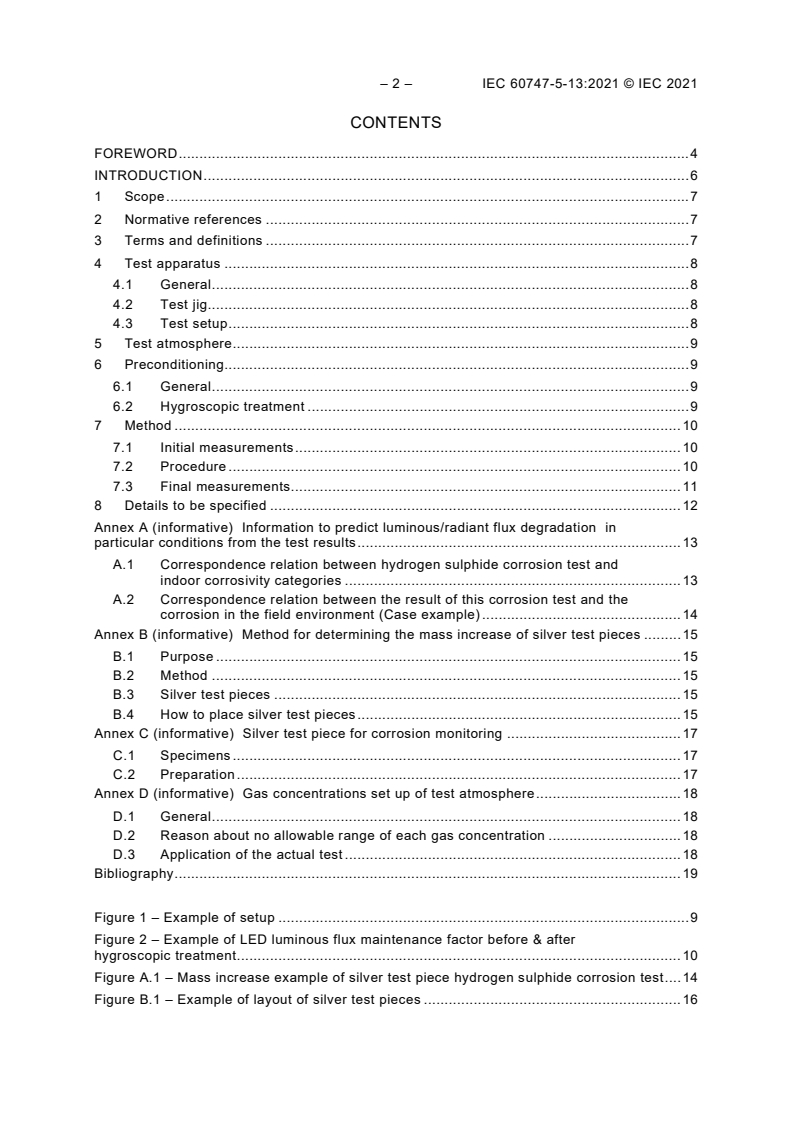
CONTENTS
FOREWORD . 4
INTRODUCTION . 6
1 Scope . 7
2 Normative references . 7
3 Terms and definitions . 7
4 Test apparatus . 8
4.1 General . 8
4.2 Test jig. 8
4.3 Test setup . 8
5 Test atmosphere . 9
6 Preconditioning. 9
6.1 General . 9
6.2 Hygroscopic treatment . 9
7 Method . 10
7.1 Initial measurements . 10
7.2 Procedure . 10
7.3 Final measurements. 11
8 Details to be specified . 12
Annex A (informative) Information to predict luminous/radiant flux degradation in
particular conditions from the test results . 13
A.1 Correspondence relation between hydrogen sulphide corrosion test and
indoor corrosivity categories . 13
A.2 Correspondence relation between the result of this corrosion test and the
corrosion in the field environment (Case example) . 14
Annex B (informative) Method for determining the mass increase of silver test pieces . 15
B.1 Purpose . 15
B.2 Method . 15
B.3 Silver test pieces . 15
B.4 How to place silver test pieces . 15
Annex C (informative) Silver test piece for corrosion monitoring . 17
C.1 Specimens . 17
C.2 Preparation . 17
Annex D (informative) Gas concentrations set up of test atmosphere . 18
D.1 General . 18
D.2 Reason about no allowable range of each gas concentration . 18
D.3 Application of the actual test . 18
Bibliography . 19
Figure 1 – Example of setup . 9
Figure 2 – Example of LED luminous flux maintenance factor before & after
hygroscopic treatment . 10
Figure A.1 – Mass increase example of silver test piece hydrogen sulphide corrosion test . 14
Figure B.1 – Example of layout of silver test pieces . 16
Table A.1 – Description of typical environments related to the estimation of indoor
corrosivity categories in ISO 11844-1:2006, Table D.3 . 13
Table A.2 – The upper limit of mass increase of silver test pieces in the indoor
environment of corrosivity category in ISO 11844-1:2006 for approximately ten years’
usage . 14
– 4 – IEC 60747-5-13:2021 © IEC 2021
INTERNATIONAL ELECTROTECHNICAL COMMISSION
____________
SEMICONDUCTOR DEVICES –
Part 5-13: Optoelectronic devices –
Hydrogen sulphide corrosion test for LED packages
FOREWORD
1) The International Electrotechnical Commission (IEC) is a worldwide organization for standardization comprising
all national electrotechnical committees (IEC National Committees). The object of IEC is to promote international
co-operation on all questions concerning standardization in the electrical and electronic fields. To this end and
in addition to other activities, IEC publishes International Standards, Technical Specifications, Technical Reports,
Publicly Available Specifications (PAS) and Guides (hereafter referred to as “IEC Publication(s)”). Their
preparation is entrusted to technical committees; any IEC National Committee interested in the subject dealt with
may participate in this preparatory work. International, governmental and non-governmental organizations liaising
with the IEC also participate in this preparation. IEC collaborates closely with the International Organization for
Standardization (ISO) in accordance with conditions determined by agreement between the two organizations.
2) The formal decisions or agreements of IEC on technical matters express, as nearly as possible, an international
consensus of opinion on the relevant subjects since each technical committee has representation from all
interested IEC National Committees.
3) IEC Publications have the form of recommendations for international use and are accepted by IEC National
Committees in that sense. While all reasonable efforts are made to ensure that the technical content of IEC
Publications is accurate, IEC cannot be held responsible for the way in which they are used or for any
misinterpretation by any end user.
4) In order to promote international uniformity, IEC National Committees undertake to apply IEC Publications
transparently to the maximum extent possible in their national and regional publications. Any divergence between
any IEC Publication and the corresponding national or regional publication shall be clearly indicated in the latter.
5) IEC itself does not provide any attestation of conformity. Independent certification bodies provide conformity
assessment services and, in some areas, access to IEC marks of conformity. IEC is not responsible for any
services carried out by independent certification bodies.
6) All users should ensure that they have the latest edition of this publication.
7) No liability shall attach to IEC or its directors, employees, servants or agents including individual experts and
members of its technical committees and IEC National Committees for any personal injury, property damage or
other damage of any nature whatsoever, whether direct or indirect, or for costs (including legal fees) and
expenses arising out of the publication, use of, or reliance upon, this IEC Publication or any other IEC Publications.
8) Attention is drawn to the Normative references cited in this publication. Use of the referenced publications is
indispensable for the correct application of this publication.
9) Attention is drawn to the possibility that some of the elements of this IEC Publication may be the subject of patent
rights. IEC shall not be held responsible for identifying any or all such patent rights.
IEC 60747-5-13 has been prepared by subcommittee 47E: Discrete semiconductor devices, of
IEC technical committee 47: Semiconductor devices. It is an International Standard.
The text of this International Standard is based on the following documents:
FDIS Report on voting
47E/746/FDIS 47E/751/RVD
Full information on the voting for its approval can be found in the report on voting indicated in
the above table.
The language used for the development of this International Standard is English.
This document was drafted in accordance with ISO/IEC Directives, Part 2, and developed in
accordance with ISO/IEC Directives, Part 1 and ISO/IEC Directives, IEC Supplement, available
at www.iec.ch/members_experts/refdocs. The main document types developed by IEC are
described in greater detail at www.iec.ch/standardsdev/publications.
A list of all parts in the IEC 60747 series, published under the general title Semiconductor
devices, can be found on the IEC website.
The committee has decided that the contents of this document will remain unchanged until the
stability date indicated on the IEC website under webstore.iec.ch in the data related to the
specific document. At this date, the document will be
• reconfirmed,
• withdrawn,
• replaced by a revised edition, or
• amended.
– 6 – IEC 60747-5-13:2021 © IEC 2021
INTRODUCTION
This part of IEC 60747 provides the accelerated test method to assess effects of the tarnishing
of silver and silver alloys used for LED packages due to hydrogen sulphide, because sulphide
gas (H S) tarnishes silver used in LED packages and causes lumen degradation.
There are some existing environmental stress test standards, but they intend to test contacts
and connections, not LED lumen degradation. IEC 60068-2-43 provides useful information to
assess effects to the contact resistance for contacts and connections due to corrosion of silver
and silver alloy. Because the criterion performance in IEC 60068-2-43 is contact resistance, it
is not applicable to LED packages to determine effects to the luminous/radiant flux maintenance.
For LEDs, light output should be measured, but there is no such provision in existing standards.
Therefore, this document has been drawn up.
This document provides the accelerated test method with mixture gas (H S & NO ) test which
2 2
has the following merits:
• the test method in this document can reproduce the real failure mode;
• the test method in this document works to reproduce the in-situ linear kinetics;
• the test method in this document can reduce the testing duration.
In all tests, the major criterion of performance will be the change in the luminous/radiant flux
and/or electric characteristics (e.g. forward voltage and forward current) caused by sulphide
corrosion.
This test may not be suitable as a general corrosion test, i.e. it may not predict the behaviour
of flux and/or electric characteristics and connections in industrial atmospheres.
This document also contains an informative Annex A that gives information to predict
luminous/radiant flux degradation due to the silver and silver alloy tarnishing in particular
conditions from test results.
SEMICONDUCTOR DEVICES –
Part 5-13: Optoelectronic devices –
Hydrogen sulphide corrosion test for LED packages
1 Scope
This part of IEC 60747 provides the accelerated test method to assess effects of the tarnishing
of silver and silver alloys used for LED packages due to hydrogen sulphide. Particularly, this
test method is intended to give information on silver and silver alloy tarnishing effects to the
luminous/radiant flux maintenance of LED packages. Additionally, this test method can give
information on electric performances of LED packages due to corrosion of silver and silver
alloys.
The object of this test is to determine the influence of atmospheres containing hydrogen
sulphide on parts of LED packages made of:
• silver or silver alloy;
• silver or silver alloy protected with another layer;
• other metals covered with silver or silver alloy.
Testing other degradations that are susceptible to affect luminous/radiant flux maintenance
and/or electric performance (e.g. degradation of copper or silicone parts) is not the object of
this test.
This document is applicable to LED packages for lighting applications only if referenced by an
IEC SC 34A document.
2 Normative references
The following documents are referred to in the text in such a way that some or all of their content
constitutes requirements of this document. For dated references, only the edition cited applies.
For undated references, the latest edition of the referenced document (including any
amendments) applies.
IEC 60068-1, Environmental testing – Part 1: General and guidance
IEC 60068-2-60:2015, Environmental testing – Part 2-60: Tests – Test Ke: Flowing mixed gas
corrosion test
IEC 60747-5-6, Semiconductor devices – Part 5-6: Optoelectronic devices – Light emitting
diodes
CIE 127, Measurement of LEDs
3 Terms and definitions
For the purposes of this document, the following terms and definitions apply. ISO and IEC
maintain terminological databases for use in standardization at the following addresses:
• IEC Electropedia: available at http://www.electropedia.org/
• ISO Online browsing platform: available at http://www.iso.org/obp
– 8 – IEC 60747-5-13:2021 © IEC 2021
3.1
luminous flux
Φ
v
quantity derived from radiant flux Φ by evaluating the radiation according to its action upon the
e
CIE standard photometric observer
[SOURCE: IEC 60050-845:2020, 845-21-039, modified – The explanation for photopic vision
has been removed as well as the notes.]
3.2
radiant flux
Φ
e
power emitted, transmitted or received in the form of radiation
[SOURCE: IEC 60050-845:2020, 845-21-038, modified – The definition has been reviewed and
the notes have been removed.]
4 Test apparatus
4.1 General
The test apparatus consists of a climatic system, test enclosure, gas delivery system and means
for measuring gas concentration, detailed in IEC 60068-2-60:2015, Annex B.
Details of design and construction are optional but shall be such that the conditions specified
for the method are fulfilled throughout the working volume and shall comply with the following
requirements:
• water droplets or aerosols shall not be injected into the test enclosure;
• air and water used shall be sufficiently clean in order not to affect performance of the test;
• the test atmosphere shall flow through the enclosure in such a manner as to ensure uniform
test conditions within the working volume;
• the sampling point for gas analyses shall be in the working volume of the test enclosure;
• the exhaust gases shall be treated in accordance with the relevant regulatory stipulations;
• the wet bulb pod shall be placed in the test chamber in such a manner not to exceed 0,1 %
of the cross-section of the test chamber.
4.2 Test jig
If jigs are used to set specimens under test, the jigs shall be made of corrosion-free materials
(e.g. UPVC tube, PTFE, glass, etc.).
The jigs shall also allow air to pass through easily enough so that the wind speed in the test
enclosure is not influenced significantly.
4.3 Test setup
...
IEC 60747-5-13 ®
Edition 1.1 2026-01
INTERNATIONAL
STANDARD
CONSOLIDATED VERSION
Semiconductor devices -
Part 5-13: Optoelectronic devices - Hydrogen sulphide corrosion test for LED
packages
ICS 31.080.99 ISBN 978-2-8327-1012-8
All rights reserved. Unless otherwise specified, no part of this publication may be reproduced or utilized in any form or
by any means, electronic or mechanical, including photocopying and microfilm, without permission in writing from either
IEC or IEC's member National Committee in the country of the requester. If you have any questions about IEC copyright
or have an enquiry about obtaining additional rights to this publication, please contact the address below or your local
IEC member National Committee for further information.
IEC Secretariat Tel.: +41 22 919 02 11
3, rue de Varembé info@iec.ch
CH-1211 Geneva 20 www.iec.ch
Switzerland
About the IEC
The International Electrotechnical Commission (IEC) is the leading global organization that prepares and publishes
International Standards for all electrical, electronic and related technologies.
About IEC publications
The technical content of IEC publications is kept under constant review by the IEC. Please make sure that you have the
latest edition, a corrigendum or an amendment might have been published.
IEC publications search - IEC Products & Services Portal - products.iec.ch
webstore.iec.ch/advsearchform Discover our powerful search engine and read freely all the
The advanced search enables to find IEC publications by a publications previews, graphical symbols and the glossary.
variety of criteria (reference number, text, technical With a subscription you will always have access to up to date
committee, …). It also gives information on projects, content tailored to your needs.
replaced and withdrawn publications.
Electropedia - www.electropedia.org
The world's leading online dictionary on electrotechnology,
IEC Just Published - webstore.iec.ch/justpublished
Stay up to date on all new IEC publications. Just Published containing more than 22 500 terminological entries in English
details all new publications released. Available online and and French, with equivalent terms in 25 additional languages.
once a month by email. Also known as the International Electrotechnical Vocabulary
(IEV) online.
IEC Customer Service Centre - webstore.iec.ch/csc
If you wish to give us your feedback on this publication or
need further assistance, please contact the Customer
Service Centre: sales@iec.ch.
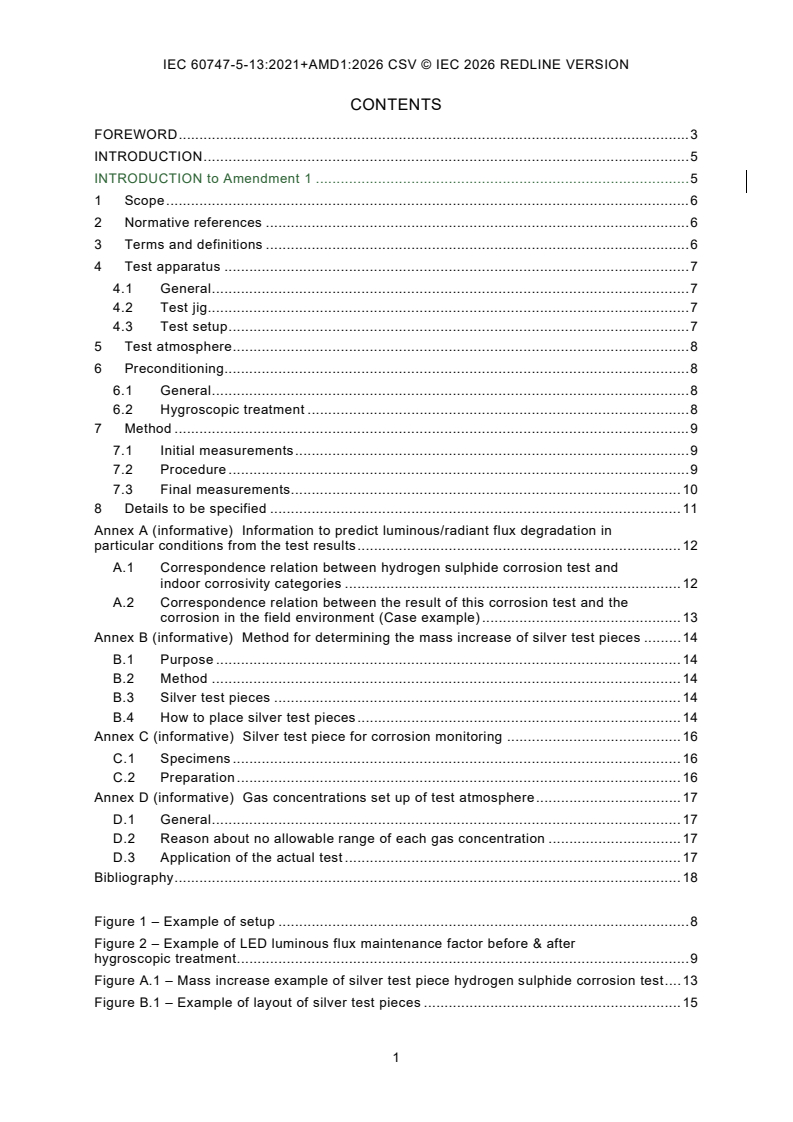
CONTENTS
FOREWORD . 3
INTRODUCTION . 5
INTRODUCTION to Amendment 1 . 5
1 Scope . 6
2 Normative references . 6
3 Terms and definitions . 6
4 Test apparatus . 7
4.1 General . 7
4.2 Test jig. 7
4.3 Test setup . 7
5 Test atmosphere . 8
6 Preconditioning. 8
6.1 General . 8
6.2 Hygroscopic treatment . 8
7 Method . 9
7.1 Initial measurements . 9
7.2 Procedure . 9
7.3 Final measurements. 10
8 Details to be specified . 11
Annex A (informative) Information to predict luminous/radiant flux degradation in
particular conditions from the test results . 12
A.1 Correspondence relation between hydrogen sulphide corrosion test and
indoor corrosivity categories . 12
A.2 Correspondence relation between the result of this corrosion test and the
corrosion in the field environment (Case example) . 13
Annex B (informative) Method for determining the mass increase of silver test pieces . 14
B.1 Purpose . 14
B.2 Method . 14
B.3 Silver test pieces . 14
B.4 How to place silver test pieces . 14
Annex C (informative) Silver test piece for corrosion monitoring . 16
C.1 Specimens . 16
C.2 Preparation . 16
Annex D (informative) Gas concentrations set up of test atmosphere . 17
D.1 General . 17
D.2 Reason about no allowable range of each gas concentration . 17
D.3 Application of the actual test . 17
Bibliography . 18
Figure 1 – Example of setup . 8
Figure 2 – Example of LED luminous flux maintenance factor before & after
hygroscopic treatment . 9
Figure A.1 – Mass increase example of silver test piece hydrogen sulphide corrosion test . 13
Figure B.1 – Example of layout of silver test pieces . 15
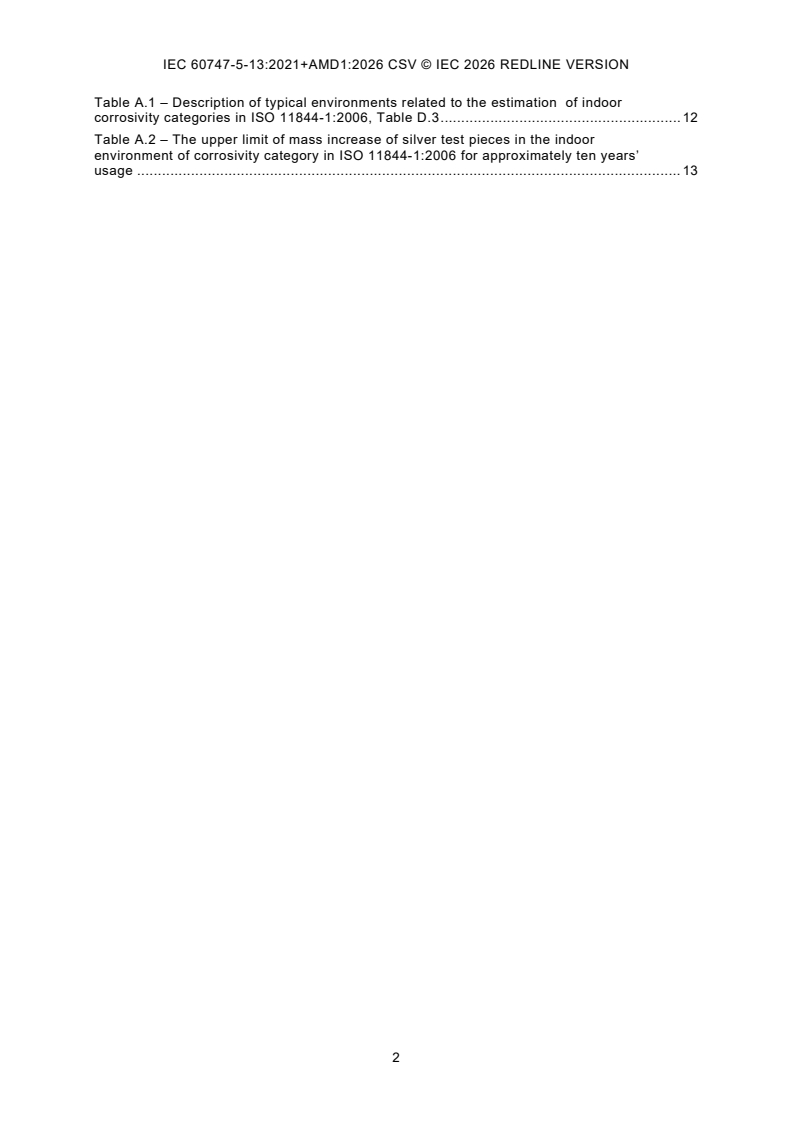
Table A.1 – Description of typical environments related to the estimation of indoor
corrosivity categories in ISO 11844-1:2006, Table D.3 . 12
Table A.2 – The upper limit of mass increase of silver test pieces in the indoor
environment of corrosivity category in ISO 11844-1:2006 for approximately ten years’
usage . 13
INTERNATIONAL ELECTROTECHNICAL COMMISSION
____________
Semiconductor devices -
Part 5-13: Optoelectronic devices - Hydrogen sulphide corrosion test for
LED packages
FOREWORD
1) The International Electrotechnical Commission (IEC) is a worldwide organization for standardization comprising
all national electrotechnical committees (IEC National Committees). The object of IEC is to promote international
co-operation on all questions concerning standardization in the electrical and electronic fields. To this end and
in addition to other activities, IEC publishes International Standards, Technical Specifications, Technical Reports,
Publicly Available Specifications (PAS) and Guides (hereafter referred to as "IEC Publication(s)"). Their
preparation is entrusted to technical committees; any IEC National Committee interested in the subject dealt with
may participate in this preparatory work. International, governmental and non-governmental organizations liaising
with the IEC also participate in this preparation. IEC collaborates closely with the International Organization for
Standardization (ISO) in accordance with conditions determined by agreement between the two organizations.
2) The formal decisions or agreements of IEC on technical matters express, as nearly as possible, an international
consensus of opinion on the relevant subjects since each technical committee has representation from all
interested IEC National Committees.
3) IEC Publications have the form of recommendations for international use and are accepted by IEC National
Committees in that sense. While all reasonable efforts are made to ensure that the technical content of IEC
Publications is accurate, IEC cannot be held responsible for the way in which they are used or for any
misinterpretation by any end user.
4) In order to promote international uniformity, IEC National Committees undertake to apply IEC Publications
transparently to the maximum extent possible in their national and regional publications. Any divergence between
any IEC Publication and the corresponding national or regional publication shall be clearly indicated in the latter.
5) IEC itself does not provide any attestation of conformity. Independent certification bodies provide conformity
assessment services and, in some areas, access to IEC marks of conformity. IEC is not responsible for any
services carried out by independent certification bodies.
6) All users should ensure that they have the latest edition of this publication.
7) No liability shall attach to IEC or its directors, employees, servants or agents including individual experts and
members of its technical committees and IEC National Committees for any personal injury, property damage or
other damage of any nature whatsoever, whether direct or indirect, or for costs (including legal fees) and
expenses arising out of the publication, use of, or reliance upon, this IEC Publication or any other IEC Publications.
8) Attention is drawn to the Normative references cited in this publication. Use of the referenced publications is
indispensable for the correct application of this publication.
9) IEC draws attention to the possibility that the implementation of this document may involve the use of (a) patent(s).
IEC takes no position concerning the evidence, validity or applicability of any claimed patent rights in respect
thereof. As of the date of publication of this document, IEC had not received notice of (a) patent(s), which may
be required to implement this document. However, implementers are cautioned that this may not represent the
latest information, which may be obtained from the patent database available at https://patents.iec.ch. IEC shall
not be held responsible for identifying any or all such patent rights.
This consolidated version of the official IEC Standard and its amendment has been prepared
for user convenience.
IEC 60747-5-13 edition 1.1 contains the first edition (2021-06) [documents 47E/746/FDIS and
47E/751/RVD] and its amendment 1 (2026-01) [documents 47E/853/CDV and 47E/866/RVC].
In this Redline version, a vertical line in the margin shows where the technical content is
modified by amendment 1. Additions are in green text, deletions are in strikethrough red text.
A separate Final version with all changes accepted is available in this publication.
IEC 60747-5-13 has been prepared by subcommittee 47E: Discrete semiconductor devices, of
IEC technical committee 47: Semiconductor devices. It is an International Standard.
The text of this International Standard is based on the following documents:
FDIS Report on voting
47E/746/FDIS 47E/751/RVD
Full information on the voting for its approval can be found in the report on voting indicated in
the above table.
The language used for the development of this International Standard is English.
This document was drafted in accordance with ISO/IEC Directives, Part 2, and developed in
accordance with ISO/IEC Directives, Part 1 and ISO/IEC Directives, IEC Supplement, available
at www.iec.ch/members_experts/refdocs. The main document types developed by IEC are
described in greater detail at www.iec.ch/standardsdev/publications.
A list of all parts in the IEC 60747 series, published under the general title Semiconductor
devices, can be found on the IEC website.
The committee has decided that the contents of this document and its amendment will remain
unchanged until the stability date indicated on the IEC website under webstore.iec.ch in the
data related to the specific document. At this date, the document will be
– reconfirmed,
– withdrawn, or
– revised.
INTRODUCTION
This part of IEC 60747 provides the accelerated test method to assess effects of the tarnishing
of silver and silver alloys used for LED packages due to hydrogen sulphide, because sulphide
gas (H S) tarnishes silver used in LED packages and causes lumen degradation.
There are some existing environmental stress test standards, but they intend to test contacts
and connections, not LED lumen degradation. IEC 60068-2-43 provides useful information to
assess effects to the contact resistance for contacts and connections due to corrosion of silver
and silver alloy. Because the criterion performance in IEC 60068-2-43 is contact resistance, it
is not applicable to LED packages to determine effects to the luminous/radiant flux maintenance.
For LEDs, light output should be measured, but there is no such provision in existing standards.
Therefore, this document has been drawn up.
This document provides the accelerated test method with mixture gas (H S & NO ) test which
2 2
has the following merits:
• the test method in this document can reproduce the real failure mode;
• the test method in this document works to reproduce the in-situ linear kinetics;
• the test method in this document can reduce the testing duration.
In all tests, the major criterion of performance will be the change in the luminous/radiant flux
and/or electric characteristics (e.g. forward voltage and forward current) caused by sulphide
corrosion.
This test may not be suitable as a general corrosion test, i.e. it may not predict the behaviour
of flux and/or electric characteristics and connections in industrial atmospheres.
This document also contains an informative Annex A that gives information to predict
luminous/radiant flux degradation due to the silver and silver alloy tarnishing in particular
conditions from test results.
INTRODUCTION to Amendment 1
This amendment corrects Annex C, Clause C.2 a) (preparation of silver test piece for corrosion
monitoring) as follows:
– The grade of silicon carbide paper shall be P 1 200 instead of P 1 000.
– Water shall NOT be used when polishing with silicon carbide paper to avoid contamination,
i.e., impurity of the abrasive grains may dissolve in water and may react with the silver. The
washing process is provided in C.2 b).
With this amendment preparation of the silver test piece is aligned with ISO 11844-2 A.2 which
uses the same silver test piece for the determination of corrosion rate by mass change
measurement.
1 Scope
This part of IEC 60747 provides the accelerated test method to assess effects of the tarnishing
of silver and silver alloys used for LED packages due to hydrogen sulphide. Particularly, this
test method is intended to give information on silver and silver alloy tarnishing effects to the
luminous/radiant flux maintenance of LED packages. Additionally, this test method can give
information on electric performances of LED packages due to corrosion of silver and silver
alloys.
The object of this test is to determine the influence of atmospheres containing hydrogen
sulphide on parts of LED packages made of:
• silver or silver alloy;
• silver or silver alloy protected with another layer;
• other metals covered with silver or silver alloy.
Testing other degradations that are susceptible to affect luminous/radiant flux maintenance
and/or electric performance (e.g. degradation of copper or silicone parts) is not the object of
this test.
This document is applicable to LED packages for lighting applications only if referenced by an
IEC SC 34A document.
2 Normative references
The following documents are referred to in the text in such a way that some or all of their content
constitutes requirements of this document. For dated references, only the edition cited applies.
For undated references, the latest edition of the referenced document (including any
amendments) applies.
IEC 60068-1, Environmental testing – Part 1: General and guidance
IEC 60068-2-60:2015, Environmental testing – Part 2-60: Tests – Test Ke: Flowing mixed gas
corrosion test
IEC 60747-5-6, Semiconductor devices – Part 5-6: Optoelectronic devices – Light emitting
diodes
CIE 127, Measurement of LEDs
3 Terms and definitions
For the purposes of this document, the following terms and definitions apply. ISO and IEC
maintain terminological databases for use in standardization at the following addresses:
• IEC Electropedia: available at http://www.electropedia.org/
• ISO Online browsing platform: available at http://www.iso.org/obp
3.1
luminous flux
Φ
v
quantity derived from radiant flux Φ by evaluating the radiation according to its action upon the
e
CIE standard photometric observer
[SOURCE: IEC 60050-845:2020, 845-21-039, modified – The explanation for photopic vision
has been removed as well as the notes.]
3.2
radiant flux
Φ
e
power emitted, transmitted or received in the form of radiation
[SOURCE: IEC 60050-845:2020, 845-21-038, modified – The definition has been reviewed and
the notes have been removed.]
4 Test apparatus
4.1 General
The test apparatus consists of a climatic system, test enclosure, gas delivery system and means
for measuring gas concentration, detailed in IEC 60068-2-60:2015, Annex B.
Details of design and construction are optional but shall be such that the conditions specified
for the method are fulfilled throughout the working volume and shall comply with the following
requirements:
• water droplets or aerosols shall not be injected into the test enclosure;
• air and water used shall be sufficiently clean in order not to affect performance of the test;
• the test atmosphere shall flow through the enclosure in such a manner as to ensure uniform
test conditions within the working volume;
• the sampling point for gas analyses shall be in the working volume of the test enclosure;
• the exhaust gases shall be treated in accordance with the relevant regulatory stipulations;
• the wet bulb pod shall be placed in the test chamber in such a manner not to exceed 0,1 %
of the cross-section of the test chamber.
4.2 Test jig
If jigs are used to set specimens under test, the jigs shall be made of corrosion-free materials
(e.g. UPVC tube, PTFE, glass, etc.).
The jigs shall also allow air to pass through easily enough so that the wind speed in the test
enclosure is not influenced significantly.
4.3 Test setup
If multiple specimens are tested, each specimen shall be set in the same posture. See Figure 1
as an example.
The distance between specimens should be 10 mm or more.
Corrosive materials or objects including corrosive materials (e.g. silver) other than the test
specimens shall not be set in the test enclosure.
Figure 1 – Example of setup
5 Test atmosphere
The composition of the atmosphere within the test chamber shall satisfy the following
conditions:
–6
• hydrogen sulphide: 2 × 10 vol/vol;
–6
• nitrogen dioxide: 4 × 10 vol/vol;
• temperature: 40 °C ± 2 °C;
• relative humidity: 75 % ± 5 %
• rate of ventilations 3 cycles/hour to 10 cycles/hour
The test atmosphere may be obtained by mixing hydrogen sulphide and nitrogen dioxide (from
any convenient source) with air and water vapour in a way to ensure a homogeneous mixture.
(More than one stage may be necessary to obtain a homogeneous distribution of the small
quantity of hydrogen sulphide.)
6 Preconditioning
6.1 General
The specimens under test shall not be cleaned in any way unless required by the manufacturer’s
instructions, the relevant detail specification, or agreed upon between the interested parties.
6.2 Hygroscopic treatment
Before the test, test specimens shall absorb moisture under the condition below.
• Temperature: 85 °C ± 2 °C
• Relative humidity: 85 % ± 5%
• Duration: more than 24 h and more than a period for the test specimens to reach a moisture
saturation condition.
The specimens shall be set in the test closure and the test shall be started within one hour after
the hygroscopic treatment.
The period for the test specimens to reach a moisture saturation condition may be determined
by a test in advance or technical documents.
Initial measurement is done before this treatment.
There is the concern of the different results of sulphide corrosion test caused by the difference
amounts of moisture absorption in LEDs in case that LEDs are stored in different conditions
(see Figure 2 as an example).
Therefore, LED test specimens shall be saturated with moisture absorption before hydrogen
sulphide corrosion test to reduce the difference of test results caused by the difference amounts
of moisture absorption in LEDs.
Figure 2 – Example of LED luminous flux maintenance
factor before & after hygroscopic treatment
7 Method
7.1 Initial measurements
The relevant specification may require that, before and after test, a luminous/radiant flux
measurement be carried out in combination with an electric measurement.
Unless otherwise specified in the relevant specification, the luminous/radiant flux measurement
and the electric measurements shall be conducted in accordance with IEC 60747-5-6 or
CIE 127.
7.2 Procedure
Prior to the commencement of the test, it shall be established by suitable measurements that
stable conditions for the concentration of hydrogen sulphide and nitrogen dioxide, temperature,
and relative humidity have been achieved. Periodic checks for temperature and relative
humidity shall be made during the test to ensure that these conditions are maintained.
Care shall be taken that the specimens are placed in a way so that they do not come in contact
with each other, that they do not cover or shield each other from the test atmosphere, and that
they do not shield air flow in the test chamber significantly.
For the total volume and the total surface area of the test specimens, the provisions in 7.2 of
IEC 60068-2-60:2015 shall be applied.
Adequate precautions shall be taken to ensure that the luminous/radiant flux and electric
performances are not disturbed during the exposure period.
In the exposure period, the number of specimens in the test chamber should not be changed.
The specimens shall be exposed without any electrical load or as required by the detail
specification.
The specimens shall be continuously exposed to the test atmosphere for a duration as required
by the detail specification and the following steps:
• The gas concentrations set up of test atmosphere is recommended in Annex D;
• Set the test specimens in the working volume of the test chamber, after the specified
temperature is stabilized, start the flow of humid air, allow to stabilize and adjust
temperature and humidity not to accumulate the condensation on the inner wall of the test
chamber and the surface of the test specimen;
• Start the flow of the gases into the humid air stream and allow to be stabilized. Exposure
period shall be counted from the time the gas is started to flow;
• Measure and adjust, if necessary, temperature, humidity and gas concentrations. During
these adjustments, any overshooting of gas concentration shall be avoided. Maximum
allowed duration of this period of stabilization and adjustments, to prescribed values, is
24 h;
• During the course of testing, temperature, humidity and gas concentrations shall be kept
within the prescribed limits;
• At the end of the test period, remove the specimens after the humidity in the chamber is
decreased around room temperature and RH of 75 % to avoid condensation.
7.3 Final measurements
The specimens shall be removed from the chamber and stored under standard recovery
conditions specified in IEC 60068-1 for not less than 1 h before luminous/radiant flux and
electric measurements are made. The measurements should be done in 2 h after the removal
from the chamber if the measurements cannot be done within the specified time, they shall be
performed within up to 24 hours after the removal from the chamber. In that case, the specimens
shall be kept under standard recovery condition specified in IEC 60068-1, and such situation
shall be mentioned in the test report with the period of storage.
Adequate precautions shall be taken to ensure that the luminous/radiant flux and electric
performances are not disturbed. The method used for measuring the luminous/radiant flux and
the electric performances should be the same as used for the initial measurement.
Treatment of the specimens before final measurements and the details of measurements shall
be made as required by the relevant specification.
Visual inspection of the specimens may be required by the detail specification.
8 Details to be specified
The relevant specification shall specify the following details:
a) measurements and checks to be made prior to the test;
b) electrical loading or operational conditions of the specimens, if applicable;
c) duration of the test;
d) measurements, correction, checks and visual inspection to be made at the end of the test.
NOTE Annex A provides information to predict the luminous flux degradation in particular indoor environments from
the results of this hydrogen sulphide corrosion test.
Annex A
(informative)
Information to predict luminous/radiant flux degradation
in particular conditions from the test results
A.1 Correspondence relation between hydrogen sulphide corrosion test and
indoor corrosivity categories
The result of hydrogen sulphide corrosion test for 96 h corresponds to the luminous flux
degradation in the indoor environment of corrosivity category IC 3 in ISO 11844-1:2006 for
approximately ten years usage as shown in Table A.1.
Therefore, it is possible to predict the luminous flux degradation in particular indoor
environments from the results of this hydrogen sulphide corrosion test.
Table A.1 – Description of typical environments related to the estimation
of indoor corrosivity categories in ISO 11844-1:2006, Table D.3
Corrosivity
category
Corrosivity Typical environments
(IC)
Heated spaces with controlled stable relative humidity (< 40 %) without risk of
condensation, low levels of pollutants, no specific pollutants, e.g. computer rooms,
very low
museums with controlled environment
IC 1
indoor
Unheated spaces with dehumidification, low levels of indoor pollution, no specific
pollutants e.g. military stores for equipment
Heated spaces with low relative humidity (< 50 %) with certain fluctuation of relative
humidity without risk of condensation, low levels of pollution, without specific pollutants
e.g. museums, control rooms
IC 2 low indoor
Unheated spaces with only temperature and humidity changes, with no risk of
condensation, low levels of pollution without specific pollutants, e.g. storage rooms with
low frequency of temperature changes
Heated spaces with risk of fluctuation of temperature and humidity, medium levels of
pollution, certain risks for specific pollutants, e.g. switchboards in the power industry
medium
Unheated spaces with elevated relative humidity (> 50 % – 70 %) with periodic
IC 3
indoor
fluctuation of relative humidity, without risk of condensation, elevated levels of pollution,
low risk of specific pollutants, e.g. churches in non-polluted areas, outdoor
telecommunication boxes in rural areas
Heated spaces with fluctuation of humidity and temperature, elevated levels of pollution
including specific pollutants, e.g. electrical service rooms in industrial plants
IC 4 high indoor
Unheated spaces with high relative humidity (> 70 %) with some risk of condensation,
medium levels of pollution, possible effect of specific pollutants, e.g. churches in polluted
areas, outdoor boxes for telecommunication in polluted areas
Heated spaces with limited influence of relative humidity, higher levels of pollution
including specific pollutants like H S, e.g. electrical service rooms, cross-connection
very high
rooms in industries without efficient pollution control
IC 5
indoor
Unheated spaces with high relative humidity and risk for condensation, medium and
higher levels of pollution, e.g. storage rooms in basements in polluted areas
NOTE The general characterization of indoor atmospheres with respect to corrosion of metals is summarized in
ISO 11844-1:2006, Annex C.
____________
A new edition of ISO 11844-1 was published in 2020.
Reproduced (from ISO 11844-1:2006), with the permission of ISO.
A.2 Correspondence relation between the result of this corrosion test and the
corrosion in the field environment (Case example)
Hydrogen sulphide corrosion test for 96 h gets silver test pieces mass increase by about
4 500 mg/m (see the test results by test apparatus in Figure A.1). Method of confirmation of
the mass increase of silver test pieces is detailed in Annex B.
This mass increase corresponds to the ten times the upper limit of mass increase to silver test
pieces in the indoor environment of corrosivity category IC 3 in ISO 11844-1:2006 for
approximately one year's usage (see Table A.1 and Table A.2).
The result of hydrogen sulphide corrosion test for 96 h corresponds to the corrosion in the
indoor environment of corrosivity category IC 3 in ISO 11844-1:2006 for approximately ten
years’ usage, because the mass increase to silver test pieces in the field environment linearly
changes.
Table A.2 – The upper limit of mass increase of silver test pieces in the indoor
environment of corrosivity category in ISO 11844-1:2006 for approximately ten years’
usage
Class The upper limit of mass The upper limit of mass
increase of silver test increase of silver test pieces
pieces
2 2
mg/m for approximately・ mg/m ・for approximately 10
1 year years
IC 1 25 250
IC 2 100 1 000
IC 3 450 4 500
IC 4 1 000 10 000
IC 6 2 500 25 000
Figure A.1 – Mass increase example of silver test piece
hydrogen sulphide corrosion test
Annex B
(informative)
Method for determining the mass
increase of silver test pieces
B.1 Purpose
The purpose here is to explain how to determine the increase amount of silver test pieces.
The specification of the silver test pieces is described in Annex C.
B.2 Method
The mass increase of silver test pieces d should be obtained by the hydrogen sulphide
m
corrosion test with only silver test pieces done by the same test apparatus, test jig, test
atmosphere and test method described in this document.
Mass increase of silver test piece d (mg/m ) is calculated by the following formula:
m
= (ms1 – ms2) / sa
d
m
where
ms1 (mg) is the mass of silver test piece after the test;
ms2 (mg) is the mass of silver test piece before the test;
sa (m ) is the surface area of silver test piece.
No material to be eroded or something to contain it shall be allowed in test chamber.
In particular, this test inside the same chamber for hydrogen sulphide corrosion test for LED
should be avoided not to have the influence on the result of hydrogen sulphide corrosion test
for LED.
B.3 Silver test pieces
Five silver test pieces prepared based on Annex C should be exposed.
The increase amount measured by appropriate ability after the test shall be used to monitor the
test repeatability and repetitiveness, one of criteria for corrosivity.
Apply 7.2 of IEC 60068-2-60:2015 to total cubic volume and surface area of test pieces.
B.4 How to place silver test pieces
One silver test piece should be placed at the centre of the area to place test pieces and other
4 pieces should be placed at the locations to surround the area.
They should be hanged, holding one end of longer direction on test pieces.
It is advisable that the distance between test pieces is longer than 10 mm not to disturb
homogeneous air flow.
Example of layout of silver test pieces is shown in Figure B.1.
Figure B.1 – Example of layout of silver test pieces
Annex C
(informative)
Silver test piece for corrosion monitoring
C.1 Specimens
Silver specimens should be pure pieces from silver purity not lower than 99,98 %.
It is preferable to use rectangular specimens in the form of flat sheets, as they can be readily
weighed by the analytical balance (readability down to 0,1 mg). A convenient specimen size is
10 mm × 50 mm.
Specimens may be larger provided that they can be accurately weighed. The specimen
thickness may preferably be 0,5 mm.
C.2 Preparation
Silver specimens should, before weighing, be prepared as follows:
a) A hole with diameter not greater than 4 mm is cut at the upper side of the specimen;
Abrading with deionised water and silicon carbide paper to P 1 000 1 200 specified in
ISO 6344-3 without water.
b) Cleaning in deionised water in an ultrasonic bath for 3 min to 5 min;
c) Degreasing in ethanol in an ultrasonic bath for 3 min to 5 min;
d) Drying 60 °C for 5 min;
e) Store in small plastic bags with open top. The small plastic bags are placed in a desiccator
or sealed plastic bag with desiccant that have no corrosiveness before and after the
weighing and the exposure.
After final surface cleaning before exposure, it is important that limited handling occurs. The
specimens are only handled with a clean pair of tweezers. After the preparation, the specimens
are allowed to be kept for maximum of 120 h in the desiccator or sealed plastic bag with
desiccants that have no corrosiveness.
To avoid marking on the specimens, the identity of the specimens may preferably be marked
on the small plastic bags.
____________
To avoid the risk of contamination, the abrading papers for polishing specimens of different materials are not
recommended for this use.
Annex D
(informative)
Gas concentrations set up of test atmosphere
D.1 General
Gas concentrations in this test shall be as follows:
–6
• hydrogen sulphide: 2 × 10 vol/vol
–6
• nitrogen dioxide: 4 × 10 vol/vol;
• hydrogen sulphide/ nitrogen dioxide = 0,5
Unlike other similar standards such as IEC 60068-2-43, this document does not allow the range
of each gas concentration. This Annex D states the reasons and an example of applications of
the actual test.
D.2 Reason about no allowable range of each gas concentration
Detector tubes are generally used to measure gas concentrations. However, it is well known
that the gas concentration measured by the detector tube has relatively large uncertainty.
To set up the gas concentration by a detector tube means that the tolerance would be about
20 % of the required concentration. Because the tolerance of a detector tube is 20 %, it will
make no sense to require that gas concentrations in this test shall be equal or less than 20 %.
D.3 Application of the actual test
The following set-up of each gas concentration is advisable in the actual test:
• confirm 2 ppm as the measurement value of the hydrogen sulphide gas concentration by a
detector tube after the flow of the gas starts into the chamber and is stabilized in a certain
period of time. If the value is less or greater than 2 ppm, the adjustment of gas flow should
be repeated until the measurement value is exactly 2 ppm.
• exhaust hydrogen sulphide gas from the chamber after setting up its gas concentration and
adjust gas flow of nitrogen dioxide to 4 ppm of the measurement value.
• then, test according to the procedure in 7.2 after exhaustion of nitrogen dioxide from the
chamber.
• as described above, the measurement of gas concentration and adjustment of gas flow
should be done independently, because the measurement will not be able to be done
correctly due to the interference of both gases in case that there are hydrogen sulphide and
nitrogen dioxide in the chamber at the same time.
• It is advisable that the maximum scale value of the detector tube should be equal or less
than the set-up value for accurate measurement. Namely, the maximum scale value of
hydrogen sulphide and nitrogen dioxide should be equal to or less than 6 ppm and 12 ppm
respectively.
Furthermore, the measurement value of gas concentration should be within ± 5 %:
–6
– Hydrogen sulphide: 2 × 10 vol/vol;
–6
– Nitrogen dioxide: 4 × 10 vol/vol;
• the ratio of both gas concentrations should be within 0,5 ± 0,05.
Bibliography
IEC 60050-845, International Electrotechnical Vocabulary – Part 845: Lighting
(available at http://www.electropedia.org)
IEC 60068-2-43:2003, Environmental testing – Part 2-43: Tests – Test Kd: Hydrogen sulphide
test for contacts and connections
IEC 60068-2-46:1982, Basic environmental testing procedures – Part 2: Tests. Guidance to
Test Kd: Hydrogen sulphide test for contacts and connections
IEC 60355:1971 , An appraisal of the problems of accelerated testing for atmospheric corrosion
ISO 6344-3, Coated abrasives – Grain size analysis – Part 3: Determination of grain size
distribution of microgrits P240 to P2500
ISO 11844-1:2006 , Corrosion of metals and alloys – Classification of low corrosivity of indoor
atmospheres – Part 1: Determination and estimation of indoor corrosivity
____________
____________
IEC 60355:1971 has been withdrawn.
A new edition of ISO 11844-1 was published in 2020.
CONTENTS
FOREWORD . 3
INTRODUCTION . 5
INTRODUCTION to Amendment 1 . 5
1 Scope . 6
2 Normative references . 6
3 Terms and definitions . 6
4 Test apparatus . 7
4.1 General . 7
4.2 Test jig. 7
4.3 Test setup . 7
5 Test atmosphere . 8
6 Preconditioning. 8
6.1 General . 8
6.2 Hygroscopic treatment . 8
7 Method . 9
7.1 Initial measurements . 9
7.2 Procedure . 9
7.3 Final measurements. 10
8 Details to be specified . 11
Annex A (informative) Information to predict luminous/radiant flux degradation in
particular conditions from the test results . 12
A.1 Correspondence relation between hydrogen sulphide corrosion test and
indoor corrosivity categories . 12
A.2 Correspondence relation between the result of this corrosion test and the
corrosion in the field environment (Case example) . 13
Annex B (informative) Method for determining the mass increase of silver test pieces . 14
B.1 Purpose .
...