


IEC 61000-6-3:2026
(Amendment)Electromagnetic compatibility (EMC) - Part 6-3: Generic standards - Emission standard for equipment in residential locations
General Information
- Abstract
IEC 61000-6-3:2026 is applicable only if no relevant dedicated product or product family EMC emission standard has been published. This part of IEC 61000 for emission requirements applies to electrical and electronic equipment intended for use at residential (see 3.1.21) locations. This part of IEC 61000 also applies to electrical and electronic equipment intended for use at other locations that do not fall within the scope of IEC 61000-6-8 or IEC 61000-6-4. The intention is that all equipment used in the residential, commercial and light-industrial locations are covered by IEC 61000-6-3 or IEC 61000-6-8. If there is any doubt the requirements in IEC 61000-6-3 apply. Equipment that has a radio function (3.1.20) are included in the scope of this document. However, the emission requirements in this document are not intended to be applicable to the intentional transmissions from these radio transmitters, their harmonics and their out of band emissions. Not all disturbance phenomena have been included for testing purposes but only those considered relevant for the equipment intended to operate within the locations included within this document.
The objectives of this document are:
- to establish requirements that provide an adequate level of protection of radio reception in the frequency range 9 kHz to 400 GHz;
- to establish requirements that provide an adequate level of protection against conducted and radiated electromagnetic disturbances emitted by equipment in the scope of this document;
- to support the reproducibility of measurement and the repeatability of results.
NOTE 1 In special cases, situations will arise where the levels specified in this document will not offer adequate protection; for example, where a sensitive receiver is used in close proximity to an equipment. In these instances, special mitigation measures can be employed.
NOTE 2 Disturbances generated in fault conditions of equipment are not covered by this document.
NOTE 3 The requirements in this document are more stringent or equivalent to the requirements specified in IEC 61000-6-4 and IEC 61000-6-8.
This fourth edition cancels and replaces the third edition published in 2020. This edition constitutes a technical revision. This edition includes the following significant technical changes with respect to the previous edition:
a) the addition of magnetic field emission requirements, including the measurement of WPT function;
b) the extension of low-voltage AC mains power requirements to cover the range 9 kHz to 150 kHz;
c) products with a radio function have been added to the scope;
d) limits in a FAR for rack mounted equipment have been added.
- Status
- Published
- Publication Date
- 06-Apr-2026
- Technical Committee
- CIS/H - Limits for the protection of radio services
- Current Stage
- PPUB - Publication issued
- Start Date
- 07-Apr-2026
- Completion Date
- 03-Apr-2026
Buy Documents
IEC 61000-6-3:2026 - Electromagnetic compatibility (EMC) - Part 6-3: Generic standards - Emission standard for equipment in residential locations
REDLINE IEC 61000-6-3:2026 RLV - Electromagnetic compatibility (EMC) - Part 6-3: Generic standards - Emission standard for equipment in residential locations
IEC 61000-6-3:2026 - Compatibilité électromagnétique (CEM) - Partie 6-3: Normes génériques - Norme sur l'émission relative aux appareils utilisés dans les environnements résidentiels
Overview
IEC 61000-6-3:2026 is an international standard published by the International Electrotechnical Commission (IEC) focusing on electromagnetic compatibility (EMC). Specifically, this standard sets out generic emission requirements for electrical and electronic equipment intended for use in residential environments when no dedicated product or product family EMC emission standard is available. The intent is to ensure that such equipment does not cause excessive electromagnetic disturbances that could impact radio reception and other electronic systems in homes and similar environments.
This fourth edition of IEC 61000-6-3 introduces technical updates to stay aligned with evolving technology and regulatory expectations. It applies to both residential and other locations not covered by IEC 61000-6-4 or IEC 61000-6-8. Where uncertainty exists regarding emission requirements, IEC 61000-6-3 takes precedence.
Key Topics
- Generic Emission Standard: Designed for broad applicability to various types of electrical and electronic equipment used in residential environments, unless a more specific EMC emission standard exists.
- Frequency Range: Emission requirements are specified for the frequency spectrum from 9 kHz to 400 GHz to ensure comprehensive radio reception protection.
- Scope Expansion:
- Now includes products with radio functions.
- Magnetic field emission requirements and measurement of wireless power transfer (WPT) functions have been added.
- Extended coverage of low-voltage AC mains emission requirements down to 9 kHz.
- New limits for rack-mounted equipment in fully anechoic rooms (FAR).
- Protection of Radio Reception: The standard is structured to provide an adequate level of protection for radio services and ensure minimal interference in the home.
- Measurement Consistency: Supports reproducibility of measurement and the repeatability of EMC testing results.
- Harmonization: The requirements in IEC 61000-6-3 are at least as stringent as or exceed those in related generic standards, which helps streamline compliance across similar environments.
Applications
IEC 61000-6-3:2026 is widely applied in the following contexts:
- Household Appliances & Consumer Electronics: Ensuring devices such as televisions, audio systems, and small appliances meet EMC emission limits when operated in homes or apartments.
- Light Industrial & Commercial Products: Covers equipment used in locations not specifically classified as heavy industrial but not addressed by other standards.
- New Product Development: Essential for manufacturers introducing innovative electronic products where dedicated EMC emission standards are not available.
- Wireless Devices and WPT Equipment: Applies emission requirements to products with wireless communication and wireless power transfer functions, while excluding emission limits on intentional radio transmissions (regulated by telecom standards).
- Technical Assessments and Market Access: Used by testing labs, certification bodies, and manufacturers to demonstrate conformity and streamline global market access.
Related Standards
IEC 61000-6-3:2026 fits into a broader framework of EMC standards designed to ensure electromagnetic compatibility in various environments. Key related standards include:
- IEC 61000-6-4: EMC emission standard for industrial environments.
- IEC 61000-6-8: Emission standard for commercial environments.
- CISPR 14-1, CISPR 16 series, CISPR 32: Provide detailed methods, apparatus specifications, and specific requirements for measuring radio disturbances and immunity.
- IEC 61000-3-2, IEC 61000-3-3, IEC 61000-3-11, and IEC 61000-3-12: Address limitations on harmonic currents and voltage fluctuations for equipment connected to public low-voltage networks.
- IEC 61000-4 series: Discusses testing and measurement techniques relevant to EMC assessment.
Practical Value
Adopting IEC 61000-6-3:2026 delivers several benefits:
- Assured EMC Compliance: Meets international requirements for emission control in residential areas, safeguarding radio services and other electronics.
- Market Readiness: Facilitates entry into global markets by aligning products with established international standards.
- Consumer Protection: Reduces the likelihood of interference and promotes a reliable home electronic environment.
- Future-Proofing: Addresses emerging technologies such as wireless power transfer, keeping standards current with industry evolution.
By integrating IEC 61000-6-3:2026 into product development and compliance strategies, manufacturers and stakeholders enhance product reliability, meet legal obligations, and ensure seamless operation of electrical and electronic devices in residential settings.
Relations
- Effective Date
- 05-Sep-2023
Buy Documents
IEC 61000-6-3:2026 - Electromagnetic compatibility (EMC) - Part 6-3: Generic standards - Emission standard for equipment in residential locations
REDLINE IEC 61000-6-3:2026 RLV - Electromagnetic compatibility (EMC) - Part 6-3: Generic standards - Emission standard for equipment in residential locations
IEC 61000-6-3:2026 - Compatibilité électromagnétique (CEM) - Partie 6-3: Normes génériques - Norme sur l'émission relative aux appareils utilisés dans les environnements résidentiels
Get Certified
Connect with accredited certification bodies for this standard

ANCE
Mexican certification and testing association.

Intertek Slovenia
Intertek testing, inspection, and certification services in Slovenia.

LNE (Laboratoire National de Métrologie et d'Essais)
French national laboratory for metrology and testing.
Sponsored listings
Frequently Asked Questions
IEC 61000-6-3:2026 is a standard published by the International Electrotechnical Commission (IEC). Its full title is "Electromagnetic compatibility (EMC) - Part 6-3: Generic standards - Emission standard for equipment in residential locations". This standard covers: IEC 61000-6-3:2026 is applicable only if no relevant dedicated product or product family EMC emission standard has been published. This part of IEC 61000 for emission requirements applies to electrical and electronic equipment intended for use at residential (see 3.1.21) locations. This part of IEC 61000 also applies to electrical and electronic equipment intended for use at other locations that do not fall within the scope of IEC 61000-6-8 or IEC 61000-6-4. The intention is that all equipment used in the residential, commercial and light-industrial locations are covered by IEC 61000-6-3 or IEC 61000-6-8. If there is any doubt the requirements in IEC 61000-6-3 apply. Equipment that has a radio function (3.1.20) are included in the scope of this document. However, the emission requirements in this document are not intended to be applicable to the intentional transmissions from these radio transmitters, their harmonics and their out of band emissions. Not all disturbance phenomena have been included for testing purposes but only those considered relevant for the equipment intended to operate within the locations included within this document. The objectives of this document are: - to establish requirements that provide an adequate level of protection of radio reception in the frequency range 9 kHz to 400 GHz; - to establish requirements that provide an adequate level of protection against conducted and radiated electromagnetic disturbances emitted by equipment in the scope of this document; - to support the reproducibility of measurement and the repeatability of results. NOTE 1 In special cases, situations will arise where the levels specified in this document will not offer adequate protection; for example, where a sensitive receiver is used in close proximity to an equipment. In these instances, special mitigation measures can be employed. NOTE 2 Disturbances generated in fault conditions of equipment are not covered by this document. NOTE 3 The requirements in this document are more stringent or equivalent to the requirements specified in IEC 61000-6-4 and IEC 61000-6-8. This fourth edition cancels and replaces the third edition published in 2020. This edition constitutes a technical revision. This edition includes the following significant technical changes with respect to the previous edition: a) the addition of magnetic field emission requirements, including the measurement of WPT function; b) the extension of low-voltage AC mains power requirements to cover the range 9 kHz to 150 kHz; c) products with a radio function have been added to the scope; d) limits in a FAR for rack mounted equipment have been added.
IEC 61000-6-3:2026 is applicable only if no relevant dedicated product or product family EMC emission standard has been published. This part of IEC 61000 for emission requirements applies to electrical and electronic equipment intended for use at residential (see 3.1.21) locations. This part of IEC 61000 also applies to electrical and electronic equipment intended for use at other locations that do not fall within the scope of IEC 61000-6-8 or IEC 61000-6-4. The intention is that all equipment used in the residential, commercial and light-industrial locations are covered by IEC 61000-6-3 or IEC 61000-6-8. If there is any doubt the requirements in IEC 61000-6-3 apply. Equipment that has a radio function (3.1.20) are included in the scope of this document. However, the emission requirements in this document are not intended to be applicable to the intentional transmissions from these radio transmitters, their harmonics and their out of band emissions. Not all disturbance phenomena have been included for testing purposes but only those considered relevant for the equipment intended to operate within the locations included within this document. The objectives of this document are: - to establish requirements that provide an adequate level of protection of radio reception in the frequency range 9 kHz to 400 GHz; - to establish requirements that provide an adequate level of protection against conducted and radiated electromagnetic disturbances emitted by equipment in the scope of this document; - to support the reproducibility of measurement and the repeatability of results. NOTE 1 In special cases, situations will arise where the levels specified in this document will not offer adequate protection; for example, where a sensitive receiver is used in close proximity to an equipment. In these instances, special mitigation measures can be employed. NOTE 2 Disturbances generated in fault conditions of equipment are not covered by this document. NOTE 3 The requirements in this document are more stringent or equivalent to the requirements specified in IEC 61000-6-4 and IEC 61000-6-8. This fourth edition cancels and replaces the third edition published in 2020. This edition constitutes a technical revision. This edition includes the following significant technical changes with respect to the previous edition: a) the addition of magnetic field emission requirements, including the measurement of WPT function; b) the extension of low-voltage AC mains power requirements to cover the range 9 kHz to 150 kHz; c) products with a radio function have been added to the scope; d) limits in a FAR for rack mounted equipment have been added.
IEC 61000-6-3:2026 is classified under the following ICS (International Classification for Standards) categories: 33.100.10 - Emission. The ICS classification helps identify the subject area and facilitates finding related standards.
IEC 61000-6-3:2026 has the following relationships with other standards: It is inter standard links to IEC 61000-6-3:2020. Understanding these relationships helps ensure you are using the most current and applicable version of the standard.
IEC 61000-6-3:2026 is available in PDF format for immediate download after purchase. The document can be added to your cart and obtained through the secure checkout process. Digital delivery ensures instant access to the complete standard document.
Standards Content (Sample)
IEC 61000-6-3 ®
Edition 4.0 2026-04
INTERNATIONAL
STANDARD
INTERNATIONAL SPECIAL COMMITTEE ON RADIO INTERFERENCE
HORIZONTAL PUBLICATION
GENERIC EMC STANDARD
Electromagnetic compatibility (EMC) -
Part 6-3: Generic standards - Emission standard for equipment in residential
locations
ICS 33.100.10 ISBN 978-2-8327-1165-1
All rights reserved. Unless otherwise specified, no part of this publication may be reproduced or utilized in any form or
by any means, electronic or mechanical, including photocopying and microfilm, without permission in writing from either
IEC or IEC's member National Committee in the country of the requester. If you have any questions about IEC copyright
or have an enquiry about obtaining additional rights to this publication, please contact the address below or your local
IEC member National Committee for further information.
IEC Secretariat Tel.: +41 22 919 02 11
3, rue de Varembé info@iec.ch
CH-1211 Geneva 20 www.iec.ch
Switzerland
About the IEC
The International Electrotechnical Commission (IEC) is the leading global organization that prepares and publishes
International Standards for all electrical, electronic and related technologies.
About IEC publications
The technical content of IEC publications is kept under constant review by the IEC. Please make sure that you have the
latest edition, a corrigendum or an amendment might have been published.
IEC publications search - IEC Products & Services Portal - products.iec.ch
webstore.iec.ch/advsearchform Discover our powerful search engine and read freely all the
The advanced search enables to find IEC publications by a publications previews, graphical symbols and the glossary.
variety of criteria (reference number, text, technical With a subscription you will always have access to up to date
committee, …). It also gives information on projects, content tailored to your needs.
replaced and withdrawn publications.
Electropedia - www.electropedia.org
The world's leading online dictionary on electrotechnology,
IEC Just Published - webstore.iec.ch/justpublished
Stay up to date on all new IEC publications. Just Published containing more than 22 500 terminological entries in English
details all new publications released. Available online and and French, with equivalent terms in 25 additional languages.
once a month by email. Also known as the International Electrotechnical Vocabulary
(IEV) online.
IEC Customer Service Centre - webstore.iec.ch/csc
If you wish to give us your feedback on this publication or
need further assistance, please contact the Customer
Service Centre: sales@iec.ch.
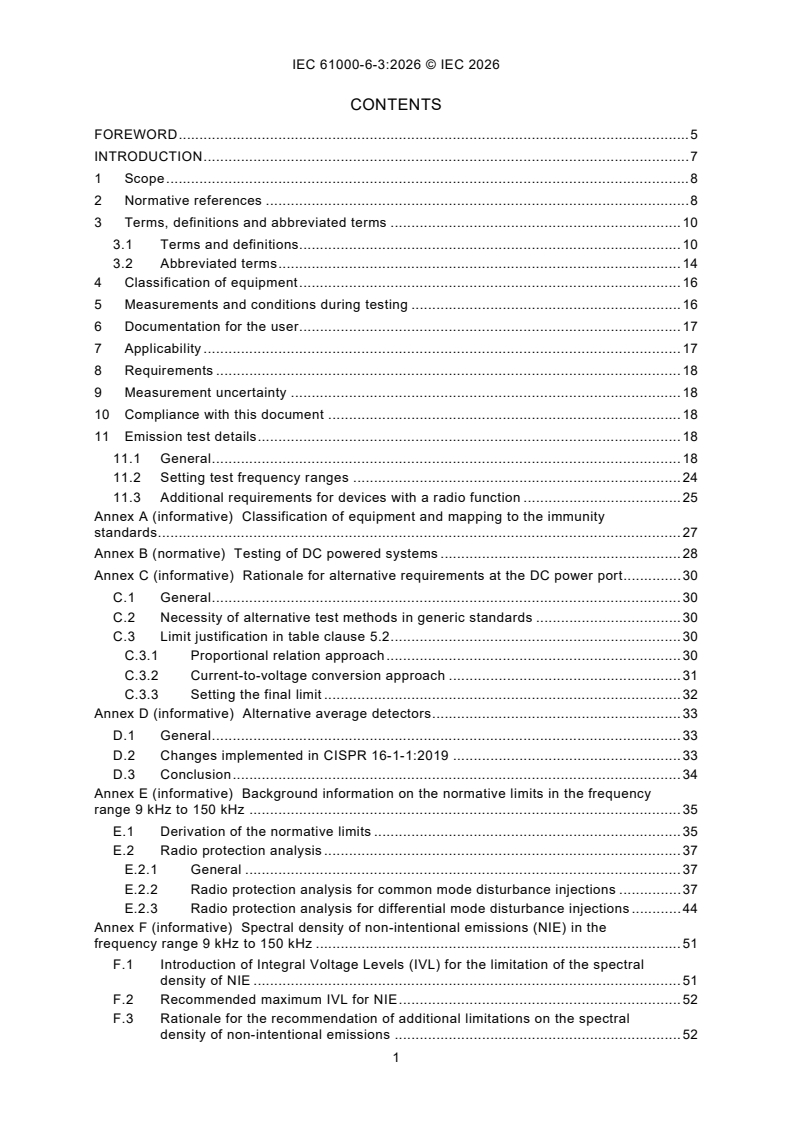
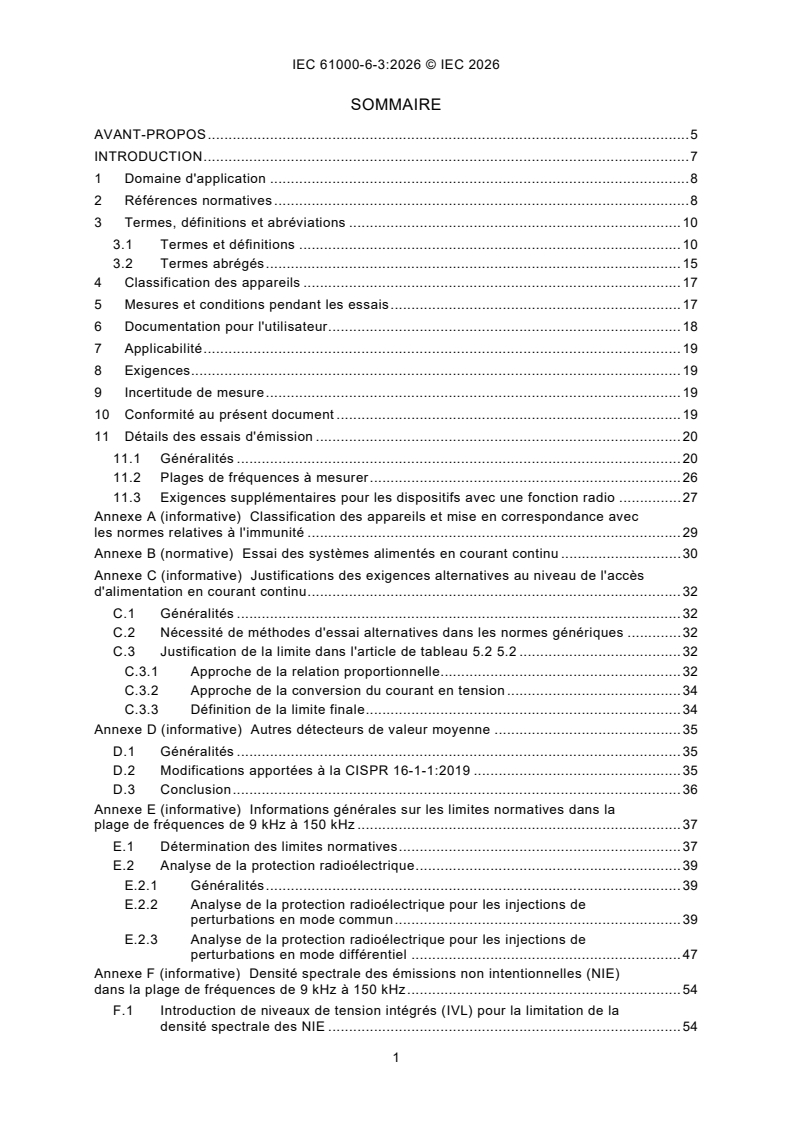
CONTENTS
FOREWORD . 5
INTRODUCTION . 7
1 Scope . 8
2 Normative references . 8
3 Terms, definitions and abbreviated terms . 10
3.1 Terms and definitions. 10
3.2 Abbreviated terms . 14
4 Classification of equipment . 16
5 Measurements and conditions during testing . 16
6 Documentation for the user. 17
7 Applicability . 17
8 Requirements . 18
9 Measurement uncertainty . 18
10 Compliance with this document . 18
11 Emission test details . 18
11.1 General . 18
11.2 Setting test frequency ranges . 24
11.3 Additional requirements for devices with a radio function . 25
Annex A (informative) Classification of equipment and mapping to the immunity
standards . 27
Annex B (normative) Testing of DC powered systems . 28
Annex C (informative) Rationale for alternative requirements at the DC power port . 30
C.1 General . 30
C.2 Necessity of alternative test methods in generic standards . 30
C.3 Limit justification in table clause 5.2 . 30
C.3.1 Proportional relation approach . 30
C.3.2 Current-to-voltage conversion approach . 31
C.3.3 Setting the final limit . 32
Annex D (informative) Alternative average detectors . 33
D.1 General . 33
D.2 Changes implemented in CISPR 16-1-1:2019 . 33
D.3 Conclusion . 34
Annex E (informative) Background information on the normative limits in the frequency
range 9 kHz to 150 kHz . 35
E.1 Derivation of the normative limits . 35
E.2 Radio protection analysis . 37
E.2.1 General . 37
E.2.2 Radio protection analysis for common mode disturbance injections . 37
E.2.3 Radio protection analysis for differential mode disturbance injections . 44
Annex F (informative) Spectral density of non-intentional emissions (NIE) in the
frequency range 9 kHz to 150 kHz . 51
F.1 Introduction of Integral Voltage Levels (IVL) for the limitation of the spectral
density of NIE . 51
F.2 Recommended maximum IVL for NIE . 52
F.3 Rationale for the recommendation of additional limitations on the spectral
density of non-intentional emissions . 52
F.3.1 Rationale . 52
F.3.2 Relationship between MCE performances and Integral Voltage Levels . 53
Annex G (informative) Rationale for radiated magnetic field emissions requirements . 58
Annex H (informative) Possible limits for radiated magnetic field emissions for EUT
with the potential to produce disturbing electromagnetic fields . 59
Annex I (informative) The conversion factor for magnetic emissions limits below
30 MHz . 61
I.1 General . 61
I.2 Considerations . 63
I.3 Summary . 66
Annex J (informative) Magnetic field emission limit correction based upon power . 68
J.1 General . 68
J.2 Limits . 68
Bibliography . 69
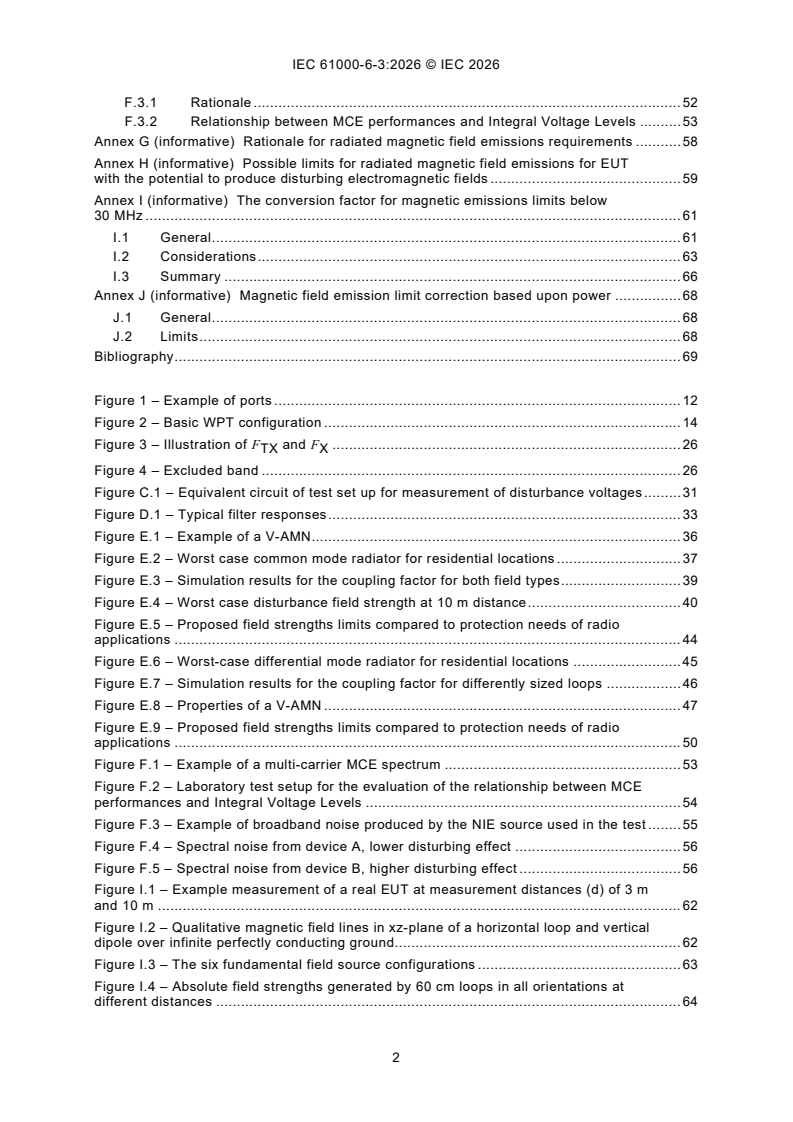
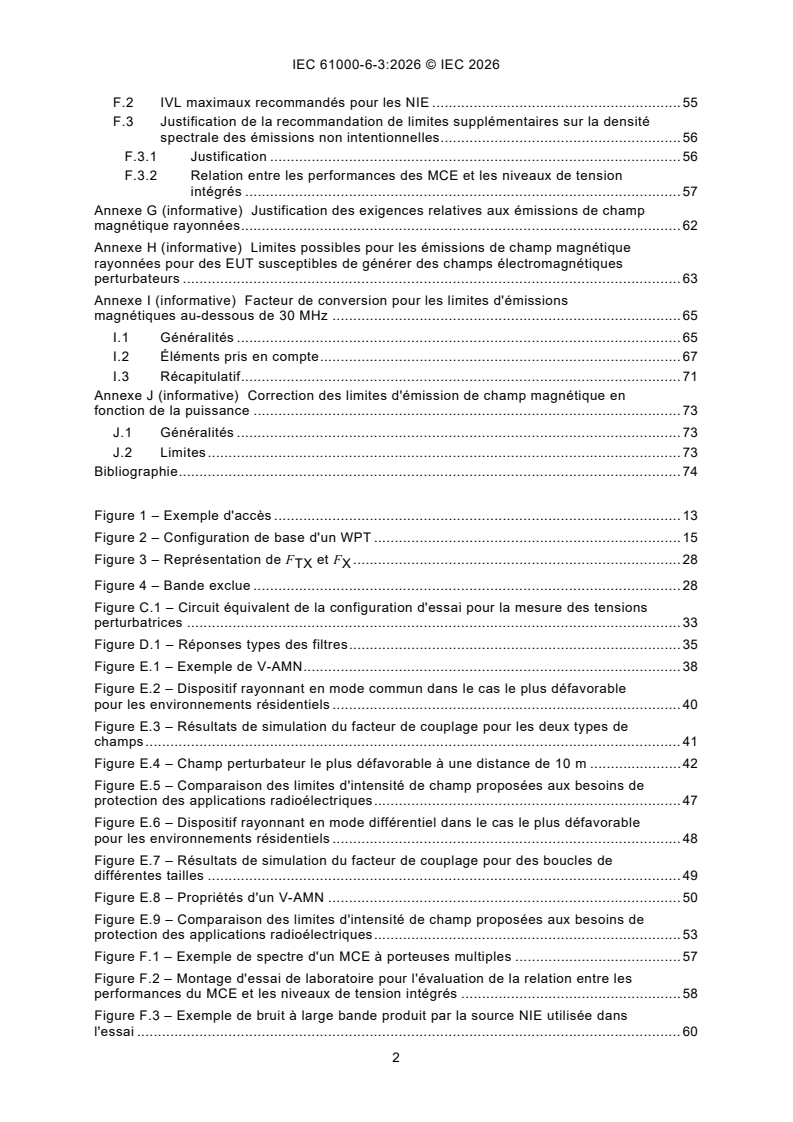
Figure 1 – Example of ports . 12
Figure 2 – Basic WPT configuration . 14
Figure 3 – Illustration of F and F . 26
TX X
Figure 4 – Excluded band . 26
Figure C.1 – Equivalent circuit of test set up for measurement of disturbance voltages . 31
Figure D.1 – Typical filter responses . 33
Figure E.1 – Example of a V-AMN . 36
Figure E.2 – Worst case common mode radiator for residential locations . 37
Figure E.3 – Simulation results for the coupling factor for both field types . 39
Figure E.4 – Worst case disturbance field strength at 10 m distance . 40
Figure E.5 – Proposed field strengths limits compared to protection needs of radio
applications . 44
Figure E.6 – Worst-case differential mode radiator for residential locations . 45
Figure E.7 – Simulation results for the coupling factor for differently sized loops . 46
Figure E.8 – Properties of a V-AMN . 47
Figure E.9 – Proposed field strengths limits compared to protection needs of radio
applications . 50
Figure F.1 – Example of a multi-carrier MCE spectrum . 53
Figure F.2 – Laboratory test setup for the evaluation of the relationship between MCE
performances and Integral Voltage Levels . 54
Figure F.3 – Example of broadband noise produced by the NIE source used in the test . 55
Figure F.4 – Spectral noise from device A, lower disturbing effect . 56
Figure F.5 – Spectral noise from device B, higher disturbing effect . 56
Figure I.1 – Example measurement of a real EUT at measurement distances (d) of 3 m
and 10 m . 62
Figure I.2 – Qualitative magnetic field lines in xz-plane of a horizontal loop and vertical
dipole over infinite perfectly conducting ground. 62
Figure I.3 – The six fundamental field source configurations . 63
Figure I.4 – Absolute field strengths generated by 60 cm loops in all orientations at
different distances . 64
Figure I.5 – Absolute field strengths generated by 80 cm dipoles in all orientations at
different distances . 64
Figure I.6 – Conversion factors for dominant coupling . 65
Figure I.7 – Derivation of the final conversion factor using dominant coupling for EUTs
described in I.1 . 66
Figure I.8 – Conversion factor from a distance of 3 m to 10 m, in the frequency
range 150 kHz to 30 MHz (CF ) . 67
3 m to 10 m
Table 1 – Test arrangements of EUT . 17
Table 2 – Requirements for radiated electric field emissions, enclosure port . 20
Table 3 – Requirements for radiated magnetic field emissions, enclosure port . 21
Table 4 – Requirements for conducted emissions, low-voltage AC mains port . 22
Table 5 – Requirements for conducted emissions, DC power port . 23
Table 6 – Requirements for conducted emissions, other wired ports . 24
Table 7 – Required highest frequency for radiated electric field emission
measurements for EUT containing at least one active radio transmitter that is
transmitting . 25
Table 8 – Required highest frequency for radiated electric field emission
measurements for EUT not containing at least one active radio transmitter that is
transmitting . 25
Table A.1 – Examples of emission and immunity requirements against product type
and intended use . 27
Table B.1 – Conducted emission requirements of DC powered equipment . 28
Table B.2 – Conditional requirements for the start frequency of test at DC power ports
for tests defined in table clause B1.4 to B1.7 . 29
Table C.1 – DC power port, terminal disturbance voltage limits for class B GCPCs,
measured on a test site, proportion relation approach . 31
Table C.2 – DC power port, terminal disturbance voltage limits for class B GCPCs,
measured on a test site, current-to-voltage conversion approach . 32
Table D.1 – Updated tolerances . 33
Table E.1 – Simulation results for the coupling factor for both field types . 38
Table E.2 – Worst case disturbance field strength at 10 m distance . 40
Table E.3 – Probability factors and respective rationales . 41
Table E.4 – Calculations of the required field strength limit . 43
Table E.5 – Calculations of the required field strength limit . 46
Table E.6 – Conversion from voltage limit to current limit for injection . 47
Table E.7 – Disturbance field strength calculation for 20 cm and 50 cm loops . 48
Table E.8 – Disturbance field strength calculation for 100 cm loop . 49
Table F.1 – Recommended maximum Integral Voltage Levels . 52
Table F.2 – Recommended maximum Integral Voltage Levels for equipment covered by
a
footnote to Table 4 . 52
Table F.3 – Correlation between MCE’s noise assessment and Integral Voltage Levels
computed in the MCE’s operating frequency ranges . 55
Table F.4 – Correlation between IVLs and MCE communication performance . 56
Table H.1 – Proposed limits for radiated magnetic field emissions, enclosure port . 60
Table I.1 – Conversion factor from a distance of 3 m to 10 m in the frequency range
150 kHz to 30 MHz (CF ) . 67
3 m to 10 m
Table J.1 – Proposed reduction to the limits . 68
INTERNATIONAL ELECTROTECHNICAL COMMISSION
____________
Electromagnetic compatibility (EMC) -
Part 6-3: Generic standards -
Emission standard for equipment in residential locations
FOREWORD
1) The International Electrotechnical Commission (IEC) is a worldwide organization for standardization comprising
all national electrotechnical committees (IEC National Committees). The object of IEC is to promote international
co-operation on all questions concerning standardization in the electrical and electronic fields. To this end and
in addition to other activities, IEC publishes International Standards, Technical Specifications, Technical Reports,
Publicly Available Specifications (PAS) and Guides (hereafter referred to as “IEC Publication(s)”). Their
preparation is entrusted to technical committees; any IEC National Committee interested in the subject dealt with
may participate in this preparatory work. International, governmental and non-governmental organizations liaising
with the IEC also participate in this preparation. IEC collaborates closely with the International Organization for
Standardization (ISO) in accordance with conditions determined by agreement between the two organizations.
2) The formal decisions or agreements of IEC on technical matters express, as nearly as possible, an international
consensus of opinion on the relevant subjects since each technical committee has representation from all
interested IEC National Committees.
3) IEC Publications have the form of recommendations for international use and are accepted by IEC National
Committees in that sense. While all reasonable efforts are made to ensure that the technical content of IEC
Publications is accurate, IEC cannot be held responsible for the way in which they are used or for any
misinterpretation by any end user.
4) In order to promote international uniformity, IEC National Committees undertake to apply IEC Publications
transparently to the maximum extent possible in their national and regional publications. Any divergence between
any IEC Publication and the corresponding national or regional publication shall be clearly indicated in the latter.
5) IEC itself does not provide any attestation of conformity. Independent certification bodies provide conformity
assessment services and, in some areas, access to IEC marks of conformity. IEC is not responsible for any
services carried out by independent certification bodies.
6) All users should ensure that they have the latest edition of this publication.
7) No liability shall attach to IEC or its directors, employees, servants or agents including individual experts and
members of its technical committees and IEC National Committees for any personal injury, property damage or
other damage of any nature whatsoever, whether direct or indirect, or for costs (including legal fees) and
expenses arising out of the publication, use of, or reliance upon, this IEC Publication or any other IEC
Publications.
8) Attention is drawn to the Normative references cited in this publication. Use of the referenced publications is
indispensable for the correct application of this publication.
9) IEC draws attention to the possibility that the implementation of this document may involve the use of (a)
patent(s). IEC takes no position concerning the evidence, validity or applicability of any claimed patent rights in
respect thereof. As of the date of publication of this document, IEC had not received notice of (a) patent(s), which
may be required to implement this document. However, implementers are cautioned that this may not represent
the latest information, which may be obtained from the patent database available at https://patents.iec.ch. IEC
shall not be held responsible for identifying any or all such patent rights.
IEC 61000-6-3 has been prepared by CISPR subcommittee H: Limits for the protection of radio
services. It is an International Standard.
This fourth edition cancels and replaces the third edition published in 2020. This edition
constitutes a technical revision.
This edition includes the following significant technical changes with respect to the previous
edition:
a) the addition of magnetic field emission requirements, including the measurement of WPT
function;
b) the extension of low-voltage AC mains power requirements to cover the range 9 kHz to
150 kHz;
c) products with a radio function have been added to the scope;
d) limits in a FAR for rack mounted equipment have been added.
The text of this document is based on the following documents:
Draft Report on voting
CIS/H/547/FDIS CIS/H/557/RVD
Full information on the voting for the approval of this document can be found in the report on
voting indicated in the above table.
The language used for the development of this International Standard is English.
This document has been drafted in accordance with the ISO/IEC Directives, Part 2, and
developed in accordance with ISO/IEC Directives, Part 1 and ISO/IEC Directives, IEC
Supplement, available at www.iec.ch/members_experts/refdocs. The main document types
developed by IEC are described in greater detail at www.iec.ch/publications.
A list of all parts in the IEC 61000 series, published under the general title Electromagnetic
compatibility (EMC), can be found on the IEC website.
The committee has decided that the contents of this document will remain unchanged until the
stability date indicated on the IEC website under webstore.iec.ch in the data related to the
specific document. At this date, the document will be
– reconfirmed,
– withdrawn, or
– revised.
INTRODUCTION
IEC 61000 is published in separate parts according to the following structure:
Part 1: General
General considerations (introduction, fundamental principles)
Definitions, terminology
Part 2: Environment
Description of the environment
Classification of the environment
Compatibility levels
Part 3: Limits
Emission limits
Immunity limits (insofar as they do not fall under the responsibility of the product
committees)
Part 4: Testing and measurement techniques
Measurement techniques
Testing techniques
Part 5: Installation and mitigation guidelines
Installation guidelines
Mitigation methods and devices
Part 6: Generic standards
Part 9: Miscellaneous
Each part is further subdivided into several parts published either as International Standards,
technical reports or technical specifications. These are published as sections. Others will be
published with the part number followed by a dash and a second number identifying the
subdivision (example: IEC 61000-6-1).
1 Scope
This generic EMC emission standard is applicable only if no relevant dedicated product or
product family EMC emission standard has been published.
This part of IEC 61000 for emission requirements applies to electrical and electronic equipment
intended for use at residential (see 3.1.21) locations. This part of IEC 61000 also applies to
electrical and electronic equipment intended for use at other locations that do not fall within the
scope of IEC 61000-6-8 or IEC 61000-6-4.
The intention is that all equipment used in the residential, commercial and light-industrial
locations are covered by IEC 61000-6-3 or IEC 61000-6-8. If there is any doubt the
requirements in IEC 61000-6-3 apply.
Equipment that have a radio function (3.1.20) are included in the scope of this document.
However, the emission requirements in this document are not intended to be applicable to the
intentional transmissions from these radio transmitters, their harmonics and their out of band
emissions.
Not all disturbance phenomena have been included for testing purposes but only those
considered relevant for the equipment intended to operate within the locations included within
this document.
The objectives of this document are:
a) to establish requirements that provide an adequate level of protection of radio reception in
the frequency range 9 kHz to 400 GHz;
b) to establish requirements that provide an adequate level of protection against conducted
and radiated electromagnetic disturbances emitted by equipment in the scope of this
document;
c) to support the reproducibility of measurement and the repeatability of results.
NOTE 1 In special cases, situations will arise where the levels specified in this document will not offer adequate
protection; for example, where a sensitive receiver is used in close proximity to an equipment. In these instances,
special mitigation measures can be employed.
NOTE 2 Disturbances generated in fault conditions of equipment are not covered by this document.
NOTE 3 The requirements in this document are more stringent or equivalent to the requirements specified in
IEC 61000-6-4 and IEC 61000-6-8.
2 Normative references
The following documents are referred to in the text in such a way that some or all of their content
constitutes requirements of this document. For dated references, only the edition cited applies.
For undated references, the latest edition of the referenced document (including any
amendments) applies.
IEC 61000-3-2:2018, Electromagnetic compatibility (EMC) - Part 3-2: Limits - Limits for
harmonic current emissions (equipment input current ≤ 16 A per phase)
IEC 61000-3-2:2018/AMD1:2020
IEC 61000-3-2:2018/AMD2:2024
IEC 61000-3-3:2013, Electromagnetic compatibility (EMC) - Part 3-3: Limits - Limitation of
voltage changes, voltage fluctuations and flicker in public low-voltage supply systems, for
equipment with rated current ≤ 16 A per phase and not subject to conditional connection
IEC 61000-3-3:2013/AMD1:2017
IEC 61000-3-3:2013/AMD2:2021
IEC 61000-3-11:2017, Electromagnetic compatibility (EMC) - Part 3-11: Limits - Limitation of
voltage changes, voltage fluctuations and flicker in public low-voltage supply systems -
Equipment with rated current ≤ 75 A and subject to conditional connection
IEC 61000-3-12:2011, Electromagnetic compatibility (EMC) - Part 3-12: Limits - Limits for
harmonic currents produced by equipment connected to public low-voltage systems with input
current > 16 A and ≤ 75 A per phase
IEC 61000-3-12:2011/AMD1:2021
IEC 61000-4-20:2022, Electromagnetic compatibility (EMC) - Part 4-20: Testing and
measurement techniques - Emission and immunity testing in transverse electromagnetic (TEM)
waveguides
CISPR 14-1:2020, Electromagnetic compatibility - Requirements for household appliances,
electric tools and similar apparatus - Part 1: Emission
CISPR 16-1-1:2019, Specification for radio disturbance and immunity measuring apparatus and
methods - Part 1-1: Radio disturbance and immunity measuring apparatus - Measuring
apparatus
CISPR 16-1-1:2010, Specification for radio disturbance and immunity measuring apparatus and
methods - Part 1-1: Radio disturbance and immunity measuring apparatus - Measuring
apparatus
CISPR 16-1-1:2010/AMD1:2010
CISPR 16-1-1:2010/AMD2:2014
CISPR 16-1-2:2014, Specification for radio disturbance and immunity measuring apparatus and
methods - Part 1-2: Radio disturbance and immunity measuring apparatus - Coupling devices
for conducted disturbance measurements
CISPR 16-1-2:2014/AMD1:2017
CISPR 16-1-4:2019, Specification for radio disturbance and immunity measuring apparatus and
methods - Part 1-4: Radio disturbance and immunity measuring apparatus - Antennas and test
sites for radiated disturbance measurements
CISPR 16-1-4:2019/AMD1:2020
CISPR 16-1-4:2019/AMD2:2023
CISPR 16-1-5:2014, Specification for radio disturbance and immunity measuring apparatus and
methods - Part 1-5: Radio disturbance and immunity measuring apparatus - Antenna calibration
sites and reference test sites for 5 MHz to 18 GHz
CISPR 16-1-5:2014/AMD1:2016
CISPR 16-1-6:2014, Specification for radio disturbance and immunity measuring apparatus and
methods - Part 1-6: Radio disturbance and immunity measuring apparatus - EMC antenna
calibration
CISPR 16-1-6:2014/AMD1:2017
CISPR 16-1-6:2014/AMD2:2022
CISPR 16-2-1:2014, Specification for radio disturbance and immunity measuring apparatus and
methods - Part 2-1: Methods of measurement of disturbances and immunity - Conducted
disturbance measurements
CISPR 16-2-1:2014/AMD1:2017
___________
This version has been superseded.
CISPR 16-2-3:2016, Specification for radio disturbance and immunity measuring apparatus and
methods - Part 2-3: Methods of measurement of disturbances and immunity - Radiated
disturbance measurements
CISPR 16-2-3:2016/AMD1:2019
CISPR 16-2-3:2016/AMD2:2023
CISPR 16-4-2:2011, Specification for radio disturbance and immunity measuring apparatus and
methods - Part 4-2: Uncertainties, statistics and limit modelling - Measurement instrumentation
uncertainty
CISPR 16-4-2:2011/AMD1:2014
CISPR 16-4-2:2011/AMD2:2018
CISPR 32:2015, Electromagnetic compatibility of multimedia equipment - Emission
requirements
CISPR 32:2015/AMD1:2019
3 Terms, definitions and abbreviated terms
3.1 Terms and definitions
For the purposes of this document, the following terms and definitions apply.
ISO and IEC maintain terminological databases for use in standardization at the following
addresses:
– IEC Electropedia: available at http://www.electropedia.org/
– ISO Online browsing platform: available at http://www.iso.org/obp
3.1.1
adjustable speed electric power drive function
power drive system function that provides adjustable speed AC or DC motor drives and can
convert input voltages (line-to-line) to other voltages
3.1.2
antenna port
port, other than a broadcast receiver tuner port (3.1.4), for connection of an antenna used for
intentional transmission, reception of radiated RF energy
3.1.3
associated equipment
AE
equipment needed to exercise, monitor or to exercise and monitor the operation of the EUT
Note 1 to entry: The AE can be either local (within the measurement or test area) or remote.
3.1.4
broadcast receiver tuner port
port intended for the reception of a modulated RF signal carrying terrestrial, satellite or cable
transmissions of audio broadcast, video broadcast and similar services
Note 1 to entry: This port can be connected to an antenna, a cable distribution system, a VCR or similar device.
3.1.5
DC distribution network
local supply network in the infrastructure of a site or building intended for use by one or more
different types of equipment and providing power independent of the public mains network
Note 1 to entry: Connection to a remote local battery is not regarded as a DC distribution network, if such a link
comprises only power supply for a single piece of equipment.
3.1.6
DC power port
port used to connect to a low-voltage DC power generating system, energy storage or DC
distribution network to power the equipment
Note 1 to entry: See Annex B.
3.1.7
enclosure port
physical boundary of the equipment which electromagnetic fields can radiate through or impinge
on
3.1.8
highest internal frequency
F
x
highest fundamental frequency generated or used within the EUT, or the highest frequency at
which it operates, whichever is the greater
Note 1 to entry: This includes fundamental frequencies which are solely used within an integrated circuit.
Note 2 to entry: This excludes the frequencies generated or used intentionally by a radio function (3.1.20).
3.1.9
low-voltage
voltage having a value below a conventionally adopted limit
Note 1 to entry: For the distribution of AC electric power, the upper limit is generally accepted to be 1 000 V. For
the distribution of DC electric power, the upper limit is generally accepted to be 1 500 V.
3.1.10
low-voltage AC mains port
port used to connect to the low-voltage (3.1.9) AC mains supply network to power the equipment
Note 1 to entry: Equipment with a DC power port is considered low-voltage AC mains powered if it is powered from
an AC/DC power converter.
Note 2 to entry: The low-voltage AC mains supply could be public or non-public.
3.1.11
necessary bandwidth
for a given class of emission, the width of the frequency band which is just sufficient to ensure
the transmission of information at the rate and with the quality required under specified
conditions
[SOURCE: ITU Radio Regulations (2020), 1.152]
3.1.12
optical fibre port
port at which an optical fibre is connected to an equipment
3.1.13
out-of-band emission
emission on a frequency or frequencies immediately outside the necessary bandwidth which
results from the modulation process, but excluding spurious emissions
Note 1 to entry: In terms of this definition, “immediately outside” means “adjacent to”.
[SOURCE: ITU Radio Regulations (2020), 1.144, modified – Addition of Note 1 to entry.]
3.1.14
plasma screen
display that uses small cells containing plasma, an ionized gas that responds to electric fields
to create light
3.1.15
port
physical interface of the specified equipment with the external electromagnetic environment
Note 1 to entry: See Figure 1.
Note 2 to entry: Examples of ‘Other wired port’ shown in Figure 1 are specified in Table 6.
Figure 1 – Example of ports
3.1.16
power port
port for the connection of the equipment to its primary electrical power supply
3.1.17
primary function
any function of an EUT considered essential for the user or for the majority of users
Note 1 to entry: An EUT can have more than one primary function. For example, the primary functions of a basic
television set include broadcast reception, audio reproduction and display.
3.1.18
primary WPT port
port through which power is transferred wirelessly to equipment with one or more secondary
WPT ports
3.1.19
public mains network
electricity lines to which all categories of consumers have access and which are operated by a
supply or distribution undertaking for the purpose of supplying electrical energy
3.1.20
radio function
function that includes radio reception or radio transmission or both
3.1.21
residential location
area of land designated for domestic dwellings where the mains power within these locations is
directly connected to the low-voltage public mains network
Note 1 to entry: Examples of residential locations are: houses, apartments, farm buildings housing people.
Note 2 to entry: A dwelling can be a single building, separate building or a separate section of a larger building.
Note 3 to entry: Within these locations, it is expected to operate a radio receiver within a distance of 10 m from the
equipment.
Note 4 to entry: Domestic dwellings are places for one or more people to live.
3.1.22
secondary WPT port
port through which power is received from another equipment with a primary WPT port
Note 1 to entry: The secondary device can either store or directly use the received energy, or both.
3.1.23
spurious emission
emission on a frequency or frequencies which are outside the necessary bandwidth and the
level of which can be reduced without affecting the corresponding transmission of information
Note 1 to entry: Spurious emissions include harmonic emissions, parasitic emissions, intermodulation products and
frequency conversion products, but exclude out-of-band emissions.
[SOURCE: ITU Radio Regulations (2020), 1.145, modified – The second sentence was
formatted as a note to entry.]
3.1.24
UPS function
Uninterruptible Power Systems function
power supply function, that provides power during unintentional AC mains power supply
interruptions
3.1.25
wired network port
port for the connection of communication intended to interconnect widely dispersed systems by
direct connection to a single-user or multi-user network
Note 1 to entry: Examples of communication through the network include voice, data and signalling transfers.
Note 2 to entry: Examples of these networks include CATV, PSTN, ISDN, xDSL, LAN and similar.
Note 3 to entry: These ports can support screened or unscreened cables and can also carry AC or DC power where
this is an integral part of the telecommunication specification.
Note 4 to entry: A port generally intended for interconnection of components of a system under test (e.g. RS-232
(defined in ITU-T V.28), RS-485 (defined in ITU-T V.11), field buses in the scope of IEC 61158-1, IEEE Standard
1284 (parallel printer), Universal Serial Bus (USB), IEEE Standard 1394 (“Fire Wire”), etc.) and used in accordance
with its functional specifications (e.g. for the maximum length of cable connected to it), is not considered to be a
wired network port.
Note 5 to entry: In previous editions of this document and many product standards, this port was defined as a
telecommunications or network port.
3.1.26
wireless power transfer
WPT
transfer of electrical energy between equipment, not galvanically connected, through a primary
WPT port (3.1.18) to a secondary WPT port (3.1.22)
Note 1 to entry: WPT can use a variety of coupling methods including inductive, capacitive, and electromagnetic
coupling technologies. The method of energy transfer uses any combination of electric fields, magnetic fields or
electromagnetic fields.
Note 2 to entry: Equipment with a primary WPT port (3.1.18) can be able to provide power to more than one
equipment with a secondary WPT port (3.1.22).
Note 3 to entry: See Figure 2.
Figure 2 – Basic WPT configuration
3.2 Abbreviated terms
AAN Asymmetric Artificial Network
AC Alternating Current
ACEC Advisory Committee on Electromagnetic Compatibility
AE Associated Equipment
V-AMN Artificial Mains V-Network
V-AN Artificial V-Network
AP Allowance Probability
AV Average
BPSK Binary Phase-Shift Keying
CATV Cable TV network
CALTS Calibration Test Site
CF Coupling Factor
CF(E) Electric field Coupling Factor
CF(H) Magnetic field Coupling Factor
CM Common Mode
CMAD Common Mode Absorption Device (including those defined in CISPR 16-1-4)
DC Direct Current
DC-AN Direct Current-Artificial Network
DM Differential Mode
DSL Digital Subscriber Line
DVR Digital Video Recorder
EUT Equipment Under Test
FAR Fully Anechoic Room
FREQ Frequency
FS Field Strength
FSFI Free Space Field Impedance
FSOATS Free Space Open Area Test Site
FSK Frequency-Shift Keying
GCPC Grid-Connected Power Converter
IEC International Electrotechnical Commission
IEEE Institute of Electrical and Electronics Engineers
ISDN Integrated Services Digital Network
ISM Industrial, Scientific and Medical
ITE Information Technology Equipment
ITU International Telecommunication Union
IVL Integral Voltage Level
LAN Local Area Network
LED Light Emitting Diode
LF Low Frequency
MCE Mains Communicating Equipment
MCS Mains Communicating System
MID Middle of the band
MME Multi Media Equipment
NEC2 Numerical Electromagnetics Code 2
NIE Non-Intentional Emission
OATS Open Area Test Site
OFDM Orthogonal Frequency-Division Multiplexing
PR Protection Ratio
PSTN Public Switched Telephone Network
QP Quasi-Peak
RF Radio Frequency
SAC Semi Anechoic Chamber
SC SubCommittee
SSM Standard Site Method
TC Table Clause
TEM Transverse Electromagnetic Mode
TV Television
USB Universal Serial Bus
UPS Uninterruptible Power Systems
VLF Very Low Frequency
WPT Wireless Power Transfer
xDSL Generic term for all types of DSL technology
Δ-AN Artificial Δ-Network (‘Δ’ is pronounced ‘delta’)
4 Classification of equipment
For equipment within the scope of this document the requirements of Table 2 to Table 6 apply.
These requirements are intended to offer adequate protection to radio services within
residential locations.
NOTE Examples of the emission classification of equipment and mapping to the immunity standards is given in
Annex A.
5 Measurements and conditions during testing
Measurements shall be conducted in a defined and reproducible manner.
The measurements may be performed in any order.
The description of the measurement, the measurement instrumentation, the measurement
methods and the measurement set-up to be used are given in the standards, referred to in
Table 2 to Table 6. The contents of these standards are not repeated here, however
modifications or additional information needed for the practical application of the measurements
are given in this document.
All aspects of testing the EUT shall be defined and documented in a test plan prior to testing.
This requirement includes, but is not limited to, the following details: EUT configuration, EUT
modes of operation, EUT highest internal frequency (see 3.1.8), EUT arrangement (see Table 1).
These details as a minimum shall be included in the test report.
The EUT shall be tested in the operating mode expected to produce the largest emission in the
frequency band being assessed, consistent with intended use. When testing an EUT with a
radio function that includes a transmitter, this transmitter shall be active in at least one test
configuration. The configurations of the test sample shall be varied with the aim to achieve
maximum emission consistent with typical use and installation practice.
When testing a EUT with a radio fun
...
IEC 61000-6-3 ®
Edition 4.0 2026-04
INTERNATIONAL
STANDARD
REDLINE VERSION
INTERNATIONAL SPECIAL COMMITTEE ON RADIO INTERFERENCE
HORIZONTAL PUBLICATION
GENERIC EMC STANDARD
Electromagnetic compatibility (EMC) -
Part 6-3: Generic standards - Emission standard for equipment in residential
environments locations
ICS 33.100.10 ISBN 978-2-8327-1196-5
All rights reserved. Unless otherwise specified, no part of this publication may be reproduced or utilized in any form or
by any means, electronic or mechanical, including photocopying and microfilm, without permission in writing from either
IEC or IEC's member National Committee in the country of the requester. If you have any questions about IEC copyright
or have an enquiry about obtaining additional rights to this publication, please contact the address below or your local
IEC member National Committee for further information.
IEC Secretariat Tel.: +41 22 919 02 11
3, rue de Varembé info@iec.ch
CH-1211 Geneva 20 www.iec.ch
Switzerland
About the IEC
The International Electrotechnical Commission (IEC) is the leading global organization that prepares and publishes
International Standards for all electrical, electronic and related technologies.
About IEC publications
The technical content of IEC publications is kept under constant review by the IEC. Please make sure that you have the
latest edition, a corrigendum or an amendment might have been published.
IEC publications search - IEC Products & Services Portal - products.iec.ch
webstore.iec.ch/advsearchform Discover our powerful search engine and read freely all the
The advanced search enables to find IEC publications by a publications previews, graphical symbols and the glossary.
variety of criteria (reference number, text, technical With a subscription you will always have access to up to date
committee, …). It also gives information on projects, content tailored to your needs.
replaced and withdrawn publications.
Electropedia - www.electropedia.org
IEC Just Published - webstore.iec.ch/justpublished The world's leading online dictionary on electrotechnology,
Stay up to date on all new IEC publications. Just Published containing more than 22 500 terminological entries in English
details all new publications released. Available online and and French, with equivalent terms in 25 additional languages.
once a month by email. Also known as the International Electrotechnical Vocabulary
(IEV) online.
IEC Customer Service Centre - webstore.iec.ch/csc
If you wish to give us your feedback on this publication or
need further assistance, please contact the Customer
Service Centre: sales@iec.ch.
CONTENTS
FOREWORD . 5
INTRODUCTION . 7
1 Scope . 8
2 Normative references . 8
3 Terms, definitions and abbreviated terms . 10
3.1 Terms and definitions. 10
3.2 Abbreviated terms . 10
4 Classification of equipment . 15
5 Measurements and conditions during testing . 17
6 Documentation for the user. 18
7 Applicability . 19
8 Requirements . 19
9 Measurement uncertainty . 19
10 Compliance with this document . 19
11 Emission test details . 20
11.1 General . 20
11.2 Setting test frequency ranges . 26
11.3 Additional requirements for devices with a radio function . 27
Annex A (informative) Classification of equipment and mapping to the immunity
standards . 29
Annex B (normative) Testing of DC powered systems . 30
Annex C (informative) Rationale for alternative test levels requirements at the DC
power port . 32
C.1 General . 32
C.2 Necessity of alternative test methods in generic standards . 32
C.3 Limit justification in table clause 5.2 . 32
C.3.1 Proportional relation approach . 32
C.3.2 Current-to-voltage conversion approach . 33
C.3.3 Setting the final limit . 34
Annex D (informative) Alternative average detectors . 35
D.1 General . 35
D.2 Changes implemented in CISPR 16-1-1:2019 . 35
D.3 Conclusion . 36
Annex E (informative) Background information on the normative limits in the frequency
range 9 kHz to 150 kHz . 37
E.1 Derivation of the normative limits . 37
E.2 Radio protection analysis . 39
E.2.1 General . 39
E.2.2 Radio protection analysis for common mode disturbance injections . 39
E.2.3 Radio protection analysis for differential mode disturbance injections . 46
Annex F (informative) Spectral density of non-intentional emissions (NIE) in the
frequency range 9 kHz to 150 kHz . 53
F.1 Introduction of Integral Voltage Levels (IVL) for the limitation of the spectral
density of NIE . 53
F.2 Recommended maximum IVL for NIE . 54
F.3 Rationale for the recommendation of additional limitations on the spectral
density of non-intentional emissions . 54
F.3.1 Rationale . 54
F.3.2 Relationship between MCE performances and Integral Voltage Levels . 55
Annex G (informative) Rationale for radiated magnetic field emissions requirements . 60
Annex H (informative) Possible limits for radiated magnetic field emissions for EUT
with the potential to produce disturbing electromagnetic fields . 61
Annex I (informative) The conversion factor for magnetic emissions limits below
30 MHz . 63
I.1 General . 63
I.2 Considerations . 65
I.3 Summary . 68
Annex J (informative) Magnetic field emission limit correction based upon power . 70
J.1 General . 70
J.2 Limits . 70
Bibliography . 71
Figure 1 – Example of ports . 13
Figure 2 – Basic WPT configuration . 15
Figure 3 – Illustration of F and F . 28
TX X
Figure 4 – Excluded band . 28
Figure C.1 – Equivalent circuit of test set up for measurement of disturbance voltages . 33
Figure D.1 – Typical filter responses . 35
Figure E.1 – Example of a V-AMN . 38
Figure E.2 – Worst case common mode radiator for residential locations . 39
Figure E.3 – Simulation results for the coupling factor for both field types . 41
Figure E.4 – Worst case disturbance field strength at 10 m distance . 42
Figure E.5 – Proposed field strengths limits compared to protection needs of radio
applications . 46
Figure E.6 – Worst-case differential mode radiator for residential locations . 47
Figure E.7 – Simulation results for the coupling factor for differently sized loops . 48
Figure E.8 – Properties of a V-AMN . 49
Figure E.9 – Proposed field strengths limits compared to protection needs of radio
applications . 52
Figure F.1 – Example of a multi-carrier MCE spectrum . 55
Figure F.2 – Laboratory test setup for the evaluation of the relationship between MCE
performances and Integral Voltage Levels . 56
Figure F.3 – Example of broadband noise produced by the NIE source used in the test . 57
Figure F.4 – Spectral noise from device A, lower disturbing effect . 58
Figure F.5 – Spectral noise from device B, higher disturbing effect . 58
Figure I.1 – Example measurement of a real EUT at measurement distances (d) of 3 m
and 10 m . 64
Figure I.2 – Qualitative magnetic field lines in xz-plane of a horizontal loop and vertical
dipole over infinite perfectly conducting ground. 64
Figure I.3 – The six fundamental field source configurations . 65
Figure I.4 – Absolute field strengths generated by 60 cm loops in all orientations at
different distances . 66
Figure I.5 – Absolute field strengths generated by 80 cm dipoles in all orientations at
different distances . 66
Figure I.6 – Conversion factors for dominant coupling . 67
Figure I.7 – Derivation of the final conversion factor using dominant coupling for EUTs
described in I.1 . 68
Figure I.8 – Conversion factor from a distance of 3 m to 10 m, in the frequency
range 150 kHz to 30 MHz (CF ) . 69
3 m to 10 m
Table 1 – Test arrangements of EUT . 18
Table 2 – Required highest frequency for radiated measurement .
Table 32 – Requirements for radiated electric field emissions, enclosure port . 22
Table 3 – Requirements for radiated magnetic field emissions, enclosure port . 23
Table 4 – Requirements for conducted emissions, low-voltage AC mains port . 24
Table 5 – Requirements for conducted emissions, DC power port . 25
Table 6 – Requirements for conducted emissions, other wired ports . 26
Table 7 – Required highest frequency for radiated electric field emission
measurements for EUT containing at least one active radio transmitter that is
transmitting . 27
Table 8 – Required highest frequency for radiated electric field emission
measurements for EUT not containing at least one active radio transmitter that is
transmitting . 27
Table A.1 – Examples of emission and immunity requirements against product type
and intended use . 29
Table B.1 – Conducted emission requirements of DC powered equipment . 30
Table B.2 – Conditional requirements for the start frequency of test at DC power ports
for tests defined in table clause B1.4 to B1.7 . 31
Table C.1 – DC power port, terminal disturbance voltage limits for class B GCPCs,
measured on a test site, proportion relation approach . 33
Table C.2 – DC power port, terminal disturbance voltage limits for class B GCPCs,
measured on a test site, current-to-voltage conversion approach . 34
Table D.1 – Updated tolerances . 35
Table E.1 – Simulation results for the coupling factor for both field types . 40
Table E.2 – Worst case disturbance field strength at 10 m distance . 42
Table E.3 – Probability factors and respective rationales . 43
Table E.4 – Calculations of the required field strength limit . 45
Table E.5 – Calculations of the required field strength limit . 48
Table E.6 – Conversion from voltage limit to current limit for injection . 49
Table E.7 – Disturbance field strength calculation for 20 cm and 50 cm loops . 50
Table E.8 – Disturbance field strength calculation for 100 cm loop . 51
Table F.1 – Recommended maximum Integral Voltage Levels . 54
Table F.2 – Recommended maximum Integral Voltage Levels for equipment covered by
a
footnote to Table 4 . 54
Table F.3 – Correlation between MCE’s noise assessment and Integral Voltage Levels
computed in the MCE’s operating frequency ranges . 57
Table F.4 – Correlation between IVLs and MCE communication performance . 58
Table H.1 – Proposed limits for radiated magnetic field emissions, enclosure port . 62
Table I.1 – Conversion factor from a distance of 3 m to 10 m in the frequency range
150 kHz to 30 MHz (CF ) . 69
3 m to 10 m
Table J.1 – Proposed reduction to the limits . 70
INTERNATIONAL ELECTROTECHNICAL COMMISSION
____________
Electromagnetic compatibility (EMC) -
Part 6-3: Generic standards -
Emission standard for equipment in residential environments locations
FOREWORD
1) The International Electrotechnical Commission (IEC) is a worldwide organization for standardization comprising
all national electrotechnical committees (IEC National Committees). The object of IEC is to promote international
co-operation on all questions concerning standardization in the electrical and electronic fields. To this end and
in addition to other activities, IEC publishes International Standards, Technical Specifications, Technical Reports,
Publicly Available Specifications (PAS) and Guides (hereafter referred to as “IEC Publication(s)”). Their
preparation is entrusted to technical committees; any IEC National Committee interested in the subject dealt with
may participate in this preparatory work. International, governmental and non-governmental organizations liaising
with the IEC also participate in this preparation. IEC collaborates closely with the International Organization for
Standardization (ISO) in accordance with conditions determined by agreement between the two organizations.
2) The formal decisions or agreements of IEC on technical matters express, as nearly as possible, an international
consensus of opinion on the relevant subjects since each technical committee has representation from all
interested IEC National Committees.
3) IEC Publications have the form of recommendations for international use and are accepted by IEC National
Committees in that sense. While all reasonable efforts are made to ensure that the technical content of IEC
Publications is accurate, IEC cannot be held responsible for the way in which they are used or for any
misinterpretation by any end user.
4) In order to promote international uniformity, IEC National Committees undertake to apply IEC Publications
transparently to the maximum extent possible in their national and regional publications. Any divergence between
any IEC Publication and the corresponding national or regional publication shall be clearly indicated in the latter.
5) IEC itself does not provide any attestation of conformity. Independent certification bodies provide conformity
assessment services and, in some areas, access to IEC marks of conformity. IEC is not responsible for any
services carried out by independent certification bodies.
6) All users should ensure that they have the latest edition of this publication.
7) No liability shall attach to IEC or its directors, employees, servants or agents including individual experts and
members of its technical committees and IEC National Committees for any personal injury, property damage or
other damage of any nature whatsoever, whether direct or indirect, or for costs (including legal fees) and
expenses arising out of the publication, use of, or reliance upon, this IEC Publication or any other IEC
Publications.
8) Attention is drawn to the Normative references cited in this publication. Use of the referenced publications is
indispensable for the correct application of this publication.
9) IEC draws attention to the possibility that the implementation of this document may involve the use of (a)
patent(s). IEC takes no position concerning the evidence, validity or applicability of any claimed patent rights in
respect thereof. As of the date of publication of this document, IEC had not received notice of (a) patent(s), which
may be required to implement this document. However, implementers are cautioned that this may not represent
the latest information, which may be obtained from the patent database available at https://patents.iec.ch. IEC
shall not be held responsible for identifying any or all such patent rights.
This redline version of the official IEC Standard allows the user to identify the changes made
to the previous edition IEC 61000-6-3:2020. A vertical bar appears in the margin wherever a
change has been made. Additions are in green text, deletions are in strikethrough red text.
IEC 61000-6-3 has been prepared by CISPR subcommittee H: Limits for the protection of radio
services. It is an International Standard.
This fourth edition cancels and replaces the third edition published in 2020. This edition
constitutes a technical revision.
This edition includes the following significant technical changes with respect to the previous
edition:
a) the addition of magnetic field emission requirements, including the measurement of WPT
function;
b) the extension of low-voltage AC mains power requirements to cover the range 9 kHz to
150 kHz;
c) products with a radio function have been added to the scope;
d) limits in a FAR for rack mounted equipment have been added.
The text of this document is based on the following documents:
Draft Report on voting
CIS/H/547/FDIS CIS/H/557/RVD
Full information on the voting for the approval of this document can be found in the report on
voting indicated in the above table.
The language used for the development of this International Standard is English.
This document has been drafted in accordance with the ISO/IEC Directives, Part 2, and
developed in accordance with ISO/IEC Directives, Part 1 and ISO/IEC Directives, IEC
Supplement, available at www.iec.ch/members_experts/refdocs. The main document types
developed by IEC are described in greater detail at www.iec.ch/publications.
A list of all parts in the IEC 61000 series, published under the general title Electromagnetic
compatibility (EMC), can be found on the IEC website.
The committee has decided that the contents of this document will remain unchanged until the
stability date indicated on the IEC website under webstore.iec.ch in the data related to the
specific document. At this date, the document will be
– reconfirmed,
– withdrawn, or
– revised.
INTRODUCTION
IEC 61000 is published in separate parts according to the following structure:
Part 1: General
General considerations (introduction, fundamental principles)
Definitions, terminology
Part 2: Environment
Description of the environment
Classification of the environment
Compatibility levels
Part 3: Limits
Emission limits
Immunity limits (insofar as they do not fall under the responsibility of the product
committees)
Part 4: Testing and measurement techniques
Measurement techniques
Testing techniques
Part 5: Installation and mitigation guidelines
Installation guidelines
Mitigation methods and devices
Part 6: Generic standards
Part 9: Miscellaneous
Each part is further subdivided into several parts published either as International Standards,
technical reports or technical reports/specifications, some of which have already been. These
are published as sections. Others will be published with the part number followed by a dash
and a second number identifying the subdivision (example: IEC 61000-6-1).
1 Scope
This generic EMC emission standard is applicable only if no relevant dedicated product or
product family EMC emission standard has been published.
This part of IEC 61000 for emission requirements applies to electrical and electronic equipment
intended for use at residential (see 3.1.21) locations. This part of IEC 61000 also applies to
electrical and electronic equipment intended for use at other locations that do not fall within the
scope of IEC 61000-6-8 or IEC 61000-6-4.
The intention is that all equipment used in the residential, commercial and light-industrial
environments locations are covered by IEC 61000-6-3 or IEC 61000-6-8. If there is any doubt
the requirements in IEC 61000-6-3 apply.
The conducted and radiated emission requirements in the frequency range up to 400 GHz are
considered essential and have been selected to provide an adequate level of protection of radio
reception in the defined electromagnetic environment. Equipment that have a radio function
(3.1.20) are included in the scope of this document. However, the emission requirements in this
document are not intended to be applicable to the intentional transmissions from these radio
transmitters, their harmonics and their out of band emissions.
Not all disturbance phenomena have been included for testing purposes but only those
considered relevant for the equipment intended to operate within the locations included within
this document.
The emission requirements in this document are not intended to be applicable to the intentional
transmissions and their harmonics from a radio transmitter as defined by the ITU.
The objectives of this document are:
a) to establish requirements that provide an adequate level of protection of radio reception in
the frequency range 9 kHz to 400 GHz;
b) to establish requirements that provide an adequate level of protection against conducted
and radiated electromagnetic disturbances emitted by equipment in the scope of this
document;
c) to support the reproducibility of measurement and the repeatability of results.
NOTE 1 Safety considerations are not covered by this document.
NOTE 2 1 In special cases, situations will arise where the levels specified in this document will not offer adequate
protection; for example, where a sensitive receiver is used in close proximity to an equipment. In these instances,
special mitigation measures can be employed.
NOTE 32 Disturbances generated in fault conditions of equipment are not covered by this document.
NOTE 43 As The requirements in this document are more stringent or equivalent to the requirements specified in
IEC 61000-6-4 and IEC 61000-6-8, equipment fulfilling the requirements of this document comply with the
requirements of IEC 61000-6-4 and IEC 61000-6-8.
2 Normative references
The following documents are referred to in the text in such a way that some or all of their content
constitutes requirements of this document. For dated references, only the edition cited applies.
For undated references, the latest edition of the referenced document (including any
amendments) applies.
IEC 61000-3-2:2018, Electromagnetic compatibility (EMC) - Part 3-2: Limits - Limits for
harmonic current emissions (equipment input current ≤ 16 A per phase)
IEC 61000-3-2:2018/AMD1:2020
IEC 61000-3-2:2018/AMD2:2024
IEC 61000-3-3:2013, Electromagnetic compatibility (EMC) - Part 3-3: Limits - Limitation of
voltage changes, voltage fluctuations and flicker in public low-voltage supply systems, for
equipment with rated current ≤ 16 A per phase and not subject to conditional connection
IEC 61000-3-3:2013/AMD1:2017
IEC 61000-3-3:2013/AMD2:2021
IEC 61000-3-11:2017, Electromagnetic compatibility (EMC) - Part 3-11: Limits - Limitation of
voltage changes, voltage fluctuations and flicker in public low-voltage supply systems -
Equipment with rated current ≤ 75 A and subject to conditional connection
IEC 61000-3-12:2011, Electromagnetic compatibility (EMC) - Part 3-12: Limits - Limits for
harmonic currents produced by equipment connected to public low-voltage systems with input
current > 16 A and ≤ 75 A per phase
IEC 61000-3-12:2011/AMD1:2021
IEC 61000-4-20:20102022, Electromagnetic compatibility (EMC) - Part 4-20: Testing and
measurement techniques - Emission and immunity testing in transverse electromagnetic (TEM)
waveguides
CISPR 14-1:20162020, Electromagnetic compatibility - Requirements for household appliances,
electric tools and similar apparatus - Part 1: Emission
CISPR 16-1-1:2019, Specification for radio disturbance and immunity measuring apparatus and
methods - Part 1-1: Radio disturbance and immunity measuring apparatus - Measuring
apparatus
CISPR 16-1-1:2010, Specification for radio disturbance and immunity measuring apparatus and
methods - Part 1-1: Radio disturbance and immunity measuring apparatus - Measuring
apparatus
CISPR 16-1-1:2010/AMD1:2010
CISPR 16-1-1:2010/AMD2:2014
CISPR 16-1-2:2014, Specification for radio disturbance and immunity measuring apparatus and
methods - Part 1-2: Radio disturbance and immunity measuring apparatus - Coupling devices
for conducted disturbance measurements
CISPR 16-1-2:2014/AMD1:2017
CISPR 16-1-4:2019, Specification for radio disturbance and immunity measuring apparatus and
methods - Part 1-4: Radio disturbance and immunity measuring apparatus - Antennas and test
sites for radiated disturbance measurements
CISPR 16-1-4:2019/AMD1:2020
CISPR 16-1-4:2019/AMD2:2023
CISPR 16-1-5:2014, Specification for radio disturbance and immunity measuring apparatus and
methods - Part 1-5: Radio disturbance and immunity measuring apparatus - Antenna calibration
sites and reference test sites for 5 MHz to 18 GHz
CISPR 16-1-5:2014/AMD1:2016
CISPR 16-1-6:2014, Specification for radio disturbance and immunity measuring apparatus and
methods - Part 1-6: Radio disturbance and immunity measuring apparatus - EMC antenna
calibration
CISPR 16-1-6:2014/AMD1:2017
CISPR 16-1-6:2014/AMD2:2022
___________
This version has been superseded.
CISPR 16-2-1:2014, Specification for radio disturbance and immunity measuring apparatus and
methods - Part 2-1: Methods of measurement of disturbances and immunity - Conducted
disturbance measurements
CISPR 16-2-1:2014/AMD1:2017
CISPR 16-2-3:2016, Specification for radio disturbance and immunity measuring apparatus and
methods - Part 2-3: Methods of measurement of disturbances and immunity - Radiated
disturbance measurements
CISPR 16-2-3:2016/AMD1:2019
CISPR 16-2-3:2016/AMD2:2023
CISPR 16-4-2:2011, Specification for radio disturbance and immunity measuring apparatus and
methods - Part 4-2: Uncertainties, statistics and limit modelling - Measurement instrumentation
uncertainty
CISPR 16-4-2:2011/AMD1:2014
CISPR 16-4-2:2011/AMD2:2018
CISPR 32:2015, Electromagnetic compatibility of multimedia equipment - Emission
requirements
CISPR 32:2015/AMD1:2019
3 Terms, definitions and abbreviated terms
3.1 Terms and definitions
For the purposes of this document, the following terms and definitions apply.
ISO and IEC maintain terminological databases for use in standardization at the following
addresses:
– IEC Electropedia: available at http://www.electropedia.org/
– ISO Online browsing platform: available at http://www.iso.org/obp
3.1.1
adjustable speed electric power drive function
power drive system function that provides adjustable speed AC or DC motor drives and can
convert input voltages (line-to-line) to other voltages
3.1.2
antenna port
port, other than a broadcast receiver tuner port (3.1.4), for connection of an antenna used for
intentional transmission and/or, reception of radiated RF energy
3.1.3
associated equipment
AE
equipment needed to exercise, monitor or to exercise and/or monitor the operation of the EUT
Note 1 to entry: The AE can be either local (within the measurement or test area) or remote.
3.1.4
broadcast receiver tuner port
port intended for the reception of a modulated RF signal carrying terrestrial, satellite and/or
cable transmissions of audio and/orbroadcast, video broadcast and similar services
Note 1 to entry: This port may can be connected to an antenna, a cable distribution system, a VCR or similar device.
3.1.5
DC distribution network
local supply network in the infrastructure of a site or building intended for use by one or more
different types of equipment and providing power independent of the public mains network
Note 1 to entry: Connection to a remote local battery is not regarded as a DC distribution network, if such a link
comprises only power supply for a single piece of equipment.
3.1.6
DC power port
port used to connect to a low-voltage DC power generating system, energy storage or DC
distribution network to power the equipment
Note 1 to entry: See Annex B.
3.1.7
enclosure port
physical boundary of the equipment which electromagnetic fields may can radiate through or
impinge on
3.1.8
highest internal frequency
F
x
highest fundamental frequency generated or used within the EUT, or the highest frequency at
which it operates, whichever is the greater
Note 1 to entry: This includes fundamental frequencies which are solely used within an integrated circuit.
Note 2 to entry: This excludes the frequencies generated or used intentionally by a radio function (3.1.20).
3.1.9
low-voltage
LV
voltage having a value below a conventionally adopted limit
Note 1 to entry: For the distribution of AC electric power, the upper limit is generally accepted to be 1 000 V. For
the distribution of DC electric power, the upper limit is generally accepted to be 1 500 V.
3.1.10
low-voltage AC mains port
port used to connect to the low-voltage (3.1.9) AC mains supply network to power the equipment
Note 1 to entry: Equipment with a DC power port is considered low-voltage AC mains powered if it is powered from
an AC/DC power converter.
Note 2 to entry: The low-voltage AC mains supply could be public or non-public.
3.1.11
necessary bandwidth
for a given class of emission, the width of the frequency band which is just sufficient to ensure
the transmission of information at the rate and with the quality required under specified
conditions
[SOURCE: ITU Radio Regulations (2020), 1.152]
3.1.12
optical fibre port
port at which an optical fibre is connected to an equipment
3.1.13
out-of-band emission
emission on a frequency or frequencies immediately outside the necessary bandwidth which
results from the modulation process, but excluding spurious emissions
Note 1 to entry: In terms of this definition, “immediately outside” means “adjacent to”.
[SOURCE: ITU Radio Regulations (2020), 1.144, modified – Addition of Note 1 to entry.]
3.1.14
plasma screen
display that uses small cells containing plasma, an ionized gas that responds to electric fields
to create light
3.1.15
port
physical interface of the specified equipment with the external electromagnetic environment
Note 1 to entry: See Figure 1.
Note 2 to entry: Examples of ‘Other wired port’ shown in Figure 1 are specified in Table 6.
Figure 1 – Example of ports
3.1.16
power port
port for the connection of the equipment to its primary electrical power supply
3.1.17
primary function
any function of an EUT considered essential for the user or for the majority of users
Note 1 to entry: An EUT can have more than one primary function. For example, the primary functions of a basic
television set include broadcast reception, audio reproduction and display.
3.1.18
primary WPT port
port through which power is transferred wirelessly to equipment with one or more secondary
WPT ports
3.1.19
public mains network
electricity lines to which all categories of consumers have access and which are operated by a
supply or distribution undertaking for the purpose of supplying electrical energy
3.1.20
radio function
function that includes radio reception or radio transmission or both
3.1.21
residential location
area of land designated for domestic dwellings where the mains power within these locations is
directly connected to the low-voltage public mains network
Note 1 to entry: Examples of residential locations are: houses, apartments, farm buildings housing people.
Note 2 to entry: A dwelling can be a single building, separate building or a separate section of a larger building.
Note 3 to entry: Within these locations, it is expected to operate a radio receiver within a distance of 10 m from the
equipment.
Note 4 to entry: Domestic dwellings are places for one or more people to live.
3.1.15
small equipment
equipment, either positioned on a table top or standing on the floor which, including its cables
fits in a cylindrical test volume of 1,2 m in diameter and 1,5 m above the ground plane
Note 1 to entry: These dimensions are currently under discussion in CISPR.
3.1.22
secondary WPT port
port through which power is received from another equipment with a primary WPT port
Note 1 to entry: The secondary device can either store or directly use the received energy, or both.
3.1.23
spurious emission
emission on a frequency or frequencies which are outside the necessary bandwidth and the
level of which can be reduced without affecting the corresponding transmission of information
Note 1 to entry: Spurious emissions include harmonic emissions, parasitic emissions, intermodulation products and
frequency conversion products, but exclude out-of-band emissions.
[SOURCE: ITU Radio Regulations (2020), 1.145, modified – The second sentence was
formatted as a note to entry.]
3.1.24
UPS function
Uninterruptible Power Systems function
power supply function, that provides power during unintentional AC mains power supply
interruptions
3.1.25
wired network port
port for the connection of communication intended to interconnect widely dispersed systems by
direct connection to a single-user or multi-user network
Note 1 to entry: Examples of communication through the network include voice, data and signalling transfers.
Note 2 to entry: Examples of these networks include CATV, PSTN, ISDN, xDSL, LAN and similar.
Note 3 to entry: These ports may can support screened or unscreened cables and may can also carry AC or DC
power where this is an integral part of the telecommunication specification.
Note 4 to entry: A port generally intended for interconnection of components of a system under test (e.g. RS-232
(defined in ITU-T V.28), RS-485 (defined in ITU-T V.11), field buses in the scope of IEC 61158-1, IEEE Standard
1284 (parallel printer), Universal Serial Bus (USB), IEEE Standard 1394 (“Fire Wire”), etc.) and used in accordance
with its functional specifications (e.g. for the maximum length of cable connected to it), is not considered to be a
wired network port.
Note 5 to entry: In previous editions of this document and many product standards, this port was defined as a
telecommunications or network port.
3.1.26
wireless power transfer
WPT
transfer of electrical energy between equipment, not galvanically connected, through a primary
WPT port (3.1.18) to a secondary WPT port (3.1.22)
Note 1 to entry: WPT can use a variety of coupling methods including inductive, capacitive, and electromagnetic
coupling technologies. The method of energy transfer uses any combination of electric fields, magnetic fields or
electromagnetic fields.
Note 2 to entry: Equipment with a primary WPT port (3.1.18) can be able to provide power to more than one
equipment with a secondary WPT port (3.1.22).
Note 3 to entry: See Figure 2.
Figure 2 – Basic WPT configuration
3.2 Abbreviated terms
AAN Asymmetric Artificial Network
AC Alternating Current
ACEC Advisory Committee on Electromagnetic Compatibility
AE Associated Equipment
V-AMN Artificial Mains V-Network
V-AN Artificial V-Network
AP Allowance Probability
AV Average
BPSK Binary Phase-Shift Keying
CATV Cable TV network
CALTS Calibration Test Site
CF Coupling Factor
CF(E) Electric field Coupling Factor
CF(H) Magnetic field Coupling Factor
CM Common Mode
CMAD Common Mode Absorption Device (including those defined in CISPR 16-1-4)
DC Direct Current
DC-AN Direct Current-Artificial Network
DM Differential Mode
DSL Digital Subscriber Line
DVR Digital Video Recorder
EUT Equipment Under Test
FAR Fully Anechoic Room
FREQ Frequency
FS Field Strength
FSFI Free Space Field Impedance
FSOATS Free Space Open Area Test Site
FSK Frequency-Shift Keying
GCPC Grid-Connected Power Converter
IEC International Electrotechnical Commission
IEEE Institute of Electrical and Electronics Engineers
ISDN Integrated Services Digital Network
ISM Industrial, Scientific and Medical
ITE Information Technology Equipment
ITU International Telecommunication Union
IVL Integral Voltage Level
LAN Local Area Network
LED Light Emitting Diode
LF Low Frequency
MCE Mains Communicating Equipment
MCS Mains Communicating System
MID Middle of the band
MME Multi Media Equipment
NEC2 Numerical Electromagnetics Code 2
NIE Non-Intentional Emission
OATS Open Area Test Site
OFDM Orthogonal Frequency-Division Multiplexing
PR Protection Ratio
PSTN Public Switched Telephone Network
QP Quasi-Peak
RF Radio Frequency
SAC Semi Anechoic Chamber
SC SubCommittee
SSM Standard Site Method
TC Table Clause
TEM Transverse Electromagnetic Mode
TV Television
USB Universal Serial Bus
UPS Uninterruptible Power Supply Systems
VLF Very Low Frequency
WPT Wireless Power Transfer
xDSL Generic term for all types of DSL technology
Δ-AN Artificial Δ-Network (‘Δ’ is pronounced ‘delta’)
4 Classification of equi
...
IEC 61000-6-3 ®
Edition 4.0 2026-04
NORME
INTERNATIONALE
COMITÉ INTERNATIONAL SPÉCIAL DES PERTURBATIONS RADIOÉLECTRIQUES
PUBLICATION HORIZONTALE
NORME GÉNÉRIQUE EN CEM
Compatibilité électromagnétique (CEM) -
Partie 6-3: Normes génériques - Norme sur l'émission relative aux appareils
utilisés dans les environnements résidentiels
ICS 33.100.10 ISBN 978-2-8327-1165-1
Droits de reproduction réservés. Sauf indication contraire, aucune partie de cette publication ne peut être reproduite ni
utilisée sous quelque forme que ce soit et par aucun procédé, électronique ou mécanique, y compris la photocopie et
les microfilms, sans l'accord écrit de l'IEC ou du Comité national de l'IEC du pays du demandeur. Si vous avez des
questions sur le copyright de l'IEC ou si vous désirez obtenir des droits supplémentaires sur cette publication, utilisez
les coordonnées ci-après ou contactez le Comité national de l'IEC de votre pays de résidence.
IEC Secretariat Tel.: +41 22 919 02 11
3, rue de Varembé info@iec.ch
CH-1211 Geneva 20 www.iec.ch
Switzerland
A propos de l'IEC
La Commission Electrotechnique Internationale (IEC) est la première organisation mondiale qui élabore et publie des
Normes internationales pour tout ce qui a trait à l'électricité, à l'électronique et aux technologies apparentées.
A propos des publications IEC
Le contenu technique des publications IEC est constamment revu. Veuillez vous assurer que vous possédez l’édition la
plus récente, un corrigendum ou amendement peut avoir été publié.
Recherche de publications IEC - IEC Products & Services Portal - products.iec.ch
webstore.iec.ch/advsearchform Découvrez notre puissant moteur de recherche et consultez
La recherche avancée permet de trouver des publications gratuitement tous les aperçus des publications, symboles
IEC en utilisant différents critères (numéro de référence, graphiques et le glossaire. Avec un abonnement, vous aurez
texte, comité d’études, …). Elle donne aussi des toujours accès à un contenu à jour adapté à vos besoins.
informations sur les projets et les publications remplacées
ou retirées. Electropedia - www.electropedia.org
Le premier dictionnaire d'électrotechnologie en ligne au
IEC Just Published - webstore.iec.ch/justpublished monde, avec plus de 22 500 articles terminologiques en
Restez informé sur les nouvelles publications IEC. Just anglais et en français, ainsi que les termes équivalents
dans 25 langues additionnelles. Egalement appelé
Published détaille les nouvelles publications parues.
Disponible en ligne et une fois par mois par email. Vocabulaire Electrotechnique International (IEV) en ligne.
Service Clients - webstore.iec.ch/csc
Si vous désirez nous donner des commentaires sur cette
publication ou si vous avez des questions contactez-
nous: sales@iec.ch.
SOMMAIRE
AVANT-PROPOS . 5
INTRODUCTION . 7
1 Domaine d'application . 8
2 Références normatives . 8
3 Termes, définitions et abréviations . 10
3.1 Termes et définitions . 10
3.2 Termes abrégés . 15
4 Classification des appareils . 17
5 Mesures et conditions pendant les essais . 17
6 Documentation pour l'utilisateur . 18
7 Applicabilité . 19
8 Exigences . 19
9 Incertitude de mesure . 19
10 Conformité au présent document . 19
11 Détails des essais d'émission . 20
11.1 Généralités . 20
11.2 Plages de fréquences à mesurer . 26
11.3 Exigences supplémentaires pour les dispositifs avec une fonction radio . 27
Annexe A (informative) Classification des appareils et mise en correspondance avec
les normes relatives à l'immunité . 29
Annexe B (normative) Essai des systèmes alimentés en courant continu . 30
Annexe C (informative) Justifications des exigences alternatives au niveau de l'accès
d'alimentation en courant continu . 32
C.1 Généralités . 32
C.2 Nécessité de méthodes d'essai alternatives dans les normes génériques . 32
C.3 Justification de la limite dans l'article de tableau 5.2 5.2 . 32
C.3.1 Approche de la relation proportionnelle. 32
C.3.2 Approche de la conversion du courant en tension . 34
C.3.3 Définition de la limite finale . 34
Annexe D (informative) Autres détecteurs de valeur moyenne . 35
D.1 Généralités . 35
D.2 Modifications apportées à la CISPR 16-1-1:2019 . 35
D.3 Conclusion . 36
Annexe E (informative) Informations générales sur les limites normatives dans la
plage de fréquences de 9 kHz à 150 kHz . 37
E.1 Détermination des limites normatives . 37
E.2 Analyse de la protection radioélectrique . 39
E.2.1 Généralités . 39
E.2.2 Analyse de la protection radioélectrique pour les injections de
perturbations en mode commun . 39
E.2.3 Analyse de la protection radioélectrique pour les injections de
perturbations en mode différentiel . 47
Annexe F (informative) Densité spectrale des émissions non intentionnelles (NIE)
dans la plage de fréquences de 9 kHz à 150 kHz . 54
F.1 Introduction de niveaux de tension intégrés (IVL) pour la limitation de la
densité spectrale des NIE . 54
F.2 IVL maximaux recommandés pour les NIE . 55
F.3 Justification de la recommandation de limites supplémentaires sur la densité
spectrale des émissions non intentionnelles . 56
F.3.1 Justification . 56
F.3.2 Relation entre les performances des MCE et les niveaux de tension
intégrés . 57
Annexe G (informative) Justification des exigences relatives aux émissions de champ
magnétique rayonnées . 62
Annexe H (informative) Limites possibles pour les émissions de champ magnétique
rayonnées pour des EUT susceptibles de générer des champs électromagnétiques
perturbateurs . 63
Annexe I (informative) Facteur de conversion pour les limites d'émissions
magnétiques au-dessous de 30 MHz . 65
I.1 Généralités . 65
I.2 Éléments pris en compte . 67
I.3 Récapitulatif . 71
Annexe J (informative) Correction des limites d'émission de champ magnétique en
fonction de la puissance . 73
J.1 Généralités . 73
J.2 Limites . 73
Bibliographie . 74
Figure 1 – Exemple d'accès . 13
Figure 2 – Configuration de base d'un WPT . 15
Figure 3 – Représentation de F et F . 28
TX X
Figure 4 – Bande exclue . 28
Figure C.1 – Circuit équivalent de la configuration d'essai pour la mesure des tensions
perturbatrices . 33
Figure D.1 – Réponses types des filtres . 35
Figure E.1 – Exemple de V-AMN . 38
Figure E.2 – Dispositif rayonnant en mode commun dans le cas le plus défavorable
pour les environnements résidentiels . 40
Figure E.3 – Résultats de simulation du facteur de couplage pour les deux types de
champs . 41
Figure E.4 – Champ perturbateur le plus défavorable à une distance de 10 m . 42
Figure E.5 – Comparaison des limites d'intensité de champ proposées aux besoins de
protection des applications radioélectriques . 47
Figure E.6 – Dispositif rayonnant en mode différentiel dans le cas le plus défavorable
pour les environnements résidentiels . 48
Figure E.7 – Résultats de simulation du facteur de couplage pour des boucles de
différentes tailles . 49
Figure E.8 – Propriétés d'un V-AMN . 50
Figure E.9 – Comparaison des limites d'intensité de champ proposées aux besoins de
protection des applications radioélectriques . 53
Figure F.1 – Exemple de spectre d'un MCE à porteuses multiples . 57
Figure F.2 – Montage d'essai de laboratoire pour l'évaluation de la relation entre les
performances du MCE et les niveaux de tension intégrés . 58
Figure F.3 – Exemple de bruit à large bande produit par la source NIE utilisée dans
l'essai . 60
Figure F.4 – Bruit spectral du dispositif A, effet perturbateur plus faible . 61
Figure F.5 – Bruit spectral du dispositif B, effet perturbateur plus important . 61
Figure I.1 – Exemple de mesure d'un EUT réel à des distances de mesure (d) de 3 m
et 10 m . 66
Figure I.2 – Lignes de champ magnétique qualitatives dans le plan xz d'une boucle
horizontale et d'un dipôle vertical au-dessus d'une masse infinie parfaitement
conductrice . 66
Figure I.3 – Six configurations de sources de champs fondamentales . 67
Figure I.4 – Intensités absolues des champs générés par des boucles de 60 cm dans
toutes les orientations à différentes distances . 68
Figure I.5 – Intensités absolues des champs générés par des dipôles de 80 cm dans
toutes les orientations à différentes distances . 69
Figure I.6 – Facteurs de conversion pour le couplage dominant . 70
Figure I.7 – Détermination du facteur de conversion final à l'aide du couplage dominant
pour les EUT décrits à l'Article I.1 . 71
Figure I.8 – Facteur de conversion d'une distance de 3 m à 10 m, dans la plage de
fréquences de 150 kHz à 30 MHz (CF ) . 72
3 m à 10 m
Tableau 1 – Dispositions d'essai de l'EUT . 18
Tableau 2 – Exigences relatives aux émissions de champ électrique rayonnées –
Accès d'enveloppe . 21
Tableau 3 – Exigences relatives aux émissions de champ magnétique rayonnées –
Accès d'enveloppe . 23
Tableau 4 – Exigences pour les émissions conduites – Accès d'alimentation en courant
alternatif basse tension . 24
Tableau 5 – Exigences pour les émissions conduites – Accès d'alimentation en courant
continu . 25
Tableau 6 – Exigences pour les émissions conduites – Autres accès câblés . 26
Tableau 7 – Fréquence maximale exigée pour les mesurages d'émissions de champ
électrique rayonnées pour les EUT qui contiennent au moins un émetteur radio actif
qui émet . 27
Tableau 8 – Fréquence maximale exigée pour les mesurages d'émissions de champ
électrique rayonnées pour les EUT qui ne contiennent pas au moins un émetteur radio
actif qui émet . 27
Tableau A.1 – Exemples d'exigences d'émission et d'immunité en fonction du type de
produit et de l'utilisation prévue . 29
Tableau B.1 – Exigences relatives aux émissions conduites des appareils alimentés en
courant continu . 30
Tableau B.2 – Exigences conditionnelles pour la fréquence de début d'essai au niveau
des accès d'alimentation en courant continu pour les essais définis aux articles de
tableau B1.4 à B1.7 . 31
Tableau C.1 – Accès d'alimentation en courant continu, limites de tension perturbatrice
aux bornes des GCPC de classe B, mesurées sur un site d'essai, approche de la
relation proportionnelle . 33
Tableau C.2 – Accès d'alimentation en courant continu, limites de tension perturbatrice
aux bornes des GCPC de classe B, mesurées sur un site d'essai, approche de la
conversion du courant en tension . 34
Tableau D.1 – Tolérances mises à jour . 35
Tableau E.1 – Résultats de simulation du facteur de couplage pour les deux types de
champs . 40
Tableau E.2 – Champ perturbateur le plus défavorable à une distance de 10 m . 42
Tableau E.3 – Facteurs de probabilité et justifications correspondantes. 43
Tableau E.4 – Calculs de la limite d'intensité de champ exigée . 45
Tableau E.5 – Calculs de la limite d'intensité de champ exigée . 49
Tableau E.6 – Conversion de la limite de tension en limite de courant pour l'injection . 50
Tableau E.7 – Calcul du champ perturbateur pour des boucles de 20 cm et de 50 cm . 51
Tableau E.8 – Calcul du champ perturbateur pour une boucle de 100 cm . 52
Tableau F.1 – Niveaux de tension intégrés maximaux recommandés . 55
Tableau F.2 – Niveaux de tension intégrés maximaux recommandés pour les appareils
a
couverts par la note au bas du Tableau 4 . 55
Tableau F.3 – Corrélation entre l'évaluation du bruit par le MCE et les niveaux de
tension intégrés calculés dans les plages de fréquences de fonctionnement du MCE . 59
Tableau F.4 – Corrélation entre les IVL et les performances de communication des
MCE . 60
Tableau H.1 – Limites suggérées pour les émissions de champ magnétique rayonnées
– Accès d'enveloppe . 64
Tableau I.1 – Facteur de conversion d'une distance de 3 m à 10 m, dans la plage de
fréquences de 150 kHz à 30 MHz (CF ) . 72
3 m à 10 m
Tableau J.1 – Réduction suggérée par rapport aux limites . 73
COMMISSION ÉLECTROTECHNIQUE INTERNATIONALE
____________
Compatibilité électromagnétique (CEM) -
Partie 6-3: Normes génériques -
Norme sur l'émission relative aux appareils utilisés
dans les environnements résidentiels
AVANT-PROPOS
1) La Commission Électrotechnique Internationale (IEC) est une organisation mondiale de normalisation composée
de l'ensemble des comités électrotechniques nationaux (Comités nationaux de l'IEC). L'IEC a pour objet de
favoriser la coopération internationale pour toutes les questions de normalisation dans les domaines de
l'électricité et de l'électronique. À cet effet, l'IEC – entre autres activités – publie des Normes internationales,
des Spécifications techniques, des Rapports techniques, des Spécifications accessibles au public (PAS) et des
Guides (ci-après dénommés "Publication(s) de l'IEC"). Leur élaboration est confiée à des comités d'études, aux
travaux desquels tout Comité national intéressé par le sujet traité peut participer. Les organisations
internationales, gouvernementales et non gouvernementales, en liaison avec l'IEC, participent également aux
travaux. L'IEC collabore étroitement avec l'Organisation Internationale de Normalisation (ISO), selon des
conditions fixées par accord entre les deux organisations.
2) Les décisions ou accords officiels de l'IEC concernant les questions techniques représentent, dans la mesure du
possible, un accord international sur les sujets étudiés, étant donné que les Comités nationaux de l'IEC intéressés
sont représentés dans chaque comité d'études.
3) Les Publications de l'IEC se présentent sous la forme de recommandations internationales et sont agréées
comme telles par les Comités nationaux de l'IEC. Tous les efforts raisonnables sont entrepris afin que l'IEC
s'assure de l'exactitude du contenu technique de ses publications; l'IEC ne peut pas être tenue responsable de
l'éventuelle mauvaise utilisation ou interprétation qui en est faite par un quelconque utilisateur final.
4) Dans le but d'encourager l'uniformité internationale, les Comités nationaux de l'IEC s'engagent, dans toute la
mesure possible, à appliquer de façon transparente les Publications de l'IEC dans leurs publications nationales
et régionales. Toutes divergences entre toutes Publications de l'IEC et toutes publications nationales ou
régionales correspondantes doivent être indiquées en termes clairs dans ces dernières.
5) L'IEC elle-même ne fournit aucune attestation de conformité. Des organismes de certification indépendants
fournissent des services d'évaluation de conformité et, dans certains secteurs, accèdent aux marques de
conformité de l'IEC. L'IEC n'est responsable d'aucun des services effectués par les organismes de certification
indépendants.
6) Tous les utilisateurs doivent s'assurer qu'ils sont en possession de la dernière édition de cette publication.
7) Aucune responsabilité ne doit être imputée à l'IEC, à ses administrateurs, employés, auxiliaires ou mandataires,
y compris ses experts particuliers et les membres de ses comités d'études et des Comités nationaux de l'IEC,
pour tout préjudice causé en cas de dommages corporels et matériels, ou de tout autre dommage de quelque
nature que ce soit, directe ou indirecte, ou pour supporter les coûts (y compris les frais de justice) et les dépenses
découlant de la publication ou de l'utilisation de cette Publication de l'IEC ou de toute autre Publication de l'IEC,
ou au crédit qui lui est accordé.
8) L'attention est attirée sur les références normatives citées dans cette publication. L'utilisation de publications
référencées est obligatoire pour une application correcte de la présente publication.
9) L'IEC attire l'attention sur le fait que la mise en application du présent document peut entraîner l'utilisation d'un
ou de plusieurs brevets. L'IEC ne prend pas position quant à la preuve, à la validité et à l'applicabilité de tout
droit de brevet revendiqué à cet égard. À la date de publication du présent document, l'IEC n'avait pas reçu
notification qu'un ou plusieurs brevets pouvaient être nécessaires à sa mise en application. Toutefois, il y a lieu
d'avertir les responsables de la mise en application du présent document que des informations plus récentes
sont susceptibles de figurer dans la base de données de brevets, disponible à l'adresse https://patents.iec.ch.
L'IEC ne saurait être tenue pour responsable de ne pas avoir identifié de tels droits de brevets.
L'IEC 61000-6-3 a été établie par le sous-comité CISPR H: Limites pour la protection des
services radioélectriques Il s'agit d'une Norme internationale.
Cette quatrième édition annule et remplace la troisième édition parue en 2020. Cette édition
constitue une révision technique.
Cette édition inclut les modifications techniques majeures suivantes par rapport à l'édition
précédente:
a) ajout d'exigences relatives aux émissions de champ magnétique, y compris la mesure de la
fonction WPT;
b) extension des exigences relatives à l'alimentation secteur en courant alternatif basse
tension pour couvrir la plage de 9 kHz à 150 kHz;
c) ajout des produits avec une fonction radio au domaine d'application;
d) ajout de limites dans une FAR pour les appareils montés sur bâti.
Le texte du présent document est issu des documents suivants:
Projet Rapport de vote
CIS/H/547/FDIS CIS/H/557/RVD
Le rapport de vote indiqué dans le tableau ci-dessus donne toute information sur le vote ayant
abouti à l'approbation de ce document.
La langue employée pour l'élaboration de cette Norme internationale est l'anglais.
Ce document a été rédigé selon les Directives ISO/IEC, Partie 2, il a été développé selon les
Directives ISO/IEC, Partie 1 et les Directives ISO/IEC, Supplément IEC, disponibles sous
www.iec.ch/members_experts/refdocs. Les principaux types de documents développés par
l'IEC sont décrits plus en détail sous www.iec.ch/publications.
Une liste de toutes les parties de la série IEC 61000, publiées sous le titre général Compatibilité
électromagnétique (CEM), se trouve sur le site web de l'IEC.
Le comité a décidé que le contenu de ce document ne sera pas modifié avant la date de stabilité
indiquée sur le site web de l'IEC sous webstore.iec.ch dans les données relatives au document
recherché. À cette date, le document sera
– reconduit,
– supprimé, ou
– révisé.
INTRODUCTION
La norme IEC 61000 est publiée sous forme de plusieurs parties conformément à la structure
suivante:
Partie 1: Généralités
Considérations générales (introduction, principes fondamentaux)
Définitions, terminologie
Partie 2: Environnement
Description de l'environnement
Classification de l'environnement
Niveaux de compatibilité
Partie 3: Limites
Limites d'émission
Limites d'immunité (dans la mesure où elles ne relèvent pas des comités de produit)
Partie 4: Techniques d'essai et de mesure
Techniques de mesure
Techniques d'essai
Partie 5: Guide d'installation et d'atténuation
Guide d'installation
Méthodes et dispositifs d'atténuation
Partie 6: Normes génériques
Partie 9: Divers
Chaque partie est à son tour subdivisée en parties qui sont publiées comme Normes
internationales, rapports techniques ou spécifications techniques. Celles-ci sont publiées sous
forme de sections. D'autres sont publiées avec le numéro de la partie suivi d'un tiret et d'un
second chiffre identifiant la subdivision (exemple: IEC 61000-6-1).
1 Domaine d'application
La présente norme CEM générique relative aux émissions s'applique uniquement si aucune
norme CEM d'émission pertinente dédiée à un produit ou une famille de produits n'a été publiée.
La présente partie de l'IEC 61000 concernant les exigences d'émissions s'applique aux
appareils électriques et électroniques destinés à être utilisés dans des environnements
résidentiels (voir le 3.1.21). La présente partie de l'IEC 61000 s'applique également aux
appareils électriques et électroniques destinés à être utilisés dans des environnements
n'entrant pas dans le domaine d'application de l'IEC 61000-6-8 ou de l'IEC 61000-6-4.
L'objectif est que tous les appareils utilisés dans les environnements résidentiels, commerciaux
et de l'industrie légère soient couverts par l'IEC 61000-6-3 ou l'IEC 61000-6-8. Les exigences
dans l'IEC 61000-6-3 s'appliquent en présence du moindre doute.
Les appareils qui possèdent une fonction radio (3.1.20) sont inclus dans le domaine
d'application du présent document. Toutefois, les exigences d'émissions spécifiées dans le
présent document ne sont pas destinées à s'appliquer aux transmissions intentionnelles issues
de ces émetteurs radioélectriques, à leurs harmoniques et à leurs émissions hors bande.
Tous les phénomènes de perturbation n'ont pas été inclus pour les besoins de l'essai. Seuls
l'ont été ceux considérés comme pertinents pour les appareils destinés à fonctionner dans
l'environnement couvert par le présent document.
Les objectifs du présent document sont les suivants:
a) établir des exigences qui procurent un niveau adéquat de protection de la réception
radioélectrique dans la plage de fréquences de 9 kHz à 400 GHz;
b) établir des exigences qui procurent un niveau adéquat de protection contre les perturbations
électromagnétiques conduites et rayonnées émises par les appareils qui relèvent du
domaine d'application du présent document;
c) assurer la reproductibilité du mesurage et la répétabilité des résultats.
NOTE 1 Dans certains cas particuliers, des situations sont susceptibles de se produire, pour lesquelles les niveaux
spécifiés dans le présent document n'offrent pas le niveau de protection adéquat; par exemple lorsqu'un récepteur
sensible est utilisé très proche d'un appareil. Dans de tels cas, des mesures particulières d'atténuation peuvent être
employées.
NOTE 2 Les perturbations générées dans les conditions de défaut de l'appareil ne sont pas couvertes par le présent
document.
NOTE 3 Les exigences du présent document sont plus strictes ou équivalentes aux exigences spécifiées dans
l'IEC 61000-6-4 et l'IEC 61000-6-8.
2 Références normatives
Les documents suivants sont cités dans le texte de sorte qu'ils constituent, pour tout ou partie
de leur contenu, des exigences du présent document. Pour les références datées, seule
l'édition citée s'applique. Pour les références non datées, la dernière édition du document de
référence s'applique (y compris les éventuels amendements).
IEC 61000-3-2:2018, Compatibilité électromagnétique (CEM) - Partie 3-2: Limites - Limites
pour les émissions de courant harmonique (courant appelé par les appareils ≤ 16 A par phase)
IEC 61000-3-2:2018/AMD1:2020
IEC 61000-3-2:2018/AMD2:2024
IEC 61000-3-3:2013, Compatibilité électromagnétique (CEM) - Partie 3-3: Limites - Limitation
des variations de tension, des fluctuations de tension et du papillotement dans les réseaux
publics d'alimentation basse tension, pour les matériels ayant un courant assigné ≤ 16 A par
phase et non soumis à un raccordement conditionnel
IEC 61000-3-3:2013/AMD1:2017
IEC 61000-3-3:2013/AMD2:2021
IEC 61000-3-11:2017, Compatibilité électromagnétique (CEM) - Partie 3-11: Limites -
Limitation des variations de tension, des fluctuations de tension et du papillotement dans les
réseaux publics d'alimentation basse tension - Équipements ayant un courant assigné ≤ 75 A
et soumis à un raccordement conditionnel
IEC 61000-3-12:2011, Compatibilité électromagnétique (CEM) - Partie 3-12: Limites - Limites
pour les courants harmoniques produits par les appareils connectés aux réseaux publics basse
tension ayant un courant appelé > 16 A et ≤ 75 A par phase
IEC 61000-3-12:2011/AMD1:2021
IEC 61000-4-20:2022, Compatibilité électromagnétique (CEM) - Partie 4-20: Techniques
d'essai et de mesure - Essais d'émission et d'immunité dans les guides d'onde TEM
CISPR 14-1:2020, Compatibilité électromagnétique - Exigences relatives aux appareils
électrodomestiques, aux outils électriques et aux appareils analogues - Partie 1: Émission
CISPR 16-1-1:2019, Spécifications des méthodes et des appareils de mesure des perturbations
radioélectriques et de l'immunité aux perturbations radioélectriques - Partie 1-1: Appareils de
mesure des perturbations radioélectriques et de l'immunité aux perturbations radioélectriques -
Appareils de mesure
CISPR 16-1-1:2010, Spécifications des méthodes et des appareils de mesure des perturbations
radioélectriques et de l'immunité aux perturbations radioélectriques - Partie 1-1: Appareils de
mesure des perturbations radioélectriques et de l'immunité aux perturbations radioélectriques -
Appareils de mesure
CISPR 16-1-1:2010/AMD1:2010
CISPR 16-1-1:2010/AMD2:2014
CISPR 16-1-2:2014, Spécifications des méthodes et des appareils de mesure des perturbations
radioélectriques et de l'immunité aux perturbations radioélectriques - Partie 1-2: Appareils de
mesure des perturbations radioélectriques et de l'immunité aux perturbations radioélectriques -
Dispositifs de couplage pour la mesure des perturbations conduites
CISPR 16-1-2:2014/AMD1:2017
CISPR 16-1-4:2019, Spécifications des méthodes et des appareils de mesure des perturbations
radioélectriques et de l'immunité aux perturbations radioélectriques - Partie 1-4: Appareils de
mesure des perturbations radioélectriques et de l'immunité aux perturbations radioélectriques -
Antennes et emplacements d'essai pour les mesures des perturbations rayonnées
CISPR 16-1-4:2019/AMD1:2020
CISPR 16-1-4:2019/AMD2:2023
CISPR 16-1-5:2014, Spécifications des méthodes et des appareils de mesure des perturbations
radioélectriques et de l'immunité aux perturbations radioélectriques - Partie 1-5: Appareils de
mesure des perturbations radioélectriques et de l'immunité aux perturbations radioélectriques -
Emplacements d'étalonnage d'antenne et emplacements d'essai de référence pour la plage
comprise entre 5 MHz et 18 GHz
CISPR 16-1-5:2014/AMD1:2016
___________
Cette version a été remplacée.
CISPR 16-1-6:2014, Spécifications des méthodes et des appareils de mesure des perturbations
radioélectriques et de l'immunité aux perturbations radioélectriques - Partie 1-6: Appareils de
mesure des perturbations radioélectriques et de l'immunité aux perturbations radioélectriques -
Étalonnage des antennes CEM
CISPR 16-1-6:2014/AMD1:2017
CISPR 16-1-6:2014/AMD2:2022
CISPR 16-2-1:2014, Spécifications des méthodes et des appareils de mesure des perturbations
radioélectriques et de l'immunité aux perturbations radioélectriques - Partie 2-1: Méthodes de
mesure des perturbations et de l'immunité - Mesures des perturbations conduites
CISPR 16-2-1:2014/AMD1:2017
CISPR 16-2-3:2016, Spécifications des méthodes et des appareils de mesure des perturbations
radioélectriques et de l'immunité aux perturbations radioélectriques - Partie 2-3: Méthodes de
mesure des perturbations et de l'immunité - Mesurages des perturbations rayonnées
CISPR 16-2-3:2016/AMD1:2019
CISPR 16-2-3:2016/AMD2:2023
CISPR 16-4-2:2011, Spécifications des méthodes et des appareils de mesure des perturbations
radioélectriques et de l'immunité aux perturbations radioélectriques - Partie 4-2: Incertitudes,
statistiques et modélisation des limites - Incertitudes de mesure de l'instrumentation
CISPR 16-4-2:2011/AMD1:2014
CISPR 16-4-2:2011/AMD2:2018
CISPR 32:2015, Compatibilité électromagnétique des équipements multimédia - Exigences
d'émission
CISPR 32:2015/AMD1:2019
3 Termes, définitions et abréviations
3.1 Termes et définitions
Pour les besoins du présent document, les termes et définitions suivants s'appliquent.
L'ISO et l'IEC tiennent à jour des bases de données terminologiques destinées à être utilisées
en normalisation, consultables aux adresses suivantes:
– IEC Electropedia: disponible à l'adresse http://www.electropedia.org/
– ISO Online browsing platform: disponible à l'adresse http://www.iso.org/obp
3.1.1
fonction d'entraînement électrique de puissance à vitesse réglable
fonction d'un système d'entraînement de puissance qui entraîne un moteur à courant alternatif
ou continu à une vitesse réglable, et qui peut convertir les tensions d'entrée (entre phases) en
d'autres tensions
3.1.2
accès d'antenne
accès autre qu'un accès du syntoniseur récepteur de radiodiffusion (3.1.4), destiné au
raccordement d'une antenne utilisée pour la transmission et la réception intentionnelles
d'énergie RF rayonnée
3.1.3
appareil associé
EA
appareil nécessaire pour pratiquer, pour surveiller ou pour pratiquer et surveiller le
fonctionnement de l'EUT
Note 1 à l'article: L'AE peut être local (à l'intérieur de la surface de mesure ou d'essai) ou distant.
Note 2 à l'article: L'abréviation "EA" est dérivée du terme anglais développé correspondant "associated equipment".
3.1.4
accès du syntoniseur récepteur de radiodiffusion
accès destiné à la réception d'un signal RF modulé transportant des transmissions terrestres,
satellitaires ou câblées de radiodiffusion audio, de radiodiffusion vidéo et des services
similaires
Note 1 à l'article: Cet accès peut être raccordé à une antenne, un système de distribution par câble, un VCR ou un
dispositif similaire.
3.1.5
réseau de distribution en courant continu
réseau d'alimentation local dans l'infrastructure d'un site ou d'un bâtiment destiné à l'utilisation
d'un ou plusieurs types d'appareils différents et assurant l'alimentation indépendamment des
conditions du réseau public
Note 1 à l'article: La connexion à une batterie locale ou distante n'est pas considérée comme un réseau de
distribution en courant continu si une telle liaison ne comprend que la source d'alimentation pour un seul appareil.
3.1.6
accès d'alimentation en courant continu
accès utilisé pour le raccordement à un système de production d'énergie en courant continu
basse tension, à un système de stockage d'énergie ou à un réseau de distribution en courant
continu pour alimenter l'appareil
Note 1 à l'article: Voir l'Annexe B.
3.1.7
accès d'enveloppe
frontière physique de l'appareil à travers laquelle des champs électromagnétiques peuvent être
émis ou reçus
3.1.8
fréquence interne la plus élevée
F
x
fréquence fondamentale la plus élevée produite ou utilisée dans l'EUT, ou fréquence la plus
élevée à laquelle il fonctionne, si cette valeur est la plus élevée
Note 1 à l'article: Cela comprend les fréquences fondamentales qui sont uniquement utilisées dans un circuit
intégré.
Note 2 à l'article: Cela ne comprend pas les fréquences produites ou utilisées intentionnellement par une fonction
radio (3.1.20).
3.1.9
basse tension
tension ayant une valeur inférieure à une limite conventionnellement adoptée
Note 1 à l'article: Pour la distribution de la puissance électrique en courant alternatif, la limite supérieure de 1 000 V
est en général acceptée. Pour la distribution de la puissance électrique en courant continu, la limite supérieure de
1 500 V est en général acceptée.
3.1.10
accès d'alimentation en courant alternatif basse tension
accès utilisé pour être relié au réseau d'alimentation en courant alternatif basse tension (3.1.9),
pour alimenter l'appareil
Note 1 à l'article: Un appareil avec un accès d'alimentation en courant continu est considéré comme alimenté en
courant alternatif à basse tension s'il est alimenté à partir d'un convertisseur d'alimentation alternative/continue.
Note 2 à l'article: L'alimentation en courant alternatif basse tension peut être publique ou non publique.
3.1.11
largeur de bande nécessaire
pour une classe d'émission donnée, largeur de la bande de fréquences juste suffisante pour
assurer la transmission de l'information à la vitesse et avec la qualité requises dans des
conditions données
[SOURCE: Règlement des radiocommunications de l'UIT (2020), 1.152]
3.1.12
accès pour fibre optique
accès auquel une fibre optique est raccordée à un appareil
3.1.13
émission hors bande
émission sur une ou des fréquences situées en dehors de la largeur de bande nécessaire mais
en son voisinage immédiat, due au processus de la modulation, à l'exclusion des émissions
non essentielles
Note 1 à l'article: Dans le cadre de cette définition, "en son voisinage immédiat" signifie "adjacentes à celle-ci".
[SOURCE: Règlement des radiocommunications de l'UIT (2020), 1.144, modifié – Ajout de la
Note 1 à l'article.]
3.1.14
écran à plasma
affichage qui utilise de petites cellules contenant du plasma, un gaz ionisé qui répond aux
champs électriques pour créer de la lumière
3.1.15
accès
interface physique de l'appareil spécifié avec l'environnement électromagnétique extérieur
Note 1 à l'article: Voir la Figure 1.
Note 2 à l'article: Les exemples d'"autres accès câblés" représentés à la Figure 1 sont spécifiés dans le Tableau 6.
Figure 1 – Exemple d'accès
3.1.16
accès d'alimentation
accès prévu pour la connexion de l'appareil à son alimentation électrique primaire
3.1.17
fonction principale
toute fonction d'un EUT considérée comme essentielle pour l'utilisateur ou pour la majorité des
utilisateurs
Note 1 à l'article: Un EUT peut avoir plusieurs fonctions principales. Par exemple, les fonctions principales d'un
téléviseur de base comprennent la réception d'émissions, la reproduction audio et l'affichage.
3.1.18
accès WPT primaire
accès par lequel la puissance est transférée sans fil à un appareil équipé d'un ou de plusieurs
accès WPT secondaires
3.1.19
réseau public d'alimentation
lignes électriques auxquelles toutes les catégories de consommateurs ont accès et qui sont
régies par une entreprise assurant la fourniture ou la distribution d'énergie électrique
3.1.20
fonction radio
fonction qui inclut la réception radioélectrique ou la transmission radioélectrique, ou les deux
3.1.21
environnement résidentiel
parcelle de terrain prévue pour recevoir des habitations, l'alimentation secteur dans ces
environnements étant directement raccordée au réseau public d'alimentation basse tension
Note 1 à l'article: Les environnements résidentiels sont, par exemple, des maisons, des appartements, des
bâtiments agricoles hébergeant des personnes.
Note 2 à l'article: Une habitation peut être un bâtiment isolé, un bâtiment séparé ou une partie distincte d'un
bâtiment plus grand.
Note 3 à l'article: Dans ces environnements, il est prévu qu'un récepteur radio fonctionne à une distance maximale
de 10 m de l'appareil.
Note 4 à l'article: Les habitations sont des endroits dans lesquelles vivent une ou plusieurs personnes.
3.1.22
accès WPT secondaire
accès par lequel la puissance est reçue à partir d'un autre appareil équipé d'un accès WPT
primaire
Note 1 à l'article: Le dispositif secondaire peut stocker ou utiliser directement
...