

CISPR PAS 39:2024
(Main)Electromagnetic compatibility (EMC) - Conducted emission requirements on the low voltage AC mains port in the frequency range 9 kHz to 150 kHz for equipment intended to operate in residential environments
General Information
- Abstract
CISPR PAS 39:2024, which is a Publicly available specification, is applicable to electrical and electronic equipment within the scope of IEC 61000-6-3:2020, for which no relevant dedicated product or product family EMC emission standard has been published. It defines low voltage AC mains conducted emission requirements in the frequency range 9 kHz to 150 kHz which are considered essential and have been selected to provide an adequate level of protection to both radio reception and Mains Communicating Systems (MCS) in the defined electromagnetic environment. The emission requirements in this document are not intended to be applicable to the intentional transmissions and their harmonics from a radio transmitter as defined by the ITU.
This PAS complements IEC 61000-6-3:2020 by the addition of the following:
- addition of normative requirements for conducted emissions at the low voltage AC mains port in the frequency range 9 kHz to 150 kHz;
- addition of an informative annex providing background information on the normative limits;
- addition of an informative annex with recommendations to limit the spectral density of non‑intentional emissions (NIE).
- Status
- Published
- Publication Date
- 29-Oct-2024
- Technical Committee
- CIS/H - Limits for the protection of radio services
- Current Stage
- PPUB - Publication issued
- Start Date
- 30-Oct-2024
- Completion Date
- 15-Nov-2024
Buy Documents
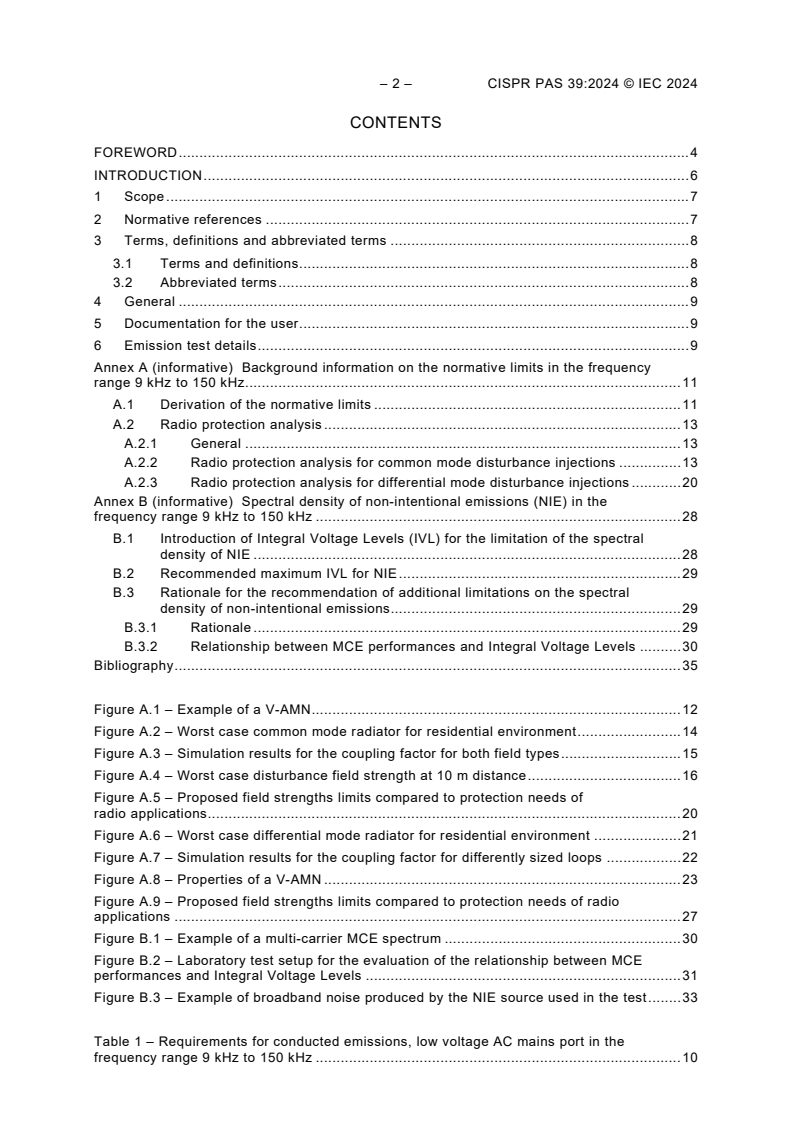
CISPR PAS 39:2024 - Electromagnetic compatibility (EMC) - Conducted emission requirements on the low voltage AC mains port in the frequency range 9 kHz to 150 kHz for equipment intended to operate in residential environments
CISPR PAS 39:2024 - Electromagnetic compatibility (EMC) - Conducted emission requirements on the low voltage AC mains port in the frequency range 9 kHz to 150 kHz for equipment intended to operate in residential environments/30/2024
Overview
CISPR PAS 39:2024 is an internationally recognized Publicly Available Specification by the IEC, setting out requirements for electromagnetic compatibility (EMC) regarding conducted emissions on low voltage AC mains ports in residential environments. Specifically, it addresses the frequency range of 9 kHz to 150 kHz, focusing on equipment that falls under the scope of IEC 61000-6-3:2020 when no dedicated product or family EMC emission standard exists. The standard ensures that electrical and electronic products do not cause harmful interference to radio reception and Mains Communicating Systems (MCS) within residential settings.
Key Topics
- Frequency Range and Scope: Applies to conducted emissions on low voltage AC mains ports within 9 kHz to 150 kHz for products used in residential environments.
- Normative Requirements: Introduces specific conducted emission limits for products not covered by existing EMC emission standards, complementing IEC 61000-6-3:2020.
- Protecting Radio Reception and Communication Systems: Requirements are designed to prevent interference with radio services and MCS, supporting robust and reliable operation in residential areas.
- Exclusions: The standard does not apply to intentional transmissions or their harmonics from radio transmitters as defined by the ITU.
- Additional Guidance: Annexes offer background information on the rationale for limits and recommendations for managing the spectral density of non-intentional emissions (NIE).
Applications
CISPR PAS 39:2024 is relevant for manufacturers, compliance engineers, and designers of electrical and electronic equipment intended for residential settings where no product-specific emissions standard exists. Key applications include:
- Product Compliance: Offers a benchmark for product testing and documentation to demonstrate conformity with EMC regulations in the specified frequency range.
- Protection of Mains Communication: Ensures compatibility and performance of MCS-based applications, such as smart meters, home automation, and advanced energy management solutions.
- Reduction of Interference: Guides manufacturers in limiting disturbances that can affect radio reception or disrupt communication signals transmitted over power lines.
- Market Access: Facilitates entry into regulatory markets requiring evidence of controlled emissions, especially in regions with stringent EMC standards.
Related Standards
For comprehensive EMC compliance, reference and alignment with the following standards are essential:
- IEC 61000-6-3:2020: Generic emission standard for residential, commercial, and light-industrial environments - the base document augmented by CISPR PAS 39:2024.
- CISPR 16 Series: Specifies measurement apparatus, methods, and network specifications for EMC test environments:
- Part 1-1: Measuring apparatus for radio disturbance and immunity
- Part 1-2: Coupling devices for conducted disturbance measurements
- Part 2-1: Methods of measurement for conducted disturbances
- IEC 61000-2-2: Defines compatibility levels for low-frequency conducted disturbances and guides the rationale for emission limits in CISPR PAS 39:2024.
- CISPR 15: Applicable to lighting equipment with similar conducted emission constraints in the higher subrange (50 kHz to 150 kHz).
Practical Value
Adherence to CISPR PAS 39:2024 enables equipment manufacturers to:
- Ensure their products meet modern EMC requirements for residential environments, preventing unwanted emissions in the 9 kHz to 150 kHz range.
- Reduce the risk of mains-borne interference that could impact radio and communication systems, which is critical for user satisfaction.
- Streamline conformity assessment processes by providing clear emission measurement methods and documentation expectations.
- Enhance market acceptance by aligning with internationally harmonized standards for EMC.
Incorporating CISPR PAS 39:2024 into product development and testing workflows results in more resilient, compliant, and market-ready electrical and electronic equipment for the residential sector.
Buy Documents
CISPR PAS 39:2024 - Electromagnetic compatibility (EMC) - Conducted emission requirements on the low voltage AC mains port in the frequency range 9 kHz to 150 kHz for equipment intended to operate in residential environments
CISPR PAS 39:2024 - Electromagnetic compatibility (EMC) - Conducted emission requirements on the low voltage AC mains port in the frequency range 9 kHz to 150 kHz for equipment intended to operate in residential environments/30/2024
Get Certified
Connect with accredited certification bodies for this standard

ANCE
Mexican certification and testing association.

Intertek Slovenia
Intertek testing, inspection, and certification services in Slovenia.

LNE (Laboratoire National de Métrologie et d'Essais)
French national laboratory for metrology and testing.
Sponsored listings
Frequently Asked Questions
CISPR PAS 39:2024 is a technical specification published by the International Electrotechnical Commission (IEC). Its full title is "Electromagnetic compatibility (EMC) - Conducted emission requirements on the low voltage AC mains port in the frequency range 9 kHz to 150 kHz for equipment intended to operate in residential environments". This standard covers: CISPR PAS 39:2024, which is a Publicly available specification, is applicable to electrical and electronic equipment within the scope of IEC 61000-6-3:2020, for which no relevant dedicated product or product family EMC emission standard has been published. It defines low voltage AC mains conducted emission requirements in the frequency range 9 kHz to 150 kHz which are considered essential and have been selected to provide an adequate level of protection to both radio reception and Mains Communicating Systems (MCS) in the defined electromagnetic environment. The emission requirements in this document are not intended to be applicable to the intentional transmissions and their harmonics from a radio transmitter as defined by the ITU. This PAS complements IEC 61000-6-3:2020 by the addition of the following: - addition of normative requirements for conducted emissions at the low voltage AC mains port in the frequency range 9 kHz to 150 kHz; - addition of an informative annex providing background information on the normative limits; - addition of an informative annex with recommendations to limit the spectral density of non‑intentional emissions (NIE).
CISPR PAS 39:2024, which is a Publicly available specification, is applicable to electrical and electronic equipment within the scope of IEC 61000-6-3:2020, for which no relevant dedicated product or product family EMC emission standard has been published. It defines low voltage AC mains conducted emission requirements in the frequency range 9 kHz to 150 kHz which are considered essential and have been selected to provide an adequate level of protection to both radio reception and Mains Communicating Systems (MCS) in the defined electromagnetic environment. The emission requirements in this document are not intended to be applicable to the intentional transmissions and their harmonics from a radio transmitter as defined by the ITU. This PAS complements IEC 61000-6-3:2020 by the addition of the following: - addition of normative requirements for conducted emissions at the low voltage AC mains port in the frequency range 9 kHz to 150 kHz; - addition of an informative annex providing background information on the normative limits; - addition of an informative annex with recommendations to limit the spectral density of non‑intentional emissions (NIE).
CISPR PAS 39:2024 is classified under the following ICS (International Classification for Standards) categories: 33.100.10 - Emission. The ICS classification helps identify the subject area and facilitates finding related standards.
CISPR PAS 39:2024 is available in PDF format for immediate download after purchase. The document can be added to your cart and obtained through the secure checkout process. Digital delivery ensures instant access to the complete standard document.
Standards Content (Sample)
CISPR PAS 39 ®
Edition 1.0 2024-10
PUBLICLY AVAILABLE
SPECIFICATION
colour
inside
INTERNATIONAL SPECIAL COMMITTEE ON RADIO INTERFERENCE
Electromagnetic compatibility (EMC) – Conducted emission requirements on the
low voltage AC mains port in the frequency range 9 kHz to 150 kHz for
equipment intended to operate in residential environments
All rights reserved. Unless otherwise specified, no part of this publication may be reproduced or utilized in any form
or by any means, electronic or mechanical, including photocopying and microfilm, without permission in writing from
either IEC or IEC's member National Committee in the country of the requester. If you have any questions about IEC
copyright or have an enquiry about obtaining additional rights to this publication, please contact the address below or
your local IEC member National Committee for further information.
IEC Secretariat Tel.: +41 22 919 02 11
3, rue de Varembé info@iec.ch
CH-1211 Geneva 20 www.iec.ch
Switzerland
About the IEC
The International Electrotechnical Commission (IEC) is the leading global organization that prepares and publishes
International Standards for all electrical, electronic and related technologies.
About IEC publications
The technical content of IEC publications is kept under constant review by the IEC. Please make sure that you have the
latest edition, a corrigendum or an amendment might have been published.
IEC publications search - webstore.iec.ch/advsearchform IEC Products & Services Portal - products.iec.ch
The advanced search enables to find IEC publications by a Discover our powerful search engine and read freely all the
variety of criteria (reference number, text, technical publications previews, graphical symbols and the glossary.
committee, …). It also gives information on projects, replaced With a subscription you will always have access to up to date
and withdrawn publications. content tailored to your needs.
IEC Just Published - webstore.iec.ch/justpublished
Electropedia - www.electropedia.org
Stay up to date on all new IEC publications. Just Published
The world's leading online dictionary on electrotechnology,
details all new publications released. Available online and once
containing more than 22 500 terminological entries in English
a month by email.
and French, with equivalent terms in 25 additional languages.
Also known as the International Electrotechnical Vocabulary
IEC Customer Service Centre - webstore.iec.ch/csc
(IEV) online.
If you wish to give us your feedback on this publication or need
further assistance, please contact the Customer Service
Centre: sales@iec.ch.
CISPR PAS 39 ®
Edition 1.0 2024-10
PUBLICLY AVAILABLE
SPECIFICATION
colour
inside
INTERNATIONAL SPECIAL COMMITTEE ON RADIO INTERFERENCE
Electromagnetic compatibility (EMC) – Conducted emission requirements on
the low voltage AC mains port in the frequency range 9 kHz to 150 kHz for
equipment intended to operate in residential environments
INTERNATIONAL
ELECTROTECHNICAL
COMMISSION
ICS 33.100.10 ISBN 978-2-8322-9867-1
– 2 – CISPR PAS 39:2024 © IEC 2024
CONTENTS
FOREWORD . 4
INTRODUCTION . 6
1 Scope . 7
2 Normative references . 7
3 Terms, definitions and abbreviated terms . 8
3.1 Terms and definitions . 8
3.2 Abbreviated terms . 8
4 General . 9
5 Documentation for the user . 9
6 Emission test details . 9
Annex A (informative) Background information on the normative limits in the frequency
range 9 kHz to 150 kHz. 11
A.1 Derivation of the normative limits . 11
A.2 Radio protection analysis . 13
A.2.1 General . 13
A.2.2 Radio protection analysis for common mode disturbance injections . 13
A.2.3 Radio protection analysis for differential mode disturbance injections . 20
Annex B (informative) Spectral density of non-intentional emissions (NIE) in the
frequency range 9 kHz to 150 kHz . 28
B.1 Introduction of Integral Voltage Levels (IVL) for the limitation of the spectral
density of NIE . 28
B.2 Recommended maximum IVL for NIE . 29
B.3 Rationale for the recommendation of additional limitations on the spectral
density of non-intentional emissions. 29
B.3.1 Rationale . 29
B.3.2 Relationship between MCE performances and Integral Voltage Levels . 30
Bibliography . 35
Figure A.1 – Example of a V-AMN . 12
Figure A.2 – Worst case common mode radiator for residential environment . 14
Figure A.3 – Simulation results for the coupling factor for both field types . 15
Figure A.4 – Worst case disturbance field strength at 10 m distance . 16
Figure A.5 – Proposed field strengths limits compared to protection needs of
radio applications . 20
Figure A.6 – Worst case differential mode radiator for residential environment . 21
Figure A.7 – Simulation results for the coupling factor for differently sized loops . 22
Figure A.8 – Properties of a V-AMN . 23
Figure A.9 – Proposed field strengths limits compared to protection needs of radio
applications . 27
Figure B.1 – Example of a multi-carrier MCE spectrum . 30
Figure B.2 – Laboratory test setup for the evaluation of the relationship between MCE
performances and Integral Voltage Levels . 31
Figure B.3 – Example of broadband noise produced by the NIE source used in the test . 33
Table 1 – Requirements for conducted emissions, low voltage AC mains port in the
frequency range 9 kHz to 150 kHz . 10
Table A.1 – Simulation results for the coupling factor for both field types . 14
Table A.2 – Worst case disturbance field strength at 10 m distance . 15
Table A.3 – Probability factors and respective rationales . 17
Table A.4 – Calculations of the required field strength limit . 19
Table A.5 – Calculations of the required field strength limit . 22
Table A.6 – Conversion from voltage limit to current limit for injection . 24
Table A.7 – Disturbance field strength calculation for 20 cm and 50 cm loops . 25
Table A.8 – Disturbance field strength calculation for 100 cm loop . 26
Table B.1 – Recommended maximum Integral Voltage Levels . 29
Table B.2 – Recommended maximum Integral Voltage Levels for equipment covered
a
by footnote to Table 1 . 29
Table B.3 – Correlation between MCE's noise assessment and Integral Voltage Levels
computed in the MCE's operating frequency ranges . 32
Table B.4 – Correlation between IVLs and MCE communication performance . 34
– 4 – CISPR PAS 39:2024 © IEC 2024
INTERNATIONAL ELECTROTECHNICAL COMMISSION
____________
ELECTROMAGNETIC COMPATIBILITY (EMC) –
Conducted emission requirements on the low voltage AC mains
port in the frequency range 9 kHz to 150 kHz for equipment
intended to operate in residential environments
FOREWORD
1) The International Electrotechnical Commission (IEC) is a worldwide organization for standardization comprising
all national electrotechnical committees (IEC National Committees). The object of IEC is to promote international
co-operation on all questions concerning standardization in the electrical and electronic fields. To this end and
in addition to other activities, IEC publishes International Standards, Technical Specifications, Technical Reports,
Publicly Available Specifications (PAS) and Guides (hereafter referred to as "IEC Publication(s)"). Their
preparation is entrusted to technical committees; any IEC National Committee interested in the subject dealt with
may participate in this preparatory work. International, governmental and non-governmental organizations liaising
with the IEC also participate in this preparation. IEC collaborates closely with the International Organization for
Standardization (ISO) in accordance with conditions determined by agreement between the two organizations.
2) The formal decisions or agreements of IEC on technical matters express, as nearly as possible, an international
consensus of opinion on the relevant subjects since each technical committee has representation from all
interested IEC National Committees.
3) IEC Publications have the form of recommendations for international use and are accepted by IEC National
Committees in that sense. While all reasonable efforts are made to ensure that the technical content of IEC
Publications is accurate, IEC cannot be held responsible for the way in which they are used or for any
misinterpretation by any end user.
4) In order to promote international uniformity, IEC National Committees undertake to apply IEC Publications
transparently to the maximum extent possible in their national and regional publications. Any divergence between
any IEC Publication and the corresponding national or regional publication shall be clearly indicated in the latter.
5) IEC itself does not provide any attestation of conformity. Independent certification bodies provide conformity
assessment services and, in some areas, access to IEC marks of conformity. IEC is not responsible for any
services carried out by independent certification bodies.
6) All users should ensure that they have the latest edition of this publication.
7) No liability shall attach to IEC or its directors, employees, servants or agents including individual experts and
members of its technical committees and IEC National Committees for any personal injury, property damage or
other damage of any nature whatsoever, whether direct or indirect, or for costs (including legal fees) and
expenses arising out of the publication, use of, or reliance upon, this IEC Publication or any other IEC
Publications.
8) Attention is drawn to the Normative references cited in this publication. Use of the referenced publications is
indispensable for the correct application of this publication.
9) IEC draws attention to the possibility that the implementation of this document may involve the use of (a)
patent(s). IEC takes no position concerning the evidence, validity or applicability of any claimed patent rights in
respect thereof. As of the date of publication of this document, IEC had not received notice of (a) patent(s), which
may be required to implement this document. However, implementers are cautioned that this may not represent
the latest information, which may be obtained from the patent database available at https://patents.iec.ch or
www.iso.org/patents. IEC shall not be held responsible for identifying any or all such patent rights.
CISPR 39 has been prepared by CISPR subcommittee H: Limits for the protection of radio
services. It is a Publicly Available Specification.
The text of this Publicly Available Specification is based on the following documents:
Draft Report on voting
CIS/H/505/DPAS CIS/H/517/RVDPAS
Full information on the voting for its approval can be found in the report on voting indicated in
the above table.
The language used for the development of this Publicly Available Specification is English.
This document was drafted in accordance with ISO/IEC Directives, Part 2, and developed in
accordance with ISO/IEC Directives, Part 1 and ISO/IEC Directives, IEC Supplement, available
at www.iec.ch/members_experts/refdocs. The main document types developed by IEC are
described in greater detail at www.iec.ch/publications.
The committee has decided that the contents of this document will remain unchanged until the
stability date indicated on the IEC website under webstore.iec.ch in the data related to the
specific document. At this date, the document will be
• reconfirmed,
• withdrawn, or
• revised.
NOTE In accordance with ISO/IEC Directives, Part 1, IEC PASs are automatically withdrawn after 4 years.
IMPORTANT – The "colour inside" logo on the cover page of this document indicates
that it contains colours which are considered to be useful for the correct understanding
of its contents. Users should therefore print this document using a colour printer.
– 6 – CISPR PAS 39:2024 © IEC 2024
INTRODUCTION
This PAS complements IEC 61000-6-3:2020 by the addition of the following:
• addition of normative requirements for conducted emissions at the low voltage AC mains
port in the frequency range 9 kHz to 150 kHz;
• addition of an informative annex providing background information on the normative limits;
• addition of an informative annex with recommendations to limit the spectral density of
non-intentional emissions (NIE).
The technical content of this PAS was derived from a fragment of the maintenance of
IEC 61000-6-3 and, as CIS/H/459/CDV, this fragment received 100 % support from the National
Committees.
This PAS is published due to the urgent market needs for these requirements.
ELECTROMAGNETIC COMPATIBILITY (EMC) –
Conducted emission requirements on the low voltage AC mains
port in the frequency range 9 kHz to 150 kHz for equipment
intended to operate in residential environments
1 Scope
This document is applicable to electrical and electronic equipment within the scope of
IEC 61000-6-3:2020, for which no relevant dedicated product or product family EMC emission
standard has been published.
It defines low voltage AC mains conducted emission requirements in the frequency range
9 kHz to 150 kHz which are considered essential and have been selected to provide an
adequate level of protection to both radio reception and Mains Communicating Systems (MCS)
in the defined electromagnetic environment.
The emission requirements in this document are not intended to be applicable to the intentional
transmissions and their harmonics from a radio transmitter as defined by the ITU.
2 Normative references
The following documents are referred to in the text in such a way that some or all of their content
constitutes requirements of this document. For dated references, only the edition cited applies.
For undated references, the latest edition of the referenced document (including any
amendments) applies.
NOTE The normative references in this clause are identical to those published in IEC 61000-6-3:2020.
CISPR 16-1-1:2019, Specification for radio disturbance and immunity measuring apparatus and
methods – Part 1-1: Radio disturbance and immunity measuring apparatus – Measuring
Apparatus
CISPR 16-1-2:2014, Specification for radio disturbance and immunity measuring apparatus and
methods – Part 1-2: Radio disturbance and immunity measuring apparatus – Coupling devices
for conducted disturbance measurements
CISPR 16-1-2:2014/AMD 1:2017
CISPR 16-2-1:2014, Specification for radio disturbance and immunity measuring apparatus and
methods – Part 2-1: Methods of measurement of disturbances and immunity – Conducted
disturbance measurements
CISPR 16-2-1:2014/A1:2017
IEC 61000-6-3:2020, Electromagnetic compatibility (EMC) – Part 6-3: Generic standards –
Emission standard for equipment in residential environments
– 8 – CISPR PAS 39:2024 © IEC 2024
3 Terms, definitions and abbreviated terms
3.1 Terms and definitions
For the purposes of this document, the terms and definitions given in IEC 61000-6-3:2020 and
the following apply.
ISO and IEC maintain terminology databases for use in standardization at the following
addresses:
• IEC Electropedia: available at https://www.electropedia.org/
• ISO Online browsing platform: available at https://www.iso.org/obp
3.1.1
primary function
any function of an EUT considered essential for the user or for the majority of users
Note 1 to entry: An EUT can have more than one primary function. For example, the primary functions of a basic
television set include broadcast reception, audio reproduction and display.
3.1.2
UPS function
power supply function, that provides power during unintentional AC mains power supply
interruptions
3.1.3
adjustable speed electric power drive function
a power drive system function that provides adjustable speed AC or DC motor drives and can
convert input and/or output voltages (line-to-line voltage).
3.2 Abbreviated terms
For the purposes of this document, the abbreviated terms given in IEC 61000-6-3:2020 and the
following apply.
AC Alternating Current
ACEC Advisory Committee on Electromagnetic Compatibility
AMN Artificial Mains Network
AP Allowance Probability
AV Average
BPSK Binary Phase-Shift Keying
CF Coupling Factor
CF(E) Electric field Coupling Factor
CF(H) Magnetic field Coupling Factor
CISPR International Special Committee on Radio Interference
CM Common Mode
DC Direct Current
DM Differential Mode
EMC Electro-Magnetic Compatibility
EUT Equipment Under Test
FS Field Strength
FSFI Free Space Field Impedance
FSK Frequency-Shift Keying
H-Field Magnetic Field
IEC International Electrotechnical Commission
ISO International Standards Organization
IVL Integral Voltage Level
LED Light Emitting Diode
LF Low Frequency
MCE Mains Communicating Equipment
MCS Mains Communicating System
NEC2 Numerical Electromagnetics Code 2
NIE Non-Intentional Emission
OFDM Orthogonal Frequency-Division Multiplexing
RFI Radio Frequency Interference
PR Protection Ratio
QP Quasi-Peak
UPS Uninterruptible Power Systems
V-AMN Artificial Mains V-Network
VLF Very Low Frequency
4 General
The requirements specified in this document are applicable to an equipment intended to operate
in the residential environment. For any additional information needed to assess emissions
according to Table 1, refer to IEC 61000-6-3:2020.
5 Documentation for the user
In addition to the requirements specified in Clause 6 of IEC 61000-6-3:2020, the instructions
a
for use of the equipment shall include, where relevant, the notification required by footnote to
Table 1.
6 Emission test details
The requirements in Table 1 shall apply.
The following shall be taken into account during the application of the measurements defined
in Table 1:
• At transitional frequencies, the lower limit applies.
• Where the limit value varies over a given frequency range, it changes linearly with respect
to the logarithm of the frequency.
– 10 – CISPR PAS 39:2024 © IEC 2024
Table 1 – Requirements for conducted emissions, low voltage AC mains port
in the frequency range 9 kHz to 150 kHz
Frequency Limits dB(µV) Limitations
Measurement Measurement
range and
network specifications
Detector
MHz restrictions
V-AMN 0,009 to 0,05 120,5 to 110 Instrumentation, None
Quasi-peak CISPR 16-1-1:2019,
Clauses 4, 5 and 7
a
0,05 to 0,15
104 to 80
Networks,
Quasi-peak
CISPR 16-1-2:2014 and
CISPR 16-1-2:2014/AMD1:2017,
Clause 4
Method,
CISPR 16-2-1:2014 and
CISPR 16-2-1:2014/AMD1:2017,
Clause 7
Set-up,
CISPR 16-2-1:2014 and
CISPR 16-2-1:2014/AMD1:2017,
Clause 7
NOTE See Annex A for background information about the normative limits, including recommendations related to
the limit application in the frequency range 9 kHz to 150 kHz, and Annex B for recommendations to improve
compatibility with MCE by additional assessments.
a
For equipment with a primary function according to 3.1.2 (UPS function) or 3.1.3 (adjustable speed electric
power drive function), the following limits can be applied: 110 dB(μV) to 82,5 dB(μV). When these relaxed limits
are applied, it shall be recorded in the test report and a notification shall be added in the user manual of the
equipment. The notification shall state that such equipment has a higher risk of interference, and specific
measures might be required for its installation and operation, or it can be necessary to disconnect the
equipment.
Annex A
(informative)
Background information on the normative limits
in the frequency range 9 kHz to 150 kHz
A.1 Derivation of the normative limits
The starting point for the derivation of limits in the frequency range 9 kHz to 150 kHz for
residential environment are the compatibility levels contained in IEC 61000-2-2:2002,
IEC 61000-2-2:2002/AMD1:2017 and IEC 61000-2-2:2002/AMD2:2018.
The compatibility levels have been defined in the frequency range from 9 kHz to 150 kHz, after
long controversial discussions in IEC SC77A, under direct supervision of ACEC, to improve
EMC for equipment such as mains communicating systems, electricity meters and clocks
supplied by public low voltage AC mains supply systems against disturbances generated by
equipment such as switching power converters, switch mode power supplies, photovoltaic
inverters, etc.
As explained in Annex D of IEC 61000-2-2:2002, IEC 61000-2-2:2002/AMD1:2017 and
IEC 61000-2-2:2002/AMD2:2018, the defined compatibility level curve represents the best
currently achievable compromise supported by all stakeholders and has been defined for
voltage distortion in differential mode.
The task to derive emission limits from these compatibility levels has been given to a joint
working group between CISPR H and IEC SC77A with the following terms of reference:
• Developing equipment emission limits in the frequency range 9 kHz to 150 kHz to
accommodate the latest amendments to IEC 61000-2-2 for this frequency range.
• Developing the methodology for emission measurements against the newly developed
limits, possibly using measuring equipment and methods from the CISPR 16 series for both
differential mode and common mode disturbances. The suitability of the methodology shall
be shown.
• Preparing appropriate implementation in standards, i.e. proposing an amendment to the
generic standard – which has a pilot function for the product standards – and preparing the
implementation into Product/Product Family standards.
Measurements in the 9 kHz to 150 kHz frequency range have been based on the established
quasi-peak detector in a 200 Hz bandwidth, as defined in CISPR 16-1-1:2019, with the
measuring methods specified in the CISPR 16 series. Accordingly, the same measuring
equipment can be used to evaluate both the protection requirements for MCS and the protection
requirements for radio services.
Since the CISPR method is based on the measurement of unsymmetrical voltages (i.e. voltage
referenced to earth using the V-AMN, see Figure A.1), the calculation of the limit values is
based on the recommendations from the Note in 4.12.1 of IEC 61000-2-2:2002,
IEC 61000-2-2:2002/AMD1:2017 and IEC 61000-2-2:2002/AMD2:2018, which is quoted as
follows.
– 12 – CISPR PAS 39:2024 © IEC 2024
NOTE Based on the following assumptions, an emission margin equal to or higher than 3 dB between the equipment
emission limits in differential mode for non-intentional emissions and the corresponding compatibility levels, or a
difference equal to or higher than 9 dB (3 dB for the emission margin +6 dB for the conversion factor between the
unsymmetrical voltages and the voltage in differential mode) between the equipment emission limits for
unsymmetrical voltage distortion and the compatibility levels in differential mode given in 4.12.2 and 4.12.3, is
sufficient:
– for each bandwidth of 200 Hz, the probability that the compatibility level is exceeded is lower than 5 %;
– at a given location, the disturbance level in a same bandwidth of 200 Hz does not result from more than two
pieces of equipment generating non-intentional emissions close to the emission limit at the same time;
– non-intentional emissions from different equipment are generated independently from each other.
The 6 dB conversion factor is based on the very worst-case assumption that the EUT produces
only differential mode emission. The compatibility levels in IEC 61000-2-2:2002,
IEC 61000-2-2:2002/AMD1:2017 and IEC 61000-2-2:2002/AMD2:2018 are given only for
symmetrical voltage (line to neutral) and in this case the measured unsymmetrical voltage is
only half of a hypothetically produced 100 % symmetrical disturbance voltage. In reality, the
unsymmetrical voltage is made by the combination of both differential mode and common mode
disturbance voltages. Accordingly, the fixed 6 dB conversion factor gives an additional margin
for the protection of mains communicating systems.
In summary, the normative limits for unsymmetrical voltage in the frequency range 9 kHz to
150 kHz have been set 9 dB lower than the compatibility levels for this frequency range, as
suggested in IEC 61000-2-2:2002, IEC 61000-2-2:2002/AMD1:2017 and
IEC 61000-2-2:2002/AMD2:2018.
SOURCE: CISPR 16-1-2:2014 and CISPR 16-1-2:2014/AMD1:2017, Figure 5.
Figure A.1 – Example of a V-AMN
Footnote a in Table 1 gives a slight relaxation of the limits for some equipment. This relaxation
of the limits is based on the assumption that all such equipment is not used by more than 5 %
of all customers connected to the same medium voltage / low voltage transformer. In case of
interference generated by equipment, using this relaxation, the connection of such equipment
might be restricted, for example by the distribution system operator.
For equipment widely used in household environment and consequently expected to be present
in a high percentage of residential installations and with several units per installation (e.g.
lighting equipment), in the frequency range 50 kHz to 150 kHz, it is recommended to apply a
quasi-peak limit decreasing linearly with the logarithm of the frequency from 90 dB(µV) at
50 kHz to 80 dB(µV) at 150 kHz, in line with existing limits for lighting equipment in
CISPR 15:2018.
A.2 Radio protection analysis
A.2.1 General
As explained in detail, the limits in the frequency range 9 kHz to 150 kHz were derived from the
compatibility levels in IEC 61000-2-2:2002, IEC 61000-2-2:2002/AMD1:2017 and
IEC 61000-2-2:2002/AMD2:2018 for protection of MCS operation. Additionally, those limits are
also intended to protect radio reception in that frequency range. Therefore, the following
considerations do not derive a whole new set of limits, but model the field strength expected at
the frequencies of radio services at the given protection distance, when radio frequency
emission having an amplitude equal to the limits specified in this document is injected into the
mains grid and radiated by the cables of the grid. Since the V-AMN does not separate common
and differential mode disturbance voltages, for these calculations, it is assumed that the
measured value from the V-AMN is based on a disturbance voltage from the EUT, produced
either 100 % in common mode or 100 % in differential mode. This would represent the worst
case for each analysis.
A.2.2 Radio protection analysis for common mode disturbance injections
A.2.2.1 Derivation of coupling factor by simulation
For the case at hand, a conducted limit line shall be derived based on the protection
requirements of the radio services given in field strength values in the requested protection
distance (which for residential environments is a distance of 10 m). At first a representative
radiation model shall be defined. In a residential environment, electronic or electrical devices
are typically connected to some wire in the house and will via connection to the installation
topology around the house (including all possible directions) finally terminate in the circuit
breaker box. From the viewpoint of which cable topology would possibly have the maximum
radiation efficiency, a vertical wire (i.e. a vertical antenna) would represent the worst case of a
possible common mode radiator. With respect to the length of such a wire, a length of 30 m is
estimated as the worst case in typical residential environments. Therefore, the coupling factor
for a 30 m long vertical antenna (see Figure A.2) was chosen to represent the worst possible
coupling situation for common mode injection. Any real installation, where the low voltage line
would take a respective path around the house connecting power outlets, switches, lamps and
other appliances, would radiate less than the scenario chosen.
– 14 – CISPR PAS 39:2024 © IEC 2024
a) Simple vertical wire fed with 1 V CM voltage b) Electric field strength distribution
at the yellow dot in 1 m height
Figure A.2 – Worst case common mode radiator for residential environment
A simulation with a finite momentum solver NEC2 for the several frequencies and a feed of 1 V
of CM voltage at the bottom of the structure results in the coupling factor values shown in
Table A.1 and Figure A.3. The value of 1 V is chosen for simplicity, as this calculation is only
meant to determine the CF of the radiating structure, which is the ratio of the field strengths
and the injected radio frequency voltage. As two different field types are emitted, a coupling
factor is needed for both electric CF(E) and magnetic CF(H) fields. The latter can be converted
to units of the electrical field in order to compare their magnitude.
Table A.1 – Simulation results for the coupling factor for both field types
Frequency CF(H) FSFI CF(E) Maximum CF
MHz 1/Ω/m 1/m 1/m 1/m
-6 -3
0,009 4,28 × 10 1,61 × 10 0,013 3 0,013 3
-6 -3
0,010 3,89 × 10 1,47 × 10 0,013 3 0,013 3
-6 -4
0,020 0,013 3 0,013 3
2,23 × 10 8,41 × 10
-6 -4
0,030 0,013 3 0,013 3
1,80 × 10 6,79 × 10
-6 -4
0,040 0,013 3 0,013 3
1,68 × 10 6,33 × 10
-6 -4
0,050 1,69 × 10 6,37 × 10 0,013 3 0,013 3
-6 -4
0,060 1,75 × 10 6,60 × 10 0,013 3 0,013 3
-6 -4
0,070 0,013 3 0,013 3
1,86 × 10 7,01 × 10
-6 -4
0,080 0,013 3 0,013 3
1,98 × 10 7,46 × 10
-6 -4
0,090 0,013 3 0,013 3
2,12 × 10 7,99 × 10
-6 -4
0,100 2,27 × 10 8,56 × 10 0,013 3 0,013 3
-6 -4
0,110 2,43 × 10 9,16 × 10 0,013 3 0,013 3
-6 -4
0,120 2,59 × 10 9,76 × 10 0,013 3 0,013 3
-6 -3
0,130 0,013 3 0,013 3
2,76 × 10 1,04 × 10
-6 -3
0,140 0,013 3 0,013 3
2,95 × 10 1,11 × 10
-6 -3
0,150 0,013 3 0,013 3
3,17 × 10 1,20 × 10
Figure A.3 – Simulation results for the coupling factor for both field types
The coupling factors were calculated by finding the maximum field strengths on a cylinder with
radius of 10 m (protection distance) and a height of 30 m divided by the feed voltage of 1 V.
The cylinder is emulating the use of a turntable in a typical EMC measurement, which however
in the case at hand is not necessary as the chosen object is of rotational symmetry. The CF for
the magnetic field is multiplied by the free space field impedance ("FSFI" in Table A.1), so both
field types can be compared. As expected for a short (compared to the wavelength) wire
antenna capacitive coupling prevails in the nearfield, and thus the maximum coupling is
provided by the electrical field CF(E), compared to the magnetic field CF(H), for all frequencies
in question.
Using the limits specified in Table 1 and the CFs derived above, the disturbance field strength
which would be produced at the protection distance in the worst case can now be calculated.
The results are given in Table A.2 and Figure A.4.
Table A.2 – Worst case disturbance field strength at 10 m distance
Frequency Limit CF CF Electrical field
MHz dB(µV) 1/m dB(1/m) dB(µV/m)
-2
0,009 120,5 -37,7 82,8
1,3 × 10
-2
0,010 119,9 1,3 × 10 -37,7 82,2
-2
0,020 115,6 1,3 × 10 -37,7 77,9
-2
0,030 113,1 1,3 × 10 -37,7 75,4
-2
0,040 111,4 -37,7 73,6
1,3 × 10
-2
0,049 110,1 -37,7 72,4
1,3 × 10
-2
0,050 104,0 1,3 × 10 -37,7 66,3
-2
0,060 100,0 1,3 × 10 -37,7 62,3
-2
0,070 96,6 1,3 × 10 -37,7 58,9
-2
0,080 93,7 -37,7 56,0
1,3 × 10
-2
0,090 91,2 -37,7 53,4
1,3 × 10
-2
0,100 88,9 -37,7 51,1
1,3 × 10
– 16 – CISPR PAS 39:2024 © IEC 2024
Frequency Limit CF CF Electrical field
MHz dB(µV) 1/m dB(1/m) dB(µV/m)
-2
0,110 86,8 -37,7 49,1
1,3 × 10
-2
0,120 84,9 1,3 × 10 -37,7 47,2
-2
0,130 83,1 1,3 × 10 -37,7 45,4
-2
0,140 81,5 1,3 × 10 -37,7 43,8
-2
0,150 80,0 -37,7 42,3
1,3 × 10
Figure A.4 – Worst case disturbance field strength at 10 m distance
A.2.2.2 Application of the disturbance model CISPR TR 16-4-4
Equation (37) from CISPR TR 16-4-4:2007, CISPR TR 16-4-4:2007/AMD1:2017 and
CISPR TR 16-4-4:2007/AMD2:2020 is the basis for the limit calculation:
E =μ−R+μ++μ μ++μμ+μ+μμ+ +μ+μ+t×σ
limit w p p1 p23456p p p p p78p p9 p10 βi
(A.1)
2 22 22 2 22 2 2
−t × σ ++σσ ++σσ + σ ++σσ + σ + σ
( )
α p1 pp23456pp p pp78 p9 p10
This equation is based on ten probability factors P1 to P10 (µ to µ in Equation (A.1)) and
P1 P10
parameters of the wanted signal µ and R , which are entries in the IEC Radio Services
w p
Database. Table A.3 describes the meaning of the probability factors, their values, the
respective values for their variations and an explanation for the values, for those radio services
in the database, which can be expected to be operated near products falling in the scope of this
document.
The derivation of values for the probability factors from the model, described in
CISPR TR 16-4-4:2007, CISPR TR 16-4-4:2007/AMD1:2017 and
CISPR TR 16-4-4:2007/AMD2:2020 is debatable. Instead of fixed values for some of the
probability factors a range of values between µPi and µPi (such as i takes one of the following
a b
values: 1, 4, 7 or 9, depending on targeted probability factor) has been given. Accordingly, also
a range of values for the final results of the estimations has been given. Further considerations
have not been necessary, because the application of the more stringent parameters showed,
that the new limits proposed in this document for this frequency range are also sufficient for the
protection of the radio services.
Table A.3 – Probability factors and respective rationales
Probability Meaning µ σ Explanation
Pi Pi
factor
dB dB
P1a Directivity 0 0 Emitter at these wavelengths have no directivity as the antennas
source are always (short) monopole antennas.
P1b Directivity 6 0 The probability of having vertical wires and horizontal wires for
source emitting disturbances is about 50 %. Only vertical wires cause
radiation, horizontal wires are attenuated by the earth.
P2a+b Directivity 6 8 Time signal receivers usually use ferrite rod antennas with a dipole
victim radiation pattern as described in
CISPR TR 16-4-4:2007, CISPR TR 16-4-4:2007/AMD1:2017 and
CISPR TR 16-4-4:2007/AMD2:2020, 5.6.5.2.1.2, leading to a
directivity of 6 dB. The value for σPi is taken from the same clause
as 8 dB.
P3a+b Stationary 0 0 Time signal reception usually is stationary, as are ripple control
receivers.
P4a Frequency 3 3 Typical emitters in this frequency range (e.g. LED lighting, switch
correlation mode power supplies) are broadband (including their harmonics
and dithering) and usually affect many frequencies in the range
9 kHz to 150 kHz at the same time. It is estimated that about half of
the frequency range is affected. The variance can reach from
narrowband to full spread of the spectrum.
P4b Frequency 10 3 The practical experience of measuring EMC potential of typical
correlation electronic devices shows, that not more than 10 % of the spectrum
is disturbed (including harmonics) by a noise level which almost
reaches the level of the limit. The 10 dB are still very conservative.
P5a+b Harmonics 0 0 The harmonics are considered under P4 already.
P6a+b Disturbing 0 0 Typical disturbers in this frequency range are switched mode power
signal supplies and alike, that generate a wide signal. In contrast time
produces signals are very low in bandwidth, so it can be assumed, that the
significant disturbance channel of the victim is always filled.
effect
P7a Time 13,8 0 Time signal receivers usually only synchronize once a day. Thus,
Correlation reception of 1 hour out of 24 hours is sufficient.
3 0 For the amateur radio service allocation it can be assumed, that
only night time reception is worthwhile in the frequency range, thus
leading to µ of 3 dB.
P7
P7b Time 30 5,5 Time signal receivers usually synchronize only once a day, one
correlation minute is sufficient for time signal reception. So a probability of one
minute out of 24 h is assumed as 0,1 %.
9 3 At 137 kHz there is also a radio service used by radio amateurs. It
is assumed that a radio amateur is using his service not more than
3 h a day. Therefore the probability is 12,5 %.
P8a+b Location 3 3 It is assumed that every second household has a time signal
correlation receiver.
60 3 For the amateur radio service allocation, it was assumed, that only
one amateur among 1 000 people exists. Since the LF band is very
special with respect to antenna construction, only about one in a
thousand of amateurs actually use this band, leading to a µ of
P8
60 dB.
– 18 – CISPR PAS 39:2024 © IEC 2024
Probability Meaning µ σ Explanation
Pi Pi
factor
dB dB
P9a Edge of 3 3 Long wave reception usually is ground wave propagation, thus a
service basic approximation could be based upon a simple circularly
response and the ratio between the two different coverage areas.
P9b Edge of 10 3,2 The range of radio services, especially in the long wave range, can
service be assumed as a circular area. The further a receiver is away from
the transceiver, the weaker the signal becomes. At a certain point
of attenuation of the signal the receiver can be assessed as
operated on the edge of the service. Time signal receivers have a
coverage of round about 1 000 km. Receivers operated at a
distance of more than 900 km are estimated to be at the edge of
this service. Probability for a receiver to be within this edge can
easily be calculated by the ratio of these two coverage areas. In
this long wave time receiver situation a probability P9 of 20 % is
calculated.
P10a+b Building 0 0 Most time signal receivers are inside houses as are typical
attenuation emitters. Thus, no building attenuation can be considered in this
frequency range.
Radio services, that would be expected very far away from any product falling in the scope of
this document (passive lightning detectors, VLF and LF navigation and communication) are
vastly predominated by location correlation. Receivers of those services are at least 1 000 m
away from any disturber. Considering a signal attenuation of at least 20 dB/decade, the location
correlation would allow at least 60 dB allowance of probability.
Equation (A.1) is applied to all radio applications listed in the database to calculate the
maximum tolerable noise levels and the required field strength limits, including consideration of
the probability factors, the radio sensitivity and the protection ratio. Table A.4 provides a
summary of these calculations and includes the sum of the probability factors, known as the
allowance probability AP.
In the following Table A.4, the following radio services are not considered relevant because
there is no planned reception in the residential locations:
• Passive lightning locators
• VLF Navigation (Alpha)
• VLF Marine (communication)
• LF Marine communication
Additionally, the historic VLF transmitter is not considered relevant, because it transmits only 2
days per year.
Table A.4 – Calculations of the required field strength limit
Method b
Method a
Frequency
Tolerable
FS Limit
Sensitivity PR Location AP FS Limit AP
Radio noise
Start Stop
service
dB(µV/m)
kHz kHz dB(µV/m) dB dB(µV/m) dB dB(µV/m) dB
19,95 20,05 60 12 Worldwide 48 21 69 56
39 41 60 12 Japan 48 21 69 56
49,25 50,75 60 12 Russia 48 21 69 56
Standard
UK, USA,
frequency 104
59 61 60 12 48 21 69 56
Japan
and Time
65,85 67,35 60 12 Russia 48 21 69 56
signal
service
68,25 68,75 60 12 China 48 21 69 56
77,25 77,75 60 12 Germany 48 21 69 56
99,75 102,5 60 12 China 48 21 69 56
LF fixed
Germany,
129,1 139 60 12
48 21 69 56
land
Hungary
based
Amateur
135,7 137,8 -17 10 Worldwide -27 65 38 70
radio
NOTE The field strengths for both methods in Table A.4 were calculated using Equation (A.1) and the values
provided in Table A.3, while tα and tβ are 0,84, while σi was set to zero, not considering any measurement variation.
On Figure A.5, the middle point of the frequency service is used.
To invest
...
CISPR PAS 39 ®
Edition 1.0 2024-10
INTERNATIONAL
STANDARD
NORME
INTERNATIONALE
colour
inside
INTERNATIONAL SPECIAL COMMITTEE ON RADIO INTERFERENCE
COMITÉ INTERNATIONAL SPÉCIAL DES PERTURBATIONS RADIOÉLECTRIQUES
Electromagnetic compatibility (EMC) – Conducted emission requirements on the
low voltage AC mains port in the frequency range 9 kHz to 150 kHz for
equipment intended to operate in residential environments
Compatibilité électromagnétique (CEM) – Exigences en matière d'émissions
conduites sur l'accès d'alimentation en courant alternatif basse tension dans la
plage de fréquencesde 9 kHz à 150 kHz pour les appareils destinés à fonctionner
dans des environnements résidentiels
All rights reserved. Unless otherwise specified, no part of this publication may be reproduced or utilized in any form
or by any means, electronic or mechanical, including photocopying and microfilm, without permission in writing from
either IEC or IEC's member National Committee in the country of the requester. If you have any questions about IEC
copyright or have an enquiry about obtaining additional rights to this publication, please contact the address below or
your local IEC member National Committee for further information.
Droits de reproduction réservés. Sauf indication contraire, aucune partie de cette publication ne peut être reproduite ni
utilisée sous quelque forme que ce soit et par aucun procédé, électronique ou mécanique, y compris la photocopie et
les microfilms, sans l'accord écrit de l'IEC ou du Comité national de l'IEC du pays du demandeur. Si vous avez des
questions sur le copyright de l'IEC ou si vous désirez obtenir des droits supplémentaires sur cette publication, utilisez
les coordonnées ci-après ou contactez le Comité national de l'IEC de votre pays de résidence.
IEC Secretariat Tel.: +41 22 919 02 11
3, rue de Varembé info@iec.ch
CH-1211 Geneva 20 www.iec.ch
Switzerland
About the IEC
The International Electrotechnical Commission (IEC) is the leading global organization that prepares and publishes
International Standards for all electrical, electronic and related technologies.
About IEC publications
The technical content of IEC publications is kept under constant review by the IEC. Please make sure that you have the
latest edition, a corrigendum or an amendment might have been published.
IEC publications search - webstore.iec.ch/advsearchform IEC Products & Services Portal - products.iec.ch
The advanced search enables to find IEC publications by a Discover our powerful search engine and read freely all the
variety of criteria (reference number, text, technical publications previews, graphical symbols and the glossary.
committee, …). It also gives information on projects, replaced With a subscription you will always have access to up to date
and withdrawn publications. content tailored to your needs.
IEC Just Published - webstore.iec.ch/justpublished
Electropedia - www.electropedia.org
Stay up to date on all new IEC publications. Just Published
The world's leading online dictionary on electrotechnology,
details all new publications released. Available online and once
containing more than 22 500 terminological entries in English
a month by email.
and French, with equivalent terms in 25 additional languages.
Also known as the International Electrotechnical Vocabulary
IEC Customer Service Centre - webstore.iec.ch/csc
(IEV) online.
If you wish to give us your feedback on this publication or need
further assistance, please contact the Customer Service
Centre: sales@iec.ch.
A propos de l'IEC
La Commission Electrotechnique Internationale (IEC) est la première organisation mondiale qui élabore et publie des
Normes internationales pour tout ce qui a trait à l'électricité, à l'électronique et aux technologies apparentées.
A propos des publications IEC
Le contenu technique des publications IEC est constamment revu. Veuillez vous assurer que vous possédez l’édition la
plus récente, un corrigendum ou amendement peut avoir été publié.
Recherche de publications IEC - IEC Products & Services Portal - products.iec.ch
webstore.iec.ch/advsearchform Découvrez notre puissant moteur de recherche et consultez
La recherche avancée permet de trouver des publications IEC gratuitement tous les aperçus des publications, symboles
en utilisant différents critères (numéro de référence, texte, graphiques et le glossaire. Avec un abonnement, vous aurez
comité d’études, …). Elle donne aussi des informations sur les toujours accès à un contenu à jour adapté à vos besoins.
projets et les publications remplacées ou retirées.
Electropedia - www.electropedia.org
IEC Just Published - webstore.iec.ch/justpublished
Le premier dictionnaire d'électrotechnologie en ligne au monde,
Restez informé sur les nouvelles publications IEC. Just
avec plus de 22 500 articles terminologiques en anglais et en
Published détaille les nouvelles publications parues.
français, ainsi que les termes équivalents dans 25 langues
Disponible en ligne et une fois par mois par email.
additionnelles. Egalement appelé Vocabulaire
Electrotechnique International (IEV) en ligne.
Service Clients - webstore.iec.ch/csc
Si vous désirez nous donner des commentaires sur cette
publication ou si vous avez des questions contactez-nous:
sales@iec.ch.
CISPR PAS 39 ®
Edition 1.0 2024-10
INTERNATIONAL
STANDARD
NORME
INTERNATIONALE
colour
inside
INTERNATIONAL SPECIAL COMMITTEE ON RADIO INTERFERENCE
COMITÉ INTERNATIONAL SPÉCIAL DES PERTURBATIONS RADIOÉLECTRIQUES
Electromagnetic compatibility (EMC) – Conducted emission requirements on
the low voltage AC mains port in the frequency range 9 kHz to 150 kHz for
equipment intended to operate in residential environments
Compatibilité électromagnétique (CEM) – Exigences en matière d'émissions
conduites sur l'accès d'alimentation en courant alternatif basse tension dans la
plage de fréquencesde 9 kHz à 150 kHz pour les appareils destinés à
fonctionner dans des environnements résidentiels
INTERNATIONAL
ELECTROTECHNICAL
COMMISSION
COMMISSION
ELECTROTECHNIQUE
INTERNATIONALE
ICS 33.100.10 ISBN 978-2-8327-0250-5
– 2 – CISPR PAS 39:2024 © IEC 2024
CONTENTS
FOREWORD . 4
INTRODUCTION . 6
1 Scope . 7
2 Normative references. 7
3 Terms, definitions and abbreviated terms . 8
3.1 Terms and definitions . 8
3.2 Abbreviated terms . 8
4 General . 9
5 Documentation for the user . 9
6 Emission test details . 9
Annex A (informative) Background information on the normative limits in the frequency
range 9 kHz to 150 kHz . 11
A.1 Derivation of the normative limits . 11
A.2 Radio protection analysis . 13
A.2.1 General . 13
A.2.2 Radio protection analysis for common mode disturbance injections . 13
A.2.3 Radio protection analysis for differential mode disturbance injections . 20
Annex B (informative) Spectral density of non-intentional emissions (NIE) in the
frequency range 9 kHz to 150 kHz . 28
B.1 Introduction of Integral Voltage Levels (IVL) for the limitation of the spectral
density of NIE . 28
B.2 Recommended maximum IVL for NIE . 29
B.3 Rationale for the recommendation of additional limitations on the spectral
density of non-intentional emissions . 29
B.3.1 Rationale . 29
B.3.2 Relationship between MCE performances and Integral Voltage Levels . 30
Bibliography . 35
Figure A.1 – Example of a V-AMN . 12
Figure A.2 – Worst case common mode radiator for residential environment . 14
Figure A.3 – Simulation results for the coupling factor for both field types . 15
Figure A.4 – Worst case disturbance field strength at 10 m distance . 16
Figure A.5 – Proposed field strengths limits compared to protection needs of
radio applications . 20
Figure A.6 – Worst case differential mode radiator for residential environment . 21
Figure A.7 – Simulation results for the coupling factor for differently sized loops . 22
Figure A.8 – Properties of a V-AMN . 23
Figure A.9 – Proposed field strengths limits compared to protection needs of radio
applications . 27
Figure B.1 – Example of a multi-carrier MCE spectrum . 30
Figure B.2 – Laboratory test setup for the evaluation of the relationship between MCE
performances and Integral Voltage Levels . 31
Figure B.3 – Example of broadband noise produced by the NIE source used in the test . 33
Table 1 – Requirements for conducted emissions, low voltage AC mains port in the
frequency range 9 kHz to 150 kHz . 10
Table A.1 – Simulation results for the coupling factor for both field types . 14
Table A.2 – Worst case disturbance field strength at 10 m distance . 15
Table A.3 – Probability factors and respective rationales . 17
Table A.4 – Calculations of the required field strength limit . 19
Table A.5 – Calculations of the required field strength limit . 22
Table A.6 – Conversion from voltage limit to current limit for injection . 24
Table A.7 – Disturbance field strength calculation for 20 cm and 50 cm loops . 25
Table A.8 – Disturbance field strength calculation for 100 cm loop . 26
Table B.1 – Recommended maximum Integral Voltage Levels . 29
Table B.2 – Recommended maximum Integral Voltage Levels for equipment covered
by footnote to Table 1 . 29
Table B.3 – Correlation between MCE's noise assessment and Integral Voltage Levels
computed in the MCE's operating frequency ranges . 32
Table B.4 – Correlation between IVLs and MCE communication performance . 34
– 4 – CISPR PAS 39:2024 © IEC 2024
INTERNATIONAL ELECTROTECHNICAL COMMISSION
____________
ELECTROMAGNETIC COMPATIBILITY (EMC) –
Conducted emission requirements on the low voltage AC mains
port in the frequency range 9 kHz to 150 kHz for equipment
intended to operate in residential environments
FOREWORD
1) The International Electrotechnical Commission (IEC) is a worldwide organization for standardization comprising
all national electrotechnical committees (IEC National Committees). The object of IEC is to promote international
co-operation on all questions concerning standardization in the electrical and electronic fields. To this end and
in addition to other activities, IEC publishes International Standards, Technical Specifications, Technical Reports,
Publicly Available Specifications (PAS) and Guides (hereafter referred to as "IEC Publication(s)"). Their
preparation is entrusted to technical committees; any IEC National Committee interested in the subject dealt with
may participate in this preparatory work. International, governmental and non-governmental organizations liaising
with the IEC also participate in this preparation. IEC collaborates closely with the International Organization for
Standardization (ISO) in accordance with conditions determined by agreement between the two organizations.
2) The formal decisions or agreements of IEC on technical matters express, as nearly as possible, an international
consensus of opinion on the relevant subjects since each technical committee has representation from all
interested IEC National Committees.
3) IEC Publications have the form of recommendations for international use and are accepted by IEC National
Committees in that sense. While all reasonable efforts are made to ensure that the technical content of IEC
Publications is accurate, IEC cannot be held responsible for the way in which they are used or for any
misinterpretation by any end user.
4) In order to promote international uniformity, IEC National Committees undertake to apply IEC Publications
transparently to the maximum extent possible in their national and regional publications. Any divergence between
any IEC Publication and the corresponding national or regional publication shall be clearly indicated in the latter.
5) IEC itself does not provide any attestation of conformity. Independent certification bodies provide conformity
assessment services and, in some areas, access to IEC marks of conformity. IEC is not responsible for any
services carried out by independent certification bodies.
6) All users should ensure that they have the latest edition of this publication.
7) No liability shall attach to IEC or its directors, employees, servants or agents including individual experts and
members of its technical committees and IEC National Committees for any personal injury, property damage or
other damage of any nature whatsoever, whether direct or indirect, or for costs (including legal fees) and
expenses arising out of the publication, use of, or reliance upon, this IEC Publication or any other IEC
Publications.
8) Attention is drawn to the Normative references cited in this publication. Use of the referenced publications is
indispensable for the correct application of this publication.
9) IEC draws attention to the possibility that the implementation of this document may involve the use of (a)
patent(s). IEC takes no position concerning the evidence, validity or applicability of any claimed patent rights in
respect thereof. As of the date of publication of this document, IEC had not received notice of (a) patent(s), which
may be required to implement this document. However, implementers are cautioned that this may not represent
the latest information, which may be obtained from the patent database available at https://patents.iec.ch or
www.iso.org/patents. IEC shall not be held responsible for identifying any or all such patent rights.
CISPR 39 has been prepared by CISPR subcommittee H: Limits for the protection of radio
services. It is a Publicly Available Specification.
The text of this Publicly Available Specification is based on the following documents:
Draft Report on voting
CIS/H/505/DPAS CIS/H/517/RVDPAS
Full information on the voting for its approval can be found in the report on voting indicated in
the above table.
The language used for the development of this Publicly Available Specification is English.
This document was drafted in accordance with ISO/IEC Directives, Part 2, and developed in
accordance with ISO/IEC Directives, Part 1 and ISO/IEC Directives, IEC Supplement, available
at www.iec.ch/members_experts/refdocs. The main document types developed by IEC are
described in greater detail at www.iec.ch/publications.
The committee has decided that the contents of this document will remain unchanged until the
stability date indicated on the IEC website under webstore.iec.ch in the data related to the
specific document. At this date, the document will be
• reconfirmed,
• withdrawn, or
• revised.
NOTE In accordance with ISO/IEC Directives, Part 1, IEC PASs are automatically withdrawn after 4 years.
IMPORTANT – The "colour inside" logo on the cover page of this document indicates
that it contains colours which are considered to be useful for the correct understanding
of its contents. Users should therefore print this document using a colour printer.
– 6 – CISPR PAS 39:2024 © IEC 2024
INTRODUCTION
This PAS complements IEC 61000-6-3:2020 by the addition of the following:
• addition of normative requirements for conducted emissions at the low voltage AC mains
port in the frequency range 9 kHz to 150 kHz;
• addition of an informative annex providing background information on the normative limits;
• addition of an informative annex with recommendations to limit the spectral density of
non-intentional emissions (NIE).
The technical content of this PAS was derived from a fragment of the maintenance of
IEC 61000-6-3 and, as CIS/H/459/CDV, this fragment received 100 % support from the National
Committees.
This PAS is published due to the urgent market needs for these requirements.
ELECTROMAGNETIC COMPATIBILITY (EMC) –
Conducted emission requirements on the low voltage AC mains
port in the frequency range 9 kHz to 150 kHz for equipment
intended to operate in residential environments
1 Scope
This document is applicable to electrical and electronic equipment within the scope of
IEC 61000-6-3:2020, for which no relevant dedicated product or product family EMC emission
standard has been published.
It defines low voltage AC mains conducted emission requirements in the frequency range
9 kHz to 150 kHz which are considered essential and have been selected to provide an
adequate level of protection to both radio reception and Mains Communicating Systems (MCS)
in the defined electromagnetic environment.
The emission requirements in this document are not intended to be applicable to the intentional
transmissions and their harmonics from a radio transmitter as defined by the ITU.
2 Normative references
The following documents are referred to in the text in such a way that some or all of their content
constitutes requirements of this document. For dated references, only the edition cited applies.
For undated references, the latest edition of the referenced document (including any
amendments) applies.
NOTE The normative references in this clause are identical to those published in IEC 61000-6-3:2020.
CISPR 16-1-1:2019, Specification for radio disturbance and immunity measuring apparatus and
methods – Part 1-1: Radio disturbance and immunity measuring apparatus – Measuring
Apparatus
CISPR 16-1-2:2014, Specification for radio disturbance and immunity measuring apparatus and
methods – Part 1-2: Radio disturbance and immunity measuring apparatus – Coupling devices
for conducted disturbance measurements
CISPR 16-1-2:2014/AMD 1:2017
CISPR 16-2-1:2014, Specification for radio disturbance and immunity measuring apparatus and
methods – Part 2-1: Methods of measurement of disturbances and immunity – Conducted
disturbance measurements
CISPR 16-2-1:2014/A1:2017
IEC 61000-6-3:2020, Electromagnetic compatibility (EMC) – Part 6-3: Generic standards –
Emission standard for equipment in residential environments
– 8 – CISPR PAS 39:2024 © IEC 2024
3 Terms, definitions and abbreviated terms
3.1 Terms and definitions
For the purposes of this document, the terms and definitions given in IEC 61000-6-3:2020 and
the following apply.
ISO and IEC maintain terminology databases for use in standardization at the following
addresses:
• IEC Electropedia: available at https://www.electropedia.org/
• ISO Online browsing platform: available at https://www.iso.org/obp
3.1.1
primary function
any function of an EUT considered essential for the user or for the majority of users
Note 1 to entry: An EUT can have more than one primary function. For example, the primary functions of a basic
television set include broadcast reception, audio reproduction and display.
3.1.2
UPS function
power supply function, that provides power during unintentional AC mains power supply
interruptions
3.1.3
adjustable speed electric power drive function
a power drive system function that provides adjustable speed AC or DC motor drives and can
convert input and/or output voltages (line-to-line voltage).
3.2 Abbreviated terms
For the purposes of this document, the abbreviated terms given in IEC 61000-6-3:2020 and the
following apply.
AC Alternating Current
ACEC Advisory Committee on Electromagnetic Compatibility
AMN Artificial Mains Network
AP Allowance Probability
AV Average
BPSK Binary Phase-Shift Keying
CF Coupling Factor
CF(E) Electric field Coupling Factor
CF(H) Magnetic field Coupling Factor
CISPR International Special Committee on Radio Interference
CM Common Mode
DC Direct Current
DM Differential Mode
EMC Electro-Magnetic Compatibility
EUT Equipment Under Test
FS Field Strength
FSFI Free Space Field Impedance
FSK Frequency-Shift Keying
H-Field Magnetic Field
IEC International Electrotechnical Commission
ISO International Standards Organization
IVL Integral Voltage Level
LED Light Emitting Diode
LF Low Frequency
MCE Mains Communicating Equipment
MCS Mains Communicating System
NEC2 Numerical Electromagnetics Code 2
NIE Non-Intentional Emission
OFDM Orthogonal Frequency-Division Multiplexing
RFI Radio Frequency Interference
PR Protection Ratio
QP Quasi-Peak
UPS Uninterruptible Power Systems
V-AMN Artificial Mains V-Network
VLF Very Low Frequency
4 General
The requirements specified in this document are applicable to an equipment intended to operate
in the residential environment. For any additional information needed to assess emissions
according to Table 1, refer to IEC 61000-6-3:2020.
5 Documentation for the user
In addition to the requirements specified in Clause 6 of IEC 61000-6-3:2020, the instructions
a
for use of the equipment shall include, where relevant, the notification required by footnote to
Table 1.
6 Emission test details
The requirements in Table 1 shall apply.
The following shall be taken into account during the application of the measurements defined
in Table 1:
• At transitional frequencies, the lower limit applies.
• Where the limit value varies over a given frequency range, it changes linearly with respect
to the logarithm of the frequency.
– 10 – CISPR PAS 39:2024 © IEC 2024
Table 1 – Requirements for conducted emissions, low voltage AC mains port
in the frequency range 9 kHz to 150 kHz
Frequency Limits dB(µV) Limitations
Measurement Measurement
range and
network specifications
Detector
MHz restrictions
V-AMN 0,009 to 0,05 120,5 to 110 Instrumentation, None
Quasi-peak CISPR 16-1-1:2019,
Clauses 4, 5 and 7
a
0,05 to 0,15
104 to 80
Networks,
Quasi-peak
CISPR 16-1-2:2014 and
CISPR 16-1-2:2014/AMD1:2017,
Clause 4
Method,
CISPR 16-2-1:2014 and
CISPR 16-2-1:2014/AMD1:2017,
Clause 7
Set-up,
CISPR 16-2-1:2014 and
CISPR 16-2-1:2014/AMD1:2017,
Clause 7
NOTE See Annex A for background information about the normative limits, including recommendations related to
the limit application in the frequency range 9 kHz to 150 kHz, and Annex B for recommendations to improve
compatibility with MCE by additional assessments.
a
For equipment with a primary function according to 3.1.2 (UPS function) or 3.1.3 (adjustable speed electric
power drive function), the following limits can be applied: 110 dB(μV) to 82,5 dB(μV). When these relaxed limits
are applied, it shall be recorded in the test report and a notification shall be added in the user manual of the
equipment. The notification shall state that such equipment has a higher risk of interference, and specific
measures might be required for its installation and operation, or it can be necessary to disconnect the
equipment.
Annex A
(informative)
Background information on the normative limits
in the frequency range 9 kHz to 150 kHz
A.1 Derivation of the normative limits
The starting point for the derivation of limits in the frequency range 9 kHz to 150 kHz for
residential environment are the compatibility levels contained in IEC 61000-2-2:2002,
IEC 61000-2-2:2002/AMD1:2017 and IEC 61000-2-2:2002/AMD2:2018.
The compatibility levels have been defined in the frequency range from 9 kHz to 150 kHz, after
long controversial discussions in IEC SC77A, under direct supervision of ACEC, to improve
EMC for equipment such as mains communicating systems, electricity meters and clocks
supplied by public low voltage AC mains supply systems against disturbances generated by
equipment such as switching power converters, switch mode power supplies, photovoltaic
inverters, etc.
As explained in Annex D of IEC 61000-2-2:2002, IEC 61000-2-2:2002/AMD1:2017 and
IEC 61000-2-2:2002/AMD2:2018, the defined compatibility level curve represents the best
currently achievable compromise supported by all stakeholders and has been defined for
voltage distortion in differential mode.
The task to derive emission limits from these compatibility levels has been given to a joint
working group between CISPR H and IEC SC77A with the following terms of reference:
• Developing equipment emission limits in the frequency range 9 kHz to 150 kHz to
accommodate the latest amendments to IEC 61000-2-2 for this frequency range.
• Developing the methodology for emission measurements against the newly developed
limits, possibly using measuring equipment and methods from the CISPR 16 series for both
differential mode and common mode disturbances. The suitability of the methodology shall
be shown.
• Preparing appropriate implementation in standards, i.e. proposing an amendment to the
generic standard – which has a pilot function for the product standards – and preparing the
implementation into Product/Product Family standards.
Measurements in the 9 kHz to 150 kHz frequency range have been based on the established
quasi-peak detector in a 200 Hz bandwidth, as defined in CISPR 16-1-1:2019, with the
measuring methods specified in the CISPR 16 series. Accordingly, the same measuring
equipment can be used to evaluate both the protection requirements for MCS and the protection
requirements for radio services.
Since the CISPR method is based on the measurement of unsymmetrical voltages (i.e. voltage
referenced to earth using the V-AMN, see Figure A.1), the calculation of the limit values is
based on the recommendations from the Note in 4.12.1 of IEC 61000-2-2:2002,
IEC 61000-2-2:2002/AMD1:2017 and IEC 61000-2-2:2002/AMD2:2018, which is quoted as
follows.
– 12 – CISPR PAS 39:2024 © IEC 2024
NOTE Based on the following assumptions, an emission margin equal to or higher than 3 dB between the equipment
emission limits in differential mode for non-intentional emissions and the corresponding compatibility levels, or a
difference equal to or higher than 9 dB (3 dB for the emission margin +6 dB for the conversion factor between the
unsymmetrical voltages and the voltage in differential mode) between the equipment emission limits for
unsymmetrical voltage distortion and the compatibility levels in differential mode given in 4.12.2 and 4.12.3, is
sufficient:
– for each bandwidth of 200 Hz, the probability that the compatibility level is exceeded is lower than 5 %;
– at a given location, the disturbance level in a same bandwidth of 200 Hz does not result from more than two
pieces of equipment generating non-intentional emissions close to the emission limit at the same time;
– non-intentional emissions from different equipment are generated independently from each other.
The 6 dB conversion factor is based on the very worst-case assumption that the EUT produces
only differential mode emission. The compatibility levels in IEC 61000-2-2:2002,
IEC 61000-2-2:2002/AMD1:2017 and IEC 61000-2-2:2002/AMD2:2018 are given only for
symmetrical voltage (line to neutral) and in this case the measured unsymmetrical voltage is
only half of a hypothetically produced 100 % symmetrical disturbance voltage. In reality, the
unsymmetrical voltage is made by the combination of both differential mode and common mode
disturbance voltages. Accordingly, the fixed 6 dB conversion factor gives an additional margin
for the protection of mains communicating systems.
In summary, the normative limits for unsymmetrical voltage in the frequency range 9 kHz to
150 kHz have been set 9 dB lower than the compatibility levels for this frequency range, as
suggested in IEC 61000-2-2:2002, IEC 61000-2-2:2002/AMD1:2017 and
IEC 61000-2-2:2002/AMD2:2018.
SOURCE: CISPR 16-1-2:2014 and CISPR 16-1-2:2014/AMD1:2017, Figure 5.
Figure A.1 – Example of a V-AMN
Footnote a in Table 1 gives a slight relaxation of the limits for some equipment. This relaxation
of the limits is based on the assumption that all such equipment is not used by more than 5 %
of all customers connected to the same medium voltage / low voltage transformer. In case of
interference generated by equipment, using this relaxation, the connection of such equipment
might be restricted, for example by the distribution system operator.
For equipment widely used in household environment and consequently expected to be present
in a high percentage of residential installations and with several units per installation (e.g.
lighting equipment), in the frequency range 50 kHz to 150 kHz, it is recommended to apply a
quasi-peak limit decreasing linearly with the logarithm of the frequency from 90 dB(µV) at
50 kHz to 80 dB(µV) at 150 kHz, in line with existing limits for lighting equipment in
CISPR 15:2018.
A.2 Radio protection analysis
A.2.1 General
As explained in detail, the limits in the frequency range 9 kHz to 150 kHz were derived from the
compatibility levels in IEC 61000-2-2:2002, IEC 61000-2-2:2002/AMD1:2017 and
IEC 61000-2-2:2002/AMD2:2018 for protection of MCS operation. Additionally, those limits are
also intended to protect radio reception in that frequency range. Therefore, the following
considerations do not derive a whole new set of limits, but model the field strength expected at
the frequencies of radio services at the given protection distance, when radio frequency
emission having an amplitude equal to the limits specified in this document is injected into the
mains grid and radiated by the cables of the grid. Since the V-AMN does not separate common
and differential mode disturbance voltages, for these calculations, it is assumed that the
measured value from the V-AMN is based on a disturbance voltage from the EUT, produced
either 100 % in common mode or 100 % in differential mode. This would represent the worst
case for each analysis.
A.2.2 Radio protection analysis for common mode disturbance injections
A.2.2.1 Derivation of coupling factor by simulation
For the case at hand, a conducted limit line shall be derived based on the protection
requirements of the radio services given in field strength values in the requested protection
distance (which for residential environments is a distance of 10 m). At first a representative
radiation model shall be defined. In a residential environment, electronic or electrical devices
are typically connected to some wire in the house and will via connection to the installation
topology around the house (including all possible directions) finally terminate in the circuit
breaker box. From the viewpoint of which cable topology would possibly have the maximum
radiation efficiency, a vertical wire (i.e. a vertical antenna) would represent the worst case of a
possible common mode radiator. With respect to the length of such a wire, a length of 30 m is
estimated as the worst case in typical residential environments. Therefore, the coupling factor
for a 30 m long vertical antenna (see Figure A.2) was chosen to represent the worst possible
coupling situation for common mode injection. Any real installation, where the low voltage line
would take a respective path around the house connecting power outlets, switches, lamps and
other appliances, would radiate less than the scenario chosen.
– 14 – CISPR PAS 39:2024 © IEC 2024
a) Simple vertical wire fed with 1 V CM voltage b) Electric field strength distribution
at the yellow dot in 1 m height
Figure A.2 – Worst case common mode radiator for residential environment
A simulation with a finite momentum solver NEC2 for the several frequencies and a feed of 1 V
of CM voltage at the bottom of the structure results in the coupling factor values shown in
Table A.1 and Figure A.3. The value of 1 V is chosen for simplicity, as this calculation is only
meant to determine the CF of the radiating structure, which is the ratio of the field strengths
and the injected radio frequency voltage. As two different field types are emitted, a coupling
factor is needed for both electric CF(E) and magnetic CF(H) fields. The latter can be converted
to units of the electrical field in order to compare their magnitude.
Table A.1 – Simulation results for the coupling factor for both field types
Frequency CF(H) FSFI CF(E) Maximum CF
MHz 1/Ω/m 1/m 1/m 1/m
-6 -3
0,009 4,28 × 10 1,61 × 10 0,013 3 0,013 3
-6 -3
0,010 3,89 × 10 1,47 × 10 0,013 3 0,013 3
-6 -4
0,020 0,013 3 0,013 3
2,23 × 10 8,41 × 10
-6 -4
0,030 0,013 3 0,013 3
1,80 × 10 6,79 × 10
-6 -4
0,040 0,013 3 0,013 3
1,68 × 10 6,33 × 10
-6 -4
0,050 1,69 × 10 6,37 × 10 0,013 3 0,013 3
-6 -4
0,060 1,75 × 10 6,60 × 10 0,013 3 0,013 3
-6 -4
0,070 0,013 3 0,013 3
1,86 × 10 7,01 × 10
-6 -4
0,080 0,013 3 0,013 3
1,98 × 10 7,46 × 10
-6 -4
0,090 0,013 3 0,013 3
2,12 × 10 7,99 × 10
-6 -4
0,100 0,013 3 0,013 3
2,27 × 10 8,56 × 10
-6 -4
0,110 2,43 × 10 9,16 × 10 0,013 3 0,013 3
-6 -4
0,120 2,59 × 10 9,76 × 10 0,013 3 0,013 3
-6 -3
0,130 0,013 3 0,013 3
2,76 × 10 1,04 × 10
-6 -3
0,140 0,013 3 0,013 3
2,95 × 10 1,11 × 10
-6 -3
0,150 0,013 3 0,013 3
3,17 × 10 1,20 × 10
Figure A.3 – Simulation results for the coupling factor for both field types
The coupling factors were calculated by finding the maximum field strengths on a cylinder with
radius of 10 m (protection distance) and a height of 30 m divided by the feed voltage of 1 V.
The cylinder is emulating the use of a turntable in a typical EMC measurement, which however
in the case at hand is not necessary as the chosen object is of rotational symmetry. The CF for
the magnetic field is multiplied by the free space field impedance ("FSFI" in Table A.1), so both
field types can be compared. As expected for a short (compared to the wavelength) wire
antenna capacitive coupling prevails in the nearfield, and thus the maximum coupling is
provided by the electrical field CF(E), compared to the magnetic field CF(H), for all frequencies
in question.
Using the limits specified in Table 1 and the CFs derived above, the disturbance field strength
which would be produced at the protection distance in the worst case can now be calculated.
The results are given in Table A.2 and Figure A.4.
Table A.2 – Worst case disturbance field strength at 10 m distance
Frequency Limit CF CF Electrical field
MHz dB(µV) 1/m dB(1/m) dB(µV/m)
-2
0,009 120,5 -37,7 82,8
1,3 × 10
-2
0,010 119,9 1,3 × 10 -37,7 82,2
-2
0,020 115,6 1,3 × 10 -37,7 77,9
-2
0,030 113,1 -37,7 75,4
1,3 × 10
-2
0,040 111,4 -37,7 73,6
1,3 × 10
-2
0,049 110,1 -37,7 72,4
1,3 × 10
-2
0,050 104,0 -37,7 66,3
1,3 × 10
-2
0,060 100,0 1,3 × 10 -37,7 62,3
-2
0,070 96,6 1,3 × 10 -37,7 58,9
-2
0,080 93,7 -37,7 56,0
1,3 × 10
-2
0,090 91,2 -37,7 53,4
1,3 × 10
-2
0,100 88,9 -37,7 51,1
1,3 × 10
– 16 – CISPR PAS 39:2024 © IEC 2024
Frequency Limit CF CF Electrical field
MHz dB(µV) 1/m dB(1/m) dB(µV/m)
-2
0,110 86,8 -37,7 49,1
1,3 × 10
-2
0,120 84,9 1,3 × 10 -37,7 47,2
-2
0,130 83,1 1,3 × 10 -37,7 45,4
-2
0,140 81,5 -37,7 43,8
1,3 × 10
-2
0,150 80,0 -37,7 42,3
1,3 × 10
Figure A.4 – Worst case disturbance field strength at 10 m distance
A.2.2.2 Application of the disturbance model CISPR TR 16-4-4
Equation (37) from CISPR TR 16-4-4:2007, CISPR TR 16-4-4:2007/AMD1:2017 and
CISPR TR 16-4-4:2007/AMD2:2020 is the basis for the limit calculation:
E =μ−R+μ++μ μ++μμ+μ+μμ+ +μ+μ+t×σ
limit w p p1 p23456p p p p p78p p9 p10 βi
(A.1)
2 22 22 2 22 2 2
−t × σ ++σσ ++σσ + σ ++σσ + σ + σ
( )
α p1 pp23456pp p pp78 p9 p10
This equation is based on ten probability factors P1 to P10 (µ to µ in Equation (A.1)) and
P1 P10
parameters of the wanted signal µ and R , which are entries in the IEC Radio Services
w p
Database. Table A.3 describes the meaning of the probability factors, their values, the
respective values for their variations and an explanation for the values, for those radio services
in the database, which can be expected to be operated near products falling in the scope of this
document.
The derivation of values for the probability factors from the model, described in
CISPR TR 16-4-4:2007, CISPR TR 16-4-4:2007/AMD1:2017 and
CISPR TR 16-4-4:2007/AMD2:2020 is debatable. Instead of fixed values for some of the
probability factors a range of values between µPi and µPi (such as i takes one of the following
a b
values: 1, 4, 7 or 9, depending on targeted probability factor) has been given. Accordingly, also
a range of values for the final results of the estimations has been given. Further considerations
have not been necessary, because the application of the more stringent parameters showed,
that the new limits proposed in this document for this frequency range are also sufficient for the
protection of the radio services.
Table A.3 – Probability factors and respective rationales
Probability Meaning µ σ Explanation
Pi Pi
factor
dB dB
P1a Directivity 0 0 Emitter at these wavelengths have no directivity as the antennas
source are always (short) monopole antennas.
P1b Directivity 6 0 The probability of having vertical wires and horizontal wires for
source emitting disturbances is about 50 %. Only vertical wires cause
radiation, horizontal wires are attenuated by the earth.
P2a+b Directivity 6 8 Time signal receivers usually use ferrite rod antennas with a dipole
victim radiation pattern as described in
CISPR TR 16-4-4:2007, CISPR TR 16-4-4:2007/AMD1:2017 and
CISPR TR 16-4-4:2007/AMD2:2020, 5.6.5.2.1.2, leading to a
directivity of 6 dB. The value for σPi is taken from the same clause
as 8 dB.
P3a+b Stationary 0 0 Time signal reception usually is stationary, as are ripple control
receivers.
P4a Frequency 3 3 Typical emitters in this frequency range (e.g. LED lighting, switch
correlation mode power supplies) are broadband (including their harmonics
and dithering) and usually affect many frequencies in the range
9 kHz to 150 kHz at the same time. It is estimated that about half of
the frequency range is affected. The variance can reach from
narrowband to full spread of the spectrum.
P4b Frequency 10 3 The practical experience of measuring EMC potential of typical
correlation electronic devices shows, that not more than 10 % of the spectrum
is disturbed (including harmonics) by a noise level which almost
reaches the level of the limit. The 10 dB are still very conservative.
P5a+b Harmonics 0 0 The harmonics are considered under P4 already.
P6a+b Disturbing 0 0 Typical disturbers in this frequency range are switched mode power
signal supplies and alike, that generate a wide signal. In contrast time
produces signals are very low in bandwidth, so it can be assumed, that the
significant disturbance channel of the victim is always filled.
effect
P7a Time 13,8 0 Time signal receivers usually only synchronize once a day. Thus,
Correlation reception of 1 hour out of 24 hours is sufficient.
3 0 For the amateur radio service allocation it can be assumed, that
only night time reception is worthwhile in the frequency range, thus
leading to µ of 3 dB.
P7
P7b Time 30 5,5 Time signal receivers usually synchronize only once a day, one
correlation minute is sufficient for time signal reception. So a probability of one
minute out of 24 h is assumed as 0,1 %.
9 3 At 137 kHz there is also a radio service used by radio amateurs. It
is assumed that a radio amateur is using his service not more than
3 h a day. Therefore the probability is 12,5 %.
P8a+b Location 3 3 It is assumed that every second household has a time signal
correlation receiver.
60 3 For the amateur radio service allocation, it was assumed, that only
one amateur among 1 000 people exists. Since the LF band is very
special with respect to antenna construction, only about one in a
thousand of amateurs actually use this band, leading to a µ of
P8
60 dB.
– 18 – CISPR PAS 39:2024 © IEC 2024
Probability Meaning µ σ Explanation
Pi Pi
factor
dB dB
P9a Edge of 3 3 Long wave reception usually is ground wave propagation, thus a
service basic approximation could be based upon a simple circularly
response and the ratio between the two different coverage areas.
P9b Edge of 10 3,2 The range of radio services, especially in the long wave range, can
ser
...