


IEC 61097-4:2012/AMD2:2019
(Amendment)Amendment 2 - Global maritime distress and safety system (GMDSS) - Part 4: Inmarsat-C ship earth station and Inmarsat enhanced group call (EGC) equipment - Operational and performance requirements, methods of testing and required test results
General Information
- Abstract
- Status
- Published
- Publication Date
- 26-Jun-2019
- Technical Committee
- TC 80 - Maritime navigation and radiocommunication equipment and systems
- Drafting Committee
- MT 19 - TC 80/MT 19
- Current Stage
- DELPUB - Deleted Publication
- Start Date
- 20-Feb-2024
- Completion Date
- 28-Aug-2026
Buy Documents


IEC 61097-4:2012/AMD2:2019 - Amendment 2 - Global maritime distress and safety system (GMDSS) - Part 4: Inmarsat-C ship earth station and Inmarsat enhanced group call (EGC) equipment - Operational and performance requirements, methods of testing and required test results Released:6/27/2019
Overview
IEC 61097-4:2012/AMD2:2019 is the second amendment to Part 4 of the Global Maritime Distress and Safety System (GMDSS) standard. It focuses on the operational and performance requirements, testing methods, and mandated test results for Inmarsat-C ship earth stations and Inmarsat Enhanced Group Call (EGC) equipment. This amendment introduces critical updates enhancing alert management interfaces while modernizing requirements related to received safety information handling. Developed by IEC Technical Committee 80 (Maritime navigation and radiocommunication equipment), it aligns with International Maritime Organization (IMO) resolutions to improve maritime safety communication systems.
Key Topics
Alert Management Interface
This amendment adds a mandatory interface for bridge alert management (BAM) in compliance with IEC 62923-1 and IEC 62923-2 standards. The EGC receiver is configured as an alert source capable of classifying and handling alerts seamlessly within integrated navigation systems (INS).Elimination of Printed Safety Information
The requirement to produce printed copies of received safety messages is removed. Instead, equipment must support data interfaces that transmit received information to navigation or integrated communication equipment capable of displaying enhanced group calls, per IEC 61924-2 standards.Interface and Data Transmission Compliance
All interfaces for communication with other maritime navigation or communication equipment must comply with IEC 61162 series standards. Specifically, the equipment must support transmission and reception of NMEA 0183 sentences (SM1, SM2, SM3, SM4, SMB, ACN, ALC, ALF, ARC, HBT).Alert Handling Protocols
The equipment shall issue alerts with priority "Warning" and Category A for distress or urgency priority EGC messages, using alert identifier 3122. Alerts must repeat every 5 minutes until acknowledged by the operator at the source and must not escalate to alarm priority if unacknowledged.Testing and Verification Requirements
The amendment defines inspection and analytical evaluation procedures to ensure compliance, including verification that the equipment conforms to bridge alert management requirements and correctly generates and repeats alerts.
Applications
IEC 61097-4:2012/AMD2:2019 applies to manufacturers, shipbuilders, and maritime operators involved in the design, installation, and operation of GMDSS equipment on merchant and passenger ships. The updated requirements support:
- Integration of Inmarsat-C EGC receivers with advanced ship bridge systems for enhanced safety message management.
- Reduction of onboard paper-based safety message handling by enabling electronic interfaces with integrated navigation systems.
- Compliance with international mandates for bridge alert management systems, improving alert prioritization, visibility, and operator response times.
- Seamless interoperability between ship earth stations and navigation equipment, fostering efficient real-time communication of distress and safety information.
- Assurance of maritime distress communications meeting IMO performance standards, supporting global maritime safety.
Related Standards
- IEC 62923-1 and IEC 62923-2: Bridge alert management - specifications defining operational and performance requirements for alert handling and classification on a ship’s bridge.
- IEC 61924-2: Integrated Navigation Systems - sets modular performance standards for INS, focusing on operational requirements and testing methods.
- IEC 62940: Integrated Communication Systems for GMDSS - covers operational and testing methods for shipborne integrated radiocommunication systems.
- IMO Resolution MSC.431(98): Amendments to performance standards for enhanced group call (EGC) equipment.
- IEC 61162 Series: Maritime navigation and radiocommunication equipment interface standards for digital communication between navigation devices.
- IMO Resolution MSC 252(83): Revised performance standards for integrated navigation systems.
- IMO Resolution A.811(19): Performance standards for a shipborne integrated radiocommunication system used in GMDSS.
By adhering to IEC 61097-4:2012/AMD2:2019 and its associated standard framework, maritime stakeholders can ensure compliance with international safety regulations, enhance onboard alert management, and improve the efficacy of distress and safety communications across global shipping fleets.
Relations
- Effective Date
- 05-Sep-2023
- Effective Date
- 05-Sep-2023
Buy Documents
IEC 61097-4:2012/AMD2:2019 - Amendment 2 - Global maritime distress and safety system (GMDSS) - Part 4: Inmarsat-C ship earth station and Inmarsat enhanced group call (EGC) equipment - Operational and performance requirements, methods of testing and required test results Released:6/27/2019
Get Certified
Connect with accredited certification bodies for this standard

DNV
DNV is an independent assurance and risk management provider.

Lloyd's Register
Lloyd's Register is a global professional services organisation specialising in engineering and technology.

FSC International
Forest Stewardship Council certification.
Sponsored listings
Frequently Asked Questions
IEC 61097-4:2012/AMD2:2019 is a standard published by the International Electrotechnical Commission (IEC). Its full title is "Amendment 2 - Global maritime distress and safety system (GMDSS) - Part 4: Inmarsat-C ship earth station and Inmarsat enhanced group call (EGC) equipment - Operational and performance requirements, methods of testing and required test results". This standard covers: Amendment 2 - Global maritime distress and safety system (GMDSS) - Part 4: Inmarsat-C ship earth station and Inmarsat enhanced group call (EGC) equipment - Operational and performance requirements, methods of testing and required test results
Amendment 2 - Global maritime distress and safety system (GMDSS) - Part 4: Inmarsat-C ship earth station and Inmarsat enhanced group call (EGC) equipment - Operational and performance requirements, methods of testing and required test results
IEC 61097-4:2012/AMD2:2019 is classified under the following ICS (International Classification for Standards) categories: 47.020.70 - Navigation and control equipment. The ICS classification helps identify the subject area and facilitates finding related standards.
IEC 61097-4:2012/AMD2:2019 has the following relationships with other standards: It is inter standard links to IEC 61097-4:2012, IEC 61097-4:2024. Understanding these relationships helps ensure you are using the most current and applicable version of the standard.
IEC 61097-4:2012/AMD2:2019 is available in PDF format for immediate download after purchase. The document can be added to your cart and obtained through the secure checkout process. Digital delivery ensures instant access to the complete standard document.
Standards Content (Sample)
IEC 61097-4 ®
Edition 3.0 2019-06
INTERNATIONAL
STANDARD
NORME
INTERNATIONALE
A MENDMENT 2
AM ENDEMENT 2
Global maritime distress and safety system (GMDSS) –
Part 4: Inmarsat-C ship earth station and Inmarsat enhanced group call (EGC)
equipment – Operational and performance requirements, methods of testing
and required test results
Système mondial de détresse et de sécurité en mer (SMDSM) –
Partie 4: Stations terriennes de navire INMARSAT de type C et matériel
INMARSAT d'appel de groupe amélioré (AGA) – Exigences opérationnelles
et de fonctionnement, méthodes d'essai et résultats exigibles
IEC 61097-4:2012-05/AMD2:2019-06(en-fr)
All rights reserved. Unless otherwise specified, no part of this publication may be reproduced or utilized in any form
or by any means, electronic or mechanical, including photocopying and microfilm, without permission in writing from
either IEC or IEC's member National Committee in the country of the requester. If you have any questions about IEC
copyright or have an enquiry about obtaining additional rights to this publication, please contact the address below or
your local IEC member National Committee for further information.
Droits de reproduction réservés. Sauf indication contraire, aucune partie de cette publication ne peut être reproduite
ni utilisée sous quelque forme que ce soit et par aucun procédé, électronique ou mécanique, y compris la photocopie
et les microfilms, sans l'accord écrit de l'IEC ou du Comité national de l'IEC du pays du demandeur. Si vous avez des
questions sur le copyright de l'IEC ou si vous désirez obtenir des droits supplémentaires sur cette publication, utilisez
les coordonnées ci-après ou contactez le Comité national de l'IEC de votre pays de résidence.
IEC Central Office Tel.: +41 22 919 02 11
3, rue de Varembé info@iec.ch
CH-1211 Geneva 20 www.iec.ch
Switzerland
About the IEC
The International Electrotechnical Commission (IEC) is the leading global organization that prepares and publishes
International Standards for all electrical, electronic and related technologies.
About IEC publications
The technical content of IEC publications is kept under constant review by the IEC. Please make sure that you have the
latest edition, a corrigendum or an amendment might have been published.
IEC publications search - webstore.iec.ch/advsearchform Electropedia - www.electropedia.org
The advanced search enables to find IEC publications by a The world's leading online dictionary on electrotechnology,
variety of criteria (reference number, text, technical containing more than 22 000 terminological entries in English
committee,…). It also gives information on projects, replaced and French, with equivalent terms in 16 additional languages.
and withdrawn publications. Also known as the International Electrotechnical Vocabulary
(IEV) online.
IEC Just Published - webstore.iec.ch/justpublished
Stay up to date on all new IEC publications. Just Published IEC Glossary - std.iec.ch/glossary
details all new publications released. Available online and 67 000 electrotechnical terminology entries in English and
once a month by email. French extracted from the Terms and Definitions clause of
IEC publications issued since 2002. Some entries have been
IEC Customer Service Centre - webstore.iec.ch/csc collected from earlier publications of IEC TC 37, 77, 86 and
If you wish to give us your feedback on this publication or CISPR.
need further assistance, please contact the Customer Service
Centre: sales@iec.ch.
A propos de l'IEC
La Commission Electrotechnique Internationale (IEC) est la première organisation mondiale qui élabore et publie des
Normes internationales pour tout ce qui a trait à l'électricité, à l'électronique et aux technologies apparentées.
A propos des publications IEC
Le contenu technique des publications IEC est constamment revu. Veuillez vous assurer que vous possédez l’édition la
plus récente, un corrigendum ou amendement peut avoir été publié.
Recherche de publications IEC - Electropedia - www.electropedia.org
webstore.iec.ch/advsearchform Le premier dictionnaire d'électrotechnologie en ligne au
La recherche avancée permet de trouver des publications IEC monde, avec plus de 22 000 articles terminologiques en
en utilisant différents critères (numéro de référence, texte, anglais et en français, ainsi que les termes équivalents dans
comité d’études,…). Elle donne aussi des informations sur les 16 langues additionnelles. Egalement appelé Vocabulaire
projets et les publications remplacées ou retirées. Electrotechnique International (IEV) en ligne.
IEC Just Published - webstore.iec.ch/justpublished Glossaire IEC - std.iec.ch/glossary
Restez informé sur les nouvelles publications IEC. Just 67 000 entrées terminologiques électrotechniques, en anglais
Published détaille les nouvelles publications parues. et en français, extraites des articles Termes et Définitions des
Disponible en ligne et une fois par mois par email. publications IEC parues depuis 2002. Plus certaines entrées
antérieures extraites des publications des CE 37, 77, 86 et
Service Clients - webstore.iec.ch/csc CISPR de l'IEC.
Si vous désirez nous donner des commentaires sur cette
publication ou si vous avez des questions contactez-nous:
sales@iec.ch.
IEC 61097-4 ®
Edition 3.0 2019-06
INTERNATIONAL
STANDARD
NORME
INTERNATIONALE
A MENDMENT 2
AM ENDEMENT 2
Global maritime distress and safety system (GMDSS) –
Part 4: Inmarsat-C ship earth station and Inmarsat enhanced group call (EGC)
equipment – Operational and performance requirements, methods of testing
and required test results
Système mondial de détresse et de sécurité en mer (SMDSM) –
Partie 4: Stations terriennes de navire INMARSAT de type C et matériel
INMARSAT d'appel de groupe amélioré (AGA) – Exigences opérationnelles
et de fonctionnement, méthodes d'essai et résultats exigibles
INTERNATIONAL
ELECTROTECHNICAL
COMMISSION
COMMISSION
ELECTROTECHNIQUE
INTERNATIONALE
ICS 47.020.70 ISBN 978-2-8322-7044-8
– 2 – IEC 61097-4:2012/AMD2:2019
© IEC 2019
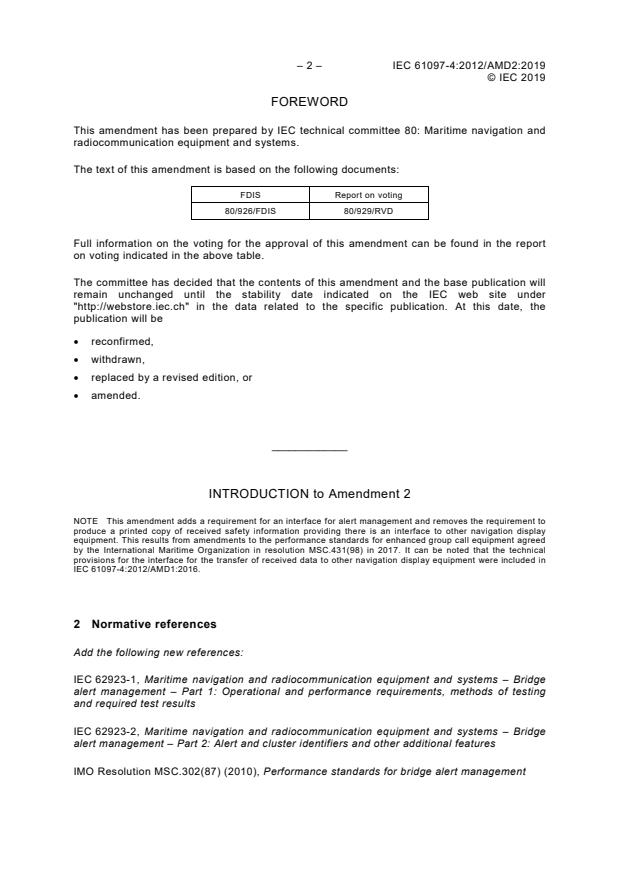
FOREWORD
This amendment has been prepared by IEC technical committee 80: Maritime navigation and
radiocommunication equipment and systems.
The text of this amendment is based on the following documents:
FDIS Report on voting
80/926/FDIS 80/929/RVD
Full information on the voting for the approval of this amendment can be found in the report
on voting indicated in the above table.
The committee has decided that the contents of this amendment and the base publication will
remain unchanged until the stability date indicated on the IEC web site under
"http://webstore.iec.ch" in the data related to the specific publication. At this date, the
publication will be
• reconfirmed,
• withdrawn,
• replaced by a revised edition, or
• amended.
_____________
INTRODUCTION to Amendment 2
NOTE This amendment adds a requirement for an interface for alert management and removes the requirement to
produce a printed copy of received safety information providing there is an interface to other navigation display
equipment. This results from amendments to the performance standards for enhanced group call equipment agreed
by the International Maritime Organization in resolution MSC.431(98) in 2017. It can be noted that the technical
provisions for the interface for the transfer of received data to other navigation display equipment were included in
IEC 61097-4:2012/AMD1:2016.
2 Normative references
Add the following new references:
IEC 62923-1, Maritime navigation and radiocommunication equipment and systems – Bridge
alert management – Part 1: Operational and performance requirements, methods of testing
and required test results
IEC 62923-2, Maritime navigation and radiocommunication equipment and systems – Bridge
alert management – Part 2: Alert and cluster identifiers and other additional features
IMO Resolution MSC.302(87) (2010), Performance standards for bridge alert management
© IEC 2019
3 Performance requirements
3.4.2 General
(See 5.4.2)
Replace the second paragraph with the following:
(MSC.306(87) A1.3): Alternatively to the requirement in paragraph MSC.306(87) A1.2, the
equipment need not provide means to produce a printed copy of received information if it is
installed in combination with an interface connecting it to navigation equipment that is
compliant with resolution MSC 252(83), as amended, on Revised Performance standards for
integrated navigation systems (INS). Provisions for interconnection to a shipborne integrated
radiocommunication system (IRCS) when used in the GMDSS (resolution A.811(19)) shall
also be included.
If no means are provided by the equipment to produce a printed copy of received information
then the manufacturer’s documentation shall clearly describe that the equipment can only be
used when connected to an equipment enabled for the display of enhanced group calls in
compliance with the applicable IEC 61924-2 requirements.
NOTE The testing standard for compliance with INS (Resolution MSC 252(83)) is IEC 61924-2. The testing
standard for compliance with IRCS (Resolution A.811(19)) is IEC 62940.
(MSC.306(87) A1.4): The enhanced group call installation may be either separate or
combined with other installations. Elements of other installations, e.g. the antenna, low noise
amplifier and down converter of the ship earth system, may be shared for the reception of
enhanced group call messages.
4 Technical characteristics
4.4 Interfaces
Replace the existing text, modified by Amendment 1, with the following:
(See 5.8.3)
(MSC.306(87) A6.3): All interfaces provided for communication with other navigation or
communication equipment shall comply with IEC standards 61162.
(MSC.306(87) A6.1): The equipment shall include at least one interface for the transfer of
received data to other navigation display or integrated communications equipment.
The equipment shall be provided with a data interface capable of transmitting the sentences
SM1, SM2, SM3, SM4 and SMB according to IEC 61162-1.
(MSC.306(87) A6.2): The equipment shall include an interface for alert management in
accordance with resolution MSC.302(87) on Performance standards for bridge alert
management.
In addition to the sentences previously mentioned, the equipment shall be capable of
communicating with the sentences ACN, ALC, ALF, ARC and HBT according to IEC 61162-1.
The equipment shall be capable of classifying, handling, displaying and reporting alerts as
required in IEC 62923-1 and IEC 62923-2. In the BAM concept, the EGC receiver acts as an
alert source.
– 4 – IEC 61097-4:2012/AMD2:2019
© IEC 2019
The equipment shall be capable of releasing an alert with priority Warning and Category A
with alert identifier 3122 on receipt of a distress or urgency priority EGC message.
NOTE 1 Warning is a short audible announcement repeated up to every 5 min until acknowledged by the
operator, “Category A” refers to when acknowledgement is only possible at the source, “Alert identifier 3122”
indicates a message received warning.
The alert title for the first ALF sentence for a distress priority EGC message (C = 3) shall be
“Distress RX”. The additional information in the second ALF sentence shall be “Incoming
distress. Check Inmarsat display”.
The alert title for the first ALF sentence for an urgency priority EGC message (C = 2) shall be
“Urgency RX”. The additional information in the second ALF sentence shall be “Incoming
urgency warning. Check Inmarsat C display”.
NOTE 2 The priority codes (C ) are described in the IMO International SafetyNET Manual.
The alert, if not acknowledged, shall be repeated as a warning after a limited time period no
...