

IEC 60601-2-18:1996
(Main)Medical electrical equipment - Part 2: Particular requirements for the safety of endoscopic equipment
General Information
- Abstract
Establishes particular requirements for the safety of endoscopic equipment and enables parts of endoscopic equipment to be tested together or individually.
- Status
- Published
- Publication Date
- 06-Aug-1996
- Technical Committee
- SC 62D - Particular medical equipment, software, and systems
- Current Stage
- DELPUB - Deleted Publication
- Start Date
- 12-Aug-2009
- Completion Date
- 28-Aug-2026
Overview
IEC 60601-2-18:1996 is an international standard published by the International Electrotechnical Commission (IEC) that specifies particular safety requirements for endoscopic equipment. This standard is part 2 of the IEC 60601 series, which covers medical electrical equipment and builds upon the general safety principles outlined in IEC 60601-1. The document focuses on ensuring the safety of endoscopic devices, including their operating conditions, testing methods, and interaction with endoscopic accessories.
The 1996 edition of IEC 60601-2-18 replaces the previous 1990 edition with updated definitions, particularly for the term "endoscope," and introduces additional provisions for interconnecting conditions between endoscopes and their accessories. This standard allows either individual components of endoscopic systems or complete assemblies to be tested for compliance.
Key Topics
Scope and Application
Specifies safety requirements tailored to endoscopic equipment used in medical practice. Addresses the design, construction, and testing of the endoscopes and their accessories to mitigate risks during use.Terminology and Definitions
Standardizes terms related to endoscopic devices for consistent understanding and application.General Requirements and Testing
Covers essential safety aspects such as electrical, mechanical, and environmental conditions under which endoscopic equipment must reliably operate.Protection Against Hazards
- Electrical Shock: Dielectric strength and electrical insulation to protect users and patients.
- Mechanical Safety: Mechanical strength, prevention of injury from moving parts, resistance to vibration, noise, and the management of suspended masses.
- Radiation Safety: Limits on unwanted or excessive radiation, including electromagnetic compatibility requirements.
- Fire Safety: Measures to prevent ignition of flammable anesthetic mixtures during endoscopic procedures.
- Thermal Safety: Avoidance of excessive temperatures, ensuring patient and operator safety.
- Ingress Protection: Safeguards against liquid intrusion, facilitating proper cleaning, sterilization, and disinfection without degrading device performance or safety.
Accuracy and Operating Characteristics
Ensures endoscopes deliver precise results and prevents risks related to hazardous output features.Abnormal Operation and Fault Conditions
Guidelines for design robustness when facing equipment malfunction or environmental stress.
Applications
IEC 60601-2-18:1996 is essential for manufacturers, designers, and testers of endoscopic equipment to ensure compliance with internationally accepted safety standards. Its practical applications include:
Medical Device Design
Incorporating safety features that reduce patient and user risk during diagnostic or surgical endoscopic procedures.Quality Assurance and Testing
Validating safety performance through standardized tests including electrical safety, mechanical durability, and environmental resistance.Regulatory Compliance
Meeting national and international medical device regulations that often require adherence to IEC standards.Accessory Integration
Ensuring safe interconnection between endoscopes and various endoscopic accessories, preserving the integrity and functionality of complex medical systems.
Related Standards
IEC 60601-2-18 forms part of a comprehensive set of standards for medical electrical equipment, closely related to:
IEC 60601-1: General requirements for basic safety and essential performance of medical electrical equipment. This acts as the foundational safety standard.
IEC 60601-1-1: Safety requirements for medical electrical systems.
IEC 60601-1-2: Requirements for electromagnetic compatibility of medical devices.
These standards collectively ensure a harmonized approach to medical device safety, covering general principles, system safety, and environment interaction.
Keywords: IEC 60601-2-18, endoscopic equipment safety, medical electrical equipment standards, endoscope safety requirements, IEC medical device standards, endoscope testing, electrical safety for endoscopes, medical device interconnection, electromagnetic compatibility medical devices, medical device construction guidelines, endoscope accessories safety.
Relations
- Effective Date
- 05-Sep-2023
- Effective Date
- 05-Sep-2023
Get Certified
Connect with accredited certification bodies for this standard

BSI Group
BSI (British Standards Institution) is the business standards company that helps organizations make excellence a habit.

TÜV Rheinland
TÜV Rheinland is a leading international provider of technical services.

TÜV SÜD
TÜV SÜD is a trusted partner of choice for safety, security and sustainability solutions.
Sponsored listings
Frequently Asked Questions
IEC 60601-2-18:1996 is a standard published by the International Electrotechnical Commission (IEC). Its full title is "Medical electrical equipment - Part 2: Particular requirements for the safety of endoscopic equipment". This standard covers: Establishes particular requirements for the safety of endoscopic equipment and enables parts of endoscopic equipment to be tested together or individually.
Establishes particular requirements for the safety of endoscopic equipment and enables parts of endoscopic equipment to be tested together or individually.
IEC 60601-2-18:1996 is classified under the following ICS (International Classification for Standards) categories: 11.040.50 - Radiographic equipment. The ICS classification helps identify the subject area and facilitates finding related standards.
IEC 60601-2-18:1996 has the following relationships with other standards: It is inter standard links to IEC 60601-2-18:1996/AMD1:2000, IEC 60601-2-18:2009. Understanding these relationships helps ensure you are using the most current and applicable version of the standard.
IEC 60601-2-18:1996 is available in PDF format for immediate download after purchase. The document can be added to your cart and obtained through the secure checkout process. Digital delivery ensures instant access to the complete standard document.
Standards Content (Sample)
NORME
CEI
INTERNATIONALE
IEC
601-2-18
INTERNATIONAL
Deuxième édition
STANDARD
Second edition
1996-08
Appareils électromédicaux –
Partie 2:
Règles particulières de sécurité
pour appareils d’endoscopie
Medical electrical equipment –
Part 2:
Particular requirements for the safety
of endoscopic equipment
Numéro de référence
Reference number
CEI/IEC 601-2-18: 1996
NORME
CEI
INTERNATIONALE
IEC
601-2-18
INTERNATIONAL
Deuxième édition
STANDARD
Second edition
1996-08
Appareils électromédicaux –
Partie 2:
Règles particulières de sécurité
pour appareils d’endoscopie
Medical electrical equipment –
Part 2:
Particular requirements for the safety
of endoscopic equipment
CEI 1996 Droits de reproduction réservés Copyright - all rights reserved
Aucune partie de cette publication ne peut être reproduite ni No part of this publication may be reproduced or utilized
utilisée sous quelque forme que ce soit et par aucun procédé, in any form or by any means, electronic or mechanical,
électronique ou mécanique, y compris la photocopie et les including photocopying and microfilm, without permission
microfilms, sans l'accord écrit de l'éditeur. in writing from the publisher
Bureau central de la Commission Electrotechnique Internationale 3, rue de Varembé Genève, Suisse
CODE PRIX
Commission Electrotechnique Internationale
U
International Electrotechnical Commission PRICE CODE
Pour prix, voir catalogue en vigueur
For price, see current catalogue
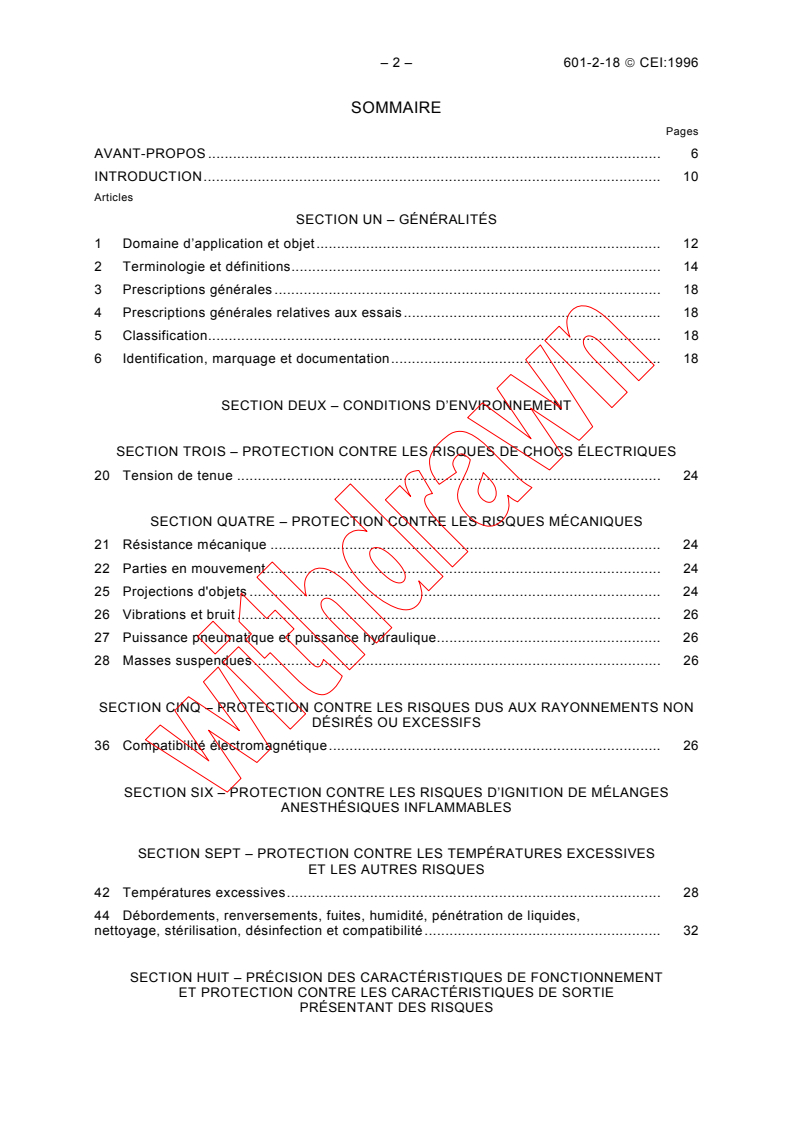
– 2 – 601-2-18 CEI:1996
SOMMAIRE
Pages
AVANT-PROPOS . 6
INTRODUCTION. 10
Articles
SECTION UN – GÉNÉRALITÉS
1 Domaine d’application et objet. 12
2 Terminologie et définitions. 14
3 Prescriptions générales . 18
4 Prescriptions générales relatives aux essais. 18
5 Classification. 18
6 Identification, marquage et documentation. 18
SECTION DEUX – CONDITIONS D’ENVIRONNEMENT
SECTION TROIS – PROTECTION CONTRE LES RISQUES DE CHOCS ÉLECTRIQUES
20 Tension de tenue . 24
SECTION QUATRE – PROTECTION CONTRE LES RISQUES MÉCANIQUES
21 Résistance mécanique . 24
22 Parties en mouvement. 24
25 Projections d'objets . 24
26 Vibrations et bruit . 26
27 Puissance pneumatique et puissance hydraulique. 26
28 Masses suspendues. 26
SECTION CINQ – PROTECTION CONTRE LES RISQUES DUS AUX RAYONNEMENTS NON
DÉSIRÉS OU EXCESSIFS
36 Compatibilité électromagnétique. 26
SECTION SIX – PROTECTION CONTRE LES RISQUES D’IGNITION DE MÉLANGES
ANESTHÉSIQUES INFLAMMABLES
SECTION SEPT – PROTECTION CONTRE LES TEMPÉRATURES EXCESSIVES
ET LES AUTRES RISQUES
42 Températures excessives. 28
44 Débordements, renversements, fuites, humidité, pénétration de liquides,
nettoyage, stérilisation, désinfection et compatibilité. 32
SECTION HUIT – PRÉCISION DES CARACTÉRISTIQUES DE FONCTIONNEMENT
ET PROTECTION CONTRE LES CARACTÉRISTIQUES DE SORTIE
PRÉSENTANT DES RISQUES
601-2-18 IEC:1996 − 3 −
CONTENTS
Page
FOREWORD. 7
INTRODUCTION. 11
SECTION ONE − GENERAL
Clause
1 Scope and object . 13
2 Terminology and definitions . 15
3 General requirements. 19
4 General requirements for tests . 19
5 Classification. 19
6 Identification, marking and documents. 19
SECTION TWO − ENVIRONMENTAL CONDITIONS
SECTION THREE − PROTECTION AGAINST ELECTRIC SHOCK HAZARDS
20 Dielectric strength . 25
SECTION FOUR − PROTECTION AGAINST MECHANICAL HAZARDS
21 Mechanical strength . 25
22 Moving parts . 25
25 Expelled parts . 25
26 Vibration and noise. 27
27 Pneumatic and hydraulic power . 27
28 Suspended masses . 27
SECTION FIVE − PROTECTION AGAINST HAZARDS FROM UNWANTED
OR EXCESSIVE RADIATION
36 Electromagnetic compatibility . 27
SECTION SIX − PROTECTION AGAINST HAZARDS OF IGNITION
OF FLAMMABLE ANAESTHETIC MIXTURES
SECTION SEVEN − PROTECTION AGAINST EXCESSIVE TEMPERATURES
AND OTHER SAFETY HAZARDS
42 Excessive temperatures . 29
44 Overflow, spillage, leakage, humidity, ingress of liquids, cleaning, sterilization,
disinfection and compatibility . 33
SECTION EIGHT − ACCURACY OF OPERATING DATA AND PROTECTION
AGAINST HAZARDOUS OUTPUT
– 4 – 601-2-18 CEI:1996
SECTION NEUF – FONCTIONNEMENT ANORMAL ET CONDITIONS DE DÉFAUT;
ESSAIS D’ENVIRONNEMENT
SECTION DIX – RÈGLES DE CONSTRUCTION
PARTIES RELIÉES AU RÉSEAU, composants et montage . 34
Figures
101 Identification de la PARTIE ÉMETTRICE DE LUMIÈRE . 36
102 Mesure des COURANTS HF PAR COUPLAGE CAPACITIF à travers l’oculaire . 36
Annexes
D Symboles des marquages. 38
L Références – Publications mentionnées dans la présente norme . 40
AA Justifications . 42
601-2-18 IEC:1996 − 5 −
SECTION NINE − ABNORMAL OPERATION AND FAULT CONDITIONS;
ENVIRONMENTAL TESTS
SECTION TEN − CONSTRUCTIONAL REQUIREMENTS
57 MAINS PARTS, components and layout. 35
Figures
101 Identification of LIGHT EMISSION PART. 37
102 Measurement of CAPACITIVELY COUPLED HF CURRENT through the eyepiece . 37
Appendices/Annexes
D Symbols on marking . 39
L References – Publications mentioned in this standard. 41
AA Rationale. 43
– 6 – 601-2-18 CEI:1996
COMMISSION ÉLECTROTECHNIQUE INTERNATIONALE
__________
APPAREILS ÉLECTROMÉDICAUX –
Partie 2: Règles particulières de sécurité
pour appareils d'endoscopie
AVANT-PROPOS
1) La CEI (Commission Electrotechnique Internationale) est une organisation mondiale de normalisation
composée de l'ensemble des comités électrotechniques nationaux (Comités nationaux de la CEI). La CEI a
pour objet de favoriser la coopération internationale pour toutes les questions de normalisation dans les
domaines de l'électricité et de l'électronique. A cet effet, la CEI, entre autres activités, publie des Normes
Internationales. Leur élaboration est confiée à des comités d'études, aux travaux desquels tout Comité
national intéressé par le sujet traité peut participer. Les organisations internationales, gouvernementales et
non gouvernementales, en liaison avec la CEI, participent également aux travaux. La CEI collabore
étroitement avec l'Organisation Internationale de Normalisation (ISO), selon des conditions fixées par accord
entre les deux organisations.
2) Les décisions ou accords officiels de la CEI concernant les questions techniques, représentent, dans la
mesure du possible un accord international sur les sujets étudiés, étant donné que les Comités nationaux
intéressés sont représentés dans chaque comité d’études.
3) Les documents produits se présentent sous la forme de recommandations internationales. Ils sont publiés
comme normes, rapports techniques ou guides et agréés comme tels par les Comités nationaux.
4) Dans le but d'encourager l'unification internationale, les Comités nationaux de la CEI s'engagent à appliquer
de façon transparente, dans toute la mesure possible, les Normes internationales de la CEI dans leurs normes
nationales et régionales. Toute divergence entre la norme de la CEI et la norme nationale ou régionale
correspondante doit être indiquée en termes clairs dans cette dernière.
5) La CEI n’a fixé aucune procédure concernant le marquage comme indication d’approbation et sa
responsabilité n’est pas engagée quand un matériel est déclaré conforme à l’une de ses normes.
6) L’attention est attirée sur le fait que certains des éléments de la présente Norme internationale peuvent faire
l’objet de droits de propriété intellectuelle ou de droits analogues. La CEI ne saurait être tenue pour
responsable de ne pas avoir identifié de tels droits de propriété et de ne pas avoir signalé leur existence.
La Norme internationale CEI 601-2-18 a été établie par le sous-comité 62D: Appareils
électromédicaux, du comité d'études 62 de la CEI: Equipements électriques dans la pratique
médicale.
La présente deuxième édition de la CEI 601-2-18 annule et remplace la première édition
publiée en 1990. Elle constitue une révision technique.
Le texte de cette Norme Particulière est issu des documents suivants:
FDIS Rapport de vote
62D/191/FDIS 62D/208/RVD
Le rapport de vote indiqué dans le tableau ci-dessus donne toute information sur le vote ayant
abouti à l'approbation de cette Norme Particulière.
L'annexe AA est donnée uniquement à titre d'information.
601-2-18 IEC:1996 − 7 −
INTERNATIONAL ELECTROTECHNICAL COMMISSION
_________
MEDICAL ELECTRICAL EQUIPMENT −−−−
Part 2: Particular requirements for the safety
of endoscopic equipment
FOREWORD
1) The IEC (International Electrotechnical Commission) is a worldwide organization for standardization
comprising all national electrotechnical committees (IEC National Committees). The object of the IEC is to
promote international co-operation on all questions concerning standardization in the electrical and electronic
fields. To this end and in addition to other activities, the IEC publishes International Standards. Their
preparation is entrusted to technical committees; any IEC National Committee interested in the subject dealt
with may participate in this preparatory work. International, governmental and non-governmental organizations
liaising with the IEC also participate in this preparation. The IEC collaborates closely with the International
Organization for Standardization (ISO) in accordance with conditions determined by agreement between the
two organizations.
2) The formal decisions or agreements of the IEC on technical matters, express as nearly as possible, an
international consensus of opinion on the relevant subjects since each technical committee has representation
from all interested National Committees.
3) The documents produced have the form of recommendations for international use and are published in the
form of standards, technical reports or guides and they are accepted by the National Committees in that
sense.
4) In order to promote international unification, IEC National Committees undertake to apply IEC International
Standards transparently to the maximum extent possible in their national and regional standards. Any
divergence between the IEC Standard and the corresponding national or regional standard shall be clearly
indicated in the latter.
5) The IEC provides no marking procedure to indicate its approval and cannot be rendered responsible for any
equipment declared to be in conformity with one of its standards.
6) Attention is drawn to the possibility that some of the elements of this International Standard may be the
subject of patent rights. IEC shall not be held responsible for identifying any or all such patent rights.
International Standard IEC 601-2-18 has been prepared by subcommittee 62D: Electromedical
equipment, of IEC technical committee 62: Electrical equipment in medical practice.
This second edition of IEC 601-2-18 cancels and replaces the first edition published in 1990.
This second edition constitutes a technical revision.
The text of this Particular Standard is based on the following documents:
FDIS Report on voting
62D/191/FDIS 62D/208/RVD
Full information on the voting for the approval of this Particular Standard can be found in the
report on voting indicated in the above table.
Annex AA is for information only.
– 8 – 601-2-18 CEI:1996
Dans la présente Norme Particulière, les caractères d’imprimerie suivants sont utilisés:
– Prescriptions dont la conformité peut être vérifiée par un essai et définitions: caractères
romains;
– Explications, conseils, introductions, énoncés de portée générale, exceptions et références: petits
caractères romains;
– Modalités d’essais: caractères italiques;
–LES TERMES DÉFINIS DANS L’ARTICLE 2 DE LA NORME GÉNÉRALE CEI 601-1 OU DANS LA
PRÉSENTE NORME PARTICULIÈRE: PETITES CAPITALES.
Les prescriptions sont suivies des spécifications d'essai correspondantes.
601-2-18 IEC:1996 − 9 −
In this Particular Standard, the following print types are used:
− Requirements, compliance with which can be tested, and definitions: in roman type;
− Explanations, advice, introductions, general statements and references: in smaller type;
− Test specifications: in italic types;
− TERMS DEFINED IN CLAUSE 2 OF THE GENERAL STANDARD IEC 601-1 OR THIS PARTICULAR
STANDARD: SMALL CAPITALS.
The requirements are followed by specifications for the relevant tests.
– 10 – 601-2-18 CEI:1996
INTRODUCTION
La présente Norme Particulière concerne la sécurité des APPAREILS D'ENDOSCOPIE. La relation
entre la présente Norme Particulière et la CEI 601-1 (y compris ses amendements) et les
Normes Collatérales est expliquée en 1.3.
Les révisions de cette deuxième édition concernent:
1 Une nouvelle définition de l'ENDOSCOPE;
2 L'insertion de prescriptions pour les CONDITIONS DE RACCORDEMENT avec des
ACCESSOIRES UTILISÉS POUR L'ENDOSCOPIE.
601-2-18 IEC:1996 − 11 −
INTRODUCTION
This Particular Standard concerns the safety of ENDOSCOPIC EQUIPMENT. The relationship of this
Particular Standard with IEC 601-1 (including the amendments) and the Collateral Standards is
explained in 1.3.
The revisions for this second edition include the following:
1) A new definition of ENDOSCOPE;
2) The inclusion of requirements for INTERCONNECTION CONDITIONS with ENDOSCOPICALLY-
USED ACCESSORIES.
– 12 – 601-2-18 CEI:1996
APPAREILS ÉLECTROMÉDICAUX –
Partie 2: Règles particulières de sécurité
pour appareils d'endoscopie
SECTION UN – GÉNÉRALITÉS
Les articles et paragraphes de la section correspondante de la Norme Générale s'appliquent
avec les exceptions suivantes:
1 Domaine d'application et objet
L'article correspondant de la Norme Générale s'applique avec les exceptions suivantes:
1.1 Domaine d'application
Complément:
La présente Norme Particulière spécifie des prescriptions pour la sécurité des APPAREILS
D'ENDOSCOPIE et leurs CONDITIONS DE RACCORDEMENT avec des ACCESSOIRES UTILISÉS EN
ENDOSCOPIE.
NOTE – Comme la Norme Générale ne fournit pas de prescriptions de sécurité pour les combinaisons de
PARTIES APPLIQUÉES de différents APPAREILS ÉLECTROMÉDICAUX, la présente Norme Particulière en fournit pour des
CONDITIONS DE RACCORDEMENT spécifiques couramment rencontrées lors de l'utilisation d'ENDOSCOPES.
1.2 Objet
Remplacement:
L'objet de la présente Norme Particulière est d'établir des prescriptions particulières de
sécurité pour les APPAREILS D'ENDOSCOPIE et de permettre les essais de leurs composants
associés ou considérés individuellement.
1.3 Normes Particulières
Complément:
La présente Norme Particulière modifie et complète l'ensemble des publications CEI, désigné
ci-après «Norme Générale», comprenant la CEI 601-1: 1988, Appareils électromédicaux –
Première Partie: Règles générales de sécurité, son amendement 1, son amendement 2, la CEI
601-1-1: 1992, Appareils électromédicaux – Première Partie: Règles générales de sécurité – 1.
Norme collatérale: Règles de sécurité pour systèmes électromédicaux, son amendement 1, et
la CEI 601-1-2: 1993, Appareils électromédicaux – Première Partie: Règles générales de
sécurité – 2. Norme collatérale: Compatibilité électromagnétique – Prescriptions et essais.
Pour plus de concision, la CEI 601-1 est désignée dans la présente Norme Particulière soit
comme «Norme Générale», soit comme «Prescription(s) Générale(s)», et la CEI 601-1-1 et la
CEI 601-1-2 sont désignées comme «Normes Collatérales».
L'expression «cette Norme» est utilisée pour se référer à la Norme Générale, aux Normes
Collatérales et à cette Norme Particulière, considérées ensemble.
601-2-18 IEC:1996 − 13 −
MEDICAL ELECTRICAL EQUIPMENT −−
−−
Part 2: Particular requirements for the safety
of endoscopic equipment
SECTION ONE − GENERAL
The clauses and subclauses of this section of the General Standard apply except as follows:
1 Scope and object
This clause of the General Standard applies, except as follows:
1.1 Scope
Addition:
This Particular Standard specifies requirements for the safety of ENDOSCOPIC EQUIPMENT and its
INTERCONNECTION CONDITIONS with ENDOSCOPICALLY-USED ACCESSORIES.
NOTE − As the General Standard does not give requirements for the safety of APPLIED PARTS of different
MEDICAL ELECTRICAL EQUIPMENT when used together, this standard gives requirements for specific
INTERCONNECTION CONDITIONS commonly encountered during the use of ENDOSCOPES.
1.2 Object
Replacement:
The object of this Particular Standard to establish particular requirements for the safety of
ENDOSCOPIC EQUIPMENT and enable parts of ENDOSCOPIC EQUIPMENT to be tested together or
individually.
1.3 Particular Standards
Addition:
This Particular Standard amends and supplements a set of IEC publications, hereinafter
referred to as “General Standard”, consisting of IEC 601-1: 1988, Medical electrical equipment
− Part 1: General requirements for safety, amendment 1, amendment 2, IEC 601-1-1: 1992,
Medical electrical equipment − Part 1: General requirements for safety, 1. Collateral Standard:
Safety requirements for medical electrical systems, amendment 1, and IEC 601-1-2: 1993,
Medical electrical equipment − Part 1: General requirements for safety, 2. Collateral standard:
Electromagnetic compatibility − Requirements and tests.
For brevity, IEC 601-1 is referred to in this Particular Standard either as the “General Standard”
or as the “General Requirement(s)”, and IEC 601-1-1 and IEC 601-1-2 as the “Collateral
Standards”.
The term “this Standard” covers this Particular Standard, used together with the General
Standard and Collateral Standards.
– 14 – 601-2-18 CEI:1996
La numérotation des sections, articles et paragraphes de la présente Norme Particulière
correspond à celle de la Norme Générale. Les modifications au texte de la Norme Générale
sont indiquées par les expressions suivantes:
«Remplacement» signifie que l’article ou le paragraphe correspondant de la Norme Générale
est remplacé complètement par le texte de la présente Norme Particulière.
«Complément» signifie que le texte de la présente Norme Particulière doit être ajouté aux
prescriptions de la Norme Générale.
«Modification» signifie que l’article ou le paragraphe de la Norme Générale est modifié ainsi
qu’indiqué dans la présente Norme Particulière.
Les paragraphes et figures ajoutés à la Norme Générale sont numérotés à partir de 101, les
annexes complémentaires sont notées AA, BB, etc., et les compléments aa), bb), etc.
Les articles et paragraphes faisant l’objet d'une justification sont marqués d’un astérisque *.
Ces justifications se trouvent dans l’annexe informative AA. L’annexe AA ne fait pas partie
intégrante de cette Norme Particulière et donne uniquement des informations
complémentaires; elle ne peut en aucun cas être utilisée dans le but de spécifier des
prescriptions d’essai.
Lorsque la présente Norme Particulière ne comprend pas de section, article ou paragraphe, la
section, l’article ou le paragraphe de la Norme Générale ou de la Norme Collatérale s’applique
sans modification.
Lorsqu’il est demandé qu’une partie quelconque de la Norme Générale ou de la Norme
Collatérale, bien que pertinente, ne s’applique pas, cela est expressément mentionné dans la
présente Norme Particulière.
Une prescription de la présente Norme Particulière remplaçant ou modifiant des prescriptions
de la Norme Générale ou de la norme Collatérale a priorité sur la (ou les) Prescription(s)
Générale(s).
2 Terminologie et définitions
L'article correspondant de la Norme Générale s'applique avec les exceptions suivantes:
2.1.5 PARTIE APPLIQUÉE
Complément:
Pour certains APPAREILS D'ENDOSCOPIE, la PARTIE APPLIQUÉE s'étend, vue du PATIENT, dans le
(ou les) ÉLÉMENT(S) AUXILIAIRE(S) jusqu'aux points où se situe la séparation prescrite (voir 17a)
de la Norme Générale).
Définitions complémentaires:
*2.1.101 ENDOSCOPE
PARTIE APPLIQUÉE d'APPAREILS ÉLECTROMÉDICAUX introduite dans un PATIENT. Pour fournir une
vue interne ou une image à des fins d'examen, de diagnostic et/ou de thérapie.
601-2-18 IEC:1996 − 15 −
The numbering of sections, clauses and subclauses of this Particular Standard corresponds
with that of the General Standard. The changes to the text of the General Standard are
specified by the use of the following words:
“Replacement” means that the clause or subclause of the General Standard is replaced
completely by the text of this Particular Standard.
“Addition” means that the text of this Particular Standard is additional to the requirements of
the General Standard.
“Amendment” means that the clause of subclause of the General Standard is amended as
indicated by the text of this Particular Standard.
Subclauses or figures which are additional to those of the General Standard are numbered
starting from 101, additional annexes are lettered AA, BB, etc., and additional items aa), bb),
etc.
Clauses and subclauses to which there is a rationale are marked with an asterisk *. These
rationales can be found in an informative annex AA. Annex AA is not part of this Particular
Standard and only gives additional information; it can never be the subject of testing.
Where there is no corresponding section, clause or subclause in this Particular Standard, the
section, clause or subclause of the General Standard or Collateral Standard applies without
modification.
Where it is intended that any part of the General Standard or Collateral Standards, although
possibly irrelevant, is not to be applied, a statement to that effect is given in this Particular
Standard.
A requirement of this Particular Standard replacing or modifying requirements of the General
Standard or Collateral Standards takes precedence over the corresponding General
Requirement(s).
2 Terminology and definitions
This clause of the General Standard applies, except as follows:
2.1.4 APPLIED PART
Addition:
For some ENDOSCOPIC EQUIPMENT, the APPLIED PART extends, as seen from the PATIENT, into
the SUPPLY UNIT(S) to the point(s) where the required separation is provided (see 17a) of the
General Standard).
Additional definitions:
*2.1.101 ENDOSCOPE
An APPLIED PART of MEDICAL ELECTRICAL EQUIPMENT introduced into a PATIENT to provide an
internal view or image for examination, diagnosis and/or therapy.
– 16 – 601-2-18 CEI:1996
*2.1.102 ACCESSOIRES UTILISÉS EN ENDOSCOPIE
ACCESSOIRE qui peut être la PARTIE APPLIQUÉE d'APPAREILS ÉLECTROMÉDICAUX qui ne sont pas
des APPAREILS D'ENDOSCOPIE et qui est introduit dans le PATIENT par le même orifice que
l'ENDOSCOPE.
*2.1.103 APPAREIL D'ENDOSCOPIE
ENDOSCOPE et son (ou ses) ÉLÉMENT(S) D'ALIMENTATION nécessaires pour l'usage envisagé.
2.1.104 APPAREIL D'ÉLECTROCHIRURGIE À COURANT HAUTE FRÉQUENCE
Défini en 2.1.101 de la CEI 601-2-2.
2.1.105 PARTIE ÉMETTRICE DE LUMIÈRE
Partie de l'élément introduit d'un ENDOSCOPE entourant la fenêtre émissive de lumière,
délimitée comme suit:
Zone de la surface de l'élément introduit ayant trois fois le diamètre maximal de l'élément
introduit, mesurée à l'extrémité (enveloppe distale enlevée) des ENDOSCOPES à visée à
l'extrémité, ou au centre de la fenêtre émissive de lumière des ENDOSCOPES à visée sur le côté,
mesurée dans des directions longitudinales dans les deux cas à partir du centre de la fenêtre
émissive de lumière entre 10 mm au moins et 25 mm au plus.
Voir aussi la figure 101.
*2.1.106 ÉLÉMENT D'ALIMENTATION
Partie de l'APPAREIL ENDOSCOPIQUE reliée directement à un ENDOSCOPE alimentant celui-ci pour
qu'il fournisse la vue ou l'image désirée, par exemple un éclairage ou un traitement du signal.
2.1.107 APPAREIL DE DIAGNOSTIC ET DE SURVEILLANCE À ULTRASONS
**
Défini au 2.1.124 de la future CEI 601-2-37 «Sécurité pour les appareils de diagnostic et de
surveillance à ultrasons».
*2.5.101 COURANT HF PAR COUPLAGE CAPACITIF
Courant HF qu'on ne peut éviter circulant depuis un ACCESSOIRE UTILISÉ EN ENDOSCOPIE jusqu'à
l'ENDOSCOPE.
2.12.101 CONDITIONS DE RACCORDEMENT
Conditions qui doivent être remplies pour utiliser sans danger un ENDOSCOPE alimenté ou un
ACCESSOIRE UTILISÉ POUR L'ENDOSCOPIE alimenté et utilisé avec un ENDOSCOPE.
_________
**
A present, projet de comité 62B/290/CD.
601-2-18 IEC:1996 − 17 −
*2.1.102 ENDOSCOPICALLY-USED ACCESSORY
An accessory, which may be the APPLIED PART of MEDICAL ELECTRICAL EQUIPMENT that is not
ENDOSCOPIC EQUIPMENT, introduced into a PATIENT through the same orifice in the PATIENT as
the ENDOSCOPE.
*2.1.103 ENDOSCOPIC EQUIPMENT
An ENDOSCOPE together with its SUPPLY UNIT(S), as required for its intended use.
2.1.104 HIGH FREQUENCY SURGICAL EQUIPMENT
As defined by 2.1.101 of IEC 601-2-2.
2.1.105 LIGHT EMISSION PART
That part of the insertion portion of an ENDOSCOPE surrounding the light emission window,
delineated as follows:
The area of the surface of the insertion portion within three times the maximum diameter of the
insertion portion, measured at the tip (distal cover removed) for end viewing ENDOSCOPES or
the centre of the light emission window for side viewing ENDOSCOPES, measured in both
longitudinal directions from the centre of the light emission window, but with a minimum of
10 mm and a maximum of 25 mm.
See also figure 101.
*2.1.106 SUPPLY UNIT
That part of ENDOSCOPIC EQUIPMENT directly connected to an ENDOSCOPE, supplying functions
necessary for the ENDOSCOPE to produce the intended view or image, for example illumination
or signal processing.
2.1.107 ULTRASONIC MEDICAL DIAGNOSTIC AND MONITORING EQUIPMENT
As defined by 2.1.124 of future IEC 601-2-37**, “Safety of ultrasonic medical diagnostic and
monitoring equipment”.
*2.5.101 CAPACITIVELY COUPLED HF CURRENT
Unavoidable high frequency current flowing from an ENDOSCOPICALLY-USED ACCESSORY to the
endoscope.
2.12.101 INTERCONNECTION CONDITIONS
Conditions that shall be fulfilled for safe use when an energized ENDOSCOPE or energized
ENDOSCOPICALLY-USED ACCESSORY is used with an ENDOSCOPE.
_________
** At present Committee draft ref. 62B/290/CD.
– 18 – 601-2-18 CEI:1996
3 Prescriptions générales
L'article correspondant de la Norme Générale s'applique avec les exceptions suivantes:
Paragraphes complémentaires:
*3.101 Si des prescriptions pour des ACCESSOIRES UTILISÉS EN ENDOSCOPIE données dans
d'autres Normes Particulières sont en désaccord avec les prescriptions des CONDITIONS DE
RACCORDEMENT de la présente Norme Particulière, ces dernières doivent s'imposer.
*3.102 Pour les aspects concernant la sécurité de fonctionnement avec des ultrasons des
APPAREILS D'ENDOSCOPIE qui sont aussi des APPAREILS DE DIAGNOSTIC ET DE SURVEILLANCE À
ULTRASONS, cette partie qui concerne le diagnostic et la surveillance à ultrasons doit être en
accord avec les prescriptions de la publication CEI 601-2-37 et les autres parties doivent être
en accord avec les prescriptions de la présente Norme Particulière.
*3.103 Pour les ÉLÉMENTS D'ALIMENTATION ayant plusieurs fonctions, par exemple pour un
courant à haute fréquence, une insufflation, une aspiration etc., les parties appropriées de
ceux-ci doivent suivre les prescriptions des Normes Particulières correspondantes.
4 Prescriptions générales relatives aux essais
L'article correspondant de la Norme Générale s'applique avec l'exception suivante:
4.10 Complément:
Ce paragraphe ne s'applique pas aux CONDITIONS DE RACCORDEMENT.
5 Classification
L'article correspondant de la Norme Générale s'applique avec l'exception suivante:
5.2 Modification:
Supprimer PARTIE APPLIQUÉE DU TYPE B.
*6 Identification, marquage et documentation
L'article correspondant de la Norme Générale s'applique avec les exceptions suivantes:
Complément:
Les APPAREILS D'ENDOSCOPIE possédant des lampes d'éclairage doivent comporter des
marquages fixés de façon permanente et clairement lisibles près des lampes à l'intérieur ou à
l'extérieur de l'ÉLÉMENT D'ALIMENTATION, fournissant la RÉFÉRENCE DU MODÈLE ou DU TYPE. Cette
prescription ne s'applique pas aux lampes d'éclairage placées à l'extrémité distale des
ENDOSCOPES pour lesquelles des informations doivent être fournies dans les instructions
d'utilisation.
6.1 Marquage sur l'extérieur des APPAREILS ou des parties d'APPAREIL
d) Marquage minimal des APPAREILS et des parties interchangeables
Remplacement:
601-2-18 IEC:1996 − 19 −
3 General requirements
This clause of the General Standard applies, except as follows:
Additional subclauses:
*3.101 Where requirements for ENDOSCOPICALLY-USED ACCESSORIES given in other applicable
Particular Standards conflict with the requirements for INTERCONNECTION CONDITIONS of this
Particular Standard, the requirements of this Particular Standard shall take precedence.
*3.102 For the ultrasonic safety aspects of ENDOSCOPIC EQUIPMENT which is also ULTRASONIC
MEDICAL DIAGNOSTIC AND MONITORING EQUIPMENT, that part which is intended for ultrasonic
diagnosis or monitoring shall comply with the requirements of IEC 601-2-37 and the other parts
shall comply with the requirements of this Particular Standard.
*3.103 For SUPPLY UNITS providing a plurality of functions, for example high frequency
current, insufflation, suction, etc., the appropriate parts of these shall comply with the
requirements of relevant Particular Standards.
4 General requirements for tests
This clause of the General Standard applies, except as follows:
4.10 Addition:
This subclause does not apply to INTERCONNECTION CONDITIONS.
5 Classification
This clause of the General Standard applies, except as follows:
5.2 Amendment:
Delete TYPE B APPLIED PART.
*6 Identification, marking and documents
This clause of the General Standard applies, except as follows:
Addition:
ENDOSCOPIC EQUIPMENT having illumination lamps shall be provided with permanently affixed
and clearly legible markings near the lamps, either inside or outside the SUPPLY UNIT, giving
their MODEL OR TYPE REFERENCE. This requirement does not apply to illumination lamps built
into the distant end of ENDOSCOPES, for which the information shall be provided in the
instructions for use.
6.1 Marking on the outside of EQUIPMENT or EQUIPMENT parts
d) Minimum requirements for marking on EQUIPMENT and on interchangeable parts
Replacement:
– 20 – 601-2-18 CEI:1996
Si les dimensions de l'APPAREIL ou des PARTIES APPLIQUÉES spécifiées en 6.1 ou la nature de
l'ENVELOPPE ne permet pas d'y fixer tous les marquages spécifiés, dans ce cas au moins, les
marquages indiqués en 6.1 e), 6.1 f) et 6.1 g) (à l'exception des APPAREILS INSTALLÉS DE FAÇON
PERMANENTE), 6.1 l) et 6.1.q) (si cela s'applique) doivent être apposés et les autres marquages
doivent figurer intégralement dans les DOCUMENTS D'ACCOMPAGNEMENT. Si le marquage ne peut
être mis en place, toutes les informations doivent figurer dans les DOCUMENTS
D'ACCOMPAGNEMENT.
e) Indication d'origine
Complément:
Le nom et/ou la marque commerciale du fabricant ou du fournisseur doivent être portés sur les
PARTIES APPLIQUÉES.
f) RÉFÉRENCE DU MODÈLE ou DU TYPE
Complément:
La RÉFÉRENCE DU MODÈLE ou DU TYPE doit être portée sur les PARTIES APPLIQUÉES.
Point complémentaire:
aa) Marquages complémentaires
Au choix du fabricant, des symboles signalant certaines fonctions de l'APPAREIL D'ENDOSCOPIE
peuvent être utilisés mais doivent être expliqués dans les DOCUMENTS D'ACCOMPAGNEMENT. Si
on utilise des symboles, l'annexe D fournit ceux qui doivent être utilisés de préférence pour
signaler les fonctions décrites.
6.8 DOCUMENTS D'ACCOMPAGNEMENT
6.8.2 Instructions d'utilisation
Points complémentaires:
aa) Conseils généraux
Les instructions d'utilisation des APPAREILS D'ENDOSCOPIE doivent contenir, si cela convient, des
avis concernant leur utilisation sans danger, traitant des points suivants:
*1) Prévention des RISQUES si l'APPAREIL D'ENDOSCOPIE ne fonctionne plus.
2) Avant chaque utilisation, la surface extérieure des parties de l'ENDOSCOPE et des parties
des ACCESSOIRES UTILISÉS EN ENDOSCOPIE destinées à être introduites dans un PATIENT devrait
être vérifiée pour s'assurer qu'il n'existe aucune surface rugueuse, aucune arête aiguë ou
saillie non désirées pouvant présenter un RISQUE.
3) Des avertissements si les températures de surface sur les PARTIES APPLIQUÉES risquent de
dépasser 41 °C (voir 42.3).
4) Des avertissements expliquant qu'une lumière émise à haute énergie peut provenir de la
fenêtre d'émission de la lumière de l'ENDOSCOPE, donnant naissance à de hautes températures
devant la fenêtre d'émission de la lumière, et un avis sur la manière de réduire au minimum les
RISQUES.
601-2-18 IEC:1996 − 21 −
If the size of the EQUIPMENT or APPLIED PART specified in 6.1 or the nature of its ENCLOSURE
does not allow affixation of all specified markings, then at least the markings as indicated in
6.1e), 6.1f) and 6.1g) (not for PERMANENTLY INSTALLED EQUIPMENT), 6.1l) and 6.1q) (if
applicable) shall be affixed and the remaining markings shall be recorded in full in the
ACCOMPANYING DOCUMENTS. Where no marking is practicable, all information shall be included
in the ACCOMPANYING DOCUMENTS.
e) Indication of origin
Addition:
The name and/or trade mark of the manufacturer or supplier shall be marked on the APPLIED
PART.
f) MODEL OR TYPE REFERENCE
Addition:
The MODEL OR TYPE REFERENCE shall be marked on the APPLIED PART.
Additional item:
aa) Additional markings
At the option of the manufacturer, symbols to denote certain functions of ENDOSCOPIC
EQUIPMENT may be used but shall be explained in the ACCOMPANYING DOCUMENTS. If symbols
are used, appendix D lists those preferred symbols which shall be used to denote the functions
described.
6.8 ACCOMPANYING DOCUMENTS
6.8.2 Instructions for use
Additional items:
aa) General advice
The instructions for use of ENDOSCOPIC EQUIPMENT shall contain, where appropriate, advice
concerning its safe use, including the following:
*1) Prevention of SAFETY HAZARDS if ENDOSCOPIC EQUIPMENT loses functions.
2) That before each use, the outer surface of the portions of the ENDOSCOPE and any
ENDOSCOPICALLY-USED ACCESSORIES which are intended to be inserted into a PATIENT should be
checked to ensure there are no unintended rough surfaces, sharp edges or protrusions which
may cause a SAFETY HAZARD.
3) Warnings if surface temperatures on an APPLIED PART are likely to exceed 41 °C
(see 42.3).
4) Warnings that high energy radiated light may be transmitted from the light emission
window of the ENDOSCOPE, giving rise to high temperatures in front of the light emission
window, and advice on how to minimize associated SAFETY HAZARDS.
– 22 – 601-2-18 CEI:1996
5) Remplacement de la lampe d'éclairage, y compris la prévention des RISQUES de brûlure et
de blessure aux yeux pour l'OPÉRATEUR et l'UTILISATEUR.
6) Des avertissements concernant les RISQUES résultant d'embolie gazeuse provoquée, par
exemple, par une insufflation excessive d'air, de gaz inerte avant une intervention chirurgicale
à haute fréquence ou de gaz auxiliaire pour le laser.
7) Toutes les CONDITIONS DE RACCORDEMENT applicables existent.
8) Des avertissements que, lorsque les ENDOSCOPES sont mis en oeuvre avec des
ACCESSOIRES UTILISÉS EN ENDOSCOPIE alimentés, les COURANTS DE FUITE PATIENT ne s'ajouteront
pas. Cela est particulièrement important lorsqu'on utilise un ENDOSCOPE à PARTIE APPLIQUÉE du
TYPE CF auquel cas on devrait utiliser aussi des ACCESSOIRES UTILISÉS EN ENDOSCOPIE du TYPE
CF afin de rendre minimum le COURANT DE FUITE PATIENT.
*bb) Conseils lors d'une utilisation avec des APPAREILS D'ÉLECTROCHIRURGIE À COURANT HAUTE
FRÉQUENCE
Quand l'APPAREIL D'ENDOSCOPIE et/ou les ACCESSOIRES UTILISÉS EN ENDOSCOPIE sont utilisés
couplés à des APPAREILS D'ÉLECTROCHIRURGIE À COURANT HAUTE FRÉQUENCE, des conseils
concernant leur utilisation sans danger doivent être donnés traitant des points suivants:
1) La compatibilité à haute fréquence des ENDOSCOPES et des ACCESSOIRES UTILISÉS EN
ENDOSCOPIE par la détermination de la tension de crête périodique NOMINALE maximale de
l'ENDOSCOPE ou de l'ACCESSOIRE UTILISÉ EN ENDOSCOPIE pour chaque mode d'utilisation prévu
(voir 42.101) avec, de plus, des consignes pour qu'on n'utilise pas des tensions de crête
périodiques plus élevées.
2) La manière d'éviter un RISQUE au cas où des concentrations de gaz explosif sont présentes
dans la zone d'utilisation des ACCESSOIRES UTILISÉS EN ENDOSCOPIE en haute fréquence.
*cc) Conseils lors d'une utilisation avec des appareils à laser
Quand l'APPAREIL D'ENDOSCOPIE et/ou les ACCESSOIRES UTILISÉS EN ENDOSCOPIE sont utilisés
avec des appareils à laser, des conseils concernant leur utilisation sans danger doivent être
donnés, en particulier sur la manière d'éviter des blessures aux yeux pour l'OPÉRATEUR en
portant des lunettes filtrantes assurant une protection convenable ou en plaçant un filtre
adéquat dans l'oculaire de l'ENDOSCOPE.
dd) Conseils lors d'une utilisation avec d'autres APPAREILS ÉLECTROMÉDICAUX
Quand un APPAREIL D'ENDOSCOPIE est utilisé avec d'autres APPAREILS ÉLECTROMÉDICAUX, des
conseils sur la manière d'éviter les RISQUES possibles dus à leur utilisation doivent aussi être
donnés.
SECTION DEUX – CONDITIONS D'ENVIRONNEMENT
Les articles et paragraphes de la section correspondante de la Norme Générale s'appliquent.
601-2-18 IEC:1996 − 23 −
5) Replacement of the illumination lamp and prevention of SAFETY HAZARDS such as burns
and eye damage to the OPERATOR and USER.
6) Warnings regarding SAFETY HAZARDS resulting from gas embolism caused by, for example,
over-insufflation of air, inert gas prior to high frequency surgery or laser assist gas.
7) Whether there are any applicable INTERCONNECTION CONDITIONS.
8) Warnings that when ENDOSCOPES are used with energized ENDOSCOPICALLY-USED
ACCESSORIES, the PATIENT LEAKAGE CURRENTS may be additive. This is particularly important if a
TYPE CF APPLIED PART ENDOSCOPE is used, in which case a TYPE CF ENDOSCOPICALLY-USED
ACCESSORY should be used in order to minimize total PATIENT LEAKAGE CURRENT.
*bb) Advice when used with HIGH FREQUENCY SURGICAL EQUIPMENT
When ENDOSCOPIC EQUIPMENT and/or ENDOSCOPICALLY-USED ACCESSORIES is/are used with HIGH
FREQUENCY SURGICAL EQUIPMENT, advice concerning their safe use shall be given, including the
following:
1) The high frequency compatibility of ENDOSCOPES and ENDOSCOPICALLY-USED ACCESSORIES,
by stating the maximum RATED recurring peak voltage of the ENDOSCOPE or ENDOSCOPICALLY-
USED ACCESSORY for each mode of intended use (see 42.101), together with instructions that
higher recurring peak voltages shall not be used.
2) Avoidance of a SAFETY HAZARD in the event of explosive gas concentrations being present
in the area of use of HIGH FREQUENCY ENDOSCOPICALLY-USED ACCESSORIES.
*cc) Advice when used with laser equipment
When ENDOSCOPIC EQUIPMENT and/or ENDOSCOPICALLY-USED ACCESSORIES is/are used with
laser equipment, advice concerning their safe use shall be given, including avoidance of
potential eye damage to the OPERATOR by, for example, wearing suitable protective filtering
spectacles or by inserting a suitable filter in the eyepiece of the ENDOSCOPE.
dd) Advice when used with other MEDICAL ELECTRICAL EQUIPMENT
When ENDOSCOPIC EQUIPMENT is used with other MEDICAL ELECTRICAL EQUIPMENT, advice on the
avoidance of potential SAFETY HAZARDS caused by their use together shall also be given.
SECTION TWO − ENVIRONMENTAL CONDITIONS
The clauses and subclauses of this section of the General Standard apply.
– 24 – 601-2-18 CEI:1996
SECTION TROIS – PROTECTION CONTRE LES RISQUE DE CHO
...