

IEC 63322:2025
(Main)Security of ME equipment containing high-activity sealed radioactive sources
General Information
- Abstract
IEC 63322:2025 establishes security requirements of ME EQUIPMENT using high-activity SEALED RADIOACTIVE SOURCES, directly or indirectly, for medical treatment and other clinical procedures. ME EQUIPMENT containing SEALED RADIOACTIVE SOURCES that are defined as Category 1, 2 and 3 RADIOACTIVE SOURCES by IAEA are subject to this document. The object of this document is to specify requirements for the security of ME EQUIPMENT containing high-activity SEALED RADIOACTIVE SOURCES with the aim to minimize the risk of unauthorized access to the contained SEALED RADIOACTIVE SOURCES, and to serve as the basis for other standards. This document contains requirements for the MANUFACTURER of the ME EQUIPMENT and, separately, for the RESPONSIBLE ORGANIZATION regarding security at the location during use and storage. The requirements of this document apply when the SEALED RADIOACTIVE SOURCES are contained in the ME EQUIPMENT, i.e. from the time when the SEALED RADIOACTIVE SOURCES are inserted into the ME EQUIPMENT, during the INTENDED USE and when the ME EQUIPMENT is not being used for its INTENDED USE or taken out of regular use, until the equipment is being decommissioned, i.e. until all SEALED RADIOACTIVE SOURCES are permanently removed from the equipment.
- Status
- Published
- Publication Date
- 27-Jul-2025
- Drafting Committee
- WG 1 - TC 62/SC 62C/WG 1
- Current Stage
- PPUB - Publication issued
- Start Date
- 28-Jul-2025
- Completion Date
- 25-Jul-2025
Buy Documents
IEC 63322:2025 - Security of ME equipment containing high-activity sealed radioactive sources Released:7/28/2025
IEC 63322:2025 - Sécurité des appareils EM contenant des sources radioactives scellées de haute activité Released:7/28/2025
IEC 63322:2025 - Security of ME equipment containing high-activity sealed radioactive sources Released:7/28/2025
Overview
IEC 63322:2025 - "Security of ME equipment containing high-activity sealed radioactive sources" is an international standard that specifies security requirements for medical electrical (ME) equipment that contains high-activity sealed radioactive sources. It applies to equipment holding sources classified by the IAEA as Category 1, 2 or 3, and covers the lifecycle from insertion of the source into the ME equipment, through intended use and storage, until decommissioning and permanent source removal. The standard assigns responsibilities to both the MANUFACTURER and the RESPONSIBLE ORGANIZATION (e.g., hospitals, clinics) to minimize unauthorized access and misuse.
Key topics and technical requirements
- Scope and applicability: ME equipment with high-activity sealed sources used for medical treatment and clinical procedures; IAEA Category 1–3 sources.
- Division of responsibilities: Separate, explicit requirements for the Manufacturer (design, testing, documentation) and the Responsible Organization (site security, storage, use).
- Vulnerability assessment: Mandatory assessments by manufacturer and site to identify access pathways and reduce vulnerabilities.
- Security groups and resistance grades: Equipment is classified into security groups (A, B, C) with corresponding resistance grade requirements to physical attack.
- Physical resistance and testing: Type tests and site tests, with defined test grades and procedures to demonstrate compliance; Annexes include test specifications, attack-tool tables and anchoring tests.
- Intrusion detection and interfaces: Requirements for intrusion detection on ME equipment and interoperability with organizational security systems.
- Secure locations and access control: Rules for secure rooms, access control systems, markings, emergency procedures and site security manuals.
- Documentation and marking: Manufacturer-supplied site security guide, technical documentation and compliant markings.
Keywords: IEC 63322, medical equipment security, sealed radioactive source security, high-activity sources, vulnerability assessment, resistance grade, intrusion detection.
Practical applications and users
IEC 63322 is intended for:
- Manufacturers of ME equipment with sealed radioactive sources - to design, test and document compliant security arrangements.
- Healthcare providers and Responsible Organizations (hospitals, radiotherapy centers, nuclear medicine departments) - to implement site security, access control, emergency procedures and maintain compliant storage/use.
- Regulators and certification bodies - to assess conformity and review security measures for Category 1–3 sources.
- Testing laboratories and security engineers - to perform type/site tests and evaluate physical resistance and intrusion detection interfaces.
Implementing IEC 63322 improves protection of high-activity sealed sources, reduces theft/diversion risk, and provides a standardized basis for regulatory compliance and procurement.
Related standards
- IAEA categorization of radioactive sources (Category 1–3) - referenced in scope.
- EN 1143-1:2019 - relationship and testing correlations are addressed in Annex B of IEC 63322.
Buy Documents
IEC 63322:2025 - Security of ME equipment containing high-activity sealed radioactive sources Released:7/28/2025
IEC 63322:2025 - Sécurité des appareils EM contenant des sources radioactives scellées de haute activité Released:7/28/2025
IEC 63322:2025 - Security of ME equipment containing high-activity sealed radioactive sources Released:7/28/2025
Get Certified
Connect with accredited certification bodies for this standard

BSI Group
BSI (British Standards Institution) is the business standards company that helps organizations make excellence a habit.

TÜV Rheinland
TÜV Rheinland is a leading international provider of technical services.

TÜV SÜD
TÜV SÜD is a trusted partner of choice for safety, security and sustainability solutions.
Sponsored listings
Frequently Asked Questions
IEC 63322:2025 is a standard published by the International Electrotechnical Commission (IEC). Its full title is "Security of ME equipment containing high-activity sealed radioactive sources". This standard covers: IEC 63322:2025 establishes security requirements of ME EQUIPMENT using high-activity SEALED RADIOACTIVE SOURCES, directly or indirectly, for medical treatment and other clinical procedures. ME EQUIPMENT containing SEALED RADIOACTIVE SOURCES that are defined as Category 1, 2 and 3 RADIOACTIVE SOURCES by IAEA are subject to this document. The object of this document is to specify requirements for the security of ME EQUIPMENT containing high-activity SEALED RADIOACTIVE SOURCES with the aim to minimize the risk of unauthorized access to the contained SEALED RADIOACTIVE SOURCES, and to serve as the basis for other standards. This document contains requirements for the MANUFACTURER of the ME EQUIPMENT and, separately, for the RESPONSIBLE ORGANIZATION regarding security at the location during use and storage. The requirements of this document apply when the SEALED RADIOACTIVE SOURCES are contained in the ME EQUIPMENT, i.e. from the time when the SEALED RADIOACTIVE SOURCES are inserted into the ME EQUIPMENT, during the INTENDED USE and when the ME EQUIPMENT is not being used for its INTENDED USE or taken out of regular use, until the equipment is being decommissioned, i.e. until all SEALED RADIOACTIVE SOURCES are permanently removed from the equipment.
IEC 63322:2025 establishes security requirements of ME EQUIPMENT using high-activity SEALED RADIOACTIVE SOURCES, directly or indirectly, for medical treatment and other clinical procedures. ME EQUIPMENT containing SEALED RADIOACTIVE SOURCES that are defined as Category 1, 2 and 3 RADIOACTIVE SOURCES by IAEA are subject to this document. The object of this document is to specify requirements for the security of ME EQUIPMENT containing high-activity SEALED RADIOACTIVE SOURCES with the aim to minimize the risk of unauthorized access to the contained SEALED RADIOACTIVE SOURCES, and to serve as the basis for other standards. This document contains requirements for the MANUFACTURER of the ME EQUIPMENT and, separately, for the RESPONSIBLE ORGANIZATION regarding security at the location during use and storage. The requirements of this document apply when the SEALED RADIOACTIVE SOURCES are contained in the ME EQUIPMENT, i.e. from the time when the SEALED RADIOACTIVE SOURCES are inserted into the ME EQUIPMENT, during the INTENDED USE and when the ME EQUIPMENT is not being used for its INTENDED USE or taken out of regular use, until the equipment is being decommissioned, i.e. until all SEALED RADIOACTIVE SOURCES are permanently removed from the equipment.
IEC 63322:2025 is classified under the following ICS (International Classification for Standards) categories: 11.040.50 - Radiographic equipment. The ICS classification helps identify the subject area and facilitates finding related standards.
IEC 63322:2025 is available in PDF format for immediate download after purchase. The document can be added to your cart and obtained through the secure checkout process. Digital delivery ensures instant access to the complete standard document.
Standards Content (Sample)
IEC 63322 ®
Edition 1.0 2025-07
INTERNATIONAL
STANDARD
Security of ME equipment containing high-activity sealed radioactive sources
ICS 11.040.50 ISBN 978-2-8327-0530-8
All rights reserved. Unless otherwise specified, no part of this publication may be reproduced or utilized in any form or
by any means, electronic or mechanical, including photocopying and microfilm, without permission in writing from either
IEC or IEC's member National Committee in the country of the requester. If you have any questions about IEC copyright
or have an enquiry about obtaining additional rights to this publication, please contact the address below or your local
IEC member National Committee for further information.
IEC Secretariat Tel.: +41 22 919 02 11
3, rue de Varembé info@iec.ch
CH-1211 Geneva 20 www.iec.ch
Switzerland
About the IEC
The International Electrotechnical Commission (IEC) is the leading global organization that prepares and publishes
International Standards for all electrical, electronic and related technologies.
About IEC publications
The technical content of IEC publications is kept under constant review by the IEC. Please make sure that you have the
latest edition, a corrigendum or an amendment might have been published.
IEC publications search - IEC Products & Services Portal - products.iec.ch
webstore.iec.ch/advsearchform Discover our powerful search engine and read freely all the
The advanced search enables to find IEC publications by a publications previews, graphical symbols and the glossary.
variety of criteria (reference number, text, technical With a subscription you will always have access to up to date
committee, …). It also gives information on projects, content tailored to your needs.
replaced and withdrawn publications.
Electropedia - www.electropedia.org
The world's leading online dictionary on electrotechnology,
IEC Just Published - webstore.iec.ch/justpublished
Stay up to date on all new IEC publications. Just Published containing more than 22 500 terminological entries in English
details all new publications released. Available online and and French, with equivalent terms in 25 additional languages.
once a month by email. Also known as the International Electrotechnical Vocabulary
(IEV) online.
IEC Customer Service Centre - webstore.iec.ch/csc
If you wish to give us your feedback on this publication or
need further assistance, please contact the Customer
Service Centre: sales@iec.ch.
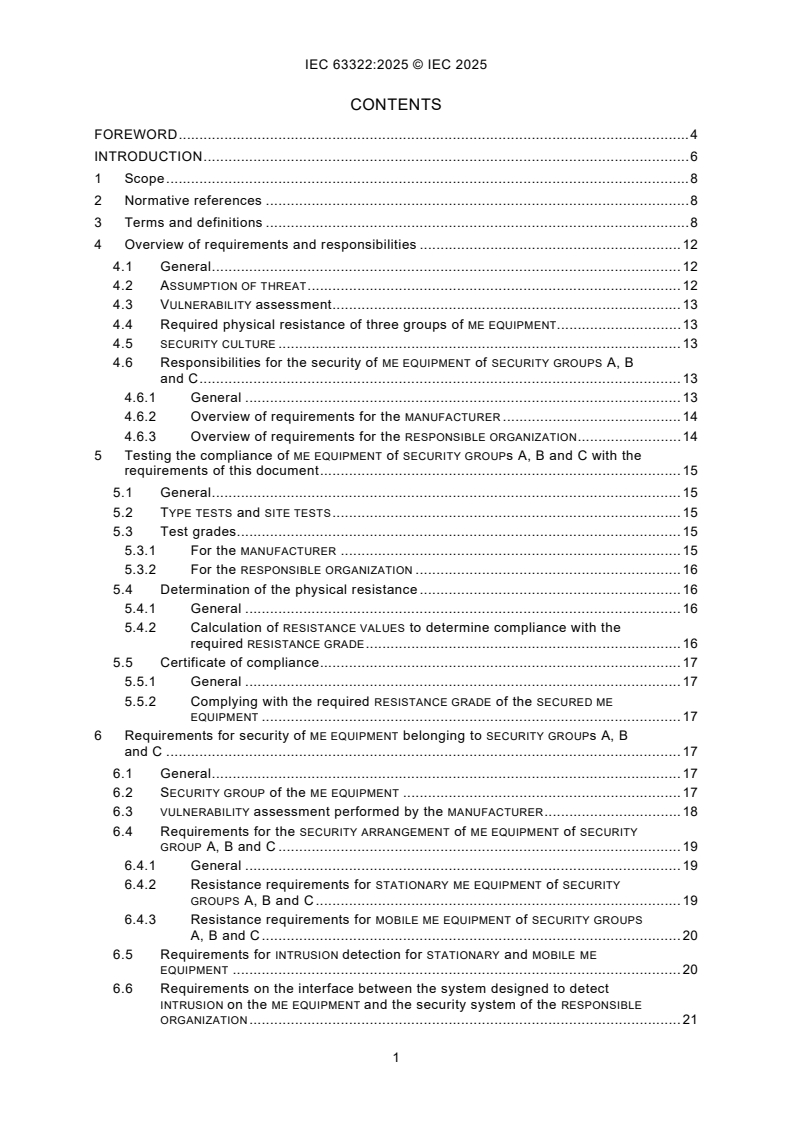
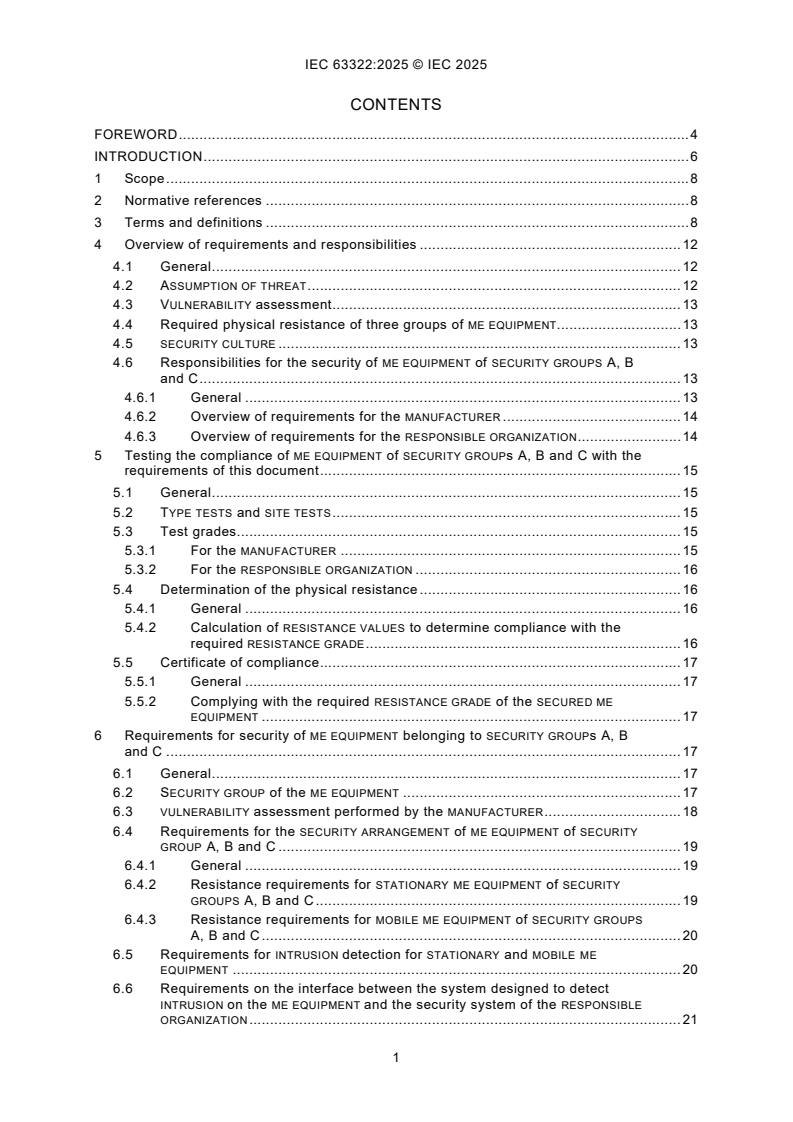
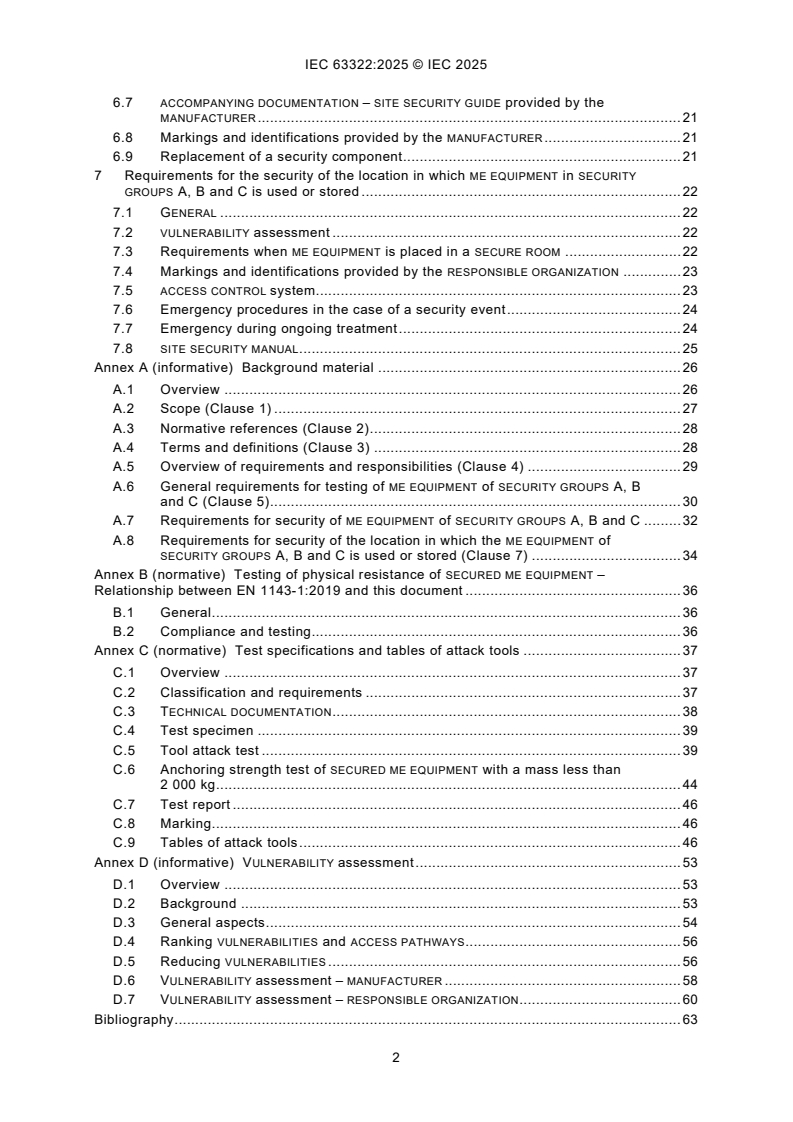
CONTENTS
FOREWORD . 4
INTRODUCTION . 6
1 Scope . 8
2 Normative references . 8
3 Terms and definitions . 8
4 Overview of requirements and responsibilities . 12
4.1 General . 12
4.2 ASSUMPTION OF THREAT . 12
4.3 VULNERABILITY assessment . 13
4.4 Required physical resistance of three groups of ME EQUIPMENT. 13
4.5 SECURITY CULTURE . 13
4.6 Responsibilities for the security of ME EQUIPMENT of SECURITY GROUPS A, B
and C . 13
4.6.1 General . 13
4.6.2 Overview of requirements for the MANUFACTURER . 14
4.6.3 Overview of requirements for the RESPONSIBLE ORGANIZATION . 14
5 Testing the compliance of ME EQUIPMENT of SECURITY GROUPs A, B and C with the
requirements of this document . 15
5.1 General . 15
5.2 TYPE TESTS and SITE TESTS . 15
5.3 Test grades. 15
5.3.1 For the MANUFACTURER . 15
5.3.2 For the RESPONSIBLE ORGANIZATION . 16
5.4 Determination of the physical resistance . 16
5.4.1 General . 16
5.4.2 Calculation of RESISTANCE VALUES to determine compliance with the
required RESISTANCE GRADE . 16
5.5 Certificate of compliance . 17
5.5.1 General . 17
5.5.2 Complying with the required RESISTANCE GRADE of the SECURED ME
EQUIPMENT . 17
6 Requirements for security of ME EQUIPMENT belonging to SECURITY GROUPs A, B
and C . 17
6.1 General . 17
6.2 SECURITY GROUP of the ME EQUIPMENT . 17
6.3 VULNERABILITY assessment performed by the MANUFACTURER . 18
6.4 Requirements for the SECURITY ARRANGEMENT of ME EQUIPMENT of SECURITY
GROUP A, B and C . 19
6.4.1 General . 19
6.4.2 Resistance requirements for STATIONARY ME EQUIPMENT of SECURITY
GROUPS A, B and C . 19
6.4.3 Resistance requirements for MOBILE ME EQUIPMENT of SECURITY GROUPS
A, B and C . 20
6.5 Requirements for INTRUSION detection for STATIONARY and MOBILE ME
EQUIPMENT . 20
6.6 Requirements on the interface between the system designed to detect
INTRUSION on the ME EQUIPMENT and the security system of the RESPONSIBLE
ORGANIZATION . 21
6.7 ACCOMPANYING DOCUMENTATION – SITE SECURITY GUIDE provided by the
MANUFACTURER . 21
6.8 Markings and identifications provided by the MANUFACTURER . 21
6.9 Replacement of a security component . 21
7 Requirements for the security of the location in which ME EQUIPMENT in SECURITY
GROUPS A, B and C is used or stored . 22
7.1 GENERAL . 22
7.2 VULNERABILITY assessment . 22
7.3 Requirements when ME EQUIPMENT is placed in a SECURE ROOM . 22
7.4 Markings and identifications provided by the RESPONSIBLE ORGANIZATION . 23
7.5 ACCESS CONTROL system. 23
7.6 Emergency procedures in the case of a security event . 24
7.7 Emergency during ongoing treatment . 24
7.8 SITE SECURITY MANUAL. 25
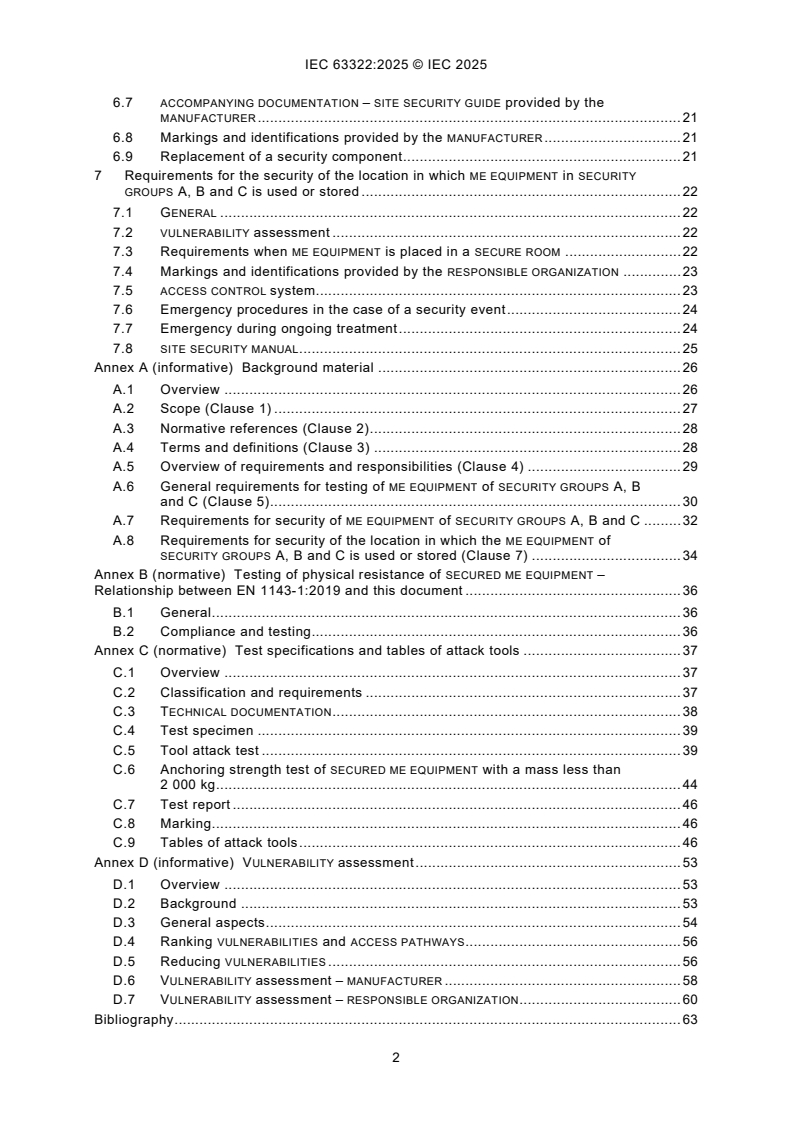
Annex A (informative) Background material . 26
A.1 Overview . 26
A.2 Scope (Clause 1) . 27
A.3 Normative references (Clause 2) . 28
A.4 Terms and definitions (Clause 3) . 28
A.5 Overview of requirements and responsibilities (Clause 4) . 29
A.6 General requirements for testing of ME EQUIPMENT of SECURITY GROUPS A, B
and C (Clause 5) . 30
A.7 Requirements for security of ME EQUIPMENT of SECURITY GROUPS A, B and C . 32
A.8 Requirements for security of the location in which the ME EQUIPMENT of
SECURITY GROUPS A, B and C is used or stored (Clause 7) . 34
Annex B (normative) Testing of physical resistance of SECURED ME EQUIPMENT –
Relationship between EN 1143-1:2019 and this document . 36
B.1 General . 36
B.2 Compliance and testing . 36
Annex C (normative) Test specifications and tables of attack tools . 37
C.1 Overview . 37
C.2 Classification and requirements . 37
C.3 TECHNICAL DOCUMENTATION . 38
C.4 Test specimen . 39
C.5 Tool attack test . 39
C.6 Anchoring strength test of SECURED ME EQUIPMENT with a mass less than
2 000 kg . 44
C.7 Test report . 46
C.8 Marking . 46
C.9 Tables of attack tools . 46
Annex D (informative) VULNERABILITY assessment . 53
D.1 Overview . 53
D.2 Background . 53
D.3 General aspects . 54
D.4 Ranking VULNERABILITIES and ACCESS PATHWAYS . 56
D.5 Reducing VULNERABILITIES . 56
D.6 VULNERABILITY assessment – MANUFACTURER . 58
D.7 VULNERABILITY assessment – RESPONSIBLE ORGANIZATION . 60
Bibliography . 63
Index of defined terms . 65
Figure C.1 – Example of loading equipment . 45
Figure D.1 – Examples of how VULNERABILITIES in an ACCESS PATHWAY can be
structured . 54
Table 1 – ME EQUIPMENT, SECURITY GROUPS and RESISTANCE GRADE requirements . 13
Table 2 – Resistance requirements for ME EQUIPMENT of SECURITY GROUP A to C . 18
Table A.1 – Overview of presently used ME-EQUIPMENT and associated SECURITY GROUP . 32
Table C.1 – Minimum requirements for classification of SECURED ME EQUIPMENT into
RESISTANCE GRADES . 38
Table C.2 – Hand (dis)assembling tools . 47
Table C.3 – Hand gripping tools . 47
Table C.4 – Hand levering tools . 47
Table C.5 – Hand sawing/filling/cutting and drilling tools . 48
Table C.6 – Hand hammering tools . 48
Table C.7 – Specially made tools . 48
Table C.8 – Electric powered tools, without impact . 49
Table C.9 – Electric powered tools, with impact option . 49
Table C.10 – Electric powered impacting machine tools, without rotation . 49
Table C.11 – Electric powered cutting/slitting machine tools . 50
Table C.12 – Thermal cutting/melting tools . 50
Table C.13 – Accessories for tools of Table C.2 up to Table C.12 . 51
Table C.14 – Miscellaneous "tools" . 52
Table C.15 – Non-tools . 52
Table D.1 – The 5 Ds of security . 55
Table D.2 – Dependencies . 57
INTERNATIONAL ELECTROTECHNICAL COMMISSION
____________
Security of ME equipment containing high-activity
sealed radioactive sources
FOREWORD
1) The International Electrotechnical Commission (IEC) is a worldwide organization for standardization comprising
all national electrotechnical committees (IEC National Committees). The object of IEC is to promote international
co-operation on all questions concerning standardization in the electrical and electronic fields. To this end and
in addition to other activities, IEC publishes International Standards, Technical Specifications, Technical Reports,
Publicly Available Specifications (PAS) and Guides (hereafter referred to as "IEC Publication(s)"). Their
preparation is entrusted to technical committees; any IEC National Committee interested in the subject dealt with
may participate in this preparatory work. International, governmental and non-governmental organizations liaising
with the IEC also participate in this preparation. IEC collaborates closely with the International Organization for
Standardization (ISO) in accordance with conditions determined by agreement between the two organizations.
2) The formal decisions or agreements of IEC on technical matters express, as nearly as possible, an international
consensus of opinion on the relevant subjects since each technical committee has representation from all
interested IEC National Committees.
3) IEC Publications have the form of recommendations for international use and are accepted by IEC National
Committees in that sense. While all reasonable efforts are made to ensure that the technical content of IEC
Publications is accurate, IEC cannot be held responsible for the way in which they are used or for any
misinterpretation by any end user.
4) In order to promote international uniformity, IEC National Committees undertake to apply IEC Publications
transparently to the maximum extent possible in their national and regional publications. Any divergence between
any IEC Publication and the corresponding national or regional publication shall be clearly indicated in the latter.
5) IEC itself does not provide any attestation of conformity. Independent certification bodies provide conformity
assessment services and, in some areas, access to IEC marks of conformity. IEC is not responsible for any
services carried out by independent certification bodies.
6) All users should ensure that they have the latest edition of this publication.
7) No liability shall attach to IEC or its directors, employees, servants or agents including individual experts and
members of its technical committees and IEC National Committees for any personal injury, property damage or
other damage of any nature whatsoever, whether direct or indirect, or for costs (including legal fees) and
expenses arising out of the publication, use of, or reliance upon, this IEC Publication or any other IEC
Publications.
8) Attention is drawn to the Normative references cited in this publication. Use of the referenced publications is
indispensable for the correct application of this publication.
9) IEC draws attention to the possibility that the implementation of this document may involve the use of (a)
patent(s). IEC takes no position concerning the evidence, validity or applicability of any claimed patent rights in
respect thereof. As of the date of publication of this document, IEC had not received notice of (a) patent(s), which
may be required to implement this document. However, implementers are cautioned that this may not represent
the latest information, which may be obtained from the patent database available at https://patents.iec.ch. IEC
shall not be held responsible for identifying any or all such patent rights.
IEC 63322 has been prepared by subcommittee SC 62C: Equipment for radiotherapy, nuclear
medicine and radiation dosimetry, of IEC technical committee TC 62: Medical equipment,
software, and systems. It is an International Standard.
The text of this International Standard is based on the following documents:
Draft Report on voting
62C/945/FDIS 62C/950/RVD
Full information on the voting for its approval can be found in the report on voting indicated in
the above table.
The language used for the development of this International Standard is English.
In this document, the following print types are used:
– requirements and definitions: roman type;
– test specifications: italic type;
– informative material appearing outside of tables, such as notes, examples and references: in smaller type.
Normative text of tables is also in a smaller type;
– TERMS DEFINED IN IN THIS DOCUMENT OR AS NOTED: SMALL CAPITALS.
This document was drafted in accordance with ISO/IEC Directives, Part 2, and developed in
accordance with ISO/IEC Directives, Part 1 and ISO/IEC Directives, IEC Supplement, available
at www.iec.ch/members_experts/refdocs. The main document types developed by IEC are
described in greater detail at www.iec.ch/publications.
The committee has decided that the contents of this document will remain unchanged until the
stability date indicated on the IEC website under webstore.iec.ch in the data related to the
specific document. At this date, the document will be
• reconfirmed,
• withdrawn, or
• revised.
INTRODUCTION
st
Two new international treaties were entered into force in the early 21 century, namely the
International Convention on the Suppression of Acts of Nuclear Terrorism (2007) [1] and the
Amendment to the Convention on the Physical Protection of Nuclear Material (2016) [2].
International treaties contain obligations to be implemented by each State Party, i.e.,
commitments to make every effort to prevent unlawful access to radioactive materials, such as
SEALED RADIOACTIVE SOURCES. While the international treaties are binding to the State Parties,
they do not contain requirements that are directly applicable or useful for the different target
groups of this document, the MANUFACTURERS of ME EQUIPMENT and the RESPONSIBLE
ORGANIZATION as the equipment user. This document provides requirements on how to secure
ME EQUIPMENT in order to protect against unauthorized access of the SEALED RADIOACTIVE
SOURCES contained and on SECURITY ARRANGEMENTS in the location in which the ME EQUIPMENT
is used or stored. These requirements are consistent with the intentions and goals of the
international treaties.
Aware of the need and the urgency for a standard that aims at protecting ME EQUIPMENT
containing high-activity SEALED RADIOACTIVE SOURCES from unauthorized access, 20
participating members of the National Committees voted in February 2020 in favor of
establishing a security standard to address this risk.
This document complements safety standards for ME EQUIPMENT containing high-activity SEALED
RADIOACTIVE SOURCES, for example [3] and [4], by addressing security, and therefore deviates
somewhat from the structure established by IEC 60601-1 for standards that are defined as
safety standards only. This document does not in any way impact on the implementation of, or
adherence to, the requirements of IEC 60601-1 regarding BASIC SAFETY and ESSENTIAL
PERFORMANCE.
The MANUFACTURER and the RESPONSIBLE ORGANIZATION both have responsibilities for the secure
use of ME EQUIPMENT containing high-activity SEALED RADIOACTIVE SOURCES. This document
establishes security requirements for the two entities based on an assumption of the threat.
The requirements are strictly separated in different clauses for the MANUFACTURER and the
RESPONSIBLE ORGANIZATION to facilitate certification. The appropriate national regulators and
other competent organizations will provide additional input regarding the threat level and in
response to a security event. The MANUFACTURER of ME EQUIPMENT containing high-activity
SEALED RADIOACTIVE SOURCES will have responsibility for the requirements that relate to the ME
EQUIPMENT itself, such as the equipment's design, the use of materials and components, and
other measures that will increase the equipment's physical resistance against attempts to
remove the SEALED RADIOACTIVE SOURCES unlawfully, including devices that provide a warning
in case of such an attempt.
The RESPONSIBLE ORGANIZATION will have responsibility for the security requirements that relate
to the location where the equipment is used or stored, that the staff is well informed and that
there are actions planned in case there is a security event. The implementation of a SECURITY
CULTURE [5] supported by the leadership of the RESPONSIBLE ORGANIZATION will be both
necessary and important to maintain effectiveness of the security system.
The compliance with the requirements of this document will be objectively tested by an
accredited test house. A certificate will communicate compliance with this document and help
to build trust among the users and with patients and the public. The overall impact of all
measures taken by the MANUFACTURER and by the RESPONSIBLE ORGANIZATION will contribute to
reducing the risk that perpetrators can succeed in attempts to illegally access and remove the
SEALED RADIOACTIVE SOURCES from the ME EQUIPMENT.
___________
Numbers in square brackets refer to the Bibliography
The methodology, including the numerical parameters, expressed in EN 1143-1:2019 is used
to quantify the required physical resistance of SECURED ME EQUIPMENT against unauthorized
removal of the SEALED RADIOACTIVE SOURCES.
1 Scope
This document establishes security requirements of ME EQUIPMENT using high-activity SEALED
RADIOACTIVE SOURCES, directly or indirectly, for medical treatment and other clinical procedures.
ME EQUIPMENT containing SEALED RADIOACTIVE SOURCES that are defined as Category 1, 2 and 3
RADIOACTIVE SOURCES by IAEA [6] are subject to this document.
The object of this document is to specify requirements for the security of ME EQUIPMENT
containing high-activity SEALED RADIOACTIVE SOURCES with the aim to minimize the risk of
unauthorized access to the contained SEALED RADIOACTIVE SOURCES, and to serve as the basis
for other standards. This document contains requirements for the MANUFACTURER of the ME
and, separately, for the RESPONSIBLE ORGANIZATION regarding security at the location
EQUIPMENT
during use and storage.
The requirements of this document apply when the SEALED RADIOACTIVE SOURCES are contained
in the ME EQUIPMENT, i.e. from the time when the SEALED RADIOACTIVE SOURCES are inserted into
the ME EQUIPMENT, during the INTENDED USE and when the ME EQUIPMENT is not being used for
its INTENDED USE or taken out of regular use, until the equipment is being decommissioned, i.e.
SEALED RADIOACTIVE SOURCES are permanently removed from the equipment.
until all
2 Normative references
The following documents are referred to in the text in such a way that some or all of their content
constitutes requirements of this document. For dated references, only the edition cited applies.
For undated references, the latest edition of the referenced document (including any
amendments) applies.
IEC 60601-1:2005, Medical electrical equipment – Part 1: General requirements for basic safety
and essential performance
IEC 60601-1:2005/AMD1:2012
IEC 60601-1:2005/AMD1:2020
EN 1143-1:2019, Secure storage units – Requirements, classification and methods of test for
resistance to burglary – Part 1: Safes, ATM safes, strongroom doors and strongrooms
EN 1300:2023, Secure storage units – Classification for high security locks according to their
resistance to unauthorized opening
EN 1627:2021, Pedestrian doorsets, windows, curtain walling, grilles and shutters - Burglar
resistance - Requirements and classification
3 Terms and definitions
For the purposes of this document, the following terms and definitions apply.
ISO and IEC maintain terminology databases for use in standardization at the following
addresses:
• IEC Electropedia: available at https://www.electropedia.org/
• ISO Online browsing platform: available at https://www.iso.org/obp
NOTE The Nuclear safety and security glossary from the International atomic energy agency can also be used.
3.1
ASSUMPTION OF THREAT
set of assumptions used to set the level of the threat
Note 1 to entry: The ASSUMPTION OF THREAT is used when performing risk assessments in general and
VULNERABILITY assessments in particular.
3.2
ACCESS PATHWAY
AP
time-ordered steps in a path or route that one or more persons can take to arrive at the
target in the desired location
3.3
BASIC VALUE
BV
number in RESISTANCE UNITS allocated to a particular tool
Note 1 to entry: The BASIC VALUE represents problems in obtaining, transporting, conditions (e.g. water cooling and
power availability) and using the relevant tool at the site in question, and the necessary knowledge and experience
for its efficient use.
[SOURCE: EN 1143-1:2019, 3.16]
3.4
BOLTWORK
mechanism by which a closed door is held such that, until it is in the withdrawn position, the
door cannot be opened
Note 1 to entry: The term BOLTWORK is used only in Annex C.
[SOURCE: EN 1143-1:2019, 3.18], modified – The note to entry has been added.
3.5
CABINET
storage unit which protects its contents against burglary and when closed has at least one
internal side ≤ 1 m length
[SOURCE: EN 1143-1:2019, 3.1, modified – Adaptation from the definition of a safe.]
3.6
COMPLEMENTARY SECURITY ARRANGEMENT
temporary SECURITY ARRANGEMENT deemed necessary to protect against criminal or intentional
unauthorized acts during the time permanent protective measures are disabled or absent or
their effectiveness reduced
Note 1 to entry: An example of a COMPLEMENTARY SECURITY ARRANGEMENT is a guard on duty when all or a part of
the permanent protective measures are disabled, which can be the case during service and maintenance. Another
example when COMPLEMENTARY SECURITY ARRANGEMENTS can be needed is when moving an equipment between two
protected areas.
3.7
DUMMY SOURCE
source capsule without radioactive material inside with the same form and exterior dimensions
as the SEALED SOURCE used in the ME EQUIPMENT
Note 1 to entry: DUMMY SOURCES are used during testing of the ME EQUIPMENT to establish the RESISTANCE GRADE.
3.8
INTRINSIC SECURITY
protection against unauthorized attempts to remove the SEALED RADIOACTIVE SOURCES that is
either built into the ME EQUIPMENT, added to or attached to the ME EQUIPMENT during installation,
and that will remain attached to the ME EQUIPMENT during NORMAL USE
3.9
INTRUSION
unauthorized act of compromising a system
[SOURCE: IEC TS 62443-1-1:2009, 3.2.63, modified – The reference in the definition has been
deleted.]
3.10
INTRUSION DETECTION SYSTEM
system that contains the capability to detect an INTRUSION and also contains an alarm function
that is activated should an INTRUSION be detected
3.11
OPERATING TIME
time during which a tool is used attempting to create a change in the test specimen
Note 1 to entry: In the context of this document, there are also OPERATING TIMES considered during which no visible
modifications/changes are caused to the test specimen.
[SOURCE: EN 1143-1:2019, 3.12]
3.12
RESISTANCE GRADE
classification designation for burglary resistance
[SOURCE: EN 1143-1:2019, 3.14]
3.13
RESISTANCE UNIT
RU
burglary resistance which results from one minute's use of a tool carrying the coefficient 1 and
the BASIC VALUE 0
[SOURCE: EN 1143-1:2019, 3.13]
3.14
RESISTANCE VALUE
numerical value in RESISTANCE UNITS calculated for each test
[SOURCE: EN 1143-1:2019, 3.15]
3.15
SECURE ROOM
room with characteristics that provide protection against burglary and, when closed, has internal
side lengths in all directions > 1 m
Note 1 to entry: The definition is adapted from the definition of strongroom in EN 1143:2019-1, 3.4.
Note 2 to entry: In this document, a SECURE ROOM can either be 1) a radiation therapy treatment room or 2) a room
that has been modified to increase its resistance to burglary. The requirements that need to be fulfilled for a SECURE
ROOM are stated in 7.3.
3.16
SECURED ME EQUIPMENT
ME EQUIPMENT designed with INTRINSIC SECURITY, or ME EQUIPMENT placed in a CABINET or in a
SECURE ROOM that complies with the requirements for security in this document
3.17
SECURITY ARRANGEMENT
measures intended to protect against criminal or intentional unauthorized acts involving or
directed at SEALED RADIOACTIVE SOURCES
3.18
SECURITY CULTURE
assembly of characteristics, attitudes and behaviours of individuals, organizations and
institutions which serves as a means to support, enhance and sustain security
[SOURCE: IAEA Nuclear Safety and Security Glossary, 2022 (Interim) Edition, modified –
The term "nuclear security" has been replaced with "security".]
3.19
SECURITY GROUP
ME EQUIPMENT subject to this document that contains SEALED SOURCES of IAEA Category 1,
Category 2, or Category 3 are referred to three groups A, B and C, with different security
requirements
Note 1 to entry: The security requirements of the SECURITY GROUPS are based on a graded approach.
3.20
SITE SECURITY GUIDE
MANUFACTURER giving a suggested outline of the SECURITY
planning guide written by the
ARRANGEMENTS to be considered for the security of the location in which the ME EQUIPMENT is
used or stored
3.21
SITE SECURITY MANUAL
manual documenting the policies, procedures and SECURITY ARRANGEMENTS that the
RESPONSIBLE ORGANIZATION has adopted and implemented according to the requirements of this
document
3.22
TOOL COEFFICIENT
number in RESISTANCE UNITS per minute allocated to a group of tools
Note 1 to entry: The TOOL COEFFICIENT represents factors such as noise, smoke, fumes and other effects, which
increase the likelihood of a burglary attack being detected.
[SOURCE: EN 1143-1:2019, 3.17]
3.23
VULNERABILITY
physical feature or operational attribute that renders an entity, asset, system, network, facility,
activity or geographic area open to exploitation or susceptible to a given threat
[SOURCE: IAEA Nuclear Safety and Security Glossary, 2022 (Interim) Edition]
4 Overview of requirements and responsibilities
4.1 General
Both the MANUFACTURER and the RESPONSIBLE ORGANIZATION have responsibilities to ensure that
ME EQUIPMENT with high-activity SEALED RADIOACTIVE SOURCES can be used securely, and this
document includes separate requirements for the MANUFACTURER and for the RESPONSIBLE
. Clause 4 gives an overview of the requirements on the MANUFACTURER and the
ORGANIZATION
RESPONSIBLE ORGANIZATION. All explicit requirements are listed in Clauses 6 and 7, respectively.
The MANUFACTURER will address all requirements related to the design and construction of the
ME EQUIPMENT, and the RESPONSIBLE ORGANIZATION will address the requirements related to the
local installation and organizational measures to be implemented.
The SECURITY ARRANGEMENTS provided by the MANUFACTURER and by the RESPONSIBLE
shall not affect the INTENDED USE, the ESSENTIAL PERFORMANCE, BASIC SAFETY, and
ORGANIZATION
serviceability, as defined in IEC 60601-1:2005, IEC 60601-1:2005/AMD1:2012 and IEC 60601-
1:2005/AMD2:2020 and in particular standards such as [3] and [4].
The requirements stated in this document for the ME EQUIPMENT shall be met whether the
SECURITY ARRANGEMENTS are integrated in the design and construction of a new ME EQUIPMENT
or if they are retrofitted to an existing model of the ME EQUIPMENT. For an existing model of the
ME EQUIPMENT, compliance with IEC 60601-1 will be based on the version in force at the time of
the original compliance assessment.
TECHNICAL DOCUMENTATION, manuals, and procedures required for the operation and storage of
the ME EQUIPMENT can contain security sensitive information. The MANUFACTURER and the
RESPONSIBLE ORGANIZATION shall ensure that the information is protected at the appropriate
level.
SSUMPTION OF THREAT
4.2 A
Security risk management and VULNERABILITY assessment shall be performed under the
ASSUMPTION OF THREAT:
following
• the INTRUSION is performed by one person, or a small group of persons, with intention to
perform an unauthorized act, and that could blend in with the categories of people that are
normally found at the site;
• an INSIDER can be involved;
• the location of the ME EQUIPMENT is known;
• the perpetrators have full information regarding the construction of the ME EQUIPMENT;
• operating procedures and control functions for the ME EQUIPMENT are known;
• the perpetrators will have access to hand/machine tools;
• the attack can be assisted by cyber INTRUSION into the ME EQUIPMENT's control system.
It is assumed that the tools carried by the perpetrators have capacities and characteristics that
are comparable to the capacities and characteristics of the tools used to test compliance of the
ME EQUIPMENT with the required RESISTANCE GRADE.
4.3 VULNERABILITY assessment
The VULNERABILITY of ME EQUIPMENT in this context is an assessment of the ease with which an
unauthorized person can access the ME EQUIPMENT itself, and then remove the SEALED
RADIOACTIVE SOURCES contained in the ME EQUIPMENT. The results of the VULNERABILITY
assessment serve as the basis for the design of the SECURITY ARRANGEMENTS required for the
ME EQUIPMENT, as well as for the SECURITY ARRANGEMENTS in the location in which the ME
EQUIPMENT is used or stored. The ASSUMPTION OF THREAT stated in 4.2 will be used in the
assessment. Annex D contains a guide to the performance of a VULNERABILITY assessment by
the MANUFACTURER and the RESPONSIBLE ORGANIZATION.
4.4 Required physical resistance of three groups of ME EQUIPMENT
The ME EQUIPMENT subject to this document contains SEALED RADIOACTIVE SOURCES with
different activities (denoted A). The IAEA has analyzed most radionuclides and established the
activity above which the security of the sources should be considered. This activity value is
referred to as the D-value of the radionuclide. The IAEA has grouped the sources into five
categories based on the A/D-ratios (denoted A/D-values). ME EQUIPMENT subject to this
document contains SEALED RADIOACTIVE SOURCES of IAEA Categories 1 to 3 (see also Annex A).
Such ME EQUIPMENT, for the purposes of this document, is grouped into three SECURITY GROUPS,
A, B and C according to Table 1.
Table 1 – ME EQUIPMENT, SECURITY GROUPS and RESISTANCE GRADE requirements
A/D-values Minimum required
SECURITY GROUP of
RADIOACTIVE SOURCE Category RESISTANCE GRADE of the
ME EQUIPMENT
SECURED ME EQUIPMENT
A 1 000 ≤ A/D 1 III
B 10 ≤ A/D < 1 000 2 II
C 3 I
1 ≤ A/D < 10
The specific security requirements for the different SECURITY GROUPS are given in Clause 6.
This document uses the methodology developed for EN 1143-1:2019 to define the requirement
of physical resistance for the SECURITY ARRANGEMENTS used for ME EQUIPMENT containing SEALED
RADIOACTIVE SOURCES. It also aligns to EN 1143-1:2019 for the procedure to be applied in the
TYPE TESTING of compliance with the required RESISTANCE GRADE. The methodology and testing
procedure are given in Annex B and Annex C.
4.5 SECURITY CULTURE
The implementation of a SECURITY CULTURE, supported by the executive leadership of the
RESPONSIBLE ORGANIZATION, is essential to obtain effective security of the ME EQUIPMENT of
SECURITY GROUPS A to C. The SECURITY CULTURE will recognize the necessity of effective ACCESS
CONTROL, information security as well as the importance of informed and competent staff. The
principles applied will be documented and included in the RESPONSIBLE ORGANIZATION's SITE
SECURITY MANUAL.
4.6 Responsibilities for the security of ME EQUIPMENT of SECURITY GROUPS A, B and C
4.6.1 General
Both the MANUFACTURER and the RESPONSIBLE ORGANIZATION have responsibilities to ensure that
ME EQUIPMENT of SECURITY GROUPs A, B and C can be installed, used, and stored securely. The
responsibilities for the two entities differ. This document formulates the requirements that shall
be met by the MANUFACTURER (Clause 6) and the RESPONSIBLE ORGANIZATION (Clause 7) to fulfill
the responsibilities.
4.6.2 Overview of requirements for the MANUFACTURER
The MANUFACTURER will determine the SECURITY GROUP of the ME EQUIPMENT and perform a
VULNERABILITY assessment of the ME EQUIPMENT. The result of the VULNERABILITY assessment
will serve as the input to the design and construction of the SECURITY ARRANGEMENTS deemed
necessary to meet the required RESISTANCE GRADE. The MANUFACTURER will ensure that SECURED
ME EQUIPMENT comply with the requirements of this document. This can be achieved in three
ways, by
• providing the ME EQUIPMENT with INTRINSIC SECURITY that meets the physical resistance
requirements for INTRINSIC SECURITY stated in this document, or
• providing a CABINET that meets the RESISTANCE GRADE requirements for CABINETS in this
document, in which the ME EQUIPMENT will be stored when not in clinical use, or
NOTE The CABINET can also be provided by the RESPONSIBLE ORGANIZATION together with evidence that the
CABINET meets the security requirements of this document.
• installing the ME EQUIPMENT in a SECURE ROOM that is provided by the RESPONSIBLE
ORGANIZATION.
The MANUFACTURER will not equip the ME EQUIPMENT, which is to be placed in a SECURE ROOM,
with SEALED RADIOACTIVE SOURCES unless evidence of compliance of the SECURE ROOM with the
physical resistance requirements of this document is obtained from the RESPONSIBLE
ORGANIZATION.
An INTRUSION DETECTION SYSTEM will be applied to the SECURED ME EQUIPMENT. Information on
how to connect the equipment’s INTRUSION DETECTION SYSTEM to the RESPONSIBLE
ORGANIZATION's security system will be included in the ACCOMPANYING DOCUMENTATION provided
by the MANUFACTURER.
The SITE SECURITY GUIDE provided by the MANUFACTURER will further contain information and
guidance regarding appropriate COMPLEMENTARY SECURITY ARRANGEMENTS for consideration by
the RESPONSIBLE ORGANIZATION.
Sensitive security related information, for example the VULNERABILITY assessment, its results
and the design of the SECURITY ARRANGEMENTS including the function of the system designed to
detect INTRUSION attempts, with its connecting interface, will be protected as strictly confidential
information.
4.6.3 Overview of requirements for the RESPONSIBLE ORGANIZATION
To comply with this document, the RESPONSIBLE ORGANIZATION will perform a VULNERABILITY
assessment of the premises in which the ME EQUIPMENT is used or stored.
In case the ME EQUIPMENT is placed in a SECURE ROOM, the RESPONSIBLE ORGANIZATION will
provide evidence that the room complies with the requirements in this document.
The RESPONSIBLE ORGANIZATION will connect the INTRUSION DETECTION SYSTEM to the security
system used by the RESPONSIBLE ORGANIZATION.
The RESPONSIBLE ORGANIZATION will provide an anchoring point that fulfils the requirements in
this document in every room where MOBILE ME EQUIPMENT will be used for its INTENDED USE.
The RESPONSIBLE ORGANIZATION will control access to the locations/rooms in which the ME
EQUIPMENT is used
...
IEC 63322 ®
Edition 1.0 2025-07
NORME
INTERNATIONALE
Sécurité des appareils EM contenant des sources radioactives scellées de haute
activité
ICS 11.040.50 ISBN 978-2-8327-0530-8
Droits de reproduction réservés. Sauf indication contraire, aucune partie de cette publication ne peut être reproduite ni
utilisée sous quelque forme que ce soit et par aucun procédé, électronique ou mécanique, y compris la photocopie et
les microfilms, sans l'accord écrit de l'IEC ou du Comité national de l'IEC du pays du demandeur. Si vous avez des
questions sur le copyright de l'IEC ou si vous désirez obtenir des droits supplémentaires sur cette publication, utilisez
les coordonnées ci-après ou contactez le Comité national de l'IEC de votre pays de résidence.
IEC Secretariat Tel.: +41 22 919 02 11
3, rue de Varembé info@iec.ch
CH-1211 Geneva 20 www.iec.ch
Switzerland
A propos de l'IEC
La Commission Electrotechnique Internationale (IEC) est la première organisation mondiale qui élabore et publie des
Normes internationales pour tout ce qui a trait à l'électricité, à l'électronique et aux technologies apparentées.
A propos des publications IEC
Le contenu technique des publications IEC est constamment revu. Veuillez vous assurer que vous possédez l’édition la
plus récente, un corrigendum ou amendement peut avoir été publié.
Recherche de publications IEC - IEC Products & Services Portal - products.iec.ch
webstore.iec.ch/advsearchform Découvrez notre puissant moteur de recherche et consultez
La recherche avancée permet de trouver des publications gratuitement tous les aperçus des publications, symboles
IEC en utilisant différents critères (numéro de référence, graphiques et le glossaire. Avec un abonnement, vous aurez
texte, comité d’études, …). Elle donne aussi des toujours accès à un contenu à jour adapté à vos besoins.
informations sur les projets et les publications remplacées
ou retirées. Electropedia - www.electropedia.org
Le premier dictionnaire d'électrotechnologie en ligne au
IEC Just Published - webstore.iec.ch/justpublished monde, avec plus de 22 500 articles terminologiques en
Restez informé sur les nouvelles publications IEC. Just anglais et en français, ainsi que les termes équivalents
dans 25 langues additionnelles. Egalement appelé
Published détaille les nouvelles publications parues.
Disponible en ligne et une fois par mois par email. Vocabulaire Electrotechnique International (IEV) en ligne.
Service Clients - webstore.iec.ch/csc
Si vous désirez nous donner des commentaires sur cette
publication ou si vous avez des questions contactez-
nous: sales@iec.ch.
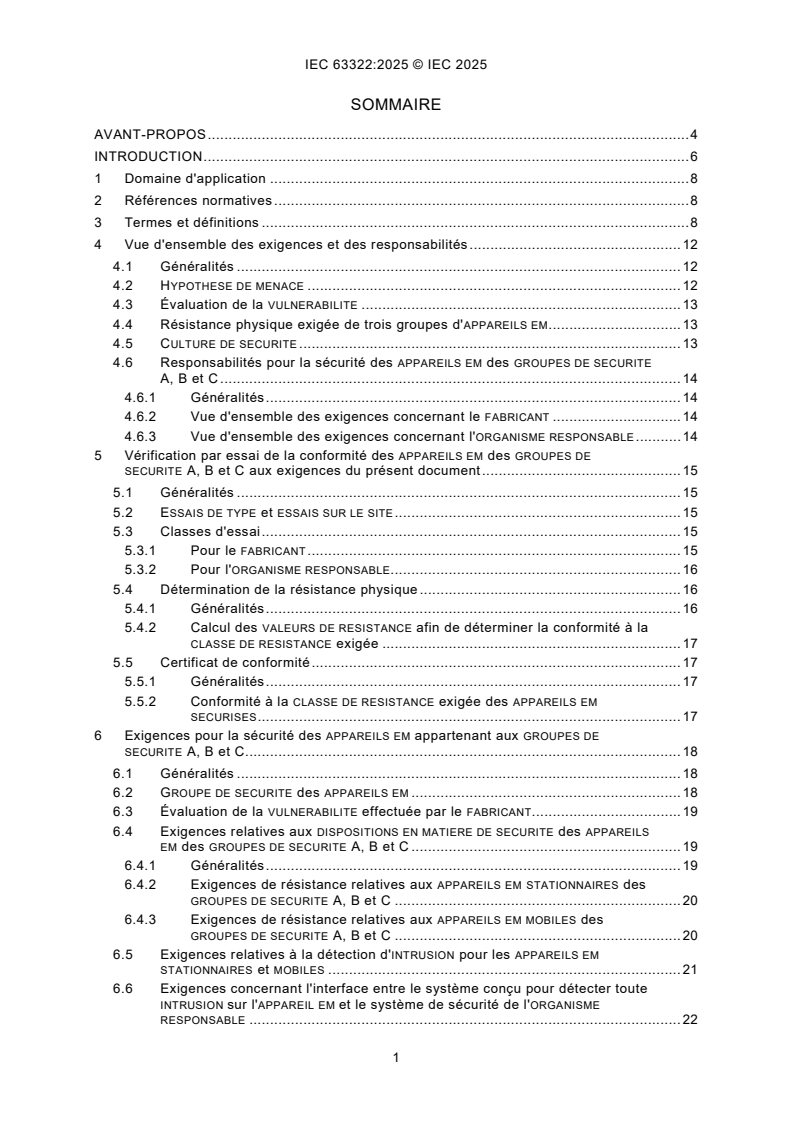
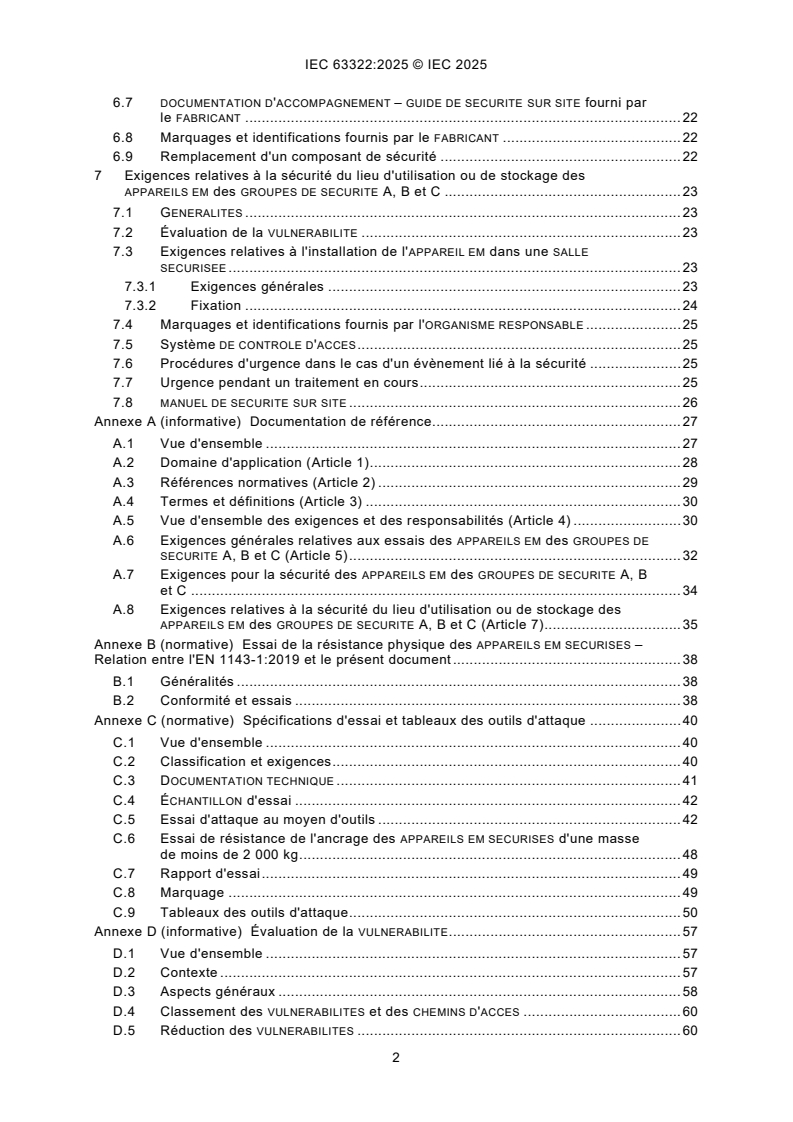
SOMMAIRE
AVANT-PROPOS . 4
INTRODUCTION . 6
1 Domaine d'application . 8
2 Références normatives . 8
3 Termes et définitions . 8
4 Vue d'ensemble des exigences et des responsabilités . 12
4.1 Généralités . 12
4.2 HYPOTHESE DE MENACE . 12
4.3 Évaluation de la VULNERABILITE . 13
4.4 Résistance physique exigée de trois groupes d'APPAREILS EM . 13
4.5 CULTURE DE SECURITE . 13
4.6 Responsabilités pour la sécurité des APPAREILS EM des GROUPES DE SECURITE
A, B et C . 14
4.6.1 Généralités . 14
4.6.2 Vue d'ensemble des exigences concernant le FABRICANT . 14
4.6.3 Vue d'ensemble des exigences concernant l'ORGANISME RESPONSABLE . 14
5 Vérification par essai de la conformité des APPAREILS EM des GROUPES DE
SECURITE A, B et C aux exigences du présent document . 15
5.1 Généralités . 15
5.2 ESSAIS DE TYPE et ESSAIS SUR LE SITE . 15
5.3 Classes d'essai . 15
5.3.1 Pour le FABRICANT . 15
5.3.2 Pour l'ORGANISME RESPONSABLE. 16
5.4 Détermination de la résistance physique . 16
5.4.1 Généralités . 16
5.4.2 Calcul des VALEURS DE RESISTANCE afin de déterminer la conformité à la
CLASSE DE RESISTANCE exigée . 17
5.5 Certificat de conformité . 17
5.5.1 Généralités . 17
5.5.2 Conformité à la CLASSE DE RESISTANCE exigée des APPAREILS EM
SECURISES . 17
6 Exigences pour la sécurité des APPAREILS EM appartenant aux GROUPES DE
SECURITE A, B et C. 18
6.1 Généralités . 18
6.2 GROUPE DE SECURITE des APPAREILS EM . 18
6.3 Évaluation de la VULNERABILITE effectuée par le FABRICANT. 19
6.4 Exigences relatives aux DISPOSITIONS EN MATIERE DE SECURITE des APPAREILS
EM des GROUPES DE SECURITE A, B et C . 19
6.4.1 Généralités . 19
6.4.2 Exigences de résistance relatives aux APPAREILS EM STATIONNAIRES des
GROUPES DE SECURITE A, B et C . 20
6.4.3 Exigences de résistance relatives aux APPAREILS EM MOBILES des
GROUPES DE SECURITE A, B et C . 20
6.5 Exigences relatives à la détection d'INTRUSION pour les APPAREILS EM
STATIONNAIRES et MOBILES . 21
6.6 Exigences concernant l'interface entre le système conçu pour détecter toute
INTRUSION sur l'APPAREIL EM et le système de sécurité de l'ORGANISME
RESPONSABLE . 22
6.7 DOCUMENTATION D'ACCOMPAGNEMENT – GUIDE DE SECURITE SUR SITE fourni par
le FABRICANT . 22
6.8 Marquages et identifications fournis par le FABRICANT . 22
6.9 Remplacement d'un composant de sécurité . 22
7 Exigences relatives à la sécurité du lieu d'utilisation ou de stockage des
APPAREILS EM des GROUPES DE SECURITE A, B et C . 23
7.1 GENERALITES . 23
7.2 Évaluation de la VULNERABILITE . 23
7.3 Exigences relatives à l'installation de l'APPAREIL EM dans une SALLE
SECURISEE . 23
7.3.1 Exigences générales . 23
7.3.2 Fixation . 24
7.4 Marquages et identifications fournis par l'ORGANISME RESPONSABLE . 25
7.5 Système DE CONTROLE D'ACCES . 25
7.6 Procédures d'urgence dans le cas d'un évènement lié à la sécurité . 25
7.7 Urgence pendant un traitement en cours . 25
7.8 MANUEL DE SECURITE SUR SITE . 26
Annexe A (informative) Documentation de référence . 27
A.1 Vue d'ensemble . 27
A.2 Domaine d'application (Article 1) . 28
A.3 Références normatives (Article 2) . 29
A.4 Termes et définitions (Article 3) . 30
A.5 Vue d'ensemble des exigences et des responsabilités (Article 4) . 30
A.6 Exigences générales relatives aux essais des APPAREILS EM des GROUPES DE
SECURITE A, B et C (Article 5) . 32
A.7 Exigences pour la sécurité des APPAREILS EM des GROUPES DE SECURITE A, B
et C . 34
A.8 Exigences relatives à la sécurité du lieu d'utilisation ou de stockage des
APPAREILS EM des GROUPES DE SECURITE A, B et C (Article 7) . 35
Annexe B (normative) Essai de la résistance physique des APPAREILS EM SECURISES –
Relation entre l'EN 1143-1:2019 et le présent document . 38
B.1 Généralités . 38
B.2 Conformité et essais . 38
Annexe C (normative) Spécifications d'essai et tableaux des outils d'attaque . 40
C.1 Vue d'ensemble . 40
C.2 Classification et exigences . 40
C.3 DOCUMENTATION TECHNIQUE . 41
C.4 ÉCHANTILLON d'essai . 42
C.5 Essai d'attaque au moyen d'outils . 42
C.6 Essai de résistance de l'ancrage des APPAREILS EM SECURISES d'une masse
de moins de 2 000 kg . 48
C.7 Rapport d'essai . 49
C.8 Marquage . 49
C.9 Tableaux des outils d'attaque . 50
Annexe D (informative) Évaluation de la VULNERABILITE . 57
D.1 Vue d'ensemble . 57
D.2 Contexte . 57
D.3 Aspects généraux . 58
D.4 Classement des VULNERABILITES et des CHEMINS D'ACCES . 60
D.5 Réduction des VULNERABILITES . 60
D.6 Évaluation de la VULNERABILITE – FABRICANT . 62
D.7 Évaluation de la VULNERABILITE – ORGANISME RESPONSABLE . 64
Bibliographie . 67
Index des termes définis . 69
Figure C.1 – Exemple d'équipement d'application de charge . 48
Figure D.1 – Exemples de structuration possible des VULNERABILITES dans un CHEMIN
D'ACCES . 58
Tableau 1 – Exigences en matière de GROUPES DE SECURITE et de CLASSE DE
RESISTANCE des APPAREILS EM . 13
Tableau 2 – Exigences de résistance pour les APPAREILS EM des GROUPES DE SECURITE
A à C . 18
Tableau A.1 – Vue d'ensemble des APPAREILS EM actuellement utilisés et du GROUPE DE
SECURITE associé . 34
Tableau C.1 – Exigences minimales pour la classification des APPAREILS EM SECURISES
en CLASSES DE RESISTANCE . 41
Tableau C.2 – Outils à main de (dé)montage . 50
Tableau C.3 – Outils à main de saisie . 51
Tableau C.4 – Outils à main à effet de levier . 51
Tableau C.5 – Outils à main de sciage/limage/découpage et perçage . 51
Tableau C.6 – Outils à main de frappe . 52
Tableau C.7 – Outils spécialement fabriqués . 52
Tableau C.8 – Outils électriques sans percussion . 53
Tableau C.9 – Outils électriques à percussion . 53
Tableau C.10 – Outils électriques à percussion sans rotation . 53
Tableau C.11 – Outils électriques de coupe/abrasion . 54
Tableau C.12 – Outils thermiques de coupe/fusion . 54
Tableau C.13 – Accessoires pour les outils du Tableau C.2 au Tableau C.12 . 55
Tableau C.14 – "Outils" divers . 56
Tableau C.15 – Outils hors catégorie . 56
Tableau D.1 – Les 5 D de la sécurité . 59
Tableau D.2 – Dépendances . 61
COMMISSION ÉLECTROTECHNIQUE INTERNATIONALE
____________
Sécurité des appareils EM contenant des sources
radioactives scellées de haute activité
AVANT-PROPOS
1) La Commission Électrotechnique Internationale (IEC) est une organisation mondiale de normalisation composée
de l'ensemble des comités électrotechniques nationaux (Comités nationaux de l'IEC). L'IEC a pour objet de
favoriser la coopération internationale pour toutes les questions de normalisation dans les domaines de
l'électricité et de l'électronique. À cet effet, l'IEC – entre autres activités – publie des Normes internationales,
des Spécifications techniques, des Rapports techniques, des Spécifications accessibles au public (PAS) et des
Guides (ci-après dénommés "Publication(s) de l'IEC"). Leur élaboration est confiée à des comités d'études, aux
travaux desquels tout Comité national intéressé par le sujet traité peut participer. Les organisations
internationales, gouvernementales et non gouvernementales, en liaison avec l'IEC, participent également aux
travaux. L'IEC collabore étroitement avec l'Organisation Internationale de Normalisation (ISO), selon des
conditions fixées par accord entre les deux organisations.
2) Les décisions ou accords officiels de l'IEC concernant les questions techniques représentent, dans la mesure du
possible, un accord international sur les sujets étudiés, étant donné que les Comités nationaux de l'IEC intéressés
sont représentés dans chaque comité d'études.
3) Les Publications de l'IEC se présentent sous la forme de recommandations internationales et sont agréées
comme telles par les Comités nationaux de l'IEC. Tous les efforts raisonnables sont entrepris afin que l'IEC
s'assure de l'exactitude du contenu technique de ses publications; l'IEC ne peut pas être tenue responsable de
l'éventuelle mauvaise utilisation ou interprétation qui en est faite par un quelconque utilisateur final.
4) Dans le but d'encourager l'uniformité internationale, les Comités nationaux de l'IEC s'engagent, dans toute la
mesure possible, à appliquer de façon transparente les Publications de l'IEC dans leurs publications nationales
et régionales. Toutes divergences entre toutes Publications de l'IEC et toutes publications nationales ou
régionales correspondantes doivent être indiquées en termes clairs dans ces dernières.
5) L'IEC elle-même ne fournit aucune attestation de conformité. Des organismes de certification indépendants
fournissent des services d'évaluation de conformité et, dans certains secteurs, accèdent aux marques de
conformité de l'IEC. L'IEC n'est responsable d'aucun des services effectués par les organismes de certification
indépendants.
6) Tous les utilisateurs doivent s'assurer qu'ils sont en possession de la dernière édition de cette publication.
7) Aucune responsabilité ne doit être imputée à l'IEC, à ses administrateurs, employés, auxiliaires ou mandataires,
y compris ses experts particuliers et les membres de ses comités d'études et des Comités nationaux de l'IEC,
pour tout préjudice causé en cas de dommages corporels et matériels, ou de tout autre dommage de quelque
nature que ce soit, directe ou indirecte, ou pour supporter les coûts (y compris les frais de justice) et les dépenses
découlant de la publication ou de l'utilisation de cette Publication de l'IEC ou de toute autre Publication de l'IEC,
ou au crédit qui lui est accordé.
8) L'attention est attirée sur les références normatives citées dans cette publication. L'utilisation de publications
référencées est obligatoire pour une application correcte de la présente publication.
9) L'IEC attire l'attention sur le fait que la mise en application du présent document peut entraîner l'utilisation d'un
ou de plusieurs brevets. L'IEC ne prend pas position quant à la preuve, à la validité et à l'applicabilité de tout
droit de brevet revendiqué à cet égard. À la date de publication du présent document, l'IEC n'avait pas reçu
notification qu'un ou plusieurs brevets pouvaient être nécessaires à sa mise en application. Toutefois, il y a lieu
d'avertir les responsables de la mise en application du présent document que des informations plus récentes
sont susceptibles de figurer dans la base de données de brevets, disponible à l'adresse https://patents.iec.ch.
L'IEC ne saurait être tenue pour responsable de ne pas avoir identifié de tels droits de brevets.
L'IEC 63322 a été établie par le sous-comité SC 62C: Équipements médicaux, logiciels et
systèmes pour la radiothérapie, la médecine nucléaire et la radiodosimétrie, du comité
d'études CE 62 de l'IEC: Équipement médical, logiciels et systèmes médicaux. Il s'agit d'une
Norme internationale.
Le texte de cette Norme internationale est issu des documents suivants:
Projet Rapport de vote
62C/945/FDIS 62C/950/RVD
Le rapport de vote indiqué dans le tableau ci-dessus donne toute information sur le vote ayant
abouti à son approbation.
La langue employée pour l'élaboration de cette Norme internationale est l'anglais.
Dans le présent document, les caractères d'imprimerie suivants sont utilisés:
– exigences et définitions: caractères romains;
– modalités d'essais: caractères italiques;
– indications de nature informative qui apparaissent hors des tableaux, comme les notes, les exemples et les
références: petits caractères. Le texte normatif à l'intérieur des tableaux est également en petits caractères;
– TERMES DEFINIS DANS LE PRESENT DOCUMENT OU COMME NOTES: PETITES MAJUSCULES.
Ce document a été rédigé selon les Directives ISO/IEC, Partie 2, il a été développé selon les
Directives ISO/IEC, Partie 1 et les Directives ISO/IEC, Supplément IEC, disponibles sous
www.iec.ch/members_experts/refdocs. Les principaux types de documents développés par
l'IEC sont décrits plus en détail sous www.iec.ch/publications.
Le comité a décidé que le contenu de ce document ne sera pas modifié avant la date de stabilité
indiquée sur le site web de l'IEC sous webstore.iec.ch dans les données relatives au document
recherché. À cette date, le document sera
• reconduit,
• supprimé, ou
• révisé.
INTRODUCTION
e
Deux nouveaux traités internationaux sont entrés en vigueur au début du 21 siècle, à savoir
la Convention internationale pour la répression des actes de terrorisme nucléaire (2007) [1] et
l'Amendement à la Convention sur la protection physique des matières nucléaires (2016) [2].
Les traités internationaux contiennent des obligations à mettre en œuvre par chaque État partie,
c'est-à-dire des engagements à tout mettre en œuvre pour empêcher l'accès illégal aux
matières radioactives, telles que les SOURCES RADIOACTIVES SCELLEES. Bien que les traités
internationaux soient contraignants pour les États parties, ils ne contiennent pas d'exigences
directement applicables ou utiles pour les différents groupes cibles du présent document, les
FABRICANTS des APPAREILS EM et l'ORGANISME RESPONSABLE en tant qu'utilisateur des appareils.
Le présent document énonce des exigences relatives à la manière de sécuriser les APPAREILS
EM pour empêcher tout accès non autorisé aux SOURCES RADIOACTIVES SCELLEES contenues,
ainsi qu'aux DISPOSITIONS EN MATIERE DE SECURITE sur le lieu d'utilisation ou de stockage des
APPAREILS EM. Ces exigences sont conformes aux intentions et aux objectifs des traités
internationaux.
Conscients de la nécessité et de l'urgence d'une norme qui visent à protéger les APPAREILS EM
qui contiennent des SOURCES RADIOACTIVES SCELLEES de haute activité contre tout accès non
autorisé, 20 membres participants des comités nationaux ont voté en février 2020 en faveur de
l'établissement d'une norme de sécurité pour traiter ce risque.
Le présent document complète les normes de sécurité des APPAREILS EM qui contiennent des
SOURCES RADIOACTIVES SCELLEES de haute activité, par exemple [3] et [4], en traitant de la
sécurité, et s'écarte par conséquent quelque peu de la structure établie par l'IEC 60601-1 pour
les normes définies uniquement comme des normes de sécurité. Le présent document n'a
aucune incidence sur la mise en œuvre ou le respect des exigences de l'IEC 60601-1
concernant la SECURITE DE BASE et les PERFORMANCES ESSENTIELLES.
Le FABRICANT et l'ORGANISME RESPONSABLE répondent tous deux de l'utilisation sécurisée des
APPAREILS EM qui contiennent des SOURCES RADIOACTIVES SCELLEES de haute activité. Le présent
document établit des exigences de sécurité pour les deux entités à partir d'une hypothèse de
menace. Les exigences sont strictement séparées en différents articles pour le FABRICANT et
l'ORGANISME RESPONSABLE en vue de faciliter la certification. Les régulateurs nationaux
appropriés et d'autres organismes compétents fourniront des informations supplémentaires
concernant le niveau de menace et en réponse à un évènement lié à la sécurité. Le FABRICANT
des APPAREILS EM qui contiennent des SOURCES RADIOACTIVES SCELLEES de haute activité
répondra des exigences relatives aux APPAREILS EM eux-mêmes, comme la conception des
appareils, l'utilisation de matériaux et de composants, et d'autres mesures de renforcement de
la résistance physique des appareils contre les tentatives de retrait illégal des SOURCES
RADIOACTIVES SCELLEES, y compris les dispositifs qui fournissent un avertissement en cas de
tentative de ce type.
L'ORGANISME RESPONSABLE répondra des exigences de sécurité relatives au lieu d'utilisation ou
de stockage des appareils, ainsi que de l'information en bonne et due forme du personnel et de
la prévision d'actions en cas d'évènement lié à la sécurité. La mise en œuvre d'une CULTURE DE
SECURITE [5] soutenue par la direction de l'ORGANISME RESPONSABLE sera à la fois nécessaire et
importante pour maintenir l'efficacité du système de sécurité.
La conformité aux exigences du présent document fera l'objet d'une vérification par essai
objective par un laboratoire d'essai accrédité. Un certificat attestera de la conformité au présent
document et contribuera à instaurer la confiance entre les utilisateurs, ainsi qu'avec les patients
et le public. L'effet global de toutes les mesures prises par le FABRICANT et par l'ORGANISME
RESPONSABLE contribuera à réduire le risque que des auteurs puissent réussir à accéder de
manière illégale aux SOURCES RADIOACTIVES SCELLEES et à les retirer des APPAREILS EM.
___________
Les chiffres entre crochets renvoient à la Bibliographie.
La méthodologie, y compris les paramètres numériques exprimés dans l'EN 1143-1:2019,
permet de quantifier la résistance physique exigée des APPAREILS EM sécurisés contre le retrait
non autorisé des SOURCES RADIOACTIVES SCELLEES.
1 Domaine d'application
Le présent document définit les exigences de sécurité relatives aux APPAREILS EM qui utilisent
des SOURCES RADIOACTIVES SCELLEES de haute activité, directement ou indirectement, pour un
APPAREILS EM qui contiennent des
traitement médical et d'autres procédures cliniques. Les
SOURCES RADIOACTIVES SCELLEES définies comme SOURCES RADIOACTIVES de Catégorie 1, 2 et 3
par l'AIEA [6] sont soumis au présent document.
L'objet du présent document est de spécifier les exigences relatives à la sécurité des
APPAREILS EM qui contiennent des SOURCES RADIOACTIVES SCELLEES de haute activité dans le
but de réduire le plus possible le risque d'accès non autorisé aux SOURCES RADIOACTIVES
contenues, et de servir de base à d'autres normes. Le présent document contient des
SCELLEES
exigences pour le FABRICANT des APPAREILS EM et, séparément, pour l'ORGANISME RESPONSABLE
en ce qui concerne la sécurité sur le site pendant l'utilisation et le stockage.
Les exigences du présent document s'appliquent lorsque les SOURCES RADIOACTIVES SCELLEES
sont contenues dans les APPAREILS EM, c'est-à-dire à partir du moment auquel les SOURCES
RADIOACTIVES SCELLEES sont insérées dans les APPAREILS EM, pendant l'UTILISATION PREVUE et
APPAREILS EM ne sont pas employés pour leur UTILISATION PREVUE ou sont retirés de
lorsque les
l'utilisation normale, jusqu'à leur mise hors service, c'est-à-dire jusqu'au retrait définitif de
toutes les SOURCES RADIOACTIVES SCELLEES des appareils.
2 Références normatives
Les documents suivants sont cités dans le texte de sorte qu'ils constituent, pour tout ou partie
de leur contenu, des exigences du présent document. Pour les références datées, seule
l'édition citée s'applique. Pour les références non datées, la dernière édition du document de
référence s'applique (y compris les éventuels amendements).
IEC 60601-1:2005, Appareils électromédicaux – Partie 1: Exigences générales pour la sécurité
de base et les performances essentielles
IEC 60601-1:2005/AMD1:2012
IEC 60601-1:2005/AMD1:2020
EN 1143-1:2019, Unités de stockage en lieux sûrs – Prescriptions, classification et méthodes
d'essai pour la résistance à l'effraction – Partie 1: Coffres-forts, distributeurs automatiques de
billets (DAB), portes fortes et chambres fortes
EN 1300:2023, Unités de stockage en lieu sûr – Classification des serrures haute sécurité en
fonction de leur résistance à l'effraction
EN 1627:2021, Blocs-portes pour piétons, fenêtres, façades rideaux, grilles et fermetures –
Résistance à l'effraction – Prescriptions et classification
3 Termes et définitions
Pour les besoins du présent document, les termes et définitions suivants s'appliquent.
L'ISO et l'IEC tiennent à jour des bases de données terminologiques destinées à être utilisées
en normalisation, consultables aux adresses suivantes:
• IEC Electropedia: disponible à l'adresse https://www.electropedia.org/
• ISO Online browsing platform: disponible à l'adresse https://www.iso.org/obp
NOTE Le Glossaire de sûreté et de sécurité nucléaires de l'Agence internationale de l'énergie atomique peut
également être utilisé.
3.1
HYPOTHESE DE MENACE
ensemble des hypothèses utilisées pour fixer le niveau de la menace
Note 1 à l'article: L'HYPOTHESE DE MENACE est utilisée lors des appréciations du risque en général et des évaluations
de la vulnérabilité en particulier.
3.2
CHEMIN D'ACCES
AP
étapes ordonnées dans le temps d'un chemin ou itinéraire qu'une ou plusieurs personnes
peuvent emprunter pour arriver sur la cible à l'emplacement souhaité
Note 1 à l'article: L'abréviation "AP" est dérivée du terme anglais développé correspondant "access pathway".
3.3
POINT DE BASE
BV
nombre exprimé en UNITES DE RESISTANCE, attribué à un outil donné
Note 1 à l'article: Le POINT DE BASE représente les difficultés liées à l'obtention, au transport, aux conditions (par
exemple, refroidissement à l'eau et disponibilité de l'alimentation électrique) et à l'utilisation de l'outil approprié sur
le lieu en question, ainsi que les connaissances et l'expérience requises pour une utilisation efficace.
Note 2 à l'article: L'abréviation "BV" est dérivée du terme anglais développé correspondant "basic value".
[SOURCE: EN 1143-1:2019, 3.16]
3.4
TRINGLERIE
mécanisme par lequel une porte fermée est condamnée de sorte que, tant qu'il n'est pas
rétracté, la porte ne peut pas être ouverte
Note 1 à l'article: Le terme TRINGLERIE est utilisé uniquement à l'Annexe C.
[SOURCE: EN 1143-1:2019, 3.18], modifié – La Note à l'article a été ajoutée.]
3.5
ENCEINTE
unité de stockage assurant une protection de son contenu contre l'effraction et qui, lorsqu'elle
est fermée, présente au moins une paroi intérieure d'une longueur ≤ 1 m
[SOURCE: EN 1143-1:2019, 3.1, modifié – Adaptation de la définition d'un coffre-fort.]
3.6
DISPOSITION COMPLEMENTAIRE EN MATIERE DE SECURITE
DISPOSITION EN MATIERE DE SECURITE à caractère temporaire, jugée nécessaire pour se protéger
contre des actes criminels ou intentionnels non autorisés pendant que les mesures de
protection permanentes sont désactivées ou absentes ou que leur efficacité est réduite
Note 1 à l'article: Un exemple de DISPOSITION COMPLEMENTAIRE EN MATIERE DE SECURITE est un gardien en service
lorsque tout ou partie des mesures de protection permanentes est désactivée, ce qui peut être le cas lors de
l'entretien et de la maintenance. Le déplacement d'un appareil entre deux zones protégées constitue un autre
exemple pour lequel des DISPOSITIONS COMPLEMENTAIRES EN MATIERE DE SECURITE peuvent être nécessaires.
3.7
SOURCE FACTICE
capsule source sans matière radioactive à l'intérieur, ayant la même forme et les mêmes
dimensions extérieures que la SOURCE SCELLEE utilisée dans les APPAREILS EM
Note 1 à l'article: Les SOURCES FACTICES sont utilisées lors des essais des APPAREILS EM afin d'établir la CLASSE DE
RESISTANCE.
3.8
SECURITE INTRINSEQUE
protection contre les tentatives non autorisées de retrait des SOURCES RADIOACTIVES SCELLEES
qui est soit encastrée aux APPAREILS EM, soit ajoutée ou fixée aux APPAREILS EM lors de
l'installation, et qui reste fixée auxdits APPAREILS en UTILISATION NORMALE
3.9
INTRUSION
acte non autorisé de compromettre un système
[SOURCE: IEC TS 62443-1-1:2009, 3.2.63, modifié – La référence dans la définition a été
supprimée.]
3.10
SYSTEME DE DETECTION D'INTRUSION
système qui comprend la capacité à détecter une INTRUSION et comporte également une fonction
alarme activée en cas de détection d'une INTRUSION
3.11
TEMPS DE TRAVAIL
durée pendant laquelle un outil est utilisé pour tenter d'altérer l'échantillon d'essai
Note 1 à l'article: Dans le cadre du présent document, sont également pris en compte des TEMPS DE TRAVAIL durant
lesquels aucune modification/aucun changement visible n'est apporté(e) à l'échantillon d'essai.
[SOURCE: EN 1143-1:2019, 3.12]
3.12
CLASSE DE RESISTANCE
désignation de classification de la résistance à l'effraction
[SOURCE: EN 1143-1:2019, 3.14]
3.13
UNITE DE RESISTANCE
RU
résistance à l'effraction qui résulte de l'utilisation pendant une minute d'un outil de coefficient 1
et de POINT DE BASE 0
Note 1 à l'article: L'abréviation "RU" est dérivée du terme anglais développé correspondant "resistance unit".
[SOURCE: EN 1143-1:2019, 3.13]
3.14
VALEUR DE RESISTANCE
valeur numérique exprimée en UNITES DE RESISTANCE et calculée pour chaque essai
[SOURCE: EN 1143-1:2019, 3.15]
3.15
SALLE SECURISEE
salle dont les caractéristiques procurent une protection contre l'effraction et qui, lorsqu'elle est
fermée, présente des longueurs de parois intérieures > 1 m dans toutes les directions
Note 1 à l'article: La définition est adaptée de la définition de "chambre forte" dans l'EN 1143:2019-1, 3.4.
Note 2 à l'article: Dans le présent document, une SALLE SECURISEE peut être soit 1) une salle de traitement par
radiothérapie, soit 2) une salle qui a été modifiée pour augmenter sa résistance à l'effraction. Les exigences
auxquelles il est nécessaire de satisfaire pour une SALLE SECURISEE sont énoncées au 7.3.
3.16
APPAREIL EM SECURISE
APPAREIL EM conçu avec une SECURITE INTRINSEQUE, ou APPAREIL EM placé dans une ENCEINTE
voire une SALLE SECURISEE conforme aux exigences de sécurité du présent document
3.17
DISPOSITION EN MATIERE DE SECURITE
mesures de protection contre les actes criminels ou intentionnels non autorisés qui impliquent
ou visent des SOURCES RADIOACTIVES SCELLEES
3.18
CULTURE DE SECURITE
ensemble des caractéristiques, des attitudes et des comportements des individus, des
organismes et des institutions qui servent à soutenir, à améliorer et à pérenniser la sécurité
[SOURCE: Glossaire de sûreté et de sécurité nucléaires de l'AIEA, version (provisoire) 2022,
modifié – Le terme "sécurité nucléaire" a été remplacé par "sécurité".]
3.19
GROUPE DE SECURITE
APPAREILS EM soumis au présent document qui contiennent des sources scellées de
Catégorie 1, 2 ou 3 de l'AIEA et qui sont classés en trois groupes A, B et C, avec des exigences
de sécurité différentes
Note 1 à l'article: Les exigences de sécurité des GROUPES DE SECURITE sont fondées sur une approche graduelle.
3.20
GUIDE DE SECURITE SUR SITE
FABRICANT et proposant un aperçu des DISPOSITIONS EN
guide de planification rédigé par le
MATIERE DE SECURITE à envisager pour assurer la sécurité du lieu d'utilisation ou de stockage
des APPAREILS EM
3.21
MANUEL DE SECURITE SUR SITE
manuel de documentation des politiques, des modes opératoires et des DISPOSITIONS EN
que l'ORGANISME RESPONSABLE a adoptées et mises en œuvre selon les
MATIERE DE SECURITE
exigences du présent document
3.22
COEFFICIENT D'OUTIL
nombre attribué à un groupe d'outils et exprimé en UNITES DE RESISTANCE par minute
Note 1 à l'article: Le COEFFICIENT D'OUTIL représente des facteurs tels que le bruit, la fumée, les émanations et
autres effets, qui augmentent la probabilité de détection d'une tentative d'effraction.
[SOURCE: EN 1143-1:2019, 3.17]
3.23
VULNERABILITE
caractéristique physique ou attribut opérationnel qui rend une entité, un bien, un système, un
réseau, une installation, une activité ou une zone géographique susceptibles d'être exploités
ou exposés à une menace donnée
[SOURCE: Glossaire de sûreté et de sécurité nucléaires de l'AIEA, version (provisoire) 2022]
4 Vue d'ensemble des exigences et des responsabilités
4.1 Généralités
Le FABRICANT et l'ORGANISME RESPONSABLE ont tous deux la responsabilité de veiller à ce que
les APPAREILS EM contenant des SOURCES RADIOACTIVES SCELLEES de haute activité puissent être
utilisés en toute sécurité, et le présent document comprend des exigences distinctes pour le
FABRICANT et pour l'ORGANISME RESPONSABLE. L'Article 4 donne une vue d'ensemble des
exigences imposées au FABRICANT et à l'ORGANISME RESPONSABLE. Toutes les exigences
explicites sont énumérées aux Articles 6 et 7, respectivement.
Le FABRICANT répond à toutes les exigences liées à la conception et à la construction des
APPAREILS EM, et l'ORGANISME RESPONSABLE répond aux exigences liées aux mesures locales
d'installation et organisationnelles à mettre en œuvre.
Les DISPOSITIONS EN MATIERE DE SECURITE fournies par le FABRICANT et par l'ORGANISME
RESPONSABLE ne doivent pas affecter l'UTILISATION PREVUE, les PERFORMANCES ESSENTIELLES, la
SECURITE DE BASE et l'aptitude à l'entretien, telles qu'elles sont définies dans
l'IEC 60601-1:2005, l'IEC 60601-1:2005/AMD1:2012 et l'IEC 60601-1:2005/AMD2:2020 et dans
des normes particulières telles que [3] et [4].
Les exigences énoncées dans le présent document pour les APPAREILS EM doivent être
DISPOSITIONS EN MATIERE DE SECURITE soient intégrées dans la conception
respectées, que les
et la construction d'un nouvel APPAREIL EM ou qu'elles soient mises en place en rattrapage sur
un modèle existant de l'APPAREIL EM. Pour un modèle existant de l'APPAREIL EM, la conformité à
l'IEC 60601-1 est fondée sur la version en vigueur au moment de l'évaluation initiale de la
conformité.
La DOCUMENTATION TECHNIQUE, les manuels et les modes opératoires exigés pour le
APPAREIL EM peuvent contenir des informations sensibles du
fonctionnement et le stockage de l'
point de vue de la sécurité. Le FABRICANT et l'ORGANISME RESPONSABLE doivent veiller à la
protection des informations au niveau approprié.
4.2 HYPOTHESE DE MENACE
La gestion des risques de sécurité et l'évaluation de la VULNERABILITE doivent être effectuées à
partir de l'HYPOTHESE DE MENACE suivante:
• l'INTRUSION est le fait d'une personne, ou d'un petit groupe de personnes, dont l'intention
est de réaliser un acte non autorisé, et qui peut se fondre dans les catégories de personnes
qui se trouvent habituellement sur le site;
• un TRAVAILLEUR EN PLACE peut être impliqué;
APPAREIL EM est connu;
• le site d'installation de l'
• les auteurs de l'INTRUSION disposent de toutes les informations relatives à la construction
de l'APPAREIL EM;
• les procédures d'exploitation et les fonctions de commande de l'APPAREIL EM sont connues;
• les auteurs ont accès aux outils à main/machines-outils;
• l'attaque peut être facilitée par une INTRUSION cybernétique dans le système de commande
de l'APPAREIL EM.
Par hypothèse, les outils portés par les auteurs de l'intrusion ont des capacités et des
caractéristiques comparables aux capacités et aux caractéristiques des outils utilisés pour
vérifier par essai la conformité de l'APPAREIL EM avec la CLASSE DE RESISTANCE exigée.
4.3 Évaluation de la VULNERABILITE
La VULNERABILITE de l'APPAREIL EM dans ce contexte est une évaluation de la facilité avec
laquelle une personne non autorisée peut accéder à l'APPAREIL EM lui-même, puis retirer les
SOURCES RADIOACTIVES SCELLEES contenues dans l'APPAREIL EM. Les résultats de l'évaluation de
la VULNERABILITE servent de base à la conception des DISPOSITIONS EN MATIERE DE SECURITE
exigées pour l'APPAREIL EM, ainsi que pour les DISPOSITIONS EN MATIERE DE SECURITE sur le lieu
d'utilisation ou de stockage de l'APPAREIL EM. L'HYPOTHESE DE MENACE énoncée au 4.2 est
utilisée dans l'évaluation. L'Annexe D contient un guide pour la réalisation d'une évaluation de
la VULNERABILITE par le FABRICANT et l'ORGANISME RESPONSABLE.
4.4 Résistance physique exigée de trois groupes d'APPAREILS EM
Les APPAREILS EM soumis au présent document contiennent des SOURCES RADIOACTIVES
SCELLEES avec des activités différentes (désignées par la lettre A). L'AIEA a analysé la plupart
des radionucléides et établi l'activité au-dessus de laquelle il convient de prendre en
considération la sécurité des sources. Cette valeur d'activité est appelée valeur D du
radionucléide. L'AIEA a regroupé les sources en cinq catégories à partir des rapports A/D
(désignés comme valeurs A/D). Les APPAREILS EM soumis au présent document contiennent
des SOURCES RADIOACTIVES SCELLEES des Catégories 1 à 3 de l'AIEA (voir également
l'Annexe A). Pour les besoins du présent document, ces APPAREILS EM sont regroupés en trois
GROUPES DE SECURITE, A, B et C selon le Tableau 1.
Tableau 1 – Exigences en matière de GROUPES DE SECURITE
et de CLASSE DE RESISTANCE des APPAREILS EM
GROUPE DE SECURITE Valeurs A/D Catégorie de SOURCE CLASSE DE RESISTANCE exigée
des APPAREILS EM RADIOACTIVE des APPAREILS EM SECURISES
A 1 000 ≤ A/D 1 III
B 10 ≤ A/D < 1 000 2 II
C 1 ≤ A/D < 10 3 I
Les exigences de sécurité spécifiques pour les différents GROUPES DE SECURITE sont indiquées
à l'Article 6.
Le présent document utilise la méthodologie développée pour l'EN 1143-1:2019 afin de définir
l'exigence de résistance physique pour les DISPOSITIONS EN MATIERE DE SECURITE appliquées
pour les APPAREILS EM qui contiennent des SOURCES RADIOACTIVES SCELLEES. Il s'aligne
également sur l'EN 1143-1:2019 en ce qui concerne le mode opératoire à appliquer lors des
ESSAIS DE TYPE pour
...
IEC 63322 ®
Edition 1.0 2025-07
INTERNATIONAL
STANDARD
NORME
INTERNATIONALE
Security of ME equipment containing high-activity sealed radioactive sources
Sécurité des appareils EM contenant des sources radioactives scellées de haute
activité
ICS 11.040.50 ISBN 978-2-8327-0530-8
All rights reserved. Unless otherwise specified, no part of this publication may be reproduced or utilized in any form or
by any means, electronic or mechanical, including photocopying and microfilm, without permission in writing from either
IEC or IEC's member National Committee in the country of the requester. If you have any questions about IEC copyright
or have an enquiry about obtaining additional rights to this publication, please contact the address below or your local
IEC member National Committee for further information.
Droits de reproduction réservés. Sauf indication contraire, aucune partie de cette publication ne peut être reproduite ni
utilisée sous quelque forme que ce soit et par aucun procédé, électronique ou mécanique, y compris la photocopie et
les microfilms, sans l'accord écrit de l'IEC ou du Comité national de l'IEC du pays du demandeur. Si vous avez des
questions sur le copyright de l'IEC ou si vous désirez obtenir des droits supplémentaires sur cette publication, utilisez
les coordonnées ci-après ou contactez le Comité national de l'IEC de votre pays de résidence.
IEC Secretariat Tel.: +41 22 919 02 11
3, rue de Varembé info@iec.ch
CH-1211 Geneva 20 www.iec.ch
Switzerland
About the IEC
The International Electrotechnical Commission (IEC) is the leading global organization that prepares and publishes
International Standards for all electrical, electronic and related technologies.
About IEC publications
The technical content of IEC publications is kept under constant review by the IEC. Please make sure that you have the
latest edition, a corrigendum or an amendment might have been published.
IEC publications search - IEC Products & Services Portal - products.iec.ch
webstore.iec.ch/advsearchform Discover our powerful search engine and read freely all the
The advanced search enables to find IEC publications by a publications previews, graphical symbols and the glossary.
variety of criteria (reference number, text, technical With a subscription you will always have access to up to date
committee, …). It also gives information on projects, content tailored to your needs.
replaced and withdrawn publications.
Electropedia - www.electropedia.org
IEC Just Published - webstore.iec.ch/justpublished The world's leading online dictionary on electrotechnology,
Stay up to date on all new IEC publications. Just Published containing more than 22 500 terminological entries in English
details all new publications released. Available online and and French, with equivalent terms in 25 additional languages.
once a month by email. Also known as the International Electrotechnical Vocabulary
(IEV) online.
IEC Customer Service Centre - webstore.iec.ch/csc
If you wish to give us your feedback on this publication or
need further assistance, please contact the Customer
Service Centre: sales@iec.ch.
A propos de l'IEC
La Commission Electrotechnique Internationale (IEC) est la première organisation mondiale qui élabore et publie des
Normes internationales pour tout ce qui a trait à l'électricité, à l'électronique et aux technologies apparentées.
A propos des publications IEC
Le contenu technique des publications IEC est constamment revu. Veuillez vous assurer que vous possédez l’édition la
plus récente, un corrigendum ou amendement peut avoir été publié.
Recherche de publications IEC - IEC Products & Services Portal - products.iec.ch
webstore.iec.ch/advsearchform Découvrez notre puissant moteur de recherche et consultez
La recherche avancée permet de trouver des publications gratuitement tous les aperçus des publications, symboles
IEC en utilisant différents critères (numéro de référence, graphiques et le glossaire. Avec un abonnement, vous aurez
texte, comité d’études, …). Elle donne aussi des toujours accès à un contenu à jour adapté à vos besoins.
informations sur les projets et les publications remplacées
ou retirées. Electropedia - www.electropedia.org
Le premier dictionnaire d'électrotechnologie en ligne au
IEC Just Published - webstore.iec.ch/justpublished monde, avec plus de 22 500 articles terminologiques en
Restez informé sur les nouvelles publications IEC. Just anglais et en français, ainsi que les termes équivalents
Published détaille les nouvelles publications parues. dans 25 langues additionnelles. Egalement appelé
Disponible en ligne et une fois par mois par email. Vocabulaire Electrotechnique International (IEV) en ligne.
Service Clients - webstore.iec.ch/csc
Si vous désirez nous donner des commentaires sur cette
publication ou si vous avez des questions contactez-
nous: sales@iec.ch.
CONTENTS
FOREWORD . 4
INTRODUCTION . 6
1 Scope . 8
2 Normative references . 8
3 Terms and definitions . 8
4 Overview of requirements and responsibilities . 12
4.1 General . 12
4.2 ASSUMPTION OF THREAT . 12
4.3 VULNERABILITY assessment . 13
4.4 Required physical resistance of three groups of ME EQUIPMENT. 13
4.5 SECURITY CULTURE . 13
4.6 Responsibilities for the security of ME EQUIPMENT of SECURITY GROUPS A, B
and C . 13
4.6.1 General . 13
4.6.2 Overview of requirements for the MANUFACTURER . 14
4.6.3 Overview of requirements for the RESPONSIBLE ORGANIZATION . 14
5 Testing the compliance of ME EQUIPMENT of SECURITY GROUPs A, B and C with the
requirements of this document . 15
5.1 General . 15
5.2 TYPE TESTS and SITE TESTS . 15
5.3 Test grades. 15
5.3.1 For the MANUFACTURER . 15
5.3.2 For the RESPONSIBLE ORGANIZATION . 16
5.4 Determination of the physical resistance . 16
5.4.1 General . 16
5.4.2 Calculation of RESISTANCE VALUES to determine compliance with the
required RESISTANCE GRADE . 16
5.5 Certificate of compliance . 17
5.5.1 General . 17
5.5.2 Complying with the required RESISTANCE GRADE of the SECURED ME
EQUIPMENT . 17
6 Requirements for security of ME EQUIPMENT belonging to SECURITY GROUPs A, B
and C . 17
6.1 General . 17
6.2 SECURITY GROUP of the ME EQUIPMENT . 17
6.3 VULNERABILITY assessment performed by the MANUFACTURER . 18
6.4 Requirements for the SECURITY ARRANGEMENT of ME EQUIPMENT of SECURITY
GROUP A, B and C . 19
6.4.1 General . 19
6.4.2 Resistance requirements for STATIONARY ME EQUIPMENT of SECURITY
GROUPS A, B and C . 19
6.4.3 Resistance requirements for MOBILE ME EQUIPMENT of SECURITY GROUPS
A, B and C . 20
6.5 Requirements for INTRUSION detection for STATIONARY and MOBILE ME
EQUIPMENT . 20
6.6 Requirements on the interface between the system designed to detect
INTRUSION on the ME EQUIPMENT and the security system of the RESPONSIBLE
ORGANIZATION . 21
6.7 ACCOMPANYING DOCUMENTATION – SITE SECURITY GUIDE provided by the
MANUFACTURER . 21
6.8 Markings and identifications provided by the MANUFACTURER . 21
6.9 Replacement of a security component . 21
7 Requirements for the security of the location in which ME EQUIPMENT in SECURITY
GROUPS A, B and C is used or stored . 22
7.1 GENERAL . 22
7.2 VULNERABILITY assessment . 22
7.3 Requirements when ME EQUIPMENT is placed in a SECURE ROOM . 22
7.4 Markings and identifications provided by the RESPONSIBLE ORGANIZATION . 23
7.5 ACCESS CONTROL system. 23
7.6 Emergency procedures in the case of a security event . 24
7.7 Emergency during ongoing treatment . 24
7.8 SITE SECURITY MANUAL. 25
Annex A (informative) Background material . 26
A.1 Overview . 26
A.2 Scope (Clause 1) . 27
A.3 Normative references (Clause 2) . 28
A.4 Terms and definitions (Clause 3) . 28
A.5 Overview of requirements and responsibilities (Clause 4) . 29
A.6 General requirements for testing of ME EQUIPMENT of SECURITY GROUPS A, B
and C (Clause 5) . 30
A.7 Requirements for security of ME EQUIPMENT of SECURITY GROUPS A, B and C . 32
A.8 Requirements for security of the location in which the ME EQUIPMENT of
SECURITY GROUPS A, B and C is used or stored (Clause 7) . 34
Annex B (normative) Testing of physical resistance of SECURED ME EQUIPMENT –
Relationship between EN 1143-1:2019 and this document . 36
B.1 General . 36
B.2 Compliance and testing . 36
Annex C (normative) Test specifications and tables of attack tools . 37
C.1 Overview . 37
C.2 Classification and requirements . 37
C.3 TECHNICAL DOCUMENTATION . 38
C.4 Test specimen . 39
C.5 Tool attack test . 39
C.6 Anchoring strength test of SECURED ME EQUIPMENT with a mass less than
2 000 kg . 44
C.7 Test report . 46
C.8 Marking . 46
C.9 Tables of attack tools . 46
Annex D (informative) VULNERABILITY assessment . 53
D.1 Overview . 53
D.2 Background . 53
D.3 General aspects . 54
D.4 Ranking VULNERABILITIES and ACCESS PATHWAYS . 56
D.5 Reducing VULNERABILITIES . 56
D.6 VULNERABILITY assessment – MANUFACTURER . 58
D.7 VULNERABILITY assessment – RESPONSIBLE ORGANIZATION . 60
Bibliography . 63
Index of defined terms . 65
Figure C.1 – Example of loading equipment . 45
Figure D.1 – Examples of how VULNERABILITIES in an ACCESS PATHWAY can be
structured . 54
Table 1 – ME EQUIPMENT, SECURITY GROUPS and RESISTANCE GRADE requirements . 13
Table 2 – Resistance requirements for ME EQUIPMENT of SECURITY GROUP A to C . 18
Table A.1 – Overview of presently used ME-EQUIPMENT and associated SECURITY GROUP . 32
Table C.1 – Minimum requirements for classification of SECURED ME EQUIPMENT into
RESISTANCE GRADES . 38
Table C.2 – Hand (dis)assembling tools . 47
Table C.3 – Hand gripping tools . 47
Table C.4 – Hand levering tools . 47
Table C.5 – Hand sawing/filling/cutting and drilling tools . 48
Table C.6 – Hand hammering tools . 48
Table C.7 – Specially made tools . 48
Table C.8 – Electric powered tools, without impact . 49
Table C.9 – Electric powered tools, with impact option . 49
Table C.10 – Electric powered impacting machine tools, without rotation . 49
Table C.11 – Electric powered cutting/slitting machine tools . 50
Table C.12 – Thermal cutting/melting tools . 50
Table C.13 – Accessories for tools of Table C.2 up to Table C.12 . 51
Table C.14 – Miscellaneous "tools" . 52
Table C.15 – Non-tools . 52
Table D.1 – The 5 Ds of security . 55
Table D.2 – Dependencies . 57
INTERNATIONAL ELECTROTECHNICAL COMMISSION
____________
Security of ME equipment containing high-activity
sealed radioactive sources
FOREWORD
1) The International Electrotechnical Commission (IEC) is a worldwide organization for standardization comprising
all national electrotechnical committees (IEC National Committees). The object of IEC is to promote international
co-operation on all questions concerning standardization in the electrical and electronic fields. To this end and
in addition to other activities, IEC publishes International Standards, Technical Specifications, Technical Reports,
Publicly Available Specifications (PAS) and Guides (hereafter referred to as "IEC Publication(s)"). Their
preparation is entrusted to technical committees; any IEC National Committee interested in the subject dealt with
may participate in this preparatory work. International, governmental and non-governmental organizations liaising
with the IEC also participate in this preparation. IEC collaborates closely with the International Organization for
Standardization (ISO) in accordance with conditions determined by agreement between the two organizations.
2) The formal decisions or agreements of IEC on technical matters express, as nearly as possible, an international
consensus of opinion on the relevant subjects since each technical committee has representation from all
interested IEC National Committees.
3) IEC Publications have the form of recommendations for international use and are accepted by IEC National
Committees in that sense. While all reasonable efforts are made to ensure that the technical content of IEC
Publications is accurate, IEC cannot be held responsible for the way in which they are used or for any
misinterpretation by any end user.
4) In order to promote international uniformity, IEC National Committees undertake to apply IEC Publications
transparently to the maximum extent possible in their national and regional publications. Any divergence between
any IEC Publication and the corresponding national or regional publication shall be clearly indicated in the latter.
5) IEC itself does not provide any attestation of conformity. Independent certification bodies provide conformity
assessment services and, in some areas, access to IEC marks of conformity. IEC is not responsible for any
services carried out by independent certification bodies.
6) All users should ensure that they have the latest edition of this publication.
7) No liability shall attach to IEC or its directors, employees, servants or agents including individual experts and
members of its technical committees and IEC National Committees for any personal injury, property damage or
other damage of any nature whatsoever, whether direct or indirect, or for costs (including legal fees) and
expenses arising out of the publication, use of, or reliance upon, this IEC Publication or any other IEC
Publications.
8) Attention is drawn to the Normative references cited in this publication. Use of the referenced publications is
indispensable for the correct application of this publication.
9) IEC draws attention to the possibility that the implementation of this document may involve the use of (a)
patent(s). IEC takes no position concerning the evidence, validity or applicability of any claimed patent rights in
respect thereof. As of the date of publication of this document, IEC had not received notice of (a) patent(s), which
may be required to implement this document. However, implementers are cautioned that this may not represent
the latest information, which may be obtained from the patent database available at https://patents.iec.ch. IEC
shall not be held responsible for identifying any or all such patent rights.
IEC 63322 has been prepared by subcommittee SC 62C: Equipment for radiotherapy, nuclear
medicine and radiation dosimetry, of IEC technical committee TC 62: Medical equipment,
software, and systems. It is an International Standard.
The text of this International Standard is based on the following documents:
Draft Report on voting
62C/945/FDIS 62C/950/RVD
Full information on the voting for its approval can be found in the report on voting indicated in
the above table.
The language used for the development of this International Standard is English.
In this document, the following print types are used:
– requirements and definitions: roman type;
– test specifications: italic type;
– informative material appearing outside of tables, such as notes, examples and references: in smaller type.
Normative text of tables is also in a smaller type;
– TERMS DEFINED IN IN THIS DOCUMENT OR AS NOTED: SMALL CAPITALS.
This document was drafted in accordance with ISO/IEC Directives, Part 2, and developed in
accordance with ISO/IEC Directives, Part 1 and ISO/IEC Directives, IEC Supplement, available
at www.iec.ch/members_experts/refdocs. The main document types developed by IEC are
described in greater detail at www.iec.ch/publications.
The committee has decided that the contents of this document will remain unchanged until the
stability date indicated on the IEC website under webstore.iec.ch in the data related to the
specific document. At this date, the document will be
• reconfirmed,
• withdrawn, or
• revised.
INTRODUCTION
st
Two new international treaties were entered into force in the early 21 century, namely the
International Convention on the Suppression of Acts of Nuclear Terrorism (2007) [1] and the
Amendment to the Convention on the Physical Protection of Nuclear Material (2016) [2].
International treaties contain obligations to be implemented by each State Party, i.e.,
commitments to make every effort to prevent unlawful access to radioactive materials, such as
SEALED RADIOACTIVE SOURCES. While the international treaties are binding to the State Parties,
they do not contain requirements that are directly applicable or useful for the different target
groups of this document, the MANUFACTURERS of ME EQUIPMENT and the RESPONSIBLE
ORGANIZATION as the equipment user. This document provides requirements on how to secure
ME EQUIPMENT in order to protect against unauthorized access of the SEALED RADIOACTIVE
SOURCES contained and on SECURITY ARRANGEMENTS in the location in which the ME EQUIPMENT
is used or stored. These requirements are consistent with the intentions and goals of the
international treaties.
Aware of the need and the urgency for a standard that aims at protecting ME EQUIPMENT
containing high-activity SEALED RADIOACTIVE SOURCES from unauthorized access, 20
participating members of the National Committees voted in February 2020 in favor of
establishing a security standard to address this risk.
This document complements safety standards for ME EQUIPMENT containing high-activity SEALED
RADIOACTIVE SOURCES, for example [3] and [4], by addressing security, and therefore deviates
somewhat from the structure established by IEC 60601-1 for standards that are defined as
safety standards only. This document does not in any way impact on the implementation of, or
adherence to, the requirements of IEC 60601-1 regarding BASIC SAFETY and ESSENTIAL
PERFORMANCE.
The MANUFACTURER and the RESPONSIBLE ORGANIZATION both have responsibilities for the secure
use of ME EQUIPMENT containing high-activity SEALED RADIOACTIVE SOURCES. This document
establishes security requirements for the two entities based on an assumption of the threat.
The requirements are strictly separated in different clauses for the MANUFACTURER and the
RESPONSIBLE ORGANIZATION to facilitate certification. The appropriate national regulators and
other competent organizations will provide additional input regarding the threat level and in
response to a security event. The MANUFACTURER of ME EQUIPMENT containing high-activity
SEALED RADIOACTIVE SOURCES will have responsibility for the requirements that relate to the ME
EQUIPMENT itself, such as the equipment's design, the use of materials and components, and
other measures that will increase the equipment's physical resistance against attempts to
remove the SEALED RADIOACTIVE SOURCES unlawfully, including devices that provide a warning
in case of such an attempt.
The RESPONSIBLE ORGANIZATION will have responsibility for the security requirements that relate
to the location where the equipment is used or stored, that the staff is well informed and that
there are actions planned in case there is a security event. The implementation of a SECURITY
CULTURE [5] supported by the leadership of the RESPONSIBLE ORGANIZATION will be both
necessary and important to maintain effectiveness of the security system.
The compliance with the requirements of this document will be objectively tested by an
accredited test house. A certificate will communicate compliance with this document and help
to build trust among the users and with patients and the public. The overall impact of all
measures taken by the MANUFACTURER and by the RESPONSIBLE ORGANIZATION will contribute to
reducing the risk that perpetrators can succeed in attempts to illegally access and remove the
SEALED RADIOACTIVE SOURCES from the ME EQUIPMENT.
___________
Numbers in square brackets refer to the Bibliography
The methodology, including the numerical parameters, expressed in EN 1143-1:2019 is used
to quantify the required physical resistance of SECURED ME EQUIPMENT against unauthorized
removal of the SEALED RADIOACTIVE SOURCES.
1 Scope
This document establishes security requirements of ME EQUIPMENT using high-activity SEALED
RADIOACTIVE SOURCES, directly or indirectly, for medical treatment and other clinical procedures.
ME EQUIPMENT containing SEALED RADIOACTIVE SOURCES that are defined as Category 1, 2 and 3
RADIOACTIVE SOURCES by IAEA [6] are subject to this document.
The object of this document is to specify requirements for the security of ME EQUIPMENT
containing high-activity SEALED RADIOACTIVE SOURCES with the aim to minimize the risk of
unauthorized access to the contained SEALED RADIOACTIVE SOURCES, and to serve as the basis
for other standards. This document contains requirements for the MANUFACTURER of the ME
and, separately, for the RESPONSIBLE ORGANIZATION regarding security at the location
EQUIPMENT
during use and storage.
The requirements of this document apply when the SEALED RADIOACTIVE SOURCES are contained
in the ME EQUIPMENT, i.e. from the time when the SEALED RADIOACTIVE SOURCES are inserted into
the ME EQUIPMENT, during the INTENDED USE and when the ME EQUIPMENT is not being used for
its INTENDED USE or taken out of regular use, until the equipment is being decommissioned, i.e.
SEALED RADIOACTIVE SOURCES are permanently removed from the equipment.
until all
2 Normative references
The following documents are referred to in the text in such a way that some or all of their content
constitutes requirements of this document. For dated references, only the edition cited applies.
For undated references, the latest edition of the referenced document (including any
amendments) applies.
IEC 60601-1:2005, Medical electrical equipment – Part 1: General requirements for basic safety
and essential performance
IEC 60601-1:2005/AMD1:2012
IEC 60601-1:2005/AMD1:2020
EN 1143-1:2019, Secure storage units – Requirements, classification and methods of test for
resistance to burglary – Part 1: Safes, ATM safes, strongroom doors and strongrooms
EN 1300:2023, Secure storage units – Classification for high security locks according to their
resistance to unauthorized opening
EN 1627:2021, Pedestrian doorsets, windows, curtain walling, grilles and shutters - Burglar
resistance - Requirements and classification
3 Terms and definitions
For the purposes of this document, the following terms and definitions apply.
ISO and IEC maintain terminology databases for use in standardization at the following
addresses:
• IEC Electropedia: available at https://www.electropedia.org/
• ISO Online browsing platform: available at https://www.iso.org/obp
NOTE The Nuclear safety and security glossary from the International atomic energy agency can also be used.
3.1
ASSUMPTION OF THREAT
set of assumptions used to set the level of the threat
Note 1 to entry: The ASSUMPTION OF THREAT is used when performing risk assessments in general and
VULNERABILITY assessments in particular.
3.2
ACCESS PATHWAY
AP
time-ordered steps in a path or route that one or more persons can take to arrive at the
target in the desired location
3.3
BASIC VALUE
BV
number in RESISTANCE UNITS allocated to a particular tool
Note 1 to entry: The BASIC VALUE represents problems in obtaining, transporting, conditions (e.g. water cooling and
power availability) and using the relevant tool at the site in question, and the necessary knowledge and experience
for its efficient use.
[SOURCE: EN 1143-1:2019, 3.16]
3.4
BOLTWORK
mechanism by which a closed door is held such that, until it is in the withdrawn position, the
door cannot be opened
Note 1 to entry: The term BOLTWORK is used only in Annex C.
[SOURCE: EN 1143-1:2019, 3.18], modified – The note to entry has been added.
3.5
CABINET
storage unit which protects its contents against burglary and when closed has at least one
internal side ≤ 1 m length
[SOURCE: EN 1143-1:2019, 3.1, modified – Adaptation from the definition of a safe.]
3.6
COMPLEMENTARY SECURITY ARRANGEMENT
temporary SECURITY ARRANGEMENT deemed necessary to protect against criminal or intentional
unauthorized acts during the time permanent protective measures are disabled or absent or
their effectiveness reduced
Note 1 to entry: An example of a COMPLEMENTARY SECURITY ARRANGEMENT is a guard on duty when all or a part of
the permanent protective measures are disabled, which can be the case during service and maintenance. Another
example when COMPLEMENTARY SECURITY ARRANGEMENTS can be needed is when moving an equipment between two
protected areas.
3.7
DUMMY SOURCE
source capsule without radioactive material inside with the same form and exterior dimensions
as the SEALED SOURCE used in the ME EQUIPMENT
Note 1 to entry: DUMMY SOURCES are used during testing of the ME EQUIPMENT to establish the RESISTANCE GRADE.
3.8
INTRINSIC SECURITY
protection against unauthorized attempts to remove the SEALED RADIOACTIVE SOURCES that is
either built into the ME EQUIPMENT, added to or attached to the ME EQUIPMENT during installation,
and that will remain attached to the ME EQUIPMENT during NORMAL USE
3.9
INTRUSION
unauthorized act of compromising a system
[SOURCE: IEC TS 62443-1-1:2009, 3.2.63, modified – The reference in the definition has been
deleted.]
3.10
INTRUSION DETECTION SYSTEM
system that contains the capability to detect an INTRUSION and also contains an alarm function
that is activated should an INTRUSION be detected
3.11
OPERATING TIME
time during which a tool is used attempting to create a change in the test specimen
Note 1 to entry: In the context of this document, there are also OPERATING TIMES considered during which no visible
modifications/changes are caused to the test specimen.
[SOURCE: EN 1143-1:2019, 3.12]
3.12
RESISTANCE GRADE
classification designation for burglary resistance
[SOURCE: EN 1143-1:2019, 3.14]
3.13
RESISTANCE UNIT
RU
burglary resistance which results from one minute's use of a tool carrying the coefficient 1 and
the BASIC VALUE 0
[SOURCE: EN 1143-1:2019, 3.13]
3.14
RESISTANCE VALUE
numerical value in RESISTANCE UNITS calculated for each test
[SOURCE: EN 1143-1:2019, 3.15]
3.15
SECURE ROOM
room with characteristics that provide protection against burglary and, when closed, has internal
side lengths in all directions > 1 m
Note 1 to entry: The definition is adapted from the definition of strongroom in EN 1143:2019-1, 3.4.
Note 2 to entry: In this document, a SECURE ROOM can either be 1) a radiation therapy treatment room or 2) a room
that has been modified to increase its resistance to burglary. The requirements that need to be fulfilled for a SECURE
ROOM are stated in 7.3.
3.16
SECURED ME EQUIPMENT
ME EQUIPMENT designed with INTRINSIC SECURITY, or ME EQUIPMENT placed in a CABINET or in a
SECURE ROOM that complies with the requirements for security in this document
3.17
SECURITY ARRANGEMENT
measures intended to protect against criminal or intentional unauthorized acts involving or
directed at SEALED RADIOACTIVE SOURCES
3.18
SECURITY CULTURE
assembly of characteristics, attitudes and behaviours of individuals, organizations and
institutions which serves as a means to support, enhance and sustain security
[SOURCE: IAEA Nuclear Safety and Security Glossary, 2022 (Interim) Edition, modified –
The term "nuclear security" has been replaced with "security".]
3.19
SECURITY GROUP
ME EQUIPMENT subject to this document that contains SEALED SOURCES of IAEA Category 1,
Category 2, or Category 3 are referred to three groups A, B and C, with different security
requirements
Note 1 to entry: The security requirements of the SECURITY GROUPS are based on a graded approach.
3.20
SITE SECURITY GUIDE
MANUFACTURER giving a suggested outline of the SECURITY
planning guide written by the
ARRANGEMENTS to be considered for the security of the location in which the ME EQUIPMENT is
used or stored
3.21
SITE SECURITY MANUAL
manual documenting the policies, procedures and SECURITY ARRANGEMENTS that the
RESPONSIBLE ORGANIZATION has adopted and implemented according to the requirements of this
document
3.22
TOOL COEFFICIENT
number in RESISTANCE UNITS per minute allocated to a group of tools
Note 1 to entry: The TOOL COEFFICIENT represents factors such as noise, smoke, fumes and other effects, which
increase the likelihood of a burglary attack being detected.
[SOURCE: EN 1143-1:2019, 3.17]
3.23
VULNERABILITY
physical feature or operational attribute that renders an entity, asset, system, network, facility,
activity or geographic area open to exploitation or susceptible to a given threat
[SOURCE: IAEA Nuclear Safety and Security Glossary, 2022 (Interim) Edition]
4 Overview of requirements and responsibilities
4.1 General
Both the MANUFACTURER and the RESPONSIBLE ORGANIZATION have responsibilities to ensure that
ME EQUIPMENT with high-activity SEALED RADIOACTIVE SOURCES can be used securely, and this
document includes separate requirements for the MANUFACTURER and for the RESPONSIBLE
. Clause 4 gives an overview of the requirements on the MANUFACTURER and the
ORGANIZATION
RESPONSIBLE ORGANIZATION. All explicit requirements are listed in Clauses 6 and 7, respectively.
The MANUFACTURER will address all requirements related to the design and construction of the
ME EQUIPMENT, and the RESPONSIBLE ORGANIZATION will address the requirements related to the
local installation and organizational measures to be implemented.
The SECURITY ARRANGEMENTS provided by the MANUFACTURER and by the RESPONSIBLE
shall not affect the INTENDED USE, the ESSENTIAL PERFORMANCE, BASIC SAFETY, and
ORGANIZATION
serviceability, as defined in IEC 60601-1:2005, IEC 60601-1:2005/AMD1:2012 and IEC 60601-
1:2005/AMD2:2020 and in particular standards such as [3] and [4].
The requirements stated in this document for the ME EQUIPMENT shall be met whether the
SECURITY ARRANGEMENTS are integrated in the design and construction of a new ME EQUIPMENT
or if they are retrofitted to an existing model of the ME EQUIPMENT. For an existing model of the
ME EQUIPMENT, compliance with IEC 60601-1 will be based on the version in force at the time of
the original compliance assessment.
TECHNICAL DOCUMENTATION, manuals, and procedures required for the operation and storage of
the ME EQUIPMENT can contain security sensitive information. The MANUFACTURER and the
RESPONSIBLE ORGANIZATION shall ensure that the information is protected at the appropriate
level.
SSUMPTION OF THREAT
4.2 A
Security risk management and VULNERABILITY assessment shall be performed under the
ASSUMPTION OF THREAT:
following
• the INTRUSION is performed by one person, or a small group of persons, with intention to
perform an unauthorized act, and that could blend in with the categories of people that are
normally found at the site;
• an INSIDER can be involved;
• the location of the ME EQUIPMENT is known;
• the perpetrators have full information regarding the construction of the ME EQUIPMENT;
• operating procedures and control functions for the ME EQUIPMENT are known;
• the perpetrators will have access to hand/machine tools;
• the attack can be assisted by cyber INTRUSION into the ME EQUIPMENT's control system.
It is assumed that the tools carried by the perpetrators have capacities and characteristics that
are comparable to the capacities and characteristics of the tools used to test compliance of the
ME EQUIPMENT with the required RESISTANCE GRADE.
4.3 VULNERABILITY assessment
The VULNERABILITY of ME EQUIPMENT in this context is an assessment of the ease with which an
unauthorized person can access the ME EQUIPMENT itself, and then remove the SEALED
RADIOACTIVE SOURCES contained in the ME EQUIPMENT. The results of the VULNERABILITY
assessment serve as the basis for the design of the SECURITY ARRANGEMENTS required for the
ME EQUIPMENT, as well as for the SECURITY ARRANGEMENTS in the location in which the ME
EQUIPMENT is used or stored. The ASSUMPTION OF THREAT stated in 4.2 will be used in the
assessment. Annex D contains a guide to the performance of a VULNERABILITY assessment by
the MANUFACTURER and the RESPONSIBLE ORGANIZATION.
4.4 Required physical resistance of three groups of ME EQUIPMENT
The ME EQUIPMENT subject to this document contains SEALED RADIOACTIVE SOURCES with
different activities (denoted A). The IAEA has analyzed most radionuclides and established the
activity above which the security of the sources should be considered. This activity value is
referred to as the D-value of the radionuclide. The IAEA has grouped the sources into five
categories based on the A/D-ratios (denoted A/D-values). ME EQUIPMENT subject to this
document contains SEALED RADIOACTIVE SOURCES of IAEA Categories 1 to 3 (see also Annex A).
Such ME EQUIPMENT, for the purposes of this document, is grouped into three SECURITY GROUPS,
A, B and C according to Table 1.
Table 1 – ME EQUIPMENT, SECURITY GROUPS and RESISTANCE GRADE requirements
A/D-values Minimum required
SECURITY GROUP of
RADIOACTIVE SOURCE Category RESISTANCE GRADE of the
ME EQUIPMENT
SECURED ME EQUIPMENT
A 1 000 ≤ A/D 1 III
B 10 ≤ A/D < 1 000 2 II
C 3 I
1 ≤ A/D < 10
The specific security requirements for the different SECURITY GROUPS are given in Clause 6.
This document uses the methodology developed for EN 1143-1:2019 to define the requirement
of physical resistance for the SECURITY ARRANGEMENTS used for ME EQUIPMENT containing SEALED
RADIOACTIVE SOURCES. It also aligns to EN 1143-1:2019 for the procedure to be applied in the
TYPE TESTING of compliance with the required RESISTANCE GRADE. The methodology and testing
procedure are given in Annex B and Annex C.
4.5 SECURITY CULTURE
The implementation of a SECURITY CULTURE, supported by the executive leadership of the
RESPONSIBLE ORGANIZATION, is essential to obtain effective security of the ME EQUIPMENT of
SECURITY GROUPS A to C. The SECURITY CULTURE will recognize the necessity of effective ACCESS
CONTROL, information security as well as the importance of informed and competent staff. The
principles applied will be documented and included in the RESPONSIBLE ORGANIZATION's SITE
SECURITY MANUAL.
4.6 Responsibilities for the security of ME EQUIPMENT of SECURITY GROUPS A, B and C
4.6.1 General
Both the MANUFACTURER and the RESPONSIBLE ORGANIZATION have responsibilities to ensure that
ME EQUIPMENT of SECURITY GROUPs A, B and C can be installed, used, and stored securely. The
responsibilities for the two entities differ. This document formulates the requirements that shall
be met by the MANUFACTURER (Clause 6) and the RESPONSIBLE ORGANIZATION (Clause 7) to fulfill
the responsibilities.
4.6.2 Overview of requirements for the MANUFACTURER
The MANUFACTURER will determine the SECURITY GROUP of the ME EQUIPMENT and perform a
VULNERABILITY assessment of the ME EQUIPMENT. The result of the VULNERABILITY assessment
will serve as the input to the design and construction of the SECURITY ARRANGEMENTS deemed
necessary to meet the required RESISTANCE GRADE. The MANUFACTURER will ensure that SECURED
ME EQUIPMENT comply with the r
...