

IEC 60502-1:2004+AMD1:2009 CSV
(Main)Power cables with extruded insulation and their accessories for rated voltages from 1 kV (Um = 1,2 kV) up to 30 kV(Um = 36 kV) - Part 1: Cables for rated voltages of 1 kV (Um = 1,2 kV) and 3 kV (Um = 3,6 kV)
General Information
- Abstract
IEC 60502-1:2004+A1:2009 specifies the construction, dimensions and test requirements of power cables with extruded solid insulation for rated voltages of 1 kV (Um = 1,2 kV) and 3 kV (Um = 3,6 kV) for fixed installations such as distribution networks or industrial installations. This standard includes cables which exhibit properties of reduced flame spread, low levels of smoke emission and halogen-free gas emission when exposed to fire. Cables for special installation and service conditions are not included, for example cables for overhead networks, the mining industry, nuclear power plants (in and around the containment area), submarine use or shipboard application. This consolidated version consists of the second edition (2004) and its amendment 1 (2009). Therefore, no need to order amendment in addition to this publication.
- Status
- Published
- Publication Date
- 24-Nov-2009
- Technical Committee
- TC 20 - Electric cables
- Current Stage
- DELPUB - Deleted Publication
- Completion Date
- 09-Feb-2021
Buy Documents
IEC 60502-1:2004+AMD1:2009 CSV - Power cables with extruded insulation and their accessories for rated voltages from 1 kV (<em>U</em><sub>m</sub> = 1,2 kV) up to 30 kV(<em>U</em><sub>m</sub> = 36 kV) - Part 1: Cables for rated voltages of 1 kV (<em>U</em><sub>m</sub> = 1,2 kV) and 3 kV (<em>U</em><sub>m</sub> = 3,6 kV)
Overview
IEC 60502-1:2004+AMD1:2009 CSV is an international standard published by the International Electrotechnical Commission (IEC). This standard specifies the construction, dimensions, and test requirements for power cables with extruded solid insulation, designed for rated voltages of 1 kV (Um = 1.2 kV) and 3 kV (Um = 3.6 kV). The guidance applies to fixed electrical installations such as power distribution systems and industrial infrastructure, emphasizing cables that reduce flame spread, emit low levels of smoke, and are halogen-free when exposed to fire.
IEC 60502-1 is a consolidated version, covering both the second edition issued in 2004 and its amendment 1 from 2009, making it comprehensive for users without needing separate documents.
Key Topics
Scope of Application
- Specifies requirements for cables used in fixed installations (e.g., distribution networks, industrial facilities)
- Not intended for specific environments such as overhead networks, mining, nuclear power plants, submarines, or ships
Cable Construction and Materials
- Covers constructional details including conductors, insulation, sheaths, metallic layers, armouring, and oversheaths
- Special focus on the use of extruded solid insulation materials like PVC, XLPE, EPR, and HEPR
Fire Performance
- Ensures cables exhibit reduced flame propagation
- Specifies low smoke emission and halogen-free gas emission for safer installations during fire incidents
Testing Requirements
- Defines routine tests for every manufactured cable length
- Includes sample tests and type tests for mechanical and electrical performance
- Outlines fire and smoke tests, mechanical aging, and environmental resistance
Voltage Ratings
- Standard provides designations for 0.6/1 kV (1.2 kV) and 1.8/3 kV (3.6 kV) cables
- Clarifies suitability for three-phase system categories A (faults isolated within 1 min), B (faults for a limited time), and C (systems without rapid fault clearance)
Applications
Power cables standardized under IEC 60502-1 are commonly used in:
- Power Distribution Networks: Suitable for underground and fixed installation where safety and performance are critical.
- Industrial Installations: Used for wiring in plants, factories, and large-scale infrastructure due to high mechanical and fire safety standards.
- Commercial Buildings: Ideal for facilities requiring stringent fire performance, including public buildings and data centers.
- Critical Installations: Where the release of toxic halogen gases during a fire needs to be prevented to protect people and sensitive equipment.
Key benefits of compliance include enhanced fire safety, minimized smoke generation, and improved long-term reliability for power transmission.
Related Standards
The framework of IEC 60502 is closely linked with several other standards to ensure comprehensive safety and compatibility across electric cable systems:
- IEC 60502-2: Cables for rated voltages from 6 kV up to 30 kV
- IEC 60228: Conductors of insulated cables (conductor requirements)
- IEC 60332 series: Tests on cables under fire conditions (flame spread, smoke generation)
- IEC 60754 series: Determination of halogen gas evolved during combustion
- IEC 60811 series: Common test methods for insulating and sheathing materials
Referencing these standards alongside IEC 60502-1 ensures complete compliance with industry best practices in cable safety, performance, and environmental impact.
By adhering to IEC 60502-1, manufacturers and engineers ensure that power cables meet the latest requirements for safety, durability, and fire resistance in modern fixed installations. Choosing cables certified to this standard supports regulatory compliance and minimizes risk during installation and operation.
Relations
- Effective Date
- 10-Feb-2026
- Effective Date
- 10-Feb-2026
- Effective Date
- 10-Feb-2026
- Referred By
EN 62271-1:2008 - High-voltage switchgear and controlgear - Part 1: Common specifications - Effective Date
- 10-Feb-2026
- Effective Date
- 10-Feb-2026
- Effective Date
- 10-Feb-2026
- Effective Date
- 10-Feb-2026
- Effective Date
- 10-Feb-2026
- Effective Date
- 10-Feb-2026
- Effective Date
- 10-Feb-2026
Buy Documents
IEC 60502-1:2004+AMD1:2009 CSV - Power cables with extruded insulation and their accessories for rated voltages from 1 kV (<em>U</em><sub>m</sub> = 1,2 kV) up to 30 kV(<em>U</em><sub>m</sub> = 36 kV) - Part 1: Cables for rated voltages of 1 kV (<em>U</em><sub>m</sub> = 1,2 kV) and 3 kV (<em>U</em><sub>m</sub> = 3,6 kV)
Get Certified
Connect with accredited certification bodies for this standard

IMQ S.p.A. (Certification)
Italian electrical product certification.

SLG Prüf- und Zertifizierungs GmbH
German testing and certification body.

UL Solutions
Global safety science company with testing, inspection and certification.
Sponsored listings
Frequently Asked Questions
IEC 60502-1:2004+AMD1:2009 CSV is a standard published by the International Electrotechnical Commission (IEC). Its full title is "Power cables with extruded insulation and their accessories for rated voltages from 1 kV (<em>U</em><sub>m</sub> = 1,2 kV) up to 30 kV(<em>U</em><sub>m</sub> = 36 kV) - Part 1: Cables for rated voltages of 1 kV (<em>U</em><sub>m</sub> = 1,2 kV) and 3 kV (<em>U</em><sub>m</sub> = 3,6 kV)". This standard covers: IEC 60502-1:2004+A1:2009 specifies the construction, dimensions and test requirements of power cables with extruded solid insulation for rated voltages of 1 kV (Um = 1,2 kV) and 3 kV (Um = 3,6 kV) for fixed installations such as distribution networks or industrial installations. This standard includes cables which exhibit properties of reduced flame spread, low levels of smoke emission and halogen-free gas emission when exposed to fire. Cables for special installation and service conditions are not included, for example cables for overhead networks, the mining industry, nuclear power plants (in and around the containment area), submarine use or shipboard application. This consolidated version consists of the second edition (2004) and its amendment 1 (2009). Therefore, no need to order amendment in addition to this publication.
IEC 60502-1:2004+A1:2009 specifies the construction, dimensions and test requirements of power cables with extruded solid insulation for rated voltages of 1 kV (Um = 1,2 kV) and 3 kV (Um = 3,6 kV) for fixed installations such as distribution networks or industrial installations. This standard includes cables which exhibit properties of reduced flame spread, low levels of smoke emission and halogen-free gas emission when exposed to fire. Cables for special installation and service conditions are not included, for example cables for overhead networks, the mining industry, nuclear power plants (in and around the containment area), submarine use or shipboard application. This consolidated version consists of the second edition (2004) and its amendment 1 (2009). Therefore, no need to order amendment in addition to this publication.
IEC 60502-1:2004+AMD1:2009 CSV is classified under the following ICS (International Classification for Standards) categories: 29.060.20 - Cables. The ICS classification helps identify the subject area and facilitates finding related standards.
IEC 60502-1:2004+AMD1:2009 CSV has the following relationships with other standards: It is inter standard links to EN IEC 61914:2021, EN 60684-3-282:2010, EN 60684-3-247:2011, EN 62271-1:2008, EN 61138:2007, HD 605 S2:2008, EN 60811-100:2012, EN 60684-3-280:2010, HD 60364-5-52:2011, EN 60684-3-281:2010. Understanding these relationships helps ensure you are using the most current and applicable version of the standard.
IEC 60502-1:2004+AMD1:2009 CSV is available in PDF format for immediate download after purchase. The document can be added to your cart and obtained through the secure checkout process. Digital delivery ensures instant access to the complete standard document.
Standards Content (Sample)
IEC 60502-1 ®
Edition 2.1 2009-11
INTERNATIONAL
STANDARD
NORME
INTERNATIONALE
Power cables with extruded insulation and their accessories for rated voltages
from 1 kV (U = 1,2 kV) up to 30 kV (U = 36 kV) –
m m
Part 1: Cables for rated voltages of 1 kV (U = 1,2 kV) and 3 kV (U = 3,6 kV)
m m
Câbles d'énergie à isolant extrudé et leurs accessoires pour des tensions
assignées de 1 kV (U = 1,2 kV) à 30 kV (U = 36 kV) –
m m
Partie 1: Câbles de tensions assignées de 1 kV (U = 1,2 kV) et 3 kV
m
(U = 3,6 kV)
m
IEC 60502-1:2009-11(en-fr)
All rights reserved. Unless otherwise specified, no part of this publication may be reproduced or utilized in any form
or by any means, electronic or mechanical, including photocopying and microfilm, without permission in writing from
either IEC or IEC's member National Committee in the country of the requester. If you have any questions about IEC
copyright or have an enquiry about obtaining additional rights to this publication, please contact the address below or
your local IEC member National Committee for further information.
Droits de reproduction réservés. Sauf indication contraire, aucune partie de cette publication ne peut être reproduite
ni utilisée sous quelque forme que ce soit et par aucun procédé, électronique ou mécanique, y compris la photocopie
et les microfilms, sans l'accord écrit de l'IEC ou du Comité national de l'IEC du pays du demandeur. Si vous avez des
questions sur le copyright de l'IEC ou si vous désirez obtenir des droits supplémentaires sur cette publication, utilisez
les coordonnées ci-après ou contactez le Comité national de l'IEC de votre pays de résidence.
IEC Central Office Tel.: +41 22 919 02 11
3, rue de Varembé Fax: +41 22 919 03 00
CH-1211 Geneva 20 info@iec.ch
Switzerland www.iec.ch
About the IEC
The International Electrotechnical Commission (IEC) is the leading global organization that prepares and publishes
International Standards for all electrical, electronic and related technologies.
About IEC publications
The technical content of IEC publications is kept under constant review by the IEC. Please make sure that you have the
latest edition, a corrigenda or an amendment might have been published.
IEC Catalogue - webstore.iec.ch/catalogue Electropedia - www.electropedia.org
The stand-alone application for consulting the entire The world's leading online dictionary of electronic and
bibliographical information on IEC International Standards, electrical terms containing more than 30 000 terms and
Technical Specifications, Technical Reports and other definitions in English and French, with equivalent terms in 14
documents. Available for PC, Mac OS, Android Tablets and additional languages. Also known as the International
iPad. Electrotechnical Vocabulary (IEV) online.
IEC publications search - www.iec.ch/searchpub IEC Glossary - std.iec.ch/glossary
The advanced search enables to find IEC publications by a More than 55 000 electrotechnical terminology entries in
variety of criteria (reference number, text, technical English and French extracted from the Terms and Definitions
committee,…). It also gives information on projects, replaced clause of IEC publications issued since 2002. Some entries
and withdrawn publications. have been collected from earlier publications of IEC TC 37,
77, 86 and CISPR.
IEC Just Published - webstore.iec.ch/justpublished
Stay up to date on all new IEC publications. Just Published IEC Customer Service Centre - webstore.iec.ch/csc
details all new publications released. Available online and If you wish to give us your feedback on this publication or
also once a month by email. need further assistance, please contact the Customer Service
Centre: csc@iec.ch.
A propos de l'IEC
La Commission Electrotechnique Internationale (IEC) est la première organisation mondiale qui élabore et publie des
Normes internationales pour tout ce qui a trait à l'électricité, à l'électronique et aux technologies apparentées.
A propos des publications IEC
Le contenu technique des publications IEC est constamment revu. Veuillez vous assurer que vous possédez l’édition la
plus récente, un corrigendum ou amendement peut avoir été publié.
Catalogue IEC - webstore.iec.ch/catalogue Electropedia - www.electropedia.org
Application autonome pour consulter tous les renseignements
Le premier dictionnaire en ligne de termes électroniques et
bibliographiques sur les Normes internationales,
électriques. Il contient plus de 30 000 termes et définitions en
Spécifications techniques, Rapports techniques et autres
anglais et en français, ainsi que les termes équivalents dans
documents de l'IEC. Disponible pour PC, Mac OS, tablettes
14 langues additionnelles. Egalement appelé Vocabulaire
Android et iPad.
Electrotechnique International (IEV) en ligne.
Recherche de publications IEC - www.iec.ch/searchpub
Glossaire IEC - std.iec.ch/glossary
Plus de 55 000 entrées terminologiques électrotechniques, en
La recherche avancée permet de trouver des publications IEC
en utilisant différents critères (numéro de référence, texte, anglais et en français, extraites des articles Termes et
comité d’études,…). Elle donne aussi des informations sur les Définitions des publications IEC parues depuis 2002. Plus
projets et les publications remplacées ou retirées. certaines entrées antérieures extraites des publications des
CE 37, 77, 86 et CISPR de l'IEC.
IEC Just Published - webstore.iec.ch/justpublished
Service Clients - webstore.iec.ch/csc
Restez informé sur les nouvelles publications IEC. Just
Published détaille les nouvelles publications parues. Si vous désirez nous donner des commentaires sur cette
Disponible en ligne et aussi une fois par mois par email. publication ou si vous avez des questions contactez-nous:
csc@iec.ch.
IEC 60502-1 ®
Edition 2.1 2009-11
INTERNATIONAL
STANDARD
NORME
INTERNATIONALE
Power cables with extruded insulation and their accessories for rated voltages
from 1 kV (U = 1,2 kV) up to 30 kV (U = 36 kV) –
m m
Part 1: Cables for rated voltages of 1 kV (U = 1,2 kV) and 3 kV (U = 3,6 kV)
m m
Câbles d'énergie à isolant extrudé et leurs accessoires pour des tensions
assignées de 1 kV (U = 1,2 kV) à 30 kV (U = 36 kV) –
m m
Partie 1: Câbles de tensions assignées de 1 kV (U = 1,2 kV) et 3 kV
m
(U = 3,6 kV)
m
INTERNATIONAL
ELECTROTECHNICAL
COMMISSION
COMMISSION
ELECTROTECHNIQUE
INTERNATIONALE
ICS 29.060.20 ISBN 978-2-8891-0200-6
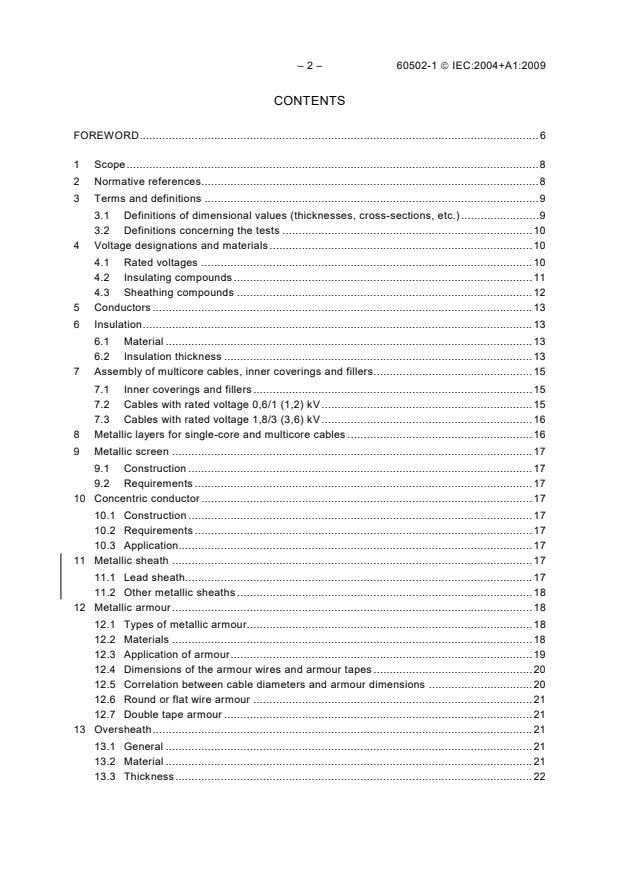
– 2 – 60502-1 IEC:2004+A1:2009
CONTENTS
FOREWORD . 6
1 Scope . 8
2 Normative references. 8
3 Terms and definitions . 9
3.1 Definitions of dimensional values (thicknesses, cross-sections, etc.) . 9
3.2 Definitions concerning the tests . 10
4 Voltage designations and materials . 10
4.1 Rated voltages . 10
4.2 Insulating compounds . 11
4.3 Sheathing compounds . 12
5 Conductors . 13
6 Insulation . 13
6.1 Material . 13
6.2 Insulation thickness . 13
7 Assembly of multicore cables, inner coverings and fillers . 15
7.1 Inner coverings and fillers . 15
7.2 Cables with rated voltage 0,6/1 (1,2) kV . 15
7.3 Cables with rated voltage 1,8/3 (3,6) kV . 16
8 Metallic layers for single-core and multicore cables . 16
9 Metallic screen . 17
9.1 Construction . 17
9.2 Requirements . 17
10 Concentric conductor . 17
10.1 Construction . 17
10.2 Requirements . 17
10.3 Application. 17
11 Metallic sheath . 17
11.1 Lead sheath. 17
11.2 Other metallic sheaths . 18
12 Metallic armour . 18
12.1 Types of metallic armour. 18
12.2 Materials . 18
12.3 Application of armour . 19
12.4 Dimensions of the armour wires and armour tapes . 20
12.5 Correlation between cable diameters and armour dimensions . 20
12.6 Round or flat wire armour . 21
12.7 Double tape armour . 21
13 Oversheath . 21
13.1 General . 21
13.2 Material . 21
13.3 Thickness . 22
60502-1 IEC:2004+A1:2009 – 3 –
14 Test conditions . 22
14.1 Ambient temperature . 22
14.2 Frequency and waveform of power frequency test voltages . 22
14.3 Waveform of impulse test voltages . 22
15 Routine tests . 22
15.1 General . 22
15.2 Electrical resistance of conductors . 23
15.3 Voltage test . 23
16 Sample tests . 24
16.1 General . 24
16.2 Frequency of sample tests . 24
16.3 Repetition of tests . 25
16.4 Conductor examination . 25
16.5 Measurement of thickness of insulation and of non-metallic sheaths (including
extruded separation sheaths, but excluding inner extruded coverings) . 25
16.6 Measurement of thickness of lead sheath . 26
16.7 Measurement of armour wires and tapes . 26
16.8 Measurement of external diameter . 27
16.9 Hot set test for EPR, HEPR and XLPE insulations and elastomeric sheaths . 27
17 Type tests, electrical . 27
17.1 Insulation resistance measurement at ambient temperature . 27
17.2 Insulation resistance measurement at maximum conductor temperature . 28
17.3 Voltage test for 4 h . 29
17.4 Impulse test for cables of rated voltage 1,8/3 (3,6) kV . 29
18 Type tests, non-electrical . 29
18.1 Measurement of thickness of insulation . 29
18.2 Measurement of thickness of non-metallic sheaths (including extruded
separation sheaths, but excluding inner coverings) . 30
18.3 Tests for determining the mechanical properties of insulation before and
after ageing . 30
18.4 Tests for determining the mechanical properties of non-metallic sheaths
before and after ageing . 30
18.5 Additional ageing test on pieces of completed cables . 31
18.6 Loss of mass test on PVC sheaths of type ST . 31
18.7 Pressure test at high temperature on insulations and non-metallic sheaths . 32
18.8 Test on PVC insulation and sheaths and halogen free sheaths at low
temperatures . 32
18.9 Test for resistance of PVC insulation and sheaths to cracking (heat shock test) . 32
18.10 Ozone resistance test for EPR and HEPR insulations . 32
18.11 Hot set test for EPR, HEPR and XLPE insulations and elastomeric sheaths . 32
18.12 Oil immersion test for elastomeric sheaths . 32
18.13 Water absorption test on insulation . 33
18.14 Fire tests . 33
18.15 Measurement of carbon black content of black PE oversheaths . 34
18.16 Shrinkage test for XLPE insulation . 34
18.17 Special bending test . 34
18.18 Determination of hardness of HEPR insulation . 35
18.19 Determination of the elastic modulus of HEPR insulation . 35
– 4 – 60502-1 IEC:2004+A1:2009
18.20 Shrinkage test for PE oversheaths . 35
18.21 Additional mechanical tests on halogen free oversheaths . 35
18.22 Water absorption test for halogen free oversheaths . 35
19 Electrical tests after installation . 36
Annex A (normative) Fictitious calculation method for determination of dimensions of
protective coverings . 45
A.1 General. 45
A.2 Method . 45
Annex B (normative) Rounding of numbers . 51
B.1 Rounding of numbers for the purpose of the fictitious calculation method . 51
B.2 Rounding of numbers for other purposes . 51
Annex C (normative) Determination of hardness of HEPR insulations . 53
C.1 Test piece . 53
C.2 Test procedure . 53
Figure C.1 – Test on surfaces of large radius of curvature . 54
Figure C.2 – Test on surfaces of small radius of curvature . 55
Table 1 – Recommended rated voltages U . 11
Table 2 – Insulating compounds . 11
Table 3 – Maximum conductor temperatures for different types of insulating compound . 12
Table 4 – Maximum conductor temperatures for different types of sheathing compound . 12
Table 5 – Nominal thickness of PVC/A insulation . 13
Table 6 – Nominal thickness of cross-linked polyethylene (XLPE) insulation . 14
Table 7 – Nominal thickness of ethylene propylene rubber (EPR) and hard ethylene
propylene rubber (HEPR) insulation . 14
Table 8 – Thickness of extruded inner covering . 15
Table 9 – Nominal diameter of round armour wires . 20
Table 10 – Nominal thickness of armour tapes . 20
Table 11 – Routine test voltages . 24
Table 12 – Number of samples for sample tests . 25
Table 13 – Electrical type test requirements for insulating compounds . 36
Table 14 – Non-electrical type tests (see Tables 15 to 23) . 37
Table 15 – Test requirements for mechanical characteristics of insulating compounds
(before and after ageing) . 38
Table 16 – Test requirements for particular characteristics for PVC insulating compound . 39
Table 17 – Test requirements for particular characteristics of various cross-linked
insulating compounds . 40
Table 18 – Test requirements for mechanical characteristics of sheathing compounds
(before and after ageing) . 41
Table 19 – Test requirements for particular characteristics for PVC sheathing
compounds . 42
Table 20 – Test requirements for particular characteristics of thermoplastic PE
sheathing compounds . 43
60502-1 IEC:2004+A1:2009 – 5 –
Table 21 – Test requirements for particular characteristics of halogen free sheathing
compound . 43
Table 22 – Test requirements for particular characteristics of elastomeric sheathing
compound . 44
Table 23 – Test methods and requirements for halogen free compounds . 44
Table A.1 – Fictitious diameter of conductor . 48
Table A.2 – Assembly coefficient k for laid-up cores . 47
Table A.3 – Increase of diameter for concentric conductors and metallic screens . 48
Table A.4 – Increase of diameter for additional bedding . 50
– 6 – 60502-1 IEC:2004+A1:2009
INTERNATIONAL ELECTROTECHNICAL COMMISSION
____________
POWER CABLES WITH EXTRUDED INSULATION
AND THEIR ACCESSORIES FOR RATED VOLTAGES
FROM 1 kV (U = 1,2 kV) UP TO 30 kV (U = 36 kV) –
m m
Part 1: Cables for rated voltages of 1 kV
(U = 1,2 kV) and 3 kV (U = 3,6 kV)
m m
FOREWORD
1) The International Electrotechnical Commission (IEC) is a worldwide organization for standardization comprising
all national electrotechnical committees (IEC National Committees). The object of IEC is to promote
international co-operation on all questions concerning standardization in the electrical and electronic fields. To
this end and in addition to other activities, IEC publishes International Standards, Technical Specifications,
Technical Reports, Publicly Available Specifications (PAS) and Guides (hereafter referred to as “IEC
Publication(s)”). Their preparation is entrusted to technical committees; any IEC National Committee interested
in the subject dealt with may participate in this preparatory work. International, governmental and non-
governmental organizations liaising with the IEC also participate in this preparation. IEC collaborates closely
with the International Organization for Standardization (ISO) in accordance with conditions determined by
agreement between the two organizations.
2) The formal decisions or agreements of IEC on technical matters express, as nearly as possible, an international
consensus of opinion on the relevant subjects since each technical committee has representation from all
interested IEC National Committees.
3) IEC Publications have the form of recommendations for international use and are accepted by IEC National
Committees in that sense. While all reasonable efforts are made to ensure that the technical content of IEC
Publications is accurate, IEC cannot be held responsible for the way in which they are used or for any
misinterpretation by any end user.
4) In order to promote international uniformity, IEC National Committees undertake to apply IEC Publications
transparently to the maximum extent possible in their national and regional publications. Any divergence
between any IEC Publication and the corresponding national or regional publication shall be clearly indicated in
the latter.
5) IEC itself does not provide any attestation of conformity. Independent certification bodies provide conformity
assessment services and, in some areas, access to IEC marks of conformity. IEC is not responsible for any
services carried out by independent certification bodies.
6) All users should ensure that they have the latest edition of this publication.
7) No liability shall attach to IEC or its directors, employees, servants or agents including individual experts and
members of its technical committees and IEC National Committees for any personal injury, property damage or
other damage of any nature whatsoever, whether direct or indirect, or for costs (including legal fees) and
expenses arising out of the publication, use of, or reliance upon, this IEC Publication or any other IEC
Publications.
8) Attention is drawn to the Normative references cited in this publication. Use of the referenced publications is
indispensable for the correct application of this publication.
9) Attention is drawn to the possibility that some of the elements of this IEC Publication may be the subject of
patent rights. IEC shall not be held responsible for identifying any or all such patent rights.
International Standard IEC 60502-1 has been prepared by IEC technical committee 20: Electric
cables.
This consolidated version of IEC 60502-1 consists of the second edition (2004) [documents
20/683/FDIS and 20/691/RVD] and its amendment 1 (2009) [documents 20/1063/FDIS and
20/1069/RVD].
The technical content is therefore identical to the base edition and its amendment and has
been prepared for user convenience.
It bears the edition number 2.1.
A vertical line in the margin shows where the base publication has been modified by
amendment 1.
60502-1 IEC:2004+A1:2009 – 7 –
The main changes with respect to the first edition relate to insulation and oversheath thickness
requirements, and inclusion of constructions and requirements for halogen free cables with
reduced flame propagation and low levels of smoke emission.
This publication has been drafted in accordance with the ISO/IEC Directives, Part 2.
IEC 60502 consists of the following parts, under the general title Power cables with extruded
insulation and their accessories for rated voltages from 1 kV (U = 1,2 kV) up to 30 kV
m
(U = 36 kV):
m
Part 1: Cables for rated voltages of 1 kV (U = 1,2 kV) and 3 kV (U = 3,6 kV);
m m
= 7,2 kV) up to 30 kV (U = 36 kV);
Part 2: Cables for rated voltages from 6 kV (U
m m
Part 3: Reserved;
Part 4: Test requirements on accessories for cables with rated voltages from 6 kV
(U = 7,2 kV) up to 30 kV (U = 36 kV).
m m
The committee has decided that the contents of the base publication and its amendments will
remain unchanged until the maintenance result date indicated on the IEC web site under
"http://webstore.iec.ch" in the data related to the specific publication. At this date,
the publication will be
• reconfirmed,
• withdrawn,
• replaced by a revised edition, or
• amended.
– 8 – 60502-1 IEC:2004+A1:2009
POWER CABLES WITH EXTRUDED INSULATION
AND THEIR ACCESSORIES FOR RATED VOLTAGES
FROM 1 kV (U = 1,2 kV) UP TO 30 kV (U = 36 kV) –
m m
Part 1: Cables for rated voltages of 1 kV
(U = 1,2 kV) and 3 kV (U = 3,6 kV)
m m
1 Scope
This part of IEC 60502 specifies the construction, dimensions and test requirements of power
cables with extruded solid insulation for rated voltages of 1 kV (U = 1,2 kV) and 3 kV (U =
m m
3,6 kV) for fixed installations such as distribution networks or industrial installations.
This standard includes cables which exhibit properties of reduced flame spread, low levels of
smoke emission and halogen-free gas emission when exposed to fire.
Cables for special installation and service conditions are not included, for example cables for
overhead networks, the mining industry, nuclear power plants (in and around the containment
area), submarine use or shipboard application.
2 Normative references
The following referenced documents are indispensable for the application of this document. For
dated references, only the edition cited applies. For undated references, the latest edition of
the referenced document (including any amendments) applies.
IEC 60038:1983, IEC standard voltages
IEC 60060-1:1989, High-voltage test techniques – Part 1: General definitions and test
requirements
IEC 60183:1984, Guide to the selection of high-voltage cables
IEC 60228:1978, Conductors of insulated cables
IEC 60230:1966, Impulse tests on cables and their accessories
IEC 60332-1:1993, Tests on electric cables under fire conditions – Part 1: Test on a single
vertical insulated wire or cable
IEC 60332-3-24:2000, Tests on electric cables under fire conditions – Part 3-24: Test for
vertical flame spread of vertically-mounted bunched wires or cables – Category C
IEC 60502-2:1997, Power cables with extruded insulation and their accessories for rated
voltages from 1 kV (U = 1,2 kV) up to 30 kV (U = 36 kV) – Part 2: Cables for rated voltages
m m
from 6 kV (U = 7,2 kV) up to 30 kV (U = 36 kV)
m m
IEC 60684-2:1987, Flexible insulating sleeving – Part 2: Methods of test
IEC 60724:2000, Short-circuit temperature limits of electric cables with rated voltages of 1 kV
(U = 1,2 kV) and 3 kV (U = 3,6 kV)
m m
IEC 60754-1:1994, Test on gases evolved during combustion of materials from cables – Part 1:
Determination of the amount of halogen gas
60502-1 IEC:2004+A1:2009 – 9 –
IEC 60754-2:1991, Test on gases evolved during combustion of electric cables – Part 2:
Determination of degree of acidity of gases evolved during the combustion of materials taken
from electric cables by measuring pH and conductivity
IEC 60811-1-1:1993, Common test methods for insulating and sheathing materials of electric
cables – Part 1: Methods for general application – Section 1: Measurement of thickness and
overall dimensions – Tests for determining the mechanical properties
IEC 60811-1-2:1985, Common test methods for insulating and sheathing materials of electric
cables – Part 1: Methods for general application – Section 2: Thermal ageing methods
IEC 60811-1-3:1993, Common test methods for insulating and sheathing materials of electric
cables – Part 1: Methods for general application – Section 3: Methods for determining the
density – Water absorption tests – Shrinkage test
IEC 60811-1-4:1985, Common test methods for insulating and sheathing materials of electric
cables – Part 1: Methods for general application – Section 4: Tests at low temperature
IEC 60811-2-1:1998, Insulating and sheathing materials of electric and optical cables –
Common test methods – Part 2-1: Methods specific to elastomeric compounds – Ozone
resistance, hot set and mineral oil immersion tests
IEC 60811-3-1:1985, Common test methods for insulating and sheathing materials of electric
cables – Part 3: Methods specific to PVC compounds – Section 1: Pressure test at high
temperature – Tests for resistance to cracking
IEC 60811-3-2:1985, Common test methods for insulating and sheathing materials of electric
cables – Part 3: Methods specific to PVC compounds – Section 2: Loss of mass test – Thermal
stability test
IEC 60811-4-1:1985, Common test methods for insulating and sheathing materials of electric
cables – Part 4: Methods specific to polyethylene and polypropylene compounds – Section 1:
Resistance to environmental stress cracking – Wrapping test after thermal ageing in air –
Measurement of the melt flow index – Carbon black and/or mineral content measurement in PE
IEC 61034-2: 1997, Measurement of smoke density of cables burning under defined conditions –
Part 2: Test procedure and requirements
ISO 48:1994, Rubber, vulcanized or thermoplastic – Determination of hardness (hardness
between 10 IRHD and 100 IRHD)
3 Terms and definitions
For the purposes of this document, the following definitions apply.
3.1 Definitions of dimensional values (thicknesses, cross-sections, etc.)
3.1.1
nominal value
value by which a quantity is designated and which is often used in tables
NOTE Usually, in this standard, nominal values give rise to values to be checked by measurements taking into
account specified tolerances.
3.1.2
approximate value
value which is neither guaranteed nor checked; it is used, for example, for the calculation of
other dimensional values
– 10 – 60502-1 IEC:2004+A1:2009
3.1.3
median value
when several test results have been obtained and ordered in an increasing (or decreasing)
succession, the median value is the middle value if the number of available values is odd, and
the mean of the two middle values if the number is even
3.1.4
fictitious value
value calculated according to the "fictitious method'' described in Annex A
3.2 Definitions concerning the tests
3.2.1
routine tests
tests made by the manufacturer on each manufactured length of cable to check that each
length meets the specified requirements
3.2.2
sample tests
tests made by the manufacturer on samples of completed cable or components taken from a
completed cable, at a specified frequency, so as to verify that the finished product meets the
specified requirements
3.2.3
type tests
tests made before supplying, on a general commercial basis, a type of cable covered by this
standard, in order to demonstrate satisfactory performance characteristics to meet the
intended application
NOTE These tests are of such a nature that, after they have been made, they need not be repeated, unless
changes are made in the cable materials or design or manufacturing process which might change the performance
characteristics.
3.2.4
electrical tests after installation
tests made to demonstrate the integrity of the cable and its accessories as installed
4 Voltage designations and materials
4.1 Rated voltages
The rated voltages U /U (U ) of the cables considered in this standard are 0,6/1 (1,2) kV and
0 m
1,8/3 (3,6) kV.
NOTE 1 The voltages given above are the correct designations although in some countries other designations are
used, e.g. 1,7/3 kV or 1,9/3,3 kV instead of 1,8/3 kV.
In the voltage designation of cables U /U (U ):
0 m
U is the rated power frequency voltage between conductor and earth or metallic screen for
which the cable is designed;
U is the rated power frequency voltage between conductors for which the cable is designed;
U is the maximum value of the "highest system voltage'' for which the equipment may be
m
used (see IEC 60038).
The rated voltage of the cable for a given application shall be suitable for the operating
conditions in the system in which the cable is used. To facilitate the selection of the cable,
systems are divided into three categories:
60502-1 IEC:2004+A1:2009 – 11 –
– Category A: this category comprises those systems in which any phase conductor that
comes in contact with earth or an earth conductor is disconnected from the
system within 1 min;
– Category B: this category comprises those systems which, under fault conditions, are
operated for a short time with one phase earthed. This period, according to
IEC 60183, should not exceed 1 h. For cables covered by this standard, a
longer period, not exceeding 8 h on any occasion, can be tolerated. The total
duration of earth faults in any year should not exceed 125 h;
– Category C: this category comprises all systems which do not fall into category A or B.
NOTE 2 It should be realized that in a system where an earth fault is not automatically and promptly isolated, the
extra stresses on the insulation of cables during the earth fault reduce the life of the cables to a certain degree. If
the system is expected to be operated fairly often with a permanent earth fault, it may be advisable to classify the
system in Category C.
The values of U recommended for cables to be used in three-phase systems are listed in
Table 1.
Table 1 – Recommended rated voltages U
Highest system voltage Rated voltage (U )
(U ) kV
m
kV Categories A and B Category C
1,2 0,6 0,6
*
3,6 1,8 3,6
*
This category is covered by 3,6/6 (7,2) kV cables according to IEC 60502-2.
4.2 Insulating compounds
The types of insulating compound covered by this standard are listed in Table 2, together with
their abbreviated designations.
Table 2 – Insulating compounds
Abbreviated
Insulating compound
designation
a) Thermoplastic
*
Polyvinyl chloride intended for cables with rated voltages U /U ≤ 1,8/3 kV PVC/A
b) Cross-linked:
Ethylene propylene rubber or similar (EPM or EPDM) EPR
High modulus or hard grade ethylene propylene rubber HEPR
Cross-linked polyethylene XLPE
* Insulating compound based on polyvinyl chloride intended for cables with rated voltages U /U = 3,6/6 kV is
designated PVC/B in IEC 60502-2.
The maximum conductor temperatures for different types of insulating compound covered by
this standard are given in Table 3.
– 12 – 60502-1 IEC:2004+A1:2009
Table 3 – Maximum conductor temperatures for different types of insulating compound
Maximum conductor temperature
°C
Insulating compound
Short-circuit
Normal operation (5 s maximum
duration)
Polyvinyl chloride (PVC/A)
Conductor cross-section ≤300 mm 70 160
70 140
Conductor cross-section >300 mm
Cross-linked polyethylene (XLPE) 90 250
Ethylene propylene rubber (EPR and HEPR) 90 250
The temperatures in Table 3 are based on the intrinsic properties of the insulating materials. It
is important to take into account other factors when using these values for the calculation of
current ratings.
For example, in normal operation, if a cable directly buried in the ground is operated under
continuous load (100 % load factor) at the maximum conductor temperature shown in the table,
the thermal resistivity of the soil surrounding the cable may, in the course of time, increase
from its original value as a result of drying-out processes. As a consequence, the conductor
temperature may greatly exceed the maximum value. If such operating conditions are foreseen,
adequate provisions shall be made.
For guidance on the short-circuit temperatures, reference should be made to IEC 60724.
4.3 Sheathing compounds
The maximum conductor temperatures for the different types of sheathing compound covered
by this standard are given in Table 4.
Table 4 – Maximum conductor temperatures for different types of sheathing compound
Maximum conductor
Abbreviated temperature
Sheathing compound
designation in normal operation
°C
a) Thermoplastic:
Polyvinyl chloride (PVC) ST 80
ST 90
ST 80
Polyethylene
ST 90
Halogen free ST 90
b) Elastomeric:
Polychloroprene, chlorosulfonated polyethylene SE 85
or similar polymers
60502-1 IEC:2004+A1:2009 – 13 –
5 Conductors
The conductors shall be either of Class 1 or Class 2 of plain or metal-coated annealed copper
or of plain aluminium or aluminium alloy, or of Class 5 of plain or metal-coated copper in
accordance with IEC 60228.
6 Insulation
6.1 Material
The insulation shall be extruded dielectric of one of the types listed in Table 2.
For halogen free cables, the insulation shall meet the requirements given in Table 23.
6.2 Insulation thickness
The nominal insulation thicknesses are specified in Tables 5 to 7.
The thickness of any separator shall not be included in the thickness of the insulation.
Table 5 – Nominal thickness of PVC/A insulation
Nominal cross-sectional Nominal thickness of insulation at rated voltage
area of conductor U /U (U )
0 m
0,6/1 (1,2) kV 1,8/3 (3,6) kV
mm mm mm
1,5 and 2,5 0,8 –
4 and 6 1,0 –
10 and 16 1,0 2,2
25 and 35 1,2 2,2
50 and 70 1,4 2,2
95 and 120 1,6 2,2
150 1,8 2,2
185 2,0 2,2
240 2,2 2,2
300 2,4 2,4
2,6 2,6
500 to 800 2,8 2,8
1 000 3,0 3,0
NOTE Any conductor cross-section smaller than those given in this table is not recommended.
– 14 – 60502-1 IEC:2004+A1:2009
Table 6 – Nominal thickness of cross-linked polyethylene (XLPE) insulation
Nominal cross-sectional Nominal thickness of insulation at rated voltage
area of conductor U /U (U )
0 m
0,6/1 (1,2) kV 1,8/3 (3,6) kV
mm mm mm
1,5 and 2,5 0,7 –
4 and 6 0,7 –
10 and 16 0,7 2,0
25 and 35 0,9 2,0
50 1,0 2,0
70 and 95 1,1 2,0
120 1,2 2,0
150 1,4 2,0
185 1,6 2,0
240 1,7 2,0
1,8 2,0
400 2,0 2,0
500 2,2 2,2
630 2,4
2,4
800 2,6 2,6
1 000 2,8 2,8
NOTE Any conductor cross-section smaller than those given in this table is not recommended.
Table 7 – Nominal thickness of ethylene propylene rubber (EPR)
and hard ethylene propylene rubber (HEPR) insulation
Nominal cross-sectional Nominal thickness of insulation at rated voltage
area of conductor U /U (U )
0 m
0,6/1 (1,2) kV 1,8/3 (3,6) kV
EPR HEPR EPR HEPR
mm
mm mm mm mm
1,5 and 2,5 1,0 0,7 – –
4 and 6 1,0 0,7
– –
10 and 16 1,0 0,7 2,2 2,0
25 and 35 1,2 0,9 2,2 2,0
50 1,4 1,0 2,2
2,0
70 1,4 1,1 2,2 2,0
95 1,6 1,1 2,4 2,0
120 1,6 1,2 2,4 2,0
150 1,8 1,4 2,4 2,0
185 2,0 1,6 2,4 2,0
240 2,2 1,7 2,4 2,0
300 2,4 1,8 2,4 2,0
400 2,6 2,0 2,6 2,0
500 2,8 2,2 2,8 2,2
630 2,8 2,4 2,8 2,4
800 2,8 2,6 2,8 2,6
1 000 3,0 2,8 3,0 2,8
NOTE Any conductor cross-section smaller than those given in this table is not recommended.
60502-1 IEC:2004+A1:2009 – 15 –
7 Assembly of multicore cables, inner coverings and fillers
The assembly of multicore cables depends on the rated voltage and whether a metallic layer is
applied to each core.
The following subclauses 7.1 to 7.3 do not apply to assemblies of sheathed single-core cables.
7.1 Inner coverings and fillers
7.1.1 Construction
The inner coverings may be extruded or lapped.
For cables with circular cores, except cables with more than five cores, a lapped inner covering
shall be permitted only if the interstices between the cores are substantially filled.
A suitable binder is permitted before application of an extruded inner covering.
7.1.2 Material
The materials used for inner coverings and fillers shall be suitable for the operating
temperature of the cable and compatible with the insulating material.
For halogen free cable
...