

IEC 60702-1:2002
(Main)Mineral insulated cables and their terminations with a rated voltage not exceeding 750 V - Part 1: Cables
General Information
- Abstract
Applies to mineral insulated general wiring cables with copper or copper alloy sheath and copper conductors and with rated voltages of 500 V and 750 V. Provision is made for a corrosion-resistant extruded outer covering over the copper sheath, when required. This outer covering is not specified for the purpose of electrical insulation of the metal sheath. Requirements for terminations for use with these cables are specified in IEC 60702-2. The purpose of this standard is to specify mineral insulated cables that are safe and reliable when properly used, to state the manufacturing requirements and characteristics to achieve this, and to specify methods for checking conformity with those requirements.
- Status
- Published
- Publication Date
- 14-Jan-2015
- Technical Committee
- TC 20 - Electric cables
- Drafting Committee
- WG 17 - TC 20/WG 17
- Current Stage
- PPUB - Publication issued
- Start Date
- 14-Feb-2002
- Completion Date
- 31-Mar-2002
Buy Documents
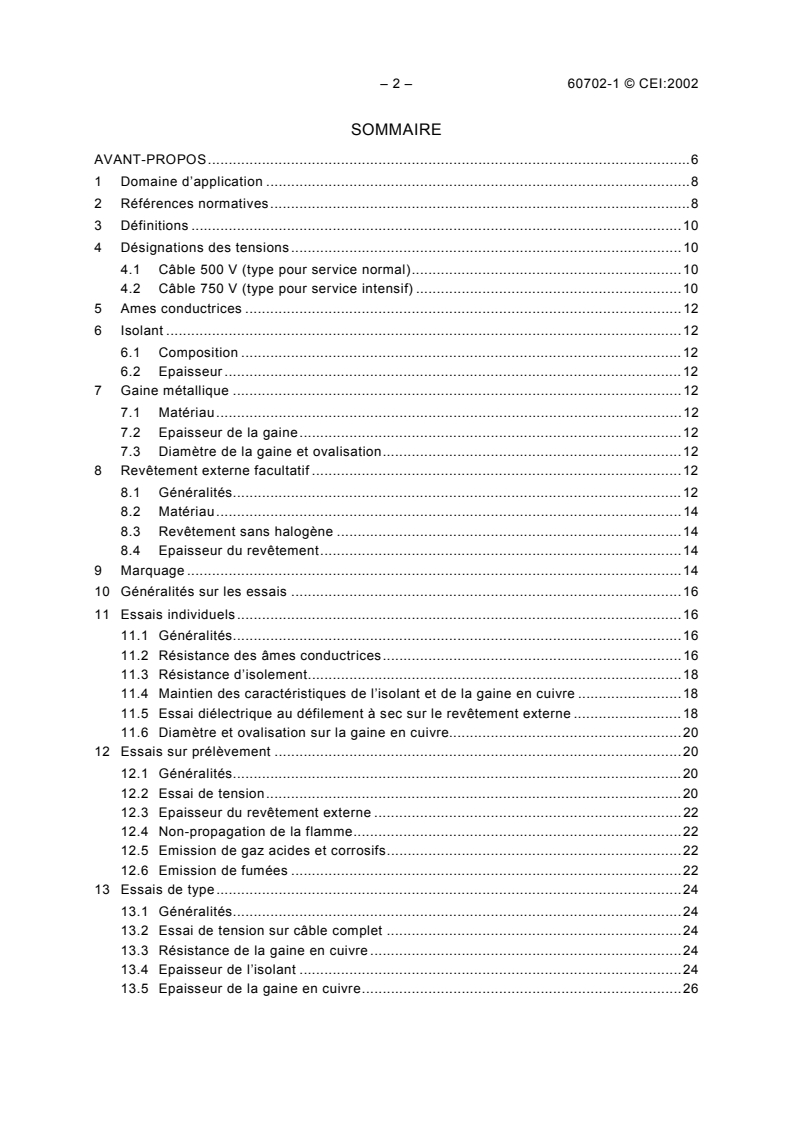
IEC 60702-1:2002 - Mineral insulated cables and their terminations with a rated voltage not exceeding 750 V - Part 1: Cables Released:2/14/2002

IEC 60702-1:2002+AMD1:2015 CSV - Mineral insulated cables and their terminations with a rated voltage not exceeding 750 V - Part 1: Cables Released:1/15/2015
Overview
IEC 60702-1:2002 is an international standard developed by the International Electrotechnical Commission (IEC) that specifies requirements for mineral insulated cables with rated voltages not exceeding 750 V. These cables feature copper or copper alloy sheaths and copper conductors and are designed primarily for general wiring applications. The standard also allows for an optional corrosion-resistant extruded outer covering to enhance durability, although this covering is not intended to provide electrical insulation.
The purpose of IEC 60702-1 is to ensure that mineral insulated cables are safe, reliable, and manufactured according to strict quality and construction criteria. It defines manufacturing processes, physical and electrical characteristics, testing methods, and conformity verification to meet international performance expectations.
Key Topics
- Voltage Ratings: The standard applies to two voltage grades-500 V for light duty cables and 750 V for heavy duty cables.
- Conductor and Sheath Materials: Conductors must be copper, while the metallic sheath is made from copper or copper alloy to ensure conductivity and mechanical protection.
- Insulation: The mineral insulation, typically magnesium oxide, provides excellent thermal and electrical insulation and is resistant to fire and mechanical damage.
- Optional Outer Covering: A corrosion-resistant extruded covering can be applied over the copper sheath when necessary; this covering is not part of the electrical insulation system.
- Dimensions and Mechanical Properties: Detailed specifications include sheath thickness, diameter, ovality, and bending and flattening tests to guarantee cable robustness.
- Marking and Identification: Cables must be clearly marked for easy identification, including rated voltage and other relevant details.
- Testing Methods: The standard specifies routine, sample, and type tests such as conductor resistance, insulation resistance, spark tests, flame retardance, smoke emission, and fire resistance tests to ensure quality and safety compliance.
Applications
IEC 60702-1 mineral insulated cables are widely used in applications where high mechanical strength, fire resistance, and durability are critical, including:
- Building Wiring: Ideal for fire-resistant wiring in residential, commercial, and industrial buildings.
- Safety Circuits: Suitable for emergency systems, fire alarms, and safety-related electrical installations requiring reliable operation under adverse conditions.
- Industrial Environments: Applicable in harsh industrial settings where exposure to corrosive agents, moisture, or mechanical impact is common.
- Critical Installations: Used in nuclear power plants, tunnels, hospitals, and transport infrastructure, where cable reliability and safety are paramount.
Related Standards
- IEC 60702-2: Specifies requirements for terminations used with mineral insulated cables covered under IEC 60702-1.
- IEC 60228: Defines standard conductors for electrical cables, including copper conductors used in mineral insulated cables.
- IEC 60332: Covers tests on electric and optical fiber cables under fire conditions, which complement fire resistance provisions in IEC 60702-1.
- IEC 61034: Addresses measurement of smoke density during cable fire testing, relevant to smoke emission tests for mineral insulated cables.
- ISO/IEC Directives Part 3: Governs the drafting principles for international standards, ensuring consistent and harmonized documentation.
Keywords: IEC 60702-1, mineral insulated cables, rated voltage 750 V, copper sheath, copper conductor, mineral insulation, fire-resistant cables, corrosion-resistant covering, electrical safety standards, cable testing, wiring cables, IEC standards.
Relations
- Effective Date
- 05-Sep-2023
Buy Documents
IEC 60702-1:2002 - Mineral insulated cables and their terminations with a rated voltage not exceeding 750 V - Part 1: Cables Released:2/14/2002
IEC 60702-1:2002+AMD1:2015 CSV - Mineral insulated cables and their terminations with a rated voltage not exceeding 750 V - Part 1: Cables Released:1/15/2015
Get Certified
Connect with accredited certification bodies for this standard

IMQ S.p.A. (Certification)
Italian electrical product certification.

SLG Prüf- und Zertifizierungs GmbH
German testing and certification body.

UL Solutions
Global safety science company with testing, inspection and certification.
Sponsored listings
Frequently Asked Questions
IEC 60702-1:2002 is a standard published by the International Electrotechnical Commission (IEC). Its full title is "Mineral insulated cables and their terminations with a rated voltage not exceeding 750 V - Part 1: Cables". This standard covers: Applies to mineral insulated general wiring cables with copper or copper alloy sheath and copper conductors and with rated voltages of 500 V and 750 V. Provision is made for a corrosion-resistant extruded outer covering over the copper sheath, when required. This outer covering is not specified for the purpose of electrical insulation of the metal sheath. Requirements for terminations for use with these cables are specified in IEC 60702-2. The purpose of this standard is to specify mineral insulated cables that are safe and reliable when properly used, to state the manufacturing requirements and characteristics to achieve this, and to specify methods for checking conformity with those requirements.
Applies to mineral insulated general wiring cables with copper or copper alloy sheath and copper conductors and with rated voltages of 500 V and 750 V. Provision is made for a corrosion-resistant extruded outer covering over the copper sheath, when required. This outer covering is not specified for the purpose of electrical insulation of the metal sheath. Requirements for terminations for use with these cables are specified in IEC 60702-2. The purpose of this standard is to specify mineral insulated cables that are safe and reliable when properly used, to state the manufacturing requirements and characteristics to achieve this, and to specify methods for checking conformity with those requirements.
IEC 60702-1:2002 is classified under the following ICS (International Classification for Standards) categories: 29.060.20 - Cables. The ICS classification helps identify the subject area and facilitates finding related standards.
IEC 60702-1:2002 has the following relationships with other standards: It is inter standard links to IEC 60702-1:2002/AMD1:2015. Understanding these relationships helps ensure you are using the most current and applicable version of the standard.
IEC 60702-1:2002 is available in PDF format for immediate download after purchase. The document can be added to your cart and obtained through the secure checkout process. Digital delivery ensures instant access to the complete standard document.
Standards Content (Sample)
NORME CEI
INTERNATIONALE IEC
60702-1
INTERNATIONAL
Troisième édition
STANDARD
Third edition
2002-02
Câbles à isolant minéral et leurs terminaisons
de tension assignée ne dépassant pas 750 V –
Partie 1:
Câbles
Mineral insulated cables and their terminations
with a rated voltage not exceeding 750 V –
Part 1:
Cables
Numéro de référence
Reference number
CEI/IEC 60702-1:2002
Numérotation des publications Publication numbering
Depuis le 1er janvier 1997, les publications de la CEI As from 1 January 1997 all IEC publications are
sont numérotées à partir de 60000. Ainsi, la CEI 34-1 issued with a designation in the 60000 series. For
devient la CEI 60034-1. example, IEC 34-1 is now referred to as IEC 60034-1.
Editions consolidées Consolidated editions
Les versions consolidées de certaines publications de la The IEC is now publishing consolidated versions of its
CEI incorporant les amendements sont disponibles. Par publications. For example, edition numbers 1.0, 1.1
exemple, les numéros d’édition 1.0, 1.1 et 1.2 indiquent and 1.2 refer, respectively, to the base publication,
respectivement la publication de base, la publication de the base publication incorporating amendment 1 and
base incorporant l’amendement 1, et la publication de the base publication incorporating amendments 1
base incorporant les amendements 1 et 2. and 2.
Informations supplémentaires Further information on IEC publications
sur les publications de la CEI
Le contenu technique des publications de la CEI est The technical content of IEC publications is kept
constamment revu par la CEI afin qu'il reflète l'état under constant review by the IEC, thus ensuring that
actuel de la technique. Des renseignements relatifs à the content reflects current technology. Information
cette publication, y compris sa validité, sont dispo- relating to this publication, including its validity, is
nibles dans le Catalogue des publications de la CEI available in the IEC Catalogue of publications
(voir ci-dessous) en plus des nouvelles éditions, (see below) in addition to new editions, amendments
amendements et corrigenda. Des informations sur les and corrigenda. Information on the subjects under
sujets à l’étude et l’avancement des travaux entrepris consideration and work in progress undertaken by the
par le comité d’études qui a élaboré cette publication, technical committee which has prepared this
ainsi que la liste des publications parues, sont publication, as well as the list of publications issued,
également disponibles par l’intermédiaire de: is also available from the following:
• Site web de la CEI (www.iec.ch) • IEC Web Site (www.iec.ch)
• Catalogue des publications de la CEI • Catalogue of IEC publications
Le catalogue en ligne sur le site web de la CEI The on-line catalogue on the IEC web site
(www.iec.ch/catlg-f.htm) vous permet de faire des (www.iec.ch/catlg-e.htm) enables you to search
recherches en utilisant de nombreux critères, by a variety of criteria including text searches,
comprenant des recherches textuelles, par comité technical committees and date of publication. On-
d’études ou date de publication. Des informations line information is also available on recently
en ligne sont également disponibles sur les issued publications, withdrawn and replaced
nouvelles publications, les publications rempla- publications, as well as corrigenda.
cées ou retirées, ainsi que sur les corrigenda.
• IEC Just Published
• IEC Just Published
Ce résumé des dernières publications parues
This summary of recently issued publications
(www.iec.ch/JP.htm) est aussi disponible par
(www.iec.ch/JP.htm) is also available by email.
courrier électronique. Veuillez prendre contact
Please contact the Customer Service Centre (see
avec le Service client (voir ci-dessous) pour plus
below) for further information.
d’informations.
• Service clients
• Customer Service Centre
Si vous avez des questions au sujet de cette
If you have any questions regarding this
publication ou avez besoin de renseignements
publication or need further assistance, please
supplémentaires, prenez contact avec le Service
contact the Customer Service Centre:
clients:
Email: custserv@iec.ch
Email: custserv@iec.ch
Tél: +41 22 919 02 11
Tel: +41 22 919 02 11
Fax: +41 22 919 03 00
Fax: +41 22 919 03 00
.
NORME CEI
INTERNATIONALE IEC
60702-1
INTERNATIONAL
Troisième édition
STANDARD
Third edition
2002-02
Câbles à isolant minéral et leurs terminaisons
de tension assignée ne dépassant pas 750 V –
Partie 1:
Câbles
Mineral insulated cables and their terminations
with a rated voltage not exceeding 750 V –
Part 1:
Cables
IEC 2002 Droits de reproduction réservés Copyright - all rights reserved
Aucune partie de cette publication ne peut être reproduite ni No part of this publication may be reproduced or utilized in any
utilisée sous quelque forme que ce soit et par aucun procédé, form or by any means, electronic or mechanical, including
électronique ou mécanique, y compris la photocopie et les photocopying and microfilm, without permission in writing from
microfilms, sans l'accord écrit de l'éditeur. the publisher.
International Electrotechnical Commission, 3, rue de Varembé, PO Box 131, CH-1211 Geneva 20, Switzerland
Telephone: +41 22 919 02 11 Telefax: +41 22 919 03 00 E-mail: inmail@iec.ch Web: www.iec.ch
CODE PRIX
S
PRICE CODE
Commission Electrotechnique Internationale
International Electrotechnical Commission
Международная Электротехническая Комиссия
Pour prix, voir catalogue en vigueur
For price, see current catalogue
– 2 – 60702-1 © CEI:2002
SOMMAIRE
AVANT-PROPOS.6
1 Domaine d’application .8
2 Références normatives.8
3 Définitions .10
4 Désignations des tensions.10
4.1 Câble 500 V (type pour service normal).10
4.2 Câble 750 V (type pour service intensif) .10
5 Ames conductrices .12
6 Isolant .12
6.1 Composition .12
6.2 Epaisseur .12
7 Gaine métallique .12
7.1 Matériau.12
7.2 Epaisseur de la gaine.12
7.3 Diamètre de la gaine et ovalisation.12
8 Revêtement externe facultatif .12
8.1 Généralités.12
8.2 Matériau.14
8.3 Revêtement sans halogène .14
8.4 Epaisseur du revêtement.14
9 Marquage .14
10 Généralités sur les essais .16
11 Essais individuels.16
11.1 Généralités.16
11.2 Résistance des âmes conductrices.16
11.3 Résistance d’isolement.18
11.4 Maintien des caractéristiques de l’isolant et de la gaine en cuivre .18
11.5 Essai diélectrique au défilement à sec sur le revêtement externe .18
11.6 Diamètre et ovalisation sur la gaine en cuivre.20
12 Essais sur prélèvement .20
12.1 Généralités.20
12.2 Essai de tension.20
12.3 Epaisseur du revêtement externe .22
12.4 Non-propagation de la flamme.22
12.5 Emission de gaz acides et corrosifs.22
12.6 Emission de fumées .22
13 Essais de type.24
13.1 Généralités.24
13.2 Essai de tension sur câble complet .24
13.3 Résistance de la gaine en cuivre .24
13.4 Epaisseur de l’isolant .24
13.5 Epaisseur de la gaine en cuivre.26
60702-1 © IEC:2002 – 3 –
CONTENTS
FOREWORD.7
1 Scope.9
2 Normative references .9
3 Definitions .11
4 Voltage designations .11
4.1 500 V cable (light duty grade).11
4.2 750 V cable (heavy duty grade) .11
5 Conductors.13
6 Insulation .13
6.1 Composition .13
6.2 Thickness.13
7 Metallic sheath .13
7.1 Material .13
7.2 Sheath thickness .13
7.3 Sheath diameter and ovality .13
8 Optional outer covering .13
8.1 General .13
8.2 Material .15
8.3 Halogen-free covering .15
8.4 Thickness of covering.15
9 Marking .15
10 General notes on tests .17
11 Routine tests .17
11.1 General .17
11.2 Conductor resistance.17
11.3 Insulation resistance .19
11.4 Integrity of insulation and copper sheath .19
11.5 Spark test on outer covering.19
11.6 Diameter and ovality over copper sheath.21
12 Sample tests .21
12.1 General .21
12.2 Voltage test.21
12.3 Thickness of outer covering.23
12.4 Flame retardance .23
12.5 Emission of acidic and corrosive gases .23
12.6 Smoke emission .23
13 Type tests .25
13.1 General .25
13.2 Voltage test on completed cable.25
13.3 Resistance of copper sheath .25
13.4 Thickness of insulation .25
13.5 Thickness of copper sheath.27
– 4 – 60702-1 © CEI:2002
13.6 Essai de pliage.26
13.7 Essai d’aplatissement.34
13.8 Résistance au feu.36
14 Câble à isolant minéral de 500 V (service normal) .36
14.1 Désignation .36
14.2 Tension assignée .36
14.3 Construction.36
14.4 Dimensions .36
14.5 Prescriptions .38
15 Câbles à isolant minéral de 750 V (service intensif).38
15.1 Désignation .38
15.2 Tension assignée .38
15.3 Construction.40
15.4 Dimensions .40
15.5 Prescriptions .44
60702-1 © IEC:2002 – 5 –
13.6 Bending test .27
13.7 Flattening test .35
13.8 Fire resistance .37
14 500 V mineral insulated cable (light duty grade) .37
14.1 Code designation .37
14.2 Rated voltage.37
14.3 Construction.37
14.4 Dimensions .37
14.5 Requirements.39
15 750 V mineral insulated cable (heavy duty grade).39
15.1 Code designation .39
15.2 Rated voltage.39
15.3 Construction.41
15.4 Dimensions .41
15.5 Requirements.45
– 6 – 60702-1 © CEI:2002
COMMISSION ÉLECTROTECHNIQUE INTERNATIONALE
____________
CÂBLES À ISOLANT MINÉRAL ET LEURS TERMINAISONS
DE TENSION ASSIGNÉE NE DÉPASSANT PAS 750 V –
Partie 1: Câbles
AVANT-PROPOS
1) La CEI (Commission Électrotechnique Internationale) est une organisation mondiale de normalisation
composée de l'ensemble des comités électrotechniques nationaux (Comités nationaux de la CEI). La CEI a
pour objet de favoriser la coopération internationale pour toutes les questions de normalisation dans les
domaines de l'électricité et de l'électronique. A cet effet, la CEI, entre autres activités, publie des Normes
internationales. Leur élaboration est confiée à des comités d'études, aux travaux desquels tout Comité national
intéressé par le sujet traité peut participer. Les organisations internationales, gouvernementales et non
gouvernementales, en liaison avec la CEI, participent également aux travaux. La CEI collabore étroitement
avec l'Organisation Internationale de Normalisation (ISO), selon des conditions fixées par accord entre les
deux organisations.
2) Les décisions ou accords officiels de la CEI concernant les questions techniques représentent, dans la mesure
du possible, un accord international sur les sujets étudiés, étant donné que les Comités nationaux intéressés
sont représentés dans chaque comité d’études.
3) Les documents produits se présentent sous la forme de recommandations internationales. Ils sont publiés
comme normes, spécifications techniques, rapports techniques ou guides et agréés comme tels par les
Comités nationaux.
4) Dans le but d'encourager l'unification internationale, les Comités nationaux de la CEI s'engagent à appliquer de
façon transparente, dans toute la mesure possible, les Normes internationales de la CEI dans leurs normes
nationales et régionales. Toute divergence entre la norme de la CEI et la norme nationale ou régionale
correspondante doit être indiquée en termes clairs dans cette dernière.
5) La CEI n’a fixé aucune procédure concernant le marquage comme indication d’approbation et sa responsabilité
n’est pas engagée quand un matériel est déclaré conforme à l’une de ses normes.
6) L’attention est attirée sur le fait que certains des éléments de la présente Norme internationale peuvent faire
l’objet de droits de propriété intellectuelle ou de droits analogues. La CEI ne saurait être tenue pour
responsable de ne pas avoir identifié de tels droits de propriété et de ne pas avoir signalé leur existence.
La Norme internationale CEI 60702-1 a été établie par le comité d'études 20 de la CEI:
Câbles électriques.
Cette troisième édition de la CEI 60702-1 annule et remplace la deuxième édition publiée en
1988 et son amendement 1 publié en 1992, et constitue une révision technique.
Le texte de cette norme est issu des documents suivants:
FDIS Rapport de vote
20/490/FDIS 20/510/RVD
Le rapport de vote indiqué dans le tableau ci-dessus donne toute information sur le vote ayant
abouti à l'approbation de cette norme.
Cette publication a été rédigée selon les Directives ISO/CEI, Partie 3.
Le comité a décidé que le contenu de cette publication ne sera pas modifié avant 2012.
A cette date, la publication sera
• reconduite;
• supprimée;
• remplacée par une édition révisée, ou
• amendée.
60702-1 © IEC:2002 – 7 –
INTERNATIONAL ELECTROTECHNICAL COMMISSION
____________
MINERAL INSULATED CABLES AND THEIR TERMINATIONS
WITH A RATED VOLTAGE NOT EXCEEDING 750 V –
Part 1: Cables
FOREWORD
1) The IEC (International Electrotechnical Commission) is a worldwide organization for standardization comprising
all national electrotechnical committees (IEC National Committees). The object of the IEC is to promote
international co-operation on all questions concerning standardization in the electrical and electronic fields. To
this end and in addition to other activities, the IEC publishes International Standards. Their preparation is
entrusted to technical committees; any IEC National Committee interested in the subject dealt with may
participate in this preparatory work. International, governmental and non-governmental organizations liaising
with the IEC also participate in this preparation. The IEC collaborates closely with the International
Organization for Standardization (ISO) in accordance with conditions determined by agreement between the
two organizations.
2) The formal decisions or agreements of the IEC on technical matters express, as nearly as possible, an
international consensus of opinion on the relevant subjects since each technical committee has representation
from all interested National Committees.
3) The documents produced have the form of recommendations for international use and are published in the form
of standards, technical specifications, technical reports or guides and they are accepted by the National
Committees in that sense.
4) In order to promote international unification, IEC National Committees undertake to apply IEC International
Standards transparently to the maximum extent possible in their national and regional standards. Any
divergence between the IEC Standard and the corresponding national or regional standard shall be clearly
indicated in the latter.
5) The IEC provides no marking procedure to indicate its approval and cannot be rendered responsible for any
equipment declared to be in conformity with one of its standards.
6) Attention is drawn to the possibility that some of the elements of this International Standard may be the subject
of patent rights. The IEC shall not be held responsible for identifying any or all such patent rights.
International Standard IEC 60702-1 has been prepared by IEC technical committee 20:
Electric cables.
This third edition of IEC 60702-1 cancels and replaces the second edition of IEC 60702-1
published in 1988 and its amendment 1 published in 1992, and constitutes a technical
revision.
The text of this standard is based on the following documents:
FDIS Report on voting
20/490/FDIS 20/510/RVD
Full information on the voting for the approval of this standard can be found in the report on
voting indicated in the above table.
This publication has been drafted in accordance with the ISO/IEC Directives, Part 3.
The committee has decided that the contents of this publication will remain unchanged until
2012. At this date, the publication will be
• reconfirmed;
• withdrawn;
• replaced by a revised edition, or
• amended.
– 8 – 60702-1 © CEI:2002
CÂBLES À ISOLANT MINÉRAL ET LEURS TERMINAISONS
DE TENSION ASSIGNÉE NE DÉPASSANT PAS 750 V –
Partie 1: Câbles
1 Domaine d’application
La présente norme s’applique aux câbles à isolant minéral pour usage général, ayant une
gaine en cuivre ou en alliage de cuivre et des âmes conductrices en cuivre, de tensions
assignées 500 V et 750 V. Elle précise les dispositions qui s’appliquent au revêtement
externe en matériau extrudé résistant à la corrosion recouvrant la gaine en cuivre, lorsque
cela est exigé. Ce revêtement externe n’est pas destiné à assurer l’isolation électrique de la
gaine métallique.
Les exigences pour les terminaisons à utiliser avec ces câbles sont spécifiées dans la
CEI 60702-2.
L’objet de la présente norme est de déterminer les règles auxquelles doivent répondre les
câbles à isolant minéral afin qu’ils soient sûrs et fiables lorsqu’ils sont correctement utilisés,
de fixer dans ce but leurs caractéristiques et les prescriptions relatives à leur fabrication, et
de préciser les méthodes pour la vérification de la conformité à ces prescriptions.
2 Références normatives
Les documents de référence suivants sont indispensables pour l'application du présent
document. Pour les références datées, seule l'édition citée s'applique. Pour les références
non datées, la dernière édition du document de référence s'applique (y compris les éventuels
amendements).
CEI 60227-1:1993, Conducteurs et câbles isolés au polychlorure de vinyle, de tension
nominale au plus égale à 450/750 V – Partie 1: Prescriptions générales
CEI 60228:1978, Âmes des câbles isolés
CEI 60331-21:1999, Essais de câbles électriques soumis au feu – Intégrité des circuits –
Partie 21: Procédures et prescriptions – Câbles de tension assignée jusque et y compris
0,6/1,0 kV
CEI 60332-1:1993, Essais des câbles électriques soumis au feu – Partie 1: Essais sur un
conducteur ou câble isolé vertical
CEI 60702-2:2002, Câbles à isolant minéral et leurs terminaisons de tension assignée ne
dépassant pas 750 V – Partie 2: Terminaisons
CEI 60754-2:1991, Essai sur les gaz émis lors de la combustion des câbles électriques –
Partie 2: Détermination de l’acidité des gaz émis lors de la combustion d’un matériau prélevé
sur un câble par mesurage du pH et de la conductivité
CEI 60811-1-1:1993, Méthodes d’essai communes pour les matériaux d’isolation et de
gainage des câbles électriques et des câbles optiques – Partie 1: Méthodes d’application
générale – Section 1: Mesure des épaisseurs et des dimensions extérieures – Détermination
des propriétés mécaniques
60702-1 © IEC:2002 – 9 –
MINERAL INSULATED CABLES AND THEIR TERMINATIONS
WITH A RATED VOLTAGE NOT EXCEEDING 750 V –
Part 1: Cables
1 Scope
This standard applies to mineral insulated general wiring cables with copper or copper alloy
sheath and copper conductors and with rated voltages of 500 V and 750 V. Provision is made
for a corrosion-resistant extruded outer covering over the copper sheath, when required. This
outer covering is not specified for the purpose of electrical insulation of the metal sheath.
Requirements for terminations for use with these cables are specified in IEC 60702-2.
The purpose of this standard is to specify mineral insulated cables that are safe and reliable
when properly used, to state the manufacturing requirements and characteristics to achieve
this, and to specify methods for checking conformity with those requirements.
2 Normative references
The following referenced documents are indispensable for the application of this document.
For dated references, only the edition cited applies. For undated references, the latest edition
of the referenced document (including any amendments) applies.
IEC 60227-1:1993, Polyvinyl chloride insulated cables of rated voltages up to and including
450/750 V – Part 1: General requirements
IEC 60228:1978, Conductors of insulated cables
IEC 60331-21:1999, Tests for electric cables under fire conditions – Circuit integrity – Part 21:
Procedures and requirements – Cables of rated voltage up to and including 0,6/1,0 kV
IEC 60332-1:1993, Tests on electric cables under fire conditions – Part 1: Test on a single
vertical insulated wire or cable
IEC 60702-2:2002, Mineral insulated cables and their terminations with a rated voltage not
exceeding 750 V – Part 2: Terminations
IEC 60754-2:1991, Test on gases evolved during combustion of electric cables – Part 2:
Determination of degree of acidity of gases evolved during the combustion of materials taken
from electric cables by measuring pH and conductivity
IEC 60811-1-1:1993, Common test methods for insulating and sheathing materials of electric
cables and optical cables – Part 1: Methods for general application – Section 1: Measurement
of thickness and overall dimensions – Tests for determining the mechanical properties
– 10 – 60702-1 © CEI:2002
CEI 60811-1-4:1985, Méthodes d’essais communes pour les matériaux d’isolation et de
gainage des câbles électriques – Partie 1: Méthodes d’application générale – Section 4:
Essais à basse température
CEI 60811-3-1:1985, Méthodes d’essais communes pour les matériaux d’isolation et de
gainage des câbles électriques – Partie 3: Méthodes spécifiques pour les mélanges PVC –
Section 1: Essai de pression à température élevée – Essais de résistance à la fissuration
CEI 61034-2:1997, Mesure de la densité de fumées dégagées par des câbles brûlant dans
des conditions définies – Partie 2: Procédure d’essai et prescriptions
3 Définitions
Pour les besoins de la présente partie de la CEI 60702, les définitions suivantes s’appliquent.
3.1
valeur nominale
valeur par laquelle on désigne une grandeur et qui est fréquemment utilisée dans les
tableaux. De manière générale, dans la présente norme, les valeurs nominales donnent des
valeurs qui doivent être vérifiées par des mesures en tenant compte de tolérances spécifiées
3.2
essais individuels (symbole R)
essais réalisés par le fabricant sur chaque longueur de câble fabriquée pour vérifier que
l’ensemble de chaque longueur satisfait aux prescriptions spécifiées
3.3
essais sur prélèvement (symbole S)
essais réalisés par le fabricant sur des échantillons de câbles complets ou des éléments
provenant d’un câble complet, à une fréquence prévue, de manière à vérifier que le produit
fini satisfait aux exigences spécifiées
3.4
essais de type (symbole T)
essais réalisés avant la mise sur le marché, sur une base commerciale générale, d’un type de
câble couvert par la présente norme pour démontrer que les caractéristiques de performances
sont satisfaisantes pour répondre à l’application prévue. Ces essais sont tels qu’après leur
réalisation il n’est pas nécessaire de les répéter, à moins que des modifications aient été
effectuées sur les matériaux du câble, la conception ou le procédé de fabrication pouvant
modifier les caractéristiques de performances
4 Désignations des tensions
Les tensions assignées des câbles traités dans la présente norme sont les suivantes.
4.1 Câble 500 V (type pour service normal)
Pour utilisation lorsque la tension entre âmes conductrices et gaine et entre âmes
conductrices ne dépasse pas 500 V en valeur efficace ou 500 V en courant continu.
4.2 Câble 750 V (type pour service intensif)
Pour utilisation lorsque la tension entre âmes conductrices et gaine et entre âmes
conductrices ne dépasse pas 750 V en valeur efficace ou 750 V en courant continu.
60702-1 © IEC:2002 – 11 –
IEC 60811-1-4:1985, Common test methods for insulating and sheathing materials of electric
cables – Part 1: Methods for general application – Section 4: Tests at low temperature
IEC 60811-3-1:1985, Common test methods for insulating and sheathing materials of electric
cables – Part 3: Methods specific to PVC compounds – Section 1: Pressure test at high
temperature – Tests for resistance to cracking
IEC 61034-2:1997, Measurement of smoke density of cables burning under defined conditions
– Part 2: Test procedure and requirements
3 Definitions
For the purpose of this part of IEC 60702, the following definitions apply.
3.1
nominal value
value by which a quantity is designated and which is often used in tables. Usually, in this
standard, nominal values give rise to values to be checked by measurements, taking into
account specified tolerances
3.2
routine tests (symbol R)
tests made by the manufacturer on each manufactured length of cable to check that the whole
of each length meets the specified requirements
3.3
sample tests (symbol S)
tests made by the manufacturer on samples of completed cable, or components from a
completed cable, at a planned frequency, so as to verify that the finished product meets the
specified requirements
3.4
type tests (symbol T)
tests made before supplying, on a general commercial basis, a type of cable covered by this
standard, in order to demonstrate satisfactory performance characteristics to meet the
intended application. These tests are such that, after they have been made, they need not be
repeated unless changes are made in the cable material, design or manufacturing process
which might change the performance characteristics
4 Voltage designations
The rated voltages of the cables considered in this standard are as follows.
4.1 500 V cable (light duty grade)
For use where the voltage between conductors and sheath and between conductors does not
exceed 500 V r.m.s. or 500 V d.c.
4.2 750 V cable (heavy duty grade)
For use where the voltage between conductors and sheath and between conductors does not
exceed 750 V r.m.s. or 750 V d.c.
– 12 – 60702-1 © CEI:2002
5 Ames conductrices
Les âmes conductrices doivent être en cuivre recuit nu et de section approximativement
circulaire. Elles doivent être conformes aux prescriptions données dans la CEI 60228 pour les
âmes de classe 1.
La vérification est effectuée par examen et en mesurant sur chaque couronne complète de
câble en l'état de livraison la résistance de chaque âme conductrice et la longueur du câble.
La résistance mesurée doit être corrigée à 20 °C et pour une longueur de 1 km,
conformément à 11.2.
6 Isolant
6.1 Composition
L’isolant est constitué par une poudre d’un ou de plusieurs minéraux, comprimée pour former
une masse compacte. Les caractéristiques électriques de l’isolant doivent être telles que le
câble terminé satisfasse aux essais prescrits par la présente norme.
6.2 Epaisseur
L’épaisseur nominale de l’isolant entre les âmes conductrices et entre chaque âme conduc-
trice et la gaine doit être conforme aux valeurs des tableaux 7 et 10.
Lorsqu’on réalise les mesures conformément à 13.4, l’épaisseur minimale ne doit pas être
inférieure à 80 % de la valeur nominale moins 0,1 mm.
7 Gaine métallique
7.1 Matériau
La gaine doit être en cuivre recuit nu ou en alliage de cuivre. La résistance de la gaine,
mesurée et corrigée à 20 °C conformément à 13.3, doit être conforme aux valeurs des
tableaux 9 et 12.
7.2 Epaisseur de la gaine
L’épaisseur moyenne de la gaine ne doit pas être inférieure à l’épaisseur nominale spécifiée
aux tableaux 8 et 11. L’épaisseur en un point peut cependant être inférieure à la valeur
nominale, dans la mesure où la différence ne dépasse pas 10 % de la valeur nominale.
La vérification est effectuée par l’essai de 13.5.
7.3 Diamètre de la gaine et ovalisation
Les mesures du diamètre, lorsqu’elles sont réalisées conformément à 11.6, doivent être
égales à ±0,05 mm près à la valeur spécifiée aux tableaux 7 et 10.
8 Revêtement externe facultatif
8.1 Généralités
Lorsque cela est jugé nécessaire en raison d’environnements corrosifs, d’identification du câble
ou d'un critère esthétique, un revêtement externe extrudé peut être utilisé. La mise en œuvre
doit être réalisée de telle manière que le câble soit conforme à l’essai diélectrique au défilement
à sec spécifié en 11.5 et à l’essai de non-propagation de la flamme spécifié en 12.4.
60702-1 © IEC:2002 – 13 –
5 Conductors
Conductors shall consist of plain annealed copper and shall be of approximately circular
cross-section. They shall comply with the requirements given in IEC 60228 for class 1
conductors.
Compliance shall be checked by inspection and by measuring the resistance of each
conductor of each complete coil of completed cable and measuring the length of the cable.
The measured resistance shall be corrected to 20 °C and to a length of 1 km, in accordance
with 11.2.
6 Insulation
6.1 Composition
The insulation shall consist of compressed powdered mineral or minerals which shall form a
compact body. The electrical properties of the insulation shall be such that the completed
cable shall meet the test requirements of this standard.
6.2 Thickness
The nominal thickness of insulation between conductors and between each conductor and the
sheath shall be as given in tables 7 and 10.
When measured in accordance with 13.4, the minimum thickness shall be not less than 80 %
of the nominal value minus 0,1 mm.
7 Metallic sheath
7.1 Material
The sheath shall be of plain annealed copper or copper alloy. The resistance of the sheath,
measured and corrected to 20 °C in accordance with 13.3, shall comply with the values in
tables 9 and 12.
7.2 Sheath thickness
The mean thickness of the sheath shall be not less than the nominal thickness specified in
tables 8 and 11. The thickness at any point may, however, be less than the nominal value,
provided that the difference does not exceed 10 % of the nominal value.
Compliance shall be checked by the test in 13.5.
7.3 Sheath diameter and ovality
When measured in accordance with 11.6, the diameter measurements shall be within ±0,05 mm
of the value specified in tables 7 and 10.
8 Optional outer covering
8.1 General
Where deemed necessary because of corrosive environments, cable identification or aesthetic
appeal, an extruded outer covering may be applied. Application shall be such that the cable
complies with the spark test specified in 11.5 and with the flame retardance test specified in 12.4.
– 14 – 60702-1 © CEI:2002
Ce revêtement peut être de n’importe quelle couleur appropriée pour le pays d’utilisation. Le
matériau doit satisfaire aux prescriptions de 8.2 et 8.3, le cas échéant.
NOTE Après accord entre le fabricant et l’acheteur, il est admis d’appliquer des revêtements externes avec
d’autres matériaux et d’autres épaisseurs.
8.2 Matériau
Le matériau du revêtement externe doit être conforme aux prescriptions suivantes.
8.2.1 Choc à basse température
Lorsque des échantillons de câble avec revêtement externe sont essayés conformément à 8.5
de la CEI 60811-1-4, à une température de (–15 ± 2) °C, ils ne doivent pas se craqueler.
8.2.2 Essai de choc thermique
Lorsque des échantillons de câble avec revêtement externe sont essayés conformément à 9.2
de la CEI 60811-3-1, à une température de (150 ± 3) °C, ils ne doivent pas se craqueler.
8.3 Revêtement sans halogène
Le revêtement sans halogènes doit satisfaire aux prescriptions données en 8.2 et être tels
que le câble complet satisfasse aux essais de performance au feu de 12.4, 12.5 et 12.6.
8.4 Epaisseur du revêtement
Lorsque la mesure est réalisée conformément à 12.3, la valeur moyenne de l’épaisseur du
revêtement externe ne doit pas être inférieure à la valeur nominale donnée au tableau 1.
L’épaisseur en un point peut cependant être inférieure à la valeur nominale, sous réserve que
la différence ne dépasse pas 0,1 mm + 15 % de la valeur nominale spécifiée.
Tableau 1 – Epaisseur du revêtement
1)
Diamètre sur gaine en cuivre
Epaisseur nominale
mm
du revêtement
mm
Supérieur à Inférieur ou égal à
– 7 0,65
7 15 0,75
15 20 1,00
20 – 1,25
1)
Comme indiqué aux tableaux 7 et 10.
9 Marquage
Tous les câbles doivent porter un marquage avec la tension assignée et un moyen d’identi-
fication du fabricant. Le marquage doit être conforme aux prescriptions de la CEI 60227-1 à
l'exception des câbles sans revêtement externe, pour lesquels les informations peuvent être
portées sur une étiquette attachée à chaque longueur de câble.
60702-1 © IEC:2002 – 15 –
The covering may be of any colour appropriate for the country of use. The material shall meet
the requirements of 8.2 and 8.3, as appropriate.
NOTE By agreement between the manufacturer and purchaser, outer coverings of alternative materials and
thicknesses may be applied.
8.2 Material
The material of the outer covering shall comply with the following requirements.
8.2.1 Low temperature impact
When samples of cable with outer covering are tested in accordance with 8.5 of IEC 60811-1-4,
at a temperature of (–15 ± 2) °C, the samples shall not crack.
8.2.2 Heat shock test
When samples of cable with outer covering are tested in accordance with 9.2 of IEC 60811-3-1,
at a temperature of (150 ± 3) °C, the samples shall not crack.
8.3 Halogen-free covering
Halogen-free covering shall meet the requirements given in 8.2, and be such that the
completed cable will meet the fire performance tests of 12.4, 12.5 and 12.6.
8.4 Thickness of covering
When measured in accordance with 12.3, the mean value of the thickness of the outer
covering shall be not less than the nominal value given in table 1. The thickness at any point
may, however, be less than the nominal value, provided that the difference does not exceed
0,1 mm + 15 % of the specified nominal value.
Table 1 – Thickness of covering
1)
Diameter over copper sheath
Nominal thickness
mm
of covering
mm
Above Up to and including
– 7 0,65
7 15 0,75
15 20 1,00
20 – 1,25
1)
As given in tables 7 and 10.
9 Marking
Every cable shall be identified with the rated voltage and a means of identifying the
manufacturer. Marking shall comply with the requirements of IEC 60227-1 except that, for
cables without an outer covering, the information may be marked on a label attached to each
length of cable.
– 16 – 60702-1 © CEI:2002
Tableau 2 – Liste des essais
1)
Essai Article
Catégorie
Résistance des âmes 5 R
Isolant:
Résistance de l’isolant 11.3 R
Epaisseur 13.4 T
Gaine en cuivre:
Rés
...
IEC 60702-1 ®
Edition 3.1 2015-01
CONSOLIDATED VERSION
INTERNATIONAL
STANDARD
NORME
INTERNATIONALE
colour
inside
Mineral insulated cables and their terminations with a rated voltage not
exceeding 750 V –
Part 1: Cables
Câbles à isolant minéral et leurs terminaisons de tension assignée ne dépassant
pas 750 V –
Partie 1: Câbles
All rights reserved. Unless otherwise specified, no part of this publication may be reproduced or utilized in any form
or by any means, electronic or mechanical, including photocopying and microfilm, without permission in writing from
either IEC or IEC's member National Committee in the country of the requester. If you have any questions about IEC
copyright or have an enquiry about obtaining additional rights to this publication, please contact the address below or
your local IEC member National Committee for further information.
Droits de reproduction réservés. Sauf indication contraire, aucune partie de cette publication ne peut être reproduite
ni utilisée sous quelque forme que ce soit et par aucun procédé, électronique ou mécanique, y compris la photocopie
et les microfilms, sans l'accord écrit de l'IEC ou du Comité national de l'IEC du pays du demandeur. Si vous avez des
questions sur le copyright de l'IEC ou si vous désirez obtenir des droits supplémentaires sur cette publication, utilisez
les coordonnées ci-après ou contactez le Comité national de l'IEC de votre pays de résidence.
IEC Central Office Tel.: +41 22 919 02 11
3, rue de Varembé Fax: +41 22 919 03 00
CH-1211 Geneva 20 info@iec.ch
Switzerland www.iec.ch
About the IEC
The International Electrotechnical Commission (IEC) is the leading global organization that prepares and publishes
International Standards for all electrical, electronic and related technologies.
About IEC publications
The technical content of IEC publications is kept under constant review by the IEC. Please make sure that you have the
latest edition, a corrigenda or an amendment might have been published.
IEC Catalogue - webstore.iec.ch/catalogue Electropedia - www.electropedia.org
The stand-alone application for consulting the entire The world's leading online dictionary of electronic and
bibliographical information on IEC International Standards, electrical terms containing more than 30 000 terms and
Technical Specifications, Technical Reports and other definitions in English and French, with equivalent terms in 15
documents. Available for PC, Mac OS, Android Tablets and additional languages. Also known as the International
iPad. Electrotechnical Vocabulary (IEV) online.
IEC publications search - www.iec.ch/searchpub IEC Glossary - std.iec.ch/glossary
The advanced search enables to find IEC publications by a More than 60 000 electrotechnical terminology entries in
variety of criteria (reference number, text, technical English and French extracted from the Terms and Definitions
committee,…). It also gives information on projects, replaced clause of IEC publications issued since 2002. Some entries
and withdrawn publications. have been collected from earlier publications of IEC TC 37,
77, 86 and CISPR.
IEC Just Published - webstore.iec.ch/justpublished
Stay up to date on all new IEC publications. Just Published IEC Customer Service Centre - webstore.iec.ch/csc
details all new publications released. Available online and If you wish to give us your feedback on this publication or
also once a month by email. need further assistance, please contact the Customer Service
Centre: csc@iec.ch.
A propos de l'IEC
La Commission Electrotechnique Internationale (IEC) est la première organisation mondiale qui élabore et publie des
Normes internationales pour tout ce qui a trait à l'électricité, à l'électronique et aux technologies apparentées.
A propos des publications IEC
Le contenu technique des publications IEC est constamment revu. Veuillez vous assurer que vous possédez l’édition la
plus récente, un corrigendum ou amendement peut avoir été publié.
Catalogue IEC - webstore.iec.ch/catalogue Electropedia - www.electropedia.org
Application autonome pour consulter tous les renseignements
Le premier dictionnaire en ligne de termes électroniques et
bibliographiques sur les Normes internationales,
électriques. Il contient plus de 30 000 termes et définitions en
Spécifications techniques, Rapports techniques et autres
anglais et en français, ainsi que les termes équivalents dans
documents de l'IEC. Disponible pour PC, Mac OS, tablettes
15 langues additionnelles. Egalement appelé Vocabulaire
Android et iPad.
Electrotechnique International (IEV) en ligne.
Recherche de publications IEC - www.iec.ch/searchpub
Glossaire IEC - std.iec.ch/glossary
La recherche avancée permet de trouver des publications IEC Plus de 60 000 entrées terminologiques électrotechniques, en
en utilisant différents critères (numéro de référence, texte, anglais et en français, extraites des articles Termes et
comité d’études,…). Elle donne aussi des informations sur les Définitions des publications IEC parues depuis 2002. Plus
projets et les publications remplacées ou retirées. certaines entrées antérieures extraites des publications des
CE 37, 77, 86 et CISPR de l'IEC.
IEC Just Published - webstore.iec.ch/justpublished
Service Clients - webstore.iec.ch/csc
Restez informé sur les nouvelles publications IEC. Just
Published détaille les nouvelles publications parues. Si vous désirez nous donner des commentaires sur cette
Disponible en ligne et aussi une fois par mois par email. publication ou si vous avez des questions contactez-nous:
csc@iec.ch.
IEC 60702-1 ®
Edition 3.1 2015-01
CONSOLIDATED VERSION
INTERNATIONAL
STANDARD
NORME
INTERNATIONALE
colour
inside
Mineral insulated cables and their terminations with a rated voltage not
exceeding 750 V –
Part 1: Cables
Câbles à isolant minéral et leurs terminaisons de tension assignée ne
dépassant pas 750 V –
Partie 1: Câbles
INTERNATIONAL
ELECTROTECHNICAL
COMMISSION
COMMISSION
ELECTROTECHNIQUE
INTERNATIONALE
ICS 29.060.20 ISBN 978-2-8322-2203-4
IEC 60702-1 ®
Edition 3.1 2015-01
CONSOLIDATED VERSION
REDLINE VERSION
VERSION REDLINE
colour
inside
Mineral insulated cables and their terminations with a rated voltage not
exceeding 750 V –
Part 1: Cables
Câbles à isolant minéral et leurs terminaisons de tension assignée ne dépassant
pas 750 V –
Partie 1: Câbles
– 2 – IEC 60702-1:2002
+AMD1:2015 © IEC 2015
CONTENTS
FOREWORD . 4
1 Scope . 6
2 Normative references . 6
3 Definitions . 7
4 Voltage designations . 8
4.1 500 V cable (light duty grade) . 8
4.2 750 V cable (heavy duty grade) . 8
5 Conductors . 8
6 Insulation . 8
6.1 Composition . 8
6.2 Thickness . 8
7 Metallic sheath . 8
7.1 Material . 8
7.2 Sheath thickness . 9
7.3 Sheath diameter and ovality . 9
8 Optional outer covering . 9
8.1 General . 9
8.2 Material . 9
8.3 Halogen-free covering . 9
8.4 Thickness of covering . 9
9 Marking . 10
10 General notes on tests . 10
11 Routine tests . 11
11.1 General . 11
11.2 Conductor resistance . 11
11.3 Insulation resistance . 11
11.4 Integrity of insulation and copper sheath . 11
11.5 Spark test on outer covering . 11
11.6 Diameter and ovality over copper sheath . 12
12 Sample tests . 12
12.1 General . 12
12.2 Voltage test . 12
12.3 Thickness of outer covering . 13
12.4 Flame retardance . 13
12.5 Emission of acidic and corrosive gases . 13
12.6 Smoke emission . 13
13 Type tests . 14
13.1 General . 14
13.2 Voltage test on completed cable . 14
13.3 Resistance of copper sheath . 14
13.4 Thickness of insulation . 14
13.5 Thickness of copper sheath . 15
13.6 Bending test . 15
13.7 Flattening test . 18
13.8 Fire resistance . 19
+AMD1:2015 © IEC 2015
14 500 V mineral insulated cable (light duty grade) . 19
14.1 Code designation . 19
14.2 Rated voltage . 19
14.3 Construction . 19
14.4 Dimensions . 19
14.5 Requirements . 20
15 750 V mineral insulated cable (heavy duty grade) . 20
15.1 Code designation . 20
15.2 Rated voltage . 20
15.3 Construction . 21
15.4 Dimensions . 21
15.5 Requirements . 23
Bibliography . 24
– 4 – IEC 60702-1:2002
+AMD1:2015 © IEC 2015
INTERNATIONAL ELECTROTECHNICAL COMMISSION
____________
MINERAL INSULATED CABLES AND THEIR TERMINATIONS
WITH A RATED VOLTAGE NOT EXCEEDING 750 V –
Part 1: Cables
FOREWORD
1) The International Electrotechnical Commission (IEC) is a worldwide organization for standardization comprising
all national electrotechnical committees (IEC National Committees). The object of IEC is to promote
international co-operation on all questions concerning standardization in the electrical and electronic fields. To
this end and in addition to other activities, IEC publishes International Standards, Technical Specifications,
Technical Reports, Publicly Available Specifications (PAS) and Guides (hereafter referred to as “IEC
Publication(s)”). Their preparation is entrusted to technical committees; any IEC National Committee interested
in the subject dealt with may participate in this preparatory work. International, governmental and non-
governmental organizations liaising with the IEC also participate in this preparation. IEC collaborates closely
with the International Organization for Standardization (ISO) in accordance with conditions determined by
agreement between the two organizations.
2) The formal decisions or agreements of IEC on technical matters express, as nearly as possible, an international
consensus of opinion on the relevant subjects since each technical committee has representation from all
interested IEC National Committees.
3) IEC Publications have the form of recommendations for international use and are accepted by IEC National
Committees in that sense. While all reasonable efforts are made to ensure that the technical content of IEC
Publications is accurate, IEC cannot be held responsible for the way in which they are used or for any
misinterpretation by any end user.
4) In order to promote international uniformity, IEC National Committees undertake to apply IEC Publications
transparently to the maximum extent possible in their national and regional publications. Any divergence
between any IEC Publication and the corresponding national or regional publication shall be clearly indicated in
the latter.
5) IEC itself does not provide any attestation of conformity. Independent certification bodies provide conformity
assessment services and, in some areas, access to IEC marks of conformity. IEC is not responsible for any
services carried out by independent certification bodies.
6) All users should ensure that they have the latest edition of this publication.
7) No liability shall attach to IEC or its directors, employees, servants or agents including individual experts and
members of its technical committees and IEC National Committees for any personal injury, property damage or
other damage of any nature whatsoever, whether direct or indirect, or for costs (including legal fees) and
expenses arising out of the publication, use of, or reliance upon, this IEC Publication or any other IEC
Publications.
8) Attention is drawn to the Normative references cited in this publication. Use of the referenced publications is
indispensable for the correct application of this publication.
9) Attention is drawn to the possibility that some of the elements of this IEC Publication may be the subject of
patent rights. IEC shall not be held responsible for identifying any or all such patent rights.
This consolidated version of the official IEC Standard and its amendment has been prepared
for user convenience.
IEC 60702-1 edition 3.1 contains the third edition (2002-02) [documents 20/490/FDIS and 20/510/
RVD] and its amendment 1 (2015-01) [documents 20/1528/FDIS and 20/1556/RVD].
In this Redline version, a vertical line in the margin shows where the technical content is
modified by amendment 1. Additions and deletions are displayed in red, with deletions being
struck through. A separate Final version with all changes accepted is available in this
publication.
+AMD1:2015 © IEC 2015
International Standard IEC 60702-1 has been prepared by IEC technical committee 20:
Electric cables.
This publication has been drafted in accordance with the ISO/IEC Directives, Part 3.
The committee has decided that the contents of the base publication and its amendment will
remain unchanged until the stability date indicated on the IEC web site under
"http://webstore.iec.ch" in the data related to the specific publication. At this date, the
publication will be
• reconfirmed,
• withdrawn,
• replaced by a revised edition, or
• amended.
IMPORTANT – The “colour inside” logo on the cover page of this publication indicates
that it contains colours which are considered to be useful for the correct understanding
of its contents. Users should therefore print this publication using a colour printer.
– 6 – IEC 60702-1:2002
+AMD1:2015 © IEC 2015
MINERAL INSULATED CABLES AND THEIR TERMINATIONS
WITH A RATED VOLTAGE NOT EXCEEDING 750 V –
Part 1: Cables
1 Scope
This standard applies to mineral insulated general wiring cables with copper or copper alloy
sheath and copper conductors and with rated voltages of 500 V and 750 V. Provision is made
for a corrosion-resistant extruded outer covering over the copper sheath, when required. This
outer covering is not specified for the purpose of electrical insulation of the metal sheath.
Requirements for terminations for use with these cables are specified in IEC 60702-2.
The purpose of this standard is to specify mineral insulated cables that are safe and reliable
when properly used, to state the manufacturing requirements and characteristics to achieve
this, and to specify methods for checking conformity with those requirements.
2 Normative references
The following referenced documents, in whole or in part, are normatively referenced in this
document and are indispensable for the its application of this document. For dated
references, only the edition cited applies. For undated references, the latest edition of the
referenced document (including any amendments) applies.
IEC 60227-1:1993, Polyvinyl chloride insulated cables of rated voltages up to and including
450/750 V – Part 1: General requirements
IEC 60228:1978, Conductors of insulated cables
IEC 60331-21:1999, Tests for electric cables under fire conditions – Circuit integrity – Part 21:
Procedures and requirements – Cables of rated voltage up to and including 0,6/1,0 kV
IEC 60332-1:1993, Tests on electric cables under fire conditions – Part 1: Test on a single
vertical insulated wire or cable
IEC 60702-2:2002, Mineral insulated cables and their terminations with a rated voltage not
exceeding 750 V – Part 2: Terminations
IEC 60331-1, Tests for electric cables under fire conditions – Circuit integrity – Part 1: Test
method for fire with shock at a temperature of at least 830 °C for cables of rated voltage up to
and including 0,6/1,0 kV and with an overall diameter exceeding 20 mm
IEC 60331-2, Tests for electric cables under fire conditions – Circuit integrity – Part 2: Test
method for fire with shock at a temperature of at least 830 °C for cables of rated voltage up to
and including 0,6/1,0 kV and with an overall diameter not exceeding 20 mm
IEC 60332-1-2, Tests on electric and optical fibre cables under fire conditions – Part 1-2: Test
for vertical flame propagation for a single insulated wire or cable – Procedure for 1 kW pre-
mixed flame
+AMD1:2015 © IEC 2015
IEC 60754-2:1991, Test on gases evolved during combustion of electric materials from cables
– Part 2: Determination of degree of acidity of gases evolved during the combustion of
materials taken from electric cables by measuring pH (by pH measurement) and conductivity
IEC 60811-1-1:1993, Common test methods for insulating and sheathing materials of electric
cables and optical cables – Part 1: Methods for general application – Section 1: Measurement
of thickness and overall dimensions – Tests for determining the mechanical properties
IEC 60811-1-4:1985, Common test methods for insulating and sheathing materials of electric
cables – Part 1: Methods for general application – Section 4: Tests at low temperature
IEC 60811-3-1:1985, Common test methods for insulating and sheathing materials of electric
cables – Part 3: Methods specific to PVC compounds – Section 1: Pressure test at high
temperature – Tests for resistance to cracking
IEC 60811-202, Electric and optical fibre cables – Test methods for non-metallic materials –
Part 202: General tests – Measurement of thickness of non-metallic sheath
IEC 60811-506, Electric and optical fibre cables – Test methods for non-metallic materials –
Part 506: Mechanical tests – Impact test at low temperature for insulations and sheaths
IEC 60811-509, Electric and optical fibre cables – Test methods for non-metallic materials –
Part 509: Mechanical tests – Test for resistance of insulations and sheaths to cracking (heat
shock test)
IEC 61034-2:1997, Measurement of smoke density of cables burning under defined conditions
– Part 2: Test procedure and requirements
3 Definitions
For the purpose of this part of IEC 60702, the following definitions apply.
3.1
nominal value
value by which a quantity is designated and which is often used in tables
Note 1 to entry: Usually, in this standard, nominal values give rise to values to be checked by measurements,
taking into account specified tolerances.
3.2
routine tests (symbol R)
tests made by the manufacturer on each manufactured length of cable to check that the whole
of each length meets the specified requirements
3.3
sample tests (symbol S)
tests made by the manufacturer on samples of completed cable, or components from a
completed cable, at a planned frequency, so as to verify that the finished product meets the
specified requirements
3.4
type tests (symbol T)
T
tests made before supplying, on a general commercial basis, a type of cable covered by this
standard, in order to demonstrate satisfactory performance characteristics to meet the
intended application
– 8 – IEC 60702-1:2002
+AMD1:2015 © IEC 2015
Note 1 to entry: These Type tests are such that, after they have been made, they need not be repeated unless
changes are made in the cable material, design or manufacturing process which might change the performance
characteristics.
4 Voltage designations
The rated voltages of the cables considered in this standard are as follows.
4.1 500 V cable (light duty grade)
For use where the voltage between conductors and sheath and between conductors does not
exceed 500 V r.m.s. or 500 V d.c.
4.2 750 V cable (heavy duty grade)
For use where the voltage between conductors and sheath and between conductors does not
exceed 750 V r.m.s. or 750 V d.c.
5 Conductors
Conductors shall consist of plain annealed copper and shall be of approximately circular
cross-section. They shall comply with the requirements given in IEC 60228 for class 1
conductors.
Compliance shall be checked by inspection and by measuring the resistance of each
conductor of each complete coil of completed cable and measuring the length of the cable.
The measured resistance shall be corrected to 20 °C and to a length of 1 km, in accordance
with 11.2.
6 Insulation
6.1 Composition
The insulation shall consist of compressed powdered mineral or minerals which shall form a
compact body. The electrical properties of the insulation shall be such that the completed
cable shall meet the test requirements of this standard.
6.2 Thickness
The nominal thickness of insulation between conductors and between each conductor and the
sheath shall be as given in tables 7 and 10.
When measured in accordance with 13.4, the minimum thickness shall be not less than 80 %
of the nominal value minus 0,1 mm.
7 Metallic sheath
7.1 Material
The sheath shall be of plain annealed copper or copper alloy. The resistance of the sheath,
measured and corrected to 20 °C in accordance with 13.3, shall comply with the values in
tables 9 and 12.
+AMD1:2015 © IEC 2015
7.2 Sheath thickness
The mean thickness of the sheath shall be not less than the nominal thickness specified in
tables 8 and 11. The thickness at any point may, however, be less than the nominal value,
provided that the difference does not exceed 10 % of the nominal value.
Compliance shall be checked by the test in 13.5.
7.3 Sheath diameter and ovality
When measured in accordance with 11.6, the diameter measurements shall be within ±0,05 mm
of the value specified in tables 7 and 10.
8 Optional outer covering
8.1 General
Where deemed necessary because of corrosive environments, cable identification or aesthetic
appeal, an extruded outer covering may be applied. Application shall be such that the cable
complies with the spark test specified in 11.5 and with the flame retardance test specified in 12.4.
The covering may be of any colour appropriate for the country of use. The material shall meet
the requirements of 8.2 and 8.3, as appropriate.
NOTE By agreement between the manufacturer and purchaser, outer coverings of alternative materials and
thicknesses may be applied.
8.2 Material
The material of the outer covering shall comply with the following requirements.
8.2.1 Low temperature impact
When samples of cable with outer covering are tested in accordance with 8.5 of IEC 60811-1-4
IEC 60811-506, at a temperature of (–15 ± 2) °C, the samples shall not crack.
8.2.2 Heat shock test
When samples of cable with outer covering are tested in accordance with 9.2 of IEC 60811-3-1
IEC 60811-509, at a temperature of (150 ± 3) °C, the samples shall not crack.
8.3 Halogen-free covering
Halogen-free covering shall meet the requirements given in 8.2, and be such that the
completed cable will meet the fire performance tests of 12.4, 12.5 and 12.6.
8.4 Thickness of covering
When measured in accordance with 12.3, the mean value of the thickness of the outer
covering shall be not less than the nominal value given in table 1. The thickness at any point
may, however, be less than the nominal value, provided that the difference does not exceed
0,1 mm + 15 % of the specified nominal value.
– 10 – IEC 60702-1:2002
+AMD1:2015 © IEC 2015
Table 1 – Thickness of covering
1)
Diameter over copper sheath
Nominal thickness
mm
of covering
mm
Above Up to and including
– 7 0,65
7 15 0,75
15 20 1,00
20 – 1,25
1)
As given in tables 7 and 10.
9 Marking
Every cable shall be identified with the rated voltage and a means of identifying the
manufacturer. Marking shall comply with the requirements of IEC 60227-1 except that, for
cables without an outer covering, the information may be marked on a label attached to each
length of cable.
Table 2 – Schedule of tests
1)
Test Clause
Category
Conductor resistance 5 R
Insulation:
Insulation resistance 11.3 R
Thickness 13.4 T
Copper sheath:
Sheath resistance 13.3 T
Thickness 13.5 T
Integrity of sheath 11.4 R
Diameter and ovality 11.6
R
Outer covering:
Material properties 8.2 S
Thickness 12.3 S
Spark test 11.5 R
Acidic and corrosive gases 12.5 S
Voltage test (1 min) 12.2 S
Voltage test (15 min) 13.2 T
Bending test 13.6 T
Flattening test 13.7 T
Flame retardance test
12.4 S
Smoke emission test 12.6 S
Fire resistance test 13.8 T
1)
R = routine test; S = sample test; T = type test
10 General notes on tests
Unless otherwise specified, tests shall be made at an ambient temperature of (20 ± 15) °C.
+AMD1:2015 © IEC 2015
Unless otherwise specified, the test voltages shall be either a.c. 49 Hz to 61 Hz of
approximately sine-wave form, the ratio peak value/r.m.s. being equal to 2 with a tolerance
of ±7 %, or d.c. at 1,5 times the r.m.s. value.
11 Routine tests
11.1 General
Routine tests are identified in table 2 by the symbol R, as defined in 3.2.
11.2 Conductor resistance
The d.c. resistance of each conductor shall comply with IEC 60228 when measured and
corrected to 20 °C in accordance with that standard.
11.3 Insulation resistance
Each complete coil of completed cable, prior to the application of any outer covering, shall be
totally immersed for at least 1 h in water at a temperature of (15 ± 10) °C. Within 8 h of the
cable being removed from the water, the cable ends shall then be stripped to expose the
conductors and temporarily sealed at each end.
A d.c. voltage of not less than 80 V and not more than the peak voltage corresponding to the
appropriate r.m.s. value specified in 11.4 shall be applied between the conductors and
between conductors and the copper sheath. The insulation resistance shall be measured after
1 min of voltage application or sooner provided that the reading is satisfactory and not
decreasing.
The product of the insulation resistance in megohms and the cable length in kilometres shall
be not less than 1 000 MΩ⋅km, except for cable lengths less than 100 m when the measured
insulation resistance shall be not less than 10 000 MΩ.
11.4 Integrity of insulation and copper sheath
Each complete coil of completed cable, prior to the application of any outer covering, shall be
totally immersed for at least 1 h in water at a temperature of (15 ± 10) °C. Within 8 h of the
cable being removed from the water, the cable ends shall be stripped, to expose the
conductors, and temporarily sealed at each end. The voltages specified below shall be
applied with a minimum rate of rise of voltage of 150 V/s and maintained for at least 60 s
between conductors and between conductors and sheath.
Rated voltage Test voltage
500 V 2,0 kV r.m.s.
750 V 2,5 kV r.m.s.
This test may be combined with that specified in 11.3 provided that a d.c. voltage equal to
1,5 times the value of the appropriate a.c. r.m.s. value is used.
11.5 Spark test on outer covering
The integrity of the outer covering shall be verified by compliance with the following spark test.
An electrode, consisting preferably of a curtain of metallic beads, shall make intimate contact
with the plastic covered surface of the cable.
The speed at which the cable passes through the electrode shall be such that every point is in
contact with the electrode for not less than 0,05 s.
– 12 – IEC 60702-1:2002
+AMD1:2015 © IEC 2015
The test voltage supply to the electrode shall be a.c. at a frequency of 49 Hz to 61 Hz and of
a value given in table 3, the copper sheath of the cable being earthed.
Table 3 – Test voltages
1)
Diameter over copper sheath
Test voltage
mm
r.m.s.
kV
Above Up to and including
– 7 4
7 15 5
15 20 6
20 – 8
1)
As given in tables 7 and 10.
A fault detector shall be so arranged as to maintain its indication even after a fault has passed
out of the electrode.
The minimum sensitivity of the spark testing apparatus shall be such that the detector will
operate when an artificial fault device, consisting of a spark gap in series with a capacitor, is
connected between the electrode and earth. The electrode voltage shall be 6 kV r.m.s. and
the capacitance of the capacitor shall be 350 pF.
The spark gap shall consist of a metal plate moving past a needle point in 0,02 s, and the
distance between them during this time shall be 5,0 mm.
The covered cable shall exhibit no fault when tested with this apparatus.
11.6 Diameter and ovality over copper sheath
The overall diameter of the completed cable (excluding outer covering) shall be checked by
measurement on complete cable samples. The measurements shall be made at two positions,
separated by at least 1 m. At each position, measurements shall be made in two directions
perpendicular to each other, by means of a micrometer with flat anvils or an equivalent
method.
All four measurements shall lie within ±0,05 mm of the value in table 7 or 10 as appropriate.
12 Sample tests
12.1 General
Sample tests are identified in table 2 by the symbol S, as defined in 3.3.
12.2 Voltage test
Prior to the application of any plastic outer covering, a complete coil of completed cable shall
be stripped to expose the conductors, and temporarily sealed at each end.
A voltage of
• 2 000 V r.m.s. for 500 V cables, or
• 2 500 V r.m.s. for 750 V cables
shall then be applied for 1 min each time between
+AMD1:2015 © IEC 2015
a) conductors,
b) each conductor and the copper sheath.
The rate of rise of test voltage shall be not less than 150 V/s.
When required by the purchaser, the same levels of test voltage shall be applied to cables
with a plastic outer covering.
No breakdown shall occur during the test.
12.3 Thickness of outer covering
A sample of the cable covering approximately 250 mm in length shall be taken not less than
300 mm from the end of a coil of cable.
The thickness of the covering shall be measured at three cross-sections, not less than 100 mm
apart, in accordance with 8.2 of IEC 60811-1-1 IEC 60811-202.
The average of all 18 measurements shall be calculated and rounded off to two decimal
places as below, and this shall be taken as the mean value of the thickness of the outer
covering.
If in the calculation the third decimal figure is 5 or more, the second decimal figure shall be
raised to the next number; thus, for example, 1,734 is rounded off to 1,73 and 1,757 to 1,76.
The lowest of all values obtained shall be taken as the minimum thickness of the plastic outer
covering.
The average and minimum thicknesses shall meet the requirements of 8.4.
12.4 Flame retardance
When a cable with an outer covering is tested in accordance with IEC 60332-1-2, the charred
or affected portion shall not reach within 50 mm of the top clamp.
12.5 Emission of acidic and corrosive gases
When samples of halogen-free covering, removed from finished cables, are tested in
accordance with IEC 60754-2, the pH shall not be less than 4,3 and the conductivity shall not
be greater than 10 µS/mm.
12.6 Smoke emission
When samples of finished cables with halogen-free covering are tested in accordance with
IEC 61034-2, the smoke produced shall be such that the light transmittance meets the
requirements in table 4. The sample requirements shall be in accordance with table 4.
– 14 – IEC 60702-1:2002
+AMD1:2015 © IEC 2015
Table 4 – Smoke emission
Overall Number of test pieces
2)
Light transmittance
1)
cable diameter (D)
3)
Cables
Bundles
%
mm
20 < D ≤ 40 2 – 60
3 – 60
10 < D ≤ 20
4,6)
5 < D ≤ 10 – 50
N
– 5,6) 50
2 < D ≤ 5
N
1)
D = overall diameter of cable (mm) taken as the tabulated diameter over copper sheath plus twice the nominal
thickness of covering.
2)
These are provisional values.
3)
Each bundle shall consist of seven cables laid straight and bound in the centre with two turns of an
approximately 0,5 mm diameter wire and at every 100 mm each side from the centre.
4)
N = 45/D
5)
N = 45/3D
6)
The value of N and N shall be rounded down to the nearest whole number.
1 2
13 Type tests
13.1 General
Type tests are identified in table 2 by the symbol T, as defined in 3.4.
13.2 Voltage test on completed cable
A sample of completed cable, (5 ± 1) m long, shall be stripped to expose the conductors, and
shall be temporarily sealed at each end.
For 500 V cables, a voltage of 2 000 V r.m.s. and for 750 V cables a voltage of 2 500 V r.m.s.
shall then be applied, with a minimum rate of rise of voltage of 150 V/s, and maintained for
15 min in each case, between
a) each conductor in turn and all others connected together;
b) all conductors and the copper sheath.
No breakdown shall occur during the test.
13.3 Resistance of copper sheath
The electrical resistance at 20 °C of the copper sheath shall not exceed the appropriate value
in table 9 or 12 as appropriate.
Compliance shall be checked by measuring the resistance of the sheath on a sample of cable
at least 1 m long, and by measuring the length of this sample.
13.4 Thickness of insulation
The thickness of insulation shall be checked by the following test.
+AMD1:2015 © IEC 2015
A sample shall be cut from one end of the cable after discarding, if necessary, the end
portion. The ends of the sample shall be cut in a plane at right angles to the cable axis, and
all burrs removed.
The minimum insulation thickness shall be measured at each end of the sample. The
measurements shall be carried out using a microscope or profile enlarger at a magnification of
at least 10 times. In cases of dispute, measurement made with a microscope shall be the
reference method.
The minimum distance between each pair of conductors and between each conductor and
sheath shall be measured. The smallest of these distances shall be taken as the minimum
insulation thickness.
The minimum thickness shall comply with 6.2.
The cable shall be accepted if both ends of the sample meet the requirement. If only one end
fails to comply with the requirement, a new sample shall be prepared from the other end of
the cable coil and the measurements of insulation thickness repeated. The cable shall be
accepted if both ends of the new sample meet the requirement.
13.5 Thickness of copper sheath
The sheath thickness shall be checked by the following test.
The measurement shall be made on an opened out circumferential strip of the copper sheath
carefully cut from the cable. This sample shall be taken not more than 150 mm from the end
of the coil.
Six measurements shall be made, as far as possible equally spaced along the strip, with a
micrometer having a flat nose for the outside of the sheath and a ball nose for the inside of
the sheath.
The average of the values obtained shall be calculated to three decimal places and rounded
off as below, and this shall be taken as the mean value of the thickness of the sheath.
If, in the calculation, the third decimal figure is 5 or more, the second decimal figure shall be
raised to the next number; thus for example, 0,573 shall be rounded off to 0,57 and 0,575
to 0,58.
The lowest of all values shall be considered to be the minimum thickness of the sheath
at any place.
The mean thickness and minimum thickness shall comply with the requirements of 7.2.
13.6 Bending test
The bending test shall be carried out with a suitable bending apparatus, for example as
shown in figure 1; the radius of the concave portions shall be larger than the radius of the
cable but not larger than 16 mm.
A sample of about 1 m in length shall be taken from the coil of cable to be tested and any
outer covering shall be removed.
The appropriate diameter of the mandrel for the bending test is given in table 5.
The following bending operation, as illustrated in figure 2, shall be carried out.
– 16 – IEC 60702-1:2002
+AMD1:2015 © IEC 2015
For cables having a diameter up to and including 14 mm, the sample shall be clamped and
bent round the appropriate mandrel so that the cable forms a semi-circle extended by two
straight portions (operation 1a). The clamping pressure shall be released and, whilst still in
the jig, the sample shall be rotated through 180° around the longitudinal axis of the unbent
portion within the clamp. The sample shall then be bent in the same plane but in the opposite
direction until it is again in the form of a semi-circle extended by two straight portions
(operation 1b).
Two further such rotation and bending operations shall be carried out (operations 2a and 2b).
For cables having a diameter larger than 14 mm, the bending operation shall be as described
above except that the two further bending operations (2a and 2b) shall be omitted.
The cable sheath shall show no split, crack or flaw when examined with normal or corrected
vision without magnification.
The bent sample shall then be suitably sealed and immersed in water, with the ends out of the
water, for not less than 1 h.
For 500 V cables a voltage of 750 V and for 750 V cables a voltage of 1 250 V shall then be
applied, for 15 min in each case, between conductors and between conductors and sheath.
No breakdown shall occur during the test.
NOTE Care should be taken during installation to ensure that the cable is not bent to any smaller diameter than
given in table 5.
X
X
IEC 443/02
Key
1 Clamping device x-x Enlarged section
2 Mandrel 6 Mandrel
3 Cable 7 Cable
4 Pulley 8 Pulley
5 Bending lever 9 Radius concave portions
Figure 1 – Bending test apparatus
+AMD1:2015 © IEC 2015
1a 1b 2a 2b
IEC 444/02
Operations for cables of sheath diameter up to and including 14 mm
1a 1b
IEC 445/02
Operations for cables of sheath diameter above 14 mm
o
NOTE Full lines indicate shape of sample at start of each operation. Cable is rotated through 180 around the
longitudinal axis of the unbent portion between each operation.
Figure 2 – Bending test operations
– 18 – IEC 60702-1:2002
+AMD1:2015 © IEC 2015
Table 5 – Mandrel diameters
Nominal Diameter of mandrel for cables
cross- with the stated number of c
...