

CISPR 16-1-3:2004
(Main)Specification for radio disturbance and immunity measuring apparatus and methods - Part 1-3: Radio disturbance and immunity measuring apparatus - Ancillary equipment - Disturbance power
General Information
- Abstract
This part of CISPR 16 is designated a basic standard, which specifies the characteristics and calibration of the absorbing clamp for the measurement of radio disturbance power in the frequency range 30 MHz to 1 GHz. This second edition cancels and replaces the first edition published in 2003. It constitutes a technical revision. In this edition a more detailed calibration method for the absorbing clamp is specified. Furthermore, new alternative calibration methods are introduced which are more practicable than the one which was specified previously. Additional parameters to describe the absorbing clamp are defined, like the decoupling factor for the broadband absorber (DF) and the decoupling factor for the current transformer (DR), along with their validation methods. A procedure for the validation of the absorbing clamp test site (ACTS) is also included in the document. The contents of the corrigendum of February 2006 have been included in this copy.
- Status
- Published
- Publication Date
- 27-Jan-2020
- Technical Committee
- CIS/A - Radio-interference measurements and statistical methods
- Current Stage
- PPUB - Publication issued
- Start Date
- 28-Jun-2004
- Completion Date
- 15-Oct-2004
Buy Documents
CISPR 16-1-3:2004 - Specification for radio disturbance and immunity measuring apparatus and methods - Part 1-3: Radio disturbance and immunity measuring apparatus - Ancillary equipment - Disturbance power Released:6/28/2004
CISPR 16-1-3:2004 - Spécifications des méthodes et des appareils de mesure des perturbations radioélectriques et de l'immunité aux perturbations radioélectriques - Partie 1-3: Appareils de mesure des perturbations radioélectriques et de l'immunité aux perturbations radioélectriques - Matériels auxiliaires - Puissance perturbatrice Released:6/28/2004
CISPR 16-1-3:2004 - Specification for radio disturbance and immunity measuring apparatus and methods - Part 1-3: Radio disturbance and immunity measuring apparatus - Ancillary equipment - Disturbance power Released:6/28/2004


CISPR 16-1-3:2004+AMD1:2016+AMD2:2020 CSV - Specification for radio disturbance and immunity measuring apparatus and methods - Part 1-3: Radio disturbance and immunity measuring apparatus - Ancillary equipment - Disturbance power Released:1/28/2020

CISPR 16-1-3:2004+AMD1:2016 CSV - Specification for radio disturbance and immunity measuring apparatus and methods - Part 1-3: Radio disturbance and immunity measuring apparatus - Ancillary equipment - Disturbance power Released:3/31/2016
Overview
CISPR 16-1-3:2004 (IEC) is a basic CISPR standard that specifies the characteristics and calibration of the absorbing clamp used for measuring radio disturbance power in the frequency range 30 MHz to 1 GHz. It defines the absorbing clamp assembly, calibration and validation methods, and test‑site requirements for the Absorbing Clamp Measurement Method (ACMM). This second edition (2004) updates calibration detail, introduces more practicable alternative calibration methods, defines additional descriptive parameters (DF, DR) and includes the February 2006 corrigendum.
Key Topics and Requirements
- Scope and frequency range: Measurement of disturbance power from 30 MHz to 1 GHz using an absorbing clamp.
- Absorbing clamp assembly: Required parts include a broadband RF current transformer, broadband RF power absorber/impedance stabilizer, absorbing sleeve/ferrite rings, 6 dB attenuator and receiver coaxial cable. The clamp reference point (CRP) must be marked.
- Calibration methods: A more detailed primary calibration is specified and new alternative (more practicable) calibration methods are introduced. The standard refers to multiple clamp calibration approaches (see table of three-clamp methods).
- Clamp factor and site attenuation: Definitions and relations between measured voltage, clamp factor (CF), received power and disturbance power are provided to derive the actual clamp site attenuation (A).
- Decoupling parameters: Defines decoupling factor for the broadband absorber (DF) and decoupling factor for the current transformer (DR), with validation methods to quantify how well the clamp isolates measurement from site and receiver influences.
- Secondary absorbing device (SAD): Requirements and calibration/validation methods for the SAD used with the clamp.
- Absorbing Clamp Test Site (ACTS): Procedures for validating the test site (site attenuation and repeatability) are included to ensure accurate disturbance power results.
- Normative references: Linked to other CISPR/IEC parts relevant to conducted disturbances, disturbance power measurement methods and measurement uncertainty.
Applications and Users
- EMC test laboratories performing disturbance power measurements as an alternative to radiated field tests (OATS/SAR).
- Calibration laboratories that certify absorbing clamps and SADs.
- Product compliance engineers and manufacturers assessing radiated emissions from equipment with external leads (mains and other cables).
- Standards bodies and test‑site owners validating ACTS for repeatable EMC measurements.
Practical value: enables consistent, repeatable measurement of imbalance currents and emitted disturbance power using absorbing clamps, supports traceable calibration, and improves comparability between labs and product compliance results.
Related Standards
- CISPR 16-2-2: Measurement methods - measurement of disturbance power (application of ACMM)
- CISPR 16-1-2: Ancillary equipment - conducted disturbances
- CISPR 16-4-2: Uncertainties and statistical methods (uncertainty in EMC measurements)
- IEC 60050-161: IEV - EMC terminology
Keywords: CISPR 16-1-3:2004, absorbing clamp, disturbance power, ACMM, absorbing clamp calibration, DF, DR, ACTS, EMC testing, radio disturbance power.
Relations
- Effective Date
- 05-Sep-2023
- Effective Date
- 05-Sep-2023
- Effective Date
- 05-Sep-2023
- Effective Date
- 05-Sep-2023
Buy Documents
CISPR 16-1-3:2004 - Specification for radio disturbance and immunity measuring apparatus and methods - Part 1-3: Radio disturbance and immunity measuring apparatus - Ancillary equipment - Disturbance power Released:6/28/2004
CISPR 16-1-3:2004 - Spécifications des méthodes et des appareils de mesure des perturbations radioélectriques et de l'immunité aux perturbations radioélectriques - Partie 1-3: Appareils de mesure des perturbations radioélectriques et de l'immunité aux perturbations radioélectriques - Matériels auxiliaires - Puissance perturbatrice Released:6/28/2004
CISPR 16-1-3:2004 - Specification for radio disturbance and immunity measuring apparatus and methods - Part 1-3: Radio disturbance and immunity measuring apparatus - Ancillary equipment - Disturbance power Released:6/28/2004
CISPR 16-1-3:2004+AMD1:2016+AMD2:2020 CSV - Specification for radio disturbance and immunity measuring apparatus and methods - Part 1-3: Radio disturbance and immunity measuring apparatus - Ancillary equipment - Disturbance power Released:1/28/2020
CISPR 16-1-3:2004+AMD1:2016 CSV - Specification for radio disturbance and immunity measuring apparatus and methods - Part 1-3: Radio disturbance and immunity measuring apparatus - Ancillary equipment - Disturbance power Released:3/31/2016
Get Certified
Connect with accredited certification bodies for this standard

ANCE
Mexican certification and testing association.

Intertek Slovenia
Intertek testing, inspection, and certification services in Slovenia.

LNE (Laboratoire National de Métrologie et d'Essais)
French national laboratory for metrology and testing.
Sponsored listings
Frequently Asked Questions
CISPR 16-1-3:2004 is a standard published by the International Electrotechnical Commission (IEC). Its full title is "Specification for radio disturbance and immunity measuring apparatus and methods - Part 1-3: Radio disturbance and immunity measuring apparatus - Ancillary equipment - Disturbance power". This standard covers: This part of CISPR 16 is designated a basic standard, which specifies the characteristics and calibration of the absorbing clamp for the measurement of radio disturbance power in the frequency range 30 MHz to 1 GHz. This second edition cancels and replaces the first edition published in 2003. It constitutes a technical revision. In this edition a more detailed calibration method for the absorbing clamp is specified. Furthermore, new alternative calibration methods are introduced which are more practicable than the one which was specified previously. Additional parameters to describe the absorbing clamp are defined, like the decoupling factor for the broadband absorber (DF) and the decoupling factor for the current transformer (DR), along with their validation methods. A procedure for the validation of the absorbing clamp test site (ACTS) is also included in the document. The contents of the corrigendum of February 2006 have been included in this copy.
This part of CISPR 16 is designated a basic standard, which specifies the characteristics and calibration of the absorbing clamp for the measurement of radio disturbance power in the frequency range 30 MHz to 1 GHz. This second edition cancels and replaces the first edition published in 2003. It constitutes a technical revision. In this edition a more detailed calibration method for the absorbing clamp is specified. Furthermore, new alternative calibration methods are introduced which are more practicable than the one which was specified previously. Additional parameters to describe the absorbing clamp are defined, like the decoupling factor for the broadband absorber (DF) and the decoupling factor for the current transformer (DR), along with their validation methods. A procedure for the validation of the absorbing clamp test site (ACTS) is also included in the document. The contents of the corrigendum of February 2006 have been included in this copy.
CISPR 16-1-3:2004 is classified under the following ICS (International Classification for Standards) categories: 33.100.10 - Emission; 33.100.20 - Immunity. The ICS classification helps identify the subject area and facilitates finding related standards.
CISPR 16-1-3:2004 has the following relationships with other standards: It is inter standard links to CISPR 16-1-3:2004/AMD1:2016, CISPR 16-1-3:2004/AMD2:2020, CISPR 16-1-3:2004/COR1:2006, CISPR 16-1-3:2003. Understanding these relationships helps ensure you are using the most current and applicable version of the standard.
CISPR 16-1-3:2004 is available in PDF format for immediate download after purchase. The document can be added to your cart and obtained through the secure checkout process. Digital delivery ensures instant access to the complete standard document.
Standards Content (Sample)
INTERNATIONAL
CISPR
ELECTROTECHNICAL
16-1-3
COMMISSION
Second edition
2004-06
INTERNATIONAL SPECIAL COMMITTEE ON RADIO INTERFERENCE
Specification for radio disturbance and immunity
measuring apparatus and methods –
Part 1-3:
Radio disturbance and immunity measuring
apparatus – Ancillary equipment –
Disturbance power
This English-language version is derived from the original
bilingual publication by leaving out all French-language
pages. Missing page numbers correspond to the French-
language pages.
Reference number
Consolidated editions
The IEC is now publishing consolidated versions of its publications. For example,
edition numbers 1.0, 1.1 and 1.2 refer, respectively, to the base publication, the base
publication incorporating amendment 1 and the base publication incorporating
amendments 1 and 2.
Further information on IEC publications
The technical content of IEC publications is kept under constant review by the IEC,
thus ensuring that the content reflects current technology. Information relating to this
publication, including its validity, is available in the IEC Catalogue of publications
(see below) in addition to new editions, amendments and corrigenda. Information on
the subjects under consideration and work in progress undertaken by the technical
committee which has prepared this publication, as well as the list of publications
issued, is also available from the following:
• IEC Web Site (www.iec.ch)
• Catalogue of IEC publications
The on-line catalogue on the IEC web site (www.iec.ch/searchpub) enables you to
search by a variety of criteria including text searches, technical committees and
date of publication. On-line information is also available on recently issued
publications, withdrawn and replaced publications, as well as corrigenda.
• IEC Just Published
This summary of recently issued publications (www.iec.ch/online_news/justpub) is
also available by email. Please contact the Customer Service Centre (see below)
for further information.
• Customer Service Centre
If you have any questions regarding this publication or need further assistance,
please contact the Customer Service Centre:
Email: custserv@iec.ch
Tel: +41 22 919 02 11
Fax: +41 22 919 03 00
INTERNATIONAL
CISPR
ELECTROTECHNICAL
16-1-3
COMMISSION
Second edition
2004-06
INTERNATIONAL SPECIAL COMMITTEE ON RADIO INTERFERENCE
Specification for radio disturbance and immunity
measuring apparatus and methods –
Part 1-3:
Radio disturbance and immunity measuring
apparatus – Ancillary equipment –
Disturbance power
IEC 2004 Copyright - all rights reserved
No part of this publication may be reproduced or utilized in any form or by any means, electronic or mechanical,
including photocopying and microfilm, without permission in writing from the publisher.
International Electrotechnical Commission, 3, rue de Varembé, PO Box 131, CH-1211 Geneva 20, Switzerland
Telephone: +41 22 919 02 11 Telefax: +41 22 919 03 00 E-mail: inmail@iec.ch Web: www.iec.ch
PRICE CODE
V
Commission Electrotechnique Internationale
International Electrotechnical Commission
МеждународнаяЭлектротехническаяКомиссия
For price, see current catalogue
CISPR 16-1-3 IEC:2004 – 3 –
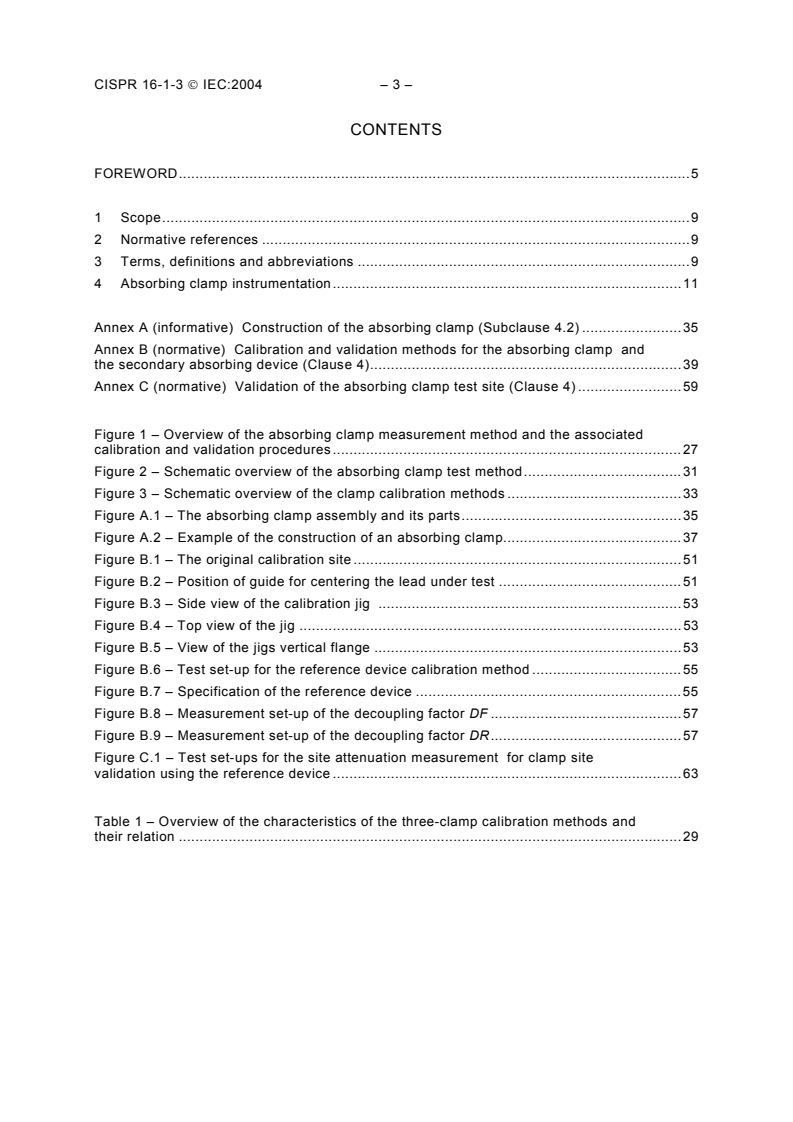
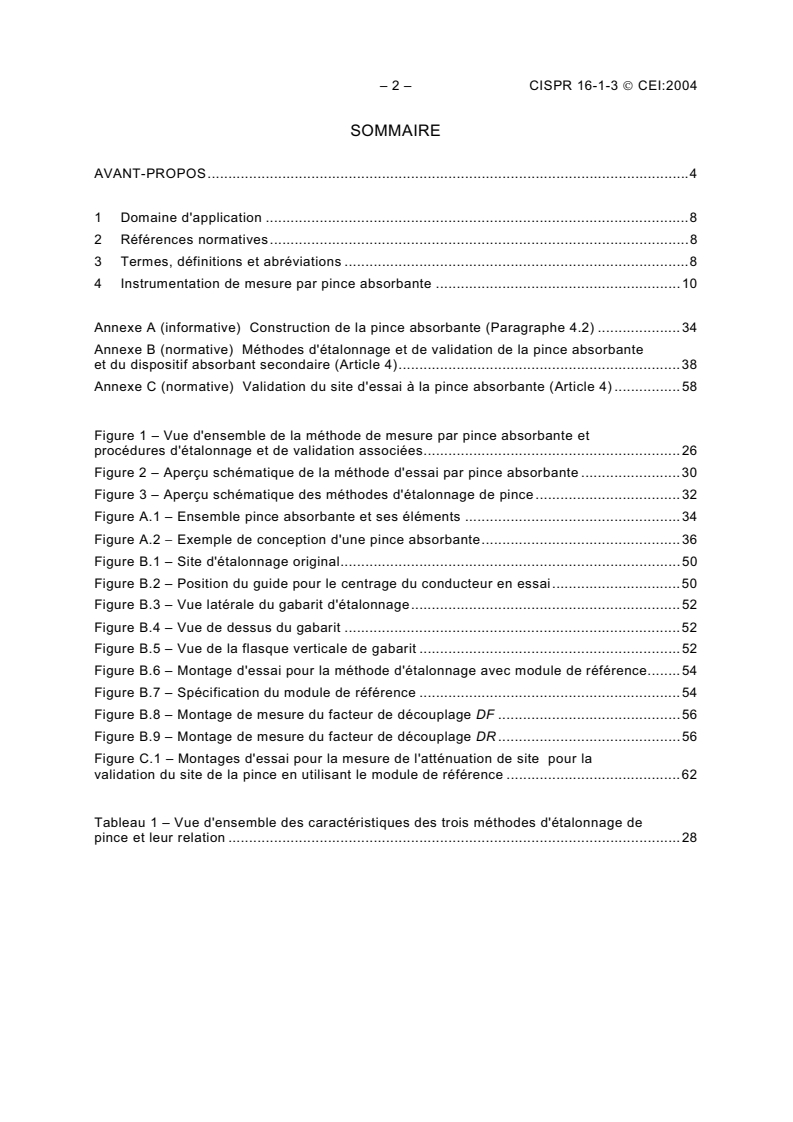
CONTENTS
FOREWORD.5
1 Scope.9
2 Normative references.9
3 Terms, definitions and abbreviations .9
4 Absorbing clamp instrumentation.11
Annex A (informative) Construction of the absorbing clamp (Subclause 4.2) .35
Annex B (normative) Calibration and validation methods for the absorbing clamp and
the secondary absorbing device (Clause 4).39
Annex C (normative) Validation of the absorbing clamp test site (Clause 4) .59
Figure 1 – Overview of the absorbing clamp measurement method and the associated
calibration and validation procedures.27
Figure 2 – Schematic overview of the absorbing clamp test method.31
Figure 3 – Schematic overview of the clamp calibration methods .33
Figure A.1 – The absorbing clamp assembly and its parts.35
Figure A.2 – Example of the construction of an absorbing clamp.37
Figure B.1 – The original calibration site .51
Figure B.2 – Position of guide for centering the lead under test .51
Figure B.3 – Side view of the calibration jig .53
Figure B.4 – Top view of the jig .53
Figure B.5 – View of the jigs vertical flange .53
Figure B.6 – Test set-up for the reference device calibration method .55
Figure B.7 – Specification of the reference device .55
Figure B.8 – Measurement set-up of the decoupling factor DF .57
Figure B.9 – Measurement set-up of the decoupling factor DR.57
Figure C.1 – Test set-ups for the site attenuation measurement for clamp site
validation using the reference device .63
Table 1 – Overview of the characteristics of the three-clamp calibration methods and
their relation .29
CISPR 16-1-3 IEC:2004 – 5 –
INTERNATIONAL ELECTROTECHNICAL COMMISSION
INTERNATIONAL SPECIAL COMMITTEE ON RADIO INTERFERENCE
___________
SPECIFICATION FOR RADIO DISTURBANCE AND IMMUNITY
MEASURING APPARATUS AND METHODS –
Part 1-3: Radio disturbance and immunity measuring apparatus –
Ancillary equipment – Disturbance power
FOREWORD
1) The International Electrotechnical Commission (IEC) is a worldwide organization for standardization comprising
all national electrotechnical committees (IEC National Committees). The object of IEC is to promote
international co-operation on all questions concerning standardization in the electrical and electronic fields. To
this end and in addition to other activities, IEC publishes International Standards, Technical Specifications,
Technical Reports, Publicly Available Specifications (PAS) and Guides (hereafter referred to as “IEC
Publication(s)”). Their preparation is entrusted to technical committees; any IEC National Committee interested
in the subject dealt with may participate in this preparatory work. International, governmental and non-
governmental organizations liaising with the IEC also participate in this preparation. IEC collaborates closely
with the International Organization for Standardization (ISO) in accordance with conditions determined by
agreement between the two organizations.
2) The formal decisions or agreements of IEC on technical matters express, as nearly as possible, an international
consensus of opinion on the relevant subjects since each technical committee has representation from all
interested IEC National Committees.
3) IEC Publications have the form of recommendations for international use and are accepted by IEC National
Committees in that sense. While all reasonable efforts are made to ensure that the technical content of IEC
Publications is accurate, IEC cannot be held responsible for the way in which they are used or for any
misinterpretation by any end user.
4) In order to promote international uniformity, IEC National Committees undertake to apply IEC Publications
transparently to the maximum extent possible in their national and regional publications. Any divergence
between any IEC Publication and the corresponding national or regional publication shall be clearly indicated in
the latter.
5) IEC provides no marking procedure to indicate its approval and cannot be rendered responsible for any
equipment declared to be in conformity with an IEC Publication.
6) All users should ensure that they have the latest edition of this publication.
7) No liability shall attach to IEC or its directors, employees, servants or agents including individual experts and
members of its technical committees and IEC National Committees for any personal injury, property damage or
other damage of any nature whatsoever, whether direct or indirect, or for costs (including legal fees) and
expenses arising out of the publication, use of, or reliance upon, this IEC Publication or any other IEC
Publications.
8) Attention is drawn to the Normative references cited in this publication. Use of the referenced publications is
indispensable for the correct application of this publication.
9) Attention is drawn to the possibility that some of the elements of this IEC Publication may be the subject of
patent rights. IEC shall not be held responsible for identifying any or all such patent rights.
International Standard CISPR 16-1-3 has been prepared by CISPR subcommittee A: Radio
interference measurements and statistical methods.
This second edition cancels and replaces the first edition published in 2003. It constitutes a
technical revision. In this edition a more detailed calibration method for the absorbing clamp is
specified. Furthermore, new alternative calibration methods are introduced which are more
practicable than the one which was specified previously. Additional parameters to describe
the absorbing clamp are defined, like the decoupling factor for the broadband absorber (DF)
and the decoupling factor for the current transformer (DR), along with their validation
methods. A procedure for the validation of the absorbing clamp test site (ACTS) is also
included in the document.
CISPR 16-1-3 © IEC:2004 – 7 –
The text of this standard is based on the following documents:
FDIS Report on voting
CISPR/A/517/FDIS CISPR/A/532/RVD
Full information on the voting for the approval of this standard can be found in the report on
voting indicated in the above table.
This publication has been drafted in accordance with the ISO/IEC Directives, Part 2.
The committee has decided that the contents of this publication will remain unchanged until
the maintenance result date indicated on the IEC web site under "http://webstore.iec.ch" in
the data related to the specific publication. At this date, the publication will be
• reconfirmed;
• withdrawn;
• replaced by a revised edition, or
• amended.
The contents of the corrigendum of February 2006 have been included in this copy.
CISPR 16-1-3 IEC:2004 – 9 –
SPECIFICATION FOR RADIO DISTURBANCE AND IMMUNITY
MEASURING APPARATUS AND METHODS –
Part 1-3: Radio disturbance and immunity measuring apparatus –
Ancillary equipment – Disturbance power
1 Scope
This part of CISPR 16 is designated a basic standard, which specifies the characteristics and
calibration of the absorbing clamp for the measurement of radio disturbance power in the
frequency range 30 MHz to 1 GHz.
2 Normative references
The following referenced documents are indispensable for the application of this document.
For dated references, only the edition cited applies. For undated references, the latest edition
of the referenced document (including any amendments) applies.
CISPR 16-1-2:2003, Specification for radio disturbance and immunity measuring apparatus
and methods – Part 1-2: Radio disturbance and immunity measuring apparatus – Ancillary
equipment – Conducted disturbances
CISPR 16-2-2:2003, Specification for radio disturbance and immunity measuring apparatus
and methods – Part 2-2: Methods of measurement of disturbances and immunity –
Measurement of disturbance power
CISPR 16-4-2, Specification for radio disturbance and immunity measuring apparatus and
methods – Part 4-2: Uncertainties, statistics and limit modelling – Uncertainty in EMC
measurements
IEC 60050-161:1990, International Electrotechnical Vocabulary (IEV) – Chapter 161: Electro-
magnetic compatibility
Amendment 1 (1997)
Amendment 2 (1998)
3 Terms, definitions and abbreviations
3.1 Terms and definitions
See IEC 60050-161, where applicable.
3.2 Abbreviations
ACA Absorbing clamp assembly
ACMM Absorbing clamp measurement method
ACRS Absorbing clamp reference site
ACTS Absorbing clamp test site
CF Clamp factor
CISPR 16-1-3 IEC:2004 – 11 –
CRP Clamp reference point
DF Decoupling factor
DR Decoupling factor that specifies the decoupling of the current transformer from the
common mode impedance of the measurement receiver
JTF Jig transfer factor
LUT Lead under test
RTF Reference transfer factor
SAD Secondary absorbing device
SAR Semi-anechoic room
SRP Slide reference point
4 Absorbing clamp instrumentation
4.1 Introduction
The measurement of disturbance power using an absorbing clamp is a method for the
determination of the radiated disturbance in the frequency range above 30 MHz. This
measurement method represents an alternative approach to the measurement of the
disturbance field strength on an OATS. The absorbing clamp measurement method (ACMM) is
described in Clause 7 of CISPR 16-2-2.
The ACMM uses the following measurement instrumentation:
– the absorbing clamp assembly;
– the secondary absorbing device;
– the absorbing clamp test site.
Figure 1 gives an overview of the absorbing clamp measurement method including the
instrumentation required for this method and the calibration and validation methods for the
instrumentation. The requirements for the instrumentation necessary for the ACMM are
specified in this clause. Details of the absorbing clamp calibration method, and validation of
other properties of the clamp and the secondary absorbing device, are described in Annex B.
Details of the absorbing clamp test site validation are described in Annex C. Absorbing
clamps are suitable for the measurement of disturbances from some types of equipment,
depending on construction and size. The precise measuring procedure and its applicability is
to be specified for each category of equipment. If the EUT itself (without connecting leads)
has a dimension that approaches 1/4 of the wavelength, direct cabinet radiation may occur.
The disturbance capability of an appliance having a mains lead as the only external lead may
be taken as the power the appliance could supply to its mains lead, which acts as a
transmitting antenna. This power is nearly equal to that supplied by the appliance to a
suitable absorbing device placed around the lead at the position where the absorbed power is
at a maximum. Direct radiation from the appliance is not taken into account. Equipment
having external leads other than a mains lead can radiate disturbance energy from such
leads, whether shielded or unshielded, in the same manner as radiation from the mains lead.
Measurements using the absorbing clamp can be made on these types of lead as well.
The application of the ACMM is specified in more detail in 7.9 of CISPR 16-2-2.
CISPR 16-1-3 IEC:2004 – 13 –
4.2 The absorbing clamp assembly
4.2.1 Description of the absorbing clamp assembly
Annex A describes the construction of the clamp and gives a typical example of such a
construction.
The absorbing clamp assembly consists of the following five parts:
– a broadband RF current transformer;
– a broadband RF power absorber and impedance stabilizer for the lead under test;
– an absorbing sleeve and assembly of ferrite rings to reduce RF current on the surface of
the coaxial cable from the current transformer to the measuring receiver;
– a 6 dB attenuator between the output of the absorbing clamp and the coaxial cable
connecting to the measuring receiver;
– a coaxial cable as receiver cable.
The clamp reference point (CRP) indicates the longitudinal position of the front of the current
transformer within the clamp. This reference point is used to define the position of the clamp
during the measurement procedure. The CRP shall be indicated on the outside housing of the
absorbing clamp.
4.2.2 The clamp factor and the clamp site attenuation
An actual measurement of an EUT using the ACMM is depicted schematically in Figure 2.
Details on the ACMM are given in Clause 7 of CISPR 16-2-2.
The disturbance power measurement is based on measurement of the asymmetrical current
generated by the EUT, which is measured at the input of the absorbing clamp using a current
probe. The absorbing ferrites of the clamp around the lead under test isolate the current
transformer from disturbances on the mains. The maximum current is determined by moving
the absorbing clamp along the stretched lead, which acts as a transmission line. The
transmission line transforms the input impedance of the absorbing clamp to the output of the
EUT. At the point of optimal adjustment, the maximum disturbance current at the current
probe or the maximum disturbance voltage at the receiver input can be measured.
For this situation the actual clamp factor CF of an absorbing clamp relates the output signal
act
of the clamp V to the measurand of interest, i.e. the disturbance power P of an EUT as
rec eut
follows:
P = CF + V (1)
eut act rec
where
P = the disturbance power of the EUT in dBpW;
eut
V = the measured voltage in dBμV;
rec
CF = the actual clamp factor in dBpW/μV.
act
Ideally, the received power level P in dBpW at the receiver input can be calculated using
rec
the following formula:
P =V − 10 ⋅ log()Z = V − 17 (2)
rec rec i rec
CISPR 16-1-3 IEC:2004 – 15 –
where
Z = 50 Ω, input impedance of the measuring receiver, and
i
V = measured voltage level in dBμV.
rec
Using Equations (1) and (2) one can derive a relation between the disturbance power P
eut
emitted by the EUT and the power P received by the receiver as follows:
rec
17P − P = CF + (3)
eut rec act
This ideal relation between the disturbance power of the EUT and the power received by the
measuring receiver is defined as the actual clamp site attenuation A (in dB).
act
17A ≡ P − P = CF + (4)
act eut rec act
This actual clamp site attenuation depends on three properties:
– the clamp response properties,
– the site properties and
– the EUT properties.
4.2.3 Decoupling functions of the absorbing clamp
Whereas the current transformer of the absorbing clamp measures the disturbance power, the
decoupling attenuation of the ferrites around the lead under test establishes an asymmetrical
impedance and separates the current transformer from the far end of the lead under test. This
separation reduces the disturbing influence of the connected mains and of the impedance of
the far end and its influence on the measured current. This decoupling attenuation is called
the decoupling factor (DF).
A second decoupling function is needed for the absorbing clamp. The second decoupling
function is the decoupling of the current transformer from the asymmetrical (or common
mode) impedance of the receiver cable. This decoupling is achieved by the absorbing section
of ferrite rings on the cable from the current transformer to the measurement receiver. This
decoupling attenuation is called the decoupling factor to the measurement receiver (DR).
4.2.4 Requirements for the absorbing clamp assembly (ACA)
Absorbing clamps used for disturbance power measurements shall meet the following
requirements:
a) The actual clamp factor (CF ) of the absorbing clamp assembly, as defined in 4.2.1 shall
act
be determined in accordance with the normative methods described in Annex B. The
uncertainty of the clamp factor shall be determined in accordance with the requirements
given in Annex B.
b) The decoupling factor (DF) of the broadband RF absorber and the impedance stabilizer for
the lead under test shall be verified in accordance with the measurement procedure as
described in Annex B. The decoupling factor shall be at least 21 dB for the whole
frequency range.
c) The decoupling function from the current transformer to the measuring output (DR) of the
absorbing clamp shall be determined in accordance with the measurement procedure as
described in Annex B. The decoupling factor to the measurement receiver shall be at least
30 dB for the whole frequency range. The 30 dB contains 20,5 dB attenuation from the
absorbing clamp and 9,5 dB from the coupling/decoupling network (CDN).
CISPR 16-1-3 IEC:2004 – 17 –
d) The length of the clamp housing shall be 600 mm ± 40 mm.
e) A 50 Ω RF attenuator of at least 6 dB shall be used directly at the clamp output.
4.3 The absorbing clamp assembly calibration methods and their relations
The purpose of the clamp calibration is to determine the clamp factor CF in a situation that
resembles an actual measurement with an EUT as much as possible. However, in 4.2.2 it is
stated that the clamp factor is a function of the EUT, the clamp properties and the site
performance. For standardization (reproducibility) reasons, the calibration method shall use a
test site with a specified and reproducible performance, and a signal generator and receiver
with reproducible performance. Under these conditions, the only variable left is the absorbing
clamp under consideration.
Three absorbing clamp calibration methods are developed below, each with their own
advantages, disadvantages and applications (see Table 1). Figure 3 gives a schematic
overview of the three possible methods.
In general, each of the calibration methods comprises the following two steps.
First, as a reference, the output power P of the RF generator (with 50 Ω output impedance)
gen
is measured directly through a 10 dB attenuator using a receiver (Figure 3a). Secondly, the
disturbance power of the same generator and 10 dB attenuator is measured through the
clamp using one of the following three possible methods.
a) The original method
The original absorbing clamp set-up calibration method uses a reference site including a
large vertical reference plane (Figure 3b). By definition this method gives the CF directly,
because this is the original calibration method, which is used for the determination of the
limits and therefore considered as the reference. The lead under test is connected to the
centre conductor of the feed-through connector in the vertical reference plane. At the back
of this vertical plane, the feed-through connector is connected to the generator. For this
calibration configuration, P is measured while the clamp is moved along the lead under
orig
test, in accordance with the procedure described in Annex B such that for each frequency
the maximum value is obtained. The minimum site attenuation A and the absorbing
orig
clamp factor CF can be determined using the following equations:
orig
A = P − P (5)
orig gen orig
and
CF = A − 17 (6)
orig orig
The minimum site attenuation A is in the range of about 13 dB to 22 dB.
orig
b) The jig calibration method
The jig calibration method uses a jig that can be adapted to the length of the absorbing
clamp under calibration and the secondary absorbing device (SAD). This jig serves as a
reference structure for the absorbing clamp (see Figure 3c). For this calibration
configuration P is measured as a function of frequency while the clamp is in a fixed
jig
position within the jig. The site attenuation A and the absorbing clamp factor CF can
jig jig
be determined using the following equations:
CISPR 16-1-3 IEC:2004 – 19 –
A = P – P (7)
jig gen jig
and
CF = A – 17 (8)
jig
c) The reference device method
The reference device method uses a reference site (without vertical reference plane) and
a reference device that is fed through the lead under test, which is a coaxial structure for
this purpose (see Figure 3d).
For this calibration configuration, P is measured while the absorbing clamp is moved
ref
along the lead under test in accordance with the procedure described in Annex A such that
for each frequency the maximum value is obtained. The minimum site attenuation A and
ref
the absorbing clamp factor CF can be determined using the following equations:
ref
A = P – P (9)
ref gen ref
and
CF = A – 17 (10)
ref ref
Annex B describes the three possible absorbing clamp calibration methods in more detail. A
survey of the three clamp calibration methods is also given in Figure 1. Figure 1 also gives
the relation of the clamp measurement method and the clamp calibration methods and the
role of the reference site.
NOTE Calibration takes place on clamp, attenuator and cable. They have to be held together.
The absorbing clamp factors obtained through the jig method and the reference device
method (CF , CF ) differ systematically from the original absorbing clamp factor CF . It is
jig ref orig
necessary to establish this systematic relation between these different clamp factors as
follows.
The jig transfer factor JTF is calculated by
JTF = CF – CF (11)
jig orig
The JTF in dB is to be determined for each type of absorbing clamp by the clamp
manufacturer. The manufacturer or an accredited calibration laboratory in charge shall
determine the JTF by averaging the results of at least five reproduced calibrations for five
devices of a production series. Similarly, the reference transfer factor RTF is determined by
RTF = CF – CF (12)
ref orig
Again, the RTF in dB is to be determined for each type of absorbing clamp by the clamp
manufacturer. The manufacturer or an accredited calibration laboratory in charge shall
determine the RTF by averaging the results of at least five reproduced calibrations for five
devices of a production series.
In summary, the original calibration method directly gives the value of CF . The jig and the
orig
reference device method give the CF and the CF respectively, from which the original
jig ref
absorbing clamp factor can be calculated using Equations (11) and (12).
CISPR 16-1-3 IEC:2004 – 21 –
4.4 The secondary absorbing device
In addition to the absorbing part of the clamp, a secondary absorbing device (SAD) directly
behind the absorbing clamp shall be applied to reduce the uncertainty of the measurement.
The function of this SAD is to provide an attenuation in addition to that provided by the
decoupling attenuation of the absorbing clamp. The SAD shall be moved in the same way as
the absorbing clamp during the calibration and measurement. Therefore the SAD needs
wheels to accommodate the scanning. The SAD dimensions shall be such that the lead under
test is at the same height as in the absorbing clamp.
The decoupling factor of the SAD shall be verified in accordance with the measurement
procedure as described in Annex B. The decoupling factor for the SAD is measured together
with the absorbing clamp.
NOTE New technologies may make it possible for the additional functionality of the SAD to be integrated in the
absorbing clamp. Consequently, if the absorbing clamp itself meets the decoupling factor specification, then the
SAD does not need to be applied.
4.5 The absorbing clamp test site (ACTS)
4.5.1 Description of the ACTS
The absorbing clamp test site (ACTS) is a site used for application of the ACMM. The ACTS
can be either an outdoor or an indoor facility and includes the following elements (see
Annex C, Figure C.1):
– the EUT table, which is a support for the EUT unit;
– the clamp slide, which is a support for the connected lead of the EUT (or lead under test,
LUT) and for the absorbing clamp ;
– a gliding support for the receiver cable of the absorbing clamp;
– auxiliary means like a rope to move the absorbing clamp
All the above-mentioned ACTS elements (without EUT table) shall be measured in the ACTS
validation procedure.
The near end of the clamp slide (at the side of the EUT) is denoted as the slide reference
point (SRP, see Figure C.1). This SRP is used to define the horizontal distance to the CRP of
the clamp.
4.5.2 The functions of the ACTS
The ACTS has the following functions.
a) Physical function: to provide specific supporting means for the EUT and the LUT.
b) Electrical function: to provide an ideal (for RF) site for the EUT and the clamp assembly
and to provide a well-defined measurement environment for application of the absorbing
clamp (no distortion of emissions by walls or by the supporting elements like the EUT
table, the clamp slide, gliding support and rope).
4.5.3 Requirements for the ACTS
The following requirements apply for the ACTS:
a) The length of the clamp slide shall ensure that the absorbing clamp can be moved over a
distance of 5 m. This means that the clamp slide shall have a length of 6 m.
CISPR 16-1-3 © IEC:2004 – 23 –
NOTE For reproducibility reasons, the length of the clamp slide and the scanning distance of the clamp are
fixed to at least 6 m and 5 m respectively. The length of the clamp slide is determined by the sum of the
scanning length (5 m), the margin between the SRP and the CRP (0,15 m) and the length of the absorbing
clamp (0,64 m) plus a margin to accommodate lead fixtures at the end (0,1 m). This totals a length of 6 m for
the clamp slide.
b) The height of the clamp slide shall be 0,8 m ± 0,05 m. This implies that within the
absorbing clamp and within the SAD, the height of the LUT above the reference plane will
be a few centimetres larger.
c) The material of the EUT table and of the clamp slide shall be non-reflecting, non-
conducting and the dielectric properties may be close to the dielectric properties of air. In
this way, the EUT table is transparent from an electromagnetic point of view.
d) The material of the rope used to move the clamp along the clamp slide shall also be
transparent from an electromagnetic point of view.
NOTE The influence of the material of the EUT table and the clamp slide may be significant for frequencies
above 300 MHz.
e) The adequacy of the site (see the electrical ACTS function) is validated by comparing the
in-situ measured clamp factor of the ACTS (CF ) with the clamp factor measured on
in-situ
the absorbing clamp reference site (ACRS) (CF ) using the original calibration method
orig
(see Annex C). The absolute difference between both clamp factors shall comply with the
following requirement:
∆ = CF – CF (13)
ACTS orig in-situ
shall be
<2,5 dB between 30 MHz and 150 MHz,
2,5 dB to 2 dB between 150 MHz and 300 MHz, decreasing and
<2 dB between 300 MHz and 1 000 MHz
This site validation procedure is specified in more detail in the next subclause.
4.5.4 Validation methods for the ACTS
The characteristics for the ACTS are validated as follows.
– The physical requirements 4.5.3a) and 4.5.3b) can be validated by inspection.
– The electrical function of the ACTS (requirement 4.5.3e) shall be validated by comparing
the clamp factor CF of the calibrated clamp with the clamp factor CF measured in-
in-situ
situ, in accordance with the ”original calibration method” (see Annex C).
Investigations have shown that a 10 m OATS or SAR validated for radiated emission
measurements can be considered as an ideal site for performing the ACMM. Therefore, a
validated 10 m OATS or SAR is adopted as a reference site for electrical validation of the
ACTS. Consequently, if a validated 10 m OATS or SAR is used as a clamp test site, then the
electrical function of this site does not need to be validated further.
The validation procedure of the electrical function of a clamp test site is described in detail in
Annex C.
CISPR 16-1-3 IEC:2004 – 25 –
4.6 Quality assurance procedures for the absorbing clamp instrumentation.
4.6.1 Overview
The performance of an absorbing clamp and secondary absorbing device may change over
time due to use, aging or defects. Similarly, the ACTS performance may change due to
modifications in the construction or by aging.
The jig calibration method and the reference device calibration method can be used
conveniently for quality assurance procedures, provided that the jig clamp factor and the
reference device clamp factor are initially known.
4.6.2 Quality assurance check for the ACTS
The data of the site attenuation A of the ACTS determined at the time the site was validated
ref
can be used as a reference.
After a certain time interval and after modification of the site, this site attenuation
measurement can be repeated, and the results compared with the reference data.
The advantage of this method is that all elements of the ACMM are evaluated at once.
4.6.3 Quality assurance check for the absorbing clamp
The decoupling functions and the clamp factor performance determined at the time the clamp
has been validated can be used as reference performance data.
After certain time intervals or after a change made to the site, these performance parameters
can be verified again by measuring the decoupling factors and by measuring the clamp factor
using the jig method (Annex B).
4.6.4 Quality assurance pass/fail criteria
The pass/fail criteria for the quality assurance tests are related to the measurement
uncertainty of the measurement parameter in question. This means that a change of the
parameter in question is acceptable if this change is less than one times the measurement
uncertainty.
CISPR 16-1-3 IEC:2004 – 27 –
ABSORBING CLAMP MEASUREMENT
METHOD (ACMM)
(CISPR 16-2-2 Clause 7)
Requires:
• EUT
• a calibrated clamp
• a validated abs. clamp test site (ACTS)
• a calibrated receiver
VALIDATION OF THE ABS CLAMP TEST SITE
• specified test set-up
(ACTS)
• specified test procedure
(specified in Annex C)
Gives: disturbance power of an EUT
Requires:
• the ACTS (absorbing clamp test site) under
validation
• a calibrated clamp with the SAD calibrated with
the original method
• a calibrated receiver
CLAMP CALIBRATION METHODS
(specified in Annex B)
• a specific test set-up
a. Validation of the clamp
• a specific test procedure
Requires:
Gives: a validated test absorbing clamp test site
The validation of the decoupling functions of the
clamp with the secondary absorbing device
b. The original method
Requires:
• the clamp under calibration with the SAD
VALIDATION OF DECOUPLING
• measurement equipment
FUNCTIONS OF THE
• a validated site: ACRS (absorbing clamp reference
ABSORBING CLAMP WITH THE
site)
SECONDARY DEVICE (Annex B)
• a specified source (generator + large vertical
reference plane)
Requires:
• a specified test set-up
• the clamp with the SAD
• a specified test procedure
• a jig
Gives: the original clamp factor (CF )
orig
• a specified source
• measurement equipment
c. The jig method
• specified test setup
Requires:
• specified test procedure
• the clamp under calibration with the SAD
• measurement equipment
• a calibration jig
• a specified source
• a specified test set-up
• a specified test procedure
Gives: the clamp factor CF and CF can be
jig orig
calculated using the jig transfer factor JTF.
ABS CLAMP REFERENCE SITE (ACRS)
d. The reference device method
A 10 m OATS or SAR, validated for radiated
Requires:
emission measurements between 30 MHz and
• the clamp under calibration with the SAD
1 000 MHz is considered also valid as a site for
• measurement equipment
clamp calibration.
• a validated site: ACRS (absorbing clamp reference
site)
• the clamp reference device
• a specified test set-up
• a specified test procedure
Gives: the clamp factor CF and CF can be
ref orig
calculated using the reference transfer factor RTF.
IEC 830/04
Figure 1 – Overview of the absorbing clamp measurement method and the associated
calibration and validation procedures
CISPR 16-1-3 IEC:2004 – 29 –
Table 1 – Overview of the characteristics of the three-clamp calibration methods and their relation
Name of the
Test Site used EUT used Applications
Advantages (+), disadvantages (-) and remarks (••••)
calibration method
The original method An absorbing Large vertical reference plane • Calibration set-up resembles an actual measurement Direct calibration of the
clamp reference and fed behind this reference absorbing clamp
with a large EUT
site plane by a generator
– Handling of the large vertical reference plane is
laborious
– A reference site (ACRS) required
+ By definition this method gives the CF directly
because this method is the original calibration method
and therefore considered as the reference
One of the vertical flanges of the – Calibration set-up does not resemble an actual test Indirect calibration of the
The jig method An absorbing
clamp calibration jig and fed behind this jig flange absorbing clamp
+ Convenient handling
jig by a generator
Quality assurance check
+ No reference site (ACRS) required
of the clamp
+ Good reproducibility
– Does not give the CF directly; CF is calculated using
the JTF
The reference device An absorbing Small reference device fed from Indirect calibration of the
• Calibration set-up resembles an actual measurement
method clamp reference the far end by a generator absorbing clamp
with a large EUT
site
+ Reference device easy to handle Validation of the ACTS
– A reference site (ACRS) required Quality assurance check
of the overall clamp
– Does not give the CF directly; CF is calculated using
measurement set-up
the RTF
NOTE An ACRS is a validated 10 m OATS or SAR facility.
CISPR 16-1-3 IEC:2004 – 31 –
EUT
P
eut
Absorbing
clamp
Lead under test
CF
act
V (P )
rec rec
IEC 831/04
Horizontal floor of the clamp test site
Key
P the disturbance power of the EUT in dBpW;
eut
V the measured voltage in dBμV;
rec
CF the actual clamp factor in dBpW/μV;
act
P the received power level in dBpW.
rec
Figure 2 – Schematic overview of the absorbing clamp test method
CISPR 16-1-3 IEC:2004 – 33 –
P
gen
Receiver
Generator
(50 Ω)
10 dB
attenuator
IEC 832/04
Figure 3a
Large vertical reference plane
Absorbing Secondary
Generator
clamp absorbing device
10 dB
attenuator
CF
orig
P
orig
Horizontal reference plane of the reference site IEC 833/04
Figure 3b
jig
CF
jig
Absorbing Secondary
Generator
clamp absorbing device
50 Ω
10 dB
attenuator
P
jig
IEC 834/04
Figure 3c
Reference device
Absorbing Secondary
Generator
clamp absorbing device
10 dB
attenuator
CF
ref
P
ref
Horizontal reference plane of the reference site IEC 835/04
Figure 3d
Key
CF , CF , CF Absorbing clamp factors
orig jig ref
P , P , P Measurement of P depending on validation method used
orig ref jig
P Output power of the generator and 10 dB attenuator
gen
NOTE Figures 3b., 3c., and 3d correspond respectively to the three methods of Table 1.
Figure 3 – Schematic overview of the clamp calibration methods
CISPR 16-1-3 IEC:2004 – 35 –
Annex A
(informative)
Construction of the absorbing clamp
(Subclause 4.2)
A.1 Examples of absorbing clamp construction
Figures A.1 and A.2 describe the basic assembly of the clamp. The three main parts of the
absorbing clamp described in 4.2 are the current transformer C, the power absorber and
impedance stabilizer D, and the absorbing sleeve E. D consists of a number of ferrite rings
and E consists of ferrite rings or tubes. The core of the transformer C has two or three rings of
the type used in D. The secondary winding of the current transformer consists of a turn of a
miniature coaxial cable encircling the rings and connected as shown. The cable is passed
through the sleeve E to a coaxial terminal on the clamp (possibly via the 6 dB attenuator). C
and D are mounted close together and aligned on the same axis to permit movement along
the lead under test B. Sleeve E is usually mounted alongside absorber D for practical
reasons. Both D and E serve to attenuate asymmetric currents on the leads through them.
The example in Figure A.2 shows also some features of improvements to the absorbing clamp
performance. A metal cylinder (1) is mounted inside the core of the transformer C to act as a
capacitive shield. This cylinder is split into two halves. An insulating tube (2) is used to
centralize the lead within the transformer. This tube extends from the input end of the
transformer to the first ring of the absorber D, and is for use during clamp calibration and for
small diameter leads.
The absorbing clamp may be constructed to cover the frequency range 30 MHz to 1 000 MHz
using suitable ferrite rings.
To measurement
Absorber
6 dB
receiver
(Ferrite rings)
attenuator
Clamp reference
point (CRP)
Coaxial measurement
cable
Lead under
Absorber
Current
test
(Ferrite rings)
transformer
IEC 836/04
NOTE The 6 dB attenuator and measurement cable are integral part of the clamp assembly.
Figure A.1 – The absorbing clamp assembly and its parts
CISPR 16-1-3 IEC:2004 – 37 –
640 mm ± 40 mm
E E ∼15
B
∼23
B
C
D D
2 rings ∼560
34 rings
IEC 837/04
Clamp reference
point (CRP)
Key
B lead under test
C current transformer
D absorbing section
E absorbing section on cable from transformer
1 metal cylinder - two halves
2 centralizing tube for lead B
3 coaxial connector (for the 6 dB attenuator)
Figure A.2 – Example of the construction of an absorbing clamp
CISPR 16-1-3 IEC:2004 – 39 –
Annex B
(normative)
Calibration and validation methods for the absorbing clamp
and the secondary absorbing device
(Clause 4)
B.1 Introduction
This annex gives details on the various calibration and validation methods for the absorbing
clamp assembly and for the secondary absorbing device.
The methods for the calibration of the clamp factor of the absorbing clamp (see also 4.3) are
given in B.2.
The methods for validation of the decoupling functions DF and DR are given in Article B.3.
B.2 Calibration methods of the absorbing clamp assembly
For all three methods, the clamp factor (CF) of the absorbing clamp assembly including the
attenuator of at least 6 dB and the receiver cable is determined. Since the decoupling of the
clamp is not perfect, the clamp interacts with the cable.
...
COMMISSION
CISPR
ÉLECTROTECHNIQUE
16-1-3
INTERNATIONALE
Deuxième édition
2004-06
COMITÉ INTERNATIONAL SPÉCIAL DES PERTURBATIONS RADIOÉLECTRIQUES
Spécifications des méthodes et des appareils
de mesure des perturbations radioélectriques
et de l’immunité aux perturbations
radioélectriques –
Partie 1-3:
Appareils de mesure des perturbations
radioélectriques et de l’immunité
aux perturbations radioélectriques –
Matériels auxiliaires – Puissance perturbatrice
Cette version française découle de la publication d’origine
bilingue dont les pages anglaises ont été supprimées.
Les numéros de page manquants sont ceux des pages
supprimées.
Numéro de référence
Editions consolidées
Les versions consolidées de certaines publications de la CEI incorporant les
amendements sont disponibles. Par exemple, les numéros d’édition 1.0, 1.1 et 1.2
indiquent respectivement la publication de base, la publication de base incorporant
l’amendement 1, et la publication de base incorporant les amendements 1 et 2
Informations supplémentaires sur les publications de la CEI
Le contenu technique des publications de la CEI est constamment revu par la CEI
afin qu'il reflète l'état actuel de la technique. Des renseignements relatifs à cette
publication, y compris sa validité, sont disponibles dans le Catalogue des
publications de la CEI (voir ci-dessous) en plus des nouvelles éditions, amende-
ments et corrigenda. Des informations sur les sujets à l’étude et l’avancement des
travaux entrepris par le comité d’études qui a élaboré cette publication, ainsi que la
liste des publications parues, sont également disponibles par l’intermédiaire de:
• Site web de la CEI (www.iec.ch)
• Catalogue des publications de la CEI
Le catalogue en ligne sur le site web de la CEI (www.iec.ch/searchpub) vous permet
de faire des recherches en utilisant de nombreux critères, comprenant des
recherches textuelles, par comité d’études ou date de publication. Des informations
en ligne sont également disponibles sur les nouvelles publications, les publications
remplacées ou retirées, ainsi que sur les corrigenda.
• IEC Just Published
Ce résumé des dernières publications parues (www.iec.ch/online_news/justpub)
est aussi disponible par courrier électronique. Veuillez prendre contact avec le
Service client (voir ci-dessous) pour plus d’informations.
• Service clients
Si vous avez des questions au sujet de cette publication ou avez besoin de
renseignements supplémentaires, prenez contact avec le Service clients:
Email: custserv@iec.ch
Tél: +41 22 919 02 11
Fax: +41 22 919 03 00
COMMISSION
CISPR
ÉLECTROTECHNIQUE
16-1-3
INTERNATIONALE
Deuxième édition
2004-06
COMITÉ INTERNATIONAL SPÉCIAL DES PERTURBATIONS RADIOÉLECTRIQUES
Spécifications des méthodes et des appareils
de mesure des perturbations radioélectriques
et de l’immunité aux perturbations
radioélectriques –
Partie 1-3:
Appareils de mesure des perturbations
radioélectriques et de l’immunité
aux perturbations radioélectriques –
Matériels auxiliaires – Puissance perturbatrice
IEC 2004 Droits de reproduction réservés
Aucune partie de cette publication ne peut être reproduite ni utilisée sous quelque forme que ce soit et par aucun
procédé, électronique ou mécanique, y compris la photocopie et les microfilms, sans l'accord écrit de l'éditeur.
International Electrotechnical Commission, 3, rue de Varembé, PO Box 131, CH-1211 Geneva 20, Switzerland
Telephone: +41 22 919 02 11 Telefax: +41 22 919 03 00 E-mail: inmail@iec.ch Web: www.iec.ch
CODE PRIX
V
Commission Electrotechnique Internationale
International Electrotechnical Commission
МеждународнаяЭлектротехническаяКомиссия
Pour prix, voir catalogue en vigueur
– 2 – CISPR 16-1-3 CEI:2004
SOMMAIRE
AVANT-PROPOS.4
1 Domaine d'application.8
2 Références normatives.8
3 Termes, définitions et abréviations .8
4 Instrumentation de mesure par pince absorbante .10
Annexe A (informative) Construction de la pince absorbante (Paragraphe 4.2) .34
Annexe B (normative) Méthodes d'étalonnage et de validation de la pince absorbante
et du dispositif absorbant secondaire (Article 4).38
Annexe C (normative) Validation du site d'essai à la pince absorbante (Article 4) .58
Figure 1 – Vue d'ensemble de la méthode de mesure par pince absorbante et
procédures d'étalonnage et de validation associées.26
Figure 2 – Aperçu schématique de la méthode d'essai par pince absorbante .30
Figure 3 – Aperçu schématique des méthodes d'étalonnage de pince.32
Figure A.1 – Ensemble pince absorbante et ses éléments .34
Figure A.2 − Exemple de conception d'une pince absorbante.36
Figure B.1 – Site d'étalonnage original.50
Figure B.2 – Position du guide pour le centrage du conducteur en essai.50
Figure B.3 – Vue latérale du gabarit d'étalonnage.52
Figure B.4 – Vue de dessus du gabarit .52
Figure B.5 – Vue de la flasque verticale de gabarit .52
Figure B.6 – Montage d'essai pour la méthode d'étalonnage avec module de référence.54
Figure B.7 – Spécification du module de référence .54
Figure B.8 – Montage de mesure du facteur de découplage DF .56
Figure B.9 – Montage de mesure du facteur de découplage DR .56
Figure C.1 – Montages d'essai pour la mesure de l'atténuation de site pour la
validation du site de la pince en utilisant le module de référence .62
Tableau 1 – Vue d'ensemble des caractéristiques des trois méthodes d'étalonnage de
pince et leur relation .28
– 4 – CISPR 16-1-3 CEI:2004
COMMISSION ÉLECTROTECHNIQUE INTERNATIONALE
COMITÉ INTERNATIONAL SPÉCIAL DES PERTURBATIONS RADIOÉLECTRIQUES
___________
SPÉCIFICATIONS DES MÉTHODES ET DES APPAREILS
DE MESURE DES PERTURBATIONS RADIOÉLECTRIQUES ET
DE L'IMMUNITÉ AUX PERTURBATIONS RADIOÉLECTRIQUES –
Partie 1-3: Appareils de mesure des perturbations radioélectriques
et de l'immunité aux perturbations radioélectriques –
Matériels auxiliaires – Puissance perturbatrice
AVANT-PROPOS
1) La Commission Electrotechnique Internationale (CEI) est une organisation mondiale de normalisation
composée de l'ensemble des comités électrotechniques nationaux (Comités nationaux de la CEI). La CEI a
pour objet de favoriser la coopération internationale pour toutes les questions de normalisation dans les
domaines de l'électricité et de l'électronique. A cet effet, la CEI – entre autres activités – publie des Normes
internationales, des Spécifications techniques, des Rapports techniques, des Spécifications accessibles au
public (PAS) et des Guides (ci-après dénommés «Publication(s) de la CEI»). Leur élaboration est confiée à des
comités d'études, aux travaux desquels tout Comité national intéressé par le sujet traité peut participer. Les
organisations internationales, gouvernementales et non gouvernementales, en liaison avec la CEI, participent
également aux travaux. La CEI collabore étroitement avec l'Organisation Internationale de Normalisation (ISO),
selon des conditions fixées par accord entre les deux organisations.
2) Les décisions ou accords officiels de la CEI concernant les questions techniques représentent, dans la mesure
du possible, un accord international sur les sujets étudiés, étant donné que les Comités nationaux de la CEI
intéressés sont représentés dans chaque comité d’études.
3) Les Publications de la CEI se présentent sous la forme de recommandations internationales et sont agréées
comme telles par les Comités nationaux de la CEI. Tous les efforts raisonnables sont entrepris afin que la CEI
s'assure de l'exactitude du contenu technique de ses publications; la CEI ne peut pas être tenue responsable
de l'éventuelle mauvaise utilisation ou interprétation qui en est faite par un quelconque utilisateur final.
4) Dans le but d'encourager l'uniformité internationale, les Comités nationaux de la CEI s'engagent, dans toute la
mesure possible, à appliquer de façon transparente les Publications de la CEI dans leurs publications
nationales et régionales. Toutes divergences entre toutes Publications de la CEI et toutes publications
nationales ou régionales correspondantes doivent être indiquées en termes clairs dans ces dernières.
5) La CEI n’a prévu aucune procédure de marquage valant indication d’approbation et n'engage pas sa
responsabilité pour les équipements déclarés conformes à une de ses Publications.
6) Tous les utilisateurs doivent s'assurer qu'ils sont en possession de la dernière édition de cette publication.
7) Aucune responsabilité ne doit être imputée à la CEI, à ses administrateurs, employés, auxiliaires ou
mandataires, y compris ses experts particuliers et les membres de ses comités d'études et des Comités
nationaux de la CEI, pour tout préjudice causé en cas de dommages corporels et matériels, ou de tout autre
dommage de quelque nature que ce soit, directe ou indirecte, ou pour supporter les coûts (y compris les frais
de justice) et les dépenses découlant de la publication ou de l'utilisation de cette Publication de la CEI ou de
toute autre Publication de la CEI, ou au crédit qui lui est accordé.
8) L'attention est attirée sur les références normatives citées dans cette publication. L'utilisation de publications
référencées est obligatoire pour une application correcte de la présente publication.
9) L’attention est attirée sur le fait que certains des éléments de la présente Publication de la CEI peuvent faire
l’objet de droits de propriété intellectuelle ou de droits analogues. La CEI ne saurait être tenue pour
responsable de ne pas avoir identifié de tels droits de propriété et de ne pas avoir signalé leur existence.
La Norme internationale CISPR 16-1-3 a été établie par le sous-comité A du CISPR: Mesures
des perturbations radioélectriques et méthodes statistiques.
Cette deuxième édition annule et remplace la première édition parue en 2003. Elle constitue
une révision technique. Cette édition spécifie une méthode d’étalonnage plus détaillée pour la
pince absorbante. De plus, de nouvelles méthodes d’étalonnage possibles sont introduites,
qui sont plus praticables que celle qui était spécifiée auparavant. Des paramètres
additionnels pour décrire la pince absorbante sont définis, tels le facteur de découplage pour
l’absorbeur large bande «DF» et le facteur de découplage pour le transformateur de courant
«DR», avec leurs méthodes de validation. Une procédure pour la validation du site d’essai à
la pince absorbante (ACTS) est aussi incluse dans le document.
– 6 – CISPR 16-1-3 © CEI:2004
Le texte de cette norme est issu des documents suivants:
FDIS Rapport de vote
CISPR/A/517/FDIS CISPR/A/532/RVD
Le rapport de vote indiqué dans le tableau ci-dessus donne toute information sur le vote ayant
abouti à l'approbation de cette norme.
Cette publication a été rédigée selon les Directives ISO/CEI, Partie 2.
Le comité a décidé que le contenu de cette publication ne sera pas modifié avant la date de
maintenance indiquée sur le site web de la CEI sous «http://webstore.iec.ch» dans les
données relatives à la publication recherchée. A cette date, la publication sera
• reconduite;
• supprimée;
• remplacée par une édition révisée, ou
• amendée.
Le contenu du corrigendum de février 2006 a été pris en considération dans cet exemplaire.
– 8 – CISPR 16-1-3 CEI:2004
SPÉCIFICATIONS DES MÉTHODES ET DES APPAREILS
DE MESURE DES PERTURBATIONS RADIOÉLECTRIQUES ET
DE L'IMMUNITÉ AUX PERTURBATIONS RADIOÉLECTRIQUES –
Partie 1-3: Appareils de mesure des perturbations radioélectriques
et de l'immunité aux perturbations radioélectriques –
Matériels auxiliaires – Puissance perturbatrice
1 Domaine d'application
La présente partie de la CISPR 16 est une norme fondamentale qui spécifie les
caractéristiques et l'étalonnage de la pince absorbante pour la mesure de la puissance
perturbatrice radioélectrique dans la gamme de fréquences de 30 MHz à 1 GHz.
2 Références normatives
Les documents de référence suivants sont indispensables pour l'application du présent
document. Pour les références datées, seule l'édition citée s'applique. Pour les références
non datées, la dernière édition du document de référence s'applique (y compris les éventuels
amendements).
CISPR 16-1-2:2003, Spécifications des méthodes et des appareils de mesure des pertur-
bations radioélectriques et de l'immunité aux perturbations radioélectriques – Partie 1-2:
Appareils de mesure des perturbations radioélectriques et de l'immunité aux perturbations
radioélectriques – Matériels auxiliaires – Perturbations conduites
CISPR 16-2-2:2003, Spécifications des méthodes et des appareils de mesure des pertur-
bations radioélectriques et de l'immunité aux perturbations radioélectriques – Partie 2-2:
Méthodes de mesure des perturbations et de l'immunité – Mesure de la puissance
perturbatrice
CISPR 16-4-2, Spécifications des méthodes et des appareils de mesure des perturbations
radioélectriques et de l'immunité aux perturbations radioélectriques – Partie 4-2: Incertitudes,
statistiques et modélisation des limites – Incertitudes de mesure CEM
CEI 60050-161:1990, Vocabulaire Electrotechnique International (VEI) – Chapitre 161:
Compatibilité électromagnétique
Amendement 1 (1997)
Amendement 2 (1998)
3 Termes, définitions et abréviations
3.1 Termes et définitions
Voir la CEI 60050-161 lorsque cela s’applique.
3.2 Abréviations
ACA Absorbing clamp assembly (ensemble pince absorbante)
ACMM Absorbing clamp measurement method (méthode de mesure par pince absorbante)
ACRS Absorbing clamp reference site (site de référence de la pince absorbante)
ACTS Absorbing clamp test site (site d'essai à la pince absorbante)
CF Clamp factor (facteur de pince)
– 10 – CISPR 16-1-3 CEI:2004
CRP Clamp reference point (point de référence de la pince)
DF Decoupling factor (facteur de découplage)
DR Facteur de découplage qui spécifie le découplage entre le transformateur de
courant et l'impédance de mode commun du récepteur de mesure
JTF Jig transfer factor (facteur de transfert du gabarit)
LUT Lead under test (conducteur en essai)
RTF Reference transfer factor (facteur de transfert de référence)
SAD Secondary absorbing device (dispositif absorbant secondaire)
SAR Semi-anechoic room (chambre semi-anéchoïque)
SRP Slide reference point (point de référence de la glissière)
4 Instrumentation de mesure par pince absorbante
4.1 Introduction
La mesure de la puissance perturbatrice par pince absorbante est une méthode destinée
à déterminer les perturbations rayonnées dans la gamme des fréquences supérieures à
30 MHz. Cette méthode de mesure constitue une alternative à la mesure du champ
perturbateur sur un OATS. La méthode de mesure par pince absorbante (ACMM) est décrite à
l'Article 7 de la CISPR 16-2-2.
L'ACMM utilise l'instrumentation de mesure suivante:
– l'ensemble pince absorbante;
– le dispositif absorbant secondaire;
– le site d’essai à la pince absorbante.
La Figure 1 donne une vue générale de la méthode de mesure par pince absorbante, y
compris l'instrumentation nécessaire pour cette méthode ainsi que les méthodes d'étalonnage
et de validation de cette instrumentation. Le présent article détaille les exigences concernant
l'instrumentation nécessaire pour l'ACMM. L’Annexe B décrit en détail la méthode
d'étalonnage de la pince absorbante et la validation des autres propriétés de la pince et du
dispositif absorbant secondaire. Les détails concernant la validation du site d'essai à la pince
absorbante sont décrits à l'Annexe C. Les pinces absorbantes sont adaptées aux mesures de
perturbations de certains types d'appareils en fonction de leur conception et de leur taille. La
procédure de mesure précise et son applicabilité doivent être spécifiées pour chaque
catégorie d'appareil. Si les dimensions de l'appareil en essai seul (sans câbles de
raccordement) approchent 1/4 de la longueur d'onde, un rayonnement peut être produit
directement depuis le boîtier. La puissance perturbatrice d'un appareil dont le cordon
d'alimentation est le seul câble externe peut être considérée comme la puissance que
l'appareil peut fournir à ce cordon, qui se comporte comme une antenne rayonnante. Cette
puissance est à peu près équivalente à celle fournie par l'appareil à un dispositif absorbant
adapté placé autour du cordon à l'endroit où la puissance absorbée est maximale. Le
rayonnement direct provenant de l'appareil n'est pas pris en compte. Les appareils équipés
de câbles externes autres qu'un cordon d'alimentation peuvent rayonner de l'énergie
perturbatrice par ces câbles, qu'ils soient blindés ou non, de la même manière que par le
cordon d'alimentation. On peut également effectuer des mesures par pince absorbante sur
ces câbles.
L'application de l'ACMM est spécifiée de manière plus détaillée en 7.9 de la CISPR 16-2-2.
– 12 – CISPR 16-1-3 CEI:2004
4.2 Ensemble pince absorbante
4.2.1 Description de l'ensemble pince absorbante
L'Annexe A décrit la conception de la pince et donne un exemple type d'une telle conception.
L'ensemble pince absorbante se compose des cinq parties suivantes:
– un transformateur de courant RF large bande;
– un absorbeur de puissance RF large bande et un stabilisateur d'impédance pour le câble
en essai;
– un manchon absorbant et un ensemble d'anneaux de ferrite destinés à réduire le courant
RF circulant à la surface du câble coaxial entre le transformateur de courant et le
récepteur de mesure;
– un atténuateur de 6 dB entre la sortie de la pince absorbante et le câble coaxial assurant
le raccordement au récepteur de mesure;
– un câble coaxial en tant que câble récepteur.
Le point de référence de la pince (CRP) indique la position longitudinale de l'avant du
transformateur de courant dans la pince. Ce point de référence est utilisé pour définir la
position de la pince pendant la procédure de mesure. Le CRP doit être indiqué sur le boîtier
extérieur de la pince absorbante.
4.2.2 Facteur de pince et atténuation de site
La Figure 2 donne une représentation schématique d'une mesure réelle d'un appareil en essai
effectuée en utilisant l'ACMM. Des informations détaillées sur l'ACMM sont données à
l'Article 7 de la CISPR 16-2-2.
La mesure de la puissance perturbatrice est basée sur la mesure du courant asymétrique
généré par l'appareil en essai, mesuré à l'entrée de la pince absorbante avec une sonde de
courant. Les ferrites absorbantes de la pince autour du câble en essai isolent le
transformateur de courant des perturbations provenant du réseau d'alimentation. Le courant
maximal est déterminé en déplaçant la pince absorbante le long du câble tendu, qui se
comporte comme une ligne de transmission. La ligne de transmission réalise la transformation
d'impédance entre l'entrée de la pince absorbante et la sortie de l'appareil en essai. Au point
de réglage optimal, on peut mesurer le courant perturbateur maximal en sortie de la sonde de
courant ou la tension perturbatrice maximale à l'entrée du récepteur.
Dans le cas présent, le facteur de pince réel CF d'une pince absorbante donne la relation
act
entre le signal de sortie de la pince V et la grandeur à mesurer considérée, c'est-à-dire la
rec
puissance perturbatrice P d'un appareil en essai comme suit:
eut
P = CF + V (1)
eut act rec
où
P est la puissance perturbatrice de l'appareil en essai EUT en dBpW;
eut
V est la tension mesurée en dBμV;
rec
CF est le facteur de pince réel en dBpW/μV.
act
Idéalement, le niveau de puissance reçu P en dBpW au niveau de l'entrée du récepteur
rec
peut être calculé en utilisant la formule suivante:
P =V − 10 ⋅ log()Z = V − 17 (2)
rec rec i rec
– 14 – CISPR 16-1-3 CEI:2004
où
Z = 50 Ω, impédance d'entrée du récepteur de mesure, et
i
V = niveau de tension mesuré en dBμV.
rec
En utilisant les équations (1) et (2), il est possible de déduire une relation entre la puissance
perturbatrice P émise par l'appareil en essai et la puissance P reçue par le récepteur
eut rec
comme suit:
17P − P = CF + (3)
eut rec act
Cette relation idéale entre la puissance perturbatrice de l'appareil en essai et la puissance
reçue par le récepteur de mesure est définie comme l'atténuation de site réelle de la pince
A (en dB).
act
17A ≡ P − P = CF + (4)
act eut rec act
Cette atténuation de site réelle de la pince dépend de trois propriétés:
– les propriétés de réponse de la pince,
– les propriétés du site, et
– les propriétés de l'appareil en essai.
4.2.3 Fonctions de découplage de la pince absorbante
Alors que le transformateur de courant de la pince absorbante mesure la puissance
perturbatrice, l'atténuation de découplage apportée par les ferrites autour du câble en essai
établit une dissymétrie d'impédance et isole le transformateur de courant de l'extrémité
éloignée du câble en essai. Cette isolation réduit l'influence perturbatrice du réseau
d'alimentation et de l'impédance de l'extrémité éloignée du câble ainsi que son influence sur
le courant mesuré. Cette atténuation de découplage est appelée facteur de découplage (DF).
Une deuxième fonction de découplage est nécessaire pour la pince absorbante. La deuxième
fonction de découplage est le découplage entre le transformateur de courant et l'impédance
asymétrique (ou de mode commun) du câble récepteur. Ce découplage est obtenu par la
section absorbante constituée d'anneaux de ferrite sur le câble entre le transformateur de
courant et le récepteur de mesure. Cette atténuation de découplage est appelée facteur de
découplage pour le récepteur de mesure (DR).
4.2.4 Exigences pour l'ensemble pince absorbante (ACA)
Les pinces absorbantes utilisées pour les mesures de la puissance perturbatrice doivent
satisfaire aux exigences suivantes:
a) Le facteur de pince réel (CF ) de l'ensemble pince absorbante, tel qu'il est défini
act
en 4.2.1, doit être déterminé conformément aux méthodes normatives décrites à
l'Annexe B. L'incertitude sur le facteur de pince doit être déterminée conformément aux
exigences énoncées à l'Annexe B.
b) Le facteur de découplage (DF) de l'absorbeur RF large bande et du stabilisateur
d'impédance pour le câble en essai doit être vérifié conformément à la procédure de
mesure telle qu'elle est décrite à l'Annexe B. Le facteur de découplage doit être d'au
moins 21 dB pour l'ensemble de la gamme de fréquences.
c) La fonction de découplage entre le transformateur de courant et la sortie mesure (DR) de
la pince absorbante doit être déterminée conformément à la procédure de mesure telle
qu'elle est décrite à l'Annexe B. Le facteur de découplage du récepteur de mesure doit
être d'au moins 30 dB pour l'ensemble de la gamme de fréquences. La valeur de 30 dB
inclut l'atténuation de 20,5 dB provenant de la pince absorbante plus 9,5 dB provenant du
réseau de couplage/découplage (CDN).
– 16 – CISPR 16-1-3 CEI:2004
d) La longueur du boîtier de la pince doit être de 600 mm ± 40 mm.
e) Un atténuateur RF 50 Ω d'une valeur minimale de 6 dB doit être inséré directement en
sortie de la pince.
4.3 Méthodes d'étalonnage de l'ensemble pince absorbante et leurs relations
L'étalonnage de la pince est destiné à déterminer le facteur de pince CF dans une
configuration qui s’apparente autant que possible à celle d'une mesure réelle effectuée sur un
appareil en essai. Cependant, en 4.2.2, il a été observé que le facteur de pince varie en
fonction de l'appareil en essai, des propriétés de la pince et des performances du site. Pour
des raisons de normalisation (reproductibilité), la méthode d'étalonnage doit mettre en œuvre
un site d'essai présentant des performances spécifiées et reproductibles ainsi qu’un
générateur et un récepteur de signaux dont les performances sont également reproductibles.
Dans ces conditions, la seule variable restant vient de la pince absorbante en considération.
Trois méthodes d'étalonnage de la pince absorbante sont développées ci-dessous, et pour
chacune sont présentés leurs avantages, leurs inconvénients et leurs applications propres
(voir Tableau 1). La Figure 3 donne une vue d'ensemble schématique de ces trois méthodes.
En général, chacune des méthodes d'étalonnage comprend les deux étapes suivantes.
Premièrement, pour établir une référence, on mesure directement la puissance de sortie P
gen
du générateur RF (impédance de sortie de 50 Ω) via un atténuateur de 10 dB en utilisant un
récepteur (Figure 3a). Ensuite, la puissance perturbatrice du même générateur et de
l'atténuateur de 10 dB est mesurée par l'intermédiaire de la pince en utilisant l’une des trois
méthodes suivantes.
a) Méthode originale
La méthode d'étalonnage originale du montage de pince absorbante utilise un site de
référence qui comporte un plan de référence vertical de grande taille (Figure 3b). Par
définition, cette méthode donne le CF directement car il s'agit de la méthode d'étalonnage
originale qui est utilisée pour la détermination des limites et qui est donc considérée
comme la référence. Le conducteur en essai est raccordé à l'âme centrale du connecteur
de traversée du plan de référence vertical. De l'autre côté de ce plan vertical, le
connecteur de traversée est relié au générateur. Pour cette configuration d'étalonnage,
P est mesuré au cours du déplacement de la pince le long du conducteur en essai,
orig
conformément à la procédure décrite à l'Annexe B de telle manière qu’on obtienne la
valeur maximale pour chaque fréquence. L'atténuation de site minimale A et le facteur
orig
de pince absorbante CF peuvent être déterminés en utilisant les équations suivantes:
orig
A = P − P (5)
orig gen orig
et
CF = A − 17 (6)
orig orig
L'atténuation de site minimale A se situe approximativement dans la plage 13 dB à
orig
22 dB.
b) Méthode d'étalonnage avec gabarit
Cette méthode d'étalonnage utilise un gabarit qui peut être adapté à la longueur de la
pince absorbante en étalonnage et du dispositif absorbant secondaire (SAD). Ce gabarit
sert de structure de référence pour la pince absorbante (voir Figure 3c). Pour cette
configuration d'étalonnage, P est mesurée en fonction de la fréquence alors que la pince
jig
est à une position fixe à l'intérieur du gabarit. L'atténuation de site A et le facteur de
jig
pince absorbante CF peuvent être déterminés en utilisant les équations suivantes:
jig
– 18 – CISPR 16-1-3 CEI:2004
A = P – P (7)
jig gen jig
et
CF = A – 17 (8)
jig
c) Méthode avec module de référence
La méthode avec module de référence utilise un site de référence (sans plan de référence
vertical) et un module de référence alimenté par l'intermédiaire du conducteur en essai
qui, dans ce but, est de structure coaxiale (voir Figure 3d).
Pour cette configuration d'étalonnage, P est mesuré au cours du déplacement de la
ref
pince absorbante le long du conducteur en essai, conformément à la procédure décrite à
l'Annexe A de manière à obtenir la valeur maximale pour chaque fréquence. L'atténuation
de site minimale A et le facteur de pince absorbante CF peuvent être déterminés en
ref ref
utilisant les équations suivantes:
A = P – P (9)
ref gen ref
et
CF = A – 17 (10)
ref ref
L'Annexe B décrit de manière plus détaillée les trois méthodes d'étalonnage possibles pour la
pince absorbante. Un aperçu de ces trois méthodes d'étalonnage de la pince est également
donné à la Figure 1. La Figure 1 décrit également la relation entre la méthode de mesure à la
pince et les méthodes d'étalonnage de la pince ainsi que le rôle du site de référence.
NOTE L'étalonnage s'applique à la pince, l'atténuateur et le câble. Il ne faut pas les dissocier.
Les facteurs de pince absorbante obtenus par la méthode du gabarit et la méthode avec
module de référence (CF , CF ) diffèrent par principe du facteur original de la pince
jig ref
absorbante CF . Il est nécessaire d'introduire cette relation de principe entre ces différents
orig
facteurs de pince comme suit.
Le facteur de transfert de gabarit JTF est calculé en utilisant la relation
JTF = CF – CF (11)
jig orig
Le JTF en dB doit être déterminé pour chaque type de pince absorbante par le fabricant de
pince. Le fabricant ou un laboratoire d'étalonnage accrédité doit déterminer le JTF en faisant
la moyenne des résultats d'au moins cinq étalonnages reproductibles pour cinq dispositifs
d'une série en production. De même, le facteur de transfert de référence RTF est déterminé
par
RTF = CF – CF (12)
ref orig
De la même façon, le RTF en dB doit être déterminé pour chaque type de pince absorbante
par le fabricant de la pince. Le fabricant ou un laboratoire d'étalonnage accrédité doit
déterminer le RTF en faisant la moyenne des résultats d'au moins cinq étalonnages
reproductibles pour cinq dispositifs d'une série en production.
En résumé, la méthode d'étalonnage originale fournit directement la valeur du CF . La
orig
méthode avec gabarit et celle avec module de référence donnent respectivement le CF et le
jig
CF , à partir desquels on peut calculer le facteur de pince absorbante original en utilisant les
ref
équations (11) et (12).
– 20 – CISPR 16-1-3 CEI:2004
4.4 Dispositif absorbant secondaire
En plus de la partie absorbante de la pince, il est nécessaire de recourir à un dispositif
absorbant secondaire (SAD) placé directement à la suite de la pince absorbante pour réduire
l'incertitude sur la mesure. La fonction de ce SAD consiste à fournir une atténuation
supplémentaire à celle procurée par l'atténuation de découplage de la pince absorbante. Le
SAD doit être déplacé de la même manière que la pince absorbante au cours de l'étalonnage
et de la mesure. C'est pourquoi le SAD doit être équipé de roues pour permettre la mise en
pratique du processus de scrutation. Les dimensions du SAD doivent être telles que le câble
en essai soit à la même hauteur qu'à l'intérieur de la pince absorbante.
Le facteur de découplage du SAD doit être vérifié conformément à la procédure de mesure
telle que décrite à l'Annexe B. Durant la mesure du facteur de découplage du SAD, celui-ci
est solidaire de la pince absorbante.
NOTE De nouvelles technologies peuvent rendre possible l'intégration dans la pince absorbante de la
fonctionnalité complémentaire du SAD. Par conséquent, si la pince absorbante elle-même satisfait à la
spécification du facteur de découplage, il n'est pas nécessaire d'adjoindre un SAD.
4.5 Site d'essai à la pince absorbante (ACTS)
4.5.1 Description de l'ACTS
Le site d'essai à la pince absorbante (ACTS) est un emplacement utilisé pour la mise en
œuvre de l'ACMM. L'ACTS peut être une installation intérieure ou extérieure et inclut les
éléments suivants (voir Annexe C, Figure C.1):
– la table d'essai qui sert de support à l'appareil en essai;
– la glissière de pince, qui sert de support au conducteur raccordé à l'appareil en essai (ou
au conducteur en essai, LUT), et à la pince absorbante;
– un support coulissant pour le câble récepteur de la pince absorbante;
– des moyens auxiliaires tels qu'une corde pour déplacer la pince absorbante.
Tous les éléments ACTS cités ci-dessus (sauf la table de l'appareil en essai) doivent être des
grandeurs spécifiées dans la procédure de validation ACTS.
L'extrémité de la glissière de pince (du côté de l'appareil en essai) est désignée comme le
point de référence de la glissière (SRP, voir Figure C.1). Ce SRP est utilisé pour définir la
distance horizontale jusqu'au CRP de la pince.
4.5.2 Fonctions de l'ACTS
L'ACTS a les fonctions suivantes.
a) Fonction physique: fournir des moyens de support spécifiques pour l'appareil et le câble
en essai.
b) Fonction électrique: fournir un emplacement idéal (du point de vue RF) pour l'appareil en
essai et l'ensemble pince absorbante et fournir un environnement de mesure bien défini
pour l’utilisation de la pince absorbante (pas de distorsion des émissions par les parois ou
les éléments supports que constituent la table de l'appareil en essai, la glissière de pince,
le support coulissant et la corde).
4.5.3 Exigences relatives à l'ACTS
Les exigences suivantes s'appliquent à l'ACTS.
a) La longueur de la glissière de pince doit permettre un déplacement de la pince absorbante
sur une distance de 5 m. Cela signifie que la glissière de pince doit avoir une longueur de
6 m.
– 22 – CISPR 16-1-3 CEI:2004
NOTE Pour des raisons de reproductibilité, les longueurs minimales de la glissière de pince et de la distance
de scrutation avec la pince sont fixées respectivement à 6 m et 5 m. La longueur de la glissière de pince est
déterminée par la somme de la longueur de scrutation (5 m), la distance entre le SRP et le CRP (0,15 m) et la
longueur de la pince absorbante (0,64 m) plus un espace pour recevoir les fixations des câbles aux extrémités
(0,1 m). Cela représente une longueur totale de 6 m pour la glissière de pince.
b) La hauteur de la glissière de pince doit être de 0,8 m ± 0,05 m. Cela implique que dans la
pince absorbante et dans le SAD, la hauteur du câble en essai au-dessus du plan de
référence sera supérieure de quelques centimètres.
c) Le matériau qui constitue la table de l'appareil en essai et la glissière de pince doit être
non réfléchissant, non conducteur et ses propriétés diélectriques peuvent être proches de
celles de l'air. De cette manière, la table de l'appareil en essai est transparente d'un point
de vue électromagnétique.
d) Le matériau de la corde utilisée pour déplacer la pince le long de la glissière doit
également être transparent d'un point de vue électromagnétique.
NOTE L'influence du matériau de la table d'essai et de la glissière de pince peut s’avérer significative pour
les fréquences supérieures à 300 MHz.
e) L'adéquation du site (voir la fonction électrique de l'ACTS) est validée en comparant le
facteur de pince de l'ACTS mesuré in situ (CF ) avec le facteur de pince mesuré sur
in-situ
le site de référence de la pince (ACRS) (CF ), en appliquant la méthode d'étalonnage
orig
originale (voir Annexe C). La différence absolue entre les deux facteurs de pince doit être
conforme à l'exigence suivante.
Δ = CF – CF (13)
ACTS orig in-situ
doit être
<2,5 dB entre 30 MHz et 150 MHz;
2,5 dB à 2 dB entre 150 MHz et 300 MHz en décroissant;
<2 dB entre 300 MHz et 1 000 MHz.
La procédure de validation de l'emplacement est spécifiée de manière plus détaillée au
paragraphe suivant.
4.5.4 Méthodes de validation pour l'ACTS
Les caractéristiques de l'ACTS sont validées comme suit.
– Les exigences physiques 4.5.3a) et 4.5.3b) peuvent être validées par inspection.
– La fonction électrique de l'ACTS (exigence de 4.5.3e) doit être validée en comparant le
facteur de pince CF de la pince étalonnée avec le facteur de pince mesuré in situ CF
in situ
conformément à la «méthode d'étalonnage originale» (voir Annexe C).
Des études ont montré qu'un OATS ou un SAR validé pour les mesures des émissions
rayonnées à 10 m peut être considéré comme un site idéal pour la mise en application de
l'ACMM. C'est pourquoi un OATS ou un SAR pour les mesures à 10 m sera adopté comme
site de référence pour la validation électrique de l'ACTS. En conséquence, si un OATS ou un
SAR validé pour les mesures à 10 m est utilisé comme site d'essai à la pince, alors la fonction
électrique de cet emplacement n'a plus à être validée.
La procédure de validation de la fonction électrique de l'emplacement d'essai à la pince est
décrite en détail à l'Annexe C.
– 24 – CISPR 16-1-3 CEI:2004
4.6 Procédures d'assurance qualité pour l'instrumentation de mesure par pince
absorbante
4.6.1 Vue d'ensemble
Les performances de la pince absorbante tout comme celles du dispositif absorbant
secondaire peuvent varier avec la durée d'utilisation, le vieillissement ou l'apparition de
défauts. De même, les performances de l'ACTS peuvent varier à cause de modifications
apportées à la conception ou du vieillissement.
La méthode d'étalonnage avec gabarit et la méthode d'étalonnage avec module de référence
peuvent être aisément utilisées pour les procédures d'assurance qualité, sous réserve que le
facteur de pince du gabarit et le facteur de pince du module de référence soient connus au
départ.
4.6.2 Vérification de l'assurance qualité pour l'ACTS
Il est possible d’utiliser comme référence les données sur l'atténuation de site A de l'ACTS,
ref
déterminées au moment de la validation du site.
Au-delà d’un certain temps et après modification du site, il est possible de répéter cette
mesure d'atténuation de site et de comparer les résultats avec les données de référence.
L'avantage de cette méthode est que tous les éléments de l'ACMM sont évalués en même
temps.
4.6.3 Vérification de l'assurance qualité pour la pince absorbante
Les performances des fonctions de découplage et du facteur de pince déterminées au
moment de la validation de la pince, peuvent être utilisées comme données de performance
de référence.
Au-delà d’un certain temps ou après une modification apportée au site, il est possible de
vérifier à nouveau ces paramètres de performance en mesurant les facteurs de découplage et
le facteur de pince en appliquant la méthode avec gabarit (Annexe B).
4.6.4 Critères d'acceptation/de refus en assurance qualité
Les critères d'acceptation/de refus des essais en assurance qualité sont liés à l'incertitude sur
la mesure du paramètre de mesure en question. Cela signifie qu'une variation du paramètre
en question sera acceptable si celle-ci est inférieure à une fois l'incertitude sur la mesure.
– 26 – CISPR 16-1-3 CEI:2004
METHODE DE MESURE PAR PINCE
ABSORBANTE (ACMM)
(Article 7 de la CISPR 16-2-2)
Nécessite:
• Appareil en essai
• une pince étalonnée
• un site d'essai à la pince absorbante validé
(ACTS)
VALIDATION DU SITE D'ESSAI A LA PINCE
• un récepteur étalonné
ABSORBANTE (ACTS)
• un montage d'essai spécifié
(spécifié à l’Annexe C)
• une procédure d'essai spécifiée
Fournit: la puissance perturbatrice d'un appareil
Nécessite:
en essai
• L'ACTS (site d'essai à la pince absorbante) en
validation
• une pince étalonnée avec le SAD étalonné en
appliquant la méthode originale
• un récepteur étalonné
METHODES D'ETALONNAGE DE PINCE
(spécifiées à l’Annexe B)
• un montage d'essai spécifique
a. Validation de la pince
• une procédure d'essai spécifique
Nécessite:
Fournit: un site d'essai à la pince absorbante validé
La validation des fonctions de découplage de la
pince avec le dispositif absorbant secondaire
b. La méthode originale
Nécessite:
• la pince en étalonnage avec le SAD
VALIDATION DES FONCTIONS
• l'équipement de mesure
• un site validé: ACRS (site de référence pour pince DE DECOUPLAGE ENTRE LA
absorbante)
PINCE ABSORBANTE ET LE
• une source spécifiée (générateur + plan de
DISPOSITIF SECONDAIRE
référence vertical de grande taille)
(Annexe B)
• un montage d'essai spécifié
• une procédure d'essai spécifiée
Nécessite:
Fournit: Le facteur de pince original (CF )
orig
• la pince avec le SAD
• un gabarit
c. La méthode avec gabarit
• une source spécifiée
Nécessite:
• l'équipement de mesure
• la pince en étalonnage avec le SAD
• un montage d'essai spécifié
• l'équipement de mesure
• une procédure d'essai spécifiée
• un gabarit d'étalonnage
• une source spécifiée
• un montage d'essai spécifié
• une procédure d'essai spécifiée
Fournit: les facteurs de pince CF et CF qui
jig orig
peuvent être calculés à l’aide du facteur de transfert
de gabarit JTF.
SITE DE REFERENCE POUR PINCE
d. La méthode avec module de référence
ABSORBANTE (ACRS)
Nécessite:
• la pince en étalonnage avec le SAD
Un OATS ou SAR, validé pour les mesures
• l'équipement de mesure
d'émissions rayonnées à 10 m entre 30 MHz et
• un site validé: ACRS (site de référence pour pince
1 000 MHz, est considéré également comme un
absorbante.)
site valide d'étalonnage de pince.
• le module de référence de pince
• un montage d'essai spécifié
• une procédure d'essai spécifiée
Fournit: Les facteurs de pince CF et CF peuvent
ref orig
être calculés avec le facteur de transfert de réf RTF.
IEC 830/04
Figure 1 – Vue d'ensemble de la méthode de mesure par pince absorbante et
procédures d'étalonnage et de validation associées
– 28 – CISPR 16-1-3 CEI:2004
Tableau 1 – Vue d'ensemble des caractéristiques des trois méthodes d'étalonnage de pince et leur relation
Nom de la méthode Emplacement d'essai
APPAREIL EN ESSAI utilisé Applications
Avantages (+), inconvénients (–) et remarques (••••)
d'étalonnage utilisé
Méthode originale Un site de référence Plan de référence vertical de • Le montage d'étalonnage ressemble à une mesure Etalonnage direct de la
pour pince absorbante grande taille et alimenté depuis pince absorbante
réelle sur un appareil en essai de grande taille
l'arrière de ce plan de référence
– La manipulation du plan de référence de grande
par un générateur
taille est laborieuse
– Un emplacement de référence (ACRS) est
nécessaire
+ Par définition, cette méthode donne le CF
directement car il s'agit de la méthode d'étalonnage
originale et elle est donc considérée comme la
référence
Méthode avec Un gabarit d'étalonnage Une des flasques verticales du – Le montage d'étalonnage ne ressemble pas à un Etalonnage indirect de la
gabarit de pince absorbante gabarit et alimenté depuis l’arrière essai réel pince absorbante
de cette flasque de gabarit par un
+ Manipulation aisée Contrôle assurance
générateur
qualité de la pince
+ Pas de site de référence (ACRS) nécessaire
+ Bonne reproductibilité
– Ne donne pas directement le CF ; le CF est calculé
en utilisant le JTF
Méthode avec Un site de référence Petit module de référence alimenté • Le montage d'étalonnage ressemble à une mesure Etalonnage indirect de la
module de référence pour pince absorbante depuis son extrémité la plus réelle sur un appareil en essai de grande taille pince absorbante
éloignée par un générateur
Validation de
...
COMMISSION
CISPR
ÉLECTROTECHNIQUE
16-1-3
INTERNATIONALE
INTERNATIONAL
Deuxième édition
ELECTROTECHNICAL
Second edition
COMMISSION 2004-06
COMITÉ INTERNATIONAL SPÉCIAL DES PERTURBATIONS RADIOÉLECTRIQUES
INTERNATIONAL SPECIAL COMMITTEE ON RADIO INTERFERENCE
Spécifications des méthodes et des appareils
de mesure des perturbations radioélectriques et
de l'immunité aux perturbations radioélectriques –
Partie 1-3:
Appareils de mesure des perturbations
radioélectriques et de l'immunité aux
perturbations radioélectriques –
Matériels auxiliaires – Puissance perturbatrice
Specification for radio disturbance
and immunity measuring apparatus
and methods –
Part 1-3:
Radio disturbance and immunity measuring
apparatus – Ancillary equipment –
Disturbance power
Numéro de référence
Reference number
Editions consolidées Consolidated editions
Les versions consolidées de certaines publications de la The IEC is now publishing consolidated versions of its
CEI incorporant les amendements sont disponibles. Par publications. For example, edition numbers 1.0, 1.1
exemple, les numéros d’édition 1.0, 1.1 et 1.2 indiquent and 1.2 refer, respectively, to the base publication,
respectivement la publication de base, la publication de the base publication incorporating amendment 1 and
base incorporant l’amendement 1, et la publication de the base publication incorporating amendments 1
base incorporant les amendements 1 et 2 and 2.
Informations supplémentaires Further information on IEC publications
sur les publications de la CEI
Le contenu technique des publications de la CEI est The technical content of IEC publications is kept
constamment revu par la CEI afin qu'il reflète l'état under constant review by the IEC, thus ensuring that
actuel de la technique. Des renseignements relatifs à the content reflects current technology. Information
cette publication, y compris sa validité, sont dispo- relating to this publication, including its validity, is
nibles dans le Catalogue des publications de la CEI available in the IEC Catalogue of publications
(voir ci-dessous) en plus des nouvelles éditions, (see below) in addition to new editions, amendments
amendements et corrigenda. Des informations sur les and corrigenda. Information on the subjects under
sujets à l’étude et l’avancement des travaux entrepris consideration and work in progress undertaken by the
par le comité d’études qui a élaboré cette publication, technical committee which has prepared this
ainsi que la liste des publications parues, sont publication, as well as the list of publications issued,
également disponibles par l’intermédiaire de: is also available from the following:
x Site web de la CEI (www.iec.ch) x IEC Web Site (www.iec.ch)
x Catalogue des publications de la CEI x Catalogue of IEC publications
Le catalogue en ligne sur le site web de la CEI The on-line catalogue on the IEC web site
(www.iec.ch/searchpub) vous permet de faire des (www.iec.ch/searchpub) enables you to search by a
recherches en utilisant de nombreux critères, variety of criteria including text searches,
comprenant des recherches textuelles, par comité technical committees and date of publication. On-
d’études ou date de publication. Des informations en line information is also available on recently
ligne sont également disponibles sur les nouvelles issued publications, withdrawn and replaced
publications, les publications remplacées ou retirées, publications, as well as corrigenda.
ainsi que sur les corrigenda.
x IEC Just Published x IEC Just Published
Ce résumé des dernières publications parues This summary of recently issued publications
(www.iec.ch/online_news/justpub) est aussi dispo- (www.iec.ch/online_news/justpub) is also available
nible par courrier électronique. Veuillez prendre by email. Please contact the Customer Service
contact avec le Service client (voir ci-dessous) Centre (see below) for further information.
pour plus d’informations.
x Service clients x Customer Service Centre
Si vous avez des questions au sujet de cette If you have any questions regarding this
publication ou avez besoin de renseignements publication or need further assistance, please
supplémentaires, prenez contact avec le Service contact the Customer Service Centre:
clients:
Email: custserv@iec.ch Email: custserv@iec.ch
Tél: +41 22 919 02 11 Tel: +41 22 919 02 11
Fax: +41 22 919 03 00 Fax: +41 22 919 03 00
.
COMMISSION
CISPR
ÉLECTROTECHNIQUE
16-1-3
INTERNATIONALE
INTERNATIONAL
Deuxième édition
ELECTROTECHNICAL
Second edition
COMMISSION 2004-06
COMITÉ INTERNATIONAL SPÉCIAL DES PERTURBATIONS RADIOÉLECTRIQUES
INTERNATIONAL SPECIAL COMMITTEE ON RADIO INTERFERENCE
Spécifications des méthodes et des appareils
de mesure des perturbations radioélectriques et
de l'immunité aux perturbations radioélectriques –
Partie 1-3:
Appareils de mesure des perturbations
radioélectriques et de l'immunité aux
perturbations radioélectriques –
Matériels auxiliaires – Puissance perturbatrice
Specification for radio disturbance
and immunity measuring apparatus
and methods –
Part 1-3:
Radio disturbance and immunity measuring
apparatus – Ancillary equipment –
Disturbance power
” IEC 2004 Droits de reproduction réservés Copyright - all rights reserved
Aucune partie de cette publication ne peut être reproduite ni No part of this publication may be reproduced or utilized in any
utilisée sous quelque forme que ce soit et par aucun procédé, form or by any means, electronic or mechanical, including
électronique ou mécanique, y compris la photocopie et les photocopying and microfilm, without permission in writing from
microfilms, sans l'accord écrit de l'éditeur. the publisher.
International Electrotechnical Commission, 3, rue de Varembé, PO Box 131, CH-1211 Geneva 20, Switzerland
Telephone: +41 22 919 02 11 Telefax: +41 22 919 03 00 E-mail: inmail@iec.ch Web: www.iec.ch
CODE PRIX
V
Commission Electrotechnique Internationale
PRICE CODE
International Electrotechnical Commission
ɆɟɠɞɭɧɚɪɨɞɧɚɹɗɥɟɤɬɪɨɬɟɯɧɢɱɟɫɤɚɹɄɨɦɢɫɫɢɹ
Pour prix, voir catalogue en vigueur
For price, see current catalogue
– 2 – CISPR 16-1-3 © CEI:2004
SOMMAIRE
AVANT-PROPOS.4
1 Domaine d'application.8
2 Références normatives.8
3 Termes, définitions et abréviations .8
4 Instrumentation de mesure par pince absorbante .10
Annexe A (informative) Construction de la pince absorbante (Paragraphe 4.2) .34
Annexe B (normative) Méthodes d'étalonnage et de validation de la pince absorbante
et du dispositif absorbant secondaire (Article 4).38
Annexe C (normative) Validation du site d'essai à la pince absorbante (Article 4) .58
Figure 1 – Vue d'ensemble de la méthode de mesure par pince absorbante et
procédures d'étalonnage et de validation associées.26
Figure 2 – Aperçu schématique de la méthode d'essai par pince absorbante .30
Figure 3 – Aperçu schématique des méthodes d'étalonnage de pince.32
Figure A.1 – Ensemble pince absorbante et ses éléments .34
Figure A.2 − Exemple de conception d'une pince absorbante.36
Figure B.1 – Site d'étalonnage original.50
Figure B.2 – Position du guide pour le centrage du conducteur en essai.50
Figure B.3 – Vue latérale du gabarit d'étalonnage.52
Figure B.4 – Vue de dessus du gabarit .52
Figure B.5 – Vue de la flasque verticale de gabarit .52
Figure B.6 – Montage d'essai pour la méthode d'étalonnage avec module de référence.54
Figure B.7 – Spécification du module de référence .54
Figure B.8 – Montage de mesure du facteur de découplage DF .56
Figure B.9 – Montage de mesure du facteur de découplage DR .56
Figure C.1 – Montages d'essai pour la mesure de l'atténuation de site pour la
validation du site de la pince en utilisant le module de référence .62
Tableau 1 – Vue d'ensemble des caractéristiques des trois méthodes d'étalonnage de
pince et leur relation .28
CISPR 16-1-3 © IEC:2004 – 3 –
CONTENTS
FOREWORD.5
1 Scope.9
2 Normative references.9
3 Terms, definitions and abbreviations .9
4 Absorbing clamp instrumentation.11
Annex A (informative) Construction of the absorbing clamp (Subclause 4.2) .35
Annex B (normative) Calibration and validation methods for the absorbing clamp and
the secondary absorbing device (Clause 4).39
Annex C (normative) Validation of the absorbing clamp test site (Clause 4) .59
Figure 1 – Overview of the absorbing clamp measurement method and the associated
calibration and validation procedures.27
Figure 2 – Schematic overview of the absorbing clamp test method.31
Figure 3 – Schematic overview of the clamp calibration methods .33
Figure A.1 – The absorbing clamp assembly and its parts.35
Figure A.2 – Example of the construction of an absorbing clamp.37
Figure B.1 – The original calibration site .51
Figure B.2 – Position of guide for centering the lead under test .51
Figure B.3 – Side view of the calibration jig .53
Figure B.4 – Top view of the jig .53
Figure B.5 – View of the jigs vertical flange .53
Figure B.6 – Test set-up for the reference device calibration method .55
Figure B.7 – Specification of the reference device .55
Figure B.8 – Measurement set-up of the decoupling factor DF .57
Figure B.9 – Measurement set-up of the decoupling factor DR.57
Figure C.1 – Test set-ups for the site attenuation measurement for clamp site
validation using the reference device .63
Table 1 – Overview of the characteristics of the three-clamp calibration methods and
their relation .29
– 4 – CISPR 16-1-3 © CEI:2004
COMMISSION ÉLECTROTECHNIQUE INTERNATIONALE
COMITÉ INTERNATIONAL SPÉCIAL DES PERTURBATIONS RADIOÉLECTRIQUES
___________
SPÉCIFICATIONS DES MÉTHODES ET DES APPAREILS
DE MESURE DES PERTURBATIONS RADIOÉLECTRIQUES ET
DE L'IMMUNITÉ AUX PERTURBATIONS RADIOÉLECTRIQUES –
Partie 1-3: Appareils de mesure des perturbations radioélectriques
et de l'immunité aux perturbations radioélectriques –
Matériels auxiliaires – Puissance perturbatrice
AVANT-PROPOS
1) La Commission Electrotechnique Internationale (CEI) est une organisation mondiale de normalisation
composée de l'ensemble des comités électrotechniques nationaux (Comités nationaux de la CEI). La CEI a
pour objet de favoriser la coopération internationale pour toutes les questions de normalisation dans les
domaines de l'électricité et de l'électronique. A cet effet, la CEI – entre autres activités – publie des Normes
internationales, des Spécifications techniques, des Rapports techniques, des Spécifications accessibles au
public (PAS) et des Guides (ci-après dénommés «Publication(s) de la CEI»). Leur élaboration est confiée à des
comités d'études, aux travaux desquels tout Comité national intéressé par le sujet traité peut participer. Les
organisations internationales, gouvernementales et non gouvernementales, en liaison avec la CEI, participent
également aux travaux. La CEI collabore étroitement avec l'Organisation Internationale de Normalisation (ISO),
selon des conditions fixées par accord entre les deux organisations.
2) Les décisions ou accords officiels de la CEI concernant les questions techniques représentent, dans la mesure
du possible, un accord international sur les sujets étudiés, étant donné que les Comités nationaux de la CEI
intéressés sont représentés dans chaque comité d’études.
3) Les Publications de la CEI se présentent sous la forme de recommandations internationales et sont agréées
comme telles par les Comités nationaux de la CEI. Tous les efforts raisonnables sont entrepris afin que la CEI
s'assure de l'exactitude du contenu technique de ses publications; la CEI ne peut pas être tenue responsable
de l'éventuelle mauvaise utilisation ou interprétation qui en est faite par un quelconque utilisateur final.
4) Dans le but d'encourager l'uniformité internationale, les Comités nationaux de la CEI s'engagent, dans toute la
mesure possible, à appliquer de façon transparente les Publications de la CEI dans leurs publications
nationales et régionales. Toutes divergences entre toutes Publications de la CEI et toutes publications
nationales ou régionales correspondantes doivent être indiquées en termes clairs dans ces dernières.
5) La CEI n’a prévu aucune procédure de marquage valant indication d’approbation et n'engage pas sa
responsabilité pour les équipements déclarés conformes à une de ses Publications.
6) Tous les utilisateurs doivent s'assurer qu'ils sont en possession de la dernière édition de cette publication.
7) Aucune responsabilité ne doit être imputée à la CEI, à ses administrateurs, employés, auxiliaires ou
mandataires, y compris ses experts particuliers et les membres de ses comités d'études et des Comités
nationaux de la CEI, pour tout préjudice causé en cas de dommages corporels et matériels, ou de tout autre
dommage de quelque nature que ce soit, directe ou indirecte, ou pour supporter les coûts (y compris les frais
de justice) et les dépenses découlant de la publication ou de l'utilisation de cette Publication de la CEI ou de
toute autre Publication de la CEI, ou au crédit qui lui est accordé.
8) L'attention est attirée sur les références normatives citées dans cette publication. L'utilisation de publications
référencées est obligatoire pour une application correcte de la présente publication.
9) L’attention est attirée sur le fait que certains des éléments de la présente Publication de la CEI peuvent faire
l’objet de droits de propriété intellectuelle ou de droits analogues. La CEI ne saurait être tenue pour
responsable de ne pas avoir identifié de tels droits de propriété et de ne pas avoir signalé leur existence.
La Norme internationale CISPR 16-1-3 a été établie par le sous-comité A du CISPR: Mesures
des perturbations radioélectriques et méthodes statistiques.
Cette deuxième édition annule et remplace la première édition parue en 2003. Elle constitue
une révision technique. Cette édition spécifie une méthode d’étalonnage plus détaillée pour la
pince absorbante. De plus, de nouvelles méthodes d’étalonnage possibles sont introduites,
qui sont plus praticables que celle qui était spécifiée auparavant. Des paramètres
additionnels pour décrire la pince absorbante sont définis, tels le facteur de découplage pour
l’absorbeur large bande «DF» et le facteur de découplage pour le transformateur de courant
«DR», avec leurs méthodes de validation. Une procédure pour la validation du site d’essai à
la pince absorbante (ACTS) est aussi incluse dans le document.
CISPR 16-1-3 © IEC:2004 – 5 –
INTERNATIONAL ELECTROTECHNICAL COMMISSION
INTERNATIONAL SPECIAL COMMITTEE ON RADIO INTERFERENCE
___________
SPECIFICATION FOR RADIO DISTURBANCE AND IMMUNITY
MEASURING APPARATUS AND METHODS –
Part 1-3: Radio disturbance and immunity measuring apparatus –
Ancillary equipment – Disturbance power
FOREWORD
1) The International Electrotechnical Commission (IEC) is a worldwide organization for standardization comprising
all national electrotechnical committees (IEC National Committees). The object of IEC is to promote
international co-operation on all questions concerning standardization in the electrical and electronic fields. To
this end and in addition to other activities, IEC publishes International Standards, Technical Specifications,
Technical Reports, Publicly Available Specifications (PAS) and Guides (hereafter referred to as “IEC
Publication(s)”). Their preparation is entrusted to technical committees; any IEC National Committee interested
in the subject dealt with may participate in this preparatory work. International, governmental and non-
governmental organizations liaising with the IEC also participate in this preparation. IEC collaborates closely
with the International Organization for Standardization (ISO) in accordance with conditions determined by
agreement between the two organizations.
2) The formal decisions or agreements of IEC on technical matters express, as nearly as possible, an international
consensus of opinion on the relevant subjects since each technical committee has representation from all
interested IEC National Committees.
3) IEC Publications have the form of recommendations for international use and are accepted by IEC National
Committees in that sense. While all reasonable efforts are made to ensure that the technical content of IEC
Publications is accurate, IEC cannot be held responsible for the way in which they are used or for any
misinterpretation by any end user.
4) In order to promote international uniformity, IEC National Committees undertake to apply IEC Publications
transparently to the maximum extent possible in their national and regional publications. Any divergence
between any IEC Publication and the corresponding national or regional publication shall be clearly indicated in
the latter.
5) IEC provides no marking procedure to indicate its approval and cannot be rendered responsible for any
equipment declared to be in conformity with an IEC Publication.
6) All users should ensure that they have the latest edition of this publication.
7) No liability shall attach to IEC or its directors, employees, servants or agents including individual experts and
members of its technical committees and IEC National Committees for any personal injury, property damage or
other damage of any nature whatsoever, whether direct or indirect, or for costs (including legal fees) and
expenses arising out of the publication, use of, or reliance upon, this IEC Publication or any other IEC
Publications.
8) Attention is drawn to the Normative references cited in this publication. Use of the referenced publications is
indispensable for the correct application of this publication.
9) Attention is drawn to the possibility that some of the elements of this IEC Publication may be the subject of
patent rights. IEC shall not be held responsible for identifying any or all such patent rights.
International Standard CISPR 16-1-3 has been prepared by CISPR subcommittee A: Radio
interference measurements and statistical methods.
This second edition cancels and replaces the first edition published in 2003. It constitutes a
technical revision. In this edition a more detailed calibration method for the absorbing clamp is
specified. Furthermore, new alternative calibration methods are introduced which are more
practicable than the one which was specified previously. Additional parameters to describe
the absorbing clamp are defined, like the decoupling factor for the broadband absorber (DF)
and the decoupling factor for the current transformer (DR), along with their validation
methods. A procedure for the validation of the absorbing clamp test site (ACTS) is also
included in the document.
– 6 – CISPR 16-1-3 © CEI:2004
Le texte de cette norme est issu des documents suivants:
FDIS Rapport de vote
CISPR/A/517/FDIS CISPR/A/532/RVD
Le rapport de vote indiqué dans le tableau ci-dessus donne toute information sur le vote ayant
abouti à l'approbation de cette norme.
Cette publication a été rédigée selon les Directives ISO/CEI, Partie 2.
Le comité a décidé que le contenu de cette publication ne sera pas modifié avant la date de
maintenance indiquée sur le site web de la CEI sous «http://webstore.iec.ch» dans les
données relatives à la publication recherchée. A cette date, la publication sera
• reconduite;
• supprimée;
• remplacée par une édition révisée, ou
• amendée.
Le contenu du corrigendum de février 2006 a été pris en considération dans cet exemplaire.
CISPR 16-1-3 © IEC:2004 – 7 –
The text of this standard is based on the following documents:
FDIS Report on voting
CISPR/A/517/FDIS CISPR/A/532/RVD
Full information on the voting for the approval of this standard can be found in the report on
voting indicated in the above table.
This publication has been drafted in accordance with the ISO/IEC Directives, Part 2.
The committee has decided that the contents of this publication will remain unchanged until
the maintenance result date indicated on the IEC web site under "http://webstore.iec.ch" in
the data related to the specific publication. At this date, the publication will be
• reconfirmed;
• withdrawn;
• replaced by a revised edition, or
• amended.
The contents of the corrigendum of February 2006 have been included in this copy.
– 8 – CISPR 16-1-3 © CEI:2004
SPÉCIFICATIONS DES MÉTHODES ET DES APPAREILS
DE MESURE DES PERTURBATIONS RADIOÉLECTRIQUES ET
DE L'IMMUNITÉ AUX PERTURBATIONS RADIOÉLECTRIQUES –
Partie 1-3: Appareils de mesure des perturbations radioélectriques
et de l'immunité aux perturbations radioélectriques –
Matériels auxiliaires – Puissance perturbatrice
1 Domaine d'application
La présente partie de la CISPR 16 est une norme fondamentale qui spécifie les
caractéristiques et l'étalonnage de la pince absorbante pour la mesure de la puissance
perturbatrice radioélectrique dans la gamme de fréquences de 30 MHz à 1 GHz.
2 Références normatives
Les documents de référence suivants sont indispensables pour l'application du présent
document. Pour les références datées, seule l'édition citée s'applique. Pour les références
non datées, la dernière édition du document de référence s'applique (y compris les éventuels
amendements).
CISPR 16-1-2:2003, Spécifications des méthodes et des appareils de mesure des pertur-
bations radioélectriques et de l'immunité aux perturbations radioélectriques – Partie 1-2:
Appareils de mesure des perturbations radioélectriques et de l'immunité aux perturbations
radioélectriques – Matériels auxiliaires – Perturbations conduites
CISPR 16-2-2:2003, Spécifications des méthodes et des appareils de mesure des pertur-
bations radioélectriques et de l'immunité aux perturbations radioélectriques – Partie 2-2:
Méthodes de mesure des perturbations et de l'immunité – Mesure de la puissance
perturbatrice
CISPR 16-4-2, Spécifications des méthodes et des appareils de mesure des perturbations
radioélectriques et de l'immunité aux perturbations radioélectriques – Partie 4-2: Incertitudes,
statistiques et modélisation des limites – Incertitudes de mesure CEM
CEI 60050-161:1990, Vocabulaire Electrotechnique International (VEI) – Chapitre 161:
Compatibilité électromagnétique
Amendement 1 (1997)
Amendement 2 (1998)
3 Termes, définitions et abréviations
3.1 Termes et définitions
Voir la CEI 60050-161 lorsque cela s’applique.
3.2 Abréviations
ACA Absorbing clamp assembly (ensemble pince absorbante)
ACMM Absorbing clamp measurement method (méthode de mesure par pince absorbante)
ACRS Absorbing clamp reference site (site de référence de la pince absorbante)
ACTS Absorbing clamp test site (site d'essai à la pince absorbante)
CF Clamp factor (facteur de pince)
CISPR 16-1-3 © IEC:2004 – 9 –
SPECIFICATION FOR RADIO DISTURBANCE AND IMMUNITY
MEASURING APPARATUS AND METHODS –
Part 1-3: Radio disturbance and immunity measuring apparatus –
Ancillary equipment – Disturbance power
1 Scope
This part of CISPR 16 is designated a basic standard, which specifies the characteristics and
calibration of the absorbing clamp for the measurement of radio disturbance power in the
frequency range 30 MHz to 1 GHz.
2 Normative references
The following referenced documents are indispensable for the application of this document.
For dated references, only the edition cited applies. For undated references, the latest edition
of the referenced document (including any amendments) applies.
CISPR 16-1-2:2003, Specification for radio disturbance and immunity measuring apparatus
and methods – Part 1-2: Radio disturbance and immunity measuring apparatus – Ancillary
equipment – Conducted disturbances
CISPR 16-2-2:2003, Specification for radio disturbance and immunity measuring apparatus
and methods – Part 2-2: Methods of measurement of disturbances and immunity –
Measurement of disturbance power
CISPR 16-4-2, Specification for radio disturbance and immunity measuring apparatus and
methods – Part 4-2: Uncertainties, statistics and limit modelling – Uncertainty in EMC
measurements
IEC 60050-161:1990, International Electrotechnical Vocabulary (IEV) – Chapter 161: Electro-
magnetic compatibility
Amendment 1 (1997)
Amendment 2 (1998)
3 Terms, definitions and abbreviations
3.1 Terms and definitions
See IEC 60050-161, where applicable.
3.2 Abbreviations
ACA Absorbing clamp assembly
ACMM Absorbing clamp measurement method
ACRS Absorbing clamp reference site
ACTS Absorbing clamp test site
CF Clamp factor
– 10 – CISPR 16-1-3 © CEI:2004
CRP Clamp reference point (point de référence de la pince)
DF Decoupling factor (facteur de découplage)
DR Facteur de découplage qui spécifie le découplage entre le transformateur de
courant et l'impédance de mode commun du récepteur de mesure
JTF Jig transfer factor (facteur de transfert du gabarit)
LUT Lead under test (conducteur en essai)
RTF Reference transfer factor (facteur de transfert de référence)
SAD Secondary absorbing device (dispositif absorbant secondaire)
SAR Semi-anechoic room (chambre semi-anéchoïque)
SRP Slide reference point (point de référence de la glissière)
4 Instrumentation de mesure par pince absorbante
4.1 Introduction
La mesure de la puissance perturbatrice par pince absorbante est une méthode destinée
à déterminer les perturbations rayonnées dans la gamme des fréquences supérieures à
30 MHz. Cette méthode de mesure constitue une alternative à la mesure du champ
perturbateur sur un OATS. La méthode de mesure par pince absorbante (ACMM) est décrite à
l'Article 7 de la CISPR 16-2-2.
L'ACMM utilise l'instrumentation de mesure suivante:
– l'ensemble pince absorbante;
– le dispositif absorbant secondaire;
– le site d’essai à la pince absorbante.
La Figure 1 donne une vue générale de la méthode de mesure par pince absorbante, y
compris l'instrumentation nécessaire pour cette méthode ainsi que les méthodes d'étalonnage
et de validation de cette instrumentation. Le présent article détaille les exigences concernant
l'instrumentation nécessaire pour l'ACMM. L’Annexe B décrit en détail la méthode
d'étalonnage de la pince absorbante et la validation des autres propriétés de la pince et du
dispositif absorbant secondaire. Les détails concernant la validation du site d'essai à la pince
absorbante sont décrits à l'Annexe C. Les pinces absorbantes sont adaptées aux mesures de
perturbations de certains types d'appareils en fonction de leur conception et de leur taille. La
procédure de mesure précise et son applicabilité doivent être spécifiées pour chaque
catégorie d'appareil. Si les dimensions de l'appareil en essai seul (sans câbles de
raccordement) approchent 1/4 de la longueur d'onde, un rayonnement peut être produit
directement depuis le boîtier. La puissance perturbatrice d'un appareil dont le cordon
d'alimentation est le seul câble externe peut être considérée comme la puissance que
l'appareil peut fournir à ce cordon, qui se comporte comme une antenne rayonnante. Cette
puissance est à peu près équivalente à celle fournie par l'appareil à un dispositif absorbant
adapté placé autour du cordon à l'endroit où la puissance absorbée est maximale. Le
rayonnement direct provenant de l'appareil n'est pas pris en compte. Les appareils équipés
de câbles externes autres qu'un cordon d'alimentation peuvent rayonner de l'énergie
perturbatrice par ces câbles, qu'ils soient blindés ou non, de la même manière que par le
cordon d'alimentation. On peut également effectuer des mesures par pince absorbante sur
ces câbles.
L'application de l'ACMM est spécifiée de manière plus détaillée en 7.9 de la CISPR 16-2-2.
CISPR 16-1-3 © IEC:2004 – 11 –
CRP Clamp reference point
DF Decoupling factor
DR Decoupling factor that specifies the decoupling of the current transformer from the
common mode impedance of the measurement receiver
JTF Jig transfer factor
LUT Lead under test
RTF Reference transfer factor
SAD Secondary absorbing device
SAR Semi-anechoic room
SRP Slide reference point
4 Absorbing clamp instrumentation
4.1 Introduction
The measurement of disturbance power using an absorbing clamp is a method for the
determination of the radiated disturbance in the frequency range above 30 MHz. This
measurement method represents an alternative approach to the measurement of the
disturbance field strength on an OATS. The absorbing clamp measurement method (ACMM) is
described in Clause 7 of CISPR 16-2-2.
The ACMM uses the following measurement instrumentation:
– the absorbing clamp assembly;
– the secondary absorbing device;
– the absorbing clamp test site.
Figure 1 gives an overview of the absorbing clamp measurement method including the
instrumentation required for this method and the calibration and validation methods for the
instrumentation. The requirements for the instrumentation necessary for the ACMM are
specified in this clause. Details of the absorbing clamp calibration method, and validation of
other properties of the clamp and the secondary absorbing device, are described in Annex B.
Details of the absorbing clamp test site validation are described in Annex C. Absorbing
clamps are suitable for the measurement of disturbances from some types of equipment,
depending on construction and size. The precise measuring procedure and its applicability is
to be specified for each category of equipment. If the EUT itself (without connecting leads)
has a dimension that approaches 1/4 of the wavelength, direct cabinet radiation may occur.
The disturbance capability of an appliance having a mains lead as the only external lead may
be taken as the power the appliance could supply to its mains lead, which acts as a
transmitting antenna. This power is nearly equal to that supplied by the appliance to a
suitable absorbing device placed around the lead at the position where the absorbed power is
at a maximum. Direct radiation from the appliance is not taken into account. Equipment
having external leads other than a mains lead can radiate disturbance energy from such
leads, whether shielded or unshielded, in the same manner as radiation from the mains lead.
Measurements using the absorbing clamp can be made on these types of lead as well.
The application of the ACMM is specified in more detail in 7.9 of CISPR 16-2-2.
– 12 – CISPR 16-1-3 © CEI:2004
4.2 Ensemble pince absorbante
4.2.1 Description de l'ensemble pince absorbante
L'Annexe A décrit la conception de la pince et donne un exemple type d'une telle conception.
L'ensemble pince absorbante se compose des cinq parties suivantes:
– un transformateur de courant RF large bande;
– un absorbeur de puissance RF large bande et un stabilisateur d'impédance pour le câble
en essai;
– un manchon absorbant et un ensemble d'anneaux de ferrite destinés à réduire le courant
RF circulant à la surface du câble coaxial entre le transformateur de courant et le
récepteur de mesure;
– un atténuateur de 6 dB entre la sortie de la pince absorbante et le câble coaxial assurant
le raccordement au récepteur de mesure;
– un câble coaxial en tant que câble récepteur.
Le point de référence de la pince (CRP) indique la position longitudinale de l'avant du
transformateur de courant dans la pince. Ce point de référence est utilisé pour définir la
position de la pince pendant la procédure de mesure. Le CRP doit être indiqué sur le boîtier
extérieur de la pince absorbante.
4.2.2 Facteur de pince et atténuation de site
La Figure 2 donne une représentation schématique d'une mesure réelle d'un appareil en essai
effectuée en utilisant l'ACMM. Des informations détaillées sur l'ACMM sont données à
l'Article 7 de la CISPR 16-2-2.
La mesure de la puissance perturbatrice est basée sur la mesure du courant asymétrique
généré par l'appareil en essai, mesuré à l'entrée de la pince absorbante avec une sonde de
courant. Les ferrites absorbantes de la pince autour du câble en essai isolent le
transformateur de courant des perturbations provenant du réseau d'alimentation. Le courant
maximal est déterminé en déplaçant la pince absorbante le long du câble tendu, qui se
comporte comme une ligne de transmission. La ligne de transmission réalise la transformation
d'impédance entre l'entrée de la pince absorbante et la sortie de l'appareil en essai. Au point
de réglage optimal, on peut mesurer le courant perturbateur maximal en sortie de la sonde de
courant ou la tension perturbatrice maximale à l'entrée du récepteur.
Dans le cas présent, le facteur de pince réel CF d'une pince absorbante donne la relation
act
entre le signal de sortie de la pince V et la grandeur à mesurer considérée, c'est-à-dire la
rec
puissance perturbatrice P d'un appareil en essai comme suit:
eut
P = CF + V (1)
eut act rec
où
P est la puissance perturbatrice de l'appareil en essai EUT en dBpW;
eut
V est la tension mesurée en dBµV;
rec
CF est le facteur de pince réel en dBpW/µV.
act
Idéalement, le niveau de puissance reçu P en dBpW au niveau de l'entrée du récepteur
rec
peut être calculé en utilisant la formule suivante:
P =V − 10 ⋅ log()Z = V − 17 (2)
rec rec i rec
CISPR 16-1-3 © IEC:2004 – 13 –
4.2 The absorbing clamp assembly
4.2.1 Description of the absorbing clamp assembly
Annex A describes the construction of the clamp and gives a typical example of such a
construction.
The absorbing clamp assembly consists of the following five parts:
– a broadband RF current transformer;
– a broadband RF power absorber and impedance stabilizer for the lead under test;
– an absorbing sleeve and assembly of ferrite rings to reduce RF current on the surface of
the coaxial cable from the current transformer to the measuring receiver;
– a 6 dB attenuator between the output of the absorbing clamp and the coaxial cable
connecting to the measuring receiver;
– a coaxial cable as receiver cable.
The clamp reference point (CRP) indicates the longitudinal position of the front of the current
transformer within the clamp. This reference point is used to define the position of the clamp
during the measurement procedure. The CRP shall be indicated on the outside housing of the
absorbing clamp.
4.2.2 The clamp factor and the clamp site attenuation
An actual measurement of an EUT using the ACMM is depicted schematically in Figure 2.
Details on the ACMM are given in Clause 7 of CISPR 16-2-2.
The disturbance power measurement is based on measurement of the asymmetrical current
generated by the EUT, which is measured at the input of the absorbing clamp using a current
probe. The absorbing ferrites of the clamp around the lead under test isolate the current
transformer from disturbances on the mains. The maximum current is determined by moving
the absorbing clamp along the stretched lead, which acts as a transmission line. The
transmission line transforms the input impedance of the absorbing clamp to the output of the
EUT. At the point of optimal adjustment, the maximum disturbance current at the current
probe or the maximum disturbance voltage at the receiver input can be measured.
For this situation the actual clamp factor CF of an absorbing clamp relates the output signal
act
of the clamp V to the measurand of interest, i.e. the disturbance power P of an EUT as
rec eut
follows:
P = CF + V (1)
eut act rec
where
P = the disturbance power of the EUT in dBpW;
eut
V = the measured voltage in dBµV;
rec
CF = the actual clamp factor in dBpW/µV.
act
Ideally, the received power level P in dBpW at the receiver input can be calculated using
rec
the following formula:
P =V − 10 ⋅ log()Z = V − 17 (2)
rec rec i rec
– 14 – CISPR 16-1-3 © CEI:2004
où
Z = 50 Ω, impédance d'entrée du récepteur de mesure, et
i
V = niveau de tension mesuré en dBµV.
rec
En utilisant les équations (1) et (2), il est possible de déduire une relation entre la puissance
perturbatrice P émise par l'appareil en essai et la puissance P reçue par le récepteur
eut rec
comme suit:
17P − P = CF + (3)
eut rec act
Cette relation idéale entre la puissance perturbatrice de l'appareil en essai et la puissance
reçue par le récepteur de mesure est définie comme l'atténuation de site réelle de la pince
A (en dB).
act
17A ≡ P − P = CF + (4)
act eut rec act
Cette atténuation de site réelle de la pince dépend de trois propriétés:
– les propriétés de réponse de la pince,
– les propriétés du site, et
– les propriétés de l'appareil en essai.
4.2.3 Fonctions de découplage de la pince absorbante
Alors que le transformateur de courant de la pince absorbante mesure la puissance
perturbatrice, l'atténuation de découplage apportée par les ferrites autour du câble en essai
établit une dissymétrie d'impédance et isole le transformateur de courant de l'extrémité
éloignée du câble en essai. Cette isolation réduit l'influence perturbatrice du réseau
d'alimentation et de l'impédance de l'extrémité éloignée du câble ainsi que son influence sur
le courant mesuré. Cette atténuation de découplage est appelée facteur de découplage (DF).
Une deuxième fonction de découplage est nécessaire pour la pince absorbante. La deuxième
fonction de découplage est le découplage entre le transformateur de courant et l'impédance
asymétrique (ou de mode commun) du câble récepteur. Ce découplage est obtenu par la
section absorbante constituée d'anneaux de ferrite sur le câble entre le transformateur de
courant et le récepteur de mesure. Cette atténuation de découplage est appelée facteur de
découplage pour le récepteur de mesure (DR).
4.2.4 Exigences pour l'ensemble pince absorbante (ACA)
Les pinces absorbantes utilisées pour les mesures de la puissance perturbatrice doivent
satisfaire aux exigences suivantes:
a) Le facteur de pince réel (CF ) de l'ensemble pince absorbante, tel qu'il est défini
act
en 4.2.1, doit être déterminé conformément aux méthodes normatives décrites à
l'Annexe B. L'incertitude sur le facteur de pince doit être déterminée conformément aux
exigences énoncées à l'Annexe B.
b) Le facteur de découplage (DF) de l'absorbeur RF large bande et du stabilisateur
d'impédance pour le câble en essai doit être vérifié conformément à la procédure de
mesure telle qu'elle est décrite à l'Annexe B. Le facteur de découplage doit être d'au
moins 21 dB pour l'ensemble de la gamme de fréquences.
c) La fonction de découplage entre le transformateur de courant et la sortie mesure (DR) de
la pince absorbante doit être déterminée conformément à la procédure de mesure telle
qu'elle est décrite à l'Annexe B. Le facteur de découplage du récepteur de mesure doit
être d'au moins 30 dB pour l'ensemble de la gamme de fréquences. La valeur de 30 dB
inclut l'atténuation de 20,5 dB provenant de la pince absorbante plus 9,5 dB provenant du
réseau de couplage/découplage (CDN).
CISPR 16-1-3 © IEC:2004 – 15 –
where
Z = 50 Ω, input impedance of the measuring receiver, and
i
V = measured voltage level in dBµV.
rec
Using Equations (1) and (2) one can derive a relation between the disturbance power P
eut
emitted by the EUT and the power P received by the receiver as follows:
rec
17P − P = CF + (3)
eut rec act
This ideal relation between the disturbance power of the EUT and the power received by the
measuring receiver is defined as the actual clamp site attenuation A (in dB).
act
17A ≡ P − P = CF + (4)
act eut rec act
This actual clamp site attenuation depends on three properties:
– the clamp response properties,
– the site properties and
– the EUT properties.
4.2.3 Decoupling functions of the absorbing clamp
Whereas the current transformer of the absorbing clamp measures the disturbance power, the
decoupling attenuation of the ferrites around the lead under test establishes an asymmetrical
impedance and separates the current transformer from the far end of the lead under test. This
separation reduces the disturbing influence of the connected mains and of the impedance of
the far end and its influence on the measured current. This decoupling attenuation is called
the decoupling factor (DF).
A second decoupling function is needed for the absorbing clamp. The second decoupling
function is the decoupling of the current transformer from the asymmetrical (or common
mode) impedance of the receiver cable. This decoupling is achieved by the absorbing section
of ferrite rings on the cable from the current transformer to the measurement receiver. This
decoupling attenuation is called the decoupling factor to the measurement receiver (DR).
4.2.4 Requirements for the absorbing clamp assembly (ACA)
Absorbing clamps used for disturbance power measurements shall meet the following
requirements:
a) The actual clamp factor (CF ) of the absorbing clamp assembly, as defined in 4.2.1 shall
act
be determined in accordance with the normative methods described in Annex B. The
uncertainty of the clamp factor shall be determined in accordance with the requirements
given in Annex B.
b) The decoupling factor (DF) of the broad
...
CISPR 16-1-3 ®
Edition 2.2 2020-01
CONSOLIDATED VERSION
INTERNATIONAL
STANDARD
NORME
INTERNATIONALE
colour
inside
INTERNATIONAL SPECIAL COMMITTEE ON RADIO INTERFERENCE
COMITÉ INTERNATIONAL SPÉCIAL DES PERTURBATIONS RADIOÉLECTRIQUES
Specification for radio disturbance and immunity measuring apparatus and
methods –
Part 1-3: Radio disturbance and immunity measuring apparatus – Ancillary
equipment – Disturbance power
Spécifications des méthodes et des appareils de mesure des perturbations
radioélectriques et de l'immunité aux perturbations radioélectriques –
Partie 1-3: Appareils de mesure des perturbations radioélectriques et de
l'immunité aux perturbations radioélectriques – Matériels auxiliaires –
Puissance perturbatrice
All rights reserved. Unless otherwise specified, no part of this publication may be reproduced or utilized in any form
or by any means, electronic or mechanical, including photocopying and microfilm, without permission in writing from
either IEC or IEC's member National Committee in the country of the requester. If you have any questions about IEC
copyright or have an enquiry about obtaining additional rights to this publication, please contact the address below or
your local IEC member National Committee for further information.
Droits de reproduction réservés. Sauf indication contraire, aucune partie de cette publication ne peut être reproduite
ni utilisée sous quelque forme que ce soit et par aucun procédé, électronique ou mécanique, y compris la photocopie
et les microfilms, sans l'accord écrit de l'IEC ou du Comité national de l'IEC du pays du demandeur. Si vous avez des
questions sur le copyright de l'IEC ou si vous désirez obtenir des droits supplémentaires sur cette publication, utilisez
les coordonnées ci-après ou contactez le Comité national de l'IEC de votre pays de résidence.
IEC Central Office Tel.: +41 22 919 02 11
3, rue de Varembé info@iec.ch
CH-1211 Geneva 20 www.iec.ch
Switzerland
About the IEC
The International Electrotechnical Commission (IEC) is the leading global organization that prepares and publishes
International Standards for all electrical, electronic and related technologies.
About IEC publications
The technical content of IEC publications is kept under constant review by the IEC. Please make sure that you have the
latest edition, a corrigendum or an amendment might have been published.
IEC publications search - webstore.iec.ch/advsearchform Electropedia - www.electropedia.org
The advanced search enables to find IEC publications by a The world's leading online dictionary on electrotechnology,
variety of criteria (reference number, text, technical containing more than 22 000 terminological entries in English
committee,…). It also gives information on projects, replaced and French, with equivalent terms in 16 additional languages.
and withdrawn publications. Also known as the International Electrotechnical Vocabulary
(IEV) online.
IEC Just Published - webstore.iec.ch/justpublished
Stay up to date on all new IEC publications. Just Published IEC Glossary - std.iec.ch/glossary
details all new publications released. Available online and 67 000 electrotechnical terminology entries in English and
once a month by email. French extracted from the Terms and definitions clause of
IEC publications issued between 2002 and 2015. Some
IEC Customer Service Centre - webstore.iec.ch/csc entries have been collected from earlier publications of IEC
If you wish to give us your feedback on this publication or TC 37, 77, 86 and CISPR.
need further assistance, please contact the Customer Service
Centre: sales@iec.ch.
A propos de l'IEC
La Commission Electrotechnique Internationale (IEC) est la première organisation mondiale qui élabore et publie des
Normes internationales pour tout ce qui a trait à l'électricité, à l'électronique et aux technologies apparentées.
A propos des publications IEC
Le contenu technique des publications IEC est constamment revu. Veuillez vous assurer que vous possédez l’édition la
plus récente, un corrigendum ou amendement peut avoir été publié.
Recherche de publications IEC - Electropedia - www.electropedia.org
webstore.iec.ch/advsearchform Le premier dictionnaire d'électrotechnologie en ligne au
La recherche avancée permet de trouver des publications IEC monde, avec plus de 22 000 articles terminologiques en
en utilisant différents critères (numéro de référence, texte, anglais et en français, ainsi que les termes équivalents dans
comité d’études,…). Elle donne aussi des informations sur les 16 langues additionnelles. Egalement appelé Vocabulaire
projets et les publications remplacées ou retirées. Electrotechnique International (IEV) en ligne.
IEC Just Published - webstore.iec.ch/justpublished Glossaire IEC - std.iec.ch/glossary
Restez informé sur les nouvelles publications IEC. Just 67 000 entrées terminologiques électrotechniques, en anglais
Published détaille les nouvelles publications parues. et en français, extraites des articles Termes et définitions des
Disponible en ligne et une fois par mois par email. publications IEC parues entre 2002 et 2015. Plus certaines
entrées antérieures extraites des publications des CE 37, 77,
Service Clients - webstore.iec.ch/csc 86 et CISPR de l'IEC.
Si vous désirez nous donner des commentaires sur cette
publication ou si vous avez des questions contactez-nous:
sales@iec.ch.
CISPR 16-1-3 ®
Edition 2.2 2020-01
CONSOLIDATED VERSION
INTERNATIONAL
STANDARD
NORME
INTERNATIONALE
colour
inside
INTERNATIONAL SPECIAL COMMITTEE ON RADIO INTERFERENCE
COMITÉ INTERNATIONAL SPÉCIAL DES PERTURBATIONS RADIOÉLECTRIQUES
Specification for radio disturbance and immunity measuring apparatus and
methods –
Part 1-3: Radio disturbance and immunity measuring apparatus – Ancillary
equipment – Disturbance power
Spécifications des méthodes et des appareils de mesure des perturbations
radioélectriques et de l'immunité aux perturbations radioélectriques –
Partie 1-3: Appareils de mesure des perturbations radioélectriques et de
l'immunité aux perturbations radioélectriques – Matériels auxiliaires –
Puissance perturbatrice
INTERNATIONAL
ELECTROTECHNICAL
COMMISSION
COMMISSION
ELECTROTECHNIQUE
INTERNATIONALE
ICS 33.100.10; 33.100.20 ISBN 978-2-8322-7811-6
CISPR 16-1-3 ®
Edition 2.2 2020-01
CONSOLIDATED VERSION
REDLINE VERSION
VERSION REDLINE
colour
inside
INTERNATIONAL SPECIAL COMMITTEE ON RADIO INTERFERENCE
COMITÉ INTERNATIONAL SPÉCIAL DES PERTURBATIONS RADIOÉLECTRIQUES
Specification for radio disturbance and immunity measuring apparatus and
methods –
Part 1-3: Radio disturbance and immunity measuring apparatus – Ancillary
equipment – Disturbance power
Spécifications des méthodes et des appareils de mesure des perturbations
radioélectriques et de l'immunité aux perturbations radioélectriques –
Partie 1-3: Appareils de mesure des perturbations radioélectriques et de
l'immunité aux perturbations radioélectriques – Matériels auxiliaires –
Puissance perturbatrice
– 2 – CISPR 16-1-3:2004+AMD1:2016
+AMD2:2020 CSV IEC 2020
CONTENTS
FOREWORD . 3
1 Scope . 5
2 Normative references . 5
3 Terms, definitions and abbreviations . 5
4 Absorbing clamp instrumentation . 6
Annex A (informative) Construction of the absorbing clamp (Subclause 4.2) . 18
Annex B (normative) Calibration and validation methods for the absorbing clamp and
the secondary absorbing device (Clause 4) . 20
Annex C (normative) Validation of the absorbing clamp test site (Clause 4) . 35
Bibliography . 38
Figure 1 – Overview of the absorbing clamp measurement method and the associated
calibration and validation procedures . 14
Figure 2 – Schematic overview of the absorbing clamp test method . 16
Figure 3 – Schematic overview of the clamp calibration methods . 17
Figure A.1 – The absorbing clamp assembly and its parts . 18
Figure A.2 – Example of the construction of an absorbing clamp. 19
Figure B.1 – The original calibration site . 27
Figure B.2 – Position of guide for centring the lead under test . 27
Figure B.3 – Side view of the calibration jig . 28
Figure B.4 – Top view of the jig . 29
Figure B.5 – View of the jigs vertical flange . 31
Figure B.6 – Test set-up for the reference device calibration method .
Figure B.7 – Specification of the reference device .
Figure B.8 – Measurement set-up of the decoupling factor DF . 33
Figure B.9 – Measurement set-up of the decoupling factor DR . 34
Figure C.1 – Test set-ups for the site attenuation measurement for clamp site
validation using the reference device . 37
Table 1 – Overview of the characteristics of the three two clamp calibration methods
and their relation . 15
Table B.1 – Uncertainty budget for the absorbing clamp jig calibration method in the
frequency range 30 MHz to 1 000 MHz . 24
+AMD2:2020 CSV IEC 2020
INTERNATIONAL ELECTROTECHNICAL COMMISSION
INTERNATIONAL SPECIAL COMMITTEE ON RADIO INTERFERENCE
___________
SPECIFICATION FOR RADIO DISTURBANCE AND IMMUNITY
MEASURING APPARATUS AND METHODS –
Part 1-3: Radio disturbance and immunity measuring apparatus –
Ancillary equipment – Disturbance power
FOREWORD
1) The International Electrotechnical Commission (IEC) is a worldwide organization for standardization comprising
all national electrotechnical committees (IEC National Committees). The object of IEC is to promote
international co-operation on all questions concerning standardization in the electrical and electronic fields. To
this end and in addition to other activities, IEC publishes International Standards, Technical Specifications,
Technical Reports, Publicly Available Specifications (PAS) and Guides (hereafter referred to as “IEC
Publication(s)”). Their preparation is entrusted to technical committees; any IEC National Committee interested
in the subject dealt with may participate in this preparatory work. International, governmental and non-
governmental organizations liaising with the IEC also participate in this preparation. IEC collaborates closely
with the International Organization for Standardization (ISO) in accordance with conditions determined by
agreement between the two organizations.
2) The formal decisions or agreements of IEC on technical matters express, as nearly as possible, an international
consensus of opinion on the relevant subjects since each technical committee has representation from all
interested IEC National Committees.
3) IEC Publications have the form of recommendations for international use and are accepted by IEC National
Committees in that sense. While all reasonable efforts are made to ensure that the technical content of IEC
Publications is accurate, IEC cannot be held responsible for the way in which they are used or for any
misinterpretation by any end user.
4) In order to promote international uniformity, IEC National Committees undertake to apply IEC Publications
transparently to the maximum extent possible in their national and regional publications. Any divergence
between any IEC Publication and the corresponding national or regional publication shall be clearly indicated in
the latter.
5) IEC itself does not provide any attestation of conformity. Independent certification bodies provide conformity
assessment services and, in some areas, access to IEC marks of conformity. IEC is not responsible for any
services carried out by independent certification bodies.
6) All users should ensure that they have the latest edition of this publication.
7) No liability shall attach to IEC or its directors, employees, servants or agents including individual experts and
members of its technical committees and IEC National Committees for any personal injury, property damage or
other damage of any nature whatsoever, whether direct or indirect, or for costs (including legal fees) and
expenses arising out of the publication, use of, or reliance upon, this IEC Publication or any other IEC
Publications.
8) Attention is drawn to the Normative references cited in this publication. Use of the referenced publications is
indispensable for the correct application of this publication.
9) Attention is drawn to the possibility that some of the elements of this IEC Publication may be the subject of
patent rights. IEC shall not be held responsible for identifying any or all such patent rights.
This consolidated version of the official IEC Standard and its amendments has been
prepared for user convenience.
CISPR 16-1-3 edition 2.2 contains the second edition (2004-06) [documents CISPR/
A/517/FDIS and CISPR/A/532/RVD] and its corrigendum 1 (2006-02), its amendment 1
(2016-03) [documents CIS/A/1111/CDV and CIS/A/1138/RVC] and its amendment 2
(2020-01) [documents CIS/A/1305/FDIS and CIS/A/1314/RVD].
In this Redline version, a vertical line in the margin shows where the technical content
is modified by amendments 1 and 2. Additions are in green text, deletions are in
strikethrough red text. A separate Final version with all changes accepted is available in
this publication.
– 4 – CISPR 16-1-3:2004+AMD1:2016
+AMD2:2020 CSV IEC 2020
International Standard CISPR 16-1-3 has been prepared by CISPR subcommittee A: Radio
interference measurements and statistical methods.
This edition constitutes a technical revision. In this edition a more detailed calibration
method for the absorbing clamp is specified. Furthermore, new alternative calibration
methods are introduced which are more practicable than the one which was specified
previously. Additional parameters to describe the absorbing clamp are defined, like the
decoupling factor for the broadband absorber (DF) and the decoupling factor for the
current transformer (DR), along with their validation methods. A procedure for the validation
of the absorbing clamp test site (ACTS) is also included in the document.
This publication has been drafted in accordance with the ISO/IEC Directives, Part 2.
The committee has decided that the contents of the base publication and its amendments will
remain unchanged until the stability date indicated on the IEC web site under
"http://webstore.iec.ch" in the data related to the specific publication. At this date,
the publication will be
• reconfirmed,
• withdrawn,
• replaced by a revised edition, or
• amended.
IMPORTANT – The 'colour inside' logo on the cover page of this publication indicates
that it contains colours which are considered to be useful for the correct
understanding of its contents. Users should therefore print this document using a
colour printer.
+AMD2:2020 CSV IEC 2020
SPECIFICATION FOR RADIO DISTURBANCE AND IMMUNITY
MEASURING APPARATUS AND METHODS –
Part 1-3: Radio disturbance and immunity measuring apparatus –
Ancillary equipment – Disturbance power
1 Scope
This part of CISPR 16 is designated a basic standard, which specifies the characteristics and
calibration of the absorbing clamp for the measurement of radio disturbance power in the
frequency range 30 MHz to 1 GHz.
2 Normative references
The following referenced documents are indispensable for the application of this document.
For dated references, only the edition cited applies. For undated references, the latest edition
of the referenced document (including any amendments) applies.
CISPR 16-1-2:2003, Specification for radio disturbance and immunity measuring apparatus
and methods – Part 1-2: Radio disturbance and immunity measuring apparatus – Ancillary
equipment – Conducted disturbances
CISPR 16-2-2:2003, Specification for radio disturbance and immunity measuring apparatus
and methods – Part 2-2: Methods of measurement of disturbances and immunity –
Measurement of disturbance power
CISPR TR 16-4-1:2009, Specification for radio disturbance and immunity measuring
apparatus and methods – Part 4-1: Uncertainties, statistics and limit modelling – Uncertainties
in standardized EMC tests
CISPR 16-4-2, Specification for radio disturbance and immunity measuring apparatus and
methods – Part 4-2: Uncertainties, statistics and limit modelling – Uncertainty in EMC
measurements
IEC 60050-161:1990, International Electrotechnical Vocabulary (IEV) – Chapter 161: Electro-
magnetic compatibility
Amendment 1 (1997)
Amendment 2 (1998)
3 Terms, definitions and abbreviations
3.1 Terms and definitions
See IEC 60050-161, where applicable.
3.2 Abbreviations
ACA Absorbing clamp assembly
ACMM Absorbing clamp measurement method
ACRS Absorbing clamp reference site
– 6 – CISPR 16-1-3:2004+AMD1:2016
+AMD2:2020 CSV IEC 2020
ACTS Absorbing clamp test site
CF Clamp factor
CRP Clamp reference point
DF Decoupling factor
DR Decoupling factor that specifies the decoupling of the current transformer from the
common mode impedance of the measurement receiver
JTF Jig transfer factor
LUT Lead under test
RTF Reference transfer factor
SAD Secondary absorbing device
SAR Semi-anechoic room
SRP Slide reference point
4 Absorbing clamp instrumentation
4.1 Introduction
The measurement of disturbance power using an absorbing clamp is a method for the
determination of the radiated disturbance in the frequency range above 30 MHz. This
measurement method represents an alternative approach to the measurement of the
disturbance field strength on an OATS. The absorbing clamp measurement method (ACMM) is
described in Clause 7 of CISPR 16-2-2.
The ACMM uses the following measurement instrumentation:
– the absorbing clamp assembly;
– the secondary absorbing device;
– the absorbing clamp test site.
Figure 1 gives an overview of the absorbing clamp measurement method including the
instrumentation required for this method and the calibration and validation methods for the
instrumentation. The requirements for the instrumentation necessary for the ACMM are
specified in this clause. Details of the absorbing clamp calibration method, and validation of
other properties of the clamp and the secondary absorbing device, are described in Annex B.
Details of the absorbing clamp test site validation are described in Annex C. Absorbing
clamps are suitable for the measurement of disturbances from some types of equipment,
depending on construction and size. The precise measuring procedure and its applicability is
to be specified for each category of equipment. If the EUT itself (without connecting leads)
has a dimension that approaches 1/4 of the wavelength, direct cabinet radiation may occur.
The disturbance capability of an appliance having a mains lead as the only external lead may
be taken as the power the appliance could supply to its mains lead, which acts as a
transmitting antenna. This power is nearly equal to that supplied by the appliance to a
suitable absorbing device placed around the lead at the position where the absorbed power is
at a maximum. Direct radiation from the appliance is not taken into account. Equipment
having external leads other than a mains lead can radiate disturbance energy from such
leads, whether shielded or unshielded, in the same manner as radiation from the mains lead.
Measurements using the absorbing clamp can be made on these types of lead as well.
The application of the ACMM is specified in more detail in 7.9 of CISPR 16-2-2.
+AMD2:2020 CSV IEC 2020
4.2 The absorbing clamp assembly
4.2.1 Description of the absorbing clamp assembly
Annex A describes the construction of the clamp and gives a typical example of such a
construction.
The absorbing clamp assembly consists of the following five parts:
– a broadband RF current transformer;
– a broadband RF power absorber and impedance stabilizer for the lead under test;
– an absorbing sleeve and assembly of ferrite rings to reduce RF current on the surface of
the coaxial cable from the current transformer to the measuring receiver;
– a 6 dB attenuator between the output of the absorbing clamp and the coaxial cable
connecting to the measuring receiver;
– a coaxial cable as receiver cable.
The clamp reference point (CRP) indicates the longitudinal position of the front of the current
transformer within the clamp. This reference point is used to define the position of the clamp
during the measurement procedure. The CRP shall be indicated on the outside housing of the
absorbing clamp.
4.2.2 The clamp factor and the clamp site attenuation
An actual measurement of an EUT using the ACMM is depicted schematically in Figure 2.
Details on the ACMM are given in Clause 7 of CISPR 16-2-2.
The disturbance power measurement is based on measurement of the asymmetrical current
generated by the EUT, which is measured at the input of the absorbing clamp using a current
probe. The absorbing ferrites of the clamp around the lead under test isolate the current
transformer from disturbances on the mains. The maximum current is determined by moving
the absorbing clamp along the stretched lead, which acts as a transmission line. The
transmission line transforms the input impedance of the absorbing clamp to the output of the
EUT. At the point of optimal adjustment, the maximum disturbance current at the current
probe or the maximum disturbance voltage at the receiver input can be measured.
of an absorbing clamp relates the output signal
For this situation the actual clamp factor CF
act
of the clamp V to the measurand of interest, i.e. the disturbance power P of an EUT as
rec eut
follows:
P = CF + V (1)
eut act rec
where
P = the disturbance power of the EUT in dBpW;
eut
V = the measured voltage in dBµV;
rec
CF = the actual clamp factor in dBpW/µV.
act
Ideally, the received power level P in dBpW at the receiver input can be calculated using
rec
the following formula:
P =V − 10 ⋅ log(Z ) = V − 17 (2)
rec rec i rec
– 8 – CISPR 16-1-3:2004+AMD1:2016
+AMD2:2020 CSV IEC 2020
where
Z = 50 Ω, input impedance of the measuring receiver, and
i
V = measured voltage level in dBµV.
rec
Using Equations (1) and (2) one can derive a relation between the disturbance power P
eut
emitted by the EUT and the power P received by the receiver as follows:
rec
P − P = CF + 17 (3)
eut rec act
This ideal relation between the disturbance power of the EUT and the power received by the
(in dB).
measuring receiver is defined as the actual clamp site attenuation A
act
A ≡ P − P = CF + 17 (4)
act eut rec act
This actual clamp site attenuation depends on three properties:
– the clamp response properties,
– the site properties and
– the EUT properties.
4.2.3 Decoupling functions of the absorbing clamp
Whereas the current transformer of the absorbing clamp measures the disturbance power, the
decoupling attenuation of the ferrites around the lead under test establishes an asymmetrical
impedance and separates the current transformer from the far end of the lead under test. This
separation reduces the disturbing influence of the connected mains and of the impedance of
the far end and its influence on the measured current. This decoupling attenuation is called
the decoupling factor (DF).
A second decoupling function is needed for the absorbing clamp. The second decoupling
function is the decoupling of the current transformer from the asymmetrical (or common
mode) impedance of the receiver cable. This decoupling is achieved by the absorbing section
of ferrite rings on the cable from the current transformer to the measurement receiver. This
decoupling attenuation is called the decoupling factor to the measurement receiver (DR).
4.2.4 Requirements for the absorbing clamp assembly (ACA)
Absorbing clamps used for disturbance power measurements shall meet the following
requirements:
) of the absorbing clamp assembly, as defined in 4.2.1 shall
a) The actual clamp factor (CF
act
be determined in accordance with the normative methods described in Annex B. The
uncertainty of the clamp factor shall be determined in accordance with the requirements
given in Annex B.
b) The decoupling factor (DF) of the broadband RF absorber and the impedance stabilizer for
the lead under test shall be verified in accordance with the measurement procedure as
described in Annex B. The decoupling factor shall be at least 21 dB for the whole
frequency range.
c) The decoupling function from the current transformer to the measuring output (DR) of the
absorbing clamp shall be determined in accordance with the measurement procedure as
described in Annex B. The decoupling factor to the measurement receiver shall be at least
30 dB for the whole frequency range. The 30 dB contains 20,5 dB attenuation from the
absorbing clamp and 9,5 dB from the coupling/decoupling network (CDN).
d) The length of the clamp housing shall be 600 mm ± 40 mm.
e) A 50 Ω RF attenuator of at least 6 dB shall be used directly at the clamp output.
+AMD2:2020 CSV IEC 2020
4.3 The absorbing clamp assembly calibration methods and their relations
The purpose of the clamp calibration is to determine the clamp factor CF in a situation that
resembles an actual measurement with an EUT as much as possible. However, in 4.2.2 it is
stated that the clamp factor is a function of the EUT, the clamp properties and the site
performance. For standardization (reproducibility) reasons, the calibration method shall use a
test site with a specified and reproducible performance, and a signal generator and receiver
with reproducible performance. Under these conditions, the only variable left is the absorbing
clamp under consideration.
Three Two absorbing clamp calibration methods are developed below, each with their own
advantages, disadvantages and applications (see Table 1). Figure 3 gives a schematic
overview of the three two possible methods.
In general, each of the calibration methods comprises the following two steps.
First, as a reference, the output power P of the RF generator (with 50 Ω output impedance)
gen
is measured directly through a 10 dB attenuator using a receiver (Figure 3a). Secondly, the
disturbance power of the same generator and 10 dB attenuator is measured through the
clamp using one of the following three two possible methods.
a) The original method
The original absorbing clamp set-up calibration method uses a reference site including a
large vertical reference plane (Figure 3b). By definition this method gives the CF directly,
because this is the original calibration method, which is used for the determination of the
limits and therefore considered as the reference. The lead under test is connected to the
centre conductor of the feed-through connector in the vertical reference plane. At the back
of this vertical plane, the feed-through connector is connected to the generator. For this
calibration configuration, P is measured while the clamp is moved along the lead under
orig
test, in accordance with the procedure described in Annex B such that for each frequency
and the absorbing
the maximum value is obtained. The minimum site attenuation A
orig
clamp factor CF can be determined using the following equations:
orig
A = P − P (5)
orig gen orig
and
CF = A − 17 (6)
orig orig
The minimum site attenuation A is in the range of about 13 dB to 22 dB.
orig
b) The jig calibration method
The jig calibration method uses a jig that can be adapted to the length of the absorbing
clamp under calibration and the secondary absorbing device (SAD). This jig serves as a
reference structure for the absorbing clamp (see Figure 3c). For this calibration
configuration P is measured as a function of frequency while the clamp is in a fixed
jig
position within the jig. The site attenuation A and the absorbing clamp factor CF can
jig jig
be determined using the following equations:
A = P – P (7)
jig gen jig
and
CF = A – 17 (8)
jig
c) The reference device method
– 10 – CISPR 16-1-3:2004+AMD1:2016
+AMD2:2020 CSV IEC 2020
The reference device method uses a reference site (without vertical reference plane) and
a reference device that is fed through the lead under test, which is a coaxial structure for
this purpose (see Figure 3d).
For this calibration configuration, P is measured while the absorbing clamp is moved
ref
along the lead under test in accordance with the procedure described in Annex A such that
for each frequency the maximum value is obtained. The minimum site attenuation A and
ref
the absorbing clamp factor CF can be determined using the following equations:
ref
A = P – P (9)
ref gen ref
and
CF = A – 17 (10)
ref ref
Annex B describes the three two possible absorbing clamp calibration methods in more detail.
A survey of the three two clamp calibration methods is also given in Figure 1. Figure 1 also
gives the relation of the clamp measurement method and the clamp calibration methods and
the role of the reference site.
NOTE Calibration takes place on clamp, attenuator and cable. They have to be held together.
The absorbing clamp factors obtained through the jig method and the reference device
method (CF , CF ) differ systematically from the original absorbing clamp factor CF . It is
jig ref orig
necessary to establish this systematic relation between these different clamp factors as
follows.
The jig transfer factor JTF is calculated by
JTF = CF – CF (11)
jig orig
The JTF in dB is to be determined for each type of absorbing clamp by the clamp
manufacturer. The manufacturer or an accredited calibration laboratory in charge shall
determine the JTF by averaging the results of at least five reproduced calibrations for five
devices of a production series. Similarly, the reference transfer factor RTF is determined by
RTF = CF – CF (12)
ref orig
Again, the RTF in dB is to be determined for each type of absorbing clamp by the clamp
manufacturer. The manufacturer or an accredited calibration laboratory in charge shall
determine the RTF by averaging the results of at least five reproduced calibrations for five
devices of a production series.
In summary, the original calibration method directly gives the value of CF . The jig and the
orig
reference device method gives the CF and the CF respectively, from which the original
jig ref
absorbing clamp factor can be calculated using Equations (11) and (12).
Absorbing clamps with different geometries, different arrangement and material of ferrites,
different current probes as well as different housing material do require a separate
determination of the JTF. A new determination is also required if a different type of jig is used,
e.g. larger geometry.
+AMD2:2020 CSV IEC 2020
4.4 The secondary absorbing device
In addition to the absorbing part of the clamp, a secondary absorbing device (SAD) directly
behind the absorbing clamp shall be applied to reduce the uncertainty of the measurement.
The function of this SAD is to provide an attenuation in addition to that provided by the
decoupling attenuation of the absorbing clamp. The SAD shall be moved in the same way as
the absorbing clamp during the calibration and measurement. Therefore the SAD needs
wheels to accommodate the scanning. The SAD dimensions shall be such that the lead under
test is at the same height as in the absorbing clamp.
The decoupling factor of the SAD shall be verified in accordance with the measurement
procedure as described in Annex B. The decoupling factor for the SAD is measured together
with the absorbing clamp.
NOTE New technologies may make it possible for the additional functionality of the SAD to be integrated in the
absorbing clamp. Consequently, if the absorbing clamp itself meets the decoupling factor specification, then the
SAD does not need to be applied.
4.5 The absorbing clamp test site (ACTS)
4.5.1 Description of the ACTS
The absorbing clamp test site (ACTS) is a site used for application of the ACMM. The ACTS
can be either an outdoor or an indoor facility and includes the following elements (see
Annex C, Figure C.1):
– the EUT table, which is a support for the EUT unit;
– the clamp slide, which is a support for the connected lead of the EUT (or lead under test,
LUT) and for the absorbing clamp ;
– a gliding support for the receiver cable of the absorbing clamp;
– auxiliary means like a rope to move the absorbing clamp
All the above-mentioned ACTS elements (without EUT table) shall be measured in the ACTS
validation procedure.
The near end of the clamp slide (at the side of the EUT) is denoted as the slide reference
point (SRP, see Figure C.1). This SRP is used to define the horizontal distance to the CRP of
the clamp.
4.5.2 The functions of the ACTS
The ACTS has the following functions.
a) Physical function: to provide specific supporting means for the EUT and the LUT.
b) Electrical function: to provide an ideal (for RF) site for the EUT and the clamp assembly
and to provide a well-defined measurement environment for application of the absorbing
clamp (no distortion of emissions by walls or by the supporting elements like the EUT
table, the clamp slide, gliding support and rope).
4.5.3 Requirements for the ACTS
The following requirements apply for the ACTS:
a) The length of the clamp slide shall ensure that the absorbing clamp can be moved over a
distance of 5 m. This means that the clamp slide shall have a length of 6 m.
– 12 – CISPR 16-1-3:2004+AMD1:2016
+AMD2:2020 CSV IEC 2020
NOTE For reproducibility reasons, the length of the clamp slide and the scanning distance of the clamp are
fixed to at least 6 m and 5 m respectively. The length of the clamp slide is determined by the sum of the
scanning length (5 m), the margin between the SRP and the CRP (0,15 m) and the length of the absorbing
clamp (0,64 m) plus a margin to accommodate lead fixtures at the end (0,1 m). This totals a length of 6 m for
the clamp slide.
b) The height of the clamp slide shall be 0,8 m ± 0,05 m. This implies that within the
absorbing clamp and within the SAD, the height of the LUT above the reference plane will
be a few centimetres larger.
c) The material of the EUT table and of the clamp slide shall be non-reflecting, non-
conducting and the dielectric properties may be close to the dielectric properties of air. In
this way, the EUT table is transparent from an electromagnetic point of view.
d) The material of the rope used to move the clamp along the clamp slide shall also be
transparent from an electromagnetic point of view.
NOTE The influence of the material of the EUT table and the clamp slide may be significant for frequencies
above 300 MHz.
e) The adequacy of the site (see the electrical ACTS function) is validated by comparing the
in-situ measured clamp factor of the ACTS (CF ) with the clamp factor measured on
in-situ
the absorbing clamp reference site (ACRS) (CF ) using the original calibration method
orig
(see Annex C). It is also permissible to use clamp factors provided on a calibration
certificate by a calibration laboratory. However, such clamp factors that are used as a
reference for an ACTS validation shall be determined only using the original calibration
method. The absolute difference between both clamp factors shall comply with the
following requirement:
∆ = CF – CF (13)
ACTS orig in-situ
shall be
<2,5 dB between 30 MHz and 150 MHz,
2,5 dB to 2 dB between 150 MHz and 300 MHz, decreasing and
<2 dB between 300 MHz and 1 000 MHz
This site validation procedure is specified in more detail in the next subclause.
4.5.4 Validation methods for the ACTS
The characteristics for the ACTS are validated as follows.
– The physical requirements 4.5.3a) and 4.5.3b) can be validated by inspection.
– The electrical function of the ACTS (requirement 4.5.3e) shall be validated by comparing
the clamp factor CF of the calibrated clamp with the clamp factor CF measured in-
in-situ
situ, in accordance with the ”original calibration method” (see Annex C).
Investigations have shown that a 10 m OATS or SAR validated for radiated emission
measurements can be considered as an ideal site for performing the ACMM. Therefore, a
validated 10 m OATS or SAR is adopted as a reference site for electrical validation of the
ACTS. Consequently, if a validated 10 m OATS or SAR is used as a clamp test site, then the
electrical function of this site does not need to be validated further.
The validation procedure of the electrical function of a clamp test site is described in detail in
Annex C.
+AMD2:2020 CSV IEC 2020
4.6 Quality assurance procedures for the absorbing clamp instrumentation.
4.6.1 Overview
The performance of an absorbing clamp and secondary absorbing device may change over
time due to use, aging or defects. Similarly, the ACTS performance may change due to
modifications in the construction or by aging.
The jig calibration method and the reference device calibration method can be used
conveniently for quality assurance procedures, provided that the jig clamp factor and the
reference device clamp factor are is initially known.
4.6.2 Quality assurance check for the ACTS
The data of the site attenuation A of the ACTS determined at the time the site was validated
ref
can be used as a reference.
After a certain time interval and after modification of the site, this site attenuation
measurement can be repeated, and the results compared with the reference data.
The advantage of this method is that all elements of the ACMM are evaluated at once.
4.6.3 Quality assurance check for the absorbing clamp
The decoupling functions and the clamp factor performance determined at the time the clamp
has been validated can be used as reference performance data.
After certain time intervals or after a change made to the site, these performance parameters
can be verified again by measuring the decoupling factors and by measuring the clamp factor
using the jig method (Annex B).
4.6.4 Quality assurance pass/fail criteria
The pass/fail criteria for the quality assurance tests are related to the measurement
uncertainty of the measurement parameter in question. This means that a change of the
parameter in question is acceptable if this change is less than one times the measurement
uncertainty.
– 14 – CISPR 16-1-3:2004+AMD1:2016
+AMD2:2020 CSV IEC 2020
ABSORBING CLAMP MEASUREMENT
METHOD (ACMM)
(CISPR 16-2-2 Clause 7)
Requires:
• EUT
• a calibrated clamp
• a validated abs. clamp test site (ACTS)
• a calibrated receiver
VALIDATION OF THE ABS CLAMP TEST
• specified test set-up
SITE (ACTS)
• specified test procedure
(specified in Annex C)
Gives: disturbance power of an EUT
Requires:
• the ACTS (absorbing clamp test site) under
validation
• a calibrated clamp with the SAD calibrated with
the original method
• a calibrated receiver
CLAMP CALIBRATION METHODS
(specified in Annex B)
• a specific test set-up
a. Validation of the clamp
• a specific test procedure
Requires:
Gives: a validated test absorbing clamp test site
The validation of the decoupling functions of the
clamp with the secondary absorbing device
b. The original method
Requires:
• the clamp under calibration with the SAD
VALIDATION OF DECOUPLING
• measurement equipment
FUNCTIONS OF THE
• a validated site: ACRS (absorbing clamp
ABSORBING CLAMP WITH THE
reference site)
SECONDARY DEVICE (Annex B)
• a specified source (generator + large vertical
reference plane)
Requires:
• a specified test set-up
• the clamp with the SAD
• a specified test procedure
• a jig
Gives: the original clamp factor (CForig)
• a specified source
• measurement equipment
c. The jig method
• specified test setup
Requires:
• specified test procedure
• the clamp under calibration with the SAD
• measurement equipment
• a calibration jig
• a specified source
• a specified test set-up
• a specified test procedure
Gives: the clamp factor CF and CF can be
jig orig
calculated using the jig transfer factor JTF.
ABS CLAMP REFERENCE SITE (ACRS)
d. The reference device method
A 10 m OATS or SAR, validated for radiated
Requires:
emission measurements between 30 MHz and
• the clamp under calibration with the SAD
1 000 MHz is considered also valid as a site for
• measurement equipment
clamp calibration.
• a validated site: ACRS (absorbing clamp
reference site)
• the clamp reference device
• a specified test set-up
• a specified test procedure
Gives: the clamp factor CFref and CForig can be
calculated using the reference transfer factor RTF.
IEC 830/04
Figure 1 – Overview of the absorbing clamp measurement method and the associated
calibration and validation procedures
...
CISPR 16-1-3 ®
Edition 2.1 2016-03
CONSOLIDATED VERSION
INTERNATIONAL
STANDARD
NORME
INTERNATIONALE
colour
inside
INTERNATIONAL SPECIAL COMMITTEE ON RADIO INTERFERENCE
COMITÉ INTERNATIONAL SPÉCIAL DES PERTURBATIONS RADIOÉLECTRIQUES
Specification for radio disturbance and immunity measuring apparatus and
methods –
Part 1-3: Radio disturbance and immunity measuring apparatus – Ancillary
equipment – Disturbance power
Spécifications des méthodes et des appareils de mesure des perturbations
radioélectriques et de l'immunité aux perturbations radioélectriques –
Partie 1-3: Appareils de mesure des perturbations radioélectriques et de
l'immunité aux perturbations radioélectriques – Matériels auxiliaires – Puissance
perturbatrice
All rights reserved. Unless otherwise specified, no part of this publication may be reproduced or utilized in any form
or by any means, electronic or mechanical, including photocopying and microfilm, without permission in writing from
either IEC or IEC's member National Committee in the country of the requester. If you have any questions about IEC
copyright or have an enquiry about obtaining additional rights to this publication, please contact the address below or
your local IEC member National Committee for further information.
Droits de reproduction réservés. Sauf indication contraire, aucune partie de cette publication ne peut être reproduite
ni utilisée sous quelque forme que ce soit et par aucun procédé, électronique ou mécanique, y compris la photocopie
et les microfilms, sans l'accord écrit de l'IEC ou du Comité national de l'IEC du pays du demandeur. Si vous avez des
questions sur le copyright de l'IEC ou si vous désirez obtenir des droits supplémentaires sur cette publication, utilisez
les coordonnées ci-après ou contactez le Comité national de l'IEC de votre pays de résidence.
IEC Central Office Tel.: +41 22 919 02 11
3, rue de Varembé Fax: +41 22 919 03 00
CH-1211 Geneva 20 info@iec.ch
Switzerland www.iec.ch
About the IEC
The International Electrotechnical Commission (IEC) is the leading global organization that prepares and publishes
International Standards for all electrical, electronic and related technologies.
About IEC publications
The technical content of IEC publications is kept under constant review by the IEC. Please make sure that you have the
latest edition, a corrigenda or an amendment might have been published.
IEC Catalogue - webstore.iec.ch/catalogue Electropedia - www.electropedia.org
The stand-alone application for consulting the entire The world's leading online dictionary of electronic and
bibliographical information on IEC International Standards, electrical terms containing 20 000 terms and definitions in
Technical Specifications, Technical Reports and other English and French, with equivalent terms in 15 additional
documents. Available for PC, Mac OS, Android Tablets and languages. Also known as the International Electrotechnical
iPad. Vocabulary (IEV) online.
IEC publications search - www.iec.ch/searchpub IEC Glossary - std.iec.ch/glossary
The advanced search enables to find IEC publications by a 65 000 electrotechnical terminology entries in English and
variety of criteria (reference number, text, technical French extracted from the Terms and Definitions clause of
committee,…). It also gives information on projects, replaced IEC publications issued since 2002. Some entries have been
and withdrawn publications. collected from earlier publications of IEC TC 37, 77, 86 and
CISPR.
IEC Just Published - webstore.iec.ch/justpublished
Stay up to date on all new IEC publications. Just Published IEC Customer Service Centre - webstore.iec.ch/csc
details all new publications released. Available online and If you wish to give us your feedback on this publication or
also once a month by email. need further assistance, please contact the Customer Service
Centre: csc@iec.ch.
A propos de l'IEC
La Commission Electrotechnique Internationale (IEC) est la première organisation mondiale qui élabore et publie des
Normes internationales pour tout ce qui a trait à l'électricité, à l'électronique et aux technologies apparentées.
A propos des publications IEC
Le contenu technique des publications IEC est constamment revu. Veuillez vous assurer que vous possédez l’édition la
plus récente, un corrigendum ou amendement peut avoir été publié.
Catalogue IEC - webstore.iec.ch/catalogue Electropedia - www.electropedia.org
Application autonome pour consulter tous les renseignements
Le premier dictionnaire en ligne de termes électroniques et
bibliographiques sur les Normes internationales,
électriques. Il contient 20 000 termes et définitions en anglais
Spécifications techniques, Rapports techniques et autres
et en français, ainsi que les termes équivalents dans 15
documents de l'IEC. Disponible pour PC, Mac OS, tablettes
langues additionnelles. Egalement appelé Vocabulaire
Android et iPad.
Electrotechnique International (IEV) en ligne.
Recherche de publications IEC - www.iec.ch/searchpub
Glossaire IEC - std.iec.ch/glossary
La recherche avancée permet de trouver des publications IEC
65 000 entrées terminologiques électrotechniques, en anglais
en utilisant différents critères (numéro de référence, texte,
et en français, extraites des articles Termes et Définitions des
comité d’études,…). Elle donne aussi des informations sur les
publications IEC parues depuis 2002. Plus certaines entrées
projets et les publications remplacées ou retirées.
antérieures extraites des publications des CE 37, 77, 86 et
CISPR de l'IEC.
IEC Just Published - webstore.iec.ch/justpublished
Restez informé sur les nouvelles publications IEC. Just Service Clients - webstore.iec.ch/csc
Published détaille les nouvelles publications parues. Si vous désirez nous donner des commentaires sur cette
Disponible en ligne et aussi une fois par mois par email. publication ou si vous avez des questions contactez-nous:
csc@iec.ch.
CISPR 16-1-3 ®
Edition 2.1 2016-03
CONSOLIDATED VERSION
INTERNATIONAL
STANDARD
NORME
INTERNATIONALE
colour
inside
INTERNATIONAL SPECIAL COMMITTEE ON RADIO INTERFERENCE
COMITÉ INTERNATIONAL SPÉCIAL DES PERTURBATIONS RADIOÉLECTRIQUES
Specification for radio disturbance and immunity measuring apparatus and
methods –
Part 1-3: Radio disturbance and immunity measuring apparatus – Ancillary
equipment – Disturbance power
Spécifications des méthodes et des appareils de mesure des perturbations
radioélectriques et de l'immunité aux perturbations radioélectriques –
Partie 1-3: Appareils de mesure des perturbations radioélectriques et de
l'immunité aux perturbations radioélectriques – Matériels auxiliaires –
Puissance perturbatrice
INTERNATIONAL
ELECTROTECHNICAL
COMMISSION
COMMISSION
ELECTROTECHNIQUE
INTERNATIONALE
ICS 33.100.10, 33.100.20 ISBN 978-2-8322-3276-7
colour
inside
CISPR 16-1-3 ®
Edition 2.1 2016-03
CONSOLIDATED VERSION
REDLINE VERSION
VERSION REDLINE
colour
inside
INTERNATIONAL SPECIAL COMMITTEE ON RADIO INTERFERENCE
COMITÉ INTERNATIONAL SPÉCIAL DES PERTURBATIONS RADIOÉLECTRIQUES
Specification for radio disturbance and immunity measuring apparatus and
methods –
Part 1-3: Radio disturbance and immunity measuring apparatus – Ancillary
equipment – Disturbance power
Spécifications des méthodes et des appareils de mesure des perturbations
radioélectriques et de l'immunité aux perturbations radioélectriques –
Partie 1-3: Appareils de mesure des perturbations radioélectriques et de
l'immunité aux perturbations radioélectriques – Matériels auxiliaires – Puissance
perturbatrice
– 2 – CISPR 16-1-3:2004+AMD1:2016 CSV
IEC 2016
CONTENTS
FOREWORD. 3
1 Scope . 5
2 Normative references . 5
3 Terms, definitions and abbreviations . 5
4 Absorbing clamp instrumentation . 6
Annex A (informative) Construction of the absorbing clamp (Subclause 4.2) . 18
Annex B (normative) Calibration and validation methods for the absorbing clamp and
the secondary absorbing device (Clause 4) . 20
Annex C (normative) Validation of the absorbing clamp test site (Clause 4) . 34
Bibliography . 37
Figure 1 – Overview of the absorbing clamp measurement method and the associated
calibration and validation procedures . 14
Figure 2 – Schematic overview of the absorbing clamp test method . 16
Figure 3 – Schematic overview of the clamp calibration methods . 17
Figure A.1 – The absorbing clamp assembly and its parts . 18
Figure A.2 – Example of the construction of an absorbing clamp . 19
Figure B.1 – The original calibration site. 26
Figure B.2 – Position of guide for centring the lead under test . 26
Figure B.3 – Side view of the calibration jig . 27
Figure B.4 – Top view of the jig . 28
Figure B.5 – View of the jigs vertical flange . 30
Figure B.6 – Test set-up for the reference device calibration method .
Figure B.7 – Specification of the reference device .
Figure B.8 – Measurement set-up of the decoupling factor DF . 32
Figure B.9 – Measurement set-up of the decoupling factor DR . 33
Figure C.1 – Test set-ups for the site attenuation measurement for clamp site
validation using the reference device . 36
Table 1 – Overview of the characteristics of the three- two clamp calibration methods
and their relation. 15
© IEC 2016
INTERNATIONAL ELECTROTECHNICAL COMMISSION
INTERNATIONAL SPECIAL COMMITTEE ON RADIO INTERFERENCE
___________
SPECIFICATION FOR RADIO DISTURBANCE AND IMMUNITY
MEASURING APPARATUS AND METHODS –
Part 1-3: Radio disturbance and immunity measuring apparatus –
Ancillary equipment – Disturbance power
FOREWORD
1) The International Electrotechnical Commission (IEC) is a worldwide organization for standardization comprising
all national electrotechnical committees (IEC National Committees). The object of IEC is to promote
international co-operation on all questions concerning standardization in the electrical and electronic fields. To
this end and in addition to other activities, IEC publishes International Standards, Technical Specifications,
Technical Reports, Publicly Available Specifications (PAS) and Guides (hereafter referred to as “IEC
Publication(s)”). Their preparation is entrusted to technical committees; any IEC National Committee interested
in the subject dealt with may participate in this preparatory work. International, governmental and non-
governmental organizations liaising with the IEC also participate in this preparation. IEC collaborates closely
with the International Organization for Standardization (ISO) in accordance with conditions determined by
agreement between the two organizations.
2) The formal decisions or agreements of IEC on technical matters express, as nearly as possible, an international
consensus of opinion on the relevant subjects since each technical committee has representation from all
interested IEC National Committees.
3) IEC Publications have the form of recommendations for international use and are accepted by IEC National
Committees in that sense. While all reasonable efforts are made to ensure that the technical content of IEC
Publications is accurate, IEC cannot be held responsible for the way in which they are used or for any
misinterpretation by any end user.
4) In order to promote international uniformity, IEC National Committees undertake to apply IEC Publications
transparently to the maximum extent possible in their national and regional publications. Any divergence
between any IEC Publication and the corresponding national or regional publication shall be clearly indicated in
the latter.
5) IEC itself does not provide any attestation of conformity. Independent certification bodies provide conformity
assessment services and, in some areas, access to IEC marks of conformity. IEC is not responsible for any
services carried out by independent certification bodies.
6) All users should ensure that they have the latest edition of this publication.
7) No liability shall attach to IEC or its directors, employees, servants or agents including individual experts and
members of its technical committees and IEC National Committees for any personal injury, property damage or
other damage of any nature whatsoever, whether direct or indirect, or for costs (including legal fees) and
expenses arising out of the publication, use of, or reliance upon, this IEC Publication or any other IEC
Publications.
8) Attention is drawn to the Normative references cited in this publication. Use of the referenced publications is
indispensable for the correct application of this publication.
9) Attention is drawn to the possibility that some of the elements of this IEC Publication may be the subject of
patent rights. IEC shall not be held responsible for identifying any or all such patent rights.
This consolidated version of the official IEC Standard and its amendment has been
prepared for user convenience.
CISPR 16-1-3 edition 2.1 contains the second edition (2004-06) [documents CISPR/A/517/
FDIS and CISPR/A/532/RVD] and its corrigendum 1 (February 2006) and its amendment 1
(2016-03) [documents CIS/A/1111/CDV and CIS/A/1138/RVC].
In this Redline version, a vertical line in the margin shows where the technical content is
modified by amendment 1. Additions are in green text, deletions are in strikethrough red
text. A separate Final version with all changes accepted is available in this publication.
– 4 – CISPR 16-1-3:2004+AMD1:2016 CSV
© IEC 2016
International Standard CISPR 16-1-3 has been prepared by CISPR subcommittee A:
Radio interference measurements and statistical methods.
This edition constitutes a technical revision. In this edition a more detailed calibration
method for the absorbing clamp is specified. Furthermore, new alternative calibration
methods are introduced which are more practicable than the one which was specified
previously. Additional parameters to describe the absorbing clamp are defined, like the
decoupling factor for the broadband absorber (DF) and the decoupling factor for the
current transformer (DR), along with their validation methods. A procedure for the validation
of the absorbing clamp test site (ACTS) is also included in the document.
This publication has been drafted in accordance with the ISO/IEC Directives, Part 2.
The committee has decided that the contents of the base publication and its amendment will
remain unchanged until the stability date indicated on the IEC web site under
"http://webstore.iec.ch" in the data related to the specific publication. At this date,
the publication will be
• reconfirmed,
• withdrawn,
• replaced by a revised edition, or
• amended.
IMPORTANT – The 'colour inside' logo on the cover page of this publication indicates
that it contains colours which are considered to be useful for the correct
understanding of its contents. Users should therefore print this document using a
colour printer.
IEC 2016
SPECIFICATION FOR RADIO DISTURBANCE AND IMMUNITY
MEASURING APPARATUS AND METHODS –
Part 1-3: Radio disturbance and immunity measuring apparatus –
Ancillary equipment – Disturbance power
1 Scope
This part of CISPR 16 is designated a basic standard, which specifies the characteristics and
calibration of the absorbing clamp for the measurement of radio disturbance power in the
frequency range 30 MHz to 1 GHz.
2 Normative references
The following referenced documents are indispensable for the application of this document.
For dated references, only the edition cited applies. For undated references, the latest edition
of the referenced document (including any amendments) applies.
CISPR 16-1-2:2003, Specification for radio disturbance and immunity measuring apparatus
and methods – Part 1-2: Radio disturbance and immunity measuring apparatus – Ancillary
equipment – Conducted disturbances
CISPR 16-2-2:2003, Specification for radio disturbance and immunity measuring apparatus
and methods – Part 2-2: Methods of measurement of disturbances and immunity –
Measurement of disturbance power
CISPR 16-4-2, Specification for radio disturbance and immunity measuring apparatus and
methods – Part 4-2: Uncertainties, statistics and limit modelling – Uncertainty in EMC
measurements
IEC 60050-161:1990, International Electrotechnical Vocabulary (IEV) – Chapter 161: Electro-
magnetic compatibility
Amendment 1 (1997)
Amendment 2 (1998)
3 Terms, definitions and abbreviations
3.1 Terms and definitions
See IEC 60050-161, where applicable.
3.2 Abbreviations
ACA Absorbing clamp assembly
ACMM Absorbing clamp measurement method
ACRS Absorbing clamp reference site
ACTS Absorbing clamp test site
CF Clamp factor
CRP Clamp reference point
DF Decoupling factor
– 6 – CISPR 16-1-3:2004+AMD1:2016 CSV
IEC 2016
DR Decoupling factor that specifies the decoupling of the current transformer from the
common mode impedance of the measurement receiver
JTF Jig transfer factor
LUT Lead under test
RTF Reference transfer factor
SAD Secondary absorbing device
SAR Semi-anechoic room
SRP Slide reference point
4 Absorbing clamp instrumentation
4.1 Introduction
The measurement of disturbance power using an absorbing clamp is a method for the
determination of the radiated disturbance in the frequency range above 30 MHz. This
measurement method represents an alternative approach to the measurement of the
disturbance field strength on an OATS. The absorbing clamp measurement method (ACMM) is
described in Clause 7 of CISPR 16-2-2.
The ACMM uses the following measurement instrumentation:
– the absorbing clamp assembly;
– the secondary absorbing device;
– the absorbing clamp test site.
Figure 1 gives an overview of the absorbing clamp measurement method including the
instrumentation required for this method and the calibration and validation methods for the
instrumentation. The requirements for the instrumentation necessary for the ACMM are
specified in this clause. Details of the absorbing clamp calibration method, and validation of
other properties of the clamp and the secondary absorbing device, are described in Annex B.
Details of the absorbing clamp test site validation are described in Annex C. Absorbing
clamps are suitable for the measurement of disturbances from some types of equipment,
depending on construction and size. The precise measuring procedure and its applicability is
to be specified for each category of equipment. If the EUT itself (without connecting leads)
has a dimension that approaches 1/4 of the wavelength, direct cabinet radiation may occur.
The disturbance capability of an appliance having a mains lead as the only external lead may
be taken as the power the appliance could supply to its mains lead, which acts as a
transmitting antenna. This power is nearly equal to that supplied by the appliance to a
suitable absorbing device placed around the lead at the position where the absorbed power is
at a maximum. Direct radiation from the appliance is not taken into account. Equipment
having external leads other than a mains lead can radiate disturbance energy from such
leads, whether shielded or unshielded, in the same manner as radiation from the mains lead.
Measurements using the absorbing clamp can be made on these types of lead as well.
The application of the ACMM is specified in more detail in 7.9 of CISPR 16-2-2.
4.2 The absorbing clamp assembly
4.2.1 Description of the absorbing clamp assembly
Annex A describes the construction of the clamp and gives a typical example of such a
construction.
The absorbing clamp assembly consists of the following five parts:
– a broadband RF current transformer;
IEC 2016
– a broadband RF power absorber and impedance stabilizer for the lead under test;
– an absorbing sleeve and assembly of ferrite rings to reduce RF current on the surface of
the coaxial cable from the current transformer to the measuring receiver;
– a 6 dB attenuator between the output of the absorbing clamp and the coaxial cable
connecting to the measuring receiver;
– a coaxial cable as receiver cable.
The clamp reference point (CRP) indicates the longitudinal position of the front of the current
transformer within the clamp. This reference point is used to define the position of the clamp
during the measurement procedure. The CRP shall be indicated on the outside housing of the
absorbing clamp.
4.2.2 The clamp factor and the clamp site attenuation
An actual measurement of an EUT using the ACMM is depicted schematically in Figure 2.
Details on the ACMM are given in Clause 7 of CISPR 16-2-2.
The disturbance power measurement is based on measurement of the asymmetrical current
generated by the EUT, which is measured at the input of the absorbing clamp using a current
probe. The absorbing ferrites of the clamp around the lead under test isolate the current
transformer from disturbances on the mains. The maximum current is determined by moving
the absorbing clamp along the stretched lead, which acts as a transmission line. The
transmission line transforms the input impedance of the absorbing clamp to the output of the
EUT. At the point of optimal adjustment, the maximum disturbance current at the current
probe or the maximum disturbance voltage at the receiver input can be measured.
For this situation the actual clamp factor CF of an absorbing clamp relates the output signal
act
of the clamp V to the measurand of interest, i.e. the disturbance power P of an EUT as
rec eut
follows:
P = CF + V (1)
eut act rec
where
P = the disturbance power of the EUT in dBpW;
eut
V = the measured voltage in dBµV;
rec
CF = the actual clamp factor in dBpW/µV.
act
Ideally, the received power level P in dBpW at the receiver input can be calculated using
rec
the following formula:
P =V − 10 ⋅ log(Z ) = V − 17 (2)
rec rec i rec
where
Z = 50 Ω, input impedance of the measuring receiver, and
i
V = measured voltage level in dBµV.
rec
Using Equations (1) and (2) one can derive a relation between the disturbance power P
eut
emitted by the EUT and the power P received by the receiver as follows:
rec
P − P = CF + 17 (3)
eut rec act
This ideal relation between the disturbance power of the EUT and the power received by the
measuring receiver is defined as the actual clamp site attenuation A (in dB).
act
– 8 – CISPR 16-1-3:2004+AMD1:2016 CSV
IEC 2016
A ≡ P − P = CF + 17 (4)
act eut rec act
This actual clamp site attenuation depends on three properties:
– the clamp response properties,
– the site properties and
– the EUT properties.
4.2.3 Decoupling functions of the absorbing clamp
Whereas the current transformer of the absorbing clamp measures the disturbance power, the
decoupling attenuation of the ferrites around the lead under test establishes an asymmetrical
impedance and separates the current transformer from the far end of the lead under test. This
separation reduces the disturbing influence of the connected mains and of the impedance of
the far end and its influence on the measured current. This decoupling attenuation is called
the decoupling factor (DF).
A second decoupling function is needed for the absorbing clamp. The second decoupling
function is the decoupling of the current transformer from the asymmetrical (or common
mode) impedance of the receiver cable. This decoupling is achieved by the absorbing section
of ferrite rings on the cable from the current transformer to the measurement receiver. This
decoupling attenuation is called the decoupling factor to the measurement receiver (DR).
4.2.4 Requirements for the absorbing clamp assembly (ACA)
Absorbing clamps used for disturbance power measurements shall meet the following
requirements:
a) The actual clamp factor (CF ) of the absorbing clamp assembly, as defined in 4.2.1 shall
act
be determined in accordance with the normative methods described in Annex B. The
uncertainty of the clamp factor shall be determined in accordance with the requirements
given in Annex B.
b) The decoupling factor (DF) of the broadband RF absorber and the impedance stabilizer for
the lead under test shall be verified in accordance with the measurement procedure as
described in Annex B. The decoupling factor shall be at least 21 dB for the whole
frequency range.
c) The decoupling function from the current transformer to the measuring output (DR) of the
absorbing clamp shall be determined in accordance with the measurement procedure as
described in Annex B. The decoupling factor to the measurement receiver shall be at least
30 dB for the whole frequency range. The 30 dB contains 20,5 dB attenuation from the
absorbing clamp and 9,5 dB from the coupling/decoupling network (CDN).
d) The length of the clamp housing shall be 600 mm ± 40 mm.
e) A 50 Ω RF attenuator of at least 6 dB shall be used directly at the clamp output.
4.3 The absorbing clamp assembly calibration methods and their relations
The purpose of the clamp calibration is to determine the clamp factor CF in a situation that
resembles an actual measurement with an EUT as much as possible. However, in 4.2.2 it is
stated that the clamp factor is a function of the EUT, the clamp properties and the site
performance. For standardization (reproducibility) reasons, the calibration method shall use a
test site with a specified and reproducible performance, and a signal generator and receiver
with reproducible performance. Under these conditions, the only variable left is the absorbing
clamp under consideration.
Three Two absorbing clamp calibration methods are developed below, each with their own
advantages, disadvantages and applications (see Table 1). Figure 3 gives a schematic
overview of the three two possible methods.
IEC 2016
In general, each of the calibration methods comprises the following two steps.
First, as a reference, the output power P of the RF generator (with 50 Ω output impedance)
gen
is measured directly through a 10 dB attenuator using a receiver (Figure 3a). Secondly, the
disturbance power of the same generator and 10 dB attenuator is measured through the
clamp using one of the following three two possible methods.
a) The original method
The original absorbing clamp set-up calibration method uses a reference site including a
large vertical reference plane (Figure 3b). By definition this method gives the CF directly,
because this is the original calibration method, which is used for the determination of the
limits and therefore considered as the reference. The lead under test is connected to the
centre conductor of the feed-through connector in the vertical reference plane. At the back
of this vertical plane, the feed-through connector is connected to the generator. For this
calibration configuration, P is measured while the clamp is moved along the lead under
orig
test, in accordance with the procedure described in Annex B such that for each frequency
the maximum value is obtained. The minimum site attenuation A and the absorbing
orig
clamp factor CF can be determined using the following equations:
orig
A = P − P (5)
orig gen orig
and
CF = A − 17 (6)
orig orig
The minimum site attenuation A is in the range of about 13 dB to 22 dB.
orig
b) The jig calibration method
The jig calibration method uses a jig that can be adapted to the length of the absorbing
clamp under calibration and the secondary absorbing device (SAD). This jig serves as a
reference structure for the absorbing clamp (see Figure 3c). For this calibration
configuration P is measured as a function of frequency while the clamp is in a fixed
jig
position within the jig. The site attenuation A and the absorbing clamp factor CF can
jig jig
be determined using the following equations:
A = P – P (7)
jig gen jig
and
CF = A – 17 (8)
jig
c) The reference device method
The reference device method uses a reference site (without vertical reference plane) and
a reference device that is fed through the lead under test, which is a coaxial structure for
this purpose (see Figure 3d).
For this calibration configuration, P is measured while the absorbing clamp is moved
ref
along the lead under test in accordance with the procedure described in Annex A such that
for each frequency the maximum value is obtained. The minimum site attenuation A and
ref
the absorbing clamp factor CF can be determined using the following equations:
ref
A = P – P (9)
ref gen ref
and
CF = A – 17 (10)
ref ref
– 10 – CISPR 16-1-3:2004+AMD1:2016 CSV
IEC 2016
Annex B describes the three two possible absorbing clamp calibration methods in more detail.
A survey of the three two clamp calibration methods is also given in Figure 1. Figure 1 also
gives the relation of the clamp measurement method and the clamp calibration methods and
the role of the reference site.
NOTE Calibration takes place on clamp, attenuator and cable. They have to be held together.
The absorbing clamp factors obtained through the jig method and the reference device
method (CF , CF ) differ systematically from the original absorbing clamp factor CF . It is
jig ref orig
necessary to establish this systematic relation between these different clamp factors as
follows.
The jig transfer factor JTF is calculated by
JTF = CF – CF (11)
jig orig
The JTF in dB is to be determined for each type of absorbing clamp by the clamp
manufacturer. The manufacturer or an accredited calibration laboratory in charge shall
determine the JTF by averaging the results of at least five reproduced calibrations for five
devices of a production series. Similarly, the reference transfer factor RTF is determined by
RTF = CF – CF (12)
ref orig
Again, the RTF in dB is to be determined for each type of absorbing clamp by the clamp
manufacturer. The manufacturer or an accredited calibration laboratory in charge shall
determine the RTF by averaging the results of at least five reproduced calibrations for five
devices of a production series.
In summary, the original calibration method directly gives the value of CF . The jig and the
orig
reference device method gives the CF and the CF respectively, from which the original
jig ref
absorbing clamp factor can be calculated using Equations (11) and (12).
Absorbing clamps with different geometries, different arrangement and material of ferrites,
different current probes as well as different housing material do require a separate
determination of the JTF. A new determination is also required if a different type of jig is used,
e.g. larger geometry.
4.4 The secondary absorbing device
In addition to the absorbing part of the clamp, a secondary absorbing device (SAD) directly
behind the absorbing clamp shall be applied to reduce the uncertainty of the measurement.
The function of this SAD is to provide an attenuation in addition to that provided by the
decoupling attenuation of the absorbing clamp. The SAD shall be moved in the same way as
the absorbing clamp during the calibration and measurement. Therefore the SAD needs
wheels to accommodate the scanning. The SAD dimensions shall be such that the lead under
test is at the same height as in the absorbing clamp.
The decoupling factor of the SAD shall be verified in accordance with the measurement
procedure as described in Annex B. The decoupling factor for the SAD is measured together
with the absorbing clamp.
NOTE New technologies may make it possible for the additional functionality of the SAD to be integrated in the
absorbing clamp. Consequently, if the absorbing clamp itself meets the decoupling factor specification, then the
SAD does not need to be applied.
IEC 2016
4.5 The absorbing clamp test site (ACTS)
4.5.1 Description of the ACTS
The absorbing clamp test site (ACTS) is a site used for application of the ACMM. The ACTS
can be either an outdoor or an indoor facility and includes the following elements (see
Annex C, Figure C.1):
– the EUT table, which is a support for the EUT unit;
– the clamp slide, which is a support for the connected lead of the EUT (or lead under test,
LUT) and for the absorbing clamp ;
– a gliding support for the receiver cable of the absorbing clamp;
– auxiliary means like a rope to move the absorbing clamp
All the above-mentioned ACTS elements (without EUT table) shall be measured in the ACTS
validation procedure.
The near end of the clamp slide (at the side of the EUT) is denoted as the slide reference
point (SRP, see Figure C.1). This SRP is used to define the horizontal distance to the CRP of
the clamp.
4.5.2 The functions of the ACTS
The ACTS has the following functions.
a) Physical function: to provide specific supporting means for the EUT and the LUT.
b) Electrical function: to provide an ideal (for RF) site for the EUT and the clamp assembly
and to provide a well-defined measurement environment for application of the absorbing
clamp (no distortion of emissions by walls or by the supporting elements like the EUT
table, the clamp slide, gliding support and rope).
4.5.3 Requirements for the ACTS
The following requirements apply for the ACTS:
a) The length of the clamp slide shall ensure that the absorbing clamp can be moved over a
distance of 5 m. This means that the clamp slide shall have a length of 6 m.
NOTE For reproducibility reasons, the length of the clamp slide and the scanning distance of the clamp are
fixed to at least 6 m and 5 m respectively. The length of the clamp slide is determined by the sum of the
scanning length (5 m), the margin between the SRP and the CRP (0,15 m) and the length of the absorbing
clamp (0,64 m) plus a margin to accommodate lead fixtures at the end (0,1 m). This totals a length of 6 m for
the clamp slide.
b) The height of the clamp slide shall be 0,8 m ± 0,05 m. This implies that within the
absorbing clamp and within the SAD, the height of the LUT above the reference plane will
be a few centimetres larger.
c) The material of the EUT table and of the clamp slide shall be non-reflecting, non-
conducting and the dielectric properties may be close to the dielectric properties of air. In
this way, the EUT table is transparent from an electromagnetic point of view.
d) The material of the rope used to move the clamp along the clamp slide shall also be
transparent from an electromagnetic point of view.
NOTE The influence of the material of the EUT table and the clamp slide may be significant for frequencies
above 300 MHz.
e) The adequacy of the site (see the electrical ACTS function) is validated by comparing the
in-situ measured clamp factor of the ACTS (CF ) with the clamp factor measured on
in-situ
the absorbing clamp reference site (ACRS) (CF ) using the original calibration method
orig
(see Annex C). It is also permissible to use clamp factors provided on a calibration
certificate by a calibration laboratory. However, such clamp factors that are used as a
reference for an ACTS validation shall be determined only using the original calibration
– 12 – CISPR 16-1-3:2004+AMD1:2016 CSV
© IEC 2016
method. The absolute difference between both clamp factors shall comply with the
following requirement:
Δ = CF – CF (13)
ACTS orig in-situ
shall be
<2,5 dB between 30 MHz and 150 MHz,
2,5 dB to 2 dB between 150 MHz and 300 MHz, decreasing and
<2 dB between 300 MHz and 1 000 MHz
This site validation procedure is specified in more detail in the next subclause.
4.5.4 Validation methods for the ACTS
The characteristics for the ACTS are validated as follows.
– The physical requirements 4.5.3a) and 4.5.3b) can be validated by inspection.
– The electrical function of the ACTS (requirement 4.5.3e) shall be validated by comparing
the clamp factor CF of the calibrated clamp with the clamp factor CF measured in-
in-situ
situ, in accordance with the ”original calibration method” (see Annex C).
Investigations have shown that a 10 m OATS or SAR validated for radiated emission
measurements can be considered as an ideal site for performing the ACMM. Therefore, a
validated 10 m OATS or SAR is adopted as a reference site for electrical validation of the
ACTS. Consequently, if a validated 10 m OATS or SAR is used as a clamp test site, then the
electrical function of this site does not need to be validated further.
The validation procedure of the electrical function of a clamp test site is described in detail in
Annex C.
4.6 Quality assurance procedures for the absorbing clamp instrumentation.
4.6.1 Overview
The performance of an absorbing clamp and secondary absorbing device may change over
time due to use, aging or defects. Similarly, the ACTS performance may change due to
modifications in the construction or by aging.
The jig calibration method and the reference device calibration method can be used
conveniently for quality assurance procedures, provided that the jig clamp factor and the
reference device clamp factor are is initially known.
4.6.2 Quality assurance check for the ACTS
The data of the site attenuation A of the ACTS determined at the time the site was validated
ref
can be used as a reference.
After a certain time interval and after modification of the site, this site attenuation
measurement can be repeated, and the results compared with the reference data.
The advantage of this method is that all elements of the ACMM are evaluated at once.
IEC 2016
4.6.3 Quality assurance check for the absorbing clamp
The decoupling functions and the clamp factor performance determined at the time the clamp
has been validated can be used as reference performance data.
After certain time intervals or after a change made to the site, these performance parameters
can be verified again by measuring the decoupling factors and by measuring the clamp factor
using the jig method (Annex B).
4.6.4 Quality assurance pass/fail criteria
The pass/fail criteria for the quality assurance tests are related to the measurement
uncertainty of the measurement parameter in question. This means that a change of the
parameter in question is acceptable if this change is less than one times the measurement
uncertainty.
– 14 – CISPR 16-1-3:2004+AMD1:2016 CSV
IEC 2016
ABSORBING CLAMP MEASUREMENT
METHOD (ACMM)
(CISPR 16-2-2 Clause 7)
Requires:
• EUT
• a calibrated clamp
• a validated abs. clamp test site (ACTS)
• a calibrated receiver
VALIDATION OF THE ABS CLAMP TEST
• specified test set-up
SITE (ACTS)
• specified test procedure
(specified in Annex C)
Gives: disturbance power of an EUT
Requires:
• the ACTS (absorbing clamp test site) under
validation
• a calibrated clamp with the SAD calibrated with
the original method
• a calibrated receiver
CLAMP CALIBRATION METHODS
(specified in Annex B)
• a specific test set-up
a. Validation of the clamp
• a specific test procedure
Requires:
Gives: a validated test absorbing clamp test site
The validation of the decoupling functions of the
clamp with the secondary absorbing device
b. The original method
Requires:
• the clamp under calibration with the SAD
VALIDATION OF DECOUPLING
• measurement equipment
FUNCTIONS OF THE
• a validated site: ACRS (absorbing clamp
ABSORBING CLAMP WITH THE
reference site)
SECONDARY DEVICE (Annex B)
• a specified source (generator + large vertical
reference plane)
Requires:
• a specified test set-up
• the clamp with the SAD
• a specified test procedure
• a jig
Gives: the original clamp factor (CF )
orig
• a specified source
• measurement equipment
c. The jig method
• specified test setup
Requires:
• specified test procedure
• the clamp under calibration with the SAD
• measurement equipment
• a calibration jig
• a specified source
• a specified test set-up
• a specified test procedure
Gives: the clamp factor CF and CF can be
jig orig
calculated using the jig transfer factor JTF.
ABS CLAMP REFERENCE SITE (ACRS)
d. The reference device method
A 10 m OATS or SAR, validated for radiated
Requires:
emission measurements between 30 MHz and
• the clamp under calibration with the SAD
1 000 MHz is considered also valid as a site for
• measurement equipment
clamp calibration.
• a validated site: ACRS (absorbing clamp
reference site)
• the clamp reference device
• a specified test set-up
• a specified test procedure
Gives: the clamp factor CF and CF can be
ref orig
calculated using the reference transfer factor RTF.
IEC 830/04
Figure 1 – Overview of the absorbing clamp measurement method and the associated
calibration and validation procedures
IEC 2016
Table 1 – Overvie
...