


IEC 62940:2016
(Main)Maritime navigation and radiocommunication equipment and systems - Integrated communication system (ICS) - Operational and performance requirements, methods of testing and required test results
Maritime navigation and radiocommunication equipment and systems - Integrated communication system (ICS) - Operational and performance requirements, methods of testing and required test results
IEC 62940:2016 specifies the minimum operational and performance requirements, technical characteristics and methods of testing, and required test results, for shipborne integrated communication systems (ICS) designed to perform ship external communication and distress and safety communications (GMDSS) and the functions of onboard routeing of this communication. It takes account of IMO Resolution A.694(17) and is associated with IEC 60945. When a requirement in this document is different from IEC 60945, the requirement in this document takes precedence.
Matériels et systèmes de navigation et de radiocommunication maritimes - Système de communication intégré (ICS) - Exigences de fonctionnement et de performance, méthodes d’essai et résultats d’essai exigés
L’IEC 62940:2016 spécifie les exigences minimales de fonctionnement et de performance, les caractéristiques techniques, les méthodes d’essai et les résultats exigés pour les systèmes de communication intégrés (ICS) embarqués, conçus pour assurer la communication externe des navires et les communications de détresse et de sécurité (SMDSM) et exécuter les fonctions de routage à bord de ces communications. Elle tient compte de la Résolution OMI A.694(17) et est associée à l’IEC 60945. Lorsqu’une exigence du présent document est différente de l’IEC 60945, l’exigence du présent document est prioritaire.
General Information
- Status
- Published
- Publication Date
- 25-Oct-2016
- Technical Committee
- TC 80 - Maritime navigation and radiocommunication equipment and systems
- Drafting Committee
- MT 18 - TC 80/MT 18
- Current Stage
- PPUB - Publication issued
- Start Date
- 26-Oct-2016
- Completion Date
- 30-Nov-2016
Overview
IEC 62940:2016 - Maritime navigation and radiocommunication equipment and systems - Integrated communication system (ICS) - defines the operational and performance requirements, test methods and required test results for shipborne Integrated Communication Systems (ICS). The standard covers ICS used for ship‑to‑shore and distress/safety communications under the Global Maritime Distress and Safety System (GMDSS) and the onboard routing/management of those communications. IEC 62940:2016 takes account of IMO Resolution A.694(17) and is associated with IEC 60945; where requirements conflict, IEC 62940 takes precedence.
Key topics and technical requirements
- Scope and functional requirements
- Minimum operational and performance requirements for shipborne ICS including GMDSS and non‑GMDSS functions.
- Testing and required test results
- Prescribed methods of testing and the results that must be demonstrated for compliance.
- COM‑HMI (Communication Human‑Machine Interface)
- Operational requirements, remote COM‑HMI, and presentation of integrity/status information.
- Alert management
- Classification, handling, acknowledgement and remote silencing of alerts related to communication and distress.
- Interfaces and interoperability
- Network integration, IEC 61162 serial/network interfaces, BNWAS, INS/EPFS and optional communication access interfaces.
- Technical performance
- Integrity monitoring, accuracy/performance, malfunctions and restoration procedures.
- Software/firmware maintenance
- Requirements and test methods for software updates and lifecycle management.
- Ship/shore data exchange and e‑navigation
- Annexes detail HTTP/file transport, directory structures, authentication and examples supporting e‑navigation and shore‑to‑ship transfers.
Practical applications and users
IEC 62940 is essential for stakeholders involved in maritime communications, including:
- Equipment manufacturers designing shipborne ICS and COM‑HMI
- System integrators implementing integrated shipboard networks and interfaces
- Shipbuilders and ship operators ensuring onboard systems meet GMDSS and operational requirements
- Classification societies, flag administrations and test laboratories performing type approval, certification and compliance testing
- Maritime software vendors supporting secure ship/shore data exchange and e‑navigation services
Practical uses include design validation, factory acceptance testing, installation commissioning, periodic maintenance checks, and interoperability verification for distress and safety communication capabilities.
Related standards
- IEC 60945 (maritime navigation and radiocommunication general requirements) - associated reference
- IEC 61162 series - interfaces for navigation and communication data
- IMO Resolution A.694(17) - GMDSS performance standards
Keywords: IEC 62940:2016, integrated communication system (ICS), maritime communication, GMDSS, COM‑HMI, shipborne testing methods, e‑navigation, communication access interface, IEC 60945.
Buy Documents
IEC 62940:2016 - Maritime navigation and radiocommunication equipment and systems - Integrated communication system (ICS) - Operational and performance requirements, methods of testing and required test results Released:10/26/2016


IEC 62940:2016 - Maritime navigation and radiocommunication equipment and systems - Integrated communication system (ICS) - Operational and performance requirements, methods of testing and required test results Released:10/26/2016
Get Certified
Connect with accredited certification bodies for this standard

DNV
DNV is an independent assurance and risk management provider.

Lloyd's Register
Lloyd's Register is a global professional services organisation specialising in engineering and technology.

ABS Quality Evaluations Inc.
American Bureau of Shipping quality certification.
Sponsored listings
Frequently Asked Questions
IEC 62940:2016 is a standard published by the International Electrotechnical Commission (IEC). Its full title is "Maritime navigation and radiocommunication equipment and systems - Integrated communication system (ICS) - Operational and performance requirements, methods of testing and required test results". This standard covers: IEC 62940:2016 specifies the minimum operational and performance requirements, technical characteristics and methods of testing, and required test results, for shipborne integrated communication systems (ICS) designed to perform ship external communication and distress and safety communications (GMDSS) and the functions of onboard routeing of this communication. It takes account of IMO Resolution A.694(17) and is associated with IEC 60945. When a requirement in this document is different from IEC 60945, the requirement in this document takes precedence.
IEC 62940:2016 specifies the minimum operational and performance requirements, technical characteristics and methods of testing, and required test results, for shipborne integrated communication systems (ICS) designed to perform ship external communication and distress and safety communications (GMDSS) and the functions of onboard routeing of this communication. It takes account of IMO Resolution A.694(17) and is associated with IEC 60945. When a requirement in this document is different from IEC 60945, the requirement in this document takes precedence.
IEC 62940:2016 is classified under the following ICS (International Classification for Standards) categories: 47.020.70 - Navigation and control equipment. The ICS classification helps identify the subject area and facilitates finding related standards.
IEC 62940:2016 is available in PDF format for immediate download after purchase. The document can be added to your cart and obtained through the secure checkout process. Digital delivery ensures instant access to the complete standard document.
Standards Content (Sample)
IEC 62940 ®
Edition 1.0 2016-10
INTERNATIONAL
STANDARD
colour
inside
Maritime navigation and radiocommunication equipment and systems –
Integrated communication system (ICS) – Operational and performance
requirements, methods of testing and required test results
All rights reserved. Unless otherwise specified, no part of this publication may be reproduced or utilized in any form
or by any means, electronic or mechanical, including photocopying and microfilm, without permission in writing from
either IEC or IEC's member National Committee in the country of the requester. If you have any questions about IEC
copyright or have an enquiry about obtaining additional rights to this publication, please contact the address below or
your local IEC member National Committee for further information.
IEC Central Office Tel.: +41 22 919 02 11
3, rue de Varembé Fax: +41 22 919 03 00
CH-1211 Geneva 20 info@iec.ch
Switzerland www.iec.ch
About the IEC
The International Electrotechnical Commission (IEC) is the leading global organization that prepares and publishes
International Standards for all electrical, electronic and related technologies.
About IEC publications
The technical content of IEC publications is kept under constant review by the IEC. Please make sure that you have the
latest edition, a corrigenda or an amendment might have been published.
IEC Catalogue - webstore.iec.ch/catalogue Electropedia - www.electropedia.org
The stand-alone application for consulting the entire The world's leading online dictionary of electronic and
bibliographical information on IEC International Standards, electrical terms containing 20 000 terms and definitions in
Technical Specifications, Technical Reports and other English and French, with equivalent terms in 15 additional
documents. Available for PC, Mac OS, Android Tablets and languages. Also known as the International Electrotechnical
iPad. Vocabulary (IEV) online.
IEC publications search - www.iec.ch/searchpub IEC Glossary - std.iec.ch/glossary
The advanced search enables to find IEC publications by a 65 000 electrotechnical terminology entries in English and
variety of criteria (reference number, text, technical French extracted from the Terms and Definitions clause of
committee,…). It also gives information on projects, replaced IEC publications issued since 2002. Some entries have been
and withdrawn publications. collected from earlier publications of IEC TC 37, 77, 86 and
CISPR.
IEC Just Published - webstore.iec.ch/justpublished
Stay up to date on all new IEC publications. Just Published IEC Customer Service Centre - webstore.iec.ch/csc
details all new publications released. Available online and If you wish to give us your feedback on this publication or
also once a month by email. need further assistance, please contact the Customer Service
Centre: csc@iec.ch.
IEC 62940 ®
Edition 1.0 2016-10
INTERNATIONAL
STANDARD
colour
inside
Maritime navigation and radiocommunication equipment and systems –
Integrated communication system (ICS) – Operational and performance
requirements, methods of testing and required test results
INTERNATIONAL
ELECTROTECHNICAL
COMMISSION
ICS 47.020.70 ISBN 978-2-8322-3708-3
– 2 – IEC 62940:2016 © IEC 2016
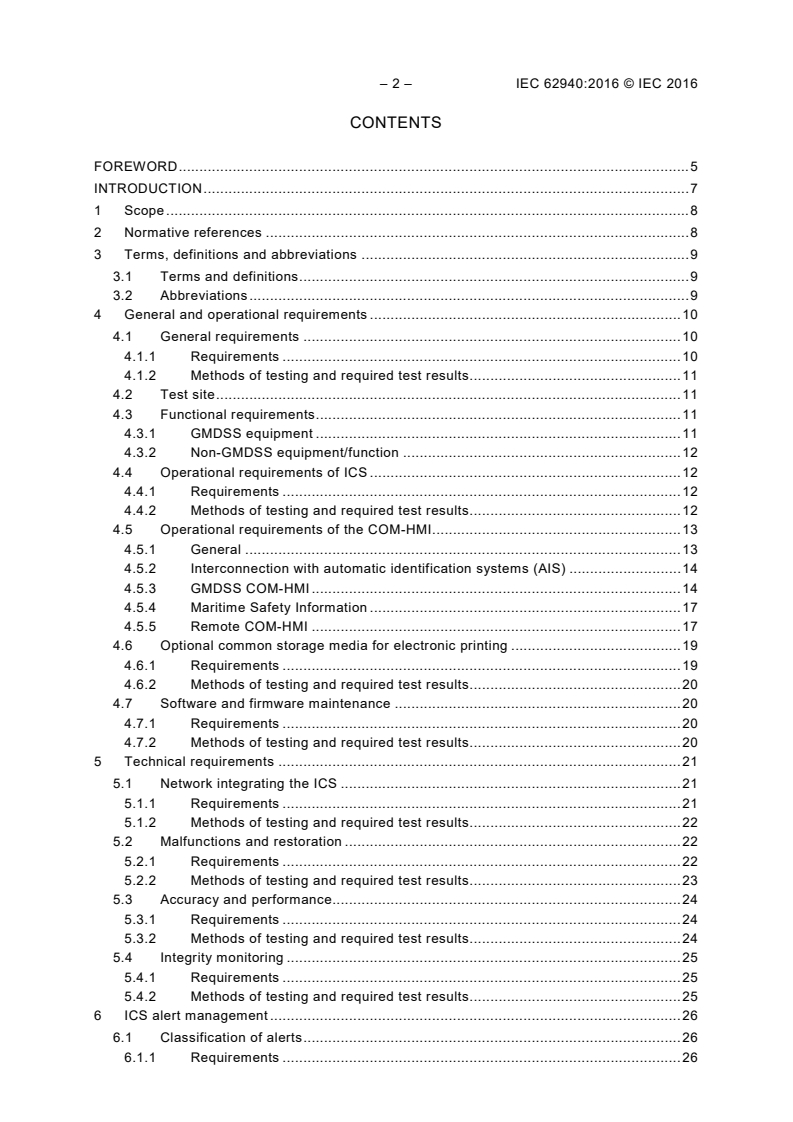
CONTENTS
FOREWORD . 5
INTRODUCTION . 7
1 Scope . 8
2 Normative references . 8
3 Terms, definitions and abbreviations . 9
3.1 Terms and definitions . 9
3.2 Abbreviations . 9
4 General and operational requirements . 10
4.1 General requirements . 10
4.1.1 Requirements . 10
4.1.2 Methods of testing and required test results. 11
4.2 Test site . 11
4.3 Functional requirements . 11
4.3.1 GMDSS equipment . 11
4.3.2 Non-GMDSS equipment/function . 12
4.4 Operational requirements of ICS . 12
4.4.1 Requirements . 12
4.4.2 Methods of testing and required test results. 12
4.5 Operational requirements of the COM-HMI. 13
4.5.1 General . 13
4.5.2 Interconnection with automatic identification systems (AIS) . 14
4.5.3 GMDSS COM-HMI . 14
4.5.4 Maritime Safety Information . 17
4.5.5 Remote COM-HMI . 17
4.6 Optional common storage media for electronic printing . 19
4.6.1 Requirements . 19
4.6.2 Methods of testing and required test results. 20
4.7 Software and firmware maintenance . 20
4.7.1 Requirements . 20
4.7.2 Methods of testing and required test results. 20
5 Technical requirements . 21
5.1 Network integrating the ICS . 21
5.1.1 Requirements . 21
5.1.2 Methods of testing and required test results. 22
5.2 Malfunctions and restoration . 22
5.2.1 Requirements . 22
5.2.2 Methods of testing and required test results. 23
5.3 Accuracy and performance. 24
5.3.1 Requirements . 24
5.3.2 Methods of testing and required test results. 24
5.4 Integrity monitoring . 25
5.4.1 Requirements . 25
5.4.2 Methods of testing and required test results. 25
6 ICS alert management . 26
6.1 Classification of alerts . 26
6.1.1 Requirements . 26
6.1.2 Methods of testing and required test results. 26
6.2 Alert management . 27
6.2.1 General . 27
6.2.2 Unacknowledged warnings . 28
6.2.3 Remote acknowledgement and silencing of alerts . 28
7 Interfacing . 28
7.1 IEC 61162 interfaces . 28
7.1.1 Requirements . 28
7.1.2 Methods of testing and required test results. 32
7.2 BNWAS interface . 32
7.2.1 Requirements . 32
7.2.2 Methods of testing and required test results. 33
7.3 INS/EPFS interface . 33
7.3.1 Requirements . 33
7.3.2 Methods of testing and required test results. 33
7.4 Optional communication access interface . 33
7.4.1 Requirements . 33
7.4.2 Methods of testing and required test results. 34
Annex A (normative) Distress alerting . 35
Annex B (informative) Extracts from IMO performance standards for alarms and
indications . 37
B.1 Alarms . 37
B.1.1 VHF radio installations . 37
B.1.2 MF/HF radio installations . 37
B.1.3 Inmarsat-C ship earth stations . 37
B.1.4 Inmarsat ship earth stations . 37
B.1.5 NAVTEX . 37
B.1.6 EGC equipment . 38
B.1.7 Automatic battery chargers . 38
B.2 Indications . 38
B.2.1 VHF radio installations . 38
B.2.2 MF/HF radio installations . 38
B.2.3 NAVTEX . 38
B.2.4 EGC equipment . 39
Annex C (normative) Communication access interface implementation details . 40
C.1 HTTP communication . 40
C.2 Paths, directories and URIs . 41
C.3 Meta information for the file transport. 42
C.4 Vessel-id and shore entity identifier . 43
C.5 Access to files by multiple on-board systems . 43
C.6 Authentication and authorization . 44
C.7 Implementation examples for data transfer scenarios . 44
C.7.1 Ship system sends data to shore-system "TrackingSys" at "Acme" . 44
C.7.2 On-shore system "controlpanel-update" at GadgetCorp sends data to
ship system "controlpanel" . 44
C.7.3 Ship client (ECDIS) requests the latest chart from shore. 44
Annex D (informative) Ship/shore and shore/ship communication implementation in
support of e-navigation . 46
D.1 General . 46
– 4 – IEC 62940:2016 © IEC 2016
D.2 One alternative for data transfer . 46
D.2.1 General . 46
D.2.2 Vessel to shore data transfer . 47
D.2.3 Shore to vessel data transfer . 47
D.2.4 Vessel to vessel data transfer . 48
D.3 Another alternative for data transfer . 48
Annex E (informative) Digital interface sentence to parameter group number
equivalence . 49
Bibliography . 51
Figure 1 – Example of ICS supporting distress communications . 16
Figure 2 – Remote COM-HMI . 18
Figure 3 – ICS interfaces . 21
Figure 4 – Example of alert management in an ICS. 27
Figure 5 – Interfaces of an ICS . 29
Figure 6 – Role of communication access interface . 34
Figure A.1 – Distress alert procedure . 35
Figure A.2 – Follow up voice procedure . 36
Figure C.1 – Example of a shore to ship transfer . 45
Figure D.1 – Example of communication for e-navigation . 46
Figure D.2 – Shore to vessel data transfer . 47
Table 1 – Minimum integrity/status information to be presented by COM-HMI . 25
Table 2 – Classification of GMDSS equipment alerts for alert management purposes . 26
Table 3 – Mandatory IEC 61162-1 sentences received by the ICS equipment . 30
Table 4 – Mandatory IEC 61162-1 sentences transmitted by the ICS equipment . 30
Table 5 – IEC 61162-1 sentences received by the ICS equipment from remote COM-
HMI and from external devices using MSI . 30
Table 6 – IEC 61162-1 sentences transmitted by ICS equipment to remote COM-HMI
and to external devices using MSI . 31
Table 7 – IEC 61162-1 sentences received by ICS equipment from an external
navigation equipment . 31
Table 8 – IEC 61162-1 sentences transmitted by the ICS equipment to an external
navigation equipment . 31
Table 9 – Optional IEC 61162-1 sentences received by the ICS equipment from
external equipment . 32
Table 10 – Optional IEC 61162-1 sentences transmitted by ICS equipment to external
equipment . 32
Table C.1 – Information elements HTTP communication . 41
Table C.2 – Communication access interface directories . 42
Table C.3 – Information elements file transport . 43
Table C.4 – Communications access interface operations . 44
Table E.1 – Digital sentence to PGN equivalence . 49
INTERNATIONAL ELECTROTECHNICAL COMMISSION
____________
MARITIME NAVIGATION AND
RADIOCOMMUNICATION EQUIPMENT AND SYSTEMS –
INTEGRATED COMMUNICATION SYSTEM (ICS) –
OPERATIONAL AND PERFORMANCE REQUIREMENTS,
METHODS OF TESTING AND REQUIRED TEST RESULTS
FOREWORD
1) The International Electrotechnical Commission (IEC) is a worldwide organization for standardization comprising
all national electrotechnical committees (IEC National Committees). The object of IEC is to promote
international co-operation on all questions concerning standardization in the electrical and electronic fields. To
this end and in addition to other activities, IEC publishes International Standards, Technical Specifications,
Technical Reports, Publicly Available Specifications (PAS) and Guides (hereafter referred to as “IEC
Publication(s)”). Their preparation is entrusted to technical committees; any IEC National Committee interested
in the subject dealt with may participate in this preparatory work. International, governmental and non-
governmental organizations liaising with the IEC also participate in this preparation. IEC collaborates closely
with the International Organization for Standardization (ISO) in accordance with conditions determined by
agreement between the two organizations.
2) The formal decisions or agreements of IEC on technical matters express, as nearly as possible, an international
consensus of opinion on the relevant subjects since each technical committee has representation from all
interested IEC National Committees.
3) IEC Publications have the form of recommendations for international use and are accepted by IEC National
Committees in that sense. While all reasonable efforts are made to ensure that the technical content of IEC
Publications is accurate, IEC cannot be held responsible for the way in which they are used or for any
misinterpretation by any end user.
4) In order to promote international uniformity, IEC National Committees undertake to apply IEC Publications
transparently to the maximum extent possible in their national and regional publications. Any divergence
between any IEC Publication and the corresponding national or regional publication shall be clearly indicated in
the latter.
5) IEC itself does not provide any attestation of conformity. Independent certification bodies provide conformity
assessment services and, in some areas, access to IEC marks of conformity. IEC is not responsible for any
services carried out by independent certification bodies.
6) All users should ensure that they have the latest edition of this publication.
7) No liability shall attach to IEC or its directors, employees, servants or agents including individual experts and
members of its technical committees and IEC National Committees for any personal injury, property damage or
other damage of any nature whatsoever, whether direct or indirect, or for costs (including legal fees) and
expenses arising out of the publication, use of, or reliance upon, this IEC Publication or any other IEC
Publications.
8) Attention is drawn to the Normative references cited in this publication. Use of the referenced publications is
indispensable for the correct application of this publication.
9) Attention is drawn to the possibility that some of the elements of this IEC Publication may be the subject of
patent rights. IEC shall not be held responsible for identifying any or all such patent rights.
International Standard IEC 62940 has been prepared by IEC technical committee 80: Maritime
navigation and radiocommunication equipment and systems.
The text of this standard is based on the following documents:
FDIS Report on voting
80/816/FDIS 80/821/RVD
Full information on the voting for the approval of this document can be found in the report on
voting indicated in the above table.
This publication has been drafted in accordance with the ISO/IEC Directives, Part 2.
– 6 – IEC 62940:2016 © IEC 2016
The committee has decided that the contents of this publication will remain unchanged until
the stability date indicated on the IEC website under "http://webstore.iec.ch" in the data
related to the specific publication. At this date, the publication will be
• reconfirmed,
• withdrawn,
• replaced by a revised edition, or
• amended.
A bilingual version of this publication may be issued at a later date.
IMPORTANT – The 'colour inside' logo on the cover page of this publication indicates
that it contains colours which are considered to be useful for the correct
understanding of its contents. Users should therefore print this document using a
colour printer.
INTRODUCTION
IEC 62940 incorporates the applicable parts of the performance standards included in
IMO Resolution A.811(19) for an integrated radiocommunication system. It also incorporates
the applicable requirements for the presentation of information included in
IMO Resolution MSC.191(79) which is associated with IEC 62288, applicable requirements for
bridge alert management included in IMO Resolution MSC.302(87) based on, and in
compliance with applicable requirements for Ethernet interconnection in IEC 61162-450.
The ICS is a system in which individual radiocommunication equipment and installations are
used as subsystems, i.e. without the need for their own control units, providing outputs to and
accepting inputs from a communications human machine interface (COM-HMI). Each
subsystem is in compliance with the type approval requirements for that subsystem where
applicable, and is in compliance with the interface requirements in this document. An ICS
consists of at least two individual GMDSS subsystems.
The COM-HMI is designed so that it can be made available on a bridge workstation either
dedicated to communications or as part of a multi-function display.
– 8 – IEC 62940:2016 © IEC 2016
MARITIME NAVIGATION AND
RADIOCOMMUNICATION EQUIPMENT AND SYSTEMS –
INTEGRATED COMMUNICATION SYSTEM (ICS) –
OPERATIONAL AND PERFORMANCE REQUIREMENTS,
METHODS OF TESTING AND REQUIRED TEST RESULTS
1 Scope
IEC 62940 specifies the minimum operational and performance requirements, technical
characteristics and methods of testing, and required test results, for shipborne integrated
communication systems (ICS) designed to perform ship external communication and distress
and safety communications (GMDSS) and the functions of onboard routeing of this
communication. It takes account of IMO Resolution A.694(17) and is associated with
IEC 60945. When a requirement in this document is different from IEC 60945, the requirement
in this document takes precedence.
2 Normative references
The following documents are referred to in the text in such a way that some or all of their
content constitutes requirements of this document. For dated references, only the edition
cited applies. For undated references, the latest edition of the referenced document (including
any amendments) applies.
IEC 60945, Maritime navigation and radiocommunication equipment and systems – General
requirements – Methods of testing and required test results
IEC 61162-1, Maritime navigation and radiocommunication equipment and systems – Digital
interfaces – Part 1: Single talker and multiple listeners
IEC 61162-450, Maritime navigation and radiocommunication equipment and systems –
Digital interfaces – Part 450: Multiple talkers and multiple listeners – Ethernet interconnection
IEC 61162-460:2015, Maritime navigation and radiocommunication equipment and systems –
Digital interface – Part 460: Multiple talker and multiple listeners – Ethernet interconnection –
Safety and security
IEC 61924-2:2012, Maritime navigation and radiocommunication equipment and systems –
Integrated navigation systems – Part 2: Modular structure for INS – Operational and
performance requirements, methods of testing and required test results
IEC 62288:2014, Maritime navigation and radiocommunication equipment and systems –
Presentation of navigation-related information on shipborne navigational displays – General
requirements, methods of testing and required test results
IMO Resolution A.694(17), General requirements for shipborne radio equipment forming part
of the global maritime distress and safety system (GMDSS) and for electronic navigational
aids
IMO Resolution MSC.191(79), Performance standards for the presentation of navigation-
related information on shipborne navigational displays
IMO MSC.1/Circ.1389, Guidance on procedures for updating shipborne navigation and
communication equipment
ITU-R M.493, Digital selective-calling system for use in the maritime mobile service
3 Terms, definitions and abbreviations
3.1 Terms and definitions
For the purposes of this document, the following terms and definitions apply.
ISO and IEC maintain terminological databases for use in standardization at the following
addresses:
• IEC Electropedia: available at http://www.electropedia.org/
• ISO Online browsing platform: available at http://www.iso.org/obp
3.1.1
COM-HMI
communications human machine interface
human machine interface for presentation and handling of communication tasks on the bridge
3.1.2
CCRS
consistent common reference system
sub-system or function of an INS for acquisition, processing, storage, surveillance and
distribution of data and information providing identical and obligatory reference to sub-
systems and subsequent functions within an INS and to other connected equipment, if
available
3.1.3
ICS
integrated communication system
composite communication system designed to perform ship external communication and
distress and safety communications and the functions of onboard routeing of this
communication
3.1.4
radio communication
wireless transmission of information
Note 1 to entry: Examples of radio communication are voice radio communication and the wireless exchange of
data.
3.1.5
remote COM-HMI
remote communications human machine interface
human machine interface for presentation and handling of communication tasks, placed
outside the ICS
3.1.6
subsystem
communication-related device within the ICS
3.2 Abbreviations
AIS automatic identification system
BAM bridge alert management
BNWAS bridge navigational watch alarm system
CAM central alert management
DSC digital selective calling
– 10 – IEC 62940:2016 © IEC 2016
EPFS electronic position fixing system
EUT equipment under test
FMEA failure mode and effects analysis
FTP file transfer protocol
GMDSS global maritime distress and safety system
HMI human machine interface
HTTP hypertext transfer protocol
IMAP internet message access protocol
INS integrated navigation system
MFD multi-function display
MSI maritime safety information
SMTP simple mail transfer protocol
4 General and operational requirements
4.1 General requirements
4.1.1 Requirements
The ICS shall meet the general requirements set out in IMO Resolution A.694(17) as further
specified in IEC 60945 appropriate to their category, for example "protected". However,
specific requirements may be made in individual equipment standards so consideration should
be given to any exemptions or additional requirements in combination with standards for all
included radiocommunications equipment in the ICS.
The manufacturer shall declare any preconditioning required before environmental checks.
For the purposes of this document, the following definitions for "performance check" and
"performance test", required by IEC 60945, shall apply:
Performance check Reconfigure the EUT and check by non-quantitative visual checks
that the system is still operative.
Performance test Identical to the "performance check".
The manufacturer shall declare the equipment to be tested and the tasks and functions that it
performs. The EUT shall be installed in compliance with the manufacturer´s installation
manual. Where equipment is divided, the entire configuration shall be tested together.
The manufacturer shall declare
• the physical parts involved,
• the location of tasks and functions,
• the general data flow between physical and/or logical parts, and
• the dependencies between tasks and functions.
NOTE Typical examples are hardware overviews down to the lowest replaceable unit, block diagrams or high
functional level software descriptions.
The acoustic alarm level may be capable of being adjustable below the level defined in
IEC 60945.
The ICS shall meet the requirements for the presentation of information on shipborne displays
set out in IMO Resolution MSC.191(79) as further specified in IEC 62288:2014, Clause 4 and
Clause 7.
The ICS shall meet the requirements for alert management as an alert source (see Clause 6
and Clause 7).
4.1.2 Methods of testing and required test results
Verify conformance with IMO Resolution A.694(17) by testing in accordance with IEC 60945.
Verify conformance with IMO Resolution MSC.191(79) by testing in accordance with
IEC 62288:2014, Clause 4 and Clause 7.
4.2 Test site
Unless otherwise stated, all tests in this document are to be executed in a laboratory
environment with a simulator arrangement or via live "on-air" tests on the actual equipment.
For a simulator arrangement, the following characteristics are required:
• capable of simulating the "air-interface" for transmission of radio signals for the equipment
included in the ICS;
• capable of simulating AIS targets and other AIS messages.
The simulated signals shall be in accordance with the applicable international standards. The
output signals shall comply with IEC 61162-1 and with the types of interfaces supported by
the EUT according to the manufacturer´s declaration.
4.3 Functional requirements
4.3.1 GMDSS equipment
4.3.1.1 Requirements
The manufacturer shall declare which selected functions of the GMDSS are integrated in the
ICS. All functional requirements of the GMDSS equipment integrated into the ICS shall
conform to the performance standards for that equipment. For functionality of DSC, the latest
version of ITU-R M.493 is applicable.
NOTE The functions of the GMDSS are given in SOLAS regulation IV/4 and the performance standards are given
in IMO Resolutions which are referenced in SOLAS regulation IV/14. The relevant Resolutions are given in the
Bibliography.
The implementation of a specific item of GMDSS equipment or its installation shall not impair
the availability, operation or functionality of another equipment integrated into the ICS.
For radio transmission, at least two simultaneous operations are required. All receiver
functions shall be available simultaneously.
4.3.1.2 Methods of testing and required test results
Confirm by inspection of the documented evidence that the documents provided by the
manufacturer declare the configuration of the ICS.
Confirm by observation or analytic evaluation that the implementation of a specific item of
GMDSS equipment or its installation does not impair availability, operation or functionality of
another equipment integrated into the ICS.
Confirm by observation that for radio transmission at least two simultaneous operations are
possible, and that all receiver functions are available simultaneously.
– 12 – IEC 62940:2016 © IEC 2016
4.3.2 Non-GMDSS equipment/function
4.3.2.1 Requirements
The ICS may integrate non-GMDSS communication and other equipment/functions. The
manufacturer shall declare which non-GMDSS communication and other equipment/functions
are integrated in the ICS. Such equipment/functions shall comply with IEC 60945, and the ICS
shall be compliant with the relevant interface requirements of IEC 61162-1.
The implementation of a specific item of non-GMDSS equipment or its installation shall not
impair the availability, operation or functionality of another equipment integrated into the ICS.
4.3.2.2 Methods of testing and required test results
Confirm by inspection of documented evidence whether non-GMDSS communication
equipment/functions are integrated in the ICS.
Confirm by inspection of documented evidence that such equipment complies with the
relevant interfaces requirements in IEC 61162-1.
Confirm by inspection of documented evidence that such equipment complies with the
relevant requirements in IEC 60945.
Confirm by observation or analytic evaluation that the implementation of a specific item of
non-GMDSS equipment or its installation does not impair the availability, operation or
functionality of another equipment integrated into the ICS.
4.4 Operational requirements of ICS
4.4.1 Requirements
The ICS shall
a) comprise at least two COM-HMI capable of performing GMDSS functions for the included
GMDSS equipment,
b) ensure that initiating a distress alert has priority over all other functions of the ICS,
c) be capable of performing all distress functions, for the included GMDSS equipment,
d) include a printing capability if required by individual IMO performance standards and not
provided by the individual equipment,
e) make MSI available based on a common storage media if provided (see 4.6),
f) have facilities for automatic reception of position and time data from the ship’s CCRS, in
addition to provision for manual input of this data (if required),
g) have a power supply arrangement which ensures that it is not possible to inadvertently
switch off any part of the ICS,
h) have a failure analysis, at ICS functional level, performed and documented for the ICS.
The failure analysis shall verify that the ICS is designed on "fail-to-safe" principle and that
failure of one part of the integrated system should not affect the functionality of other
parts, except for those functions directly dependent on the defective part.
NOTE IEC 60812 (FMEA) describes how failure analysis can be performed.
4.4.2 Methods of testing and required test results
Perform the following:
a) confirm by inspection of documented evidence that the EUT comprises at least two
COM-HMIs capable of performing GMDSS functions for the GMDSS equipment included
into the EUT;
b) confirm by analytic evaluation that initiating a distress alert has priority over all other
functions of the EUT;
c) confirm by observation that the EUT is capable of performing all distress functions for the
GMDSS equipment included into the EUT;
d) confirm by observation that the EUT provides printing capability, if required by the
individual performance standards related to the GMDSS equipment included into the EUT;
e) see test for 4.6;
f) confirm by observation that the EUT has facilities both for automatic reception of position
and time data and for manual input from the ship’s CCRS for position and time data;
g) confirm by analytic evaluation that the power supply arrangements for the EUT are such
that it is not possible to inadvertently switch off any part of the EUT;
h) use the manufacturer’s documentation for failure analysis to select randomly 3 cases from
the failure analysis and confirm by observation that what is documented in the failure
analysis happens in the EUT.
4.5 Operational requirements of the COM-HMI
4.5.1 General
4.5.1.1 Requirements
Each of the COM-HMI shall
• have consistent and identical lay out of the user interfaces,
• have consistent and identical access to each function for different subsystems (use of
different screen sizes is allowed), and
• be capable of being operated independently of each other.
Only one COM-HMI, at one indicated workstation or MFD task station shall be in control of
configuration per "non-shareable function" at any time, and only one COM-HMI or MFD task
station shall be assigned to accept control commands per "non-shareable function" at any
time.
NOTE An example of a non-shareable functions is VHF voice; an example of a sharable function is making a text
message for Inmarsat-C.
It shall be visually indicated to the bridge team, if not otherwise obvious, which COM-HMI is in
control of which functions. Means shall be available on the COM-HMI to take over control of
individual functions to that COM-HMI.
4.5.1.2 Methods of testing and required test results
Confirm by observation that each COM-HMI has consistent and identical layout of the user
interface for each of the functions provided.
Confirm by observation that there is consistent and similar access to each function of the
different subsystems provided on the COM-HMIs.
Access different functions on different COM-HMIs and confirm by observation that it is
possible to operate the COM-HMIs independently of each other.
Access a "non-shareable function" on one COM-HMI and do not complete the operation.
Confirm by observation that it is indicated on the COM-HMI used that there indeed is access
to the "non-shareable function". Then attempt to access the same function on another
COM-HMI. Confirm by observation that access to the "non-shareable function" is not
accepted. Confirm by observation that a function to take over control is present. Subsequently
exercise that function and confirm by observation that control and access is transferred.
– 14 – IEC 62940:2016 © IEC 2016
4.5.2 Interconnection with automatic identification systems (AIS)
4.5.2.1 Requirements
Where interconnection with AIS is provided, the ICS shall be capable of
• displaying notices using the same rules as for MSI (see 4.5.4),
NOTE Notices use Application Specific Message (ASM) Functional Identifiers (FI) as identified in Table 6 and
Table 7.
• sending and receiving broadcast and addressed AIS safety-related messages, and
• correlating distress information received by DSC with available received AIS ship
information and displaying the results in accordance with 4.5.3.2.
4.5.2.2 Methods of testing and required test results
If an AIS interface is provided, use a simulator to send to the EUT:
• VDM sentences containing at least ten notices using ASM FI 22 and 23 and confirm by
observation that the notices are available for display using same rules as for MSI (see
4.5.4);
• VDM sentences containing at least ten addressed and broadcast safety related messages
and confirm by observation that those messages are available for display. Create an
addressed and a broadcast message and confirm by observation that data sentences ABM
and BBM are transmitted with the proper format. Acknowledge one of the transmitted
addressed safety related message by sending an ABK sentence to the EUT and confirm
by observation that the addressed message is displayed as acknowledged.
4.5.3 GMDSS COM-HMI
4.5.3.1 Distress alerting
4.5.3.1.1 Requirements
The COM-HMI for GMDSS functions shall include a dedicated distress button that has no
other function than activating distress alerts. An example of an ICS supporting distress
communications is shown in Figure 1.
The dedicated distress button shall not be any key of a digital input panel or a keyboard
provided on the equipment. The distress button shall be clearly identified and protected
against inadvertent activation, requiring at least two independent actions.
NOTE These requirements conform to IMO Circular MSC/Circ.862.
The use of the dedicated distress button shall activate distress alerts on all GMDSS
communication subsystems in the ICS when continuously pressed for an activation period of
at least 3 s. In this period, the display on the COM-HMI used shall show: "Transmitting
undesignated DISTRESS using [MF, HF, VHF, Inmarsat-C] in [Start counter 3 -2 -1] seconds"
with a visual indication following the count down, and an audible signal of frequency 2 kHz
with a sequence of on 500 ms off 500 ms synchronized with the count down. The COM-HMI
shall indicate distress status/progress for each of the radio systems, to give the operator the
state of own distress.
If the dedicated distress button is released before the distress alert is transmitted, the distress
alert procedure shall be interrupted, and a dedicated distress menu shall be made available
on the COM-HMI if multiple distress capable devices/functions are available in the ICS.
A flow chart describing the distress alert procedure is shown in Figure A.1. The follow up
voice procedure is shown in Figure A.2.
4.5.3.1.2 Methods of testing and required test results
Confirm by observation that it is possible to initiate transmi
...
IEC 62940 ®
Edition 1.0 2016-10
INTERNATIONAL
STANDARD
NORME
INTERNATIONALE
colour
inside
Maritime navigation and radiocommunication equipment and systems –
Integrated communication system (ICS) – Operational and performance
requirements, methods of testing and required test results
Matériels et systèmes de navigation et de radiocommunication maritimes –
Système de communication intégré (ICS) – Exigences de fonctionnement et
de performance, méthodes d’essai et résultats d’essai exigés
All rights reserved. Unless otherwise specified, no part of this publication may be reproduced or utilized in any form
or by any means, electronic or mechanical, including photocopying and microfilm, without permission in writing from
either IEC or IEC's member National Committee in the country of the requester. If you have any questions about IEC
copyright or have an enquiry about obtaining additional rights to this publication, please contact the address below or
your local IEC member National Committee for further information.
Droits de reproduction réservés. Sauf indication contraire, aucune partie de cette publication ne peut être reproduite
ni utilisée sous quelque forme que ce soit et par aucun procédé, électronique ou mécanique, y compris la photocopie
et les microfilms, sans l'accord écrit de l'IEC ou du Comité national de l'IEC du pays du demandeur. Si vous avez des
questions sur le copyright de l'IEC ou si vous désirez obtenir des droits supplémentaires sur cette publication, utilisez
les coordonnées ci-après ou contactez le Comité national de l'IEC de votre pays de résidence.
IEC Central Office Tel.: +41 22 919 02 11
3, rue de Varembé info@iec.ch
CH-1211 Geneva 20 www.iec.ch
Switzerland
About the IEC
The International Electrotechnical Commission (IEC) is the leading global organization that prepares and publishes
International Standards for all electrical, electronic and related technologies.
About IEC publications
The technical content of IEC publications is kept under constant review by the IEC. Please make sure that you have the
latest edition, a corrigendum or an amendment might have been published.
IEC publications search - webstore.iec.ch/advsearchform IEC online collection - oc.iec.ch
The advanced search enables to find IEC publications by a Discover our powerful search engine and read freely all the
variety of criteria (reference number, text, technical publications previews. With a subscription you will always
committee, …). It also gives information on projects, replaced have access to up to date content tailored to your needs.
and withdrawn publications.
Electropedia - www.electropedia.org
IEC Just Published - webstore.iec.ch/justpublished
The world's leading online dictionary on electrotechnology,
Stay up to date on all new IEC publications. Just Published
containing more than 22 000 terminological entries in English
details all new publications released. Available online and
and French, with equivalent terms in 18 additional languages.
once a month by email.
Also known as the International Electrotechnical Vocabulary
(IEV) online.
IEC Customer Service Centre - webstore.iec.ch/csc
If you wish to give us your feedback on this publication or
need further assistance, please contact the Customer Service
Centre: sales@iec.ch.
A propos de l'IEC
La Commission Electrotechnique Internationale (IEC) est la première organisation mondiale qui élabore et publie des
Normes internationales pour tout ce qui a trait à l'électricité, à l'électronique et aux technologies apparentées.
A propos des publications IEC
Le contenu technique des publications IEC est constamment revu. Veuillez vous assurer que vous possédez l’édition la
plus récente, un corrigendum ou amendement peut avoir été publié.
Recherche de publications IEC - IEC online collection - oc.iec.ch
webstore.iec.ch/advsearchform Découvrez notre puissant moteur de recherche et consultez
La recherche avancée permet de trouver des publications IEC gratuitement tous les aperçus des publications. Avec un
en utilisant différents critères (numéro de référence, texte, abonnement, vous aurez toujours accès à un contenu à jour
comité d’études, …). Elle donne aussi des informations sur adapté à vos besoins.
les projets et les publications remplacées ou retirées.
Electropedia - www.electropedia.org
IEC Just Published - webstore.iec.ch/justpublished
Le premier dictionnaire d'électrotechnologie en ligne au
Restez informé sur les nouvelles publications IEC. Just
monde, avec plus de 22 000 articles terminologiques en
Published détaille les nouvelles publications parues.
anglais et en français, ainsi que les termes équivalents dans
Disponible en ligne et une fois par mois par email.
16 langues additionnelles. Egalement appelé Vocabulaire
Electrotechnique International (IEV) en ligne.
Service Clients - webstore.iec.ch/csc
Si vous désirez nous donner des commentaires sur cette
publication ou si vous avez des questions contactez-nous:
sales@iec.ch.
IEC 62940 ®
Edition 1.0 2016-10
INTERNATIONAL
STANDARD
NORME
INTERNATIONALE
colour
inside
Maritime navigation and radiocommunication equipment and systems –
Integrated communication system (ICS) – Operational and performance
requirements, methods of testing and required test results
Matériels et systèmes de navigation et de radiocommunication maritimes –
Système de communication intégré (ICS) – Exigences de fonctionnement et
de performance, méthodes d’essai et résultats d’essai exigés
INTERNATIONAL
ELECTROTECHNICAL
COMMISSION
COMMISSION
ELECTROTECHNIQUE
INTERNATIONALE
ICS 47.020.70 ISBN 978-2-8322-9409-3
– 2 – IEC 62940:2016 © IEC 2016
CONTENTS
FOREWORD . 5
INTRODUCTION . 7
1 Scope . 8
2 Normative references . 8
3 Terms, definitions and abbreviations . 9
3.1 Terms and definitions . 9
3.2 Abbreviations . 9
4 General and operational requirements . 10
4.1 General requirements . 10
4.1.1 Requirements . 10
4.1.2 Methods of testing and required test results. 11
4.2 Test site . 11
4.3 Functional requirements . 11
4.3.1 GMDSS equipment . 11
4.3.2 Non-GMDSS equipment/function . 12
4.4 Operational requirements of ICS . 12
4.4.1 Requirements . 12
4.4.2 Methods of testing and required test results. 12
4.5 Operational requirements of the COM-HMI. 13
4.5.1 General . 13
4.5.2 Interconnection with automatic identification systems (AIS) . 14
4.5.3 GMDSS COM-HMI . 14
4.5.4 Maritime Safety Information . 17
4.5.5 Remote COM-HMI . 17
4.6 Optional common storage media for electronic printing . 19
4.6.1 Requirements . 19
4.6.2 Methods of testing and required test results. 20
4.7 Software and firmware maintenance . 20
4.7.1 Requirements . 20
4.7.2 Methods of testing and required test results. 20
5 Technical requirements . 21
5.1 Network integrating the ICS . 21
5.1.1 Requirements . 21
5.1.2 Methods of testing and required test results. 22
5.2 Malfunctions and restoration . 22
5.2.1 Requirements . 22
5.2.2 Methods of testing and required test results. 23
5.3 Accuracy and performance. 24
5.3.1 Requirements . 24
5.3.2 Methods of testing and required test results. 24
5.4 Integrity monitoring . 25
5.4.1 Requirements . 25
5.4.2 Methods of testing and required test results. 25
6 ICS alert management . 26
6.1 Classification of alerts . 26
6.1.1 Requirements . 26
6.1.2 Methods of testing and required test results. 26
6.2 Alert management . 27
6.2.1 General . 27
6.2.2 Unacknowledged warnings . 28
6.2.3 Remote acknowledgement and silencing of alerts . 28
7 Interfacing . 28
7.1 IEC 61162 interfaces . 28
7.1.1 Requirements . 28
7.1.2 Methods of testing and required test results. 32
7.2 BNWAS interface . 32
7.2.1 Requirements . 32
7.2.2 Methods of testing and required test results. 33
7.3 INS/EPFS interface . 33
7.3.1 Requirements . 33
7.3.2 Methods of testing and required test results. 33
7.4 Optional communication access interface . 33
7.4.1 Requirements . 33
7.4.2 Methods of testing and required test results. 34
Annex A (normative) Distress alerting . 35
Annex B (informative) Extracts from IMO performance standards for alarms and
indications . 37
B.1 Alarms . 37
B.1.1 VHF radio installations . 37
B.1.2 MF/HF radio installations . 37
B.1.3 Inmarsat-C ship earth stations . 37
B.1.4 Inmarsat ship earth stations . 37
B.1.5 NAVTEX . 37
B.1.6 EGC equipment . 38
B.1.7 Automatic battery chargers . 38
B.2 Indications . 38
B.2.1 VHF radio installations . 38
B.2.2 MF/HF radio installations . 38
B.2.3 NAVTEX . 38
B.2.4 EGC equipment . 39
Annex C (normative) Communication access interface implementation details . 40
C.1 HTTP communication . 40
C.2 Paths, directories and URIs . 41
C.3 Meta information for the file transport. 42
C.4 Vessel-id and shore entity identifier . 43
C.5 Access to files by multiple on-board systems . 43
C.6 Authentication and authorization . 44
C.7 Implementation examples for data transfer scenarios . 44
C.7.1 Ship system sends data to shore-system "TrackingSys" at "Acme" . 44
C.7.2 On-shore system "controlpanel-update" at GadgetCorp sends data to
ship system "controlpanel" . 44
C.7.3 Ship client (ECDIS) requests the latest chart from shore. 44
Annex D (informative) Ship/shore and shore/ship communication implementation in
support of e-navigation . 46
D.1 General . 46
– 4 – IEC 62940:2016 © IEC 2016
D.2 One alternative for data transfer . 46
D.2.1 General . 46
D.2.2 Vessel to shore data transfer . 47
D.2.3 Shore to vessel data transfer . 47
D.2.4 Vessel to vessel data transfer . 48
D.3 Another alternative for data transfer . 48
Annex E (informative) Digital interface sentence to parameter group number
equivalence . 49
Bibliography . 51
Figure 1 – Example of ICS supporting distress communications . 16
Figure 2 – Remote COM-HMI . 18
Figure 3 – ICS interfaces . 21
Figure 4 – Example of alert management in an ICS. 27
Figure 5 – Interfaces of an ICS . 29
Figure 6 – Role of communication access interface . 34
Figure A.1 – Distress alert procedure . 35
Figure A.2 – Follow up voice procedure . 36
Figure C.1 – Example of a shore to ship transfer . 45
Figure D.1 – Example of communication for e-navigation . 46
Figure D.2 – Shore to vessel data transfer . 47
Table 1 – Minimum integrity/status information to be presented by COM-HMI . 25
Table 2 – Classification of GMDSS equipment alerts for alert management purposes . 26
Table 3 – Mandatory IEC 61162-1 sentences received by the ICS equipment . 30
Table 4 – Mandatory IEC 61162-1 sentences transmitted by the ICS equipment . 30
Table 5 – IEC 61162-1 sentences received by the ICS equipment from remote COM-
HMI and from external devices using MSI . 30
Table 6 – IEC 61162-1 sentences transmitted by ICS equipment to remote COM-HMI
and to external devices using MSI . 31
Table 7 – IEC 61162-1 sentences received by ICS equipment from an external
navigation equipment . 31
Table 8 – IEC 61162-1 sentences transmitted by the ICS equipment to an external
navigation equipment . 31
Table 9 – Optional IEC 61162-1 sentences received by the ICS equipment from
external equipment . 32
Table 10 – Optional IEC 61162-1 sentences transmitted by ICS equipment to external
equipment . 32
Table C.1 – Information elements HTTP communication . 41
Table C.2 – Communication access interface directories . 42
Table C.3 – Information elements file transport . 43
Table C.4 – Communications access interface operations . 44
Table E.1 – Digital sentence to PGN equivalence . 49
INTERNATIONAL ELECTROTECHNICAL COMMISSION
____________
MARITIME NAVIGATION AND
RADIOCOMMUNICATION EQUIPMENT AND SYSTEMS –
INTEGRATED COMMUNICATION SYSTEM (ICS) –
OPERATIONAL AND PERFORMANCE REQUIREMENTS,
METHODS OF TESTING AND REQUIRED TEST RESULTS
FOREWORD
1) The International Electrotechnical Commission (IEC) is a worldwide organization for standardization comprising
all national electrotechnical committees (IEC National Committees). The object of IEC is to promote
international co-operation on all questions concerning standardization in the electrical and electronic fields. To
this end and in addition to other activities, IEC publishes International Standards, Technical Specifications,
Technical Reports, Publicly Available Specifications (PAS) and Guides (hereafter referred to as “IEC
Publication(s)”). Their preparation is entrusted to technical committees; any IEC National Committee interested
in the subject dealt with may participate in this preparatory work. International, governmental and non-
governmental organizations liaising with the IEC also participate in this preparation. IEC collaborates closely
with the International Organization for Standardization (ISO) in accordance with conditions determined by
agreement between the two organizations.
2) The formal decisions or agreements of IEC on technical matters express, as nearly as possible, an international
consensus of opinion on the relevant subjects since each technical committee has representation from all
interested IEC National Committees.
3) IEC Publications have the form of recommendations for international use and are accepted by IEC National
Committees in that sense. While all reasonable efforts are made to ensure that the technical content of IEC
Publications is accurate, IEC cannot be held responsible for the way in which they are used or for any
misinterpretation by any end user.
4) In order to promote international uniformity, IEC National Committees undertake to apply IEC Publications
transparently to the maximum extent possible in their national and regional publications. Any divergence
between any IEC Publication and the corresponding national or regional publication shall be clearly indicated in
the latter.
5) IEC itself does not provide any attestation of conformity. Independent certification bodies provide conformity
assessment services and, in some areas, access to IEC marks of conformity. IEC is not responsible for any
services carried out by independent certification bodies.
6) All users should ensure that they have the latest edition of this publication.
7) No liability shall attach to IEC or its directors, employees, servants or agents including individual experts and
members of its technical committees and IEC National Committees for any personal injury, property damage or
other damage of any nature whatsoever, whether direct or indirect, or for costs (including legal fees) and
expenses arising out of the publication, use of, or reliance upon, this IEC Publication or any other IEC
Publications.
8) Attention is drawn to the Normative references cited in this publication. Use of the referenced publications is
indispensable for the correct application of this publication.
9) Attention is drawn to the possibility that some of the elements of this IEC Publication may be the subject of
patent rights. IEC shall not be held responsible for identifying any or all such patent rights.
International Standard IEC 62940 has been prepared by IEC technical committee 80: Maritime
navigation and radiocommunication equipment and systems.
The text of this standard is based on the following documents:
FDIS Report on voting
80/816/FDIS 80/821/RVD
Full information on the voting for the approval of this document can be found in the report on
voting indicated in the above table.
This publication has been drafted in accordance with the ISO/IEC Directives, Part 2.
– 6 – IEC 62940:2016 © IEC 2016
The committee has decided that the contents of this publication will remain unchanged until
the stability date indicated on the IEC website under "http://webstore.iec.ch" in the data
related to the specific publication. At this date, the publication will be
• reconfirmed,
• withdrawn,
• replaced by a revised edition, or
• amended.
IMPORTANT – The 'colour inside' logo on the cover page of this publication indicates
that it contains colours which are considered to be useful for the correct
understanding of its contents. Users should therefore print this document using a
colour printer.
INTRODUCTION
IEC 62940 incorporates the applicable parts of the performance standards included in
IMO Resolution A.811(19) for an integrated radiocommunication system. It also incorporates
the applicable requirements for the presentation of information included in
IMO Resolution MSC.191(79) which is associated with IEC 62288, applicable requirements for
bridge alert management included in IMO Resolution MSC.302(87) based on, and in
compliance with applicable requirements for Ethernet interconnection in IEC 61162-450.
The ICS is a system in which individual radiocommunication equipment and installations are
used as subsystems, i.e. without the need for their own control units, providing outputs to and
accepting inputs from a communications human machine interface (COM-HMI). Each
subsystem is in compliance with the type approval requirements for that subsystem where
applicable, and is in compliance with the interface requirements in this document. An ICS
consists of at least two individual GMDSS subsystems.
The COM-HMI is designed so that it can be made available on a bridge workstation either
dedicated to communications or as part of a multi-function display.
– 8 – IEC 62940:2016 © IEC 2016
MARITIME NAVIGATION AND
RADIOCOMMUNICATION EQUIPMENT AND SYSTEMS –
INTEGRATED COMMUNICATION SYSTEM (ICS) –
OPERATIONAL AND PERFORMANCE REQUIREMENTS,
METHODS OF TESTING AND REQUIRED TEST RESULTS
1 Scope
IEC 62940 specifies the minimum operational and performance requirements, technical
characteristics and methods of testing, and required test results, for shipborne integrated
communication systems (ICS) designed to perform ship external communication and distress
and safety communications (GMDSS) and the functions of onboard routeing of this
communication. It takes account of IMO Resolution A.694(17) and is associated with
IEC 60945. When a requirement in this document is different from IEC 60945, the requirement
in this document takes precedence.
2 Normative references
The following documents are referred to in the text in such a way that some or all of their
content constitutes requirements of this document. For dated references, only the edition
cited applies. For undated references, the latest edition of the referenced document (including
any amendments) applies.
IEC 60945, Maritime navigation and radiocommunication equipment and systems – General
requirements – Methods of testing and required test results
IEC 61162-1, Maritime navigation and radiocommunication equipment and systems – Digital
interfaces – Part 1: Single talker and multiple listeners
IEC 61162-450, Maritime navigation and radiocommunication equipment and systems –
Digital interfaces – Part 450: Multiple talkers and multiple listeners – Ethernet interconnection
IEC 61162-460:2015, Maritime navigation and radiocommunication equipment and systems –
Digital interface – Part 460: Multiple talker and multiple listeners – Ethernet interconnection –
Safety and security
IEC 61924-2:2012, Maritime navigation and radiocommunication equipment and systems –
Integrated navigation systems – Part 2: Modular structure for INS – Operational and
performance requirements, methods of testing and required test results
IEC 62288:2014, Maritime navigation and radiocommunication equipment and systems –
Presentation of navigation-related information on shipborne navigational displays – General
requirements, methods of testing and required test results
IMO Resolution A.694(17), General requirements for shipborne radio equipment forming part
of the global maritime distress and safety system (GMDSS) and for electronic navigational
aids
IMO Resolution MSC.191(79), Performance standards for the presentation of navigation-
related information on shipborne navigational displays
IMO MSC.1/Circ.1389, Guidance on procedures for updating shipborne navigation and
communication equipment
ITU-R M.493, Digital selective-calling system for use in the maritime mobile service
3 Terms, definitions and abbreviations
3.1 Terms and definitions
For the purposes of this document, the following terms and definitions apply.
ISO and IEC maintain terminological databases for use in standardization at the following
addresses:
• IEC Electropedia: available at http://www.electropedia.org/
• ISO Online browsing platform: available at http://www.iso.org/obp
3.1.1
COM-HMI
communications human machine interface
human machine interface for presentation and handling of communication tasks on the bridge
3.1.2
CCRS
consistent common reference system
sub-system or function of an INS for acquisition, processing, storage, surveillance and
distribution of data and information providing identical and obligatory reference to sub-
systems and subsequent functions within an INS and to other connected equipment, if
available
3.1.3
ICS
integrated communication system
composite communication system designed to perform ship external communication and
distress and safety communications and the functions of onboard routeing of this
communication
3.1.4
radio communication
wireless transmission of information
Note 1 to entry: Examples of radio communication are voice radio communication and the wireless exchange of
data.
3.1.5
remote COM-HMI
remote communications human machine interface
human machine interface for presentation and handling of communication tasks, placed
outside the ICS
3.1.6
subsystem
communication-related device within the ICS
3.2 Abbreviations
AIS automatic identification system
BAM bridge alert management
BNWAS bridge navigational watch alarm system
CAM central alert management
DSC digital selective calling
– 10 – IEC 62940:2016 © IEC 2016
EPFS electronic position fixing system
EUT equipment under test
FMEA failure mode and effects analysis
FTP file transfer protocol
GMDSS global maritime distress and safety system
HMI human machine interface
HTTP hypertext transfer protocol
IMAP internet message access protocol
INS integrated navigation system
MFD multi-function display
MSI maritime safety information
SMTP simple mail transfer protocol
4 General and operational requirements
4.1 General requirements
4.1.1 Requirements
The ICS shall meet the general requirements set out in IMO Resolution A.694(17) as further
specified in IEC 60945 appropriate to their category, for example "protected". However,
specific requirements may be made in individual equipment standards so consideration should
be given to any exemptions or additional requirements in combination with standards for all
included radiocommunications equipment in the ICS.
The manufacturer shall declare any preconditioning required before environmental checks.
For the purposes of this document, the following definitions for "performance check" and
"performance test", required by IEC 60945, shall apply:
Performance check Reconfigure the EUT and check by non-quantitative visual checks
that the system is still operative.
Performance test Identical to the "performance check".
The manufacturer shall declare the equipment to be tested and the tasks and functions that it
performs. The EUT shall be installed in compliance with the manufacturer´s installation
manual. Where equipment is divided, the entire configuration shall be tested together.
The manufacturer shall declare
• the physical parts involved,
• the location of tasks and functions,
• the general data flow between physical and/or logical parts, and
• the dependencies between tasks and functions.
NOTE Typical examples are hardware overviews down to the lowest replaceable unit, block diagrams or high
functional level software descriptions.
The acoustic alarm level may be capable of being adjustable below the level defined in
IEC 60945.
The ICS shall meet the requirements for the presentation of information on shipborne displays
set out in IMO Resolution MSC.191(79) as further specified in IEC 62288:2014, Clause 4 and
Clause 7.
The ICS shall meet the requirements for alert management as an alert source (see Clause 6
and Clause 7).
4.1.2 Methods of testing and required test results
Verify conformance with IMO Resolution A.694(17) by testing in accordance with IEC 60945.
Verify conformance with IMO Resolution MSC.191(79) by testing in accordance with
IEC 62288:2014, Clause 4 and Clause 7.
4.2 Test site
Unless otherwise stated, all tests in this document are to be executed in a laboratory
environment with a simulator arrangement or via live "on-air" tests on the actual equipment.
For a simulator arrangement, the following characteristics are required:
• capable of simulating the "air-interface" for transmission of radio signals for the equipment
included in the ICS;
• capable of simulating AIS targets and other AIS messages.
The simulated signals shall be in accordance with the applicable international standards. The
output signals shall comply with IEC 61162-1 and with the types of interfaces supported by
the EUT according to the manufacturer´s declaration.
4.3 Functional requirements
4.3.1 GMDSS equipment
4.3.1.1 Requirements
The manufacturer shall declare which selected functions of the GMDSS are integrated in the
ICS. All functional requirements of the GMDSS equipment integrated into the ICS shall
conform to the performance standards for that equipment. For functionality of DSC, the latest
version of ITU-R M.493 is applicable.
NOTE The functions of the GMDSS are given in SOLAS regulation IV/4 and the performance standards are given
in IMO Resolutions which are referenced in SOLAS regulation IV/14. The relevant Resolutions are given in the
Bibliography.
The implementation of a specific item of GMDSS equipment or its installation shall not impair
the availability, operation or functionality of another equipment integrated into the ICS.
For radio transmission, at least two simultaneous operations are required. All receiver
functions shall be available simultaneously.
4.3.1.2 Methods of testing and required test results
Confirm by inspection of the documented evidence that the documents provided by the
manufacturer declare the configuration of the ICS.
Confirm by observation or analytic evaluation that the implementation of a specific item of
GMDSS equipment or its installation does not impair availability, operation or functionality of
another equipment integrated into the ICS.
Confirm by observation that for radio transmission at least two simultaneous operations are
possible, and that all receiver functions are available simultaneously.
– 12 – IEC 62940:2016 © IEC 2016
4.3.2 Non-GMDSS equipment/function
4.3.2.1 Requirements
The ICS may integrate non-GMDSS communication and other equipment/functions. The
manufacturer shall declare which non-GMDSS communication and other equipment/functions
are integrated in the ICS. Such equipment/functions shall comply with IEC 60945, and the ICS
shall be compliant with the relevant interface requirements of IEC 61162-1.
The implementation of a specific item of non-GMDSS equipment or its installation shall not
impair the availability, operation or functionality of another equipment integrated into the ICS.
4.3.2.2 Methods of testing and required test results
Confirm by inspection of documented evidence whether non-GMDSS communication
equipment/functions are integrated in the ICS.
Confirm by inspection of documented evidence that such equipment complies with the
relevant interfaces requirements in IEC 61162-1.
Confirm by inspection of documented evidence that such equipment complies with the
relevant requirements in IEC 60945.
Confirm by observation or analytic evaluation that the implementation of a specific item of
non-GMDSS equipment or its installation does not impair the availability, operation or
functionality of another equipment integrated into the ICS.
4.4 Operational requirements of ICS
4.4.1 Requirements
The ICS shall
a) comprise at least two COM-HMI capable of performing GMDSS functions for the included
GMDSS equipment,
b) ensure that initiating a distress alert has priority over all other functions of the ICS,
c) be capable of performing all distress functions, for the included GMDSS equipment,
d) include a printing capability if required by individual IMO performance standards and not
provided by the individual equipment,
e) make MSI available based on a common storage media if provided (see 4.6),
f) have facilities for automatic reception of position and time data from the ship’s CCRS, in
addition to provision for manual input of this data (if required),
g) have a power supply arrangement which ensures that it is not possible to inadvertently
switch off any part of the ICS,
h) have a failure analysis, at ICS functional level, performed and documented for the ICS.
The failure analysis shall verify that the ICS is designed on "fail-to-safe" principle and that
failure of one part of the integrated system should not affect the functionality of other
parts, except for those functions directly dependent on the defective part.
NOTE IEC 60812 (FMEA) describes how failure analysis can be performed.
4.4.2 Methods of testing and required test results
Perform the following:
a) confirm by inspection of documented evidence that the EUT comprises at least two
COM-HMIs capable of performing GMDSS functions for the GMDSS equipment included
into the EUT;
b) confirm by analytic evaluation that initiating a distress alert has priority over all other
functions of the EUT;
c) confirm by observation that the EUT is capable of performing all distress functions for the
GMDSS equipment included into the EUT;
d) confirm by observation that the EUT provides printing capability, if required by the
individual performance standards related to the GMDSS equipment included into the EUT;
e) see test for 4.6;
f) confirm by observation that the EUT has facilities both for automatic reception of position
and time data and for manual input from the ship’s CCRS for position and time data;
g) confirm by analytic evaluation that the power supply arrangements for the EUT are such
that it is not possible to inadvertently switch off any part of the EUT;
h) use the manufacturer’s documentation for failure analysis to select randomly 3 cases from
the failure analysis and confirm by observation that what is documented in the failure
analysis happens in the EUT.
4.5 Operational requirements of the COM-HMI
4.5.1 General
4.5.1.1 Requirements
Each of the COM-HMI shall
• have consistent and identical lay out of the user interfaces,
• have consistent and identical access to each function for different subsystems (use of
different screen sizes is allowed), and
• be capable of being operated independently of each other.
Only one COM-HMI, at one indicated workstation or MFD task station shall be in control of
configuration per "non-shareable function" at any time, and only one COM-HMI or MFD task
station shall be assigned to accept control commands per "non-shareable function" at any
time.
NOTE An example of a non-shareable functions is VHF voice; an example of a sharable function is making a text
message for Inmarsat-C.
It shall be visually indicated to the bridge team, if not otherwise obvious, which COM-HMI is in
control of which functions. Means shall be available on the COM-HMI to take over control of
individual functions to that COM-HMI.
4.5.1.2 Methods of testing and required test results
Confirm by observation that each COM-HMI has consistent and identical layout of the user
interface for each of the functions provided.
Confirm by observation that there is consistent and similar access to each function of the
different subsystems provided on the COM-HMIs.
Access different functions on different COM-HMIs and confirm by observation that it is
possible to operate the COM-HMIs independently of each other.
Access a "non-shareable function" on one COM-HMI and do not complete the operation.
Confirm by observation that it is indicated on the COM-HMI used that there indeed is access
to the "non-shareable function". Then attempt to access the same function on another
COM-HMI. Confirm by observation that access to the "non-shareable function" is not
accepted. Confirm by observation that a function to take over control is present. Subsequently
exercise that function and confirm by observation that control and access is transferred.
– 14 – IEC 62940:2016 © IEC 2016
4.5.2 Interconnection with automatic identification systems (AIS)
4.5.2.1 Requirements
Where interconnection with AIS is provided, the ICS shall be capable of
• displaying notices using the same rules as for MSI (see 4.5.4),
NOTE Notices use Application Specific Message (ASM) Functional Identifiers (FI) as identified in Table 6 and
Table 7.
• sending and receiving broadcast and addressed AIS safety-related messages, and
• correlating distress information received by DSC with available received AIS ship
information and displaying the results in accordance with 4.5.3.2.
4.5.2.2 Methods of testing and required test results
If an AIS interface is provided, use a simulator to send to the EUT:
• VDM sentences containi
...
Questions, Comments and Discussion
Ask us and Technical Secretary will try to provide an answer. You can facilitate discussion about the standard in here.
Loading comments...