


IEC 60287-3-3:2007
(Main)Electric cables - Calculation of the current rating - Part 3-3: Sections on operating conditions - Cables crossing external heat sources
Electric cables - Calculation of the current rating - Part 3-3: Sections on operating conditions - Cables crossing external heat sources
Describes a method for calculating the continuous current rating factor for cables of all voltages where crossings of external heat sources are involved. The method is applicable to any type of cable. The method assumes that the entire region surrounding a cable, or cables, has uniform thermal characteristics and that the principle of superposition applies. The principle of superposition does not strictly apply to touching cables and hence the calculation method set out in this standard will produce an optimistic result if applied to touching cables
Câbles électriques - Calcul de la capacité de transport - Partie 3-3: Sections relatives aux conditions d'exploitation - Câbles croisant des sources de chaleur externes
Donne une méthode de calcul du facteur de dimensionnement en régime de charge continu pour les câbles de toute tension dans le cas de croisements avec des sources de chaleur externes. La méthode est applicable à tous les types de câbles. La méthode suppose que l'ensemble de la région au voisinage du ou des câbles a des caractéristiques thermiques uniformes et que le principe de superposition est applicable. Le principe de superposition n'est pas applicable, en toute rigueur, dans le cas de câbles jointifs et, par conséquent, la méthode de calcul décrite dans cette norme conduira à un résultat optimiste si elle est appliquée à des câbles jointifs
General Information
- Status
- Published
- Publication Date
- 14-May-2007
- Technical Committee
- TC 20 - Electric cables
- Drafting Committee
- WG 19 - TC 20/WG 19
- Current Stage
- PPUB - Publication issued
- Start Date
- 15-May-2007
- Completion Date
- 15-Jul-2007
Overview
IEC 60287-3-3:2007 is an international standard developed by the International Electrotechnical Commission (IEC) that specifies a method for calculating the continuous current rating factor for electric cables of all voltage levels when they cross external heat sources. This standard applies universally to any cable type and provides procedures to assess how external heat sources, such as other cables, steam pipes, or heating ducts, impact the permissible current rating of crossing cables.
The standard assumes that the cable environment has uniform thermal characteristics. The superposition principle is used in the calculations-however, it is important to note that this principle is not strictly applicable to touching cables, so results may be overly optimistic if applied in such cases. IEC 60287-3-3 is crucial for engineers and designers to ensure safe and efficient cable installation in modern electrical infrastructure where multiple utilities may intersect.
Key Topics
- Current Rating Factor: Describes the method for deriving the derating factor for cables affected by nearby external heat sources.
- Superposition Principle: Calculation relies on the principle that the temperature rise from multiple sources can be summed, except for cables in contact.
- Uniform Thermal Conditions: Assumes the surrounding environment has consistent thermal resistivity for reliable calculation.
- Single and Multiple Crossings: Covers analytical approaches for single or several external heat sources crossing a cable.
- Calculation Method: Involves determining the maximum conductor temperature rise and applying a derating factor to adjust the cable's current rating.
- Iterative Procedure: For cases where two crossing cables influence each other, an iterative calculation ensures accurate derating for both.
Applications
Implementing IEC 60287-3-3 is essential for the following practical scenarios:
- Power Distribution Networks: Used by electrical engineers to determine safe current levels for underground or surface-laid cables in complex urban environments where cables may cross pipes or other utilities.
- Industrial Installations: Applied in settings such as factories or plants where cable routes frequently intersect with heat-emitting infrastructures.
- Utility Corridor Planning: Assists planners in designing cable routes for electricity, telecommunications, and other services while minimizing thermal interference and maximizing cable longevity.
- Safety and Reliability: Critical for ensuring that cables are not overloaded when exposed to additional thermal stress, reducing the risk of failure or fire hazards.
Applying the standard supports compliance with best engineering practices, yielding improved system performance and reduced risk in high-density installations.
Related Standards
Professionals referencing IEC 60287-3-3 should also be familiar with other key international standards for cable current rating and thermal analysis:
- IEC 60287-1 Series: General formulae for current ratings and power losses in cables.
- IEC 60287-2-1: Methods for calculating thermal resistance, particularly for groups of buried cables.
- IEC 60228: Specifies cable conductor sizes and requirements.
- IEC 60183: Provides guide for current-carrying capacity calculations.
- CENELEC HD 603 S1: Regional guidelines for cable installation in European contexts.
Together, these standards provide comprehensive guidance for cable selection, derating, and safe installation practices when encountering varying route and environmental conditions.
By adhering to IEC 60287-3-3:2007, planners and engineers can efficiently calculate derating factors for cables crossing external heat sources, supporting safer, more reliable, and optimally designed electrical infrastructure.
Get Certified
Connect with accredited certification bodies for this standard

IMQ S.p.A. (Certification)
Italian electrical product certification.

SLG Prüf- und Zertifizierungs GmbH
German testing and certification body.

UL Solutions
Global safety science company with testing, inspection and certification.
Sponsored listings
Frequently Asked Questions
IEC 60287-3-3:2007 is a standard published by the International Electrotechnical Commission (IEC). Its full title is "Electric cables - Calculation of the current rating - Part 3-3: Sections on operating conditions - Cables crossing external heat sources". This standard covers: Describes a method for calculating the continuous current rating factor for cables of all voltages where crossings of external heat sources are involved. The method is applicable to any type of cable. The method assumes that the entire region surrounding a cable, or cables, has uniform thermal characteristics and that the principle of superposition applies. The principle of superposition does not strictly apply to touching cables and hence the calculation method set out in this standard will produce an optimistic result if applied to touching cables
Describes a method for calculating the continuous current rating factor for cables of all voltages where crossings of external heat sources are involved. The method is applicable to any type of cable. The method assumes that the entire region surrounding a cable, or cables, has uniform thermal characteristics and that the principle of superposition applies. The principle of superposition does not strictly apply to touching cables and hence the calculation method set out in this standard will produce an optimistic result if applied to touching cables
IEC 60287-3-3:2007 is classified under the following ICS (International Classification for Standards) categories: 29.060.20 - Cables. The ICS classification helps identify the subject area and facilitates finding related standards.
IEC 60287-3-3:2007 is available in PDF format for immediate download after purchase. The document can be added to your cart and obtained through the secure checkout process. Digital delivery ensures instant access to the complete standard document.
Standards Content (Sample)
INTERNATIONAL IEC
STANDARD
CEI
60287-3-3
NORME
First edition
INTERNATIONALE
Première édition
2007-05
Electric cables –
Calculation of the current rating –
Part 3-3:
Sections on operating conditions –
Cables crossing external heat sources
Câbles électriques –
Calcul de la capacité de transport –
Partie 3-3:
Sections relatives aux conditions d’exploitation –
Câbles croisant des sources de chaleur externes
Reference number
Numéro de référence
IEC/CEI 60287-3-3:2007
All rights reserved. Unless otherwise specified, no part of this publication may be reproduced or utilized in any form
or by any means, electronic or mechanical, including photocopying and microfilm, without permission in writing from
either IEC or IEC's member National Committee in the country of the requester.
If you have any questions about IEC copyright or have an enquiry about obtaining additional rights to this publication,
please contact the address below or your local IEC member National Committee for further information.
Droits de reproduction réservés. Sauf indication contraire, aucune partie de cette publication ne peut être reproduite
ni utilisée sous quelque forme que ce soit et par aucun procédé, électronique ou mécanique, y compris la photocopie
et les microfilms, sans l'accord écrit de la CEI ou du Comité national de la CEI du pays du demandeur.
Si vous avez des questions sur le copyright de la CEI ou si vous désirez obtenir des droits supplémentaires sur cette
publication, utilisez les coordonnées ci-après ou contactez le Comité national de la CEI de votre pays de résidence.
IEC Central Office
3, rue de Varembé
CH-1211 Geneva 20
Switzerland
Email: inmail@iec.ch
Web: www.iec.ch
About the IEC
The International Electrotechnical Commission (IEC) is the leading global organization that prepares and publishes
International Standards for all electrical, electronic and related technologies.
About IEC publications
The technical content of IEC publications is kept under constant review by the IEC. Please make sure that you have the
latest edition, a corrigenda or an amendment might have been published.
ƒ Catalogue of IEC publications: www.iec.ch/searchpub
The IEC on-line Catalogue enables you to search by a variety of criteria (reference number, text, technical committee,…).
It also gives information on projects, withdrawn and replaced publications.
ƒ IEC Just Published: www.iec.ch/online_news/justpub
Stay up to date on all new IEC publications. Just Published details twice a month all new publications released. Available
on-line and also by email.
ƒ Customer Service Centre: www.iec.ch/webstore/custserv
If you wish to give us your feedback on this publication or need further assistance, please visit the Customer Service
Centre FAQ or contact us:
Email: csc@iec.ch
Tel.: +41 22 919 02 11
Fax: +41 22 919 03 00
A propos de la CEI
La Commission Electrotechnique Internationale (CEI) est la première organisation mondiale qui élabore et publie des
normes internationales pour tout ce qui a trait à l'électricité, à l'électronique et aux technologies apparentées.
A propos des publications CEI
Le contenu technique des publications de la CEI est constamment revu. Veuillez vous assurer que vous possédez
l’édition la plus récente, un corrigendum ou amendement peut avoir été publié.
ƒ Catalogue des publications de la CEI: www.iec.ch/searchpub/cur_fut-f.htm
Le Catalogue en-ligne de la CEI vous permet d’effectuer des recherches en utilisant différents critères (numéro de
référence, texte, comité d’études,…). Il donne aussi des informations sur les projets et les publications retirées ou
remplacées.
ƒ Just Published CEI: www.iec.ch/online_news/justpub
Restez informé sur les nouvelles publications de la CEI. Just Published détaille deux fois par mois les nouvelles
publications parues. Disponible en-ligne et aussi par email.
ƒ Service Clients: www.iec.ch/webstore/custserv/custserv_entry-f.htm
Si vous désirez nous donner des commentaires sur cette publication ou si vous avez des questions, visitez le FAQ du
Service clients ou contactez-nous:
Email: csc@iec.ch
Tél.: +41 22 919 02 11
Fax: +41 22 919 03 00
INTERNATIONAL IEC
STANDARD
CEI
60287-3-3
NORME
First edition
INTERNATIONALE
Première édition
2007-05
Electric cables –
Calculation of the current rating –
Part 3-3:
Sections on operating conditions –
Cables crossing external heat sources
Câbles électriques –
Calcul de la capacité de transport –
Partie 3-3:
Sections relatives aux conditions d’exploitation –
Câbles croisant des sources de chaleur externes
PRICE CODE
Q
CODE PRIX
Commission Electrotechnique Internationale
International Electrotechnical Commission
МеждународнаяЭлектротехническаяКомиссия
For price, see current catalogue
Pour prix, voir catalogue en vigueur
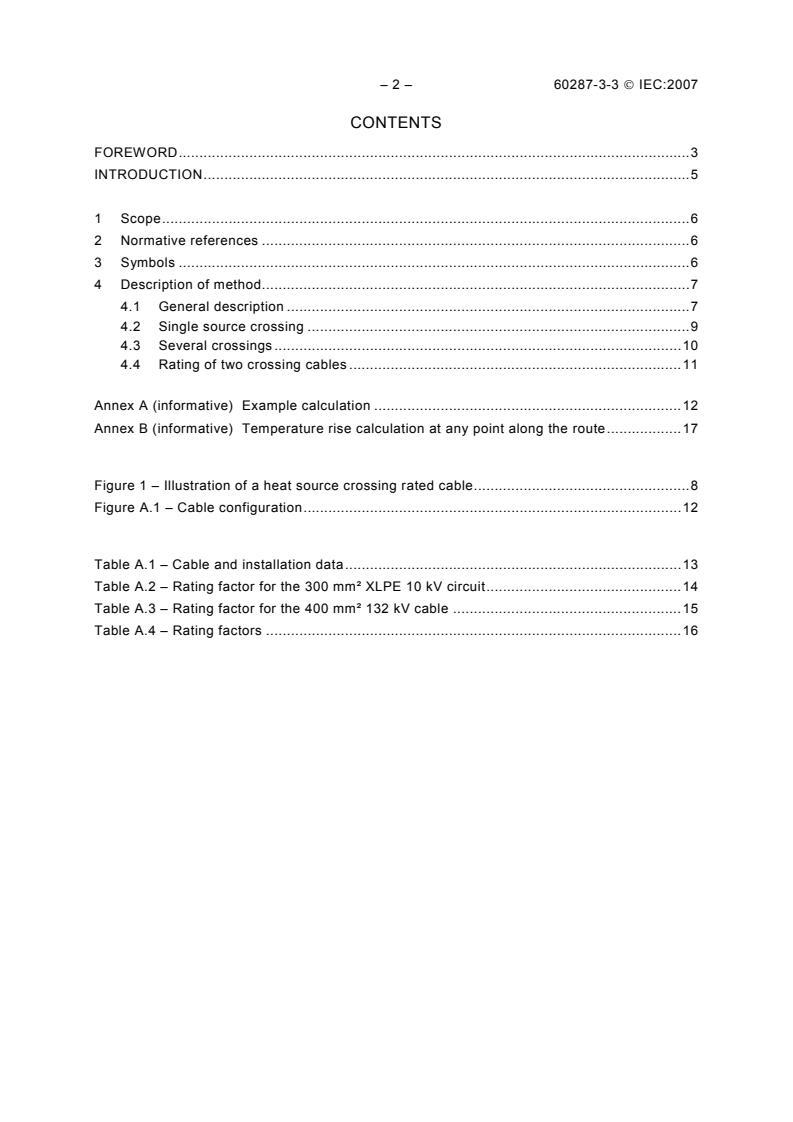
– 2 – 60287-3-3 © IEC:2007
CONTENTS
FOREWORD.3
INTRODUCTION.5
1 Scope.6
2 Normative references .6
3 Symbols .6
4 Description of method.7
4.1 General description .7
4.2 Single source crossing .9
4.3 Several crossings .10
4.4 Rating of two crossing cables .11
Annex A (informative) Example calculation .12
Annex B (informative) Temperature rise calculation at any point along the route.17
Figure 1 – Illustration of a heat source crossing rated cable.8
Figure A.1 – Cable configuration.12
Table A.1 – Cable and installation data.13
Table A.2 – Rating factor for the 300 mm² XLPE 10 kV circuit.14
Table A.3 – Rating factor for the 400 mm² 132 kV cable .15
Table A.4 – Rating factors .16
60287-3-3 © IEC:2007 – 3 –
INTERNATIONAL ELECTROTECHNICAL COMMISSION
___________
ELECTRIC CABLES –
CALCULATION OF THE CURRENT RATING –
Part 3-3: Sections on operating conditions –
Cables crossing external heat sources
FOREWORD
1) The International Electrotechnical Commission (IEC) is a worldwide organization for standardization comprising
all national electrotechnical committees (IEC National Committees). The object of IEC is to promote
international co-operation on all questions concerning standardization in the electrical and electronic fields. To
this end and in addition to other activities, IEC publishes International Standards, Technical Specifications,
Technical Reports, Publicly Available Specifications (PAS) and Guides (hereafter referred to as “IEC
Publication(s)”). Their preparation is entrusted to technical committees; any IEC National Committee interested
in the subject dealt with may participate in this preparatory work. International, governmental and non-
governmental organizations liaising with the IEC also participate in this preparation. IEC collaborates closely
with the International Organization for Standardization (ISO) in accordance with conditions determined by
agreement between the two organizations.
2) The formal decisions or agreements of IEC on technical matters express, as nearly as possible, an international
consensus of opinion on the relevant subjects since each technical committee has representation from all
interested IEC National Committees.
3) IEC Publications have the form of recommendations for international use and are accepted by IEC National
Committees in that sense. While all reasonable efforts are made to ensure that the technical content of IEC
Publications is accurate, IEC cannot be held responsible for the way in which they are used or for any
misinterpretation by any end user.
4) In order to promote international uniformity, IEC National Committees undertake to apply IEC Publications
transparently to the maximum extent possible in their national and regional publications. Any divergence
between any IEC Publication and the corresponding national or regional publication shall be clearly indicated in
the latter.
5) IEC provides no marking procedure to indicate its approval and cannot be rendered responsible for any
equipment declared to be in conformity with an IEC Publication.
6) All users should ensure that they have the latest edition of this publication.
7) No liability shall attach to IEC or its directors, employees, servants or agents including individual experts and
members of its technical committees and IEC National Committees for any personal injury, property damage or
other damage of any nature whatsoever, whether direct or indirect, or for costs (including legal fees) and
expenses arising out of the publication, use of, or reliance upon, this IEC Publication or any other IEC
Publications.
8) Attention is drawn to the Normative references cited in this publication. Use of the referenced publications is
indispensable for the correct application of this publication.
9) Attention is drawn to the possibility that some of the elements of this IEC Publication may be the subject of
patent rights. IEC shall not be held responsible for identifying any or all such patent rights.
International Standard IEC 60287-3-3 has been prepared by IEC technical committee 20:
Electric cables.
The text of this standard is based on the following documents:
FDIS Report on voting
20/879/FDIS 20/882/RVD
Full information on the voting for the approval of this standard can be found in the report on
voting indicated in the above table.
This publication has been drafted in accordance with the ISO/IEC Directives, Part 2.
– 4 – 60287-3-3 © IEC:2007
A list of all the parts in the IEC 60287 series, under the general title Electric cables –
Calculation of the current rating, can be found on the IEC website.
The committee has decided that the contents of this publication will remain unchanged until
the maintenance result date indicated on the IEC web site under "http://webstore.iec.ch" in
the data related to the specific publication. At this date, the publication will be
• reconfirmed,
• withdrawn,
• replaced by a revised edition, or
• amended.
60287-3-3 © IEC:2007 – 5 –
INTRODUCTION
In the IEC 60287 series, Part 1 provides general formulae for ratings and power losses of
electric cables.
Part 2 presents formulae for thermal resistance, with Part 2-1 providing general calculation
methods for thermal resistance.
Part 2-1 provides calculation methods for dealing with groups of buried cables (see 2.2.3).
These methods assume that the cables are laid in parallel and hence every cable acts as a
parallel line heat source.
This Part 3-3 deals with the crossing of a cable, at right angles or obliquely with another
cable, and, more generally, with any linear heat source, such as steam pipes.
When heat sources are installed in the vicinity of a cable, the permissible current-carrying
capacity of the cable should be reduced to avoid overheating. But applying formulae that are
valid for parallel routes would overestimate the thermal influence of the crossing heat source
on the cable.
In this standard a general simplified method is provided to estimate the reduction of the
permissible current-carrying capacity of a cable crossed by heat sources.
Every cable and heat source is assumed to be laid horizontally.
– 6 – 60287-3-3 © IEC:2007
ELECTRIC CABLES –
CALCULATION OF THE CURRENT RATING –
Part 3-3: Sections on operating conditions –
Cables crossing external heat sources
1 Scope
This part of IEC 60287 describes a method for calculating the continuous current rating factor
for cables of all voltages where crossings of external heat sources are involved. The method
is applicable to any type of cable.
The method assumes that the entire region surrounding a cable, or cables, has uniform
thermal characteristics and that the principle of superposition applies. The principle of
superposition does not strictly apply to touching cables and hence the calculation method set
out in this standard will produce an optimistic result if applied to touching cables.
2 Normative references
The following referenced documents are indispensable for the application of this document.
For dated references, only the edition cited applies. For undated references, the latest edition
of the referenced document (including any amendments) applies.
IEC 60287 (all parts), Electric cables – Calculation of the current rating
3 Symbols
A Conductor cross-sectional area mm²
DF Ratio of the permissible current when taking into account the presence of -
crossing heat sources to the permissible current of the isolated cable
(derating factor)
I
Maximum permissible current of the rated cable when isolated A
L
Depth of laying, to cable axis, of the rated cable m
L
Depth of laying of heat source h m
h
N Number of intervals in the spatial discretization for the calculations
T Thermal resistance per core between conductor and sheath
K×m/W
T Thermal resistance between sheath and armour
K×m/W
T Thermal resistance of external serving
K×m/W
T Thermal resistance of surrounding medium (ratio of cable surface
K×m/W
temperature rise above ambient to the losses per unit length)
T Mutual thermal resistance between cable and heat source
K×m/W
mh
T Equivalent thermal resistance of cable per conductor
K×m/W
T Total thermal resistance of cable per conductor K×m/W
r
T Thermal longitudinal resistance of a conductor K/m/W
L
W Dielectric losses per unit length per phase W/m
d
60287-3-3 © IEC:2007 – 7 –
W Heat generated in the rated cable, due to losses in a conductor, assuming W/m
g
a conductor temperature of 20 °C
W Heat generated by external heat source h W/m
h
k Number of heat sources, crossing the rated cable -
z Location of the hottest point on the route of the rated cable(z co-ordinate) m
r
when several crossings are considered
z Distance along the cable route from the hottest point to the point where m
max
longitudinal heat flux is negligible
Number of cores -
n
-1
α Temperature coefficient of electrical resistivity at 20 °C, per Kelvin K
β Crossing angle Radian
-1
γ Attenuation factor m
λ Ratio of the total losses in metallic sheaths to the total conductor -
losses(sheath/screen loss factor)
λ Ratio of the total losses in armour to the total conductor losses -
(armour loss factor)
Soil thermal resistivity
ρ K×m/W
ρ Conductor thermal resistivity K×m/W
cr
θ Maximum permissible conductor temperature °C
max
Δθ Conductor temperature rise due to dielectric losses K
d
Δθ Maximum permissible conductor temperature rise above ambient K
max
Δθ()z Temperature rise of the conductor(s) of the rated cable, due to crossing K
heat sources, at the point z in the cable route
Temperature rise of the conductor(s) of the rated cable, due to crossing K
Δθ (0)
heat sources, at the hottest point in the cable route
Temperature rise of the conductor(s) of the rated cable, due to the heat K
Δθ ()z
uh
source, h, without taking into account longitudinal heat flux
ΔW
Incremental heat generated due to change of conductor resistance W/K×m
Δz Length of an interval used in the calculations m
4 Description of method
4.1 General description
The conditions examined in this standard involve an external heat source crossing the route
of the rated cable(s). The crossing heat source can be located either above or below the rated
cable(s) with the crossing angle ranging from parallel to perpendicular. An example of such
situation is shown in Figure 1.
– 8 – 60287-3-3 © IEC:2007
Sectional view
y
x
Ground surface
z
L
h
Heat source
L
Cable
Plan view
z
β
Crossing angle
x
IEC 742/07
Figure 1 – Illustration of a heat source crossing rated cable
The conductor temperature rise along the route of the rated cable, caused by the heat
generated by the crossing heat source, may be calculated using Kennelly’s principle. The
temperature rise is maximum at the crossing point and decreases with the distance from the
crossing. The distance from the crossing along the cable route, where the longitudinal heat
flux is negligible, is denoted by z .
max
As a consequence of the varying temperature rise along the cable length, a longitudinal heat
flux is generated in the conductor, which leads to a reduction in the conductor temperature
rise at the crossing, compared to the case when this longitudinal flux is ignored.
The maximum permissible current in the cable to be rated, taking into account the presence of
a crossing heat source, is obtained by multiplying the steady-state rating of the cable, without
the crossing heat source, by a derating factor, DF, related to the heating due to the heat
source:
Δθ()0
DF = 1− (1)
Δθ − Δθ
max d
where Δθ()0 is the temperature rise of the conductor due to the crossing heat source, at the
crossing point.
60287-3-3 © IEC:2007 – 9 –
4.2 Single source crossing
The value of Δθ()0 is obtained from the following formula by dividing the distance z into N
max
intervals, each of length Δz:
γ ×Δz N 2 2
W × ρ × (e −1) ()L + L +(ν × Δz × sin β)
h −ν ×γ ×Δz h
Δθ()0 = e ln (2)
∑
2 2
4π
()L − L +(ν × Δz × sin β)
ν =1 h
where
ρ is the soil thermal resistivity;
W is the heat generated by external heat source;
h
β is the crossing angle;
L is the laying depth of the rated cable;
L is the laying depth of the heat source.
h
The attenuation factor γ is expressed as
T
L
γ =()1− ΔW × T × (3)
T
r
with
ρ
cr
T = (4)
L
−6
A⋅10
( )
T = T + n⋅ T +T +T (5)
r 1 2 3 4
T = T + n ×[]()1+ λ × T +(1+ λ + λ)×(T + T) (6)
1 1 2 1 2 3 4
⎡ T ⎤
()
Δθ = W × + n × T + T + T (7)
d d 2 3 4
⎢ ⎥
⎣ ⎦
⎡ Δθ()0 ⎤
ΔW = ΔW ×1− (8)
0 ⎢ ⎥
Δθ − Δθ
⎣ max d⎦
R × α × I
ΔW = (9)
()
1 + α × θ − 20
20 max
where
ρ is the conductor thermal resistivity;
cr
For copper ρ = 0,0026 Kxm/W; for aluminium ρ = 0,004 9 Kxm/W.
cr cr
A is the conductor cross-sectional area;
α is the temperature coefficient of electrical resistivity for the conductor material;
I is the maximum permissible current of the rated cable when isolated.
The remaining variables are defined in other parts of the IEC 60287 series.
– 10 – 60287-3-3 © IEC:2007
Typically a value of Δz = 0,01 m may be used. It has to be verified that:
γ × Δz < ε (10)
z
max
N is determined from: N = with Δθ()N × Δz < ε (11)
uh
Δz
where ε is a small value, typically 0,01. The distance z is a function of the longitudinal
max
thermal resistance of the conductors, the separation between the cable and the heat source
and the heat generated by the crossing source. In the example in Annex A a value of 5 m is
used.
Δθ ()z represents the temperature rise in the conductor, as a function of the distance z from
uh
the crossing, caused by the crossing heat source. This temperature can be obtained by
applying Kennelly’s principle:
2 2 2
ρ ()L + L + z × sin β
h
()
Δθ z = ×W × ln (12)
uh h
2 2 2
4π
()L − L + z × sin β
h
As γ depends upon the current in the rated cable, which is to be determined, an iterative
solution is necessary, using as a first estimation of this current the rated current when the
heat source is assumed to be parallel to the rated cable.
The first estimate of Δθ()0 is as follows:
()L + L
ρ
h
Δθ()0 = ×W × ln (13)
h
4π
()L − L
h
4.3 Several crossings
The derating factor, Equation (1) in 4.1, can be generalized for several heat sources crossing
the rated cable by applying a superposition principle. In order to make this generalization, it is
assumed that the point z = 0 is the position where the temperature of the rated cable is at its
maximum.
NOTE If the position of the hottest point can not be predetermined it may be necessary to perform the calculation
at several points to ensure that the hottest point is found.
When several heat sources cross the rated cable (for example, the heat source is another
cable circuit composed of several cables), the same equation is valid, i.e. the derating factor
has the same expression:
Δθ()0
DF =1 (− 14)
Δθ − Δθ
max d
where the term Δθ (0) takes into account the effect of every heat source h.
60287-3-3 © IEC:2007 – 11 –
k
()
Δθ 0 = T ×W (15)
∑ mh h
h=1
Let the rated cable have the designation r and z be the z-coordinate of the hottest point in
r
cable r. Then, for any other heat source h, located at the z-coordinate z = z , we have
h
γ ×Δz N
()L + L +[]()z − z + v × Δz × sin β
ρ × (e − 1)
r h r h h
−v×γ ×Δz
T = × e ln (16)
mh ∑
4π
()L − L +[]()z − z + v × Δz × sin β
v =1
r h r h h
where
k is the number of heat sources crossing the rated cable;
L is the laying depth of heat source h.
h
The attenuation factor γ shall be calculated from Equation (3) with, as a first estimate:
k 2 2
()L + L +(z − z)
ρ
h r h
Δθ()0 = × W × ln (17)
h
∑
2 2
4 ×π
()L − L +(z − z)
h=1
h r h
4.4 Rating of two crossing cables
To calculate the maximum permissible current in each cable, an iterative procedure is
necessary. The first stage in the procedure is to calculate the derating factor for one cable,
assuming that the other cable is carrying its maximum permissible current, when isolated. The
derating factor for the second cable is then calculated, assuming that the first cable is
carrying its derated current. This is repeated for each cable until there is no change in the
calculated derating factors.
For example consider two circuits having maximum permissible currents, when isolated, I
and I :
a) First, the derating factor for circuit 1, DF , is calculated, assuming that circuit 2, is carrying
its maximum permissible current, I .
b) Then, the derating factor for circuit 2, DF , is calculated assuming that circuit 1 is carrying
its derated current, I x DF . That is W is based on I x DF .
1 1 h 1 1
c) A new value for the derating factor for circuit 1, DF , is calculated assuming that circuit 2
is carrying its derated current, I × DF . In this calculation the values of Δθ and θ in
2 2 max max
Equations (8) and (9) are based on I x DF and I is replaced by I x DF in Equation (9).
1 1 1 1
d) The derating factor for circuit 2 is then recalculated, as described for circuit 1 in step c).
e) Steps c) and d) are repeated until there is no change in the calculated derating factors.
– 12 – 60287-3-3 © IEC:2007
Annex A
(informative)
Example calculation
The example chosen is that of a 10 kV circuit of 300 mm² Cu - XLPE single-core cables laid in
flat formation (with a 0,072 m spacing) and a 400 mm² Cu -132 kV three-core oil-filled cable.
y
x
Cable 2
Oil-filled cable
L = 0,90 m
z
x
L = 1,2 m
z
2 2
10 kV cables
Cable 1
0,072 m
IEC 743/07
Figure A.1 – Cable configuration
The following details are required for the calculation of the derating factor:
− ambient temperature θ = 25 °C;
amb
− soil resistivity = 0,8 K×m/W;
− crossing angle = 90° (circuits are at right angles).
60287-3-3 © IEC:2007 – 13 –
Table A.1 – Cable and installation data
Cable characteristics (hottest cable)
Cable type 10 kV 132 kV
Cross-sectional area A (mm²) 300 400
Maximum permissible temperature
θ (°C) 90 85
max
Current rating of isolated cable 665 585
I (A)
0,0781 0,0615
R (ohm/km)
Conductor resistance at θ
max
Concentric sheath/ screen wires loss factor 0,089 0,135
λ
Armour loss factor 0 0
λ
0,214 0,835
T (K×m/W)
Thermal resistance of insulation
0,104 0,090
Thermal resistance of jacket/sheath T (K×m/W)
1,427 0,445
T (K×m/W)
External thermal resistance 100 % LF
34,54 21,05
Conductor losses per core W (W/m)
c
0 2,01
W (W/m)
Dielectric losses per core
d
37,61 23,89
Total joule losses per core W (W/m)
I
37,61 25,90
Total losses per core W (W/m)
1,20 0,90
Laying depth (m) L (m)
– 14 – 60287-3-3 © IEC:2007
Table A.2 – Derating factor for 300 mm² XLPE 10 kV circuit
Cable type: 300 mm² XLPE 10 kV
Characteristics Equation
Longitudinal thermal resistance
−6
K/m×W 4
0,0026 / 300 ×10 = 8,67
of the conductors
T
L
T
r
K×m/W 0,214 + 0,104 + 1,427 = 1,745 5
T 0,214 + 1,09 ×()0,104 + 1,427 = 1,88
K×m/W 6
Δθ °C
90 − 25 = 65
max
Δθ
°C 0 7
d
−3 2
0,0781×10 ×0,00393 × 665
−2
ΔW W/m 9
= 10,64 ×10
1+ 0,00393 ×()90 − 20
Computing derating factor With: Δz = 0,01 m - N > 500
⎡ ⎤
0,8 × 25,90 ×3 ()1,20 + 0,9
°C ×ln⎢ ⎥ = 19,2 13
First estimate of Δθ
4 ×π
()1,20 − 0,9
⎢ ⎥
⎣ ⎦
⎛ 19,2⎞
−2
10,64 ×10 × 1− = 0,075 8
⎜ ⎟
First estimate of ΔW
W/K ×m
⎝ ⎠
()1− 0,075 ×1,88 ×8,67
–1
= 2,07
m
First estimate of γ
1,745
°C 14,1 2
Final estimate of Δθ
(second iteration)
14,1
1− = 0,89
Derating factor DF
The derating factor calculated above is that which is applied to the current rating of the 10 kV
cables to take account of the temperature rise due to the crossing 132 kV cable. This factor
does not take account of the temperature rise in the 132 kV cable due to the crossing 10 kV
cables (see 4.4).
60287-3-3 © IEC:2007 – 15 –
Table A.3 – Derating factor for 400 mm² 132 kV cable
Cable type: 400 mm² 132 kV
Characteristics Equation
longitudinal thermal resistance of
−6
K/m×W 4
0,002 6 / 400 ×10 = 6,5
the conductors T
L
T 0,835 + 3 ×()0,09 + 0,445 = 2,44
K×m/W 5
r
T K×m/W 0,835 + 3 ×1,135 ×()0,09 + 0,445 = 2,66 6
Δθ °C
max 85 − 25 = 60
⎡ 0,835 ⎤
2,01× + 3 ×()0,09 + 0,445 = 4,1
Δθ °C 7
d
⎢ ⎥
⎣ ⎦
−3 2
0,0615 ×10 × 0,00393 × 585
−2
ΔW W/m 9
= 6,59 ×10
1+ 0,00393 ×()85 − 20
With: Δz = 0,01 m – N > 500
Computing derating factor
⎧ ⎫
⎡ ⎤
()1,2 + 0,9
⎪ln + ⎪
⎢ ⎥
⎪ ⎪
⎢()1,2 − 0,9 ⎥
0,8 × 37,61
⎪ ⎣ ⎦ ⎪
× = 27,7
⎨ ⎬
°C 17
4 × π 2
First estimate of Δθ ⎡ ⎤
⎪ ⎪
()1,2 + 0,9 + 0,072
2 ×ln
⎢ ⎥
⎪ ⎪
2 2
⎢()1,2 − 0,9 + 0,072 ⎥
⎪ ⎪
⎣ ⎦
⎩ ⎭
⎛ 27,7 ⎞
−2
6,59 ×10 ×⎜1− ⎟ = 0,033 8
First estimate of ΔW W/K×m
60 − 5,2
⎝ ⎠
()1− 0,033 × 2,66 6,5
–1
= 1,558 3
First estimate of γ m
2,44
First estimate of mutual thermal
resistance:
Left cable
K×m/W 0,156 16
Middle cable
K×m/W 0,165 16
Right cable
0,174 16
K×m/W
Second estimate of Δθ (1st
18,6 15
iteration)
°C
Final estimate of Δθ (2nd
°C 18,5 15 + 16
iteration)
18,5
1− = 0,82
...
Questions, Comments and Discussion
Ask us and Technical Secretary will try to provide an answer. You can facilitate discussion about the standard in here.
Loading comments...