

IEC 62878-1-1:2015
(Main)Device embedded substrate - Part 1-1: Generic specification - Test methods
General Information
- Abstract
IEC 62878-1-1:2015 specifies the test methods of passive and active device embedded substrates. The basic test methods of printed wiring substrate materials and substrates themselves are specified in IEC 61189-3. This part of IEC 62878 is applicable to device embedded substrates fabricated by use of organic base material, which include for example active or passive devices, discrete components formed in the fabrication process of electronic wiring board, and sheet formed components.
- Status
- Published
- Publication Date
- 19-May-2015
- Technical Committee
- TC 91 - Electronics assembly technology
- Drafting Committee
- WG 6 - TC 91/WG 6
- Current Stage
- PPUB - Publication issued
- Start Date
- 20-May-2015
- Completion Date
- 15-Jun-2015
Overview
IEC 62878-1-1:2015 is an international standard developed by the International Electrotechnical Commission (IEC) that outlines the generic test methods for passive and active device embedded substrates. This specification focuses on testing device embedded substrates fabricated using organic base materials, encompassing embedded discrete passive or active electronic devices and sheet-formed components integrated during the electronic wiring board manufacturing process. The standard operates alongside IEC 61189-3, which covers test methods for printed wiring substrate materials and substrates themselves.
Device embedded substrates are increasingly utilized in advanced electronic assemblies, where miniaturization and higher functionality are required. By embedding components directly within the substrate, manufacturers can reduce product size, enhance electrical performance, and increase design flexibility. IEC 62878-1-1 is vital to ensure the quality, reliability, and consistency of these embedded technology solutions.
Key Topics
IEC 62878-1-1 covers several essential aspects for device embedded substrate testing:
- Visual Inspection and Micro-sectioning: Procedures for inspecting substrate appearance, finish, pattern, and the internal structure via micro-sectioning to assess quality and detect defects such as delamination, cracks, or poor plating.
- Electrical Testing: Standardized electrical test methods for measuring conductor resistance, through hole and via integrity, current carrying capacity, insulation resistance, and voltage withstand capabilities.
- Mechanical Testing: Methods to determine the mechanical robustness of conductors and holes, including pulling strength, adhesivity of plated foils, solder resist layers, and coated films.
- Environmental Testing: Criteria for evaluating the substrate’s reliability under various conditions through thermal shock, humidity resistance, and high-temperature immersion tests.
- Shipping Inspection: Guidelines to verify product quality during final inspection prior to shipping, including electrical, internal transparent, and visual inspections to ensure compliance with specifications.
- Terminology and Definitions: Adoption of standardized vocabulary as defined in IEC 60194 to maintain consistency in description and communication.
Applications
The standardized test methods outlined in IEC 62878-1-1 have direct practical applications in the electronics manufacturing industry, particularly for:
- Advanced Printed Circuit Board (PCB) Manufacture: Ensuring reliability and quality of high-density PCBs with embedded components for use in telecommunications, computing, automotive, and medical electronics.
- Quality Assurance and Conformity Assessment: Enabling manufacturers to demonstrate product quality, meet industry certifications, and fulfill customer requirements.
- Process Optimization: Supporting process control during substrate fabrication, allowing for rapid identification and mitigation of defects or process anomalies.
- Product Miniaturization: Facilitating the development of compact, multifunctional electronic systems by guaranteeing the integrity of embedded substrates.
- Supplier and Customer Agreements: Providing a reference framework (AABUS - as agreed between user and supplier) for customizing specific test parameters to unique product or customer needs.
Related Standards
IEC 62878-1-1 should be used in conjunction with other IEC and international standards to ensure comprehensive compliance and interoperability, including:
- IEC 61189-3: Test methods for electrical materials, printed boards, and other interconnection structures.
- IEC 60194: Terms and definitions for printed board design, manufacture, and assembly.
- IEC 60068-2-1 / 2-2: Environmental testing procedures for cold and dry heat conditions.
- IEC TS 62878-2-4: Guidelines and test element groups (TEG) for device embedded substrates.
Conclusion
IEC 62878-1-1:2015 establishes fundamental test methods for device embedded substrates, supporting the electronics industry’s drive towards greater integration, reliability, and miniaturization. Adherence to this standard helps manufacturers deliver high-quality, high-performance electronic assemblies that meet global market expectations. By harmonizing testing practices across the supply chain, IEC 62878-1-1 plays a key role in quality assurance, risk reduction, and technological advancement in embedded component technology.
Frequently Asked Questions
IEC 62878-1-1:2015 is a standard published by the International Electrotechnical Commission (IEC). Its full title is "Device embedded substrate - Part 1-1: Generic specification - Test methods". This standard covers: IEC 62878-1-1:2015 specifies the test methods of passive and active device embedded substrates. The basic test methods of printed wiring substrate materials and substrates themselves are specified in IEC 61189-3. This part of IEC 62878 is applicable to device embedded substrates fabricated by use of organic base material, which include for example active or passive devices, discrete components formed in the fabrication process of electronic wiring board, and sheet formed components.
IEC 62878-1-1:2015 specifies the test methods of passive and active device embedded substrates. The basic test methods of printed wiring substrate materials and substrates themselves are specified in IEC 61189-3. This part of IEC 62878 is applicable to device embedded substrates fabricated by use of organic base material, which include for example active or passive devices, discrete components formed in the fabrication process of electronic wiring board, and sheet formed components.
IEC 62878-1-1:2015 is classified under the following ICS (International Classification for Standards) categories: 31.180 - Printed circuits and boards; 31.190 - Electronic component assemblies. The ICS classification helps identify the subject area and facilitates finding related standards.
IEC 62878-1-1:2015 is available in PDF format for immediate download after purchase. The document can be added to your cart and obtained through the secure checkout process. Digital delivery ensures instant access to the complete standard document.
Standards Content (Sample)
IEC 62878-1-1 ®
Edition 1.0 2015-05
INTERNATIONAL
STANDARD
NORME
INTERNATIONALE
colour
inside
Device embedded substrate –
Part 1-1: Generic specification – Test methods
Substrat avec appareil(s) intégré(s) –
Partie 1-1: Spécification générique – Méthodes d'essai
All rights reserved. Unless otherwise specified, no part of this publication may be reproduced or utilized in any form
or by any means, electronic or mechanical, including photocopying and microfilm, without permission in writing from
either IEC or IEC's member National Committee in the country of the requester. If you have any questions about IEC
copyright or have an enquiry about obtaining additional rights to this publication, please contact the address below or
your local IEC member National Committee for further information.
Droits de reproduction réservés. Sauf indication contraire, aucune partie de cette publication ne peut être reproduite
ni utilisée sous quelque forme que ce soit et par aucun procédé, électronique ou mécanique, y compris la photocopie
et les microfilms, sans l'accord écrit de l'IEC ou du Comité national de l'IEC du pays du demandeur. Si vous avez des
questions sur le copyright de l'IEC ou si vous désirez obtenir des droits supplémentaires sur cette publication, utilisez
les coordonnées ci-après ou contactez le Comité national de l'IEC de votre pays de résidence.
IEC Central Office Tel.: +41 22 919 02 11
3, rue de Varembé Fax: +41 22 919 03 00
CH-1211 Geneva 20 info@iec.ch
Switzerland www.iec.ch
About the IEC
The International Electrotechnical Commission (IEC) is the leading global organization that prepares and publishes
International Standards for all electrical, electronic and related technologies.
About IEC publications
The technical content of IEC publications is kept under constant review by the IEC. Please make sure that you have the
latest edition, a corrigenda or an amendment might have been published.
IEC Catalogue - webstore.iec.ch/catalogue Electropedia - www.electropedia.org
The stand-alone application for consulting the entire The world's leading online dictionary of electronic and
bibliographical information on IEC International Standards, electrical terms containing more than 30 000 terms and
Technical Specifications, Technical Reports and other definitions in English and French, with equivalent terms in 15
documents. Available for PC, Mac OS, Android Tablets and additional languages. Also known as the International
iPad. Electrotechnical Vocabulary (IEV) online.
IEC publications search - www.iec.ch/searchpub IEC Glossary - std.iec.ch/glossary
The advanced search enables to find IEC publications by a More than 60 000 electrotechnical terminology entries in
variety of criteria (reference number, text, technical English and French extracted from the Terms and Definitions
committee,…). It also gives information on projects, replaced clause of IEC publications issued since 2002. Some entries
and withdrawn publications. have been collected from earlier publications of IEC TC 37,
77, 86 and CISPR.
IEC Just Published - webstore.iec.ch/justpublished
Stay up to date on all new IEC publications. Just Published IEC Customer Service Centre - webstore.iec.ch/csc
details all new publications released. Available online and If you wish to give us your feedback on this publication or
also once a month by email. need further assistance, please contact the Customer Service
Centre: csc@iec.ch.
A propos de l'IEC
La Commission Electrotechnique Internationale (IEC) est la première organisation mondiale qui élabore et publie des
Normes internationales pour tout ce qui a trait à l'électricité, à l'électronique et aux technologies apparentées.
A propos des publications IEC
Le contenu technique des publications IEC est constamment revu. Veuillez vous assurer que vous possédez l’édition la
plus récente, un corrigendum ou amendement peut avoir été publié.
Catalogue IEC - webstore.iec.ch/catalogue Electropedia - www.electropedia.org
Application autonome pour consulter tous les renseignements
Le premier dictionnaire en ligne de termes électroniques et
bibliographiques sur les Normes internationales,
électriques. Il contient plus de 30 000 termes et définitions en
Spécifications techniques, Rapports techniques et autres
anglais et en français, ainsi que les termes équivalents dans
documents de l'IEC. Disponible pour PC, Mac OS, tablettes
15 langues additionnelles. Egalement appelé Vocabulaire
Android et iPad.
Electrotechnique International (IEV) en ligne.
Recherche de publications IEC - www.iec.ch/searchpub
Glossaire IEC - std.iec.ch/glossary
Plus de 60 000 entrées terminologiques électrotechniques, en
La recherche avancée permet de trouver des publications IEC
en utilisant différents critères (numéro de référence, texte, anglais et en français, extraites des articles Termes et
comité d’études,…). Elle donne aussi des informations sur les Définitions des publications IEC parues depuis 2002. Plus
projets et les publications remplacées ou retirées. certaines entrées antérieures extraites des publications des
CE 37, 77, 86 et CISPR de l'IEC.
IEC Just Published - webstore.iec.ch/justpublished
Service Clients - webstore.iec.ch/csc
Restez informé sur les nouvelles publications IEC. Just
Published détaille les nouvelles publications parues. Si vous désirez nous donner des commentaires sur cette
Disponible en ligne et aussi une fois par mois par email. publication ou si vous avez des questions contactez-nous:
csc@iec.ch.
IEC 62878-1-1 ®
Edition 1.0 2015-05
INTERNATIONAL
STANDARD
NORME
INTERNATIONALE
colour
inside
Device embedded substrate –
Part 1-1: Generic specification – Test methods
Substrat avec appareil(s) intégré(s) –
Partie 1-1: Spécification générique – Méthodes d'essai
INTERNATIONAL
ELECTROTECHNICAL
COMMISSION
COMMISSION
ELECTROTECHNIQUE
INTERNATIONALE
ICS 31.180; 31.190 ISBN 978-2-8322-2674-2
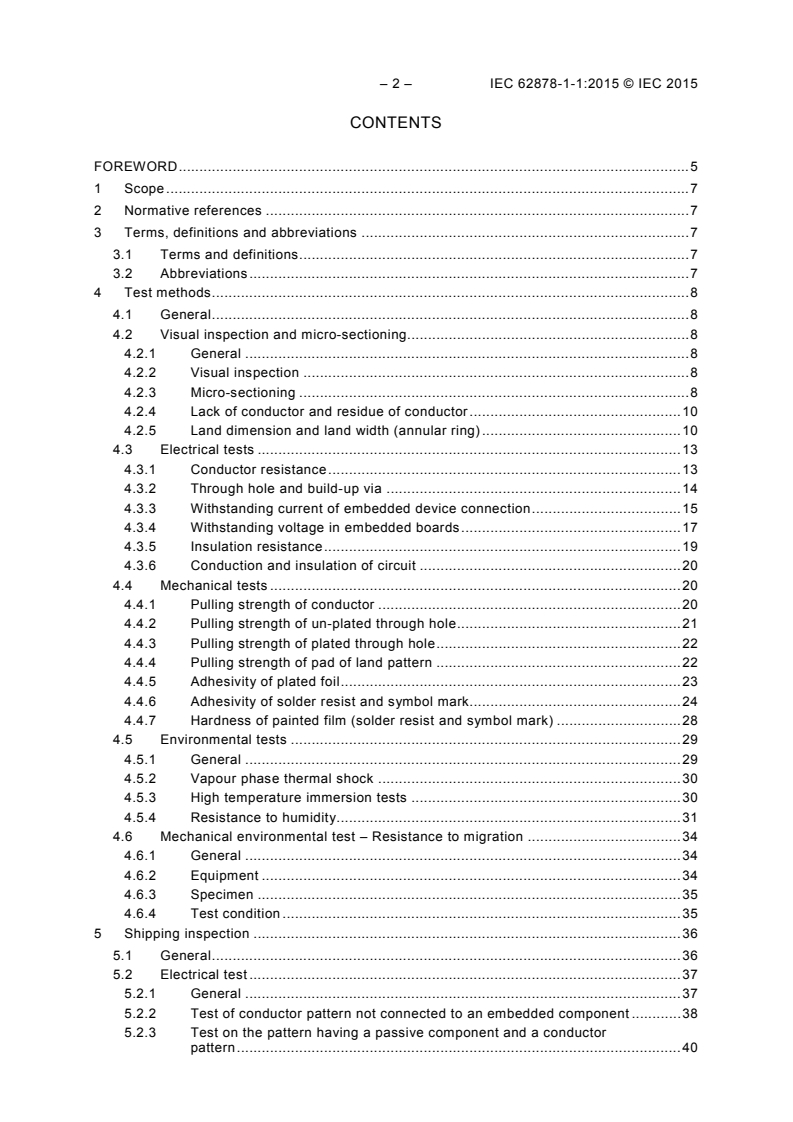
– 2 – IEC 62878-1-1:2015 © IEC 2015
CONTENTS
FOREWORD . 5
1 Scope . 7
2 Normative references . 7
3 Terms, definitions and abbreviations . 7
3.1 Terms and definitions . 7
3.2 Abbreviations . 7
4 Test methods . 8
4.1 General . 8
4.2 Visual inspection and micro-sectioning. 8
4.2.1 General . 8
4.2.2 Visual inspection . 8
4.2.3 Micro-sectioning . 8
4.2.4 Lack of conductor and residue of conductor . 10
4.2.5 Land dimension and land width (annular ring) . 10
4.3 Electrical tests . 13
4.3.1 Conductor resistance . 13
4.3.2 Through hole and build-up via . 14
4.3.3 Withstanding current of embedded device connection . 15
4.3.4 Withstanding voltage in embedded boards . 17
4.3.5 Insulation resistance . 19
4.3.6 Conduction and insulation of circuit . 20
4.4 Mechanical tests . 20
4.4.1 Pulling strength of conductor . 20
4.4.2 Pulling strength of un-plated through hole . 21
4.4.3 Pulling strength of plated through hole . 22
4.4.4 Pulling strength of pad of land pattern . 22
4.4.5 Adhesivity of plated foil . 23
4.4.6 Adhesivity of solder resist and symbol mark. 24
4.4.7 Hardness of painted film (solder resist and symbol mark) . 28
4.5 Environmental tests . 29
4.5.1 General . 29
4.5.2 Vapour phase thermal shock . 30
4.5.3 High temperature immersion tests . 30
4.5.4 Resistance to humidity . 31
4.6 Mechanical environmental test – Resistance to migration . 34
4.6.1 General . 34
4.6.2 Equipment . 34
4.6.3 Specimen . 35
4.6.4 Test condition . 35
5 Shipping inspection . 36
5.1 General . 36
5.2 Electrical test . 37
5.2.1 General . 37
5.2.2 Test of conductor pattern not connected to an embedded component . 38
5.2.3 Test on the pattern having a passive component and a conductor
pattern . 40
5.2.4 Test of a circuit having both active component(s) and a conductor
pattern . 43
5.2.5 Test of a circuit having connections of both individual passive
component(s) and conductor pattern . 46
5.2.6 Test of a circuit having an embedded component which cannot be
checked from the surface and a conductor pattern . 47
5.3 Internal transparent test . 47
5.4 Visual test . 47
Annex A (informative) Related test methods . 49
Bibliography . 52
Figure 1 – Measuring items of the micro-sectioned through hole structure . 9
Figure 2 – Measuring items of the micro-sectioned device embedded board with build-
up structure . 9
Figure 3 – Measurement of land dimension . 11
Figure 4 – Build-up land measurement . 12
Figure 5 – Conductor resistance measurement . 14
Figure 6 – Relationship between current, conductor width and thickness and
temperature rise . 17
Figure 7 – Adhesivity of plated film . 24
Figure 8 – Single cutting tool . 25
Figure 9 – Cutter knife . 25
Figure 10 – Multiple blade cutter . 26
Figure 11 – Equal-distance spacer with guide . 26
Figure 12 – Cutting using a single cutting tool or a cutting knife . 27
Figure 13 – Cross-cut test . 28
Figure 14 – Coated film hardness test . 29
Figure 15 – Temperature and humidity cycles . 33
Figure 16 – Device embedded board for shipping inspection . 36
Figure 17 – Typical circuit construction of device embedded board . 37
Figure 18 – Examples of evaluation levels of electrical test . 39
Figure 19 – Circuit construction not connected to embedded component . 39
Figure 20 – Circuit construction which is capable of independent check . 40
Figure 21 – Circuit construction for parallel connection of passive components . 42
Figure 22 – Circuit construction for series connection of passive components . 43
Figure 23 – Circuit construction of embedded diode . 44
Figure 24 – Circuit construction of transistor circuit . 44
Figure 25 – Circuit construction of a conductor pattern with embedded IC and LSI . 45
Figure 26 – Circuit construction composed of a passive component and an active
component . 46
Figure 27 – Circuit construction of embedded components having no connection
terminal on the surface . 47
Table 1 – Test items, characteristics and observations of micro-sectioned specimens . 9
Table 2 – Test method for coplanarity around the land pattern . 12
Table 3 – Characteristics and test methods for conductor resistance . 15
– 4 – IEC 62878-1-1:2015 © IEC 2015
Table 4 – Withstanding current and test methods . 16
Table 5 – Withstanding voltage and test methods . 18
Table 6 – Criteria and test methods for insulation resistance . 20
Table 7 – Characteristics and test method of pulling strength of conductor . 21
Table 8 – Dimensions of land, hole and conductor . 22
Table 9 – Characteristics and test methods of pulling strength of plated through hole . 22
Table 10 – Specification and test method of pad pulling strength of land pattern . 23
Table 11 – High and low temperature characteristics and tests . 30
Table 12 – Thermal shock characteristics and test methods . 30
Table 13 – Thermal shock (high temperature immersion test) . 31
Table 14 – Measuring environment . 31
Table 15 – Thermal shock (high temperature immersion tests) . 31
Table 16 – Resistance to humidity characteristics and test methods . 34
Table 17 – Resistance to migration characteristics and test methods . 35
Table 18 – Applicable items of shipping inspection . 37
Table A.1 – Related test methods . 49
INTERNATIONAL ELECTROTECHNICAL COMMISSION
____________
DEVICE EMBEDDED SUBSTRATE –
Part 1-1: Generic specification – Test methods
FOREWORD
1) The International Electrotechnical Commission (IEC) is a worldwide organization for standardization comprising
all national electrotechnical committees (IEC National Committees). The object of IEC is to promote
international co-operation on all questions concerning standardization in the electrical and electronic fields. To
this end and in addition to other activities, IEC publishes International Standards, Technical Specifications,
Technical Reports, Publicly Available Specifications (PAS) and Guides (hereafter referred to as “IEC
Publication(s)”). Their preparation is entrusted to technical committees; any IEC National Committee interested
in the subject dealt with may participate in this preparatory work. International, governmental and non-
governmental organizations liaising with the IEC also participate in this preparation. IEC collaborates closely
with the International Organization for Standardization (ISO) in accordance with conditions determined by
agreement between the two organizations.
2) The formal decisions or agreements of IEC on technical matters express, as nearly as possible, an international
consensus of opinion on the relevant subjects since each technical committee has representation from all
interested IEC National Committees.
3) IEC Publications have the form of recommendations for international use and are accepted by IEC National
Committees in that sense. While all reasonable efforts are made to ensure that the technical content of IEC
Publications is accurate, IEC cannot be held responsible for the way in which they are used or for any
misinterpretation by any end user.
4) In order to promote international uniformity, IEC National Committees undertake to apply IEC Publications
transparently to the maximum extent possible in their national and regional publications. Any divergence
between any IEC Publication and the corresponding national or regional publication shall be clearly indicated in
the latter.
5) IEC itself does not provide any attestation of conformity. Independent certification bodies provide conformity
assessment services and, in some areas, access to IEC marks of conformity. IEC is not responsible for any
services carried out by independent certification bodies.
6) All users should ensure that they have the latest edition of this publication.
7) No liability shall attach to IEC or its directors, employees, servants or agents including individual experts and
members of its technical committees and IEC National Committees for any personal injury, property damage or
other damage of any nature whatsoever, whether direct or indirect, or for costs (including legal fees) and
expenses arising out of the publication, use of, or reliance upon, this IEC Publication or any other IEC
Publications.
8) Attention is drawn to the Normative references cited in this publication. Use of the referenced publications is
indispensable for the correct application of this publication.
9) Attention is drawn to the possibility that some of the elements of this IEC Publication may be the subject of
patent rights. IEC shall not be held responsible for identifying any or all such patent rights.
International Standard IEC 62878-1-1 has been prepared by IEC technical committee 91:
Electronics assembly technology.
The text of this standard is based on the following documents:
FDIS Report on voting
91/1248/FDIS 91/1260/RVD
Full information on the voting for the approval of this standard can be found in the report on
voting indicated in the above table.
A list of all parts in the IEC 62878, published under the general title Device embedded
substrate, can be found on the IEC website.
This publication has been drafted in accordance with the ISO/IEC Directives, Part 2.
– 6 – IEC 62878-1-1:2015 © IEC 2015
The committee has decided that the contents of this publication will remain unchanged until
the stability date indicated on the IEC web site under "http://webstore.iec.ch" in the data
related to the specific publication. At this date, the publication will be
• reconfirmed,
• withdrawn,
• replaced by a revised edition, or
• amended.
IMPORTANT – The 'colour inside' logo on the cover page of this publication indicates
that it contains colours which are considered to be useful for the correct
understanding of its contents. Users should therefore print this document using a
colour printer.
DEVICE EMBEDDED SUBSTRATE –
Part 1-1: Generic specification – Test methods
1 Scope
This part of IEC 62878 specifies the test methods of passive and active device embedded
substrates. The basic test methods of printed wiring substrate materials and substrates
themselves are specified in IEC 61189-3.
This part of IEC 62878 is applicable to device embedded substrates fabricated by use of
organic base material, which include for example active or passive devices, discrete
components formed in the fabrication process of electronic wiring board, and sheet formed
components.
The IEC 62878 series neither applies to the re-distribution layer (RDL) nor to the electronic
modules defined as an M-type business model in IEC 62421.
2 Normative references
The following documents, in whole or in part, are normatively referenced in this document and
are indispensable for its application. For dated references, only the edition cited applies. For
undated references, the latest edition of the referenced document (including any
amendments) applies.
IEC 60068-2-1, Environmental testing – Part 2-1: Tests – Test A: Cold
IEC 60068-2-2, Environmental testing – Part 2-2: Tests – Test B: Dry heat
IEC 60194, Printed board design, manufacture and assembly – Terms and definitions
IEC 61189-3, Test methods for electrical materials, printed boards and other interconnection
structures and assemblies – Part 3: Test methods for interconnection structures (printed
boards)
IEC TS 62878-2-4:2015, Device embedded substrate – Part 2-4 – Guidelines – Test element
groups (TEG)
3 Terms, definitions and abbreviations
3.1 Terms and definitions
For the purposes of this document, the terms and definitions given in IEC 60194 apply.
3.2 Abbreviations
AABUS as agreed between user and supplier
AOI automated optical inspection
LSI large scale integration
– 8 – IEC 62878-1-1:2015 © IEC 2015
4 Test methods
4.1 General
This clause is given for guidance only. The test shall be carried out at the standard air
conditions (or simply stated as standard environment):
Temperature Relative humidity Atmospheric pressure
15°C to 35°C 25 % to 75 % 86 kPa to 106 kPa
4.2 Visual inspection and micro-sectioning
4.2.1 General
Visual inspection and micro-sectioning of multi-layer printed wiring boards are specified in
4.2.2 and 4.2.3.
4.2.2 Visual inspection
Visual inspection consists of checking the appearance, finish, and pattern of specimens using
the naked eye or a magnifying glass in reference to its individual specification. The test result
shall be as agreed between user and supplier (hereafter referred as AABUS).
4.2.3 Micro-sectioning
Micro-sectioning is to check the state, appearance, and dimensions according to individual
specifications of the plated through hole, the via in the build-up layer, the conductor, the
interlayer distance, the conductor distance, and the connections to the embedded device. The
specimen is mounted in epoxy or polyester resin and the specimen is cross-sectioned and
polished for observation. The evaluation of the results shall be AABUS. The equipment,
material, specimen and test are specified in a) to d).
a) Equipment
An industrial microscope capable of measuring plated film thicknesses with an accuracy of
0,001 mm.
b) Material
Materials used in this test are releasing agent, moulding resin, polishing cloth or paper
(#180, #400, #1 000, etc.) with the option to use polishing materials (alumina or chromium
oxide).
c) Specimen
A specimen is cut from the product to an appropriate size sufficient for observation and
mounted in moulding resin. The cut surface is then polished with polishing cloth/paper
starting from coarse to fine using a rotating felt surface and the above mentioned polishing
material. The polishing face shall be within an angle of 85° to 95° to the layer to be
observed. The diameter of the plated film of the through hole and of the vias in the build-
up layer observed by micro-sectioning shall be no less than 90 % of the previously
observed hole diameter. Etch the specimen if the boundary of the plating needs to be
clarified after polishing.
d) Test
The test consists of observing the items specified in the individual specifications by means
of a microscope of specified magnification. Figure 1 illustrates the test items for the
through hole to check the micro-sectioned faces, and Figure 2 for the build-up structure
and embedded devices. Table 1 gives the characteristics and observation items of the test.
E
B
A
F
C
G
C
D
H
I
I J
IEC
Key
A Conductor width F Conductor plated film thickness
B Conductor gap G Thickness of copper foil
C Insulation layer thickness H Conductor thickness
D Hole diameter I Boundary of plated film
E Plated film thickness of through hole J Internal circuit
Figure 1 – Measuring items of the micro-sectioned through hole structure
A
B
IEC
Key
A Distance between conductor and embedded device
B Device embedding layer
Figure 2 – Measuring items of the micro-sectioned device
embedded board with build-up structure
Table 1 – Test items, characteristics and observations
of micro-sectioned specimens
No Test item Characteristics and observation
– Upper conductor width
Conductor width
1 – Lower conductor width
(inner layer , outer layer)
– Etch factor
2 Conductor gap (inner layer, outer layer) – Minimum conductor gap
– Minimum insulation layer/minimum conductor gap
– Delamination
3 Insulation layer thickness/conductor gap
– Measling
– Crazing
– Hole diameter
4 Hole diameter and land width
– Land width
– 10 – IEC 62878-1-1:2015 © IEC 2015
No Test item Characteristics and observation
– Plated film thickness of the through hole
– Plated film thickness of the via in the build-up layer
(conformal via)
5 Plated film thickness of the through hole
– Corner crack
– Barrel crack
– Foil crack
6 Film thickness of the plated conductor – Film thickness of the plated conductor
7 Copper foil thickness – Copper foil thickness
– Total conductor thickness(copper foil and film thickness
8 Conductor thickness
of the plated conductor)
Distance between conductor and
9 – Distance between conductor and embedded device
embedded device
– Thickness of the device embedding layer
– Delamination
10 Thickness of the device embedding layer
– Measling
– Crazing
4.2.4 Lack of conductor and residue of conductor
In order to measure lack and residue of conductor, a) and b) apply:
a) Equipment
An industrial microscope with an accuracy of at least 0,001 mm.
b) Measurement
Measure the lack of conductor and residue of the conductor in the vertical and horizontal
directions at the insulating area.
4.2.5 Land dimension and land width (annular ring)
4.2.5.1 Component insertion land and through hole land
In order to measure component insertion land and through hole land, a) and b) apply:
a) Equipment
An industrial microscope with an accuracy of at least 0,001 mm.
b) Measurement
1) Measure the land dimension d to d as illustrated in Figure 3.
1 4
2) Measure the left outer land width w to w as illustrated in Figure 3 by micro-sectioning
1 4
of the distance between the hall edge and not including the plated film and land edge
to better than 0,001 mm.
d
d
w
w
B
A
w
A
C
d
d
w
w
B
A
w
A 6
IEC
a) Non-plated hole b) Plated hole
Key
A Non-plated hole
B Plated hole
C Via in the build-up layer with the form of conformal via
d to d Maximum dimension of land
1 4
w to w Width of lands in outer layer
1 4
w , w Width of lands in inter layer
5 6
Figure 3 – Measurement of land dimension
4.2.5.2 Via (including interstitial via hole and via in the build-up layer)
In order to measure the via, a) and b) apply:
a) Equipment
Industrial microscope with an accuracy of at least 0,001 mm.
b) Measurement
1) Measure the land dimension d to d as illustrated in Figure 4.
1 4
2) It is not necessary to measure the land dimension w to w as shown in Figure 4
1 4
unless there is a problem with the electrical connection. The measurement can be
carried out upon agreement between user and supplier and by means of micro-
sectioning to better than 0,001 mm of the maximum dimension.
– 12 – IEC 62878-1-1:2015 © IEC 2015
d d
1 3
w
w
1 3
d
d
A
w
w
2 4
IEC
a) Conformal via b) Filled via
Key
A Insulation layer
d to d Maximum land dimension
1 4
w to w
Land edge width
1 4
Figure 4 – Build-up land measurement
4.2.5.3 Coplanarity
4.2.5.3.1 Bend
In order to measure the bend, a) and b) apply.
a) Equipment
A gap gauge or a height gauge with an accuracy of 0,1 mm or better shall be used.
b) Measurement
Place a device embedded board on a precision plate with the protruded side up and then
measure the maximum gap between the base and specimen to an accuracy of 0,1 mm to
find the bend.
4.2.5.3.2 Twist
In order to measure the twist, a) and b) apply
a) Equipment
A gap gauge or a height gauge with an accuracy of 0,1 mm or better shall be used.
b) Measurement
Place a device embedded board on a precision plate with the protruded side up with three
corners of the specimen touched to the plate and measure the distance between the plate
and the untouched corner of the specimen to an accuracy of 0,1 mm.
4.2.5.3.3 Test method
Table 2 gives the test method for coplanarity around the land pattern.
Table 2 – Test method for coplanarity around the land pattern
Item Criteria Test method
Effect on embedded device AABUS Use TEG in-place of an embedded device
A test for terminal connections of embedded devices is under
consideration.
4.3 Electrical tests
4.3.1 Conductor resistance
In order to check conductor resistance, a) to d) apply:
a) Equipment
Voltage drop method (four-terminal method) or equivalent. The measuring signal (voltage
or current) shall be DC or AC.
b) Specimen
The specimen is the specified section of the test pattern or the complex test pattern of a
device embedded board illustrated in IEC TS 62878-2-4:2015, Figures 1 to 27.
c) Pre-treatment
Pre-treatment shall be either 1) or 2), depending on the individual specifications.
1) Leave a specimen in the standard environment for 24 h ± 4 h.
2) Leave a specimen in a bath of 85 °C ± 2 °C for 4 h and then in the standard
environment for 24 h ± 4 h.
d) Test
The measurement shall be carried out as illustrated in Figure 5 to an accuracy of ± 5 %.
Ensure that effects of probe contacting and heating due to measuring current are avoided.
The specimen includes the connection between an embedded device and terminals, a
conductor including through hole and a via in the build-up layer.
– 14 – IEC 62878-1-1:2015 © IEC 2015
A B
A
B
IEC
B
A
IEC
a) Conductor resistance measurement b) Through hole resistance measurement
B A
A
B
IEC
A
B
IEC
c) Resistance measurement of via in the d) Resistance measurement of via in the inner
build-up layer conductor layer
A
B
D
C
IEC
e) Resistance measurement for connection
of embedded device
Key
A Current terminal C TEG
B Voltage terminal D Connection actually used
Figure 5 – Conductor resistance measurement
4.3.2 Through hole and build-up via
In order to check through hole and build-up via, a) to d) apply:
a) Equipment
The equipment shall be in accordance with 4.3.1 a).
b) Specimen
Specimen is the specified section of the test pattern or of the complex test pattern of a
device embedded board illustrated in Figures 1 to 27 of IEC TS 62878-2-4:2015.
c) Pre-treatment
Pre-treatment shall be in accordance with 4.3.1 c).
d) Test
Measurement shall be made as illustrated in Figure 5 to an accuracy of ± 5 % with an
effort to avoid effects of probe contacting and heating due to measuring current.
Table 3 gives the characteristics and test method for conductor resistance.
Table 3 – Characteristics and test methods for conductor resistance
Item Characteristics Test method
Connection to embedded device/Pad AABUS As indicated in 4.3.2, plated through hole and via in
connection/Via connection the build-up layer. Use TEG for embedded device.
4.3.3 Withstanding current of embedded device connection
In order to measure withstanding current of embedded device connection, a) to d) apply:
a) Equipment
A DC or AC power supply capable of giving the test current specified in Table 4 and an
ammeter. The equipment shall be a DC or AC power supply capable of giving the test
current specified in 4.3.2 a) and an ammeter.
b) Specimen
The specimen shall be the terminals of the TEG and the specified part of the complex test
pattern (Figures 1 to 28 in IEC TS 62878-2-4:2015). A zero ohm jumper resistor is
recommended for the TEG for an embedded device.
c) Pre-treatment
Pre-treatment shall be in accordance with 4.3.1 c).
d) Test
Check any abnormality after supplying a current contact terminal of TEG and pad on the
board with a specified current given its individual specification for 30 s. Test current for a
given hole diameter is given in Table 5.
Table 4 shows the withstanding current characteristics and test methods.
– 16 – IEC 62878-1-1:2015 © IEC 2015
Table 4 – Withstanding current and test methods
Item Characteristics Test method
Conductor Withstanding current As per 4.3.2 withstanding current for through hole and
characteristics shall be AABUS. via in the build-up layers.
The relationship between As per 4.3.3 withstanding current of conductor. Shape
current and conductor width, and dimension of specimen shall be AABUS.
conductor thickness and
temperature rise is shown in
Figure 6.
Through hole and As per 4.3.3 withstanding current of conductor. Shape
via in the build-up and dimension of specimen shall be AABUS.
layer
Embedded device As per 4.3.3 withstanding current of embedding device
connection. Use the TEG for embedded device. Internal
– Pad connection
resistance of the TEG shall be less than 50 mΩ. The test
current shall not exceed the rated current shown below.
– Via connection
Rated current is for steady state loading of 30 s.
The maximum overload current is defined for 2 s.
Type Rated current Maximum overload
70 °C, A current, A
0402 ― ―
0603 0,5 1,0
1005 1,0 2,0
1608 1,0 2,0
2,5
2,5
∆ t = 10 °C
∆ t = 10 °C
1,5
1,5
∆ t = 20 °C
∆ t = 20 °C
1,2
1,2
∆ t = 30 °C
∆ t = 30 °C
1,0
1,0
∆ t = 40 °C
∆ t = 40 °C
0,8
0,8
0,6
0,6
0,5
0,5
∆ t = 50 °C
∆ t = 50 °C
0,4
0,4
∆ t = 75 °C
∆ t = 75 °C
0,3
0,3
∆ t = 100 °C
∆ t = 100 °C
0,2
0,2
0,15
0,15
0,1
0,1
0,2 0,3 0,4 0,6 0,8 1 1,5 2 3 4 5 6 8 10
0,3 0,5 0,7 0,9 1,2 1,5 2 3 4 6 8 10 15
IEC
IEC
a) Conductor thickness is 18 µm b) Conductor thickness is 35 µm
2,5
2,5
∆ t = 10 °C
∆ t = 10 °C
1,5
∆ t = 20 °C
1,5
∆ t = 20 °C
1,2
∆ t = 30 °C
1,2
∆ t = 30 °C
1,0
∆ t = 40 °C 1,0
∆ t = 40 °C
0,8
0,8
0,6
0,6
0,5
0,5
∆ t = 50 °C
0,4
∆ t = 50 °C
0,4
∆ t = 75 °C
0,3 ∆ t = 75 °C
0,3
∆ t = 100 °C
∆ t = 100 °C
0,2
0,2
0,15
0,15
0,1 0,1
0,4 0,8 1,2 2 3 4 6 8 10 15 20
0,6 1 1,5 2 3 4 5 6 8 10 15 20 30
IEC
IEC
c) Conductor thickness is 70 µm d) Conductor thickness is 105 µm
X current (A)
Y conductor width (mm)
Figure 6 – Relationship between current, conductor width
and thickness and temperature rise
4.3.4 Withstanding voltage in embedded boards
4.3.4.1 General
Withstanding voltages of conductor, plated through hole and via in the build-up layers, inner
connection and connection to the embedded device shall be measured according to each
individual specification. This test shall be made only when the test of withstanding voltage is
required.
4.3.4.2 Withstanding voltage of inner layers in embedded boards
In order to measure withstanding voltage of inner layer in embedded boards, a) to d) apply:
a) Equipment
The equipment shall be in accordance with 4.3.2.a).
b) Specimen
– 18 – IEC 62878-1-1:2015 © IEC 2015
The specimen shall be manufactured to fit the connection terminal of the TEG in the
device embedding board or the pad of complex test pattern (see Figures 1 to 27 in
IEC TS 62878-2-4:2015). A specimen suffering from mechanical damage, flashover,
sparkover or breakdown shall not be used in further tests.
c) Pre-treatment
Pre-treatment shall be as described in 4.3.1 c).
d) Test
The test shall be as described in 4.3.1 d).
4.3.4.3 Withstanding voltage of embedded device connection
Items a) to d) apply:
a) Equipment
The equipment shall be in accordance with 4.3.1 a).
b) Specimen
The specimen shall be a specified part of the TEG in a device embedding board or
complex test pattern (Figures 1 to 27 of IEC TS 62878-2-4:2015). It is recommended to
use a zero ohm jumper resistor for the TEG. A specimen suffering from mechanical
damage, flush over, spark over or breakdown shall not be used in further tests.
c) Pre-treatment
Pre-treatment shall be as described in 4.3.1 c).
d) Test
The test shall be as described in 4.3.1 d).
Table 5 shows the test methods for withstanding voltage.
Table 5 – Withstanding voltage and test methods
Item Characteristics Test
Interlayer There should be no abnormality As stated in 4.3.4.2, interlayer surge voltage. The test voltage
such as mechanical damage, is given below.
flush-over or insulation
Interlayer distance x Test voltage
damage.
mm V
0,02 ≦ x < 0,05
0,05 ≦ x < 0,08
0,08 ≦ x < 0,20
1 000
0,20 ≦ x
Connection to There should be no abnormality As stated in 4.3.4.3, withstanding voltage for embedded
embedded such as mechanical damage, device.
device flush-over or insulation
Use the TEG for embedded device.
damage.
The internal resistance of the TEG shall be less than 50 mΩ.
Test below the isolation voltage of the TEG.
Isolation voltage
Type (effective value of
V or V )
dc ac
0402 ―
0603 30
1005 100
1608 100
4.3.5 Insulation resistance
4.3.5.1 General
The insulation resistance shall be measured between the terminals of the conductor the
embedded device based on individual specifications.
4.3.5.2 Insulation resistance of the inner layer
In order to measure insulation resistance of the inner layer, a) to d) apply:
a) Equipment
An insulation resistance tester capable of measuring values greater than 10 Ω.
b) Specimen
The specimen shall be a specified part of a device embedding board, test pattern or
complex test pattern (Figures 1 to 27 of IEC TS 62878-2-4:2015) including connection to
embedded device.
c) Pre-treatment
Pre-treatment shall be in accordance with 4.3.4.2 c).
d) Test
Apply a DC voltage of 10 V ± 1 V, 50 V ± 5 V, 100 V ± 10 V or 500 V ± 50 V depending on
the individual specification for 1 min and then measure the insulation resistance while
applying the voltage.
4.3.5.3 Insulation resistance between inner layers
In order to measure insulation resistance between inner layers, a) to d) apply:
a) Equipment
Equipment shall be in accordance with 4.3.1 a).
b) Specimen
The specimen shall be a specified part of a device embedding board, test pattern or a
complex test pattern (Figures 1 to 27 of IEC TS 62878-2-4:2015) including connection to
embedded device.
c) Pre-treatment
Pre-treatment shall be in accordance with 4.3.1 c).
d) Test
The test shall be in accordance with 4.3.1 d).
4.3.5.4 Insulation resistance between embedded terminals
In order to measure insulation resistance between embedded terminals, a) to d) apply:
a) Equipment
The equipment shall be in accordance with 4.3.4.3 a).
b) Specimen
The specimen shall be a specified part of a device embedding board, test pattern or a
complex test pattern (Figures 1 to 27 in IEC TS 62878-2-4:2015) including connection to
embedded device. It is recommended to use a zero ohm jumper resistor for TEG.
c) Pre-treatment
Pre-treatment shall be in accordance with 4.3.1 c).
d) Test
– 20 – IEC 62878-1-1:2015 © IEC 2015
The test shall be in accordance with 4.3.1 d).
Table 6 shows evaluation items of insulation resistance, characteris
...