


IEC 61097-4:2007
(Main)Global maritime distress and safety system (GMDSS) - Part 4: INMARSAT-C ship earth station and INMARSAT enhanced group call (EGC) equipment - Operational and performance requirements, methods of testing and required test results
General Information
- Abstract
Specifies the performance requirements and methods of testing for INMARSAT-C ship earth stations capable of transmitting and receiving direct-printing communications, and for enhanced group call equipment, for use in the GMDSS. This second edition takes into account the new performance standards for Inmarsat-C ship earth stations, and the latest editions of IEC 61162-1 and IEC 60945.
- Status
- Published
- Publication Date
- 08-Oct-2007
- Technical Committee
- TC 80 - Maritime navigation and radiocommunication equipment and systems
- Drafting Committee
- WG 8 - TC 80/WG 8
- Current Stage
- DELPUB - Deleted Publication
- Start Date
- 29-May-2012
- Completion Date
- 28-Aug-2026
Buy Documents
IEC 61097-4:2007 - Global maritime distress and safety system (GMDSS) - Part 4: INMARSAT-C ship earth station and INMARSAT enhanced group call (EGC) equipment - Operational and performance requirements, methods of testing and required test results Released:10/9/2007
Overview
IEC 61097-4:2007 defines operational and performance requirements, test methods and required test results for INMARSAT‑C ship earth stations (SES) and INMARSAT enhanced group call (EGC) equipment used in the Global Maritime Distress and Safety System (GMDSS). This second edition (2007) updates Inmarsat‑C performance expectations and aligns interfaces and general requirements with the latest editions of IEC 61162‑1 and IEC 60945. The standard covers equipment construction, environmental/EMC constraints, radiated unwanted emissions and installation guidance necessary for GMDSS operation.
Key Topics
- Scope and classes:
- Defines equipment variants: Class 0 (EGC receiver) and Classes 1–3 (INMARSAT‑C SES with differing EGC integration options).
- Performance requirements:
- Operational requirements for transmitting/receiving direct‑printing communications and handling shore‑to‑ship / ship‑to‑shore messaging in GMDSS.
- Availability and memory retention during power interruptions (no manual re‑initialization for short outages).
- Testing and conformity:
- Detailed methods of testing and required test results; includes test schedules and technical characteristic tables.
- Type approval responsibility and referenced INMARSAT test procedures are required for conformity.
- Technical characteristics:
- Environmental conditions, electromagnetic compatibility (EMC), radiated spurious emissions and limits (Annex B).
- Interface and construction requirements consistent with IEC 61162‑1 and IEC 60945.
- Installation guidance:
- Normative installation requirements reproduced (Annex A) and radome radiation‑hazard labeling obligations.
Applications and Who Uses It
- Equipment manufacturers: for design, development and pre‑compliance checks of INMARSAT‑C/EGC terminals intended for GMDSS.
- Test laboratories and certification bodies: to perform type approval testing, EMC and environmental tests, and to verify required test results and emissions limits.
- Shipyards, integrators and marine installers: for correct installation, labeling and integration into shipboard GMDSS installations.
- Flag administrations, maritime surveyors and procurement teams: to assess compliance with SOLAS and IMO requirements when approving or buying shipborne communication equipment. Practical uses include product design validation, type approval documentation, pre‑shipment testing and ensuring compliance with GMDSS operational readiness.
Related Standards
- IEC 60945 - Maritime navigation and radiocommunication equipment: general requirements and test methods
- IEC 61162‑1 - Digital interfaces for navigational equipment (serial data)
- IMO SOLAS regulations and IMO Resolutions A.807(19), A.664(16), A.694(17)
- INMARSAT System Definition Manual (SDM), Recommended Test Procedures (RTP) and Design & Installation Guidelines (DIG)
Keywords: IEC 61097‑4, GMDSS, INMARSAT‑C, EGC, ship earth station, type approval, testing methods, IEC 60945, IEC 61162‑1, radiated emissions, maritime communications.
Relations
- Effective Date
- 05-Sep-2023
Buy Documents
IEC 61097-4:2007 - Global maritime distress and safety system (GMDSS) - Part 4: INMARSAT-C ship earth station and INMARSAT enhanced group call (EGC) equipment - Operational and performance requirements, methods of testing and required test results Released:10/9/2007
Get Certified
Connect with accredited certification bodies for this standard

DNV
DNV is an independent assurance and risk management provider.

Lloyd's Register
Lloyd's Register is a global professional services organisation specialising in engineering and technology.

FSC International
Forest Stewardship Council certification.
Sponsored listings
Frequently Asked Questions
IEC 61097-4:2007 is a standard published by the International Electrotechnical Commission (IEC). Its full title is "Global maritime distress and safety system (GMDSS) - Part 4: INMARSAT-C ship earth station and INMARSAT enhanced group call (EGC) equipment - Operational and performance requirements, methods of testing and required test results". This standard covers: Specifies the performance requirements and methods of testing for INMARSAT-C ship earth stations capable of transmitting and receiving direct-printing communications, and for enhanced group call equipment, for use in the GMDSS. This second edition takes into account the new performance standards for Inmarsat-C ship earth stations, and the latest editions of IEC 61162-1 and IEC 60945.
Specifies the performance requirements and methods of testing for INMARSAT-C ship earth stations capable of transmitting and receiving direct-printing communications, and for enhanced group call equipment, for use in the GMDSS. This second edition takes into account the new performance standards for Inmarsat-C ship earth stations, and the latest editions of IEC 61162-1 and IEC 60945.
IEC 61097-4:2007 is classified under the following ICS (International Classification for Standards) categories: 47.020.70 - Navigation and control equipment. The ICS classification helps identify the subject area and facilitates finding related standards.
IEC 61097-4:2007 has the following relationships with other standards: It is inter standard links to IEC 61097-4:2012. Understanding these relationships helps ensure you are using the most current and applicable version of the standard.
IEC 61097-4:2007 is available in PDF format for immediate download after purchase. The document can be added to your cart and obtained through the secure checkout process. Digital delivery ensures instant access to the complete standard document.
Standards Content (Sample)
IEC 61097-4
Edition 2.0 2007-10
INTERNATIONAL
STANDARD
Global maritime distress and safety system (GMDSS) –
Part 4: INMARSAT-C ship earth station and INMARSAT enhanced group call
(EGC) equipment – Operational and performance requirements, methods of
testing and required test results
All rights reserved. Unless otherwise specified, no part of this publication may be reproduced or utilized in any form
or by any means, electronic or mechanical, including photocopying and microfilm, without permission in writing from
either IEC or IEC's member National Committee in the country of the requester.
If you have any questions about IEC copyright or have an enquiry about obtaining additional rights to this publication,
please contact the address below or your local IEC member National Committee for further information.
IEC Central Office
3, rue de Varembé
CH-1211 Geneva 20
Switzerland
Email: inmail@iec.ch
Web: www.iec.ch
About the IEC
The International Electrotechnical Commission (IEC) is the leading global organization that prepares and publishes
International Standards for all electrical, electronic and related technologies.
About IEC publications
The technical content of IEC publications is kept under constant review by the IEC. Please make sure that you have the
latest edition, a corrigenda or an amendment might have been published.
ƒ Catalogue of IEC publications: www.iec.ch/searchpub
The IEC on-line Catalogue enables you to search by a variety of criteria (reference number, text, technical committee,…).
It also gives information on projects, withdrawn and replaced publications.
ƒ IEC Just Published: www.iec.ch/online_news/justpub
Stay up to date on all new IEC publications. Just Published details twice a month all new publications released. Available
on-line and also by email.
ƒ Electropedia: www.electropedia.org
The world's leading online dictionary of electronic and electrical terms containing more than 20 000 terms and definitions
in English and French, with equivalent terms in additional languages. Also known as the International Electrotechnical
Vocabulary online.
ƒ Customer Service Centre: www.iec.ch/webstore/custserv
If you wish to give us your feedback on this publication or need further assistance, please visit the Customer Service
Centre FAQ or contact us:
Email: csc@iec.ch
Tel.: +41 22 919 02 11
Fax: +41 22 919 03 00
IEC 61097-4
Edition 2.0 2007-10
INTERNATIONAL
STANDARD
Global maritime distress and safety system (GMDSS) –
Part 4: INMARSAT-C ship earth station and INMARSAT enhanced group call
(EGC) equipment – Operational and performance requirements, methods of
testing and required test results
INTERNATIONAL
ELECTROTECHNICAL
COMMISSION
PRICE CODE
U
ICS 47.020.70 ISBN 2-8318-9317-8
– 2 – 61097-4 © IEC:2007(E)
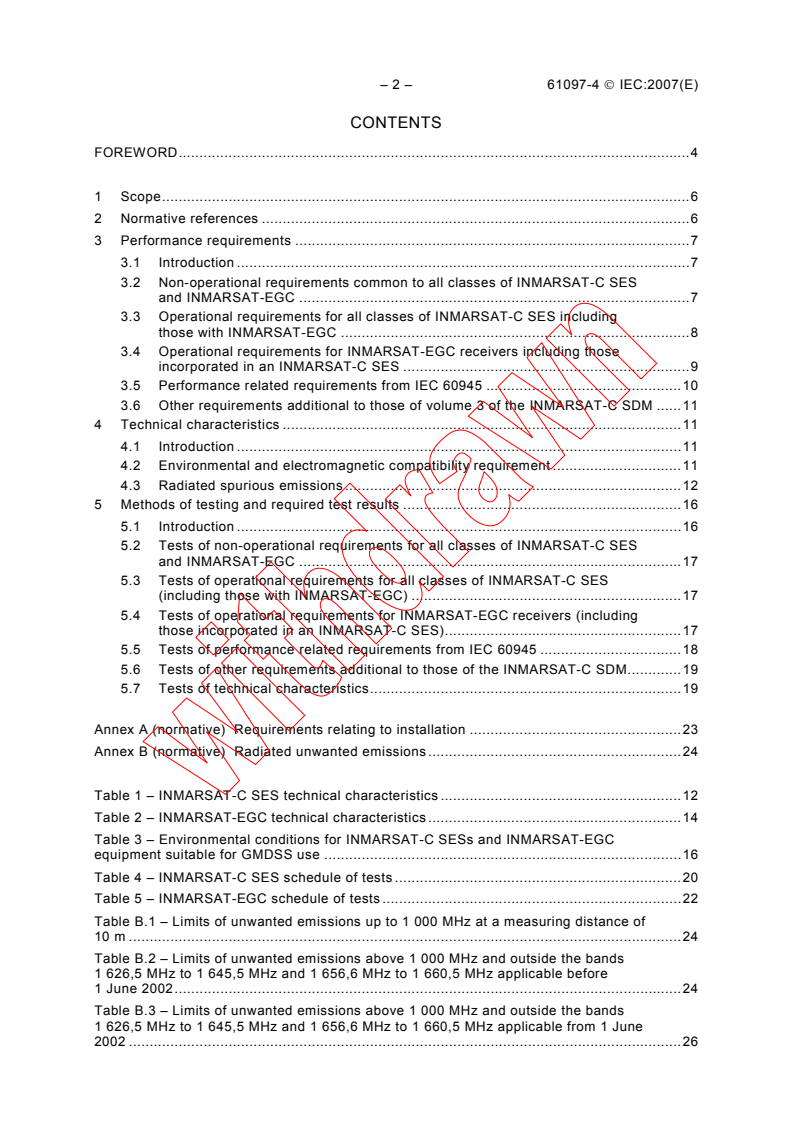
CONTENTS
FOREWORD.4
1 Scope.6
2 Normative references .6
3 Performance requirements .7
3.1 Introduction .7
3.2 Non-operational requirements common to all classes of INMARSAT-C SES
and INMARSAT-EGC .7
3.3 Operational requirements for all classes of INMARSAT-C SES including
those with INMARSAT-EGC .8
3.4 Operational requirements for INMARSAT-EGC receivers including those
incorporated in an INMARSAT-C SES .9
3.5 Performance related requirements from IEC 60945 .10
3.6 Other requirements additional to those of volume 3 of the INMARSAT-C SDM .11
4 Technical characteristics .11
4.1 Introduction .11
4.2 Environmental and electromagnetic compatibility requirement .11
4.3 Radiated spurious emissions .12
5 Methods of testing and required test results .16
5.1 Introduction .16
5.2 Tests of non-operational requirements for all classes of INMARSAT-C SES
and INMARSAT-EGC .17
5.3 Tests of operational requirements for all classes of INMARSAT-C SES
(including those with INMARSAT-EGC) .17
5.4 Tests of operational requirements for INMARSAT-EGC receivers (including
those incorporated in an INMARSAT-C SES).17
5.5 Tests of performance related requirements from IEC 60945 .18
5.6 Tests of other requirements additional to those of the INMARSAT-C SDM.19
5.7 Tests of technical characteristics.19
Annex A (normative) Requirements relating to installation .23
Annex B (normative) Radiated unwanted emissions .24
Table 1 – INMARSAT-C SES technical characteristics .12
Table 2 – INMARSAT-EGC technical characteristics .14
Table 3 – Environmental conditions for INMARSAT-C SESs and INMARSAT-EGC
equipment suitable for GMDSS use .16
Table 4 – INMARSAT-C SES schedule of tests .20
Table 5 – INMARSAT-EGC schedule of tests .22
Table B.1 – Limits of unwanted emissions up to 1 000 MHz at a measuring distance of
10 m .24
Table B.2 – Limits of unwanted emissions above 1 000 MHz and outside the bands
1 626,5 MHz to 1 645,5 MHz and 1 656,6 MHz to 1 660,5 MHz applicable before
1 June 2002.24
Table B.3 – Limits of unwanted emissions above 1 000 MHz and outside the bands
1 626,5 MHz to 1 645,5 MHz and 1 656,6 MHz to 1 660,5 MHz applicable from 1 June
2002 .26
61097-4 © IEC:2007(E) – 3 –
Table B.4 – Limits of unwanted emission within the operating band with carrier-on .27
– 4 – 61097-4 © IEC:2007(E)
INTERNATIONAL ELECTROTECHNICAL COMMISSION
____________
GLOBAL MARITIME DISTRESS AND
SAFETY SYSTEM (GMDSS) –
Part 4: INMARSAT-C ship earth station and
INMARSAT enhanced group call (EGC) equipment –
Operational and performance requirements,
methods of testing and required test results
FOREWORD
1) The International Electrotechnical Commission (IEC) is a worldwide organization for standardization comprising
all national electrotechnical committees (IEC National Committees). The object of IEC is to promote
international co-operation on all questions concerning standardization in the electrical and electronic fields. To
this end and in addition to other activities, IEC publishes International Standards, Technical Specifications,
Technical Reports, Publicly Available Specifications (PAS) and Guides (hereafter referred to as “IEC
Publication(s)”). Their preparation is entrusted to technical committees; any IEC National Committee interested
in the subject dealt with may participate in this preparatory work. International, governmental and non-
governmental organizations liaising with the IEC also participate in this preparation. IEC collaborates closely
with the International Organization for Standardization (ISO) in accordance with conditions determined by
agreement between the two organizations.
2) The formal decisions or agreements of IEC on technical matters express, as nearly as possible, an international
consensus of opinion on the relevant subjects since each technical committee has representation from all
interested IEC National Committees.
3) IEC Publications have the form of recommendations for international use and are accepted by IEC National
Committees in that sense. While all reasonable efforts are made to ensure that the technical content of IEC
Publications is accurate, IEC cannot be held responsible for the way in which they are used or for any
misinterpretation by any end user.
4) In order to promote international uniformity, IEC National Committees undertake to apply IEC Publications
transparently to the maximum extent possible in their national and regional publications. Any divergence
between any IEC Publication and the corresponding national or regional publication shall be clearly indicated in
the latter.
5) IEC provides no marking procedure to indicate its approval and cannot be rendered responsible for any
equipment declared to be in conformity with an IEC Publication.
6) All users should ensure that they have the latest edition of this publication.
7) No liability shall attach to IEC or its directors, employees, servants or agents including individual experts and
members of its technical committees and IEC National Committees for any personal injury, property damage or
other damage of any nature whatsoever, whether direct or indirect, or for costs (including legal fees) and
expenses arising out of the publication, use of, or reliance upon, this IEC Publication or any other IEC
Publications.
8) Attention is drawn to the Normative references cited in this publication. Use of the referenced publications is
indispensable for the correct application of this publication.
9) Attention is drawn to the possibility that some of the elements of this IEC Publication may be the subject of
patent rights. IEC shall not be held responsible for identifying any or all such patent rights.
International Standard IEC 61097-4 has been prepared by IEC technical committee 80:
Maritime navigation and radiocommunication equipment and systems.
This second edition cancels and replaces the first edition published in 1994. This edition
constitutes a technical revision.
The main changes with respect to the previous edition are:
– the IMO references and requirements have been updated to the new performance
standards for Inmarsat-C ship earth stations adopted in 1995;
– the requirements for interfaces have been updated to the current version of IEC 61162-1;
– the general requirements have been updated to the current version of IEC 60945;
61097-4 © IEC:2007(E) – 5 –
– Annex B concerning radiated unwanted emissions has been updated to current
requirements.
The text of this standard is based on the following documents:
FDIS Report on voting
80/487/FDIS 80/497/RVD
Full information on the voting for the approval of this standard can be found in the report on
voting indicated in the above table.
This publication has been drafted in accordance with the ISO/IEC Directives, Part 2.
A list of all parts of IEC 61097 series, published under the general title Global maritime
distress and safety system (GMDSS), can be found on the IEC website.
The committee has decided that the contents of this publication will remain unchanged until
the maintenance result date indicated on the IEC web site under "http://webstore.iec.ch" in
the data related to the specific publication. At this date, the publication will be
• reconfirmed,
• withdrawn,
• replaced by a revised edition, or
• amended.
A bilingual version of this publication may be issued at a later date.
– 6 – 61097-4 © IEC:2007(E)
GLOBAL MARITIME DISTRESS AND
SAFETY SYSTEM (GMDSS) –
Part 4: INMARSAT-C ship earth station and
INMARSAT enhanced group call (EGC) equipment –
Operational and performance requirements,
methods of testing and required test results
1 Scope
This part of IEC 61097 specifies the performance requirements and methods of testing for
INMARSAT-C ship earth stations (SES) capable of transmitting and receiving direct-printing
communications, and for enhanced group call (EGC) equipment, for use in the GMDSS. The
available variants are:
Class 0: An EGC receiver, either stand-alone or an element of a GMDSS installation in
accordance with the INMARSAT design and installation guidelines (DIGs) for
GMDSS installations.
Class 1: A basic SES providing shore-to-ship and ship-to-shore message transfer only.
Class 2: As class 1 but with EGC as an alternative to shore-to-ship transfer using a
shared receiver.
Class 3: As class 1 but with EGC using an independent receiver.
The standard complies with IMO performance requirements stated in the normative
references, INMARSAT technical characteristics and test procedures, and IEC 60945 general
requirements except where modifications are explicitly stated in this standard. Technical
characteristics essential to GMDSS operation as defined by the IMO are identified.
All text of this standard, whose wording is identical to that in IMO SOLAS Convention 1974 as
amended in 1988 and Resolutions A.807(19), A.664(16), and A.694(17) is printed in italics
and reference made to the Resolution/Recommendation and subclause number.
This standard covers equipment construction and testing. Matters relating to installation may
also be found in the normative references listed in clause 2. Those to be found in IMO
Resolutions A.807(19) and A.664(16) are reproduced in annex A.
Responsibility for type approval of INMARSAT-C and INMARSAT-EGC is vested in
INMARSAT by IMO Resolutions A.807(19) and A.664(16). Therefore, this standard does not
reproduce INMARSAT test procedures in full, but refers to where they are given in INMARSAT
documentation cited in the normative references to this standard.
NOTE For the purposes of this standard the terms INMARSAT-C, INMARSAT Standard-C and Standard-C refer to
the same equipment.
2 Normative references
The following referenced documents are indispensable for the application of this document.
For dated references, only the edition cited applies. For undated references, the latest edition
of the referenced document (including any amendments) applies.
IEC 60945:2002, Maritime navigation and radiocommunication equipment and systems –
General requirements – Methods of testing and required test results
61097-4 © IEC:2007(E) – 7 –
ISO 2022, Information technology – Character code structure and extension techniques
International Convention for the safety of life at sea (SOLAS), Regulations IV/7, IV/8, IV/9 and
IV/10 of the 1988 amendments concerning radiocommunications for the GMDSS
IMO Resolution A.807(19):1995, Performance Standards for INMARST--C ship earth stations
capable of transmitting and receiving direct-printing communications as amended by
Resolution MSC.68(68) Annex 4
IMO Resolution A.664(16):1989, Performance standards for enhanced group call equipment
IMO Resolution A.694(17):1991, General requirements for shipborne radio equipment forming
part of the global maritime distress and safety system (GMDSS) and for electronic
navigational aids
IMO: NAVTEX Manual
INMARSAT-C System definition manual (SDM):
– Volume 3, Part 2, Chapter 2, Mobile earth station technical requirements
– Volume 3, Part 2, Chapter 5, Ship earth station technical requirements
– Volume 3, Part 2, Chapter 8, Technical requirements for an EGC receiver
INMARSAT: Recommended test procedures (RTP) for the type approval of INMARSAT-C
mobile earth stations
INMARSAT: Design and installation guidelines (DIGs) for INMARSAT-C ship earth stations
and enhanced group call receivers
1)
Recommendation ITU-R M.540-2 :1990, Operational and technical characteristics for an
automated direct-printing telegraph system for promulgation of navigational and
meteorological warnings and urgent information to ships
3 Performance requirements
3.1 Introduction
Subclauses 3.2 through 3.4 of this part of IEC 61097 describe performance requirements
directly attributable to IMO Resolutions A.807(19), A.664(16) and A.694(17) as listed in the
normative references. Subclause 3.5 is provided to highlight those requirements of IEC 60945
which are not included in the normal INMARSAT requirements for INMARSAT-C SES type
approval. Subclause 3.6 describes other requirements, additional to the normal INMARSAT-C
type approval requirements, which are required to make the equipment suitable for GMDSS
applications.
3.2 Non-operational requirements common to all classes of INMARSAT-C SES
and INMARSAT-EGC
3.2.1 General requirements
3.2.1.1 (A.807(19) A1.1/A.664(16) A1.1) The INMARSAT Standard-C ship earth station
installation capable of transmitting and receiving direct-printing communications, and the
enhanced group call equipment to be used in the INMARSAT system shall comply with the
general requirements set out in Assembly resolution A.694(17) as detailed in IEC 60945.
—————————
)
Formerly CCIR Recommendation 540-2.
– 8 – 61097-4 © IEC:2007(E)
3.2.1.2 (A.807(19) 2/A.664(16) 2) The ship earth station and the EGC equipment shall be
type-approved by INMARSAT and shall comply with the environmental conditions specified in
its technical requirements for INMARSAT Standard-C ship earth stations except as detailed in
IEC 60945.
3.2.1.3 (A.807(19) 4) In order to permit a warning of potential radiation hazards to be
displayed in appropriate locations, a label shall be attached to the radome indicating
2 2
the distances external to the radome at which radiation levels of 100 W/m , 25 W/m and
10 W/m exist. However, the distances which are within the radome need not be indicated.
3.2.1.4 (A.807(19) A5.2/A.664(16) A4.2) Changing from one source of supply to another or
any interruption of up to 60 s duration of the supply of electrical energy shall not require the
equipment to be manually re-initialized and shall not result in loss of received messages
stored in the memory.
3.3 Operational requirements for all classes of INMARSAT-C SES including those
with INMARSAT-EGC
The equipment shall comply with regulations IV/8 through IV/10 of SOLAS 1974, as amended,
which prescribe the capabilities of INMARSAT ship earth stations to meet the GMDSS
requirements for ships in the various sea areas. The four capabilities are:
3.3.1 (IV/8.1.5.1/IV/9.1.3.3 and IV/10.1.4.3): Means of initiating the transmission of ship-to-
shore distress alerts.
3.3.2 (IV/10.1.1.1): Transmitting and receiving distress and safety communications using
direct-printing telegraphy.
3.3.3 (IV/10.1.1.2): Initiating and receiving distress priority calls.
3.3.4 (IV/9.3.2/IV/10.1.1.4): Transmitting and receiving general radiocommunications,
using either radiotelephony or direct-printing telegraphy.
NOTE In the case of this equipment only direct-printing telegraphy applies.
3.3.5 In addition, classes 2 and 3 INMARSAT-C SES shall comply with the operational
requirements for INMARSAT-EGC receivers (see 3.4).
Operational requirements common to INMARSAT-C equipment are:
3.3.6 (A.807(19) 3.1): No control external to the equipment shall be available for alteration of
the ship station identity.
3.3.7 (A.807(19) 3.2): It shall be possible to initiate and make distress calls from the position
from which the ship is normally navigated and from at least one other position designated for
distress alerting.
3.3.7.1 (A.807(19) 3.3): A distress alert shall be activated only by means of a dedicated
distress button. This button shall not be any key of an ITU-T digital input panel or an ISO
keyboard provided on the equipment.
3.3.7.2 (A.807(19) 3.4): The dedicated distress button shall:
1 be clearly identified; and
2 be protected against inadvertent operation.
3.3.7.3 (A.807(19) 3.5): The distress alert initiation shall require at least two independent
actions.
61097-4 © IEC:2007(E) – 9 –
3.3.7.4 (A.807(19) 3.6): The equipment shall indicate the status of the distress alert
transmission.
3.3.7.5 (A.807(19) 3.7): It shall be possible to interrupt and initiate distress messages at any
time.
3.3.7.6 It shall be possible to select the content of, but not initiate a distress alert using the
equipment keyboard or other means, before depressing one of the dedicated buttons to
initiate the distress alert. It shall also be possible to activate an undesignated (see Note)
distress alert by depressing one of the buttons, at any time.
NOTE Undesignated - unspecified emergency distress alert, i.e. the default setting. All other selectable alerts are
"designated".
3.3.7.7 (A.807(19) 3.8): Facilities shall be provided to automatically update the ship’s
position and the time at which the position was determined from a suitable electronic position-
fixing aid which may be an integral part of the equipment. For equipment which does not have
an integral position-fixing aid, such facilities shall include a suitable interface conforming to
IEC 61162.
NOTE As a minimum, the equipment should support the sentences GGA, GLL, GNS, RMC and ZDA according to
IEC 61162-1.
3.3.7.8 (A.807(19) 3.9): Provision shall also be made for manual entry of position
information and of the time at which the position was determined.
3.3.7.9 (A.807(19) 3.10): An alarm shall be activated when no position data is received from
the electronic position-fixing aid or, in the case of manual input, the position information is
over 4 hours old. Any position information not updated for more than 24 hours shall be clearly
identified.”
3.4 Operational requirements for INMARSAT-EGC receivers including those
incorporated in an INMARSAT-C SES
The equipment shall comply with regulations IV/7 and IV/10 of SOLAS 1974, as amended,
which prescribe the capabilities of EGC receivers to meet the GMDSS requirements for ships
in the various sea areas. The two capabilities are:
3.4.1 (IV/7.1.5): A radio facility for reception of maritime safety information by the
INMARSAT enhanced group calling system.
3.4.2 (IV/10.1.1.3): An INMARSAT ship earth station capable of maintaining watch for shore-
to-ship distress alerts, including those directed to specifically defined geographical areas.
Operational requirements common to all EGC receivers are:
3.4.3 (A.664(16) A1.2): The equipment shall be capable of producing a printed copy of
received information. Received EGC messages may be stored, with indication that the
message has been received, for later printing, except for the vital messages referred to in 3.2
(3.4.6) and 3.5 (3.4.9) which shall be printed out upon receipt.
3.4.4 (A.664(16) A1.3): The enhanced group call installation may be either separate or
combined with other installations. Elements of other installations, e.g. the antenna, low noise
amplifier and down converter of the ship earth system, may be shared for the reception of
enhanced group call messages.
3.4.5 (A.664(16) A3.1): Means shall be provided to enter the ship's position and area code
manually so that area group calls can be received. Optionally, and additionally, the ship's
– 10 – 61097-4 © IEC:2007(E)
position, as determined by the navigational equipment may be entered automatically and the
area code automatically derived therefrom.
3.4.6 (A.664(16) A3.2): Provision shall be made for a specific aural alarm and visual
indication at the position from which the ship is normally navigated to indicate receipt of a
distress or urgency call or a call having distress category. It shall not be possible to disable
this alarm and it shall only be possible to reset it manually and then only from the position
where the message is displayed or printed.
3.4.7 (A.664(16) A3.3): The equipment shall indicate when it is not correctly tuned or
synchronized to the enhanced group call carrier.
3.4.8 (A.664(16) A3.4): Any message shall be printed regardless of the character error rate
of its reception. The equipment shall print a low-line mark if a character is received mutilated.
3.4.9 (A.664(16) A3.5): Acceptance or rejection of service codes (same as for the NAVTEX
system, see ITU-R Recommendation M.540-2 and the IMO NAVTEX manual) shall be under
the operator's control except that equipment shall be unable to reject relevant navigational
and meteorological warnings, search and rescue information, and certain special warnings,
which are directed to a geographical area in which the ship is operating.
3.4.10 (A.664(16) A3.6): Means shall be provided not to reprint the same message after it
has been received without error.
3.4.11 (A.664(16) A3.7): The printing device shall be capable of printing at least the
standard IA number 5 character set. Other character sets are optionally used according
to ISO 2022.
3.4.12 (A.664(16) A3.8): The printing device shall be able to print at least 40 characters per
line.
3.4.13 (A.664(16) A3.9): The signal processor and printing device shall ensure that if a word
cannot be accommodated in full on one line, it shall be transferred to the next line. The
printing device shall automatically feed five lines after completing the printed messages.
3.5 Performance related requirements from IEC 60945
The equipment shall comply with those clauses of IEC 60945 appropriate to its equipment
class. The subclauses of IEC 60945 referenced below, amend or augment the corresponding
requirements of the INMARSAT-C SDM.
61097-4 © IEC:2007(E) – 11 –
3.5.1 (4.1 of IEC 60945) General
3.5.2 (4.2 of IEC 60945) Design and operation
3.5.3 (4.3 of IEC 60945) Power supply
3.5.4 (4.4 of IEC 60945) Durability and resistance to environmental conditions
3.5.5 (4.5 of IEC 60945) Interference
3.5.6 (4.6 of IEC 60945) Safety precautions
3.5.7 (4.7 of IEC 60945) Maintenance
3.5.8 (4.8 of IEC 60945) Equipment manuals
3.5.9 (4.9 of IEC 60945) Marking and identification
3.6 Other requirements additional to those of volume 3 of the INMARSAT-C SDM
The requirements listed below augment or amend the indicated sections of the INMARSAT-C
SDM.
3.6.1 (Volume 3, Part 2, Chapter 2, Section 7.3.1) Message display facilities shall be
suitable for displaying received distress-related messages. It is recommended that the display
facilities should comply with the corresponding requirements for INMARSAT-EGC equipment
in 3.4.8, 3.4.11, 3.4.12 and 3.4.13 of this standard.
3.6.2 Any programming material or software that forms part of the SES and which is
necessary for meeting the GMDSS requirements shall be permanently installed in the SES.
Any software needed to fulfil any distress and safety requirements of the GMDSS shall not be
stored on any medium which can be accessed, modified or corrupted.
3.6.3 (Volume 3, Part 2, Chapter 5, Section 8.3) To enable compliance with IMO Resolution
A.807(19) A3.2, the SES shall include facilities for initiating and making distress calls from at
least two positions.
3.6.4 Any ancillaries associ
...