

IEC 62769-151-1:2023
(Main)Field device integration (FDI®) - Part 151-1: Profiles - OPC UA
General Information
- Abstract
IEC 62769-151-1:2023 defines the protocol-specific definitions (PSDs) as defined in IEC 62769‑7 for the OPC UA protocol.
- Status
- Published
- Publication Date
- 13-Apr-2023
- Technical Committee
- SC 65E - Devices and integration in enterprise systems
- Drafting Committee
- WG 7 - TC 65/SC 65E/WG 7
- Current Stage
- PPUB - Publication issued
- Start Date
- 14-Apr-2023
- Completion Date
- 15-May-2023
Overview
IEC 62769-151-1:2023 is part of the IEC 62769 series, which addresses Field Device Integration (FDI®). This specific part, Part 151-1: Profiles – OPC UA, defines protocol-specific definitions (PSDs) necessary for integrating OPC UA (Open Platform Communications Unified Architecture) devices with the FDI architecture. By establishing mappings and definitions outlined in IEC 62769-7 for the OPC UA protocol, this standard aims to streamline the integration and management of field devices in industrial automation environments.
Key Topics
- FDI and OPC UA Integration: Describes how OPC UA's protocol-specific details are mapped for use within FDI architecture.
- Protocol-Specific Definitions (PSDs): Outlines important definitions, such as header formats, node addressing, and attribute mapping used in communication between devices and hosts.
- Data Type and Attribute Mapping: Explains how FDI data types align with OPC UA data types for consistent information exchange.
- Error Management: Defines error codes and methods for ensuring reliable communication and diagnostics within the FDI and OPC UA ecosystem.
- Security and Addressing: Specifies how to use OPC UA's security features, endpoint descriptions, and address formats for secure device integration and user authentication.
Applications
IEC 62769-151-1:2023 is essential for industrial automation engineers, system integrators, and device vendors who:
- Develop or maintain FDI Packages: Ensures that OPC UA-based field devices can be properly described and integrated into FDI-compliant host systems.
- Implement multi-vendor device integration: Facilitates the uniform representation and control of OPC UA devices alongside devices using other protocols, supporting interoperability in complex environments.
- Enhance security and reliability: By using standardized error codes and security policies, organizations can ensure secure and robust operation of their industrial field devices.
- Automate device discovery and parameterization: Supports scanning, identification, and configuration of OPC UA devices, streamlining asset management and commissioning processes in manufacturing and process industries.
Related Standards
Implementing IEC 62769-151-1:2023 often involves using or referencing related international standards, including:
- IEC 62769 series: Core FDI standards, covering package structure, information models, and communication devices.
- IEC 62541 series: The OPC UA standard, including parts on services, mappings, device interfaces, and discovery.
- IEC 61784-1: Fieldbus profiles for communication networks relevant to industrial field devices.
- IEC 61804 series: Function blocks and Electronic Device Description Language (EDDL) for process control integration.
These standards collectively provide a robust framework for industrial communication, device management, and interoperability within Industry 4.0 and IIoT (Industrial Internet of Things) initiatives.
Summary
IEC 62769-151-1:2023 offers a standardized approach to integrating OPC UA devices within FDI-based industrial automation systems. By defining mappings, error handling, and secure addressing for OPC UA, the standard ensures seamless and secure multi-vendor device operation, simplified engineering, and consistent data management-all crucial for modern industrial digitalization and streamlined plant operations.
Get Certified
Connect with accredited certification bodies for this standard

ANCE
Mexican certification and testing association.

Intertek Slovenia
Intertek testing, inspection, and certification services in Slovenia.

LNE (Laboratoire National de Métrologie et d'Essais)
French national laboratory for metrology and testing.
Sponsored listings
Frequently Asked Questions
IEC 62769-151-1:2023 is a standard published by the International Electrotechnical Commission (IEC). Its full title is "Field device integration (FDI®) - Part 151-1: Profiles - OPC UA". This standard covers: IEC 62769-151-1:2023 defines the protocol-specific definitions (PSDs) as defined in IEC 62769‑7 for the OPC UA protocol.
IEC 62769-151-1:2023 defines the protocol-specific definitions (PSDs) as defined in IEC 62769‑7 for the OPC UA protocol.
IEC 62769-151-1:2023 is classified under the following ICS (International Classification for Standards) categories: 33.040.40 - Data communication networks. The ICS classification helps identify the subject area and facilitates finding related standards.
IEC 62769-151-1:2023 is available in PDF format for immediate download after purchase. The document can be added to your cart and obtained through the secure checkout process. Digital delivery ensures instant access to the complete standard document.
Standards Content (Sample)
IEC 62769-151-1 ®
Edition 1.0 2023-04
INTERNATIONAL
STANDARD
NORME
INTERNATIONALE ®
Field device integration (FDI) –
Part 151-1: Profiles – OPC UA ®
Intégration des appareils de terrain (FDI) –
Partie 151-1: Profils – OPC UA
All rights reserved. Unless otherwise specified, no part of this publication may be reproduced or utilized in any form
or by any means, electronic or mechanical, including photocopying and microfilm, without permission in writing from
either IEC or IEC's member National Committee in the country of the requester. If you have any questions about IEC
copyright or have an enquiry about obtaining additional rights to this publication, please contact the address below or
your local IEC member National Committee for further information.
Droits de reproduction réservés. Sauf indication contraire, aucune partie de cette publication ne peut être reproduite ni
utilisée sous quelque forme que ce soit et par aucun procédé, électronique ou mécanique, y compris la photocopie et
les microfilms, sans l'accord écrit de l'IEC ou du Comité national de l'IEC du pays du demandeur. Si vous avez des
questions sur le copyright de l'IEC ou si vous désirez obtenir des droits supplémentaires sur cette publication, utilisez
les coordonnées ci-après ou contactez le Comité national de l'IEC de votre pays de résidence.
IEC Secretariat Tel.: +41 22 919 02 11
3, rue de Varembé info@iec.ch
CH-1211 Geneva 20 www.iec.ch
Switzerland
About the IEC
The International Electrotechnical Commission (IEC) is the leading global organization that prepares and publishes
International Standards for all electrical, electronic and related technologies.
About IEC publications
The technical content of IEC publications is kept under constant review by the IEC. Please make sure that you have the
latest edition, a corrigendum or an amendment might have been published.
IEC publications search - webstore.iec.ch/advsearchform IEC Products & Services Portal - products.iec.ch
The advanced search enables to find IEC publications by a Discover our powerful search engine and read freely all the
variety of criteria (reference number, text, technical publications previews. With a subscription you will always have
committee, …). It also gives information on projects, replaced access to up to date content tailored to your needs.
and withdrawn publications.
Electropedia - www.electropedia.org
IEC Just Published - webstore.iec.ch/justpublished
The world's leading online dictionary on electrotechnology,
Stay up to date on all new IEC publications. Just Published
containing more than 22 300 terminological entries in English
details all new publications released. Available online and once
and French, with equivalent terms in 19 additional languages.
a month by email.
Also known as the International Electrotechnical Vocabulary
(IEV) online.
IEC Customer Service Centre - webstore.iec.ch/csc
If you wish to give us your feedback on this publication or need
further assistance, please contact the Customer Service
Centre: sales@iec.ch.
A propos de l'IEC
La Commission Electrotechnique Internationale (IEC) est la première organisation mondiale qui élabore et publie des
Normes internationales pour tout ce qui a trait à l'électricité, à l'électronique et aux technologies apparentées.
A propos des publications IEC
Le contenu technique des publications IEC est constamment revu. Veuillez vous assurer que vous possédez l’édition la
plus récente, un corrigendum ou amendement peut avoir été publié.
Recherche de publications IEC - Découvrez notre puissant moteur de recherche et consultez
webstore.iec.ch/advsearchform gratuitement tous les aperçus des publications. Avec un
La recherche avancée permet de trouver des publications IEC abonnement, vous aurez toujours accès à un contenu à jour
en utilisant différents critères (numéro de référence, texte, adapté à vos besoins.
comité d’études, …). Elle donne aussi des informations sur les
projets et les publications remplacées ou retirées. Electropedia - www.electropedia.org
Le premier dictionnaire d'électrotechnologie en ligne au monde,
IEC Just Published - webstore.iec.ch/justpublished
avec plus de 22 300 articles terminologiques en anglais et en
Restez informé sur les nouvelles publications IEC. Just
français, ainsi que les termes équivalents dans 19 langues
Published détaille les nouvelles publications parues.
additionnelles. Egalement appelé Vocabulaire
Disponible en ligne et une fois par mois par email.
Electrotechnique International (IEV) en ligne.
Service Clients - webstore.iec.ch/csc
Si vous désirez nous donner des commentaires sur cette
publication ou si vous avez des questions contactez-nous:
sales@iec.ch.
IEC Products & Services Portal - products.iec.ch
IEC 62769-151-1 ®
Edition 1.0 2023-04
INTERNATIONAL
STANDARD
NORME
INTERNATIONALE ®
Field device integration (FDI) –
Part 151-1: Profiles – OPC UA ®
Intégration des appareils de terrain (FDI) –
Partie 151-1: Profils – OPC UA
INTERNATIONAL
ELECTROTECHNICAL
COMMISSION
COMMISSION
ELECTROTECHNIQUE
INTERNATIONALE
ICS 33.040.40 ISBN 978-2-8322-6826-1
– 2 – IEC 62769-151-1:2023 © IEC 2023
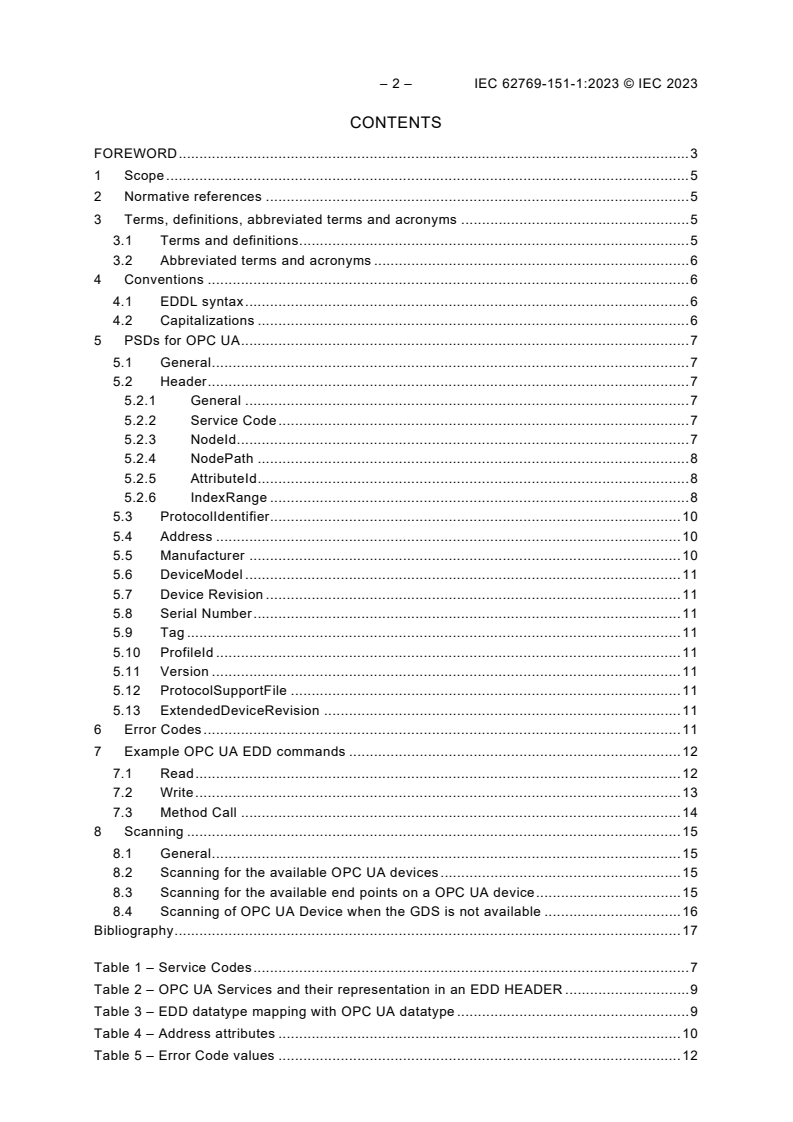
CONTENTS
FOREWORD . 3
1 Scope . 5
2 Normative references . 5
3 Terms, definitions, abbreviated terms and acronyms . 5
3.1 Terms and definitions . 5
3.2 Abbreviated terms and acronyms . 6
4 Conventions . 6
4.1 EDDL syntax . 6
4.2 Capitalizations . 6
5 PSDs for OPC UA . 7
5.1 General . 7
5.2 Header . 7
5.2.1 General . 7
5.2.2 Service Code . 7
5.2.3 NodeId. 7
5.2.4 NodePath . 8
5.2.5 AttributeId . 8
5.2.6 IndexRange . 8
5.3 ProtocolIdentifier . 10
5.4 Address . 10
5.5 Manufacturer . 10
5.6 DeviceModel . 11
5.7 Device Revision . 11
5.8 Serial Number . 11
5.9 Tag . 11
5.10 ProfileId . 11
5.11 Version . 11
5.12 ProtocolSupportFile . 11
5.13 ExtendedDeviceRevision . 11
6 Error Codes . 11
7 Example OPC UA EDD commands . 12
7.1 Read . 12
7.2 Write . 13
7.3 Method Call . 14
8 Scanning . 15
8.1 General . 15
8.2 Scanning for the available OPC UA devices . 15
8.3 Scanning for the available end points on a OPC UA device . 15
8.4 Scanning of OPC UA Device when the GDS is not available . 16
Bibliography . 17
Table 1 – Service Codes . 7
Table 2 – OPC UA Services and their representation in an EDD HEADER . 9
Table 3 – EDD datatype mapping with OPC UA datatype . 9
Table 4 – Address attributes . 10
Table 5 – Error Code values . 12
INTERNATIONAL ELECTROTECHNICAL COMMISSION
____________ ®
FIELD DEVICE INTEGRATION (FDI ) –
Part 151-1: Profiles – OPC UA
FOREWORD
1) The International Electrotechnical Commission (IEC) is a worldwide organization for standardization comprising
all national electrotechnical committees (IEC National Committees). The object of IEC is to promote international
co-operation on all questions concerning standardization in the electrical and electronic fields. To this end and
in addition to other activities, IEC publishes International Standards, Technical Specifications, Technical Reports,
Publicly Available Specifications (PAS) and Guides (hereafter referred to as “IEC Publication(s)”). Their
preparation is entrusted to technical committees; any IEC National Committee interested in the subject dealt with
may participate in this preparatory work. International, governmental and non-governmental organizations liaising
with the IEC also participate in this preparation. IEC collaborates closely with the International Organization for
Standardization (ISO) in accordance with conditions determined by agreement between the two organizations.
2) The formal decisions or agreements of IEC on technical matters express, as nearly as possible, an international
consensus of opinion on the relevant subjects since each technical committee has representation from all
interested IEC National Committees.
3) IEC Publications have the form of recommendations for international use and are accepted by IEC National
Committees in that sense. While all reasonable efforts are made to ensure that the technical content of IEC
Publications is accurate, IEC cannot be held responsible for the way in which they are used or for any
misinterpretation by any end user.
4) In order to promote international uniformity, IEC National Committees undertake to apply IEC Publications
transparently to the maximum extent possible in their national and regional publications. Any divergence between
any IEC Publication and the corresponding national or regional publication shall be clearly indicated in the latter.
5) IEC itself does not provide any attestation of conformity. Independent certification bodies provide conformity
assessment services and, in some areas, access to IEC marks of conformity. IEC is not responsible for any
services carried out by independent certification bodies.
6) All users should ensure that they have the latest edition of this publication.
7) No liability shall attach to IEC or its directors, employees, servants or agents including individual experts and
members of its technical committees and IEC National Committees for any personal injury, property damage or
other damage of any nature whatsoever, whether direct or indirect, or for costs (including legal fees) and
expenses arising out of the publication, use of, or reliance upon, this IEC Publication or any other IEC
Publications.
8) Attention is drawn to the Normative references cited in this publication. Use of the referenced publications is
indispensable for the correct application of this publication.
9) Attention is drawn to the possibility that some of the elements of this IEC Publication may be the subject of patent
rights. IEC shall not be held responsible for identifying any or all such patent rights.
IEC 62769-151-1 has been prepared by subcommittee 65E: Devices and integration in
enterprise systems, of IEC technical committee 65: Industrial-process measurement, control
and automation. It is an International Standard.
The text of this International Standard is based on the following documents:
Draft Report on voting
65E/853/CDV 65E/911/RVC
Full information on the voting for its approval can be found in the report on voting indicated in
the above table.
The language used for the development of this International Standard is English.
This document was drafted in accordance with ISO/IEC Directives, Part 2, and developed in
accordance with ISO/IEC Directives, Part 1 and ISO/IEC Directives, IEC Supplement, available
at www.iec.ch/members_experts/refdocs. The main document types developed by IEC are
described in greater detail at www.iec.ch/publications.
– 4 – IEC 62769-151-1:2023 © IEC 2023
A list of all parts in the IEC 62769 series, published under the general title Field device ®
integration (FDI ), can be found on the IEC website.
The committee has decided that the contents of this document will remain unchanged until the
stability date indicated on the IEC website under webstore.iec.ch in the data related to the
specific document. At this date, the document will be
• reconfirmed,
• withdrawn,
• replaced by a revised edition, or
• amended. ®
FIELD DEVICE INTEGRATION (FDI ) –
Part 151-1: Profiles – OPC UA
1 Scope
This part of IEC 62769 defines the protocol-specific definitions (PSDs) as defined in
IEC 62769-7 for the OPC UA protocol.
2 Normative references
The following documents are referred to in the text in such a way that some or all of their content
constitutes requirements of this document. For dated references, only the edition cited applies.
For undated references, the latest edition of the referenced document (including any
amendments) applies.
IEC 61784-1, Industrial communication networks – Profiles Part 1: Fieldbus profiles
IEC 61804 (all parts), Devices and integration in enterprise systems – Function blocks (FB) for
process control and electronic device description language (EDDL)
IEC 62541-4:2020, OPC unified architecture – Part 4: Services
IEC 62541-6:2020, OPC Unified Architecture – Part 6: Mappings
IEC 62541-12:2020, OPC unified architecture – Part 12: Discovery and global services
IEC 62541-100, OPC unified architecture – Part 100: Device Interface
® ®
IEC 62769‑4, Field device integration (FDI ) – Part 4: FDI Packages ®
IEC 62769‑5, Field device integration (FDI ) – Part 5: Information Model ®
IEC 62769‑7, Field device integration (FDI ) – Part 7: Communication devices ®
IEC 62769‑100:2020, Field device integration (FDI ) – Part 100: Profiles – Generic protocols
3 Terms, definitions, abbreviated terms and acronyms
3.1 Terms and definitions
For the purposes of this document, the terms and definitions are given in IEC 61784-1,
IEC 61804 (all parts), IEC 62541-4, IEC 62541-100, IEC 62769‑4, IEC 62769‑5, and
IEC 62769‑7 apply.
ISO and IEC maintain terminology databases for use in standardization at the following
addresses:
• IEC Electropedia: available at http://www.electropedia.org/
ISO Online browsing platform: available at http:www.iso.org/obp
– 6 – IEC 62769-151-1:2023 © IEC 2023
3.2 Abbreviated terms and acronyms
For the purposes of this specification, the following abbreviations apply.
EDD Electronic Device Description
EDDL Electronic Device Description Language (see IEC 61804 (all parts))
®1
FDI Field Device Integration
FCG FieldComm Group
XML Extensible markup language (see REC-xml-20081126)
OPC UA Open Platform Communications Unified Architecture
GDS Global Discovery Server
LDS Local Discovery Server
LDS-ME Local Discovery Server – Multicast Extentions
4 Conventions
4.1 EDDL syntax ®
This document specifies content for the EDD component that is part of FDI Communication
Packages. The specification content using EDDL syntax uses the font Courier New. The EDDL
syntax is used for method signature, variable, data structure and component declarations.
4.2 Capitalizations ®
The IEC 62769 series uses capitalized terms to emphasize that these terms have a FDI
specific meaning.
Some of these terms using an acronym as a prefix for example ®
• FDI Client, or ®
• FDI Server.
Some of these terms are compound terms such as:
• Communication Servers, or
• Profile Package.
Parameter names or attributes are concatenated to a single term, where the original terms start
in this term with a capital letter such as:
• ProtocolSupportFile or
• ProtocolType.
Parameter names or attributes can also be constructed by using an underscore character to
concatenate two or more terms such as:
• DEVICE_REV or
• DEVICE_MODEL
___________
FDI is a registered trademark of the non-profit organization Fieldbus Foundation, Inc. This information is given
for the convenience of users of this document and does not constitute an endorsement by IEC of the trademark
holder or any of its products. Compliance does not require use of the trade name. Use of the trade name requires
permission of the trade name holder.
5 PSDs for OPC UA
5.1 General
Clause 5 defines the protocol-specific definitions for OPC UA to be used to develop the
communication server which defines header syntax, Topology Scan result mapping, error
coding mapping etc.
5.2 Header
5.2.1 General
The HEADER string is composed of Service Code, NodeId, NodePath, AttributeId, and
IndexRange.
Syntax:- “SERVICE_CODE=\”\” NODEID=\”\”
NODEPATH=\”\” ATTRIBUTE=\”\”
INDEXRANGE=\”\””
5.2.2 Service Code
Table 1 defines the supported services.
Table 1 – Service Codes
Service Code Description
Read Service is to perform to read the parameter value from the OPC UA device.
Write Service is to perform to write the parameter value to the OPC UA device.
MethodCall Service is to perform the simple Method execution supports in OPC UA device that can be
invoked. A simple method is a method that doesn’t have any input or output parameters.
[Ex:- LoadDefaultConfiguration()]
5.2.3 NodeId
NodeId is the String representation of the target NodeId for the service. If NODEPATH is
specifiied, the NodeId of the starting node of the NodePath is specified. If NODEPATH is not
specifiied or null, the NodeId of the target node is specified.
Syntax:- ns=;=
NameSpace Index: Name Space Index number. For zero, ns=0 is not required.
NodeId Type:
i UInteger
s String
g GUID
b ByteString
Id: Identifier
Examples:
ns=2;s=Temperature
i=2045
ns=1;g=09087e75-8e5e-499b-954f-f2a9603db28a
ns=1;b=M/RbKBsRVkePCePcx24oRA=='
___________
Note that \ is used as escape character allowing “ in the HEADER string.
– 8 – IEC 62769-151-1:2023 © IEC 2023
5.2.4 NodePath
Nodepath is the relative path of the node starting from the specified NodeId.
The text format for the NodePath is as defined in IEC 62541-4:2020, Clause A.2]
Examples:
Browse Path Description
“/2:Block&.Output” Follows any forward hierarchical Reference with target
BrowseName = “2:Block.Output”.
“/3:Truck.0:NodeVersion” Follows any forward hierarchical Reference with target
BrowseName = “3:Truck” and from there a forward Aggregates
Reference to a target with BrowseName “0:NodeVersion”.
“<1:ConnectedTo>1:Boiler/1:HeatSensor” Follows any forward Reference with a BrowseName =
‘1:ConnectedTo’ and finds targets with BrowseName = ‘1:Boiler’.
From there follows any hierarchical Reference and find targets with
BrowseName = ‘1:HeatSensor’.
“<1:ConnectedTo>1:Boiler/” Follows any forward Reference with a BrowseName =
‘1:ConnectedTo’ and finds targets with BrowseName = ‘1:Boiler’.
From there it finds all targets of hierarchical References.
“<0:HasChild>2:Wheel” Follows any forward Reference with a BrowseName = ‘HasChild’
and qualified with the default OPC UA namespace. Then find
targets with BrowseName = ‘Wheel’ qualified with namespace index
‘2’.
“Truck” Follows any inverse Reference with a BrowseName = ‘HasChild’.
Then find targets with BrowseName = ‘Truck’. In both cases, the
namespace component of the BrowseName is assumed to be 0.
“<0:HasChild>” Finds all targets of forward References with a BrowseName =
‘HasChild’ and qualified with the default OPC UA namespace.
5.2.5 AttributeId
AttributeId is the Id of the attribute as defined in IEC 62541-6:2020, Clause A.1. If ATTRIBUTE
is not specified, AttributeId(Value) 13 ia assumed.
5.2.6 IndexRange
IndexRange is the NumericRange as defined in IEC 62541-4:2020, 7.22. This parameter is used
to identify a single element of an array, or a single range of indexes for arrays. If ATTRIBUTE
is an array, and INDEXRANGE is specified, the specific element of the array is addressed. If
ATTRIBUTE is an array and INDEXRANGE is not specified, all the element of the array are
addressed.
Table 2 specifies the common OPC UA SERVICE_CODE values, the usage of the attributes,
and the used EDD COMMAND OPERATION.
Table 2 – OPC UA Services and their representation in an EDD HEADER
Read 01 NodeId of the Relative path of AttributeId Index R - Attribute
source / start Node the source node Range Values
Write 02 NodeId of the Relative path of AttributeId Index W Attribute -
target / start Node the target node Range Value
MethodCall 03 NodeId of the Relative path of - - C - -
MethodCall / start the MethodCall
Node node
NOTE 1 The table lists the most common three services and what data is provided in the HEADER, REQUEST &
RESPONSE parameters of an EDD command.
NOTE 2 Based on the service, it can happen that the NodePath and/or AttributeId is not be applicable for all the
service. In such case it is not mandatory to define the NODEPATH and/or ATTRIBUTE in EDD Header. For example,
calling Write for writing value of a variable doesn’t need to specify attribute value as 13 is assumed internally. In
such case, the EDD header looks like this. “SERVICE_CODE=\”02\” NODEID=\”ns=2;s=TemperatureUnits\””
Key
R/W/C The Operation (in EDD) is READ (R) or WRITE (W) or COMMAND (C)
The supported EDD datatypes and equivalent OPC UA datatypes are described in Table 3.
Table 3 – EDD datatype mapping with OPC UA datatype
EDD Datatype OPC UA Datatype
BOOLEAN Boolean
DOUBLE Double
FLOAT Float
INTEGER(1,2,4,8) SByte, Int16, Int32, Int64
UNSIGNED_INTEGER(1,2,4,8) Byte, UInt16, UInt32, UInt64
DATE DateTime (Ignore the Time Part)
DATE_AND_TIME DateTime (Fill both) – Calender
DURATION Duration
TIME DateTime (Fill both) – Starting from 1984-01-01
TIME_VALUE -
BIT_ENUMERATED Enumeration(Int32)
ENUMERATED Enumeration(Int32)
ASCII String
BITSTRING -
EUC -
OCTET ByteString
PACKED_ASCII String
PASSWORD String
VISIBLE String
Functionality
SERVICE_CODE(Hex)
NODEID
NODEPATH
ATTRIBUTE
INDEXRANGE
Operation (in EDD)
Request (in EDD)
Response (in EDD)
– 10 – IEC 62769-151-1:2023 © IEC 2023
5.3 ProtocolIdentifier
The ProtocolIdentifier for OPC UA shall be “urn:fdipsd:OPCUA”.
5.4 Address
The Address is mapped to one of the EndpointDescription of the OPC UA Server running on
the device. Refer to Clause 8 for the detailed information on the Scanning process.
The Address format: ®
“{serverUrl};{securitymode};{securitypolicy};{useridentitytoken};{identitydata}” in FDI host.
Table 4 defines the Address attributes.
Table 4 – Address attributes
Attribute Description
serverUrl Unique URL of the OPC UA Device
securitymode Selected security mode in which the OPC UA device shall establish the session, below
are the possible values
{0} – Invalid
{1} – None
{2} – Sign
{3} – Sign&Encrypt
securityPolicies Selected security policy in which the OPC UA device shall establish the session, the
security policies are depends on server endpoints which identified during the scan
result. Below are some examples:
None,
Basic256sha256
Aes128-Sha256-RsaOaep
useridentitytoken Selected User Identity token to establish the session, below are the possible values
Anonymous,
UserName,
Certificate
IdentityData Based on the selection of useridentitytoken, the identity data shall be used. This is used
to carry the metadata for User Identity. For ex, for UserName token the password shall
be passed as a value for the Identity data. Encryption of identify data shall be done
based on the Session encryption mechanism.
The certificate of the OPC UA device shall exchange with Communication Server (OPC UA client) automatically
to establish the secure connection.
NOTE 1 Identity data is only applicable for the Username Token policy.
NOTE 2 Refer to IEC 62541-4 for more information about the security policies and User Token.
5.5 Manufacturer
The mapping of Manufacturer depends on the capabilities of the OPC UA Server. If the Identified
device is based on IEC 62541-100, the Manufacturer is mapped to the Manufacturer property
of the DeviceType (see IEC 62541-100) For the other server types, the Manufacturer can be ®
mapped from the ManufacturerName component of the ServerStatus->BuildInfo. For FDI
Gateways, the EDD data type EUC of length 256 shall be used and therefore the length of the
string is limited to 256.
5.6 DeviceModel
The mapping of DeviceModel depends on the capabilities of the OPC UA Server. If the Identified
device is based on IEC 62541-100, the DeviceModel is mapped to the Model property of the
DeviceType (see IEC 62541-100). For the other server types, the DeviceModel can be mapped ®
from the ProductName component of the ServerStatus->BuildInfo. For FDI Gateways, the EDD
data type EUC of length 256 shall be used and therefore the length of the string is limited to
256.
5.7 Device Revision
No mapping is defined for Device Revision and Device Revision shall not be used. See 5.13 for
information on how to map the Device Revision.
5.8 Serial Number
No mapping is defined for Serial Number and Serial Number shall not be used.
5.9 Tag
No mapping is defined for Tag and Tag shall not be used.
5.10 ProfileId
No mapping is defined for ProfileId and ProfileId shall not be used.
5.11 Version ®
The OPC UA Protocol Version of the device shall be mapped to Version in the FDI Package.
Example: “1.0.4”.
5.12 ProtocolSupportFile
No mapping is defined for ProtocolSupportFile and ProtocolSupportFile shall not be used.
5.13 ExtendedDeviceRevision
The mapping of ExtendedDeviceRevision depends on the capabilities of the OPC UA Server. If
the Identified device is based on IEC 62541-100, the ExtendedDeviceRevision is mapped to the
DeviceRevision property of the DeviceType (see IEC 62541-100). For the other server types,
the ExtendedDeviceRevision is mapped to the SoftwareVersion component of the ®
ServerStatus->BuildInfo. ExtendedDeviceRevision follows the FDI versioning format (see
IEC 62769‑100:2020, Annex C) with the format of (major.minor.revision) the OPC UA Device
Revision shall be mapped to this format.
6 Error Codes
As per IEC 62541-4: “The StatusCode is a 32-bit unsigned integer. The top 16 bits represent
the numeric value of the code that shall be used for detecting specific errors or conditions. The
bottom 16 bits are bit flags that contain additional information but do not affect the meaning of
the StatusCode.”
Table 2 defines the Error Code values. The numeric identifiers for all of the StatusCodes and
the corresponding description shall be those defined by IEC 62541-6:2020 Clause A.2. The
CSV file released with IEC 62541-6:2020 can be found here:
http://www.opcfoundation.org/UA/schemas/1.04/StatusCode.csv.
– 12 – IEC 62769-151-1:2023 © IEC 2023
Table 5 – Error Code values
Service Code StatusCodes Values
BadNodeIdInvalid 0x40330000
BadNodeIdUnknown 0x40340000
BadAttributeIdInvalid 0x40350000
BadIndexRangeInvalid 0x40360000
Read(01) BadIndexRangeNoData 0x40370000
BadDataEncodingInvalid 0x40380000
BadDataEncodingUnsupported 0x40390000
BadNotReadable 0x403A0000
BadUserAccessDenied 0x401F0000
BadSecurityModeInsufficient 0x40E60000
GoodCompletesAsynchronously 0x002E0000
BadNodeIdInvalid 0x40330000
BadNodeIdUnknown 0x40340000
BadAttributeIdInvalid 0x40350000
BadIndexRangeInvalid 0x40360000
BadIndexRangeNoData 0x40370000
Write(2) BadWriteNotSupported 0x40730000
BadNotWritable 0x403B0000
BadUserAccessDenied 0x401F0000
BadOutOfRange 0x403C0000
BadTypeMismatch 0x40740000
BadDataEncodingUnsupported 0x40390000
BadNoCommunication 0x40310000
BadNodeIdInvalid 0x40330000
BadNodeIdUnknown 0x40340000
BadNotExecutable 0x41110000
BadArgumentsMissing 0x40760000
MethodCall(03) BadTooManyArguments 0x40E50000
BadInvalidArgument 0x40AB0000
BadUserAccessDenied 0x401F0000
BadSecurityModeInsufficient 0x40E60000
BadMethodInvalid 0x40750000
BadNoCommunication 0x40310000
NOTE From the OPC UA Status code value,the 31:30 bits of the status code has been shifted to next bit right
(29th bit) since the error code in EDD has some limitation accepting the large values.
7 Example OPC UA EDD commands
7.1 Read
The following defines an EDD command to read status of OPC UA Device.
COMMAND ReadLevelValue
{
OPERATION READ;
HEADER “SERVICE_CODE=\”01\” NODEID=\”ns=2;b=M/RbKBsRVkePCePcx24oRA=='\”
NODEPATH=\”<2:SignalSet>2:LevelSignal/2:AnalogSignal/2:LevelValue
TRANSACTION
{
REQUEST
{
}
REPLY
{
LevelValue
}
}
RESPONSE_CODES
{
0x00000000, Good, "The operation was successful."
0x80330000, BadNodeIdInvalid, "The syntax of the node id is not
valid."
0x80340000, BadNodeIdUnknown, "The node id refers to a node that
does not exist in the server address space."
0x80350000, BadAttributeIdInvalid, "The attribute is not supported
for the specified Node."
0x80360000, BadIndexRangeInvalid, "The syntax of the index range
parameter is invalid."
0x80370000, BadIndexRangeNoData, "No data exists within the range
of indexes specified."
0x80380000, BadDataEncodingInvalid, "The data encoding is invalid."
0x80390000, BadDataEncodingUnsupported, "The server does not support the
requested data encoding for the node."
0x803A0000, BadNotReadable, "The access level does not allow
reading or subscribing to the Node."
0x801F0000, BadUserAccessDenied, "User does not have permission to
perform the requested operation."
0x80E60000, BadSecurityModeInsufficient, "The operation is not permitted
over the current secure channel."
}
}
A successful response is put into the DeviceStatus as defined in the REPLY and the response
code 0 is used. In case of an error case, the exception code is put into the RESPONSE_CODES.
7.2 Write
The following defines an EDD command to set level units.
COMMAND WriteLevelUnits
{
OPERATION WRITE;
HEADER “SERVICE_CODE=\”02\” NODEID=\”ns=2;b=M/RbKBsRVkePCePcx24oRA=='\”
NODEPATH=\”<2: SignalSet>2: LevelSignal/2: AnalogSignal/2:EngineeringUnits
\””
TRANSACTION
{
REQUEST
{
LevelUnits
}
REPLY
{
}
}
RESPONSE_CODES
– 14 – IEC 62769-151-1:2023 © IEC 2023
{
0x00000000, Good, "(0x00000000)The operation was
successful."
0x002E0000, GoodCompletesAsynchronously, "(0x002E0000)The processing
will complete asynchronously."
0x80330000, BadNodeIdInvalid, "(0x80330000)The syntax of the
node id is not valid."
0x80340000, BadNodeIdUnknown, "(0x80340000)The node id refers to
a node that does not exist in the server address space."
0x80350000, BadAttributeIdInvalid, "(0x80350000)The attribute is not
supported for the specified Node."
0x80360000, BadIndexRangeInvalid, "(0x80360000)The syntax of the
index range parameter is invalid."
0x80370000, BadIndexRangeNoData, "(0x80370000)No data exists within
the range of indexes specified."
0x80730000, BadWriteNotSupported, "(0x80730000)The server does not
support writing the combination of value, status and timestamps provided."
0x803B0000, BadNotWritable, "(0x803B0000)The access level does
not allow writing to the Node."
0x801F0000, BadUserAccessDenied, "(0x801F0000)User does not have
permission to perform the requested operation."
0x803C0000, BadOutOfRange, "(0x803C0000)The value was out of
range."
0x80740000, BadTypeMismatch, "(0x80740000)The value supplied
for the attribute is not of the same type as the attribute's value."
0x80390000, BadDataEncodingUnsupported, "(0x80390000)The server does not
support the requested data encoding for the node."
0x80310000, BadNoCommunication, "(0x80310000)Communication with
the data source is defined, but not established, and there is no last known
value available."
}
}
LevelUnits to the corresponding attribute value of the node. In
A successful execution writes
case of an error case, the exception code is put into the RESPONSE_CODES.
7.3 Method Call
The following defines an EDD command to invoke the method.
COMMAND VolumeFlowZeroPointAdjustment
{
OPERATION COMMAND;
HEADER “SERVICE_CODE=\”03\” NODEID=\”ns=2;b=M/RbKBsRVkePCePcx24oRA=='\”
NODEPATH=\”<2: SignalSet>2: ActualVolumeFlowSignal/2: ZeroPointAdjustment
\””
TRANSACTION
{
REQUEST
{
}
REPLY
{
}
}
RESPONSE_CODES
{
0x00000000, Good, "(0x00000000)The operation was
successful."
0x80330000, BadNodeIdInvalid, "(0x80330000)The syntax of the
node id is not valid."
0x80340000, BadNodeIdUnknown, "(0x80340000)The node id refers to
a node that does not exist in the server address space."
0x81110000, BadNotExecutable, "(0x81110000)The executable
attribute does not allow the execution of the method."
0x80760000, BadArgumentsMissing, "(0x80760000)The client did not
specify all of the input arguments for the method."
0x801F0000, BadUserAccessDenied, "(0x801F0000)User does not have
permission to perform the requested operation."
0x80E60000, BadSecurityModeInsufficient, "(0x80E60000)The operation is not
permitted over the current secure channel."
0x80750000, BadMethodInvalid, "(0x80750000)The method id does
not refer to a method for the specified object."
0x80310000, BadNoCommunication, "(0x80310000)Communication with
the data source is defined, but not established, and there is no last known
value available."
}
}
A successful execution loads the defult configuration to the corresponding configuration
parameter nodes and attributes. In case of an error case, the exception code is put into the
RESPONSE_CODES.
8 Scanning
8.1 General
The scanning process is a two-step process. Following are the two steps. The input for the
scanning process is the URL of GDS.
8.2 Scanning for the available OPC UA devices
Scanning of available OPC UA devices in the domain involves interacting with GDS Server.
Only the OPC UA devices that are registered with the GDS are detected during the scanning
process. The OPC UA Communication Server sends request to invoke QueryApplications
method. Pass 0x1 – Servers as the input parameter applicationType to the QueryApplications
method. Set of ApplicationDescription structures are returned as the method output. Each of
the ApplicationDescription contains set of DiscoveryEndpoints of the registered OPC UA
servers.
If the registered OPC UA device supports Aggregation Server, if server supports the OPC UA
DI information model then all the aggregated OPC UA device Endpoints which are listed under
the DeviceSet can be shown in the scan result. NodeId of the starting node in the aggregated
device is used along with Server URI for the aggregation device.
8.3 Scanning for the available end points on a OPC UA device
OPC UA Communication server uses the set of DiscoveryEndpoints to connect to each device
and sends the GetEndpoints service request. The response contains set of
EndpointDescriptions. All the EndpointDescripitions shall be formatted in the below that will be
shown in the scan result.
Syntax- {serverUrl};{{securitypolicy{securitymode}};{Usertoken};{NodeId},
Example: “opc.tcp://fdi-demopc:48030/;Basic256sha256{2}{3};Aes128-Sha256-RsaOaep{2}{3};,opc.https://fdi-
demopc:48030/;Basic256sha256{2}{3};Aes128-Sha256-RsaOaep{2}{3};
1:s=SampleDIServer;,UserName;Anonymous;”
In above example, the server return multiple endpoints,
Server url – “opc.tcp://fdi-demopc:48030/” and “opc.https://fdi-demopc:48030/”
– 16 – IEC 62769-151-1:2023 © IEC 2023
Security Modes & Policies
1) Basic256sha256 with Sign and Sign&Encrypt modes
2) Aes128-Sha256-RsaOaep with Sign and Sign&Encrypt modes
3) NodeId – the Starting Node Id of the OPC UA to be fixed for addressing. This is optional
used only in case of aggregated server. In above example, “1” denotes the namespace index
“s=SampleDIServer” denotes Identifier of the Node
4) UserToken –UserName, Anonymous
Delimeters (‘;’ ‘,’) are used to split the address the end index of the split array contains the
UserToken information, rest will be the different protocol entry of the Server URL with security
modes.
8.4 Scanning of OPC UA Device when the GDS is not available
When GDS is not present OR GDS URL is not configured, OPC UA Communication follows the
Combined Discovery Process for Clients defined in IEC 62541-12:2020, 4.3.7. If the GDS URL
is not identified, then the communication server can optionally accept any known OPC UA
Device server URL that can identified using the discovery server, and the requested OPC UA
Device server url endpoints shall be shown in the scan result.
Bibliography ®
IEC 62769 (all parts), Field device integration (FDI )
REC-xml-20081126, Extensible Markup Language (XML) 1.0 (Fifth Edition) – W3C
Recommendation 26 November 2008, available at http://www.w3.org/TR/xml/
OPC UA Status Codes, http://www.opcfoundation.org/UA/schemas/1.04/StatusCode.csv
___________
– 18 – IEC 62769-151-1:2023 © IEC 2023
SOMMAIRE
AVANT-PROPOS . 19
1 Domaine d'application . 21
2 Références normatives . 21
3 Termes, définitions, abréviations et acronymes . 21
3.1 Termes et définitions . 21
3.2 Abréviations et acronymes . 22
4 Conventions . 22
4.1 Syntaxe EDDL . 22
4.2 Utilisation de majuscules . 22
5 PSD pour OPC UA . 23
5.1 Généralités . 23
5.2 Header . 23
5.2.1 Généralités . 23
5.2.2 Code de service . 23
5.2.3 NodeId. 23
5.2.4 NodePath . 24
5.2.5 AttributeId . 24
5.2.6 IndexRange . 25
5.3 ProtocolIdentifier . 26
5.4 Address .
...