


IEC 60872-3:2000
(Main)Maritime navigation and radiocommunication equipment and systems - Radar plotting aids - Part 3: Electronic plotting aid (EPA) - Performance requirements - Methods of testing and required test results
General Information
- Abstract
Specifies the minimum performance requirements, technical characteristics, methods of testing and test results for equipment that complies with performance standards not inferior to those adopted by the IMO. This standard takes account of IMO resolution A.694 and is associated with IEC 60945.
- Status
- Replaced
- Publication Date
- 29-Aug-2000
- Technical Committee
- TC 80 - Maritime navigation and radiocommunication equipment and systems
- Drafting Committee
- WG 1 - TC 80/WG 1
- Current Stage
- DELPUB - Deleted Publication
- Start Date
- 13-Dec-2007
- Completion Date
- 28-Aug-2026
Buy Documents



IEC 60872-3:2000 - Maritime navigation and radiocommunication equipment and systems - Radar plotting aids - Part 3: Electronic plotting aid (EPA) - Performance requirements - Methods of testing and required test results Released:8/30/2000
Relations
- Effective Date
- 05-Sep-2023
Buy Documents
IEC 60872-3:2000 - Maritime navigation and radiocommunication equipment and systems - Radar plotting aids - Part 3: Electronic plotting aid (EPA) - Performance requirements - Methods of testing and required test results Released:8/30/2000
Get Certified
Connect with accredited certification bodies for this standard

DNV
DNV is an independent assurance and risk management provider.

Lloyd's Register
Lloyd's Register is a global professional services organisation specialising in engineering and technology.

FSC International
Forest Stewardship Council certification.
Sponsored listings
Frequently Asked Questions
IEC 60872-3:2000 is a standard published by the International Electrotechnical Commission (IEC). Its full title is "Maritime navigation and radiocommunication equipment and systems - Radar plotting aids - Part 3: Electronic plotting aid (EPA) - Performance requirements - Methods of testing and required test results". This standard covers: Specifies the minimum performance requirements, technical characteristics, methods of testing and test results for equipment that complies with performance standards not inferior to those adopted by the IMO. This standard takes account of IMO resolution A.694 and is associated with IEC 60945.
Specifies the minimum performance requirements, technical characteristics, methods of testing and test results for equipment that complies with performance standards not inferior to those adopted by the IMO. This standard takes account of IMO resolution A.694 and is associated with IEC 60945.
IEC 60872-3:2000 is classified under the following ICS (International Classification for Standards) categories: 47.020.70 - Navigation and control equipment. The ICS classification helps identify the subject area and facilitates finding related standards.
IEC 60872-3:2000 has the following relationships with other standards: It is inter standard links to IEC 62388:2007. Understanding these relationships helps ensure you are using the most current and applicable version of the standard.
IEC 60872-3:2000 is available in PDF format for immediate download after purchase. The document can be added to your cart and obtained through the secure checkout process. Digital delivery ensures instant access to the complete standard document.
Standards Content (Sample)
INTERNATIONAL IEC
STANDARD
60872-3
First edition
2000-08
Maritime navigation and radiocommunication
equipment and systems – Radar plotting aids –
Part 3:
Electronic plotting aid (EPA) –
Performance requirements –
Methods of testing and required test results
Matériels et systèmes de navigation et
de radiocommunication maritimes – Aides de pointage radar –
Partie 3:
Aide de pointage électronique (EPA) –
Exigences de fonctionnement – Méthodes d’essai
et résultats d’essai exigés
Reference number
Numbering
As from 1 January 1997 all IEC publications are issued with a designation in the
60000 series.
Consolidated publications
Consolidated versions of some IEC publications including amendments are
available. For example, edition numbers 1.0, 1.1 and 1.2 refer, respectively, to the
base publication, the base publication incorporating amendment 1 and the base
publication incorporating amendments 1 and 2.
Validity of this publication
The technical content of IEC publications is kept under constant review by the IEC,
thus ensuring that the content reflects current technology.
Information relating to the date of the reconfirmation of the publication is available
in the IEC catalogue.
Information on the subjects under consideration and work in progress undertaken
by the technical committee which has prepared this publication, as well as the list
of publications issued, is to be found at the following IEC sources:
• IEC web site*
•
Catalogue of IEC publications
Published yearly with regular updates
(On-line catalogue)*
• IEC Bulletin
Available both at the IEC web site* and as a printed periodical
Terminology, graphical and letter symbols
For general terminology, readers are referred to IEC 60050: International
Electrotechnical Vocabulary (IEV).
For graphical symbols, and letter symbols and signs approved by the IEC for
general use, readers are referred to publications IEC 60027: Letter symbols to be
used in electrical technology, IEC 60417: Graphical symbols for use on equipment.
Index, survey and compilation of the single sheets and IEC 60617: Graphical symbols
for diagrams.
* See web site address on title page.
INTERNATIONAL IEC
STANDARD
60872-3
First edition
2000-08
Maritime navigation and radiocommunication
equipment and systems – Radar plotting aids –
Part 3:
Electronic plotting aid (EPA) –
Performance requirements –
Methods of testing and required test results
Matériels et systèmes de navigation et
de radiocommunication maritimes – Aides de pointage radar –
Partie 3:
Aide de pointage électronique (EPA) –
Exigences de fonctionnement – Méthodes d’essai
et résultats d’essai exigés
IEC 2000 Copyright - all rights reserved
No part of this publication may be reproduced or utilized in any form or by any means, electronic or
mechanical, including photocopying and microfilm, without permission in writing from the publisher.
International Electrotechnical Commission 3, rue de Varembé Geneva, Switzerland
Telefax: +41 22 919 0300 e-mail: inmail@iec.ch IEC web site http://www.iec.ch
Commission Electrotechnique Internationale
PRICE CODE
T
International Electrotechnical Commission
For price, see current catalogue
– 2 – 60872-3 © IEC:2000(E)
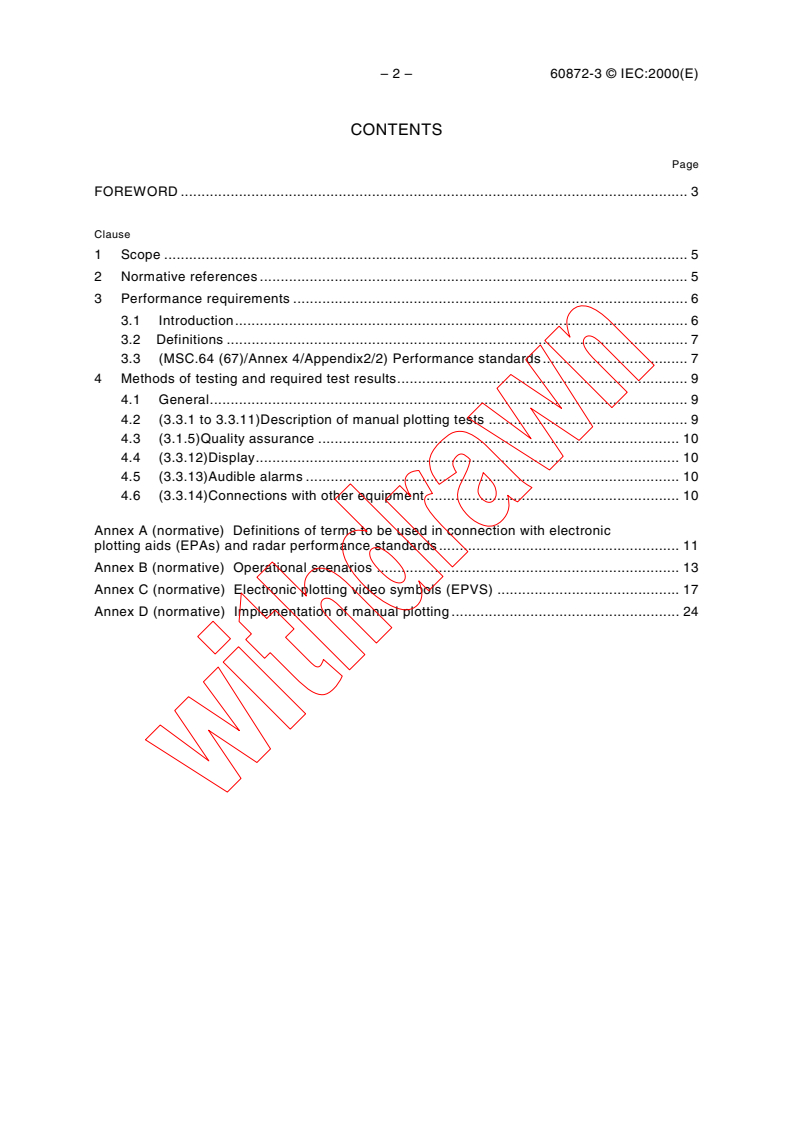
CONTENTS
Page
FOREWORD . 3
Clause
1 Scope . 5
2 Normative references . 5
3 Performance requirements . 6
3.1 Introduction. 6
3.2 Definitions . 7
3.3 (MSC.64 (67)/Annex 4/Appendix2/2) Performance standards. 7
4 Methods of testing and required test results. 9
4.1 General. 9
4.2 (3.3.1 to 3.3.11)Description of manual plotting tests . 9
4.3 (3.1.5)Quality assurance . 10
4.4 (3.3.12)Display. 10
4.5 (3.3.13)Audible alarms . 10
4.6 (3.3.14)Connections with other equipment . 10
Annex A (normative) Definitions of terms to be used in connection with electronic
plotting aids (EPAs) and radar performance standards . 11
Annex B (normative) Operational scenarios . 13
Annex C (normative) Electronic plotting video symbols (EPVS) . 17
Annex D (normative) Implementation of manual plotting . 24
60872-3 © IEC:2000(E) – 3 –
INTERNATIONAL ELECTROTECHNICAL COMMISSION
___________
MARITIME NAVIGATION AND RADIOCOMMUNICATION
EQUIPMENT AND SYSTEMS – RADAR PLOTTING AIDS –
Part 3: Electronic plotting aid (EPA) –
Performance requirements –
Methods of testing and required test results
FOREWORD
1) The IEC (International Electrotechnical Commission) is a worldwide organization for standardization comprising
all national electrotechnical committees (IEC National Committees). The object of the IEC is to promote
international co-operation on all questions concerning standardization in the electrical and electronic fields. To
this end and in addition to other activities, the IEC publishes International Standards. Their preparation is
entrusted to technical committees; any IEC National Committee interested in the subject dealt with may
participate in this preparatory work. International, governmental and non-governmental organizations liaising
with the IEC also participate in this preparation. The IEC collaborates closely with the International Organization
for Standardization (ISO) in accordance with conditions determined by agreement between the two
organizations.
2) The formal decisions or agreements of the IEC on technical matters express, as nearly as possible, an
international consensus of opinion on the relevant subjects since each technical committee has representation
from all interested National Committees.
3) The documents produced have the form of recommendations for international use and are published in the form
of standards, technical specifications, technical reports or guides and they are accepted by the National
Committees in that sense.
4) In order to promote international unification, IEC National Committees undertake to apply IEC International
Standards transparently to the maximum extent possible in their national and regional standards. Any
divergence between the IEC Standard and the corresponding national or regional standard shall be clearly
indicated in the latter.
5) The IEC provides no marking procedure to indicate its approval and cannot be rendered responsible for any
equipment declared to be in conformity with one of its standards.
6) Attention is drawn to the possibility that some of the elements of this International Standard may be the subject
of patent rights. The IEC shall not be held responsible for identifying any or all such patent rights.
International Standard IEC 60872-3 has been prepared by IEC technical committee 80:
Maritime navigation and radiocommunication equipment and systems.
The text of this standard is based on the following documents:
FDIS Report on voting
80/251/FDIS 80/274/RVD
Full information on the voting for the approval of this standard can be found in the report on
voting indicated in the above table.
This publication has been drafted in accordance with the ISO/IEC Directives, Part 3.
Annexes A, B, C and D form an integral part of this standard.
– 4 – 60872-3 © IEC:2000(E)
The committee has decided that the contents of this publication will remain unchanged until
2008. At this date, the publication will be
reconfirmed;
withdrawn;
replaced by a revised edition, or
amended.
A bilingual version of this standard may be issued at a later date.
60872-3 © IEC:2000(E) – 5 –
MARITIME NAVIGATION AND RADIOCOMMUNICATION
EQUIPMENT AND SYSTEMS – RADAR PLOTTING AIDS –
Part 3: Electronic plotting aid (EPA) -–
Performance requirements –
Methods of testing and required test results
1 Scope
This part of IEC 60872 specifies the minimum operational and performance requirements,
methods of testing and test results for equipment that complies with performance standards not
inferior to those adopted by the International Maritime Organization (IMO) in resolution MSC.64
(67) Annex 4 – Appendix 2. In addition, this standard takes account of IMO Resolution A.694
and is associated with IEC 60945.
When a requirement in this standard is different from IEC 60945, the requirement in this
standard takes precedence.
The electronic plotting aid for manual direct plotting is intended for small ships fitted with either
a gyrocompass or a transmitting marine electromagnetic compass conforming to ISO 11606 or
a transmitting magnetic heading device conforming to IMO MSC.86(70) – annex 2, and a speed
and distance measuring equipment (SDME) conforming to IMO Resolution A.824 and
IEC 61023. This plotting aid is not suitable for ships classed as high-speed craft.
All texts in this standard, the wording of which is identical to that in IMO resolution MSC.64 (67)
Annex 4 – Appendix 2, are printed in italics and the resolution and paragraph numbers are
indicated in brackets.
2 Normative references
The following normative documents contain provisions which, through reference in this text,
constitute provisions of this part of IEC 60872. For dated references, subsequent amendments
to, or revisions of, any of these publications do not apply. However, parties to agreements
based on this part of IEC 60872 are encouraged to investigate the possibility of applying the
most recent editions of the normative documents indicated below. For undated references, the
latest edition of the normative document referred to applies. Members of IEC and ISO maintain
registers of currently valid International Standards.
IEC 60872-1:1998, Maritime navigation and radiocommunication equipment and systems –
Radar plotting aids – Part 1: Automatic radar plotting aid (ARPA) – Methods of testing and
required test results
IEC 60872-2:1999, Maritime navigation and radiocommunication equipment and systems –
Radar plotting aids – Part 2: Automatic tracking aid (ATA) – Methods of testing and required
test results
IEC 60936-1:1999, Maritime navigation and radiocommunication equipment and systems –
Radar – Part 1: Shipborne radar – Performance requirements - Methods of testing and required
test results
– 6 – 60872-3 © IEC:2000(E)
IEC 60945:1996, Maritime navigation and radiocommunication equipment and systems –
General requirements – Methods of testing and required test results
IEC 61023:1999, Maritime navigation and radiocommunication equipment and systems –
Marine speed and distance measuring equipment (SDME) – Performance requirements –
Methods of testing and required test results
IEC 61162 (all parts), Maritime navigation and radiocommunication equipment and systems –
Digital interfaces
ISO: 11606, Ships and marine technology – Marine electromagnetic compasses
ISO 9000 (all parts), Quality management and quality assurance standards
IMO Resolution A.694:1991, General requirements for shipborne radio equipment forming part
of the global maritime distress and safety system (GMDSS) and for electronic navigational aids
IMO Resolution A.823:1995, Performance standards for automatic radar plotting aids (ARPAs)
IMO Resolution A.824:1995, Performance standards for devices to indicate speed and distance
IMO MSC/Circular 603:1993, Guidelines on display sizes and techniques for navigational
purposes
IMO MSC.64(67):1996, Annex 4 – Performance standards for radar equipment, and Appendix 2
– Electronic plotting aids
IMO MSC.86(70):1998, Annex 2 – Performance standards for marine transmitting magnetic
heading devices (TMHDs)
IHO S-52: 1996, Specifications for chart content and display aspects of ECDIS
3 Performance requirements
3.1 Introduction
3.1.1 The electronic plotting aid (EPA) shall, in order to improve the standard of collision
avoidance at sea:
.1 reduce the workload of observers by enabling them to obtain information about plotted
targets so that they can perform as well with several separate targets as they can by
manually plotting a single target;
.2 provide continuous, accurate and rapid situation evaluation.
3.1.2 The radar facilities provided by an EPA display shall comply with those clauses of
IEC 60936-1 appropriate to its mode of use.
3.1.3 In addition to the general requirements contained in IEC 60945, the EPA shall comply
with the following minimum requirements.
3.1.4 Additional ARPA or ATA facilities, not mandated in this EPA standard, may be provided.
Such facilities shall comply with IEC 60872-1 and IEC 60872-2 as applicable.
60872-3 © IEC:2000(E) – 7 –
3.1.5 Quality assurance
The EPA shall be designed, produced and documented by companies complying with
ISO 9000, as applicable.
3.2 Definitions
Definitions of terms used in these performance standards are given in annex A.
3.3 (MSC.64 (67)/Annex 4/Appendix2/2) Performance standards
3.3.1 (App2/2.1) The electronic plotting aid (EPA) shall provide a means to plot a minimum
of 10 targets on a radar display.
See annex D for a description of how manual plotting shall be implemented.
3.3.2 (App2/2.2) Range scales
3.3.2.1 It shall be possible to plot targets on the 3, 6 and 12 nautical mile range scales. The
facility may be provided on additional range scales. There shall be a positive indication of the
range scale in use. Plots shall be maintained when switching between range scales. The
methods of operation that are provided shall be clearly described in the manufacturer’s manual.
3.3.2.2 After changing range scales on which the EPA facilities are available or on resetting
the display, full plotting information shall be displayed within a period of time not exceeding one
°
scan of 360 .
3.3.3 (App2/2.3) It shall be possible to plot targets with a relative speed up to 75 knots.
3.3.4 (App2/2.4) It shall be possible for the operator to adjust the CPA/TCPA limits and the
vector time.
3.3.5 Plot positions and identification
3.3.5.1 (App2/2.5) Plot positions shall be identified by an approved symbol (see annex C
symbols 1, 4 or 6) and an associated plot number. It shall be possible to switch off the plot
number.
3.3.5.2 Automatically applied ‘target identities’ shall not be re-used until, as a minimum, the
number assigned equals the maximum number of plotted targets.
3.3.6 (App2/2.6) The minimum lapsed time between any two plots shall be greater than 30 s.
3.3.7 (App2/2.7) After the second plot, a vector shall be displayed on the target. It shall be
possible to select a true or relative vector. There shall be a positive indication of vector mode,
including an indication of sea or ground stabilization.
.1 vectors displayed shall be time-adjustable;
.2 a positive indication of the time-scale of the vector in use shall be given.
3.3.8 (App2/2.8) The vector origin shall move across the screen at a rate and direction
defined by the calculated true course and speed.
3.3.9 (App2/2.9) It shall be possible to correct the position of a plot.
– 8 – 60872-3 © IEC:2000(E)
3.3.10 (App2/2.10) It shall be possible, on demand, to display the following data on a
selected target:
.1 plot number: time since last plot (min);
.2 present range of the target;
.3 present true bearing of the target;
.4 predicted target range at the closest point of approach (CPA);
.5 predicted time to CPA (TCPA);
NOTE If the CPA has passed, it shall be indicated by a TCPA with a negative (–) sign.
.6 calculated true course of target;
.7 calculated true speed of target.
The selected plot shall be clearly identified with an approved symbol (see annex C, symbol 12)
and the plot data shall be displayed outside of the screen radar area. If data is required for
more than one target at the same time each symbol shall be separately identified, for example
with a number adjacent to the symbol.
3.3.11 (App2/2.11) There shall be an indication by a text message including the plot number
of any plot that is not updated for 10 min. The plot shall be dropped if the time between
consecutive plots exceeds 15 min.
3.3.12 Display
3.3.12.1 The display may be a separate or integral part of the ship's radar. However the EPA
display shall include all the data required to be provided by a radar display in accordance with
the performance standards for navigational radar equipment.
3.3.12.2 The design shall be such that any malfunction of EPA parts producing data additional
to information to be produced by the radar, as required by the performance standards for
navigational equipment, shall not affect the integrity of the basic radar presentation.
The equipment shall be regarded as complying with the above requirement if the design is such
that, where practicable, correct operation of the radar system in accordance with IEC 60936-1
will not be affected by malfunction of any EPA sub-system that is not an essential part of the
radar.
3.3.12.3 The EPA shall be capable of operating with a relative or true motion display with
"north-up" azimuth stabilization. There shall be a positive indication of the display mode and
orientation in use.
3.3.12.4 The EPA information shall not obscure the visibility of radar targets. The display of
EPA data (vector and associated symbol) shall be under the control of the radar observer. It
shall be possible to cancel the display of unwanted EPA data within 3 s of command.
3.3.12.5 Means shall be provided to adjust independently the brilliance of the EPA data and
radar data, including complete extinction of the EPA data.
3.3.12.6 The method of presentation shall ensure that the EPA data is clearly visible in
general to more than one observer in the conditions of light normally experienced on the bridge
of a ship by day and by night. Screening may be provided to shade the display from sunlight but
not to the extent that it will impair the observer's ability to maintain a proper lookout. Facilities
to adjust the brightness shall be provided (see IMO MSC/Circular 603).
60872-3 © IEC:2000(E) – 9 –
3.3.13 Operational alarms and indications
3.3.13.1 The EPA shall have the capability to alarm the observer with a visual and audible
signal of any tracked target that is predicted to close within a minimum range and time chosen
by the observer. The target causing the alarm shall be clearly indicated with the relevant
symbols (see annex C, symbol 8) on the display.
3.3.13.2 It shall be possible for the observer to activate or de-activate the audible alarm
capability.
3.3.14 Connections with other equipment
3.3.14.1 The connection of the EPA to any other equipment shall not degrade the
performance of that equipment. This requirement shall be met whether the EPA is operating or
not. Additionally, the EPA shall be designed to comply with this requirement under fault
conditions as far as is practicable.
3.3.14.2 Serial interfaces provided, shall comply with the IEC 61162 series, as applicable.
4 Methods of testing and required test results
4.1 General
Before these tests are effected, the equipment under test (EUT) shall be subjected to and
satisfy the relevant parts of IEC 60945.
4.2 (3.3.1 to 3.3.11) Description of manual plotting tests
4.2.1 General principle
The manual plotting tests are intended to compare target data (CPA, TCPA, speed and course)
gained simultaneously from the EUT of the EPA device and from evaluation of plot positions
(range and bearing) while plotting a cursor position simulating a target position.
4.2.2 Operational conditions
The tests shall be carried out by entering plots to pre-defined positions (range and bearing)
and own ship data according to test scenarios covering the most relevant sources of potential
error. The test scenarios to be used are given in table 1 and are detailed in annex B. Faults
of sensors and precision of positioning the cursor over a real radar target have no effects on
these tests. Only the accuracy of the EPA calculations are tested.
Table 1 – Test scenarios
Scenario Description
1 Target with nearly the same course and a risk of collision (CPA = 0); after 9 min change of own
course 45° starboard (CPA > 0)
2 Own ship at anchor (SPD = 0); target approaches from 135° exactly towards own position
(CPA = 0); own ship gets underway at +9 min and speed increases to 5 kt
3 Target with exactly the same course and speed; after 6 min reduction of own speed to 5 kt;
after 12 min change of target course so that CPA = 0
4 Target with exactly opposite course; after 9 min change of own course 10° starboard to CPA > 0
5 Target with crossing course and a risk of collision (CPA = 0); after 6 min a reduction of own
speed, target reduces accordingly (CPA = 0); after 12 min own course is changed 90° to port
so that CPA > 0
6 Target with opposite course manoeuvres to a collision course (CPA = 0); after 12 min, own speed
and course are changed; target changes its course accordingly (CPA = 0)
– 10 – 60872-3 © IEC:2000(E)
4.2.3 Method of measurement
With the gain reduced to a minimum, or off, own ship course and speed shall be set to the
required values by using manual settings at the display.
Placing the cursor to the range and bearing values given by the scenario shall set plot marks.
The test scenarios shall be performed in plot intervals of 3 min. Target data including CPA,
TCPA, course and speed obtained by the EUT and the range and bearing values entered into
the EUT shall be read out and recorded.
Required own ship changes are performed at the beginning of the plot interval, immediately
after the last plot has been set.
4.2.4 Results required
All data sets shall be evaluated by using these valid values for range and bearing, compared
with the target data obtained by the EUT (thus target data are not compared with the original
scenario data; the scena
...