

IEC 60079-26:2021
(Main)Explosive atmospheres - Part 26: Equipment with Separation Elements or combined Levels of Protection
General Information
- Abstract
IEC 60079-26:2021 specifies requirements for construction, testing and marking for Ex Equipment that contains parts of the equipment with different Equipment Protection Levels (EPLs) and a separation element. This equipment is mounted across a boundary where different EPLs are required, for example between different gas hazardous areas, dust hazardous areas or gas hazardous areas adjacent to dust hazardous areas.
Separation elements are considered for both electrical and non-electrical equipment. If mechanical energy can be transformed into a potential ignition source, additionally an ignition hazard assessment in accordance with ISO 80079-36 is performed and appropriate measures are undertaken.
This document also specifies requirements for the combination of two Types of Protection, each with EPL Gb, to achieve EPL Ga.
This document supplements and modifies the general requirements of IEC 60079-0. Where a requirement of this document conflicts with a requirement of IEC 60079-0, the requirement of this document takes precedence. This fourth edition cancels and replaces the third edition and constitutes a technical revision.
Please see the IEC 60079-26:2020 foreword for a description of the main changes with respect to the previous edition.
- Status
- Published
- Publication Date
- 24-Feb-2021
- Technical Committee
- TC 31 - Equipment for explosive atmospheres
- Drafting Committee
- MT 60079-26 - TC 31/MT 60079-26
- Current Stage
- PPUB - Publication issued
- Start Date
- 25-Feb-2021
- Completion Date
- 26-Feb-2021
Overview
IEC 60079-26:2021 is an international standard published by the International Electrotechnical Commission (IEC) that addresses the safety requirements for equipment used in explosive atmospheres. Specifically, this fourth edition focuses on equipment with separation elements or combined Equipment Protection Levels (EPLs), providing guidance for construction, testing, and marking. The standard applies to equipment mounted across boundaries that require different EPLs, such as between various gas hazardous zones, dust hazardous zones, or a combination of both.
This standard enhances safety by specifying requirements for both electrical and non-electrical equipment when mechanical energy could pose an ignition risk, mandating ignition hazard assessment in line with ISO 80079-36 where applicable. IEC 60079-26:2021 modifies and supplements the general requirements laid out in IEC 60079-0 and takes precedence where conflicts occur. Its scope extension also includes separation elements between all EPLs and covers combined types of protection.
Key Topics
Separation Elements
- Definition and role in maintaining safety between parts of equipment with differing EPLs
- Requirements for partition walls including material specifications, thickness, and gas-tight conductor bushings
- Consideration of natural ventilation for gas atmospheres to prevent hazardous accumulation
Combined Equipment Protection Levels (EPLs)
- Rules for combining two types of protection with EPL Gb to achieve the higher EPL Ga
- Electrical connections and design principles ensuring effective separation and protection
Construction and Testing
- Type tests for standardized protection types and separation elements
- Mechanical endurance testing, especially for partition walls subject to pressure and vibration, referring to IEC TS 60079-40
- Requirements for temperature evaluation to guarantee safe operating conditions
Marking and Documentation
- Detailed marking instructions for equipment with combined protection levels or separation elements
- Specification of EPL allocations and the thickness of separation elements in user instructions
- Inclusion of warnings related to abrasive dust flow and other operational hazards
Applications
IEC 60079-26:2021 has practical applications across industries where explosive atmospheres are a risk, including:
Oil and Gas Industry
Equipment operating at boundaries of hazardous areas with different gas concentrations or dust presence, requiring stringent separation and protectionChemical and Petrochemical Plants
Machinery and control devices mounted across zones with varied explosive gas and dust classifications, benefiting from combined EPL approachesMining and Grain Processing
Application to non-electrical and electrical equipment exposed to dust hazardous areas, ensuring partitions and separation elements effectively mitigate ignition risksManufacturing Facilities
Ensuring safety when equipment contains different protective systems or is subject to mechanical forces that may create ignition sources
Overall, compliance with IEC 60079-26:2021 facilitates the design and use of complex equipment assemblies that span multiple hazardous area classifications, improving worker safety and operational reliability.
Related Standards
IEC 60079-26:2021 is part of the comprehensive IEC 60079 series covering explosive atmospheres. Key related standards include:
IEC 60079-0
General requirements for electrical equipment in explosive atmospheres; foundational for all parts, but superseded by IEC 60079-26 where conflicts ariseIEC 60079-36
Addresses non-electrical equipment ignition hazard assessment, applicable when mechanical energy could cause ignitionIEC TS 60079-40
Provides guidance on endurance tests under vibrational and pressure stresses, referenced for testing separation elementsISO 80079-36
International standard dealing with the construction and testing of non-electrical equipment for explosive atmospheres
Using IEC 60079-26 alongside these standards ensures full compliance with international safety expectations for equipment in hazardous environments, supporting best practices in explosion protection engineering.
Keywords: IEC 60079-26, explosive atmospheres, equipment protection level, separation elements, hazardous areas, electrical equipment, ignition hazard assessment, type testing, marking requirements, combined protection, EPL, gas hazardous area, dust hazardous area, IEC standards.
Relations
- Effective Date
- 09-Feb-2026
- Effective Date
- 05-Sep-2023
Get Certified
Connect with accredited certification bodies for this standard

IMQ S.p.A. (Certification)
Italian electrical product certification.

SLG Prüf- und Zertifizierungs GmbH
German testing and certification body.

UL Solutions
Global safety science company with testing, inspection and certification.
Sponsored listings
Frequently Asked Questions
IEC 60079-26:2021 is a standard published by the International Electrotechnical Commission (IEC). Its full title is "Explosive atmospheres - Part 26: Equipment with Separation Elements or combined Levels of Protection". This standard covers: IEC 60079-26:2021 specifies requirements for construction, testing and marking for Ex Equipment that contains parts of the equipment with different Equipment Protection Levels (EPLs) and a separation element. This equipment is mounted across a boundary where different EPLs are required, for example between different gas hazardous areas, dust hazardous areas or gas hazardous areas adjacent to dust hazardous areas. Separation elements are considered for both electrical and non-electrical equipment. If mechanical energy can be transformed into a potential ignition source, additionally an ignition hazard assessment in accordance with ISO 80079-36 is performed and appropriate measures are undertaken. This document also specifies requirements for the combination of two Types of Protection, each with EPL Gb, to achieve EPL Ga. This document supplements and modifies the general requirements of IEC 60079-0. Where a requirement of this document conflicts with a requirement of IEC 60079-0, the requirement of this document takes precedence. This fourth edition cancels and replaces the third edition and constitutes a technical revision. Please see the IEC 60079-26:2020 foreword for a description of the main changes with respect to the previous edition.
IEC 60079-26:2021 specifies requirements for construction, testing and marking for Ex Equipment that contains parts of the equipment with different Equipment Protection Levels (EPLs) and a separation element. This equipment is mounted across a boundary where different EPLs are required, for example between different gas hazardous areas, dust hazardous areas or gas hazardous areas adjacent to dust hazardous areas. Separation elements are considered for both electrical and non-electrical equipment. If mechanical energy can be transformed into a potential ignition source, additionally an ignition hazard assessment in accordance with ISO 80079-36 is performed and appropriate measures are undertaken. This document also specifies requirements for the combination of two Types of Protection, each with EPL Gb, to achieve EPL Ga. This document supplements and modifies the general requirements of IEC 60079-0. Where a requirement of this document conflicts with a requirement of IEC 60079-0, the requirement of this document takes precedence. This fourth edition cancels and replaces the third edition and constitutes a technical revision. Please see the IEC 60079-26:2020 foreword for a description of the main changes with respect to the previous edition.
IEC 60079-26:2021 is classified under the following ICS (International Classification for Standards) categories: 29.260.20 - Electrical apparatus for explosive atmospheres. The ICS classification helps identify the subject area and facilitates finding related standards.
IEC 60079-26:2021 has the following relationships with other standards: It is inter standard links to EN ISO 12643-1:2023, IEC 60079-26:2014. Understanding these relationships helps ensure you are using the most current and applicable version of the standard.
IEC 60079-26:2021 is available in PDF format for immediate download after purchase. The document can be added to your cart and obtained through the secure checkout process. Digital delivery ensures instant access to the complete standard document.
Standards Content (Sample)
IEC 60079-26 ®
Edition 4.0 2021-02
INTERNATIONAL
STANDARD
NORME
INTERNATIONALE
colour
inside
Explosive atmospheres –
Part 26: Equipment with Separation Elements or combined Levels of Protection
Atmosphères explosives –
Partie 26: Appareil avec éléments de séparation ou niveaux de protection
combinés
All rights reserved. Unless otherwise specified, no part of this publication may be reproduced or utilized in any form
or by any means, electronic or mechanical, including photocopying and microfilm, without permission in writing from
either IEC or IEC's member National Committee in the country of the requester. If you have any questions about IEC
copyright or have an enquiry about obtaining additional rights to this publication, please contact the address below or
your local IEC member National Committee for further information.
Droits de reproduction réservés. Sauf indication contraire, aucune partie de cette publication ne peut être reproduite
ni utilisée sous quelque forme que ce soit et par aucun procédé, électronique ou mécanique, y compris la photocopie
et les microfilms, sans l'accord écrit de l'IEC ou du Comité national de l'IEC du pays du demandeur. Si vous avez des
questions sur le copyright de l'IEC ou si vous désirez obtenir des droits supplémentaires sur cette publication, utilisez
les coordonnées ci-après ou contactez le Comité national de l'IEC de votre pays de résidence.
IEC Central Office Tel.: +41 22 919 02 11
3, rue de Varembé info@iec.ch
CH-1211 Geneva 20 www.iec.ch
Switzerland
About the IEC
The International Electrotechnical Commission (IEC) is the leading global organization that prepares and publishes
International Standards for all electrical, electronic and related technologies.
About IEC publications
The technical content of IEC publications is kept under constant review by the IEC. Please make sure that you have the
latest edition, a corrigendum or an amendment might have been published.
IEC publications search - webstore.iec.ch/advsearchform IEC online collection - oc.iec.ch
The advanced search enables to find IEC publications by a Discover our powerful search engine and read freely all the
variety of criteria (reference number, text, technical publications previews. With a subscription you will always
committee, …). It also gives information on projects, replaced have access to up to date content tailored to your needs.
and withdrawn publications.
Electropedia - www.electropedia.org
IEC Just Published - webstore.iec.ch/justpublished
The world's leading online dictionary on electrotechnology,
Stay up to date on all new IEC publications. Just Published
containing more than 22 000 terminological entries in English
details all new publications released. Available online and
and French, with equivalent terms in 18 additional languages.
once a month by email.
Also known as the International Electrotechnical Vocabulary
(IEV) online.
IEC Customer Service Centre - webstore.iec.ch/csc
If you wish to give us your feedback on this publication or
need further assistance, please contact the Customer Service
Centre: sales@iec.ch.
A propos de l'IEC
La Commission Electrotechnique Internationale (IEC) est la première organisation mondiale qui élabore et publie des
Normes internationales pour tout ce qui a trait à l'électricité, à l'électronique et aux technologies apparentées.
A propos des publications IEC
Le contenu technique des publications IEC est constamment revu. Veuillez vous assurer que vous possédez l’édition la
plus récente, un corrigendum ou amendement peut avoir été publié.
Recherche de publications IEC - IEC online collection - oc.iec.ch
webstore.iec.ch/advsearchform Découvrez notre puissant moteur de recherche et consultez
La recherche avancée permet de trouver des publications IEC gratuitement tous les aperçus des publications. Avec un
en utilisant différents critères (numéro de référence, texte, abonnement, vous aurez toujours accès à un contenu à jour
comité d’études, …). Elle donne aussi des informations sur adapté à vos besoins.
les projets et les publications remplacées ou retirées.
Electropedia - www.electropedia.org
IEC Just Published - webstore.iec.ch/justpublished
Le premier dictionnaire d'électrotechnologie en ligne au
Restez informé sur les nouvelles publications IEC. Just
monde, avec plus de 22 000 articles terminologiques en
Published détaille les nouvelles publications parues.
anglais et en français, ainsi que les termes équivalents dans
Disponible en ligne et une fois par mois par email.
16 langues additionnelles. Egalement appelé Vocabulaire
Electrotechnique International (IEV) en ligne.
Service Clients - webstore.iec.ch/csc
Si vous désirez nous donner des commentaires sur cette
publication ou si vous avez des questions contactez-nous:
sales@iec.ch.
IEC 60079-26 ®
Edition 4.0 2021-02
INTERNATIONAL
STANDARD
NORME
INTERNATIONALE
colour
inside
Explosive atmospheres –
Part 26: Equipment with Separation Elements or combined Levels of Protection
Atmosphères explosives –
Partie 26: Appareil avec éléments de séparation ou niveaux de protection
combinés
INTERNATIONAL
ELECTROTECHNICAL
COMMISSION
COMMISSION
ELECTROTECHNIQUE
INTERNATIONALE
ICS 29.260.20 ISBN 978-2-8322-9390-4
– 2 – IEC 60079-26:2021 © IEC 2021
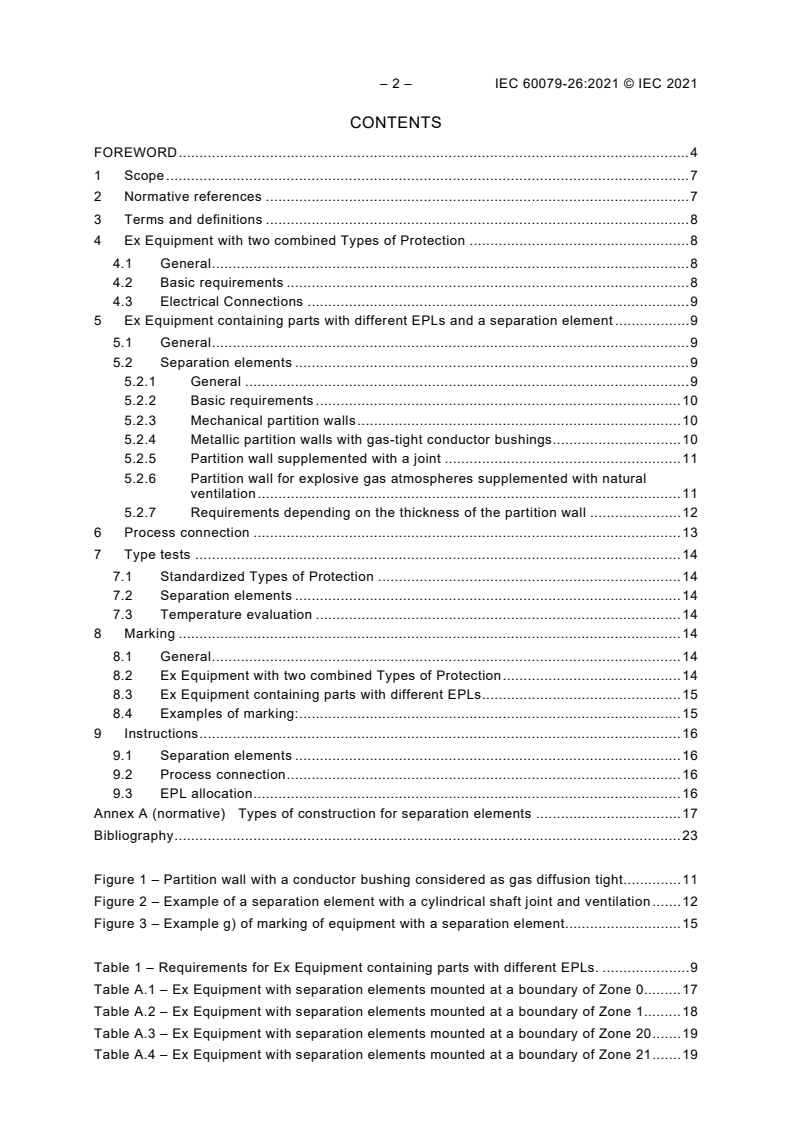
CONTENTS
FOREWORD . 4
1 Scope . 7
2 Normative references . 7
3 Terms and definitions . 8
4 Ex Equipment with two combined Types of Protection . 8
4.1 General . 8
4.2 Basic requirements . 8
4.3 Electrical Connections . 9
5 Ex Equipment containing parts with different EPLs and a separation element . 9
5.1 General . 9
5.2 Separation elements . 9
5.2.1 General . 9
5.2.2 Basic requirements . 10
5.2.3 Mechanical partition walls . 10
5.2.4 Metallic partition walls with gas-tight conductor bushings . 10
5.2.5 Partition wall supplemented with a joint . 11
5.2.6 Partition wall for explosive gas atmospheres supplemented with natural
ventilation . 11
5.2.7 Requirements depending on the thickness of the partition wall . 12
6 Process connection . 13
7 Type tests . 14
7.1 Standardized Types of Protection . 14
7.2 Separation elements . 14
7.3 Temperature evaluation . 14
8 Marking . 14
8.1 General . 14
8.2 Ex Equipment with two combined Types of Protection . 14
8.3 Ex Equipment containing parts with different EPLs. 15
8.4 Examples of marking:. 15
9 Instructions . 16
9.1 Separation elements . 16
9.2 Process connection . 16
9.3 EPL allocation . 16
Annex A (normative) Types of construction for separation elements . 17
Bibliography . 23
Figure 1 – Partition wall with a conductor bushing considered as gas diffusion tight. 11
Figure 2 – Example of a separation element with a cylindrical shaft joint and ventilation . 12
Figure 3 – Example g) of marking of equipment with a separation element. 15
Table 1 – Requirements for Ex Equipment containing parts with different EPLs. . 9
Table A.1 – Ex Equipment with separation elements mounted at a boundary of Zone 0. 17
Table A.2 – Ex Equipment with separation elements mounted at a boundary of Zone 1. 18
Table A.3 – Ex Equipment with separation elements mounted at a boundary of Zone 20 . 19
Table A.4 – Ex Equipment with separation elements mounted at a boundary of Zone 21 . 19
Table A.5 – Ex Equipment with separation elements mounted at a boundary of Zone 0
in Zone 21 or 22 . 20
Table A.6 – Ex Equipment with separation elements mounted at a boundary of Zone 1
in Zone 21 or 22 . 20
Table A.7 – Ex Equipment with separation elements mounted at a boundary of Zone 20
in Zone 1 or 2 . 21
Table A.8 – Ex Equipment with separation elements mounted at a boundary of Zone 21
in Zone 1 or 2 . 22
– 4 – IEC 60079-26:2021 © IEC 2021
INTERNATIONAL ELECTROTECHNICAL COMMISSION
____________
EXPLOSIVE ATMOSPHERES –
Part 26: Equipment with Separation Elements
or combined Levels of Protection
FOREWORD
1) The International Electrotechnical Commission (IEC) is a worldwide organization for standardization comprising
all national electrotechnical committees (IEC National Committees). The object of IEC is to promote international
co-operation on all questions concerning standardization in the electrical and electronic fields. To this end and
in addition to other activities, IEC publishes International Standards, Technical Specifications, Technical Reports,
Publicly Available Specifications (PAS) and Guides (hereafter referred to as "IEC Publication(s)"). Their
preparation is entrusted to technical committees; any IEC National Committee interested in the subject dealt with
may participate in this preparatory work. International, governmental and non-governmental organizations liaising
with the IEC also participate in this preparation. IEC collaborates closely with the International Organization for
Standardization (ISO) in accordance with conditions determined by agreement between the two organizations.
2) The formal decisions or agreements of IEC on technical matters express, as nearly as possible, an international
consensus of opinion on the relevant subjects since each technical committee has representation from all
interested IEC National Committees.
3) IEC Publications have the form of recommendations for international use and are accepted by IEC National
Committees in that sense. While all reasonable efforts are made to ensure that the technical content of IEC
Publications is accurate, IEC cannot be held responsible for the way in which they are used or for any
misinterpretation by any end user.
4) In order to promote international uniformity, IEC National Committees undertake to apply IEC Publications
transparently to the maximum extent possible in their national and regional publications. Any divergence between
any IEC Publication and the corresponding national or regional publication shall be clearly indicated in the latter.
5) IEC itself does not provide any attestation of conformity. Independent certification bodies provide conformity
assessment services and, in some areas, access to IEC marks of conformity. IEC is not responsible for any
services carried out by independent certification bodies.
6) All users should ensure that they have the latest edition of this publication.
7) No liability shall attach to IEC or its directors, employees, servants or agents including individual experts and
members of its technical committees and IEC National Committees for any personal injury, property damage or
other damage of any nature whatsoever, whether direct or indirect, or for costs (including legal fees) and
expenses arising out of the publication, use of, or reliance upon, this IEC Publication or any other IEC
Publications.
8) Attention is drawn to the Normative references cited in this publication. Use of the referenced publications is
indispensable for the correct application of this publication.
9) Attention is drawn to the possibility that some of the elements of this IEC Publication may be the subject of patent
rights. IEC shall not be held responsible for identifying any or all such patent rights.
International Standard IEC 60079-26 has been prepared by IEC technical committee 31:
Equipment for explosive atmospheres.
This fourth edition cancels and replaces the third edition published in 2014 and constitutes a
technical revision.
This edition includes the following significant changes with respect to the previous edition:
Type
Minor and Major
Changes Clause
editorial Extension technical
changes changes
The scope of the standard was extended for separation 5 x
elements between all EPLs for gas and dust hazardous
areas as well as for non-electrical equipment. The title
and the structure of the standard was modified
accordingly.
The requirements for combined Types of Protection 4.1.2 4 x
were restructured and included in Clause 4
The requirements for equipment with moving parts was 4.2 x
removed and transferred to IEC 60079-0 (ed. 3)
For equipment with partition walls other than corrosion 7.2 C1
resistant metals, glass or ceramic the type tests were
detailed and the cycling test acc. to IEC TS 60079-40
specified, if they were exposed to constant vibrational
stress
The marking is extended for equipment to be mounted 8 x
between different Zones
The thickness of the partition wall must be specified in 9 x
the instructions
Additional warnings are included in the instructions for 9 x
equipment with separation elements exposed to abrasive
dust flow
Table 1 "Separation elements" was moved to Annex A as Table A.1 x
Table A.1 and modified for clarification
Table A.2 to table A.8 added for the extended separation
x
elements
NOTE The technical changes referred to include the significance of technical changes in the revised IEC Standard,
but they do not form an exhaustive list of all modifications from the previous version.
Explanation of the types of changes:
A) Definitions
1. Minor and editorial changes:
• Clarification
• Decrease of technical requirements
• Minor technical change
• Editorial corrections
These are changes which modify requirements in an editorial or a minor technical way. They
include changes of the wording to clarify technical requirements without any technical change,
or a reduction in level of existing requirement.
2. Extension: Addition of technical options
These are changes which add new or modify existing technical requirements, in a way that new
options are given, but without increasing requirements for equipment that was fully compliant
with the previous standard. Therefore, these will not have to be considered for products in
conformity with the preceding edition.
– 6 – IEC 60079-26:2021 © IEC 2021
3. Major technical changes:
• addition of technical requirements
• increase of technical requirements
These are changes to technical requirements (addition, increase of the level or removal) made
in a way that a product in conformity with the preceding edition will not always be able to fulfil
the requirements given in the later edition. These changes have to be considered for products
in conformity with the preceding edition. For these changes additional information is provided
in clause B below.
NOTE These changes represent current technological knowledge. However, these changes should not normally
have an influence on equipment already placed on the market.
B) Information about the background of ‘Major technical changes’
C1 to ensure that partition walls consisting of materials other than stainless steel, ceramics or
glass, which are exposed to pressure or vibrational stress, provide a comparable level of
safety, additional endurance tests were included. Reference to tests in IEC TS 60079-40
were considered appropriate.
The text of this International Standard is based on the following documents:
FDIS Report on voting
31/1562/FDIS 31/1564/RVD
Full information on the voting for the approval of this International Standard can be found in the
report on voting indicated in the above table.
This document has been drafted in accordance with the ISO/IEC Directives, Part 2.
A list of all parts in the IEC 60079 series, published under the general title Explosive
atmospheres, can be found on the IEC website.
The committee has decided that the contents of this document will remain unchanged until the
stability date indicated on the IEC website under "http://webstore.iec.ch" in the data related to
the specific document. At this date, the document will be
• reconfirmed,
• withdrawn,
• replaced by a revised edition, or
• amended.
IMPORTANT – The 'colour inside' logo on the cover page of this publication indicates
that it contains colours which are considered to be useful for the correct understanding
of its contents. Users should therefore print this document using a colour printer.
EXPLOSIVE ATMOSPHERES –
Part 26: Equipment with Separation Elements
or combined Levels of Protection
1 Scope
This part of IEC 60079 specifies requirements for construction, testing and marking for Ex
Equipment that contains parts of the equipment with different Equipment Protection Levels
(EPLs) and a separation element. This equipment is mounted across a boundary where different
EPLs are required, for example between different gas hazardous areas, dust hazardous areas
or gas hazardous areas adjacent to dust hazardous areas.
EXAMPLE: Equipment installed in the wall of storage tanks located in Zone 1 and containing Zone 0 inside.
Separation elements are considered for both electrical and non-electrical equipment. If
mechanical energy can be transformed into a potential ignition source, additionally an ignition
hazard assessment in accordance with ISO 80079-36 is performed and appropriate measures
are undertaken. Suitable measures can be selected from ISO 80079-37 or IEC TS 60079-42.
This document also specifies requirements for the combination of two Types of Protection, each
with EPL Gb, to achieve EPL Ga. Examples are included in 4.2.
This document supplements and modifies the general requirements of IEC 60079-0. Where a
requirement of this document conflicts with a requirement of IEC 60079-0, the requirement of
this document takes precedence.
2 Normative references
The following documents are referred to in the text in such a way that some or all of their content
constitutes requirements of this document. For dated references, only the edition cited applies.
For undated references, the latest edition of the referenced document (including any
amendments) applies.
IEC 60079-0, Explosive atmospheres – Part 0: Equipment – General requirements
IEC 60079-1, Explosive atmospheres – Part 1: Equipment protection by flameproof enclosures
"d"
IEC 60079-11, Explosive atmospheres – Part 11: Equipment protection by intrinsic safety "i"
IEC 60079-31, Explosive atmospheres – Part 31: Equipment dust ignition protection by
enclosure "t"
IEC TS 60079-40, Explosive atmospheres – Part 40: Requirements for process sealing between
flammable process fluids and electrical systems
IEC 60529, Degrees of protection provided by enclosures (IP Code)
IEC 60695-11-10, Fire hazard testing – Part 11-10: Test flames – 50 W horizontal and vertical
flame test methods
– 8 – IEC 60079-26:2021 © IEC 2021
ISO 80079-36, Explosive atmospheres – Part 36: Non-electrical equipment for explosive
atmospheres – Basic method and requirements
3 Terms and definitions
For the purposes of this document, the terms and definitions given in IEC 60079-0 apply.
ISO and IEC maintain terminological databases for use in standardization at the following
addresses:
• IEC Electropedia: available at http://www.electropedia.org/
• ISO Online browsing platform: available at http://www.iso.org/obp
4 Ex Equipment with two combined Types of Protection
4.1 General
To achieve EPL Ga, electrical equipment may comply with the requirements of two independent
Types of Protection each of EPL Gb. If one Type of Protection fails, the other Type of Protection
shall continue to function. Then even during rare malfunctions, for example two independent
faults, no ignition source can occur.
4.2 Basic requirements
The independent Types of Protection shall not have a common mode of failure, except as
specified below (see a) and b)). Combined Types of Protection of EPL Gb shall depend on
different physical protection principles.
NOTE 1 An example for an unacceptable common mode of failure is an Ex "db" enclosure containing arcing
components installed inside an Ex "eb" enclosure. Should the Ex "db" enclosure be compromised, it would also
compromise the Ex "eb" enclosure.
NOTE 2 The combination of Ex "db" and Ex "q" both depend on the avoidance of flame propagation (same physical
protection principle) and are not suitable in combination. In practice, some combinations are not suitable, for example
the combination of liquid immersion "ob" and powder filling "q".
Both Types of Protection shall be assessed using the most onerous malfunction condition of
the other Type of Protection. When combining intrinsic safety, i.e. Level of Protection "ib", with
another Type of Protection, the second Type of Protection shall be assessed after the
application of faults to the intrinsically safe apparatus which result in the most onerous condition
as specified in IEC 60079-11. Thermal dissipation shall be considered in case of a fault of one
Type of Protection.
When using two Types of Protection, which both rely on the same parameter (for example, the
creepage distance when combining Ex "ib" with Ex "eb"), the most stringent requirement of both
Types of Protection shall be applied.
If two Types of Protection are combined which both rely on the enclosure, one of the following
shall be met:
a) if two enclosures are used (one totally enclosed within the other), each enclosure shall
comply with the requirements of the respective Type of Protection; or
b) if only one enclosure is used, the enclosure and the Cable Glands shall meet the impact
test requirements of IEC 60079-0, using the Group I values.
Examples of relevant combinations of two independent Types of Protection are as follows:
– inductive transmitters (for example proximity switches, electrical position sensors) with
intrinsic safety "ib" enclosed by encapsulation "mb";
NOTE The connections to intrinsically safe "ib" circuits can be protected by increased safety "eb";
– a luminaire designed as increased safety "eb" included in a flameproof enclosure "db";
– measuring transducers with intrinsic safety "ib" enclosed by a flameproof enclosure "db";
– equipment with electrical circuits of intrinsic safety "ib", additionally protected by powder
filling "q";
– electromagnetic valves with encapsulation "mb", enclosed by a flameproof enclosure "db";
– increased safety "eb", with pressurized equipment "pxb".
4.3 Electrical Connections
Electrical connections and permanently connected cables of the equipment sited within an area
requiring EPL Ga shall comply with EPL Ga.
NOTE Installation requirements for equipment with EPL Ga achieved by combined types of protection are in
IEC 60079-14, Edition 6 .
5 Ex Equipment containing parts with different EPLs and a separation element
5.1 General
Equipment which is mounted through or forms part of the boundary wall between different Zones
may contain different parts which comply with different EPLs. In this case the equipment shall
contain a separation element between the different parts of the equipment (see Table 1).
Table 1 – Requirements for Ex Equipment containing parts with different EPLs.
Part complying with
EPL Ga EPL Gb EPL Da EPL Db
EPL Gb Table A.1 - Table A.7 Table A.8
EPL Gc Table A.1 Table A.2 Table A.7 Table A.8
Part complying
with
EPL Db Table A.5 Table A.6 Table A.3 -
EPL Dc Table A.5 Table A.6 Table A.3 Table A.4
NOTE Boundaries are not considered for hybrid mixtures.
Equipment which fully complies with one EPL, which is suitable for both of the Zones on either
side of the boundary does not require a separation element complying with the requirements of
this document.
5.2 Separation elements
5.2.1 General
A separation element consists of a mechanical partition wall, which may be supplemented with
a flameproof joint, a dust-tight joint, a natural ventilation or a combination of these, as applicable
and detailed in 5.2.2 to 5.2.7 and Annex A.
___________
Under consideration.
– 10 – IEC 60079-26:2021 © IEC 2021
5.2.2 Basic requirements
The following basic requirements apply for separation elements:
a) a separation element shall provide a boundary between different areas or parts of the
equipment complying with different EPLs to avoid a migration of flammable gasses, vapours
or dusts from parts of the equipment with higher EPL into parts of the equipment with lower
EPL;
b) if a potential ignition source becomes active in the part of the equipment with the lower EPL,
it shall not act as an ignition source in the part of the equipment with the higher EPL, for
example the permissible surface temperature of the separation element shall not be
exceeded; and
c) if an ignition can occur in the part of the equipment with the lower EPL, flame propagation
into the part with the higher EPL shall be avoided. This consideration is not applicable to
EPL Db or Dc enclosures with dust exclusion according to IP 5X.
NOTE EPL Gc is considered lower than EPL Gb or EPL Ga. EPL Gb is considered lower than EPL Ga. The same
principle applies to EPLs Da, Db and Dc.
5.2.3 Mechanical partition walls
Partition walls shall be constructed of either:
a) corrosion-resistant metal, glass or ceramic;
b) other materials which can be verified as providing the same level of safety. In this case, the
certificate number shall include the "X" suffix in accordance with the marking requirements
of IEC 60079-0, the certificate shall include the Specific Conditions of Use and the material
shall be specified in the instructions according to Clause 9.
If the partition wall is under constant vibrational stress (for example vibrating membranes), the
minimum endurance limit at maximum amplitude shall be defined in the instructions (see
Clause 9).
For mechanical loads (for example pressure, static forces, torques) the applicable safety
requirements of the relevant industrial standards shall be applied. Due to the maximum
allowable specified process pressure, loads or temperature, the separation element shall not
impair the Type of Protection.
For glass or ceramic partitions, a minimum thickness of 10 % of the diameter/maximum
dimension is required, with a minimum thickness of 1 mm.
A partition wall of other than metal, glass or ceramic shall be subjected to thermal endurance
tests according to IEC 60079-0 before the IP testing.
Partition walls used in equipment mounted in the boundary wall of Zone 20 or Zone 21
containments shall be dust-tight according to IP6X for the specified process conditions (for
example process pressure). When the surrounding area is classified as either Zone 1 or Zone 2,
the partition shall additionally meet the enclosure requirements of IEC 60079-31 to ensure a
hybrid mixture is not formed within the equipment. Partition walls separating EPL Da/Gb
(Table A.7) shall comply with the type test for enclosures EPL Da. Partition walls separating
EPL Db/Gb (Table A.8) shall comply with the type test for enclosures EPL Db.
5.2.4 Metallic partition walls with gas-tight conductor bushings
Metallic partition walls with a thickness ≥ 1 mm may be provided with suitable conductor
bushings. (See Figure 1).
Figure 1 – Partition wall with a conductor bushing
considered as gas diffusion tight
A bushing shall have a leakage rate equivalent to a helium-leakage rate of less
−2 5
than 10 Pa × l/s at a pressure difference of 10 Pa. A bushing consisting of a welded metallic
sleeve with a length L ≥ 10 mm and an insulator of melted glass, brazed ceramics or epoxy
resin as shown in Figure 1 is considered gas diffusion tight without testing.
NOTE Due to a low leakage rate through the bushing the probability that a critical concentration of explosive gas
atmosphere is accumulated in the part complying with the lower EPL is reduced.
5.2.5 Partition wall supplemented with a joint
Joints supplementing partition walls for EPL Ga or Gb shall comply with either: a) or b);
a) the requirements in IEC 60079-1; the free volume of the enclosure containing the electrical
circuits shall be used to determine the joint characteristics, non-transmission tests are not
required;
b) a construction, where the same level of safety as for a) can be demonstrated.
Joints supplementing partition walls for EPL Da or Db shall comply with an IP rating according
to IEC 60079-31 for dust containments (dust-tight joints).
EXAMPLE A cylindrical PTFE-bushing pressed form-fit into a metallic enclosure at a length ≥ 40 mm. A permanently
compressed joint with a length of at least 17 mm is also suitable (for example using a conical PTFE-bushing
compressed by a statically loaded spring).
Non-metallic components in separation elements shall meet the requirements of
IEC 60695-11-10, flammability category V-0. The material shall be specified in the instructions
according to Clause 9.
5.2.6 Partition wall for explosive gas atmospheres supplemented with natural
ventilation
The ventilation shall ensure that under the most arduous process conditions specified by the
manufacturer and the anticipated leakages, an accumulation of flammable materials in the
equipment is prevented. Under atmospheric process conditions, the ventilation is sufficient for
all gases, vapours and mists, if the length of the air gap is L ≥ 10 mm and the effective
perforation in the circumference is at least 50 %. Metallic partition walls with a thickness greater
than 1 mm and a suitable air gap may be provided, for example with a cylindrical flameproof
shaft joint according to IEC 60079-1 (see Figure 2). The joint specifications shall be defined
according to IEC 60079-1 for the minimum volume <100 cm for the type of joints. In this case,
– 12 – IEC 60079-26:2021 © IEC 2021
the ventilation air gap shall have a minimum length of L = 10 mm or a length equal to the
diameter of the shaft, whichever is greater.
Figure 2 – Example of a separation element
with a cylindrical shaft joint and ventilation
NOTE The cylindrical shaft joint inside the partition wall as shown in Figure 2 is not a supplementing joint as referred
to in 5.2.5.
This example of a cylindrical shaft joint is suitable for low power applications, for example for
instrumentation. For high power applications (for example an agitator) due to misalignment of
the shaft and high rotational energy friction in the shaft joint could provide an ignition source
and additional measures according to ISO 80079-36 shall apply for the construction.
5.2.7 Requirements depending on the thickness of the partition wall
No additional protection measures are required for homogeneous partition walls with a
thickness greater than 3 mm.
NOTE 1 In the context of this clause, ‘homogeneous’ means a membrane constructed of a single piece of material
without any insertions such as feed-throughs, or bushings. Welded joints are considered as homogeneous part of
the partition wall.
For homogeneous partition walls of thickness ≤ 3 mm the following requirements apply:
– Partition walls of thickness ≥ 1 mm are considered to be infallible and not subject to fault.
– Partition walls of thickness < 1 mm and ≥ 0,2 mm are considered to fail as a rare malfunction.
– Partition walls of thickness < 0,2 mm are considered to fail as an expected malfunction.
A wall thickness less than 1 mm is only permitted in combination with intrinsically safe circuits,
a flameproof joint, a dust-tight joint or natural ventilation (see Table A.1 to Table A.8).
NOTE 2 Without additional measures only Type of Protection intrinsic safety prevents electrical circuits from high
energetic electrical sparks or arcs, which could damage a thin partition wall < 1 mm.
If the thickness of the partition wall is less than 1 mm, the certificate number shall include the
"X" suffix in accordance with the marking requirements of IEC 60079-0, the certificate shall
include the Specific Conditions of Use and the instructions shall indicate any conditions that the
material shall not be subject to which may adversely affect the partition wall. Such conditions
could be due to environmental, chemical or physical factors.
The combinations of separation elements and additional protective measures depend on the
wall thickness t of the partition wall as described below and shown in Annex A.
i) For homogeneous partition walls with a thickness of 3 mm > t ≥ 1 mm, a Type of Protection
according to Table A.1 to Table A.8 is required. A homogeneous part of the enclosure may
form the partition wall, even for Types of Protection which rely on the enclosure.
If the equipment contains a source of ignition in normal operation (for example, a relay), one
Type of Protection is required in combination with:
– either a flameproof joint (construction b) of Table A.1 and Table A.2), or
– a ventilated air gap (construction c) of Table A.1 and Table A.2).
ii) For a partition wall of 1 mm > t ≥ 0,2 mm, one of the following protective measures is
required:
– Type of Protection intrinsic safety according to IEC 60079-11
(construction a) of Table A.1 to Table A.8); or
NOTE 3 Without additional measures only Type of Protection intrinsic safety is provided to avoid high electric
power, which could damage the separation element.
NOTE 4 The equipment group and the temperature class of the Type of Protection intrinsic safety are only
relevant for the containment.
– Type of Protection in combination with a flameproof joint
(construction b) of Table A.1, Table A.2, Table A.7 and Table A.8); or
– Type of Protection in combination with a dust-tight joint (Table A.3 and Table A.4); or
– Type of Protection in combination with a ventilated air-gap and a flameproof joint
(construction c) of Table A.1 and Table A.2).
iii) For a partition wall with t < 0,2 mm (for example, membranes) a Type of Protection
according to Table A.1 to Table A.8 is required in combination with:
– a flameproof joint, if the equipment contains no source of ignition in normal operation
(construction b) of Table A.1 and Table A.2), or
– a flameproof joint and a ventilated air gap, if the equipment contains a source of ignition
in normal operation (for example, switching contacts, construction c) of Table A.1 and
Table A.2).
6 Process connection
If the equipment is mounted across the boundary wall between different hazardous areas, the
construction shall ensure that under normal operation conditions:
a) explosive gas atmospheres or explosive dust atmospheres cannot be released from one
hazardous area to the other; and
b) that in case of an ignition of an explosive atmosphere in the surrounding area there is no
flame propagation into the containment with higher EPL.
The equipment shall be designed to allow installation in a manner that will result in a sufficiently
tight joint (IP66 or IP67 according to IEC 60529) or a flameproof joint according to IEC 60079-1
(joints specified for a volume ≤ 100 cm ) between one hazardous area to the other.
EXAMPLE Equipment with an integrated separation element according to Clause 5 or with an IP67 rating according
to IEC 60529 between the area requiring EPL Ga and the less hazardous area is considered suitable.
Process connections shall comply with an international or equivalent national standard.
NOTE 1 It is not a requirement of this standard that compliance with the relevant industrial standards be verified.
NOTE 2 Examples of process connections which are considered as suitable include:
a) gas-tight standardized industry flange;
b) gas-tight standardized tube fitting;
c) gas-tight standardized thread connection.
– 14 – IEC 60079-26:2021 © IEC 2021
If these requirements cannot be complied with, the certificate number shall include the "X" suffix
in accordance with the marking requirements of IEC 60079-0, the certificate shall include the
Specific Conditions of Use and the instructions shall contain a warning with appropriate
measures according to 9.2.
EXAMPLE To enable chemical sampling at the open nozzle or for a rope guide of probes or for inspection purposes
an opening is provided in the boundary wall between different hazardous areas.
7 Type tests
7.1 Standardized Types of Protection
Equipment in which EPL Gb Types of Protection are applied shall be submitted to type
verifications and tests as specified in the respective standards. If the combination of two Types
of Protection, with EPL Gb, according to Clause 4 are applied, both Types of Protection shall
be tested independently.
7.2 Separation elements
Separation elements in accordance with Clause 5 shall be tested in such a way that the
operational parameters (for example, pressure or temperature limits) stated by the
manufacturer are verified.
NOTE For metallic, glass or ceramic partition walls it is not a requirement of this standard that compliance with the
technical data of the manufacturer to be verified.
Partition walls according to 5.2.3 b) which are exposed to:
– operational pressure
shall be subject to the thermal endurance test of IEC 60079-0 followed by a pressure test.
The pressure test shall be performed at the maximum rated operational temperature and
operational pressure applied from the process side to the partition wall at least
1 min without visible leakage.
– Constant vibrational stress
shall have the specified vibrational endurance limit (cycles) verified with a pressure cycling
according to IEC TS 60079-40 with the specified number of cycles. After the cycling test the
maximum specified operational pressure shall be applied to the partition for at least 1 min
without visible leakage.
7.3 Temperature evaluation
For the determination of the maximum surface temperature of the separation element,
malfunctions according to the Type of Protection shall be taken into account.
8 Marking
8.1 General
These requirements supplement and modify the marking requirements of IEC 60079-0.
8.2 Ex Equipment with two combined Types of Protection
Where more than one Type of Protection is used to achieve EPL Ga in accordance with
Clause 4, the symbols for the Levels of Protection shall be joined with a "+".
8.3 Ex Equipment containing parts with different EPLs
For Ex Equipment with partitions separating parts of the equipment complying with different
EPLs and Types of Protection (if applicable) the respective markings are separated by a slash
"/". If the Ex Equipment has multiple Types of Protection for multiple EPLs (for gas or dust) at
both sides of the separation element, it is not required to mark all potential combinations.
8.4 Examples of marking:
a) Increased safety Level of Protection "eb" equipment inside a flameproof enclosure "db"
providing EPL Ga
Ex db+eb IIB T4 Ga
b) Flameproof Level of Protection "db" with a separation element facing a Zone 0 containment
Ex db IIC T6 Ga/Gb
c) Intrinsic safety Level of Protection "ia" compartment providing EPL Ga with a flameproof
Level of Protection "db" compartment providing EPL Gb
Ex ia IIC T6 Ga / Ex db IIC T6 Gb
d) Two combined Levels of Protection flameproof "db" and increased safety Level of Protection
"eb" providing EPL Ga with a flameproof Level of Protection "db" compartment providing
EPL Gb
Ex db+eb IIB T4 Ga / Ex db IIC T4 Gb
e) An intrinsically safe sensor providing EPL Ga with a temperature class T4 and a flameproof
compartment providing EPL Gb suitable for temperature class T6
Ex ia IIB T4 Ga / Ex db IIB T6 Gb
f) An intrinsically safe sensor providing EPL Ga suitable for Group IIC with a temperature class
T4 and a dust-tight compartment providing EPL Db suitable for Group IIIB, with a maximum
surface temperature of 100 °C
Ex ia IIC T4 Ga / Ex tb IIIB T100°C Db
g) An intrinsically safe sensor providing both EPL Ga and Da with a flameproof and dust-tight
compartment providing both EPL Gb and Db
Ex ia IIC T4 Ga / Ex db IIC T5 Gb
Ex ia IIIC T135°C Da / Ex tb IIIC T100°C Db
Combinations are included, even if not explicitly marked (see Figure 3):
Figure 3 – Example g
...