

IEC 61987-21:2015
(Main)Industrial-process measurement and control - Data structures and elements in process equipment catalogues - Part 21: List of Properties (LOP) of automated valves for electronic data exchange - Generic structures
General Information
- Abstract
IEC 61987-21:2015 provides a characterization for the integration of automated valves, including control valves, automated on/off-valves and process regulators, in the Common Data Dictionary (CDD); generic structures in conformance with IEC 61987-10 for Operating Lists of Properties (OLOPs) and Device Lists of Properties (DLOPs) of final control elements.
- Status
- Published
- Publication Date
- 14-Sep-2015
- Technical Committee
- SC 65B - Measurement and control devices
- Drafting Committee
- JWG 17 - TC 65/SC 65B/JWG 17
- Current Stage
- PPUB - Publication issued
- Start Date
- 15-Sep-2015
- Completion Date
- 15-Aug-2015
Buy Documents
IEC 61987-21:2015 - Industrial-process measurement and control - Data structures and elements in process equipment catalogues - Part 21: List of Properties (LOP) of automated valves for electronic data exchange - Generic structures Released:9/15/2015
Overview
IEC 61987-21:2015 is an international standard developed by the International Electrotechnical Commission (IEC) that focuses on data structures and elements for process equipment catalogues. Specifically, it addresses the List of Properties (LOP) for automated valves used in industrial-process measurement and control. This part (Part 21) defines generic structures to support electronic data exchange of automated valves, including control valves, automated on/off valves, and process regulators.
The standard facilitates the integration of automated valves into the Common Data Dictionary (CDD) by providing clear characterization schemes and data structures, ensuring consistent and interoperable electronic exchange of device information. The generic structures conform to IEC 61987-10 and cover Operating Lists of Properties (OLOPs) and Device Lists of Properties (DLOPs) for final control elements.
Key Topics
Generic Structure of Lists of Properties (LOP)
IEC 61987-21 establishes a structured framework for representing the properties of automated valves. This includes generic block structures for Operating Lists of Properties (OLOPs) and Device Lists of Properties (DLOPs).Characterization Scheme for Automated Valves
The standard uses a characterization based on IEC 60534-1 for final control elements, detailing operational, design, and environmental conditions related to valves. This supports precise device classification and selection.Operating Conditions and Design Ratings
It defines base conditions, process cases, and operating conditions such as installation design, environmental constraints, and pressure-temperature limits, critical for valve performance and safety.Device Identification and Parameters
Detailed parameters include device group identification, functionality, system design, dependability, control inputs, output types, and digital communication interfaces.Mechanical and Electrical Aspects
The standard covers critical mechanical and electrical features such as overall dimensions, weight, structural design, explosion protection, and applicable codes and standards approvals.Operability and Maintenance
It addresses parametrization, adjustment, operation, diagnostics, and power supply requirements, enabling effective device lifecycle management.Composite Devices and Additional Aspects
Guidelines for integrating composite devices comprising multiple control elements ensure comprehensive data exchange frameworks.
Applications
IEC 61987-21:2015 is essential for manufacturers, vendors, and users of automated valves involved in industrial process control and measurement. Its practical applications include:
Automated Valve Cataloguing
Standardized data structures ensure consistent, interoperable catalogues used in procurement, system integration, and maintenance workflows.Electronic Data Exchange
Facilitates communication between process control systems, asset management tools, and suppliers through uniform data formats, reducing errors and manual data entry.Device Selection and Specification
Detailed property lists support engineers in accurately selecting valves based on operational requirements, environmental conditions, and system specifications.System Integration
Enables seamless integration of final control elements into distributed control systems (DCS), supervisory control and data acquisition (SCADA), and asset management platforms.Compliance and Safety
Incorporates design ratings, explosion protection, and certification information critical for regulatory compliance and operational safety.
Related Standards
IEC 61987-10: Data Structures for Operating and Device Lists of Properties
Provides foundational principles and structures that Part 21 extends specifically for automated valves' LOP.IEC 60534-1: Industrial-process control valves - Part 1: Introduction, control valve terminology, and general sizing rules
Supports the characterization methodology of final control elements adopted in IEC 61987-21.IEC 61131 Series: Programmable Controllers
Related standards in the industrial automation domain that benefit from standardized valve data structures for control and monitoring.IEC 62424: Documentation for Process Automation Systems
Defines standard documentation practices that complement the electronic catalogue data structured in IEC 61987-21.
Keywords
- IEC 61987-21
- Automated valves
- Industrial process control
- Data structures for valve catalogues
- List of Properties (LOP)
- Electronic data exchange
- Final control elements
- Process equipment catalogue
- Valve operating conditions
- Device identification and parameters
- Control valve data standard
- Process automation standards
- Valve characterization scheme
- IEC Common Data Dictionary (CDD)
Buy Documents
IEC 61987-21:2015 - Industrial-process measurement and control - Data structures and elements in process equipment catalogues - Part 21: List of Properties (LOP) of automated valves for electronic data exchange - Generic structures Released:9/15/2015
Get Certified
Connect with accredited certification bodies for this standard

BSI Group
BSI (British Standards Institution) is the business standards company that helps organizations make excellence a habit.

DVS-ZERT GmbH
German welding certification society.
CARES (UK Certification Authority for Reinforcing Steels)
UK certification for reinforcing steels and construction.
Sponsored listings
Frequently Asked Questions
IEC 61987-21:2015 is a standard published by the International Electrotechnical Commission (IEC). Its full title is "Industrial-process measurement and control - Data structures and elements in process equipment catalogues - Part 21: List of Properties (LOP) of automated valves for electronic data exchange - Generic structures". This standard covers: IEC 61987-21:2015 provides a characterization for the integration of automated valves, including control valves, automated on/off-valves and process regulators, in the Common Data Dictionary (CDD); generic structures in conformance with IEC 61987-10 for Operating Lists of Properties (OLOPs) and Device Lists of Properties (DLOPs) of final control elements.
IEC 61987-21:2015 provides a characterization for the integration of automated valves, including control valves, automated on/off-valves and process regulators, in the Common Data Dictionary (CDD); generic structures in conformance with IEC 61987-10 for Operating Lists of Properties (OLOPs) and Device Lists of Properties (DLOPs) of final control elements.
IEC 61987-21:2015 is classified under the following ICS (International Classification for Standards) categories: 01.110 - Technical product documentation; 25.040.40 - Industrial process measurement and control; 35.240.50 - IT applications in industry. The ICS classification helps identify the subject area and facilitates finding related standards.
IEC 61987-21:2015 is available in PDF format for immediate download after purchase. The document can be added to your cart and obtained through the secure checkout process. Digital delivery ensures instant access to the complete standard document.
Standards Content (Sample)
IEC 61987-21 ®
Edition 1.0 2015-09
INTERNATIONAL
STANDARD
NORME
INTERNATIONALE
Industrial-process measurement and control – Data structures and elements in
process equipment catalogues –
Part 21: List of Properties (LOP) of automated valves for electronic data
exchange – Generic structures
Mesure et commande dans les processus industriels – Structures de données et
éléments dans les catalogues d’équipement de processus –
Partie 21: Liste de propriétés (LOP) des vannes automatisées pour l'échange
électronique de données – Structures génériques
All rights reserved. Unless otherwise specified, no part of this publication may be reproduced or utilized in any form
or by any means, electronic or mechanical, including photocopying and microfilm, without permission in writing from
either IEC or IEC's member National Committee in the country of the requester. If you have any questions about IEC
copyright or have an enquiry about obtaining additional rights to this publication, please contact the address below or
your local IEC member National Committee for further information.
Droits de reproduction réservés. Sauf indication contraire, aucune partie de cette publication ne peut être reproduite
ni utilisée sous quelque forme que ce soit et par aucun procédé, électronique ou mécanique, y compris la photocopie
et les microfilms, sans l'accord écrit de l'IEC ou du Comité national de l'IEC du pays du demandeur. Si vous avez des
questions sur le copyright de l'IEC ou si vous désirez obtenir des droits supplémentaires sur cette publication, utilisez
les coordonnées ci-après ou contactez le Comité national de l'IEC de votre pays de résidence.
IEC Central Office Tel.: +41 22 919 02 11
3, rue de Varembé Fax: +41 22 919 03 00
CH-1211 Geneva 20 info@iec.ch
Switzerland www.iec.ch
About the IEC
The International Electrotechnical Commission (IEC) is the leading global organization that prepares and publishes
International Standards for all electrical, electronic and related technologies.
About IEC publications
The technical content of IEC publications is kept under constant review by the IEC. Please make sure that you have the
latest edition, a corrigenda or an amendment might have been published.
IEC Catalogue - webstore.iec.ch/catalogue Electropedia - www.electropedia.org
The stand-alone application for consulting the entire The world's leading online dictionary of electronic and
bibliographical information on IEC International Standards, electrical terms containing more than 30 000 terms and
Technical Specifications, Technical Reports and other definitions in English and French, with equivalent terms in 15
documents. Available for PC, Mac OS, Android Tablets and additional languages. Also known as the International
iPad. Electrotechnical Vocabulary (IEV) online.
IEC publications search - www.iec.ch/searchpub IEC Glossary - std.iec.ch/glossary
The advanced search enables to find IEC publications by a More than 60 000 electrotechnical terminology entries in
variety of criteria (reference number, text, technical English and French extracted from the Terms and Definitions
committee,…). It also gives information on projects, replaced clause of IEC publications issued since 2002. Some entries
and withdrawn publications. have been collected from earlier publications of IEC TC 37,
77, 86 and CISPR.
IEC Just Published - webstore.iec.ch/justpublished
Stay up to date on all new IEC publications. Just Published IEC Customer Service Centre - webstore.iec.ch/csc
details all new publications released. Available online and If you wish to give us your feedback on this publication or
also once a month by email. need further assistance, please contact the Customer Service
Centre: csc@iec.ch.
A propos de l'IEC
La Commission Electrotechnique Internationale (IEC) est la première organisation mondiale qui élabore et publie des
Normes internationales pour tout ce qui a trait à l'électricité, à l'électronique et aux technologies apparentées.
A propos des publications IEC
Le contenu technique des publications IEC est constamment revu. Veuillez vous assurer que vous possédez l’édition la
plus récente, un corrigendum ou amendement peut avoir été publié.
Catalogue IEC - webstore.iec.ch/catalogue Electropedia - www.electropedia.org
Application autonome pour consulter tous les renseignements
Le premier dictionnaire en ligne de termes électroniques et
bibliographiques sur les Normes internationales,
électriques. Il contient plus de 30 000 termes et définitions en
Spécifications techniques, Rapports techniques et autres
anglais et en français, ainsi que les termes équivalents dans
documents de l'IEC. Disponible pour PC, Mac OS, tablettes
15 langues additionnelles. Egalement appelé Vocabulaire
Android et iPad.
Electrotechnique International (IEV) en ligne.
Recherche de publications IEC - www.iec.ch/searchpub
Glossaire IEC - std.iec.ch/glossary
Plus de 60 000 entrées terminologiques électrotechniques, en
La recherche avancée permet de trouver des publications IEC
en utilisant différents critères (numéro de référence, texte, anglais et en français, extraites des articles Termes et
comité d’études,…). Elle donne aussi des informations sur les Définitions des publications IEC parues depuis 2002. Plus
projets et les publications remplacées ou retirées. certaines entrées antérieures extraites des publications des
CE 37, 77, 86 et CISPR de l'IEC.
IEC Just Published - webstore.iec.ch/justpublished
Service Clients - webstore.iec.ch/csc
Restez informé sur les nouvelles publications IEC. Just
Published détaille les nouvelles publications parues. Si vous désirez nous donner des commentaires sur cette
Disponible en ligne et aussi une fois par mois par email. publication ou si vous avez des questions contactez-nous:
csc@iec.ch.
IEC 61987-21 ®
Edition 1.0 2015-09
INTERNATIONAL
STANDARD
NORME
INTERNATIONALE
Industrial-process measurement and control – Data structures and elements in
process equipment catalogues –
Part 21: List of Properties (LOP) of automated valves for electronic data
exchange – Generic structures
Mesure et commande dans les processus industriels – Structures de données et
éléments dans les catalogues d’équipement de processus –
Partie 21: Liste de propriétés (LOP) des vannes automatisées pour l'échange
électronique de données – Structures génériques
INTERNATIONAL
ELECTROTECHNICAL
COMMISSION
COMMISSION
ELECTROTECHNIQUE
INTERNATIONALE
ICS 01.110; 25.040.40; 35.240.50 ISBN 978-2-8322-2891-3
– 2 – IEC 61987-21:2015 © IEC 2015
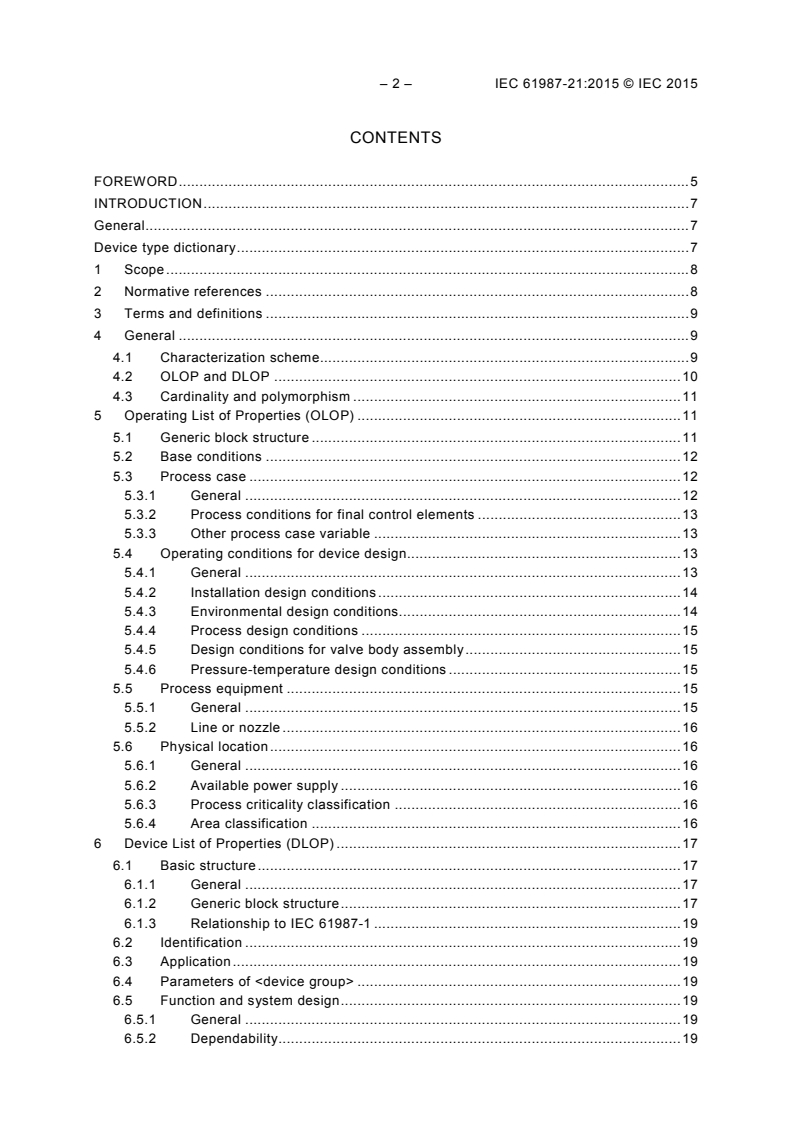
CONTENTS
FOREWORD . 5
INTRODUCTION . 7
General. 7
Device type dictionary . 7
1 Scope . 8
2 Normative references . 8
3 Terms and definitions . 9
4 General . 9
4.1 Characterization scheme. 9
4.2 OLOP and DLOP . 10
4.3 Cardinality and polymorphism . 11
5 Operating List of Properties (OLOP) . 11
5.1 Generic block structure . 11
5.2 Base conditions . 12
5.3 Process case . 12
5.3.1 General . 12
5.3.2 Process conditions for final control elements . 13
5.3.3 Other process case variable . 13
5.4 Operating conditions for device design. 13
5.4.1 General . 13
5.4.2 Installation design conditions . 14
5.4.3 Environmental design conditions. 14
5.4.4 Process design conditions . 15
5.4.5 Design conditions for valve body assembly . 15
5.4.6 Pressure-temperature design conditions . 15
5.5 Process equipment . 15
5.5.1 General . 15
5.5.2 Line or nozzle . 16
5.6 Physical location . 16
5.6.1 General . 16
5.6.2 Available power supply . 16
5.6.3 Process criticality classification . 16
5.6.4 Area classification . 16
6 Device List of Properties (DLOP) . 17
6.1 Basic structure . 17
6.1.1 General . 17
6.1.2 Generic block structure . 17
6.1.3 Relationship to IEC 61987-1 . 19
6.2 Identification . 19
6.3 Application . 19
6.4 Parameters of . 19
6.5 Function and system design . 19
6.5.1 General . 19
6.5.2 Dependability . 19
6.6 Input . 19
6.6.1 General . 19
6.6.2 Control input . 20
6.6.3 Type of auxiliary input. 20
6.7 Output. 21
6.7.1 General . 21
6.7.2 Type of output . 21
6.8 Digital communication . 22
6.8.1 General . 22
6.8.2 Digital communication interface . 22
6.9 Performance . 23
6.9.1 General . 23
6.9.2 Reference conditions for the device . 23
6.9.3 Performance variable . 23
6.10 Rated operating conditions . 24
6.10.1 General . 24
6.10.2 Installation conditions . 24
6.10.3 Environmental design ratings . 25
6.10.4 Process design ratings . 25
6.10.5 Pressure-temperature design ratings . 26
6.11 Mechanical and electrical construction . 26
6.11.1 General . 26
6.11.2 Overall dimensions and weight . 26
6.11.3 Structural design . 26
6.11.4 Explosion protection design approval . 26
6.11.5 Codes and standards approval . 26
6.12 Operability . 27
6.12.1 General . 27
6.12.2 Basic configuration . 27
6.12.3 Parametrization . 27
6.12.4 Adjustment . 27
6.12.5 Operation . 27
6.12.6 Diagnosis . 27
6.13 Power supply . 27
6.14 Certificates and approvals. 27
6.15 Component part identifications . 28
7 Composite devices . 28
8 Additional aspects . 28
Annex A (informative) Device type dictionary – Classification of final control elements . 29
Bibliography . 33
Figure 1 – Characterization of final control elements on the basis of IEC 60534-1 . 9
Figure 2 – Characterization of actuators . 10
Figure 3 – Assignment of OLOP and DLOPs for valve body assembly . 10
Figure 4 – Assignment of OLOP and DLOPs for actuators . 11
Table 1 – Generic block structure of an OLOP . 12
– 4 – IEC 61987-21:2015 © IEC 2015
Table 2 – Generic block structure of a DLOP . 18
Table A.1 – Classification scheme for final control elements . 29
INTERNATIONAL ELECTROTECHNICAL COMMISSION
____________
INDUSTRIAL-PROCESS MEASUREMENT AND CONTROL – DATA
STRUCTURES AND ELEMENTS IN PROCESS EQUIPMENT CATALOGUES –
Part 21: List of Properties (LOP) of automated valves
for electronic data exchange – Generic structures
FOREWORD
1) The International Electrotechnical Commission (IEC) is a worldwide organization for standardization comprising
all national electrotechnical committees (IEC National Committees). The object of IEC is to promote
international co-operation on all questions concerning standardization in the electrical and electronic fields. To
this end and in addition to other activities, IEC publishes International Standards, Technical Specifications,
Technical Reports, Publicly Available Specifications (PAS) and Guides (hereafter referred to as “IEC
Publication(s)”). Their preparation is entrusted to technical committees; any IEC National Committee interested
in the subject dealt with may participate in this preparatory work. International, governmental and non-
governmental organizations liaising with the IEC also participate in this preparation. IEC collaborates closely
with the International Organization for Standardization (ISO) in accordance with conditions determined by
agreement between the two organizations.
2) The formal decisions or agreements of IEC on technical matters express, as nearly as possible, an international
consensus of opinion on the relevant subjects since each technical committee has representation from all
interested IEC National Committees.
3) IEC Publications have the form of recommendations for international use and are accepted by IEC National
Committees in that sense. While all reasonable efforts are made to ensure that the technical content of IEC
Publications is accurate, IEC cannot be held responsible for the way in which they are used or for any
misinterpretation by any end user.
4) In order to promote international uniformity, IEC National Committees undertake to apply IEC Publications
transparently to the maximum extent possible in their national and regional publications. Any divergence
between any IEC Publication and the corresponding national or regional publication shall be clearly indicated in
the latter.
5) IEC itself does not provide any attestation of conformity. Independent certification bodies provide conformity
assessment services and, in some areas, access to IEC marks of conformity. IEC is not responsible for any
services carried out by independent certification bodies.
6) All users should ensure that they have the latest edition of this publication.
7) No liability shall attach to IEC or its directors, employees, servants or agents including individual experts and
members of its technical committees and IEC National Committees for any personal injury, property damage or
other damage of any nature whatsoever, whether direct or indirect, or for costs (including legal fees) and
expenses arising out of the publication, use of, or reliance upon, this IEC Publication or any other IEC
Publications.
8) Attention is drawn to the Normative references cited in this publication. Use of the referenced publications is
indispensable for the correct application of this publication.
9) Attention is drawn to the possibility that some of the elements of this IEC Publication may be the subject of
patent rights. IEC shall not be held responsible for identifying any or all such patent rights.
International Standard IEC 61987-21 has been prepared by subcommittee 65B: Measurement
and control devices, of IEC technical committee 65: Industrial-process measurement, control
and automation.
The text of this standard is based on the following documents:
FDIS Report on voting
65B/996/FDIS 65B/1024/RVD
Full information on the voting for the approval of this standard can be found in the report on
voting indicated in the above table.
This publication has been drafted in accordance with the ISO/IEC Directives, Part 2.
– 6 – IEC 61987-21:2015 © IEC 2015
A list of all parts in the IEC 61987 series, published under the general title Industrial-process
measurement and control – Data structures and elements in process equipment catalogues,
can be found on the IEC website.
The committee has decided that the contents of this publication will remain unchanged until
the stability date indicated on the IEC website under "http://webstore.iec.ch" in the data
related to the specific publication. At this date, the publication will be
• reconfirmed,
• withdrawn,
• replaced by a revised edition, or
• amended.
INTRODUCTION
General
The exchange of product data between companies, business systems, engineering tools, data
systems within companies and, in the future, control systems (electrical, measuring and
control technology) can run smoothly only when both the information to be exchanged and the
use of this information have been clearly defined.
Prior to this standard, requirements on process control devices and systems were specified by
customers in various ways when suppliers or manufacturers were asked to quote for suitable
equipment. The suppliers in their turn described the devices according to their own
documentation schemes, often using different terms, structures and media (paper, databases,
CDs, e-catalogues, etc.). The situation was similar in the planning and development process,
with device information frequently being duplicated in a number of different information
technology (IT) systems.
Any method that is capable of recording all existing information only once during the planning
and ordering process and making it available for further processing, gives all parties involved
an opportunity to concentrate on the essentials. A precondition for this is the standardization
of both the descriptions of the objects and the exchange of information.
The IEC 61987 series proposes a method for standardization which will help both suppliers
and users of process control equipment to optimize workflows both within their own
companies and in their exchanges with other companies. Depending on their role in the
process, engineering firms may be considered here to be either users or suppliers.
The method specifies process control equipment by means of blocks of properties. These
blocks are compiled into Lists of Properties (LOPs), each of which describes a specific
equipment (device) type. The IEC 61987 series covers both properties that may be used in an
inquiry or a proposal and detailed properties required for integration of the equipment in
computer systems for other tasks.
IEC 61987-10 defines structure elements for constructing lists of properties for electrical and
process control equipment in order to facilitate automatic data exchange between any two
computer systems in any possible workflow, for example engineering, maintenance or
purchasing workflow and to allow both the customers and the suppliers of the equipment to
optimize their processes and workflows. IEC 61987-10 also provides the data model for
assembling the LOPs.
IEC 61987-11, while specifying a generic structure for measuring equipment, provides several
important detail descriptions, such as the handling of composite devices that are also required
for LOPs describing automated industrial valves. This part of IEC 61987 specifies the generic
structure for Operating and Device Lists of Properties (OLOPs and DLOPs) for automated
industrial valves. Automated industrial valves are so-called final control elements and include
control valves, automated on/off-valves, and process regulators. It lays down the framework
for further parts of IEC 61987 in which complete LOPs for final control elements of different
construction and functional principle will be specified. The generic structure may also serve as
a basis for the specification of LOPs for other industrial-process control instrument types.
Device type dictionary
Annex A contains a characterisation of final control elements. This is a tree of relationships
between different device types. Starting at the root “equipment for industrial-process
automation”, it introduces the final control elements. In addition to control valves, actuators as
well as accessories such as positioners belong to this group. This characterisation is used in
the Process Automation domain of the IEC Common Data Dictionary (CDD).
– 8 – IEC 61987-21:2015 © IEC 2015
INDUSTRIAL-PROCESS MEASUREMENT AND CONTROL – DATA
STRUCTURES AND ELEMENTS IN PROCESS EQUIPMENT CATALOGUES –
Part 21: List of Properties (LOP) of automated valves
for electronic data exchange – Generic structures
1 Scope
This part of IEC 61987 provides
• a characterization for the integration of automated valves, including control valves,
automated on/off-valves and process regulators, in the Common Data Dictionary (CDD);
• generic structures in conformance with IEC 61987-10 for Operating Lists of Properties
(OLOPs) and Device Lists of Properties (DLOPs) of final control elements.
The generic structures for the OLOP and DLOP contain the most important blocks for final
control elements. Blocks pertaining to a specific equipment type will be described in the
corresponding part of the IEC 61987 standard series. Similarly, equipment properties are not
part of this part of IEC 61987. For instance, the OLOP and DLOP for globe valves and rotary
valves are found in IEC 61987-22.
NOTE Within the classification (see also Figure 1), “final control element” has only the specializations automated
valves and process regulators. In practice there are other specializations that are not considered in this standard.
2 Normative references
The following documents, in whole or in part, are normatively referenced in this document and
are indispensable for its application. For dated references, only the edition cited applies. For
undated references, the latest edition of the referenced document (including any
amendments) applies.
IEC 60534-1, Industrial-process control valves – Part 1: Control valve terminology and
general considerations
IEC 61069-5, Industrial-process measurement and control – Evaluation of system properties
for the purpose of system assessment – Part 5: Assessment of system dependability
IEC 61508-6, Functional safety of electrical/electronic/programmable electronic safety-related
systems – Part 6: Guidelines on the application of IEC 61508-2 and IEC 61508-3
IEC 61987-1:2006, Industrial-process measurement and control – Data structures and
elements in process equipment catalogues – Part 1: Measuring equipment with analogue and
digital output
IEC 61987-10, Industrial-process measurement and control – Data structures and elements in
process equipment catalogues – Part 10: List of Properties (LOPs) for Industrial-Process
Measurement and Control for Electronic Data Exchange – Fundamentals
IEC 61987-11, Industrial-process measurement and control – Data structures and elements in
process equipment catalogues – Part 11: List of Properties (LOP) of measuring equipment for
electronic data exchange – Generic structures
3 Terms and definitions
For the purposes of this document, the terms and definitions given in IEC 61987-10,
IEC 61987-11 and IEC 60534-1 apply.
4 General
4.1 Characterization scheme
IEC 61987-1 describes a general classification scheme for industrial process measuring
equipment based on measured variables. The introduction of the LOPs of any area of
technology into the IEC Common Data Dictionary (CDD) requires the creation of a
characterization scheme for the device types of this technology area.
The area of technology considered in this standard concerns final control elements. The
characterisation of the area for the CDD is provided in Table A.1.
The area of final control elements belongs to the domain of “Process Automation” in the CDD.
This area consists of two sub-areas for:
– control valves and automated on/off-valves, and
– process regulators.
While the sub-area for process regulators contains only a list of device types, the sub-area for
control valves and automated on/off-valves comprises the substructure shown in Figure 1.
Since the term “valve” is normally used to describe a complete assembly, i.e. valve body,
actuator, and accessories such as positioners and feedback units, at the next sub-level the
various types of valve are classified according to their valve body assembly. The branch
“actuator” in Figure 1 also has the substructure shown in Figure 2.
IEC
Figure 1 – Characterization of final control elements on the basis of IEC 60534-1
– 10 – IEC 61987-21:2015 © IEC 2015
IEC
Figure 2 – Characterization of actuators
4.2 OLOP and DLOP
An Operating List of Properties (OLOP) describes an aspect relating to a device type, for
example, the operational environment of the device, the device design requirements as well
as all the boundary conditions applicable to the point of operation. The structure element
“aspect” is described in IEC 61987-11. Among a range of possible aspects, the operating
aspect represented by the OLOP is the most important.
The Device List of Properties (DLOP) is used to describe a given device type, for example a
globe control valve, a pneumatic linear actuator or a positioner. The DLOP describes, for
example, the mechanical construction, the electrical construction and performance of a
device. Each DLOP describes a particular device type.
For automated valves two OLOPs are available, one for valve body assemblies and process
regulators and one for actuators. This is necessary because of the different requirements that
shall be specified for each.
Figure 3 shows the relationship between the OLOP and DLOPs for valve body assemblies.
The OLOP is valid for the generic DLOP as well as for the DLOPs for the various device
types, for example globe valves, gate valves etc., which differ in their valve body assembly.
IEC
Figure 3 – Assignment of OLOP and DLOPs for valve body assembly
Figure 4 shows the relationship between the OLOP for actuators and the actuator DLOPs. The
OLOP is valid for the generic DLOP as well as for the DLOPs for the various device types, for
example linear electrical actuators, rotary pneumatic actuators etc., which differ in their
construction and power source.
IEC
Figure 4 – Assignment of OLOP and DLOPs for actuators
At higher levels of their construction, OLOPs and DLOPs contain blocks of properties that are
common to all process variables or device types respectively. This part of IEC 61987 specifies
these generic block structures.
Further parts of this standard series specify the block structures and properties of OLOPs and
DLOPs for particular construction principles.
4.3 Cardinality and polymorphism
The principles and the description of the cardinality and polymorphic areas applied in this
standard are described in IEC 61987-10 and IEC 61987-11. These structural elements
introduce a high degree of flexibility in the description of a device and its surroundings,
provided the block structure in the LOP is used. They can be briefly described as follows:
• Cardinality allows a LOP element, for example a property block describing a particular
feature of a device, to be repeated as many times as necessary.
• Polymorphism allows the introduction of a complete property block from a selection of
property blocks at a particular structure level of a LOP.
In the case of final control elements, the cardinality can be used for replication of the “End
connection” block. For example a final control element can have four end connections: two for
the controlled medium and two for steam heating, requiring four end-connection property
blocks. Two of the end connections can be flanges, one a thread and one a welded joint.
5 Operating List of Properties (OLOP)
5.1 Generic block structure
An operating list of properties is a list of properties describing the aspect concerning the
operational conditions of the device and additional information regarding the design
conditions under which it will be applied. An OLOP contains no information about the device
itself: this is to be found in the DLOP.
The role of an OLOP is similar to that of an engineering datasheet, in which data describing
the plant environment where the device is to operate are collected. This includes information
on the process medium, the ambient conditions, the design safety conditions and plant
infrastructure. All of these data are described with an OLOP.
The generic block structure of an OLOP for valve body assemblies and process regulators
shall correspond to that shown in Table 1. It corresponds to the generic block structure of an
OLOP for measuring equipment (see IEC 61987-11). Details of the individual blocks are to be
found in 5.2 to 5.7. The generic block structure for the OLOP of actuators and the accessories
of valves follows the general structure.
– 12 – IEC 61987-21:2015 © IEC 2015
Table 1 – Generic block structure of an OLOP
Operating list of properties
Base conditions
Process case [c]
Process conditions for final control elements
Process conditions at the inlet [c]
Liquid phase
Vapor phase
Gas phase
Other material properties
Process conditions at the outlet [c]
Liquid phase
Vapor phase
Gas phase
Other material properties
Calculation results
Other process case variable [c]
Operating conditions for device design
Installation design conditions
Environmental design conditions
Normal environmental design conditions
Limiting environmental design conditions
Design conditions for external cleaning in place
Process design conditions
Normal process design conditions
Design conditions for internal cleaning in place
Design conditions for valve body assembly
Pressure-temperature design conditions
Design deratings [c]
Process equipment
Line or nozzle [c]
End connection
Physical location [c]
Available power supply
Process criticality classification
Area classification [c]
[c] The block can be repeated as many times as needed using cardinality, which means that a cardinality
property with the name “number of ” directly precedes the block (see IEC 61987-10).
5.2 Base conditions
The block base conditions shall contain the properties of the reference variables that are to
be used throughout the document. Such variables give the reference state or reference
conditions to which calculated variables such as normalized flow rate are calculated.
For example the conditions of pressure and temperature to be used to calculate density would
be entered in the properties “absolute base pressure” and “base temperature”.
NOTE Base conditions are often standardized for particular industries or applications.
5.3 Process case
5.3.1 General
The block process case shall contain the properties required to characterize the process
media at the point of control. It comprises at least the sub-blocks:
• Process conditions for final control elements
• Other process case variable
NOTE A process case contains the data corresponding to an operating point of the plant at the location where the
final control element is installed. It defines process medium-related data such as pressure, temperature, viscosity,
conductivity, etc.
5.3.2 Process conditions for final control elements
5.3.2.1 General
The block process conditions for final control elements shall contain properties that
characterize the operating state conditions and the physical properties of process media for
different phases. It comprises the following blocks:
• Process conditions at the inlet
• Process conditions at the outlet
• Calculation results of control devices
5.3.2.2 Process conditions at the inlet
The block process conditions at the inlet shall contain the properties of the set of common
process variables for a stream consisting of one or more phases at the inlet of the final control
element.
• Liquid phase
• Vapor phase
• Gas phase
• Other material properties
5.3.2.3 Process conditions at the outlet
The block process conditions at the outlet shall contain the properties of the set of common
process variables for a stream consisting of one or more phases at the outlet of the final
control element.
• Liquid phase
• Vapor phase
• Gas phase
• Other material properties
5.3.2.4 Calculation results of control devices
The block calculation results of control devices shall comprise the results of calculations
based on the current process case such as flow coefficients or sound pressure levels.
5.3.3 Other process case variable
The block other process case variable contains text properties which allow the user to
characterize variables that are not foreseen in the block process case variables.
The cardinality property “number of other process case variables” allows the block to be
replicated the required number of times to describe all other process case variables.
5.4 Operating conditions for device design
5.4.1 General
The block operating conditions for device design shall contain properties describing the
nominal conditions to be found at the control point. It comprises five sub-blocks:
– 14 – IEC 61987-21:2015 © IEC 2015
• Installation design conditions
• Environmental design conditions
• Process design conditions
• Design conditions for valve body assembly
• Pressure temperature design conditions
NOTE The corresponding blocks in the DLOP are described in 6.11.
5.4.2 Installation design conditions
5.4.2.1 General
The block installation design conditions shall contain properties that describe the installation
conditions at the control point. It comprises one block:
• Deployment design conditions
5.4.2.2 Installation design conditions
The block deployment design conditions shall contain properties that describe installation
conditions at the control point.
Examples are the proposed mounting orientation of the device or the special process
conditions given.
5.4.3 Environmental design conditions
5.4.3.1 General
The block environmental design conditions shall contain properties that describe the
environmental conditions outside the process, under which the final control element will be
operated. It comprises three blocks:
• Normal environmental design conditions
• Limiting environmental design conditions
• Design conditions for external cleaning in place
5.4.3.2 Normal environmental design conditions
The block normal environmental design conditions shall contain properties describing the
range of operating conditions for which a device is to be designed. These include the ambient
temperature or the climate class.
5.4.3.3 Limiting environmental design conditions
The block limiting environmental design conditions shall contain properties describing the
extreme values which influence the final control element. These include for example,
mechanical shock, maximum and minimum rate of ambient temperature change, maximum
and minimum value of storage temperature or vibration.
The final control element shall be able to withstand these extreme values without permanent
impairment of its operating characteristics.
5.4.3.4 Design conditions for external cleaning in place
The block design conditions for cleaning in place shall contain properties that describe the
conditions beyond the normal ambient conditions as well as the duration of these conditions
when the device is cleaned in place.
5.4.4 Process design conditions
5.4.4.1 General
The block process design conditions shall contain properties that describe the process
variables for which the device shall be designed to control or withstand. It comprises two
blocks:
• Normal process design conditions
• Design conditions for internal cleaning in place
NOTE 1 The process design and operating design conditions are generally associated with the lines or
equipment, and are not related to the process case.
NOTE 2 Users can either use the process case or the normal process design conditions to specify the process
conditions, but typically not both.
5.4.4.2 Normal process design conditions
The block normal process design conditions shall contain properties describing the range of
process conditions at the point of control for which the final control element shall operate
within its specified performance limits. The limits are expressed, as maximum and minimum
values of, for example, process pressure and temperature.
Process design condition variables are independent of process operation variables. They
reflect the minimum and maximum process values that are allowable in the operation of the
plant. The final control element shall operate safely and reliably in these conditions.
5.4.4.3 Design conditions for internal cleaning in place
The block design conditions for cleaning in place shall contain properties that describe the
conditions beyond normal process design conditions as well as the duration of these
conditions when the pipe is cleaned with the device in place.
5.4.5 Design conditions for valve body assembly
In this block, criteria specific to the design of valves shall be found. Examples are the
maximum differential pressure at closed valve, leakage rates, allowed sound pressure, and
travelling times.
5.4.6 Pressure
...