

IEC TS 61000-1-6:2026
(Main)Electromagnetic compatibility (EMC) - Part 1-6: General - Guidelines for the evaluation of measurement uncertainty in EMC testing
General Information
- Abstract
IEC TS 61000-1-6:2026, which is a Technical Specification provides methods and background information for the evaluation of measurement uncertainty in electromagnetic compatibility (EMC) tests and calibrations. It gives guidance to cover general measurement uncertainty considerations within the IEC 61000 series. The objective of this document is to give advice to EMC technical committees dealing with EMC tests, testing laboratories and calibration laboratories on the development of measurement uncertainty budgets; to allow uniform development and comparability of these budgets between laboratories; and to align the treatment of measurement uncertainty across the technical committees of the IEC dealing with EMC tests.
Any contributing factor to measurement uncertainty that is mentioned within this document will be treated as an example: the EMC committee responsible for the preparation of a basic immunity or emission standard is responsible for identifying the factors that contribute to the measurement uncertainty of the relevant test method. This document provides:
• methods for the evaluation of measurement uncertainty (MU),
• mathematical formulae for probability density functions and their interpretation,
• examples of MU calculations,
• examples of MU applications,
• MU reporting information.
This document is not intended to summarize all measurement uncertainty influence quantities, nor is it intended to specify how measurement uncertainty will be taken into account in determining compliance with an EMC requirement. This first edition cancels and replaces the first edition of IEC TR 61000-1-6 published in 2012. This edition constitutes a technical revision. This edition includes the following significant technical changes with respect to the previous edition:
a) purpose of and responsibilities in measurement uncertainty evaluation by testing and calibration laboratories, technical committees dealing with EMC requirements have been introduced;
b) classification of measurement uncertainty contributions (measurement uncertainty, measurement instrumentation uncertainty, intrinsic uncertainty of the measurand) has been revised;
c) new clauses devoted to measurement uncertainty in emission test methods and measurement uncertainty in immunity test methods and in calibration have been added;
d) methods of measurement uncertainty calculation have been enriched by introducing the GUM Supplement 1 (GUMS1) numerical approach based on Monte Carlo method;
e) measurement uncertainty budget development has been revised to include the basic steps to follow in case of application of the GUM method or of the GUMS1 method;
f) a clause specifically devoted to the measurement model function has been added to emphasize the importance of the measurement model and to provide guidance when the measurement model is unknown;
g) the clause on probability density functions has been revised to include the Student-t probability density function;
h) the clause on Type A and Type B evaluations of uncertainty has been revised to improve readability;
i) the clause on the conversion from linear quantities to decibel and vice versa has been revised to improve readability and make some corrections;
j) the clause on the applicability of measurement uncertainty has been modified to improve readability and to remove statements conflicting with conformity assessments standards;
k) Annex A and Annex B have been revised by including results of GUMS1 application;
l) new annexes have been introduced, namely Annex C (on metrological confirmation of measurement equipment), Annex D (on sampling statistics, moved from the main text to this annex to improve readability of the whole document), Annex E (on robust statistics for processing interlaboratory comparison data, with example), Annex F (including an example of application of MU for the assessment of the risk of an out of tolerance of measurement equipment) and Annex G (including an example of appli
- Status
- Published
- Publication Date
- 11-Mar-2026
- Technical Committee
- TC 77 - Electromagnetic compatibility
- Current Stage
- PPUB - Publication issued
- Start Date
- 12-Mar-2026
- Completion Date
- 03-Apr-2026
Buy Documents
IEC TS 61000-1-6:2026 - Electromagnetic compatibility (EMC) - Part 1-6: General - Guidelines for the evaluation of measurement uncertainty in EMC testing
Overview
IEC TS 61000-1-6:2026 is a Technical Specification from the International Electrotechnical Commission (IEC) that provides comprehensive guidelines for the evaluation of measurement uncertainty in electromagnetic compatibility (EMC) testing and calibration. As part of the IEC 61000 series, this standard addresses both emission and immunity test methods, helping to ensure uniformity, transparency, and accuracy in EMC measurements across laboratories and technical committees. The updated 2026 edition introduces significant technical revisions, including enhanced calculation methods, expanded guidance, and new annexes to support practical implementation for testing laboratories handling optical fibre cables such as ADSS, OPGW, or OPPC, which can be exposed to phenomena like galloping.
Key Topics
Purpose and Responsibilities
The standard sets out the responsibilities of testing and calibration laboratories and EMC technical committees regarding the assessment and documentation of measurement uncertainty. This ensures accountability and clarity in the evaluation process.Classification of Measurement Uncertainty
Measurement uncertainties are categorized into several classes, including general measurement uncertainty, measurement instrumentation uncertainty, and intrinsic uncertainty of the measurand. This classification supports more detailed and reliable uncertainty budgets.Calculation Methods
IEC TS 61000-1-6 introduces both the traditional Guide to the Expression of Uncertainty in Measurement (GUM) method and the GUM Supplement 1 (GUMS1) approach, which employs a numerical Monte Carlo technique for more complex scenarios.Development of Uncertainty Budgets
The document details step-by-step procedures for creating measurement uncertainty budgets using either the GUM or GUMS1 method, ensuring consistency and comparability across organizations.Probability Distributions and Statistical Methods
The standard elaborates on the use of various probability density functions, including normal, rectangular, triangular, and the Student-t distribution, to effectively model measurement uncertainty.Annex Guidance
New and revised annexes provide examples and methodologies for metrological confirmation, sampling statistics, robust statistics for interlaboratory comparisons, and concrete risk assessment scenarios.
Applications
EMC Test Laboratories
Provides essential procedures and tools for laboratories to evaluate and report measurement uncertainty in compliance and calibration activities, fostering confidence in EMC test results.Technical Committees and Standard Developers
Offers guidance for developing, harmonizing, and comparing measurement uncertainty budgets, facilitating international alignment and interoperability across EMC-related standards.Optical Fibre Cable Testing
Especially relevant for organizations testing ADSS, OPGW, and OPPC cables for mechanical phenomena like galloping, ensuring test results reflect true performance within stated uncertainty limits.Calibration and Conformity Assessment
Supports calibration laboratories in incorporating measurement uncertainty into their conformity assessments, enhancing the reliability of equipment performance verification.Risk and In-Tolerance Probability Assessment
Helps evaluate the probability of measurement equipment operating within tolerance limits, using advanced uncertainty analysis to support decision-making and quality assurance.
Related Standards
- IEC 60794-1-2: General requirements and test method guidance for optical fibre cables.
- IEC 60050-161: International Electrotechnical Vocabulary for electromagnetic compatibility.
- CISPR 16-1-1: Specifies radio disturbance and immunity measuring apparatus and methods.
- Guide to the Expression of Uncertainty in Measurement (GUM) and Supplements: Foundational documents for uncertainty evaluation used within IEC TS 61000-1-6.
- Related parts in IEC 61000: Other standards within the IEC 61000 series covering various EMC topics, test environments, and methods.
By following the IEC TS 61000-1-6:2026 guidelines, EMC test and calibration laboratories can deliver more accurate, repeatable, and internationally recognized measurement results, supporting compliance, innovation, and market confidence in electrical and electronic systems.
Relations
- Effective Date
- 20-Mar-2026
- Effective Date
- 15-Mar-2024
Buy Documents
IEC TS 61000-1-6:2026 - Electromagnetic compatibility (EMC) - Part 1-6: General - Guidelines for the evaluation of measurement uncertainty in EMC testing
Get Certified
Connect with accredited certification bodies for this standard

ANCE
Mexican certification and testing association.

Intertek Slovenia
Intertek testing, inspection, and certification services in Slovenia.

LNE (Laboratoire National de Métrologie et d'Essais)
French national laboratory for metrology and testing.
Sponsored listings
Frequently Asked Questions
IEC TS 61000-1-6:2026 is a technical specification published by the International Electrotechnical Commission (IEC). Its full title is "Electromagnetic compatibility (EMC) - Part 1-6: General - Guidelines for the evaluation of measurement uncertainty in EMC testing". This standard covers: IEC TS 61000-1-6:2026, which is a Technical Specification provides methods and background information for the evaluation of measurement uncertainty in electromagnetic compatibility (EMC) tests and calibrations. It gives guidance to cover general measurement uncertainty considerations within the IEC 61000 series. The objective of this document is to give advice to EMC technical committees dealing with EMC tests, testing laboratories and calibration laboratories on the development of measurement uncertainty budgets; to allow uniform development and comparability of these budgets between laboratories; and to align the treatment of measurement uncertainty across the technical committees of the IEC dealing with EMC tests. Any contributing factor to measurement uncertainty that is mentioned within this document will be treated as an example: the EMC committee responsible for the preparation of a basic immunity or emission standard is responsible for identifying the factors that contribute to the measurement uncertainty of the relevant test method. This document provides: • methods for the evaluation of measurement uncertainty (MU), • mathematical formulae for probability density functions and their interpretation, • examples of MU calculations, • examples of MU applications, • MU reporting information. This document is not intended to summarize all measurement uncertainty influence quantities, nor is it intended to specify how measurement uncertainty will be taken into account in determining compliance with an EMC requirement. This first edition cancels and replaces the first edition of IEC TR 61000-1-6 published in 2012. This edition constitutes a technical revision. This edition includes the following significant technical changes with respect to the previous edition: a) purpose of and responsibilities in measurement uncertainty evaluation by testing and calibration laboratories, technical committees dealing with EMC requirements have been introduced; b) classification of measurement uncertainty contributions (measurement uncertainty, measurement instrumentation uncertainty, intrinsic uncertainty of the measurand) has been revised; c) new clauses devoted to measurement uncertainty in emission test methods and measurement uncertainty in immunity test methods and in calibration have been added; d) methods of measurement uncertainty calculation have been enriched by introducing the GUM Supplement 1 (GUMS1) numerical approach based on Monte Carlo method; e) measurement uncertainty budget development has been revised to include the basic steps to follow in case of application of the GUM method or of the GUMS1 method; f) a clause specifically devoted to the measurement model function has been added to emphasize the importance of the measurement model and to provide guidance when the measurement model is unknown; g) the clause on probability density functions has been revised to include the Student-t probability density function; h) the clause on Type A and Type B evaluations of uncertainty has been revised to improve readability; i) the clause on the conversion from linear quantities to decibel and vice versa has been revised to improve readability and make some corrections; j) the clause on the applicability of measurement uncertainty has been modified to improve readability and to remove statements conflicting with conformity assessments standards; k) Annex A and Annex B have been revised by including results of GUMS1 application; l) new annexes have been introduced, namely Annex C (on metrological confirmation of measurement equipment), Annex D (on sampling statistics, moved from the main text to this annex to improve readability of the whole document), Annex E (on robust statistics for processing interlaboratory comparison data, with example), Annex F (including an example of application of MU for the assessment of the risk of an out of tolerance of measurement equipment) and Annex G (including an example of appli
IEC TS 61000-1-6:2026, which is a Technical Specification provides methods and background information for the evaluation of measurement uncertainty in electromagnetic compatibility (EMC) tests and calibrations. It gives guidance to cover general measurement uncertainty considerations within the IEC 61000 series. The objective of this document is to give advice to EMC technical committees dealing with EMC tests, testing laboratories and calibration laboratories on the development of measurement uncertainty budgets; to allow uniform development and comparability of these budgets between laboratories; and to align the treatment of measurement uncertainty across the technical committees of the IEC dealing with EMC tests. Any contributing factor to measurement uncertainty that is mentioned within this document will be treated as an example: the EMC committee responsible for the preparation of a basic immunity or emission standard is responsible for identifying the factors that contribute to the measurement uncertainty of the relevant test method. This document provides: • methods for the evaluation of measurement uncertainty (MU), • mathematical formulae for probability density functions and their interpretation, • examples of MU calculations, • examples of MU applications, • MU reporting information. This document is not intended to summarize all measurement uncertainty influence quantities, nor is it intended to specify how measurement uncertainty will be taken into account in determining compliance with an EMC requirement. This first edition cancels and replaces the first edition of IEC TR 61000-1-6 published in 2012. This edition constitutes a technical revision. This edition includes the following significant technical changes with respect to the previous edition: a) purpose of and responsibilities in measurement uncertainty evaluation by testing and calibration laboratories, technical committees dealing with EMC requirements have been introduced; b) classification of measurement uncertainty contributions (measurement uncertainty, measurement instrumentation uncertainty, intrinsic uncertainty of the measurand) has been revised; c) new clauses devoted to measurement uncertainty in emission test methods and measurement uncertainty in immunity test methods and in calibration have been added; d) methods of measurement uncertainty calculation have been enriched by introducing the GUM Supplement 1 (GUMS1) numerical approach based on Monte Carlo method; e) measurement uncertainty budget development has been revised to include the basic steps to follow in case of application of the GUM method or of the GUMS1 method; f) a clause specifically devoted to the measurement model function has been added to emphasize the importance of the measurement model and to provide guidance when the measurement model is unknown; g) the clause on probability density functions has been revised to include the Student-t probability density function; h) the clause on Type A and Type B evaluations of uncertainty has been revised to improve readability; i) the clause on the conversion from linear quantities to decibel and vice versa has been revised to improve readability and make some corrections; j) the clause on the applicability of measurement uncertainty has been modified to improve readability and to remove statements conflicting with conformity assessments standards; k) Annex A and Annex B have been revised by including results of GUMS1 application; l) new annexes have been introduced, namely Annex C (on metrological confirmation of measurement equipment), Annex D (on sampling statistics, moved from the main text to this annex to improve readability of the whole document), Annex E (on robust statistics for processing interlaboratory comparison data, with example), Annex F (including an example of application of MU for the assessment of the risk of an out of tolerance of measurement equipment) and Annex G (including an example of appli
IEC TS 61000-1-6:2026 is classified under the following ICS (International Classification for Standards) categories: 33.100.01 - Electromagnetic compatibility in general. The ICS classification helps identify the subject area and facilitates finding related standards.
IEC TS 61000-1-6:2026 has the following relationships with other standards: It is inter standard links to IEC TR 61000-1-6:2012, IEC TR 61000-1-6:2012/COR1:2014. Understanding these relationships helps ensure you are using the most current and applicable version of the standard.
IEC TS 61000-1-6:2026 is available in PDF format for immediate download after purchase. The document can be added to your cart and obtained through the secure checkout process. Digital delivery ensures instant access to the complete standard document.
Standards Content (Sample)
IEC TS 61000-1-6 ®
Edition 1.0 2026-03
TECHNICAL
SPECIFICATION
Electromagnetic compatibility (EMC) -
Part 1-6: General - Guidelines for the evaluation of measurement uncertainty in
EMC testing
ICS 33.100.01 ISBN 978-2-8327-1121-7
All rights reserved. Unless otherwise specified, no part of this publication may be reproduced or utilized in any form or
by any means, electronic or mechanical, including photocopying and microfilm, without permission in writing from either
IEC or IEC's member National Committee in the country of the requester. If you have any questions about IEC copyright
or have an enquiry about obtaining additional rights to this publication, please contact the address below or your local
IEC member National Committee for further information.
IEC Secretariat Tel.: +41 22 919 02 11
3, rue de Varembé info@iec.ch
CH-1211 Geneva 20 www.iec.ch
Switzerland
About the IEC
The International Electrotechnical Commission (IEC) is the leading global organization that prepares and publishes
International Standards for all electrical, electronic and related technologies.
About IEC publications
The technical content of IEC publications is kept under constant review by the IEC. Please make sure that you have the
latest edition, a corrigendum or an amendment might have been published.
IEC publications search - IEC Products & Services Portal - products.iec.ch
webstore.iec.ch/advsearchform Discover our powerful search engine and read freely all the
The advanced search enables to find IEC publications by a publications previews, graphical symbols and the glossary.
variety of criteria (reference number, text, technical With a subscription you will always have access to up to date
committee, …). It also gives information on projects, content tailored to your needs.
replaced and withdrawn publications.
Electropedia - www.electropedia.org
The world's leading online dictionary on electrotechnology,
IEC Just Published - webstore.iec.ch/justpublished
Stay up to date on all new IEC publications. Just Published containing more than 22 500 terminological entries in English
details all new publications released. Available online and and French, with equivalent terms in 25 additional languages.
once a month by email. Also known as the International Electrotechnical Vocabulary
(IEV) online.
IEC Customer Service Centre - webstore.iec.ch/csc
If you wish to give us your feedback on this publication or
need further assistance, please contact the Customer
Service Centre: sales@iec.ch.
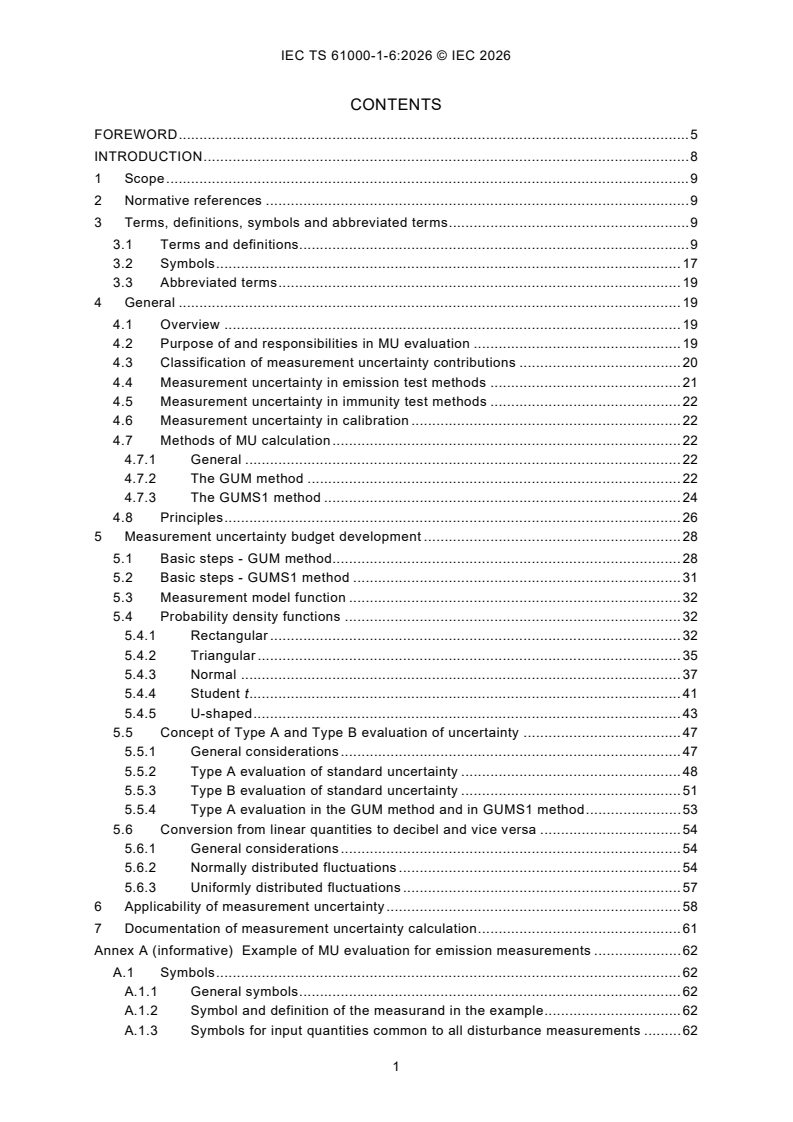
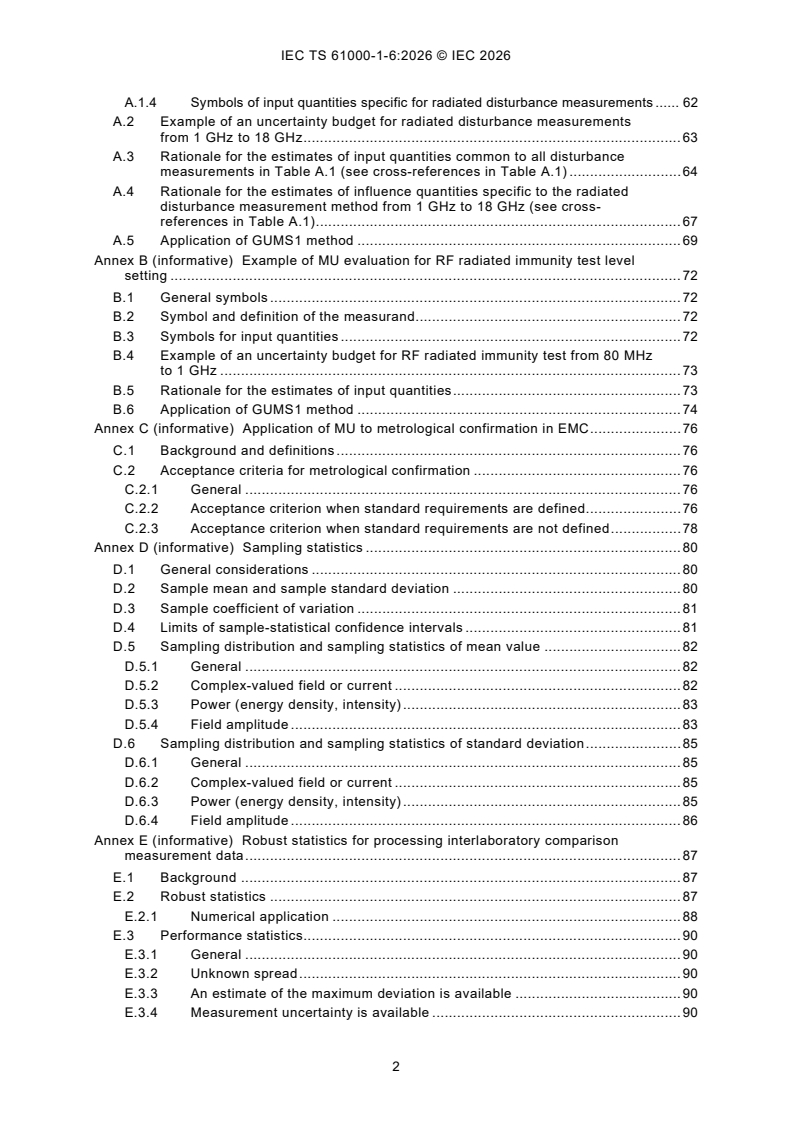
CONTENTS
FOREWORD . 5
INTRODUCTION . 8
1 Scope . 9
2 Normative references . 9
3 Terms, definitions, symbols and abbreviated terms . 9
3.1 Terms and definitions. 9
3.2 Symbols . 17
3.3 Abbreviated terms . 19
4 General . 19
4.1 Overview . 19
4.2 Purpose of and responsibilities in MU evaluation . 19
4.3 Classification of measurement uncertainty contributions . 20
4.4 Measurement uncertainty in emission test methods . 21
4.5 Measurement uncertainty in immunity test methods . 22
4.6 Measurement uncertainty in calibration . 22
4.7 Methods of MU calculation . 22
4.7.1 General . 22
4.7.2 The GUM method . 22
4.7.3 The GUMS1 method . 24
4.8 Principles . 26
5 Measurement uncertainty budget development . 28
5.1 Basic steps - GUM method. 28
5.2 Basic steps - GUMS1 method . 31
5.3 Measurement model function . 32
5.4 Probability density functions . 32
5.4.1 Rectangular . 32
5.4.2 Triangular . 35
5.4.3 Normal . 37
5.4.4 Student t . 41
5.4.5 U-shaped . 43
5.5 Concept of Type A and Type B evaluation of uncertainty . 47
5.5.1 General considerations . 47
5.5.2 Type A evaluation of standard uncertainty . 48
5.5.3 Type B evaluation of standard uncertainty . 51
5.5.4 Type A evaluation in the GUM method and in GUMS1 method . 53
5.6 Conversion from linear quantities to decibel and vice versa . 54
5.6.1 General considerations . 54
5.6.2 Normally distributed fluctuations . 54
5.6.3 Uniformly distributed fluctuations . 57
6 Applicability of measurement uncertainty . 58
7 Documentation of measurement uncertainty calculation . 61
Annex A (informative) Example of MU evaluation for emission measurements . 62
A.1 Symbols . 62
A.1.1 General symbols . 62
A.1.2 Symbol and definition of the measurand in the example . 62
A.1.3 Symbols for input quantities common to all disturbance measurements . 62
A.1.4 Symbols of input quantities specific for radiated disturbance measurements . 62
A.2 Example of an uncertainty budget for radiated disturbance measurements
from 1 GHz to 18 GHz . 63
A.3 Rationale for the estimates of input quantities common to all disturbance
measurements in Table A.1 (see cross-references in Table A.1) . 64
A.4 Rationale for the estimates of influence quantities specific to the radiated
disturbance measurement method from 1 GHz to 18 GHz (see cross-
references in Table A.1) . 67
A.5 Application of GUMS1 method . 69
Annex B (informative) Example of MU evaluation for RF radiated immunity test level
setting . 72
B.1 General symbols . 72
B.2 Symbol and definition of the measurand. 72
B.3 Symbols for input quantities . 72
B.4 Example of an uncertainty budget for RF radiated immunity test from 80 MHz
to 1 GHz . 73
B.5 Rationale for the estimates of input quantities . 73
B.6 Application of GUMS1 method . 74
Annex C (informative) Application of MU to metrological confirmation in EMC . 76
C.1 Background and definitions . 76
C.2 Acceptance criteria for metrological confirmation . 76
C.2.1 General . 76
C.2.2 Acceptance criterion when standard requirements are defined . 76
C.2.3 Acceptance criterion when standard requirements are not defined . 78
Annex D (informative) Sampling statistics . 80
D.1 General considerations . 80
D.2 Sample mean and sample standard deviation . 80
D.3 Sample coefficient of variation . 81
D.4 Limits of sample-statistical confidence intervals . 81
D.5 Sampling distribution and sampling statistics of mean value . 82
D.5.1 General . 82
D.5.2 Complex-valued field or current . 82
D.5.3 Power (energy density, intensity) . 83
D.5.4 Field amplitude . 83
D.6 Sampling distribution and sampling statistics of standard deviation . 85
D.6.1 General . 85
D.6.2 Complex-valued field or current . 85
D.6.3 Power (energy density, intensity) . 85
D.6.4 Field amplitude . 86
Annex E (informative) Robust statistics for processing interlaboratory comparison
measurement data . 87
E.1 Background . 87
E.2 Robust statistics . 87
E.2.1 Numerical application . 88
E.3 Performance statistics. 90
E.3.1 General . 90
E.3.2 Unknown spread . 90
E.3.3 An estimate of the maximum deviation is available . 90
E.3.4 Measurement uncertainty is available . 90
Annex F (informative) Example of application of MU for risk of false
acceptance/rejection of an ESD generator . 92
F.1 Background . 92
F.2 ESD generator conformity assessment. 92
F.3 Risk assessment approach . 94
Annex G (informative) Estimated probability within the tolerance range . 97
G.1 General symbols . 97
G.2 General expression of the probability included in a specific interval as a
function of tolerance to uncertainty ratio (TUR) . 97
G.3 Acceptance criteria . 100
Bibliography . 102
Figure 1 – Classification of uncertainty components associated with the experimental
evaluation of uncertainty in EMC testing and measurement . 21
Figure 2 – Graphical representation of the Law of Propagation of Uncertainty . 23
Figure 3 – Graphical representation of the propagation of distributions . 25
Figure 4 – Example of 𝑔𝑔𝑔𝑔′|𝑔𝑔. . 26
Figure 5 – Impact of 𝑔𝑔𝑔𝑔′|𝑔𝑔 on interpretation of 𝑔𝑔′ . 27
Figure 6 – Estimate returned by the measurement system . 28
Figure 7 – Rectangular PDF . 33
Figure 8 – Triangular PDF . 36
Figure 9 – Normal PDF for standardized 𝑋𝑋 . 39
Figure 10 – Student t-PDF for various values of the degrees of freedom 𝜈𝜈 . 43
Figure 11 – U-shaped PDF . 45
Figure 12 – Example of a circuit . 45
Figure 13 – PDF of 𝐵𝐵 for a Rayleigh distributed 𝐴𝐴 at selected values of 𝜎𝜎 . 56
Figure 14 – Measurement uncertainty budget for a quantity to be realized in the test
laboratory . 58
Figure 15 – Relationship between measurement uncertainty budgets for a quantity to
be realized in the test laboratory and tolerances given for this quantity in the applicable
basic standard . 59
Figure A.1 – Deviation of the peak detector level indication from the signal level at
receiver input for two cases, a sine-wave signal and an impulsive signal (PRF 100 Hz) . 66
Figure A.2 – System consisting of measuring receiver, preamplifier and connecting
cable(s) . 66
Figure A.3 – PDF obtained through application of the GUMS1 method (histogram plot),
and of the GUM method (black line, normal PDF) . 70
Figure A.4 – PDF obtained through application of the GUMS1 method (histogram plot),
and of the GUM method (black line, normal PDF) . 71
Figure B.1 – PDF obtained through application of the GUM method (dashed line,
normal distribution), and of the GUMS1 method (continuous line) . 75
Figure C.1 – Example illustrating the risk of false acceptance as the sum of
probabilities 𝑝𝑝1 and 𝑝𝑝2 . 78
Figure D.1 – Limits of 95 %, 99 % and 99,5 % confidence intervals for 𝑊𝑊 as a function
of 𝑁𝑁 for measurements using a rectilinear antenna or single-axis probe . 84
Figure D.2 – Limits of 95 %, 99 % and 99,5 % confidence intervals for 𝐴𝐴 as a function
of 𝑁𝑁 for measurements using a rectilinear antenna or single-axis probe . 85
Figure D.3 – 95 % confidence intervals for 𝑆𝑆𝑋𝑋 as a function of 𝑁𝑁 for measurements
using a single-axis detector . 86
Figure F.1 – Calibration results of an ESD generator: Rise time . 93
Figure G.1 – Normal probability distribution of the random variable 𝑔𝑔 . 97
Figure G.2 – Probability 𝑝𝑝 as a function of TUR . 100
Table 1 – Basic steps for evaluating MU with the GUM method . 28
Table 2 – Expressions used to obtain standard uncertainty . 30
Table 3 – Basic steps for evaluating MU with the GUMS1 method. 31
Table 4 – Examples of circuit parameters . 47
Table 5 – Values of the expansion coefficient 𝜂𝜂𝜈𝜈 which transforms the standard
deviation to the Type A standard uncertainty . 51
Table 6 – Situations, where and how an instrument is suitable for tests or
measurements, or both, as specified in the applicable standard with tolerances . 60
Table A.1 – Radiated disturbance measurements from 1 GHz to 18 GHz in a FAR at a
distance of 3 m . 63
Table B.1 – Example for an uncertainty budget of the radiated immunity test level
(80 MHz to 1 000 MHz) . 73
Table E.1 – Application of robust statistics and performance statistics to a numerical
case. 89
Table F.1 – Calibration results of an ESD generator: Rise time . 92
Table F.2 – Calibration results of an ESD generator: Peak current . 93
Table F.3 – Calibration results of an ESD generator: Current at 30 ns . 94
Table F.4 – Calibration results of an ESD generator: Current at 60 ns . 94
Table F.5 – Risk assessment of an ESD generator: Rise time . 95
Table F.6 – Risk assessment of an ESD generator: Peak current . 95
Table F.7 – Risk assessment of an ESD generator: Current at 30 ns . 96
Table F.8 – Risk assessment of an ESD generator: Current at 60 ns . 96
Table F.9 – Combined risk assessment of an ESD generator . 96
INTERNATIONAL ELECTROTECHNICAL COMMISSION
____________
Electromagnetic compatibility (EMC) -
Part 1-6: General - Guidelines for the evaluation of measurement
uncertainty in EMC testing
FOREWORD
1) The International Electrotechnical Commission (IEC) is a worldwide organization for
standardization comprising all national electrotechnical committees (IEC National Committees).
The object of IEC is to promote international co-operation on all questions concerning
standardization in the electrical and electronic fields. To this end and in addition to other
activities, IEC publishes International Standards, Technical Specifications, Technical Reports,
Publicly Available Specifications (PAS) and Guides (hereafter referred to as “IEC
Publication(s)”). Their preparation is entrusted to technical committees; any IEC National
Committee interested in the subject dealt with may participate in this preparatory work.
International, governmental and non-governmental organizations liaising with the IEC also
participate in this preparation. IEC collaborates closely with the International Organization for
Standardization (ISO) in accordance with conditions determined by agreement between the two
organizations.
2) The formal decisions or agreements of IEC on technical matters express, as nearly as
possible, an international consensus of opinion on the relevant subjects since each technical
committee has representation from all interested IEC National Committees.
3) IEC Publications have the form of recommendations for international use and are accepted
by IEC National Committees in that sense. While all reasonable efforts are made to ensure that
the technical content of IEC Publications is accurate, IEC cannot be held responsible for the
way in which they are used or for any misinterpretation by any end user.
4) In order to promote international uniformity, IEC National Committees undertake to apply IEC
Publications transparently to the maximum extent possible in their national and regional
publications. Any divergence between any IEC Publication and the corresponding national or
regional publication shall be clearly indicated in the latter.
5) IEC itself does not provide any attestation of conformity. Independent certification bodies
provide conformity assessment services and, in some areas, access to IEC marks of conformity.
IEC is not responsible for any services carried out by independent certification bodies.
6) All users should ensure that they have the latest edition of this publication.
7) No liability shall attach to IEC or its directors, employees, servants or agents including
individual experts and members of its technical committees and IEC National Committees for
any personal injury, property damage or other damage of any nature whatsoever, whether direct
or indirect, or for costs (including legal fees) and expenses arising out of the publication, use
of, or reliance upon, this IEC Publication or any other IEC Publications.
8) Attention is drawn to the Normative references cited in this publication. Use of the referenced
publications is indispensable for the correct application of this publication.
9) IEC draws attention to the possibility that the implementation of this document may involve
the use of (a) patent(s). IEC takes no position concerning the evidence, validity or applicability
of any claimed patent rights in respect thereof. As of the date of publication of this document,
IEC had not received notice of (a) patent(s), which may be required to implement this document.
However, implementers are cautioned that this may not represent the latest information, which
may be obtained from the patent database available at https://patents.iec.ch. IEC shall not be
held responsible for identifying any or all such patent rights.
IEC TS 61000-1-6 has been prepared by IEC technical committee 77: Electromagnetic
compatibility in cooperation with CISPR (International Special Committee on Radio
Interference). It is a Technical Specification.
This first edition cancels and replaces the first edition of IEC TR 61000-1-6 published in 2012.
This edition constitutes a technical revision.
This edition includes the following significant technical changes with respect to the previous
edition:
a) purpose of and responsibilities in measurement uncertainty evaluation by testing and
calibration laboratories, technical committees dealing with EMC requirements have been
introduced;
b) classification of measurement uncertainty contributions (measurement uncertainty,
measurement instrumentation uncertainty, intrinsic uncertainty of the measurand) has been
revised;
c) new clauses devoted to measurement uncertainty in emission test methods and
measurement uncertainty in immunity test methods and in calibration have been added;
d) methods of measurement uncertainty calculation have been enriched by introducing the
GUM Supplement 1 (GUMS1) numerical approach based on Monte Carlo method;
e) measurement uncertainty budget development has been revised to include the basic steps
to follow in case of application of the GUM method or of the GUMS1 method;
f) a clause specifically devoted to the measurement model function has been added to
emphasize the importance of the measurement model and to provide guidance when the
measurement model is unknown;
g) the clause on probability density functions has been revised to include the Student-t
probability density function;
h) the clause on Type A and Type B evaluations of uncertainty has been revised to improve
readability;
i) the clause on the conversion from linear quantities to decibel and vice versa has been
revised to improve readability and make some corrections;
j) the clause on the applicability of measurement uncertainty has been modified to improve
readability and to remove statements conflicting with conformity assessments standards;
k) Annex A and Annex B have been revised by including results of GUMS1 application;
l) new annexes have been introduced, namely Annex C (on metrological confirmation of
measurement equipment), Annex D (on sampling statistics, moved from the main text to this
annex to improve readability of the whole document), Annex E (on robust statistics for
processing interlaboratory comparison data, with example), Annex F (including an example
of application of MU for the assessment of the risk of an out of tolerance of measurement
equipment) and Annex G (including an example of application of MU for the evaluation of
in-tolerance probability as a function of tolerance to uncertainty ratio – TUR).
The text of this Technical Specification is based on the following documents:
Draft Report on voting
77/637/DTS 77/640/RVDTS
Full information on the voting for its approval can be found in the report on voting indicated in
the above table.
The language used for the development of this Technical Specification is English.
This document was drafted in accordance with ISO/IEC Directives, Part 2, and developed in
accordance with ISO/IEC Directives, Part 1 and ISO/IEC Directives, IEC Supplement, available
at www.iec.ch/members_experts/refdocs. The main document types developed by IEC are
described in greater detail at www.iec.ch/publications.
A list of all parts in the IEC 61000 series, published under the general title Electromagnetic
compatibility (EMC), can be found on the IEC website.
The committee has decided that the contents of this document will remain unchanged until the
stability date indicated on the IEC website under webstore.iec.ch in the data related to the
specific document. At this date, the document will be
– reconfirmed,
– withdrawn, or
– revised.
INTRODUCTION
IEC 61000 is published in separate parts, according to the following structure:
Part 1: General
– General considerations (introduction, fundamental principles)
– Definitions, terminology
Part 2: Environment
– Description of the environment
– Classification of the environment
– Compatibility levels
Part 3: Limits
– Emission limits
– Immunity limits (in so far as they do not fall under the responsibility of the product
committees)
Part 4: Testing and measurement techniques
– Measurement techniques
– Testing techniques
Part 5: Installation and mitigation guidelines
– Installation guidelines
– Mitigation methods and devices
Part 6: Generic standards
Part 9: Miscellaneous
Each part is further subdivided into several parts, published either as international standards
or as technical specifications or technical reports, some of which have already been published
as sections. Others will be published with the part number followed by a dash and a second
number identifying the subdivision (example: IEC 61000-6-1).
Further reading:
– European Telecommunications Standards Institute (ETSI) [1]
– European Accreditation (EA) [2]
– UK Accreditation Service (UKAS) [3]
– M. Kendall and A. Stuart [4]
– I. A. Harris and F. L. Warner [5]
– C.F.M. Carobbi [6]
1 Scope
This part of IEC 61000 provides methods and background information for the evaluation of
measurement uncertainty in electromagnetic compatibility (EMC) tests and calibrations. It gives
guidance to cover general measurement uncertainty considerations within the IEC 61000 series
[7].
The objective of this document is to give advice to EMC technical committees dealing with EMC
tests, testing laboratories and calibration laboratories on the development of measurement
uncertainty budgets; to allow uniform development and comparability of these budgets between
laboratories; and to align the treatment of measurement uncertainty across the technical
committees of the IEC dealing with EMC tests.
Any contributing factor to measurement uncertainty that is mentioned within this document will
be treated as an example: the EMC committee responsible for the preparation of a basic
immunity or emission standard is responsible for identifying the factors that contribute to the
measurement uncertainty of the relevant test method.
This document provides:
– methods for the evaluation of measurement uncertainty (MU),
– mathematical formulae for probability density functions and their interpretation,
– examples of MU calculations,
– examples of MU applications,
– MU reporting information.
This document is not intended to summarize all measurement uncertainty influence quantities,
nor is it intended to specify how measurement uncertainty will be taken into account in
determining compliance with an EMC requirement.
NOTE Some of the examples given in this document are based on IEC publications (for example CISPR 16-4 series
[8]) other than the IEC 61000 series [7] that have already implemented the evaluation procedure presented here.
These examples are used to illustrate the principles.
2 Normative references
The following documents are referred to in the text in such a way that some or all of their content
constitutes requirements of this document. For dated references, only the edition cited applies.
For undated references, the latest edition of the referenced document (including any
amendments) applies.
IEC 60050-161:1990, International Electrotechnical Vocabulary (IEV) - Part 161:
Electromagnetic compatibility
CISPR 16-1-1, Specification for radio disturbance and immunity measuring apparatus and
methods - Part 1-1: Radio disturbance and immunity measuring apparatus - Measuring
apparatus
3 Terms, definitions, symbols and abbreviated terms
3.1 Terms and definitions
For the purposes of this document, the terms and definitions given in IEC 60050-161:1990 and
the following apply.
ISO and IEC maintain terminology databases for use in standardization at the following
addresses:
– IEC Electropedia: available at https://www.electropedia.org/
– ISO Online browsing platform: available at https://www.iso.org/obp
NOTE Several of the most relevant terms and definitions from IEC 60050-161:1990 are included among the terms
and definitions below.
3.1.1
combined standard measurement uncertainty
combined standard uncertainty
standard measurement uncertainty that is obtained using the individual standard measurement
uncertainties associated with the input quantities in a measurement model
Note 1 to entry: In case of correlations of input quantities in a measurement model, covariances must also be taken
into account when calculating the combined standard measurement uncertainty; see also ISO/IEC Guide 98-3:2008
[9], 2.3.4.
[SOURCE: ISO/IEC Guide 99:2007 [10], 2.31, modified – The preferred term "combined
standard measurement uncertainty" has been deleted.]
3.1.2
coverage factor
numerical factor used as a multiplier of the combined standard uncertainty in order to obtain an
expanded uncertainty
[SOURCE: ISO/IEC Guide 98-3:2008 [9], 2.3.6, modified – The note was deleted.]
3.1.3
coverage interval
interval containing the set of quantity values of a measurand with a stated probability, based
on the information available
[SOURCE: ISO/IEC Guide 99:2007 [10], 2.36, modified – In the definition, "true quantity values"
was changed to "quantity values" and the notes were deleted.]
3.1.4
coverage probability
probability that the set of quantity values of a measurand is contained within a specified
coverage interval
Note 1 to entry: The coverage probability is also termed "level of confidence" in the GUM.
[SOURCE: ISO/IEC Guide 99:2007 [10], 2.37, modified – In the definition, "true quantity values"
was changed to "quantity values" and Note 1 was deleted.]
3.1.5
direct (method of) measurement
method of measurement in which the value of a measurand is obtained directly, without the
necessity for supplementary calculations based on a functional relationship between the
measurand and other quantities actually measured
Note 1 to entry: The value of the measurand is considered to be obtained directly even when the scale of a
measuring instrument has values which are linked to corresponding values of the measurand by means of a table or
a graph.
Note 2 to entry: The method of measurement remains direct even if it is necessary to make supplementary
measurements to determine the values of influence quantities in order to make corrections.
[SOURCE: IEC 60050-311:2001 [11], 311-02-01]
3.1.6
distribution function
function giving, for every value 𝜉𝜉, the probability that the random variable 𝑋𝑋 be less than or
equal to 𝜉𝜉: 𝐺𝐺 (𝜉𝜉) = Pr(𝑋𝑋≤𝜉𝜉)
𝑋𝑋
[SOURCE: ISO/IEC Guide 98-3:2008/Suppl 1:2008 [12], 3.2]
3.1.7
error
measured quantity value minus a reference quantity value
[SOURCE: ISO/IEC Guide 99:2007 [10], 2.16, modified – Second admitted term became the
preferred (and only) term and Note 1 and Note 2 have been deleted.]
3.1.8
expanded uncertainty
quantity defining an interval about the result of a measurement that may be expected to
encompass a large fraction of the distribution of values that could reasonably be attributed to
the measurand
[SOURCE: ISO/IEC Guide 98-3:2008 [9], 2.3.5, modified – Notes 1 to 3 have been deleted.]
3.1.9
electromagnetic compatibility
EMC
ability of an equipment or system to function satisfactorily in its electromagnetic environment
without introducing intolerable electromagnetic disturbances to anything in that environment
[SOURCE: IEC 60050-161:1990/AMD8:2018 [13], 161-01-07]
3.1.10
emission
phenomenon by which electromagnetic energy emanates from a source
[SOURCE: IEC 60050-161:1990/AMD9:2019 [14], 161-01-08, modified – In the term,
"electromagnetic" was deleted.]
3.1.11
emission level
emission level of a disturbing source
level of a given electromagnetic disturbance emitted from a particular device, equipment or
system
[SOURCE: IEC 60050-161:1990 [15], 161-03-11, modified – In the term, "(from a disturbing
source)" has been removed and "emission limit of a disturbing source" has been added as an
admitted term.]
3.1.12
emission limit
emission limit from a disturbing source
specified maximum emission level of a source of electromagnetic disturbance
[SOURCE: IEC 60050-161:1990 [15], 161-03-12, modified – In the term, "(from a disturbing
source)" has been removed and "emission limit from a disturbing source" has been added as
an admitted term.]
3.1.13
immunity
immunity to a disturbance
ability of a device, equipment or system to perform without degradation in the presence of an
electromagnetic disturbance
[SOURCE: IEC 60050-161:1990 [15], 161-01-20, modified – In the term, "(to a disturbance)"
has been removed and "immunity to a disturbance" has been added.]
3.1.14
immunity level
maximum level of a given electromagnetic disturbance incident on a particular device,
equipment or system for which it remains capable of operating at a required degree of
performance
[SOURCE: IEC 60050-161:1990 [15], 161-03-14]
3.1.15
immunity limit
specified minimum immunity level
[SOURCE: IEC 60050-161:1990 [15], 161-03-15]
3.1.16
immunity test level
level of a test signal used to simulate an electromagnetic disturbance when performing an
immunity test
[SOURCE: IEC 60050-161:1990 [15], 161-04-41, modified – In the term, "severity level
(deprecated)" has been removed.]
3.1.17
indication
quantity value provided by a measuring instrument or a measuring system
Note 1 to entry: An indication may be presented in visual or acoustic form or may be transferred to another device.
An indication is often given by the position of a pointer on the display for analog outputs, a displayed or printed
number for digital outputs, a code pattern for code outputs, or an assigned quantity value for material measures.
Note 2 to entry: An indication and a corresponding value of the quantity being measured are not necessarily values
of quantities of the same kind.
[SOURCE: ISO/IEC Guide 99:2007 [10], 4.1.]
3.1.18
indirect (method of) measurement
method of measurement in which the value of a quantity is obtained from measurements made
by direct methods of measurement of other quantities linked to the measurand by a known
relationship
[SOURCE: IEC 60050-311:2001 [11], 311-02-02]
3.1.19
influence quantity
quantity that is not the measurand but that affects the result of the measurement
[SOURCE: ISO/IEC Guide 98-3:2008 [9], B.2.10, modified – Examples were deleted.]
3.1.20
input quantity
quantity that must be measured, or a quantity, the value of which can be otherwise obtained, in
order to calculate a measured quantity value of a measurand
EXAMPLE When the length of a steel rod at a specified temperature is the measurand, the actual temperature, the
length at that actual temperature, and the linear thermal expansion coefficient of the rod are input quantities in a
measurement model.
Note 1 to entry: An input quantity in a measurement model is often an output quantity of a measuring system.
Note 2 to entry: Indications, corrections and influence quantities can be input quantities in a measurement model.
[SOURCE: ISO/IEC Guide 99:2007 [10], 2.50, modified – The term "input quantity in a
measurement model" has been removed.]
3.1.21
instrumentation uncertainty
IU
measurement instrumentation uncertainty
MIU
parameter, associated with the disturbance quantity generated during an emission
measurement or applied during an immunity test that characterizes the dispersion of the values
that could reasonably be attributed to the measurand, induced by all relevant influence
quantities that are related to the measurement instrumentation and the test facility
Note 1 to entry: This term is intended to be applicable to both emission measurements and immunity tests. The
CISPR 16 series of documents also employs the term ‘measurement instrumentation uncertainty’ MIU.
Note 2 to entry: Based on IEC 60359:2001 [16], 3.1.4.
3.1.22
intrinsic uncertainty of the measurand
minimum uncertainty that can be assigned in the description of a measured quantity
Note 1 to entry: In theory, the intrinsic uncertainty of the measurand would be obtained if the measurand was
measured using a measurement system having a negligible measurement instrumentation uncertainty.
Note 2 to entry: No quantity can be measured with continually lower uncertainty, inasmuch as any given quantity is
defined or identified at a given level of detail. If one tries to measure a given quantity at an uncertainty lower than
its own intrinsic uncertainty one is compelled to redefine it with higher detail, so that one is actually measuring
another quantity. See also ISO/IEC Guide 98-3:2008 [9], D.1.1.
Note 3 to entry: The result of a measurement carried out with the intrinsic uncertainty of the measurand may be
called the best measurement of the quantity in question.
[SOURCE: IEC 60359:2001 [16], 3.1.11, modified – An additional explanation has been added,
i.e., Note 1 to entry.]
3.1.23
level
value of a quantity, such as a power or a field quantity, measured and/or evaluated in a specified
manner during a specified time interval
[SOURCE: IEC 60050-161:1990 [15], 161-03-01, modified – In the term "(of a time varying
quantity)" has been removed and the note has been removed.]
3.1.24
limit of error
extreme value of measurement error, with respect to a known reference quantity value,
permitted by specifications or regulations for a given measurement, measuring instrument, or
measuring system
[SOURCE: ISO/IEC Guide 99:2007 [10], 4.26, modified – In the term "maximum permissible
measurement error" and "maximum permissible error" have been removed, and Notes 1 and 2
have been removed.]
3.1.25
measurand
particular quantity subject to measurement
[SOURCE: IEC 60050-311:2001 [11], 311-01-03]
3.1.26
measurement accuracy
accuracy of measurement
accuracy
closeness of agreement between a measured quantity value and a true quantity value of a
measurand
Note 1 to entry: The concept ‘measurement accuracy’ is no
...