

IEC TR 63179-1:2020
(Main)Guideline for planning of HVDC systems - Part 1: HVDC systems with line-commutated converters
General Information
- Abstract
IEC TR 63179-1:2020 (E) provides guidelines for the selection of a high-voltage directive current (HVDC) system with line-commutated converters (LCC), hereafter referred to as HVDC system, for the purposes of HVDC system planning. It covers the guidelines on the requirements for integrating HVDC systems in AC power networks, selection of rated voltage and power, overloads, circuit configuration, expandability, comparison of technical, economic, regulatory, political, social and environmental factors, etc.
This document is applicable for planning an HVDC system. This guideline is not exhaustive and it is possible that there will be other specific aspects, particular to a specific HVDC project, which will also need to be considered.
- Status
- Published
- Publication Date
- 20-Apr-2020
- Technical Committee
- TC 115 - High Voltage Direct Current (HVDC) transmission for DC voltages above 100 kV
- Drafting Committee
- WG 10 - TC 115/WG 10
- Current Stage
- PPUB - Publication issued
- Start Date
- 21-Apr-2020
- Completion Date
- 18-May-2020

Overview
IEC TR 63179-1:2020 - "Guideline for planning of HVDC systems – Part 1: HVDC systems with line-commutated converters (LCC)" provides guidance for selecting and planning high-voltage direct current (HVDC) transmission schemes that use line-commutated converters. The report addresses the planning lifecycle and decision process for integrating LCC‑HVDC into AC power networks, covering technical, economic, regulatory and environmental factors. It is explicitly intended for the planning phase and notes that project‑specific aspects may require further detailed studies during system design.
Key topics and requirements
The Technical Report organizes practical planning topics that planners and engineers use to evaluate HVDC versus AC alternatives and to define an HVDC solution. Key topics include:
- Comparison of HVDC and AC alternatives: transmission capacity, operational requirements, system fault and stability behavior, reactive power/voltage regulation, cost and non‑technical factors.
- HVDC solution options and circuit topologies: monopolar, bipolar and rigid bipolar configurations and selection considerations for converter stations.
- Main equipment and interface requirements: converter assemblies, AC filters, and DC conductors; interface criteria between the AC network and HVDC.
- Key DC rating parameters: guidance on selecting rated DC power, voltage and current and consideration of overloads and expandability.
- Routing and siting: converter station sites, electrode stations, overhead lines, submarine and land cable routes.
- Control, protection and stability requirements: basic and supplementary HVDC control, protection schemes, short‑circuit ratio (SCR) implications, multi‑infeed interactions and sub‑synchronous torsional interaction (SSTI) assessments.
- Security of supply and stability analysis: network connection criteria, effective inertia considerations and procedures for stability studies.
- Economic comparison and decision framework: cost drivers, sensitivity analysis and indexes to support the recommended solution.
Normative references include IEC 60633 (HVDC vocabulary).
Practical applications and users
This guideline is practical for professionals involved in transmission planning and early project definition, including:
- Transmission planners and system operators evaluating long‑distance or bulk power links
- Utilities and grid developers preparing feasibility and option‑selection studies
- Engineering consultants performing technical and economic comparisons of HVDC vs AC solutions
- Regulators, project financiers and stakeholders assessing environmental, social and policy trade‑offs
Use cases include inter‑area power transfers, asynchronous interconnections, long submarine or land cable links, and projects where controllability, stability or routing constraints favor LCC‑HVDC.
Related standards (if applicable)
- IEC 60633 - High‑voltage direct current (HVDC) transmission: Vocabulary
- Other IEC and national HVDC/grid code documents and standards referenced during detailed design and compliance studies.
Relations
- Effective Date
- 05-Sep-2023
Get Certified
Connect with accredited certification bodies for this standard

IMQ S.p.A. (Certification)
Italian electrical product certification.

SLG Prüf- und Zertifizierungs GmbH
German testing and certification body.

UL Solutions
Global safety science company with testing, inspection and certification.
Sponsored listings
Frequently Asked Questions
IEC TR 63179-1:2020 is a technical report published by the International Electrotechnical Commission (IEC). Its full title is "Guideline for planning of HVDC systems - Part 1: HVDC systems with line-commutated converters". This standard covers: IEC TR 63179-1:2020 (E) provides guidelines for the selection of a high-voltage directive current (HVDC) system with line-commutated converters (LCC), hereafter referred to as HVDC system, for the purposes of HVDC system planning. It covers the guidelines on the requirements for integrating HVDC systems in AC power networks, selection of rated voltage and power, overloads, circuit configuration, expandability, comparison of technical, economic, regulatory, political, social and environmental factors, etc. This document is applicable for planning an HVDC system. This guideline is not exhaustive and it is possible that there will be other specific aspects, particular to a specific HVDC project, which will also need to be considered.
IEC TR 63179-1:2020 (E) provides guidelines for the selection of a high-voltage directive current (HVDC) system with line-commutated converters (LCC), hereafter referred to as HVDC system, for the purposes of HVDC system planning. It covers the guidelines on the requirements for integrating HVDC systems in AC power networks, selection of rated voltage and power, overloads, circuit configuration, expandability, comparison of technical, economic, regulatory, political, social and environmental factors, etc. This document is applicable for planning an HVDC system. This guideline is not exhaustive and it is possible that there will be other specific aspects, particular to a specific HVDC project, which will also need to be considered.
IEC TR 63179-1:2020 is classified under the following ICS (International Classification for Standards) categories: 29.200 - Rectifiers. Convertors. Stabilized power supply; 29.240.01 - Power transmission and distribution networks in general. The ICS classification helps identify the subject area and facilitates finding related standards.
IEC TR 63179-1:2020 has the following relationships with other standards: It is inter standard links to IEC TR 63179:2026. Understanding these relationships helps ensure you are using the most current and applicable version of the standard.
IEC TR 63179-1:2020 is available in PDF format for immediate download after purchase. The document can be added to your cart and obtained through the secure checkout process. Digital delivery ensures instant access to the complete standard document.
Standards Content (Sample)
IEC TR 63179-1 ®
Edition 1.0 2020-04
TECHNICAL
REPORT
colour
inside
Guideline for planning of HVDC systems –
Part 1: HVDC systems with line-commutated converters
All rights reserved. Unless otherwise specified, no part of this publication may be reproduced or utilized in any form
or by any means, electronic or mechanical, including photocopying and microfilm, without permission in writing from
either IEC or IEC's member National Committee in the country of the requester. If you have any questions about IEC
copyright or have an enquiry about obtaining additional rights to this publication, please contact the address below or
your local IEC member National Committee for further information.
IEC Central Office Tel.: +41 22 919 02 11
3, rue de Varembé info@iec.ch
CH-1211 Geneva 20 www.iec.ch
Switzerland
About the IEC
The International Electrotechnical Commission (IEC) is the leading global organization that prepares and publishes
International Standards for all electrical, electronic and related technologies.
About IEC publications
The technical content of IEC publications is kept under constant review by the IEC. Please make sure that you have the
latest edition, a corrigendum or an amendment might have been published.
IEC publications search - webstore.iec.ch/advsearchform Electropedia - www.electropedia.org
The advanced search enables to find IEC publications by a The world's leading online dictionary on electrotechnology,
variety of criteria (reference number, text, technical containing more than 22 000 terminological entries in English
committee,…). It also gives information on projects, replaced and French, with equivalent terms in 16 additional languages.
and withdrawn publications. Also known as the International Electrotechnical Vocabulary
(IEV) online.
IEC Just Published - webstore.iec.ch/justpublished
Stay up to date on all new IEC publications. Just Published IEC Glossary - std.iec.ch/glossary
details all new publications released. Available online and 67 000 electrotechnical terminology entries in English and
once a month by email. French extracted from the Terms and Definitions clause of
IEC publications issued since 2002. Some entries have been
IEC Customer Service Centre - webstore.iec.ch/csc collected from earlier publications of IEC TC 37, 77, 86 and
If you wish to give us your feedback on this publication or CISPR.
need further assistance, please contact the Customer Service
Centre: sales@iec.ch.
IEC TR 63179-1 ®
Edition 1.0 2020-04
TECHNICAL
REPORT
colour
inside
Guideline for planning of HVDC systems –
Part 1: HVDC systems with line-commutated converters
INTERNATIONAL
ELECTROTECHNICAL
COMMISSION
ICS 29.200; 29.240.01 ISBN 978-2-8322-8208-3
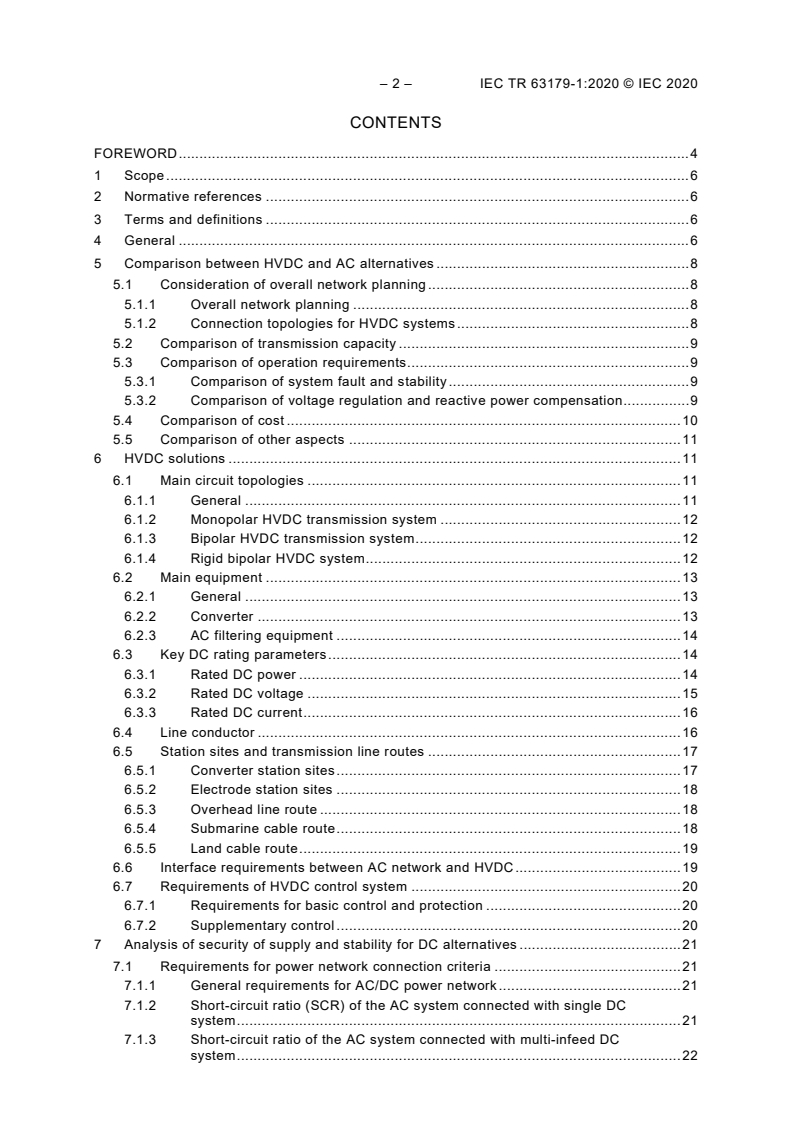
– 2 – IEC TR 63179-1:2020 © IEC 2020
CONTENTS
FOREWORD . 4
1 Scope . 6
2 Normative references . 6
3 Terms and definitions . 6
4 General . 6
5 Comparison between HVDC and AC alternatives . 8
5.1 Consideration of overall network planning . 8
5.1.1 Overall network planning . 8
5.1.2 Connection topologies for HVDC systems . 8
5.2 Comparison of transmission capacity . 9
5.3 Comparison of operation requirements . 9
5.3.1 Comparison of system fault and stability . 9
5.3.2 Comparison of voltage regulation and reactive power compensation . 9
5.4 Comparison of cost . 10
5.5 Comparison of other aspects . 11
6 HVDC solutions . 11
6.1 Main circuit topologies . 11
6.1.1 General . 11
6.1.2 Monopolar HVDC transmission system . 12
6.1.3 Bipolar HVDC transmission system . 12
6.1.4 Rigid bipolar HVDC system . 12
6.2 Main equipment . 13
6.2.1 General . 13
6.2.2 Converter . 13
6.2.3 AC filtering equipment . 14
6.3 Key DC rating parameters . 14
6.3.1 Rated DC power . 14
6.3.2 Rated DC voltage . 15
6.3.3 Rated DC current . 16
6.4 Line conductor . 16
6.5 Station sites and transmission line routes . 17
6.5.1 Converter station sites . 17
6.5.2 Electrode station sites . 18
6.5.3 Overhead line route . 18
6.5.4 Submarine cable route . 18
6.5.5 Land cable route . 19
6.6 Interface requirements between AC network and HVDC . 19
6.7 Requirements of HVDC control system . 20
6.7.1 Requirements for basic control and protection . 20
6.7.2 Supplementary control . 20
7 Analysis of security of supply and stability for DC alternatives . 21
7.1 Requirements for power network connection criteria . 21
7.1.1 General requirements for AC/DC power network . 21
7.1.2 Short-circuit ratio (SCR) of the AC system connected with single DC
system . 21
7.1.3 Short-circuit ratio of the AC system connected with multi-infeed DC
system . 22
7.1.4 Effective inertia constant of AC/DC power network . 23
7.2 Stability of AC power system due to HVDC alternatives . 24
7.2.1 Stability analysis for AC power system . 24
7.2.2 Analysis of sub-synchronous torsional interactions (SSTI) between
HVDC and nearby turbine-generator . 24
7.2.3 Analysis for multi-infeed HVDC links . 25
8 Economic comparison among the alternatives . 25
8.1 General . 25
8.2 Main factors to be considered . 25
8.3 Indexes to be considered . 26
8.4 Sensitivity analysis . 26
8.5 Economic conclusion for recommended solution . 26
9 Study conclusions and recommended solution . 26
Bibliography . 28
Figure 1 – Phases during integration of a new HVDC system into the power network . 7
Figure 2 – Procedure for planning an HVDC system . 8
Figure 3 – Cost versus distance . 11
Table 1 – Typical overhead bipolar HVDC project for power transmission . 15
– 4 – IEC TR 63179-1:2020 © IEC 2020
INTERNATIONAL ELECTROTECHNICAL COMMISSION
____________
GUIDELINE FOR PLANNING OF HVDC SYSTEMS –
Part 1: HVDC systems with line-commutated converters
FOREWORD
1) The International Electrotechnical Commission (IEC) is a worldwide organization for standardization comprising
all national electrotechnical committees (IEC National Committees). The object of IEC is to promote
international co-operation on all questions concerning standardization in the electrical and electronic fields. To
this end and in addition to other activities, IEC publishes International Standards, Technical Specifications,
Technical Reports, Publicly Available Specifications (PAS) and Guides (hereafter referred to as “IEC
Publication(s)”). Their preparation is entrusted to technical committees; any IEC National Committee interested
in the subject dealt with may participate in this preparatory work. International, governmental and non-
governmental organizations liaising with the IEC also participate in this preparation. IEC collaborates closely
with the International Organization for Standardization (ISO) in accordance with conditions determined by
agreement between the two organizations.
2) The formal decisions or agreements of IEC on technical matters express, as nearly as possible, an international
consensus of opinion on the relevant subjects since each technical committee has representation from all
interested IEC National Committees.
3) IEC Publications have the form of recommendations for international use and are accepted by IEC National
Committees in that sense. While all reasonable efforts are made to ensure that the technical content of IEC
Publications is accurate, IEC cannot be held responsible for the way in which they are used or for any
misinterpretation by any end user.
4) In order to promote international uniformity, IEC National Committees undertake to apply IEC Publications
transparently to the maximum extent possible in their national and regional publications. Any divergence
between any IEC Publication and the corresponding national or regional publication shall be clearly indicated in
the latter.
5) IEC itself does not provide any attestation of conformity. Independent certification bodies provide conformity
assessment services and, in some areas, access to IEC marks of conformity. IEC is not responsible for any
services carried out by independent certification bodies.
6) All users should ensure that they have the latest edition of this publication.
7) No liability shall attach to IEC or its directors, employees, servants or agents including individual experts and
members of its technical committees and IEC National Committees for any personal injury, property damage or
other damage of any nature whatsoever, whether direct or indirect, or for costs (including legal fees) and
expenses arising out of the publication, use of, or reliance upon, this IEC Publication or any other IEC
Publications.
8) Attention is drawn to the Normative references cited in this publication. Use of the referenced publications is
indispensable for the correct application of this publication.
9) Attention is drawn to the possibility that some of the elements of this IEC Publication may be the subject of
patent rights. IEC shall not be held responsible for identifying any or all such patent rights.
The main task of IEC technical committees is to prepare International Standards. However, a
technical committee may propose the publication of a technical report when it has collected
data of a different kind from that which is normally published as an International Standard, for
example "state of the art".
IEC TR 63179-1, which is a Technical Report, has been prepared by IEC technical
committee 115: High Voltage Direct Current (HVDC) transmission for DC voltages above
100 kV.
The text of this Technical Report is based on the following documents:
Draft TR Report on voting
115/216/DTR 115/230/RVDTR
Full information on the voting for the approval of this Technical Report can be found in the
report on voting indicated in the above table.
This document has been drafted in accordance with the ISO/IEC Directives, Part 2.
The committee has decided that the contents of this document will remain unchanged until the
stability date indicated on the IEC website under "http://webstore.iec.ch" in the data related to
the specific document. At this date, the document will be
• reconfirmed,
• withdrawn,
• replaced by a revised edition, or
• amended.
IMPORTANT – The 'colour inside' logo on the cover page of this publication indicates
that it contains colours which are considered to be useful for the correct
understanding of its contents. Users should therefore print this document using a
colour printer.
– 6 – IEC TR 63179-1:2020 © IEC 2020
GUIDELINE FOR PLANNING OF HVDC SYSTEMS –
Part 1: HVDC systems with line-commutated converters
1 Scope
This document provides guidelines for the selection of a high-voltage directive current (HVDC)
system with line-commutated converters (LCC), hereafter referred to as HVDC system, for the
purposes of HVDC system planning. It covers the guidelines on the requirements for
integrating HVDC systems in AC power networks, selection of rated voltage and power,
overloads, circuit configuration, expandability, comparison of technical, economic, regulatory,
political, social and environmental factors, etc. This document is applicable for planning an
HVDC system.
This guideline is not exhaustive and it is possible that there will be other specific aspects,
particular to a specific HVDC project, which will also need to be considered.
2 Normative references
The following documents are referred to in the text in such a way that some or all of their
content constitutes requirements of this document. For dated references, only the edition
cited applies. For undated references, the latest edition of the referenced document (including
any amendments) applies.
IEC 60633, High-voltage direct current (HVDC) transmission – Vocabulary
3 Terms and definitions
For the purposes of this document, the terms and definitions given in IEC 60633 apply.
ISO and IEC maintain terminological databases for use in standardization at the following
addresses:
• IEC Electropedia: available at http://www.electropedia.org
• ISO Online browsing platform: available at http://www.iso.org/obp
4 General
The HVDC system development and integration cycle may be described in terms of six
phases, as shown in Figure 1.
The main task of HVDC system planning is to develop and select an HVDC scheme based on
the conclusions of power network development planning where the network requirements are
defined. HVDC system planning uses as a minimum the total transmission capacity and range
of connection points previously determined by power network development planning, taking
into account current and future conditions of the power system, environment, and other
contributing factors.
There is a certain degree of repetition and iteration between HVDC system planning and
system design (refer to Figure 1). For the purpose of project feasibility study and scheme
comparison, some investigation would be carried out during the system planning phase, the
detailed studies and final design would be accomplished during the system design phase.
Figure 1 – Phases during integration of a new HVDC system into the power network
The work contents and procedure for planning of an HVDC system are as follows:
a) compare HVDC and AC solutions at high level according to the specific requirements (see
Clause 5);
b) when HVDC is the only technically feasible solution, or the use of an HVDC scheme has
overwhelming advantages, a number of alternative HVDC solutions could be investigated
(see Clause 6). When both HVDC and AC alternatives are technically feasible and neither
of them has overwhelming advantages, further analysis is required to confirm the
preferred solution;
c) verify the security of supply and stability of each alternative (see Clause 7);
d) compare the economic efficiency of alternative solutions (see Clause 8);
e) present the recommended solution (see Clause 9).
The above steps in the planning of an HVDC system are shown in Figure 2.
– 8 – IEC TR 63179-1:2020 © IEC 2020
Figure 2 – Procedure for planning an HVDC system
5 Comparison between HVDC and AC alternatives
5.1 Consideration of overall network planning
5.1.1 Overall network planning
When a new line between two areas is planned, the solutions should consider all aspects of
transmission planning, including the current and future power demand, line corridor conditions,
operation and maintenance, energy dispatch and overall cost.
5.1.2 Connection topologies for HVDC systems
When an HVDC system is to be added to AC power networks, there are two typical connection
topologies:
a) HVDC interconnection between two asynchronous AC power networks;
b) embedded HVDC system. An embedded HVDC system is an HVDC link between two parts
of the same AC synchronous transmission system.
In addition, a multi-terminal HVDC link could also be considered both in a) and b) above.
5.2 Comparison of transmission capacity
The power transfer between two networks through an AC overhead transmission line is
approximately given by the following expression:
VV
SR
P= sinθ
SR
X
SR
where
V and V are the voltages at the sending and receiving ends, respectively;
S R
X is the series reactance between the two ends;
SR
θ is the load angle (phase difference between the two voltages).
SR
To ensure that synchronism between the two networks is maintained following major
disturbances, the load angle is kept low during steady state operation. As a result, the power
transfer capability of the AC line is reduced compared to its thermal capability. This problem
does not exist with an HVDC system, as the two networks are decoupled and the power can
be independently controlled by the HVDC system.
For high-voltage AC cable transmission over certain distances, the charging current becomes
a major contributor to the thermal loading of the cable, due to its large shunt capacitance.
This therefore limits the useful load that the AC transmission circuit can carry. With DC
transmission, no charging current problems occur and therefore the useful load is also
generally only limited by the thermal capability of the cable.
5.3 Comparison of operation requirements
5.3.1 Comparison of system fault and stability
Faults causing significant voltage variation or power swings do not transmit across an HVDC
link. They may emerge on the other end of an HVDC link simply as a reduction in power,
without causing severe disturbance on the other end of the HVDC link.
Contrary to AC transmission, HVDC does not significantly increase the short-circuit currents
in both sending and receiving ends of AC power networks.
An HVDC link does not suffer from the power angle stability problems which frequently occur
with long AC transmission lines. Also, an AC transmission line is sensitive to disturbances of
the power balance in AC power networks, and the power flow within connecting AC lines is
not easy to be controlled, whereas the controllability of an HVDC system can be used to
support the stability of the connected AC networks by power runback or runup. Furthermore,
an HVDC link can provide additional benefits, such as possible overload and reduced voltage
operation. However, for a short time during a transient, an AC line may be able to transmit
more power than a DC link, even beyond its steady state thermal capacity, while the transient
overload allowed by the converter stations is usually smaller.
5.3.2 Comparison of voltage regulation and reactive power compensation
An AC transmission line imposes a load-dependent reactive power demand which may impact
the active current rating, and may require reactive power compensation at the terminals, and
at points along the line, to ensure the desired voltage level and adequate active power
transfer capability. While series or shunt compensation can assist transmission through
overhead lines, a technical limit is encountered in the case of transmission through insulated
cables. Even at relatively short distances, the reactive power consumes the greater part of the
current carrying capacity of the cable. Such solutions are possible, but inconvenient.
– 10 – IEC TR 63179-1:2020 © IEC 2020
HVDC systems do not need this type of compensation and therefore do not present the same
technical limitations in long transmission distance, with no requirement for special
compensation along the line/cable.
5.4 Comparison of cost
The listed items below should be evaluated and compared from a monetary point of view:
a) station costs;
b) line costs;
c) cost due to the adaptation of the existing network;
d) capitalised cost of converter station and DC line losses during the life of the project;
e) operational costs;
f) maintenance costs;
g) decommissioning costs;
h) land acquisition and rights of way.
NOTE The above list is not exhaustive.
For bulk power transfer over long distances, an HVDC transmission project has a lower cost,
whereas an AC transmission project has a lower cost at short distance to transmit the same
power. There exists a "breakeven distance" at which HVDC and AC transmission projects
have the same cost.
The comparison is shown in Figure 3. Many factors contribute to the cost of AC and DC
transmission, including ratings, locations, terrain, losses, etc., therefore the determination of
the actual breakeven distance for a particular transmission system should be carried out on a
case-by-case basis. The breakeven distance of overhead line is typically around 600 km to
800 km. For transmission by submarine cable the breakeven distance is around 40 km to
120 km. It may not be practical to consider AC cables longer than 40 km without some forms
of additional compensation measures, but HVDC links using cables over hundreds of
kilometres are feasible.
Figure 3 – Cost versus distance
5.5 Comparison of other aspects
In order to determine the most appropriate power transmission solution, a study and
comparison should be done for AC and HVDC alternatives.
The items listed below may be evaluated and compared from a strategic point of view:
a) political environment;
b) social impact;
c) environmental considerations;
d) transmission capacity and integration in the future power networks;
e) human resources for maintenance management and maintenance work;
f) regulatory and statutory requirements.
NOTE The above list is not exhaustive.
6 HVDC solutions
6.1 Main circuit topologies
6.1.1 General
There are two main types of HVDC system, namely transmission (two-terminal, also referred
to as point-to-point, or multi-terminal, where the different terminals are some distance away
from each other) and back-to-back systems (where the two terminals are in the same location
without an HVDC transmission line or cable).
For HVDC transmission systems, there are two categories, namely monopole and bipole.
For a back-to-back HVDC system, the monopolar configuration is normally used. There may
be more than one monopolar back-to-back converter unit in the same location.
– 12 – IEC TR 63179-1:2020 © IEC 2020
For the main circuit topologies and their features, refer to IEC 60919-1.
6.1.2 Monopolar HVDC transmission system
6.1.2.1 Monopolar HVDC transmission system with earth return
This is the simplest HVDC transmission system topology. It is one of the most cost-effective
solutions. This topology is generally used as the first stage in construction of a (future) bipolar
system. However, it presents the following disadvantages:
a) a pole outage means that 100 % of power transfer capability is lost;
b) it requires an electrode line and a continuously operable earth electrode at the two ends
of the transmission which involves consideration of issues such as corrosion, magnetic
field effects, etc., and with possible impacts on the environment and on transformers close
to the electrodes.
NOTE Details about electrodes are available in IEC/TS 62344.
6.1.2.2 Monopolar HVDC transmission systems with dedicated metallic return
This topology will generally be used:
a) as the first stage in construction of a bipolar system and if long term flow of earth current
is not desirable during the interim period; or
b) if the HVDC transmission line length is short, where electrode lines and earth electrodes
are not economical; or
c) if the earth resistivity is high enough to impose an unacceptable economic penalty; or
d) if the environmental impact due to earth/sea return, such as dryness of land, sea
temperature rise, emission of dissolved gases, etc., is not acceptable.
6.1.3 Bipolar HVDC transmission system
Bipolar HVDC transmission topology is the most commonly used topology when an HVDC
transmission line connects two HVDC converter stations. The bipolar HVDC system with earth
return may be designed such that when one pole converter is out of service, the healthy pole
may use the faulty pole's high-voltage line as a metallic return.
The advantages of the bipolar topology compared to monopolar are as follows:
a) lower losses for a given transmitted power;
b) a pole outage means only 50 % of the total power transfer capability of the HVDC link is
lost. Owing to this, a bipole HVDC link is compared to a double circuit AC line;
c) overload capability may be incorporated into the rating of each pole, such that when one
pole is out of service the healthy pole may pick up some of the faulted pole power, leading
to some contingency power capability above 50 %, although this is scheme-specific;
d) lower earth current flow.
The disadvantages of this topology (compared to monopolar) include the following:
e) higher converter station costs;
f) more converter station equipment and therefore more land usage.
6.1.4 Rigid bipolar HVDC system
In this topology, there is not neutral connection between both converter stations. Since only
two (pole) conductors exist, no unbalance current between both poles is possible. In case of
interruption of power transfer of one converter pole, the current of the other pole also has to
be interrupted (at least for a limited time to allow reconfiguration of the DC circuit).
The advantages of the rigid bipolar topology compared to the conventional bipolar topology
described in 6.1.3 are as follows:
a) no environmental impact due to earth current;
b) lower cost;
c) either return conductor or electrode station is not required.
The disadvantages of the rigid bipolar topology compared to the conventional bipolar topology
described in 6.1.3 are as follows:
d) lower availability because the outage on one of the two pole conductors will lead to a
bipole (100 %) power loss and any failure of main equipment excluding pole conductors
will result in at least a short total power interruption to re-configure the DC circuit;
e) impossibility to have a scheduled outage of an individual pole including the associated
pole conductor without an outage of the complete bipole, and maybe of possibility to have
a scheduled outage of an individual pole excluding the associated pole conductor but at
least with a short total power interruption to re-configure the DC circuit.
6.2 Main equipment
6.2.1 General
Typically, an HVDC converter station includes mainly the following primary equipment:
a) converter (comprising one or more converter bridges, one or more converter transformers,
converter control equipment, essential protective and switching devices and auxiliaries, if
any, used for conversion, according to IEC 60633);
b) AC filtering equipment and reactive power compensation equipment;
c) DC smoothing reactor;
d) DC filtering equipment;
e) surge arresters;
f) AC switchgear and measuring equipment;
g) DC switchgear and measuring equipment;
h) wall bushings.
Converter and AC filtering equipment may be considered in some detail during the planning
stage, since these items have the most significant impact on cost, land requirements, etc. For
detailed descriptions of this equipment, refer to IEC 60919-1.
6.2.2 Converter
Most modern HVDC transmission schemes utilize twelve-pulse converters. Meanwhile, there
is also another kind of configuration which uses two or more twelve-pulse converters per pole
connected in series or in parallel. Compared with using a single twelve-pulse converter, the
main advantage of the two twelve-pulse configuration is that for any single outage, only 50 %
of the pole power capability is lost, instead of 100 %. Its main disadvantage is that the cost
and land requirements are higher. One of the reasons for using multiple converters per pole is
that a single twelve-pulse converter may not be feasible due to the capability limitations of
manufacturing or transportation for items such as converter transformers.
The following factors should be considered to determine the optimum HVDC converter
configuration:
a) the maximum capacity of a single twelve-pulse converter in terms of ability to manufacture;
b) the limits of transportation of converter transformers from factory to site;
c) reliability of the AC power network connected to the HVDC link;
d) reliability of the HVDC system;
– 14 – IEC TR 63179-1:2020 © IEC 2020
e) flexibility of operation, especially during maintenance and fault conditions;
f) construction in phases;
g) cost-effectiveness of the project.
NOTE This list is not exhaustive and there can be additional applicable factors.
There are four basic types of converter transformer:
1) three-phase, three-winding transformer;
2) three-phase, two-winding transformer;
3) single-phase, three-winding transformer;
4) single-phase, two-winding transformer.
The choice of transformer type is based on the following factors:
– HVDC power transmission rating;
– voltage requirements on both AC and DC sides;
– transformer manufacture capacity;
– transportation constraints;
– replacement work requirements;
– cost effectiveness;
– available land for station layout;
– spare transformer / reliability and availability philosophy.
NOTE This list is not exhaustive and can contain other factors.
6.2.3 AC filtering equipment
The AC filters have two primary purposes:
a) to filter the AC harmonics generated by the HVDC converter; and
b) to provide reactive power needed by the HVDC converter.
The type/size of the filters can be calculated based on the system requirements (i.e. AC filter
performance, AC network equivalent impedance, maximum AC filter switching voltages, etc.).
These performance requirements have a significant effect on the AC filter designs and
consequently also on the station footprint/layout and cost.
6.3 Key DC rating parameters
6.3.1 Rated DC power
Rated DC power refers to the power transmitted continuously by an HVDC link under the
specified environmental conditions without the redundant cooling equipment in service. The
rated power is generally defined at the rectifier DC terminals, but can also be defined at the
inverter DC terminals, or at either of the two converter AC terminals. The rated power of an
HVDC link is decided based on many aspects. Below are three of the key considerations:
a) power levels required to be transmitted in the link, considering the minimum and maximum
power levels needed according to short and long-term power network planning;
b) overall transmission network considerations, including capacity in the connection points;
c) technological-economic factors to reach a cost-optimised power level.
The maximum continuous and short-term overload capacities should be defined carefully, as
these may impact the redundant cooling requirements for the thyristor valves and converter
transformers, and the ratings of main circuit equipment, including thyristor valves, the
overhead line or cable conductor, etc. The overload capability of the HVDC transmission
system should be determined according to the stability and reliability requirements of the
power system.
The minimum power should be defined as this could have an impact on the rating of converter
equipment and on other power circuit equipment such as a smoothing reactor due to
discontinuous current. In the case of a very weak AC network, the value of minimum power
should be low enough to keep the network stable when the HVDC system starts.
Further, power direction should also be defined. It could be fully bidirectional (symmetrical
ratings), only unidirectional, or bidirectional with a reduced power rating in the direction
opposite to the "normal" direction. Specifying a scheme for fully bidirectional power
transmission when this is not actually required could add extra cost.
6.3.2 Rated DC voltage
The rated DC voltage is the continuous DC voltage at which the rated power is to be
transmitted. For an HVDC system, the rated DC voltage is generally defined at the rectifier
terminals, but may also be defined at the inverter terminals or at a point along the DC
transmission line based on the needs of a specific project.
For an HVDC transmission system, the rated voltage is selected through analysis considering
many aspects including total investment and operation cost including cost of capitalized
losses. Below are three of the key considerations:
a) the transmission rated power;
b) the manufacturing capability of equipment;
c) technological-economic factors to reach a cost-optimum power level.
Table 1 lists typical rated voltage ranges under various transmission powers and distances.
Table 1 – Typical overhead bipolar HVDC project for power transmission
Up to 200 km Up to 500 km Up to Up to Up to 2 000 km or
1 000 km 1 500 km 2 000 km more
Up to 500 MW 250 kV 400 kV ---------------- ---------------- ---------------- ----------------
Up to 1 000 MW 350 kV 400 kV 500 kV ---------------- ---------------- ----------------
Up to 3 000 MW 500 kV, 500 kV, 600 kV, 600 kV,
---------------- 800 kV
600 kV 600 kV 800 kV 800 kV
Up to 4 000 MW 600 kV,
---------------- 600 kV 800 kV 800 kV 800 kV
800 kV
Up to 6 000 MW ---------------- 800 kV 800 kV 800 kV 800 kV 800 kV
6 000 MW or more 800 kV or 800 kV or
---------------- 800 kV 800 kV 800 kV
more more
As the cost depends a lot on the terrain and country, Table 1 can be considered as a
reference, and project-specific calculations should be made.
Extreme environmental conditions which may adversely affect the insulation capability of the
HVDC link should be considered during the planning stage. Depending on the frequency of
occurrence of these conditions, it may be necessary to temporarily impose a lower operating
limit on the HVDC voltage during the operation of an HVDC system, for example during
metallic return operation. Under these circumstances, the required voltage during reduced
voltage operation should be stated, together with the transmitted power requirements, as it
may not be possible to achieve full rated power at this reduced DC voltage.
– 16 – IEC TR 63179-1:2020 © IEC 2020
For a back-to-back system, the rated voltage is generally the rated power divided by the rated
current. The rated voltage is determined through the maximum utilization of current capability
of converter valves/thyristors, as converter station space and converter cost saving are major
concerns, and thus normally this is not finalized in the planning phase.
6.3.3 Rated DC current
For an HVDC transmission system, the rated current is the rated power divided by the rated
DC voltage.
Rated current is a key factor in the design of all main circuit equipment in the HVDC system,
as the current must pass through all of these individual components, which requires an
assessment of the physical weight and dimensions, cooling, mounting, and cost. This also
applies to the overhead line or cable conductors. For these reasons the selection of both the
rated DC current and DC voltage should take all factors into account to achieve a fully
cost-optimized solution for a given power rating.
For a back-to-back system, the rated DC current should be selected based on the current
carrying capability of the converter equipment. A higher rated DC current is preferred such
that rated DC voltage can be lower, thus leading to lower converter equipment costs.
However, this must be subject to other factors such as converter loss evaluation, overload
requirements, etc. This is generally decided in the detailed design phase.
6.4 Line conductor
An HVDC transmission line conductor may be an overhead line, a cable or a combination of
both. When an overhead line is impractical or not feasible, an HVDC cable (underground or
submarine) might be the preferred or the only alternative.
Depending on the distance between the two converter stations, the HVDC transmission line
may be one of the major components for an HVDC transmission system in terms of overall
cost and power losses. The selection of line conductor should therefore be an integral part of
the optimization at the planning stage, when considering the overall cost, rated power and
voltage for the HVDC transmission system.
For overhead lines, the critical considerations for the conductor design are the corona effects
(radio interference, losses and audible noise), as well as the power losses. The corona effects
are generally reduced by increasing the equivalent radius of the conductor (also referred to as
geometric mean radius), and by increasing the number and/or the cross-sectional area of the
sub-conductors in a bundle. The power losses may be reduced by increasing the overall
cross-sectional area of the conductor. Both the number and the cross-sectional area of the
sub-conductors in a bundle will have major implications on the cost of the HVDC transmission
line. Usually, the cross-sectional area of conductors should be selected based on the rated
current and the determined economic current density, and then checked in terms of corona
effects and other constraints. In conditions of high elevation and high voltage, the corona
effects may be significant, requiring particular consideration.
For an HVDC link using insulated cables, either underground or submarine, the following
factors may be taken into consideration:
a) insulation coordination with the converter station design;
b) load carrying requirements, including overload;
c) DC voltage;
d) HVDC link topology;
e) depth of water in submarine transmission;
f) installation costs (trenching, horizontal direct drilling, etc.);
g) protection requirements, for example, rock dumping, cable burial depth, etc.;
h) transition between land cables and submarine transmission cables;
i) transition between cables and overhead lines (if necessary);
j) landing point of submarine cables;
k) environmental issues, for example, the temperature rise of the seabed or land;
l) power reversal requirements.
NOTE This list is not exhaustive and can contain other factors.
The earth electrode line will require particular attention, as there are several different aspects
to the duty which it performs. Its length is usually insignificant compared to the distance
between the two converter stations, as it is generally determined by the nearest suitable site
(to achieve the best separation from a converter station and the best soil conductivity in all
climatic conditions), typically at 20 km to 100 km distance from the converter station. Its
voltage classification may be viewed as "medium voltage" in terms of insulation levels.
Further, the most common duty of the electrode line is to carry a relatively small amount of
current during bipole operation, and the utilization time of an electrode at rated current in
contingency monopole operation is usually limited. In some projects, monopolar earth return
configuration might be used for limited/short time and is then transferred to monopolar
metallic return mode. As a consequence, it is generally not considered as a major factor in the
techno-economic optimization of the HVDC system design option, although some exceptions
have been encountered where the distance to a suitable electrode site may significantly
exceed the typical range given above (i.e. at 20 km to 100 km distance from the converter
station). Nevertheless, for its current rating, the expected maximum DC current that it could
carry under any operating configuration shall be considered.
6.5 Station sites and transmission line routes
6.5.1 Converter station sites
The location of converter station sites is normally decided taking into account a wide range of
factors, incl
...