


IEC 60936-3:2002
(Main)Maritime navigation and radiocommunication equipment and systems - Radar - Part 3: Radar with chart facilities - Performance requirements - Methods of testing and required test results
General Information
- Abstract
Specifies the minimum operational and performance requirements, methods of testing and required test results conforming to performance standards not inferior to those adopted by the IMO in Resolution MSC.64(67) Annex 4 Radar clauses 3.3.9 and 3.3.10 for the optional requirements for superimposition of selected parts of SENC information. Takes into account IMO Resolution A.694 and is associated with IEC 60945.
- Status
- Replaced
- Publication Date
- 28-Apr-2002
- Technical Committee
- TC 80 - Maritime navigation and radiocommunication equipment and systems
- Drafting Committee
- WG 1 - TC 80/WG 1
- Current Stage
- DELPUB - Deleted Publication
- Start Date
- 13-Dec-2007
- Completion Date
- 28-Aug-2026
Buy Documents

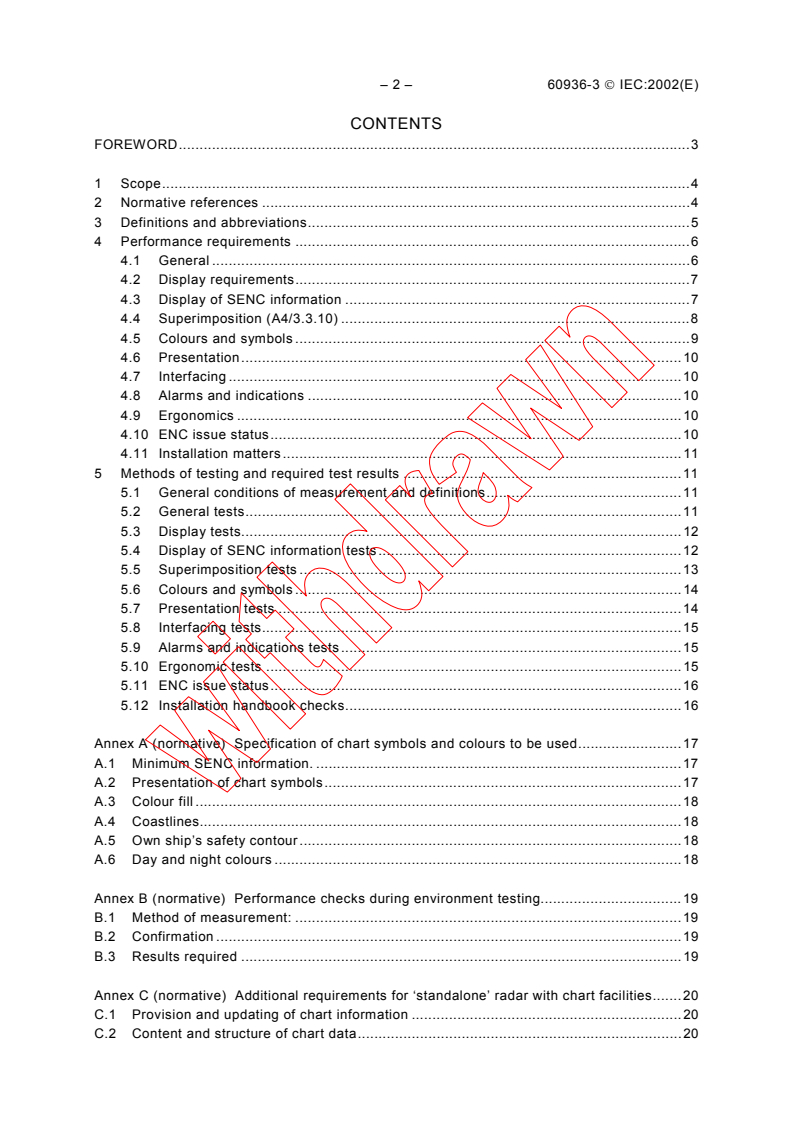
IEC 60936-3:2002 - Maritime navigation and radiocommunication equipment and systems - Radar - Part 3: Radar with chart facilities - Performance requirements - Methods of testing and required test results Released:4/29/2002
Relations
- Effective Date
- 05-Sep-2023
Buy Documents
IEC 60936-3:2002 - Maritime navigation and radiocommunication equipment and systems - Radar - Part 3: Radar with chart facilities - Performance requirements - Methods of testing and required test results Released:4/29/2002
Get Certified
Connect with accredited certification bodies for this standard

DNV
DNV is an independent assurance and risk management provider.

Lloyd's Register
Lloyd's Register is a global professional services organisation specialising in engineering and technology.

FSC International
Forest Stewardship Council certification.
Sponsored listings
Frequently Asked Questions
IEC 60936-3:2002 is a standard published by the International Electrotechnical Commission (IEC). Its full title is "Maritime navigation and radiocommunication equipment and systems - Radar - Part 3: Radar with chart facilities - Performance requirements - Methods of testing and required test results". This standard covers: Specifies the minimum operational and performance requirements, methods of testing and required test results conforming to performance standards not inferior to those adopted by the IMO in Resolution MSC.64(67) Annex 4 Radar clauses 3.3.9 and 3.3.10 for the optional requirements for superimposition of selected parts of SENC information. Takes into account IMO Resolution A.694 and is associated with IEC 60945.
Specifies the minimum operational and performance requirements, methods of testing and required test results conforming to performance standards not inferior to those adopted by the IMO in Resolution MSC.64(67) Annex 4 Radar clauses 3.3.9 and 3.3.10 for the optional requirements for superimposition of selected parts of SENC information. Takes into account IMO Resolution A.694 and is associated with IEC 60945.
IEC 60936-3:2002 is classified under the following ICS (International Classification for Standards) categories: 47.020.70 - Navigation and control equipment. The ICS classification helps identify the subject area and facilitates finding related standards.
IEC 60936-3:2002 has the following relationships with other standards: It is inter standard links to IEC 62388:2007. Understanding these relationships helps ensure you are using the most current and applicable version of the standard.
IEC 60936-3:2002 is available in PDF format for immediate download after purchase. The document can be added to your cart and obtained through the secure checkout process. Digital delivery ensures instant access to the complete standard document.
Standards Content (Sample)
INTERNATIONAL IEC
STANDARD
60936-3
First edition
2002-04
Maritime navigation and radiocommunication
equipment and systems – Radar –
Part 3:
Radar with chart facilities –
Performance requirements –
Methods of testing and required test results
Reference number
Publication numbering
As from 1 January 1997 all IEC publications are issued with a designation in the
60000 series. For example, IEC 34-1 is now referred to as IEC 60034-1.
Consolidated editions
The IEC is now publishing consolidated versions of its publications. For example,
edition numbers 1.0, 1.1 and 1.2 refer, respectively, to the base publication, the
base publication incorporating amendment 1 and the base publication incorporating
amendments 1 and 2.
Further information on IEC publications
The technical content of IEC publications is kept under constant review by the IEC,
thus ensuring that the content reflects current technology. Information relating to
this publication, including its validity, is available in the IEC Catalogue of
publications (see below) in addition to new editions, amendments and corrigenda.
Information on the subjects under consideration and work in progress undertaken
by the technical committee which has prepared this publication, as well as the list
of publications issued, is also available from the following:
• IEC Web Site (www.iec.ch)
• Catalogue of IEC publications
The on-line catalogue on the IEC web site (www.iec.ch/catlg-e.htm) enables
you to search by a variety of criteria including text searches, technical
committees and date of publication. On-line information is also available on
recently issued publications, withdrawn and replaced publications, as well as
corrigenda.
• IEC Just Published
This summary of recently issued publications (www.iec.ch/JP.htm) is also
available by email. Please contact the Customer Service Centre (see below) for
further information.
• Customer Service Centre
If you have any questions regarding this publication or need further assistance,
please contact the Customer Service Centre:
Email: custserv@iec.ch
Tel: +41 22 919 02 11
Fax: +41 22 919 03 00
INTERNATIONAL IEC
STANDARD
60936-3
First edition
2002-04
Maritime navigation and radiocommunication
equipment and systems – Radar –
Part 3:
Radar with chart facilities –
Performance requirements –
Methods of testing and required test results
IEC 2002 Copyright - all rights reserved
No part of this publication may be reproduced or utilized in any form or by any means, electronic or
mechanical, including photocopying and microfilm, without permission in writing from the publisher.
International Electrotechnical Commission, 3, rue de Varembé, PO Box 131, CH-1211 Geneva 20, Switzerland
Telephone: +41 22 919 02 11 Telefax: +41 22 919 03 00 E-mail: inmail@iec.ch Web: www.iec.ch
PRICE CODE
Commission Electrotechnique Internationale
S
International Electrotechnical Commission
Международная Электротехническая Комиссия
For price, see current catalogue
– 2 – 60936-3 IEC:2002(E)
CONTENTS
FOREWORD.3
1 Scope.4
2 Normative references .4
3 Definitions and abbreviations.5
4 Performance requirements .6
4.1 General .6
4.2 Display requirements.7
4.3 Display of SENC information .7
4.4 Superimposition (A4/3.3.10) .8
4.5 Colours and symbols .9
4.6 Presentation.10
4.7 Interfacing .10
4.8 Alarms and indications .10
4.9 Ergonomics .10
4.10 ENC issue status.10
4.11 Installation matters .11
5 Methods of testing and required test results .11
5.1 General conditions of measurement and definitions.11
5.2 General tests.11
5.3 Display tests.12
5.4 Display of SENC information tests.12
5.5 Superimposition tests .13
5.6 Colours and symbols .14
5.7 Presentation tests .14
5.8 Interfacing tests.15
5.9 Alarms and indications tests.15
5.10 Ergonomic tests .15
5.11 ENC issue status.16
5.12 Installation handbook checks.16
Annex A (normative) Specification of chart symbols and colours to be used.17
A.1 Minimum SENC information. .17
A.2 Presentation of chart symbols.17
A.3 Colour fill .18
A.4 Coastlines.18
A.5 Own ship’s safety contour.18
A.6 Day and night colours .18
Annex B (normative) Performance checks during environment testing.19
B.1 Method of measurement: .19
B.2 Confirmation .19
B.3 Results required .19
Annex C (normative) Additional requirements for ‘standalone’ radar with chart facilities.20
C.1 Provision and updating of chart information .20
C.2 Content and structure of chart data.20
60936-3 IEC:2002(E) – 3 –
INTERNATIONAL ELECTROTECHNICAL COMMISSION
____________
MARITIME NAVIGATION AND RADIOCOMMUNICATION
EQUIPMENT AND SYSTEMS – RADAR –
Part 3: Radar with chart facilities – Performance requirements –
Methods of testing and required test results
FOREWORD
1) The IEC (International Electrotechnical Commission) is a worldwide organization for standardization comprising
all national electrotechnical committees (IEC National Committees). The object of the IEC is to promote
international co-operation on all questions concerning standardization in the electrical and electronic fields. To
this end and in addition to other activities, the IEC publishes International Standards. Their preparation is
entrusted to technical committees; any IEC National Committee interested in the subject dealt with may
participate in this preparatory work. International, governmental and non-governmental organizations liaising
with the IEC also participate in this preparation. The IEC collaborates closely with the International
Organization for Standardization (ISO) in accordance with conditions determined by agreement between the
two organizations.
2) The formal decisions or agreements of the IEC on technical matters express, as nearly as possible, an
international consensus of opinion on the relevant subjects since each technical committee has representation
from all interested National Committees.
3) The documents produced have the form of recommendations for international use and are published in the form
of standards, technical specifications, technical reports or guides and they are accepted by the National
Committees in that sense.
4) In order to promote international unification, IEC National Committees undertake to apply IEC International
Standards transparently to the maximum extent possible in their national and regional standards. Any
divergence between the IEC Standard and the corresponding national or regional standard shall be clearly
indicated in the latter.
5) The IEC provides no marking procedure to indicate its approval and cannot be rendered responsible for any
equipment declared to be in conformity with one of its standards.
6) Attention is drawn to the possibility that some of the elements of this International Standard may be the subject
of patent rights. The IEC shall not be held responsible for identifying any or all such patent rights.
International Standard IEC 60936-3 has been prepared by IEC technical committee 80:
Maritime navigation and radiocommunication equipment and systems.
The text of this standard is based on the following documents:
FDIS Report on voting
80/337/FDIS 80/342/RVD
Full information on the voting for the approval of this standard can be found in the report on
voting indicated in the above table.
This publication has been drafted in accordance with the ISO/IEC Directives, Part 3.
Annexes A, B and C form an integral part of this standard.
The committee has decided that the contents of this publication will remain unchanged until
2006. At this date, the publication will be
• reconfirmed;
• withdrawn;
• replaced by a revised edition, or
• amended.
– 4 – 60936-3 IEC:2002(E)
MARITIME NAVIGATION AND RADIOCOMMUNICATION
EQUIPMENT AND SYSTEMS – RADAR –
Part 3: Radar with chart facilities – Performance requirements –
Methods of testing and required test results
1 Scope
This part of IEC 60936 specifies the minimum operational and performance requirements,
methods of testing and required test results conforming to performance standards not inferior
to those adopted by the IMO in Resolution MSC.64(67) Annex 4 Radar clauses 3.3.9 and
3.3.10 for the optional requirements for superimposition of selected parts of SENC
information. In addition it takes account of IMO Resolution A.694 and is associated with
IEC 60945. When a requirement of this standard is different from IEC 60945, the requirement
in this standard shall take precedence.
A High Speed Craft (HSC) radar, as defined in IEC 60936-2, that uses ‘selected parts of the
SENC’ shall comply with the requirements of this standard.
This standard does not include the mandatory performance requirements for the shipborne
radar or HSC radar. These are specified in IEC 60936-1, Shipborne radar, and IEC 60936-2,
HSC radar respectively.
All text in this standard, whose wording is identical to that in IMO Resolution MSC.64(67)
Annex 4 is printed in italics and the Resolution (abbreviated to – A4) and paragraph numbers
are indicated in brackets, i.e. (A4/3.3).
2 Normative references
The following referenced documents are indispensable for the application of this document.
For dated references, only the edition cited applies. For undated references, the latest edition
of the referenced document (including any amendments) applies.
IEC 60872-1, Maritime navigation and radiocommunication equipment and systems – Radar
plotting aids – Part 1: Automatic radar plotting aids (ARPA) – Methods of testing and required
test results
IEC 60872-2, Maritime navigation and radiocommunication equipment and systems – Radar
plotting aids – Part 2: Automatic tracking aids (ATA) – Methods of testing and required test
results
IEC 60872-3, Maritime navigation and radiocommunication equipment and systems – Radar
plotting aids – Part 3: Electronic plotting aid (EPA) – Methods of testing and required test
results
IEC 60945, Maritime navigation and radiocommunication equipment and systems – General
requirements – Methods of testing and required test results
IEC 60936-1, Maritime navigation and radiocommunication equipment and systems – Radar –
Part 1: Shipborne radar – Performance requirements – Methods of testing and required test
results
60936-3 IEC:2002(E) – 5 –
IEC 60936-2, Maritime navigation and radiocommunication equipment and systems – Radar –
Part 2: Shipborne radar for high-speed craft (HSC)– Methods of testing and required test
results
IEC 61162, Maritime navigation and radiocommunication equipment and systems – Digital
interfaces
IEC 61174, Maritime navigation and radiocommunication equipment and systems – Electronic
chart display and information system (ECDIS) – Operational and performance requirements,
methods of testing and required test results
IMO Convention for the Safety of Life at Sea (SOLAS) as amended
IMO Resolution MSC.64(67) Annex 4 Recommendation on performance standards for radar
equipment.
IMO Resolution A.694(17), General requirements for shipborne radio equipment forming part
of the global maritime distress and safety system and for electronic navigational aids
IMO Resolution A.820(19), Performance standards for navigational radar equipment for high-
speed craft
IMO Resolution A.817(19), Performance standards for electronic chart display and information
systems
IHO S52 and appendices
3 Definitions and abbreviations
For the purposes of this part of IEC 60936 the following definitions and abbreviations apply.
3.1 Definitions
3.1.1
ECDIS
IEC 61174 ‘Electronic chart display and information system’ (ECDIS) means a navigation
information system which, with adequate backup arrangements, can be accepted as
complying with the up-to-date chart required by regulation V/20 of the 1974 SOLAS
Convention. It displays selected information from a system electronic navigational chart
(SENC) with positional information from navigational sensors to assist the mariner in route
planning and route monitoring, and by displaying additional navigation-related information.
The reference geodetic datum is WGS-84
3.1.2
SENC
System Electronic Navigational Chart (SENC) means a database resulting from the
transformation of the ENC for appropriate use, updates to the ENC by appropriate means, and
other data added by the mariner. It is this database that is actually accessed for the display
generation and other navigational functions, and which is the equivalent to an up-to-date
paper chart. The SENC may also contain information from other sources
– 6 – 60936-3 IEC:2002(E)
3.1.3
ENC
Electronic Navigation Chart (ENC) means the database, standardized as to content, structure
and format, issued for use with ECDIS on the authority of government authorized
hydrographic offices. The ENC contains all the chart information necessary for safe navigation
and may contain supplementary information in addition to that contained in the paper chart (
e.g. sailing directions ) which may be considered necessary for safe navigation. The content,
structure and format of the ENC are specified in IHO S-57 Edition 3 including the associated
ENC product specification
3.1.4
ENC test data set
a standardized data set supplied on behalf of the International Hydrographic Organisation
(IHO) that is necessary to accomplish IEC testing requirements for ECDIS. This test data set
is encoded according to the IHO S-57 ENC product specification and contains update
information based on IHO S-52 appendix 1. The specific requirements are listed in IEC 61174
annex F
3.1.5
consistent common reference system
sensor input data, providing identical and obligatory reference pertaining to position, course,
heading, bearing, speed, velocity, etc. and horizontal datum to different sub-systems within an
integrated navigation system
3.1.6
degrade
reduce the information content of
3.1.7
primary chart-information set
coastlines, own ship's safety contour, dangers to navigation and fixed and floating aids to
navigation, as further detailed in IMO Resolution A.817 Appendix 2 clauses 1.1, 1.2, 1.3, 1.4
and 2.3 only. See annex A of this standard for the specification of chart symbols and features,
to be used.
3.2 Abbreviations
ECDIS Electronic chart display and information system
ENC Electronic navigation chart
EPFS Electronic position fixing system
EUT Equipment under test
HSC High speed craft
IHO International Hydrographic Organisation
SENC System electronic navigational chart
TM True motion
N UP North up
4 Performance requirements
4.1 General
The performance of the shipborne radar (or HSC radar) shall not be inferior to the
performance requirements adopted by the IMO in MSC.64(67) Annex 4 Radar (or A.820(19)
HSC radar) as specified in IEC 60936-1 and IEC 60936-2 respectively.
60936-3 IEC:2002(E) – 7 –
4.1.1 Quality assurance
The Administration shall require that the manufacturers have a quality control system audited
by a competent authority to ensure continuous compliance with the type approval conditions
(SOLAS Chapter V / Regulation 18.5).
4.2 Display requirements
4.2.1 Display conflict
It shall not be possible for radar maps to be displayed at the same time as SENC navigational
information. However, the navigational lines, other than those used for maps, and symbols
given in IEC 60936-1, annex C, clauses C.3, C.4 and C.5 are permitted, provided there is no
conflict between these sets of information.
Raster nautical charts (RNC) are not applicable for chart radar.
4.2.2 Display size
The equipment shall provide, without external magnification, a daylight display with a radar
minimum effective diameter within the bearing scale of not less than 250 mm.
4.2.3 Display resolution
The display shall have a minimum resolution of (L) lines per mm given by L = 800/s, where s
is the smaller dimension of the SENC information area. (e.g. for the minimum chart area,
s = 250 mm and the resolution L = 3,20 lines per mm, giving a picture unit size of 0,312 mm.)
4.2.4 Display colour
The display shall be multi-colour. The colours used for navigational lines and symbols and the
SENC information shall harmonize. The SENC information is permitted to be in shades of
grey.
4.3 Display of SENC information
4.3.1 Display degradation (A4/3.3.9)
Selected parts of the System Electronic Navigation Chart (SENC) information shall be
displayed in such a way that the radar and plotting information is not masked, obscured or
degraded
4.3.2 SENC information brilliance
The SENC information brilliance shall be adjustable by the user at any time.
4.3.3 Display functionality and response time
The radar functionality and response time shall not be adversely affected by the SENC
information.
4.3.4 Primary chart-information set
The SENC information made available for use on a radar display shall at least include
coastlines, own ship's safety contour, dangers to navigation and fixed and floating aids to
navigation. This set of information shall be known as the ‘primary chart-information set’.
The radar shall be capable of displaying the ‘primary chart-information set’ of SENC
information. Any additional SENC information as specified by the manufacturer shall meet the
requirements of this standard.
– 8 – 60936-3 IEC:2002(E)
The radar shall present the ‘primary chart-information set’ of SENC required at any time by
dedicated controls or primary access in an associated menu.
4.3.5 Selection of parts of SENC for display
From the radar display the mariner shall be able to select those parts of the SENC, which can
be made available and the mariner requires to be displayed.
The selected parts of SENC shall be displayed with minimum reduction of the information
content.
It shall be possible to suppress or remove all SENC information with a momentary control
function and it shall be possible to remove all SENC information from the radar display at any
time by a dedicated control or primary access in an associated menu.
It shall be possible to remove or add categories of the SENC information made available to
the radar. The addition or deletion of information shall be limited to categories of information,
for example prohibited and restricted areas, spot soundings, etc., but not individual items
such as individual area or an individual sounding. Full details and relevant safety cautions,
shall be provided in the operator’s handbook.
If a facility has been provided to call up information associated with an object by cursor
enquiry on its symbol, then the data shall be presented outside the radar video area. Where
this facility is provided, the text shall not appear automatically whenever the object with which
it is associated appears on the display. If depth information is displayed, it shall only be
presented as it has been provided in the ENC and n
...