


EN 60947-5-4:1997
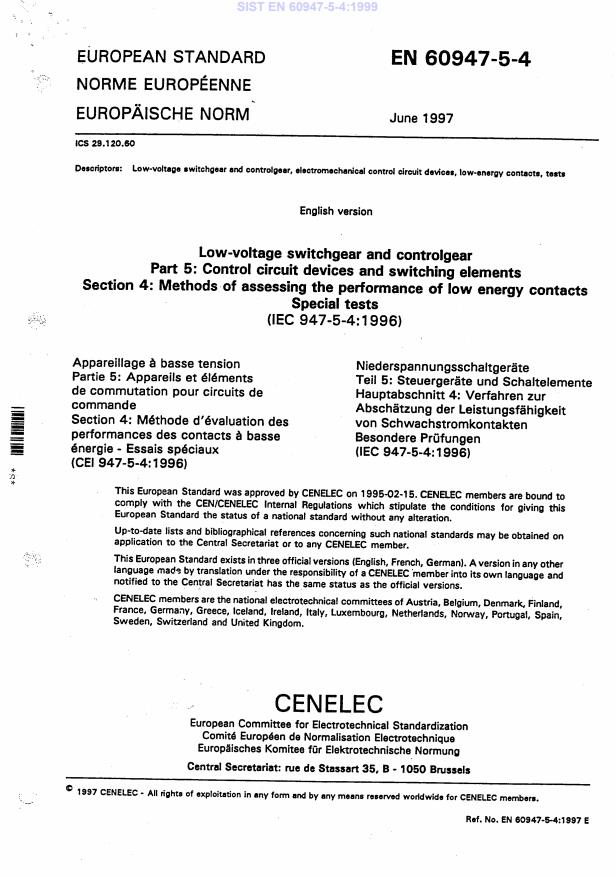
(Main)Low-voltage switchgear and controlgear - Part 5: Control circuit devices and switching elements - Section 4: Methods of assessing the performance of low energy contacts - Special tests
General Information
- Abstract
Applies to separable contacts used in the utilisation area considered such as switching element for control circuits. Two rated voltages are taken into consideration: above (and including) 10 V (typically 24 V) where contacts are used for switching loads with possible electrical erosion, such as programmable controller inputs, and below 10 V (typically 5 V) with neglible erosion, such as electronic circuits. It is a proposed method of assessing the performances of low energy contacts giving: useful definitions; general principles of test methods which are to monitor and record the behaviour of contacts at each operation; functional bases for the definition of a general testing equipment; preferred test values; particular conditions for testing contacts intended for specific applications (such as switching of PC inputs); information to be given in the test reports; interpretation and presentation of the test results.
- Status
- Withdrawn
- Publication Date
- 05-Jun-1997
- Withdrawal Date
- 30-Sep-1997
- Technical Committee
- CLC/TC 17B - Low-voltage switchgear and controlgear including dimensional standardization
- Drafting Committee
- IEC/SC 17B - IEC_SC_17B
- Parallel Committee
- IEC/SC 17B - IEC_SC_17B
- Current Stage
- 9960 - Withdrawal effective - Withdrawal
- Start Date
- 01-Dec-2006
- Completion Date
- 01-Dec-2006
- Directive
- Not Harmonized2006/95/EC - Directive 2006/95/EC of the European Parliament and of the Council of 12 December 2006 on the harmonisation of the laws of Member States relating to electrical equipment designed for use within certain voltage limits (codified version)OJ Ref: C, C 208 OJ Date: 30-Aug-2006
Not Harmonized73/23/EEC - Electrical equipment designed for use within certain voltage limitsOJ Ref: C 208

Relations
- Effective Date
- 29-Jan-2023
- Effective Date
- 09-Feb-2026
- Effective Date
- 03-Feb-2026
- Effective Date
- 03-Feb-2026
- Effective Date
- 03-Feb-2026
- Effective Date
- 03-Feb-2026
- Effective Date
- 03-Feb-2026
- Effective Date
- 09-Feb-2026
- Effective Date
- 03-Feb-2026
Get Certified
Connect with accredited certification bodies for this standard

IMQ S.p.A. (Certification)
Italian electrical product certification.

SLG Prüf- und Zertifizierungs GmbH
German testing and certification body.

UL Solutions
Global safety science company with testing, inspection and certification.
Sponsored listings
Frequently Asked Questions
EN 60947-5-4:1997 is a standard published by CLC. Its full title is "Low-voltage switchgear and controlgear - Part 5: Control circuit devices and switching elements - Section 4: Methods of assessing the performance of low energy contacts - Special tests". This standard covers: Applies to separable contacts used in the utilisation area considered such as switching element for control circuits. Two rated voltages are taken into consideration: above (and including) 10 V (typically 24 V) where contacts are used for switching loads with possible electrical erosion, such as programmable controller inputs, and below 10 V (typically 5 V) with neglible erosion, such as electronic circuits. It is a proposed method of assessing the performances of low energy contacts giving: useful definitions; general principles of test methods which are to monitor and record the behaviour of contacts at each operation; functional bases for the definition of a general testing equipment; preferred test values; particular conditions for testing contacts intended for specific applications (such as switching of PC inputs); information to be given in the test reports; interpretation and presentation of the test results.
Applies to separable contacts used in the utilisation area considered such as switching element for control circuits. Two rated voltages are taken into consideration: above (and including) 10 V (typically 24 V) where contacts are used for switching loads with possible electrical erosion, such as programmable controller inputs, and below 10 V (typically 5 V) with neglible erosion, such as electronic circuits. It is a proposed method of assessing the performances of low energy contacts giving: useful definitions; general principles of test methods which are to monitor and record the behaviour of contacts at each operation; functional bases for the definition of a general testing equipment; preferred test values; particular conditions for testing contacts intended for specific applications (such as switching of PC inputs); information to be given in the test reports; interpretation and presentation of the test results.
EN 60947-5-4:1997 is classified under the following ICS (International Classification for Standards) categories: 29.130.20 - Low voltage switchgear and controlgear. The ICS classification helps identify the subject area and facilitates finding related standards.
EN 60947-5-4:1997 has the following relationships with other standards: It is inter standard links to EN 60947-5-4:2003, EN ISO 8402:1995, EN 60068-1:1994, EN 60068-2-1:1993, EN 61131-2:1994, EN 60947-1:1997, EN 60947-5-1:1991, EN 13814:2004, EN 62019:1999. Understanding these relationships helps ensure you are using the most current and applicable version of the standard.
EN 60947-5-4:1997 is associated with the following European legislation: EU Directives/Regulations: 2006/95/EC, 73/23/EEC. When a standard is cited in the Official Journal of the European Union, products manufactured in conformity with it benefit from a presumption of conformity with the essential requirements of the corresponding EU directive or regulation.
EN 60947-5-4:1997 is available in PDF format for immediate download after purchase. The document can be added to your cart and obtained through the secure checkout process. Digital delivery ensures instant access to the complete standard document.
Standards Content (Sample)
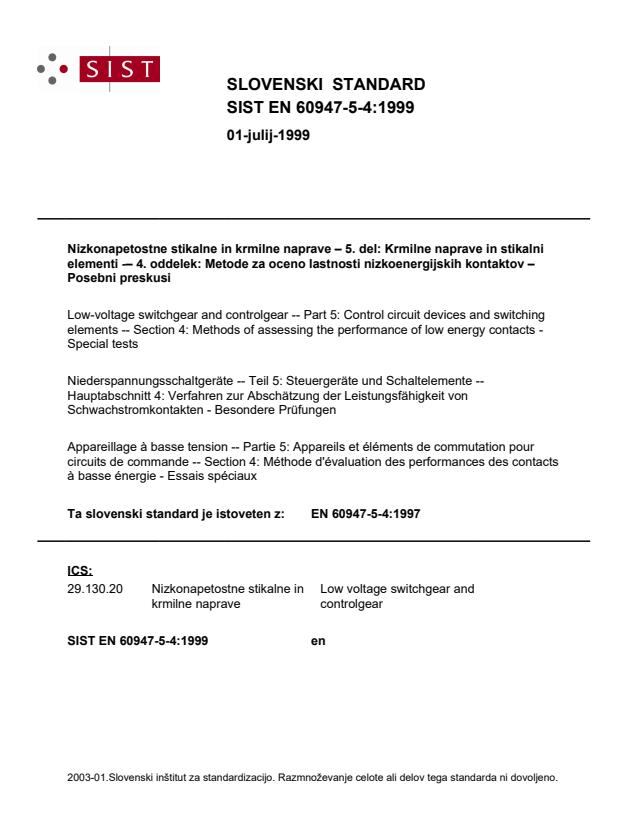
SLOVENSKI STANDARD
01-julij-1999
Nizkonapetostne stikalne in krmilne naprave – 5. del: Krmilne naprave in stikalni
elementi -– 4. oddelek: Metode za oceno lastnosti nizkoenergijskih kontaktov –
Posebni preskusi
Low-voltage switchgear and controlgear -- Part 5: Control circuit devices and switching
elements -- Section 4: Methods of assessing the performance of low energy contacts -
Special tests
Niederspannungsschaltgeräte -- Teil 5: Steuergeräte und Schaltelemente --
Hauptabschnitt 4: Verfahren zur Abschätzung der Leistungsfähigkeit von
Schwachstromkontakten - Besondere Prüfungen
Appareillage à basse tension -- Partie 5: Appareils et éléments de commutation pour
circuits de commande -- Section 4: Méthode d'évaluation des performances des contacts
à basse énergie - Essais spéciaux
Ta slovenski standard je istoveten z: EN 60947-5-4:1997
ICS:
29.130.20 Nizkonapetostne stikalne in Low voltage switchgear and
krmilne naprave controlgear
2003-01.Slovenski inštitut za standardizacijo. Razmnoževanje celote ali delov tega standarda ni dovoljeno.
-----------------
...