


EN 60204-1:1997
(Main)Safety of machinery - Electrical equipment of machines - Part 1: General requirements
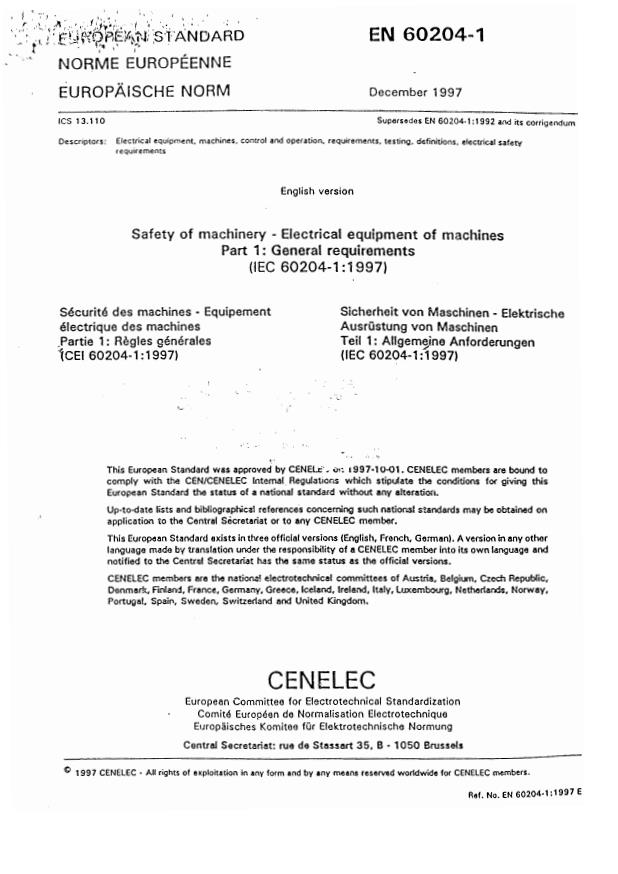
Safety of machinery - Electrical equipment of machines - Part 1: General requirements
Applies to the electrical and electronic equipment of industrial machines. Promotes the safety of persons who come into contact with industrial machines, not only from hazards associated with electricity (such as electrical shock and fire), but also resulting from the malfunction of the electrical equipment itself. Addresses hazards associated with the machine and its environment.
Sicherheit von Maschinen - Elektrische Ausrüstung von Maschinen - Teil 1: Allgemeine Anforderungen
Sécurité des machines - Equipement électrique des machines - Partie 1: Règles générales
S'applique aux équipements et systèmes électriques et électroniques des machines industrielles. Assure la sécurité des personnes, non seulement contre les risques normalement associés à l'utilisation de l'électricité comme le feu ou les chocs électriques, mais également contre les dangers qui peuvent découler du mauvais fonctionnement de l'équipement proprement dit. Porte aussi sur les dangers engendrés par les machines et leur environnement.
Safety of machinery - Electrical equipment of machines -- Part 1: General requirements (IEC 60204-1:1997+corrigendum Sep.1998)
General Information
- Status
- Withdrawn
- Publication Date
- 10-Dec-1997
- Withdrawal Date
- 30-Jun-2001
- Technical Committee
- CLC/TC 44X - Safety of machinery: electrotchnical aspects
- Drafting Committee
- IEC/TC 44 - IEC_TC_44
- Parallel Committee
- IEC/TC 44 - IEC_TC_44
- Current Stage
- 9960 - Withdrawal effective - Withdrawal
- Start Date
- 01-Jun-2009
- Completion Date
- 01-Jun-2009
- Directive
- Not Harmonized2006/95/EC - Directive 2006/95/EC of the European Parliament and of the Council of 12 December 2006 on the harmonisation of the laws of Member States relating to electrical equipment designed for use within certain voltage limits (codified version)OJ Ref: C144/1, C144/1, C144/1, C144/1, C144/1, C144/1, C1 OJ Date: 10-Jun-2008
Not Harmonized73/23/EEC - Electrical equipment designed for use within certain voltage limitsOJ Ref: C 208
Not Harmonized98/37/EC - MachineryOJ Ref: C 180/11, C 180/11, C 180/11, C 180/11, C 180/11,, OJ Date: 02-Aug-2006
- Mandate
- M/083 - Machinery
Relations
- Effective Date
- 29-Jan-2023
- Effective Date
- 28-Jan-2023
- Effective Date
- 20-Feb-2026
- Effective Date
- 10-Feb-2026
- Effective Date
- 10-Feb-2026
- Effective Date
- 10-Feb-2026
- Effective Date
- 09-Feb-2026
- Effective Date
- 09-Feb-2026
- Effective Date
- 09-Feb-2026
- Effective Date
- 09-Feb-2026
- Effective Date
- 03-Feb-2026
- Effective Date
- 03-Feb-2026
- Effective Date
- 03-Feb-2026
- Effective Date
- 03-Feb-2026
- Effective Date
- 03-Feb-2026

Get Certified
Connect with accredited certification bodies for this standard

NSF International
Global independent organization facilitating standards development and certification.

CIS Institut d.o.o.
Personal Protective Equipment (PPE) certification body. Notified Body NB-2890 for EU Regulation 2016/425 PPE.

Kiwa BDA Testing
Building and construction product certification.
Sponsored listings
Frequently Asked Questions
EN 60204-1:1997 is a standard published by CLC. Its full title is "Safety of machinery - Electrical equipment of machines - Part 1: General requirements". This standard covers: Applies to the electrical and electronic equipment of industrial machines. Promotes the safety of persons who come into contact with industrial machines, not only from hazards associated with electricity (such as electrical shock and fire), but also resulting from the malfunction of the electrical equipment itself. Addresses hazards associated with the machine and its environment.
Applies to the electrical and electronic equipment of industrial machines. Promotes the safety of persons who come into contact with industrial machines, not only from hazards associated with electricity (such as electrical shock and fire), but also resulting from the malfunction of the electrical equipment itself. Addresses hazards associated with the machine and its environment.
EN 60204-1:1997 is classified under the following ICS (International Classification for Standards) categories: 13.110 - Safety of machinery. The ICS classification helps identify the subject area and facilitates finding related standards.
EN 60204-1:1997 has the following relationships with other standards: It is inter standard links to EN 60204-1:1992, EN 60204-1:2006, ISO 7000:1989, ISO/TR 12100-1:1992, ISO 3864:1984, IEC 60050-441:1984, EN 13087-7:2000/A1:2001, EN ISO 3680:2004, EN ISO 14935:1998, EN 1060-1:1995/A1:2002, HD 384.5.54 S1:1988, HD 384.6.61 S2:2003, EN 60947-3:1992, EN 61131-1:1994, R009-005:2001. Understanding these relationships helps ensure you are using the most current and applicable version of the standard.
EN 60204-1:1997 is associated with the following European legislation: EU Directives/Regulations: 2006/95/EC, 73/23/EEC, 98/37/EC; Standardization Mandates: M/083. When a standard is cited in the Official Journal of the European Union, products manufactured in conformity with it benefit from a presumption of conformity with the essential requirements of the corresponding EU directive or regulation.
EN 60204-1:1997 is available in PDF format for immediate download after purchase. The document can be added to your cart and obtained through the secure checkout process. Digital delivery ensures instant access to the complete standard document.
Questions, Comments and Discussion
Ask us and Technical Secretary will try to provide an answer. You can facilitate discussion about the standard in here.
Loading comments...