

EN IEC 60728-3:2018
(Main)Cable networks for television signals, sound signals and interactive services - Part 3: Active wideband equipment for cable networks (TA 5)
General Information
- Abstract
NEW!IEC 60728-3:2017 is available as IEC 60728-3:2017 RLV which contains the International Standard and its Redline version, showing all changes of the technical content compared to the previous edition.IEC 60728-3:2017 specifies the measuring methods, performance requirements and data publication requirements for active wideband equipment of cable networks for television signals, sound signals and interactive services. This fifth edition cancels and replaces the fourth edition published in 2010. This edition constitutes a technical revision. This edition includes the following significant technical changes with respect to the previous edition: a) extension of upper frequency range limit for cable network equipment in the forward path from 1 000 MHz to 1 218 MHz (optional up to 1 794 MHz); b) extension of upper frequency range limit for cable network equipment in the return path from 85 MHz to 204 MHz; c) integration and update of IEC 60728-3-1 content; d) integration and update of the Technical Specification CLC/TS 50083-3-3 content; e) deletion of specifications and test methods for obsolete analogue parameters; f) additional normative references; g) additional terms and definitions and abbreviations.
- Status
- Published
- Publication Date
- 22-Feb-2018
- Withdrawal Date
- 31-Dec-2020
- Technical Committee
- CLC/TC 209 - Cable networks for television signals, sound signals and interactive services
- Drafting Committee
- IEC/TC 100 - IEC_TC_100
- Current Stage
- 9093 - Decision to confirm - Review Enquiry
- Start Date
- 27-Apr-2026
- Completion Date
- 25-Aug-2026



Overview
EN IEC 60728-3:2018 specifies measurement methods, performance requirements and data publication rules for active wideband equipment for cable networks that carry television signals, sound signals and interactive services. This fifth edition (IEC 60728-3:2017 adopted as EN IEC 60728-3:2018) is a technical revision that updates frequency ranges, integrates related technical documents and removes obsolete analogue specifications. It is intended for manufacturers, test laboratories and operators involved in coaxial cable distribution systems.
Key Topics
- Measuring methods for linear and non-linear distortion, including:
- Return loss and group delay variation (linear distortion)
- Intermodulation, composite triple beat and composite second order tests (non-linear distortion)
- Noise measurements:
- Noise figure and Noise Power Ratio (NPR) test procedures
- Crosstalk attenuation measurements for loop‑through and output ports
- Hum modulation and immunity to surge voltages
- Equipment requirements and performance parameters:
- Frequency range, gain, flatness, test points, maximum operating level for digital channel loads
- Power supply, environmental, marking and energy-efficiency considerations
- Frequency range updates:
- Forward path upper limit extended from 1000 MHz to 1218 MHz (optionally up to 1794 MHz)
- Return path upper limit extended from 85 MHz to 204 MHz
- Integration of IEC 60728-3-1 and CLC/TS 50083-3-3 content; additional normative references, terms and definitions.
Applications
EN IEC 60728-3:2018 is used to design, test and certify active components in cable distribution networks, including:
- Broadband amplifiers, line amplifiers and headend active equipment
- Return‑path amplifiers, upstream modems and multi‑switches
- Equipment qualification in manufacturing test benches and independent test labs
- Network acceptance testing and performance validation by cable operators and system integrators
- Compliance demonstrations for procurement and regulatory purposes
Adoption of this standard helps ensure predictable RF performance, interoperability across devices and reliable broadband service delivery for television, radio and interactive services.
Related Standards
- EN IEC 60728-1 (general)
- EN 60728-2 (EMC)
- EN 60728-4 (passive wideband equipment)
- EN 60728-5 (headend equipment)
- EN 60728-11 (safety)
- IEC 61000-4-5 (surge immunity), IEC 62368-1 (safety)
Keywords: EN IEC 60728-3:2018, active wideband equipment, cable networks, measuring methods, noise figure, intermodulation, NPR, return loss, forward path, return path.
Relations
- Effective Date
- 07-Jun-2022
- Effective Date
- 13-Mar-2018
- Effective Date
- 10-Feb-2026
- Effective Date
- 10-Feb-2026
- Effective Date
- 09-Feb-2026
- Effective Date
- 03-Feb-2026
- Effective Date
- 03-Feb-2026
- Effective Date
- 03-Feb-2026
- Effective Date
- 03-Feb-2026
- Effective Date
- 03-Feb-2026
- Effective Date
- 03-Feb-2026
- Effective Date
- 03-Feb-2026
- Effective Date
- 03-Feb-2026
- Effective Date
- 03-Feb-2026
- Effective Date
- 03-Feb-2026
Get Certified
Connect with accredited certification bodies for this standard

ANCE
Mexican certification and testing association.

Intertek Slovenia
Intertek testing, inspection, and certification services in Slovenia.

LNE (Laboratoire National de Métrologie et d'Essais)
French national laboratory for metrology and testing.
Sponsored listings
Frequently Asked Questions
EN IEC 60728-3:2018 is a standard published by CLC. Its full title is "Cable networks for television signals, sound signals and interactive services - Part 3: Active wideband equipment for cable networks (TA 5)". This standard covers: NEW!IEC 60728-3:2017 is available as IEC 60728-3:2017 RLV which contains the International Standard and its Redline version, showing all changes of the technical content compared to the previous edition.IEC 60728-3:2017 specifies the measuring methods, performance requirements and data publication requirements for active wideband equipment of cable networks for television signals, sound signals and interactive services. This fifth edition cancels and replaces the fourth edition published in 2010. This edition constitutes a technical revision. This edition includes the following significant technical changes with respect to the previous edition: a) extension of upper frequency range limit for cable network equipment in the forward path from 1 000 MHz to 1 218 MHz (optional up to 1 794 MHz); b) extension of upper frequency range limit for cable network equipment in the return path from 85 MHz to 204 MHz; c) integration and update of IEC 60728-3-1 content; d) integration and update of the Technical Specification CLC/TS 50083-3-3 content; e) deletion of specifications and test methods for obsolete analogue parameters; f) additional normative references; g) additional terms and definitions and abbreviations.
NEW!IEC 60728-3:2017 is available as IEC 60728-3:2017 RLV which contains the International Standard and its Redline version, showing all changes of the technical content compared to the previous edition.IEC 60728-3:2017 specifies the measuring methods, performance requirements and data publication requirements for active wideband equipment of cable networks for television signals, sound signals and interactive services. This fifth edition cancels and replaces the fourth edition published in 2010. This edition constitutes a technical revision. This edition includes the following significant technical changes with respect to the previous edition: a) extension of upper frequency range limit for cable network equipment in the forward path from 1 000 MHz to 1 218 MHz (optional up to 1 794 MHz); b) extension of upper frequency range limit for cable network equipment in the return path from 85 MHz to 204 MHz; c) integration and update of IEC 60728-3-1 content; d) integration and update of the Technical Specification CLC/TS 50083-3-3 content; e) deletion of specifications and test methods for obsolete analogue parameters; f) additional normative references; g) additional terms and definitions and abbreviations.
EN IEC 60728-3:2018 is classified under the following ICS (International Classification for Standards) categories: 33.060.40 - Cabled distribution systems; 33.170 - Television and radio broadcasting. The ICS classification helps identify the subject area and facilitates finding related standards.
EN IEC 60728-3:2018 has the following relationships with other standards: It is inter standard links to EN 60728-3:2011, CLC/TS 50083-3-3:2014, IEC 61319-2:1997, IEC 60728-2:2010, ENV 1927-3:1998, EN 60068-2-27:2009, EN 60068-1:2014, EN IEC 60728-11:2023, EN 60068-2-40:1999, EN IEC 62368-1:2024, EN 61319-1:1996, EN IEC 60068-2-1:2025, EN IEC 60068-2-30:2025, EN 60068-2-6:2008, EN 61000-4-5:2014. Understanding these relationships helps ensure you are using the most current and applicable version of the standard.
EN IEC 60728-3:2018 is available in PDF format for immediate download after purchase. The document can be added to your cart and obtained through the secure checkout process. Digital delivery ensures instant access to the complete standard document.
Standards Content (Sample)
SLOVENSKI STANDARD
01-november-2018
Nadomešča:
SIST EN 60728-3:2011
SIST EN 60728-3-1:2012
SIST-TS CLC/TS 50083-3-3:2015
Kabelska omrežja za televizijske in zvokovne signale ter interaktivne storitve - 3.
del: Aktivna širokopasovna oprema za kabelska omrežja (TA 5) (IEC 60728-3:2017)
Cable networks for television signals, sound signals and interactive services - Part 3:
Active wideband equipment for cable networks (TA 5) (IEC 60728-3:2017)
Kabelnetze für Fernsehsignale, Tonsignale und interaktive Dienste - Teil 3: Aktive
Breitbandgeräte für Kabelnetze (IEC 60728-3:2017)
Réseaux de distribution par câbles pour signaux de télévision, signaux de radiodiffusion
sonore et services interactifs - Partie 3: Matériel actif à large bande pour réseaux de
distribution par câbles (IEC 60728-3:2017)
Ta slovenski standard je istoveten z: EN IEC 60728-3:2018
ICS:
33.060.40 Kabelski razdelilni sistemi Cabled distribution systems
33.170 Televizijska in radijska Television and radio
difuzija broadcasting
2003-01.Slovenski inštitut za standardizacijo. Razmnoževanje celote ali delov tega standarda ni dovoljeno.
EUROPEAN STANDARD EN IEC 60728-3
NORME EUROPÉENNE
EUROPÄISCHE NORM
February 2018
ICS 33.060.40; 33.170 Supersedes EN 60728-3:2011
English Version
Cable networks for television signals, sound signals and
interactive services - Part 3: Active wideband equipment for
cable networks (TA 5)
(IEC 60728-3:2017)
Réseaux de distribution par câbles pour signaux de Kabelnetze für Fernsehsignale, Tonsignale und interaktive
télévision, signaux de radiodiffusion sonore et services Dienste - Teil 3: Aktive Breitbandgeräte für Kabelnetze
interactifs - Partie 3: Matériel actif à large bande pour (IEC 60728-3:2017)
réseaux de distribution par câbles
(IEC 60728-3:2017)
This European Standard was approved by CENELEC on 2018-01-01. CENELEC members are bound to comply with the CEN/CENELEC
Internal Regulations which stipulate the conditions for giving this European Standard the status of a national standard without any alteration.
Up-to-date lists and bibliographical references concerning such national standards may be obtained on application to the CEN-CENELEC
Management Centre or to any CENELEC member.
This European Standard exists in three official versions (English, French, German). A version in any other language made by translation
under the responsibility of a CENELEC member into its own language and notified to the CEN-CENELEC Management Centre has the
same status as the official versions.
CENELEC members are the national electrotechnical committees of Austria, Belgium, Bulgaria, Croatia, Cyprus, the Czech Republic,
Denmark, Estonia, Finland, Former Yugoslav Republic of Macedonia, France, Germany, Greece, Hungary, Iceland, Ireland, Italy, Latvia,
Lithuania, Luxembourg, Malta, the Netherlands, Norway, Poland, Portugal, Romania, Serbia, Slovakia, Slovenia, Spain, Sweden,
Switzerland, Turkey and the United Kingdom.
European Committee for Electrotechnical Standardization
Comité Européen de Normalisation Electrotechnique
Europäisches Komitee für Elektrotechnische Normung
CEN-CENELEC Management Centre: Rue de la Science 23, B-1040 Brussels
© 2018 CENELEC All rights of exploitation in any form and by any means reserved worldwide for CENELEC Members.
Ref. No. EN IEC 60728-3:2018 E
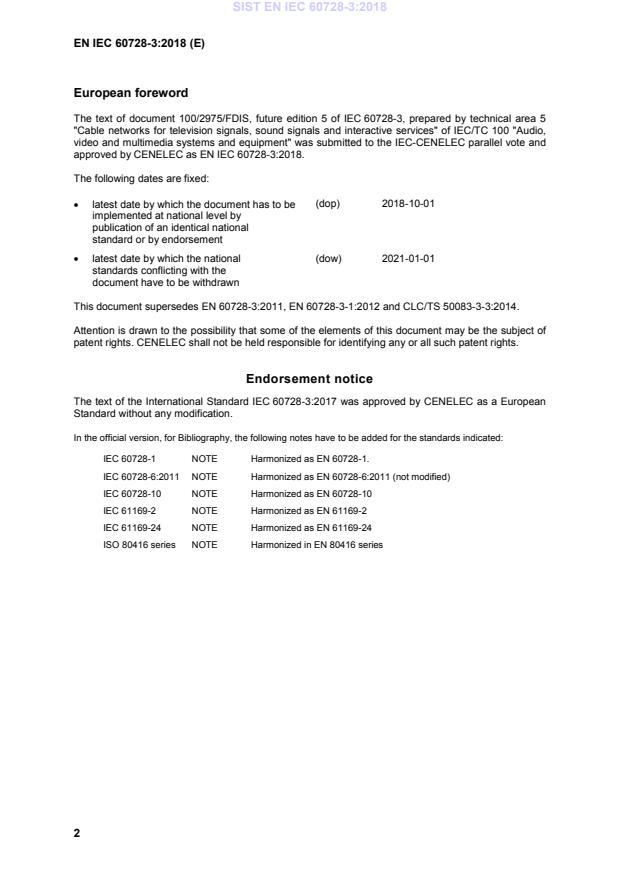
European foreword
The text of document 100/2975/FDIS, future edition 5 of IEC 60728-3, prepared by technical area 5
"Cable networks for television signals, sound signals and interactive services" of IEC/TC 100 "Audio,
video and multimedia systems and equipment" was submitted to the IEC-CENELEC parallel vote and
approved by CENELEC as EN IEC 60728-3:2018.
The following dates are fixed:
(dop) 2018-10-01
• latest date by which the document has to be
implemented at national level by
publication of an identical national
standard or by endorsement
• latest date by which the national (dow) 2021-01-01
standards conflicting with the
document have to be withdrawn
This document supersedes EN 60728-3:2011, EN 60728-3-1:2012 and CLC/TS 50083-3-3:2014.
Attention is drawn to the possibility that some of the elements of this document may be the subject of
patent rights. CENELEC shall not be held responsible for identifying any or all such patent rights.
Endorsement notice
The text of the International Standard IEC 60728-3:2017 was approved by CENELEC as a European
Standard without any modification.
In the official version, for Bibliography, the following notes have to be added for the standards indicated:
IEC 60728-1 NOTE Harmonized as EN 60728-1.
IEC 60728-6:2011 NOTE Harmonized as EN 60728-6:2011 (not modified)
IEC 60728-10 NOTE Harmonized as EN 60728-10
IEC 61169-2 NOTE Harmonized as EN 61169-2
IEC 61169-24 NOTE Harmonized as EN 61169-24
ISO 80416 series NOTE Harmonized in EN 80416 series
Annex ZA
(normative)
Normative references to international publications
with their corresponding European publications
The following documents are referred to in the text in such a way that some or all of their content
constitutes requirements of this document. For dated references, only the edition cited applies. For
undated references, the latest edition of the referenced document (including any amendments)
applies.
NOTE 1 Where an International Publication has been modified by common modifications, indicated by (mod), the relevant
EN/HD applies.
NOTE 2 Up-to-date information on the latest versions of the European Standards listed in this annex is available here:
www.cenelec.eu.
Publication Year Title EN/HD Year
IEC 60068-1 - Environmental testing -- Part 1: General EN 60068-1 -
and guidance
IEC 60068-2-1 - Environmental testing -- Part 2-1: Tests - EN 60068-2-1 -
Test A: Cold
IEC 60068-2-2 - Environmental testing -- Part 2-2: Tests - EN 60068-2-2 -
Test B: Dry heat
IEC 60068-2-6 - Environmental testing -- Part 2-6: Tests - EN 60068-2-6 -
Test Fc: Vibration (sinusoidal)
IEC 60068-2-14 - Environmental testing -- Part 2-14: Tests - EN 60068-2-14 -
Test N: Change of temperature
IEC 60068-2-27 - Environmental testing -- Part 2-27: Tests - EN 60068-2-27 -
Test Ea and guidance: Shock
IEC 60068-2-30 - Environmental testing -- Part 2-30: Tests - EN 60068-2-30 -
Test Db: Damp heat, cyclic (12 h + 12 h
cycle)
IEC 60068-2-31 - Environmental testing -- Part 2-31: Tests - EN 60068-2-31 -
Test Ec: Rough handling shocks, primarily
for equipment-type specimens
IEC 60068-2-40 - Basic environmental testing procedures - EN 60068-2-40 -
Part 2: Tests. Test Z/AM: Combined
cold/low air pressure tests
IEC 60529 - Degrees of protection provided by - -
enclosures (IP Code)
IEC 60728-2 - Cable networks for television signals, EN 50083-2 -
sound signals and interactive services -
Part 2: Electromagnetic compatibility for
equipment
IEC 60728-4 - Cable networks for television signals, EN 60728-4 -
sound signals and interactive services --
Part 4: Passive wideband equipment for
coaxial cable networks
IEC 60728-5 - Cable networks for television signals, EN 60728-5 -
sound signals and interactive services -
Part 5: Headend equipment
IEC 60728-11 - Cable networks for television signals, EN 60728-11 -
sound signals and interactive services --
Part 11: Safety
IEC 61000-4-5 - Electromagnetic compatibility (EMC) - Part EN 61000-4-5 -
4-5: Testing and measurement techniques
- Surge immunity test
IEC 61319-1 - Interconnections of satellite receiving EN 61319-1 -
equipment -- Part 1: Europe
IEC 61319-2 - Interconnections of satellite receiving - -
equipment -- Part 2: Japan
IEC 62368-1 - Audio/video, information and EN 62368-1 -
communication technology equipment --
Part 1: Safety requirements
IEC 60728-3 ®
Edition 5.0 2017-11
INTERNATIONAL
STANDARD
colour
inside
Cable networks for television signals, sound signals and interactive services
Part 3: Active wideband equipment for cable networks
INTERNATIONAL
ELECTROTECHNICAL
COMMISSION
ICS 33.060.40; 33.170 ISBN 978-2-8322-4934-5
– 2 – IEC 60728-3:2017 © IEC 2017
CONTENTS
FOREWORD . 5
INTRODUCTION . 7
1 Scope . 8
2 Normative references . 8
3 Terms, definitions, symbols and abbreviated terms . 9
3.1 Terms and definitions . 9
3.2 Symbols . 12
3.3 Abbreviated terms . 14
4 Methods of measurement . 14
4.1 General . 14
4.2 Linear distortion . 15
4.2.1 Return loss . 15
4.2.2 Group delay variation . 15
4.3 Non-linear distortion. 16
4.3.1 General . 16
4.3.2 Types of measurements . 16
4.3.3 Intermodulation . 17
4.3.4 Composite triple beat . 19
4.3.5 Composite second order beat . 22
4.3.6 Method of measurement of non-linearity for pure digital channel load . 22
4.3.7 Hum modulation of carrier . 30
4.4 Noise figure . 33
4.4.1 General . 33
4.4.2 Equipment required . 33
4.4.3 Connection of equipment . 33
4.4.4 Measurement procedure . 34
4.5 Crosstalk attenuation . 34
4.5.1 Crosstalk attenuation for loop-through ports . 34
4.5.2 Crosstalk attenuation for output ports . 34
4.6 Measurement of noise power ratio (NPR) . 36
4.6.1 General . 36
4.6.2 Equipment required . 37
4.6.3 Connection of equipment . 37
4.6.4 Measurement procedure . 38
4.6.5 Presentation of the results . 38
4.7 Immunity to surge voltages . 39
4.7.1 General . 39
4.7.2 Equipment required . 39
4.7.3 Connection of equipment . 39
4.7.4 Measurement procedure . 40
5 Equipment requirements . 40
5.1 General requirements . 40
5.2 Safety . 40
5.3 Electromagnetic compatibility (EMC) . 40
5.4 Frequency range . 40
5.5 Impedance and return loss . 40
– 3 – IEC 60728-3:2017 © IEC 2017
5.6 Gain . 41
5.6.1 Minimum and maximum gain . 41
5.6.2 Gain control . 41
5.6.3 Slope and slope control . 41
5.7 Flatness . 41
5.8 Test points . 41
5.9 Noise figure . 41
5.10 Non-linear distortion. 42
5.10.1 General . 42
5.10.2 Second-order distortion . 42
5.10.3 Third order distortion . 42
5.10.4 Composite triple beat . 42
5.10.5 Composite second order . 42
5.10.6 Maximum operating level for pure digital channel load . 42
5.11 Hum modulation . 43
5.12 Power supply . 43
5.13 Environmental . 43
5.13.1 General . 43
5.13.2 Transportation . 43
5.13.3 Installation or maintenance . 43
5.13.4 Operation . 43
5.13.5 Energy efficiency of equipment . 44
5.14 Marking . 44
5.14.1 Marking of equipment . 44
5.14.2 Marking of ports . 44
5.15 Requirements for multi-switches . 44
5.15.1 Control signals for multi-switches . 44
5.15.2 Amplitude frequency response flatness . 44
5.15.3 Return loss . 44
5.15.4 Through loss . 44
5.15.5 Isolation . 44
5.15.6 Crosstalk attenuation . 44
5.15.7 Satellite IF to terrestrial signal isolation . 45
5.16 Immunity to surge voltages . 45
5.16.1 Degrees of testing levels . 45
5.16.2 Recommendation of testing level degree . 45
Annex A (normative) Test carriers, levels and intermodulation products . 46
A.1 Two signal tests for second- and third-order products . 46
A.1.1 Intermodulation products with test signals at frequencies ƒ and ƒ ,
a b
see Table A.1 . 46
A.1.2 Signal levels . 46
A.2 Three signal tests for third order products – Intermodulation products with
test signals at frequencies ƒ , ƒ and ƒ , see Table A.2 and Figure A.3 . 47
a b c
Annex B (informative) Test frequency plan for composite triple beat (CTB), composite
second order (CSO) . 48
Annex C (informative) Measurement errors that occur due to mismatched equipment . 50
Annex D (informative) Examples of measurement channels . 51
D.1 Operating frequency range 110 MHz to 1 006 MHz . 51
D.2 Operating frequency range 110 MHz to 862 MHz . 51
– 4 – IEC 60728-3:2017 © IEC 2017
D.3 Operating frequency range 258 MHz to 1 218 MHz . 51
Bibliography . 52
Figure 1 – Basic arrangement of test equipment for evaluation of the ratio of signal to
intermodulation product . 18
Figure 2 – Connection of test equipment for the measurement of non-linear distortion
by composite beat . 21
Figure 3 – BER measurement test configuration . 24
Figure 4 – CINR measurement test setup . 28
Figure 5 – Plot of CINR in dB curve (forward path) versus EUT channel output signal
level in dBµV . 29
Figure 6 – Carrier/hum ratio . 30
Figure 7 – Test set-up for local-powered objects . 31
Figure 8 – Test set-up for remote-powered objects . 31
Figure 9 – Oscilloscope display . 32
Figure 10 – Measurement of noise figure . 33
Figure 11 – Measurement of crosstalk attenuation for loop through ports of multi-
switches. 36
Figure 12 – Characteristic of the noise filter . 37
Figure 13 – Test setup for the non-linearity measurement . 37
Figure 14 – Presentation of the result of NPR . 39
Figure 15 – Measurement set-up for surge immunity test . 40
Figure A.1 – An example showing products formed when 2ƒ >ƒ . 46
a b
Figure A.2 – An example showing products formed when 2ƒ < ƒ . 47
a b
Figure A.3 – Products of the form ƒ ± ƒ ± ƒ . 47
a b c
Figure C.1 – Error concerning return loss measurement . 50
Figure C.2 – Maximum ripple . 50
Table 1 – Measurement parameters for full channel load . 26
Table 2 – Notch filter frequencies . 37
Table 3 – Example of return loss requirements . 41
Table 4 – Parameters of surge voltages for different degrees of testing levels . 45
Table 5 – Recommendations for degree of testing levels . 45
Table A.1 – Intermodulation products with two signals . 46
Table A.2 – Intermodulation products with three signals . 47
Table B.1 – Frequency allocation plan . 48
– 5 – IEC 60728-3:2017 © IEC 2017
INTERNATIONAL ELECTROTECHNICAL COMMISSION
____________
CABLE NETWORKS FOR TELEVISION SIGNALS,
SOUND SIGNALS AND INTERACTIVE SERVICES –
Part 3: Active wideband equipment for cable networks
FOREWORD
1) The International Electrotechnical Commission (IEC) is a worldwide organization for standardization comprising
all national electrotechnical committees (IEC National Committees). The object of IEC is to promote
international co-operation on all questions concerning standardization in the electrical and electronic fields. To
this end and in addition to other activities, IEC publishes International Standards, Technical Specifications,
Technical Reports, Publicly Available Specifications (PAS) and Guides (hereafter referred to as “IEC
Publication(s)”). Their preparation is entrusted to technical committees; any IEC National Committee interested
in the subject dealt with may participate in this preparatory work. International, governmental and non-
governmental organizations liaising with the IEC also participate in this preparation. IEC collaborates closely
with the International Organization for Standardization (ISO) in accordance with conditions determined by
agreement between the two organizations.
2) The formal decisions or agreements of IEC on technical matters express, as nearly as possible, an international
consensus of opinion on the relevant subjects since each technical committee has representation from all
interested IEC National Committees.
3) IEC Publications have the form of recommendations for international use and are accepted by IEC National
Committees in that sense. While all reasonable efforts are made to ensure that the technical content of IEC
Publications is accurate, IEC cannot be held responsible for the way in which they are used or for any
misinterpretation by any end user.
4) In order to promote international uniformity, IEC National Committees undertake to apply IEC Publications
transparently to the maximum extent possible in their national and regional publications. Any divergence
between any IEC Publication and the corresponding national or regional publication shall be clearly indicated in
the latter.
5) IEC itself does not provide any attestation of conformity. Independent certification bodies provide conformity
assessment services and, in some areas, access to IEC marks of conformity. IEC is not responsible for any
services carried out by independent certification bodies.
6) All users should ensure that they have the latest edition of this publication.
7) No liability shall attach to IEC or its directors, employees, servants or agents including individual experts and
members of its technical committees and IEC National Committees for any personal injury, property damage or
other damage of any nature whatsoever, whether direct or indirect, or for costs (including legal fees) and
expenses arising out of the publication, use of, or reliance upon, this IEC Publication or any other IEC
Publications.
8) Attention is drawn to the Normative references cited in this publication. Use of the referenced publications is
indispensable for the correct application of this publication.
9) Attention is drawn to the possibility that some of the elements of this IEC Publication may be the subject of
patent rights. IEC shall not be held responsible for identifying any or all such patent rights.
International Standard IEC 60728-3 has been prepared by technical area 5: Cable networks
for television signals, sound signals and interactive services of IEC technical committee 100:
Audio, video and multimedia systems and equipment.
This fifth edition cancels and replaces the fourth edition published in 2010. This edition
constitutes a technical revision.
This edition includes the following significant technical changes with respect to the previous
edition:
a) extension of upper frequency range limit for cable network equipment in the forward path
from 1 000 MHz to 1 218 MHz (optional up to 1 794 MHz);
b) extension of upper frequency range limit for cable network equipment in the return path
from 85 MHz to 204 MHz;
c) integration and update of IEC 60728-3-1 content;
– 6 – IEC 60728-3:2017 © IEC 2017
d) integration and update of the Technical Specification CLC/TS 50083-3-3 content;
e) deletion of specifications and test methods for obsolete analogue parameters;
f) additional normative references;
g) additional terms and definitions and abbreviations.
The text of this International Standard is based on the following documents:
FDIS Report on voting
100/2975/FDIS 100/2990/RVD
Full information on the voting for the approval of this International Standard can be found in
the report on voting indicated in the above table.
This document has been drafted in accordance with the ISO/IEC Directives, Part 2.
The list of all the parts of the IEC 60728 series, under the general title Cable networks for
television signals, sound signals and interactive services, can be found on the IEC website.
The committee has decided that the contents of this document will remain unchanged until the
stability date indicated on the IEC website under "http://webstore.iec.ch" in the data related to
the specific document. At this date, the document will be
• reconfirmed,
• withdrawn,
• replaced by a revised edition, or
• amended.
A bilingual version of this publication may be issued at a later date.
– 7 – IEC 60728-3:2017 © IEC 2017
INTRODUCTION
Standards and other deliverables of the IEC 60728 series deal with cable networks, including
equipment and associated methods of measurement for headend reception, processing and
distribution of television and sound signals and for processing, interfacing and transmitting all
kinds of data signals for interactive services using all applicable transmission media. These
signals are typically transmitted in networks by frequency-multiplexing techniques.
This includes for instance:
• regional and local broadband cable networks,
• extended satellite and terrestrial television distribution systems,
• individual satellite and terrestrial television receiving systems,
and all kinds of equipment, systems and installations used in such cable networks, distribution
and receiving systems.
The extent of this standardization work is from the antennas and/or special signal source
inputs to the headend or other interface points to the network up to the terminal input of the
customer premises equipment.
The standardization work will consider coexistence with users of the RF spectrum in wired
and wireless transmission systems.
The standardization of any user terminals (i.e. tuners, receivers, decoders, multimedia
terminals, etc.) as well as of any coaxial, balanced and optical cables and accessories thereof
is excluded.
– 8 – IEC 60728-3:2017 © IEC 2017
CABLE NETWORKS FOR TELEVISION SIGNALS,
SOUND SIGNALS AND INTERACTIVE SERVICES –
Part 3: Active wideband equipment for cable networks
1 Scope
This part of IEC 60728 specifies the measuring methods, performance requirements and data
publication requirements for active wideband equipment of cable networks for television
signals, sound signals and interactive services.
This document
• applies to all amplifiers used in cable networks;
• covers the frequency range 5 MHz to 3 000 MHz;
NOTE The upper limit of 3 000 MHz is an example, but not a strict value.
• applies to one-way and two-way equipment;
• specifies the basic methods of measurement of the operational characteristics of the
active equipment in order to assess the performance of this equipment;
• identifies the performance specifications to be published by the manufacturers;
• states the minimum performance requirements of certain parameters.
2 Normative references
The following documents are referred to in the text in such a way that some or all of their
content constitutes requirements of this document. For dated references, only the edition
cited applies. For undated references, the latest edition of the referenced document (including
any amendments) applies.
IEC 60068-1, Environmental testing – Part 1: General and guidance
IEC 60068-2-1, Environmental testing – Part 2-1: Tests – Tests A: Cold
IEC 60068-2-2, Environmental testing – Part 2-2: Tests – Tests B: Dry heat
IEC 60068-2-6, Environmental testing – Part 2-6: Tests – Test Fc: Vibration (sinusoidal)
IEC 60068-2-14, Environmental testing – Part 2-14: Tests – Test N: Change of temperature
IEC 60068-2-27, Environmental testing – Part 2-27: Tests – Test Ea and guidance: Shock
IEC 60068-2-30, Environmental testing – Part 2-30: Tests – Test dB: Damp heat, cyclic
(12 h + 12 h cycle)
IEC 60068-2-31, Environmental testing – Part 2-31: Tests – Test Ec: Rough handling shocks,
primarily for equipment-type specimens
IEC 60068-2-40, Basic environmental testing procedures – Part 2-40: Tests – Test Z/AM:
Combined cold/low air pressure tests
– 9 – IEC 60728-3:2017 © IEC 2017
IEC 60529, Degrees of protection provided by enclosures (IP Code)
IEC 60728-2, Cable networks for television signals, sound signals and interactive services –
Part 2: Electromagnetic compatibility for equipment
IEC 60728-4, Cable networks for television signals, sound signals and interactive services –
Part 4: Passive wideband equipment for coaxial cable networks
IEC 60728-5, Cable networks for television signals, sound signals and interactive services –
Part 5: Headend equipment
IEC 60728-11, Cable networks for television signals, sound signals and interactive services –
Part 11: Safety
IEC 61000-4-5, Electromagnetic compatibility (EMC) – Part 4-5: Testing and measurement
techniques – Surge immunity test
IEC 61319-1, Interconnections of satellite receiving equipment – Part 1: Europe
IEC 61319-2, Interconnections of satellite receiving equipment – Part 2: Japan
IEC 62368-1, Audio/video, information and communication technology equipment – Part 1:
Safety requirements
3 Terms, definitions, symbols and abbreviated terms
For the purposes of this document, the following terms, definitions, symbols and abbreviated
terms apply.
ISO and IEC maintain terminological databases for use in standardization at the following
addresses:
• IEC Electropedia: available at http://www.electropedia.org/
• ISO Online browsing platform: available at http://www.iso.org/obp
3.1 Terms and definitions
3.1.1
amplitude frequency response
gain or loss of an equipment or system plotted against frequency
3.1.2
attenuation
ratio of the input power to the output power of an equipment or system, usually expressed in
decibels
3.1.3
carrier-to-noise ratio
difference in decibels between the vision or sound carrier level at a given point in an
equipment or system and the noise level at that point (measured within a bandwidth
appropriate to the television or radio system in use)
3.1.4
composite intermodulation noise
CIN
sum of noise and intermodulation products from digital modulated signals
– 10 – IEC 60728-3:2017 © IEC 2017
3.1.5
CINR
composite intermodulation noise ratio
ratio of the signal level and the CIN level
3.1.6
crosstalk attenuation
ratio of the wanted signal power to the unwanted signal power, which is caused by
electromagnetic coupling between two leads, while equal signal powers are applied to the
leads
Note 1 to entry: Crosstalk attenuation is usually expressed in decibels.
3.1.7
decibel ratio
ten times the logarithm of the ratio of two quantities of power P and P , i.e.
1 2
P
10lg
P
in dB
3.1.8
equaliser
device designed to compensate over a certain frequency range for the amplitude/frequency
distortion or phase/frequency distortion introduced by feeders or equipment
Note 1 to entry: This device is for the compensation of linear distortions only.
3.1.9
feeder
transmission path forming part of a cable network
Note 1 to entry: Such a path may consist of a metallic cable, optical fibre, waveguide or any combination of them.
By extension, the term is also applied to paths containing one or more radio links.
3.1.10
gain
ratio of the output power to the input power, usually expressed in decibels
3.1.11
ideal thermal noise
noise generated in a resistive component due to the thermal agitation of electrons
Note 1 to entry: The thermal power generated is given by
P= 4⋅ B⋅ k⋅ T
where
P is the noise power, in watts;
B is the bandwidth, in hertz;
−23
k is the Boltzmann's constant = 1,38 × 10 J/K;
T is the absolute temperature, in kelvins.
It follows that
U
= 4⋅ B⋅ k⋅ T
R
– 11 – IEC 60728-3:2017 © IEC 2017
and
U= 4⋅ R⋅ B⋅ k⋅ T
where
U is the noise voltage (e.m.f.);
R is the resistance, in ohms.
In practice, it is normal for the source to be terminated with a load equal to the internal
resistance value, the noise voltage at the input is then U/2.
3.1.12
level
decibel ratio of any power P to the standard reference power P , i.e.
1 0
P
10 lg
P
decibel ratio of any voltage U to the standard reference voltage U , i.e.
1 0
U
20 lg
U
Note 1 to entry: The power level may be expressed in decibels relative to P = (U /R) = (1/75) pW, i.e. in dB(P ),
0 0 0
taking into account that the level of P corresponds to 0 dB(P ) or, as more usually, in dB(pW), taking into account
0 0
that the level of P corresponds to −18,75 dB(pW). The voltage level is expressed in decibels relative to 1 µV
(across 75 Ω), i.e. in dB(µV).
3.1.13
modulation error ratio
MER
sum of the squares of the magnitudes of the ideal symbol vectors is divided by the sum of the
squares of the magnitudes of the symbol error vectors of a sequence of symbols, the result
being expressed as a power ratio in dB
N
2 2
(I + Q )
j j
∑
j=1
MER= 10 lg in dB
N
2 2
(δI + δQ )
j j
∑
j=1
3.1.14
multi-switch
equipment used in distribution systems for signals that are received from satellites and
converted to a suitable IF
Note 1 to entry: The IF signals that are received from different polarisations, frequency bands and orbital
positions are input signals to the multi-switch. Subscriber feeders are connected to the multi-switch output ports.
Each output port is switched to one of the input ports, depending on control signals that are transmitted from the
subscriber equipment to the multi-switch. Besides a splitter for each input port and a switch for each output port, a
multi-switch can contain amplifiers to compensate for distribution or cable losses.
3.1.15
multi-switch loop through port
one or more ports to loop through the input signals through a multi-switch
– 12 – IEC 60728-3:2017 © IEC 2017
Note 1 to entry: This enables larger networks with multiple multi-switches, each one installed close to a group of
subscribers. The multi-switches are connected in a loop through manner. The IF signals that are received by an
outdoor unit from different polarisations, frequency bands and orbital positions are input signals to a first
multi-switch. Cables connect the loop through ports of this multi-switch to the input ports of a second multi-switch
and so on.
3.1.16
noise factor
noise figure
figure of merit describing the internally generated noise of an active device
Note 1 to entry: The noise factor, F, is the ratio of the carrier-to-noise ratio at the input, to the carrier-to-noise
ratio at the output of an active device.
C /N
1 1
F=
C /N
2 2
where
C is the signal power at the input;
C is the signal power at the output;
N is the noise power at the input (ideal thermal noise);
N is the noise power at the output.
In other words, the noise factor is the ratio of noise power at the output of an active device to the noise power at
the same point if the device had been ideal and added no noise.
N
2actual
F=
N
2ideal
The noise factor is dimensionless and is often expressed as noise figure, NF, in dB
NF = 10 lg F in dB
3.1.17
slope
difference in gain or attenuation at two specified frequencies between any two points in an
equipment or system
Note 1 to entry: The slope sign is considered
a) negative when the attenuation increases with frequency (cables) or the gain (amplifiers) decreases with
frequency,
b) positive when the gain (amplifiers) increases with frequency (compensating slope).
3.1.18
surge voltage
surge which is produced by a direct or indirect lightning stroke
3.2 Symbols
The following graphical symbols are used in the figures of this standard. These symbols are
either listed in IEC 60617 or based on symbols defined in IEC 60617.
– 13 – IEC 60728-3:2017 © IEC 2017
Symbols Terms Symbols Terms
Ammeter Voltmeter
based on based on
[IEC 60617-S00910 [IEC 60617-S00910
(2001-07)] (2001-07)]
Power meter
based on
Selective voltmeter
[IEC 60617-S00910
(2001-07)]
Signal generator
Equipment under test
based on
based on
[IEC 60617-S00899,
[IEC 60617-S00059
IEC 60617-S01403
(2001-07)]
(2001-07)]
Variable signal generator
based on
Noise generator
[IEC 60617-S00081,
G
[IEC 60617-S01230
IEC 60617-S00899, IEC 60617-
kT (2001-07)]
S01403
(2001-09)]
Surge generator High-pass filter
[IEC 60617-S01228 [IEC 60617-S01247
(2001-07)] (2001-07)]
Low-pass filter Band-stop filter
[IEC 60617-S01248 [IEC 60617-S01250
(2001-07)] (2001-07)]
Oscilloscope
Band-pass filter based on
[IEC 60617-S01249 [IEC 60617-S00059, and
(2001-07)] IEC 60617-S00922
(2001-07)]
Spectrum analyser (electrical) Attenuator
based on based on
[IEC 60617-S00910 [IEC 60617-S01244
(2001-07)] (2001-07)]
Amplifier
Variable attenuator
[IEC 60617-S01245
[IEC 60617-S01239
(2001-07)]
(2001-07)]
RF modulator RF demodulator
based on based on
[IEC 60617-S01278 [IEC 60617-S01278
(2001-07)] (2001-07)]
Combiner
based on
Detector with LF-amplifier
[IEC 60617-S00059
(2001-07)]
Functional equipotential bonding
[IEC 60617-S01410 Adjustable AC voltage source
(2001-11)]
Resistor
Variable resistor
[IEC 60617-S00557
[IEC 60617-S00555
(2001-07)]
(2001-07)]
Capacitor RF choke
[IEC 60617-S00567 [IEC 60617-S00583
(2001-07)] (2001-07)]
– 14 – IEC 60728-3:2017 © IEC 2017
3.3 Abbreviated terms
AC alternating current
AM amplitude modulation
BER bit error ratio
CATV community antenna television (system)
CIN composite intermodulation noise
CINR composite intermodulation noise ratio
CSO composite second order
CTB composite triple beat
CW continuous wave
DC direct current
DUT device under test
DVB-C Digital Video Broadcasting – cable
EMC electromagnetic compatibility
EUT equipment under test
HP high pass
IF intermediate frequency
LF low frequency
LP low pass
MER modulation error ratio
PRBS pseudo-random bit sequence
QAM quadrature amplitude modulation
RF radio frequency
RMS root mean square
TV television
4 Methods of measurement
4.1 General
This clause defines basic methods of measurement. Ensure that all test equipment is
calibrated and all connectors, leads, and terminations have an adequate quality in order to not
affect the test results.
Unless stated otherwise, all measurements shall be carried out with 0 dB plug-in attenuators
and equalisers. The position of variable controls used during the measurements shall be
published.
A network can be used to distribute terrestrial signal
...