

prEN 40001-3:2026
(Main)Cybersecurity requirements for microprocessors and microcontrollers with security-related functionalities
- Abstract
This document specifies the security assessment requirements for platforms that include microprocessors and microcontrollers with security-related functionalities. These platforms aim to secure other products/networks/services beyond the microprocessors and microcontrollers themselves and are intended to provide assurance at a level AVA_VAN.1 as defined in [2], or without AVA_VAN claim.
- Status
- Not Published
- Publication Date
- 06-Jan-2027
- Technical Committee
- CLC/TC 47X - Semiconductors and Trusted Chips Implementation
- Current Stage
- 4060 - Enquiry results established and sent to TC, SR, BTTF - Enquiry
- Start Date
- 10-Apr-2026
- Due Date
- 18-Dec-2025
- Completion Date
- 18-Dec-2025

prEN 40001-3:2026 is a draft European Standard from CLC for cybersecurity requirements for microprocessors and microcontrollers with security-related functionalities. It specifies security assessment requirements for platforms that use those devices to protect other products, networks or services, with assurance targeted at AVA_VAN.1 or without an AVA_VAN claim. The document is written for platform designers, integrators, assessors, and buyers who need to judge whether a platform can support the required security functions.
What does prEN 40001-3:2026 specify?
prEN 40001-3:2026 specifies how to assess the cybersecurity of platforms that include microprocessors and microcontrollers with security-related functionalities. The focus is on the platform as a security-enabling element for a larger device, not on the microprocessor or microcontroller alone.
The standard is organized around a generic security analysis, a product-context description, a vulnerability handling process, and a set of technical requirements. Clause 5 explains how the requirements are structured and assessed. Clause 6 describes the platform context, users, environment, and foreseeable misuse. Clause 7 covers vulnerability handling. Clause 8 sets out the technical requirements for implementation, functionality, and operation. Annex A gives the security analysis model, Annex B gives a category and applicability overview, Annex C explains how European evaluation methodologies can support the assessments, and Annex ZZ links the standard to EU legislation.
| Annex | What it covers |
|---|---|
| Annex A | Informative security analysis: assets, incidents, threats, objectives, and risk environments |
| Annex B | Informative overview of platform categories and applicability |
| Annex C | Informative support for European security evaluation methodologies |
| Annex ZZ | Normative relationship with Regulation (EU) 2024/2847 |
What are the key requirements of prEN 40001-3:2026?
prEN 40001-3:2026 combines a common assessment method with a set of platform security requirements. In practice, that means the document tells you both what the platform should do and how its security claims are to be checked.
How the assessment is structured
Clause 5 defines a common pattern for every technical requirement: requirement, implementation options, applicability, assessment, verdict, and evidence. This matters because the assessor is not only checking a feature exists, but also whether the feature applies to the platform’s use case and whether there is enough evidence to support the claim.
Clause 5 also separates input verification, functional testing, and resistance testing. Resistance testing uses attack scenarios and attack potential aligned with the risk environment, and can draw on examples of attack methods in the referenced evaluation guidance. In practice, this means the assessment can include design review, lab testing, and robustness checks, not just document review.
How the product context drives applicability
Clause 6 requires the platform’s intended use, functions, environment, user types, and foreseeable misuse to be identified. The document distinguishes trusted and untrusted logical environments, and trusted and untrusted physical environments. This matters because several requirements become mandatory only for certain categories or certain risk conditions.
Clause 6 also defines platform categories such as PTF-COR, PTF-LTR, PTF-ADV, and PTF-SER. These categories are used to decide which security functions are expected, for example isolation, access control, secure storage, or secure communications. Clause 6 also notes that a remote data processing solution can require separate technical requirements for the core platform and the remote part.
What the mandatory security baseline covers
Clause 7 requires a vulnerability handling process in line with prEN 40000-1-3:2025. For the threat level considered in this document, no extra enhancement from that vulnerability-handling standard is required. In practical terms, a supplier needs a working process to receive, assess, and handle vulnerabilities across the product life cycle.
Clause 8.2 adds a baseline for implementation quality: secure design and coding practices, no known exploitable vulnerabilities, and secure default configuration. This is the foundation for the rest of the document. If these are weak, the higher-level security functions are harder to trust.
What the core platform functions must do
Clause 8.3 requires the platform to identify itself, prove authenticity to external entities where applicable, support secure initialisation, support secure updates, and support secure erasure of data. These functions matter because they are the main controls for trust, maintenance, and end-of-life handling.
The document also covers isolation, access control, secure storage, secure communications, cryptographic features, reporting of security events, advanced availability support, reset to initial state, and tamper-resistance. In practice, these are the functions that limit attack spread, protect secrets, support incident response, and keep the platform usable after faults or attacks.
What the operating guidance must cover
Clause 8.4 requires platform security guidance for cases where responsibility is delegated or where the platform depends on the integrator or environment. That includes user information about limits, restrictions, and required configuration steps. This matters because some security assumptions are only valid if the integrator applies the guidance correctly.
What terms does prEN 40001-3:2026 define?
- Platform - A tangible element, or assembly of tangible elements, at minimum composed of a microprocessor or microcontroller implementing security functionalities.
- Dependent component - A software or hardware component that uses a platform functionality and does not provide functionality back to the platform.
- Security functionality - A platform functionality provided to the dependent component for the protection of assets, such as secure storage or cryptographic operations.
- Asset - Data, code, or a function that needs protection so it is not lost or disrupted by an incident.
- Update package - A bundle containing platform firmware, software code, and/or data, optionally with metadata.
- Tamper-resistance - A security property intended to prevent successful exploitation of vulnerabilities by logical or physical attacks.
- Potential incident (PI) - A specific event that could occur when a threat exploits a vulnerability.
- Technical requirement (TR) - A requirement that the platform is expected to implement.
Who uses prEN 40001-3:2026?
prEN 40001-3:2026 is used by semiconductor and embedded-system engineers who design microprocessors and microcontrollers with security-related functions. It is also relevant to platform manufacturers, device integrators, firmware developers, security evaluators, and conformity assessment teams.
The document fits products used in consumer, industrial, IoT, medical, networking, computing, robotics, ECUs, and similar embedded applications mentioned in the product context. Buyers and quality managers use it to check whether a platform supports the security functions needed for the target device and environment. Assessors use it to review evidence, functional tests, and resistance tests against the stated security claims.
Which standards are used with prEN 40001-3:2026?
- prEN 40000-1-3:2025 - Defines the vulnerability handling process that Clause 7 requires.
- prEN 40000-1-1:2025 - Provides the base terms and definitions used in Clause 3.
- [2] - Supplies the definition of AVA_VAN.1 used for the stated assurance level and resistance testing context.
- [3] - Provides cryptographic best practices used for identity, authentication, updates, secure storage, and secure communications.
- [4], [5], [6], [7] - Provide password best practices referenced for authentication options.
- [11] and [12] - Provide examples of attack methods and factor calculations used in resistance testing.
What does the prEN 40001-3:2026 document contain?
The document contains a structured set of clauses for defining the platform context, evaluating applicability, and assessing each technical requirement. It gives implementation-option tables and assessment tables for each major security function, including identification, authentication, initialization, updates, erasure, isolation, access control, storage, communications, cryptography, event reporting, availability, reset, and tamper-resistance.
It also contains assessment guidance showing what evidence is expected, such as reports, logs, configuration files, and test outputs. Annex A provides the generic security-analysis framework used to derive platform-specific risk work. Annex C explains how the assessment can align with existing European evaluation methodologies, which is useful for labs and certification work.
Get Certified
Connect with accredited certification bodies for this standard

BSI Group
BSI (British Standards Institution) is the business standards company that helps organizations make excellence a habit.

Bureau Veritas
Bureau Veritas is a world leader in laboratory testing, inspection and certification services.

DNV
DNV is an independent assurance and risk management provider.
Sponsored listings
Frequently Asked Questions
prEN 40001-3:2026 is a draft published by CLC. Its full title is "Cybersecurity requirements for microprocessors and microcontrollers with security-related functionalities". This standard covers: This document specifies the security assessment requirements for platforms that include microprocessors and microcontrollers with security-related functionalities. These platforms aim to secure other products/networks/services beyond the microprocessors and microcontrollers themselves and are intended to provide assurance at a level AVA_VAN.1 as defined in [2], or without AVA_VAN claim.
This document specifies the security assessment requirements for platforms that include microprocessors and microcontrollers with security-related functionalities. These platforms aim to secure other products/networks/services beyond the microprocessors and microcontrollers themselves and are intended to provide assurance at a level AVA_VAN.1 as defined in [2], or without AVA_VAN claim.
prEN 40001-3:2026 is classified under the following ICS (International Classification for Standards) categories: 35.030 - IT Security; 35.160 - Microprocessor systems. The ICS classification helps identify the subject area and facilitates finding related standards.
prEN 40001-3:2026 is associated with the following European legislation: EU Directives/Regulations: 2024/2847; Standardization Mandates: M/606, M/XXX. When a standard is cited in the Official Journal of the European Union, products manufactured in conformity with it benefit from a presumption of conformity with the essential requirements of the corresponding EU directive or regulation.
prEN 40001-3:2026 is available in PDF format for immediate download after purchase. The document can be added to your cart and obtained through the secure checkout process. Digital delivery ensures instant access to the complete standard document.
Standards Content (Sample)
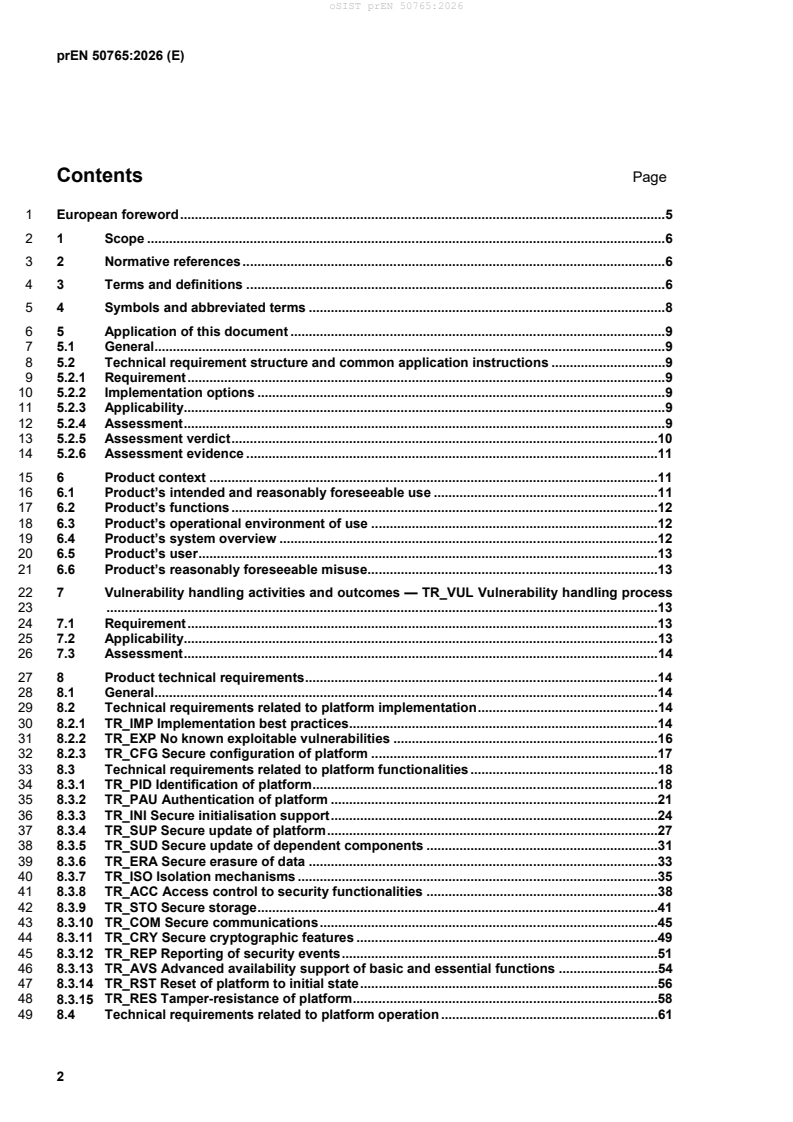
Contents
- 1 European foreword
- 2 1 Scope
- 3 2 Normative references
- 4 3 Terms and definitions
- 5 4 Symbols and abbreviated terms
- 6 5 Application of this document
- 7 5.1 General
- 8 5.2 Technical requirement structure and common application instructions
- 9 5.2.1 Requirement
- 10 5.2.2 Implementation options
- 11 5.2.3 Applicability
- 12 5.2.4 Assessment
- 13 5.2.5 Assessment verdict
- 14 5.2.6 Assessment evidence
- 15 6 Product context
- 16 6.1 Product’s intended and reasonably foreseeable use
- 17 6.2 Product’s functions
- 18 6.3 Product’s operational environment of use
- 19 6.4 Product’s system overview
- 20 6.5 Product’s user
- 21 6.6 Product’s reasonably foreseeable misuse
- 22 7 Vulnerability handling activities and outcomes — TR_VUL Vulnerability handling process 23
- 24 7.1 Requirement
- 25 7.2 Applicability
- 26 7.3 Assessment
- 27 8 Product technical requirements
- 28 8.1 General
- 29 8.2 Technical requirements related to platform implementation
- 30 8.2.1 TR_IMP Implementation best practices
- 31 8.2.2 TR_EXP No known exploitable vulnerabilities
- 32 8.2.3 TR_CFG Secure configuration of platform
- 33 8.3 Technical requirements related to platform functionalities
- 34 8.3.1 TR_PID Identification of platform
- 35 8.3.2 TR_PAU Authentication of platform
- 36 8.3.3 TR_INI Secure initialisation support
- 37 8.3.4 TR_SUP Secure update of platform
- 38 8.3.5 TR_SUD Secure update of dependent components
- 39 8.3.6 TR_ERA Secure erasure of data
- 40 8.3.7 TR_ISO Isolation mechanisms
- 41 8.3.8 TR_ACC Access control to security functionalities
- 42 8.3.9 TR_STO Secure storage
- 43 8.3.10 TR_COM Secure communications
- 44 8.3.11 TR_CRY Secure cryptographic features
- 45 8.3.12 TR_REP Reporting of security events
- 46 8.3.13 TR_AVS Advanced availability support of basic and essential functions
- 47 8.3.14 TR_RST Reset of platform to initial state
- 48 8.3.15 TR_RES Tamper-resistance of platform
- 49 8.4 Technical requirements related to platform operation
50 8.4.1 TR_SEG Application of platform security guidance ............................................................... 61 51 Annex A (informative) Security analysis ............................................................................................. 64 52 A.1 General ........................................................................................................................................ 64 53 A.2 Assets .......................................................................................................................................... 65 54 A.3 Security incidents ....................................................................................................................... 66 55 A.3.1 General ........................................................................................................................................ 66 56 A.3.2 PI_DUD Disclosure of user data ............................................................................................... 66 57 A.3.3 PI_MUD Manipulation of user data ........................................................................................... 66 58 A.3.4 PI_MBD Modification of the behaviour of the device ............................................................. 66 59 A.3.5 PI_MCD Malicious control of the device .................................................................................. 66 60 A.3.6 PI_UEB Unavailability of essential and basic functions of the device ................................. 66 61 A.3.7 PI_MDO Malicious use of the device against other devices or networks ............................ 66 62 A.3.8 Completeness of incidents identification ................................................................................ 66 63 A.4 Security problem definition ....................................................................................................... 67 64 A.4.1 General ........................................................................................................................................ 67 65 A.4.2 Threats ......................................................................................................................................... 67 66 A.4.3 Organizational security policies ............................................................................................... 68 67 A.4.4 Security assumptions ................................................................................................................ 68 68 A.4.5 Risks analysis coverage ............................................................................................................ 69 69 A.5 Security objectives ..................................................................................................................... 69 70 A.5.1 General ........................................................................................................................................ 69 71 A.5.2 Security objectives for the platform ......................................................................................... 69 72 A.5.3 Security objectives for the environment .................................................................................. 70 73 A.5.4 Security problem definition coverage ...................................................................................... 70 74 A.5.5 Security objectives coverage .................................................................................................... 71 75 A.6 Risk environments ..................................................................................................................... 73 76 A.6.1 General ........................................................................................................................................ 73 77 Annex B (informative) Platform categories and applicability overview ........................................... 74 78 Annex C (informative) Support of European security evaluation methodologies .......................... 77 79 C.1 General ........................................................................................................................................ 77 80 C.2 Compliance demonstration support ......................................................................................... 77 81 C.2.1 Assessment of applicability ...................................................................................................... 77 82 C.2.2 TR_IMP Implementation best practices ................................................................................... 77 83 C.2.3 TR_EXP No known exploitable vulnerabilities ........................................................................ 77 84 C.2.4 TR_CFG Secure configuration of platform .............................................................................. 77 85 C.2.5 TR_PID Identification of platform ............................................................................................. 77 86 C.2.6 TR_PAU Authenticity of platform ............................................................................................. 78 87 C.2.7 TR_INI Secure initialisation support ......................................................................................... 79 88 C.2.8 TR_SUP Secure update of platform .......................................................................................... 80 89 C.2.9 TR_SUD Secure update of dependent component .................................................................81 90 C.2.10 TR_ERA Secure erasure of data ...............................................................................................82 91 C.2.11 TR_ISO Isolation mechanisms ..................................................................................................83 92 C.2.12 TR_ACC Access control to security functionalities ...............................................................84 93 C.2.13 TR_STO Secure storage .............................................................................................................85 94 C.2.14 TR_COM Secure communication ..............................................................................................86 95 C.2.15 TR_CRY Secure cryptographic features ..................................................................................86 96 C.2.16 TR_REP Reporting of security events ......................................................................................87 97 C.2.17 TR_AVS Advanced availability support of basic and essential functions ...........................88 98 C.2.18 TR_RST Reset of platform to initial state .................................................................................89 99 C.2.19 TR_RES Tamper resistance of platform ...................................................................................90 100 C.2.20 TR_SEG Application of platform security guidance ...............................................................90 101 Annex ZZ (normative) Relationship between this European Standard and the essential 102 requirements of Regulation (EU) 2024/2847 aimed to be covered ........................................92 103 Bibliography .............................................................................................................................................95 104 European foreword 105 This document (prEN 50765:2026) has been prepared by CLC/TC 47X “Semiconductors and trusted chips 106 implementation” 107 This document is currently submitted to the Enquiry.
108 The following dates are proposed:
- latest date by which the existence of this (doa) dav + 6 months document has to be announced at national level
- latest date by which this document has to be (dop) dav + 12 months implemented at national level by publication of an identical national standard or by endorsement
- latest date by which the national standards (dow) dav + 36 months conflicting with this document have to be (to be confirmed or withdrawn modified when voting) 109 This document has been prepared under a standardization request addressed to CENELEC by the European 110 Commission. The Standing Committee of the EFTA States subsequently approves these requests for its 111 Member States.
112 For the relationship with EU Legislation, see informative Annex ZZ, which is an integral part of this document.
113 1 Scope 114 This document specifies the security assessment requirements for platforms that include microprocessors and 115 microcontrollers with security-related functionalities. These platforms aim to secure other 116 products/networks/services beyond the microprocessors and microcontrollers themselves and are intended to 117 provide assurance at a level AVA_VAN.1 as defined in [2], or without AVA_VAN claim.
118 2 Normative references 119 The following documents are referred to in the text in such a way that some or all of their content constitutes 120 requirements of this document. For dated references, only the edition cited applies. For undated references, the 121 latest edition of the referenced document (including any amendments) applies.
122 prEN 40000-1-3:2025, Cybersecurity requirements for products with digital elements — Vulnerability handling 123 3 Terms and definitions 124 For the purposes of this document, the terms and definitions given in prEN 40000-1-1:2025 and the following 125 apply.
126 ISO and IEC maintain terminology databases for use in standardization at the following addresses:
127 — ISO Online browsing platform: available at https://www.iso.org/obp/ 128 — IEC Electropedia: available at https://www.electropedia.org/ 129 3.1 130 access control 131 mechanism granting permission to a subject on an object 132 3.2 133 application 134 dependent component that provides a direct service to the end-user 135 3.3 136 asset 137 data, code or function that needs protection to prevent loss or disruption caused by a potential incident 138 3.4 139 best practices for cryptography 140 measures based on cryptographic techniques that have been shown to provide appropriate security for the 141 corresponding use case 142 3.5 143 dependent component 144 software or hardware component using a functionality of a platform and not providing any functionality to the 145 platform 146 3.6 147 device 148 composition of a platform and dependent components 149 3.7 150 end-user 151 user of the device 153 external entity 154 any entity in interaction with the platform 155 EXAMPLE Application, other dependent components or devices in physical or logical interaction with the platform 156 3.9 157 firmware 158 set of executable instructions which are optionally provided as a part of the platform and which can be immutable 159 and/or mutable 160 3.10 161 isolation mechanism 162 in a system separated in parts, security mechanism regulating the accesses to assets between those different 163 parts 164 3.11 165 physical attack 166 attack requiring the close presence of the attacker to the platform 167 3.12 168 platform 169 tangible element (or assembly of tangible elements) at a minimum composed of a microprocessor or 170 microcontroller implementing security functionalities 171 Note 1 to entry: Platforms can be non-application-specific.
172 3.13 173 platform code 174 code that is part of the implementation of the platform functionality 175 3.14 176 platform data 177 data handled by the platform i.e. user data, user code and platform manufacturer data 178 3.15 179 platform manufacturer data 180 data owned by the platform manufacturer handled by the platform 181 3.16 182 potential incident 183 specific event that could occur due to a threat exploiting a vulnerability 184 3.17 185 risk 186 result from the likelihood and magnitude of each threat 187 3.18 188 security functionality 189 functionality provided by the platform to the dependent component for the protection of assets (for example but 190 not limited to secure storage, cryptographic operations) 191 3.19 192 sensitive data 193 data that if compromised could harm the security functionalities of the platform or of the environment of the 194 platform 196 tamper-evidence 197 security property of a platform intended to ensure the detection of logical and/or physical attacks leading to 198 achievement of threats identified in the risk assessment 199 3.21 200 tamper-resistance 201 security property of a platform intended to prevent the successful exploitation of vulnerabilities by logical and/or 202 physical attacks leading to achievement of threats identified in the risk assessment 203 3.22 204 tamper-response 205 security property of a platform intended to provide the ability to react to the detection of logical and/or physical 206 attacks leading to achievement of threats identified in the risk assessment 207 3.23 208 threat 209 potential circumstance or cause that could lead to an incident on the product that results in loss or disruption 210 Note 1 to entry: Loss and disruption might happen amongst others on the product or its environment. 211 3.24 212 update package 213 bundle containing platform firmware and/or software code and/or data, potentially associated with metadata 214 3.25 215 user 216 platform user 217 generic term to designate any of the entities that will make use of the platform (including end-user) 218 3.26 219 user code 220 code implementing the dependent component 221 3.27 222 user data 223 data owned by (or associated to) the user handled by the platform 224 4 Symbols and abbreviated terms
CPU central processing unit
MCU microcontroller
MPU microprocessor
PI potential incident
SA security assumption
SOE security objectives for the platform environment
SOP security objectives for the platform
SP security policy
TR technical requirement 225 5 Application of this document 226 5.1 General 227 This document determines a set of technical requirements to be implemented by platforms based on a generic 228 security analysis detailed in Annex A, as well as the applicability conditions and assessment criteria for each of 229 the technical requirement.
230 In this document each technical requirement and associated information are presented in a dedicated clause 231 that follows a consistent structure. The next clause explains that structure and provide application instructions 232 common to all technical requirements where needed.
233 5.2 Technical requirement structure and common application instructions 234 5.2.1 Requirement 235 This subclause states the requirement to be implemented by the platform. It can cover one or several security 236 aspects.
237 5.2.2 Implementation options 238 This subclause lists the approved implementation options for fulfilling each security aspect of the requirement 239 clause.
240 5.2.3 Applicability 241 This subclause specifies the conditions under which the technical requirement applies.
242 Technical requirement applicability status is one of the followings:
243 — mandatory without exception; 244 — mandatory with authorized exceptions, subject to usage restrictions or delegation to other products; 245 — based on risk assessment in accordance with defined guidance.
246 In certain cases, individual security aspects of a requirement are subject to different applicability status. 247 5.2.4 Assessment 248 5.2.4.1 General 249 Each requirement is associated with assessment specifications structured according to the following 250 subclauses.
251 NOTE Each technical requirement ensures that all data it relies on to ensure security are always protected. For 252 example, if cryptographic keys or internal status flags are involved, their generation, import and/or storage is part of any 253 technical requirement relying on them. Therefore, the security assessment of each technical requirement also covers secure 254 handling at any time of all data involved in fulfilling the technical requirement.
255 5.2.4.2 Assessment objective 256 This assessment subclause identifies the security property or capability to verify, ensuring that the assessment 257 remains focused on the intent of the requirement.
258 5.2.4.3 Assessment preparation 259 This assessment subclause specifies the information and/or resources to be prepared and provided as input for 260 the assessment.
261 5.2.4.4 Assessment activities 262 5.2.4.4.1 General 263 This assessment subclause defines the assessment steps to be carried out, organized according to the following 264 subclauses.
265 Annex C provides the analysis how existing evaluation methodologies can be used to cover the following 266 assessment activities.
267 5.2.4.4.2 Input verification 268 This subclause specifies how to verify that the technical requirement is fulfilled based on input provided as part 269 of the assessment preparation.
270 5.2.4.4.3 Functional testing 271 This subclause specifies the functional tests to be performed to verify the full implementation of the requirement, 272 covering all security aspects.
273 The functional tests execution may be split between the developer and the assessor.
274 5.2.4.4.4 Resistance testing 275 This subclause defines the specific aspects of the resistance testing, such as:
276 — The attack scenario and relevant considerations to be applied; 277 — The implementation parts (e.g. mechanism, function, interface) to be targeted.
278 In accordance with those specific aspects, the resistance testing may apply the following common instructions:
279 — Consider the relevant attacks listed in [11] 5 (“Examples of attack methods”) and/or [12] 5 (“Examples of 280 attack methods”) as part of the analysis and/or alternative attack methods recognized relevant for specific 281 use cases or platform subcategories; 282 — Apply the attack potential level aligned with the applicable risk environment (see Clause A.6) using by 283 default the attack rating calculation defined in [11] 4 (“Identification of factors”) and/or [12] 4 (“Identification 284 of factors”), and/or another calculation recognized relevant for specific use cases or platform subcategories. 285 The penetration testing is based on the identification of areas of concern and prioritization of tests based on 286 vulnerability assessment.
287 5.2.5 Assessment verdict 288 This assessment subclause defines the conditions under which the assessment is considered valid. 289 For technical requirements where applicability is established, the verdict is PASS if:
290 — The input verification justifications are all satisfied; 291 — All applicable functional tests produce results consistent with the specified outputs; 292 — The resistance testing did not succeed in compromising the technical requirement.
293 For mandatory technical requirements where applicability exceptions are claimed, the verdict is PASS if required 294 corresponding security guidelines are addressed in 8.4.1.
295 In all cases, the verdict is FAIL if:
296 — An applicable technical requirement is not implemented; 297 — Any of the conditions for a PASS verdict are not fulfilled.
298 5.2.6 Assessment evidence 299 This assessment subclause defines the evidence that can be collected to demonstrate that the requirement has 300 been assessed and fulfilled.
301 Such evidence include, where applicable:
302 — test or assessment reports showing the steps performed and results obtained; 303 — logs, configuration files, or audit traces demonstrating the implementation of the requirement; 304 — screenshots, captures, or console outputs confirming the correct execution or protection behaviour. 305 6 Product context 306 6.1 Product’s intended and reasonably foreseeable use 307 In this document, products refer to microcontrollers and microprocessors, also known as platforms, that are 308 designed to be complemented with other components, software and/or hardware, to form a complete device. 309 They are intended to be used across a wide range of industries and applications, able to support multiple end 310 functions.
...