

EN 50136-2:2013/A1:2023
(Amendment)Alarm systems - Alarm transmission systems and equipment - Part 2: Requirements for Supervised Premises Transceiver (SPT)
General Information
- Abstract
This European Standard specifies the general equipment requirements for the performance, reliability, resilience, security and safety characteristics of supervised premises transceiver (SPT) installed in supervised premises and used in alarm transmission systems (ATS). A supervised premises transceiver can be a stand-alone device or an integrated part of an alarm system. These requirements also apply to SPT’s sharing means of interconnection, control, communication and power supplies with other applications. The alarm transmission system requirements and classifications are defined within EN 50136-1. Different types of alarm systems may in addition to alarm messages also send other types of messages, e.g. fault messages and status messages. The term alarm is used in this broad sense throughout the document. Additional requirements for the connection of specific types of alarm systems are given in the relevant European Standards. Because the SPT can be applied in different applications (e.g. I&HAS, fire and social alarm systems), requirements for the SPT, additional to those of this European Standard, may be specified in separate application specific documents. This European Standard specifies the requirements specific to alarm transmission. Application specific requirements for the connection of the SPT to specific types of alarm systems are given in the EN/TS 50131 series for I&HAS, and EN 54 series for fire. For other SPT applications, see the relevant National or European standards.
- Status
- Published
- Publication Date
- 16-Mar-2023
- Technical Committee
- CLC/TC 79 - Alarm systems
- Drafting Committee
- CLC/TC 79 - Alarm systems
- Current Stage
- 6060 - Document made available - Publishing
- Start Date
- 17-Mar-2023
- Due Date
- 15-Feb-2023
- Completion Date
- 17-Mar-2023

Overview
EN 50136-2:2013/A1:2023 (CLC) specifies requirements for Supervised Premises Transceiver (SPT) devices used in alarm transmission systems (ATS). The amendment A1 (2023) updates the original Part 2 (2013) to reflect current practice and correct errors. The standard covers functional, reliability, resilience, security and safety characteristics of SPTs whether they are stand‑alone devices or integrated into alarm systems. It also addresses SPTs that share interconnection, control, communication and power with other applications.
Key topics and technical requirements
- SPT classification and hierarchy - where SPTs are integrated with other alarm systems, the most demanding requirement prevails.
- Modes of operation - SPTs must secure received alarms (store in non‑volatile memory) and acknowledge receipt to the alarm system; alarms shall include accurate date/time stamps.
- Fault reporting and monitoring - requirements for reporting ATS faults to the alarm system (AS) and remote control/receiving centre (RCT); manufacturer must document fault‑reporting behavior and network interface monitoring (optional but recommended).
- Event logging and storage - non‑volatile event recording with minimum capacity (per table requirements) and protection when memory is shared with other applications.
- Interfaces to AS - two standard interface options provided for interoperability; testing covers serial, standardized parallel and proprietary interfaces.
- Software/firmware management - controlled upload/download with access level restrictions and resilience to network interruptions during updates.
- Performance verification - manufacturers must document methods to measure transmission time, reporting time and ATS availability per EN 50136‑1.
- Test and validation procedures - detailed test steps added/updated for access levels, parameter storage, firmware update, ATP failure detection (e.g., disconnecting network interfaces), parallel interface behavior, event logging, clock resolution and store‑and‑forward operation.
Applications and practical value
- Ensures reliable alarm delivery from supervised premises (commercial, residential, public buildings) to RCTs and monitoring centres.
- Supports interoperability between equipment vendors through standard interfaces and documented behaviors.
- Guides product design for manufacturers of SPT hardware/firmware, and informs system integrators and installers on expected operational and failure modes.
- Useful for testing laboratories and certification bodies to validate compliance and for building owners/operators to specify SPT performance in procurement.
Who should use this standard
- Alarm equipment manufacturers and firmware developers
- Security system integrators and installers
- Testing laboratories and conformity assessment bodies
- Monitoring/receiving centres (RCT) and service providers
- Specifiers for fire, intruder (I&HAS), social alarm and multi‑application building systems
Related standards
- EN 50136‑1 (ATS requirements and classifications) - referenced for transmission/reporting time and availability
- EN/TS 50131 series (I&HAS integration)
- EN 54 series (fire alarm system interfaces)
Keywords: EN 50136-2:2013/A1:2023, Supervised Premises Transceiver, SPT, alarm transmission system, ATS, CLC, event logging, ATP failure detection, alarm system interoperability.
Relations
- Effective Date
- 03-Feb-2026
- Effective Date
- 03-Feb-2026
- Effective Date
- 14-Jan-2020
Get Certified
Connect with accredited certification bodies for this standard

ANCE
Mexican certification and testing association.

CIS Institut d.o.o.
Personal Protective Equipment (PPE) certification body. Notified Body NB-2890 for EU Regulation 2016/425 PPE.

Intertek Slovenia
Intertek testing, inspection, and certification services in Slovenia.
Sponsored listings
Frequently Asked Questions
EN 50136-2:2013/A1:2023 is a amendment published by CLC. Its full title is "Alarm systems - Alarm transmission systems and equipment - Part 2: Requirements for Supervised Premises Transceiver (SPT)". This standard covers: This European Standard specifies the general equipment requirements for the performance, reliability, resilience, security and safety characteristics of supervised premises transceiver (SPT) installed in supervised premises and used in alarm transmission systems (ATS). A supervised premises transceiver can be a stand-alone device or an integrated part of an alarm system. These requirements also apply to SPT’s sharing means of interconnection, control, communication and power supplies with other applications. The alarm transmission system requirements and classifications are defined within EN 50136-1. Different types of alarm systems may in addition to alarm messages also send other types of messages, e.g. fault messages and status messages. The term alarm is used in this broad sense throughout the document. Additional requirements for the connection of specific types of alarm systems are given in the relevant European Standards. Because the SPT can be applied in different applications (e.g. I&HAS, fire and social alarm systems), requirements for the SPT, additional to those of this European Standard, may be specified in separate application specific documents. This European Standard specifies the requirements specific to alarm transmission. Application specific requirements for the connection of the SPT to specific types of alarm systems are given in the EN/TS 50131 series for I&HAS, and EN 54 series for fire. For other SPT applications, see the relevant National or European standards.
This European Standard specifies the general equipment requirements for the performance, reliability, resilience, security and safety characteristics of supervised premises transceiver (SPT) installed in supervised premises and used in alarm transmission systems (ATS). A supervised premises transceiver can be a stand-alone device or an integrated part of an alarm system. These requirements also apply to SPT’s sharing means of interconnection, control, communication and power supplies with other applications. The alarm transmission system requirements and classifications are defined within EN 50136-1. Different types of alarm systems may in addition to alarm messages also send other types of messages, e.g. fault messages and status messages. The term alarm is used in this broad sense throughout the document. Additional requirements for the connection of specific types of alarm systems are given in the relevant European Standards. Because the SPT can be applied in different applications (e.g. I&HAS, fire and social alarm systems), requirements for the SPT, additional to those of this European Standard, may be specified in separate application specific documents. This European Standard specifies the requirements specific to alarm transmission. Application specific requirements for the connection of the SPT to specific types of alarm systems are given in the EN/TS 50131 series for I&HAS, and EN 54 series for fire. For other SPT applications, see the relevant National or European standards.
EN 50136-2:2013/A1:2023 is classified under the following ICS (International Classification for Standards) categories: 13.320 - Alarm and warning systems; 33.040.40 - Data communication networks. The ICS classification helps identify the subject area and facilitates finding related standards.
EN 50136-2:2013/A1:2023 has the following relationships with other standards: It is inter standard links to EN 50600-2-5:2016, EN 50600-2-5:2021, EN 50136-2:2013. Understanding these relationships helps ensure you are using the most current and applicable version of the standard.
EN 50136-2:2013/A1:2023 is available in PDF format for immediate download after purchase. The document can be added to your cart and obtained through the secure checkout process. Digital delivery ensures instant access to the complete standard document.
Standards Content (Sample)
SLOVENSKI STANDARD
01-maj-2023
Alarmni sistemi - Sistemi in oprema za prenos alarma - 2. del: Zahteve za oddajno-
sprejemne naprave v nadzorovanih prostorih (SPT) - Dopolnilo A1
Alarm systems - Alarm transmission systems and equipment - Part 2: Requirements for
Supervised Premises Transceiver (SPT)
Alarmanlagen - Alarmübertragungsanlagen und -einrichtungen - Teil 2: Anforderungen
an Übertragungseinrichtungen (ÜE)
Systèmes d'alarme - Systèmes et équipements de transmission d'alarme - Partie 2:
Exigences pour les transmetteurs des locaux surveillés (SPT)
Ta slovenski standard je istoveten z: EN 50136-2:2013/A1:2023
ICS:
13.320 Alarmni in opozorilni sistemi Alarm and warning systems
33.040.40 Podatkovna komunikacijska Data communication
omrežja networks
2003-01.Slovenski inštitut za standardizacijo. Razmnoževanje celote ali delov tega standarda ni dovoljeno.
EUROPEAN STANDARD EN 50136-2:2013/A1
NORME EUROPÉENNE
EUROPÄISCHE NORM March 2023
ICS 13.320; 33.040.40
English Version
Alarm systems - Alarm transmission systems and equipment -
Part 2: Requirements for Supervised Premises Transceiver
(SPT)
Systèmes d'alarme - Systèmes et équipements de Alarmanlagen - Alarmübertragungsanlagen und -
transmission d'alarme - Partie 2: Exigences pour les einrichtungen - Teil 2: Anforderungen an
transmetteurs des locaux surveillés (SPT) Übertragungseinrichtungen (ÜE)
This amendment A1 modifies the European Standard EN 50136-2:2013; it was approved by CENELEC on 2023-02-13. CENELEC
members are bound to comply with the CEN/CENELEC Internal Regulations which stipulate the conditions for giving this amendment the
status of a national standard without any alteration.
Up-to-date lists and bibliographical references concerning such national standards may be obtained on application to the CEN-CENELEC
Management Centre or to any CENELEC member.
This amendment exists in three official versions (English, French, German). A version in any other language made by translation under the
responsibility of a CENELEC member into its own language and notified to the CEN-CENELEC Management Centre has the same status as
the official versions.
CENELEC members are the national electrotechnical committees of Austria, Belgium, Bulgaria, Croatia, Cyprus, the Czech Republic,
Denmark, Estonia, Finland, France, Germany, Greece, Hungary, Iceland, Ireland, Italy, Latvia, Lithuania, Luxembourg, Malta, the
Netherlands, Norway, Poland, Portugal, Republic of North Macedonia, Romania, Serbia, Slovakia, Slovenia, Spain, Sweden, Switzerland,
Türkiye and the United Kingdom.
European Committee for Electrotechnical Standardization
Comité Européen de Normalisation Electrotechnique
Europäisches Komitee für Elektrotechnische Normung
CEN-CENELEC Management Centre: Rue de la Science 23, B-1040 Brussels
© 2023 CENELEC All rights of exploitation in any form and by any means reserved worldwide for CENELEC Members.
Ref. No. EN 50136-2:2013/A1:2023 E
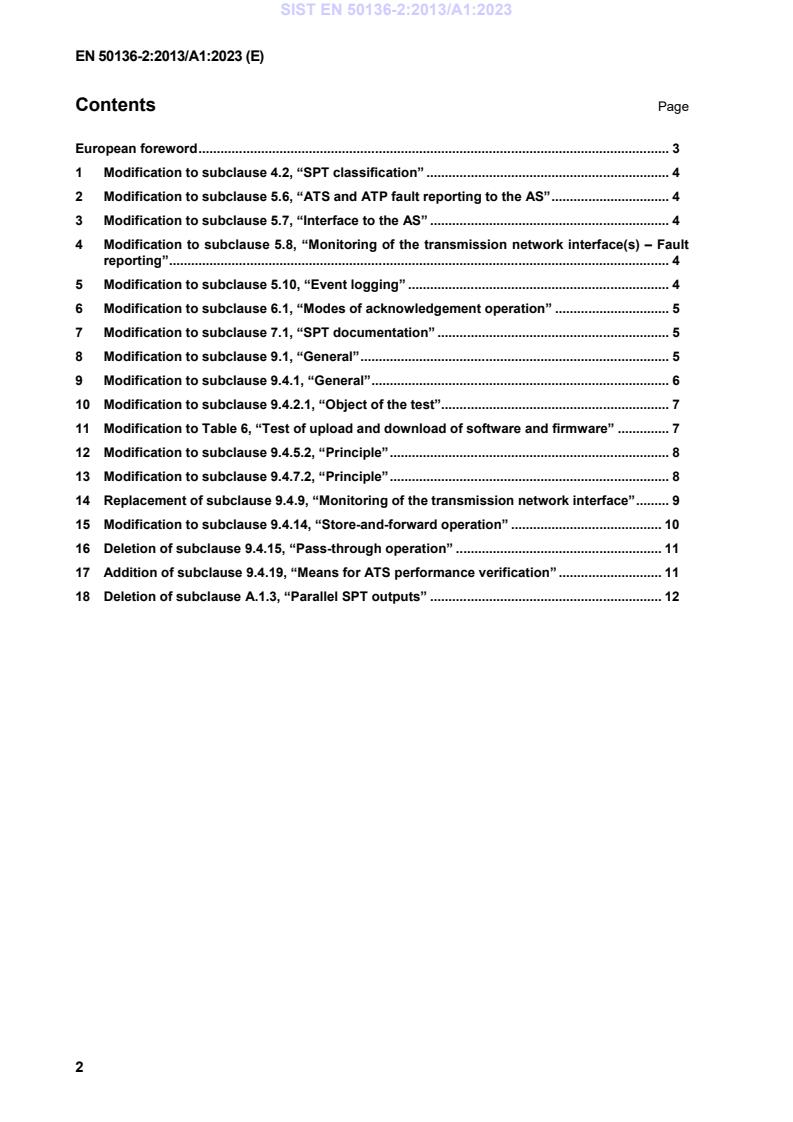
Contents Page
European foreword . 3
1 Modification to subclause 4.2, “SPT classification” . 4
2 Modification to subclause 5.6, “ATS and ATP fault reporting to the AS” . 4
3 Modification to subclause 5.7, “Interface to the AS” . 4
4 Modification to subclause 5.8, “Monitoring of the transmission network interface(s) – Fault
reporting” . 4
5 Modification to subclause 5.10, “Event logging” . 4
6 Modification to subclause 6.1, “Modes of acknowledgement operation” . 5
7 Modification to subclause 7.1, “SPT documentation” . 5
8 Modification to subclause 9.1, “General” . 5
9 Modification to subclause 9.4.1, “General” . 6
10 Modification to subclause 9.4.2.1, “Object of the test”. 7
11 Modification to Table 6, “Test of upload and download of software and firmware” . 7
12 Modification to subclause 9.4.5.2, “Principle” . 8
13 Modification to subclause 9.4.7.2, “Principle” . 8
14 Replacement of subclause 9.4.9, “Monitoring of the transmission network interface” . 9
15 Modification to subclause 9.4.14, “Store-and-forward operation” . 10
16 Deletion of subclause 9.4.15, “Pass-through operation” . 11
17 Addition of subclause 9.4.19, “Means for ATS performance verification” . 11
18 Deletion of subclause A.1.3, “Parallel SPT outputs” . 12
European foreword
This document (EN 50136-2:2013/A1:2023) has been prepared by CLC/TC 79 “Alarm systems”.
The following dates are fixed:
• latest date by which this document has to be (dop) 2024-02-13
implemented at national level by publication of
an identical national standard or by
endorsement
• latest date by which the national standards (dow) 2026-02-13
conflicting with this document have to be
withdrawn
Amendment 1 to EN 50136-2:2013 makes miscellaneous changes to correct errors and to better reflect the
current state of the art.
Attention is drawn to the possibility that some of the elements of this document may be the subject of patent
rights. CENELEC shall not be held responsible for identifying any or all such patent rights.
Any feedback and questions on this document should be directed to the users’ national committee. A complete
listing of these bodies can be found on the CENELEC website.
1 Modification to subclause 4.2, “SPT classification”
Delete the existing second paragraph and replace with the following text:
“When the SPT is used together with or integrated in associated alarm systems, in case of requirement conflict,
the most demanding requirement shall apply.”
2 Modification to subclause 5.6, “ATS and ATP fault reporting to the AS”
Rename the subclause as follows:
“5.6 ATS fault reporting to the AS”
Delete the paragraph and replace with the following text:
“Where the SPT is required to report an ATS failure to the AS as per EN 50136-1:2012, Table 5, this shall
take place within the reporting times of ‘failure of all ATPs at the same time’ shown in EN 50136-1:2012 ,
Table 3 (last row).
The manufacturer’s documentation should define the process for the reporting of ATS faults to the AS.”
3 Modification to subclause 5.7, “Interface to the AS”
Replace paragraph 3 with the following text:
“To allow compatibility of equipment from different manufacturers, this document provides two possible
standard interfaces”:
4 Modification to subclause 5.8, “Monitoring of the transmission network
interface(s) – Fault reporting”
Delete the existing text and replace with the following:
“If network interface monitoring and fault reporting to the AS and/or RCT is implemented, the manufacturer's
documentation shall describe how this is achieved.
NOTE Implementation of network interface monitoring and fault reporting is not mandatory. However, it can be useful
for the ATSP to help determine and analyse the cause of ATP failures.”
5 Modification to subclause 5.10, “Event logging”
Delete the existing fourth paragraph and replace with the following text:
“The means of recording events shall be non-volatile and have a capacity complying with the requirements of
Table 2. When the event recorder reaches maximum capacity, further events may cause the oldest events to
be erased. When the event log memory is shared with another application, the minimum requirements of
Table 2 shall be met for the SPT events and shall not be overwritten by any other application.”
Delete existing text between Table 1 and Table 2 and replace with the following text:
“Where the SPT and the AS are integrated into a single device they may share the same internal memory
provided that the minimum logging requirements for both SPT and AS are met.”
As amended by EN 50136-1:2012/A1:2018.
6 Modification to subclause 6.1, “Modes of acknowledgement operation”
Rename the subclause as follows:
“6.1 Mode of operation”
Delete the existing clause and replace by the following text:
“When an alarm is received by the SPT, the SPT shall secure the alarm and acknowledge the correct receipt
of the alarm to the AS.
The SPT shall deliver the alarm to the RCT according to the requirements of the ATS category selected.
All alarm messages shall include a date and time stamp that is accurate to the resolution specified in 5.10.
Securing the alarm shall be achieved by storing the alarm in the SPT’s non-volatile memory, this is to secure
alarms during a power failure or other ATS failure; stored alarms shall be transmitted when the fault condition
clears.
NOTE 1 The loss of an alarm message is regarded as a situation that is worse than sending a delayed message.
NOTE 2 If an ATS fault is detected after the SPT received and secured the alarm, this will be reported to both the AS
and the AMS in accordance with the requirements of EN 50136-1.”
Delete subclauses 6.1.1, 6.1.2 and 6.1.3.
Add the following subclause 6.5:
“6.5 Means of ATS performance verification
Where applicable for the ATS categories supported by the SPT, and where the SPT has integrated functions
to monitor the performance of the ATS, the manufacturer shall provide in his/her documentation a description
of how this is achieved.
The manufacturer documentation shall describe the means to achieve the following performance
measurements:
— transmission time (EN 50136-1:2012 , Table 2),
— reporting time (EN 50136-1:2012 , Table 3),
— ATS Availability (EN 50136-1:2012 , Table 6).”
7 Modification to subclause 7.1, “SPT documentation”
Add the following item to the list of SPT documentation items:
“
— Description of test to verify the ATS performance to achieve compliance with EN 50136-1:2012 , Table 2,
Table 3 and Table 6.”
8 Modification to subclause 9.1, “General”
Delete the existing paragraph and replace with the following text:
“9.1 General
The manufacturer shall provide a fully functional test setup. Other ATS components such as AS, network and
the RCT may be provided as simulating equipment and/or network(s).
Where an RCT (or simulated RCT) is required for the tests, it shall be capable of meeting the requirements of
EN 50136-1.
The tests shall be reproducible and deliver the same results when carrying out the same test procedure.”
9 Modification to subclause 9.4.1, “General”
Replace Table 4 with the following:
“
Table 4 — Summary of functional tests
Subclause Requirement to test Test/validation objective Validate or test
Demonstrate that all access levels
5.2 Access levels Test (9.4.2)
exist
Demonstrate that storage is immune
5.5 Parameter storage Test (9.4.4)
to power failure
Demonstrate that the SPT will
Uploading and downloading of
5.4 recover after an unsuccessful Test (9.4.3)
software and firmware
firmware upload/download
ATS and ATP fault reporting to
5.6 Demonstrate function Test (9.4.5)
the AS
To demonstrate that any available
Interface to AS (serial) interface shall comply with SPT Validate (9.4.6)
manufacturer's documentation
To demonstrate that the SPT
5.7 Interface to AS (parallel) Test (9.4.7)
interface shall comply with Annex A
To demonstrate that any available
Interface to AS (proprietary) interface shall comply with SPT Validate (9.4.8)
manufacturer's documentation
Monitoring of the transmission
5.8 To demonstrate function Test (9.4.9)
network interface
To demonstrate compliance against
Protection of the log Validate (9.4.11)
manufacturer's documentation
To demonstrate the capacity to store
Log capacity – Table 2 at least an equal quantity of events Test (9.4.12)
as illustrated in Table 2
5.10
To demonstrate that the clock
Clock resolution Test (9.4.13)
remains accurate in line with 5.10
To demonstrate compliance with
Event logging– Table 1 Test (9.4.10)
Table 2
To demonstrate that the SPT secures
6.1 Mode of operation alarm messages and meets the Test (9.4.14)
requirements of 6.1
To demonstrate tha
...