

EN IEC 61936-1:2021/A11:2025
(Amendment)Power installations exceeding 1 kV AC and 1,5 kV DC - Part 1: AC
General Information
- Abstract
European common modification to EN 61936-1
- Status
- Published
- Publication Date
- 18-Dec-2025
- Technical Committee
- CLC/TC 99X - Power installations exceeding 1 kV a.c. (1,5 kV d.c.)
- Drafting Committee
- CLC/TC 99X - Power installations exceeding 1 kV a.c. (1,5 kV d.c.)
- Current Stage
- 6060 - Document made available - Publishing
- Start Date
- 19-Dec-2025
- Due Date
- 17-Dec-2025
- Completion Date
- 19-Dec-2025

Overview
EN IEC 61936-1:2021/A11:2025 is a CENELEC European amendment to EN IEC 61936-1 that clarifies and adapts requirements for power installations exceeding 1 kV AC and 1.5 kV DC (Part 1: AC). The amendment updates normative references, adds notes on terms and safety, aligns earthing and touch-voltage guidance with EN 50522 for CENELEC, and introduces national-specific provisions (Annex ZA) and national deviations (Annex ZB).
Key topics and requirements
- Normative references: EN 50522 (earthing of power installations >1 kV AC) is explicitly added for CENELEC application.
- Terms & definitions: Adds a note pointing to EN 50110-1/EN 50110-2 for an additional definition of the danger zone (DL).
- Fundamental requirements: Notes added to reference:
- Directive 2013/35/EU (electromagnetic field limits)
- EN 50160 (voltage characteristics)
- EN 50341 and EN 50423 (relevant overhead line and cable considerations)
- Safety measures: Adds cross-reference to EU Regulation No 517/2014 on fluorinated greenhouse gases where applicable.
- Earthing systems and touch voltages:
- EN 50522 requirements shall be taken into account for CENELEC.
- For CENELEC, the IEEE 80 curve (Annex C) is informative only; the permissible touch-voltage curve in Figure 12 is the required reference (explicitly enforced in some countries such as Austria and Germany).
- Annex D (earthing design flow chart) and Annex C are informative for CENELEC.
- Safe working: Notes added to Annex F referencing EN 50110 series for danger/vicinity zone regulations.
- National provisions:
- Annex ZA (normative where applicable) lists special national conditions (examples include minimum fence heights, barrier heights, cable burial depths and minimum clearances for specific countries).
- Annex ZB (informative) lists A-deviations where national law or regulation supersedes the EN.
Applications and users
This amendment is essential for:
- Power system engineers and HV designers - implementing earthing, clearances, and touch-voltage mitigation in substations and lines.
- Safety managers and site contractors - ensuring safe working zones, barriers, and compliance with national requirements.
- Grid operators and asset owners - adopting earthing and protection measures consistent with EN 50522 and national deviations.
- Standards committees and regulators - harmonizing European requirements with national legal frameworks.
Related standards (mentioned)
- EN IEC 61936-1 (base document)
- EN 50522 (earthing)
- EN 50110-1 / EN 50110-2 (safe working / danger zone)
- EN 50160, EN 50341, EN 50423
- IEEE 80 (informative for CENELEC)
- National standards cited (e.g., French NF C series) where national law applies
Keywords: EN IEC 61936-1 amendment, high voltage installations, earthing systems, touch voltage, CENELEC, safety measures, national deviations, power installations exceeding 1 kV.
Relations
- Effective Date
- 03-Feb-2026
- Effective Date
- 20-Sep-2022
Get Certified
Connect with accredited certification bodies for this standard

IMQ S.p.A. (Certification)
Italian electrical product certification.

SLG Prüf- und Zertifizierungs GmbH
German testing and certification body.

UL Solutions
Global safety science company with testing, inspection and certification.
Sponsored listings
Frequently Asked Questions
EN IEC 61936-1:2021/A11:2025 is a amendment published by CLC. Its full title is "Power installations exceeding 1 kV AC and 1,5 kV DC - Part 1: AC". This standard covers: European common modification to EN 61936-1
European common modification to EN 61936-1
EN IEC 61936-1:2021/A11:2025 is classified under the following ICS (International Classification for Standards) categories: 29.020 - Electrical engineering in general; 29.080.01 - Electrical insulation in general. The ICS classification helps identify the subject area and facilitates finding related standards.
EN IEC 61936-1:2021/A11:2025 has the following relationships with other standards: It is inter standard links to EN 50522:2022, EN IEC 61936-1:2021. Understanding these relationships helps ensure you are using the most current and applicable version of the standard.
EN IEC 61936-1:2021/A11:2025 is available in PDF format for immediate download after purchase. The document can be added to your cart and obtained through the secure checkout process. Digital delivery ensures instant access to the complete standard document.
Standards Content (Sample)
SLOVENSKI STANDARD
01-februar-2026
Elektroenergetski postroji za izmenične napetosti nad 1 kV in enosmerne
napetosti nad 1,5 kV - 1. del: Izmenična napetost - Dopolnilo A11
Power installations exceeding 1 kV AC and 1,5 kV DC - Part 1: AC
Starkstromanlagen mit Nennwechselspannungen über 1 kV AC und 1,5 kV DC - Teil 1:
Wechselstrom
Installations électriques de puissance de tension supérieure à 1 kV en courant alternatif
et 1,5 kV en courant continu - Partie 1: Courant alternatif
Ta slovenski standard je istoveten z: EN IEC 61936-1:2021/A11:2025
ICS:
29.240.01 Omrežja za prenos in Power transmission and
distribucijo električne energije distribution networks in
na splošno general
2003-01.Slovenski inštitut za standardizacijo. Razmnoževanje celote ali delov tega standarda ni dovoljeno.
EUROPEAN STANDARD EN IEC 61936-1:2021/A11
NORME EUROPÉENNE
EUROPÄISCHE NORM December 2025
ICS 29.080.01; 29.020
English Version
Power installations exceeding 1 kV AC and 1,5 kV DC - Part 1:
AC
Installations électriques de puissance de tension supérieure Starkstromanlagen mit Nennwechselspannungen über 1 kV
à 1 kV en courant alternatif et 1,5 kV en courant continu - AC und 1,5 kV DC - Teil 1: Wechselstrom
Partie 1: Courant alternatif
This amendment A11 modifies the European Standard EN IEC 61936-1:2021; it was approved by CENELEC on 2025-12-01. CENELEC
members are bound to comply with the CEN/CENELEC Internal Regulations which stipulate the conditions for giving this amendment the
status of a national standard without any alteration.
Up-to-date lists and bibliographical references concerning such national standards may be obtained on application to the CEN-CENELEC
Management Centre or to any CENELEC member.
This amendment exists in three official versions (English, French, German). A version in any other language made by translation under the
responsibility of a CENELEC member into its own language and notified to the CEN-CENELEC Management Centre has the same status as
the official versions.
CENELEC members are the national electrotechnical committees of Austria, Belgium, Bulgaria, Croatia, Cyprus, the Czech Republic,
Denmark, Estonia, Finland, France, Germany, Greece, Hungary, Iceland, Ireland, Italy, Latvia, Lithuania, Luxembourg, Malta, the
Netherlands, Norway, Poland, Portugal, Republic of North Macedonia, Romania, Serbia, Slovakia, Slovenia, Spain, Sweden, Switzerland,
Türkiye and the United Kingdom.
European Committee for Electrotechnical Standardization
Comité Européen de Normalisation Electrotechnique
Europäisches Komitee für Elektrotechnische Normung
CEN-CENELEC Management Centre: Rue de la Science 23, B-1040 Brussels
© 2025 CENELEC All rights of exploitation in any form and by any means reserved worldwide for CENELEC Members.
Ref. No. EN IEC 61936-1:2021/A11:2025 E
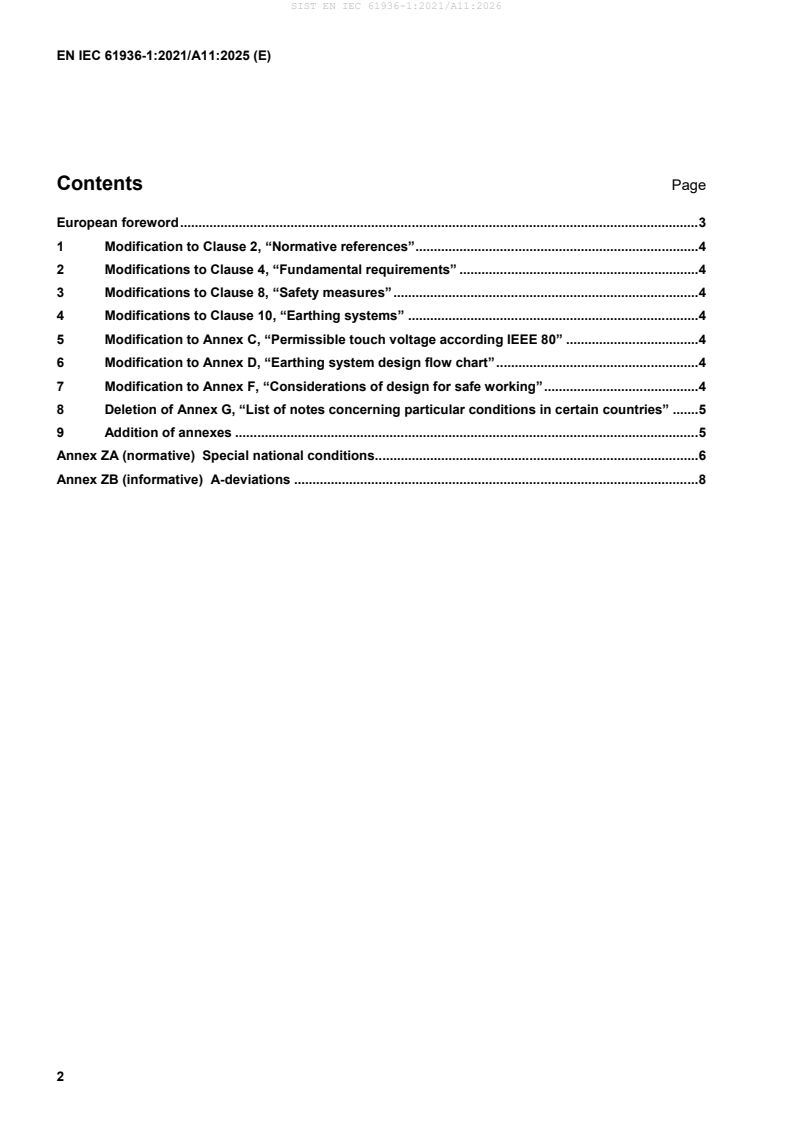
Contents Page
European foreword . 3
1 Modification to Clause 2, “Normative references” . 4
2 Modifications to Clause 4, “Fundamental requirements” . 4
3 Modifications to Clause 8, “Safety measures” . 4
4 Modifications to Clause 10, “Earthing systems” . 4
5 Modification to Annex C, “Permissible touch voltage according IEEE 80” . 4
6 Modification to Annex D, “Earthing system design flow chart” . 4
7 Modification to Annex F, “Considerations of design for safe working” . 4
8 Deletion of Annex G, “List of notes concerning particular conditions in certain countries” . 5
9 Addition of annexes . 5
Annex ZA (normative) Special national conditions. 6
Annex ZB (informative) A-deviations . 8
European foreword
This document (EN IEC 61936-1:2021/A11:2025) has been prepared by CLC/TC 99X “Power installations
exceeding 1 kV a.c. (1,5 kV d.c.)”.
The following dates are fixed:
• latest date by which this document has to be (dop) 2026-12-31
implemented at national level by publication of
an identical national standard or by
endorsement
• latest date by which the national standards (dow) 2028-12-31
conflicting with this document have to be
withdrawn
Attention is drawn to the possibility that some of the elements of this document may be the subject of patent
rights. CENELEC shall not be held responsible for identifying any or all such patent rights.
Any feedback and questions on this document should be directed to the users’ national committee. A
complete listing of these bodies can be found on the CENELEC website.
1 Modification to Clause 2, “Normative references”
Add the following reference:
EN 50522, Earthing of power installations exceeding 1 kV a.c.
2 Modifications to Clause 4, “Fundamental requirements”
In 4.2.7, replace the note with the following:
“
NOTE Directive 2013/35/EU and its national implementations specify the acceptable limits of electromagnetic fields
during work.”
In 4.2.10, change “NOTE” to “NOTE 1” and add:
“
NOTE 2 For more information consult EN 50160.”
In 4.3.10, add:
“
NOTE For more information consult the EN 50341 series.”
3 Modifications to Clause 8, “Safety measures”
In 8.8.2, replace “NOTE” with “NOTE 1”, and add:
“
NOTE 2 See also Regulation (EU) 2024/573 of the European Parliament and of the Council of 7 February 2024 on
fluorinated greenhouse gases.”
4 Modifications to Clause 10, “Earthing systems”
In 10.1, add:
“For CENELEC the requirements of EN 50522 shall be taken into account.”
In 10.2.1, replace the third last paragraph with the following:
“Details for permissible touch voltages are given in EN 50522. Annex C shows the IEEE 80 curve which shall
not be used as an alternative to the curve in Figure 12. For CENELEC Annex C is only informative.”
In 10.3.1, add to the third last paragraph:
“For CENELEC Annex D is informative.”
5 Modification to Annex C, “Permissible touch voltage according IEEE 80”
Replace the indication “normative” with “informative”.
6 Modification to Annex D, “Earthing system design flow chart”
Replace the indication “normative” with “informative”.
7 Modification to Annex F, “Considerations of design for safe working”
Add the following figure note to Figure F.1:
“
NOTE The term “minimum clearance of danger zone” is not defined in EN 50110-1. EN 50110-1 defines an
equivalent zone as "live working zone". Clearances for “live working zone” D and for the “vicinity zone” D are given in
L V
Table 1 of EN 50110-1. Further information on the relevant national specifications in each CENELEC country can also be
found in EN 50110-2.
8 Deletion of Annex G, “List of notes concerning particular conditions in certain
countries”
Delete Annex G.
9 Addition of annexes
Add the following Annexes ZA and ZB.
“
Annex ZA
(normative)
Special national conditions
Special national condition: National characteristic or practice that cannot be changed even over a long
period, e. g. climatic conditions, electrical earthing conditions.
NOTE If it affects harmonization, it forms part of the European Standard.
For the countries in which the relevant special national conditions apply these provisions are normative, for
other countries they are informative.
Clause Special national condition
4.2.4 Austria
Values of rated duration of the short-circuit less than 1 s does not apply for electrical power
installations design, construction, and erection.
4.3.2 Finland
The combinations used in Finland are for example:
— – 40 °C without ice and without wind;
— – 0 °C with ice and without wind;
— – 20 °C with wind.
For special projects even value – 50 °C without ice and without wind could be needed.
4.4.2.2 a) Finland
In Finland even class – 50 °C could be needed.
4.4.2.2 g) Ireland
In IE North Atlantic Maritime climatic conditions as per I.S. EN 50341 apply.
6.2.9.6 Iceland
Minimum depth of a buried cable is 0,7 m.
7.2.2 Finland
Barriers for outdoor installations shall have a minimum height of 2 000 mm. They shall fulfil the
same requirements as the external fence. The minimum height of live parts behind a barrier
shall be N + 300 mm with a minimum of 800 mm.
7.2.5 Finland
The height H for outdoor installations shall be at least H = N + 2 600 mm with a minimum of 2
800 mm.
7.2.5 Sweden
The height H for outdoor installations shall be at least H = N + 2 500 mm, with a minimum of 3
000 mm.
7.2.7 Finland
The height of the external fence shall be at least 2 000 mm. The local conditions of snow shall
be taken into account.
7.2.7 Iceland
Minimum height of the external fence is 2 500 mm.
7.5.4 Sweden
Gangways longer than 10 m shall be accessible from both ends. Indoor closed restricted access
areas with length exceeding 20 m shall be accessible by doors from both ends.
7.7 Iceland
Minimum height H' of live parts above accessible surfaces to the general public shall be H' = 5
500 mm for rated voltages U up to 52 kV.
m
7.7 Finland
The minimum height H’ of live parts above surfaces accessible to the general public shall be:
— H’ = 5 500 mm for rated voltages U up to 24 kV;
m
— H’ = N + 5 300 mm (minimum 6 000 mm) for rated voltages U above 24 kV.
m
9.1 Finland
Back-up protection for earth fault protection shall be provided according to the national code for
high-voltage electrical installations.
10.3.1 Austria
In Austria, the design is also complete if UE is less than 2xUTp and the requirements of Table 6
are met. Furthermore, the design is also complete if UE is less than 4xUTp with specified
measures M applied and the requirements of Table 6 are met.
Therefore the flowchart of the design process in Annex D is not applicable.
12 Finland
In Finland only emergency phone number is required.
Annex ZB
(informative)
A-deviations
A-deviation: National deviation due to regulations, the alteration of which is for the time being outside the
competence of the CENELEC national member.
This European Standard does not fall under any Directive/Regulation of the EU.
In the relevant CEN and/or CENELEC countries, these A-deviations are valid instead of the respective
provisions of the European Standard until the national situation causing the A-deviation has changed.
Clause Special national condition
General France
In France many laws and decrees are mandatory for the design, the construction, the verification,
and the control of HV installations.
The application of the French safety and legal requirements, mainly driven by the ministry of
industry (e.g. arrêté du 17 mai 2001), the ministry of labor (Décrets n° 2010-1017 du 30 août
2010 et 2010-1118 du 22 septembre 2010) and the Technical Reference Documents (DTR) for
HV and MV public networks is mandatory in France and they cannot by superseded by the EN,
which is providing only general rules.
The additional rules to be compliant with the French legal requirements are covered by three
national standards NF C 13-100, NF C 13-200 and NF C 11-201.
EN IEC 61936-1 cannot be used in France as a contracting basis between various players
involved in HV installation, since there can be discrepancies with mandatary regulations.
Mandatory rules of conception and installation:
— rules for HV substations interfacing private installation to public grid;
— rules for structural design of HV installations;
— rules concerning neutral systems;
— rules concerning design and construction of a global earthing system;
— rules concerning the protection against direct and indirect contact;
— rules concerning the protection against fire and explosion;
— rules concerning operation on HV installations;
— rules dedicated to the protection against over voltages, under voltages, temporary loss of
supply, harmonics;
— rules concerning protection against the noise;
— rules dedicated to HV cables sizing;
— rules for selection, installation and protection of generators, motors and transformers;
— rules for electrical energy measurement according to requirements of grid operators;
— dedicated rules to the data to be exchanged with the grid operator system and associated
communication equipment;
— rules for verification and control of HV installations;
— rules for classification of environmental conditions.
Main A-deviations: see appropriate (sub)clause number.
General Spain
In Spain many laws and regulations are mandatory for the design and the erection of high voltage
electrical power installations.
The main additional rules and deviations from EN IEC 61936-1 are covered by the following
Royal Decrees:
— Royal Decree (RD) 337/2014, of 9 May 2014, approving the regulation of technical and
safety conditions for high-voltage power installations and its supplementary technical
instructions ITC-RAT 01 to 23.
— Royal Decree (RD) 223/2008, of 15 February 2008, approving the regulation of technical and
safety conditions for high-voltage electrical lines and its supplementary technical instructions
ITC-LAT 01 to 09.
— Royal Decree (RD) 614/2001, of 8 June 2001, establishing the minimum health and safety
requirements for the protection of workers against electrical risk.
4.2.4 Norway
(Regulation on electrical network and with guide to the regulation. FEF 2006 § 4-3)
One phase to earth fault shall be disconnected as fast as possible and within:
Solid earthed net: 8 s
Resistance earthed net: 30 s
Isolated neutral and resonant earthed net:
Overhead line and mixed cable/aerial network with distribution transformer: 10 s
Overhead line and mixed cable/aerial network without distribution transformer: 120 min
Cable grid (without aerial conductor) with global earthing: 240 min
Net shall be monitored continuously, and the process to find and disconnect the earth fault shall
be activated immediately.
4.2.7 Norway
(Regulation on electrical network and with guide to the regulation. FEF 2006 § 2-9)
In private houses, kindergartens and schools maximum 0,4 μT.
4.3.7 France
Short-circuit mechanical stresses are not taken into account for the design of foundations in
France. They are considered to be second order effects and covered by other stress limit.
4.5.2 France
According to the French regulation (arrêté technique du 17 mai 2001 – Article 12), in France the
noise level is defined and measured in conformity with the French national standard NF S 31-010.
Clause 5 Norway
(Regulation on electrical network and with guide to the regulation. FEF 2006 § 4-2)
Insulated and coil earthed cable and overhead line network with voltage less or equal to 24 kV
shall have a minimum transition resistance towards earth. If the resistance is less then this value,
operator shall be warned automatically, alternatively the installation can be disconnected.
The values are:
— Cable grid minimum 1 000 Ω;
— Overhead line network and mixed network minimum 3 000 Ω.
5.4.1 Denmark
Clearances indicated in Table 2 are not allowed by national regulation for operation of electrical
installations exceeding 1kV AC. See also description of clearance in clause 7.1.1.
5.4.1 France
According to French regulation, the minimum clearances distances in air of Tables 2 an
...