


EN 60051-9:1989
(Main)Direct acting indicating analogue electrical-measuring instruments and their accessories - Part 9: Recommended test methods
General Information
- Abstract
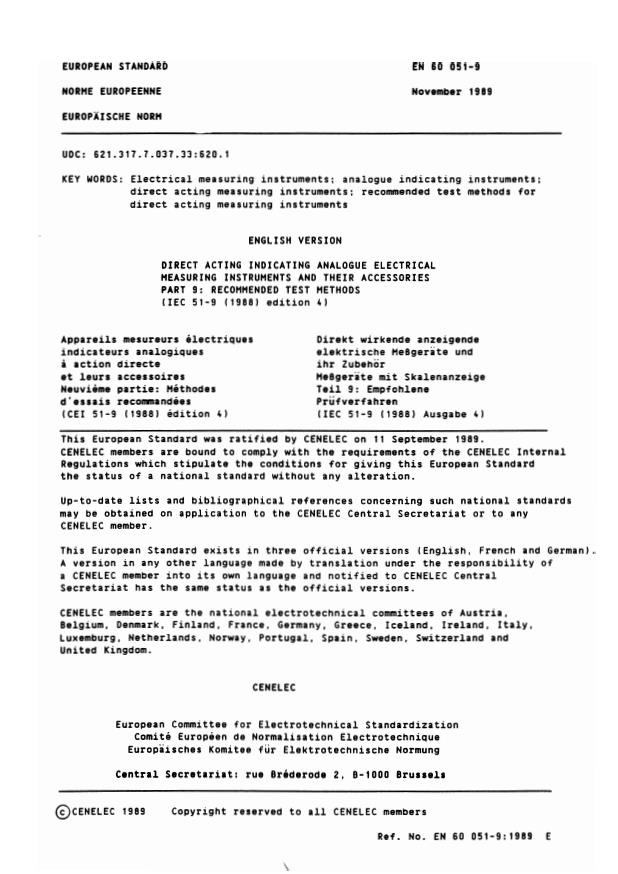
Gives test methods for direct acting indicating analogue electrical measuring instruments and their accessories, but no requirements since these are contained in EN 60051-1 to EN 60051-8.
- Status
- Withdrawn
- Publication Date
- 28-Nov-1989
- Withdrawal Date
- 31-Aug-1990
- Drafting Committee
- IEC/TC 85 - IEC_TC_85
- Parallel Committee
- IEC/TC 85 - IEC_TC_85
- Current Stage
- 9960 - Withdrawal effective - Withdrawal
- Start Date
- 30-Apr-2024
- Completion Date
- 30-Apr-2024
- Directive
- Not Harmonized2006/95/EC - Directive 2006/95/EC of the European Parliament and of the Council of 12 December 2006 on the harmonisation of the laws of Member States relating to electrical equipment designed for use within certain voltage limits (codified version)OJ Ref: C 71/, C 71/17, C 348/03 OJ Date: 28-Nov-2013
Harmonized Standard2014/35/EU - Directive 2014/35/EU of the European Parliament and of the Council of 26 February 2014 on the harmonisation of the laws of the Member States relating to the making available on the market of electrical equipment designed for use within certain voltage limitsOJ Ref: C 249/03 OJ Date: 08-Jul-2016
Not Harmonized73/23/EEC - Electrical equipment designed for use within certain voltage limitsOJ Ref: C 208

Relations
- Effective Date
- 07-Jun-2022
- Effective Date
- 03-Feb-2026
- Referred By
EN IEC 62928:2018 - Railway applications - Rolling stock - Onboard lithium-ion traction batteries - Effective Date
- 03-Feb-2026
- Effective Date
- 03-Feb-2026
- Effective Date
- 03-Feb-2026
- Effective Date
- 03-Feb-2026
- Effective Date
- 03-Feb-2026
- Effective Date
- 03-Feb-2026
- Effective Date
- 03-Feb-2026
- Effective Date
- 03-Feb-2026
- Effective Date
- 03-Feb-2026
- Effective Date
- 03-Feb-2026
- Effective Date
- 03-Feb-2026
- Effective Date
- 03-Feb-2026
- Effective Date
- 03-Feb-2026
Get Certified
Connect with accredited certification bodies for this standard

BSMI (Bureau of Standards, Metrology and Inspection)
Taiwan's standards and inspection authority.
Sponsored listings
Frequently Asked Questions
EN 60051-9:1989 is a standard published by CLC. Its full title is "Direct acting indicating analogue electrical-measuring instruments and their accessories - Part 9: Recommended test methods". This standard covers: Gives test methods for direct acting indicating analogue electrical measuring instruments and their accessories, but no requirements since these are contained in EN 60051-1 to EN 60051-8.
Gives test methods for direct acting indicating analogue electrical measuring instruments and their accessories, but no requirements since these are contained in EN 60051-1 to EN 60051-8.
EN 60051-9:1989 is classified under the following ICS (International Classification for Standards) categories: 17.220.20 - Measurement of electrical and magnetic quantities. The ICS classification helps identify the subject area and facilitates finding related standards.
EN 60051-9:1989 has the following relationships with other standards: It is inter standard links to EN IEC 60051-9:2021, prEN IEC 62973-4:2025, EN IEC 62928:2018, EN 50171:2021, EN IEC 60034-4-1:2018, EN 60898-1:2019, EN 62282-3-200:2012, EN IEC 60034-2-1:2024, EN 61009-1:2012, EN 61143-1:1994, prEN IEC 62973-2:2025, EN IEC 62282-3-200:2025, EN 62282-3-200:2016, EN 60051-1:1998, EN 61008-1:2012. Understanding these relationships helps ensure you are using the most current and applicable version of the standard.
EN 60051-9:1989 is associated with the following European legislation: EU Directives/Regulations: 2006/95/EC, 2014/35/EU, 2014/53/EU, 73/23/EEC. When a standard is cited in the Official Journal of the European Union, products manufactured in conformity with it benefit from a presumption of conformity with the essential requirements of the corresponding EU directive or regulation.
EN 60051-9:1989 is available in PDF format for immediate download after purchase. The document can be added to your cart and obtained through the secure checkout process. Digital delivery ensures instant access to the complete standard document.
Standards Content (Sample)
SLOVENSKI SIST EN 60051-9:1995
prva izdaja
STANDARD
avg 1995
Neposredni kazalni analogni električni merilni instrumenti in njihov pribor –
9. del: Priporočene preskusne metode (IEC 60051-9:1988)
Direct acting indicating analogue electrical measuring instruments and their
accessories - Part 9: Recommended test methods (IEC 51-9:1988)
ICS 17.220.20 Referenčna številka
© Standard je založil in izdal Slovenski inštitut za standardizacijo. Razmnoževanje ali kopiranje celote ali delov tega dokumenta ni dovoljeno
NORME CEI
IEC
INTERNATIONALE
51-9
INTERNATIONAL
Quatrième édition
STANDARD
Fourth edition
Appareils mesureurs électriques
indicateurs analogiques à action directe
et leurs accessoires
Neuvième partie:
Méthodes d'essai recommandées
Direct acting indicating analogue
electrical measuring instruments
and their accessories
Part 9:
Recommended test methods
de reproduction réservés — Copyright — all rights reserved
© CEI 1988 Droits
No part of this publication may be reproduced or utilized in
Aucune partie de cette publication ne peut être reproduite ni
any form or by any means, electronic or mechanical,
utilisée sous quelque forme que ce soit et par aucun pro-
including photocopying and microfilm, without permission
cédé, électronique ou mécanique, y compris la photocopie et
in writing from the publisher.
les microfilms. sans l'accord écrit de l'éditeur.
Bureau Central de la Commission Electrotechnique Internationale 3, rue de Varembé Genève, Suisse
CODE PRIX
Commission Electrotechnique Internationale
International Electrotechnical Commission
PRICE CODE
MemayrapoAHaa 3neKTporexH114ecnaa i'ioMHCCHA
E
Pour prix, voir catalogue en vigueur •
For price, see current catalogue
51-9 (4) © IEC - 3
CONTENTS
Page
FOREWORD 5
PREFACE 5
Clause
1. Scope and general test conditions 9
2. Intrinsic error tests 17
3. Variation tests 33
4. Other tests
5. Index of tests and test conditions 129
51-9 (4) © [EC - 5
INTERNATIONAL ELECTROTECHNICAL COMMISSION
DIRECT ACTING INDICATING ANALOGUE ELECTRICAL MEASURING
INSTRUMENTS AND THEIR ACCESSORIES
Part 9: Recommended test methods
FOREWORD
The formal decisions or agreements of the IEC on technical matters, prepared by Technical
1)
Committees on which all the National Committees having a special interest therein are
represented, express, as nearly as possible, an international consensus of opinion on the
subjects dealt with.
They have the form of recommendations for international use and they are accepted by the
2)
National Committees in that sense.
expresses the wish that all
3) In order to promote international unification, the IEC
National Committees should adopt the text of the IEC recommendation for their national
rules in so far as national conditions will permit. Any divergence between the IEC recom-
mendation and the corresponding national rules should, as far as possible, be clearly
indicated in the latter.
PREFACE
This standard has been prepared by IEC ,Technical Committee No. 85:
Measuring equipment for basic electrical quantities (former Sub-
Committee 13B: Electrical measuring instruments).
This fourth edition replaces the third edition of IEC Publication 51.
This standard constitutes Part 9.
The general layout for the revised Publication 51 is as follows:
Definitions and general requirements common to all parts.
Part 1:
Special requirements for ammeters and voltmeters.
Part 2:
Part 3: Special requirements for wattmeters and varmeters.
Part 4: Special requirements for frequency meters.
Part 5: Special requirements for phase meters, power factor meters
and synchroscopes.
Part 6: Special requirements for ohmmeters (impedance meters) and
conductance meters.
Part 7: Special requirements for multi-function instruments.
51-9 (4) e IEC - 7
Part 8: Special requirements for accessories.
Part 9: Recommended test methods.
Part 9 is not complete in itself as it contains no requirements. The
requirements are contained in Parts 1 to 8 and include references to the
test sub-clauses of Part 9.
Three tests specified in Part 9 have no corresponding requirements in
Parts 1 to 8 but are included to permit standardization of the test methods
for characteristics that are normally specified by agreement between the
manufacturer and the user. These tests are:
Pull-in difference frequency
Tracking error
Simultaneous influence of voltage and power factor.
The text of this standard is based on the following documents:
Six Months' Rule Report on Voting
13B(C0)105 85(C0)5
Full information on the voting for the approval of this standard can be
found in the Voting Report indicated in the above table.
51-9 (4) © IEC - 9
DIRECT ACTING INDICATING ANALOGUE ELECTRICAL MEASURING
INSTRUMENTS AND THEIR ACCESSORIES
Part 9: Recommended test methods
1. Scope and general test conditions
1.1
Scope
Part 9 of Publication 51 contains recommended test methods for direct
acting indicating analogue electrical measuring instruments and their
accessories.
1.2 General test conditions
The test methods described in this part shall be applied under the
following conditions unless otherwise specified.
1.2.1 Reference conditions
Reference conditions shall be according to Table I of the relevant
part. Where a reference range is specified, tests shall be performed at
both limits of the reference range.
1.2.2
Parallax
Note.- Care should be taken to avoid the effect of parallax error
when taking instrument readings.
For an edgewise instrument, the line of vision should be perpendi-
cular to the instrument dial at the index tip.
For an instrument having a mirror scale, the line of vision should be
such that the index tip is coincident with its reflection in the mirror.
1.2.3 Tapping
Immediately prior to taking a reading, either the instrument or its
support shall be tapped lightly as with a finger or the eraser end of a
pencil.
51-9 (4) © IEC -
11 -
However, tapping is not permitted in certain tests such as those for
determining intrinsic error, return to zero and the effects of shock
and vibration, as stated in these test methods.
1.2.4
Thermal stability
All instruments shall be allowed to remain at the reference tempera-
ture long enough to eliminate temperature gradients.
Note.-
Two hours will usually be sufficient.
1.2.5 Preconditioning time
See Part 1: Sub-clause 3.3.1.
1.2.6
Zero adjustment (mechanical)
With the instrument disconnected from all supplies and before each
set of readings is taken, the index shall be set on the zero scale mark
or to an appropriate reference mark on the scale using the mechanical
zero adjuster, as follows:
1)
Operate the zero adjuster in a direction which will drive the index
toward the zero mark of the instrument.
2)
While continuing to drive the index in the direction selected in 1),
set the index on the zero mark while tapping the instrument case.
Once the direction of drive has been selected, do not change it
until the index is on the zero mark.
3)
With the index set on the zero mark, reverse the direction of
motion of the zero adjuster, and drive it far enough to introduce
mechanical freedom (play) in the zero adjuster, but not far enough
to disturb the position of the index.
Exception: Instruments without zero adjuster or where the mechanical
zero does not appear on scale shall not be reset.
1.2.7 Zero adjustment (electrical)
Before each set of readings, the index shall be set on the reference
mark with the electrical zero adjuster. Refer to the manufacturer's
instructions for details of this adjustment.
51-9 (4) © IEC - 13 -
1.2.8 Test equipment errors
All tests shall be made using reference instruments having an
intrinsic error no more than one-fourth of that corresponding to the
accuracy class of the instrument under test. However, the use of
reference instruments having an intrinsic error no more than one-tenth
of that corresponding to the accuracy class of the instrument under
test is strongly recommended.
When testing for variations avoid, if possible, applying the influence
quantity (e.g. temperature) to the reference instrument. Otherwise,
ensure that the reference instrument is not affected by more than
one-fourth of the permissible variation of the instrument under test,
where both are subjected to the same influence quantity (e.g. change
of frequency) .
Manufacturers shall make allowance for reference instrument un-
certainty to ensure that all instruments are within their error limits at
the time of shipment. In contrast, a user shall add the errors of his
reference instrument to the permitted error when rechecking an ins-
trument and the resulting sum shall be used for the limit for that test.
Nothing in these recommendations is intended to prevent the use of
special test methods and/or specialized test equipment for making
testing simpler and/or more accurate.
1.2.9 Reading methods
Whenever possible, tests shall be conducted by setting the instru-
ment under test to a scale mark and reading the reference instrument.
Note.-
The reference instrument should have an adequate scale reso-
lution (or number of digits) to enable readings to be taken
with a resolution at least as good as that corresponding to
one-fifth of the accuracy class of the instrument under test.
1.2.10 Polyphase testing
Polyphase instruments may be tested by connecting to an appropriate
polyphase supply with properly measured and controlled voltages,
currents and phase angles.
51-9 (4) © IEC - 15 -
If single-phase testing of polyphase instruments is permitted by the
manufacturer, the current coils may be connected in series and the
voltage coils in parallel. In all cases, follow the manufacturer's
instructions for details of connections and the application of calibration
constants.
1.2.11 A.C.
instrument testing on d.c.
Some a.c. instruments, for example electrodynamic, thermal or
electrostatic instruments, may be tested on d.c. if permitted by the
manufacturer. If this is the case, perform the tests as specified for
the instrument but use a d.c. supply and neglect references to power
factor and phase angle. For these cases, the errors are computed from
the average of the results from testing with the reversal of polarity of
each measuring circuit. Other tests relating to a.c. variations may not
apply.
1.2.12 Multirange and multifunction instruments
All ranges and all functions shall be tested separately. Instruments
with multiple supply voltage capability shall be tested separately on
each supply connection.
1.2.13 Test leads
If test leads are specified by the manufacturer they shall be used
for these tests. Otherwise, the size and placement of leads used in the
performance of these tests shall be such that they do not influence the
test results.
1.2.14
Ohmmeter testing
For high value test resistors, the insulation of the test leads shall
be adequate to ensure that the test resistor is not shunted to cause
errors greater than one-tenth of the rated intrinsic error of the
ohmmeter.
For low value resistors, the total resistance of the test leads shall
be allowed for unless it is negligible in comparison with the value of
the test resistor.
Ohmmeters having special leads terminating in spikes may need
special test resistors having terminals capable of accepting the spikes.
51-9 (4) © IEC - 17 -
Ohmmeters measuring the values of 4-terminal resistors may need
special test resistors.
Care shall be taken when testing high voltage ohmmeters that the
voltage rating of the test resistor is not exceeded. This is ` necessary
both because of the danger of insulation breakdown and because of the
possibility of the test resistor having a significant voltage coefficient.
If an ohmmeter has a stated value of test voltage when measuring a
stated value of test resistance (or an open circuit), the voltage should
be measured using a voltmeter having a permissible error not exceed-
ing 1% of the test voltage. Where the voltage is to be measured at a
definite value of test resistance, the voltmeter may be shunted to
obtain this value. An electrostatic voltmeter, when shown to be ade-
quately free from leakage, will be suitable for carrying out the open
circuit voltage test.
Note.- An electronic d.c. voltmeter may be used but care should be
taken to avoid the effects of input offset voltage and current.
Care shall be taken that the test resistor will not be damaged by the
current supplied by the ohmmeter.
When an ohmmeter has a hand-driven 'generator, it should be turn-
ed, as nearly as possible, at a uniform speed and at the speed stated
by the manufacturer. If a slipping clutch is provided, the turning
speed should be about 10% higher than the clutch slipping speed.
2. Intrinsic error tests
2.1 Ammeters and voltmeters
2.1.1 Procedure
1) If relevant, set zero with tapping.
2)
Apply sufficient slowly increasing excitation to bring the index
sequentially to each of at least five approximately equidistant scale
marks (BX) including the lower and upper limits of the measuring
range without tapping. Record the values of excitation (B
R) as
shown by the reference instrument.
51-9 (4) © IEC - 19 -
3) Increase the excitation .to 120% of the value corresponding to the
upper limit of the measuring range or to cause the index to reach
the upper limit of its travel, whichever is the less. Immediately
and slowly reduce the excitation to bring the index sequentially to
the same scale marks (B X
) as in step 2) without. tapping. Record
the values of excitation (B R)
as shown by the reference
instrument.
Note. - For instruments in which the zero is displaced within the
scale, these tests should be performed on both sides of the
zero scale mark as appropriate.
2.1.2 Computation
The intrinsic error, expressed as a percentage, shall be computed
for each selected scale mark as follows:
x 100
A F
BR )
where AF
is the fiducial value
2.2 Wattmeters and varmeters
2.2.1 Procedure
1) If relevant, set zero with tapping.
2) Energize the voltage circuits at rated voltage within ±2%.
3)
Apply sufficient slowly increasing current to bring the index
sequentially to each of at least five approximately equidistant scale
marks X)
(B including the lower and upper limits of the measuring
range without tapping. Record the values of excitation (B
R) as
shown by the reference instrument.
4) Increase the current to 120% of the value corresponding to the
upper limit of the measuring range or to cause the index to reach
the upper limit of its travel, whichever is the less. Immediately
and slowly reduce the current to bring the index sequentially to
the same scale marks (BX) as in step 3) without tapping. Record
the values of excitation (B R)
as shown by the reference
instrument.
51-9 (4) © IEC - 21 -
Note.- For instruments in which the zero is displaced within the
scale, these tests should be performed on both sides of the
zero scale mark as appropriate.
2.2.2 Computation
The intrinsic error, expressed as a percentage, shall be computed
for each selected scale mark as follows:
BRi
x 100
A F
where A F
is the fiducial value
2.3 Frequency meters (pointer type)
2.3.1 Procedure
1)
If relevant, set zero with tapping.
2) Apply rated voltage or a voltage at one of the limits of the
reference range at a low frequency and slowly increase the fre-
quency to bring the index sequentially to each of at least
five
approximately equidistant scale marks (Bx) including the lower and
upper limits of the measuring range without tapping. Record the
values of frequency (B R)
as shown by the reference instrument.
3) Increase the frequency to 120% of the value corresponding to the
upper limit of the measuring range or to cause the index to reach
the upper limit of its travel, whichever is the less. Immediately
and slowly reduce the frequency to bring the index sequentially to
the same scale marks (BX) as in step 2) without tapping. Record
the values of frequency (B R)
as shown by the reference
instrument.
2.3.2 Computation
The intrinsic error, expressed as a percentage, shall be computed
for each selected scale mark as follows:
/BX BR\
x 100
\ AF
^
where A F is the fiducial value
51-9 (4) © IEC - 23 -
2.4
Frequency meters (vibrating reed type)
2.4.1 Procedure
1)
Apply rated voltage or a voltage at one of the limits of the
reference range at the frequency required to bring the reed with
the highest rating in that row
(Bx) to resonate at its greatest
amplitude and record the value of the frequency (BR) as shown by
the reference instrument.
2)
Decrease the frequency to bring the reed with the next highest
rating in that row (Bx)
to resonate at its greatest amplitude and
record the value of the frequency (B
R) as shown by the reference
instrument.
3)
Repeat step 2) for each reed.
4)
Repeat steps 1), 2) and 3) for each row if there is more than one
COW.
2.4.2 Computation
The intrinsic error, expressed as a percentage, shall be computed
for each reed as follows:
/BX - BR\
x 100
A F
where A F is the fiducial value
2.5
Phasemeters
2.5.1 Procedure
1)
If relevant, set zero with tapping.
2) Connect one of the measuring circuits to a source complying with
the requirements of Table 1-1 of Part 1 and Table I -5
of Part 5.
Connect the other measuring circuit to a separate source. Both
sources shall be set to the same frequency. The phase angle
between the sources shall be adjustable and known.
3) Slowly adjust the phase difference between the two sources to zero
and note the indication.
51-9 (4) © IEC - 25 -
4) Carefully and slowly increase the phase difference to bring the
index sequentially to each of at least five approximately equidistant
scale marks (BX) including the lower and upper limits of the
measuring range without tapping. Record the values of phase
difference
(B R) as shown by the reference instrument.
5) Increase the phase difference to 120% of the value corresponding to
the upper limit of the measuring range or to cause the index to
reach the upper limit of its travel, whichever is the less, but only
to the value corresponding to the upper limit of the measuring
ranges for instruments which cannot indicate beyond such limit.
Immediately and slowly reduce the phase difference to bring the
index sequentially to the same scale marks as in step 4) without
tapping. Record the values of phase difference (B R) as shown by
the reference instrument.
For phasemeters capable of continuous 360° rotation, step 4) shall be
conducted in a clockwise direction and shall then be repeated in a
counterclockwise direction. Step 5) shall be omitted.
2.5.2 Computation
The intrinsic error, expressed as a percentage, shall be computed
for each selected scale mark as follows:
X BR
/B \
x 100
where A F is the fiducial value
2.6 Power factor meters
2.6.1
Procedure
1)
If relevant, set zero with tapping.
2) Connect the voltage circuit to a voltage source complying with the
requirements of Table 1-1 of Part 1 and Table 1-5 of Part 5.
Connect the current circuit to a separate source of current. Both
sources shall be set to the same frequency. The phase angle
between the sources shall be adjustable and known.
51-9 (4) © IEC - 27 -
3) Apply 100% of rated current to the current circuit.
4) Carefully and slowly increase the phase difference to bring the
index sequentially to at least five approximately equidistant scale
marks (BX)
including the lower and upper limits of the measuring
range, without tapping. Record the values of power factor (B R) as
shown by the reference instrument.
5)
Increase the phase difference to 120% of the value corresponding to
the upper limit of the measuring range or to cause the index to
reach the upper limit of its travel, whichever is the less, but only
to the value corresponding to the upper limit of the measuring
ranges for instruments which cannot indicate beyond such limit.
Immediately and slowly reduce the phase difference to bring the
index sequentially to the same scale marks as in step 4) without
tapping. Record the values of phase difference (B R
) as shown by
the reference instrument.
6) Repeat the test using 40% of rated current in the current circuit.
For power factor meters capable of continuous 360° rotation, step 4)
shall be conducted in a clockwise direction and then shall be repeated
in a counterclockwise direction. Step 5) shall be omitted.
2.6.2 Computation
The intrinsic error, expressed as a percentage, shall be computed
for each selected scale mark as follows:
B R `
i
where A F is - the fiducial value
2.7
Synchroscopes
2.7.1
Procedure
1) Connect both the incoming and the running circuits to separate
voltage sources equal to the rated voltages for the instrument at
rated frequency.
51-9 (4) © IEC - 29 -
2) Adjust
the
phase difference between the incoming and running
circuits to bring the index to the synchronizing mark. Record the
phase difference
(B) D as shown by the reference instrument.
Note.-
The "incoming circuit" is that circuit which, in use, is
normally connected to a source whose phase relative to another
circuit, "the running circuit", is to be adjusted so as to
enable them to be synchronized.
2.7.2 Computation
The intrinsic error, expressed as a percentage, shall be computed as
follows:
BD^
x 100
AF/
(
where A F is the fiducial value
2.8 Ohmmeters
2.8.1 Procedure
1)
The condition of the battery(ies), if any, shall be in accordance
with the manufacturer's statements.
2)
If relevant, set mechanical zero with tapping.
3)
Carry out any preliminary adjustments that are specified by the
manufacturer.
4) Determine the error of the ohmmeter by connecting it sequentially
to known values of a test resistor. The uncertainty in the know-
ledge of the values of the test resistor should be preferably
one-tenth or less of the permissible error of the ohmmeter at that
value.
Where possible, use an adjustable resistor (for example, a multi-
decade resistance box) as the test resistor and adjust it to bring
the index sequentially to each of the numbered scale marks
(Bx)
without tapping. Record the values of the test resistor (BR).
51-9 (4) © IEC - 31 -
2.8.2 Computation
The intrinsic error, expressed as a percentage, shall be computed
for each selected scale mark as follows:
x 100
where A F is the fiducial value
2.9 Interchangeable shunts
2.9.1 Procedure
1) Connect high current leads to the shunt of a size suitable for the
rated current using the connection method intended by the manu-
facturer. If the shunt is intended for installation in a busbar, the
test installation shall include a similar busbar configuration with
the shunt mounted in the intended position of use.
2) Apply rated current, or rated current adjusted for the current
drawn by the measuring instrument, through the shunt and record
the voltage drop (B), as shown by the reference instrument. The
rated current shall be d.c. unless a frequency is stated. If the
shunt may be used on both a.c. and d.c., separate tests shall be
performed.
2.9.2 Computation
The intrinsic error, expressed as a percentage, shall be computed as
follows:
(B-AF\
x 100
A F
where A F is the fiducial value (rated value of voltage drop)
2.10
Interchangeable series resistors (impedances)
2.10.1
Procedure
1) Connect the resistor (impedance) in series with a suitable current
measuring instrument whose internal impedance is negligible
compared with the resistor (impedance) under test.
51-9 (4) ©
IEC - 33 -
2) Apply rated voltage across the resistor (impedance) in series with
the current measuring instrument. Record the value of the current
(B), as shown by the reference instrument. The rated voltage
shall be d.c. unless a frequency is stated. If the resistor
(impedance) may be used on both a.c. and d.c., separate tests
shall be performed.
2.10.2
Computation
The intrinsic error, expressed as a percentage, shall be computed as
follows:
/AF - B\
x 100
AF
where A
F is the fiducial value (rated value of current)
3. Variation tests
3.1
Variation due to ferromagnetic supports for instruments not marked
with symbols F-37, F-38 or F-39 of Part 1
3.1 .1 Fixed instruments
3.1.1.1 Procedure
1)
Mount the instrument on a non-ferromagnetic panel of any thick-
ness at least 1 m from any ferromagnetic material.
2) Record the values of the excitation (B
A), as shown by the
reference instrument, under reference conditions to bring the
index sequentially to each of at least five approximately equidistant
scale marks including the upper and lower limits of the measuring
range with tapping.
3)
Mount the instrument in a similar manner on a 2 ± 0.5 mm thick
demagnetized ferrous panel. The cutout in the panel shall be of
the dimensions specified by the manufacturer.
4) Record the values of the excitation (B B
) to bring the index to the
same scale marks as in step 2) with tapping.
51-9 (4) o IEC - 35 -
3.1.1.2 Computation
The variation, expressed as a percentage, due to ferromagnetic
supports shall be computed at each selected scale mark as follows:
(BA-BB
x 100
A
where A F is the fiducial value
3.1 .2 Portable instruments
3.1.2.1 Procedure
1) Place the instrument in the reference position on a non-ferro-
magnetic surface at least 1 m from any ferromagnetic material.
2) Record the values of the excitation (B A
), as shown by the
reference instrument, under reference conditions to bring the
index sequentially to each of at least five approximately equidistant
scale marks including the upper and lower limits of the measuring
range with tapping.
3) Place the instrument, still in the reference position, on a demagne-
tized ferrous plate which is at least 6 mm thick, but for conve-
nience limited to 10 mm and which extends at least 150 mm beyond
the instrument on all sides.
4) Record the values of the excitation (B B
) to bring the index to the
same scale marks as in step 2) with tapping.
Note. -
For instruments that may be used in multiple positions, the
limit positions and the middle position of the range should be
tested.
3.1.2.2 Computation
The variation, expressed as a percentage, due to a ferromagnetic
platform shall be computed for each selected scale mark as follows:
BA - BB
x 100
A F
where A F
is the fiducial value
51-9 (4) © IEC - 37 -
3.2 Variation due to ambient temperature
3.2.1 Procedure
Set the zero and record the values of the excitation (B R ) , as
shown by the reference instrument, under reference conditions to
bring the index to each of at least five approximately equidistant
scale marks including the upper and lower limits of the measuring
range with tapping. If a reference range for temp erature is
specified, the upper limit of the reference range shall be used.
2) Subject the instrument to a temperature equal to the upper limit of
the nominal range of use above the reference temperature until
thermal stability is attained but for not less than 2 h. Record the
to bring the index to the same scale
values of the excitation (BX)
marks as in step 1) with tapping.
3) Condition the instrument at the reference temperature until thermal
stability is attained but for not less than 2 h. Record the values
to bring the index to the same scale marks
of the excitation (BT)
as in step 1) with tapping. If a reference range for temperature is
specified, the lower limit of the reference range shall be used.
Subject the instrument to a temperature equal to the lower limit of
4)
the nominal range of use below the reference temperature until
thermal stability is attained but for not less than 2 h. Record the
values of the excitation (B) to bring the index to the same scale
Y
marks as in step 1) with tapping.
3.2.2 Computation
The variation, expressed as a percentage, at the upper limit of the
nominal range of use shall be computed for each selected scale mark as
follows:
BX
(B R
x 100
A F
where A F is the fiducial value
51-9 (4) © IEC -
39 -
A similar computation shall be made for the readings at the lower
limit of the nominal range of use, as follows:
BY
IBT \
x 100
AF
where A F
is the fiducial value
If the absolute values of the variations above and below the refer-
ence temperature are not equal, the greater absolute value together
with the appropriate sign shall be considered to be the temperature
variation.
3.3 Variation due to humidity
3.3.1 Procedure
1) Set zero and record the values of the excitation
(BA), as shown
by the reference instrument, under reference conditions, to bring
the index to at least five approximately equidistant scale marks,
including the upper and lower limits of the measuring range, with
tapping.
2)
Subject the instrument to a relative humidity of 25% to 30% for at
least 96 h.
3)
Set zero and record the values of the excitation (B B) to bring the
index to each of the same scale marks as in step 1) with tapping.
4) Subject the instrument to a relative humidity of 75% to 80% for at
least 96 h.
5) Set zero and record the values of the excitation
(BC) to bring the
index to each of the same scale marks as in step 1) with tapping.
3.3.2
Computation
The variation, expressed as a percentage, due to humidity at each
selected scale mark shall be the maximum absolute value of the varia-
tion together with the appropriate sign. Computation is as follows:
Bc\
(BA
100 or x 100
A F
where A F is the fiducial value
51-9 (4) © IEC - 41 -
3.4 Variation due to position
3.4.1
Instruments marked with symbols D-1 to D-6 of Part 1
3.4.1.1
Procedure
1)
Place the instrument in the marked position.
2)
Record the values of the excitation (B R),
as shown by the
reference instrument, under reference conditions to bring the
index to each of at least five approximately equidistant scale marks
including the upper and lower limits of the measuring range with
tapping.
Tilt the instrument forward 5° or the value marked. Set zero and
record the values of the excitation
(Bw) to bring the index to
each of the same scale marks as in step 2) with tapping.
4) Tilt the instrument back 5° or the value marked. Set zero and
record the values of the excitation (BX)
to bring the index to
each of the same scale marks as in step 2) with tapping.
Tilt the instrument to the left 5° or the value marked. Set zero
and record the values of the excitation
(By) to bring the index to
each of the same scale marks as in step 2) with tapping.
6) Tilt the instrument to the right 5° or the value marked. Set zero
and record the values of the excitation (Bz) to bring the index to
each of the same scale marks as in step 2) with tapping.
3.4.1.2 Computation
The absolute value of the variation, expressed as a percentage, due
to position for each selected scale mark shall be the maximum deviation
of the values in step 2) from the corresponding values determined in
steps 3), 4), 5) and 6) and shall be computed as follows:
B R -
BW B R - BX
x 100,
x 100,
AF
B R BY
B R BZ
x
100 and x 100.
A F
A F
where A F is the fiducial value
51-9 (4) © IEC - 43 -
3.4.2
Instruments without position marking
3.4.2.1 Procedure
1)
Place the instrument in the reference position.
2) Record the values of the excitation
(B R), as shown by the
reference instrument, under reference conditions to bring the
index sequentially to each of at least five approximately equidistant
scale marks including the upper and lower limits of the measuring
range with tapping.
3)
Tilt the instrument 90°, that is, for fixed instruments with the
mounting plane horizontal, for portable instruments with the sup-
porting plane vertical. Set zero and record the values of the
excitation (BW)
to bring the index to each of the same scale marks
as in step 2) with tapping.
3.4.2.2 Computation
The absolute value of the variation, expressed as a percentage, due
to position for each selected scale mark shall be the maximum deviation
of the values in step 3) from the corresponding values determined in
step 2) and shall be computed as follows:
BR - BW
x 100
A F
where
A F is the fiducial value
3.5
Variation due to magnetic field of external origin
3.5.1
Procedure for instruments
1) Record the values of the excitation
(B R), as shown by the
reference instrument, under reference conditions to bring the
index sequentially to each of at least five approximately equidistant
scale marks including the upper and lower limits of the measuring
range with tapping. For permanent magnet moving coil, thermal
and ferrodynamic instruments, only one measurement at the upper
limit of the measuring range shall be made.
2) Subject the instrument to a magnetic field of external origin of
0.4 kA/m produced by a current of the same kind and frequency
51-9 (4) © IEC -
45 -
as that which actuates the mechanism. The field shall be produced
by a coil of 1 m mean diameter, of square cross section and of
radial thickness small compared with the diameter. In this coil,
400 ampere-turns will produce a field of approximately 0.4 kA/m.
The instrument under test shall be placed in the centre of the
coil. The variation shall be determined by incrementally rotating
the coil and changing the phase of the external magnetic field to
produce the greatest variation.
An instrument having any external dimension exceeding 250 mm
shall be tested in a coil of mean diameter not less than four times
the maximum dimension of the instrument. The current shall be
such as to produce a magnetic field having, at its centre, the
value specified above.
Note.-
By agreement between the manufacturer and the user,
other devices which produce an adequate homogeneous
magnetic field (for example, Helmholtz coils) are also
permissible.
3) Repeat step 1) under the most unfavourable conditions as deter-
mined in step 2) and record the value(s) (8)().
Notes 1.-
Wattmeters, varmeters, phasemeters, synchroscopes and
power factor meters should have rated voltage applied to
the voltage circuit(s). For wattmeters and varmeters, the
current applied should be at reference power factor.
2.- The magnetic field is reduced for frequencies between
1 kHz and 20 kHz by the factor 1/f, where
f is the fre-
quency in kilohertz. Above 20 kHz no test is specified.
3.-
For instruments marked with symbol F-30, the external
magnetic field to be used for this test should be that value
marked on the instrument instead of the 0.4 kA/m speci-
fied in this test method.
3.5.2 Procedure for accessories
1) Apply rated excitation to the accessory connected to a measuring
instrument so that an appropriate indication is produced and
record the value of the excitation (B R), as shown by the
reference instrument.
51-9 (4) © IEC -
47 -
2)
Subject the accessory to a magnetic field of external origin of
0.4 kA/m produced by a current of the same kind and frequency
as that which excites the accessory. The field shall be produced
by the apparatus described in step 2) of Sub-clause 3.5.1.
3)
Apply sufficient excitation to the accessory connected as in step 1)
to produce the same indication of the measuring instrument as in
step 1) under the most unfavourable conditions as determined by
step 2) and record the value of the excitation (Bx) . Do not
subject the reference or measuring instruments to a magnetic field
of external origin.
Notes 1.- The magnetic field is reduced for frequencies between 1 kHz
and 20 kHz by the factor 1/f, where is the frequency in
f
kilohertz. Above 20 kHz no test is specified.
2.-
For accessories marked with symbol F-30, the external
magnetic field to be used for this test should be that value
marked on the accessory instead of the 0.4 kA/m specified
in this test method.
.3.-
Accessories of limited interchangeability and non-inter-
changeable accessories may have to be tested together with
their instruments.
3.5.3 Computation
The absolute value of the variation, expressed as a percentage, due
to external magnetic field shall be the maximum deviation computed as
follows:
-
Bx
x 100
A F
where AF
is the fiducial value
3.6 Variation due to
ripple on d.c. measured quantity
3.6.1 Procedure for instruments
1) Connect a reference instrument having a negligible ripple error,
and apply a d.c. excitation which will bring the index of the
51-9 (4) © IEC - 49 -
instrument under test to a scale mark near 80% of the upper limit
of its measuring range. Record the value of the excitation (BR),
as shown by the reference instrument.
2) While holding the d.c. excitation constant, superimpose a 45 Hz
ripple voltage or current equal to the marked value or 20% of the
value of the d.c. excitation. Slowly increase the frequency to
65 Hz to find the frequency which produces the maximum change
in indication. Then change the d.c. excitation to produce the same
indication as in step 1). Record the value of the excitation (Bx),
as shown by the reference instrument.
3) Repeat step 2) using a ripple frequency of 90 Hz to 130 Hz and
record (B) in the same manner.
Y
Note. When the ripple component of the excitation causes an oscil-
lation of the index, the mean value of its excursion should be
used as the indication.
3.6.2 Procedure for accessories
1) Connect a reference instrument having negligible ripple error and
apply a d.c. excitation to the accessory equal to 80% of its rated
value while connected to a measuring instrument having a negli-
gible ripple error such that an appropriate indication is produced
and record the value of the excitation (B R), as shown by the
reference instrument.
2) While holding the d.c. excitation constant, superimpose a 45 Hz
ripple voltage or current equal to the marked value or 20% of the
value of the d.c. excitation. Slowly increase the frequency to
65 Hz to find the frequency which produces the maximum change
in indication of the measuring instrument. Then change the d.c.
excitation to produce the same indication of the measuring ins-
trument as in step 1) above. Record the value of the excitation
(Bx), as shown by the reference instrument.
3) Repeat step 2) using a ripple frequency of 90 Hz to 130 Hz and
record (B) in the same manner.
Y
Note.- When the ripple component of the excitation causes an oscil-
lation of the index, the mean value of its excursion should be
used as the indication.
51-9 (4) © IEC - 51 -
3.6.3 Computation
The absolute value of the variation, expressed as a percentage, due
to ripple on the d.c. measured quantity shall be the maximum deviation
computed as follows:
B R BX
BR BY
x 100 or x 100
A F
A F
where A F is the fiducial value
3.7 Variation due to distortion of a.c. measured quantity
3.7.1
Procedure for ammeters and voltmeters
1) Connect a reference instrument having a negligible waveform
error, and apply sufficient sine-wave excitation (maximum dis-
tortion in accordance with Table 1-1 of Part 1) to bring the index
of the instrument under test to a scale mark near 80% of the upper
limit of the measuring range. Record the value of the excitation
(B R), as shown by the reference instrument.
2) Superimpose the marked value or 20% of the value of the funda-
mental waveform of third harmonic upon the fundamental waveform
and adjust the amplitude of the distorted waveform to produce the
same r.m.s. value on the reference instrument as was previously
noted. Vary the phase difference between the fundamental and the
third harmonic to achieve maximum influence on the instrument
under test. Then change the amplitude of the distorted wave to
produce the same indication as in step 1) above., Record the value
of the excitation (BX),
as shown by the reference instrument.
3.7.2
Procedure for frequency meters
1)
Connect a reference instrument having a negligible waveform
error, apply rated sine-wave voltage (maximum distortion in
accordance with Table 1-1 of Part 1) and adjust the frequency to
bring the index of the instrument under test to a scale mark near
mid-scale. Record the value of the frequency (B R), as shown by
the reference instrument.
2)
Superimpose the marked value or 15% of the value of the funda-
mental waveform of the third harmonic upon the fundamental wave-
form and adjust the amplitude of the distorted waveform to produce
51-9 (4) ©
IEC - 53 -
rated r.m.s. voltage. At fundamental frequency (B R
) vary the
phase difference between the fundamental and the third harmonic
to achieve maximum influence on the instrument under test. Adjust
the frequency to produce indication at the same scale mark as in
step 1) above and record the value of the frequency (B
x), as
shown by the reference instrument.
3.7.3
Procedure for wattmeters and varmeters
1) Connect a reference instrument having negligible waveform error,
and apply sufficient sine-wave excitation (maximum distortion in
accordance with Table 1-1 of Part 1) at rated voltage to bring the
index of the instrument under test to a scale mark near 80% of the
upper limit of the measuring range. Record the value of the
excitation (B R
), as shown by the reference instrument.
With rated sine-wave excitation on one of the measuring circuits,
apply distorted excitation to the other measuring circuit consisting
of the fundamental waveform with a superimposed third harmonic
waveform equal to 20% of the value of the fundamental waveform
(5% for instruments using phase shifting devices, or the marked
value if the instrument is so marked) . Adjust the amplitude of the
distorted waveform to produce the same indication on the reference
instrument as in step 1). Vary the phase difference between the
fundamental and the third harmonic waveforms to produce the
maximum influence on the instrument under test. Then change the
amplitude of the distorted wave to produce the same indication as
in step 1) . Record the value of the excitation (Bx), as shown by
the reference instrument.
3) Repeat step 2) above with the two measuring circuits inter-
changed.
3.7.4
Procedure for phasemeters, power factor meters and
synchroscopes
1) Connect
a reference instrument having negligible waveform error,
apply rated sine-wave excitation (maximum distortion in accordance
with Table I-1 of Part 1) and adjust the phase angle between the
51-9 (4) © IEC - 55 -
two circuits to bring the index of the instrument under test to the
zero, unity power factor or synchronizing scale
mark. Record the
value of the phase angle (B
R), as shown by the reference
instrument.
2)
With rated sine-wave excitation on one of the measuring circuits,
apply distorted excitation to the other measuring circuit consisting
of the fundamental waveform with a superimposed third harmonic
waveform equal to 20% of the value of the fundamental waveform
(5% for instruments using phase shifting devices or the marked
value if the instrument is so marked). The r.m.s. value of the
distorted waveform shall' be the rated value of excitation for that
measuring circuit. Vary the phase difference between the funda-
mental and the third harmonic waveform to produce the maximum
influence on the instrument under test. Then adjust the phase
difference between the sine-wave excitation on one of the measur-
ing circuits and the fundamental of the distorted waveform applied
to the other measuring circuit to produce the same indication as in
step 1). Record the value of the phase angle (Bx
), as shown by
the reference instrument.
3)
Repeat step 2) above with the two measuring circuits inter-
changed.
3.7.5
Procedure for accessories
1)
Connecta reference instrument having negligible waveform error to
the accessory, apply a sine-wave excitation (maximum distortion in
accordance with Table 1-1 of Part 1) to the accessory equal to
approximately 80% of its rated value while connected to a me
...