


prEN IEC 60730-2-25:2025
(Main)Automatic electrical controls - Part 2-25: Particular requirements for current sensing controls
Automatic electrical controls - Part 2-25: Particular requirements for current sensing controls
Dispositifs de commande électrique automatiques - Partie 2-25: Exigences particulières pour les dispositifs de commande sensibles au courant
Avtomatske električne krmilne naprave - 2-25. del: Posebne zahteve za krmilne naprave z zaznavanjem toka
General Information
- Status
- Not Published
- Publication Date
- 03-Mar-2027
- Technical Committee
- CLC/TC 72 - Automatic controls for household use
- Drafting Committee
- IEC/TC 72 - IEC_TC_72
- Current Stage
- 4060 - Enquiry results established and sent to TC, SR, BTTF - Enquiry
- Start Date
- 31-Oct-2025
- Completion Date
- 31-Oct-2025
Overview
prEN IEC 60730-2-25:2025 defines the particular requirements for automatic electrical controls, specifically those current sensing controls intended for household and similar use. Developed by the International Electrotechnical Commission (IEC) and maintained in parallel by CENELEC (CLC), this standard supplements IEC 60730-1. It covers the safety, functional performance, and endurance aspects of thermo-electro-mechanical current sensing controls, which are vital for limiting load currents and preventing hazards such as overloading in appliances.
These current sensing controls are not replacements for fuses or circuit-breakers but provide supplementary protection, especially in user-accessible applications, improving safety and reliability for both manufacturers and end-users.
Key Topics
- Applicability:
- Devices for integration into or association with household appliances and equipment used in public venues (shops, hospitals, offices, farms, etc.).
- Controls designed to prevent overloads by limiting current flow using thermal and mechanical principles, often utilizing bimetallic strips to interrupt current under certain conditions.
- Safety and Functional Requirements:
- Addresses inherent and functional safety, insulation resistance, electric shock protection, and constructional requirements.
- Includes rigorous testing for endurance, heat resistance, corrosion resistance, and mechanical strength.
- Requires a manually resettable structure for type 2 action, ensuring controls cannot be forced to remain closed during a fault.
- Testing and Marking:
- Mandates specific tests for tripping characteristics (time-current operation), fault assessment, and current interrupting rating.
- Focuses on consistency of manufacture, including operating current, tripping time, and reset function.
- Endurance testing under various electrical conditions and overcurrent scenarios.
- Exclusions:
- Electronic controls, fuses (IEC 60127/60269), circuit-breakers (IEC 60898-1), and certain GFCI/AFCI/RCD devices are not covered.
- The standard is intended for supplementary protection and does not replace primary protective devices.
Applications
- Household Appliances: Automatic current sensing controls are commonly used in appliances such as washing machines, refrigerators, and other motor-driven devices. Their purpose is to prevent accidental overloads that could result in damage or unsafe operation.
- Commercial Equipment: Devices incorporated into catering or cleaning equipment, used in public or commercial spaces, benefit from additional overcurrent protection offered by current sensing controls.
- Supplementary Protection: Adds a layer of user and appliance protection by interrupting moderate overloads, thus complementing primary safety devices like fuses and circuit breakers.
- Manual Reset Features: These controls often feature a resettable structure to restore function after tripping, enabling users to quickly resume normal appliance operation without professional intervention.
Related Standards
- IEC 60730-1: General requirements for automatic electrical controls for household and similar use. Part 2-25 is used in conjunction for current sensing controls.
- IEC 60335 Series: Safety standards for household and similar electrical appliances, providing further application guidelines for control integration.
- IEC 61058-1-1:2016: Requirements for mechanical switches integrated into control devices, referenced for controls with a manual switching function.
- IEC 60127 / IEC 60269: Standards for fuses, which provide primary overcurrent protection but are distinct from the controls defined here.
- IEC 60898-1: Applicable for circuit-breakers but outside the scope of this particular standard.
prEN IEC 60730-2-25:2025 is essential for manufacturers and designers of electrical appliances seeking compliance, improved safety, and reliable performance in current sensing automatic control systems. Its comprehensive requirements and testing protocols ensure appliances remain protected against overloads while maintaining high safety standards in both domestic and commercial environments.

Frequently Asked Questions
prEN IEC 60730-2-25:2025 is a draft published by CLC. Its full title is "Automatic electrical controls - Part 2-25: Particular requirements for current sensing controls". This standard covers: Automatic electrical controls - Part 2-25: Particular requirements for current sensing controls
Automatic electrical controls - Part 2-25: Particular requirements for current sensing controls
prEN IEC 60730-2-25:2025 is associated with the following European legislation: EU Directives/Regulations: 2014/30/EU, 2014/35/EU, 2014/53/EU; Standardization Mandates: M/511, M/536, M/552. When a standard is cited in the Official Journal of the European Union, products manufactured in conformity with it benefit from a presumption of conformity with the essential requirements of the corresponding EU directive or regulation.
prEN IEC 60730-2-25:2025 is available in PDF format for immediate download after purchase. The document can be added to your cart and obtained through the secure checkout process. Digital delivery ensures instant access to the complete standard document.
Standards Content (Sample)
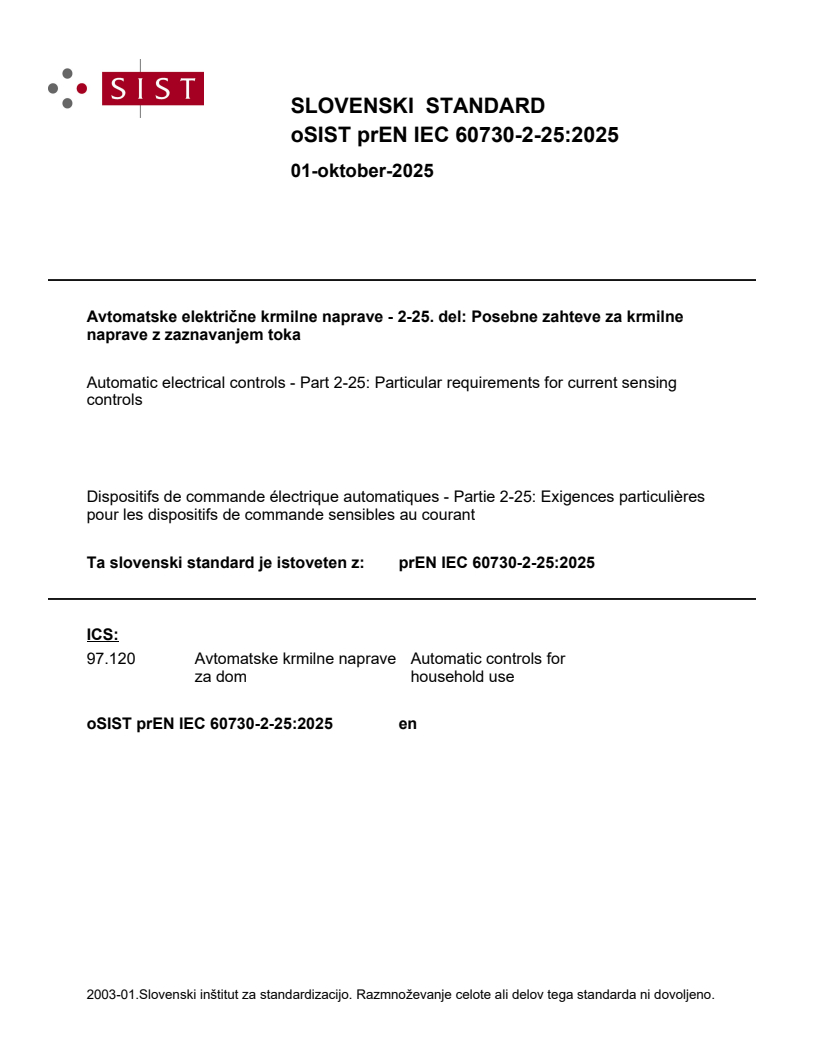
SLOVENSKI STANDARD
01-oktober-2025
Avtomatske električne krmilne naprave - 2-25. del: Posebne zahteve za krmilne
naprave z zaznavanjem toka
Automatic electrical controls - Part 2-25: Particular requirements for current sensing
controls
Dispositifs de commande électrique automatiques - Partie 2-25: Exigences particulières
pour les dispositifs de commande sensibles au courant
Ta slovenski standard je istoveten z: prEN IEC 60730-2-25:2025
ICS:
97.120 Avtomatske krmilne naprave Automatic controls for
za dom household use
2003-01.Slovenski inštitut za standardizacijo. Razmnoževanje celote ali delov tega standarda ni dovoljeno.
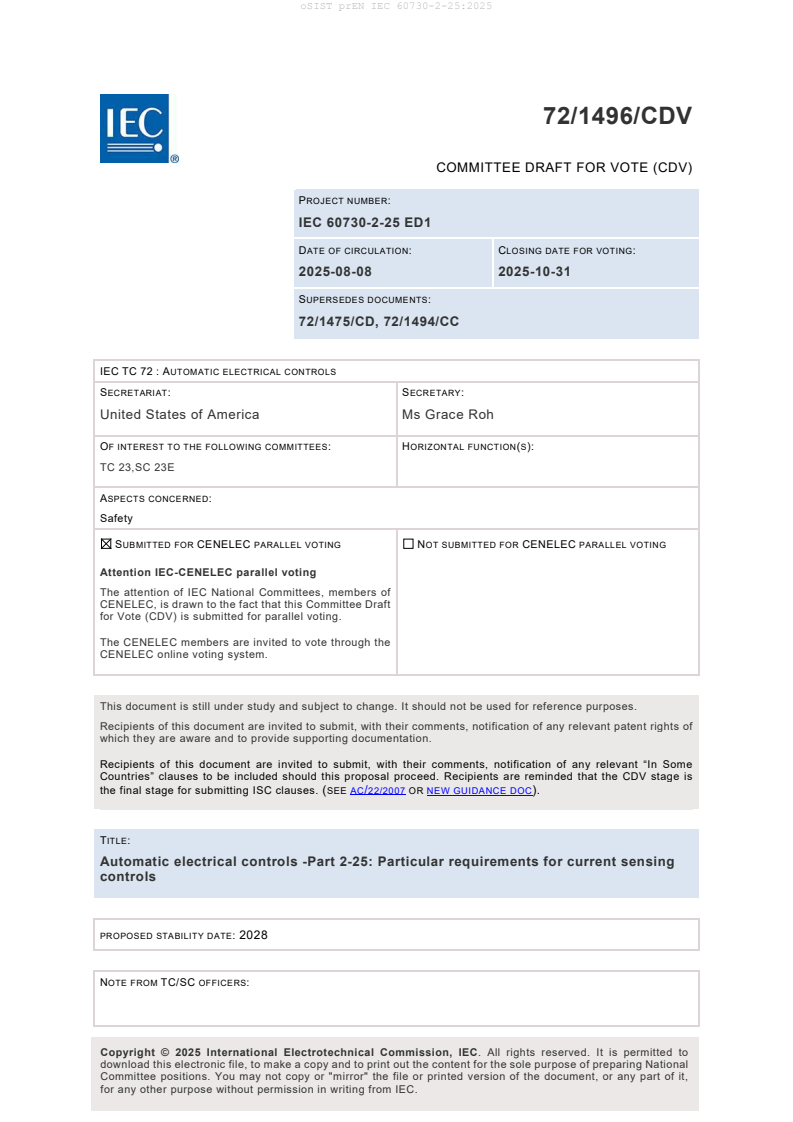
72/1496/CDV
COMMITTEE DRAFT FOR VOTE (CDV)
PROJECT NUMBER:
IEC 60730-2-25 ED1
DATE OF CIRCULATION: CLOSING DATE FOR VOTING:
2025-08-08 2025-10-31
SUPERSEDES DOCUMENTS:
72/1475/CD, 72/1494/CC
IEC TC 72 : AUTOMATIC ELECTRICAL CONTROLS
SECRETARIAT: SECRETARY:
United States of America Ms Grace Roh
OF INTEREST TO THE FOLLOWING COMMITTEES: HORIZONTAL FUNCTION(S):
TC 23,SC 23E
ASPECTS CONCERNED:
Safety
SUBMITTED FOR CENELEC PARALLEL VOTING NOT SUBMITTED FOR CENELEC PARALLEL VOTING
Attention IEC-CENELEC parallel voting
The attention of IEC National Committees, members of
CENELEC, is drawn to the fact that this Committee Draft
for Vote (CDV) is submitted for parallel voting.
The CENELEC members are invited to vote through the
CENELEC online voting system.
This document is still under study and subject to change. It should not be used for reference purposes.
Recipients of this document are invited to submit, with their comments, notification of any relevant patent rights of
which they are aware and to provide supporting documentation.
Recipients of this document are invited to submit, with their comments, notification of any relevant “In Some
Countries” clauses to be included should this proposal proceed. Recipients are reminded that the CDV stage is
the final stage for submitting ISC clauses. (SEE AC/22/2007 OR NEW GUIDANCE DOC).
TITLE:
Automatic electrical controls -Part 2-25: Particular requirements for current sensing
controls
PROPOSED STABILITY DATE: 2028
NOTE FROM TC/SC OFFICERS:
download this electronic file, to make a copy and to print out the content for the sole purpose of preparing National
Committee positions. You may not copy or "mirror" the file or printed version of the document, or any part of it,
for any other purpose without permission in writing from IEC.
IEC CDV 60730-2-25 © IEC 2025
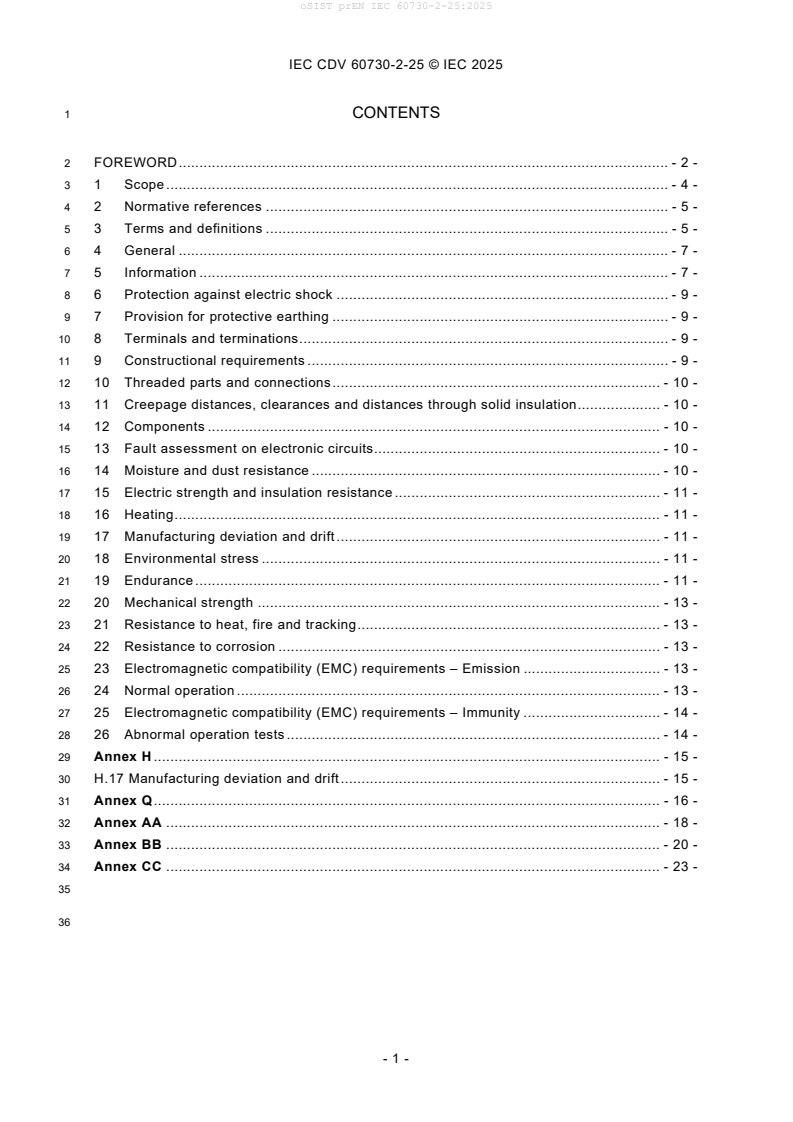
1 CONTENTS
2 FOREWORD . - 2 -
3 1 Scope . - 4 -
4 2 Normative references . - 5 -
5 3 Terms and definitions . - 5 -
6 4 General . - 7 -
7 5 Information . - 7 -
8 6 Protection against electric shock . - 9 -
9 7 Provision for protective earthing . - 9 -
10 8 Terminals and terminations . - 9 -
11 9 Constructional requirements . - 9 -
12 10 Threaded parts and connections . - 10 -
13 11 Creepage distances, clearances and distances through solid insulation . - 10 -
14 12 Components . - 10 -
15 13 Fault assessment on electronic circuits. - 10 -
16 14 Moisture and dust resistance . - 10 -
17 15 Electric strength and insulation resistance . - 11 -
18 16 Heating . - 11 -
19 17 Manufacturing deviation and drift . - 11 -
20 18 Environmental stress . - 11 -
21 19 Endurance . - 11 -
22 20 Mechanical strength . - 13 -
23 21 Resistance to heat, fire and tracking . - 13 -
24 22 Resistance to corrosion . - 13 -
25 23 Electromagnetic compatibility (EMC) requirements – Emission . - 13 -
26 24 Normal operation . - 13 -
27 25 Electromagnetic compatibility (EMC) requirements – Immunity . - 14 -
28 26 Abnormal operation tests . - 14 -
29 Annex H . - 15 -
30 H.17 Manufacturing deviation and drift . - 15 -
31 Annex Q . - 16 -
32 Annex AA . - 18 -
33 Annex BB . - 20 -
34 Annex CC . - 23 -
- 1 -
IEC CDV 60730-2-25 © IEC 2025
37 INTERNATIONAL ELECTROTECHNICAL COMMISSION
38 ____________
40 Automatic electrical controls –
41 Part 2-25: Particular requirements for current sensing controls
43 FOREWORD
44 1) The International Electrotechnical Commission (IEC) is a worldwide organization for standardization comprising all national
45 electrotechnical committees (IEC National Committees). The object of IEC is to promote international co-operation on all
46 questions concerning standardization in the electrical and electronic fields. To this end and in addition to other activities, IEC
47 publishes International Standards, Technical Specifications, Technical Reports, Publicly Available Specifications (PAS) and
48 Guides (hereafter referred to as “IEC Publication(s)”). Their preparation is entrusted to technical committees; any IEC National
49 Committee interested in the subject dealt with may participate in this preparatory work. International, governmental and non-
50 governmental organizations liaising with the IEC also participate in this preparation. IEC collaborates closely with the
51 International Organization for Standardization (ISO) in accordance with conditions determined by agreement between the two
52 organizations.
53 2) The formal decisions or agreements of IEC on technical matters express, as nearly as possible, an international consensus
54 of opinion on the relevant subjects since each technical committee has representation from all interested IEC National
55 Committees.
56 3) IEC Publications have the form of recommendations for international use and are accepted by IEC National Committees in
57 that sense. While all reasonable efforts are made to ensure that the technical content of IEC Publications is accurate, IEC
58 cannot be held responsible for the way in which they are used or for any misinterpretation by any end user.
59 4) In order to promote international uniformity, IEC National Committees undertake to apply IEC Publications transparently to
60 the maximum extent possible in their national and regional publications. Any divergence between any IEC Publication and the
61 corresponding national or regional publication shall be clearly indicated in the latter.
62 5) IEC itself does not provide any attestation of conformity. Independent certification bodies provide conformity assessment
63 services and, in some areas, access to IEC marks of conformity. IEC is not responsible for any services carried out by
64 independent certification bodies.
65 6) All users should ensure that they have the latest edition of this publication.
66 7) No liability shall attach to IEC or its directors, employees, servants or agents including individual experts and members of its
67 technical committees and IEC National Committees for any personal injury, property damage or other damage of any nature
68 whatsoever, whether direct or indirect, or for costs (including legal fees) and expenses arising out of the publication, use of,
69 or reliance upon, this IEC Publication or any other IEC Publications.
70 8) Attention is drawn to the Normative references cited in this publication. Use of the referenced publications is indispensable
71 for the correct application of this publication.
72 9) Attention is drawn to the possibility that some of the elements of this IEC Publication may be the subject of patent rights. IEC
73 shall not be held responsible for identifying any or all such patent rights.
74 This version XXXX
75 International Standard IEC 60730-2-25 has been prepared by technical committee TC 72: Automatic
76 electrical controls.
77 This edition includes alignment with the text of 60730-1 sixth edition.
78 This publication has been drafted in accordance with the ISO/IEC Directives, Part 2.
79 This Part 2-25 is intended to be used in conjunction with IEC 60730-1. It was established on the basis
80 of sixth edition (2022) of that publication. Consideration may be given to future editions of, or
81 amendments to, IEC 60730-1.
82 This Part 2-25 supplements or modifies the corresponding clauses in IEC 60730-1 so as to convert that
83 publication into the IEC standard: Particular requirements for current sensing controls.
84 Where this Part 2-25 states "addition", "modification", or "replacement", the relevant requirement, test
85 specification or explanatory matter in part 1 should be adapted accordingly.
86 Where no change is necessary, this part 2 indicates that the relevant clause or subclause applies.
- 2 -
IEC CDV 60730-2-25 © IEC 2025
87 In the development of a fully international standard, it has been necessary to take into consideration the
88 differing requirements resulting from practical experience in various parts of the world and to recognize
89 the variation in national electrical systems and wiring rules.
90 This part of International Standard IEC 60730 has been prepared by IEC technical committee 72:
91 Automatic electrical controls.
92 In this publication:
93 1) The following print types are used:
94 – Requirements proper: in roman type;
95 – Test specifications: in italic type;
96 – Notes; in small roman type;
97 – Words defined in Clause 2: bold.
98 2) Subclauses, notes, tables and figures which are additional to those in part 1 are numbered starting
99 from 101, additional annexes are lettered AA, BB, etc.
100 A list of all parts of the IEC 60730 series, published under the title Automatic electrical controls can be
101 found on the IEC website.
102 The committee has decided that the contents of the base publication and its amendment will remain
103 unchanged until the stability date indicated on the IEC web site under "http://webstore.iec.ch" in the
104 data related to the specific publication. At this date, the publication will be
105 • reconfirmed,
106 • withdrawn,
107 • replaced by a revised edition, or
108 • amended.
109 A bilingual version of this publication may be issued at a later date.
- 3 -
IEC CDV 60730-2-25 © IEC 2025
112 AUTOMATIC ELECTRICAL CONTROLS -
113 Part 2-25: Particular requirements for current sensing controls
114 1 Scope
115 This clause of Part 1 is replaced by the following:
116 This document applies to automatic thermo-electro-mechanical current sensing controls intended to
117 be incorporated or integrated into appliances. These products are designed to limit the load current
118 below a certain value to prevent a potential hazard due to misapplication or overloading condition during
119 user operation of the appliance. These products are:
120 for use in, on, or in association with appliances for household and similar use that are not in fixed
121 installation;
122 NOTE 101 Thermo-electro-mechanical current sensing controls regulate current by converting temperature changes into
123 mechanical movement. In these controls, a thermal element—commonly a bimetallic strip—bends in response to heat generated
124 by current flow, triggering a switching mechanism that limits or interrupts the current to ensure overload protection.
125 EXAMPLE 101 Controls for motor-operated appliances within the scope of IEC 60335 series.
126 for assembly within the scope of IEC 60884-2-7;
127 for equipment that is used by the public, such as equipment intended to be used in shops, offices,
128 hospitals, farms, and the like;
129 NOTE 102 Throughout this document, the word "equipment" means "appliance and equipment".
130 EXAMPLE 102 Controls for commercial catering.
131 used as supplementary overcurrent protection in appliances;
132 NOTE 104 These devices are not intended to replace fuses, circuit-breakers, etc.
133 used in, on, or in association with equipment that use electricity.
134 This document applies to
135 — the inherent safety of automatic thermo-electro-mechanical current sensing controls, and
136 — functional safety of automatic thermo-electro-mechanical current sensing controls,
137 — the operating values, operating times, and operating sequences where such are associated with
138 equipment safety.
139 — Thermo-electro-mechanical current sensing controls that incorporate manually actuated
140 switches as part of its construction.
141 NOTE 105 Requirements for manually actuated mechanical switches not forming part of an automatic control are contained in
142 IEC 61058 series. However mechanical switches that are part of the overload protection function are subjected to additional
143 requirements for functional safety in conjunction with this document, specified in Annex H.
144 This document specifies the requirements for construction, operation and testing of incorporated or
145 integrated thermo-electro-mechanical current sensing controls used in, on, or in association with an
146 equipment.
147 NOTE 106 An example of such controls is current sensing cut-out control.
148 This document does not
149 apply to electronic controls.
150 take into account the response value of an automatic action of a control, if such a response value
151 is dependent upon the method of mounting the control in the equipment. Where a response value
- 4 -
IEC CDV 60730-2-25 © IEC 2025
152 is of significant purpose for the protection of the user, or surroundings, the value defined in the
153 appropriate equipment standard or as determined by the manufacturer shall apply.
154 apply to current sensing devices such as ground-fault circuit interrupters (GFCI), arc-fault circuit
155 interrupters (AFCI), circuit breakers (CB), residual-current devices (RCDs).
156 Compared with fuses or circuit-breakers, current sensing cut-out controls have different functions in
157 current protection, and they can't replace each other. Fuses are covered by IEC 60127 series or IEC
158 60269 series. Circuit breakers intended to provide protection against overcurrents are covered by IEC
159 60898-1.
160 NOTE 107 Current sensing cut-out controls provide supplementary protection during overload conditions. Unlike circuit
161 breakers and fuses, which are designed to protect against more severe overcurrent conditions and typically require professional
162 intervention, current sensing cut-out controls are intended to prevent damage caused by light overloads and improve user
163 experience by avoiding the need for professional repair in such situations. These controls are not meant to replace circuit breakers
164 or fuses but serve as an additional protective mechanism in user-accessible applications, particularly during overload situations.
165 For more information about guide to the application of current sensing cut-out controls see Annex
166 AA.
167 2 Normative references
168 This clause of Part 1 is applicable except as follows:
169 Addition:
170 IEC 61058-1-1:2016, Switches for appliances –Part 1-1: Requirements for mechanical switches
171 3 Terms and definitions
172 This clause of Part 1 is applicable except as follows:
173 3.1 Definitions relating to ratings, voltages, currents, frequencies, and wattages
174 3.1.1
175 rated voltage, current, frequency or wattage
176 Add the following note:
177 Note 101 to entry: See BB.1.2.
178 3.2 Definitions of types of control according to purpose
179 3.2.16
180 protective control
181 Add the following note:
182 Note 101 to entry: In general, a current sensing cut-out control is a protective control.
183 Addition definitions:
184 3.2.101
185 current sensing control
186 automatic control in which initiation is by the change of current and response is by the current and
187 temperature characteristic of the bimetal or similar sensing element
188 3.2.101.1
189 current sensing cut-out control
190 current sensing control intended to keep a current below one particular value during abnormal
191 operating conditions and which has no provision for setting by the user
192 Note 1 to entry: A current sensing cut-out control will provide a type 2 action.
- 5 -
IEC CDV 60730-2-25 © IEC 2025
193 3.3 Definitions relating to the function of controls
194 Addition definitions:
195 3.3.101
196 time-current operating characteristic (tripping characteristic)
197 a product characteristic with corresponding relation between input current and tripping time
198 Note 1 to entry: Unless otherwise specified, tripping time is the time interval from the instant at which the associated tripping
199 current begins to flow in the current sensing control to the instant when this current is interrupted, measured at the ambient
200 temperature conditions specified by the manufacturer. This may include room ambient temperature as specified in 4.3.1 or other
201 ambient conditions based on the specific application. For controls incorporated into devices, the micro-environment temperature
202 may vary and can be higher than the surrounding ambient temperature. Adjustments in tripping time may occur accordingly due
203 to changes in the bimetal characteristic with temperature.
204 3.3.102
205 time-current zone (tripping zone)
206 a method of expressing time-current operating characteristics by drawing
207 3.3.105
208 tripping current
209 n I
i R
210 the specified value of current which causes a current sensing control to operate within a
211 specified time (conventional time) less than 1h
212 Note 1 to entry: n represents the magnification relationship with I .
i R
213 Note 2 to entry: See BB.1.2.
214 3.4 Definitions relating to disconnection and interruption
215 Addition definitions:
216 3.4.101
217 current interrupting rating
218 the highest current, at rated voltage, that a current sensing control is intended to interrupt
219 under standard test conditions
220 Note 1 to entry: The current interrupting rating is distinct from the maximum limiting current, under which the control is able to
221 maintain normal functioning throughout its designed lifetime.
222 Note 2 to entry: It is recommended that the current interrupting rating be determined in conjunction with the I t characteristics
223 (see Annex CC).
224 3.13 Miscellaneous definitions
225 Addition definitions:
226 3.13.101
227 I t
228 Joule integral
229 the integral of the square of the current over a given time interval:
𝑡𝑡
2 2
230 𝐼𝐼𝑡𝑡=�𝑖𝑖 𝑑𝑑𝑡𝑡
𝑡𝑡
231 Note 1 to entry: The energy in joules liberated in one ohm of resistance in a circuit controlled by a current sensing
2 2
232 cut-out control is equal to the value of the operating I t expressed in A • s.
- 6 -
IEC CDV 60730-2-25 © IEC 2025
233 [SOURCE: IEC 60050-441:1984, 441-18-23; modified – Note 1 to entry and Note 2 to entry has
234 been deleted, “protected” has been changed to “controlled” and “fuse” has been changed to
235 “current sensing cut-out control”]
236 4 General
237 This clause of Part 1 is applicable except as follows:
238 4.3 General notes on tests
239 4.3.3 Samples required
240 4.3.3.2 Additional note:
241 NOTE The tests of Clause 19 would require for additional samples, see 4.3.4.2.6 and 19.1.6.101.
242 4.3.4 Instructions for test
243 4.3.4.2 According to rating
244 4.3.4.2.6 Modification:
245 For controls marked or declared for more than one rated voltage, rated current or number of cycles for
246 each electrical conditions for the endurance test, the tests of Clause 19 are made on sets of samples
247 for each combination of rated voltage, rated current, and the number of cycles for each electrical
248 conditions for the endurance test.
249 NOTE 1 Current sensing control has a different number of cycles for endurance tests under different overcurrent conditions, see
250 Table 1, requirement 101.
251 NOTE 2 At the option of the test house, a reduced number of tests can be made to cover the various ratings.
252 5 Information
253 This clause of Part 1 is applicable except as follows:
254 5.2 Methods of providing technical information
255 Table 1 – Required technical information and methods of providing these information
Clause or
Information Method
subclause
Modification:
3.2, 4.3.4.2,
4.3.4.5, 19.15,
6 Purpose of control D or E
3.2.101,
3.2.101.1
18 Not applicable
3.6, Annex BB D or E
33 Type 1 action or type 2 action
43 Not applicable
49 Not applicable
50 Not applicable
51 Not applicable
52 Not applicable
53 Not applicable
54 Not applicable
- 7 -
IEC CDV 60730-2-25 © IEC 2025
56 Not applicable
59 Not applicable
60 Not applicable
61 Not applicable
62 Not applicable
65 Not applicable
66 Not applicable
75 Not applicable
76 Not applicable
77 Not applicable
78 Not applicable
79 Not applicable
80 Not applicable
81 Not applicable
82 Not applicable
83 Not applicable
84 Not applicable
86 Not applicable
Addition:
1)
Number of cycles corresponding to the electrical conditions for the
endurance test for current sensing cut-out controls
1)
Electrical conditions include type of circuit, operation (making and
101 19.2, 19.8 X
breaking), circuit (AC or DC, voltage, current, power factor).
NOTE According to BB.1.2 Note 1, there is no requirement for the
number of cycles for endurance test at rated current I for current
R
sensing cut-out controls.
102 Current interrupting rating 3.4.101, 26.101 X
Time-current operating characteristics (tripping characteristics)
3.3.101, 16.4,
H.17.1, H.17.4,
NOTE When input current and tripping time are related, the manufacturing
D or E
Annex AA, Annex
deviation may vary with input current, in this case, time-current zone
BB
(tripping zone) can better express manufacturing deviation.
AA.3 D or E
Notice to equipment manufacturer
Annex CC X
105 The I t withstand capacity
Modification:
d
Not applicable.
e
Not applicable.
- 8 -
IEC CDV 60730-2-25 © IEC 2025
g
Not applicable.
k
Not applicable.
Addition:
Current sensing cut-out control provide Type 2.B.E action.
256 6 Protection against electric shock
257 This clause of Part 1 is applicable.
258 7 Provision for protective earthing
259 This clause of Part 1 is applicable.
260 8 Terminals and terminations
261 This clause of Part 1 is applicable.
262 9 Constructional requirements
263 This clause of Part 1 is applicable except as follows:
264 9.4.8 Type 1.E or 2.E action (a trip-free mechanism in which the contacts cannot be prevented
265 from opening or maintained closed against a continuation of the fault)
266 Additional subclauses:
267 9.4.8.1 Current sensing cut-out control shall be designed with a manually resettable structure. This
268 structure is part of a continuous automatic trip mechanism that prevents faults. After a action occurs,
269 the reset mechanism shall neither prevent the opening of the contacts nor restore their closure while the
270 fault persists.
271 Compliance is checked by the following tests, which are made three times.
272 a) The control shall be supplied at rated voltage or at the upper limit of the rated voltage range. With
273 the contacts maintained in the closed position and the reset mechanism held in the reset position,
274 the control shall be connected to a supply current equal to 2 times the rated current.
275 The sample shall operate normally (i.e., trip).
276 b) After disconnecting the supply and releasing the reset mechanism, the sample would be cool to
277 approximately room temperature or for a period of 1 h, whichever is shorter.
278 The sample shall then be capable of resetting as intended.
279 c) Repeated the test of a) and the electrical connections would be maintained after the sample has
280 operated. Within 5 s after the sample operates, the reset mechanism would be held in the reset
281 position.
282 After a certain period of time, the sample shall reclose its contacts and subsequently operate again.
283 d) The test of b) shall be repeated after c).
284 9.13 Protective controls and components of protective control systems
285 9.13.1 Protective controls
286 Additional note:
287 NOTE See Annex AA for guidance.
288 9.13.2 Pressure limiting devices
289 Not applicable.
- 9 -
IEC CDV 60730-2-25 © IEC 2025
290 9.13.3 Temperature monitoring devices
291 Not applicable.
292 9.13.4 Batteries
293 Not applicable.
294 9.13.5 Smart enabled controls
295 Not applicable.
296 10 Threaded parts and connections
297 This clause of Part 1 is applicable.
298 11 Creepage distances, clearances and distances through solid insulation
299 This clause of Part 1 is applicable.
300 12 Components
301 This clause of Part 1 is applicable except as follows:
302 12.1 Transformers
303 Not applicable.
304 12.2 Switch mode power supplies and converters
305 Not applicable.
306 12.3 Capacitors
307 Not applicable.
308 12.4 Fuses
309 Not applicable.
310 12.5 Varistors
311 Not applicable.
312 12.7 Relays
313 Not applicable.
314 Addition:
315 12.101 Switch
316 For current sensing cut-out controls incorporating an integral manual switching function, the switch
317 part shall comply with the endurance test requirements of IEC 61058-1-1 at the specified rating. The
318 manual switching function shall be assessed by supplementary testing in accordance with Clause 17 of
319 IEC 61058-1-1:2016. See Note 104 in Clause 1 for further information.
320 13 Fault assessment on electronic circuits
321 This clause of Part 1 is not applicable.
322 14 Moisture and dust resistance
323 This clause of Part 1 is applicable.
- 10 -
IEC CDV 60730-2-25 © IEC 2025
324 15 Electric strength and insulation resistance
325 This clause of Part 1 is applicable.
326 16 Heating
327 This clause of Part 1 is applicable except as follows:
328 16.4 Replacement:
329 Controls shall be connected to a supply having the most unfavourable voltage between 0,90 V
R
330 and 1,10 V . Circuits which are not voltage sensitive are connected to a lower voltage (but not
R
331 less than 10 % of V ).
R
332 a) Circuits and contacts not intended for external loads shall be specified by the
333 manufacturer.
334 b) Actuating members are placed in the most unfavourable position.
335 c) Contacts required to be closed initially for the purpose of
...
Questions, Comments and Discussion
Ask us and Technical Secretary will try to provide an answer. You can facilitate discussion about the standard in here.
Loading comments...