

EN 62716:2013
(Main)Photovoltaic (PV) modules - Ammonia corrosion testing
General Information
- Abstract
IEC 62716:2013 describes test sequences useful to determine the resistance of PV modules to ammonia (NH3). All tests included in the sequences, except the bypass diode functionality test, are fully described in IEC 61215, IEC 61646 and IEC 61730-2. They are combined in this standard to provide means to evaluate possible faults caused in PV modules when operating under wet atmospheres having high concentration of dissolved ammonia (NH3).
- Status
- Published
- Publication Date
- 29-Aug-2013
- Withdrawal Date
- 31-Jul-2016
- Technical Committee
- CLC/TC 82 - Solar photovoltaic energy systems
- Drafting Committee
- IEC/TC 82 - IEC_TC_82
- Current Stage
- 9093 - Decision to confirm - Review Enquiry
- Start Date
- 05-Jan-2026
- Completion Date
- 25-Aug-2026

Overview
EN 62716:2013 (IEC 62716:2013), published by CLC/CENELEC, specifies test sequences to determine the resistance of flat‑plate photovoltaic (PV) modules to ammonia (NH3) corrosion. The standard combines a set of environmental and electrical tests - mostly referenced from IEC 61215, IEC 61646 and IEC 61730‑2 - to evaluate faults caused by exposure to wet atmospheres with elevated dissolved ammonia (for example, agricultural buildings). EN 62716 follows the structure of IEC 61701 and was adopted without modification from IEC 62716:2013.
Key topics and requirements
- Scope: Evaluates ammonia-induced degradation in flat‑plate PV modules (crystalline and thin‑film technologies).
- Test sequences: Separate sequences for crystalline silicon and thin‑film modules (figures in the standard). Tests must be performed in the specified order; any deviations must be recorded.
- Referenced tests: Most individual tests (preconditioning, visual inspection, dielectric withstand, wet leakage current, ground continuity, maximum power determination, light soaking for thin‑film, etc.) are defined in:
- IEC 61215 (crystalline design qualification)
- IEC 61646 (thin‑film design qualification)
- IEC 61730‑2 (PV module safety - construction)
- Exception: The bypass diode functionality test is included in the sequence but is not fully described in the referenced IEC standards and therefore requires separate specification or reporting.
- Samples and reporting:
- Three identical samples are required; one serves as a control.
- Representative sub‑samples are permitted if full‑size modules cannot fit chambers - this must be justified and reported.
- Full test report requirements and recording of any modifications are mandated.
Practical applications
- Qualification and durability assessment: Determines susceptibility of module components (metal parts, coatings, encapsulants, plastics) to ammonia-related corrosion and degradation.
- Design and material selection: Helps manufacturers select corrosion‑resistant materials and improve module construction for agro‑environments or ammonia‑rich atmospheres.
- Quality control and procurement: Used by manufacturers and buyers to verify performance claims and reduce field failures in corrosive environments.
- Certification and testing labs: Provides a standardized sequence for accredited test laboratories to assess ammonia resistance in accordance with ISO/IEC 17025 competence requirements.
Who should use this standard
- PV module manufacturers and R&D teams
- Independent testing and certification bodies
- System integrators and asset owners in agricultural or ammonia‑exposed sites
- Procurement teams specifying modules for corrosive environments
Related standards
- IEC 61215, IEC 61646, IEC 61730‑2 (normative references)
- ISO/IEC 17025 (laboratory competence)
- ISO 6988 (sulfur dioxide condensation test - adapted in EN 62716 using ammonia)
Relations
- Effective Date
- 09-Feb-2026
- Effective Date
- 09-Feb-2026
- Refers
EN 61730-2:2007 - Photovoltaic (PV) module safety qualification - Part 2: Requirements for testing - Effective Date
- 03-Feb-2026
- Effective Date
- 03-Feb-2026
- Effective Date
- 03-Feb-2026
- Effective Date
- 03-Feb-2026
- Effective Date
- 03-Feb-2026
- Effective Date
- 26-Jan-2023
Get Certified
Connect with accredited certification bodies for this standard

DNV
DNV is an independent assurance and risk management provider.

Lloyd's Register
Lloyd's Register is a global professional services organisation specialising in engineering and technology.
DNV Energy Systems
Energy and renewable energy certification.
Sponsored listings
Frequently Asked Questions
EN 62716:2013 is a standard published by CLC. Its full title is "Photovoltaic (PV) modules - Ammonia corrosion testing". This standard covers: IEC 62716:2013 describes test sequences useful to determine the resistance of PV modules to ammonia (NH3). All tests included in the sequences, except the bypass diode functionality test, are fully described in IEC 61215, IEC 61646 and IEC 61730-2. They are combined in this standard to provide means to evaluate possible faults caused in PV modules when operating under wet atmospheres having high concentration of dissolved ammonia (NH3).
IEC 62716:2013 describes test sequences useful to determine the resistance of PV modules to ammonia (NH3). All tests included in the sequences, except the bypass diode functionality test, are fully described in IEC 61215, IEC 61646 and IEC 61730-2. They are combined in this standard to provide means to evaluate possible faults caused in PV modules when operating under wet atmospheres having high concentration of dissolved ammonia (NH3).
EN 62716:2013 is classified under the following ICS (International Classification for Standards) categories: 27.160 - Solar energy engineering. The ICS classification helps identify the subject area and facilitates finding related standards.
EN 62716:2013 has the following relationships with other standards: It is inter standard links to EN ISO 6988:1994, EN ISO/IEC 17025:2017, EN 61730-2:2007, EN 61215:2005, EN 61646:2008, EN IEC 61730-1:2018, EN IEC 62093:2022, EN 62716:2013/AC:2014. Understanding these relationships helps ensure you are using the most current and applicable version of the standard.
EN 62716:2013 is available in PDF format for immediate download after purchase. The document can be added to your cart and obtained through the secure checkout process. Digital delivery ensures instant access to the complete standard document.
Standards Content (Sample)
2003-01.Slovenski inštitut za standardizacijo. Razmnoževanje celote ali delov tega standarda ni dovoljeno.Preskušanje fotonapetostnih (PV) modulov na korozijo zaradi amonijaka (IEC 62716:2013)Ammoniak-Korrosionsprüfung von photovoltaischen (PV)-ModulenEssai de corrosion à l'ammoniac des modules photovoltaïques (PV)Ammonia corrosion testing of photovoltaic (PV) modules27.160Solar energy engineeringICS:Ta slovenski standard je istoveten z:EN 62716:2013SIST EN 62716:2014en01-junij-2014SIST EN 62716:2014SLOVENSKI
STANDARD
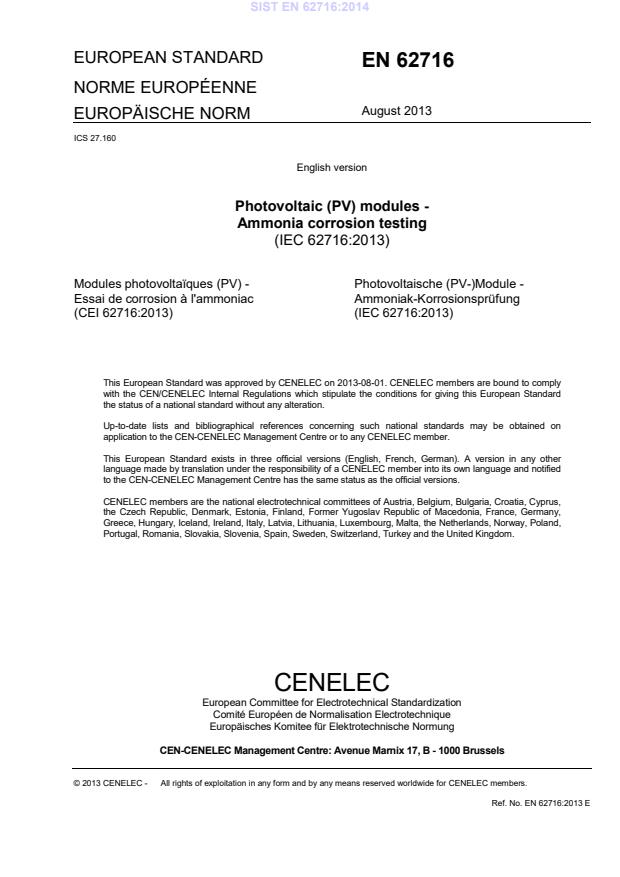
EUROPEAN STANDARD EN 62716 NORME EUROPÉENNE
EUROPÄISCHE NORM August 2013
CENELEC European Committee for Electrotechnical Standardization Comité Européen de Normalisation Electrotechnique Europäisches Komitee für Elektrotechnische Normung
CEN-CENELEC Management Centre: Avenue Marnix 17, B - 1000 Brussels
© 2013 CENELEC -
All rights of exploitation in any form and by any means reserved worldwide for CENELEC members.
Ref. No. EN 62716:2013 E
ICS 27.160
English version
Photovoltaic (PV) modules -
Ammonia corrosion testing (IEC 62716:2013)
Modules photovoltaïques (PV) -
Essai de corrosion à l'ammoniac (CEI 62716:2013)
Photovoltaische (PV-)Module -
Ammoniak-Korrosionsprüfung (IEC 62716:2013)
This European Standard was approved by CENELEC on 2013-08-01. CENELEC members are bound to comply with the CEN/CENELEC Internal Regulations which stipulate the conditions for giving this European Standard the status of a national standard without any alteration.
Up-to-date lists and bibliographical references concerning such national standards may be obtained on application to the CEN-CENELEC Management Centre or to any CENELEC member.
This European Standard exists in three official versions (English, French, German). A version in any other language made by translation under the responsibility of a CENELEC member into its own language and notified to the CEN-CENELEC Management Centre has the same status as the official versions.
CENELEC members are the national electrotechnical committees of Austria, Belgium, Bulgaria, Croatia, Cyprus, the Czech Republic, Denmark, Estonia, Finland, Former Yugoslav Republic of Macedonia, France, Germany, Greece, Hungary, Iceland, Ireland, Italy, Latvia, Lithuania, Luxembourg, Malta, the Netherlands, Norway, Poland, Portugal, Romania, Slovakia, Slovenia, Spain, Sweden, Switzerland, Turkey and the United Kingdom.
Foreword The text of document 82/769/FDIS, future edition 1 of IEC 62716, prepared by IEC/TC 82 "Solar photovoltaic energy systems" was submitted to the IEC-CENELEC parallel vote and approved by CENELEC as EN 62716:2013. The following dates are fixed: • latest date by which the document has to be implemented at national level by publication of an identical national standard or by endorsement (dop) 2014-05-01 • latest date by which the national standards conflicting with the document have to be withdrawn (dow) 2016-08-01
Attention is drawn to the possibility that some of the elements of this document may be the subject of patent rights. CENELEC [and/or CEN] shall not be held responsible for identifying any or all such patent rights.
Endorsement notice The text of the International Standard IEC 62716:2013 was approved by CENELEC as a European Standard without any modification. SIST EN 62716:2014
- 3 - EN 62716:2013
Annex ZA
(normative)
Normative references to international publications with their corresponding European publications
The following documents, in whole or in part, are normatively referenced in this document and are indispensable for its application. For dated references, only the edition cited applies. For undated references, the latest edition of the referenced document (including any amendments) applies.
NOTE
When an international publication has been modified by common modifications, indicated by (mod), the relevant EN/HD applies.
Publication Year Title EN/HD Year
IEC 61215 2005 Crystalline silicon terrestrial photovoltaic (PV) modules - Design qualification
and type approval EN 61215 2005
IEC 61646 2008 Thin-film terrestrial photovoltaic (PV) modules - Design qualification and type approval EN 61646 2008
IEC 61730-2 (mod) 2004 Photovoltaic (PV) module safety
qualification -
Part 2: Requirements for construction EN 61730-2 2007
ISO/IEC 17025 - General requirements for the
competence of testing and calibration laboratories EN ISO/IEC 17025 -
ISO 6988 1985 Metallic and other non-organic coatings - Sulfur dioxide test with general
condensation of moisture EN ISO 6988 1994
IEC 62716 Edition 1.0 2013-06 INTERNATIONAL STANDARD NORME INTERNATIONALE Photovoltaic (PV) modules – Ammonia corrosion testing
Modules photovoltaïques (PV) – Essai de corrosion à l'ammoniac
INTERNATIONAL ELECTROTECHNICAL COMMISSION COMMISSION ELECTROTECHNIQUE INTERNATIONALE M ICS 27.160 PRICE CODE CODE PRIX ISBN 978-2-83220-887-8
– 2 – 62716 © IEC:2013 CONTENTS FOREWORD . 3 1 Scope and object . 5 2 Normative references . 5 3 Samples . 5 4 Test procedures . 9
General . 9 4.1 Bypass diode functionality test . 9 4.2 Purpose . 9 4.2.1 Apparatus . 9 4.2.2 Procedure . 9 4.2.3 Requirements . 9 4.2.45 Preconditioning . 10 6 Initial measurements . 10
General . 10 6.1 Crystalline silicon . 10 6.2 Thin-film technologies . 10 6.37 Ammonia resistance test procedure . 10
Testing facility and material . 10 7.1 Test conditions and execution . 10 7.28 Cleaning and recovery . 11 9 Final measurements . 11
General . 11 9.1 Crystalline silicon . 11 9.2 Thin-film technologies . 12 9.310 Requirements . 12
General . 12 10.1 Crystalline silicon . 12 10.2 Thin-film technologies . 12 10.311 Test report . 13
Figure 1 – Ammonia resistance test sequence for crystalline PV modules . 7 Figure 2 – Ammonia resistance test sequence for thin-film PV modules . 8
Table 1 – Test conditions . 11
62716 © IEC:2013 – 3 – INTERNATIONAL ELECTROTECHNICAL COMMISSION ____________
PHOTOVOLTAIC (PV) MODULES –
AMMONIA CORROSION TESTING
FOREWORD 1) The International Electrotechnical Commission (IEC) is a worldwide organization for standardization comprising all national electrotechnical committees (IEC National Committees). The object of IEC is to promote international co-operation on all questions concerning standardization in the electrical and electronic fields. To this end and in addition to other activities, IEC publishes International Standards, Technical Specifications, Technical Reports, Publicly Available Specifications (PAS) and Guides (hereafter referred to as “IEC Publication(s)”). Their preparation is entrusted to technical committees; any IEC National Committee interested in the subject dealt with may participate in this preparatory work. International, governmental and non-governmental organizations liaising with the IEC also participate in this preparation. IEC collaborates closely with the International Organization for Standardization (ISO) in accordance with conditions determined by agreement between the two organizations. 2) The formal decisions or agreements of IEC on technical matters express, as nearly as possible, an international consensus of opinion on the relevant subjects since each technical committee has representation from all interested IEC National Committees.
3) IEC Publications have the form of recommendations for international use and are accepted by IEC National Committees in that sense. While all reasonable efforts are made to ensure that the technical content of IEC Publications is accurate, IEC cannot be held responsible for the way in which they are used or for any misinterpretation by any end user. 4) In order to promote international uniformity, IEC National Committees undertake to apply IEC Publications transparently to the maximum extent possible in their national and regional publications. Any divergence between any IEC Publication and the corresponding national or regional publication shall be clearly indicated in the latter. 5) IEC itself does not provide any attestation of conformity. Independent certification bodies provide conformity assessment services and, in some areas, access to IEC marks of conformity. IEC is not responsible for any services carried out by independent certification bodies. 6) All users should ensure that they have the latest edition of this publication. 7) No liability shall attach to IEC or its directors, employees, servants or agents including individual experts and members of its technical committees and IEC National Committees for any personal injury, property damage or other damage of any nature whatsoever, whether direct or indirect, or for costs (including legal fees) and expenses arising out of the publication, use of, or reliance upon, this IEC Publication or any other IEC Publications.
8) Attention is drawn to the Normative references cited in this publication. Use of the referenced publications is indispensable for the correct application of this publication. 9) Attention is drawn to the possibility that some of the elements of this IEC Publication may be the subject of patent rights. IEC shall not be held responsible for identifying any or all such patent rights. International Standard IEC 62716 has been prepared by IEC technical committee 82: Solar photovoltaic energy systems. The text of this standard is based on the following documents: FDIS Report on voting 82/769/FDIS 82/778/RVD
Full information on the voting for the approval of this standard can be found in the report on voting indicated in the above table. This publication has been drafted in accordance with the ISO/IEC Directives, Part 2.
– 4 – 62716 © IEC:2013 The committee has decided that the contents of this publication will remain unchanged until the stability date indicated on the IEC web site under "http://webstore.iec.ch" in the data related to the specific publication. At this date, the publication will be
• reconfirmed, • withdrawn, • replaced by a revised edition, or • amended. The contents of the corrigendum of May 2014 have been included in this copy.
62716 © IEC:2013 – 5 – PHOTOVOLTAIC (PV) MODULES – AMMONIA CORROSION TESTING
1 Scope and object Photovoltaic (PV) modules are electrical devices intended for continuous outdoor exposure during their lifetime. Highly corrosive wet atmospheres, such as in the environment of stables of agricultural companies, could eventually degrade some of the PV module components (corrosion of metallic parts, deterioration of the properties of some non-metallic materials – such as protective coatings and plastics – by assimilation of ammonia) causing permanent damages that could impair their functioning and safe operation. This standard describes test sequences useful to determine the resistance of PV modules to ammonia (NH3). All tests included in the sequences, except the bypass diode functionality test, are fully described in IEC 61215, IEC 61646 and IEC 61730-2. They are combined in this standard to provide means to evaluate possible faults caused in PV modules when operating under wet atmospheres having high concentration of dissolved ammonia (NH3). This standard applies to flat plate PV modules. The structure of this standard follows closely IEC 61701. 2 Normative references The following documents, in whole or in part, are normatively referenced in this document and are indispensable for its application. For dated references, only the edition cited applies. For undated references, the latest edition of the referenced document (including any amendments) applies. IEC 61215:2005, Crystalline silicon terrestrial photovoltaic (PV) modules – Design qualification and type approval IEC 61646:2008, Thin-film terrestrial photovoltaic (PV) modules – Design qualification and type approval IEC 61730-2:2004, Photovoltaic (PV) module safety qualification – Part 2: Requirements for testing ISO/IEC 17025, General requirements for the competence of testing and calibration laboratories ISO 6988:1985, Metallic and other non organic coatings – Sulfur dioxide test with general condensation of moisture 3 Samples Three identical samples of the model of PV module or
...