


FprEN IEC 62196-3:2025
(Main)Plugs, socket-outlets, vehicle connectors and vehicle inlets - Conductive charging of electric vehicles - Part 3: Dimensional compatibility requirements for DC and AC/DC pin and contact-tube vehicle couplers
Plugs, socket-outlets, vehicle connectors and vehicle inlets - Conductive charging of electric vehicles - Part 3: Dimensional compatibility requirements for DC and AC/DC pin and contact-tube vehicle couplers
IEC 62196-3:2026 is applicable to vehicle couplers with pins and contact tubes of standardized configuration, herein also referred to as "accessories", intended for use in electric vehicle conductive charging systems which incorporate control means, with rated operating voltage and current in accordance with IEC 62196-1:2025. This document applies to high power DC interfaces and combined AC/DC interfaces of vehicle couplers that are intended for use in conductive charging systems for circuits specified in IEC 61851-1 and IEC 61851-23. This third edition cancels and replaces the second edition published in 2022. This edition constitutes a technical revision. This edition includes the following significant technical changes with respect to the previous edition: a) The content of IEC TS 62196-3-1 has been integrated into this document as normative Annex AA. b) increased ratings for all configurations; c) reference to new tests in IEC 62196-1:2025 (Clauses 34, 35, 36 and 37).
Stecker, Steckdosen und Fahrzeugsteckvorrichtungen - Konduktives Laden von Elektrofahrzeugen - Teil 3: Maßliche Kompatibilitätsanforderungen an Fahrzeugsteckvorrichtungen mit Stiften und Buchsen für Gleichstrom und kombiniert für Gleich- und Wechselstrom
Fiches, socles de prise de courant, prises mobiles de véhicule et socles de connecteurs de véhicule - Charge conductive des véhicules électriques - Partie 3: Exigences dimensionnelles de compatibilité pour les prises de courant de véhicule à broches et alvéoles pour courant continu et pour courants alternatif et continu
l'IEC 62196-3:2026 s'applique aux prises de courant de véhicule à broches et alvéoles de configurations normalisées, ci-après dénommés "appareils", destinés à être utilisés dans les systèmes de charge conductive pour véhicules électriques qui intègrent un dispositif de commande, avec une tension d'emploi assignée et un courant assigné conformes à l'IEC 62196-1:2025. Le présent document s'applique aux interfaces forte puissance en courant continu et aux interfaces combinées en courant alternatif/continu des connecteurs de véhicule qui sont destinées à être utilisées dans les systèmes de charge conductive pour les circuits spécifiés dans l'IEC 61851-1 et l'IEC 61851-23. Cette troisième édition annule et remplace la deuxième édition parue en 2022. Cette édition constitue une révision technique. Cette édition inclut les modifications techniques majeures suivantes par rapport à l'édition précédente: a) intégration du contenu de l'IEC TS 62196-3-1 à l'Annexe normative AA du présent document; b) augmentation des caractéristiques assignées pour toutes les configurations; c) référence aux nouveaux essais de l'IEC 62196-1:2025 (Articles 34, 35, 36 et 37).
Vtiči, vtičnice, konektorji in uvodnice na vozilih - Kabelsko napajanje električnih vozil - 3. del: Zahteve za dimenzijsko združljivost za spojke na vozilih s trni in cevastimi kontakti za enosmerni (DC) in izmenični/enosmerni (AC/DC) tok
General Information
- Status
- Not Published
- Publication Date
- 25-Jun-2026
- Current Stage
- 5060 - Voting results sent to TC, SR - Formal Approval
- Start Date
- 19-Dec-2025
- Completion Date
- 19-Dec-2025

Relations
- Effective Date
- 03-Feb-2026
- Effective Date
- 04-Jul-2023
Overview
FprEN IEC 62196-3:2025 (based on prEN IEC 62196-3 / IEC 62196-3 ED3 CDV) defines dimensional compatibility requirements for DC and AC/DC pin and contact‑tube vehicle couplers used in conductive charging of electric vehicles. The standard is part of the IEC 62196 series covering plugs, socket‑outlets, vehicle connectors and vehicle inlets and focuses on geometry, interface compatibility, and associated tests so that EVs, cable assemblies and EV supply equipment (EVSE) can mate reliably and safely across manufacturers.
Key topics and technical content
The standard addresses the full lifecycle of dimensional and interface requirements through normative and informative clauses. Major technical topics include:
- Dimensions and standard sheets for multiple coupler configurations (AA, BB, EE, FF, etc.) and corresponding test gauges.
- Ratings and connection principles between power supply and vehicle (DC / AC‑DC configurations).
- Protection against electric shock, earthing provisions and size/colour of protective conductors.
- Terminals, contact design and contact‑tube interfaces to ensure mechanical and electrical compatibility.
- Interlocks and mechanical latching to prevent unsafe disconnection.
- Material and construction requirements: resistance to ageing, heat, fire, corrosion and mechanical stress.
- Electrical performance tests: insulation resistance, dielectric strength, breaking capacity, temperature rise and contact endurance.
- Environmental and mechanical tests: thermal cycling, humidity exposure, vehicle drive‑over, misalignment and EMC considerations.
- Annexes and test guidance: Standard sheets, test gauge details (Annex AAA), thermal management system for DC charging (Annex CCC), and recommended test setups and figures.
Note: the published extract is from the Committee Draft for Vote (CDV) stage; specific drawings and clauses may be refined before final publication.
Practical applications
This standard is essential for ensuring interoperable and safe conductive charging across:
- EV manufacturers and vehicle OEMs ensuring their vehicle inlets mate with public and private chargers.
- Charging equipment manufacturers and cable assembly suppliers designing EVSE plugs and couplers.
- Component designers (contacts, interlocks, housings) implementing correct dimensional and mechanical interfaces.
- Test laboratories and certification bodies performing conformity and compatibility testing.
- Infrastructure planners, fleet operators and regulators seeking consistent safety and interoperability criteria.
Who should use it
- Electrical and mechanical engineers in EV/EVSE development
- Compliance, testing and certification professionals
- Standards and regulatory teams in automotive and charging industries
- Procurement and installation teams specifying interoperable charging hardware
Related standards and context
FprEN IEC 62196‑3:2025 is part of the IEC 62196 series (plugs, socket‑outlets and vehicle connectors). It aligns with SC 23H work on EV connectors and interacts with EMC, safety and environmental standards. The proposed stability date in the draft is 2030, indicating intended long‑term applicability.
Keywords: IEC 62196-3, FprEN IEC 62196-3:2025, conductive charging, electric vehicle couplers, DC charging, AC/DC connectors, dimensional compatibility, EVSE, vehicle inlets.
Get Certified
Connect with accredited certification bodies for this standard

TÜV Rheinland
TÜV Rheinland is a leading international provider of technical services.

TÜV SÜD
TÜV SÜD is a trusted partner of choice for safety, security and sustainability solutions.

DEKRA Certification Inc.
DEKRA US certification services.
Sponsored listings
Frequently Asked Questions
FprEN IEC 62196-3:2025 is a draft published by CLC. Its full title is "Plugs, socket-outlets, vehicle connectors and vehicle inlets - Conductive charging of electric vehicles - Part 3: Dimensional compatibility requirements for DC and AC/DC pin and contact-tube vehicle couplers". This standard covers: IEC 62196-3:2026 is applicable to vehicle couplers with pins and contact tubes of standardized configuration, herein also referred to as "accessories", intended for use in electric vehicle conductive charging systems which incorporate control means, with rated operating voltage and current in accordance with IEC 62196-1:2025. This document applies to high power DC interfaces and combined AC/DC interfaces of vehicle couplers that are intended for use in conductive charging systems for circuits specified in IEC 61851-1 and IEC 61851-23. This third edition cancels and replaces the second edition published in 2022. This edition constitutes a technical revision. This edition includes the following significant technical changes with respect to the previous edition: a) The content of IEC TS 62196-3-1 has been integrated into this document as normative Annex AA. b) increased ratings for all configurations; c) reference to new tests in IEC 62196-1:2025 (Clauses 34, 35, 36 and 37).
IEC 62196-3:2026 is applicable to vehicle couplers with pins and contact tubes of standardized configuration, herein also referred to as "accessories", intended for use in electric vehicle conductive charging systems which incorporate control means, with rated operating voltage and current in accordance with IEC 62196-1:2025. This document applies to high power DC interfaces and combined AC/DC interfaces of vehicle couplers that are intended for use in conductive charging systems for circuits specified in IEC 61851-1 and IEC 61851-23. This third edition cancels and replaces the second edition published in 2022. This edition constitutes a technical revision. This edition includes the following significant technical changes with respect to the previous edition: a) The content of IEC TS 62196-3-1 has been integrated into this document as normative Annex AA. b) increased ratings for all configurations; c) reference to new tests in IEC 62196-1:2025 (Clauses 34, 35, 36 and 37).
FprEN IEC 62196-3:2025 is classified under the following ICS (International Classification for Standards) categories: 29.120.30 - Plugs, socket-outlets, couplers; 43.120 - Electric road vehicles. The ICS classification helps identify the subject area and facilitates finding related standards.
FprEN IEC 62196-3:2025 has the following relationships with other standards: It is inter standard links to EN IEC 62196-1:2026, EN IEC 62196-3:2022. Understanding these relationships helps ensure you are using the most current and applicable version of the standard.
FprEN IEC 62196-3:2025 is associated with the following European legislation: EU Directives/Regulations: 2014/35/EU, 2014/94/EU, 2023/1804, 2023/1804-1, 2023/1804-2; Standardization Mandates: M/468, M/511, M/533. When a standard is cited in the Official Journal of the European Union, products manufactured in conformity with it benefit from a presumption of conformity with the essential requirements of the corresponding EU directive or regulation.
FprEN IEC 62196-3:2025 is available in PDF format for immediate download after purchase. The document can be added to your cart and obtained through the secure checkout process. Digital delivery ensures instant access to the complete standard document.
Standards Content (Sample)
SLOVENSKI STANDARD
01-junij-2024
Vtiči, vtičnice, konektorji in uvodnice na vozilih - Kabelsko napajanje električnih
vozil - 3. del: Zahteve za dimenzijsko združljivost za spojke na vozilih s trni in
cevastimi kontakti za enosmerni (DC) in izmenični/enosmerni (AC/DC) tok
Plugs, socket-outlets, vehicle connectors and vehicle inlets - Conductive charging of
electric vehicles - Part 3: Dimensional compatibility requirements for DC and AC/DC pin
and contact-tube vehicle couplers
Stecker, Steckdosen und Fahrzeugsteckvorrichtungen - Konduktives Laden von
Elektrofahrzeugen - Teil 3: Maßliche Kompatibilitätsanforderungen an
Fahrzeugsteckvorrichtungen mit Stiften und Buchsen für Gleichstrom und kombiniert für
Gleich- und Wechselstrom
Fiches, socles de prise de courant, prises mobiles de vehicule et socles de connecteur
de véhicule - Charge conductive des véhicules électriques - Partie 3: Exigences
dimensionnelles de compatibilité pour les prises de courant de véhicule à broches et
alvéoles pour courant continu et pour courants alternatif et continu
Ta slovenski standard je istoveten z: prEN IEC 62196-3:2024
ICS:
29.120.30 Vtiči, vtičnice, spojke Plugs, socket-outlets,
couplers
43.120 Električna cestna vozila Electric road vehicles
2003-01.Slovenski inštitut za standardizacijo. Razmnoževanje celote ali delov tega standarda ni dovoljeno.
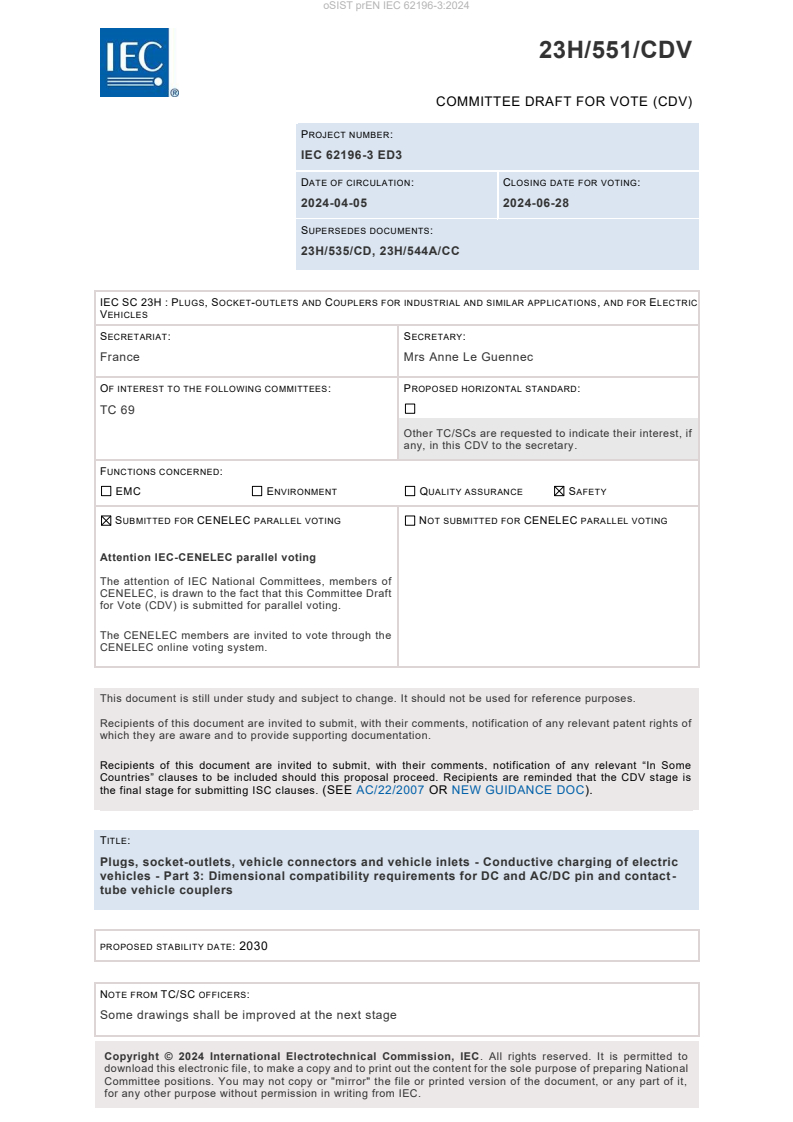
23H/551/CDV
COMMITTEE DRAFT FOR VOTE (CDV)
PROJECT NUMBER:
IEC 62196-3 ED3
DATE OF CIRCULATION: CLOSING DATE FOR VOTING:
2024-04-05 2024-06-28
SUPERSEDES DOCUMENTS:
23H/535/CD, 23H/544A/CC
IEC SC 23H : PLUGS, SOCKET-OUTLETS AND COUPLERS FOR INDUSTRIAL AND SIMILAR APPLICATIONS, AND FOR ELECTRIC
VEHICLES
SECRETARIAT: SECRETARY:
France Mrs Anne Le Guennec
OF INTEREST TO THE FOLLOWING COMMITTEES: PROPOSED HORIZONTAL STANDARD:
TC 69
Other TC/SCs are requested to indicate their interest, if
any, in this CDV to the secretary.
FUNCTIONS CONCERNED:
EMC ENVIRONMENT QUALITY ASSURANCE SAFETY
SUBMITTED FOR CENELEC PARALLEL VOTING NOT SUBMITTED FOR CENELEC PARALLEL VOTING
Attention IEC-CENELEC parallel voting
The attention of IEC National Committees, members of
CENELEC, is drawn to the fact that this Committee Draft
for Vote (CDV) is submitted for parallel voting.
The CENELEC members are invited to vote through the
CENELEC online voting system.
This document is still under study and subject to change. It should not be used for reference purposes.
Recipients of this document are invited to submit, with their comments, notification of any relevant patent rights of
which they are aware and to provide supporting documentation.
Recipients of this document are invited to submit, with their comments, notification of any relevant “In Some
Countries” clauses to be included should this proposal proceed. Recipients are reminded that the CDV stage is
the final stage for submitting ISC clauses. (SEE AC/22/2007 OR NEW GUIDANCE DOC).
TITLE:
Plugs, socket-outlets, vehicle connectors and vehicle inlets - Conductive charging of electric
vehicles - Part 3: Dimensional compatibility requirements for DC and AC/DC pin and contact -
tube vehicle couplers
PROPOSED STABILITY DATE: 2030
NOTE FROM TC/SC OFFICERS:
Some drawings shall be improved at the next stage
download this electronic file, to make a copy and to print out the content for the sole purpose of preparing National
Committee positions. You may not copy or "mirror" the file or printed version of the document, or any part of it,
for any other purpose without permission in writing from IEC.
IEC CDV 62196-3 © IEC 2024 2 23H/551/CDV
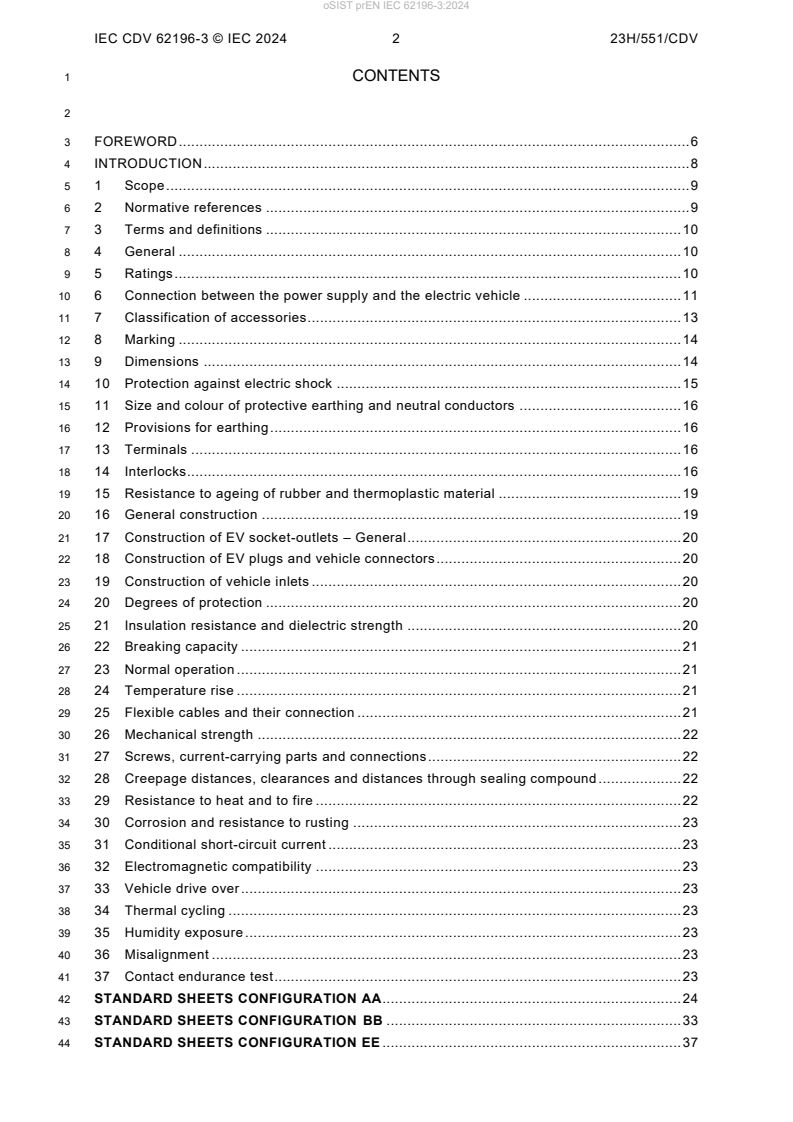
1 CONTENTS
3 FOREWORD . 6
4 INTRODUCTION . 8
5 1 Scope . 9
6 2 Normative references . 9
7 3 Terms and definitions . 10
8 4 General . 10
9 5 Ratings . 10
10 6 Connection between the power supply and the electric vehicle . 11
11 7 Classification of accessories. 13
12 8 Marking . 14
13 9 Dimensions . 14
14 10 Protection against electric shock . 15
15 11 Size and colour of protective earthing and neutral conductors . 16
16 12 Provisions for earthing . 16
17 13 Terminals . 16
18 14 Interlocks. 16
19 15 Resistance to ageing of rubber and thermoplastic material . 19
20 16 General construction . 19
21 17 Construction of EV socket-outlets – General . 20
22 18 Construction of EV plugs and vehicle connectors . 20
23 19 Construction of vehicle inlets . 20
24 20 Degrees of protection . 20
25 21 Insulation resistance and dielectric strength . 20
26 22 Breaking capacity . 21
27 23 Normal operation . 21
28 24 Temperature rise . 21
29 25 Flexible cables and their connection . 21
30 26 Mechanical strength . 22
31 27 Screws, current-carrying parts and connections . 22
32 28 Creepage distances, clearances and distances through sealing compound . 22
33 29 Resistance to heat and to fire . 22
34 30 Corrosion and resistance to rusting . 23
35 31 Conditional short-circuit current . 23
36 32 Electromagnetic compatibility . 23
37 33 Vehicle drive over . 23
38 34 Thermal cycling . 23
39 35 Humidity exposure . 23
40 36 Misalignment . 23
41 37 Contact endurance test . 23
42 STANDARD SHEETS CONFIGURATION AA. 24
43 STANDARD SHEETS CONFIGURATION BB . 33
44 STANDARD SHEETS CONFIGURATION EE . 37
IEC CDV 62196-3 © IEC 2024 3 23H/551/CDV
45 STANDARD SHEETS CONFIGURATION FF . 54
46 Annex AAA (normative) Standard Sheets for Test Gauges in 14.1.9 . 78
47 Annex BBB (informative) EV accessories directly connected to printed circuit boards
48 (PCBs) . 79
49 Annex CCC (normative) Vehicle connector, vehicle inlet and cable assembly for DC
50 charging intended to be used with a thermal management system . 80
51 CCC.1 Thermal management system scope . 80
52 CCC.2 Normative references . 80
53 CCC.3 Thermal management system terms and definitions . 80
54 CCC.4 General . 80
55 CCC.5 Ratings . 88
56 CCC.6 Connection between the power supply and the electric vehicle . 89
57 CCC.7 Classification of accessories . 89
58 CCC.8 Marking . 89
59 CCC.9 Dimensions . 89
60 CCC.10 Protection against electric shock . 89
61 CCC.11 Size and colour of protective earthing conductors . 89
62 CCC.12 Provision for protective earthing . 89
63 CCC.13 Terminals . 89
64 CCC.14 Interlocks . 90
65 CCC.15 Resistance to ageing of rubber and thermoplastic material . 90
66 CCC.16 General construction . 90
67 CCC.17 Construction of socket-outlets. 92
68 CCC.18 Construction of plugs and vehicle connectors . 92
69 CCC.19 Construction of vehicle inlets . 92
70 CCC.20 Degrees of protection . 92
71 CCC.21 Insulation resistance and dielectric strength . 92
72 CCC.22 Breaking capacity . 92
73 CCC.23 Normal operation . 93
74 CCC.24 Temperature rise . 93
75 CCC.25 Flexible cables and their connection . 100
76 CCC.26 Mechanical strength . 101
77 CCC.27 Screws, current-carrying parts and connections . 102
78 CCC.28 Creepage distances, clearances and distances. 102
79 CCC.29 Resistance to heat, to fire and to tracking . 102
80 CCC.30 Corrosion and resistance to rusting . 102
81 CCC.31 Conditional short-circuit current withstand test . 102
82 CCC.32 Electromagnetic compatibility . 102
83 CCC.33 Vehicle driveover . 102
84 CCC.34 Thermal cycling . 103
85 CCC.35 Humidity exposure . 103
86 CCC.36 Misalignment . 103
87 CCC.37 Contact Endurance . 103
88 CCC.38 Liquid coolants . 103
89 CCC.39 Specific information for configuration AA . 105
90 CCC.40 Specific information for configuration BB . 111
91 CCC.41 Specific information for configuration EE . 111
92 CCC.42 Specific information for configuration FF . 120
93 CCC.43 Specific information for configuration GG . 126
94 CCC.44 Recommended data . 135
IEC CDV 62196-3 © IEC 2024 4 23H/551/CDV
95 Annex DDD (informative) Interlock function - Example of retaining means and latching
96 device . 137
97 Bibliography . 139
99 Figure CCC.100 – DC EV supply equipment with thermal sensing . 87
100 Figure CCC.101 – DC EV supply equipment with thermal sensing, thermal transport
101 and thermal exchange. 88
102 Figure CCC.102 – Reference device AA_0. 106
103 Figure CCC.103 – Test setup AA_0 . 106
104 Figure CCC.104 – Test setup AA_1 . 107
105 Figure CCC.105 – Test setup AA_2 . 107
106 Figure CCC.106 – Reference device AA_1. 108
107 Figure CCC.107 – Test setup AA_3 . 108
108 Figure CCC.108 – Reference device AA_2. 109
109 Figure CCC.109 – Test setup AA_4 . 110
110 Figure CCC.110 – General test setup for temperature rise tests and thermal sensing
111 device tests (configuration AA) . 110
112 Figure CCC.111 – Plating of contacts for configuration AA. 111
113 Figure CCC.112 – Reference device EE_0. 113
114 Figure CCC.113 – Test setup EE_0 . 114
115 Figure CCC.114 – Test setup EE_1 . 114
116 Figure CCC.115 – Test setup EE_2 . 115
117 Figure CCC.116 – Reference device EE_1. 115
118 Figure CCC.117 – Test setup EE_3 . 116
119 Figure CCC.118 – Reference device EE_2. 116
120 Figure CCC.119 – Test setup EE_4 . 117
121 Figure CCC.120 – General test setup for temperature rise tests and thermal sensing
122 device tests (configuration EE) . 118
123 119
124 Figure CCC.121 – Plating of contacts for configuration EE. 119
125 Figure CCC.122 – Reference device FF_0 . 121
126 Figure CCC.123 – Test setup FF_0 . 122
127 Figure CCC.124 – Test setup FF_1 . 122
128 Figure CCC.126 – Reference device FF_1 . 123
129 Figure CCC.127 – Test setup FF_3Figure A.125 – Test setup FF_2 . 124
130 Figure CCC.128 – Reference device FF_2 . 124
131 Figure CCC.129 – Test setup FF_4 . 125
132 Figure CCC.130 – General test setup for temperature rise tests and thermal sensing
133 device tests (configuration FF) . 125
134 Figure CCC.131 – Plating of contacts for configuration FF . 126
135 Figure CCC.132 – Reference device GG_0 . 127
136 Figure CCC.133 – Test setup GG_0 . 129
137 Figure CCC.135 – Test setup GG_2 . 130
138 Figure CCC.136 – Reference device GG_1 . 131
139 Figure CCC.137 – Test setup GG_3 . 132
140 Figure CCC.138 – Reference device GG_2 . 133
141 Figure CCC.139 – Test setup GG_4 . 133
IEC CDV 62196-3 © IEC 2024 5 23H/551/CDV
142 Figure CCC.140 – General test setup for temperature rise tests and thermal sensing
143 device tests (configuration GG) . 134
144 Figure CCC.141 – Plating of contacts for configuration GG . 135
145 Figure DDD.1 – Side View – Scenario 1 . 137
146 Figure DDD.2 – Side View – Scenario 2 . 137
147 Figure DDD.3 – Side View – Scenario 3 . 138
149 Table 301 – Overview of the DC vehicle interface . 12
150 Table 302 – Overview of the combined AC/DC vehicle interface . 13
151 Table 303 – Interface overview . 15
152 Table 301 – Definition of interlock test numbers for. 18
153 checking latched position and unlatched position . 18
154 Table 304 – Functionality of the contacts for configuration EE . 37
155 Table 305 – Functionality of the contacts for DC configuration FF . 54
156 Table CCC.100 – Overview of applicable tests for different classifications of
157 accessories . 81
158 Table CCC.101 – Test sequence A . 84
159 Table CCC.102 – Test sequence B . 85
160 Table CCC.103 – Test sequence C . 86
161 Table CCC.104 – Test sequence D . 86
162 Table CCC.106 – Pull force and torque test values for cable anchorage . 101
163 Table CCC.107 – Impact energy for ball impact test. 101
164 Table CCC.108 – Maximum contact resistances and dimensions of reference device
165 AA_0 . 106
166 Table CCC.109 – Dimensions for reference device conductor (configuration AA) . 110
167 Table CCC.110 – Contact resistances and dimensions of reference device EE_0 . 113
168 Table CCC.111 – Dimensions for reference device conductor (configuration EE) . 118
169 Table CCC.112 – Contact resistances and dimensions of reference device FF_0. 121
170 Table CCC.113 – Dimensions for reference device conductor (configuration FF) . 126
171 Table CCC.115 – Dimensions for reference device conductor (configuration GG) . 134
IEC CDV 62196-3 © IEC 2024 6 23H/551/CDV
174 INTERNATIONAL ELECTROTECHNICAL COMMISSION
175 ____________
177 PLUGS, SOCKET-OUTLETS, VEHICLE CONNECTORS AND VEHICLE
178 INLETS – CONDUCTIVE CHARGING OF ELECTRIC VEHICLES –
180 Part 3: Dimensional compatibility requirements
181 for DC and AC/DC pin and contact-tube vehicle couplers
183 FOREWORD
184 1) The International Electrotechnical Commission (IEC) is a worldwide organization for standardization comprising
185 all national electrotechnical committees (IEC National Committees). The object of IEC is to promote international
186 co-operation on all questions concerning standardization in the electrical and electronic fields. To this end and
187 in addition to other activities, IEC publishes International Standards, Technical Specifications, Technical Reports,
188 Publicly Available Specifications (PAS) and Guides (hereafter referred to as “IEC Publication(s)”). Their
189 preparation is entrusted to technical committees; any IEC National Committee interested in the subject dealt with
190 may participate in this preparatory work. International, governmental and non-governmental organizations liaising
191 with the IEC also participate in this preparation. IEC collaborates closely with the International Organization for
192 Standardization (ISO) in accordance with conditions determined by agreement between the two organizations.
193 2) The formal decisions or agreements of IEC on technical matters express, as nearly as possible, an international
194 consensus of opinion on the relevant subjects since each technical committee has representation from all
195 interested IEC National Committees.
196 3) IEC Publications have the form of recommendations for international use and are accepted by IEC National
197 Committees in that sense. While all reasonable efforts are made to ensure that the technical content of IEC
198 Publications is accurate, IEC cannot be held responsible for the way in which they are used or for any
199 misinterpretation by any end user.
200 4) In order to promote international uniformity, IEC National Committees undertake to apply IEC Publications
201 transparently to the maximum extent possible in their national and regional publications. Any divergence between
202 any IEC Publication and the corresponding national or regional publication shall be clearly indicated in the latter.
203 5) IEC itself does not provide any attestation of conformity. Independent certification bodies provide conformity
204 assessment services and, in some areas, access to IEC marks of conformity. IEC is not responsible for any
205 services carried out by independent certification bodies.
206 6) All users should ensure that they have the latest edition of this publication.
207 7) No liability shall attach to IEC or its directors, employees, servants or agents including individual experts and
208 members of its technical committees and IEC National Committees for any personal injury, property damage or
209 other damage of any nature whatsoever, whether direct or indirect, or for costs (including legal fees) and
210 expenses arising out of the publication, use of, or reliance upon, this IEC Publication or any other IEC
211 Publications.
212 8) Attention is drawn to the Normative references cited in this publication. Use of the referenced publications is
213 indispensable for the correct application of this publication.
214 9) Attention is drawn to the possibility that some of the elements of this IEC Publication may be the subject of patent
215 rights. IEC shall not be held responsible for identifying any or all such patent rights.
216 IEC 62196-3 has been prepared by subcommittee 23H: Plugs, socket-outlets, and couplers for
217 industrial and similar applications, and for electric vehicles, of IEC technical committee 23:
218 Electrical accessories. It is an International Standard.
219 This third edition cancels and replaces the second edition published in 2022. This edition
220 constitutes a technical revision.
221 This edition includes the following significant technical changes with respect to the previous
222 edition:
223 a) The content of IEC TS 62196-3-1 has been integrated into this document as normative
224 Annex CCC. As far as applicable, the clause numbers are identical with the main part.
225 Added subclauses, tables and figures start with the number 100 to avoid confusion with
226 the main part.
227 b) interchangeability requirements have been removed from the title of Part 3;
228 c) increased ratings for all configurations;
229 d) reference to new tests in IEC 62196-1 (Clauses 34, 35, 36 and 37).
IEC CDV 62196-3 © IEC 2024 7 23H/551/CDV
230 The text of this International Standard is based on the following documents:
Draft Report on voting
23H/500/FDIS 23H/504/RVD
232 Full information on the voting for its approval can be found in the report on voting indicated in
233 the above table.
234 The language used for the development of this International Standard is English.
235 This document was drafted in accordance with ISO/IEC Directives, Part 2, and developed in
236 accordance with ISO/IEC Directives, Part 1 and ISO/IEC Directives, IEC Supplement, available
237 at www.iec.ch/members_experts/refdocs. The main document types developed by IEC are
238 described in greater detail at www.iec.ch/standardsdev/publications.
239 A list of all the parts in the IEC 62196 series, published under the general title Plugs,
240 socket-outlets, vehicle connectors and vehicle inlets – Conductive charging of electric vehicles,
241 can be found on the IEC website.
242 This document is to be read in conjunction with IEC 62196-1:2022. The clauses of the particular
243 requirements in this document supplement or modify the corresponding clauses in
244 IEC 62196-1:2022. Where the text indicates an "addition" to or a "replacement" of the relevant
245 requirement, test specification or explanation of IEC 62196-1:2022, these changes are made to
246 the relevant text of IEC 62196-1:2022, which then becomes part of this document. Where no
247 change is necessary, the words "Clause X of IEC 62196-1:2022 is applicable" are used.
248 Subclauses, figures, tables, or notes which are additional to those in IEC 62196-1:2022 are
249 numbered starting from 301.
250 In this document, the following print types are used:
251 – requirements proper: in roman type;
252 – test specifications: in italic type;
253 – notes: in smaller roman type.
254 The committee has decided that the contents of this document will remain unchanged until the
255 stability date indicated on the IEC website under webstore.iec.ch in the data related to the
256 specific document. At this date, the document will be
257 • reconfirmed,
258 • withdrawn,
259 • replaced by a revised edition, or
260 • amended.
IEC CDV 62196-3 © IEC 2024 8 23H/551/CDV
263 INTRODUCTION
264 IEC 61851 (all parts) specifies requirements for electric vehicle (EV) conductive supply
265 equipment.
266 IEC 62196 (all parts) specifies the requirements for plugs, socket-outlets, vehicle connectors,
267 vehicle inlets and cable assemblies as described in IEC 61851 (all parts).
268 Charging using off-board DC charging equipment can be achieved by the direct connection of
269 an electric vehicle to DC EV supply equipment incorporating control and communication circuits.
270 To support the connection of DC power for such vehicles, this document provides the standard
271 interface configurations of DC vehicle couplers and accessories to be used in conductive
272 charging of electric vehicles, taking the most frequent charging situations into consideration.
273 IEC 62196 is divided into several parts as follows:
274 – Part 1: General requirements, comprising clauses of a general character.
275 – Part 2: Dimensional compatibility requirements for AC pin and contact-tube accessories.
276 – Part 3: Dimensional compatibility requirements for DC and AC/DC pin and contact-tube
277 vehicle couplers.
278 – Part 4: Dimensional compatibility requirements for DC pin and contact-tube accessories for
279 Class II or Class III applications.
280 – Part 6: Dimensional compatibility requirements for DC pin and contact-tube couplers for
281 applications using a system of protective electrical separation.
IEC CDV 62196-3 © IEC 2024 9 23H/551/CDV
284 PLUGS, SOCKET-OUTLETS, VEHICLE CONNECTORS AND VEHICLE
285 INLETS – CONDUCTIVE CHARGING OF ELECTRIC VEHICLES –
287 Part 3: Dimensional compatibility requirements
288 for DC and AC/DC pin and contact-tube vehicle couplers
292 1 Scope
293 This part of IEC 62196 is applicable to vehicle couplers with pins and contact tubes of
294 standardized configuration, herein also referred to as "accessories", intended for use in electric
295 vehicle conductive charging systems which incorporate control means, with rated operating
296 voltage and current in accordance with IEC 62196-1:2022.
297 This document applies to high power DC interfaces and combined AC/DC interfaces of vehicle
298 couplers that are intended for use in conductive charging systems for circuits specified in
299 IEC 61851-1:2017 and IEC 6185123:— .
300 This document applies to accessories and cable assemblies that employ
301 – thermal sensing, or
302 – thermal transport and thermal sensing
303 with the system architecture described in CCC.4.100 of Annex CCC.
304 The DC vehicle connectors and inlets covered by this document are used only in charging
305 mode 4, according to IEC 618511:2017, 6.2.4, and case C, as shown in IEC 618511:2017,
306 Figure 3.
307 These vehicle couplers are intended to be used for circuits specified in IEC 61851-23:— which
308 operate at different voltages, and which can include ELV and communication signals.
309 This document applies to the vehicle couplers to be used in an ambient temperature between
310 –30 °C and +40 °C.
311 NOTE 1 In some countries, other requirements may apply.
312 NOTE 2 In the following country, −40 °C applies: SE.
313 These vehicle couplers are intended to be connected only to cables with copper or copper -alloy
314 conductors.
315 These accessories are intended to be connected to cables according to the IEC 62893 series
316 for DC cables.
317 2 Normative references
318 Clause 2 of IEC 62196-1:2022 applies, except as follows.
319 Additional normative references:
320 IEC 60364-5-54:2011, Low-voltage electrical installations – Part 5-54: Selection and erection
321 of electrical equipment – Earthing arrangements and protective conductors
____________
Second edition under preparation. Stage at the time of publication: IEC PRVC 61851-23:2022.
IEC CDV 62196-3 © IEC 2024 10 23H/551/CDV
322 IEC 60811-501, Electric and optical fibre cables – Test methods for non-metallic materials –
323 Part 501: Mechanical tests – Tests for determining the mechanical properties of insulating and
324 sheathing compounds
325 IEC 62196-1:2022, Plugs, socket-outlets, vehicle connectors and vehicle inlets – Conductive
326 charging of electric vehicles – Part 1: General requirements
327 IEC 62196-2:2022, Plugs, socket-outlets, vehicle connectors and vehicle inlets – Conductive
328 charging of electric vehicles – Part 2: Dimensional compatibility requirements for AC pin and
329 contact-tube accessories
330 IEC 62893-4-1:— , Charging cables for electric vehicles of rated voltages up to and including
331 0,6/1 kV – Part 4-1: Cables for DC charging according to mode 4 of IEC 61851-1 – DC charging
332 without use of a thermal management system
333 ISO 2719:2016, Determination of flash point – Pensky-Martens closed cup method
334 ISO 17409:2020, Electrically propelled road vehicles – Conductive power transfer – Safety
335 requirements
336 ISO 25178-1:2016, Geometrical product specifications (GPS) – Surface texture: Areal – Part 1:
337 Indication of surface texture
338 Globally Harmonized System of Classification and Labelling of Chemicals (GHS), Eighth revised
339 edition, United Nations, 2019
340 OECD Guidelines for the Testing of Chemicals, Section 3, Test No. 301: Ready
341 Biodegradability, 17 Jul 1992
342 3 Terms and definitions
343 Clause 3 of IEC 62196-1:2022 applies.
344 4 General
345 Clause 4 of IEC 62196-1:2022 applies except as follows:
346 Addition:
nd
347 Add the following after the 2 paragraph of 4.1 of IEC 62196-1:20XX:
348 Accessories of the combined interface for AC/DC type intended for use with AC shall comply
349 with the ratings and requirements of IEC 62196-2:2022.
350 5 Ratings
351 Clause 5 of IEC 62196-1:202X applies, except as follows:
352 Addition:
353 5.2.2 Rated current for signal or control purposes
354 Add the following text at the end of Subclause 5.2.2:
____________
Under preparation. Stage at the time of publication: IEC FDIS 62893-4-1:2020.
IEC CDV 62196-3 © IEC 2024 11 23H/551/CDV
355 For configuration AA, control pilot contacts are rated 30 V, 10 A. The auxiliary power supply
356 may consist of a safety extra-low voltage system circuit.
357 5.2.4 Accessories suitable or, not suitable for, making and breaking an electrical circuit
358 under load
359 Clause 5.2.4 is not applicable.
360 Add the following new subclause:
361 5.301 Rated current for auxiliary power supply contacts
362 For configuration BB, auxiliary power supply contacts are rated 30 V, 10 A. The auxiliary power
363 supply may consist of a safety extra-low voltage system circuit.
364 6 Connection between the power supply and the electric vehicle
365 Clause 6 of IEC 62196-1:202X applies, except as follows:
366 6.2 Basic interface
367 Not applicable.
368 6.3 DC interface
369 Replacement:
370 Replace the existing text of IEC 62196-1:202X, 6.3 with the following:
371 The DC interface may contain up to 12 power or signal contacts, with only one physical configuration
372 of contact positions. The electrical ratings and contact functions are described in
373 Table 301.
375 Table 301 – Overview of the DC vehicle interface
Configuration
AA BB GG
Position
a
number
U I U I U I
max max max max max max
Symbol Function
V A V A
1 1 000 400 950 250 1 500 600 DC + DC +
1 500 600
2 1 000 400 950 250
DC − DC −
3 30 10 30 2 30 2 CP Control Pilot 1
4 30 10 30 2 30 2 CP2 Control Pilot 2
5 30 10 - - - - CP3 Control Pilot 3
6 30 2 30 2 30 2 COM1 Communication 1 (+)
30 2
7 30 2 30 2 COM2
Communication 1 (−)
8 30 2 - - - - IM Isolation Monitor
9 - - - - - b PE Protective earth
10 30 2 - - - - PP or CS Proximity detection or
connection switch
- - Auxiliary Power Supply
c c
11 30 10 30 20 AUX1
1 (+)
IEC CDV 62196-3 © IEC 2024 12 23H/551/CDV
- - Auxiliary Power Supply
12 - - 30 20 AUX2
1 (−)
a
Position number does not refer to the location and/or identification of the contact in the accessory.
b
Conductor size dependent upon system requirements
c
For configuration AA, position 11 is optional.
377 DC vehicle interfaces shall be used in a system according to IEC 6185123:—, Annex AA "DC
378 EV supply equipment of System A," Annex BB "DC EV supply equipment of System B," or Annex
379 DD “DC EV Supply Equipment of System G” (under development) respectively. See the
380 corresponding standard sheets for additional interface details.
381 For use with non-isolated DC EV supply equipment, the interface shall be provided with a
382 contact for protective earthing conductors.
383 For use with isolated DC EV supply equipment, the interface may be provided with a contact
384 for protective earthing conductors.
385 6.4 Combined interface
386 Replacement:
387 Replace the existing text of IEC 62196-1:202X, 6.4 with the following:
388 A combined interface includes both an AC interface and a DC interface.
389 The combined interface permits AC or DC energy through separate power contacts. The
390 electrical ratings and their function are described in Table 302.
391 Table 302 – Overview of the combined AC/DC vehicle interface
Configuration EE Configuration FF
Position
U I U I
max max max max
a
number
Symbol Function Symbol Function
V A V A
b b c c,e
1 250 32 L1 L1 480 63 L1 L1
b b c c
2 L2 L2/N L2 L2
250 32 480 63
c c
3 – – – – L3 L3
480 63
c c,e
4 – – – – 480 63 N Neutral
Protective Protective
f f
5 – – PE – – PE
earth earth
d d d d
6 CP Control pilot CP Control pilot
30 2 30 2
Proximity Proximity
detection or detection or
d d d d
7 PP or CS PP or CS
30 2 30 2
connection connection
switch switch
g,h g,h
8 1 000 400 DC+ DC+ 1 000 400 DC+ DC+
g,h g,h
9 1 000 400 DC− DC− 1 000 400 DC− DC−
IEC CDV 62196-3 © IEC 2024 13 23H/551/CDV
a
Position number does not refer to the location and/or identification of the contact in the accessory.
b
These contacts are only available in Configuration EE single-phase vehicle inlet. They may be used as portion
of basic interface, see IEC 62196-2:2022, Standard Sheets 2-I.
c
These contacts are optional in Configuration FF. They may be used as a portion of basic interface, see
IEC 62196-2:2022, Standard Sheets 2-II.
d
These contacts may be used as basic interface. For requirements for basic interface see IEC 62196-2:2022,
Standard Sheets 2-I and 2-II.
e
Contacts 1 and 4 for single phase rated I = 70 A.
max
f
Conductor size dependent upon system requirements.
g
Products with thermal sensing only and up to 400 A may be deployed according to Annex CCC. Products with
thermal sensing only and exceeding 400 A shall be deployed according to Annex CCC.
h
Products with thermal transport shall be deployed according to Annex CCC.
393 The basic portion of the combined vehicle inlet can be used with a basic connector for either
394 AC charging or with a combined vehicle connector for DC charging.
395 Combined couplers shall only be used for DC charging with the "DC EV supply equipment of
396 System C" described in IEC 61851-23:—, Annex CC.
397 NOTE 1 Implementation of all aspects (i.e., topology and communication) according to IEC 61851-23:—, Annex CC
398 ensures that:
399 This system allows DC charging but prevents AC and DC charging at the same time.
400 – AC chargeable EVs with basic vehicle inlets do not need any means of protecting themselves against DC voltage
401 at the inlet. This protection is provided by the DC charging system.
402 – Vehicle protection against mischarging in case of fault is provided in accordance with ISO 17409:2020.
403 NOTE 2 If the AC or DC ratings of a mating connector and inlet differ, the coupler (mating pair) is used at the lower
404 rating of either the vehicle connector or vehicle inlet of the mating accessory.
405 NOTE 3 ISO 17409 will be revised to ISO 5474 series (under development).
406 7 Classification of accessories
407 Clause 7 of IEC 62196-1:202X applies, except as follows:
408 7.1 According to purpose
409 Replacement:
410 Replace the existing text of IEC 62196-1:202X, 7.1 with the following:
411 – vehicle connectors;
412 – vehicle inlets.
413 7.5 According to interface
414 Replacement:
415 Replace the existing text of IEC 62196-1:202X, 7.5 with the following:
416 As specified in Clause 6 of this document and in IEC 61851-1:2017:
417 – combined interface;
418 – DC interface.
419 Addition:
420 Additional subclause:
IEC CDV 62196-3 © IEC 2024 14 23H/551/CDV
421 7.301 According to the standard sheets used
422 – Configuration AA;
423 – Configuration BB;
424 – Configuration EE
...