


EN 61243-3:2010
(Main)Live working - Voltage detectors - Part 3: Two-pole low-voltage type
General Information
- Abstract
IEC 61243-3:2009 is applicable to hand-held two-pole voltage detectors with its accessories (crocodile clips and detachable leads) to be used in contact with parts of electrical systems: - for a.c. voltages not exceeding 1 000 V at nominal frequencies between 16 2/3 Hz and up to 500 Hz, and/or - for d.c. voltages not exceeding 1 500 V. Voltage detectors covered by this standard are intended to be used under dry and humid conditions, both indoor and outdoor. They are not intended to be used under rain conditions. Voltage detectors covered by this standard are not intended to be used for continuous operation. Voltage detectors covered by this standard are intended to be used up to 2 000 m above sea level. Voltage detectors covered by this standard are not considered as measuring devices. Relevant safety requirements for measuring devices are included in IEC 61010 series. This second edition cancels and replaces the first edition published in 1998. It is a technical revision.
- Status
- Withdrawn
- Publication Date
- 06-May-2010
- Withdrawal Date
- 30-Apr-2013
- Technical Committee
- CLC/TC 78 - Equipment and tools for live working
- Drafting Committee
- IEC/TC 78 - IEC_TC_78
- Parallel Committee
- IEC/TC 78 - IEC_TC_78
- Current Stage
- 9960 - Withdrawal effective - Withdrawal
- Start Date
- 13-Nov-2017
- Completion Date
- 13-Nov-2017
- Directive
- Not Harmonized2006/95/EC - Directive 2006/95/EC of the European Parliament and of the Council of 12 December 2006 on the harmonisation of the laws of Member States relating to electrical equipment designed for use within certain voltage limits (codified version)OJ Ref: C 87/, C 87/01, C 348/03 OJ Date: 28-Nov-2013
Harmonized Standard2014/35/EU - Directive 2014/35/EU of the European Parliament and of the Council of 26 February 2014 on the harmonisation of the laws of the Member States relating to the making available on the market of electrical equipment designed for use within certain voltage limitsOJ Ref: C 249/03 OJ Date: 08-Jul-2016

Relations
- Effective Date
- 29-Jan-2023
- Effective Date
- 29-Jan-2023
- Effective Date
- 18-Mar-2026
- Refers
IEC TS 60479-1:2005 - Effects of current on human beings and livestock - Part 1: General aspects - Effective Date
- 10-Feb-2026
- Effective Date
- 10-Feb-2026
- Effective Date
- 09-Feb-2026
- Effective Date
- 09-Feb-2026
- Effective Date
- 09-Feb-2026
- Refers
EN ISO 354:2003 - Acoustics - Measurement of sound absorption in a reverberation room (ISO 354:2003) - Effective Date
- 09-Feb-2026
- Effective Date
- 09-Feb-2026
- Effective Date
- 03-Feb-2026
- Effective Date
- 03-Feb-2026
- Refers
EN 61180-2:1994 - High-voltage test techniques for low-voltage equipment - Part 2: Test equipment - Effective Date
- 03-Feb-2026
- Effective Date
- 03-Feb-2026
- Effective Date
- 03-Feb-2026
Get Certified
Connect with accredited certification bodies for this standard

IMQ S.p.A. (Certification)
Italian electrical product certification.

SLG Prüf- und Zertifizierungs GmbH
German testing and certification body.

UL Solutions
Global safety science company with testing, inspection and certification.
Sponsored listings
Frequently Asked Questions
EN 61243-3:2010 is a standard published by CLC. Its full title is "Live working - Voltage detectors - Part 3: Two-pole low-voltage type". This standard covers: IEC 61243-3:2009 is applicable to hand-held two-pole voltage detectors with its accessories (crocodile clips and detachable leads) to be used in contact with parts of electrical systems: - for a.c. voltages not exceeding 1 000 V at nominal frequencies between 16 2/3 Hz and up to 500 Hz, and/or - for d.c. voltages not exceeding 1 500 V. Voltage detectors covered by this standard are intended to be used under dry and humid conditions, both indoor and outdoor. They are not intended to be used under rain conditions. Voltage detectors covered by this standard are not intended to be used for continuous operation. Voltage detectors covered by this standard are intended to be used up to 2 000 m above sea level. Voltage detectors covered by this standard are not considered as measuring devices. Relevant safety requirements for measuring devices are included in IEC 61010 series. This second edition cancels and replaces the first edition published in 1998. It is a technical revision.
IEC 61243-3:2009 is applicable to hand-held two-pole voltage detectors with its accessories (crocodile clips and detachable leads) to be used in contact with parts of electrical systems: - for a.c. voltages not exceeding 1 000 V at nominal frequencies between 16 2/3 Hz and up to 500 Hz, and/or - for d.c. voltages not exceeding 1 500 V. Voltage detectors covered by this standard are intended to be used under dry and humid conditions, both indoor and outdoor. They are not intended to be used under rain conditions. Voltage detectors covered by this standard are not intended to be used for continuous operation. Voltage detectors covered by this standard are intended to be used up to 2 000 m above sea level. Voltage detectors covered by this standard are not considered as measuring devices. Relevant safety requirements for measuring devices are included in IEC 61010 series. This second edition cancels and replaces the first edition published in 1998. It is a technical revision.
EN 61243-3:2010 is classified under the following ICS (International Classification for Standards) categories: 13.260 - Protection against electric shock. Live working; 29.240.20 - Power transmission and distribution lines; 29.260.99 - Other electrical equipment for working in special conditions. The ICS classification helps identify the subject area and facilitates finding related standards.
EN 61243-3:2010 has the following relationships with other standards: It is inter standard links to EN 61243-3:1998, EN 61243-3:2014, EN ISO 3744:2026, IEC TS 60479-1:2005, ISO 7000:2004, EN ISO 3744:2010, EN ISO 3745:2009, EN 20286-2:1993, EN ISO 354:2003, EN 20286-1:1993, EN IEC 61557-7:2022, EN 61010-1:2010, EN 61180-2:1994, EN 60068-2-75:2014, EN IEC 61010-031:2023. Understanding these relationships helps ensure you are using the most current and applicable version of the standard.
EN 61243-3:2010 is associated with the following European legislation: EU Directives/Regulations: 2006/95/EC, 2014/35/EU, 2014/53/EU. When a standard is cited in the Official Journal of the European Union, products manufactured in conformity with it benefit from a presumption of conformity with the essential requirements of the corresponding EU directive or regulation.
EN 61243-3:2010 is available in PDF format for immediate download after purchase. The document can be added to your cart and obtained through the secure checkout process. Digital delivery ensures instant access to the complete standard document.
Standards Content (Sample)
2003-01.Slovenski inštitut za standardizacijo. Razmnoževanje celote ali delov tega standarda ni dovoljeno.Delo pod napetostjo - Indikator napetosti - 3. del: Dvopolni nizkonapetostni tip (IEC 61243-3:2009)Arbeiten unter Spannung - Spannungsprüfer -- Teil 3: Zweipoliger Spannungsprüfer für NiederspannungsnetzeTravaux sous tension - Détecteurs de tension -- Partie 3: Type bipolaire basse tensionLive working - Voltage detectors -- Part 3: Two-pole low-voltage type13.260Protection against electric shock. Live workingICS:Ta slovenski standard je istoveten z:EN 61243-3:2010SIST EN 61243-3:2011en01-maj-2011SIST EN 61243-3:2011SLOVENSKI
STANDARDSIST EN 61243-3:20001DGRPHãþD
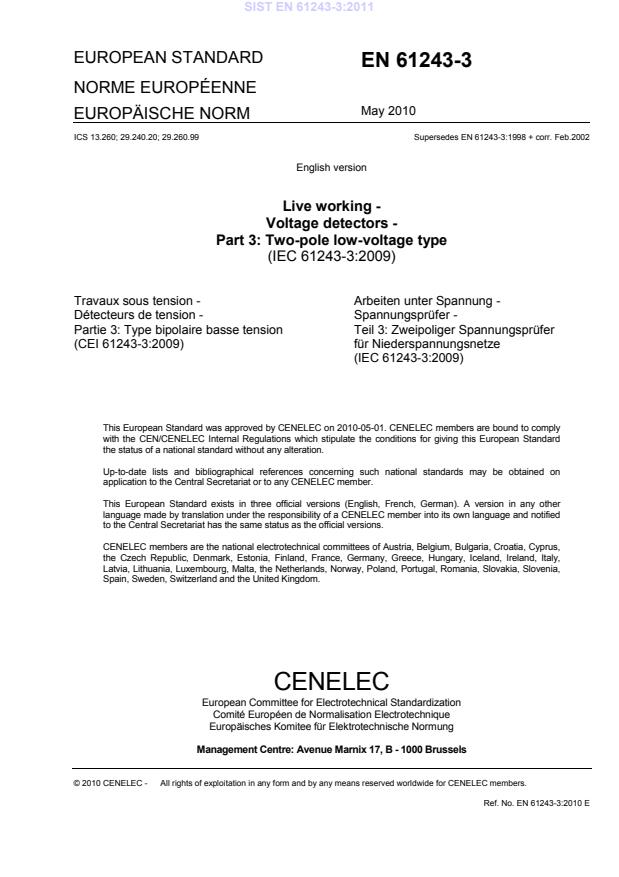
EUROPEAN STANDARD EN 61243-3 NORME EUROPÉENNE
EUROPÄISCHE NORM May 2010
CENELEC European Committee for Electrotechnical Standardization Comité Européen de Normalisation Electrotechnique Europäisches Komitee für Elektrotechnische Normung
Management Centre: Avenue Marnix 17, B - 1000 Brussels
© 2010 CENELEC -
All rights of exploitation in any form and by any means reserved worldwide for CENELEC members.
Ref. No. EN 61243-3:2010 E
ICS 13.260; 29.240.20; 29.260.99 Supersedes EN 61243-3:1998 + corr. Feb.2002
English version
Live working -
Voltage detectors -
Part 3: Two-pole low-voltage type (IEC 61243-3:2009)
Travaux sous tension -
Détecteurs de tension -
Partie 3: Type bipolaire basse tension (CEI 61243-3:2009)
Arbeiten unter Spannung -
Spannungsprüfer -
Teil 3: Zweipoliger Spannungsprüfer
für Niederspannungsnetze (IEC 61243-3:2009)
This European Standard was approved by CENELEC on 2010-05-01. CENELEC members are bound to comply with the CEN/CENELEC Internal Regulations which stipulate the conditions for giving this European Standard the status of a national standard without any alteration.
Up-to-date lists and bibliographical references concerning such national standards may be obtained on application to the Central Secretariat or to any CENELEC member.
This European Standard exists in three official versions (English, French, German). A version in any other language made by translation under the responsibility of a CENELEC member into its own language and notified to the Central Secretariat has the same status as the official versions.
CENELEC members are the national electrotechnical committees of Austria, Belgium, Bulgaria, Croatia, Cyprus, the Czech Republic, Denmark, Estonia, Finland, France, Germany, Greece, Hungary, Iceland, Ireland, Italy, Latvia, Lithuania, Luxembourg, Malta, the Netherlands, Norway, Poland, Portugal, Romania, Slovakia, Slovenia, Spain, Sweden, Switzerland and the United Kingdom.
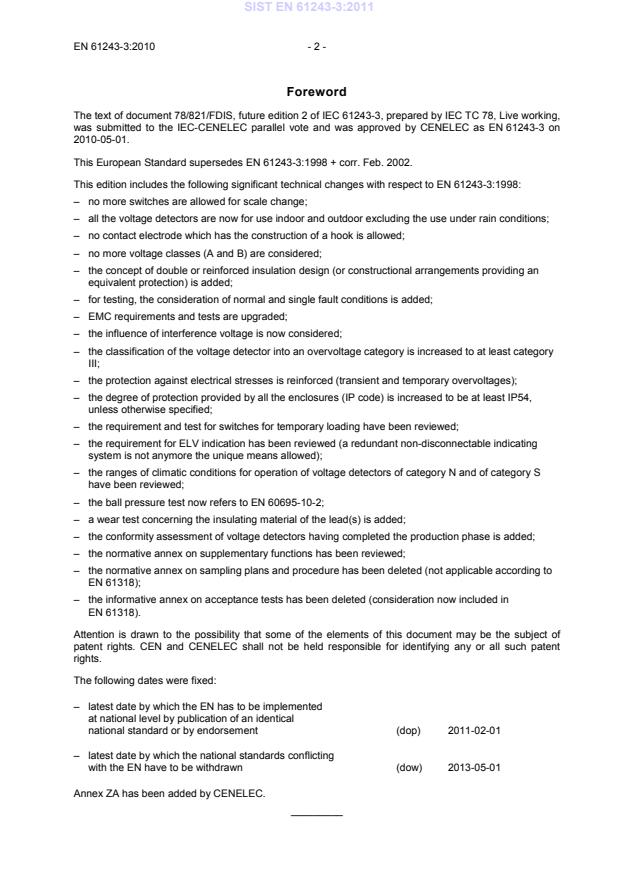
Foreword The text of document 78/821/FDIS, future edition 2 of IEC 61243-3, prepared by IEC TC 78, Live working, was submitted to the IEC-CENELEC parallel vote and was approved by CENELEC as EN 61243-3 on 2010-05-01. This European Standard supersedes EN 61243-3:1998 + corr. Feb. 2002. This edition includes the following significant technical changes with respect to EN 61243-3:1998: –
no more switches are allowed for scale change; –
all the voltage detectors are now for use indoor and outdoor excluding the use under rain conditions; –
no contact electrode which has the construction of a hook is allowed; –
no more voltage classes (A and B) are considered; –
the concept of double or reinforced insulation design (or constructional arrangements providing an equivalent protection) is added; –
for testing, the consideration of normal and single fault conditions is added; –
EMC requirements and tests are upgraded; –
the influence of interference voltage is now considered; –
the classification of the voltage detector into an overvoltage category is increased to at least category III; –
the protection against electrical stresses is reinforced (transient and temporary overvoltages); –
the degree of protection provided by all the enclosures (IP code) is increased to be at least IP54, unless otherwise specified; –
the requirement and test for switches for temporary loading have been reviewed; –
the requirement for ELV indication has been reviewed (a redundant non-disconnectable indicating system is not anymore the unique means allowed); –
the ranges of climatic conditions for operation of voltage detectors of category N and of category S have been reviewed; –
the ball pressure test now refers to EN 60695-10-2; –
a wear test concerning the insulating material of the lead(s) is added; –
the conformity assessment of voltage detectors having completed the production phase is added; –
the normative annex on supplementary functions has been reviewed; –
the normative annex on sampling plans and procedure has been deleted (not applicable according to EN 61318); –
the informative annex on acceptance tests has been deleted (consideration now included in
EN 61318). Attention is drawn to the possibility that some of the elements of this document may be the subject of patent rights. CEN and CENELEC shall not be held responsible for identifying any or all such patent rights. The following dates were fixed: – latest date by which the EN has to be implemented
at national level by publication of an identical
national standard or by endorsement
(dop)
2011-02-01 – latest date by which the national standards conflicting
with the EN have to be withdrawn
(dow)
2013-05-01 Annex ZA has been added by CENELEC. _________ SIST EN 61243-3:2011
- 3 - EN 61243-3:2010
Endorsement notice The text of the International Standard IEC 61243-3:2009 was approved by CENELEC as a European Standard without any modification. In the official version, for Bibliography, the following notes have to be added for the standards indicated: IEC 60743:2001 NOTE
Harmonized as EN 60743:2001 (not modified). ISO 9000:2005 NOTE
Harmonized as EN ISO 9000:2005 (not modified). __________
Annex ZA
(normative)
Normative references to international publications with their corresponding European publications
The following referenced documents are indispensable for the application of this document. For dated references, only the edition cited applies. For undated references, the latest edition of the referenced document (including any amendments) applies.
NOTE
When an international publication has been modified by common modifications, indicated by (mod), the relevant EN/HD applies.
Publication Year Title EN/HD Year
IEC 60068-2-6 - Environmental testing -
Part 2-6: Tests - Test Fc: Vibration (sinusoidal)
EN 60068-2-6 -
IEC 60068-2-31 2008 Environmental testing -
Part 2-31: Tests - Test Ec: Rough handling shocks, primarily for equipment-type specimens EN 60068-2-31 2008
IEC 60068-2-75 1997 Environmental testing -
Part 2-75: Tests - Test Eh: Hammer tests EN 60068-2-75 1997
IEC 60112 - Method for the determination of the proof
and the comparative tracking indices of solid insulating materials EN 60112 -
IEC 60304 - Standard colours for insulation for low-frequency cables and wires HD 402 S2 -
IEC 60417 - Graphical symbols for use on equipment - -
IEC/TS 60479-1 2005 Effects of current on human beings and livestock -
Part 1: General aspects - -
IEC 60529 + A1 1989 1999 Degrees of protection provided by enclosures (IP Code) EN 60529 + A1 1991 2000
IEC 60664-1 2007 Insulation coordination for equipment within low-voltage systems -
Part 1: Principles, requirements and tests EN 60664-1 2007
IEC 60664-3 - Insulation coordination for equipment within low-voltage systems -
Part 3: Use of coating, potting or moulding for protection against pollution EN 60664-3 -
IEC 60695-10-2 2003 Fire hazard testing - SIST EN 61243-3:2011
IEC 61243-3Edition 2.0 2009-11INTERNATIONAL STANDARD NORME INTERNATIONALELive working – Voltage detectors –
Part 3: Two-pole low-voltage type
Travaux sous tension – Détecteurs de tension –
Partie 3: Type bipolaire basse tension
INTERNATIONAL ELECTROTECHNICAL COMMISSION COMMISSION ELECTROTECHNIQUE INTERNATIONALE XBICS 13.260; 29.240.20; 29.260.99 PRICE CODECODE PRIXISBN 978-2-88910-452-9
– 2 – 61243-3 © IEC:2009 CONTENTS FOREWORD.5 INTRODUCTION.7 1 Scope.8 2 Normative references.8 3 Terms and definitions.10 4 Requirements.13 4.1 General requirements.13 4.1.1 Safety.13 4.1.2 Indication.13 4.1.3 Electromagnetic compatibility (EMC).14 4.2 Functional requirements.14 4.2.1 Clear indication.14 4.2.2 Clear perceptibility.15 4.2.3 Temperature and humidity dependence of the indication.15 4.2.4 Frequency dependency for a.c. voltage detector.16 4.2.5 Ripple dependency for d.c. voltage detector.16 4.2.6 Response time.16 4.2.7 Power source dependability.16 4.2.8 Testing element.16 4.2.9 Time rating.16 4.3 Electrical requirements.17 4.3.1 Insulating material.17 4.3.2 Protection against electric shocks.17 4.3.3 Current limiting elements.17 4.3.4 Minimum clearance and creepage distances.17 4.3.5 Protection against electrical stresses.20 4.3.6 Lead(s).20 4.3.7 Probes.20 4.3.8 Connector(s) (if any).20 4.3.9 Accessible switches in the detecting circuit for temporary loading (if any).20 4.4 Mechanical requirements.20 4.4.1 Design.20 4.4.2 Dimensions, construction.22 4.4.3 Degree of protection provided by enclosures.22 4.4.4 Resistance to vibration.22 4.4.5 Drop resistance.22 4.4.6 Shock resistance.22 4.4.7 Possible disassembling.22 4.4.8 Surface temperature.23 4.4.9 Resistance to heat.23 4.4.10 Probes.23 4.4.11 Lead(s).23 4.5 Marking.23 4.5.1 General.23 4.5.2 Marking on the indicator.23 SIST EN 61243-3:2011
61243-3 © IEC:2009 – 3 – 4.5.3 Marking on the probe and/or the lead.24 4.6 Instructions for use.24 4.7 Requirements in case of reasonably foreseeable misuse during live working.24 4.7.1 AC/DC voltage misuse.24 4.7.2 Maximum current to earth in case of misuse.25 4.7.3 Misuse in case of mistaking of the voltage of the low voltage network.26 5 Tests.26 5.1 General.26 5.2 Tests for general requirements.27 5.2.1 Indication.27 5.2.2 Electromagnetic compatibility (EMC).27 5.3 Tests for functional requirements.28 5.3.1 Clear indication.28 5.3.2 Clear perceptibility of visual indication.30 5.3.3 Clear perceptibility of audible indication (when available).32 5.3.4 Temperature and humidity dependence of the indication.34 5.3.5 Frequency dependency for a.c. voltage detector.35 5.3.6 Ripple dependency for d.c. voltage detector.36 5.3.7 Response time.36 5.3.8 Power source dependability.37 5.3.9 Testing element.37 5.3.10 Time rating.37 5.4 Tests for electrical requirements.38 5.4.1 Tests on the insulation.38 5.4.2 Protection against electric shocks.39 5.4.3 Current limiting elements.40 5.4.4 Minimum clearance and creepage distances.40 5.4.5 Protection against electrical stresses.40 5.4.6 Lead(s).41 5.4.7 Probe(s).41 5.4.8 Connector(s).41 5.4.9 Switches for temporary loading (if any).41 5.5 Tests for mechanical requirements.42 5.5.1 Design.42 5.5.2 Dimensions, construction.42 5.5.3 Degree of protection provided by enclosures.42 5.5.4 Vibration resistance.42 5.5.5 Drop resistance.43 5.5.6 Shock resistance.44 5.5.7 Possible disassembling.44 5.5.8 Surface temperature.44 5.5.9 Heat resistance.45 5.5.10 Probes.45 5.5.11 Lead(s).47 5.6 Marking.48 5.6.1 Visual inspection and measurement.48 5.6.2 Durability of marking.48 5.7 Instructions for use.48 5.7.1 Type test.48 SIST EN 61243-3:2011
– 4 – 61243-3 © IEC:2009 5.7.2 Alternative test in case of voltage detectors having completed the production phase.49 5.8 Tests for reasonably foreseeable misuse during live working.49 5.8.1 AC/DC voltage misuse.49 5.8.2 Maximum current to earth in case of misuse.49 5.8.3 Misuse in case of mistaking of the voltage of the low voltage network.50 6 Conformity assessment.50 7 Modifications.50 Annex A (informative)
Differences with IEC 61010 series.51 Annex B (normative)
Supplementary functions Phase indication – Rotating field indication – Continuity check.56 Annex C (normative)
Instructions for use.62 Annex D (normative)
General type test procedure.63 Annex E (normative)
Classification of defects and associated requirements and tests.65 Annex F (informative)
In-service care and use.67 Bibliography.69
Figure 1a – Illustration of the electrical insulation of an indicator casing.18 Figure 1b – Illustration of the electrical insulation of a probe with a detachable lead.18 Figure 1 – Illustration of the electrical insulation features
applicable to components of a voltage detector.18 Figure 2a – Example of a voltage detector with the indicator integrated in a probe.21 Figure 2b – Example of a voltage detector with the indicator not integrated in a probe.21 Figure 2 – Voltage detector.21 Figure 3 – Maximum rms a.c. current to earth in case of misuse.25 Figure 4 – Maximum d.c. current to earth in case of misuse.25 Figure 5 – Test sep-up for the influence of interference voltage.29 Figure 6 – Test set-up for measurement of clear perceptibility of visual indication.31 Figure 7a – Positioning of the voltage detector in the test set-up.33 Figure 7b – Key measurement points on the hemisphere.33 Figure 7 – Test set-up for measurement of clear perceptibility of audible indication.33 Figure 8 – Test set-up for close adhesion of insulation of the
insulated part of the contact electrode.46
Table 1 – Climatic categories of voltage detectors.16 Table 2 – Minimum clearance distances for basic insulation
and for supplementary insulation.19 Table 3 – Minimum clearance distances for reinforced insulation.19 Table 4 – Parameters to be observed to check the climatic dependence.34 Table 5 – AC voltage values for test on the complete equipment.39 Table 6 – Maximum permissible surface temperatures.45 Table B.1 – Classification of defects and associated requirements and tests.61 Table D.1 – Sequential order for performing type tests.63 Table D.2 – Type tests out of sequence.64 Table E.1 – Classification of defects and associated requirements and tests.65 Table F.1 – Periodic testing.68 SIST EN 61243-3:2011
61243-3 © IEC:2009 – 5 – INTERNATIONAL ELECTROTECHNICAL COMMISSION ____________
LIVE WORKING –
VOLTAGE DETECTORS –
Part 3: Two-pole low-voltage type
FOREWORD 1) The International Electrotechnical Commission (IEC) is a worldwide organization for standardization comprising all national electrotechnical committees (IEC National Committees). The object of IEC is to promote international co-operation on all questions concerning standardization in the electrical and electronic fields. To this end and in addition to other activities, IEC publishes International Standards, Technical Specifications, Technical Reports, Publicly Available Specifications (PAS) and Guides (hereafter referred to as “IEC Publication(s)”). Their preparation is entrusted to technical committees; any IEC National Committee interested in the subject dealt with may participate in this preparatory work. International, governmental and non-governmental organizations liaising with the IEC also participate in this preparation. IEC collaborates closely with the International Organization for Standardization (ISO) in accordance with conditions determined by agreement between the two organizations. 2) The formal decisions or agreements of IEC on technical matters express, as nearly as possible, an international consensus of opinion on the relevant subjects since each technical committee has representation from all interested IEC National Committees.
3) IEC Publications have the form of recommendations for international use and are accepted by IEC National Committees in that sense. While all reasonable efforts are made to ensure that the technical content of IEC Publications is accurate, IEC cannot be held responsible for the way in which they are used or for any misinterpretation by any end user. 4) In order to promote international uniformity, IEC National Committees undertake to apply IEC Publications transparently to the maximum extent possible in their national and regional publications. Any divergence between any IEC Publication and the corresponding national or regional publication shall be clearly indicated in the latter. 5) IEC itself does not provide any attestation of conformity. Independent certification bodies provide conformity assessment services and, in some areas, access to IEC marks of conformity. IEC is not responsible for any services carried out by independent certification bodies. 6) All users should ensure that they have the latest edition of this publication. 7) No liability shall attach to IEC or its directors, employees, servants or agents including individual experts and members of its technical committees and IEC National Committees for any personal injury, property damage or other damage of any nature whatsoever, whether direct or indirect, or for costs (including legal fees) and expenses arising out of the publication, use of, or reliance upon, this IEC Publication or any other IEC Publications.
8) Attention is drawn to the Normative references cited in this publication. Use of the referenced publications is indispensable for the correct application of this publication. 9) Attention is drawn to the possibility that some of the elements of this IEC Publication may be the subject of patent rights. IEC shall not be held responsible for identifying any or all such patent rights. International Standard IEC 61243-3 has been prepared by IEC technical committee 78: Live working. This second edition cancels and replaces the first edition published in 1998. It is a technical revision. This edition includes the following significant technical changes with respect to the previous edition:
– no more switches are allowed for scale change; – all the voltage detectors are now for use indoor and outdoor excluding the use under rain conditions; – no contact electrode which has the construction of a hook is allowed; – no more voltage classes (A and B) are considered; – the concept of double or reinforced insulation design (or constructional arrangements providing an equivalent protection) is added; SIST EN 61243-3:2011
– 6 – 61243-3 © IEC:2009 – for testing, the consideration of normal and single fault conditions is added; – EMC requirements and tests are upgraded; – the influence of interference voltage is now considered; – the classification of the voltage detector into an overvoltage category is increased to at least category III; – the protection against electrical stresses is reinforced (transient and temporary overvoltages); – the degree of protection provided by all the enclosures (IP code) is increased to be at least IP54, unless otherwise specified; – the requirement and test for switches for temporary loading have been reviewed; – the requirement for ELV indication has been reviewed (a redundant non-disconnectable indicating system is not anymore the unique means allowed); – the ranges of climatic conditions for operation of voltage detectors of category N and of category S have been reviewed; – the ball pressure test now refers to IEC 60695-10-2; – a wear test concerning the insulating material of the lead(s) is added; – the conformity assessment of voltage detectors having completed the production phase is added; – the normative annex on supplementary functions has been reviewed; – the normative annex on sampling plans and procedure has been deleted (not applicable according to IEC 61318); – the informative annex on acceptance tests has been deleted (consideration now included in IEC 61318). The text of this standard is based on the following documents: FDIS Report on voting 78/821/FDIS 78/832/RVD
Full information on the voting for the approval of this standard can be found in the report on voting indicated in the above table. This publication has been drafted in accordance with the ISO/IEC Directives, Part 2. A list of all parts of the IEC 61243 series can be found, under the general title Live working – Voltage detectors, on the IEC website. The committee has decided that the contents of this publication will remain unchanged until the maintenance result date indicated on the IEC web site under "http://webstore.iec.ch" in the data related to the specific publication. At this date, the publication will be
• reconfirmed; • withdrawn; • replaced by a revised edition; or • amended.
IMPORTANT – The “colour inside” logo on the cover page of this publication indicates that it contains colours which are considered to be useful for the correct understanding of its contents. Users should therefore print this publication using a colour printer. SIST EN 61243-3:2011
61243-3 © IEC:2009 – 7 – INTRODUCTION The devices covered by this standard are designed to be used in a live working environment to determine the status (presence or absence of operating voltage) of low-voltage installations. The live working environment comes with its specific hazards and working conditions which are generally more severe than the ones encountered by workers in other fields than live working. This International Standard is a product standard giving essential requirements and tests to verify that the devices perform well and will contribute to the safety of the users, provided they are used by skilled persons, and according to safe working procedures and to local or national regulations. Voltage detectors are not considered as measuring or testing devices, separately covered by IEC 61010 series. However, in case of misuse by general electrical workers, the requirements and tests included in this document are intended to achieve an equivalent level of safety. To take into consideration the specific needs of a live working environment, the following differences exist with IEC 61010 series: – some requirements and tests exist in both standards but with different sanctions or pass test criteria (see A.1); – some requirements of IEC 61010 are not included in this standard with the rationale (see A.2); – some additional requirements of this standard are not specified in IEC 61010 with the rationale (see A.3). This International Standard has been prepared according to the requirements of IEC 61477, where applicable. The product covered by this standard may have an impact on the environment during some or all stages of its life cycle. These impacts can range from slight to significant, be of short-term or long-term, and occur at the global, regional or local level.
This standard does not include requirements and test provisions for the manufacturers of the product, or recommendations to the users of the product for environmental improvement. However, all parties intervening in its design, manufacture, packaging, distribution, use, maintenance, repair, reuse, recovery and disposal are invited to take account of environmental considerations. SIST EN 61243-3:2011
– 8 – 61243-3 © IEC:2009 LIVE WORKING –
VOLTAGE DETECTORS –
Part 3: Two-pole low-voltage type
1 Scope This part of IEC 61243 is applicable to hand-held two-pole voltage detectors with its accessories (crocodile clips and detachable leads) to be used in contact with parts of electrical systems: – for a.c. voltages not exceeding 1 000 V at nominal frequencies between 32 16 Hz and up to 500 Hz, and/or – for d.c. voltages not exceeding 1 500 V. NOTE The a.c. voltages defined in this standard refer either to phase-to-phase voltages or phase to neutral voltages. Contact electrode extensions are not covered by this standard. Voltage detectors covered by this standard are intended to be used under dry and humid conditions, both indoor and outdoor. They are not intended to be used under rain conditions. Voltage detectors covered by this standard are not intended to be used for continuous operation. Voltage detectors covered by this standard are intended to be used up to 2 000 m above sea level. This standard also includes provisions for the following supplementary functions when available (see Annex B): – phase indication,
– rotating field indication, and
– continuity check. Other supplementary functions are not covered by this standard. Voltage detectors covered by this standard are not considered as measuring devices. Relevant safety requirements for measuring devices are included in IEC 61010 series. 2 Normative references The following referenced documents are indispensable for the application of this document. For dated references, only the edition cited applies. For undated references, the latest edition of the referenced document (including any amendments) applies. IEC 60068-2-6, Environmental testing – Part 2-6: Tests – Test Fc: Vibration (sinusoidal) IEC 60068-2-31:2008, Environmental testing – Part 2-31: Tests – Test Ec: Rough handling shocks, primarily for equipment-type specimens SIST EN 61243-3:2011
61243-3 © IEC:2009 – 9 – IEC 60068-2-75:1997, Environmental testing – Part 2: Tests – Test Eh: Hammer tests IEC 60112, Method for the determination of the proof and the comparative tracking indices of solid insulating materials IEC 60304, Standard colours for insulation for low-frequency cables and wires IEC 60417, Graphical symbols for use on equipment IEC/TS 60479-1:2005, Effects of current on human beings and livestock – Part 1: General aspects IEC 60529:1989, Degrees of protection provided by enclosures (IP Code)
Amendment 1:19991 IEC 60664-1:2007, Insulation coordination for equipment within low-voltage systems – Part 1: Principles, requirements and tests IEC 60664-3, Insulation coordination for equipment within low-voltage systems – Part 3: Use of coating, potting or moulding for protection against pollution IEC 60695-10-2:2003, Fire hazard testing – Part 10-2: Abnormal heat – Ball pressure test IEC 60942, Electroacoustics – Sound calibrators IEC 61010-031:2002, Safety requirements for electrical equipment for measurement, control and laboratory use – Part 031: Safety requirements for hand-held probe assemblies for electrical measurement and test
Amendment 1:20082 IEC 61010-1:2001, Safety requirements for electrical equipment for measurement, control, and laboratory use – Part 1: General requirements IEC 61140:2001, Protection against electric shock – Common aspects for installation and equipment
Amendment 1:2004 IEC 61180-1, High-voltage test techniques for low-voltage equipment – Part 1: Definitions, test and procedure requirements IEC 61180-2, High-voltage test techniques for low-voltage equipment – Part 2: Test equipment IEC 61260, Electroacoustics – Octave-band and fractional-octave-band filters IEC 61318, Live working – Conformity assessment applicable to tools, devices and equipment IEC 61326-1:2005, Electrical equipment for measurement, control and laboratory use – EMC requirements – Part 1: General requirements IEC 61477, Live working – Minimum requirements for the utilization of tools, devices and equipment ————————— 1
There exists a consolidated edition 2.1 (2001) that includes Edition 2 and its Amendment 1. 2
There exists a consolidated edition 1.1 (2008) that includes Edition 1 and its Amendment 1. SIST EN 61243-3:2011
– 10 – 61243-3 © IEC:2009 IEC 61557-7:2007, Electrical safety in low voltage distribution systems up to 1 000 V a.c. and 1 500 V d.c. – Equipment for testing, measuring or monitoring of protective measures – Part 7: Phase sequence IEC 61672-1, Electroacoustics – Sound level meters – Part 1: Specifications ISO 286-1, ISO system of limits and fits – Part 1: Bases of tolerances, deviations and fits ISO 286-2, ISO system of limits and fits – Part 2: Tables of standard tolerance grades and limit deviations for holes and shafts ISO 354, Acoustics – Measurement of sound absorption in a reverberation room ISO 3744:1994, Acoustics – Determination of sound power levels of noise sources using sound pressure – Engineering method in an essentially free field over a reflecting plane ISO 3745, Acoustics – Determination of sound power levels of noise sources using sound pressure – Precision methods for anechoic and hemi-anechoic rooms ISO 7000:2004, Graphical symbols for use on equipment – Index and synopsis 3 Terms and definitions For the purposes of this document, the terms and definitions given in IEC 61318 and the following apply. 3.1
basic insulation insulation applied to live parts of a voltage detector to provide basic protection against electric shock NOTE Basic insulation does not necessarily include insulation used exclusively for functional purposes (3.10.1 of IEC 61140). [3.17.2 of IEC 60664-1, modified] 3.2
clear indication unambiguous detection and indication of the voltage state between the contact electrodes [IEV 651-10-10, modified] 3.3
clear perceptibility case where the indication is unmistakably discernible by the user under specific environmental conditions when the voltage detector is in its operating position 3.4
contact electrode conductive part of the probe which establishes the electric connection to the part to be checked [IEV 651-10-09, modified] NOTE In certain designs, a part of the contact electrode is covered with insulating material. SIST EN 61243-3:2011
61243-3 © IEC:2009 – 11 – 3.5
extra low voltage
ELV voltage below 50 V a.c. or 120 V d.c. 3.6
hand-guard distinctive physical barrier (fixed to or part of the probe) to prevent the fingers or hands of the operator from inadvertently touching the contact electrode or any energized part 3.7
hazardous live capable of rendering an electrical shock or electrical burn in normal condition or single fault condition 3.8
indicating voltage Ui approximate value of the operating voltage identified by the voltage detector NOTE The indicating voltage of the voltage detector is the parameter associated with its clear indication. Certain types of voltage detectors may have several indicating voltages and/or several indicating voltage ranges. Limit values of a voltage range are named Ui min. and Ui max. 3.9
indicator part of the voltage detector which indicates the presence of the operating voltage between the contact electrodes [IEV 651-10-08, modified] NOTE The indicator may provide as well information related to supplementary functions.
3.10
inspection conformity evaluation by observation and judgement, accompanied as appropriate by measurement, testing, gauging or calculation [3.8.2 of ISO 9000, modified] 3.11
interference voltage voltage at power frequency picked up inductively or capacitively by the part to be tested 3.12
internal energy source integrated functional power supply 3.13
lead
flexible cable connecting different components of the voltage detector together 3.14
normal condition condition in which all means of protection are intact [2.7 of IEC Guide 104] SIST EN 61243-3:2011
– 12 – 61243-3 © IEC:2009 3.15
operating current minimum value of current required to operate the different indicating systems 3.16
probe insulated part of a voltage detector intended to be handled by the user to bring its contact electrode in contact with the component to be checked NOTE 1 The probe may contain the indicator. NOTE 2 The probe does not include a lead. The probe and the lead may be detachable or not. 3.17
protective impedance component, assembly of components or the combination of basic insulation and a current or voltage-limiting device, whose impedance, construction and reliability are such that, when connected between accessible conductive parts which are hazardous when live, it provides protection to the extent required by this standard in normal condition and single fault condition 3.18
reasonably foreseeable misuse use of a product, process or service in a way not intended by the supplier, but which may result from readily predictable human behaviour [3.14 of ISO/IEC Guide 51] 3.19
recovery time
rt minimum no-load time between two uses as specified by the manufacturer 3.20
response time time delay between a sudden change of the voltage state between the contact electrodes and the associated clear indication 3.21
single fault condition condition in which one means of protection against hazards is defective, or one fault is present which could cause a hazard NOTE If a single fault condition results unavoidably in one or more other fault conditions, all are considered as one single fault condition. [2.8 of IEC Guide 104] 3.22
temporary overvoltage power frequency overvoltage of relatively long duration NOTE This overvoltage is undamped or weakly damped. In some cases its frequency may be several times smaller or higher than power frequency. [IEV 604-03-12] 3.23
testing element built-in element or separate device, by means of which the functioning of the voltage detector can be checked by the user SIST EN 61243-3:2011
61243-3 © IEC:2009 – 13 – [IEV 651-10-11, modified] 3.24
threshold voltage Ut minimum voltage between the two contact electrodes required to give a clear indication 3.25
time rating
tr specified on-load time during which the voltage detector is able to operate correctly 3.26
transient overvoltage a short duration overvoltage of few milliseconds or less, oscillatory or non-oscillatory, usually highly damped [IEV 604-03-13] 3.27
two-pole voltage detector voltage detector for bi-polar application, made of two probes, an indicator included or not in one of the probes and lead(s) NOTE The term voltage detector is used in this document for two-pole low voltage detector. 3.28
voltage detector (for live working) device used to provide clear evidence of the presence or absence of the operating voltage [adapted from 11.2.5 of IEC 60743 and IEV 651-10-04]
4 Requirements 4.1 General requirements 4.1.1 Safety Voltage detectors covered by this standard shall be designed and manufactured in order to contribute to the safety of the users, provided the voltage detectors are used by skilled persons, in accordance with safe methods of work and the instructions for use. 4.1.2 Indication The voltage detector shall give a clear indication of the state "voltage present" of the operating voltage by means of the status change of the signal. The indication shall be visual. An audible indication is optional. Simultaneous indications shall be provided when the voltage detector has more than one system of indication. The visual indication (display) can be of different types but the clear indication of the presence of the operating voltage shall not display a discrete voltage value.
NOTE 1 Displays could consist of: change of the lighting state of LED(s), movement of a needle or of other current activated component, alphanumeric characters on a screen, etc. NOTE 2 Displays providing a discrete voltage value are considered as supplementary measuring functions and should fulfil the relevant standards. SIST EN 61243-3:2011
– 14 – 61243-3 © IEC:2009 4.1.3 Electromagnetic compatibility (EMC) Voltage detectors shall comply with the requirements of class A equipment for use in industrial locations according to IEC 61326-1. NOTE In some countries additional requirements may be added to fulfil EMC regulations. 4.2 Functional requirements 4.2.1 Clear indication 4.2.1.1 Clear indication of the operating voltage and threshold voltage The voltage detector shall clearly indicate at its nominal frequency or nominal frequencies the presence of – every indicating voltage and/or, – every indicating voltage range. For voltage detectors having successive indications or s
...