


EN 61243-1:2005
(Main)Live working - Voltage detectors - Part 1: Capacitive type to be used for voltages exceeding 1 kV a.c.
General Information
- Abstract
Is applicable to portable voltage detectors, with or without built-in power sources, to be used on electrical systems for voltages of 1 kV to 765 kV a.c., and frequencies of 50 Hz and/or 60 Hz. This part applies only to voltage detectors of capacitive type used in contact with the part to be tested, as a complete device including its insulating element or as a separate device, adaptable to an insulating stick which, as a separate tool, is not covered by this standard (see 4.4.1 for general design).
- Status
- Withdrawn
- Publication Date
- 30-Mar-2005
- Withdrawal Date
- 29-Feb-2008
- Technical Committee
- CLC/TC 78 - Equipment and tools for live working
- Drafting Committee
- IEC/TC 78 - IEC_TC_78
- Parallel Committee
- IEC/TC 78 - IEC_TC_78
- Current Stage
- 9960 - Withdrawal effective - Withdrawal
- Start Date
- 26-May-2024
- Completion Date
- 26-May-2024


Relations
- Effective Date
- 28-Jan-2023
- Effective Date
- 28-Jan-2023
- Effective Date
- 14-Aug-2018
- Effective Date
- 09-Feb-2026
- Refers
EN 12216:2002 - Shutters, external blinds, internal blinds - Terminology, glossary and definitions - Effective Date
- 09-Feb-2026
- Effective Date
- 09-Feb-2026
- Effective Date
- 09-Feb-2026
- Effective Date
- 09-Feb-2026
- Effective Date
- 03-Feb-2026
- Effective Date
- 03-Feb-2026
- Effective Date
- 03-Feb-2026
- Effective Date
- 03-Feb-2026
- Effective Date
- 03-Feb-2026
- Effective Date
- 03-Feb-2026
- Effective Date
- 03-Feb-2026
Get Certified
Connect with accredited certification bodies for this standard

IMQ S.p.A. (Certification)
Italian electrical product certification.

SLG Prüf- und Zertifizierungs GmbH
German testing and certification body.

UL Solutions
Global safety science company with testing, inspection and certification.
Sponsored listings
Frequently Asked Questions
EN 61243-1:2005 is a standard published by CLC. Its full title is "Live working - Voltage detectors - Part 1: Capacitive type to be used for voltages exceeding 1 kV a.c.". This standard covers: Is applicable to portable voltage detectors, with or without built-in power sources, to be used on electrical systems for voltages of 1 kV to 765 kV a.c., and frequencies of 50 Hz and/or 60 Hz. This part applies only to voltage detectors of capacitive type used in contact with the part to be tested, as a complete device including its insulating element or as a separate device, adaptable to an insulating stick which, as a separate tool, is not covered by this standard (see 4.4.1 for general design).
Is applicable to portable voltage detectors, with or without built-in power sources, to be used on electrical systems for voltages of 1 kV to 765 kV a.c., and frequencies of 50 Hz and/or 60 Hz. This part applies only to voltage detectors of capacitive type used in contact with the part to be tested, as a complete device including its insulating element or as a separate device, adaptable to an insulating stick which, as a separate tool, is not covered by this standard (see 4.4.1 for general design).
EN 61243-1:2005 is classified under the following ICS (International Classification for Standards) categories: 29.240.99 - Other equipment related to power transmission and distribution networks. The ICS classification helps identify the subject area and facilitates finding related standards.
EN 61243-1:2005 has the following relationships with other standards: It is inter standard links to EN 61243-1:1997/A1:1997, EN 61243-1:1997, EN IEC 61243-1:2021, EN 20286-1:1993, EN 12216:2002, EN ISO 3744:2009, EN 20286-2:1993, EN 1527:1998, EN 61260:1995, EN 60071-1:1995, EN 60068-1:1994, EN 60068-2-6:1995, EN 60942:2003, EN 61477:2002, EN 61672-1:2003. Understanding these relationships helps ensure you are using the most current and applicable version of the standard.
EN 61243-1:2005 is available in PDF format for immediate download after purchase. The document can be added to your cart and obtained through the secure checkout process. Digital delivery ensures instant access to the complete standard document.
Standards Content (Sample)
6,67(16/29(16.,MDQXDU67$1'$5'LVWRYHWHQ(1'HORSRGQDSHWRVWMR1DSHWRVWQLGHWHNWRUMLGHO.DSDFLWLYQLWLS]DXSRUDERSULL]PHQLþQLKQDSHWRVWLKQDGN9,(&VSUHPHQMHQ/LYHZRUNLQJ9ROWDJHGHWHFWRUV3DUW&DSDFLWLYHW\SHWREHXVHGIRUYROWDJHVH[FHHGLQJN9DF,(&PRGLILHG !"#$%&'( )&!*- . 5HIHUHQþQDãWHYLOND6,67(1HQ,&6
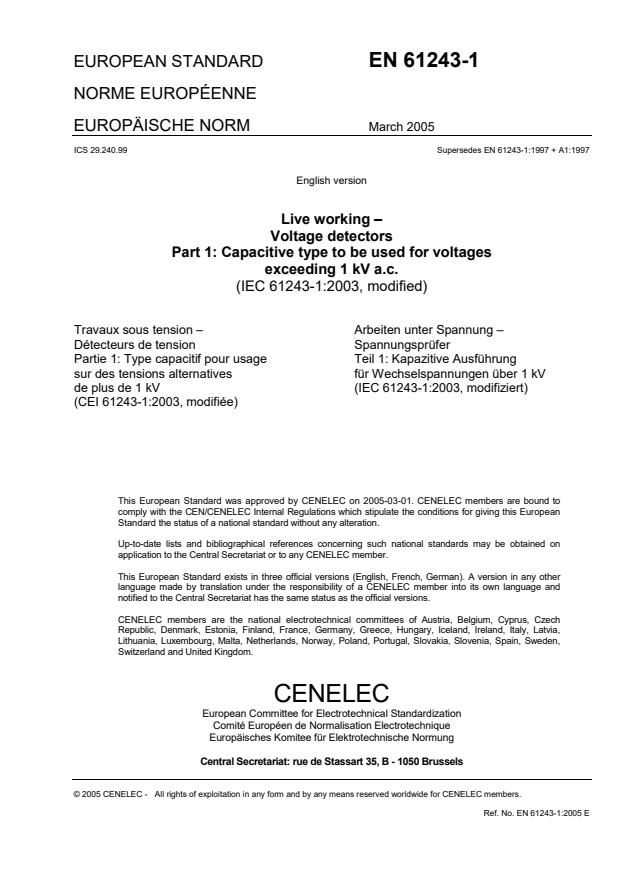
EUROPEAN STANDARD
EN 61243-1 NORME EUROPÉENNE EUROPÄISCHE NORM
March 2005 CENELEC European Committee for Electrotechnical Standardization Comité Européen de Normalisation Electrotechnique Europäisches Komitee für Elektrotechnische Normung
Central Secretariat: rue de Stassart 35, B - 1050 Brussels
© 2005 CENELEC - All rights of exploitation in any form and by any means reserved worldwide for CENELEC members.
Ref. No. EN 61243-1:2005 E
ICS 29.240.99 Supersedes EN 61243-1:1997 + A1:1997
English version
Live working –
Voltage detectors Part 1: Capacitive type to be used for voltages
exceeding 1 kV a.c. (IEC 61243-1:2003, modified)
Travaux sous tension – Détecteurs de tension Partie 1: Type capacitif pour usage
sur des tensions alternatives
de plus de 1 kV (CEI 61243-1:2003, modifiée)
Arbeiten unter Spannung –Spannungsprüfer Teil 1: Kapazitive Ausführung
für Wechselspannungen über 1 kV (IEC 61243-1:2003, modifiziert)
This European Standard was approved by CENELEC on 2005-03-01. CENELEC members are bound to comply with the CEN/CENELEC Internal Regulations which stipulate the conditions for giving this European Standard the status of a national standard without any alteration.
Up-to-date lists and bibliographical references concerning such national standards may be obtained on application to the Central Secretariat or to any CENELEC member.
This European Standard exists in three official versions (English, French, German). A version in any other language made by translation under the responsibility of a CENELEC member into its own language and notified to the Central Secretariat has the same status as the official versions.
CENELEC members are the national electrotechnical committees of Austria, Belgium, Cyprus, Czech Republic, Denmark, Estonia, Finland, France, Germany, Greece, Hungary, Iceland, Ireland, Italy, Latvia, Lithuania, Luxembourg, Malta, Netherlands, Norway, Poland, Portugal, Slovakia, Slovenia, Spain, Sweden, Switzerland and United Kingdom.
Foreword
The text of the International Standard IEC 61243-1:2003, prepared by IEC TC 78, Live working, together with the common modifications prepared by the Technical Committee CENELEC TC 78, Equipment and tools for live working, was submitted to the formal vote and was approved by CENELEC as EN 61243-1 on 2005-03-01.
This European Standard supersedes EN 61243-1:1997 + A1:1997 + corrigendum June 1999.
The following dates were fixed:
– latest date by which the EN has to be implemented at national level by publication of an identical national standard or by endorsement
(dop)
2006-03-01 – latest date by which the national standards conflicting with the EN have to be withdrawn
(dow)
2008-03-01
Annex ZA has been added by CENELEC.
__________
– 3 – EN 61243-1:2005
Endorsement notice
The text of the International Standard IEC 61243-1:2003 was approved by CENELEC as a European Standard with agreed common modifications as given below.
COMMON MODIFICATIONS
2 Normative references
Delete the reference to IEC 61318.
4 Requirements
4.5 Markings
Replace the last indent by:
- number of the relevant European Standard immediately adjacent to the symbol (EN 61243-1).
8 Quality assurance plan and acceptance test
8.1 General
Replace the second sentence by:
In the absence of an accepted quality assurance plan as specified above, Annex D provides pieces of information related to the quality assurance plan.
Annex D (normative) - Sampling procedure
Replace (normative) by (informative).
Annex F (normative) - Acceptance tests
Replace (normative) by (informative).
Annex ZA
(normative)
Normative references to international publications
with their corresponding European publications The following referenced documents are indispensable for the application of this document. For dated references, only the edition cited applies. For undated references, the latest edition of the referenced document (including any amendments) applies. NOTE Where an international publication has been modified by common modifications, indicated by (mod), the relevant EN/HD applies. Publication Year Title EN/HD Year IEC 60060-1 + corr. March 1989 1990 High-voltage test techniques Part 1: General definitions and test requirements HD 588.1 S1 1991 IEC 60068-1 - 1) Environmental testing Part 1: General and guidance EN 60068-1 1994 2)IEC 60068-2-6 + corr. March 1995 1995
Part 2: Tests - Test Fc: Vibration (sinusoidal) EN 60068-2-6 1995 IEC 60068-2-14 + A1 1984 1986 Part 2: Tests - Test N: Change of temperature EN 60068-2-14 1999 IEC 60068-2-32 + A2 1975 1990 Part 2: Tests - Test Ed: Free fall (Procedure 1) EN 60068-2-32 1993 IEC 60071-1 1993 Insulation co-ordination Part 1: Definitions, principles and rules EN 60071-1 1995 IEC 60417 database Graphical symbols for use on equipment - - IEC 60942 - 1) Electroacoustics - Sound calibrators EN 60942 2003 2)IEC 61260 1995 Electroacoustics - Octave-band and fractional-octave-band filters
EN 61260 1995 IEC 61477 A1 2001 2002 Live working - Minimum requirements for the utilization of tools, devices and equipment EN 61477 A1 2002 2002 IEC 61672-1 2002 Electroacoustics - Sound level meters Part 1: Specifications EN 61672-1 2003 ISO 286-1 1988 ISO system of limits and fits Part 1: Bases of tolerances, deviations and fits EN 20286-1 1993 ISO 286-2 1988 Part 2: Tables of standard tolerance grades and limit deviations for holes and shafts EN 20286-2 1993 ISO 3744 1994 Acoustics -Determination of sound power levels of noise sources using sound pressure - Engineering method in an essentially free field over a reflecting plane EN ISO 3744 1995 CIE 15.2 3) 1986 Colorimetry - -
1) Undated reference. 2) Valid edition at date of issue. 3) CIE = International Commission on Illumination.
NORMEINTERNATIONALECEIIECINTERNATIONALSTANDARD61243-1Deuxième éditionSecond edition2003-10Travaux sous tension –Détecteurs de tension –Partie 1:Type capacitif pour usage sur des tensionsalternatives de plus de 1 kVLive working –Voltage detectors –Part 1:Capacitive type to be used for voltagesexceeding 1 kV a.c.Pour prix, voir catalogue en vigueurFor price, see current catalogue IEC 2003
Droits de reproduction réservés
Copyright - all rights reservedAucune partie de cette publication ne peut être reproduite niutilisée sous quelque forme que ce soit et par aucun procédé,électronique ou mécanique, y compris la photocopie et lesmicrofilms, sans l'accord écrit de l'éditeur.No part of this publication may be reproduced or utilized in anyform or by any means, electronic or mechanical, includingphotocopying and microfilm, without permission in writing fromthe publisher.International Electrotechnical Commission,
3, rue de Varembé, PO Box 131, CH-1211 Geneva 20, SwitzerlandTelephone: +41 22 919 02 11
Telefax: +41 22 919 03 00
E-mail: inmail@iec.ch
Web: www.iec.chCODE PRIXPRICE CODEXACommission Electrotechnique InternationaleInternational Electrotechnical Commission
61243-1 IEC:2003– 3 –CONTENTSFOREWORD.7INTRODUCTION.111Scope.132Normative references.133Terms and definitions.154Requirements.234.1General requirements.234.1.1Safety.234.1.2Indication.234.2Functional requirements.254.2.1Clear indication.254.2.2Clear perceptibility.254.2.3Temperature and humidity dependence of the indication.274.2.4Frequency dependence.274.2.5Response time.274.2.6Power source dependability.274.2.7Testing element.294.2.8Non-response to d.c. voltage.294.2.9Time rating.294.3Electrical requirements.294.3.1Insulating material.294.3.2Protection against bridging.294.3.3Resistance against sparking.294.4Mechanical requirements.294.4.1Design.314.4.2Dimensions, construction.314.4.3Grip force and deflection.334.4.4Vibration resistance.334.4.5Drop resistance.334.4.6Shock resistance.334.5Markings.334.6Instructions for use.355Specific requirements.355.1For insulating element of a voltage detector as a complete device.355.1.1Dielectric strength.355.1.2Leakage current.355.2For indicator casing of voltage detector as a separate device.356Tests.356.1General.356.1.1Tests under wet conditions.376.1.2Type test.376.1.3Routine test.396.1.4Sampling test.396.1.5Test methods.39
61243-1 IEC:2003– 5 –6.2Function tests.396.2.1Clear indication.396.2.2Clear perceptibility of visual indication.456.2.3Clear perceptibility of audible indication.476.2.4Frequency dependence.496.2.5Response time.496.2.6Power source dependability.496.2.7Check of testing element.516.2.8Non-response to d.c. voltage.516.2.9Time rating.516.3Dielectric tests.536.3.1Protection against bridging for indoor/outdoor type voltage detector.536.3.2Protection against bridging for outdoor type voltage detector.576.3.3Spark resistance.596.4Mechanical tests.616.4.1Visual and dimensional inspection.616.4.2Grip force and deflection (only applicable for voltage detector as acomplete device).616.4.3Vibration resistance.616.4.4Drop resistance.636.4.5Shock resistance.636.4.6Climatic dependence.636.4.7Durability of markings.657Specific tests.657.1Leakage current for voltage detector as a complete device.657.1.1Leakage current under dry conditions.677.1.2Leakage current under wet conditions (for outdoor type only).678Quality assurance plan and acceptance test.698.1General.698.2Records.69Annex A (normative)
Suitable for live working; double triangle.101Annex B (normative)
Instructions for use.103Annex C (normative)
Chronology of tests.105Annex D (normative)
Sampling procedure.107Annex E (normative)
Mechanical shock tests – Pendulum method.111Annex F (normative)
Acceptance tests.115Annex G (informative)
In-service care.117Bibliography.119
61243-1 IEC:2003– 7 –INTERNATIONAL ELECTROTECHNICAL COMMISSION____________LIVE WORKING – VOLTAGE DETECTORS –Part 1: Capacitive type to be used for voltagesexceeding 1 kV a.c.FOREWORD1)The International Electrotechnical Commission (IEC) is a worldwide organization for standardization comprisingall national electrotechnical committees (IEC National Committees). The object of IEC is to promoteinternational co-operation on all questions concerning standardization in the electrical and electronic fields. Tothis end and in addition to other activities, IEC publishes International Standards, Technical Specifications,Technical Reports, Publicly Available Specifications (PAS) and Guides (hereafter referred to as “IECPublication(s)”). Their preparation is entrusted to technical committees; any IEC National Committee interestedin the subject dealt with may participate in this preparatory work. International, governmental and non-governmental organizations liaising with the IEC also participate in this preparation. IEC collaborates closelywith the International Organization for Standardization (ISO) in accordance with conditions determined byagreement between the two organizations.2)The formal decisions or agreements of IEC on technical matters express, as nearly as possible, an internationalconsensus of opinion on the relevant subjects since each technical committee has representation from allinterested IEC National Committees.3)IEC Publications have the form of recommendations for international use and are accepted by IEC NationalCommittees in that sense. While all reasonable efforts are made to ensure that the technical content of IECPublications is accurate, IEC cannot be held responsible for the way in which they are used or for anymisinterpretation by any end user.4)In order to promote international uniformity, IEC National Committees undertake to apply IEC Publicationstransparently to the maximum extent possible in their national and regional publications. Any divergencebetween any IEC Publication and the corresponding national or regional publication shall be clearly indicated inthe latter.5)IEC provides no marking procedure to indicate its approval and cannot be rendered responsible for anyequipment declared to be in conformity with an IEC Publication.6)All users should ensure that they have the latest edition of this publication.7)No liability shall attach to IEC or its directors, employees, servants or agents including individual experts andmembers of its technical committees and IEC National Committees for any personal injury, property damage orother damage of any nature whatsoever, whether direct or indirect, or for costs (including legal fees) andexpenses arising out of the publication, use of, or reliance upon, this IEC Publication or any other IECPublications.8)Attention is drawn to the Normative references cited in this publication. Use of the referenced publications isindispensable for the correct application of this publication.9)Attention is drawn to the possibility that some of the elements of this IEC Publication may be the subject ofpatent rights. IEC shall not be held responsible for identifying any or all such patent rights.International Standard IEC 61243-1 has been prepared by IEC technical committee 78: Liveworking.This second edition cancels and replaces the first edition published in 1993 and amendment 1(1997).This edition includes the following major technical changes from the previous edition:a) the Scope has been extended to cover the use on electrical systems for voltages up to765 kV a.c.;b) the notion of family of voltage detectors which are identical in terms of design anddimensions and only differ by their nominal voltages (or nominal voltage ranges) has beenincluded;
61243-1 IEC:2003 – 9 –
c) the classification in terms of the setting of the threshold voltage to give a clear indication has been eliminated; d) a new test set-up with bars has been introduced. Depending on the nominal voltage of the voltage detector, it is required or becomes an alternative test set-up for checking the influence of interference fields, the influence of interference voltages, the protection against bridging and the spark resistance; e) the revision of specific dielectric tests has been included; f) some test procedures (clear perceptibility of audible indication, drop resistance, climatic dependence) have been
improved and completed. The text of this standard is based on the following documents: FDIS Report on voting 78/527/FDIS 78/537/RVD
Full information on the voting for the approval of this standard can be found in the report on voting indicated in the above table. This publication has been drafted in accordance with the ISO/IEC Directives, Part 2. IEC 61243 consists of the following parts, under the general title Live working – Voltage detectors: Part 1: Capacitive type to be used for voltages exceeding 1 kV a.c. Part 2: Resistive type to be used for voltages of 1 kV to 36 kV a.c. Part 3: Two-pole low-voltage type
Part 5: Voltage detecting systems (VDS)
The committee has decided that the contents of this publication will remain unchanged until 2007. At this date, the publication will be
• reconfirmed; • withdrawn; • replaced by a revised edition, or • amended. The contents of the corrigendum of October 2005 have been included in this copy.
61243-1 IEC:2003– 11 –INTRODUCTIONThis International Standard has been prepared according to the requirements of IEC 61477,where applicable.
61243-1 IEC:2003– 13 –LIVE WORKING – VOLTAGE DETECTORS –Part 1: Capacitive type to be used for voltagesexceeding 1 kV a.c.1 ScopeThis part of IEC 61243 is applicable to portable voltage detectors, with or without built-inpower sources, to be used on electrical systems for voltages of 1 kV to 765 kV a.c., andfrequencies of 50 Hz and/or 60 Hz.This part applies only to voltage detectors of capacitive type used in contact with the part tobe tested, as a complete device including its insulating element or as a separate device,adaptable to an insulating stick which, as a separate tool, is not covered by this standard(see 4.4.1 for general design).Other types of voltage detectors are not covered by this part of the standard.Some restrictions on their use are applicable in the case of factory-assembled switchgear andon overhead systems of electrified railways (see Annex B, instructions for use).NOTE
Except where otherwise specified, all the voltages defined in this standard refer to values of phase-to-phase voltages of three-phase systems. In other systems, the applicable phase-to-phase or phase-to-earth(ground) voltages should be used to determine the operating voltage.2 Normative referencesThe following referenced documents are indispensable for the application of this document.For dated references, only the edition cited applies. For undated references, the latest editionof the referenced document (including any amendments) applies.IEC 60060-1:1989, High-voltage test techniques – Part 1: General definitions and testrequirementsIEC 60068-1, Environmental testing -Part 1: General and guidanceIEC 60068-2-6:1995, Environmental testing – Tests – Test Fc and guidance: Vibration(sinusoidal)IEC 60068-2-14:1984, Environmental testing – Tests – Test N: Change of temperatureAmendment 1 (1986)IEC 60068-2-32:1975, Environmental testing – Tests
– Test Ed: Free fallAmendment 2 (1990)IEC 60071-1:1993, Insulation co-ordination – Part 1: Terms, definitions, principles and rules
61243-1 IEC:2003– 15 –IEC 60417-DB:20021, Graphical symbols for use on equipmentIEC 60942, Electroacoustics – Sound calibratorsIEC 61260:1995, Electroacoustics – Octave-band and fractional-octave-band filtersIEC 61318:2003, Live working – Quality assurance plans applicable to tools, devices andequipmentIEC 61477:2001, Live working – Minimum requirements for the utilization of tools, devices andequipmentAmendment 1 (2002)2IEC 61672-1:2002, Electroacoustics – Sound level meters – Part 1: SpecificationsISO 286-1:1988, ISO system of limits and fits – Part 1: Bases of tolerances, deviations andfitsISO 286-2:1988, ISO system of limits and fits – Part 2: Tables of standard tolerance gradesand limit deviations for holes and shaftsISO 3744:1994, Acoustics – Determination of sound power levels of noise sources usingsound pressure – Engineering method in an essentially free field over a reflecting planeCIE (International Commission on Illumination) 15.2:1986, Colorimetry3 Terms and definitionsFor the purposes of this part of IEC 61243, the following terms and definitions apply.3.1 voltage detectorportable device used to detect the presence or the absence of the operating voltage (high andlow voltage at a.c. or d.c.) and used to verify that the installation is ready for earthingNOTE
These devices are generally described as either capacitive type or resistive type.[Definition 11.2.5 of IEC 60743]3.2 voltage detector of capacitive typedevice whose operation is based on the current passing through the stray capacitance toearth (ground)NOTE
The term voltage detector is used in this document for voltage detector of capacitive type.___________1 “DB” refers to the IEC on-line database.2 There exists a consolidated edition 1.1 (2002) that includes edition 1 and its amendment.
61243-1 IEC:2003– 17 –3.3 designs of voltage detectorsdifferent constructions of voltage detectors, either as a complete device with or withoutcontact electrode extension, or as a separate device intended to be equipped with aninsulating stick, with or without contact electrode extensionNOTE
Some parts such as the contact electrode, the contact electrode extension (if existing), or the insulatingelement of a voltage detector as a complete device may be dismantled.3.4 family of voltage detectorsvoltage detectors that are identical in terms of design and dimensions and only differ by theirnominal voltages (or nominal voltage ranges). A family of voltage detectors is limited by aminimum and a maximum voltage within which the nominal voltages (or voltage ranges) of thevoltage detectors will be selected3.5 contact electrodebare conductive part of the conductive element which establishes the electric connection tothe component to be tested[IEV 651-10-09]3.6 contact electrode extensionexternally insulated conductive element between the indicator and the contact electrode,intended to achieve the correct position of the indicator relative to the installation being tested3.7 indicatorpart of the voltage detector which indicates the presence or absence of the operating voltageat the contact electrode[IEV 651-10-08, modified]3.8 adaptorpart of a voltage detector as a separate device which permits attachment of an insulating stick3.9 insulating elementpart of a voltage detector as a complete device that provides adequate safety distance andinsulation to the user3.10 insulating stickseparate tool attached to a voltage detector as a separate device in order to provide thelength to reach the installation to be tested and adequate safety distance and insulation to theuser3.11 limit markdistinctive location or mark to indicate to the user the physical limit to which the voltagedetector may be inserted between live parts or may touch them
61243-1 IEC:2003– 19 –3.12 hand guarddistinctive physical guard separating the handle from the insulating elementNOTE
Its purpose is to prevent the hands from slipping and passing into contact with the insulating element.3.13 testing elementbuilt-in or external device, by means of which the functioning of the voltage detector can bechecked by the user[IEV 651-10-11, modified]3.14 accessoriesitems used to lengthen the handle or the contact electrode, to improve the efficiency of thecontact electrode or to enable the contact electrode to reach the part to be tested3.15 nominal voltageUnsuitable approximate value of voltage used to identify a system or device[IEV 601-01-21, modified]NOTE
The nominal voltage of the voltage detector is the parameter associated with its clear indication. A voltagedetector may have more than one nominal voltage, or a nominal voltage range. Limit values of the nominal voltagerange are named Un min and Un max.3.16 operating voltage (in a system)value of the voltage under normal conditions, at a given instant and a given point of thesystemNOTE
This value may be expected, estimated or measured.[IEV 601-01-22]3.17 threshold voltageUtminimum voltage between the live part and earth (ground) required to give a clear indicationcorresponding to specific conditions as defined in the corresponding testNOTE
As defined in this part of IEC 61243, threshold voltage is related to specific test conditions. Users should beaware that their requirements for threshold voltage for field operation need to be related to the test conditions inthe standard.3.18 rated voltageUrvalue of voltage generally agreed upon by manufacturer and customer, to which certainoperating specifications are referred. The rated voltage of the voltage detector is the voltageselected from IEC 60071-1, Tables 2 and 3, column 1, which should either be equal to thenominal voltage (or the highest nominal voltage of its nominal voltage range), or the nexthigher voltage selected from those tables3.19 interference voltagevoltage picked up inductively or capacitively by the part to be tested
61243-1 IEC:2003– 21 –3.20 interference fieldsuperposed electric field which may affect the indication. It may result from the part to betested or other adjacent parts, and may have any phase relationshipNOTE
The extreme cases for the tests are:–an in-phase interference field exists when a small change of potential in the direction of the voltage detectoraxis results in an incorrect indication. This occurs as a result of the dimensions and/or configuration of the partof installation to be tested (or of adjacent parts of the installation having voltages in the same phase);–an interference field in phase opposition exists when a strong change of potential in the direction of the voltagedetector axis results in an incorrect indication. This occurs as a result of the adjacent parts of the installationhaving voltages in phase opposition.3.21 active signalaudible or visual phenomenon whose presence, absence or variation is considered asrepresenting information on the condition “voltage present” or “voltage not present”[IEV 101-12-02, modified]NOTE
A signal indicating that the voltage detector is ready to operate is not considered an active signal.3.22 clear indicationunambiguous detection and indication of the voltage state at the contact electrode[IEV 651-10-10]3.23 clear perceptibilitycase where the indication is unmistakably discernible by the user under specificenvironmental conditions when the voltage detector is in its operating position3.24 response timetime delay between sudden change of the voltage state on the contact electrode and theassociated clear indication3.25 protection against bridgingprotection against flashover or breakdown, when the insulation between the parts ofinstallation to be tested, at different potentials, is reduced by the presence of the voltagedetector3.26 stand-by statestate at which the voltage detector is ready to work without manual switching on3.27 indoor typevoltage detector designed for use in dry conditions, normally indoors3.28 outdoor typevoltage detector designed for use in wet conditions, either indoors or outdoors
61243-1 IEC:2003– 23 –3.29 type testtest performed on one or more items representative of the production, made to show that theproduct meets certain specifications[IEC 61318, definition 3.10 and IEV 151-16-16 modified]3.30 routine testtest performed on each item during or after manufacture to ascertain whether it complies withcertain criteria[IEC 61318, definition 3.11 and IEV 151-16-17 modified]3.31 sampling testtest on a sample[IEC 61318, definition 3.12 and IEV 151-16-20]3.32 acceptance testcontractual test to prove to the customer that the item(s) or product in question meet(s)certain conditions of its specification[IEC 61318, definition 3.13 and IEV 151-16-23 modified]3.33 maintenance testtest carried out periodically on a device or equipment to ascertain and, if necessary, makecertain adjustments to ensure that its performance remains within specified limits[IEV 151-16-25 modified]4 Requirements4.1 General requirements4.1.1 SafetyThe voltage detector shall be designed and manufactured to be safe for the user, provided itis used in accordance with safe methods of work, and the instructions for use.4.1.2 IndicationThe voltage detector shall give a clear indication of the state "voltage present" and/or "voltagenot present", by means of the change of the status of the signal. The indication shall be visualand/or audible.
61243-1 IEC:2003– 25 –4.2 Functional requirements4.2.1 Clear indicationThe voltage detector shall clearly indicate the presence and/or the absence of the systemoperating voltage as a function of the nominal voltage or nominal voltage range of the voltagedetector, and its nominal frequency or nominal frequencies.4.2.1.1 Threshold voltageThe indication “voltage present” shall appear if the voltage to ground on the part to be testedis within 45 % to 63 % of the nominal voltage.The indication "voltage present" shall not appear if the voltage to ground on the part to betested is less than 10 % of the nominal voltage.To fulfil the above requirements, the threshold voltage Ut shall satisfy the followingrelationship:0,10 Un max ≤ U t ≤ 0,45 Un minNOTE 1
45 % of the nominal voltage corresponds to 378,0nU and 63 % corresponds to 31,1nU. 10 % of thenominal voltage corresponds to 317,0nU and is the maximum phase to earth induced voltage normallyencountered in the field.NOTE 2
It may happen that the induced voltage level or the variations of the nominal voltage network are higherthan these values. In this case, manufacturer and user should reach an agreement to set the appropriate value.The user shall not have access to the threshold voltage setting.4.2.1.2 Continuous indicationThe voltage detector shall give continuous indication when in direct contact with a live part. Itmay not indicate in the vicinity of large conductive parts which create equipotential zones.When the voltage detector is used in accordance with instructions for use, the presence of anadjacent live or earthed part shall not affect its indication.When used in accordance with instructions for use, the voltage detector shall not indicate"voltage present" for usual values of interference voltages.4.2.2 Clear perceptibilityThe voltage detector shall give a clear indication under normal light and noise conditions.The types of indications of voltage detector are divided into three groups:–group I: Indication with at least two distinct active signals, which give an indication of thecondition "voltage present" and "voltage not present". The "stand-by" state is notnecessary;–group II: Indication with at least one active signal, which gives an indication of thecondition "voltage not present" and is activated by manually switching "on", and issuppressed when the contact electrode is put into contact with a live part;–group III: Indication with at least one active signal, which gives an indication of thecondition "voltage present", and shall have a stand-by state.
61243-1 IEC:2003– 27 –4.2.2.1 Visual indicationThe indication shall be clearly visible to the user in the operating position and under normallight conditions.When two visual signals are used, the indication shall not rely solely on lights of differentcolours for perceptibility. Additional characteristics, such as physical separation of the lightsources, distinctive form of the light signals, or flashing light shall be used.4.2.2.2 Audible indicationThe indication shall be clearly audible to the user when in the operating position, and undernormal noise conditions.When two audible signals are used, the indication shall not rely solely on sounds of differentsound pressure level for perceptibility. Additional characteristics, such as tone orintermittence of the audible signals shall be used.4.2.3 Temperature and humidity dependence of the indicationThere are three categories of voltage detectors according to climatic conditions of operation:cold (C), normal (N), and warm (W).The voltage detector shall operate correctly in the temperature range of its climatic category,according to Table 1.The voltage detector shall operate correctly in case of sudden change of temperature in thetemperature range of its climatic category.In these cases, the threshold voltage shall satisfy 4.2.1.1.Table 1 – Climatic categoriesClimatic conditions ranges(operation and storage)Climatic categoriesTemperature°CHumidity%(C)Cold(N)Normal(W)Warm–40
to +55–25
to +55–5
to +7020 to 9620 to 9612 to 964.2.4 Frequency dependenceA voltage detector shall operate between 97 % and 103 % of its nominal frequency or of eachof its nominal frequencies.4.2.5 Response timeThe response time shall be less than 1 s.4.2.6 Power source dependabilityA voltage detector with a built-in power source shall give a clear indication until the source isexhausted, unless its usage is limited by an indication of non-readiness or automatic shut-off,as mentioned in the instructions for use.
61243-1 IEC:2003– 29 –4.2.7 Testing elementThe testing element, whether a built-in or separate item, shall be capable of testing all theelectrical circuits, including energy source and the functioning of the indication. When allcircuits cannot be tested, any limitation shall be clearly stated in the instructions for use.These circuits shall be constructed with high reliability. When there is a built-in testingelement, the voltage detector shall give an indication of "ready" or "not ready".4.2.8 Non-response to d.c. voltageThe voltage detector shall not respond to a d.c. voltage.4.2.9 Time ratingThe voltage detector shall be able to perform without failure when subjected to the operatingvoltage for 5 min.4.3 Electrical requirements4.3.1 Insulating materialThe insulating materials shall be adequately rated (nature of material, dimensions) for thenominal voltage (or the maximum nominal voltage of the voltage range) of the voltagedetector.NOTE
When tubes of insulating material with circular cross section are used in the design of voltage detectors,they should meet the requirements of IEC 60855 or IEC 61235.For a voltage detector as a complete device the user shall be provided with adequateinsulation by means of an insulating element.NOTE
For a voltage detector as a separate device, the user should be provided with adequate insulation by meansof an adaptable insulating stick.4.3.2 Protection against bridgingProtection shall be such that the voltage detector cannot cause flashover or breakdownbetween live parts of an installation or between a live part of an installation and earth.4.3.3 Resistance against sparkingThe voltage detector shall be constructed so that the indicator cannot be damaged or shut offas a result of a low energy electric arc.4.4 Mechanical requirementsFor a voltage detector as a complete device the user shall be provided with adequatedistance by means of an insulating element.NOTE
For a voltage detector as a separate device, the user should be provided with adequate distance by meansof an adaptable insulating stick.
61243-1 IEC:2003– 31 –4.4.1 Design4.4.1.1 General designa) The voltage detector as a complete device shall include at least the following elements:handle, hand guard, insulating element, limit mark, indicator and contact electrode (seeFigure 1a).b) The voltage detector as a separate device shall include at least: adaptor, indicator, andcontact electrode (see Figure 1b).NOTE
The insulating stick used in conjunction with the voltage detector as a separate device should fulfil therequirements of 4.3.1 and 4.4.2 even if not provided with the voltage detector.The voltage detector shall not have any external conductive connection, or any other deviceto make such connection, except for the contact electrode.4.4.1.2 Category–The voltage detector without contact electrode extension shall have category marking L.NOTE
It is used mainly on overhead lines.–The voltage detector with contact electrode extension shall have category marking S.NOTE
It is mainly used in indoor substations.4.4.2 Dimensions, constructionThe minimum length of the insulating element of a voltage detector as a complete device shallbe in accordance with Table 2.Table 2 – Minimum length of the insulating element (Li)UrkVLimm1 <
Ur
≤
3652036 <
Ur
≤
72,572,5 <
Ur
≤
1238301 300123 <
Ur
≤
1701 700170 <
Ur
≤
2452 300245 <
Ur
≤
4203 600420 <
Ur
≤
5254 300525 <
Ur
≤
7656 600NOTE 1
The nominal voltage Un is used when the parameters to be specified are related to the installationdimensioning or to the functional performance of the voltage detector, while the rated voltage Ur is used wheninsulation performance of the voltage detector is concerned.NOTE 2
The Li values of Table 2 correspond to the minimum distance in air (obtained from Tables 1 and 2 of IEC61936-1) plus an additional safety distance.Conductive parts not exceeding 200 mm (in total), measured from the limit mark towards thehandle, are allowed within the minimum length of the insulating element if they are completelyexternally insulated.The limit mark shall be about 20 mm wide, permanent, and clearly recognisable by the user.
61243-1 IEC:2003– 33 –If there is no limit mark on a voltage detector as a separate device, the end of the adaptorshall act as the limit mark (Figure 1b).For a voltage detector as a complete device, the handle shall be at least 115 mm in length.NOTE
The handle may be made longer for two-hand operation.For a voltage detector as a complete device, the hand guard shall be permanently fixed andhave a minimum height (hHG) of 20 mm.In order to adapt the voltage detector to different uses, the contact electrode readily may beinterchangeable or completed with other types of contact electrodes depending on the type ofinstallation and instructions for use.4.4.3 Grip force and deflectionThe voltage detector shall be designed to facilitate reliable operation with reasonable physicaleffort by the user.The voltage detector shall be designed to allow a safe approach toward the installation to betested. The deflection under its own weight shall be as low as possible.The weight of the indicator shall be minimal and compatible with the performancerequirements.NOTE
In case of a voltage detector as a separate device, the user should be aware that its choice of an insulatingstick may greatly influence the grip force and deflection.4.4.4 Vibration resistanceThe indicator and the contact electrode extension shall be vibration resistant.4.4.5 Drop resistanceThe voltage detector shall be drop resistant in working conditions.4.4.6 Shock resistanceThe indicator and the contact electrode extension shall withstand mechanical shocks.4.5 MarkingsEach indicator shall have at least the following markings:–nominal voltage and/or range of nominal voltage;–indication group;–nominal frequency or nominal frequencies;–name and/or trademark of the manufacturer;–type reference, serial number;–indication of type "indoor" or "outdoor";–indication of category (S or L);–climatic category (C, N or W);–year of production;
61243-1 IEC:2003– 35 ––symbol IEC 60417–5216(DB:2002-10) – Suitable for live working; double triangle (seeAnnex A);NOTE
The exact ratio of the height of the figure to the base of the triangle is 1,43. For the purpose ofconvenience, this ratio can be between the values of 1,4 and 1,5.–number of the relevant IEC standard immediately adjacent to the symbol with year ofpublication (4 digits), (IEC 61243-1:2003).In addition, the voltage detector shall provide the user or the testing laboratory an areapermitting the marking of the date of periodic testing.In case of a voltage detector with a built-in energy source, the type of power supply shall beindicated, either on the indicator or inside the compartment designed to house it, and thepolarity when required.These markings shall be legible and permanent. The characters shall be at least 3 mm high.The markings shall not impair the quality of the voltage detector.4.6 Instructions for useEach voltage detector shall be accompanied by the manufacturer's instructions for use (seeAnnex B). These instructions shall be prepared in accordance with the general provisionsgiven in IEC 61477.5 Speci
...