


EN 60265-2:1993
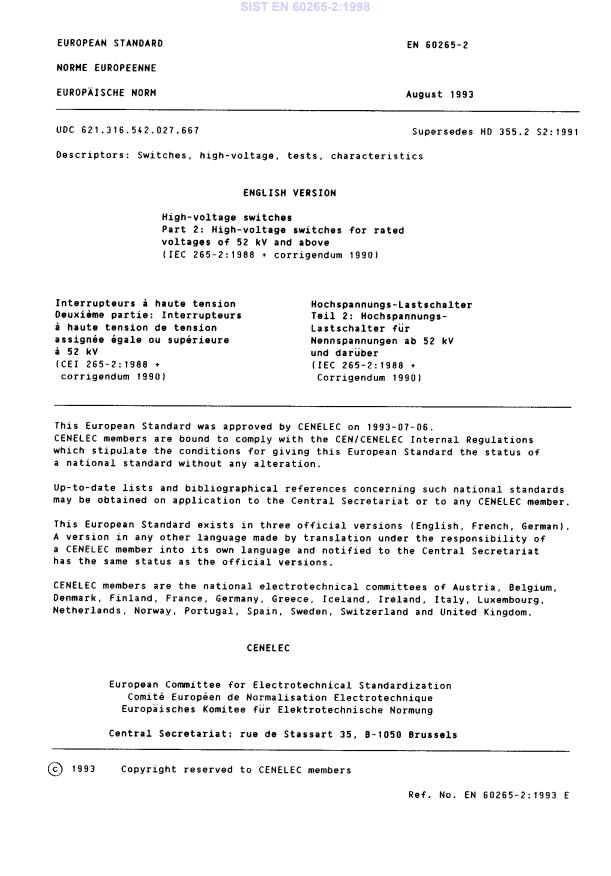
(Main)High-voltage switches - Part 2: High-voltage switches for rated voltages of 52 kV and above
General Information
- Abstract
Applicable to three-phase alternating-current switches, having making and breaking current ratings, for indoor and outdoor installations, for rated voltages 52 kV and above, and for rated frequencies up to and including 60 Hz.
- Status
- Withdrawn
- Publication Date
- 16-Aug-1993
- Withdrawal Date
- 16-Feb-1994
- Technical Committee
- CLC/TC 17AC - High-voltage switchgear and controlgear
- Drafting Committee
- IEC/SC 17A - IEC_SC_17A
- Parallel Committee
- IEC/SC 17A - IEC_SC_17A
- Current Stage
- 9960 - Withdrawal effective - Withdrawal
- Start Date
- 01-Jun-2012
- Completion Date
- 01-Jun-2012

Relations
- Effective Date
- 29-Jan-2023
- Effective Date
- 10-Feb-2026
- Effective Date
- 09-Feb-2026
- Effective Date
- 03-Feb-2026
- Effective Date
- 03-Feb-2026
- Effective Date
- 03-Feb-2026
- Effective Date
- 29-Jan-2023
- Effective Date
- 28-Jan-2023
Get Certified
Connect with accredited certification bodies for this standard

IMQ S.p.A. (Certification)
Italian electrical product certification.

SLG Prüf- und Zertifizierungs GmbH
German testing and certification body.

UL Solutions
Global safety science company with testing, inspection and certification.
Sponsored listings
Frequently Asked Questions
EN 60265-2:1993 is a standard published by CLC. Its full title is "High-voltage switches - Part 2: High-voltage switches for rated voltages of 52 kV and above". This standard covers: Applicable to three-phase alternating-current switches, having making and breaking current ratings, for indoor and outdoor installations, for rated voltages 52 kV and above, and for rated frequencies up to and including 60 Hz.
Applicable to three-phase alternating-current switches, having making and breaking current ratings, for indoor and outdoor installations, for rated voltages 52 kV and above, and for rated frequencies up to and including 60 Hz.
EN 60265-2:1993 is classified under the following ICS (International Classification for Standards) categories: 29.120.40 - Switches. The ICS classification helps identify the subject area and facilitates finding related standards.
EN 60265-2:1993 has the following relationships with other standards: It is inter standard links to EN 62271-104:2009, IEC 60050-441:1984, EN ISO 3680:2004, HD 348 S7:1998, EN 62271-3:2006, EN 62271-205:2008, EN 60265-2:1993/A2:1998, EN 60265-2:1993/A1:1995. Understanding these relationships helps ensure you are using the most current and applicable version of the standard.
EN 60265-2:1993 is available in PDF format for immediate download after purchase. The document can be added to your cart and obtained through the secure checkout process. Digital delivery ensures instant access to the complete standard document.
Standards Content (Sample)
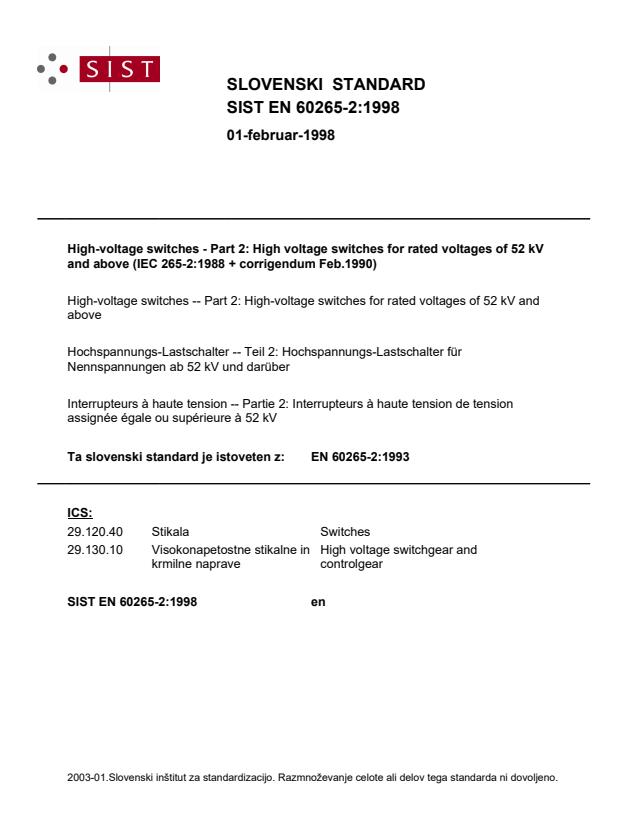
SLOVENSKI STANDARD
01-februar-1998
High-voltage switches - Part 2: High voltage switches for rated voltages of 52 kV
and above (IEC 265-2:1988 + corrigendum Feb.1990)
High-voltage switches -- Part 2: High-voltage switches for rated voltages of 52 kV and
above
Hochspannungs-Lastschalter -- Teil 2: Hochspannungs-Lastschalter für
Nennspannungen ab 52 kV und darüber
Interrupteurs à haute tension -- Partie 2: Interrupteurs à haute tension de tension
assignée égale ou supérieure à 52 kV
Ta slovenski standard je istoveten z: EN 60265-2:1993
ICS:
29.120.40 Stikala Switches
29.130.10 Visokonapetostne stikalne in High voltage switchgear and
krmilne naprave controlgear
2003-01.Slovenski inštitut za standardizacijo. Razmnoževanje celote ali delov tega standarda ni dovoljeno.
CEI
NORME
IEC
INTERNATIONALE
265-2
INTERNATIONAL
Première édition
STANDARD
First edition
Interrupteurs à haute tension
Deuxième partie:
Interrupteurs à haute tension de tension assignée
égale ou supérieure à 52 kV
High-voltage switches
Part 2:
High-voltage switches for rated voltages
of 52 kV and above
© CEI 1988 Droits de reproduction réservés — Copyright — all rights reserved
Aucune partie de cette publication ne peut être reproduite ni No part of this publication may be reproduced or utilized in
utilisée sous quelque forme que ce soit et par aucun pro- any form or by any means, electronic or mechanical,
cédé, électronique ou mécanique, y compris la photocopie et including photocopying and microfilm, without permission
les microfilms. sans l'accord écrit de l'éditeur. in writing from the publisher.
Genève, Suisse
Bureau Central de la Commission Electrotechnique Internationale 3, rue de Varembé
Commission Electrotechnique Internationale CODE PRIX
International Electrotechnical Commission
PRICE CODE
MewayHapoaHaa 3netsrporexHe9ecnae HoMHccHR
I
Pour prix, voir catalogue en vigueur
For price, see current catalogue
IEC Publication 265-2
Publication 265-2 de la CEI
1988) (First edition - 1988)
(Première édition -
High-voltage switches
Interrupteurs à haute tension
Part 2: High-voltage switches
Deuxième partie: Interrupteurs à haute
for rated voltages of 52 kV and above
tension de tension assignée égale
ou supérieure à 52 kV
CORRIGENDUM 1
Page 6
Préface, après le premier paragraphe, insérer:
Elle constitue la deuxième partie de la CEI 265; elle annule et remplace
la première édition de la CEI 265 (1968) ainsi que la CEI 265 A (1969),
265 B (1969) et 265 C (1970) pour les interrupteurs à haute tension de
tension assignée égale ou supérieure à 52 kV.
Page 7
Preface, after the first paragraph, insert:
It forms Part 2 of IEC 265 and supersedes the first edition of IEC 265
(1968) as well as IEC 265 A (1969), 265 B (1969) and 265 C (1970) for
high-voltage switches for rated voltages of 52 kV and above.
February 1990
Février 1990
265-2 (1) © I E C 3
CONTENTS
Page
FOREWORD 7
PREFACE 7
Clause
1. Scope and object 9
2. Normal and special service conditions 11
3. Definitions 11
3.101 Switch 11
3.102 Switch-disconnector 11
3.103 General-purpose switch 11
3.104 Limited-purpose switch 11
3.105 Special-purpose switch 11
3.106 Single capacitor bank switch 11
3.107 Back-to-back capacitor bank switch 11
3.108 Shunt reactor switch 13
3.109 Breaking capacity 13
3.110 Mainly active load breaking capacity 13
3.111 No-load transformer breaking capacity 13
3.112 Closed-loop breaking capacity 13
3.113 Cable-charging breaking capacity 13
3.114 Line-charging breaking capacity 13
3.115 Bus-bar charging breaking capacity 13
3.116 Single capacitor bank breaking capacity 13
3.117 Back-to-back capacitor bank breaking capacity 13
3.118 Capacitor bank inrush current 13
3.119 Shunt reactor breaking capacity 13
3.120 Earth-fault breaking capacity 15
3.121 Cable and line charging breaking capacity under earth fault conditions 15
3.122 Breaking current 15
3.123 (Peak) making current 15
3.124 Short-circuit making capacity 15
4. Rating 15
4.1 Rated voltage 15
4.2 Rated insulation level 15
4.3 Rated frequency 15
4.4 Rated normal current and temperature rise 15
4.5 Rated short-time withstand current 15
4.6 Rated peak withstand current 15
4.7 circuit Rated duration of short 15
4.8 Rated supply voltage of closing and opening devices and auxiliary circuits 17
4.9 Rated supply frequency of operating devices and auxiliary circuits 17
4.10 Rated pressure of compressed gas supply for operation 17
4.101 Rated mainly active load-breaking current 17
4.102 Rated closed-loop breaking current 17
4.103 Rated no-load transformer breaking current 17
4.104 Rated cable-charging breaking current 17
4.105 Rated line-charging breaking current 17
265-2 (1) © I E C – 5 –
4.106 Rated single capacitor bank breaking current 17
4.107 Rated back-to-back capacitor bank breaking current
4.108 Rated capacitor bank inrush making current
4.109 Rated shunt reactor breaking current
4.110 Rated short-circuit making current
4.111 Rated earth fault breaking current
4.112 Rated cable and line-charging breaking current under earth fault conditions 19
4.113 Rated mechanical terminal load
4.114 Coordination of rated values for general-purpose switch 19
4.115 Coordination of rated values for limited-purpose and special-purpose switches 21
5. Design and construction
5.1 Requirements for liquids in high-voltage switches
5.2 Requirements for gases in high-voltage switches
5.3 Earthing of high-voltage switches
5.4 Auxiliary equipment
5.5 Dependent power closing
5.6 Stored-energy closing 21
5.7 Operation of releases
5.8 Low and high pressure interlocking devices
5.9 Nameplates
5.101 Closing mechanism
5.102 Mechanical strength
5.103 Position of the movable contact system and its indicating or signalling device
6. Type tests 23
6.1 Dielectric tests
Radio interference voltage (RIV) tests 27
6.2
Temperature rise tests 27
6.3
6.4 Measurement of the resistance of the main circuit
6.5 Short-time withstand current and peak withstand current tests
6.101 Making and breaking tests
6.102 Mechanical operation tests
6.103 Operation under severe ice conditions
6.104 Verification of operation during application of rated mechanical terminal loads.
7. Routine tests 57
Power frequency voltage withstand dry tests on the main circuit 57
7.1
7.101 Mechanical operating tests 57
8. Guide to the selection of high-voltage switches for service
8.101 General
8.102 Conditions affecting application
8.103 Insulation coordination
9. Information to be given with enquiries, tenders and orders
9.101 Information to be given with enquiries and orders
9.102 Information to be given with tenders 61
10. Rules for transport, storage, erection and maintenance
FIGURES 87
– 7 –
265-2 (1) © I E C
INTERNATIONAL ELECTROTECHNICAL COMMISSION
HIGH-VOLTAGE SWITCHES
Part 2:
High-voltage switches for rated voltages of 52 kV and above
FOREWORD
The formal decisions or agreements of the I E Con technical matters, prepared by Technical Committees on which all the
1)
National Committees having a special interest therein are represented, express, as nearly as possible, an international
consensus of opinion on the subjects dealt with.
2) They have the form of recommendations for international use and they are accepted by the National Committees in that
sense.
3) In order to promote international unification, the I E C expresses the wish that all National Committees should adopt the
text of the IEC recommendation for their national rules in so far as national conditions will permit. Any divergence
between the I E C recommendation and the corresponding national rules should, as far as possible, be clearly indicated in
the latter.
PREFACE
This standard has been prepared by IEC Sub-Committee 17A: High-voltage switchgear and
controlgear, of IEC Technical Committee No. 17: Switchgear and controlgear.
The text of this standard is based upon the following documents:
on Voting
Six Months' Rule Report
17A(CO)197 I, II 17A(CO)203
Full information on the voting for the approval of this standard can be found in the Voting Repo rt
indicated in the above table.
The following IEC publications are quoted in this standard:
Publications Nos. 50 (441) (1984): International Electrotechnical Vocabulary (IEV), Chapter 441: Switchgear,
controlgear and fuses.
56 (1987): High-voltage alternating-current circuit breakers.
59 (1938): IEC standard current ratings.
71-1(1976): Insulation co-ordination, Pa rt 1: Terms, definitions, principles and rules.
129 (1984): Alternating current disconnectors (isolators) and earthing switches.
137 (1984): Bushings for alternating voltages above 1000 V.
270 (1981): Partial discharge measurements.
694 (1980): Common clauses for high-voltage switchgear and controlgear standards.
265-2 (1) © I E C — 9
HIGH-VOLTAGE SWITCHES
Part 2:
High-voltage switches for rated voltages of 52 kV and above
1. Scope
This standard is applicable to three-phase alternating-current switches, having making and
breaking current ratings, for indoor and outdoor installations, for rated voltages 52kV and
above; and for rated frequencies up to and including 60 Hz.
This standard is also applicable to the operating devices of these switches and to their
auxiliary equipment.
Notes 1. — Switches for gas insulated switchgear are covered by this standard.
2. — Switches having a disconnecting function and called switch-disconnectors are also covered by IEC
Publication 129.
3. — Earthing switches are not covered by this standard. Earthing switches forming an integral pa rt of a switch
are covered by IEC Publication 129.
1.101 Object
The main object of this standard is to establish requirements for switches used in
transmission and dist ribution systems. General-purpose switches for this application shall
comply with the following service applications:
— carrying rated normal current continuously;
— carrying short-circuit currents for a specified time;
— switching of mainly active loads;
— switching of no-load transformers;
— switching of the charging current of unloaded cables, overhead lines or busbars;
— switching of closed-loop circuits;
— making short-circuit currents.
A further object of this standard is to establish requirements for limited-purpose and special-
purpose switches used in transmission and dist ribution systems.
Limited-purpose switches shall comply with one or more of the se rvice applications indicated
above.
Special-purpose switches may comply with one or more of the se rvice applications indicated
above and, in addition, shall be suitable for one or more of the following applications:
switching single capacitor banks;
—
— switching back-to-back capacitor banks;
— switching shunt reactors including secondary or tertiary reactors switched from the primary
side of the transformer;
— applications requiring an increased number of operating cycles;
— switching under earth fault conditions in systems with isolated neutral or in resonant earthed
systems.
– 11 –
265-2 (1) © I E C
2. Normal and special service conditions
IE C Publication 694 is applicable.
3. Definitions
For the definitions of general terms used in this standard, reference is made to the IEC
Publications 50 (441) and 71-1.
3.101 Switch (441-14-10)
A switching device capable of making, carrying and breaking currents under normal circuit
conditions, which may include specified operating overload conditions and also carrying for a
specified time currents under specified abnormal circuit conditions, such as those of short-
circuit.
3.102 Switch-disconnector (441-14-12)
A switch which, in the open position, satisfies the isolating requirements specified for a
disconnector.
3.103 General-purpose switch
A switch capable of performing, with currents up to its rated breaking currents, all making
and breaking operations which may normally occur. The switch shall also be capable of
carrying and making short-circuit currents.
Note. — Refer to Sub-clause 4.114 for specific ratings of a general-purpose switch.
3.104 Limited purpose switch
A switch which complies with one or more, but not with all, service applications of a general-
purpose switch.
3.105 Special-purpose switch
A switch suitable for switching requirements other than those specified for a géneral-purpose
switch.
Examples of such requirements are capacitor bank switching, shunt reactor switching, switching under
Note. —
earth fault conditions, and a capability of an increased number of operating cycles.
3.106 Single capacitor bank switch
A special-purpose switch intended for switching of a single capacitor bank with charging
currents up to its rated single capacitor bank breaking current.
3.107 Back-to-back capacitor bank switch
A special-purpose switch intended for breaking capacitor bank-charging currents, with one
or more capacitor banks connected to the bus or supply side of the switch, up to its rated back-
to-back capacitor bank breaking current. The switch shall be capable of making the associated
inrush current, up to its rated capacitor bank inrush making current.
3.108
Shunt reactor switch
A special-purpose switch intended for switching a shunt reactor, including secondary or
tertiary reactors switched from the primary side of the transformer.
265-2 (1) © IEC – 13 –
3.109 Breaking capacity* (441-17-08)
3.110 Mainly active load breaking capacity
The breaking capacity when opening a mainly active load circuit in which the load can be
represented by resistors and reactors in parallel.
3.111 No-load transformer breaking capacity
The breaking capacity when opening a no-load transformer circuit.
3.112
Closed-loop breaking capacity
The breaking capacity when opening a closed transmission line loop circuit, or a transformer
in parallel with one or more transformers, i. e. , a circuit in which both sides of the switch remain
energized after breaking, and in which the voltage appearing across the terminals is
substantially less than the system voltage.
3.113 Cable-charging breaking capacity
The breaking capacity when opening a cable circuit at no load.
3.114 Line-charging breaking capacity
The breaking capacity when opening an overhead line circuit at no load.
3.115
Busbar charging breaking capacity
The breaking capacity when opening a busbar circuit at no load.
3.116 Single capacitor bank breaking capacity
The breaking capacity when opening a single capacitor bank circuit connected to a supply
that does not include another capacitor bank adjacent to the bank being switched.
3.117 Back-to-back capacitor bank breaking capacity
The breaking capacity when opening a capacitor bank circuit connected to a supply that
includes one or more capacitor banks adjacent to the bank being switched.
3.118 Capacitor bank inrush making current
The high frequency and high magnitude current occurring when closing a capacitor bank
circuit onto a supply including one or more capacitor banks adjacent to the bank being
switched.
Note. — The frequency and magnitude of the inrush current depend upon the values of capacitance and the values of
the inductance between the capacitor banks.
3.119 Shunt reactor breaking capacity
The breaking capacity when opening a shunt reactor circuit, including secondary or tertiary
reactors switched from the primary side of the transformer.
* Note concerning the rated values:
In English, the terms "rated making current" and "rated breaking current" are being used where formerly "rated
making capacity" and "rated breaking capacity" were used, the intended meaning being adequately conveyed by the
use of "rated". In French, the terms "pouvoir de fermeture assigné" and "pouvoir de coupure assigné" continue to be
used.
265-2 (1) © I E C – 15 –
3.120 Earth fault breaking capacity
The breaking capacity in the faulty phase of an isolated neutral or resonant earthed system
when clearing an earth fault on an unloaded cable or overhead line on the load side of the
switch.
3.121 Cable and line charging breaking capacity under earth fault conditions
The breaking capacity in the sound phases of an isolated neutral or resonant earthed system
when switching off an unloaded cable or overhead line, with an earth fault on the supply side of
the switch.
3.122 Breaking current (441-17-07)
3.123 (Peak)-making current
The peak value of the first major loop of the current in a pole of a switch during the transient
period following the initiation of current during a making operation.
Notes 1. — The peak value may differ from one pole to another and from one operation to another as it depends on
the instant of current initiation relative to the wave of the applied voltage.
2. — Where, for a polyphase circuit, a single value of (peak) making current is referred to, it is, unless
otherwise stated, the highest value in any phase.
3.124 Short-circuit making capacity (441-17-10)
4.
Rating
Clause 4 of IEC Publication 694 is app licable with the additions and exceptions indicated
below.
4.1
Rated voltage
Sub-clause 4.1 of I E C Publication 694 is applicable.
4.2 Rated insulation level
Sub-clause 4.2 of I E C Publication 694 is applicable.
4.3 Rated frequency
Sub-clause 4.3 of I E C Publication 694 is applicable.
4.4 Rated normal current and temperature rise
Sub-clause 4.4 of I E C Publication 694 is applicable.
4.5 Rated short-time withstand current
Sub-clause 4.5 of I E C Publication 694 is applicable.
4.6 Rated peak withstand current
Sub-clause 4.6 of I E C Publication 694 is applicable.
4.7 Rated duration of short-circuit
Sub-clause 4.7 of IE C Publication 694 is applicable.
265-2 (1) © IEC – 17 –
4.8 Rated supply voltage of closing and opening devices and auxiliary circuits
Sub-clause 4.8 of I E C Publication 694 is applicable.
4.9 Rated supply frequency of operating devices and auxiliary circuits
Sub-clause 4.9 of I E C Publication 694 is applicable.
4.10 Rated pressure of compressed gas supply for operation
Sub-clause 4.10 of IEC Publication 694 is applicable.
4.101 Rated mainly active load-breaking current*
The rated mainly active load-breaking current is the maximum mainly active load current
that the switch shall be capable of breaking at its rated voltage.
4.102 Rated closed-loop breaking current *
The rated closed-loop breaking current is the maximum closed-loop current the switch shall
be capable breaking. Separate ratings for transmission line loop current and parallel
of
transformer current may be assigned.
4.103 Rated no-load transformer breaking current*
The rated no-load transformer breaking current is the maximum no-load transformer
current the switch shall be capable of breaking at its rated voltage.
4.104 Rated cable-charging breaking current*
The rated cable-charging breaking current is the maximum cable-charging current that the
switch shall be capable of breaking at its rated voltage.
4.105 Rated line-charging breaking current *
The rated line-charging breaking current is the maximum line-charging current that the
switch shall be capable of breaking at its rated voltage.
4.106 Rated single capacitor bank breaking current*
The rated single capacitor bank breaking current is the maximum capacitor bank breaking
current that the switch shall be capable of breaking at its rated voltage with no capacitor bank
connected to the supply side of the switch adjacent to the bank being switched.
4.107 Rated back-to-back capacitor bank breaking current*
The rated back-to-back capacitor bank breaking current is the maximum capacitor bank
breaking current that the switch shall be capable of breaking at its rated voltage with one or
more capacitor banks connected on the supply side of the switch adjacent to the bank being
switched, such as to produce the rated capacitor bank inrush making current.
* Note concerning the rated values:
In English. the terms "rated making current" and "rated breaking current" are being used where formerly "rated
making capacity" and "rated breaking capacity" were used, the intended meaning being adequately conveyed by the
use of "rated". In French, the terms "pouvoir de fermeture assigné" and "pouvoir de coupure assigné" continue to be
used.
265-2 (1) © I EC — 19 —
4.108
Rated capacitor bank inrush making current *
The rated capacitor bank inrush making current is the peak value of the current that the
switch shall be capable of making at its rated voltage and with a frequency of the inrush current
appropriate to the service conditions.
The assignment of a rated capacitor bank inrush making current is mandatory for switches
that have a rated back-to-back capacitor bank breaking current.
Note. —
The frequency of the inrush current for back-to-back capacitor banks may be in the range of 2 kHz to
30 kHz. The specific values are dependent upon the size and con figuration of the capacitor bank being
switched, the supply side capacitor bank and the inclusion of limiting impedances, if any.
4.109 Rated shunt reactor breaking current*
The rated shunt reactor breaking current is the maximum shunt reactor current that the
switch shall be capable of breaking at its rated voltage.
Note. —
The minimum shunt reactor breaking current, if other than zero, that the switch is capable of breaking
should be specified by the manufacturer.
4.110
Rated short-circuit making current*
The rated short-circuit making current is the maximum peak prospective current that the
switch shall be capable of making at its rated voltage.
4.111 Rated earth fault breaking current *
The rated earth fault breaking current, for an isolated neutral or resonant earthed system, is
the maximum earth fault current in the faulted phase that the switch shall be capable of
breaking at its rated voltage.
Note. —
The TRV of an isolated neutral system is more severe than the TRV of a resonant earthed system, even if
detuned.
4.112
Rated cable and line-charging breaking current under earth fault conditions *
The rated cable and line-charging breaking current under earth fault conditions, for an
isolated neutral or resonant earthed system, is the current in the sound phases that the switch
shall be capable of breaking at its rated voltage.
Note. —
The maximum cable and line-charging current under fault conditions is times the cable and line charging
f
current occurring in normal conditions. This covers the most severe case, which occurs with individually
screened cables.
4.113
Rated mechanical terminal load
Sub-clause 4.103 of IEC Publication 129 is applicable.
4.114
Co-ordination of rated values for a general-purpose switch
A general-purpose switch shall have specific ratings for each switching duty as follows:
—
rated mainly active load breaking current shall be equal to the rated normal current;
—
rated no-load transformer breaking current shall be equal to 1.0% of the rated normal
current;
* Note concerning the rated values:
In English, the terms "rated making current" and "rated breaking current" are being used where formerly "rated
making capacity" and "rated breaking capacity" were used, the intended meaning being adequately conveyed by the
use of "rated". In French, the terms
"pouvoir de fermeture assigné" and "pouvoir de coupure assigné" continue to be
used.
265-2 (1) © I E C — 21 —
— rated transmission line loop breaking current shall be equal to the rated normal current;
— rated parallel transformer breaking current shall be equal to 50% of the rated normal
current;
— rated cable-charging breaking current shall be as shown in Table I;
— rated line-charging breaking current shall be as shown in Table I;
— the rated short-circuit making current shall be equal to the rated peak withstand current.
The standard values of ratings should be selected from the R10 series specified in I E C
Publication 59.
Notes 1. — Specific co-ordination between rated normal current and rated voltage is not a requirement of this
standard.
2. — Specific co-ordination between rated normal current and short-time withstand current is not a
requirement of this standard.
4.115 Co-ordination of rated values for limited purpose and special-purpose switches
A limited-purpose switch should preferably have the same specific ratings as those for a
general-purpose switch, where such ratings are applicable. If other ratings are specified, values
from the R10 series should be selected.
A special-purpose switch is not required to have coordinated ratings. The rated values,
however, should be selected from the R10 series specified in I E C Publication 59.
5.
Design and construction
Clause 5 of IEC Publication 694 is applicable with the additions indicated below.
5.1 Requirements for liquids in high-voltage switches
Sub-clause 5.1 of I E C Publication 694 is applicable.
5.2 Requirements for gases in high-voltage switches
Sub-clause 5.2 of IEC Publication 694 is applicable.
5.3 Earthing of high-voltage switches
Sub-clause 5.3 of I E C Publication 694 is applicable.
5.4
Auxiliary equipment
Sub-clause 5.4 of IEC Publication 694 is applicable.
5.5
Dependent power closing
Sub-clause 5.5 of IEC Publication 694 is applicable.
5.6 Stored energy closing
Sub-clause 5.6 of IEC Publication 694 is applicable.
5.7 Operation of releases
Sub-clause 5.7 of IEC Publication 694 is applicable.
5.8 Low and high pressure interlocking devices
Sub-clause 5.8 of IEC Publication 694 is applicable.
265-2 (1) © I E C – 23 –
5.9 Nameplates
Sub-clause 5.9 of IEC Publication 694 is applicable. Switches and their operating devices
shall be provided with nameplates which contain information in accordance with Table II.
5.101 Closing mechanism
For switches having a short-circuit making current rating, only switches having stored energy
closing or dependent power closing mechanisms are allowed.
5.102 Mechanical strength
Switches shall be capable of bearing the rated mechanical terminal load when installed
according to the manufacturer's instructions, as well as electromagnetic forces, without
reduction of their reliability or current carrying capacity.
5.103 Position of the movable contact system and its indicating or signalling device
5.103.1 Securing the position
Switches, including their operating devices, shall be so constructed that they cannot come
out of their open or closed positions by forces arising from gravity, vibration, reasonable shocks
or accidental touching of the connecting rods of their operating devices, or by electromagnetic
forces. Switches or their operating devices shall be designed to allow the application of means
to prevent unauthorized operation.
5.103.2 Indication of position
The open and closed positions of the switches shall be clearly indicated. This requirement is
met if one of the following conditions is fulfilled:
a) the gap or isolating distance is visible;
b) the position of each movable contact is indicated by a reliable indicating device.
rve as the indicating device.
Notes 1. — A visible moving contact may se
2. — In the case where all poles of a switch are so coupled as to be operated as a single unit, it is permissible to
use a common indicating device.
5.103.3 Auxiliary contacts for signalling
Signalling of the closed position shall not take place until it is ce rtain that the movable
contacts will reach a position in which the rated normal, peak withstand, and short-time
withstand currents can be carried safely.
Signalling of the open position shall not take place until the movable contacts have reached a
position such that the corresponding gap or isolating distance is at least 80% of the total
isolating distance, or until it is ce rtain that the movable contacts will reach their fully open
position.
6.
Type tests
The type tests are for the purpose of proving the characteristics of high-voltage switches,
their operating devices and their auxiliary equipment.
265-2 (1) © I E C — 25 —
Type tests include:
a) normal
type tests:
— dielectric tests including lightning and switching impulse tests, power-frequency voltage
withstand tests, and power-frequency voltage withstand tests on auxiliary and control
circuits;
— temperature-rise tests;
— measurement of the resistance of the main circuit;
— short-time withstand current and peak withstand current tests;
— tests to prove the ability of the switch to make and break the specified currents;
— tests to prove satisfactory mechanical operation and endurance.
All of the above tests should be made on the complete high-voltage switch (filled with the
specified types and quantities of liquid or gas at specified pressure or reduced pressure, as
required), and on its operating devices and auxiliary equipment.
The high-voltage switch tested shall conform in all essential details to drawings of the type
of switch specified.
b) type tests upon special request of the user:
— tests to prove the ability of the switch to make or break currents that are specified by the
user and are beyond the scope of the normal type tests;
— tests to prove the ability of the switch to interrupt earth faults in systems with isolated
neutrals or in resonant earthed systems;
— tests to prove satisfactory operation under severe ice conditions;
— tests to prove the integrity of the external insulation under conditions of air pollution;
— tests to determine the capability of a switch for applications requiring an increased
number of operating cycles;
— radio interference voltage (R. I. V.) tests;
— partial discharge tests;
— tests for verification of operation during application of rated mechanical terminal loads.
6.1 Dielectric tests
Sub-clause 6.1 of I E C Publication 694 is applicable with the following exception:
6.1.9 Partial discharge tests
Sub-clause 6.1.9 of I E C Publication 694 is replaced by the following:
No partial discharge tests are required to be performed on the complete high voltage switch.
However, in the case of switches using components for which a relevant I E C publication exists,
including partial discharge measurements (e. g., bushings, I E C Publication 137), evidence
shall be produced by the manufacturer showing that these components have passed the pa rtial
discharge tests as foreseen by the relevant I E C publication. For partial discharge measure-
ments, refer to I E C Publication 270.
265-2 (1) © I E C — 27 —
6.2 Radio interference voltage (RIV) tests
Radio interference voltage tests shall be performed by agreement between manufacturer
and user. Sub-clause 6.2 of IEC Publication 694 is applicable with the following addition:
Tests may be performed on one pole of the switch in both closed and open positions.
e not required for switches with rated voltages 52 kV to 100 kV, nor for switches used in gas-
Note. — These tests ar
insulated substations.
Temperature rise tests
6.3
Sub-clause 6.3 of IE C Publication 694 is applicable.
6.4 Measurement of the resistance of the main circuit
Sub-clause 6.4 of I E C Publication 694 is applicable.
6.5 Short-time withstand current and peak withstand current tests
Sub-clause 6.5 of I E C Publication 694 is applicable.
6.101 Making and breaking tests
6.101.1 Arrangement of the switch for tests
The switch under test shall be completely mounted on its own suppo rt , or on an equivalent
. Its operating device shall be operated in the manner prescribed and in pa rticular, if it is
support
electrically or pneumatically operated, it shall be operated at the minimum supply voltage or
air pressure, respectively.
Before commencing making and breaking tests, no-load operations shall be made, and
details of the operating characteristics of the switch, such as speed of travel, closing time, and
opening time, shall be recorded.
If applicable, tests shall be performed at the minimum gas density of the gas for interruption.
Switches with manual operation may be operated by remote control or power operating
means such that an operating speed equivalent to that of the manual operator is obtained.
Consideration shall be given to the effects of energization of either terminal of the switch.
When the switch in service can be supplied or energized from either terminal, and the physical
arrangement of one side of the switch differs from that of the other side, the supply side of the
test circuit shall be connected to one side so as to represent the most onerous conditions. In case
of the breaking and making tests shall be carried out with the supply side of the
of doubt, part
test circuit connected to one side of the switch and part with the supply connected to the other
side.
Making and breaking tests on three-pole switches shall be carried out as follows:
a three-pole switch having all three poles mounted within a common enclosure shall be
—
tested as a complete unit. Only three-phase making and breaking tests are permitted, unless
it can be shown that there is no interaction or communication between poles during making
or breaking.
— a three-pole switch consisting of three single-pole switches should be tested as a complete
unit. Three-phase making and breaking tests are preferable, but for convenience or due to
265-2 (1) © I E C – 29 –
laboratory limitations, single-phase tests on one pole of the switch may be performed,
provided that it is not in a more favorable condition than the complete three-pole switch
over the range of tests with respect to:
speed of make;
speed of break;
power and strength of closing and opening mechanism;
rigidity of structure.
Where single-phase tests are permitted, unit tests may be performed, provided that the
switch satisfies the requirements of Sub-clause 6.102.3.2 of IEC Publication 56.
Single-phase or three-phase synthetic tests may be performed in accordance with Sub-
clause 6.102.4 of I E C Publication 56.
For switches normally installed within a metal enclosure, excepting gas-insulated metal-
enclosed switches, and having the characteristic of the emission of flame or metallic particles
during breaking or making, the following procedure is required. The tests shall be made with
the switch mounted within the metal enclosure or with metallic screens placed in the vicinity of
s, and separated from them by a clearance which the manufacturer shall specify.
the live part
The screens, frame and other normally earthed pa rts shall be connected to earth through a fuse
consisting of a copper wire of 0.1 mm diameter and 5 cm in length. No significant leakage is
assumed to have occurred if this wire is intact after the test.
6.101.2 Earthing of test circuit and switch
Breaking tests conducted on general-purpose, three-pole switches, with rated voltages of
170 kV and below, using a three-phase test circuit, shall be performed with either the neutral
point of the supply earthed, or the neutral point of the load earthed. In the first case, the zero
sequence impedance shall be less than three times the positive sequence impedance on the
supply side. In either case, the test circuit and the frame of the switch shall be earthed so that
the voltage conditions between live parts and earth and across the switch, after arc extinction,
are representative of service voltage conditions.
General-purpose switches, with rated voltages of 245 kV and above, shall be tested using an
earthed neutral for both the supply and load circuits.
For single-phase breaking tests on three-pole switches or for tests on single-pole switches,
tests shall be performed with one terminal of the pole to be tested connected to the supply, and
the other terminal connected to the load. The common-side connection of the load and supply
may be earthed, as shown in Figure 2 and Figure 4, for example. (However, when it is necessary
to ensure the correct voltage distribution between the units of a multi-unit switch, another
point of the supply circuit may be connected to earth.)
d).
For capacitive test circuits, refer to Sub-clause 6.101.8.3 Items c) and
.
The connections used in all tests shall be indicated in the test repo rt
Note. — The recommended earthing connections for general-purpose switches are based upon the conditions that,
for rated voltages 170 kV and below, the system is unearthed (supply or load or both), and for rated voltages
245 kV and above, the system is earthed (both supply and load). For other earthing conditions, tests for
special-purpose or limited-purpose switches are to be conducted and breaking ratings are to be established,
by agreement between the manufacturer and user.
265-2 (1) © I E C – 31 –
6.101.3 Test frequency
Switches shall be tested at rated frequency, with a tolerance of ± 10%. However, for
convenience of testing, some deviations from the above tolerance are allowable; for example,
when switches rated at 50 Hz are tested at 60 Hz and vice versa. Care should be exercised in the
interpretation of the results, taking into account all significant facts such as the type of switch
and the type of test performed.
Note. — In some cases, the rated characteristics of a switch may be different for use at 60 Hz than for use at 50 Hz.
6.101.4 Test voltage for breaking tests
The test voltage for three-phase tests shall be equal to the rated voltage of the switch except
as noted for specific test duties. Test voltages are shown in Table VI.
Single-phase tests may be used as an alte rnative to three-phase tests for three-pole switches if
it can be shown that the conditions of Sub-clause 6.101.1 are met. Switches designed so as to
permit operation of each pole irrespective of the state of the other poles may also be tested
single-phase.
Three-pole switches may be classified into two categories with respect to pole non-
simultaneity. Pole non-simultaneity is the maximum time between the instant of contact
separation of the first pole and the last pole. Single-phase tests on switches with 0.5 cycle or less
non-simultaneity (0.25 cycle or less for test-duty 4) shall be tested in accordance with the values
specified in Table VII A. Switches having a non-simultaneity greater than 0.5 cycle (greater
than 0.25 cycle for test-duty 4) shall be tested in accordance with the values specified in
Table VII B.
Single-phase tests on switches operated pole after pole shall be conducted in accordance with
the values specified in Table VII B.
Non-simultaneity shall be measured using values of supply voltage or pressure of the
operating device and gas pressure of the interrupter yielding the maximum non-simultaneity.
The test voltage shall be measured immediately after interruption, with the exception of
capacitive loads, wherein the voltage is measured immediately prior to opening of the contacts.
The voltage shall be measured as closely as possible to the terminals of the switch, i. e., without
appreciable impedance between the measuring point and the terminals. For three-phase tests,
the test voltage shall be expressed as the average of the phase-to-phase test voltages. The test
voltage between any two phases shall not be different from the average test voltage by more
than 10%.
The power frequency test voltage shall be maintained for at least 0.1 s after interruption, for
breaking tests. For capacitive circuit-breaking tests, however, the voltage, including the d. c.
component, should be maintained for at least 0.3 s.
For unit tests, a reduced test voltage shall be chosen so as to impose the proper voltage on a
unit of a multi-unit switch.
6.101.5 Breaking current
The current to be interrupted shall be symmetrical with negligible decrement. The contacts
of the switch shall not be separated until transient currents due to closing of the circuit have
subsided.
265-2 (1) © I E C – 33 –
The breaking current for three-phase tests shall be the rated current for the specific test duty
and is measured as the average of the current interrupted in all poles. The difference between
the average current and the values obtained in each pole shall not exceed 10% of the average
value.
The' breaking currents for three-phase tests and single-phase tests shall be as shown in
Table VI and Table VII A or VII B respectively.
The waveform of the test current, for capacitive circuit-breaking tests, should be sinusoidal.
This requirement is satisfied if the ratio of the r.m.s. value of the total current to the r.m.s.
value of the fundamental component does not exceed 1.2. The test current shall not go
through zero more than once per half cycle of power frequency.
The breaking capacity shall be stated in terms of:
a) the test voltage;
b) the breaking current;
c) the circuit power factor;
d) the test circuit;
e) the transient recovery voltage parameters;
f) the number of close-open operating cycles.
6.101.6 Test voltage for short-circuit making tests
Three-phase tests should preferably be made on three-pole switches at the rated voltage of
the switch.
Single-phase tests on a three-pole switch may also be made, provided it can be shown that
conditions of Sub-clause 6.101.1 are met. Additionally, it must be shown that the severity of
single-phase tests with regard to the mechanical forces produced on each pole and on the
operating device are equal to or more severe than those produced during a three-phase test.
Test voltages for single-phase tests are shown in Tables VII A and VII B.
Laboratory limitations at the higher voltages may be such as to make direct tests at rated
voltage and rated current extremely difficult. A synthetic making circuit may be used under
these circumstances so as to produce the required test voltage from one supply and the rated
making current from a second supply.
Under certain conditions, tests may be performed at a reduced voltage. It must be shown that
reduced voltage tests are not less severe than tests at the proper voltages as indicated in
Tables VI, VII A and VII B. A means shall be provided of causing the initiation of arcing on
closing at the same distance as that which would be attained at the proper three-phase or single-
phase test voltages. There should be no significant distortion or interruption of the making
current during the closing period.
6.101.7 Short-circuit making current
The short-circuit making current shall be expressed as the maximum value of the peak test
currents for three-phase tests, or the peak test current for a single-phase test, and shall be at
least 100% of the rated short-circuit making current in at least one test of the two tests required.
The tests are considered valid if the peak current in the other test is at least 90% of the rated
value or of the specified test current. The symmetrical r.m.s. value of current in each pole
during the tenth cycle of current shall be at least 80% of the rated short-time withstand current.
The duration of the short-circuit current shall be at least 10 cycles.
– 35 –
265-2 (1) © I E C
Due to pre-arcing, it is not always possible to achieve the required rated short-circuit making
current even though tests are made at the rated voltage of the switch. For this case, evidence
shall be given that the making currents attained
...