


prEN IEC 63483:2025
(Main)Methods for spectral imaging performance evaluation of computed tomography
Methods for spectral imaging performance evaluation of computed tomography
Methoden zur Bewertung der spektralen Bildgebungsleistung von Computertomographen
Metode za ocenjevanje zmogljivosti spektralnega slikanja pri računalniški tomografiji
General Information
- Status
- Not Published
- Publication Date
- 15-Feb-2027
- Technical Committee
- CLC/TC 62 - Electrical equipment in medical practice
- Drafting Committee
- CLC/TC 62 - Electrical equipment in medical practice
- Current Stage
- 4060 - Enquiry results established and sent to TC, SR, BTTF - Enquiry
- Start Date
- 17-Oct-2025
- Completion Date
- 17-Oct-2025
Overview
prEN IEC 63483:2025 - Methods for spectral imaging performance evaluation of computed tomography defines standardized methods and metrics for assessing the imaging performance of CT spectral imaging systems. Published as a Committee Draft for Vote (IEC 63483 ED1), the document targets spectral images produced by CT scanners that conform to IEC 60601-2-44. It addresses how to evaluate different spectral image types (conventional, virtual monoenergetic, virtual non‑contrast, iodine concentration and electron density images), and provides guidance on phantom design, dosimetry considerations and applicable evaluation methodologies.
Note: this CDV is under study and subject to change.
Key topics
- Scope and image types: Specifies applicability to spectral image types generated on-scanner or via post-processing software - including virtual monoenergetic images (VMI), virtual non-contrast (VNC), iodine concentration and electron density images.
- Performance evaluation methodologies: Presents standardized approaches for measuring and reporting imaging performance for spectral CT, and discusses when conventional CT metrics apply or need adaptation.
- Phantom specifications: Describes phantom characteristics, test objects, phantom size selection and positioning required for spectral imaging performance tests.
- Metric-specific evaluations:
- Accuracy of CT numbers in VMIs
- Evaluation of virtual non‑contrast images
- Accuracy of iodine concentration measurements
- Accuracy of electron density measurements
- Dosimetry and technical considerations: Covers radiation dose aspects relevant to spectral imaging and practical technical conditions of operation.
- Informative annexes: Includes calculation methods for CT number in VMIs, correlations with DICOM Supplement 188, AAPM reports, limitations of phantom measurements, and explanations of spectral image types not covered.
Applications
This standard is intended to standardize how laboratories, hospitals, manufacturers and testing bodies evaluate CT spectral imaging performance. Practical uses include:
- Designing and specifying phantoms for spectral CT testing
- Comparing spectral imaging performance across CT systems and reconstruction methods
- Validating vendor-supplied spectral products (VMI, VNC, iodine maps, electron density maps)
- Informing quality assurance programs and research studies involving spectral CT
Who should use this standard
- Medical physicists and clinical imaging QA teams
- CT system manufacturers and software developers
- Regulatory bodies and conformity assessment laboratories
- Researchers working on spectral CT image development and validation
Related standards
Normative references cited include:
- IEC 60601-2-44 (CT equipment requirements)
- IEC 60601-1 and IEC 60601-1-3 (general medical electrical equipment safety and radiation protection)
- IEC 61223-3-5 (CT imaging performance tests)
- IEC 62945 (CT imaging performance for security screening)
Keywords: CT spectral imaging, spectral imaging performance, virtual monoenergetic image, iodine concentration image, electron density image, phantom, prEN IEC 63483:2025, computed tomography.


Get Certified
Connect with accredited certification bodies for this standard

BSI Group
BSI (British Standards Institution) is the business standards company that helps organizations make excellence a habit.

TÜV Rheinland
TÜV Rheinland is a leading international provider of technical services.

TÜV SÜD
TÜV SÜD is a trusted partner of choice for safety, security and sustainability solutions.
Sponsored listings
Frequently Asked Questions
prEN IEC 63483:2025 is a draft published by CLC. Its full title is "Methods for spectral imaging performance evaluation of computed tomography". This standard covers: Methods for spectral imaging performance evaluation of computed tomography
Methods for spectral imaging performance evaluation of computed tomography
prEN IEC 63483:2025 is classified under the following ICS (International Classification for Standards) categories: 11.040.50 - Radiographic equipment; 35.240.80 - IT applications in health care technology. The ICS classification helps identify the subject area and facilitates finding related standards.
prEN IEC 63483:2025 is available in PDF format for immediate download after purchase. The document can be added to your cart and obtained through the secure checkout process. Digital delivery ensures instant access to the complete standard document.
Standards Content (Sample)
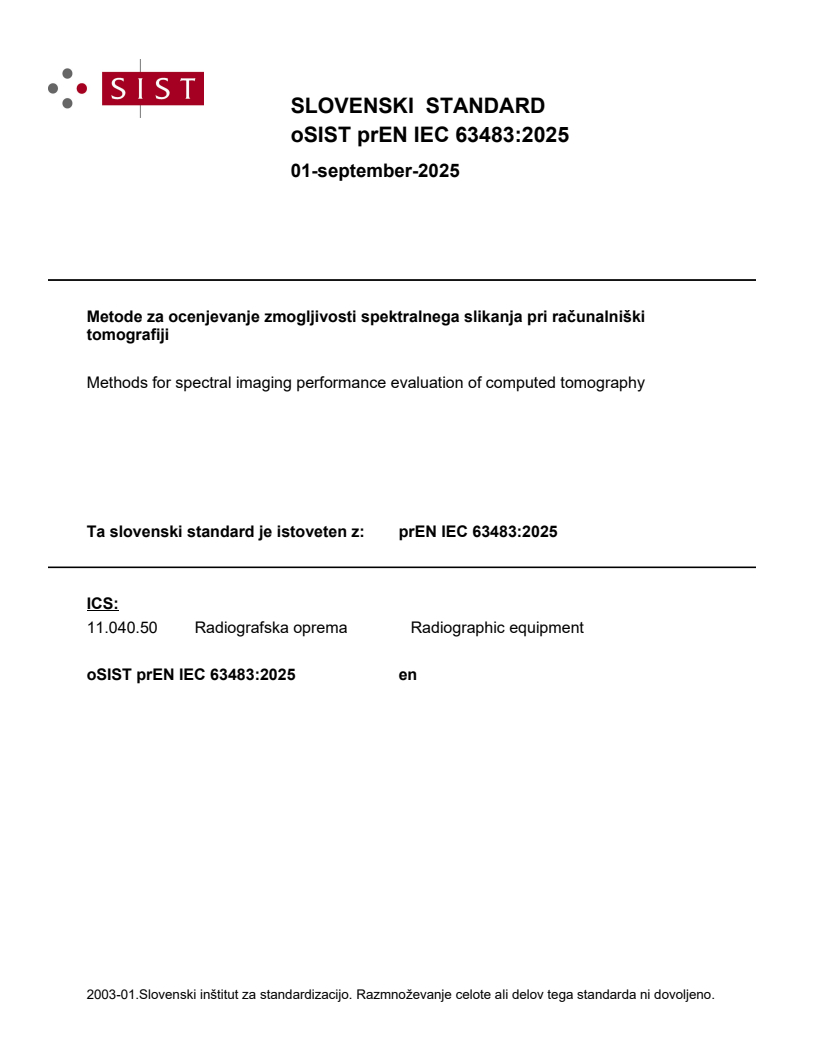
SLOVENSKI STANDARD
01-september-2025
Metode za ocenjevanje zmogljivosti spektralnega slikanja pri računalniški
tomografiji
Methods for spectral imaging performance evaluation of computed tomography
Ta slovenski standard je istoveten z: prEN IEC 63483:2025
ICS:
11.040.50 Radiografska oprema Radiographic equipment
2003-01.Slovenski inštitut za standardizacijo. Razmnoževanje celote ali delov tega standarda ni dovoljeno.
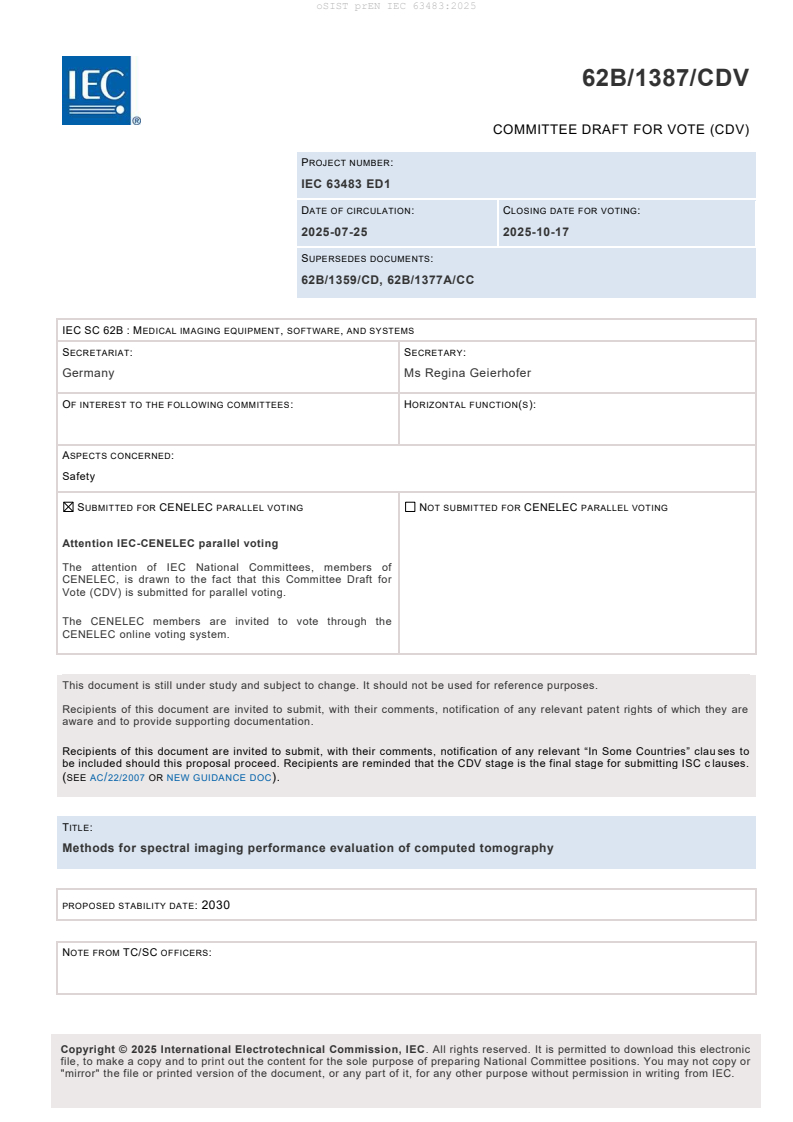
62B/1387/CDV
COMMITTEE DRAFT FOR VOTE (CDV)
PROJECT NUMBER:
IEC 63483 ED1
DATE OF CIRCULATION: CLOSING DATE FOR VOTING:
2025-07-25 2025-10-17
SUPERSEDES DOCUMENTS:
62B/1359/CD, 62B/1377A/CC
IEC SC 62B : MEDICAL IMAGING EQUIPMENT, SOFTWARE, AND SYSTEMS
SECRETARIAT: SECRETARY:
Germany Ms Regina Geierhofer
OF INTEREST TO THE FOLLOWING COMMITTEES: HORIZONTAL FUNCTION(S):
ASPECTS CONCERNED:
Safety
SUBMITTED FOR CENELEC PARALLEL VOTING NOT SUBMITTED FOR CENELEC PARALLEL VOTING
Attention IEC-CENELEC parallel voting
The attention of IEC National Committees, members of
CENELEC, is drawn to the fact that this Committee Draft for
Vote (CDV) is submitted for parallel voting.
The CENELEC members are invited to vote through the
CENELEC online voting system.
This document is still under study and subject to change. It should not be used for reference purposes.
Recipients of this document are invited to submit, with their comments, notification of any relevant patent rights of which they are
aware and to provide supporting documentation.
Recipients of this document are invited to submit, with their comments, notification of any relevant “In Some Countries” clau ses to
be included should this proposal proceed. Recipients are reminded that the CDV stage is the final stage for submitting ISC c lauses.
(SEE AC/22/2007 OR NEW GUIDANCE DOC).
TITLE:
Methods for spectral imaging performance evaluation of computed tomography
PROPOSED STABILITY DATE: 2030
NOTE FROM TC/SC OFFICERS:
file, to make a copy and to print out the content for the sole purpose of preparing National Committee positions. You may not copy or
"mirror" the file or printed version of the document, or any part of it, for any other purpose without permission in writing from IEC.
IEC 63483 ED1 © DRAFT © IEC:2025 62B/1387/CDV
IEC 2025
Link to Committee Draft for Vote (CDV) online document:
https://osd.iec.ch/#/editor/archive/1f1894c1-dc0c-a924-e063-dd13000a3c2c/en/CCDV/1
How to access
This link leads you to the Online Standards Development (OSD) platform for National Mirror
Committee’s (NMC) comments. The project draft may be found further down this document.
Resource materials
We recommend NCs to review the available materials to better understand the member commenting
on the OSD platform. This includes the:
• OSD NC roles overview: here
• How to add and submit comments to the IEC: here
Contact
Should you require any assistance, please contact the IEC IT Helpdesk at helpdesk@iec.ch.
IEC 63483 ED1 © DRAFT © IEC:2025 62B/1387/CDV
IEC 2025
CONTENTS
CONTENTS . 1
FOREWORD . 2
Introduction. 4
1 Scope . 5
2 Normative references . 5
3 Terms and definitions . 6
3.1 Terms defined in this standard . 6
3.2 Terms defined in other standards . 7
4 General consideration of spectral imaging performance evaluation . 9
4.1 Typical conditions of operation for CT spectral imaging (3.1.1) . 9
4.2 Performance evaluation methodologies for CT spectral imaging (3.1.1) . 9
4.3 Dosimetry of spectral imaging . 10
4.4 Technical considerations for proper use for the evaluation methods . 10
5 Applicability of conventional CT imaging performance metrics for spectral imaging. 10
5.1 Conventional CT performance evaluation metrics . 10
5.2 Applicability to different types of spectral images (3.1.2) . 10
6 CT spectral imaging (3.1.1) performance evaluation . 11
6.1 General . 11
6.2 Phantoms for spectral imaging performance evaluation. 11
6.2.1 Overall phantom characteristics . 11
6.2.2 Test objects (3.2.9) . 12
6.2.3 Phantom size selection and positioning . 12
6.3 Evaluation of spectral imaging performance . 13
6.3.1 Evaluation of virtual non-contrast images (3.1.5) . 13
6.3.2 CT number (3.2.3) accuracy in virtual monoenergetic images (3.1.4) . 13
6.3.3 Accuracy of iodine concentration measurements . 14
6.3.4 Accuracy of electron density measurements . 14
Annex A (informative) Calculation of CT number (3.2.3) value in virtual monoenergetic
images (3.1.4) . 16
A.1 Calculation of mass attenuation coefficient . 16
A.2 CT number (3.2.3) in virtual monoenergetic images (3.1.4) . 16
Annex B (informative) The correlations between IEC standard and other works . 18
B.1 General . 18
B.2 DICOM Supplement 188 . 18
B.3 YY.T 1766.3 . 18
B.4 AAPM TG291 and AAPM TG299 . 19
Annex C (informative) Limitations of phantom measurements . 20
Annex D (informative) Spectral image (3.1.2) type chosen in this document . 21
Bibliography . 22
Table 1 – Applicability of conventional CT imaging performance evaluation metrics on
CT spectral image (3.1.2) types . 11
IEC 63483 ED1 © DRAFT © IEC:2025 62B/1387/CDV
IEC 2025
INTERNATIONAL ELECTROTECHNICAL COMMISSION
____________
Methods for spectral imaging performance evaluation of computed
tomography
FOREWORD
1) The International Electrotechnical Commission (IEC) is a worldwide organization for
standardization comprising all national electrotechnical committees (IEC National Committees).
The object of IEC is to promote international co-operation on all questions concerning
standardization in the electrical and electronic fields. To this end and in addition to other
activities, IEC publishes International Standards, Technical Specifications, Technical Reports,
Publicly Available Specifications (PAS) and Guides (hereafter referred to as “IEC
Publication(s)”). Their preparation is entrusted to technical committees; any IEC National
Committee interested in the subject dealt with may participate in this preparatory work.
International, governmental and non-governmental organizations liaising with the IEC also
participate in this preparation. IEC collaborates closely with the International Organization for
Standardization (ISO) in accordance with conditions determined by agreement between the two
organizations.
2) The formal decisions or agreements of IEC on technical matters express, as nearly as
possible, an international consensus of opinion on the relevant subjects since each technical
committee has representation from all interested IEC National Committees.
3) IEC Publications have the form of recommendations for international use and are accepted
by IEC National Committees in that sense. While all reasonable efforts are made to ensure that
the technical content of IEC Publications is accurate, IEC cannot be held responsible for the
way in which they are used or for any misinterpretation by any end user.
4) In order to promote international uniformity, IEC National Committees undertake to apply IEC
Publications transparently to the maximum extent possible in their national and regional
publications. Any divergence between any IEC Publication and the corres ponding national or
regional publication shall be clearly indicated in the latter.
5) IEC itself does not provide any attestation of conformity. Independent certification bodies
provide conformity assessment services and, in some areas, access to IEC marks of conformity.
IEC is not responsible for any services carried out by independent certification bodies.
6) All users should ensure that they have the latest edition of this publication.
7) No liability shall attach to IEC or its directors, employees, servants or agents including
individual experts and members of its technical committees and IEC National Committees for
any personal injury, property damage or other damage of any nature whatsoever, whether direct
or indirect, or for costs (including legal fees) and expenses arising out of the publication, use
of, or reliance upon, this IEC Publication or any other IEC Publications.
8) Attention is drawn to the Normative references cited in this publication. Use of the referenced
publications is indispensable for the correct application of this publication.
9) IEC draws attention to the possibility that the implementation of this document may involve
the use of (a) patent(s). IEC takes no position concerning the evidence, validity or applicability
of any claimed patent rights in respect thereof. As of the date of publication of this document,
IEC [had/had not] received notice of (a) patent(s), which may be required to implement this
IEC 63483 ED1 © DRAFT © IEC:2025 62B/1387/CDV
IEC 2025
document. However, implementers are cautioned that this may not represent the latest
information, which may be obtained from the patent database available at https://patents.iec.ch.
IEC shall not be held responsible for identifying any or all such patent rights.
IEC 6XXXX has been prepared by subcommittee XX: TITLE, of IEC technical committee XX:
TITLE. It is an International Standard.
This XXX edition cancels and replaces the XXX edition published in [publication_date],
Amendment 1:[publication_date] and Amendment 2:[publication_date]. This edition constitutes
a technical revision.
This edition includes the following significant technical changes with respect to the previous
edition:
a) .;
The text of this International Standard is based on the following documents:
Draft Report on voting
XX/XX/FDIS XX/XX/RVD
Full information on the voting for its approval can be found in the report on voting indicated in
the above table.
The language used for the development of this International Standard is English [change
language if necessary].
This document was drafted in accordance with ISO/IEC Directives, Part 2, and developed in
accordance with ISO/IEC Directives, Part 1 and ISO/IEC Directives, IEC Supplement, available
at www.iec.ch/members_experts/refdocs. The main document types developed by IEC are
described in greater detail at www.iec.ch/publications.
The committee has decided that the contents of this document will remain unchanged until the
stability date indicated on the IEC website under webstore.iec.ch in the data related to the
specific document. At this date, the document will be
• reconfirmed,
• withdrawn, or
• revised.
IEC 63483 ED1 © DRAFT © IEC:2025 62B/1387/CDV
IEC 2025
Introduction
The purpose of the document is to provide a set of standardized methods and metrics for the
evaluation of CT spectral imaging (3.1.1).
Main content of this document includes:
– Key definitions of CT spectral imaging (3.1.1) and also spectral image (3.1.2) types
differentiated as conventional CT
– Applicability and scenarios of conventional imaging performance evaluation metrics and
methodology in CT spectral imaging (3.1.1)
– Dedicated performance evaluation metrics, methodologies and applicable phantom
specifications for corresponding image types from CT spectral imaging (3.1.1)
– Necessary notes/informative annex about CT spectral imaging (3.1.1) technology and
references
IEC 63483 ED1 © DRAFT © IEC:2025 62B/1387/CDV
IEC 2025
1 Scope
This document applies to spectral image (3.1.2) types based on data provided by a CT scanner
(3.2.2) that confirms to IEC 60601-2-44 . The spectral images (3.1.2) can be generated either
on the CT scanner (3.2.2) or with separate software.
The purpose of this standard is to provide selected methods and metrics for evaluation of
imaging performance associated with the following spectral image (3.1.2) type (if available):
– Conventional image (3.1.3)
– Virtual monoenergetic image (3.1.4)
– Virtual non contrast image (3.1.5)
– Iodine concentration image (3.1.6)
– Electron density image (3.1.7)
NOTE The methods presented in this document do not provide comprehensive technical performance evaluation of
CT spectral imaging (3.1.1).
The results obtained using the methods of this document do not replace CT spectral imaging
(3.1.1) performance specifications and testing protocols as provided by manufacturer.
This standard does neither specify performance criteria for acceptance testing or constancy
testing nor does it specify requirements for manufacturers to provide such criteria. However,
manufacturers may provide performance data and/or quality assurance test criteria according
to the methods described in this standard.
Additionally, phantom requirements are specified accordingly.
Spectral image (3.1.2) types not listed above are not covered by this document, as explained
in Annex D.
2 Normative references
The following documents are referred to in the text in such a way that some or all of their content
constitutes requirements of this document. For dated references, only the edition cited applies.
For undated references, the latest edition of the referenced document (including any
amendments) applies.
IEC 60601-1:2005, Medical electrical equipment - Part 1: General requirements for basic safety
and essential performance
IEC 60601-1-3:2008, Medical electrical equipment - Part 1-3: General requirements for basic
safety and essential performance - Collateral Standard: Radiation protection in diagnostic X-
ray equipment
IEC 60601-2-44:2009, Medical electrical equipment - Part 2-44: Particular requirements for the
basic safety and essential performance of X-ray equipment for computed tomography
IEC 60601-2-44:2009/AMD2:2016, Amendment 2 - Medical electrical equipment - Part 2-44:
Particular requirements for the basic safety and essential performance of X-ray equipment for
computed tomography
IEC 61223-3-5:2019, Evaluation and routine testing in medical imaging departments - Part 3-5:
Acceptance and constancy tests - Imaging performance of computed tomography X-ray
equipment
IEC 63483 ED1 © DRAFT © IEC:2025 62B/1387/CDV
IEC 2025
IEC 62945:2018, Radiation protection instrumentation - Measuring the imaging performance of
X-ray computed tomography (CT) security-screening systems
3 Terms and definitions
For the purposes of this document, the terms and defintions given in IEC 60601-2-44:2009, IEC
60601-2-44:2009/AMD2:2016 and IEC 61223-3-5:2019, and the following terms and definitions
apply.
ISO and IEC maintain terminology databases for use in standardization at the following
addresses:
• IEC Electropedia: available at https://www.electropedia.org/
• ISO Online browsing platform: available at https://www.iso.org/obp
3.1 Terms defined in this standard
3.1.1
CT spectral imaging
CT imaging based on separate sets of data representing different energy spectra, so that the
resulting CT images can reflect the different spectral properties of the materials in the object
scanned.
Note 1 to entry: CT spectral imaging can be realized based on different techniques.
3.1.2
Spectral image
CT images generated by CT spectral imaging (3.1.1).
Note 1 to entry: Spectral image types addressed in this document are listed in Clause 1. For those spectral image
(3.1.2) types not covered in this document, refer to rationale in Annex D.
3.1.3
Conventional image
Image created by CT spectral imaging (3.1.1), where the pixel value in the image represents
the CT number (3.2.3) of the object scanned under a specified tube voltage and filtration.
Note 1 to entry: Manufacturers may have different naming conventions on their products.
Note 2 to entry: Examples of conventional images (3.1.3) include virtual monoenergetic images (3.1.4) at a specified
keV and image types named e.g., "Combined Images", "Mixed Images" and "Single kVp like Images".
Note 3 to entry: The pixel value in the conventional image (3.1.3) can deviate from the pixel value obtained by non-
spectral CT imaging.
3.1.4
Virtual monoenergetic image
VMI
Image created by CT spectral imaging (3.1.1), where the pixel values represent the CT numbers
(3.2.3) of the object scanned with a monoenergetic x-ray source at a specified energy (in keV).
Note 1 to entry: Virtual monoenergetic images (3.1.4) are also referred as virtual monochromatic images or
synthetic monoenergetic images.
Note 2 to entry: Manufacturers may have different naming conventions on their products for above image type.
3.1.5
Virtual non-contrast image
VNC
Virtual un-enhanced image
IEC 63483 ED1 © DRAFT © IEC:2025 62B/1387/CDV
IEC 2025
VUE
Material-removed image created by CT spectral imaging (3.1.1), where the pixel values
represent the CT numbers (3.2.3) after excluding the attenuation contribution of a specific
material component related to a contrast-agent (e.g., iodine).
Note 1 to entry: Manufacturers may have different naming conventions on their products for above image type.
Note 2 to entry: There may be image types which can be generated in the similar way but with different pixel values
represented, e.g. the pixel values representing the density of water. In this case the methods and metrics specified
for Virtual non-contrast images (3.1.5) in this document can not be directly applied before converting the pixel values
to CT numbers (3.2.3).
3.1.6
Iodine concentration image
Material-specific image created by CT spectral imaging (3.1.1), where the pixel values represent
the attenuation contribution or concentration of the iodine-like material component.
Pixel values are given in units of mass density or, in case of representation as the corresponding
iodine enhancement image, in Hounsfield units.
Note 1 to entry: Manufacturers may have different naming conventions on their products for above image type.
3.1.7
Electron density image
Image created by CT spectral imaging (3.1.1), where the pixel values correspond to the number
of electrons per unit volume (e.g., given as a particle number density or electron density relative
to water).
Note 1 to entry: Manufacturers may have different naming conventions on their products for above image type.
3.2 Terms defined in other standards
3.2.1
CT conditions of operation
all selectable parameters governing the operation of a CT scanner (3.2.2)
Note 1 to entry: Examples of such conditions include nominal tomographic section thickness (IEC 60601-2-
44:2009, 201.3.206), CT pitch factor (IEC 60601-2-44:2009/AMD2:2016, 201.3.204), filtration (IEC 60601-1-
3:2008, 3.24), peak X-ray tube voltage and either X-ray tube current and loading time or current time product.
Note 2 to entry: Some CT conditions of operation (3.2.1) may vary during the exposure.
Note 3 to entry: CT conditions of operation (3.2.1) include parameters that are derived by the system from the user-
selectable parameters.
[SOURCE: IEC 60601-2-44:2009, 201.3.202]
3.2.2
CT scanner
X-ray equipment intended to generate cross-sectional images of the body by computer
reconstruction of X-ray transmission data obtained at different angles, which may include signal
analysis and display equipment, patient support, support parts and accessories
Note 1 to entry: The scope of this document is limited to CT scanners (3.2.2) intended to be used for both head
and body characterised by an enclosure of the X-ray source(s) and imaging detector(s) in a common protective
cover in the shape of a toroid.
Note 2 to entry: Secondary imaging processing is not included in the scope of this standard.
[SOURCE: IEC 60601-2-44:2009, 201.3.201]
IEC 63483 ED1 © DRAFT © IEC:2025 62B/1387/CDV
IEC 2025
3.2.3
CT number
number used to represent the mean X-ray attenuation (IEC 60601-1-3:2008, 3.7) associated
with each elemental area of the computed tomography image
Note 1 to entry: The CT number (3.2.3) is normally expressed in Hounsfield units. Measured values of the linear
attenuation (IEC 60601-1-3:2008, 3.7) coefficients are transformed into CT numbers (3.2.3) using the international
Hounsfield scale, using the expression:
𝜇 − 𝜇
𝑚𝑎𝑡𝑒𝑟𝑖𝑎𝑙 𝑤𝑎𝑡𝑒𝑟
𝐶𝑇 𝑛𝑢𝑚𝑏𝑒𝑟 = × 1000
𝜇
𝑤𝑎𝑡𝑒𝑟
where
𝜇 isthe linear attenuation (IEC 60601-1-3:2008, 3.7) coefficient.
Note 2 to entry: The CT number (3.2.3) scale is defined so that water has a value of 0 and air a value of –1 000
(𝜇 is assumed to be 0).
𝑎𝑖𝑟
[SOURCE: IEC 61223-3-5:2019, 3.6]
3.2.4
Mean CT number
mean value of the CT number (3.2.3) of all pixels within a certain defined region of interest
(3.2.7)
[SOURCE: IEC 61223-3-5:2019, 3.14]
3.2.5
Noise
variation of CT numbers (3.2.3) from a mean value in a defined area in the image of a uniform
substance
Note 1 to entry: The magnitude of noise (3.2.5) is indicated by the standard deviation of the CT numbers (3.2.3) of
a uniform substance in the region of interest (3.2.7).
[SOURCE: IEC 61223-3-5:2019, 3.15]
3.2.6
Reconstructed section thickness
Full width at half maximum (IEC 61223-3-5:2019, 3.10), of the sensitivity profile (IEC 60601-
2-44:2009, 201.3.207) of a reconstructed image
[SOURCE: IEC 61223-3-5:2019, 3.17]
3.2.7
Region of interest
ROI
Localized part of an image, of defined shape and dimension, which is of particular interest at a
given time
[SOURCE: IEC 61223-3-5:2019, 3.18]
3.2.8
Spatial resolution
CT scanners (3.2.2) ability to resolve spatially adjacent objects in the image, when the
difference in attenuation (IEC 60601-1-3:2008, 3.7) between the objects and the background
is large compared to noise (3.2.5)
[SOURCE: IEC 61223-3-5:2019, 3.20]
IEC 63483 ED1 © DRAFT © IEC:2025 62B/1387/CDV
IEC 2025
3.2.9
Test object
Individual object having specific properties (size, shape, materials, etc.) that when imaged by
the system allows a certain image quality evaluation to be carried out.
[SOURCE: ,IEC 62945:2018, 3.1.17]
3.2.10
Uniformity
consistency of the CT numbers (3.2.3) of the image of a homogeneous material across the scan
field
[SOURCE: IEC 61223-3-5:2019, 3.24]
4 General consideration of spectral imaging performance evaluation
4.1 Typical conditions of operation for CT spectral imaging (3.1.1)
If available, the manufacturer's recommended CT conditions of operation (3.2.1) and
reconstruction settings shall be used when evaluating spectral imaging performance. The CT
conditions of operation (3.2.1) should align with the clinical application of CT spectral imaging
(3.1.1). If not specified, the reference CT conditions of operation (3.2.1) according to the clinical
protocols provided by the manufacturer for CT spectral imaging (3.1.1) shall be used.
NOTE 1 Reference protocols on the system may not be optimized for or compatible with a specific phantom.
The CT conditions of operation (3.2.1), reconstruction settings, performance testing
methodology, measurement results, and reference values shall be recorded.
For each of the spectral image (3.1.2) types, the same CT conditions of operation (3.2.1) should
be applied for both conventional CT imaging metric evaluation and spectral imaging metric
evaluation, as described in sections Clause 5 and Clause 6 respectively.
Dose information associated with the scan shall be recorded.
NOTE 2 The scanner settings and measurement techniques are important to record so that the tests and results
can be effectively reproduced.
4.2 Performance evaluation methodologies for CT spectral imaging (3.1.1)
The performance evaluation of CT spectral imaging (3.1.1), as described in this document,
includes two kinds of metrics/methodologies:
– Conventional CT dose/imaging performance metrics, defined in other IEC standards (IEC
60601-2-44 and IEC 61223-3-5)
– Particular performance evaluation metrics and methodology for CT spectral imaging (3.1.1)
related image types
NOTE For certain image types which could be used for either routine diagnostics or spectral applications (e.g.,
virtual monoenergetic images), both methods may be applicable
For conve
...
Questions, Comments and Discussion
Ask us and Technical Secretary will try to provide an answer. You can facilitate discussion about the standard in here.
Loading comments...