

EN 14492-1:2006
(Main)Cranes - Power driven winches and hoists - Part 1: Power driven winches
- Abstract
This European Standard is applicable to the design, information for use, maintenance and testing of power driven winches for which the prime mover is an electric motor, hydraulic motor, internal combustion motor or pneumatic motor. They are designed for the lifting and lowering of loads which are suspended on hooks or other load handling devices or for the lifting and lowering of loads on inclined planes or the exclusive pulling of loads on planes which are normally horizontal.
NOTE Within the period of utilization, the place of use of a winch may be variable.
As a rule, a winch is used without any additional transport movement.
This European Standard is applicable to the following types of winch:
a) rope winches;
b) chain winches;
c) belt winches, except steel belts used as hoisting media;
d) traction winches.
These types of winches a) to d) also include the following specific applications:
vehicle recovery winches;
winches on boat trailers;
forestry winches;
winches for stationary offshore applications;
winches for drilling applications;
winches to be used exclusively for the pulling of loads.
NOTE Examples are shown in Annex A.
This European Standard does not apply to:
power-driven hoists in accordance with prEN 14492-2:;
winches for seagoing vessels and mobile offshore units;
winches for the lifting of persons;
NGL building hoists in accordance with prEN 14492-2;
winches for the handling of hot molten masses (risk covered by prEN 14492-2).
The significant hazards covered by this European Standard are identified in Clause 4.
This European Standard does not specify additional requirements for hazards related to the use of winches in explosive atmospheres in underground works.
This document applies to winches manufactured after approval by CEN with a transitional period of 2 years.
- Status
- Withdrawn
- Publication Date
- 26-Sep-2006
- Withdrawal Date
- 20-Oct-2009
- Technical Committee
- CEN/TC 147 - Cranes - Safety
- Drafting Committee
- CEN/TC 147 - Cranes - Safety
- Current Stage
- 9960 - Withdrawal effective - Withdrawal
- Start Date
- 21-Oct-2009
- Completion Date
- 21-Oct-2009
98/37/EC - MachineryOJ Ref: C, C 104 OJ Date: 08-May-2007

Relations
- Merged Into
EN 14492-1:2006+A1:2009 - Cranes - Power driven winches and hoists - Part 1: Power driven winches - Effective Date
- 11-Jul-2009
Frequently Asked Questions
EN 14492-1:2006 is a standard published by the European Committee for Standardization (CEN). Its full title is "Cranes - Power driven winches and hoists - Part 1: Power driven winches". This standard covers: This European Standard is applicable to the design, information for use, maintenance and testing of power driven winches for which the prime mover is an electric motor, hydraulic motor, internal combustion motor or pneumatic motor. They are designed for the lifting and lowering of loads which are suspended on hooks or other load handling devices or for the lifting and lowering of loads on inclined planes or the exclusive pulling of loads on planes which are normally horizontal. NOTE Within the period of utilization, the place of use of a winch may be variable. As a rule, a winch is used without any additional transport movement. This European Standard is applicable to the following types of winch: a) rope winches; b) chain winches; c) belt winches, except steel belts used as hoisting media; d) traction winches. These types of winches a) to d) also include the following specific applications: vehicle recovery winches; winches on boat trailers; forestry winches; winches for stationary offshore applications; winches for drilling applications; winches to be used exclusively for the pulling of loads. NOTE Examples are shown in Annex A. This European Standard does not apply to: power-driven hoists in accordance with prEN 14492-2:; winches for seagoing vessels and mobile offshore units; winches for the lifting of persons; NGL building hoists in accordance with prEN 14492-2; winches for the handling of hot molten masses (risk covered by prEN 14492-2). The significant hazards covered by this European Standard are identified in Clause 4. This European Standard does not specify additional requirements for hazards related to the use of winches in explosive atmospheres in underground works. This document applies to winches manufactured after approval by CEN with a transitional period of 2 years.
This European Standard is applicable to the design, information for use, maintenance and testing of power driven winches for which the prime mover is an electric motor, hydraulic motor, internal combustion motor or pneumatic motor. They are designed for the lifting and lowering of loads which are suspended on hooks or other load handling devices or for the lifting and lowering of loads on inclined planes or the exclusive pulling of loads on planes which are normally horizontal. NOTE Within the period of utilization, the place of use of a winch may be variable. As a rule, a winch is used without any additional transport movement. This European Standard is applicable to the following types of winch: a) rope winches; b) chain winches; c) belt winches, except steel belts used as hoisting media; d) traction winches. These types of winches a) to d) also include the following specific applications: vehicle recovery winches; winches on boat trailers; forestry winches; winches for stationary offshore applications; winches for drilling applications; winches to be used exclusively for the pulling of loads. NOTE Examples are shown in Annex A. This European Standard does not apply to: power-driven hoists in accordance with prEN 14492-2:; winches for seagoing vessels and mobile offshore units; winches for the lifting of persons; NGL building hoists in accordance with prEN 14492-2; winches for the handling of hot molten masses (risk covered by prEN 14492-2). The significant hazards covered by this European Standard are identified in Clause 4. This European Standard does not specify additional requirements for hazards related to the use of winches in explosive atmospheres in underground works. This document applies to winches manufactured after approval by CEN with a transitional period of 2 years.
EN 14492-1:2006 is classified under the following ICS (International Classification for Standards) categories: 53.020.20 - Cranes. The ICS classification helps identify the subject area and facilitates finding related standards.
EN 14492-1:2006 has the following relationships with other standards: It is inter standard links to EN 14492-1:2006+A1:2009. Understanding these relationships helps ensure you are using the most current and applicable version of the standard.
EN 14492-1:2006 is associated with the following European legislation: EU Directives/Regulations: 94/9/EC, 98/37/EC; Standardization Mandates: M/BC/CEN/91/1, M/BC/CEN/92/46. When a standard is cited in the Official Journal of the European Union, products manufactured in conformity with it benefit from a presumption of conformity with the essential requirements of the corresponding EU directive or regulation.
EN 14492-1:2006 is available in PDF format for immediate download after purchase. The document can be added to your cart and obtained through the secure checkout process. Digital delivery ensures instant access to the complete standard document.
Standards Content (Sample)
2003-01.Slovenski inštitut za standardizacijo. Razmnoževanje celote ali delov tega standarda ni dovoljeno.Dvigala (žerjavi) - Motorni vitli in dvižni mehanizmi - 1. del: Motorni vitliKrane - Kraftgetriebene Winden und Hubwerke - Teil 1: Kraftgetriebene WindenAppareils de levage a charge suspendue - Treuils et palans motorisés - Partie 1: Treuils motorisésCranes - Power driven winches and hoists - Part 1: Power driven winches53.020.20DvigalaCranesICS:Ta slovenski standard je istoveten z:EN 14492-1:2006SIST EN 14492-1:2007en01-januar-2007SIST EN 14492-1:2007SLOVENSKI
STANDARD
EUROPEAN STANDARDNORME EUROPÉENNEEUROPÄISCHE NORMEN 14492-1September 2006ICS 53.020.20 English VersionCranes - Power driven winches and hoists - Part 1: Power drivenwinchesAppareils de levage à charge suspendue - Treuils et palansmotorisés - Partie 1: Treuils motorisésKrane - Kraftgetriebene Winden und Hubwerke - Teil 1:Kraftgetriebene WindenThis European Standard was approved by CEN on 19 August 2006.CEN members are bound to comply with the CEN/CENELEC Internal Regulations which stipulate the conditions for giving this EuropeanStandard the status of a national standard without any alteration. Up-to-date lists and bibliographical references concerning such nationalstandards may be obtained on application to the Central Secretariat or to any CEN member.This European Standard exists in three official versions (English, French, German). A version in any other language made by translationunder the responsibility of a CEN member into its own language and notified to the Central Secretariat has the same status as the officialversions.CEN members are the national standards bodies of Austria, Belgium, Cyprus, Czech Republic, Denmark, Estonia, Finland, France,Germany, Greece, Hungary, Iceland, Ireland, Italy, Latvia, Lithuania, Luxembourg, Malta, Netherlands, Norway, Poland, Portugal, Romania,Slovakia, Slovenia, Spain, Sweden, Switzerland and United Kingdom.EUROPEAN COMMITTEE FOR STANDARDIZATIONCOMITÉ EUROPÉEN DE NORMALISATIONEUROPÄISCHES KOMITEE FÜR NORMUNGManagement Centre: rue de Stassart, 36
B-1050 Brussels© 2006 CENAll rights of exploitation in any form and by any means reservedworldwide for CEN national Members.Ref. No. EN 14492-1:2006: ESIST EN 14492-1:2007
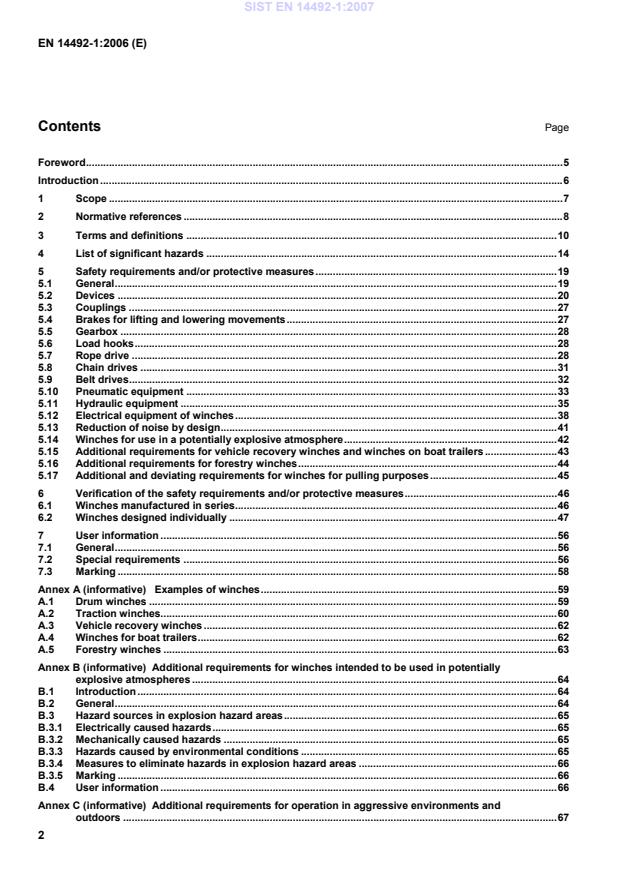
Examples of winches.59 A.1 Drum winches.59 A.2 Traction winches.60 A.3 Vehicle recovery winches.62 A.4 Winches for boat trailers.62 A.5 Forestry winches.63 Annex B (informative)
Additional requirements for winches intended to be used in potentially explosive atmospheres.64 B.1 Introduction.64 B.2 General.64 B.3 Hazard sources in explosion hazard areas.65 B.3.1 Electrically caused hazards.65 B.3.2 Mechanically caused hazards.65 B.3.3 Hazards caused by environmental conditions.65 B.3.4 Measures to eliminate hazards in explosion hazard areas.66 B.3.5 Marking.66 B.4 User information.66 Annex C (informative)
Additional requirements for operation in aggressive environments and outdoors.67 SIST EN 14492-1:2007
Additional requirements for operation at low temperatures.69 Annex E (informative)
Documents for hooks.70 Annex F (normative)
Noise test code.71 F.1 Scope.71 F.2 Standards used in this annex.71 F.3 Description of the machine family.71 F.4 Determination of the emission sound pressure level at the operator´s position by measurement.71 F.4.1 General.71 F.4.2 Winches other than construction winches.72 F.5 Determination of the sound power level.72 F.5.1 General.72 F.5.2 Winches other than construction winches.72 F.5.3 Construction winches.73 F.6 Mounting and operating conditions.74 F.6.1 General.74 F.6.2 Winches other than construction winches.75 F.6.3 Construction winches.75 F.7 Uncertainties.75 F.8 Information to be recorded.75 F.9 Information to be reported.75 F.10 Declaration and verification of noise emission values.76 Annex G (informative)
Selection of a suitable set of cranes standards for a given application.77 Annex ZA (informative)
Relationship between this European Standard and the Essential Requirements of EU Directive 98/37/EC.78 Annex ZB (informative)
Relationship between this European Standard and the Essential Requirements of EU Directive 94/9/EC.79 Bibliography.80
Figures
Figure 1 — Fleet angle.11 Figure 2 — Undercut groove base profile.31 Figure A.1.1 — Drum winch, manufactured in series.59 Figure 1.2 — Drum winch, manufactured individually.59 Figure A.1.3 — Drum winch, pneumatically driven.59 Figure A.2.1 — Traction winch, standard type.60 Figure A.2.2 — Traction winch with 2 load bearing ropes and storage drum.60 Figure A.2.3 — Traction winch with storage drum.61 Figure A.3.1 — Vehicle recovery winch with electrical drive.62 Figure A.3.2 — Vehicle recovery winch with hydraulic drive.62 Figure A.4.1 — Winch for boat trailers with electrical drive.62 SIST EN 14492-1:2007
Tables Table 1 — List of significant hazards and associated requirements.15 Table 2 — Values for vh for estimation of φφφφ IAL.25 Table 3 — Limit revolutions for three-phase slipring motors.40 Table 4 — Stall torques for three-phase slipring motors with contactor control.40 Table 5 — Methods to be used to verify conformity with the safety requirements and/or measures.48 Table F.1 — Coordinates of the 6 microphone positions.73
1 Scope This European Standard is applicable to the design, information for use, maintenance and testing of power driven winches for which the prime mover is an electric motor, hydraulic motor, internal combustion motor or pneumatic motor. They are designed for the lifting and lowering of loads which are suspended on hooks or other load handling devices or for the lifting and lowering of loads on inclined planes or the exclusive pulling of loads on planes which are normally horizontal. NOTE Within the period of utilization, the place of use of a winch may be variable. As a rule, a winch is used without any additional transport movement. This European Standard is applicable to the following types of winch: a) rope winches; b) chain winches; c) belt winches, except steel belts used as hoisting media; d) traction winches. These types of winches a) to d) also include the following specific applications: vehicle recovery winches; winches on boat trailers; forestry winches; winches for stationary offshore applications; winches for drilling applications; winches to be used exclusively for the pulling of loads. NOTE Examples are shown in Annex A. SIST EN 14492-1:2007
safety — Requirements for health and safety — Part 2: Limiting and indicating devices EN 12644-2:2000, Cranes — Information for use and testing — Part 2: Marking EN 13001-2:2004, Cranes — General design — Part 2: Load actions EN 13411-3:2004, Terminations for steel wire ropes — Safety — Part 3: Ferrules and ferrule-securing EN 13411-4:2002, Terminations for steel wire ropes — Safety — Part 4: Metal and resin socketing EN 13411-6:2004, Terminations for steel wire ropes — Safety — Part 6: Asymmetric wedge socket EN 13411-7:2003, Terminations for steel wire ropes — Safety — Part 7: Symmetric wedge socket SIST EN 14492-1:2007
(IEC 60079-0:2004) EN 60079-7:2003, Electrical apparatus for explosive gas atmospheres — Part 7: Increased safety ‘e’
(IEC 60079-7:2001) EN 60204-32:1998, Safety of machinery — Electrical equipment of machines — Part 32: Requirements for hoisting machines (IEC 60204-32:1998) EN 60529:1991, Degrees of protection provided by enclosures (IP-code) EN 61000-6-2:2005, Electromagnetic compatibility (EMC) — Part 6-2: Generic standards — Immunity for industrial environments (IEC 61000-6-2:2005) EN 61000-6-3:2001, Electromagnetic compatibility (EMC) — Part 6-3: Generic standards; Emission standard for residential, commercial and light-industrial environments (IEC 61000-6-3:1996, modified) EN 61000-6-4:2001, Electromagnetic compatibility (EMC) — Part 6-4: Generic standards; Emission standard for industrial environments (IEC 61000-6-4:1997, modified) EN ISO 3744:1995, Acoustics — Determination of sound power levels of noise sources using sound pressure — Engineering method in an essential free field over a reflecting plane (ISO 3744:1994) EN ISO 4871:1996, Acoustics — Declaration and verification of noise emission values of machinery and equipment
(ISO 4871:1996) EN ISO 11201:1995, Acoustics — Noise emitted by machinery and equipment — Measurement of emission sound pressure levels at a work station and at other specified positions — Engineering method in an essentially free field over a reflecting plane (ISO 11201:1995) EN ISO 11688-1:1998, Acoustics — Recommended practice for the design of low-noise machinery and equipment — Part 1: Planning (ISO/TR 11688-1:1995) EN ISO 12100-1:2003, Safety of machinery — Basic concepts, general principles for design — Part 1: Basic terminology, methodology (ISO 12100-1:2003) EN ISO 12100-2:2003, Safety of machinery — Basic concepts, general principles for design — Part 2: Technical principles (ISO 12100-2:2003) ISO 606:2004, Short-pitch transmission precision roller and bush chains, attachments and associated chain sprockets ISO 4301-1:1986, Cranes and lifting appliances — Classification — Part 1: General ISO 4308-1:2003, Cranes and lifting appliances — Selection of wire ropes — Part 1: General ISO 12482-1:1995, Cranes — Condition monitoring — Part 1: General FEM 1.001:1998, Rules for the design of hoisting appliances, booklets 1, 2, 3, 4, 5 and 8 SIST EN 14492-1:2007
Key β = fleet angle on the pulley β - α or β + α = fleet angle on the drum α = angle of the grooves on the drum Figure 1 — Fleet angle On drums without grooves, the fleet angle is the angle between the rope axis and a line drawn perpendicular to the axis of the drum 3.6 force transmission two or more connected parts which transmit forces 3.7 forestry winches rope winches fitted to forestry machines such as pushing tractors and row crop tractors according to
ISO 6814 and used on agricultural tractors, e.g. for fitting in a three-point rod assembly, used for pushing works in the forest 3.8 hoist medium or pulling medium either rope, belt, steel link chain or roller chain that connects the winch to the load 3.9 hydraulic components elements (e.g. switches, valves, filters) interconnected and forming an operational hydraulic system 3.10 hydraulic overpressure pressure exceeding the rated pressure or dynamic pressure 3.11 hydraulic systems definition in ISO 5598 applies 3.12 hydraulic transmission supply, control and distribution of energy by means of pressurised fluid SIST EN 14492-1:2007
Hazards Relevant clause(s) in this European Standard 1 Mechanical hazards due to:
— machine parts or workpieces, e.g.: a) shape; b) relative location; c) mass and stability (potential energy of elements which may move under the effect of gravity); d) mass and velocity (kinetic energy of elements in controlled or uncontrolled motion); e) inadequacy of mechanical strength — accumulation of energy inside the machinery, e.g.: f) elastic elements (springs); g) liquids and gases under pressure; — the effect of vacuum 5.1 n.a. 5.1
5.1, 5.2, 5.3, 5.4, 5.5, 5.7, 5.9, 5.15.4, 5.15.5, 5.15.6, 5.16.5, 5.16.6, 5.16.7, 5.17.4, 5.17.5, 5.17.6
5.4 5.10, 5.11 5.11.4.3 1.1 Crushing hazard 5.1, 5.7.2, 5.7.4 1.2 Shearing hazard 5.1 1.3 Cutting or severing hazard 5.1, 5.8.3, 5.16.9 1.4 Entanglement hazard 5.1, 5.7.2, 5.7.4, 5.8.3 1.5 Drawing-in or trapping hazard 5.1, 5.7.2, 5.7.4, 5.8.3 1.6 Impact hazard 5.1, 5.8.2, 5.16.9 1.7 Stabbing or puncture hazard 5.1 1.8 Friction or abrasion hazard 5.1, 5.7.2, 5.7.4, 5.7.9, 5.8.1 1.9 High pressure fluid injection or ejection hazard 5.11.4.2, 5.11.5, 5.11.6.3 2 Electrical hazards due to:
2.1 contact of persons with live parts (direct contact) 5.2.1, 5.12, 5.12.4 2.2 contact of persons with parts which have become live under faulty conditions (indirect contact) 5.2.1, 5.12, 5.12.4 2.3 approach to live parts under high voltage 5.12.1 2.4 electrostatic phenomena 5.12 2.5 thermal radiation or other phenomena such as the projection of molten particles and chemical effects from short circuits, overloads etc. 5.12 3 Thermal hazards, resulting in:
3.1 burns, scalds and other injuries by a possible contact of persons with objects or materials with an extreme high or low temperature, by flames or explosions and also by the radiation of heat sources 5.1, 5.11.6.5, 5.11.6.6, 5.14 3.2 damage to health by hot or cold working environment n.a. 4 Hazards generated by noise, resulting in:
4.1 hearing loss (deafness), other physiological disorders (e.g. loss of balance, loss of awareness) 5.13, 7.2, Annex F 4.2 interference with speech communication, acoustic signals etc. 5.13, 7.2, Annex F
Hazards Relevant clause(s) in this European Standard 5 Hazards generated by vibration due to:
5.1 use of hand-held machines resulting in a variety of neurological and vascular disorders n.a. 5.2 whole body vibration, particularly when combined with poor postures n.a. 6 Hazards generated by radiation due to:
6.1 low frequency, radio frequency radiation, micro waves n.a. 6.2 infrared, visible and ultraviolet light n.a. 6.3 X and gamma rays n.a. 6.4 alpha, beta rays, electron or ion beams; neutrons n.a. 6.5 lasers n.a. 7 Hazards generated by materials and substances (and their constituent elements) processed or used by the machinery due to:
7.1 hazards from contact with or inhalation of harmful fluids, gases, mists, fumes, and dusts 5.11.2 7.2 fire or explosion hazard 5.11.6.5, 5.11.6.6, 5.14, Annex B, Annex C 7.3 biological or microbiological (viral or bacterial) hazards n.a. 8 Hazards generated by neglecting ergonomic principles in machinery design as, e.g. hazards from:
8.1 unhealthy postures of excessive effort 5.2.1 8.2 inadequate consideration of hand-arm or foot-leg anatomy n.a. 8.3 neglected use of personal protection equipment n.a. 8.4 inadequate local lighting 7 8.5 mental overload and under-load, stress n.a. 8.6 human error, human behaviour 5.2.1 8.7 inadequate design, location or identification of manual controls 5.2.1, 5.12 8.8 inadequate design or location of visual display units 5.2.1, 5.12 9 Combination of hazards n.a. 10 Unexpected start-up, unexpected overrun/overspeed (or any similar malfunction) from:
10.1 failure/disorder of the control system 5.2.1, 5.2.3, 5.2.5, 5.4, 5.10.3, 5.10.4, 5.10.5.1, 5.11.6.1, 5.11.6.2, 5.12.4, 5.12.7, 5.12.8.2 10.2 restoration of energy supply after an interruption 5.2.1, 5.2.3, 5.10.5.1, 5.12 10.3 external influences on electrical equipment 5.12.3, 5.13 10.4 other external influences (gravity, wind etc.) 5.4 10.5 errors in the software 5.2.5, 5.12 10.6 errors made by the operator (due to mismatch of machinery with human characteristics and abilities, see 8.6) n.a. 11 Impossibility of stopping the machine in the best possible conditions 5.2.1, 5.2.3, 5.10.5.1, 5.10.5.2, 5.11.6.1, 5.12.4, 5.12.7 SIST EN 14492-1:2007
Hazards Relevant clause(s) in this European Standard 12 Variations in the rotational speed of tools n.a. 13 Failure of the power supply 5.4, 5.10.2.2, 5.11.6.2, 5.12, 5.12.8.2, 5.15.7 14 Failure of the control circuit 5.2.1, 5.2.3, 5.2.5, 5.4, 5.10.3, 5.10.5.1, 5.11.5, 5.11.6.1, 5.12, 5.12.7, 5.12.8.2 15 Errors of fitting 5.1, 5.7.6, 7 16 Break-up during operation 5.1, 5.4, 5.5, 5.7.8, 5.8.4, 5.9.2 17 Falling or ejected objects or fluids 5.11.6.3 18 Loss of stability/overturning of machinery n.a. 19 Slip, trip and fall of persons (related to machinery) n.a. Additional hazards, hazardous situations and hazardous events due to mobility 20 Relating to the travelling function:
20.1 movement when starting the engine n.a. 20.2 movement without a driver at the driving position n.a. 20.3 movement without all parts in a safe position n.a. 20.4 excessive speed of pedestrian controlled machinery n.a. 20.5 excessive oscillations when moving n.a. 20.6 insufficient ability of machinery to be slowed down, stopped and immobilised n.a. 21 Linked to the work position (including driving station) on the machine due to:
21.1 fall of persons during access to (or at/from) the work position n.a. 21.2 exhaust gases/lack of oxygen at the work position n.a. 21.3 fire (flammability of the cab, lack of extinguishing means) n.a. 21.4 mechanical hazards at the work position: a) contact with the wheels; b) rollover; c) fall of objects, penetration by objects; d) break-up of parts rotating at high speed; e) contact of persons with machine parts or tools (pedestrian controlled machines) n.a. 21.5 insufficient visibility from the work positions n.a. 21.6 inadequate lighting n.a. 21.7 inadequate seating n.a. 21.8 noise at the work position 5.13, 7.2, Annex F 21.9 vibration at the work position n.a. 21.10 insufficient means for evacuation/Emergency exit n.a. 22 Due to the control system:
22.1 inadequate location of manual controls 5.2.1, 5.12 SIST EN 14492-1:2007
Hazards Relevant clause(s) in this European Standard 22.2 inadequate design of manual controls and their mode of operation 5.2.1, 5.10.3, 5.10.4, 5.11.5, 5.11.6.1, 5.12 23 From handling the machine (lack of stability) 5.1 24 Due to the power source and to the transmission of power:
24.1 hazards from the engine and the batteries n.a. 24.2 hazards from transmission of power between machines n.a. 24.3 hazards from coupling and towing n.a. 25 From/to third persons due to:
25.1 unauthorised start-up/use 5.2.1 25.2 drift of a part away from its stopping position 5.2.4 25.3 lack or inadequacy of visual or acoustic warning means n.a. 26 Insufficient instructions for the driver/operator 7 Additional hazards, hazardous situations and hazardous events due to lifting 27 Mechanical hazards and hazardous events:
27.1 from load falls, collisions, machine tipping caused by:
27.1.1 lack of stability 5.1 27.1.2 uncontrolled loading – overloading – overturning moments exceeded 5.2.2, 5.11.3 27.1.3 uncontrolled amplitude of movements 5.2.1, 5.2.4, 5.4, 5.12.8.2 27.1.4 unexpected/unintended movement of loads 5.2.1, 5.2.2, 5.4, 5.10.2.2, 5.11.3, 5.11.6.2, 5.12.8.2, 5.15.4, 5.16.3, 5.17.4 27.1.5 inadequate holding devices/accessories 5.1, 5.6, 5.7.6, 5.7.8, 5.8.4, 5.9.4, 5.9.5, 5.16.7, 5.16.8 27.1.6 collision of more than one machine n.a. 27.2 from access of persons to load support n.a. 27.3 from derailment n.a. 27.4 from insufficient mechanical strength of parts 5.1, 5.2, 5.3, 5.4, 5.5, 5.6, 5.7, 5.8, 5.9, 5.11.4.1, 5.11.4.2, 5.15.2, 5.15.6, 5.15.7, 5.16.5, 5.16.7, 5.16.8, 5.17.6 27.5 from inadequate design of pulleys, drums 5.7.1, 5.7.2, 5.7.4, 5.7.5, 5.7.6, 5.9.1, 5.9.3, 5.9.4, 5.16.6, 5.16.7 27.6 from inadequate selection of chains, ropes, lifting and accessories and their inadequate integration into the machine 5.7, 5.8, 5.9, 5.15.6, 5.16.5, 5.17.6
27.7 from lowering of the load under the control of friction brake 5.4 27.8 from abnormal conditions of assembly/testing/use/maintenance 7 27.9 from the effect of load on persons (impact by load or counterweight) 5.2.1, 7 SIST EN 14492-1:2007
Hazards Relevant clause(s) in this European Standard 28 Electrical hazards
28.1 from lightning 5.12 29 Hazards generated by neglecting ergonomic principles n.a. 29.1 insufficient visibility from the driving position
7 Additional hazards, hazardous situations and hazardous events due to underground work 30 Mechanical hazards and hazardous events due to:
30.1 lack of stability of powered roof supports n.a. 30.2 failing accelerator or brake control of machinery running on rails n.a. 30.3 failing or lack of deadman's control of machinery running on rails n.a. 31 Restricted movement of persons n.a. 32 Fire and explosion n.a. 33 Emission of dust, gases etc. n.a. Additional hazards, hazardous situations and hazardous events due to the lifting or moving of persons 34 Mechanical hazards and hazardous events due to:
34.1 inadequate mechanical strength - inadequate working coefficients n.a. 34.2 failing of loading control n.a. 34.3 failing of controls in person carrier (function, priority) n.a. 34.4 overspeed of person carrier n.a. 35 Falling of person from person carrier n.a. 36 Falling or overturning of person carrier n.a. 37 Human error, human behaviour n.a. n.a.: not applicable 5 Safety requirements and/or protective measures 5.1 General Winches shall comply with the safety requirements and or protective measures of this clause. In addition, the winches shall be designed in accordance with the principles of EN ISO 12100-1 and EN ISO 12100-2 for hazards relevant but not significant, which are not dealt with by this document. Winches shall be classified in groups of mechanism in accordance with ISO 4301-1 in accordance with the operational requirements and conditions of application. Winches shall be designed in accordance with FEM 1.001, booklets 1, 2, 3, 4, 8 and 9 and FEM 9.901. NOTE For the calculation, EN 13001-1, EN 13001-2, and CEN/TS 13001-3-1 are available. After publication of these documents as harmonized European Standards, CEN/TC 147/WGP 7 will check to see how to update this European Standard and to make reference to these documents. Winches shall be designed taking into account the static and dynamic forces which may occur at intended use. Forces which occur due to the activation of the rated capacity limiter and the emergency stop device shall be taken SIST EN 14492-1:2007
...