

EN ISO/IEC 27001:2023
(Main)Information security, cybersecurity and privacy protection - Information security management systems - Requirements (ISO/IEC 27001:2022)
- Abstract
This document specifies the requirements for establishing, implementing, maintaining and continually improving an information security management system within the context of the organization. This document also includes requirements for the assessment and treatment of information security risks tailored to the needs of the organization. The requirements set out in this document are generic and are intended to be applicable to all organizations, regardless of type, size or nature. Excluding any of the requirements specified in Clauses 4 to 10 is not acceptable when an organization claims conformity to this document.
- Status
- Published
- Publication Date
- 25-Jul-2023
- Technical Committee
- CEN/CLC/TC 13 - Cybersecurity and Data Protection
- Drafting Committee
- CEN/CLC/TC 13 - Cybersecurity and Data Protection
- Current Stage
- 6060 - Definitive text made available (DAV) - Publishing
- Start Date
- 26-Jul-2023
- Due Date
- 22-May-2025
- Completion Date
- 26-Jul-2023
Buy Documents



Overview
EN ISO/IEC 27001:2023 (adoption of ISO/IEC 27001:2022) specifies the requirements for establishing, implementing, maintaining and continually improving an information security management system (ISMS). Published by CEN as a European Standard, it applies to organizations of any type, size or nature and requires tailored assessment and treatment of information security risks. Conformity requires meeting all requirements in Clauses 4–10 (context, leadership, planning, support, operation, performance evaluation, improvement). The standard is aligned with the harmonized management-systems structure and ISO/IEC 27002:2022.
Key topics and requirements
- Scope and context: define the organization’s context and the scope of the ISMS, including interested parties and their requirements.
- Leadership and policy: top management commitment, assignment of roles, responsibilities and an information security policy.
- Risk management: systematic information security risk assessment and risk treatment tailored to organizational needs (requirements for assessing and treating information security risks are core).
- Objectives and planning: measurable information security objectives and plans to achieve them.
- Support and competence: resources, competence, awareness, communication and documented information to operate the ISMS.
- Operational controls: operational planning and control of information security processes, including controls referenced in Annex A (information security controls reference).
- Performance evaluation: monitoring, measurement, internal audit and management review to evaluate ISMS effectiveness.
- Improvement: continual improvement, nonconformity handling and corrective actions.
Practical applications and who uses it
EN ISO/IEC 27001:2023 is used by organizations seeking to:
- Build an ISMS to protect confidentiality, integrity and availability of information.
- Demonstrate compliance and achieve third‑party ISO/IEC 27001 certification for customers, partners or regulators.
- Implement structured cybersecurity and privacy protection practices integrated with business processes.
- Manage supplier risk, contractual security obligations and cloud or outsourcing arrangements.
Primary users include CISOs, IT/security managers, risk and compliance teams, internal auditors, consultants and certification bodies. Small and large organizations adopt the standard to formalize risk-based security, strengthen incident readiness, and support regulatory/compliance requirements.
Related standards
- ISO/IEC 27002:2022 - guidance on selection and implementation of information security controls (aligned with Annex A).
- Other management-system standards (e.g., ISO 9001, ISO 22301) - for integrated management systems.
Keywords: EN ISO/IEC 27001:2023, ISO/IEC 27001, information security management system, ISMS, cybersecurity, privacy protection, risk assessment, ISMS certification.
Relations
- Effective Date
- 18-Jan-2023
- Effective Date
- 25-Aug-2026
- Effective Date
- 28-Jan-2026
- Effective Date
- 28-Jan-2026
- Effective Date
- 28-Jan-2026
- Effective Date
- 06-Mar-2024
Buy Documents
Get Certified
Connect with accredited certification bodies for this standard

BSI Group
BSI (British Standards Institution) is the business standards company that helps organizations make excellence a habit.

Bureau Veritas
Bureau Veritas is a world leader in laboratory testing, inspection and certification services.

DNV
DNV is an independent assurance and risk management provider.
Sponsored listings
Frequently Asked Questions
EN ISO/IEC 27001:2023 is a standard published by the European Committee for Standardization (CEN). Its full title is "Information security, cybersecurity and privacy protection - Information security management systems - Requirements (ISO/IEC 27001:2022)". This standard covers: This document specifies the requirements for establishing, implementing, maintaining and continually improving an information security management system within the context of the organization. This document also includes requirements for the assessment and treatment of information security risks tailored to the needs of the organization. The requirements set out in this document are generic and are intended to be applicable to all organizations, regardless of type, size or nature. Excluding any of the requirements specified in Clauses 4 to 10 is not acceptable when an organization claims conformity to this document.
This document specifies the requirements for establishing, implementing, maintaining and continually improving an information security management system within the context of the organization. This document also includes requirements for the assessment and treatment of information security risks tailored to the needs of the organization. The requirements set out in this document are generic and are intended to be applicable to all organizations, regardless of type, size or nature. Excluding any of the requirements specified in Clauses 4 to 10 is not acceptable when an organization claims conformity to this document.
EN ISO/IEC 27001:2023 is classified under the following ICS (International Classification for Standards) categories: 03.100.70 - Management systems; 35.030 - IT Security. The ICS classification helps identify the subject area and facilitates finding related standards.
EN ISO/IEC 27001:2023 has the following relationships with other standards: It is inter standard links to EN ISO/IEC 27001:2017, ISO/IEC 27000:2018, CEN/TR 17603-20-21:2022, EN 17928-1:2024, EN 17646:2022, EN ISO/IEC 27001:2023/A1:2024. Understanding these relationships helps ensure you are using the most current and applicable version of the standard.
EN ISO/IEC 27001:2023 is available in PDF format for immediate download after purchase. The document can be added to your cart and obtained through the secure checkout process. Digital delivery ensures instant access to the complete standard document.
Standards Content (Sample)
SLOVENSKI STANDARD
01-november-2023
Nadomešča:
SIST EN ISO/IEC 27001:2017
Informacijska varnost, kibernetska varnost in varstvo zasebnosti - Sistemi vodenja
informacijske varnosti - Zahteve (ISO/IEC 27001:2022)
Information security, cybersecurity and privacy protection - Information security
management systems - Requirements (ISO/IEC 27001:2022)
Informationssicherheit, Cybersicherheit und Datenschutz -
Informationssicherheitsmanagementsysteme - Anforderungen (ISO/IEC 27001:2022)
Sécurité de l'information, cybersécurité et protection de la vie privée - Systèmes de
management de la sécurité de l'information - Exigences (ISO/IEC 27001:2022)
Ta slovenski standard je istoveten z: EN ISO/IEC 27001:2023
ICS:
03.100.70 Sistemi vodenja Management systems
35.030 Informacijska varnost IT Security
2003-01.Slovenski inštitut za standardizacijo. Razmnoževanje celote ali delov tega standarda ni dovoljeno.
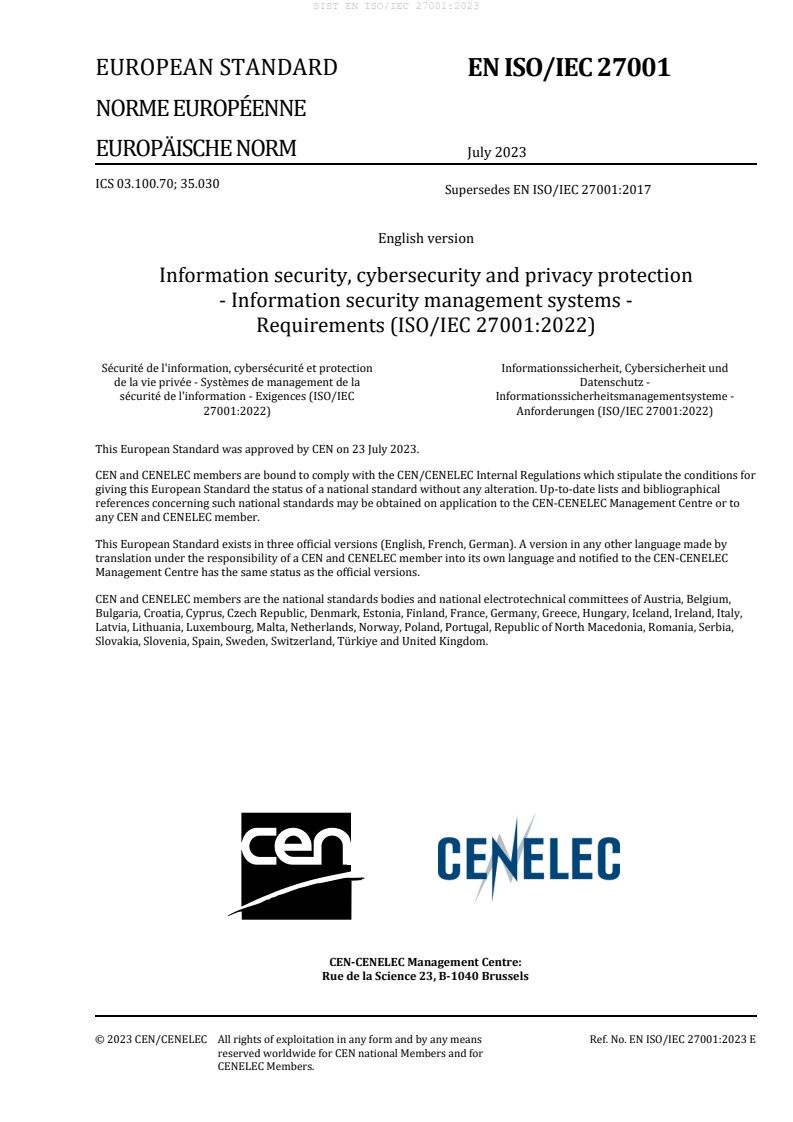
EUROPEAN STANDARD EN ISO/IEC 27001
NORME EUROPÉENNE
EUROPÄISCHE NORM
July 2023
ICS 03.100.70; 35.030
Supersedes EN ISO/IEC 27001:2017
English version
Information security, cybersecurity and privacy protection
- Information security management systems -
Requirements (ISO/IEC 27001:2022)
Sécurité de l'information, cybersécurité et protection Informationssicherheit, Cybersicherheit und
de la vie privée - Systèmes de management de la Datenschutz -
sécurité de l'information - Exigences (ISO/IEC Informationssicherheitsmanagementsysteme -
27001:2022) Anforderungen (ISO/IEC 27001:2022)
This European Standard was approved by CEN on 23 July 2023.
CEN and CENELEC members are bound to comply with the CEN/CENELEC Internal Regulations which stipulate the conditions for
giving this European Standard the status of a national standard without any alteration. Up-to-date lists and bibliographical
references concerning such national standards may be obtained on application to the CEN-CENELEC Management Centre or to
any CEN and CENELEC member.
This European Standard exists in three official versions (English, French, German). A version in any other language made by
translation under the responsibility of a CEN and CENELEC member into its own language and notified to the CEN-CENELEC
Management Centre has the same status as the official versions.
CEN and CENELEC members are the national standards bodies and national electrotechnical committees of Austria, Belgium,
Bulgaria, Croatia, Cyprus, Czech Republic, Denmark, Estonia, Finland, France, Germany, Greece, Hungary, Iceland, Ireland, Italy,
Latvia, Lithuania, Luxembourg, Malta, Netherlands, Norway, Poland, Portugal, Republic of North Macedonia, Romania, Serbia,
Slovakia, Slovenia, Spain, Sweden, Switzerland, Türkiye and United Kingdom.
CEN-CENELEC Management Centre:
Rue de la Science 23, B-1040 Brussels
© 2023 CEN/CENELEC All rights of exploitation in any form and by any means
Ref. No. EN ISO/IEC 27001:2023 E
reserved worldwide for CEN national Members and for
CENELEC Members.
Contents Page
European foreword . 3
European foreword
The text of ISO/IEC 27001:2022 has been prepared by Technical Committee ISO/IEC JTC 1 "Information
technology” of the International Organization for Standardization (ISO) and has been taken over as
Protection” the secretariat of which is held by DIN.
This European Standard shall be given the status of a national standard, either by publication of an
identical text or by endorsement, at the latest by January 2024, and conflicting national standards shall
be withdrawn at the latest by January 2024.
Attention is drawn to the possibility that some of the elements of this document may be the subject of
patent rights. CEN-CENELEC shall not be held responsible for identifying any or all such patent rights.
This document supersedes EN ISO/IEC 27001:2017.
Any feedback and questions on this document should be directed to the users’ national standards body.
A complete listing of these bodies can be found on the CEN and CENELEC websites.
According to the CEN-CENELEC Internal Regulations, the national standards organizations of the
following countries are bound to implement this European Standard: Austria, Belgium, Bulgaria,
Croatia, Cyprus, Czech Republic, Denmark, Estonia, Finland, France, Germany, Greece, Hungary, Iceland,
Ireland, Italy, Latvia, Lithuania, Luxembourg, Malta, Netherlands, Norway, Poland, Portugal, Republic of
North Macedonia, Romania, Serbia, Slovakia, Slovenia, Spain, Sweden, Switzerland, Türkiye and the
United Kingdom.
Endorsement notice
The text of ISO/IEC 27001:2022 has been approved by CEN-CENELEC as EN ISO/IEC 27001:2023
without any modification.
INTERNATIONAL ISO/IEC
STANDARD 27001
Third edition
2022-10
Information security, cybersecurity
and privacy protection — Information
security management systems —
Requirements
Sécurité de l'information, cybersécurité et protection de la vie
privée — Systèmes de management de la sécurité de l'information —
Exigences
Reference number
ISO/IEC 27001:2022(E)
© ISO/IEC 2022
ISO/IEC 27001:2022(E)
© ISO/IEC 2022
All rights reserved. Unless otherwise specified, or required in the context of its implementation, no part of this publication may
be reproduced or utilized otherwise in any form or by any means, electronic or mechanical, including photocopying, or posting on
the internet or an intranet, without prior written permission. Permission can be requested from either ISO at the address below
or ISO’s member body in the country of the requester.
ISO copyright office
CP 401 • Ch. de Blandonnet 8
CH-1214 Vernier, Geneva
Phone: +41 22 749 01 11
Email: copyright@iso.org
Website: www.iso.org
Published in Switzerland
ii
© ISO/IEC 2022 – All rights reserved
ISO/IEC 27001:2022(E)
Contents Page
Foreword .iv
Introduction .v
1 S c op e . 1
2 Nor m at i ve r ef er enc e s . 1
3 Terms and definitions . 1
4 C ontext of the organization .1
4.1 U nderstanding the organization and its context . 1
4.2 U nderstanding the needs and expectations of interested parties . 1
4.3 D etermining the scope of the information security management system . 2
4.4 I nformation security management system . 2
5 L e ader s h ip . 2
5.1 L eadership and commitment . 2
5.2 Policy . 3
5.3 O rganizational roles, responsibilities and authorities . 3
6 Pl a n n i n g . 3
6.1 A ctions to address risks and opportunities . 3
6.1.1 G eneral . 3
6.1.2 I nformation security risk assessment . 4
6.1.3 Information security risk treatment . 4
6.2 I nformation security objectives and planning to achieve them . 5
7 S upp or t . 6
7.1 R e s ou r c e s . 6
7. 2 C omp e t enc e . 6
7.3 A wareness . 6
7.4 Communication . 6
7.5 Documented information . 6
7.5.1 G eneral . 6
7.5.2 C reating and updating . 7
7.5.3 Control of documented information . 7
8 O p er at ion . 7
8.1 O perational planning and control . 7
8.2 I nformation security risk assessment . 8
8.3 I nformation security risk treatment . 8
9 Per f or m a nc e ev a lu at ion .8
9.1 M onitoring, measurement, analysis and evaluation . . 8
9.2 I nternal audit . 8
9.2.1 General . 8
9.2.2 Internal audit programme . 9
9.3 M anagement review . 9
9.3.1 General . 9
9.3.2 Management review inputs . 9
9.3.3 Management review results . 9
10 I mpr ovement .10
10.1 C ontinual improvement . 10
10.2 N onconformity and corrective action . 10
Annex A (normative) Information security controls reference .11
Bibliography .19
iii
© ISO/IEC 2022 – All rights reserved
ISO/IEC 27001:2022(E)
Foreword
ISO (the International Organization for Standardization) and IEC (the International Electrotechnical
Commission) form the specialized system for worldwide standardization. National bodies that are
members of ISO or IEC participate in the development of International Standards through technical
committees established by the respective organization to deal with particular fields of technical
activity. ISO and IEC technical committees collaborate in fields of mutual interest. Other international
organizations, governmental and non-governmental, in liaison with ISO and IEC, also take part in the
work.
The procedures used to develop this document and those intended for its further maintenance
are described in the ISO/IEC Directives, Part 1. In particular, the different approval criteria
needed for the different types of document should be noted. This document was drafted in
accordance with the editorial rules of the ISO/IEC Directives, Part 2 (see www.iso.org/directives or
www.iec.ch/members_experts/refdocs).
Attention is drawn to the possibility that some of the elements of this document may be the subject
of patent rights. ISO and IEC shall not be held responsible for identifying any or all such patent
rights. Details of any patent rights identified during the development of the document will be in the
Introduction and/or on the ISO list of patent declarations received (see www.iso.org/patents) or the IEC
list of patent declarations received (see https://patents.iec.ch).
Any trade name used in this document is information given for the convenience of users and does not
constitute an endorsement.
For an explanation of the voluntary nature of standards, the meaning of ISO specific terms and
expressions related to conformity assessment, as well as information about ISO's adherence to
the World Trade Organization (WTO) principles in the Technical Barriers to Trade (TBT) see
www.iso.org/iso/foreword.html. In the IEC, see www.iec.ch/understanding-standards.
This document was prepared by Joint Technical Committee ISO/IEC JTC 1, Information Technology,
Subcommittee SC 27, Information security, cybersecurity and privacy protection.
This third edition cancels and replaces the second edition (ISO/IEC 27001:2013), which has been
technically revised. It also incorporates the Technical Corrigenda ISO/IEC 27001:2013/Cor 1:2014 and
ISO/IEC 27001:2013/Cor 2:2015.
The main changes are as follows:
— the text has been aligned with the harmonized structure for management system standards
and ISO/IEC 27002:2022.
Any feedback or questions on this document should be directed to the user’s national standards
body. A complete listing of these bodies can be found at www.iso.org/members.html and
www.iec.ch/national-committees.
iv
© ISO/IEC 2022 – All rights reserved
ISO/IEC 27001:2022(E)
Introduction
0.1 General
This document has been prepared to provide requirements for establishing, implementing, maintaining
and continually improving an information security management system. The adoption of an
information security management system is a strategic decision for an organization. The establishment
and implementation of an organization’s information security management system is influenced by the
organization’s needs and objectives, security requirements, the organizational processes used and the
size and structure of the organization. All of these influencing factors are expected to change over time.
The information security management system preserves the confidentiality, integrity and availability
of information by applying a risk management process and gives confidence to interested parties that
risks are adequately managed.
It is important that the information security management system is part of and integrated with the
organization’s processes and overall management structure and that information security is considered
in the design of processes, information systems, and controls. It is expected that an information security
management system implementation will be scaled in accordance with the needs of the organization.
This document can be used by internal and external parties to assess the organization's ability to meet
the organization’s own information security requirements.
The order in which requirements are presented in this document does not reflect their importance
or imply the order in which they are to be implemented. The list items are enumerated for reference
purpose only.
ISO/IEC 27000 describes the overview and the vocabulary of information security management
systems, referencing the information security management system family of standards (including
[2] [3] [4]
ISO/IEC 27003 , ISO/IEC 27004 and ISO/IEC 27005 ), with related terms and definitions.
0.2 Compatibility with other management system standards
This document applies the high-level structure, identical sub-clause titles, identical text, common terms,
and core definitions defined in Annex SL of ISO/IEC Directives, Part 1, Consolidated ISO Supplement,
and therefore maintains compatibility with other management system standards that have adopted the
Annex SL.
This common approach defined in the Annex SL will be useful for those organizations that choose to
operate a single management system that meets the requirements of two or more management system
standards.
v
© ISO/IEC 2022 – All rights reserved
INTERNATIONAL STANDARD ISO/IEC 27001:2022(E)
Information security, cybersecurity and privacy
protection — Information security management systems
— Requirements
1 S cope
This document specifies the requirements for establishing, implementing, maintaining and continually
improving an information security management system within the context of the organization. This
document also includes requirements for the assessment and treatment of information security risks
tailored to the needs of the organization. The requirements set out in this document are generic and are
intended to be applicable to all organizations, regardless of type, size or nature. Excluding any of the
requirements specified in Clauses 4 to 10 is not acceptable when an organization claims conformity to
this document.
2 Normat ive references
The following documents are referred to in the text in such a way that some or all of their content
constitutes requirements of this document. For dated references, only the edition cited applies. For
undated references, the latest edition of the referenced document (including any amendments) applies.
ISO/IEC 27000, Information technology — Security techniques — Information security management
systems — Overview and vocabulary
3 Terms and definitions
For the purposes of this document, the terms and definitions given in ISO/IEC 27000 apply.
ISO and IEC maintain terminology databases for use in standardization at the following addresses:
— ISO Online browsing platform: available at https:// www .iso .org/ obp
— IEC Electropedia: available at https:// www .electropedia .org/
4 C ontext of the organization
4.1 Understanding the or ganization and its context
The organization shall determine external and internal issues that are relevant to its purpose and that
affect its ability to achieve the intended outcome(s) of its information security management system.
NOTE Determining these issues refers to establishing the external and internal context of the organization
[5]
considered in Clause 5.4.1 of ISO 31000:2018 .
4.2 Understanding the needs and e xpectations of interested parties
The organization shall determine:
a) interested parties that are relevant to the information security management system;
b) the relevant requirements of these interested parties;
c) which of these requirements will be addressed through the information security management
system.
© ISO/IEC 2022 – All rights reserved
ISO/IEC 27001:2022(E)
NOTE The requirements of interested parties can include legal and regulatory requirements and contractual
obligations.
4.3 Det ermining the scope of the information security management system
The organization shall determine the boundaries and applicability of the information security
management system to establish its scope.
When determining this scope, the organization shall consider:
a) the external and internal issues referred to in 4.1;
b) the requirements referred to in 4.2;
c) interfaces and dependencies between activities performed by the organization, and those that are
performed by other organizations.
The scope shall be available as documented information.
4.4 Information secur ity management system
The organization shall establish, implement, maintain and continually improve an information security
management system, including the processes needed and their interactions, in accordance with the
requirements of this document.
5 Leadership
5.1 Leadership and c ommitment
Top management shall demonstrate leadership and commitment with respect to the information
security management system by:
a) ensuring the information security policy and the information security objectives are established
and are compatible with the strategic direction of the organization;
b) ensuring the integration of the information security management system requirements into the
organization’s processes;
c) ensuring that the resources needed for the information security management system are available;
d) communicating the importance of effective information security management and of conforming
to the information security management system requirements;
e) ensuring that the information security management system achieves its intended outcome(s);
f) directing and supporting persons to contribute to the effectiveness of the information security
management system;
g) promoting continual improvement; and
h) supporting other relevant management roles to demonstrate their leadership as it applies to their
areas of responsibility.
NOTE Reference to “business” in this document can be interpreted broadly to mean those activities that are
core to the purposes of the organization’s existence.
© ISO/IEC 2022 – All rights reserved
ISO/IEC 27001:2022(E)
5.2 Policy
Top management shall establish an information security policy that:
a) is appropriate to the purpose of the organization;
b) includes information security objectives (see 6.2) or provides the framework for setting information
security objectives;
c) includes a commitment to satisfy applicable requirements related to information security;
d) includes a commitment to continual improvement of the information security management system.
The information security policy shall:
e) be available as documented information;
f) be communicated within the organization;
g) be available to interested parties, as appropriate.
5.3 Or ganizational roles, responsibilities and authorities
Top management shall ensure that the responsibilities and authorities for roles relevant to information
security are assigned and communicated within the organization.
Top management shall assign the responsibility and authority for:
a) ensuring that the information security management system conforms to the requirements of this
document;
b) reporting on the performance of the information security management system to top management.
NOTE Top management can also assign responsibilities and authorities for reporting performance of the
information security management system within the organization.
6 Planning
6.1 A ctions to address risks and opportunities
6.1.1 General
When planning for the information security management system, the organization shall consider
the issues referred to in 4.1 and the requirements referred to in 4.2 and determine the risks and
opportunities that need to be addressed to:
a) ensure the information security management system can achieve its intended outcome(s);
b) prevent, or reduce, undesired effects;
c) achieve continual improvement.
The organization shall plan:
d) actions to address these risks and opportunities; and
e) how to
1) integrate and implement the actions into its information security management system
processes; and
2) evaluate the effectiveness of these actions.
© ISO/IEC 2022 – All rights reserved
ISO/IEC 27001:2022(E)
6.1.2 Information security risk assessment
The organization shall define and apply an information security risk assessment process that:
a) establishes and maintains information security risk criteria that include:
1) the risk acceptance criteria; and
2) criteria for performing information security risk assessments;
b) ensures that repeated information security risk assessments produce consistent, valid and
comparable results;
c) identifies the information security risks:
1) apply the information security risk assessment process to identify risks associated with
the loss of confidentiality, integrity and availability for information within the scope of the
information security management system; and
2) identify the risk owners;
d) analyses the information security risks:
1) assess the potential consequences that would result if the risks identified in 6.1.2 c) 1) were to
materialize;
2) assess the realistic likelihood of the occurrence of the risks identified in 6.1.2 c) 1); and
3) determine the levels of risk;
e) evaluates the information security risks:
1) compare the results of risk analysis with the risk criteria established in 6.1.2 a); and
2) prioritize the analysed risks for risk treatment.
The organization shall retain documented information about the information security risk assessment
process.
6.1.3 Information security risk treatment
The organization shall define and apply an information security risk treatment process to:
a) select appropriate information security risk treatment options, taking account of the risk
assessment results;
b) determine all controls that are necessary to implement the information security risk treatment
option(s) chosen;
NOTE 1 Organizations can design controls as required, or identify them from any source.
c) compare the controls determined in 6.1.3 b) above with those in Annex A and verify that no
necessary controls have been omitted;
NOTE 2 Annex A contains a list of possible information security controls. Users of this document are
directed to Annex A to ensure that no necessary information security controls are overlooked.
NOTE 3 The information security controls listed in Annex A are not exhaustive and additional information
security controls can be included if needed.
d) produce a Statement of Applicability that contains:
— the necessary controls (see 6.1.3 b) and c));
© ISO/IEC 2022 – All rights reserved
ISO/IEC 27001:2022(E)
— justification for their inclusion;
— whether the necessary controls are implemented or not; and
— the justification for excluding any of the Annex A controls.
e) formulate an information security risk treatment plan; and
f) obtain risk owners’ approval of the information security risk treatment plan and acceptance of the
residual information security risks.
The organization shall re
...
SIST EN ISO/IEC 27001
SL O V EN S K I
S T ANDAR D
november 2023
Informacijska varnost, kibernetska varnost in varstvo zasebnosti – Sistemi
vodenja informacijske varnosti – Zahteve (ISO/IEC 27001:2022)
Information security, cybersecurity and privacy protection – Information security
management systems – Requirements (ISO/IEC 27001:2022)
Informationssicherheit, Cybersicherheit und Datenschutz –
Informationssicherheitsmanagementsysteme – Anforderungen (ISO/IEC
27001:2022)
Sécurité de l'information, cybersécurité et protection de la vie privée – Systèmes
de management de la sécurité de l'information – Exigences (ISO/IEC
27001:2022)
Referenčna oznaka
ICS 03.100.70; 35.030 SIST EN ISO/IEC 27001:2023 (sl)
Nadaljevanje na straneh ii ter od 2 do 25
© 2025-02. Slovenski inštitut za standardizacijo. Razmnoževanje celote ali delov tega standarda ni dovoljeno.
SIST EN ISO/IEC 27001 : 2023
NACIONALNI UVOD
Standard SIST EN ISO/IEC 27001 (sl), Informacijska varnost, kibernetska varnost in varstvo
zasebnosti – Sistemi vodenja informacijske varnosti – Zahteve (ISO/IEC 27001:2022), 2023, ima
status slovenskega standarda in je enakovreden evropskemu standardu EN ISO/IEC 27001 (en, fr,
de), Information security, cybersecurity and privacy protection – Information security management
systems – Requirements (ISO/IEC 27001:2022), 2023.
NACIONALNI PREDGOVOR
Besedilo standarda EN ISO/IEC 27001:2023 je pripravil združeni tehnični odbor Mednarodne
organizacije za standardizacijo (ISO) in Mednarodne elektrotehniške komisije (IEC) ISO/IEC JTC 1
Informacijska tehnologija. Slovenski standard SIST EN ISO/IEC 27001:2023 je prevod angleškega
besedila evropskega standarda EN ISO/IEC 27001:2023. V primeru spora glede besedila slovenskega
prevoda v tem standardu je odločilen izvirni evropski standard v angleškem jeziku. Slovensko izdajo
standarda je pripravil SIST/TC ITC Informacijska tehnologija.
Odločitev za privzem tega standarda je dne 27. 1. 2025 sprejel SIST/TC ITC Informacijska tehnologija.
ZVEZE S STANDARDI
S privzemom tega evropskega standarda veljajo za omenjeni namen referenčnih standardov vsi
standardi, navedeni v izvirniku, razen tistih, ki so že sprejeti v nacionalno standardizacijo:
SIST EN ISO/IEC 27000 Informacijska tehnologija – Varnostne tehnike – Sistemi vodenja
informacijske varnosti – Pregled in izrazje
OSNOVA ZA IZDAJO STANDARDA
̶ privzem standarda EN ISO/IEC 27001:2023
PREDHODNA IZDAJA
̶ SIST ISO/IEC 27001:2017, Informacijska tehnologija – Varnostne tehnike – Sistemi upravljanja
informacijske varnosti – Zahteve (ISO/IEC 27001:2013, vključno s popravkoma Cor 1:2014 in
Cor 2:2015)
OPOMBE
̶ Povsod, kjer se v besedilu standarda uporablja izraz "mednarodni standard", v SIST EN ISO/IEC
27001:2023 to pomeni "slovenski standard".
̶ Nacionalni uvod in nacionalni predgovor nista sestavni del standarda.
̶ Ta nacionalni dokument je enakovreden EN ISO/IEC 27001:2023 in je objavljen z dovoljenjem
CEN-CENELEC
Upravni center
Rue de la Science 23
B-1040 Bruselj
̶ This national document is identical with EN ISO 27001:2023 and is published with the permission
of
CEN-CENELEC
Management Centre
Rue de la Science 23
B-1040 Brussels
ii
EVROPSKI STANDARD EN ISO/IEC 27001
EUROPEAN STANDARD
NORME EUROPÉENNE
julij 2023
EUROPÄISCHE NORM
ICS 03.100.70; 35.030
Slovenska izdaja
Informacijska varnost, kibernetska varnost in varstvo zasebnosti –
Sistemi vodenja informacijske varnosti – Zahteve (ISO/IEC
27001:2022)
Information security, Sécurité de l'information, Informationssicherheit,
cybersecurity and privacy cybersécurité et protection de la vie Cybersicherheit und Datenschutz –
protection – Information security privée – Systèmes de management Informationssicherheitsmanagemen
management systems – de la sécurité de l'information – tsysteme – Anforderungen
Requirements (ISO/IEC Exigences (ISO/IEC 27001:2022) (ISO/IEC 27001:2022)
27001:2022)
Ta evropski standard je CEN sprejel 23. julija 2023.
Člani CEN in CENELEC morajo izpolnjevati notranje predpise CEN/CENELEC, s katerimi je predpisano, da mora biti ta
standard brez kakršnihkoli sprememb sprejet kot nacionalni standard. Seznami najnovejših izdaj teh nacionalnih
standardov in njihovi bibliografski podatki so na zahtevo na voljo pri Upravnem centru CEN-CENELEC ali kateremkoli
članu CEN in CENELEC.
Ta evropski standard obstaja v treh uradnih izdajah (angleški, francoski, nemški). Izdaje v drugih jezikih, ki jih člani
CEN in CENELEC na lastno odgovornost prevedejo in izdajo ter prijavijo pri Upravnem centru CEN-CENELEC, veljajo
kot uradne izdaje.
Člani CEN in CENELEC so nacionalni organi za standarde in nacionalni elektrotehniški odbori Avstrije, Belgije,
Bolgarije, Cipra, Češke republike, Danske, Estonije, Finske, Francije, Grčije, Hrvaške, Irske, Islandije, Italije, Latvije,
Litve, Luksemburga, Madžarske, Malte, Nemčije, Nizozemske, Norveške, Poljske, Portugalske, Republike Severna
Makedonija, Romunije, Slovaške, Slovenije, Srbije, Španije, Švedske, Švice, Turčije in Združenega kraljestva.
CEN-CENELEC
CEN-CENELEC Upravni center
Rue de la Science 23, B-1040 Bruselj
© 2023 CEN/CENELEC Lastnice vseh oblik avtorskih pravic so vse države članice Ref. oznaka EN ISO/IEC 27001:2023 E
CEN in CENELEC.
SIST EN ISO/IEC 27001 : 2023
VSEBINA Stran
Evropski predgovor . 3
SIST EN ISO/IEC 27001 : 2023
Evropski predgovor
Besedilo standarda ISO/IEC 27001:2022 je pripravil tehnični odbor ISO/IEC JTC 1 "Informacijska
tehnologija" Mednarodne organizacije za standardizacijo (ISO) in ga je kot EN ISO/IEC 27001:2023
sprejel tehnični odbor CEN-CENELEC/JTC 13 "Kibernetska varnost in varstvo podatkov", katerega
sekretariat vodi DIN.
Ta evropski standard mora z objavo istovetnega besedila ali z razglasitvijo dobiti status nacionalnega
standarda najpozneje do januarja 2024, nacionalne standarde, ki so v nasprotju s tem standardom, pa
je treba razveljaviti najpozneje do januarja 2024.
Opozoriti je treba na možnost, da je lahko nekaj elementov tega dokumenta predmet patentnih pravic.
CEN-CENELEC ni odgovoren za identificiranje katerekoli ali vseh takih patentnih pravic.
Ta dokument nadomešča EN ISO/IEC 27001:2017.
Uporabnik naj vse povratne informacije ali vprašanja o tem dokumentu posreduje nacionalnemu
organu za standarde v svoji državi. Celoten seznam teh organov je na voljo na spletnih straneh CEN
in CENELEC.
V skladu z notranjimi predpisi CEN-CENELEC morajo ta evropski standard obvezno uvesti nacionalne
organizacije za standardizacijo naslednjih držav: Avstrije, Belgije, Bolgarije, Cipra, Češke republike,
Danske, Estonije, Finske, Francije, Grčije, Hrvaške, Irske, Islandije, Italije, Latvije, Litve, Luksemburga,
Madžarske, Malte, Nemčije, Nizozemske, Norveške, Poljske, Portugalske, Republike Severna
Makedonija, Romunije, Slovaške, Slovenije, Srbije, Španije, Švedske, Švice, Turčije in Združenega
kraljestva.
Razglasitvena objava
Besedilo standarda ISO/IEC 27001:2022 je CEN odobril kot EN ISO/IEC 27001:2023 brez sprememb.
SIST EN ISO/IEC 27001 : 2023
Vsebina Stran
Predgovor k mednarodnemu standardu . 6
Uvod .7
1 Področje uporabe . 8
2 Zveze s standardi . 8
3 Izrazi in definicije . 8
4 Kontekst organizacije . 8
4.1 Razumevanje organizacije in njenega konteksta . 8
4.2 Razumevanje potreb in pričakovanj zainteresiranih strani . 8
4.3 Določitev obsega sistema vodenja informacijske varnosti . 8
4.4 Sistem vodenja informacijske varnosti. 9
5 Voditeljstvo .9
5.1 Voditeljstvo in zavezanost . 9
5.2 Politika . 9
5.3 Organizacijske vloge, odgovornosti in pooblastila . 10
6 Načrtovanje . 10
6.1 Ukrepi za obravnavanje tveganj in priložnosti . 10
6.1.1 Splošno . 10
6.1.2 Ocenjevanje tveganj informacijske varnosti . 10
6.1.3 Obravnavanje tveganj informacijske varnosti . 11
6.2 Cilji informacijske varnosti in načrtovanje njihovega doseganja . 11
6.3 Načrtovanje sprememb . 12
7 Podpora . 12
7.1 Viri . 12
7.2 Kompetentnost . 12
7.3 Ozaveščenost . 12
7.4 Sporočanje . 13
7.5 Dokumentirane informacije . 13
7.5.1 Splošno . 13
7.5.2 Ustvarjanje in posodabljanje . 13
7.5.3 Obvladovanje dokumentiranih informacij . 13
8 Delovanje . 14
8.1 Načrtovanje in obvladovanje delovanja . 14
8.2 Ocenjevanje tveganj informacijske varnosti. 14
8.3 Obravnavanje tveganj informacijske varnosti . 14
9 Vrednotenje delovanja . 14
9.1 Spremljanje, merjenje, analiziranje in vrednotenje . 14
9.2 Notranja presoja . 15
9.2.1 Splošno . 15
SIST EN ISO/IEC 27001 : 2023
9.2.2 Program notranje presoje . 15
9.3 Vodstveni pregled . 15
9.3.1 Splošno . 15
9.3.2 Vhodi vodstvenega pregleda . 15
9.3.3 Rezultati vodstvenega pregleda . 16
10 Izboljševanje . 16
10.1 Nenehno izboljševanje . 16
10.2 Neskladnost in korektivni ukrep . 16
Dodatek A (normativni) Sklicevanje na kontrole informacijske varnosti . 17
Viri in literatura . 25
SIST EN ISO/IEC 27001 : 2023
Predgovor k mednarodnemu standardu
ISO (Mednarodna organizacija za standardizacijo) in IEC (Mednarodna elektrotehniška komisija)
tvorita specializiran sistem za svetovno standardizacijo. Nacionalni organi, ki so člani ISO ali IEC,
sodelujejo pri pripravi mednarodnih standardov prek tehničnih odborov, ki jih za obravnavanje
določenih strokovnih področij ustanovi ustrezna organizacija. Tehnični odbori ISO in IEC sodelujejo na
področjih skupnega interesa. Pri delu sodelujejo tudi druge mednarodne, vladne in nevladne
organizacije, povezane z ISO in IEC.
Postopki, uporabljeni pri pripravi tega dokumenta, in predvideni postopki za njegovo vzdrževanje so
opisani v 1. delu Direktiv ISO/IEC. Posebna pozornost naj se nameni različnim kriterijem odobritve,
potrebnim za različne vrste dokumentov. Ta dokument je bil zasnovan v skladu z uredniškimi pravili
2. dela Direktiv ISO/IEC (glej www.iso.org/directives ali www.iec.ch/members_experts/refdocs).
Opozoriti je treba na možnost, da bi lahko bil kateri od elementov tega dokumenta predmet patentnih
pravic. ISO in IEC nista odgovorna za identificiranje katerekoli ali vseh takih patentnih pravic.
Podrobnosti o morebitnih patentnih pravicah, identificiranih med pripravo tega dokumenta, bodo
navedene v uvodu in/ali na seznamu patentnih izjav, ki jih je prejela organizacija ISO (glej
www.iso.org/patents), ali na seznamu patentnih izjav, ki jih je prejela organizacija IEC (glej
https://patents.iec.ch).
Vsakršna trgovska imena, uporabljena v tem dokumentu, so informacije za uporabnike in ne pomenijo
podpore blagovni znamki.
Za razlago prostovoljne narave standardov, pomena specifičnih pojmov in izrazov ISO, povezanih z
ugotavljanjem skladnosti, ter informacij o tem, kako ISO upošteva načela Svetovne trgovinske
organizacije (WTO) v Tehničnih ovirah pri trgovanju (TBT), glej naslednjo povezavo
www.iso.org/iso/foreword.html. Pri IEC glej povezavo www.iec.ch/understanding-standards.
Ta dokument je pripravil združeni tehnični odbor ISO/IEC JTC 1, Informacijska tehnologija, pododbor
SC 27 Informacijska varnost, kibernetska varnost in varstvo zasebnosti.
Ta tretja izdaja preklicuje in nadomešča drugo izdajo (ISO/IEC 27001:2013), ki je tehnično revidirana.
Vsebuje tudi tehnična popravka ISO/IEC 27001:2013/Cor 1:2014 in ISO/IEC 27001:2013/Cor 2:2015.
Glavne spremembe so naslednje:
‒ besedilo je bilo usklajeno s harmonizirano strukturo standardov za sisteme vodenja in
ISO/IEC 27002:2022.
Uporabnik naj vse povratne informacije ali vprašanja o tem dokumentu posreduje nacionalnemu
organu za standarde v svoji državi. Celoten seznam teh organov je na voljo na naslovih
www.iso.org/members.html in www.iec.ch/national-committees.
SIST EN ISO/IEC 27001 : 2023
Uvod
0.1 Splošno
Ta dokument je bil pripravljen, da zagotovi zahteve za vzpostavitev, izvajanje, vzdrževanje in nenehno
izboljševanje sistema vodenja informacijske varnosti. Privzem sistema vodenja informacijske varnosti
je strateška odločitev za organizacijo. Na vzpostavitev in izvedbo sistema vodenja informacijske
varnosti organizacije vplivajo potrebe in cilji organizacije, varnostne zahteve, uporabljeni organizacijski
procesi ter velikost in struktura organizacije. Vsi ti dejavniki, ki vplivajo na sistem, se bodo po
pričakovanjih s časom spreminjali.
Sistem vodenja informacijske varnosti ohranja zaupnost, celovitost in razpoložljivost informacij z
uporabo procesa za obvladovanje tveganja ter zainteresiranim stranem vzbuja zaupanje, da se
tveganja ustrezno obvladujejo.
Pomembno je, da je sistem vodenja informacijske varnosti del procesov organizacije in splošne
strukture vodenja in je integriran z njimi ter da je informacijska varnost sprejeta pri zasnovi procesov,
informacijskih sistemov in kontrol. Pričakuje se, da bo izvajanje sistema vodenja informacijske varnosti
skladno s potrebami organizacije.
Ta dokument lahko uporabljajo notranje ali zunanje stranke za ocenjevanje sposobnosti organizacije
izpolnjevati lastne zahteve informacijske varnosti.
Vrstni red predstavitve zahtev v tem dokumentu ne odraža njihovega pomena ali nakazuje vrstnega
reda, v katerem naj bi se izvedle. Elementi na seznamu so oštevilčeni zgolj za namene sklicevanja.
Standard ISO/IEC 27000 podaja pregled in izrazje sistemov vodenja informacijske varnosti, pri čemer
se sklicuje na skupino standardov za sisteme vodenja informacijske varnosti (vključno s standardi
[2] [3] [4]
ISO/IEC 27003 , ISO/IEC 27004 in ISO/IEC 27005 ) s povezanimi izrazi in definicijami.
0.2 Združljivost z drugimi standardi za sisteme vodenja
Ta dokument uporablja strukturo visoke ravni, enake naslove podtočk, enako besedilo, splošne izraze
in temeljne definicije iz dodatka SL k Direktivam ISO/IEC, 1. del, konsolidirana priloga ISO, zato
ohranja združljivost z drugimi standardi za sisteme vodenja, ki so sprejeli dodatek SL.
Ta splošni pristop iz dodatka SL bo koristil tistim organizacijam, ki so izbrale vzpostavitev enotnega
sistema vodenja, ki izpolnjuje zahteve iz dveh ali več standardov za sisteme vodenja.
SIST EN ISO/IEC 27001 : 2023
Informacijska varnost, kibernetska varnost in varstvo zasebnosti – Sistemi
vodenja informacijske varnosti – Zahteve
1 Področje uporabe
Ta dokument določa zahteve za vzpostavitev, izvajanje, vzdrževanje in nenehno izboljševanje sistema
vodenja informacijske varnosti v okviru organizacije. Ta dokument zajema tudi zahteve za ocenjevanje
in obravnavanje tveganj informacijske varnosti, ki so prilagojene potrebam organizacije. Zahteve,
določene v tem dokumentu, so generične in so namenjene uporabi v vseh organizacijah ne glede na
vrsto, velikost ali naravo. Izključevanje katerekoli zahteve, določene v točkah 4 do 10, ni sprejemljivo,
kadar organizacija zagotavlja skladnost s tem dokumentom.
2 Zveze s standardi
Naslednji dokumenti so v besedilu navedeni na način, da njihov del ali celotna vsebina predstavlja
zahteve tega dokumenta. Pri datiranih sklicevanjih se uporablja zgolj navedena izdaja. Pri nedatiranih
sklicevanjih se uporablja zadnja izdaja navedenega dokumenta (vključno z dopolnili).
ISO/IEC 27000, Informacijska tehnologija – Varnostne tehnike – Sistemi vodenja
informacijske varnosti – Pregled in izrazje
3 Izrazi in definicije
V tem dokumentu so uporabljeni izrazi in definicije, ki so podani v standardu ISO/IEC 27000.
ISO in IEC hranita terminološke podatkovne zbirke za uporabo pri standardizaciji na naslednjih
naslovih:
‒ Platforma za spletno brskanje ISO: na voljo na https://www.iso.org/obp
‒ IEC Electropedia: na voljo na spletnem mestu https://www.electropedia.org/
4 Kontekst organizacije
4.1 Razumevanje organizacije in njenega konteksta
Organizacija mora določiti zunanja in notranja vprašanja, ki so pomembna za njen namen ter vplivajo
na njeno sposobnost doseganja pričakovanega(-ih) rezultata(-ov) njenega sistema vodenja
informacijske varnosti.
OPOMBA: Določanje teh vprašanj se nanaša na opredelitev zunanjega in notranjega konteksta organizacije iz točke 5.4.1
[5]
standarda ISO 31000:2018 .
4.2 Razumevanje potreb in pričakovanj zainteresiranih strani
Organizacija mora določiti:
a) zainteresirane strani, ki so pomembne za sistem vodenja informacijske varnosti,
b) ustrezne zahteve teh zainteresiranih strani,
c) katere od teh zahtev bodo obravnavane v okviru sistema vodenja informacijske varnosti.
OPOMBA: Zahteve zainteresiranih strani lahko vključujejo zahteve zakonodaje in predpisov ter pogodbene obveznosti.
4.3 Določitev obsega sistema vodenja informacijske varnosti
Organizacija mora določiti meje in uporabnost sistema vodenja informacijske varnosti za opredelitev
njegovega obsega.
Organizacija pri določanju tega obsega upošteva:
SIST EN ISO/IEC 27001 : 2023
a) zunanja in notranja vprašanja iz točke 4.1,
b) zahteve iz točke 4.2,
c) povezave in odvisnosti med aktivnostmi, ki jih izvaja organizacija, in aktivnostmi, ki jih izvajajo
druge organizacije.
Obseg mora biti na voljo v obliki dokumentiranih informacij.
4.4 Sistem vodenja informacijske varnosti
Organizacija mora vzpostaviti, izvajati, vzdrževati ter nenehno izboljševati sistem vodenja
informacijske varnosti, vključno s potrebnimi procesi in interakcijami, v skladu z zahtevami tega
dokumenta.
5 Voditeljstvo
5.1 Voditeljstvo in zavezanost
Najvišje vodstvo mora izkazovati sposobnost vodenja in zavezanost v zvezi s sistemom vodenja
informacijske varnosti:
a) z zagotavljanjem informacijske varnostne politike in postavljanjem ciljev informacijske varnosti, ki
so združljivi s strateško usmeritvijo organizacije,
b) z zagotavljanjem vključitve zahtev sistema vodenja informacijske varnosti v procese organizacije,
c) z zagotavljanjem razpoložljivosti virov, potrebnih za sistem vodenja informacijske varnosti,
d) s sporočanjem pomena uspešnega vodenja informacijske varnosti in izpolnjevanjem zahtev
sistema vodenja informacijske varnosti,
e) z zagotavljanjem, da sistem vodenja informacijske varnosti dosega pričakovani(-e) rezultat(-e),
f) z usmerjanjem in podpiranjem oseb za večjo uspešnost sistema vodenja informacijske varnosti,
g) s spodbujanjem nenehnega izboljševanja; in
h) s podpiranjem drugih pomembnih vodstvenih vlog za izkazovanje svojega voditeljstva v skladu s
svojim področjem odgovornosti.
OPOMBA: Sklic na izraz "poslovni" v tem dokumentu se lahko razlaga široko in pomeni dejavnosti, ki so bistvene za obstoj
organizacije.
5.2 Politika
Najvišje vodstvo mora zagotavljati informacijsko varnostno politiko, ki:
a) ustreza namenu organizacije,
b) zajema cilje informacijske varnosti (glej točko 6.2) ali zagotavlja okvir za postavljanje ciljev
informacijske varnosti,
c) zajema zavezanost k izpolnjevanju veljavnih zahtev v zvezi z informacijsko varnostjo,
d) zajema zavezanost k nenehnemu izboljševanju sistema vodenja informacijske varnosti.
Informacijska varnostna politika mora biti:
e) na voljo v obliki dokumentiranih informacij,
f) sporočena znotraj organizacije,
g) po potrebi na voljo zainteresiranim stranem.
SIST EN ISO/IEC 27001 : 2023
5.3 Organizacijske vloge, odgovornosti in pooblastila
Najvišje vodstvo mora zagotavljati, da so odgovornosti in pooblastila za vloge, pomembne za
informacijsko varnost, določeni ter sporočeni znotraj organizacije.
Najvišje vodstvo mora določiti odgovornosti in pooblastila za:
a) zagotavljanje, da je sistem vodenja informacijske varnosti skladen z zahtevami tega dokumenta,
b) poročanje najvišjemu vodstvu o delovanju sistema vodenja informacijske varnosti.
OPOMBA: Najvišje vodstvo lahko določi tudi odgovornosti in pooblastila za poročanje o delovanju sistema vodenja
informacijske varnosti znotraj organizacije.
6 Načrtovanje
6.1 Ukrepi za obravnavanje tveganj in priložnosti
6.1.1 Splošno
Pri načrtovanju sistema vodenja informacijske varnosti mora organizacija upoštevati vprašanja iz
točke 4.1 in zahteve iz točke 4.2 ter določiti tveganja in priložnosti, ki jih je treba obravnavati, da:
a) zagotovi, da lahko sistem vodenja informacijske varnosti doseže pričakovane rezultate,
b) prepreči ali omeji neželene učinke,
c) doseže nenehno izboljševanje.
Organizacija mora načrtovati:
d) ukrepe za obravnavanje teh tveganj in priložnosti; ter
e) način, kako
1) vključiti ukrepe v procese svojega sistema vodenja informacijske varnosti in jih izvajati; ter
2) ovrednotiti uspešnost teh ukrepov.
6.1.2 Ocenjevanje tveganj informacijske varnosti
Organizacija mora določiti in uporabiti proces ocenjevanja tveganj informacijske varnosti, da:
a) vzpostavi in vzdržuje kriterije tveganj informacijske varnosti, ki zajemajo:
1) kriterije za sprejetje tveganja; in
2) kriterije za izvajanje ocenjevanja tveganj informacijske varnosti;
b) zagotavlja, da ponovljena ocenjevanja tveganj informacijske varnosti zagotavljajo dosledne,
veljavne in primerljive rezultate;
c) prepozna tveganja informacijske varnosti:
1) uporabi proces ocenjevanja tveganj informacijske varnosti za prepoznavanje tveganj,
povezanih z izgubo zaupnosti, celovitosti in razpoložljivosti za informacije v okviru sistema
vodenja informacijske varnosti; in
2) prepozna lastnike tveganj;
d) analizira tveganja informacijske varnosti:
1) oceni morebitne posledice, do katerih bi prišlo ob uresničitvi tveganj, prepoznanih v točki 6.1.2
c) 1),
2) oceni realno verjetnost pojava tveganj, prepoznanih v točki 6.1.2 c) 1); in
SIST EN ISO/IEC 27001 : 2023
3) določi ravni tveganj;
e) ovrednoti tveganja informacijske varnosti:
1) primerja rezultate analize tveganja s kriteriji tveganj, določenimi v točki 6.1.2 a); in
2) prednostno razvrsti analizirana tveganja za obravnavanje tveganj.
Organizacija mora hraniti dokumentirane informacije o procesu ocenjevanja tveganj informacijske
varnosti.
6.1.3 Obravnavanje tveganj informacijske varnosti
Organizacija mora določiti in uporabljati proces obravnavanja tveganj informacijske varnosti za:
a) izbiro ustreznih možnosti obravnavanja tveganj informacijske varnosti, pri čemer upošteva
rezultate ocenjevanja tveganja;
b) določitev vseh kontrol, ki so potrebne za izvajanje izbranih možnosti obravnavanja tveganj
informacijske varnosti;
OPOMBA 1: Organizacije lahko zasnujejo kontrole po potrebi ali jih opredelijo na podlagi kateregakoli vira.
c) primerjavo kontrol iz gornje točke 6.1.3 b) s kontrolami iz dodatka A in preverjanje, da nobena
potrebna kontrola ni bila izpuščena;
OPOMBA 2: Dodatek A vsebuje seznam možnih kontrol informacijske varnosti. Uporabniki tega dokumenta naj upoštevajo
dodatek A, da ne spregledajo nobene potrebne kontrole.
OPOMBA 3: Kontrole informacijske varnosti iz dodatka A niso izčrpne in po potrebi je mogoče vključiti dodatne kontrole
informacijske varnosti.
d) pripravo izjave o uporabnosti, ki vsebuje:
‒ potrebne kontrole (glej točki 6.1.3 b) in c)),
‒ utemeljitev za njihovo vključitev,
‒ ali so potrebne kontrole izvedene ali ne; in
‒ utemeljitev za izključitev katerekoli od kontrol iz dodatka A;
e) pripravo načrta obravnavanja tveganj informacijske varnosti; in
f) doseganje strinjanja lastnikov tveganj glede načrta obravnavanja tveganj informacijske varnosti
ter sprejem preostalih tveganj informacijske varnosti.
Organizacija mora hraniti dokumentirane informacije o procesu obravnavanja tveganj informacijske
varnosti.
OPOMBA 4: Proces ocenjevanja in obravnavanja tveganj informacijske varnosti v tem dokumentu je usklajen z načeli in
[5]
splošnimi smernicami iz standarda ISO 31000 .
6.2 Cilji informacijske varnosti in načrtovanje njihovega doseganja
Organizacija mora vzpostaviti cilje informacijske varnosti za ustrezne funkcije in ravni.
Cilji informacijske varnosti morajo:
a) biti skladni z informacijsko varnostno politiko,
b) biti merljivi (če je mogoče),
c) upoštevati veljavne zahteve informacijske varnosti ter rezultate ocenjevanja in obravnavanja
tveganja,
SIST EN ISO/IEC 27001 : 2023
d) biti spremljani,
e) biti sporočeni,
f) biti posodobljeni, če je to potrebno,
g) biti na voljo v obliki dokumentiranih informacij.
Organizacija mora hraniti dokumentirane informacije o ciljih informacijske varnosti.
Organizacija mora pri načrtovanju doseganja ciljev informacijske varnosti določiti:
h) kaj bo naredila,
i) kateri viri bodo potrebni,
j) kdo bo odgovoren,
k) kdaj bo delo končano; in
l) način ovrednotenj
...