

prEN 14175-3 rev
(Main)Fume cupboards - Part 3: Type test methods
- Abstract
This part of the European Standard EN 14175 specifies type test methods for the assessment of safety and performance of fume cupboards. Relevant requirements are specified in Part 2 of this European Standard.
For terms and their definitions EN 14175-1 applies. For safety and performance requirements of fume cupboards EN 14175-2 applies. For on-site test methods of fume cupboards EN 14175-4 applies. For the type testing and on-site testing of variable air volume (VAV) fume cupboards, EN 14175-6 applies in addition to this standard.
For the testing of microbiological safety cabinets EN 12469 applies.
- Status
- Not Published
- Publication Date
- 02-May-2016
- Technical Committee
- CEN/TC 332 - Laboratory equipment
- Drafting Committee
- CEN/TC 332/WG 4 - Fume cupboards
- Current Stage
- 4098 - Decision to abandon - Enquiry
- Start Date
- 10-Jun-2016
- Completion Date
- 07-Oct-2026

Overview
The draft European Standard prEN 14175-3 rev titled Fume cupboards - Part 3: Type test methods provides comprehensive procedures for the type testing of fume cupboards, focusing on the assessment of their safety and performance. Prepared by the CEN Technical Committee CEN/TC 332, this standard is an essential part of the EN 14175 series which governs fume cupboard design, safety, and testing methods. It supersedes the previous version EN 14175-3:2003 and aligns with relevant sister parts in the series to ensure uniform safety and operational benchmarks across European laboratories and industrial environments.
This standard is critical for manufacturers, laboratory managers, and testing bodies aiming to verify that fume cupboards meet strict safety and containment criteria before being installed or marketed. It establishes a rigorous framework for type testing-the evaluation of a production model to establish compliance with established performance requirements.
Key Topics
Scope and Application
- Establishes type test methods for evaluating the containment, airflow, and operational safety of fume cupboards.
- Complements requirements detailed in EN 14175-2 (Safety and performance) and refers to EN 14175-1 (Vocabulary) for terminology.
- Supports testing of variable air volume (VAV) cupboards together with EN 14175-6 and covers additional on-site test methods under EN 14175-4.
Test Environment Setup
- Defines strict conditions for the test room including minimum dimensions (4.0 m width and length, 2.7 m height), controlled airflow, temperature (23 ± 3 °C), and contamination control.
- Specifies installation positioning and operational conditions such as sash opening dimensions and restriction of personnel presence during tests to maintain reproducibility.
Airflow Testing
- Measurement of extract volume flow rate using EN ISO 5167-1 compliant methods ensuring measurement uncertainties remain within ±5%.
- Face velocity tests employing calibrated unidirectional anemometers across defined grid points on the inner measurement plane.
- Containment tests using tracer gases like sulfur hexafluoride (SF₆) to quantify performance parameters such as containment factor and protection factor.
- Assessment of robustness of containment when exposed to external airflow disturbances.
Sash and Construction Tests
- Includes sash suspension, displacement, splash protection, and alarm functionality tests to ensure operational safety.
- Construction and materials are evaluated for compliance with durability and safety expectations.
- Evaluation of illuminance to verify appropriate lighting conditions within the fume cupboard workspace.
Documentation and Reporting
- Requires detailed test reports capturing all relevant data and test conditions, facilitating traceability and certification.
Applications
Laboratory Safety Compliance prEN 14175-3 is vital for laboratories, research institutions, and industrial facilities using chemical fume cupboards to safeguard personnel from hazardous fumes.
Manufacturing Certification Manufacturers use this standard to certify new fume cupboard designs, demonstrating compliance with European safety and performance benchmarks before market release.
Quality Assurance and Product Development Supports engineering and quality control teams in designing and validating new fume cupboards and variants (e.g., VAV fume cupboards), ensuring reliable performance in typical workspace environments.
Regulatory and Inspection Use Testing bodies and auditors employ methods from this standard to inspect fume cupboards and recommend upgrades or replacements based on test data, ensuring ongoing compliance with health and safety regulations.
Related Standards
EN 14175 Series
- Part 1: Vocabulary and terms essential for understanding fume cupboard concepts.
- Part 2: Safety and performance requirements specifying minimum operational criteria.
- Part 4: On-site test methods for fume cupboards in operational environments.
- Part 6: Additional requirements and testing for variable air volume fume cupboards.
- Part 7: For cupboards designed for high heat and acidic load environments.
EN 12469
- Governs testing of microbiological safety cabinets, often used alongside fume cupboards in laboratory settings.
EN 12665 and EN 13150
- Provides standards for lighting requirements and workbench dimensions relevant to laboratory environments.
EN ISO 5167-1 and EN ISO 12569
- Applied for airflow measurement techniques critical to verifying volume flow rates and air exchange efficiency.
Practical Value
prEN 14175-3 rev enables accurate, repeatable testing of fume cupboards to guarantee they perform safely under real-world operating conditions. This improves workplace safety, ensures compliance with European regulations, and promotes uniform manufacturing standards that protects users from chemical hazards. Following this standard also streamlines certification and market approval processes, driving innovation while maintaining high safety standards across the fume cupboard industry.
Keywords: prEN 14175-3, fume cupboards, type test methods, safety assessment, laboratory equipment, airflow tests, containment factor, sash tests, European standard EN 14175, chemical laboratory safety, fume cupboard performance, ventilation testing, VAV fume cupboards.
Relations
- Effective Date
- 18-Jan-2023
Get Certified
Connect with accredited certification bodies for this standard

ECOCERT
Organic and sustainability certification.

Eurofins Food Testing Global
Global leader in food, environment, and pharmaceutical product testing.

Intertek Bangladesh
Intertek certification and testing services in Bangladesh.
Sponsored listings
Frequently Asked Questions
prEN 14175-3 rev is a draft published by the European Committee for Standardization (CEN). Its full title is "Fume cupboards - Part 3: Type test methods". This standard covers: This part of the European Standard EN 14175 specifies type test methods for the assessment of safety and performance of fume cupboards. Relevant requirements are specified in Part 2 of this European Standard. For terms and their definitions EN 14175-1 applies. For safety and performance requirements of fume cupboards EN 14175-2 applies. For on-site test methods of fume cupboards EN 14175-4 applies. For the type testing and on-site testing of variable air volume (VAV) fume cupboards, EN 14175-6 applies in addition to this standard. For the testing of microbiological safety cabinets EN 12469 applies.
This part of the European Standard EN 14175 specifies type test methods for the assessment of safety and performance of fume cupboards. Relevant requirements are specified in Part 2 of this European Standard. For terms and their definitions EN 14175-1 applies. For safety and performance requirements of fume cupboards EN 14175-2 applies. For on-site test methods of fume cupboards EN 14175-4 applies. For the type testing and on-site testing of variable air volume (VAV) fume cupboards, EN 14175-6 applies in addition to this standard. For the testing of microbiological safety cabinets EN 12469 applies.
prEN 14175-3 rev is classified under the following ICS (International Classification for Standards) categories: 71.040.10 - Chemical laboratories. Laboratory equipment. The ICS classification helps identify the subject area and facilitates finding related standards.
prEN 14175-3 rev has the following relationships with other standards: It is inter standard links to EN 14175-3:2003. Understanding these relationships helps ensure you are using the most current and applicable version of the standard.
prEN 14175-3 rev is available in PDF format for immediate download after purchase. The document can be added to your cart and obtained through the secure checkout process. Digital delivery ensures instant access to the complete standard document.
Standards Content (Sample)
SLOVENSKI STANDARD
01-oktober-2014
Digestoriji - 3. del: Metode preskusa tipa
Fume cupboards - Part 3: Type test methods
Abzüge - Teil 3: Baumusterprüfverfahren
Sorbonnes - Partie 3 : Méthodes d'essai de type
Ta slovenski standard je istoveten z: prEN 14175-3 rev
ICS:
71.040.10 Kemijski laboratoriji. Chemical laboratories.
Laboratorijska oprema Laboratory equipment
2003-01.Slovenski inštitut za standardizacijo. Razmnoževanje celote ali delov tega standarda ni dovoljeno.
EUROPEAN STANDARD
DRAFT
NORME EUROPÉENNE
EUROPÄISCHE NORM
July 2014
ICS 71.040.10 Will supersede EN 14175-3:2003
English Version
Fume cupboards - Part 3: Type test methods
Sorbonnes - Partie 3 : Méthodes d'essai de type Abzüge - Teil 3: Baumusterprüfverfahren
This draft European Standard is submitted to CEN members for enquiry. It has been drawn up by the Technical Committee CEN/TC 332.
If this draft becomes a European Standard, CEN members are bound to comply with the CEN/CENELEC Internal Regulations which
stipulate the conditions for giving this European Standard the status of a national standard without any alteration.
This draft European Standard was established by CEN in three official versions (English, French, German). A version in any other language
made by translation under the responsibility of a CEN member into its own language and notified to the CEN-CENELEC Management
Centre has the same status as the official versions.
CEN members are the national standards bodies of Austria, Belgium, Bulgaria, Croatia, Cyprus, Czech Republic, Denmark, Estonia,
Finland, Former Yugoslav Republic of Macedonia, France, Germany, Greece, Hungary, Iceland, Ireland, Italy, Latvia, Lithuania,
Luxembourg, Malta, Netherlands, Norway, Poland, Portugal, Romania, Slovakia, Slovenia, Spain, Sweden, Switzerland, Turkey and United
Kingdom.
Recipients of this draft are invited to submit, with their comments, notification of any relevant patent rights of which they are aware and to
provide supporting documentation.
Warning : This document is not a European Standard. It is distributed for review and comments. It is subject to change without notice and
shall not be referred to as a European Standard.
EUROPEAN COMMITTEE FOR STANDARDIZATION
COMITÉ EUROPÉEN DE NORMALISATION
EUROPÄISCHES KOMITEE FÜR NORMUNG
CEN-CENELEC Management Centre: Avenue Marnix 17, B-1000 Brussels
© 2014 CEN All rights of exploitation in any form and by any means reserved Ref. No. prEN 14175-3 rev:2014 E
worldwide for CEN national Members.
prEN 14175-3:2014 (E)
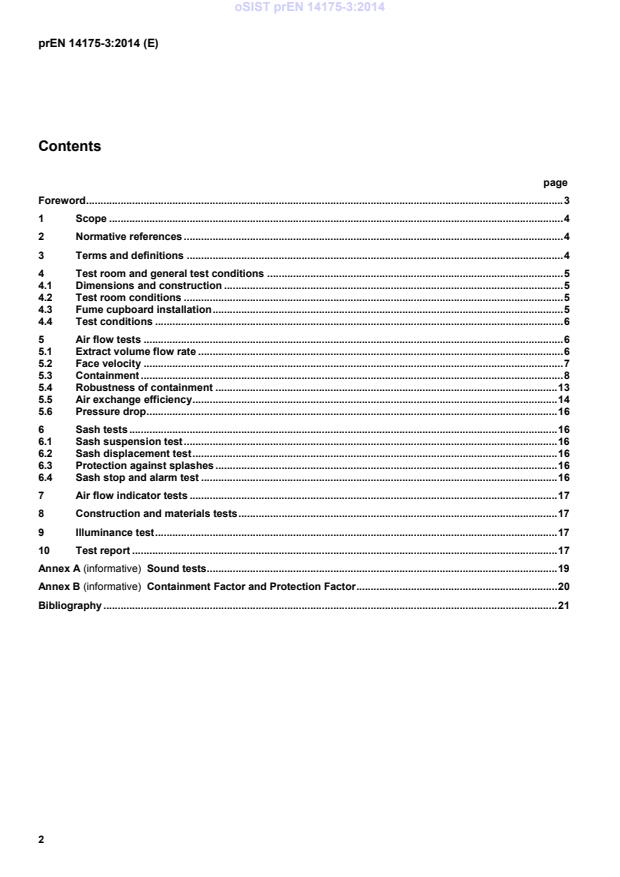
Contents
page
Foreword . 3
1 Scope . 4
2 Normative references . 4
3 Terms and definitions . 4
4 Test room and general test conditions . 5
4.1 Dimensions and construction . 5
4.2 Test room conditions . 5
4.3 Fume cupboard installation . 5
4.4 Test conditions . 6
5 Air flow tests . 6
5.1 Extract volume flow rate . 6
5.2 Face velocity . 7
5.3 Containment . 8
5.4 Robustness of containment . 13
5.5 Air exchange efficiency . 14
5.6 Pressure drop . 16
6 Sash tests . 16
6.1 Sash suspension test . 16
6.2 Sash displacement test . 16
6.3 Protection against splashes . 16
6.4 Sash stop and alarm test . 16
7 Air flow indicator tests . 17
8 Construction and materials tests . 17
9 Illuminance test . 17
10 Test report . 17
Annex A (informative) Sound tests . 19
Annex B (informative) Containment Factor and Protection Factor . 20
Bibliography . 21
prEN 14175-3:2014 (E)
Foreword
This document (prEN 14175-3:2014) has been prepared by Technical Committee CEN/TC 332 “Laboratory
Equipment”, the secretariat of which is held by DIN.
This document is currently submitted to the CEN Enquiry.
This document will supersede EN 14175-3:2003.
EN 14175 consists of the following parts, under the general title Fume cupboards:
Part 1: Vocabulary
Part 2: Safety and performance requirements
Part 3: Type test methods
Part 4: On-site test methods
Part 6: Variable air volume fume cupboards
Part 7: Fume cupboards for high heat and acidic load
Part 5 ("Recommendations for installation and maintenance") has been published as Technical Specification
CEN/TS 14175-5.
Start of application
The start of application of this standard is [Date of publication]
EN 14175-3:2003-12 may be used in parallel until [Date of publication] + 12 months
prEN 14175-3:2014 (E)
1 Scope
This part of the European Standard EN 14175 specifies type test methods for the assessment of safety and
performance of fume cupboards. Relevant requirements are specified in Part 2 of this European Standard.
For terms and their definitions EN 14175-1 applies. For safety and performance requirements of fume cupboards
EN 14175-2 applies. For on-site test methods of fume cupboards EN 14175-4 applies. For the type testing and on-
site testing of variable air volume (VAV) fume cupboards, EN 14175-6 applies in addition to this standard.
For the testing of microbiological safety cabinets EN 12469 applies.
2 Normative references
The following documents, in whole or in part, are normatively referenced in this document and are indispensable for
its application. For dated references, only the edition cited applies. For undated references, the latest edition of the
referenced document (including any amendments) applies.
EN 12665, Light and lighting — Basic terms and criteria for specifying lighting requirements
EN 13150:2001, Workbenches for laboratories — Dimensions, safety requirements and test methods
EN 14175-1:2003, Fume cupboards — Part 1: Vocabulary
EN 14175-2:2003, Fume cupboards — Part 2: Safety and performance requirements
EN ISO 5167-1, Measurement of fluid flow by means of pressure differential devices inserted in circular cross-
section conduits running full — Part 1: General principles and requirements (ISO 5167-1:2003)
EN ISO 12569, Thermal performance of buildings and materials — Determination of specific airflow rate in
buildings — Tracer gas dilution method (ISO 12569:2012)
3 Terms and definitions
For the purposes of this European Standard, the definitions given in EN 14175-1:2003 and the following apply.
3.1
plane of sash
plane in the middle between the innermost and the outermost screen surfaces of that part of the sash forming the
upper boundary of the test sash opening.
Note to entry This definition replaces the definition given in EN 14175-1:2003, 5.4.
3.2
inner measurement plane
plane of sash at the type test opening, except where the plane of sash does not meet the work surface of the fume
cupboard. In the latter case, it is usually a non-vertical plane bounded;
at the top by the lowest point of the upper edge of the type test opening in the plane of the sash;
at the bottom by the uppermost point of the lower edge of the opening closest to the plane of sash;
at the sides by the side edges of the opening.
Note 1 to entry See examples in Figures 1 and 2.
Note 2 to entry This definition replaces the definition given in EN 14175-1:2003, 7.7.
prEN 14175-3:2014 (E)
3.3
containment factor (C )
F
ratio of the calculated volume concentration of tracer gas in the workspace of the fume cupboard to the measured
concentration in the inner or outer measurement plane.
Note to entry The containment factor is not a constant value but depends on the extract volume flow rate and the measured
concentration of tracer gas.
3.4
protection factor (P )
F
ratio of the volume flow rate of the tracer gas to the measured volume flow rate of the tracer gas in the tidal
breathing flow
3.5
tidal breathing flow
volume flow rate of air moved into (or out of) human lungs during breathing
Note to entry For healthy adults, it is in the range of 6 l/min to 10 l/min. For the purposes of this standard, 10 l/min is used.
4 Test room and general test conditions
4.1 Dimensions and construction
The test room shall consist of an enclosure of cuboid shape, constructed of suitable materials, within a building or
laboratory. The internal width and length shall be not less than 4,0 m and the ceiling height not less than 2,7 m.
The ceiling and floor shall be level and the room shall be devoid of internal supports, internal walls or other
obstacles to the airflow.
4.2 Test room conditions
The room air temperature shall be (23 ± 3) °C. The make-up air temperature during measurements shall be room
air temperature ± 1 °C. Temperature gradients shall be avoided as far as possible. The make-up air shall be
supplied at a distance greater than 2 m from the front of the fume cupboard.
The test zone boundary shall extend approx. 1,5 m in front of the fume cupboard and approx. 1,0 m from the outer
sidewalls of the cupboard over the full room height.
Room extract air shall be extracted symmetrically on the opposite side to the make-up air supply and from outside
the test zone. The air speed shall be less than 0,1 m/s at the test zone boundaries. Care shall be taken regarding
uncontrolled air streams and draughts entering into the test room.
Any device the temperature of which exceeds 40 °C, except components which form part of the fume cupboard
and/or the test equipment, shall be located outside the test zone boundaries.
The air extracted from the test room shall be discharged to atmosphere in such a way as to prevent its re-
entrainment in the make-up air.
4.3 Fume cupboard installation
The fume cupboard shall be installed centrally on a wall with its opening facing away from the wall.
The test shall be carried out on the fume cupboard installed in the test room in accordance with the manufacturer's
installation instructions.
prEN 14175-3:2014 (E)
4.4 Test conditions
4.4.1 General
No person other than the operator(s) shall be present in the test room during the measurements. No person shall
remain in the test zone during the measurements.
There shall be no unnecessary obstructions or equipment within the test zone. No equipment other than that
necessary for the tests shall be in the fume cupboard.
Windows and doors of the test room shall remain closed during measurements.
NOTE Observance of all test conditions is crucial for reproducibility and comparability of the test results.
4.4.2 Test sash positions
4.4.2.1 Vertical sash fume cupboards
The sash shall be set to the height of 500 mm ± 1 % measured in the centre of the opening. If the maximum height
is less than 500 mm, the maximum operational sash opening shall be used and noted. If any additional opening is
used, this shall be noted in the test report.
For the testing of walk-in fume cupboards, the upper sash opening shall be used as the test sash position. The
lower edge of the sash opening should be at least 900 mm above floor level. If the physical configuration of the
walk-in fume cupboard does not allow this positioning of the sash, the height of the lower edge shall be noted in the
test report.
4.4.2.2 Horizontal sash fume cupboards
Sash(es) shall be set at one side opening of 500 mm ± 1 %. If the maximum sash opening is less than 500 mm,
then the maximum opening shall be used and noted. The test shall be carried out with the first side opening and
shall be repeated with the opening at the other side. If any additional opening is used, e.g. openings at both sides
of the sash, this shall be noted in the test report.
4.4.2.3 Combination sash(es)
Vertical sash test: all horizontal sash(es) shall be set to the minimum sash opening and the procedure as in 4.4.2.1
shall be followed.
Horizontal sash test: vertical sash(es) shall be set to the minimum sash opening and the procedure as in 4.4.2.2
shall be followed.
If any additional opening is used, this shall be noted in the test report.
4.4.3 General procedure
The type testing procedures shall be applied to one example of a production model of the fume cupboard to be
tested.
Adjust the make-up air and extract air systems to give the required flow rates and test conditions. Switch on all
instruments and data recording (storing) device(s), and allow sufficient time for the instruments to stabilize.
5 Air flow tests
5.1 Extract volume flow rate
For each extract volume flow rate setting, the flow rate shall be measured in the extract duct in accordance with EN
ISO 5167-1. The uncertainty of measurement shall not exceed ± 5 %.
prEN 14175-3:2014 (E)
5.2 Face velocity
5.2.1 Test equipment
5.2.1.1 Anemometer
The anemometer shall be of the unidirectional type with a directional sensitivity of ± 20°. The time constant of the
anemometer shall be less than 0,5 s. The uncertainty of an individual measurement shall not exceed 0,02 m/s + 5
% of the reading in the range of 0,2 m/s to 1,0 m/s. An anemometer with a valid calibration certificate shall be used.
5.2.1.2 Data recording
A means of recording the output of the anemometer for subsequent analysis shall be provided.
5.2.2 Probe positions
The anemometer probe shall be positioned at points formed by the intersection of lines on the inner measurement
plane (see examples in Figure 1) as follows:
a) a series of at least three equally spaced lines between the side boundaries of the inner measurement plane
with the two outermost lines (100 ± 5) mm from the side boundaries. The lines in between shall be at a
distance of 400 mm or less from the outermost lines and to each other.
b) a series of at least three equally spaced lines between the horizontal boundaries of the inner measurement
plane with the two outermost lines (100 ± 5) mm from the horizontal boundaries. The lines in between shall be
at a distance of 400 mm or less from the outermost lines and to each other.
5.2.3 Test procedure
Measurements shall be made with the anemometer probe located at each of the measurement grid points. Adjust
the orientation of the sensor so that its measurement direction is perpendicular to the inner measurement plane.
Disturbances to the space upstream of the sensor shall be minimized.
Measure and record the individual velocity component v perpendicular to the inner measurement plane at regular
i
intervals of 1,0 s or less for a period of at least 60 s.
5.2.4 Data analysis and results
Calculate at each measurement point by equation (1) the mean value of the measured velocity components in
v v
i
meter per seconds and round the result to the second decimal place:
n
v= v (1)
∑ i
n
i=1
where n is the number of measurements taken during the period of min. 60 s.
Calculate at each measurement point by equation (2) the standard deviation s of the measured velocity
r
components v in meter per seconds and round the result to the second decimal place:
i
n
(v −v)
∑ i
i=1
s = (2)
r
n−1
Calculate the spatial average velocity (see EN 14175-1:2003, 7.6) in meters per seconds at the type test opening
and round the result to the second decimal place.
prEN 14175-3:2014 (E)
5.3 Containment
5.3.1 Test equipment
5.3.1.1 General
The following test equipment shall be used. Other equipment and/or test gas may also be used provided that it is
proven to give the same results within ± 10 %. Materials of construction should not affect the test results. All
instruments shall have a valid certificate of calibration.
5.3.1.2 Tracer gas
The tracer gas shall be sulphur hexafluoride (SF ).
5.3.1.3 Test gas
The test gas shall be (10 ± 1) % volume fraction of sulphur hexafluoride (SF ) in nitrogen (N ). The storage
6 2
temperature of the test gas shall be at the test room temperature ± 2 °C.
5.3.1.4 Test gas flow regulator
The test gas flow regulator shall be capable of regulating the flow rate with a maximum permissible error of ± 5 %.
5.3.1.5 Test gas injector
The test gas injector shall be a hollow cylinder made of sintered metal with a length between 20 mm and 25 mm
and a diameter between 10 mm and 15 mm. The pressure drop through each test gas injector shall be within 10 %
of their mean value. Test gas injectors shall be connected to the test gas source by flexible tubes of equal length.
5.3.1.6 Sampling probe
Each sampling probe shall consist of a tube of internal diameter (10 ± 1) mm and a length of at least 100 mm. The
tube's wall thickness shall not exceed 2 mm.
5.3.1.7 Sampling manifold
The sampling manifold shall be a hollow cylinder. The sampling probe connecting tubes shall be evenly distributed
around the perimeter of the cylinder with the manifold outlet in the centre.
5.3.1.8 Connecting tubing
The sampling probes shall be connected to the sampling manifold by flexible tubes of equal lengths.
5.3.1.9 Sampling pump
The sampling pump shall be capable of operating at a flow rate constant within ± 5 %.
5.3.1.10 Gas analyser
-8
The gas analyser including the connected means of recording shall have a detection level of 10 or less volume
fraction of the tracer gas.
5.3.1.11 Time constant of the test system
The time constant of the sampling system including gas analyser shall be less than 15 s.
prEN 14175-3:2014 (E)
5.3.1.12 Data recording
A means of recording the output signal of the gas analyser for subsequent analysis shall be provided. The
recording interval shall be 2 s or less.
5.3.2 Test conditions
-8
The background concentration of tracer gas in the test room shall not exceed 10 volume fraction.
5.3.3 Positioning of test equipment for inner measurement plane
Nine sampling probes (see 5.3.1.6) shall be arranged in a grid formed by the intersection of lines as follows:
a) three equally spaced lines in the vertical direction. The space between the lines shall be (100 + 5) mm.
b) three equally spaced lines in the horizontal direction. The space between the lines shall be (100 + 5) mm.
The test gas injector (see 5.3.1.5) shall be arranged with its centre in line and (150 + 5) mm from the centre of the
sampling probe grid.
The sampling probe grid shall be positioned together with the injector so that the sampling probes are on the inner
measurement plane and the injector is in the workspace of the fume cupboard on a plane (150 + 5) mm from the
inner measurement plane.
Figure 1 and Figure 2 show examples of the p
...